As the Operation Epic Fury joint U.S.-Israeli attack on Iran moves into its 12th day, Tehran is intensifying its campaign against shipping in and around the Strait of Hormuz. At least three commercial ships were struck today, according to a British monitoring organization.
Each were hit in separate incidents by an “unknown projectile,” according to the United Kingdom Maritime Trade Operations (UKMTO), a monitoring agency that is part of the U.K. Royal Navy. One was a cargo ship traveling north of Oman. Another was a bulk carrier hit north of Dubai. The third was a container vessel struck near Ras al-Khaimah in the United Arab Emirates, The Washington Post noted.
Since Epic Fury was launched on Feb. 28, UKMTO “has received 17 reports of incidents affecting vessels operating in and around the Arabian Gulf, Strait of Hormuz (SOH) and Gulf of Oman,” the organization stated. That figure includes 13 attacks and four suspicious incident reports.
Iran said it is increasing these attacks to serve as an economic weapon against the U.S., Israel and allies.
The U.S. “will not be able to control oil prices,” the spokesperson for Tehran’s Khatam al-Anbiya military command headquarters vowed on Wednesday.
“We won’t allow even one liter of oil to reach the U.S., Zionists and their partners,” Ebrahim Zolfaqari proclaimed. “Any vessel or tanker bound to them will be a legitimate target.”
“Get ready for the oil barrel to be at $200 because the oil price depends on the regional security which you have destabilized,” Zolfaqari added.
As one example of market volatility, Brent Crude was trading at just over $90 a barrel as of Wednesday morning Eastern Day Light time, according to OilPrice.com. The prices have fluctuated wildly, surging to a recent high of more than $116 a barrel on March 8 and dropping to a little more than $84 a barrel yesterday.
Even as it cuts off the Strait for others, Iran is “exporting more oil through the Strait of Hormuz than before the war, showing it is in control of a strategic waterway that it has closed off to the rest of the region’s oil producers,” The Wall Street Journal reported.
The world’s biggest liquefied natural gas (LNG) export plant in Qatar hasn’t exported a shipment for five days, Bloomberg News reported. It marks the longest streak in data going back to 2008.
“A loaded tanker hasn’t left the Ras Laffan facility in five days,” according to a Bloomberg analysis of Kpler ship-tracking data. “No LNG ship traversed the Strait of Hormuz after Feb. 28, when the US and Israel began strikes on Iran.”
The unprecedented closure of the liquefaction plant, which supplies nearly 20% of the world’s LNG, came after an Iranian drone attack early last week — resulting in a jump in gas prices in Europe and Asia, the news organization noted. Ras Laffan did load a handful of shipments after stopping output, likely using fuel from storage tanks, the last of which was on Friday.
Two pipelines were built – one in Saudi Arabia, the other in UAE – just to bypass the Strait of Hormuz. This conflict, The Wall Street Journal posited, has highlighted their importance since they are the only ways to get a significant amount of oil out of the Persian Gulf and into world markets.
Iran’s closure of the Strait to most foreign shipping has thrown the world energy market into chaos, causing oil and gas prices to fluctuate dramatically.
“Japan, Germany and Austria will release oil from their strategic reserves in response to disruptions in the supply from the Middle East, officials in those countries said on Wednesday,” according to the Post. “They made the announcements hours before a meeting of leaders of the Group of 7 industrialized nations, including the United States, to discuss jointly releasing oil in consultation with the International Energy Agency.”
The International Energy Agency (IEA) on Wednesday agreed to release 400 million barrels of oil to address the supply disruption triggered by the Iran war, the largest such action in the organization’s history, CNBC reported.
“The IEA did not set out a timeline for when the stocks would hit the market,” the news outlet noted. “It said that the reserves would be released over a timeframe that is appropriate to the circumstances of each of its 32 member countries.”
The U.S., meanwhile, has yet to tap into its Strategic Petroleum Reserve, a network of salt caverns in Texas and Louisiana that can hold up to 714 million barrels of crude.
Iran is not preventing all ships from passing through the Strait. Tehran has agreed to provide Bangladeshi oil vessels with safe passage. The move comes as the Bangladesh government has intensified efforts to maintain a stable fuel supply through multiple strategic measures amid escalating conflict in the Middle East.
Bangladesh has sought assurances from Iran for the safe passage of its oil and liquefied natural gas (LNG)-carrying vessels through the Strait of Hormuz as escalating conflict in the Middle East threatens one of the world’s most critical energy shipping routes.
Some vessels are also using their AIS system to identify as Chinese owned, shipping expert Sal Mercogliano noted. Iran’s closure of the Strait does not pertain to Chinese-owned ships.
The New York Times claimed that Iran’s ongoing attacks on shipping, as well as its continuing missile and drone barrages are an example of how the Trump administration miscalculated Iran’s response to Epic Fury.
The Trump administration has said it will send U.S. Navy warships to escort commercial vessels through the Strait, but that plan has yet to be implemented. Such a deployment would put American warships at far greater risk than they are facing now at standoff distances from Iran. It remains unclear how much longer Epic Fury will continue. The longer it does, however, the more Iran can bring economic pain around the globe with even just threats against Strait shipping. The Iranian attacks have led to Trump proposing that the U.S. provide political risk insurance for seaborne trade in the Gulf. “However, Lloyd’s of London, the heart of maritime insurance globally, emphasizes it has not stopped providing contracts to those who ask – although at the right tariff,” The Guardian reported.
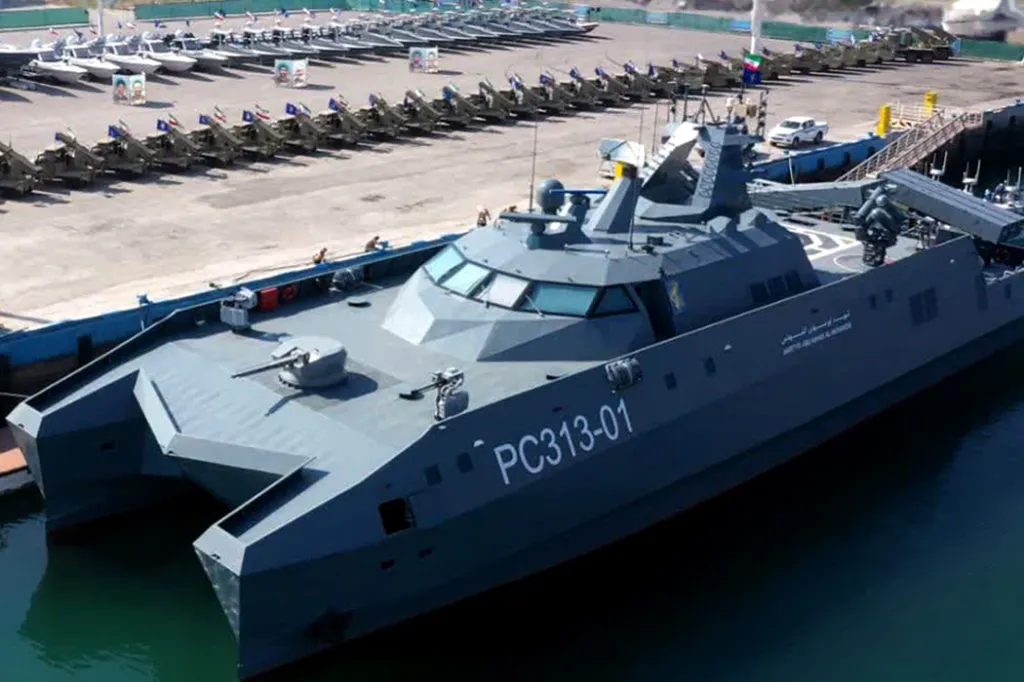
Though no escorts have been set up, the U.S. is continuing to strike Iran’s Navy, including the sinking of the last of Iran’s Soleimani class catamaran warships, the head of U.S. Central Command said in a video statement on Wednesday morning.
“To date, we have struck more than 5,500 targets inside Iran, including more than 60 ships using a variety of precision weapon systems,” Adm. Brad Cooper said in a video. “Just yesterday, we had strike waves nearly every hour from different locations and directions going into Iran. We also took out the last of four Soleimani class warships. That’s an entire class of Iranian ships now out of the fight.”
Cooper did not name which of the catamarans was hit, but the video shows one from the Soleimani class and one from a smaller class. The hull number on the smaller ship – PC313-01 – indicates it was the IRIS Abu Mahdi al-Muhandis. The ship was unveiled in a ceremony at Bandar Abbas in January 2024, the Iranian Press TV news outlet reported at the time.

U.S. Army Sgt. First Class Cory Hicks told ABC News about the Iranian drone attack on a command center in Kuwait that killed six soldiers on March 1.
The deadly attack was more severe than previously known, with dozens of troops suffering injuries that included brain trauma, burns and severe injuries from shrapnel, according to CBS News.
Iran’s new supreme leader, Mojtaba Khamenei, is “safe and sound” despite war injuries, Yousef Pezeshkian, a government adviser and the son of Iran’s president, claimed on Wednesday.
“I heard news that Mr Mojtaba Khamenei had been injured. I have asked some friends who had connections,” Pezeshkian stated on Telegram. “They told me that, thank God, he is safe and sound.”
State television had called Khamenei, 56, a “wounded veteran of the Ramadan war” but never specified his injury.
Iran’s Islamic Revolutionary Guard Corps (IRGC) has threatened to attack “economic centers and banks” related to United States and Israeli entities in the region after what it called an attack on an Iranian bank, Al Jazeera reported.
A spokesperson for the Khatam al-Anbiya Headquarters, a group described as IRGC-owned by the United Nations, said on Wednesday that “the enemy left our hands open to targeting economic centres and banks belonging to the United States and the Zionist regime in the region.”
The warning came after a reported attack on a Bank Sepah branch north of Iran, which is said to have killed many putting in extra hours ahead of the Persian New Year.
Iranian officials claimed to have hit several other U.S. targets in the region on Wednesday.
IDF Chief of the General Staff, Lt. Gen. Eyal Zamir claimed that “many thousands” of Iranian soldiers and commanders have been killed so far in this war.
The IDF released new video showing airstrikes on what it claims were Iranian troops preparing to launch drones.
The IDF completed another wave of strikes in Dahiyeh in Beirut against what it claims were Hezbollah command centers and weapons storage sites. IDF said it issued a warning to residents before the attacks and also struck a Hezbollah command post in the coastal area of Tyre.
The IDF justified the strike by claiming the Lebanon-based Iranian proxy is hiding missiles, drones and other weapons in the heart of the Dahieh neighborhood in Beirut.
The owner of this white pickup may be the luckiest person in the Middle East. Video emerged on social media showing Lebanese Army troops removing an unexploded bomb from the vehicle’s cargo bed.
Faced with growing threats from Hezbollah, Zamir ordered the Golani Brigade to be transferred from the Southern Command to operations in the Northern Command sector.
Zamir added that a decision will be made regarding additional reinforcements.
In a post on X, the UAE Defense Ministry (MoD) said its air defenses “are currently dealing with missile attacks and incoming drones originating from Iran, and the Ministry of Defense confirms that the sounds heard in scattered areas of the country are the result of the air defense systems intercepting ballistic missiles, as well as fighter jets intercepting drones and loitering munitions.”
Reuters posted a photograph on X of a building in Manama, Bahrain, reportedly damaged by an Iranian drone strike.
With Bahrain also being battered by Iranian attacks, Gulf Air has relocated its fleet of aircraft from there to Saudi Arabia, according to Al Jazeera.
Iranian Armed Forces spokesperson Brig.-Gen. Abolfazl Shekarchi “called on regional Muslims and countries to reveal the locations of U.S. and Israeli military assets to enable Tehran to conduct more accurate attacks,” the Jerusalem Post reported, citing official Iranian media.
Shekarchi also framed the request as a way to ensure the safety of the people in the region.
“I call on the Muslim people of the region and the countries of the region to show us the hideouts of US and Zionist forces so that they themselves will not be harmed, and so that we can strike them more precisely,” Shekarchi proclaimed.
In the wake of the joint U.S.-Israeli attack, The New York Times “has identified at least 17 damaged U.S. sites and other installations, several of which have been struck more than once since the war began,” the publication reported. “Our analysis is based on high-resolution, commercial satellite imagery, verified social media videos and statements by U.S. officials and Iranian state media.”
U.S. Air Force maintainers can be seen in the X post below loading weapons onto B-1B Lancer bombers, which have arrived at Fairford Air Base in the U.K.
Romanian President Nicusor Dan said that U.S. refueling planes, monitoring equipment and satellite communications systems can use his country’s military bases.
Turkey has reportedly deployed an ASELSAN’s ŞAHİN 40mm anti-drone system to Northern Cyprus, where it is now operational to defend against low-flying mini and micro UAVs using airburst smart grenades.
Ukrainian President Volodymyr Zelensky claims that Russia may send troops to Iran. That would be in addition to the support Moscow is already providing in the form of drones and air defenses, Zelensky said. He added that Russia will likely send missiles in the not-far-off future.
Ukraine, which has long sought interceptors to help fend off waves of Russian missile and drone attacks, took to social media to note the discrepancy in how much it has been supplied over the course of four years versus how much the U.S. and allies have used during 11 days of Epic Fury.
Add Italian Prime Minister Giorgia Meloni to the list of world leaders proclaiming that an Ayatollah-led regime in Iran should never obtain nuclear weapons.
UPDATES:
We have concluded our rolling coverage in this piece.
UPDATE: 5:11 PM EST –
Video has emerged showing a reported attack on an oil tanker near Iraq. Information at this point is scarce. The Ambrey martime security firm said it is investigating the matter.
The U.S. used as much as $4 billion worth of munitions in the first 72 hours of its attacks against Iran, including about 400 cruise missiles and 800 air defense interceptors, Bloomberg News reported, citing estimates from German defense giant Rheinmetall AG.
“The numbers, released in the company’s earnings presentation on Wednesday, were drawn from ‘publicly available sources and in-house assumptions,’ the slides said,” according to the news outlet. “Other reports have put the munitions cost for the first two days of the conflict higher, at as much as $5.6 billion.”
Trump said that he picked the name Epic Fury from a list of about 20 and that the U.S. has already won.
“You know, you can only do it if you win — and we’ve won,” the American leader proclaimed. “Let me say: we’ve won. You never like to say it too early, but we won the bet in the first hour. It was over.”
Israel’s Iron Dome air defense system “could not stop about half the 100 rockets Hezbollah launched at Israel just a few hours ago,” New York Post reporter Caitlin Doornbos posted on X.
The leaders of the G7 group of nations – the United States, Canada, Japan, Italy, Britain, Germany and France – “agreed to examine the option of providing escort for ships so they can navigate freely in the Gulf,” according to a statement from the G7 Presidency on Wednesday.
Despite threats from the regime to stay home, anti-government protestors are reportedly continuing to take to the streets in Iran demanding change.
The U.K. Defense Ministry (MoD) provided its latest update on Middle East operations.
The UAE MoD said its air defenses “dealt with 6 ballistic missiles, 7 cruise missiles, and 39 drones coming from Iran” today. “Since the start of the brazen Iranian aggression, UAE air defenses have dealt with 268 ballistic missiles, 15 cruise missiles, and 1,514 drones.”
UPDATE: 4:48 PM EST –
The IRGC posted video it claims shows missile launches toward U.S., Israeli and allied military bases housing American forces in the region.
Kuwaiti air defenses are currently confronting hostile missile and drone attacks, the nation’s army announced on X.
“The General Staff of the Army notes that if explosion sounds are heard, they are the result of air defense systems intercepting the hostile attacks,” the announcement added.
UPDATE: 4:18 PM EST –
Three Ukrainian teams of military personnel and engineers have gone to the Middle East to help the U.S. and allies in the fight against Iran, Ukrainian President Volodymyr Zelensky stated on X.
After four years of fending off daily bombardment by Russian missiles and drones, Ukraine has a lot of hardearned expertise to share.
Al Jazeera said a senior Iranian military official claimed that if “Washington commits a strategic mistake, another strait will be in a situation similar to the Strait of Hormuz,” the publication posted on X. “The region may enter a regional war soon, and we still have many cards to play. Any American mistake will complicate the situation in the region, and Iran has phased and graduated military plans.”
Video is emerging on social media claiming to show Tehran under a large drone attack.
Despite what appears to be a coordinated Israel attack on Basij checkpoints in Tehran, the regime is reportedly keeping a tight lid on any potential anti-government protests, journalist Nilo Tabrizy said a source told her.
“The government constantly sends threatening [text] messages to everyone. It says that if you come to the streets to protest, you will be considered an Israeli soldier and will be killed.”
Meanwhile, the Speaker of the Iranian Parliament is urging pro-government crowds to remain on the streets.
“Dear Iranian nation, to whom I would sacrifice my life a thousand times!” MB Ghalibaf stated on X. “Your presence in the streets has bewildered and enraged the enemy. This humble soldier of yours has three requests from you: the streets, the streets, the streets. Your children in the armed forces have taken their lives in hand to defend #Iran; strengthen their backs by holding the streets firm.”
Alarms have again sounded in Bahrain, as the nation braces for another wave of Iranian attacks, officials there claim.
Kuwait National Guard bomb squad engineers have destroyed a drone warhead that fell inside a fuel tank, spokesman Jadaan Al-Fadhel said in a statement on Wednesday, adding that no injuries were reported during the operation.
UPDATE: 3:45 EST –
During a visit to Thermo Fisher Scientific in Cincinnati on Wednesday, Trump said that for Iran, it’s a “war.” But for America, it’s “easier than we thought.”
The U.S. president also claimed that more than two dozen Iranian mine boats have been destroyed during Epic Fury.
“They started talking about mines. So we hit 28 mine ships as of this moment,” Trump proclaimed. “Twenty-eight. Like, using the same weapon — the exact same weapon that we use against the drug dealers in the water. We have — as an example, we had tremendous drugs pouring in through the water — through the sea. And now we have almost none. It’s down 97%.”
Iran deployed about a dozen mines in the Strait of Hormuz, Reuters reported, citing two sources familiar with the matter. The move is likely to complicate reopening the waterway — an important route for shipping oil and liquefied natural gas.
Trump is preparing to invoke Cold War-era powers to pave the way for renewed oil production off the southern California coast, Bloomberg News is reporting. The move is seen as “a long-shot bid to help ease the global crude supply crunch spurred by his war with Iran,” according to the outlet.
“Trump is set to soon summon authorities under the Defense Production Act to preempt state laws and ease permitting for Sable Offshore Corp., a Houston-based company looking to restart significant production from a cluster of offshore platforms in California,” Bloomberg added. “The plan was described by a person familiar with the matter who asked not to be named because it’s not yet public.”
The fire at Oman’s Salahah Port seems to be intensifying. The port was attacked by Iran earlier on Wednesday.
Several security forces and members of Iran’s paramilitary Basij force were killed by Israeli drones in Tehran today, according to the IRGC-affiliated Fars News Agency.
UPDATE: 2:53 PM EST –
Hezbollah fired dozens of rockets from Lebanon and Iran fired several ballistic missiles at the area, according to Israeli media.
The Israeli military later confirmed that it didn’t intercept some of the projectiles, adding that rescue services and emergency teams are “currently operating at the impact sites.”
Video has emerged showing an Iranian Shahed-type long-range strike drone approaching, then hitting the fuel tanks in the Omani port of Salalah earlier on Wednesday. The attack caused a powerful explosion and fireball.
In a post on X, Iranian President Masoud Pezeshkian said he told leaders from Russia and Pakistan that his nation reaffirms its “commitment to peace in the region.”
“The only way to end this war—ignited by the Zionist regime & US—is recognizing Iran’s legitimate rights, payment of reparations, and firm int’l guarantees against future aggression,” he exclaimed.
The Coordination Committee of the Iraqi Resistance issued a warning to Syrian leader, Ahmed Sharaa, threatening that any hostile move toward Lebanon, particularly if coordinated with the U.S. or Israel, would be treated as a declaration of war against the entire Axis of Resistance.
The threat in Iraq remains real as you can see by the following video, which reportedly shows an interceptor hitting an Iranian drone over Erbil.
There is pushback to claims that the U.S. is sending Terminal High Altitude Area Defense (THAAD) systems from Korea for deployment to the Middle East.
UAE reportedly sees an opportunity to reclaim the Abu Musa, Greater and Lesser Tunb islands that Iran seized in 1971.
The Bellingcat investigative team geolocated eight videos showing U.S. Tomahawk launches.
UPDATE: 2:40 PM EST –
Saying most of Iran’s Navy has been destroyed, Trump urged oil companies to start using the Strait of Hormuz again.
Meanwhile, India condemned the Iranian attack on the Thai ship bound for Kandla.
“Iran and the terrorist militias allied with it may be planning to target U.S.-owned oil and energy infrastructure in Iraq,” the U.S. Embassy in Baghdad warned. “Additionally, Iran-aligned terrorist militias have targeted hotels frequented by Americans in various parts of Iraq, including the Kurdistan Region of Iraq. “
The IDF released a video containing what it says was audio of a radio exchange between an Israeli and U.S. pilot.
UPDATE: 2:06 EST –
An ongoing military investigation has determined that the United States is responsible for a deadly Feb. 28 Tomahawk missile strike on an Iranian elementary school, The New York Times reported, citing U.S. officials and others familiar with the preliminary findings.
Iran’s Armed Forces spokesman General Shekarchi warned the U.S. and allies against striking Iranian ports.
“If any threat is made against our ports, all docks and economic ports in the entire region will be our legitimate targets, and we will carry out operations heavier than those we have done so far,” he vowed.
Iran may be using a Chinese satellite navigation system to target Israel and United States military assets in the Middle East, intelligence experts say, according to Al Jazeera.
“Former French foreign intelligence director Alain Juillet told France’s independent Tocsin podcast this week that it is likely that Iran has been provided access to China’s BeiDou satellite navigation system because its targeting has become much more accurate since the 12-Day War with Israel in June,” the outlet reported.
1:55PM EST—
The NYT reports that Pentagon officials told U.S. lawmakers that Iran has as much as 50% of its missiles and launchers remaining.
A Merlin early warning and control helicopter has arrived in Cyprus to provide a critical ‘look down’ capability for spotting incoming drones. You can read about how critical this capability is and how new assets are being sent to the Middle East to help provide it in our story from yesterday linked here.
Contact the author: howard@thewarzone.com