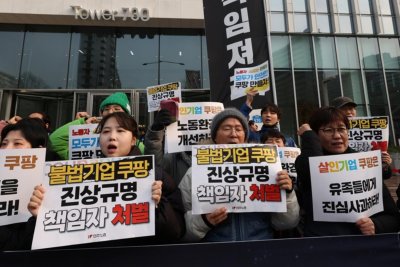
Members of civic and labor groups shout slogans during a rally in front of the headquarters of e-commerce giant Coupang Inc. in Seoul, South Korea, 29 December 2025, to call for the stern punishment of the company’s founder Kim Bom-suk over a massive personal data breach. The rally came a day after Kim issued his first public apology since the incident, which affected nearly two-thirds of South Korea’s population. File. Photo by YONHAP / EPA
Jan. 27 (Asia Today) — A recent wave of government investigations centered on one company recalls the Korean proverb about burning down a thatched house to kill a flea. The question is whether an aggressive push to solve the problem is fully accounting for the costs and fallout created along the way.
A major personal data breach is not something to dismiss. If there was managerial negligence or a structural failure, regulators should identify it and assign clear responsibility. But the pattern of probes now unfolding around Coupang raises a broader concern about whether the administrative response is proportionate and efficient, beyond the stated goal of accountability.
More than 10 government bodies have moved at the same time, including the Fair Trade Commission, the Ministry of Science and ICT, the Personal Information Protection Commission, police, the Financial Supervisory Service, the National Tax Service and customs authorities. Hundreds of investigators have reportedly been assigned, with weeks of on-site inspections. Even the Fair Trade Commission’s probe is said to be taking longer than expected. In effect, a “mini Sejong City” of regulators has been assembled for a single corporate case.
The problem is not the intensity of enforcement but its cost. Administrative resources are finite. Public officials’ time and expertise, along with the fiscal spending that follows large deployments, are costs borne by society. When hundreds of personnel spend weeks on one case, oversight in other areas inevitably slows. That is not merely a burden for one company but a broader issue of how government resources are allocated.
The burden on the private sector is also significant. When executives and operational staff are tied up for long periods responding to multiple probes, core operations suffer. Reports say headquarters functions have been disrupted and field operations affected. If the ripple effects of correcting corporate wrongdoing spread to jobs, suppliers and small businesses, the cost ultimately lands on society.
The issue also risks escalating beyond a domestic dispute. Some foreign investors have reportedly raised complaints with the U.S. Trade Representative about the Korean government’s response and have mentioned the possibility of an investor-state dispute settlement claim. The government says its actions are non-discriminatory but the risk of dampening investor sentiment in global markets cannot be dismissed.
This is not an argument to halt investigations. It is an argument about whether the scope, intensity and scale of resources committed are appropriate. If the core concerns are a data breach and possible fair-trade violations, a more focused, clearly led investigation by the responsible authorities may have been sufficient. Overlapping probes and inter-agency competition can blur accountability and reduce administrative efficiency.
What is needed is not a high-profile crackdown for its own sake but an investigative system that balances fairness with efficiency.
Catching bedbugs is necessary. But to avoid burning down the whole thatched cottage, officials must first decide where to apply pressure and how much. Corporate wrongdoing should be corrected, but the administrative and economic costs consumed in the process also deserve scrutiny.
— Reported by Asia Today; translated by UPI
© Asia Today. Unauthorized reproduction or redistribution prohibited.
Original Korean report: https://www.asiatoday.co.kr/kn/view.php?key=20260127010012533