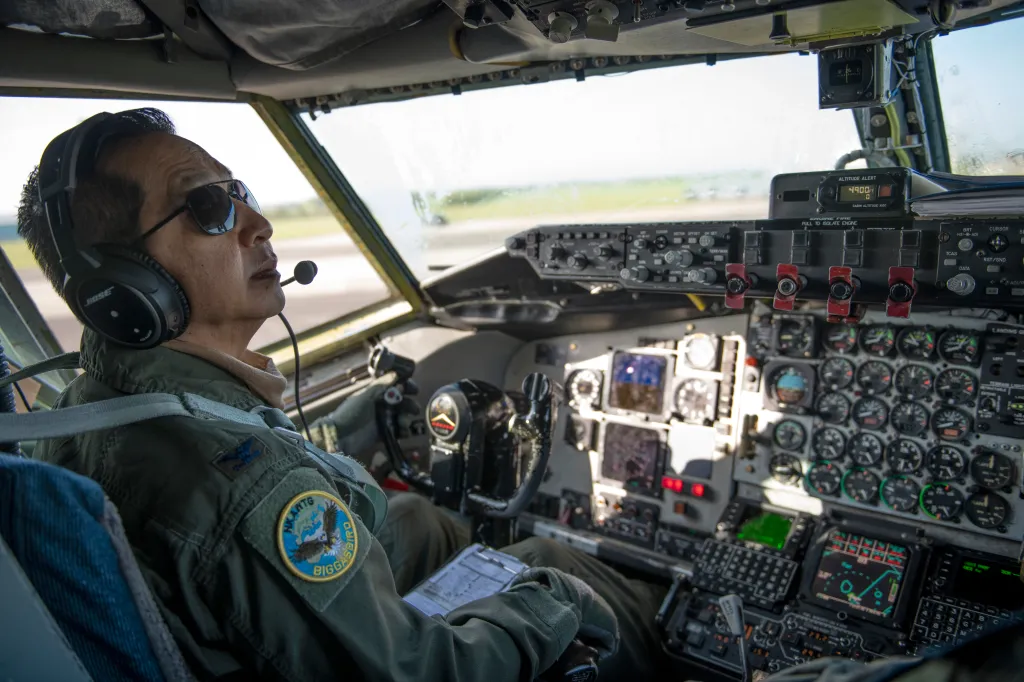
As Epic Fury grinds into a second month, the Air Force continues to rely heavily on its fleet of aerial refueling tankers, the majority of which are over 60 years old, to gas up aircraft attacking Iran and those still pouring into the Middle East. The strain on the force has been exacerbated by the loss of a KC-135 Stratotanker and damage to another after a collision over Iraq and several more tankers being destroyed and damaged on the ground by Iranian long-range weapons. Meanwhile, given this large commitment of aircraft and personnel, there are questions about how the U.S. tanker fleet can respond to a fight in the Pacific should one break out tonight. To get a better sense of that, we spoke to retired Air Force Col. Troy Pananon, who flew tankers and commanded a tanker wing.
In the second installment of our two-hour, wide-ranging exclusive interview – the first centering on Epic Fury’s strain on the force – Pananon offers insights into whether there are enough tankers and crews to sustain combat in two theaters more than 4,000 miles apart, the challenges of flying long distance over contested airspace and what, if any, countermeasures tankers should be given to survive.
Some of the questions and answers have been lightly edited for clarity.

Q: Given the heavy use of aerial refueling for Epic Fury, how concerned are you about the ability to fuel a fight in the Pacific, if one should break out tonight or in the near term?
A: There is a high demand on the tanker community. We retired the KC-10s, so that is a void that can’t be filled as quickly as we would like. But the tanker force is robust, and even though we have a contingency of aircraft in the Middle East region and parts of Europe, we still have tankers that are all over the world, to include the Pacific. Kadena has its own wing of tankers there. And so the ability for our tanker fleet to pivot or to surge and scale to another region – there is not another military out there that can do it – but it puts that demand on the total force.
I think that we could do it, sure, but it would put a significant strain if we were trying to operate in two different parts of the globe, especially if it was involving major combat operations. And not to mention, there’s an element of protecting the homeland as well. Tankers are required to do that too. So you can’t just say, ‘Oh well, we’ll deplete the entire force and focus abroad.’ There’s an element required to support homeland operations as well.

Q: Does the need to do all those missions at once worry you?
A: At my level, when I was at the tactical level or the operational level, I always felt that we were adequately supported. There was certainly a stressor involved with trying to manage all that. But whenever there was a concern, you always would go up to your higher headquarters, and say, ‘Hey, here’s the current situation. We don’t need help now, or we do need help, and this is how you can help.’
It was their ability to resource those needs that really made my job easier and made the jobs of those who worked with me easier, knowing that they had support from above. But it’s not an unlimited resource. It’d be hard for me to say what would be required if we needed to pivot, or if we needed to support two operations in different parts of the world. But I would say that we were certainly capable of doing it.
I just don’t know the duration of that, and unfortunately we always tend to think of these things in short-term snippets. But there are long-lasting impacts to things where high operations tempo means higher strain on the resources, higher strain on the aircraft.
Looking at the long view, if you have to increase your operational tempo on a particular platform versus what you had planned for that, it is going to put a strain on the acquisition process. It’s going to put a strain on the supply system. All these things, they do have an impact, not only in the short, but in the long-view as well.

Q: Considering how long it took to build up forces in the Middle East, how concerned are you about being able to fly long distances to protect Taiwan from attack by China? Can the current fleet sustain a major conflict with China, where fighters will need to fly thousands of miles on each sortie just to get to the effective fighting range?
A: I can’t completely comment on this for various reasons. There are certainly war plans in place. There have been studies that have taken place that are certainly higher classification levels, and we can’t discuss in this session or in public, right? It’s been looked at. I would say that there are plans in place that would prove that we could support operations in the Pacific region.
Is it complex? Yes. Does it require certain things to be successful? Yes, There are certain dominoes that need to fall into place in support of an operation like that.

Q: But from a tanker pilot and wing commander perspective, what are the challenges of flying over these long distances through a very robust Chinese anti-aircraft, area denial environment?
A: I like to use the term, it’s a young man’s or woman’s game. It’s fatigue that is the enemy here, because when you have to operate at these distances and for the duration that is involved, it is certainly a physical stressor. Often, we’re operating in multiple time zones, and we’re not probably getting adequate rest, and that’s a cumulative effect, as you are asked to operate for these long durations.
I’ve been on a cruise where we operated for 24 hours straight, and to do that over a sustained length of time – I don’t know that you can do it. In order to do that, it means you need more personnel. And so where an operation might be successful with – and I’ll just use easy numbers here – with 100 personnel that don’t have to range like you would in the Pacific or in Europe or even in the Middle East, depending on basing. Well, you’re probably going to need maybe twice as many to operate in the Pacific, because of the human element. You don’t want personnel to be fatigued to the point where they are not operating in a safe manner, and so you need to give them the appropriate rest.
It goes all the way down the line, from air traffic control to ground personnel to maintenance to logistics. You need more personnel to support that effort at the distances and the range that you’re talking about. And the Pacific is a challenge, and it would require more personnel to just operate the aircraft, let alone the logistics tail required to support those aircraft. It is a significant challenge. And I’ve certainly endured operations where you bring in multiple energy drinks or keep the coffee brewing for long periods of time.

Q: What about the addition of robust Chinese air defenses into that equation? How much additional concern does that raise?
A: Tanker aircraft are not inherently survivable from enemy aircraft or missiles. There are upgrades or updates that could help in certain ways. The [AN/AAQ-24(V)N Large Aircraft Infrared Countermeasure] LAIRCM is one of those technologies that would certainly help some of those aircraft. But, again, that means that we’ve got to stay out of harm’s way. Typically, we’ve got to set our tanker orbits up further away from the enemy’s reach and their engagement zone.
It is a team effort, right. The role of our strike aircraft and joint partners to eliminate that threat is probably more important than our ability to add protection to these aircraft. I think they go hand in hand. It would be nice for tankers to have protective measures in place to make sure that they are survivable if we need them to operate in a contested environment, but in their current state, I would be definitely worried about pushing tankers closer to that engagement zone, because they don’t have the survivability or protections that maybe even aircraft like the F-22 or F-35 might have.
We don’t have chaff or flares. We don’t have other measures that would protect our fleet, and so I think it’s the role of the warfighting commander to protect those assets and to ensure that they’re operating in a safe zone. And if they’re moved closer to that Weapon Engagement Zone, then they have the ability to retrograde or the connectivity and communication ability to ensure that those tankers can move back or retrograde away from the threat. There are some technology solutions out there, but I don’t know if that’s the sole solution. It is a comprehensive solution that is required to kind of go after that challenge.

Q: How difficult is to get, say, an F-35 into effective combat range and to fuel them up outside of the Chinese Weapons Engagement Zone?
A: It’s layers, right? In order for those aircraft to move into those high threat areas, it will probably require preparation of that environment. I think there are other elements of our military that would go to great lengths to create lanes or passageways to allow those aircraft to move closer to wherever they’re trying to get to their objective.
The preparation of the environment that’s required probably is not the F-35 – the shorter range aircraft. There are other elements that would be used to prepare certain areas to allow our aircraft to move closer. There are other aircraft that would probably be capable of penetrating those air defenses and eliminating some of those threats.
Q: Which aircraft?
A: You have highly capable B-2A Spirit bombers and maybe in the future, B-21 Raider aircraft. There’s other non-manned platforms that I would assume could be used to help eliminate some of the threat, but not all of it.
The Chinese have a very, very robust air defense environment and system of systems in place. But I think that we as a military certainly have capabilities that could give us moments of opportunity. And I think once we find an opportunity, our trained airmen and joint force can leverage that. I don’t think that we want to go toe-to-toe right now. I don’t think we ever want to go toe-to-toe with an adversary like China. I hope that we don’t have to do that, but I know that our joint force is preparing for that if it ever happens.

Q: What about giving tankers self defenses? We have heard about everything from just better situational awareness to providing electronic warfare pods to having their own collaborative combat aircraft (CCAs) to putting mini-interceptors under their wings capable of taking down incoming threats. What is the best avenue for making the current tankers we have more survivable?
A: Prevention is the best cure here. Not putting them in harm’s way would be the best way for them to survive. But I think it would be certainly comforting to know that they have onboard systems or bolt-on systems that would help them at least have a chance against some of these threats. There are certainly a lot of opportunities out there. I’ve heard of efforts where you would outfit certain aircraft with certain defensive measures.
If you got into a situation and we needed to do it, I think the KC-46 Pegasus is a great platform to utilize for this, because it has so much advanced avionics architecture already on board. Trying to do it on the KC-135? That is because you’re trying to answer a scale problem. We don’t have enough KC-46s and we need more. And I know that they’re trying to procure more and and they’re coming, but they’re not to the scale that we have with the KC-135. And so the problem with trying to work with that is that now we’ve got an older airframe, and we’re trying to bolt on new technology that may or may not be compatible, and so we’re gonna have to upgrade other elements on board the aircraft, just to make sure that it can work.
We have an old aircraft. We have some things that have been updated, like the avionics have been updated. But is it the same technological advancement as what is going to be required to bolt on to protect that particular aircraft? Well, no, because it probably – from a data infrastructure set – is not going to operate at the same speed. It’s not going to operate in a similar fashion. There’s some latency that gets introduced if you’re trying to onboard new technology with older technology.

Q: What about adding electronic warfare pods, CCAs or mini interceptors?
A: I think nothing is off the table. I think those are fantastic ideas, and I know that there are people that have probably experimented or modeled to and then probably proven that it’s a successful option. But you have to resource it. We have a lot of mouths to feed here – it’s not a limitless pot, and there’s the research and development and then product production of that.
It doesn’t happen overnight and with every new technology that is offered to the warfighter, it is a challenge to make sure that all the personnel are trained and learn how to leverage these resources, not just individually, but collectively, as a team, as an organization, to really harness that and make sure that anything that’s introduced is successful.
You can’t just say, ‘Oh, well, look, I got this bright, shiny object. I’m just going to bolt it onto this aircraft, and everything is going to be working beautifully.’ No, there’s a whole host of problems that creates because you don’t have personnel that are all collectively trained, that have all operated with it, that have all that is integrated with it, that ensures that when you add this to that platform, that it is operating the way it was designed or intended to be operated. You can’t just snap your fingers and think that it’s gonna work right away.

Q: As a flight commander, would you like to have been able to have air-to-air interceptors under the wings of your tanker?
A: The one thing about airmen, and I would say Air Force in general, is that we tend to like new technologies. We’re not afraid of technology in general. We embrace it. The people that we attract into our service are people that embrace technology, that are innovative themselves. So, yeah, sure if I could roll back time, and that technology was introduced to me, I’d be first in awe. And two, I’d say, ‘Okay, well, how can we make this work? How can I integrate? How can I be able to leverage that and exceed expectations, and ensure that we meet the potential for that new technology?’

Q: There’s been a great deal of discussion about the importance of improving communications connectivity on the tanker fleet. We’ve already talked a little about it. Why is connectivity an issue? And what’s your advice to improve it?
A: Connectivity provides us situational awareness, and that situational awareness improves our ability to operate. It’s a team effort, and in order to do things collectively as a team, we have to be connected. And then the challenge is deciding, well, how should we connect? What sole-source platform should we be all collectively using because it does us no good to be connected as an Air Force, but not be able to talk to a Marine Corps or Navy, or Army or a coalition partner.
And so the challenge is not only do we need to find the right technological solution, we have to ensure that it is able to integrate and communicate harmoniously with all our other partners, because it is not just an Air Force by itself, game. It is a joint force coalition game in terms of what we’re doing right now and what we’ll do in the future.
I know that it’s a huge discussion about, okay, what platform do we use? How do we get it to our airmen right away? How do we make sure that it can integrate with the joint force? And then, ok, now we’ve got the solution. Where’s the money, right? There are so many elements to ensure that we can do this at scale and at speed. I trust that our leadership has been advocating with Congress and with other elements of the administration to get this in place. I don’t know how long it’ll take, but it certainly will help from a situational awareness perspective.

Q: Is there any particular system that you think would help improve situational awareness?
A: I think there are some age-old systems that have been in place. Link 16 architecture comes to mind. There are probably other modern solutions out there, but I don’t want to say that ‘this is the right system,’ because I’m not in the position to really argue for that. There are some systems out there that help, that are already in place, that would help us immensely, if we were to have that particular system across all platforms, right where the AOC [air operations center] can talk directly to the tanker element, who is also receiving data from other elements in the air, whether it be fighter aircraft, bomber aircraft, reconnaissance aircraft, and then, feeding that through our platform – maybe a KC-46 – back to the AOC, instantaneously. I know there are efforts out there to enhance that pipeline, but it’s not my place to say one system’s better than the other.
I just know that’s the panacea. That’s where you have to get to. You have to get to where the shooter is, all the way back to where the decisions are being made, and harness that data and then allow that data to help inform a decision, so that now you can give that decision over to the activity that’s operating. And so this constant cycle, and they use the term OODA loop, right? This constant cycle of observe, orient, decide, act – it’s got to happen faster than the enemy cycle for us to be successful. Connecting those points with technology can help us do that faster.

Q: You’re in the aircraft, you’ve got a receiver coming up. You don’t necessarily know where everything is. How does it help a pilot and the crew to have better connectivity?
A: Let me just put a hypothesis out there as an example. Say we have a receiver that was coming up, and they’ve got a really good understanding of where the threat rings are, what enemy positions are, where our friendly forces are, and that’s all in a data packet on board their aircraft. And if you don’t have a secure connection over the air, but you do have a secure connection once you’re connected with the boom, that data packet can then be uploaded to our aircraft and then displayed for our airmen to see, right? Because now, it’s like that whole moving map idea, like you may have a navigation system in your car that says, ‘hey, where’s the nearest gas station?’ and then it pops up and it tells you where the nearest gas stations are.
Same thing can be said if you’re operating a tanker aircraft, and now you get a data packet that gives you the full display of what the battlefield looks like in front of you. You now know, okay, here’s where I want to go, and here’s where I don’t want to go. So, if the technologies in place or are available now, it’s just a matter of connecting the dots. And this is a huge situational awareness improvement, if we can get to the point where the tanker crew on board has the ability to see exactly what is taking place, where the threats are, where the green zones are, where it’s safe to operate. And if they can do this in a secure manner that’s impenetrable by enemy forces, that is where we need to get to.
In our next installment, Pananon talks about drone incursions, the challenges of creating a new tanker fleet and whether single-pilot operations are a good idea.
Contact the author: howard@thewarzone.com