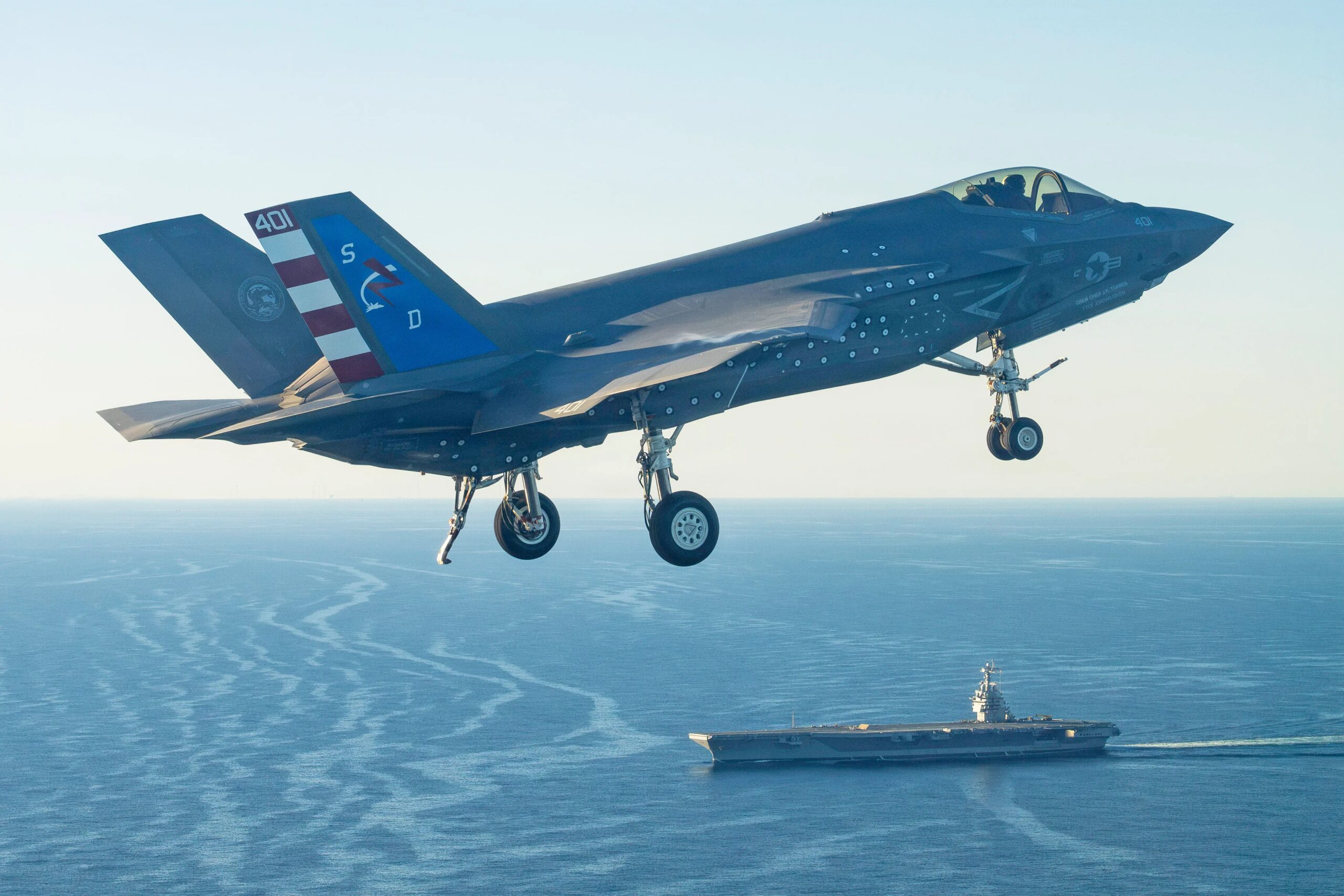
A U.S. Navy F-35C has made the first arrested landing for the type aboard a Ford class aircraft carrier, with the milestone taking place aboard the future USS John F. Kennedy (CVN 79) in the Western Atlantic on October 13, 2026. The milestone marks a major step in testing the Navy’s stealth fighter aboard its newest carrier class, following years of challenges integrating advanced launch and recovery systems.

Two F-35C test pilots assigned to Air Test and Evaluation Squadron 23 (VX-23), part of the Naval Air Warfare Center Aircraft Division (NAWCAD), flew to the carrier as part of an ongoing Aircraft Compatibility Testing (ACT) campaign. A team from the Patuxent River-based F-35 Integrated Test Force (ITF), detached to the ship, is conducting the evaluation using a specially instrumented example of the carrier-capable stealth fighter. The imagery released shows two jets, although only one is seen landing on the flattop. The other is seen carrying inert Joint Direct Attack Munition (JDAM) bombs externally.

An F-35 test pilot from Air Test and Evaluation Squadron Two Three (VX-23), Naval Air Warfare Center Aircraft Division (NAWCAD), flies an F-35C Lightning II fighter aircraft to the PCU John F. Kennedy (CVN 79) in the Western Atlantic Oct. 13, 2026. This is the first time an F-35C has landed on a Ford-class aircraft carrier. A Patuxent River F-35 Integrated Test Force (ITF) team detached to the ship is conducting Aircraft Compatibility Testing (ACT) with the specially instrumented carrier variant of the stealth jet. ACT assesses the operational capabilities of the ship's aircraft launch and recovery equipment with U.S. Navy aircraft.
An F-35 test pilot from Air Test and Evaluation Squadron Two Three (VX-23), Naval Air Warfare Center Aircraft Division (NAWCAD), flies an F-35C overhead the PCU John F. Kennedy in the Western Atlantic on Oct. 13, 2026. U.S. Navy

The Navy took preliminary acceptance of the carrier from Newport News Shipbuilding on September 29, following successful acceptance trials in August. That development allows the ship and its crew to conduct at-sea testing and build underway proficiency while the shipbuilder completes final systems testing ahead of formal delivery, scheduled for spring 2027.

Two F-35 test pilots from Air Test and Evaluation Squadron Two Three (VX-23), Naval Air Warfare Center Aircraft Division (NAWCAD), fly F-35C Lightning II fighter aircraft to the PCU John F. Kennedy (CVN 79) in the Western Atlantic Oct. 13, 2026. This is the first time an F-35C has landed on a Ford-class aircraft carrier. A Patuxent River F-35 Integrated Test Force (ITF) team detached to the ship is conducting Aircraft Compatibility Testing (ACT) with the specially instrumented carrier variant of the stealth jet. ACT assesses the operational capabilities of the ship's aircraft launch and recovery equipment with U.S. Navy aircraft.
Two F-35 test pilots from VX-23 fly F-35Cs to the PCU John F. Kennedy in the Western Atlantic on Oct. 13, 2026. U.S. Navy

The test is an important step in validating the integration of the F-35C with the Ford class. The Navy’s newest carriers use electromagnetic catapults and advanced arresting equipment, replacing the steam-powered launch systems and conventional arresting machinery found aboard the preceding Nimitz class.

Aircraft Compatibility Testing assesses the operational capabilities of a ship’s aircraft launch and recovery equipment with U.S. Navy aircraft. The process helps engineers evaluate how the carrier’s systems interact with individual aircraft and collect data needed to validate their performance.

A U.S. Navy F-35C Lightning II, attached to the "Salty Dogs" of Air Test and Evaluation Squadron (VX) 23, makes an arrested landing on the flight deck aboard PCU John F. Kennedy (CVN 79), marking the first time an F-35C lands on a Ford-class aircraft carrier. John F. Kennedy is underway conducting Aircraft Compatibility Testing, which assesses the operational capabilities of the ship's aircraft launch and recovery equipment with U.S. Navy aircraft. (U.S. Navy photo by Mass Communication Specialist Seaman Kaitlyn Bailey)
A U.S. Navy F-35C of VX-23 makes an arrested landing on the flight deck aboard PCU John F. Kennedy. U.S. Navy photo by Mass Communication Specialist Seaman Kaitlyn Bailey
A U.S. Navy F-35C Lightning II, attached to the "Salty Dogs" of Air Test and Evaluation Squadron (VX) 23, makes an arrested landing on the flight deck aboard PCU John F. Kennedy (CVN 79), marking the first time an F-35C lands on a Ford-class aircraft carrier. John F. Kennedy is underway conducting Aircraft Compatibility Testing, which assesses the operational capabilities of the ship's aircraft launch and recovery equipment with U.S. Navy aircraft. (U.S. Navy photo by Mass Communication Specialist Seaman Kaitlyn Bailey)
A U.S. Navy F-35C of VX-23 catches the wire on the flight deck aboard PCU John F. Kennedy. U.S. Navy photo by Mass Communication Specialist Seaman Kaitlyn Bailey

The F-35C is specifically designed for carrier operations, with larger wings, reinforced landing gear and a beefier tail hook compared with the Air Force’s F-35A. Its ability to launch from a carrier and recover through an arrested landing is central to its role in the Navy’s carrier air wings, which also include F-35Cs operated by the U.S. Marine Corps.

The use of a specially instrumented aircraft is particularly relevant to the test campaign. Instrumentation allows test teams to record data during flight-deck operations, helping them assess system performance and identify any issues requiring further evaluation.

A U.S. Navy F-35C Lightning II, attached to the "Salty Dogs" of Air Test and Evaluation Squadron (VX) 23, makes an arrested landing on the flight deck aboard PCU John F. Kennedy (CVN 79), marking the first time an F-35C lands on a Ford-class aircraft carrier. John F. Kennedy is underway conducting Aircraft Compatibility Testing, which assesses the operational capabilities of the ship's aircraft launch and recovery equipment with U.S. Navy aircraft. (U.S. Navy photo by Mass Communication Specialist Seaman Kaitlyn Bailey)
A U.S. Navy F-35C of VX-23 with its airframe liberally adorned with telemetry markings — these act as precision visual references used during flight testing to capture exact spatial data. U.S. Navy photo by Mass Communication Specialist Seaman Kaitlyn Bailey
A U.S. Navy F-35C Lightning II, attached to the "Salty Dogs" of Air Test and Evaluation Squadron (VX) 23, makes an arrested landing on the flight deck aboard PCU John F. Kennedy (CVN 79), marking the first time an F-35C lands on a Ford-class aircraft carrier. John F. Kennedy is underway conducting Aircraft Compatibility Testing, which assesses the operational capabilities of the ship's aircraft launch and recovery equipment with U.S. Navy aircraft. (U.S. Navy photo by Mass Communication Specialist Seaman Kaitlyn Bailey)
A close-up of one of the U.S. Navy F-35Cs of VX-23 reveals a full set of underwing stores pylons and a load of three inert 500-pound JDAM-series weapons. U.S. Navy photo by Mass Communication Specialist Seaman Kaitlyn Bailey

The first arrested landing aboard John F. Kennedy demonstrates that the ship has reached an important F-35C compatibility milestone. It does not, however, establish that all testing, certification, or operational qualification requirements have been completed.

The milestone comes against the backdrop of the Ford class program’s difficulties integrating some of its advanced aviation systems. The lead ship, USS Gerald R. Ford (CVN 78), introduced the Electromagnetic Aircraft Launch System (EMALS) and Advanced Arresting Gear (AAG), technologies intended to improve aircraft-launch flexibility, recovery performance, and overall sortie generation. Development and reliability challenges with both EMALS and AAG have contributed to delays in the class’s progress. In a 2019 report, TWZ highlighted concerns that Ford class carriers would not be ready to operate the F-35C for years.

A U.S. Navy F-35C Lightning II, attached to the "Salty Dogs" of Air Test and Evaluation Squadron (VX) 23, makes an arrested landing on the flight deck aboard PCU John F. Kennedy (CVN 79), marking the first time an F-35C lands on a Ford-class aircraft carrier. John F. Kennedy is underway conducting Aircraft Compatibility Testing, which assesses the operational capabilities of the ship's aircraft launch and recovery equipment with U.S. Navy aircraft. (U.S. Navy photo by Mass Communication Specialist Seaman Kaitlyn Bailey)
A U.S. Navy F-35C makes an arrested landing on the flight deck aboard PCU John F. Kennedy for the first time. U.S. Navy photo by Mass Communication Specialist Seaman Kaitlyn Bailey

USS Gerald R. Ford was designed and built before the F-35C’s full carrier-integration requirements were sufficiently mature, so the Navy deferred several upgrades to a later modernization period rather than delaying the ship’s delivery. Following congressional pressure, the Navy adopted a single-phase delivery approach for USS John F. Kennedy, incorporating these modifications during construction instead.

The USS Gerald R. Ford completed its Aircraft Compatibility Testing in January 2020, following 16 days at sea, during which the crew launched and recovered 211 aircraft, testing five different airframes — but the F-35C was not included.

A U.S. Navy F-35C Lightning II, attached to the "Salty Dogs" of Air Test and Evaluation Squadron (VX) 23, makes an arrested landing on the flight deck aboard PCU John F. Kennedy (CVN 79), marking the first time an F-35C lands on a Ford-class aircraft carrier. John F. Kennedy is underway conducting Aircraft Compatibility Testing, which assesses the operational capabilities of the ship's aircraft launch and recovery equipment with U.S. Navy aircraft. (U.S. Navy photo by Mass Communication Specialist Seaman Kaitlyn Bailey)
A U.S. Navy F-35C, attached to VX-23, after an arrested landing on the flight deck aboard PCU John F. Kennedy. U.S. Navy photo by Mass Communication Specialist Seaman Kaitlyn Bailey

Beyond EMALS and AAG, integrating the F-35C on Kennedy requires modifications to the carrier’s maintenance infrastructure and support systems. These include specialized spaces for handling the aircraft’s sensitive mission systems and classified data, computer networks and interfaces linking its maintenance and logistics systems with the Navy’s existing infrastructure, and facilities and equipment to support the upkeep of its low-observable coatings and materials. The Navy has also identified the need for more robust jet blast deflectors (JBDs), which protect flight-deck personnel and equipment from the F-35C’s intense engine exhaust.

Earlier F-35C integration work aboard Nimitz class carriers included JBD modifications to improve heat resistance and cooling, while planning for John F. Kennedy explicitly included both JBD upgrades and changes to maintenance spaces and information systems.

An F-35 test pilot from Air Test and Evaluation Squadron Two Three (VX-23), Naval Air Warfare Center Aircraft Division (NAWCAD), flies an F-35C Lightning II fighter aircraft to the PCU John F. Kennedy (CVN 79) in the Western Atlantic Oct. 13, 2026. This is the first time an F-35C has landed on a Ford-class aircraft carrier. A Patuxent River F-35 Integrated Test Force (ITF) team detached to the ship is conducting Aircraft Compatibility Testing (ACT) with the specially instrumented carrier variant of the stealth jet. ACT assesses the operational capabilities of the ship's aircraft launch and recovery equipment with U.S. Navy aircraft.
An F-35 test pilot from VX-23 flies an F-35C to the PCU John F. Kennedy in the Western Atlantic on Oct. 13, 2026. U.S. Navy

The latest test represents progress toward resolving the compatibility question, although the full scope of the remaining work will depend on the results of the ongoing evaluation.

The development also comes as China advances its own carrier aviation capabilities. Unlike the U.S. Navy, its Fujian aircraft carrier has demonstrated electromagnetic catapult launches and arrested recoveries involving several aircraft types, including the J-35 stealth fighter.

A J-35 is prepared for takeoff on Fujian. via Chinese internet

In contrast to the U.S. Navy, which accumulated decades of experience with steam-powered catapults before adopting electromagnetic launch technology, China chose electromagnetic catapults for its first catapult-equipped carrier.

Although China’s demonstrations aboard Fujian and the F-35C compatibility testing aboard Kennedy involve different aircraft, ships, and stages of development, both underscore the technical demands of integrating advanced aircraft with modern carrier launch and recovery systems.

For the U.S. Navy, the immediate priority is to demonstrate that the Ford class can reliably support its intended aircraft. The F-35C’s first arrested landing aboard Kennedy is a significant step in that process, with further testing — not least an EMALS takeoff — needed before the milestone can begin to translate into an operational capability.

Contact the author: thomas@thewarzone.com

Thomas Newdick is a staff writer at TWZ, where he covers military aviation, defense technology, weapons systems, and international security. Based in Berlin, Germany, he reports on conflicts, military modernization efforts, and emerging aerospace technologies around the world, with a particular interest in airpower and its role in contemporary warfare. His reporting is informed by deep expertise in modern and historical airpower, particularly in Europe, with a focus on military aviation, air campaigns, and aerospace developments across the continent and beyond.


Source link

Leave a Reply

Discover more from Occasional Digest

Subscribe now to keep reading and get access to the full archive.

Continue reading