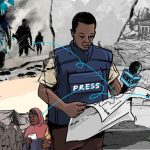

In one of the world’s most deprived and volatile regions, HumAngle’s reporting and experience reveal that journalists in Nigeria are not just observing suffering but are pulled into it as they try to report it. Consequently, they say, they find themselves paying out of pocket to feed the people whose stories they are trying to tell.
In theory, the profession is expected to observe some emotional distance from its sources and the stories they tell. However, that model is inoperable in conflict-affected regions of northern Nigeria and the Sahel.
HumAngle operates in this space. Its work across Lake Chad, Central Africa, Nigeria’s Middle Belt, the North West, the South East, and other conflict zones forces a confrontation with a difficult question: What does ethical journalism look like when the people you report on are not just sources, but individuals whose survival may intersect directly with your presence?
The limits of imported ethics
Global journalism standards discourage payment for information, and while exceptions exist, they do so under strict editorial oversight, a clear public-interest justification, and transparency. Journalism teachers say that, though these frameworks are expected to provide clarity, they don’t in conflict-affected Nigeria, where the assumed context doesn’t apply. The ideal context has clear distinctions between sources and service providers and functioning identity systems. This is hardly obtainable in conflict-affected environments.
Dr Kabiru Danladi, a Mass Communication scholar with the Ahmadu Bello University in northwestern Nigeria, says, “Our curriculum borrows heavily from Euro-American ethical frameworks – objectivity, detachment, neutrality – principles rooted in relatively stable societies. The failure becomes evident when our graduates are deployed to cover issues that weren’t directly taught in class, or they are sent to cover conflicts in places like Zamfara, Sokoto, Kebbi, Borno, Yobe or Benue, where journalism is not just a profession but a survival exercise.”
Dr Obiora Chukwumba, a researcher and media expert in Abuja, identifies the same problem in the moral obligation created by field contact. “There is no ethical barrier to a journalist intervening on grounds of goodwill to assist a source who is in a vulnerable position,” he said.
The reality of field reporting
These individuals are essential. Without them, our reporters’ access vanishes. But they are also embedded in the same systems the journalist is trying to understand, which creates layered risks, including legal risks that emerge when payments made for legitimate services are later interpreted as material support.
Barrister Joseph Danboyi, a senior lawyer in Jos, North Central Nigeria, says, “Payment to a fixer creates liability if the journalist knew his connection with criminals. Ordinary payment for information is insufficient. The journalist will be aiding and abetting when payment is purposefully linked to criminal conduct.”
He goes further to add, “The practical bottom line is that a journalist who unknowingly pays a criminal for information is generally not liable… liability requires knowledge… and intent to help or further it.”
This distinction between knowledge and intent anchors the legal reality that sits beneath field decisions.
Dr Obiora also treats fixers and access arrangements as part of newsroom operations, not automatically as ethical breaches. “Parts of the routine (investigative) costs tied to the operations of a newsroom include such services as engaging fixers, obtaining access to a reasonably considered newsmaker, and appreciation handouts,” he said. “They are all legitimate operational costs.”
There is no procedural checklist that eliminates these risks. What exists instead is a need for structured awareness and disciplined judgment in newsrooms.
The Knifar women: A case that reshapes the debate
HumAngle’s reporting amplified their efforts, influencing outcomes that ultimately led to the release of over a thousand men that the women were advocating for.
Our work required prolonged engagement with the women, whose daily reality was defined by deprivation. In some instances, our journalists provided stipends. In other cases, some of these women became part of the reporting process as fixers and contributors with fixed incomes in our newsroom. We have even given some of them ‘additional reporting’ credit for their work. Since they are both sources and resource persons for our newsroom, we are often clear about what we are paying them for – their work, not their information. We have spoken publicly about the dynamics of our relationship with these women, including in a Pulitzer Centre-supported documentary.
Kunle Adebajo, a renowned award-winning investigative journalist, reflects on his own experience in being moved to provide money to vulnerable sources: “I’ve often had to pay vulnerable sources. This is because the majority of them live from hand to mouth and rely on wages from daily labour to get their sustenance, and so such interviews could be very disruptive and uncomfortable for them. Oftentimes, they also have to transport themselves to meet at the interview location. The sums given were trifling, and there was never an understanding that the interview itself was transactional.
Dr Obiora agrees that the understanding must always be clear. “If the source or interviewee presents the personal need to overshadow the reason for the meeting with the journalist, then that could be a red flag,” he said, “pointing to potential compromised narrative or ‘adjusted facts’ from the source or interviewee.”
When observation is not enough
Journalists are trained not to pay sources because it could risk distortion and affect credibility, but what happens when the people you are interviewing live in destitute conditions?
“I met residents, elderly men and women who could not feed themselves, who could not afford basic healthcare. I met a father who lost his wife to a particular ailment, and whose two kids are still suffering from the same ailment. Yet, he could not help.”
The award-winning journalist said he felt compelled to help. “I offered to buy meals for some of them through my fixer. Yes, I offered them some cash to buy what they needed. When I got back to my hotel room that evening, I actually cried. I felt the depth of these people’s suffering.”
He is not unaware of the ethical grey spots in giving money to sources. “Ethically, I did not really care at that point whether offering them some cash would be seen as an inducement. I told myself that I had to act as a human being at the moment and drop the toga of ‘a journalist’ at that point.”
Dr Danladi understands this and says that “Students must be taught that they are a journalist, yes – but they are also human beings. Refusing to help in the name of ‘objectivity’ can itself be an ethical failure.” He says that liability only becomes possible “where the journalist knows or is willfully blind to criminal activity… or where the payment itself is tied to illegal conduct.”
Another journalist from southwestern Nigeria, who declined to be named, described facing similar situations in which his sources were suffering.
“They had had to eat rotten food sourced from the nearby markets, and sometimes they went days without eating anything because their husbands, who provided for them, had been killed. I saw that most of their children were malnourished and looked so skinny. It was such a touching situation, and I couldn’t help but give them some money that I had with me so that they could buy food and cook.”
The practice of support
Payment for content implies a transaction because it links money to information, but support that exists independently of reporting is different. It protects the integrity of the story while still acknowledging the reality of the environment.
Hauwa Shaffii Nuhu, an award-winning journalist and newsroom manager, said that though in her early days as a journalist, she could not resist the urge to help vulnerable sources, she has now learned to favour long-term external support. “Now, I connect them [the vulnerable subjects of her story] with NGOs… or make it possible for society to donate directly to them or through an independent third party like a fixer.”
In cases where reporters have to provide any form of support, journalism scholars like Obiora say documentation matters. Record decisions and rationale for such actions while in the field. According to Obiora, “one of the most important structures for documenting and reviewing ethical footprints in the newsroom is within the internal editorial space.” He proposed an Editorial Board of Line Editors, chaired by the title editor, and another layer through an Editorial Advisory Board, where “it would be necessary to bring the platform’s legal advisor as a member.”
The unresolved tension
Speaking more to the legal position of a source, unknown to the journalist, being tied to criminal activity, Danboyi reiterates that a journalist who unknowingly pays a criminal is generally not liable, as exposure begins when there is knowledge, or when you consciously ignore signals that should raise concern.
A different kind of responsibility
The Knifar women’s story forces a reconsideration of responsibility and demands a different approach to how journalism ethics is taught and judged. “We graduate students who know the code, but cannot survive in the field,” says Dr Danladi.
Dr Obiora returns the question to dignity. “A journalist whose interaction with a source contributes to lifting the source’s dignity has discharged his or her obligation professionally.”
In environments where silence sustains suffering, the act of telling a story, and the way that story is told, carries consequences beyond journalism.