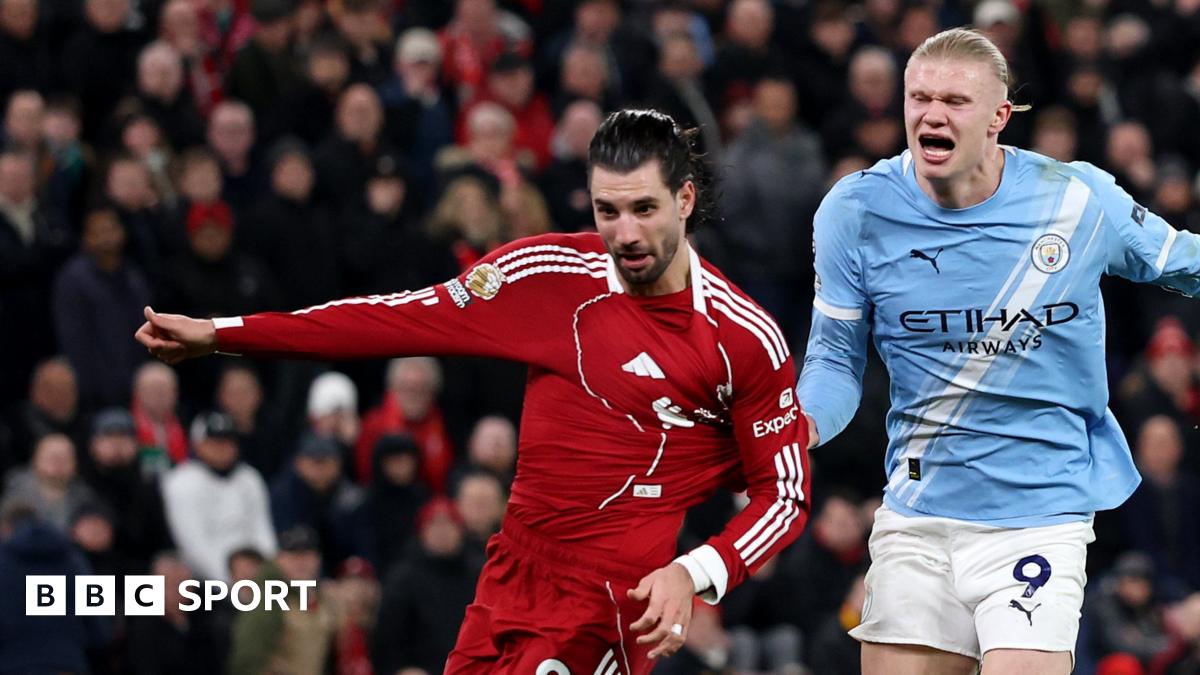
With Alisson marooned upfield for a set-piece as Liverpool searched for a late equaliser, Rayan Cherki kicked the ball towards an empty net.
Haaland gave chase and was clearly going to outpace Dominik Szoboszlai.
The City striker had overtaken Szoboszlai 25 yards from goal and looked certain to win the race – but he was pulled back.
It was a clear foul which referee Craig Pawson identified, but he played an advantage.
As the ball rolled towards the goal with the same two players still jostling to reach it, Liverpool‘s Hungary international was about to slide in and clear it off the line.
Before Szoboszlai could do so, however, Haaland pulled him back, and that stopped the home player from keeping the ball out of the net.
The first pull on Haaland muddies the waters. After all, it seemed Haaland was definitely going to score.
But they are two distinct situations. You have to separate the first foul by Szoboszlai and the subsequent offence from Haaland.
Would Szoboszlai have prevented the goal had he not been fouled? There is a high chance.
On that basis it is impossible for the goal to stand.
Remember that Pawson played advantage. Had Szoboszlai been allowed to successfully keep the ball out, the play would have been brought back and he would have been sent off.
The end result would be the same as the outcome of the VAR intervention: no goal and Szoboszlai sent off for denying an obvious goalscoring opportunity.
If you take out the first pull on Haaland, it is hard to see how anyone could have a problem with the goal being disallowed.
This is not the first time, or the last, that the VAR has correctly disallowed a goal and people really struggle to stomach it.
Yes, the goal could be important for Manchester City at the end of the season. But the goal conceded could also turn out to be vital for Liverpool.