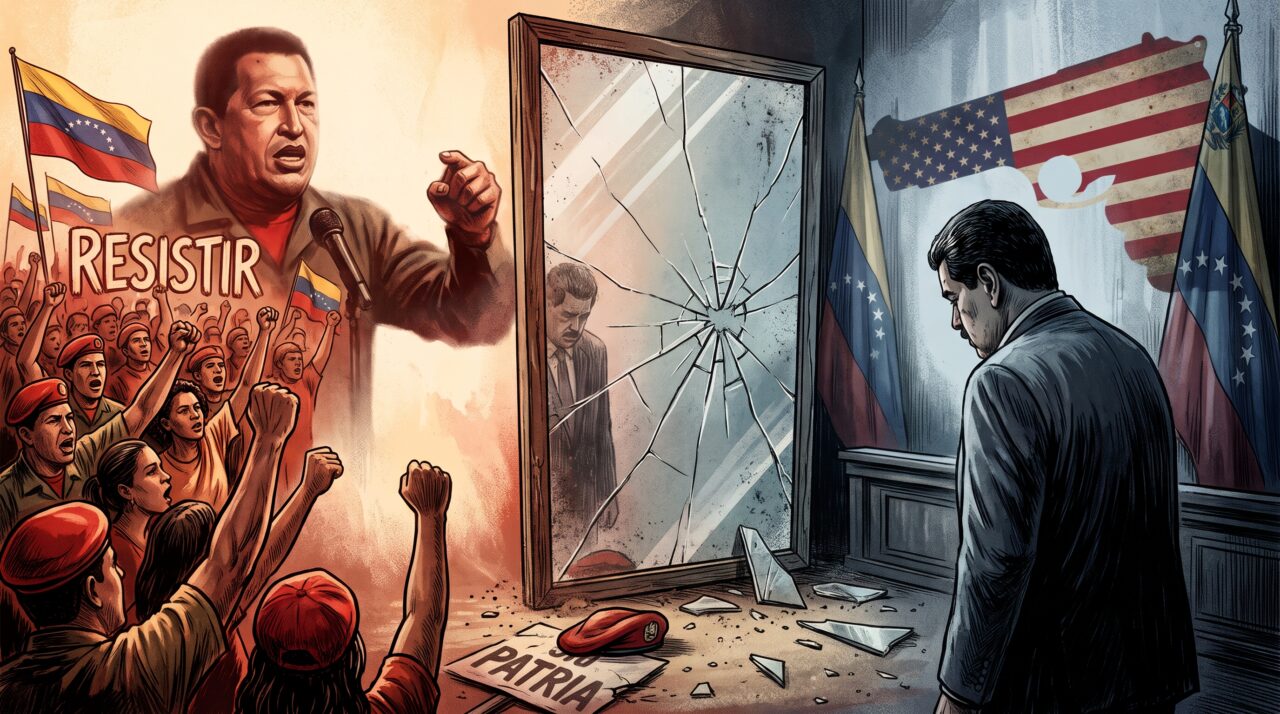
Chávez, like other Latin American predecessors, had vowed to defend national independence to the last consequences. (AI-generated image)
Writing today from a place of sympathy and loyalty to the founding principles of the Bolivarian project means confronting a semantic and political discomfort.
Recently, a fellow Chavista, deeply critical of those currently leading the party and the government, flatly rejected being labeled a dissident. “Who are the dissidents? I am not one, nor are those who think like me,” he declared, opening a necessary debate about where true consistency with the historical legacy of Hugo Rafael Chávez Frías really lies.
Those of us who identify with Chavismo without renouncing critical judgment find it difficult to accept what happened before, during, and after the January 3 [US] military operation, and we struggle to understand why Nicolás Maduro did not resist during the incursion in which he was kidnapped along with his wife, Cilia Flores.
Everything indicates that there was no effective preparation to resist to the bitter end, which shows that the US deployment in the Caribbean was underestimated and that there was excessive confidence, all the more so after two phone calls from Donald Trump.
For years, the Venezuelan political and military leadership insisted that a foreign intervention would meet fierce resistance throughout the country. Many of us faithfully believed those proclamations and repeated with great conviction and complete confidence that the aggressors “may be able to get in; the hard part will be getting out,” trusting in the readiness of a popular militia of more than four million members, according to official sources. Yet when the hour came, only 56 Venezuelan and Cuban soldiers fell in combat.
In light of this outcome, an interpretation has gained traction that seeks to explain the conduct of the political-military leadership with the argument that “with a gun to their head, they had no alternative.” With all due respect to those who have defended this thesis, among them the combative former Ecuadorian President Rafael Correa and the astute Spanish analyst Juan Carlos Monedero, it is difficult to subscribe to that interpretation without questioning the chasm between the earlier rhetoric and the facts on the ground.
The coercion alibi
The military asymmetry with the United States was no secret before the early hours of January 3, so attributing the lack of resistance solely to the imbalance of forces raises serious political questions. If the adversary’s military might ruled out any armed response, one must ask why, for two decades, a rhetoric of preparing for total confrontation was cultivated, in which millions of militants in the Bolivarian Republic of Venezuela and around the world placed their faith.
One need only recall Hugo Chávez’s historic speech of February 29, 2004, when, faced with threats to break Venezuela apart, he responded firmly that “there are enough balls to defend this homeland from any intruder, damn it.” That day, the Comandante declared himself ready to give his life like the Indigenous chief Guaicaipuro or Negro Primero, expressing that when the homeland is under threat, one’s personal existence becomes secondary.
His political heirs turned that promise into a routine slogan, assuring from official podiums that they were tracking those who called for foreign intervention, while warning that they would not hand over a single drop of oil for free. Yet it is striking that the emblematic clip of Chávez demanding courage to save the homeland has vanished from the screens of state-aligned television and allied programs, suggesting a quiet shift in discourse.
The disappearance of that reference seems to reflect the discomfort of a leadership that is now trying to manage an adverse situation according to a logic different from that of its founders. They fail to realize that when leaders distance themselves from the example they held up for years as a non-negotiable standard, the rhetoric loses its moral force and compels the movement to look itself in a mirror that reflects the unanswered questions.
Dying with dignity
The history of liberation struggles offers numerous examples that contrast with the thesis that the enemy’s superiority necessarily forces surrender. Salvador Allende endures as a symbol of revolutionary integrity because he resisted at La Moneda fully aware of his military inferiority, rejecting the plane offered by the coup plotters in order to honor his commitment to the working people, unlike other heads of state who chose to flee or surrender without a fight.
That same ethical firmness defined the thought of Juan Pablo Duarte, who conceived of national sovereignty as an inalienable principle, declaring that “to live without a homeland is the same as to live without honor.” For the Dominican founding father, accepting foreign tutelage in exchange for the promise of order or stability amounted to betraying the very nature of the Republic – a conviction for which he chose to die poor and in exile in Caracas rather than endorse any form of foreign protectorate.
In that same tradition of Caribbean dignity stands Colonel Francisco Alberto Caamaño Deñó during the April Revolution of 1965 in Santo Domingo, facing down the arrogance of US Ambassador William Tapley Bennett. When the imperial envoy demanded an end to what he described as mere disorder, Caamaño replied with words that transcended his time: “I am going to show you what it means to die with dignity.”
Far from taking refuge in calculations of personal survival, Caamaño left the diplomatic residence and marched to the front line at the Duarte Bridge alongside his comrades. “Bollo, haven’t I told you we’re dead men? So consider yourself dead, damn it, and let’s go to the bridge and fight,” he said, a reminder that a leader’s moral authority rests on his willingness to share the fate of those he calls to arms.
The judgment of History
When political leaders stray from these historical examples, pragmatic explanations fill in the gap to justify inaction in extreme situations. In 1808, the Dominican brigadier Juan Sánchez Ramírez warned that he would have any drummer who sounded the retreat shot, along with the officer who ordered it, himself included. At Fuerte Tiuna, by contrast, the drums remained silent, awaiting an order to resist that never came.
It is impossible to overlook the contrast between that institutional silence and the sacrifice of the 56 Venezuelan and Cuban fighters who lost their lives facing the assault on unequal terms. To those fallen belong the verses of José Martí, who wrote that in dying in the arms of a grateful homeland, life at last begins, while those in the high command who survived still owe the country and the continent a convincing explanation.
To argue now that the absence of combat averted a greater tragedy opens a legitimate debate, but one that falls short unless it is accompanied by deep self-criticism about the gap between what was promised and what was delivered. Political consistency demands that slogans about the comprehensive defense of the nation be matched by the actual preparedness and genuine will of those who take on the responsibility of leading the state.
Today, those who continue to uphold the original banners of Chavismo from an honest and committed stance have the right to demand clarity in the face of any attempt to normalize foreign tutelage. Because, as Hugo Chávez himself reminded us in words that retain their full moral force, at the decisive moments in a people’s history, the choice always reemerges between defending the homeland and submitting to the empire.
The views expressed in this article are the author’s own and do not necessarily reflect those of the Venezuelanalysis editorial staff.
Translated by Venezuelanalysis.
Rafael Méndez is a Dominican political analyst, former congressman, and international solidarity activist. His articles on Latin American and Caribbean geopolitics have appeared in outlets including Resumen Latinoamericano, Acento, and Tiempo Argentino.
Source: Resumen Latinoamericano