TODAY

Discover the latest happenings and stay in the know with our up-to-date today news coverage. From breaking stories and current events to trending topics and insightful analysis, we bring you the most relevant and captivating news of the day.

After six months of war, what have US, Iran gained and lost? | US-Israel war on Iran News

It has been six months since February 28, when the US and Israel shocked the world by launching missile strikes on Iran, killing Supreme Leader Ayatollah Ali Khamenei and several senior Iranian officials in Tehran, as well as scores of children in a school in Minab, southern Iran.

US President Donald Trump then claimed the conflict would only last “four to five weeks”.

Recommended Stories

list of 3 itemsend of list

In the months since, the war has erupted on several other fronts, reaching as far as the Caspian Sea. It has triggered a global oil supply crisis as the US and Iran battle for control of the strategic Strait of Hormuz, through which more than one-fifth of oil and natural gas cargo transited.

And it has resulted in an estimated 8,000-10,000 deaths, as well as tens of thousands of injuries.

The conflict is also realigning the global order, experts say, as new alliances form and dominant ones show signs of crumbling.

Here’s what we know:

President Donald Trump arrives on Air Force One as Rep. Brian Babin, R-Texas, right, looks on, Thursday, Aug. 27, 2026, at Ellington Airport in Houston. (AP Photo/Mark Schiefelbein)
President Donald Trump arrives on Air Force One as Republican Representative Brian Babin, right, looks on, on Thursday, August 27, 2026, at Ellington airport in Houston, Texas [Mark Schiefelbein/AP]

Has the US achieved any of its war objectives?

The US’s goals were not initially clear: officials first claimed the strikes were carried out in preemptive self-defence.

According to demands presented on the eve of the war, and a jumble of sometimes contradictory statements from Trump and senior US defence officials, they include the following:

Iran’s nuclear programme

Despite Trump’s claim that the US had “obliterated” Iran’s nuclear capabilities when it joined in at the end of Israel’s 12-day war on Iran in June 2025, the US and Israel again claimed in February that Tehran was just weeks away from developing nuclear weapons.

Repeated strikes on Iran’s nuclear sites during the war have likely caused vast damage to the facilities, but it is believed Tehran still possesses 440kg of highly enriched uranium, which could be used to make a weapon.

The Trump administration wanted Iran to hand over this stock to the US and to commit to zero enrichment of uranium going forward. Iran refused to do this, although at one point appeared open to the possibility of handing the stock over to a third country. Iran also insisted on retaining the capacity to develop a nuclear power programme, which requires much lower levels of uranium enrichment.

Later, Trump briefly floated the idea of US troops retrieving the stock by force – a potentially dangerous mission.

In the June 17 memorandum of understanding (MoU) signed by both sides, Iran agreed not to pursue a nuclear weapon – something it had always pledged anyway. The MoU unravelled as its vague wording led to disagreements about what it actually stipulated.

Clark Summers, a US military veteran and professor at Belmont Abbey College in North Carolina, said the US “can rightly assert that these ends have been achieved. Although for how long before Iran can rebuild is difficult to assess.”

But Iranian expert and professor at the Australian National University (ANU), Alam Saleh, disagreed, and noted that Iran’s nuclear power programme is still intact. “The US lost even before the war,” he said, adding that the effort also shows that Washington failed in last year’s 12-day war.

Regime change in Iran

On day one of the war – February 28 – the US killed Khamenei alongside several other senior officials. Trump, two days earlier, said regime change is “the best thing that could happen”.

As the US launched missiles, he also called on “Iranian patriots who yearn for freedom to seize this moment to be brave, be bold, be heroic, and take back your country”.

Iran’s political leadership has, however, remained largely the same under the new Supreme Leader Mojtaba Khamenei – the late ayatollah’s son.

Summers told Al Jazeera that the goal may have been “ad hoc” or improvised rather than well-planned. But “killing leaders does not mean strategic achievements, even if it’s a tactical success,” Saleh said.

Ending support for regional proxy groups

Iran’s “axis of resistance” is an umbrella comprising a number of armed groups around the region that it funds. This includes Hezbollah in Lebanon, the Houthis in Yemen, Hamas in the Gaza Strip, and several smaller groups in Iraq and Syria.

There are no signs that Tehran’s support for them has ended, and this demand did not appear in the MoU signed by the US.

Hezbollah went to war with Israel in Iran’s defence, and Iran has refused to negotiate an end to the war unless the Lebanon front is included. The Houthis, meanwhile, have launched a blockade on Saudi Arabia in the Bab al-Mandeb Strait, partly in support of Iran.

Iran’s ballistic missiles programme

Washington swore it would “raze” Iran’s missile facilities to the ground when it launched the war on February 28. The US also pledged to destroy Iran’s navy.

Trump has since claimed that about 82 percent of Iran’s missiles are gone and the navy is degraded.

In April, he also said that 158 Iranian naval vessels had been hit, while US Central Command (CENTCOM) has continued to announce dozens of strikes on command centres of the Islamic Revolutionary Guard Corps (IRGC).

Iran, however, has continued to fire missiles, most recently launching a long-range missile in July that killed three US soldiers in Jordan.

Furthermore, the demand for an end to Iran’s ballistic missiles programme was also absent from the July MoU.

Control of Iranian oil

In June, Trump said the US would seize and control Iran’s Kharg island, the heart of Iranian oil production.

To date, the US does not control any Iranian territory.

What have the US and Iran gained and lost during the war?

Besides the US demands at the start of the war, several other pressure points have emerged during the conflict.

Control of the Strait of Hormuz

Soon after the war began, Iran in effect closed the narrow but critical Strait of Hormuz, which passes through its territorial waters as well as those of Oman. Since then, shipping traffic has slumped from more than 100 ships per day to an average of about five.

To enforce this closure, Iran began striking vessels in the strait, the only route to the open ocean for Gulf oil and gas producers, which had not gained its explicit permission to pass through.

The US responded with its own naval blockade on Iranian ports in and around the strait. This is continuing.

Despite a large number of expletive-laden demands from Trump since then – many of them on social media – that Tehran reopen the strait, Iran has not budged. It is currently negotiating plans for the future of the waterway, through which more than one-fifth of the world’s oil and natural gas supplies were shipped before the war, with Oman.

As part of these negotiations, Iran announced this week that it has agreed to a shipping route, which it will partially control, with Oman.

While Trump has recently claimed that the US has “full control” of the strait and that it is open to vessels, shipping remains at an all-time low and Iran has continued to fire at any vessels trying to pass without its permission.

Iran sees the strait as its main piece of leverage in the war with the US, which Salah said, Iran views as an “existential threat”.

INTERACTIVE - Strait of Hormuz - March 2, 2026-1772714221
(Al Jazeera)

Economic impact

  • Iran: The war’s impact on Iran’s economy has been severe. The Iranian rial has in effect collapsed. Food prices have surged amid the war, and the US blockade and renewed sanctions have hampered Iranian oil exports, with the blockade cutting oil revenue by at least $6bn. Tehran’s economy has long been battered by US sanctions, although the fragile ceasefire provided temporary relief. Iran’s Foreign Minister Abbas Araghchi said last week that economic pressure is a “rerun we know by heart” and that the country knows how to survive it.
  • US: US consumers have also felt the pressure of the war at the petrol pump, making the conflict highly unpopular. A July poll by The Associated Press revealed that two-thirds of Americans are against the conflict. While many tend to forget there’s a war, Summers said, they do remember it acutely when petrol prices rise. In states like California, gasoline prices doubled. That anger will likely translate into a political backlash against Republicans in November’s midterms, experts say.

Relations with allies

  • Iran: Iran’s targeting of US military assets as well as both military and nonmilitary infrastructure in neighbouring Gulf states and Jordan has not made it popular regionally, experts note. Iran has hit infrastructure in Qatar, the United Arab Emirates, Saudi Arabia, Jordan, Iraq, Kuwait, Oman and Bahrain. Those states have called this a violation of their sovereignty. However, Iran’s economic and political ties with China have held, as Beijing has managed a delicate dance by advocating against sanctions on Iran while refraining from becoming fully entangled in the conflict. Trade relations with Russia also remain strong.
  • US: The US has faced reluctance from its NATO allies to back it up in this war. Despite being asked directly by Trump, they have refused to join the war. Spain and Italy, in particular, have highly criticised the conflict, while Germany, Israel’s strongest ally in Europe, has done the same. France rejected calls to send warships to enforce the blockade. Gulf allies, Pakistan and Turkiye have all similarly refused, while in Asia, Japan, Australia and South Korea all declined to get involved. Gulf allies are also likely weighing the fact that it is the US’s war on Iran which has caused them to become targets.

Military capabilities

  • Iran: US experts say that claims Washington has degraded Iran’s military capabilities are correct. Several army bases have been struck while Iran’s ballistic missile stockpiles are down by about 82 percent, according to Trump. However, Iran is still launching missiles and, while nuclear facilities have been damaged, it still has possession of its enriched uranium stockpile. Experts point out that Iran likely has a bigger appetite for an atomic weapon now than before the war began. Tehran has also continued to produce and deploy its mass-produced, cheap Shahed drones. An estimated 1,221 military personnel were killed by April, although the real toll is likely higher.
  • US: The US has lost 18 soldiers and more than 750 have been wounded. That’s “quite low”, Summers said. However, US media reports suggest the Pentagon has severely depleted stockpiles of some of its most powerful and most expensive weapons – particularly its Patriot defence missiles – something Washington denies. Those missiles are only produced in the dozens annually and cost millions of dollars each. In August, the US signed a $22.9bn deal with manufacturer Raytheon to boost Tomahawk cruise missile production from 60 to more than 1,000 annually.

Is there an outright ‘victor’?

Observers say there is not.

“Both of them have not achieved anything,” Saleh of ANU said, noting that the US has failed to translate military superiority to actual gains despite being a “superpower” fighting a “middle power”.

China and Russia are likely observing Washington’s weaknesses, making new military calculations in the event of a future conflict with the US, he said. That has implications for Taiwan, especially as the US has now deployed its last aircraft carrier in the Pacific to the Middle East. The shift leaves the US without an aircraft carrier in the Western Pacific, despite Washington’s previous strategic emphasis on the region.

“Iran surviving also does not mean it’s a winner,” however, Saleh said. “This might be a defeat for the US, but it’s not a victory for Iran either.”

Source link

Work friend under delusion he is real friend

AN office worker is living in fear of a colleague who believes he is a real friend and not merely a work friend.

Martin, not his real name, has come to dread Steve, not his real name, escalating acts of friendliness, which threaten to cross the line from cynical work banter into worthwhile friendship.

Martin said: “It’s not that I don’t like Steve, he’s alright. But outside of work we have nothing in common.

“Slagging off colleagues is fine, but now he’s suggested going for a drink, just me and him. Like a date. I managed not to commit, but I’m terrified that when we get to the pub the conversation will just freeze and we’ll both look back on it with embarrassment for the rest of our lives.

“Or what if Steve turns out to be a weirdo with no friends and a huge collection of ultra-violent comic books and hentai porn? He’ll latch onto me and I won’t be able to get rid of him in case he turns into a stalker.

“Then at work everyone will know me as ‘that weirdo Steve’s mate’ and there’ll be no chance of shagging Francesca or Rachel. Or he might ask me to go camping with him. If he’s into camping. Admittedly I’m making a few assumptions here.”

In the event Martin and Steve eventually went to the pub near their office and had a mildly amusing chat about work and mainstream films they had seen, before Malley left to go over to his girlfriend’s.

Bishop said: “I dodged a bullet there.”

US Open 2026: All to know about the schedule, top seeds and favourites | Tennis News

The season of Honey Deuce cocktails at Flushing Meadows is upon us as the 2026 US Open main draw gets under way in New York this Sunday.

This year’s fourth and final Grand Slam will feature some of the biggest names in tennis and breakout players on the up and up, although there will also be some notable injured absentees.

Recommended Stories

list of 4 itemsend of list

The mixed doubles title has already been claimed by Czech pair Karolina Muchova and Jakub Mensik on Wednesday night after defeating Switzerland’s Belinda Bencic and Italy’s Flavio Cobolli.

Here’s everything you need to know about the US Open main draw:

Where and when is the US Open?

All the main draw action from August 30 until September 13 is at the USTA Billie Jean King National Tennis Center in Flushing Meadows, just outside New York City.

The men’s and women’s quarterfinals begin on September 8 , followed by:

Women’s singles semifinals: September 10

Men’s singles semifinals: September 11

Women’s final: September 12

Men’s final: September 13

Who are the top seeds?

Women’s singles: 

  1. Aryna Sabalenka
  2. Elina Rybakina
  3. Jessica Pegula
  4. Coco Gauff
  5. Mirra Andreeva
  6. Karolina Muchova
  7. Linda Noskova
  8. Iga Swiatek
  9. Amanda Anisimova
  10. Elina Svitolina

Men’s singles: 

  1. Alexander Zverev
  2. Carlos Alcaraz
  3. Felix Auger-Aliassime
  4. Alex de Minaur
  5. Ben Shelton
  6. Novak Djokovic
  7. Daniil Medvedev
  8. Flavio Cobolli
  9. Taylor Fritz
  10. Alexander Bublik
Jakub Mensik, of the Czech Republic, celebrates with Karolina Muchova, right, of the Czech Republic, after they won the mixed doubles final match against Belinda Bencic, of Switzerland, and Flavio Cobolli, of Italy, at the U.S. Open tennis championships Wednesday, Aug. 26, 2026, in New York. (AP Photo/Frank Franklin II)
Jakub Mensik and Karolina Muchova celebrate their mixed doubles win [Frank Franklin II/AP Photo]

What are some major storylines?

  • Top-ranked Jannik Sinner withdraws: The World number one said he was “very sad and disappointed” to withdraw from after being unable to recover from a right knee injury that has sidelined him since winning the Wimbledon title. The Italian pulled out of hard-court tournaments in Montreal and Cincinnati that serve as a warm-up for the US Open.
  • Carlos Alcaraz back in action: The Spaniard will look to defend his title after a four-month hiatus from tennis due to a wrist injury, but Sinner’s absence means the crowd will not see the beloved “Sincaraz” rivalry this time.
  • Serena Williams, Alcaraz pair up for iconic mixed doubles duo: Two generational greats teamed up for this year’s mixed doubles, although their star power faded as they fell to Cobolli and Bencic in the quarterfinal.
  • Serena and Venus Williams receive doubles wildcard: The 23-time Grand Slam champion received a women’s doubles wildcard alongside older sister Venus. They have played together at the US Open nine times, winning in 1999 and 2009. Venus also received a wildcard for the women’s singles.
  • 2016 champion Stan Wawrinka handed last-minute wildcard: The former world number three was left off the initial list of wildcard entries in his farewell season, but was handed the entry on Wednesday after several days of outcry from fans over his exclusion.
  • Teen sensation Moise Kouame makes US Open debut: The 17-year-old made history at this year’s French Open when he became the youngest male Grand Slam winner in 17 years. However, the Frenchman’s US Open debut ended in the qualifying round after defeat to Nishesh Basavareddy of the US.
  • Novak Djokovic continues pursuit of elusive 25th slam: The world number five Djokovic has been in relentless pursuit of a record 25th Slam title since winning his 24th at the US Open in 2023. The Serbian’s ambition has repeatedly been tested by age as the 39-year-old struggled with stifling humidity at this month’s Cincinnati Open. Still, he reached the Australian Open final this year as well as the Wimbledon semifinal.

Is Roger Federer making a comeback?

No. The 45-year-old Swiss icon categorically ruled out a Williams-esque return.

His brief on-court appearance in New York this week was for primetime exhibition matches ahead of a trip to Newport, Rhode Island to be enshrined in the International Tennis Hall of Fame on Saturday.

epa13191699 Swiss former tennis player Roger Federer reacts to spectators during the 'Roger Federer: An Icon Returns to New York' exhibition match during US Open Fan Week at Arthur Ashe Stadium in the USTA Billie Jean King National Tennis Center in Flushing Meadows, New York, USA, 25 August 2026. EPA/SARAH YENESEL
He’s back – The Roger Federer: An Icon Returns to New York’ exhibition match during US Open Fan Week at Arthur Ashe Stadium [Sarah Yenesel/EPA]

Who’s likely to lift the trophy?

With Sinner out of contention, Alcaraz has a clear shot at his title defence for a third US Open win.

Wimbledon champion and top seed Alexander Zverev will also be looking to carry momentum from his maiden Slam win in June, although the German was knocked out in the fourth round at last week’s Cincinnati Open.

Arthur Fils, seeded 23rd, could be a surprise contender in the final four after the Frenchman defeated American Frances Tiafoe to clinch his maiden Masters 1000 title in Cincinnati last week.

NEW YORK, NEW YORK - AUGUST 25: Carlos Alcaraz of Spain returns a shot with partner Serena Williams of the United States in their mixed doubles match against Erin Routliffe of New Zealand and Lloyd Glasspool of the United Kingdom during Fan Week at the USTA Billie Jean King National Tennis Center on August 25, 2026 in the Flushing neighborhood of the Queens borough of New York City. Sarah Stier/Getty Images/AFP (Photo by Sarah Stier / GETTY IMAGES NORTH AMERICA / Getty Images via AFP)
Alcaraz will be chasing a third US Open title after defeating Sinner in the final last year [Sarah Stier/AFP]

Over on the women’s side, Gauff will look to defeat top-ranked Sabalenka for a repeat of her maiden US Open title in 2023, although the Belarusian will be eyeing a third consecutive win in New York.

That being said, the 28-year-old has faltered this season after a fourth round defeat in Cincinnati, the Toronto Masters, Wimbledon and a quarterfinal exit at Roland Garros.

World number two Rybakina is hot on Sabalenka’s heels for the top spot with 8,141 points to Sabalenka’s 8,575.

At 32, Jessica Pegula is the oldest top 10 player, but has been a finalist and semifinalist in the past two years and will look to continue that on home soil this year too.

Russian teenager Andreeva bagged her maiden Slam title at the French Open this summer and sits at a career-high world number five, although a fourth round appearance in New York will be her deepest at the US Open.

Alex Eala of the Philippines will be a force to watch after the 21-year-old found her breakthrough with a maiden WTA title this month at the Washington Open.

She received a wildcard for the US Open mixed doubles with Auger-Aliassime, although the duo fell in the first round to husband-and-wife duo of Gael Monfils and Svitolina.

Eala will headline the Stars of the Open exhibition event at Arthur Ashe on Thursday alongside young players Joao Fonseca, Iva Jovic and Learner Tien.

Alexandra Eala (PHI) kisses the championship trophy during the trophy ceremony after her match against Jessica Pegula (USA) (not pictured) in the women's singles final of the 2026 Mubadala DC Open
Eala received a wildcard for the US Open mixed doubles with Felix Auger-Aliassime, although the duo fell in the first round to husband-and-wife duo of Gael Monfils and Svitolina [Geoff Burke/Imagn Images]

What’s the prize money this year?

A record $108m prize pot is up for grabs this time:

Singles

Winner: $5.5m
Finalist: $2.8m
Semi-finalist: $1.45m
Quarter-finalist: $780,000
Round of 16: $480,000
Round of 32: $290,000
Round of 64: $190,000
Round of 128: $140,000
Qualifying Round of 32: $66,000
Qualifying Round of 64: $48,000
Qualifying Round of 128: $32,000

Doubles ($ per pair)

Winner: $1m
Finalist: $500,000
Semi-finalist: $250,000
Quarter-finalist: $125,000
Round of 16: $75,000
Round of 32: $45,000
Round of 64: $30,000

Who are some notable absences this year?

Alongside Sinner, Brazil’s Fonseca (ATP 26th ranking) and Briton Jack Draper (ATP 141st ranking) will be absent from the men’s side.

Emma Raducanu of Britain, world number 15 Victoria Mboko of Canada and Hailey Baptiste of the US, ranked 34rd, are other big names who won’t be in action.

Source link

‘Where’s the humanity?’: Imran Khan’s sons fear for jailed ex-Pakistan PM | Politics News

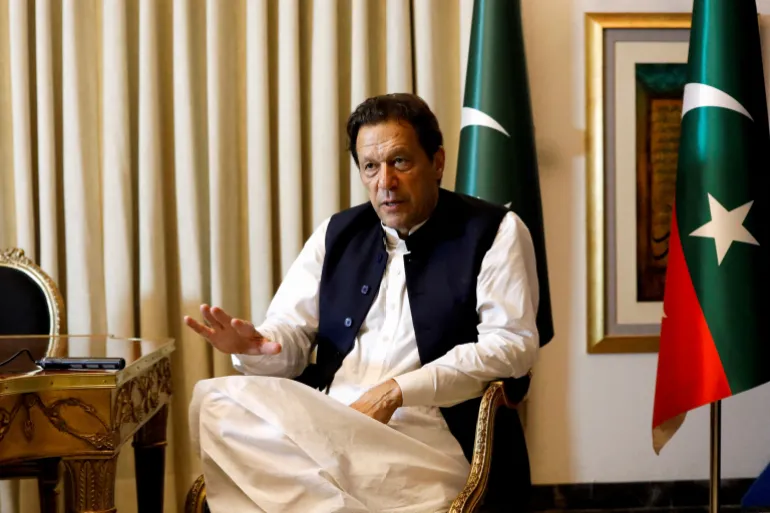
London, United Kingdom – Sulaiman and Kasim Khan have not heard their father’s voice in almost six months.

The last time they spoke to Imran Khan, the imprisoned former prime minister of Pakistan and cricket legend, was over Eid al-Fitr in March. The call lasted 20 minutes.

Recommended Stories

list of 4 itemsend of list

“We don’t know how much time we have to speak,” Kasim, 27, told Al Jazeera in London. “Usually it’s around the 20-minute mark. He frantically asks about our lives and gives us advice. But when we ask about him, he very quickly shuts it down. He doesn’t seem to want to talk too much about how he is.

“You know, it is what it is,” Kasim recalled him saying.

Three years have passed since Khan, 73, was imprisoned in Rawalpindi’s Adiala Jail. He has faced more than 100 legal cases since his 2022 ouster in a vote of no confidence, including charges of bribery, leaking state secrets and illegally selling state gifts. He denies all of the accusations against him.

All of his convictions but one have been suspended or overturned, with appeals pending.

FILE PHOTO: Former Pakistani Prime Minister Imran Khan speaks with Reuters during an interview, in Lahore, Pakistan March 17, 2023. REUTERS/Akhtar Soomro/File Photo
Former Pakistani Prime Minister Imran Khan has spent three years in jail [File: Akhtar Soomro/Reuters]

Khan’s family and his Pakistan Tehreek-e-Insaf (PTI) party believe the charges are politically motivated.

Two of his sisters, Uzma and Noreen, were recently allowed to see him. They said it was the first visit they had had in months.

“They were both quite disturbed by how agitated he was. He’s been mentally tortured with this solitary confinement,” Sulaiman, 29, said.

“His heart rate spikes considerably in his cell. He’s having palpitations due to severe anxiety,” said Kasim. “He’s the most calm, mentally strong person I’ve ever known by a considerable margin. To hear he’s facing anxiety, it’s unfathomable.”

Khan’s lawyers reported in February that he had lost 85 percent of the vision in his right eye.

“He was still wearing an eye patch when he saw our aunt the other day,” Sulaiman said. “For 10 months he wasn’t allowed any visitors. Apart from that brief visit from his sisters, none of the other orders have been followed.”

Pakistan’s Ministry of Information and Broadcasting, in a statement sent to Al Jazeera, rejected the family’s allegations, that Khan has been denied appropriate medical care “or that the government failed to comply with the directions of the Honourable Supreme Court regarding his medical examination”.

“Health matters” should not be politicised, the statement continued, adding that the government “has never adopted a disrespectful attitude towards anyone’s health”.

Faisal Sultan, personal physician along with sisters of jailed former Prime Minister Imran Khan addresses a press conference, in Islamabad, Pakistan, August 21, 2026. REUTERS/Akhtar Soomro TPX IMAGES OF THE DAY
Faisal Sultan, jailed former Prime Minister Imran Khan’s personal physician, along with Khan’s sisters, addresses a news conference, in Islamabad, Pakistan, on August 21, 2026 [Akhtar Soomro/Reuters]

On August 18, a three-judge Supreme Court bench ruled that Khan be moved to the private Shifa International Hospital within two days, that he be granted weekly family visits and twice-weekly calls with his sons, and ordered that his personal physician and sister, both doctors, be allowed to take part in his medical care. Earlier, a cardiac board review found Khan had fluctuating blood pressure and anxiety, attributed to limited contact with his family.

But he was instead taken to a government hospital, PIMS, for a brief check-up before returning to jail on August 20. Khan’s party has since filed a contempt petition.

“These government doctors are essentially told what to say,” said Sulaiman. “We want him independently checked, so we have proof. What are they hiding?”

“The establishment currently has absolute power. Any efforts by the Supreme Court seem ineffective,” said Kasim. “We’re just trying to make as much noise as possible.”

The Ministry of Information and Broadcasting said reports of Khan’s ill health were “not supported by prison or medical records”.

It said Khan has undergone 30 medical examinations since his imprisonment began “in addition to regular examinations by the prison doctor” and that doctors had recently concluded that he appears “oriented, stable and without any recorded acute or unmanaged deterioration”.

Support from the UN to cricketers

Support for Khan’s release has come from the United Nations, Amnesty International, politicians in Washington and London, and 21 former cricket captains.

“We’re hoping the UK could make a difference,” said Kasim. “Our father lived here a long time, and he’s always spoken very highly of England.”

Their mother, Khan’s ex-wife Jemima Goldsmith, has called on Prime Minister Andy Burnham and Foreign Secretary Ed Miliband for help, saying Khan has “endured three years of solitary confinement” in what has become a “human rights emergency”.

She said that their sons, who are British citizens, have been denied visas and warned they risked arrest if they travelled to see Khan, calling the situation “a human-rights emergency.”

Khan’s sons last met him in November 2022 after an attempted assassination on his life.

“We have plans, but we can’t disclose exactly what they are, because anything we say publicly is often very quickly intercepted by those in Pakistan,” Kasim said.

“Now is the toughest time, the bleakest it’s looked. But at least there’s more attention now,” Sulaiman added. “We’re lucky to have good friends and a strong family unit who keep us sane.”

The Pakistani ministry also denied claims that Khan has been isolated or denied contact, saying, “Records show approximately 198 interview sessions involving more than 900 visitor entries. These include his sisters, family members, lawyers, doctors, political representatives and other approved visitors.”

It described his prison conditions as humane, saying the facilities allow for “sleeping, sanitation and exercise”.

“He receives separately prepared meals, including meat, chicken, fruit, milk, nuts, juices and bottled water,” it said. “At the same time, access to a prisoner cannot be used as a platform for unrestricted political communication or political activity from inside prison.”

Supporters of jailed former Prime Minister of Pakistan and leader of Pakistan Tehreek-e-Insaf (PTI) party Imran Khan gather during a protest over concerns about their leader's health, on a road leading to Adiala jail in Rawalpindi, Pakistan, December 9, 2025. REUTERS/Salahuddin
Supporters of jailed former prime minister and leader of Pakistan Tehreek-e-Insaf (PTI) party Imran Khan gather during a protest over concerns about their leader’s health, on a road leading to Adiala jail in Rawalpindi, Pakistan, on December 9, 2025 [Salahuddin/Reuters]

Khan had kept his sons out of the limelight and neither sought a life in front of the cameras.

Kasim said he holds the government responsible for their father’s deteriorating health.

“Where is the humanity in not allowing someone to receive basic health checks or treatment? It’s the pettiness, the petty torture techniques, not allowing him to have books, phone calls with his children, keeping him for 23 hours in an isolated cell,” he asks.

“If they reject any claims of mistreatment, prove it. Bring him to an unbiased doctor and hospital, and show the medical reports. It puts our minds at ease, and shows the people of Pakistan that their elected leader is healthy.”

But he continues to believe in his father’s strength.

“If there’s hope that anyone can remain resilient through this period, it’s him, even though it’s so brutal in these conditions,” said the younger brother.

Source link

Nepal and China halt rescue efforts as border barrier lake overflows | Climate Crisis News

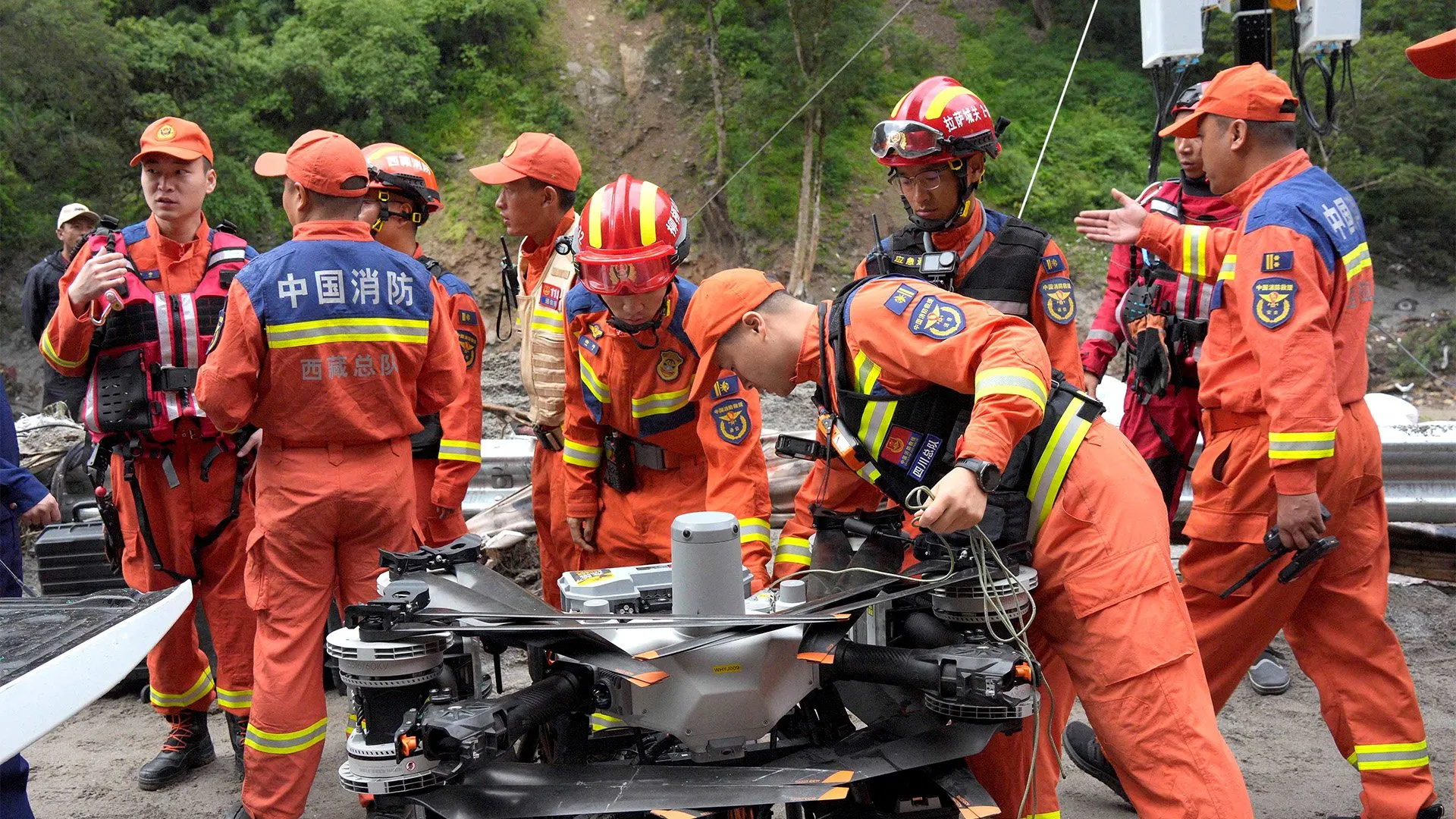
Nepal and China have paused rescue efforts for survivors of the devastating flash flood that hit the border region two days ago as a “barrier lake” formed during the disaster began to overflow.

Chinese rescue teams and vehicles were forced to pull back to safe ground, state broadcaster CCTV reported, as the risk of the lake bursting rose. Nepalese authorities also paused search operations for 90 minutes, an army officer confirmed.

The “barrier lake”, formed as Wednesday’s flash flood carried huge volumes of mud and debris down a steep valley, is threatening to unleash another huge and destructive wave.

In Nepal’s Rasuwa district, on the border with Tibet, residents were seen scrambling up hillsides to escape potential surges in the river level, according to the Reuters news agency.

The barrier lake adds a new threat to communities devastated by Wednesday’s flash flood [EPA]

The disaster unfolded as a glacier collapsed and sent a huge torrent of ice, water, rock, and mud down Himalayan river valleys, burying entire villages and destroying roads, bridges, and hydropower plants.

In its wake, leftover debris trapped water to form a barrier lake, a natural dam created when landslides block a river.

With water continuing to pour into the lake, the threat to downstream communities of another wave of flooding is rising.

China has deployed an engineering team to conduct aerial surveys and 3D modelling of the site. By Friday, the lake’s volume had swelled to more than 2.5 million cubic metres, up from the estimated 1.5 to 2 million cubic metres recorded just a day earlier.

Downstream in Nepal, officials received warnings that the lake had begun breaking its bank, according to Narendra Pariyar, the top administrator in the hard-hit Rasuwa district.

“We can see that the level of water in the river is rising,” he said, adding that the exact height of the surge remains unclear.

Relief supplies blocked

The death toll from the disaster has surpassed 470. On Friday, the Nepalese prime minister’s office reported 469 confirmed deaths, with 977 people still missing. About 1,550 people have been rescued.

Chinese authorities reported on Friday that the death toll in Tibet has now risen to at least five, with 558 missing.

Bishal Nath Upreti, president of the Nepal Centre for Disaster Management, told Al Jazeera that conditions are “extremely difficult” for those trapped in the disaster zone, as destroyed roads have left them completely cut off.

So far, about 800 people have been rescued by helicopter and 700 by land, with airlifts delivering vital aid to survivors.

Al Jazeera’s Katrina Yu, reporting from Beijing, said the number of missing is expected to rise. China has deployed about 500 military and paramilitary personnel and sent Premier Li Qiang to supervise operations on the ground, while Nepal has deployed 30,000 security personnel to search remote, cut-off valleys, she said.

More ⁠than ⁠90,000 people are estimated to have been affected ⁠by disaster, the ⁠Red Cross said on Friday, adding that the delivery of relief supplies has been blocked by the overflowing lake.

“We’re of course very concerned about the secondary flood,” said David Fisher, head of delegation ⁠for the International Federation ⁠of Red Cross and Red Crescent Societies in ⁠Nepal.

Source link

Biden never pressured Israel for ceasefire, as Israeli officials boast of exploiting US support – Middle East Monitor

The administration of former US President, Joe Biden, knowingly allowed Israel’s genocide in Gaza to continue long after it had lost any clear military objective, with senior officials in Washington privately admitting it amounted to “killing and destroying for the sake of killing and destroying”. This damning assessment, along with revelations of political manipulation, diplomatic cover-ups and sabotaged peace efforts, comes from a bombshell investigation aired by Israel’s Channel 13. Details of the investigation have been translated by Drop Site News and shared on X.

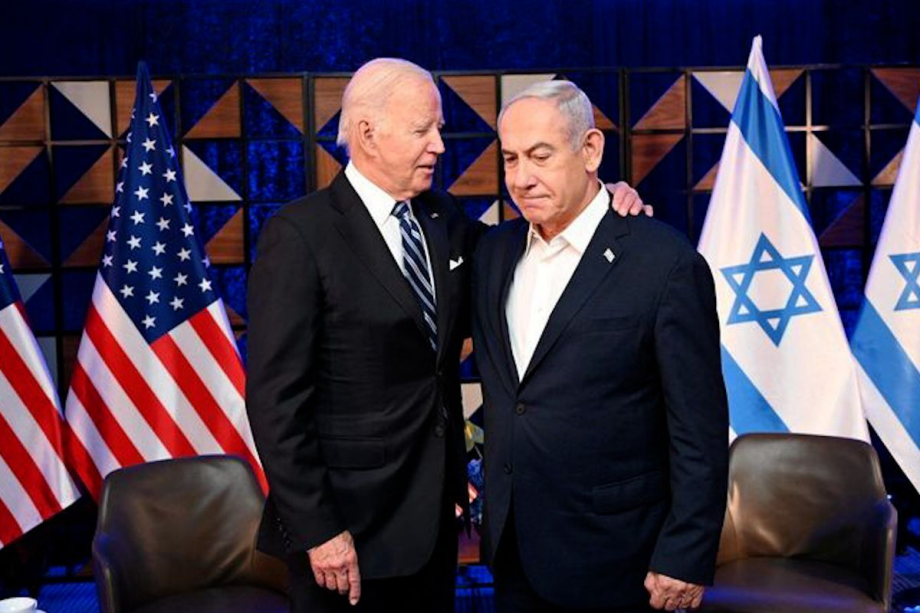
The Biden administration allowed Israel unprecedented leeway to carry out its military offensive, despite the enormous death and devastation it inflicted on Gaza. Former Israeli ambassador, Michael Herzog, made a startling admission about Biden’s support: “God did the State of Israel a favour that Biden was the president during this period. We fought [in Gaza] for over a year and the administration never came to us and said, ‘ceasefire now.’ It never did. And that’s not to be taken for granted.” His remarks encapsulated a broader sentiment that the White House gave Benjamin Netanyahu all the political space he needed to execute the military offensive, which has claimed the lives of more than 52,000 Palestinians, mainly women and children.

READ: ICC judges order prosecutor to keep arrest warrant requests confidential in Gaza probes

The investigation, which included interviews with nine current and former US officials, reveals a deeply troubling portrait of US complicity in Israel’s genocide in Gaza. Former national security aide, Ilan Goldenberg, stated that the war amounted to “killing and destroying for the sake of killing and destroying”, with no viable political alternative ever established. Despite the White House’s public messaging about restraining Israel, the internal consensus appeared to be that the administration had no intention of exerting real pressure on the Occupation state.

The Biden administration also shielded Israel from allegations of war crimes, prompting a major backlash from staffers in the State Department. Lawyer Stacy Gilbert, for example, resigned in protest after being excluded from a key report that falsely claimed Israel had not violated US arms laws. Gilbert described the report as “shocking in its mendacity”, pointing out that aid obstruction and settler attacks were well documented, yet ignored. Meanwhile, Washington continued to certify Israeli compliance with US law, ensuring the uninterrupted flow of weapons.

The investigation also revealed that Israeli Prime Minister, Benjamin Netanyahu, deliberately sabotaged hostage negotiations in order to prevent a ceasefire. US officials confirmed that Netanyahu tanked talks out of fear that a deal would compel him to halt the war.

Despite public backlash, Biden’s private approach remained deferential. Even after reportedly telling Netanyahu he was “full of shit” and hanging up mid-call, Biden ultimately maintained support. After briefly halting a shipment of 2,000-lb bombs due to concerns about their use in densely populated areas of Gaza, Netanyahu publicly accused Washington of broader arms delays. Biden, rather than escalating pressure, resumed the shipment process shortly thereafter.

The Channel 13 exposé further confirms that Biden’s reluctance to push Israel was deeply tied to a failed diplomatic initiative with Saudi Arabia. A landmark normalisation deal was in sight, but it required Israeli recognition of Palestinian statehood. These were flatly rejected by Netanyahu’s far-right coalition. Former US ambassador, Jack Lew, said he found Israel’s refusal “shocking”, while Amos Hochstein expressed disbelief that such a strategic opportunity was squandered. Sources confirmed that Netanyahu deliberately stalled negotiations in hopes that President Trump would return to office and claim the diplomatic win for himself.

These revelations lend significant weight to long-standing accusations that the Biden administration has not only provided diplomatic cover for Israel’s propaganda by repeating lies, but also actively enabled what many view as a campaign of ethnic cleansing. Critics note that Biden himself amplified false Israeli claims, such as the widely discredited allegations of Hamas beheading babies, rhetoric that helped to dehumanise a population in order to carry out genocide.

OPINION: Advisory opinions will not stop genocide

The views expressed in this article belong to the author and do not necessarily reflect the editorial policy of Middle East Monitor.

Source link

Army Widens Stinger Surface-To-Air Missile Replacement Search

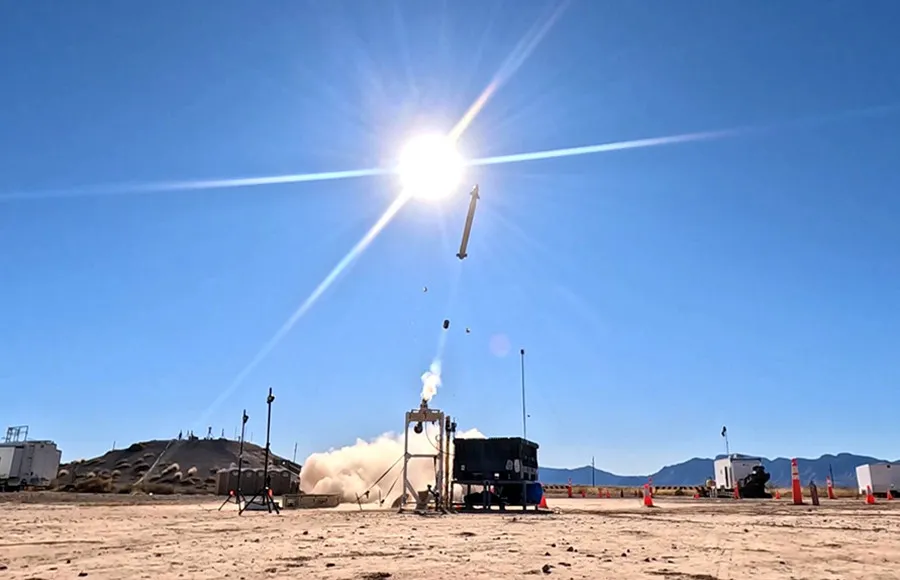
The U.S. Army is calling for new potential options for replacing the venerable Stinger short-range heat-seeking surface-to-air missile. The service has already been funding work on two competing designs from Lockheed Martin and Raytheon under its Next-Generation Short-Range Interceptor (NGSRI) program since 2023. The Army is currently aiming to buy 11,000 NGSRI missiles, as well as 2,200 new man-portable launchers, starting in Fiscal Year 2028.

The Army put out a contracting notice regarding what it is calling the NGSRI Alternate Interceptor Demonstration (AID) yesterday. The service is looking to hold an industry day event regarding its plans for the AID at Redstone Arsenal in Alabama next month.

“The Army is seeking to identify additional potential sources to fulfill the NGSRI requirements,” the notice explains. “The Army plans to conduct a demonstration in the Spring 2027 timeframe. A successful demonstration by an offeror may lead to an award for missile procurement.”

A picture showing a test of Lockheed Martin’s NGSRI entrant, called QuadStar. Lockheed Martin
Raytheon has previously released this image in relation to work on its NGSRI design. Raytheon

“The current NGSRI program was initiated to meet the Department of the Army requirement for Maneuver Short Range Air Defense (M-SHORAD) surface to air missile systems to replace the legacy FIM-92 Stinger man-portable air defense system,” the notice adds. “The NGSRI is a high performance, soldier portable, fire and forget, surface to air missile system capable of defeating rotary wing, fixed wing, and Group 2/3 Unmanned Aircraft System threats.”

US Marines fire a Stinger missile during training. The NGSRI program is seeking a replacement for Stingers in Army and Marine Corps service. US Army

In U.S. military parlance, Group 2 covers drones with gross weights between 21 and 55 pounds, that can fly up to altitudes of 3,500 feet, and hit top speeds of up to 250 knots. Group 3, the next tier up, is a far broader category that encompasses uncrewed aerial systems weighing anywhere between 55 and 1,320 pounds, with operational ceilings between 3,500 and 18,000 feet, and with top speeds between 100 and 250 knots.

The Iranian-designed Shahed-136 one-way-attack drone is, by far, the best-known example of a Group 3 design, and one that encapsulates the importance of addressing threats in that particular category. Development of kamikaze drones in the Group 2 tier has also been surging globally, including in the United States. Both categories do also include drones configured for surveillance and reconnaissance and other missions.

It is also worth noting here that the Stinger has received upgrades in recent years to improve its effectiveness against drones. You can read more about that missile’s evolution since it was first introduced in the 1970s here.

Stinger missiles with proximity fuzes destroy UAVs thumbnail

Stinger missiles with proximity fuzes destroy UAVs


“The NGSRI missile is backwards compatible with the legacy Stinger missile platforms such as SGT STOUT and Marine Corps Marine Air Defense Integrated System (MADIS),” yesterday’s contracting notice also stresses. This has been a key requirement since the program started.

Sgt. Stout is the name given to an air defense system in Army service today that is based on the 8×8 Stryker light armored vehicle. The Sgt. Stout has a turret that can be fitted with up to two four-round launchers for Stingers. Those launchers can also be swapped out for ones that can be loaded with a pair of millimeter-wave radar-guided AGM-114L Hellfire missiles. The turret also has a 30mm XM914 automatic cannon, which can fire proximity-fuzed airbursting rounds against drones and other aerial threats, and a 7.62x51mm M240B machine gun.

A Sgt. Stout air defense vehicle fires a Stinger missile during training. US Army

The four-round Stinger launchers used on the Sgt. Stout are the same ones found on the older Humvee-based Avenger air defense systems, which are in increasingly limited use in the U.S. Army and Marine Corps. Army Avengers were recently in the news after images emerged showing them protecting President Donald Trump at his golf course in Bedminster, New Jersey.

An Army Avenger system seen deployed in Bedminster, New Jersey earlier this month. USAF Lt. Col. Andrew Scott

In its current form, the Marine Corps’ MADIS consists of two 4×4 Joint Light Tactical Vehicles (JLTV) in different configurations. One is armed with Stinger missiles, as well as an XM914 cannon and M240 machine gun, all mounted on a single remote weapon station. The other has the same type of remote weapon station, but without Stingers, and also has added electronic warfare, electronic support measures, and sensor capabilities.

A Marine MADIS vehicle fires a Stinger missile during training. USMC

Stinger is still perhaps best known in its shoulder-fired form, also known as the Man-Portable Air Defense System (MANPADS) configuration, as seen in pictures earlier in this piece. The Army has already been pursuing new individual launchers, or Control Launch Assemblies (CLA), for use with existing Stingers, which could also be used with future NGSRI missiles. Lockheed Martin has publicly put forward a new CLA design as part of its NGSRI proposal, which is called QuadStar, as seen in the video below.

Whether or not the newly announced AID plans reflect any major issues with the existing NGSRI competition is unknown. Lockheed Martin and Raytheon have announced the successful passage of major milestones in work on their respective designs at separate points this year. Raytheon is also the current prime contractor for the Stinger.

Stinger is also in widespread service globally. Any replacement the U.S. military might adopt, especially one that is backwards compatible with existing launchers, could easily translate to interest from foreign armed forces. The ongoing war in Ukraine and other conflicts in recent years have contributed to a new surge in demand for MANPADS worldwide, including to help counter growing drone threats.

The U.S. military has been putting new emphasis on diversifying supplier bases and greater government control of intellectual property rights, especially for munitions, in recent years. This is a general focus area that has grown even more since President Trump’s second term began last year. Officials have been open about their desire to reduce reliance on traditional prime contractors and bring in more smaller and non-traditional firms, even for very high-profile weapon system programs. These efforts reflect a particular push to avoid so-called ‘vendor lock’ and promote greater competition, which can also offer benefits when it comes to cost and scaling production.

When it comes to NGSRI, as mentioned, the Army is looking to buy thousands of these missiles, as well as individual launchers, in the coming years. A new demonstration next year would also not preclude the service from ultimately ordering NGSRIs from either Lockheed Martin or Raytheon.

With plans to start production of the selected NGSRI design in Fiscal Year 2028, which starts on October 1 of next year, the Army will need to make a decision about how to proceed with NGSRI relatively soon.

Contact the author: joe@twz.com

Joseph is TWZ’s Deputy Editor, helping to oversee the site’s highly experienced and dedicated team, while also writing informative and impactful defense and national security content. He lives right in the thick of it in the Washington, D.C. area.


Source link

US judge blocks Pentagon blacklisting of AI firm Anthropic | Civil Rights News

Court order rules that Pentagon acted illegally, punishing AI company for criticism of government.

A United States judge has blocked the Pentagon’s blacklisting of technology company Anthropic.

In a 59-page written order issued on Thursday night, District Judge Rita Lin ruled that the Department of Defense had acted illegally when it designated the company a supply chain risk to national security.

Recommended Stories

list of 3 itemsend of list

The decision marks the latest turn in the Claude maker’s high-stakes fight with the US military over artificial intelligence safety on the battlefield. The government is expected to fight the ruling.

The judge’s order rebuked the Pentagon, saying it had targeted and punished Anthropic for the company’s public criticism of the Defense Department’s stance on AI deployment on the battlefield.

“The empty invocation of national security is not a blank check to punish and retaliate against government critics,” Lin, an appointee of former President Joe Biden, wrote.

Autonomous weapons and domestic surveillance

Anthropic’s lawsuit in a California federal court alleges that Defense Secretary Pete Hegseth overstepped his authority when he designated the company a national security supply-chain risk.

Hegseth’s move, which blocked Anthropic from military contracts, followed the company’s refusal to allow the military to use its Claude AI models for US surveillance or autonomous weapons.

Anthropic argues that AI models are not reliable enough for autonomous weapons and opposes domestic surveillance. The Pentagon maintains that private companies should not constrain military action.

Executives have said the ban could cost the company billions of dollars in lost business.

During a hearing on July 30, Lin described the government’s position as “really troubling” and “at odds … with the First Amendment”, adding that the record had “gotten worse for the government” over time.

In the same hearing, Department of Justice lawyers argued that the nature of AI models is “so staggeringly enormous and opaque” that the Pentagon cannot evaluate them like physical hardware.

First use of obscure statute

Anthropic welcomed the ruling, stating it remained “focused on working productively with the government to harness AI for our national security so all Americans benefit from this technology”.

The designation was the first time a US company has been publicly labelled a supply-chain risk under an obscure procurement statute aimed at protecting military systems from foreign sabotage.

In its lawsuit, Anthropic alleged the government violated its constitutional rights to free speech and due process by retaliating against its views on AI safety without allowing it to dispute the claim.

The lawsuit called the decision unlawful, unsupported by facts, and inconsistent with the military’s past praise of Claude.

There was no immediate comment from the Pentagon on the ruling.

Source link

Six months of war between Iran, US leave Arab states facing tough questions | Oil and Gas News

The Iran war is settling into attrition, with no regime collapse and Gulf economies facing growing uncertainty

Analysts broadly agree the United States and Israel’s war on Iran will not see regime collapse in Tehran or a definite victory for Washington, but rather a dragged-out affair of stagnation and attrition.

The hope among the US leadership at the start of the war, which began after surprise Israeli and US attacks on February 28, was that mounting economic and military pressure on Iran would force a structural shift in Tehran. Six months on, it is clear this vision will not come about, and instead many are preparing for a protracted war and managed fallout.

Recommended Stories

list of 4 itemsend of list

Oil-dependent economies are still absorbing supply shocks after traffic in the Strait of Hormuz slowed to a trickle of pre-war levels following Iran’s attacks on shipping and a US blockade on Iranian ports.

The US military is still entrenched in a region that remains its most militarised in years. Although the war’s intensity has lessened since a memorandum of understanding (MoU) was signed by Washington and Tehran in June, there is no sign it will conclude, leading to continued uncertainty about the future.

Existing tensions, such as those between the Houthi rebels and Saudi Arabia in Yemen, look only set to increase as the war drags on. The influence of rival powers, such as those of India and China, remains stalled rather than stopped, with Beijing’s Belt and Road Initiative having already established itself within the Middle East and North Africa. All in all, the region remains in flux where formal alliances with outside powers no longer guarantee safety.

The defence agreement between Turkiye, Pakistan and Saudi Arabia recently signed in Mecca will likely be the first of many such military pacts agreed in the region.

“The war has just accelerated trends, but hasn’t really started anything that wasn’t already under way. The Gulf countries were already diversifying their economies,” Sanam Vakil, director of the Middle East and North Africa Programme at Chatham House, told Al Jazeera. “Many were already looking at broadening their defence partnerships beyond existing US security guarantees, as well as increasing their own defence capability.”

Israel, for its part, is still pursuing its regional project of “paramountcy”, HA Hellyer of the Royal United Services Institute said, despite its failure to bring Iran to its knees this year.

“There is no chance of the government in Tehran falling in the next six months,” Hellyer told Al Jazeera. “If everything were to theoretically stay the same … with just increased economic pressure, that could eventually cause a ripple effect that could lead to state collapse in Iran. But we’re talking years, not months, and everything is not likely to stay the same.”

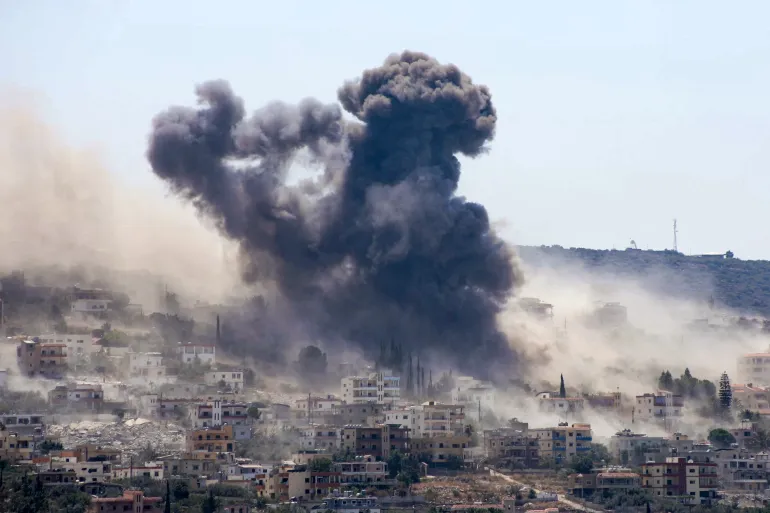
A photograph taken from the southern Lebanese city of Tyre shows smoke rising from the site of a string of Israeli airstrikes that targeted the area of al-Mansouri on August 25, 2026. [Kawnat Haju/AFP]
Smoke rises from the site of a string of Israeli air strikes that targeted the area of al-Mansouri, as seen from the southern Lebanese city of Tyre on August 25, 2026 [Kawnat Haju/AFP]

The effective closure of the Strait of Hormuz and strikes on regional cities have hindered Gulf states’ plans to use oil revenues as an engine to diversify their economies and build on their reputations as a safe haven to encourage investors.

Shipments of oil, derivative products and liquefied natural gas (LNG) have been repeatedly and severely disrupted since the US and Israel launched their attacks on Iran in February.

Transit through the Bab al-Mandeb Strait, which saw attacks on shipping by the Houthis during Israel’s genocidal war on Gaza, became even more hazardous in July, when the Iran-allied Houthis declared a naval blockade of Saudi Arabia.

“The price of oil has increased broadly in line with the Gulf states’ difficulties in exporting it,” John Sfakianakis, chief economist at the Gulf Research Center, told Al Jazeera. “Is this going to go for six months? Is it going to go on for longer?”

Exacerbating the Gulf states’ difficulties is that, although the price of oil has risen, so has inflation. In addition to the economic difficulties the war has created, there is also growing pressure for Gulf states to invest more in defence.

For now, the majority of the states caught in the middle will look at ways of living with the turmoil and managing the consequences.

Source link

Nepal’s mudslide wiped out areas of eastern China, army helps search | Climate Crisis

China has dispatched hundreds of military personnel to the border town of Gyirong in Tibet, after a wall of ice, mud, and rock collapsed into a mountain river, triggering a catastrophic flash flood on Thursday. Al Jazeera’s Katrina Yu reports from Beijing.

Source link

Luis Mariano Rivera and the Battle for Cultural Sovereignty 

Rivera sang about rural life in times of fast neocolonial expansion. (Venezuelanalysis)

Venezuelan popular artist Luis Mariano Rivera was born on August 19, 1906. His music is a tribute to life and a commitment to his community’s identity and cultural sovereignty. Rivera’s works remind us that when a people sow their land and tell their stories, they become resistant to oppression and invincible against foreign domination.

A brief and affectionate profile

In the fertile and sunny lands of eastern Venezuela, specifically in the lush village of Canchunchú in Bermúdez Municipality, Sucre State, Luis Mariano Rivera was born on August 19, 1906, 120 years ago. His life was shaped by the rural realities of this area, which combined the abundance of nature with the profound inequalities of a latifundista-dominated agrarian economy.

His childhood was marked by early orphanhood and farm labor. Far from leading to resentment or resignation, this experience shaped in Rivera a loving and vital sensibility that allowed him to dismantle traditional notions of property and patriarchal-landowner hierarchy, enabling him to identify with the land, plants, and animals that surrounded him. This connection to the land enriched his imagination, and his extended family ultimately came to encompass the entire territory.

Rivera’s creative work blossomed after he turned 48. A self-taught musician, poet, and playwright, he composed his first verses using the Venezuelan four-stringed cuatro guitar as his primary instrument. His artistic output became an act of defiance that placed elements dismissed by the dominant culture at the center of Venezuelan poetry: local biodiversity, manual labor, trees, fruits, and wildlife.

Through his popular theater plays and musical compositions, Rivera portrayed a cosmogony in which nature is not merely a resource to be exploited, but a subject with rights to be loved and respected.

Although he never joined any political party nor sought public office, his approach to life and art constitutes a profound political statement. In a Caribbean and Venezuelan context where the neocolonial oil rentier model displaced agricultural production and fueled the exodus from the countryside to the city, Rivera’s insistence on staying in Canchunchú and singing about rural life was a clear act of resistance.

His politics were rooted in pacifism, fraternity, and love for the land. In the face of the metastasizing commodification of life, he prioritized the ethics of care, respect for natural cycles, and community solidarity. Various artists of national and international renown, including Alí Primera, Lilia Vera, Cecilia Todd, Soledad Bravo, Gualberto Ibarreto, and Morella Muñoz, performed his songs, transforming his local message into a banner of continental identity. Alí Primera, in particular, saw Rivera as a beacon of popular dignity, celebrating his ability to transform everyday rural life into revolutionary and loving poetry.

Luis Mariano Rivera passed away on March 15, 2002, in Carúpano, Sucre State, at the age of 95, after nearly a century devoted to cultivating the poetry of life, simplicity, and affection. His legacy is recognized as a symbol of the musical identity that flows directly from the harmonious relationship with the land and the wisdom of the people.

Sound, memory, and collective identity

In many of the ancestral cultures of Abya Yala, sound is part of the creation myth of the women and men who originally inhabited these territories. For all of humanity, sounds have played an important role in the formation of identities. Languages and music stem from this very relationship and our need to connect, to name ourselves, and to determine our own destinies.

Every landscape has its own sonority. In other words, a set of sounds that form its geohistory. This includes our ways of speaking and our music, but also the sounds of the wind, the rain, the sea, the river, birds, insects. In short, all the sounds of life expressing itself, as well as the sounds of human inventions that are now part of our daily lives.

Within this spectrum, there are human beings who manage to connect the sounds of past, present, and future memories to bequeath a sonic identity that transcends the purely artistic realm, becoming the very landscape narrated in their poetry. Luis Mariano Rivera is an example of this transcendental audacity to place oneself beyond time with a unique music.

At the age of 48, driven by the desire to express himself without relying on others to write his letters and thoughts, he taught himself to read and write. Already in his mature years, he began composing verses, parrandas, merengues, and eastern joropos through which he paid tribute to the flora, fauna, and everyday life of his village.

Rivera’s remarkable sensitivity stems from his direct observation of the countryside. His lyrics preserve idioms, sayings, and oral expressions from eastern Venezuela that would otherwise have been lost. Long before the rise of globalized environmental movements, his songs already championed the balance between humans, wildlife, and flora from a local, community-based, and decolonizing perspective. Rivera’s legacy transcends mere musical composition; he represents a defense of communal life and a living example of how it is possible to reclaim one’s own history to create sounds that cement collective identity.

For him, Canchunchú was not merely a geographical reference point, but the center of the world. By singing about his village and embracing rural daily life as a symbol of belonging with a claim to universality, he created an affective geohistory that recognized the dignity of life as equivalent to that of the cherry, the guácara [snail], and the mango. He showed to his community that their own reality is worthy of being celebrated and sung about. As such, his work did not stem from ego. It was born out of the village’s celebrations and gatherings, and like collective knowledge, it has no other purpose than enjoyment and the strengthening of collective unity.

Singing honestly about one’s own village, honoring the vernacular of one’s community without resorting to artificial language, taught us a sense of pride in our ways of feeling, understanding, and reasoning. 

Rivera’s music, paraphrasing Alí Primera, grounds us in our own land, with the profound simplicity of one who surrenders to the magnitude of the surrounding beauty. His deep connection to his native Canchunchú never served as chauvinistic isolation or picturesque folklorism. Rather, it was a gateway to the human condition prior to the violent irruption of Western capitalist modernity, with its imposition of individuality, the commodification of nature, and linear progress, at the expense of communal memory. Rivera’s work operates in the opposite direction: it reconnects with an organic body of knowledge that does not require academia to be legitimate, because it is engraved in the lived collective experience.

It is no secret to anyone that traditional community music, as well as rural poetry, serves as a means of transmitting memory. It is not mere entertainment. Rhythmic patterns, melodic turns, and poetic meter interact with the biological, agricultural, and communal cycles that humankind has cultivated for millennia.

Rivera did not theorize about nature: he embodied it. His philosophy sprang from working the land, from sweat, and from the sounds of the countryside. It is the knowledge transmitted through the body and emotion, that “communal way of life” that predates modernity and remains a reservoir from which to conceive alternatives to capitalism, fascism, imperialism, and Zionism.

True universality does not consist in erasing differences under a single mold with domineering hegemonic pretensions, but rather in reaching our very roots. When we reaffirm the dignity of our communities, we validate the “peripheries” as the center of our own worldviews without the need for external recognition.

Rivera demonstrates that the periphery is a center in and of itself by stripping away the pretensions of colonial modernity. His music taps into the common core of humanity: the wonder of being alive, communal solidarity, and respect for the sacred meaning of life. And this is not a nostalgic gaze toward the past, but rather a reservoir of meaning and hope for the present. It reminds us that beneath the veneer of modernity, the human species remains hardwired to come together, celebrate, and sustain communities.

Finally, Rivera’s production is above all an expression of love. Love toward the full life experience. But when a poet sings about love, it is usually limited to romantic love, or heartbreak in the absence of corresponding feelings. Nevertheless, Rivera did count on a “spiritual companion,” to use his own words: Maximina Marsella, known as La Negra Marsella and whom he affectionately called “la negra,” in what is a very common expression in Venezuela. She was presented as the only woman capable of understanding his silences and his late passion for words. He dedicated many love verses to her, expressing how they shared feelings and devotion for the small things in life and the land.

Writing our own history and cultural sovereignty

The act by which a dispossessed individual reclaims control over the written word is, in essence, an act of sociopolitical liberation. For Luis Mariano Rivera, the decision to learn to read and write on his own as an adult was not merely a matter of functional education or an attempt to conform to bourgeois standards. It represented taking control of his own narrative and a fundamental reaffirmation of his personal and communal sovereignty. In a system dominated by the colonialism of knowledge, where official writing has historically functioned as a mechanism of subordination and administrative control, mastering the alphabet from the campesino perspective means dismantling the monopoly on truth. Rivera lucidly understood that mastering the written code granted him the historical ability to cease being a passive subject, an object of study in folklorism, and become the chronicler and philosopher of his own time. He ceased to be narrated by others and assumed authorship of his territorial memory.

This literacy and poetic endeavor took place against a profoundly adverse historical backdrop. Throughout the twentieth century, Venezuela underwent a traumatic transformation driven by the emergence of the neocolonial oil enclave. Urban modernization advanced aggressively through its ideological and economic strategy of marginalizing the countryside, dismantling traditional community structures, and promoting rural depopulation in favor of slums in the major cities.

The extraction of hydrocarbons by transnational corporations tied to the geopolitical interests of US and European imperialism came alongside an overwhelming wave of cultural propaganda. This ideological penetration sought to impose the American consumerist lifestyle, eroding peasant identity and dismissing local agriculture as synonymous with backwardness and savagery. Venezuela, which was barely emerging from the devastating aftermath of the war of independence and successive nineteenth-century insurrections, revolutions, and civil wars stoked by local elites and foreign capital, saw its food sovereignty and historical memory shaken.

Amid this landscape of alienation, where the country was rapidly transforming into a consumerist, import-dependent enclave, Rivera’s insistence on remaining in his Canchunchú valley and singing about the communal way of life was not a nostalgic or folkloric retreat, but rather a deeply political and assertive affirmation of cultural re-existence.

He sang with such transparent and loving clarity that his powerful message took root in the national collective imagination, ethically reframing the traditions, sufferings, joys, and experiences of campesinos in eastern Venezuela. Against the aesthetics of waste and the logic of neocolonial dispossession, he countered with the ethics of care and the sacredness of everyday life. His compositions served as a mechanism for preserving historical memory: he warned against the collective amnesia regarding the communal way of life driven by the discourse of developmental modernity; he championed food sovereignty in the face of dependence on the globalizing market; he dignified rural labor in the face of urban prejudice, revealing the profound ecological philosophy inherent in popular knowledge. But, moreover, his profound poetic work demonstrates that true national sovereignty is more than just the defense of natural resources or borders. It requires the preservation of the collective soul, the dignity of the living word, and the self-determination of the people’s power.

Luis Mariano Rivera’s life journey teaches us that decolonization is not achieved solely through theoretical confrontation or bellicose rhetoric, but above all through an organic connection to the land and the community. By recognizing himself through his own voice, he prevented imperialist corporations and the oil industry’s maelstrom from erasing the humanity of his surroundings. His music endures as an indestructible testament to cultural sovereignty: living proof that a people who remember their roots, cultivate their land, and tell their own stories become resilient in the face of modern oppressions and invincible against any attempt at external domination.

Fabiola José is a Venezuelan singer. She has performed in countries across South America, Africa, Europe, and Asia. Her singles and albums are available on all digital platforms. She hosted and produced “Cantante y Sonante” for Radio Nacional de Venezuela. In 2018–2019, she created a series of videos for social media, published on her YouTube channel #HechoEnCasa. She holds a bachelor’s degree in Music from IUDEM, Caracas (2005); specialized under Maestro Tom Krause in Spain (2007); and an M.A. in Arts and Cultures of the South from UNEARTE, Venezuela (2020).

Fidel Barbarito is a Venezuelan musician and researcher, with a bachelor’s and master’s degrees in music and history, respectively. He teaches in the undergraduate and graduate programs at the National Experimental University of the Arts (UNEARTE). Together with Fabiola José, he promotes several musical projects aimed at disseminating traditional repertoires, integrating them with contemporary compositions inspired by these sounds. Joropo llanero. Parranda de reexistencia is one of his published essays.

The views expressed in this article are the authors’ own and do not necessarily reflect those of the Venezuelanalysis editorial staff.

Source link

Congo launches Ebola vaccination drive to tackle deadly outbreak | Health

The Democratic Republic of Congo is launching an Ebola vaccination campaign to tackle the deadliest outbreak of the virus the country has ever seen. It is using a vaccine for a different strain of the virus, since there is no vaccine yet for the outbreak’s Bundibugyo variant.

Source link

Chad accuses Sudan of deadly air strike near shared border | Border Disputes News

An air strike on a fuel market near Chad’s border with Sudan killed 12 and injured seven, according to officials.

An air strike near Chad’s border with Sudan has killed at least 12 people, with Chad accusing the Sudanese army of launching it.

Addressing Thursday’s strike, a Chadian security source said it “targeted a fuel market where the RSF [Rapid Support Forces] refuel. The strike killed 12 people and wounded seven”, AFP news agency reported about the attack on the paramilitary group.

Recommended Stories

list of 3 itemsend of list

Chad’s accusation comes against the backdrop of a civil war between Sudan’s army and the RSF which has lasted over three years and displaced millions of people.

Previously, Chad said that Sudan was responsible for an air strike that hit a military convoy in its territory last week. Chad’s army said the strikes took place more than 100km (62 miles) inside its territory in the eastern Ennedi region, and that there were no Chadian casualties.

In response to threats posed by drones, Chad had raised its alert level in the area to its highest point, according to a security source. The country deployed about 100 armoured vehicles and signal-jamming trucks near eastern Tine, close to the Sudanese border, a local source told Reuters news agency.

On Thursday, Sudan said it was surprised by the allegations against its army “before any professional and independent investigation into the circumstances of the incident”.

Sudan’s Foreign Ministry said its forces “are carrying out their constitutional duty to protect Sudan’s sovereignty, security and safety and to face any threats it faces, while respecting the sovereignty of its neighbours and without targeting their territory”.

The US embassy in Khartoum also accused the Sudanese army of launching the recent strikes on Chad, condemning them on Thursday.

The Sudanese army has previously accused Chad of being aligned with the RSF. Meanwhile, nearly one million displaced Sudanese people have fled to Chad, where they have been facing a water crisis.

Source link

Friday 28 August Fourth Onam in Kerala

The legend is that King Mahabali, also known as Bali was an Asura ruler during Hindu antiquity who was so powerful and adored by his subjects, that the followers of Hindu god Vishnu feared that Bali was getting more popular than their deity.

Vishnu disguised himself as a dwarf called Vamana. Vamana tricked Bali by asking for a piece of land he could cover in only three strides. When Bali agreed to this modest request by a dwarf, Vamana turned into a giant and his first step covered the earth and the second took him to heaven. With nowhere else to go, Bali offered his head as the third step. Vamana stepped on Bali pushing him down into to the underworld. Bali asked if he could be allowed to return once a year on Thiruvonam (the second day of Onam) to visit his people to make sure they were well, and Vamana agreed.

To welcome Bali home for his annual visit, the people of Kerala clean their homes and make elaborate floral displays called Pookkalam on the ground as a carpet to welcome Bali. They perform Kathakali, one of the major forms of classical Indian dance.

Other events include boxing competitions, featuring Thallu, a martial art native to Kerala and snake-boat races which are held at Champakulam, Aranmula, and Kottayam. The boats have a high narrow stern that resembles the neck of a snake and some are up to 130 feet long and need over 100 rowers.

NASA’s Hunt To Replace Its Iconic T-38 Talon Jets Kicks Off

NASA is starting to explore options to fill the gaps that will be left by the eventual retirement of its iconic T-38 Talons. Since the 1960s, NASA has been using the jets to support astronaut training and as chase planes. However, the Talons are aging, supportability is already a problem, and challenges to sustain them further are expected to grow as the U.S. Air Force replaces its T-38 fleet with new T-7A Red Hawks.

The Johnson Space Center (JSC) in Houston, Texas, put out a contracting notice today seeking information about potential T-38 successors. NASA currently has 25 Talons in its inventory, according to the Federal Aviation Administration’s (FAA) online database.

A trio of NASA T-38s at the Johnson Space Center (JSC) in Houston, Texas. NASA

“NASA JSC is conducting market research to obtain industry information regarding availability, capability, schedule, sustainment models, and cost efficacy for modern high-performance jet aircraft that could be used in evaluation and an evaluation program for supporting NASA’s astronaut SFRT [Spaceflight Readiness Training] requirements,” the notice explains. “NASA has operated the T-38N fleet in support of astronaut SFRT for several decades. With the U.S. Air Force planning to retire the T‑38 fleet in the 2030-2035 timeframe, NASA is evaluating options to transition to a more modern high-performance aircraft.”

The T-38N variant is specific to NASA and distinct from the T-38A/B/C variants the Air Force currently operates. The U.S. Naval Test Pilot School also has a handful of T-38Cs. Both the N and C variants are based on the original T-38A, which first entered Air Force service in 1961. The Air Force bailed the first Talons to NASA three years later.

A pair of US Air Force T-38 Talon jet trainers. USAF

The N models have received various upgrades over the years, including the integration of new modern ‘glass cockpits’ with digital displays starting in the 1990s. As of 2011, compared to contemporary C variants, “the T-38N aircraft includes differences in communications and navigation, such as the addition of weather radar, a data link weather system, the terrain avoidance and warning system, the terminal collision avoidance system, GPS with localizer performance and vertical guidance approach capability, and redesigned electrical, inlet, ejector nozzle, and flight management systems,” according to a report from the National Research Council of the National Academies of Sciences, Engineering, and Medicine.

NASA T-38 Jets In Flight - Cockpit View Captured by Astronaut | Video thumbnail

NASA T-38 Jets In Flight – Cockpit View Captured by Astronaut | Video


Now, “NASA is seeking information on existing, production, or near-production high-performance jet aircraft capable of supporting SFRT,” per today’s contracting notice from the JSC. “NASA is not restricting industry responses to a specific performance class or aircraft design heritage.”

The notice does provide the following list of desired characteristics:

  • “High reliability with established maintenance documentation”
  • “Self-starting engine capability”
  • “Performance comparable to a modern jet trainer/light fighter aircraft”
  • “Capability to support dynamic maneuvering, formation flying, and cross-country navigation”
  • “Dual-seat, dual-control configuration (tandem or side-by-side)”
  • “Modern avionics compatible with instrument flight operations”
  • “Aircraft capable of being single-pilot qualified from either seat is highly desired”

“Prior to any fleet transition, NASA seeks to conduct a limited-scope evaluation program using a small number of modern aircraft,” the notice adds. “This evaluation program is not a full fleet buy or replacement. It is intended to operate a small number of aircraft within JSC’s existing operational framework to assess compatibility, logistics, cost efficacy, and training impact.”

Furthermore, “NASA anticipates evaluating a small number of aircraft over a multi-year period,” it continues. “NASA requests information on potential procurement options such as lease, lease-to-own, barter, or other arrangements due to limited upfront procurement funding.”

A quartet of NASA T-38 jets flies in formation past Launch Pad 39B at NASA’s Kennedy Space Center. NASA

NASA is looking to be solely responsible for flight operations of the jets, but is expecting contractors to handle maintenance, whether the aircraft are government-owned or not.

The contracting notice does also say that “NASA is open to operating the aircraft under reasonable flight hour limits, maneuver restrictions, or operational envelopes consistent with contractor recommendations.”

Just what kind of limits and restrictions NASA might be willing to accept is unclear. The entire reason for operating the T-38s now is to offer a high-performance platform with a good degree of maneuverability to support the SRFT requirements. These are attributes that are also valuable when flying as a chase plane and otherwise supporting flight research and test activities.

NASA certainly seems to be willing to consider a wide range of potential operations, both in terms of aircraft and operating schemes. When Boeing won the Air Force’s T-X competition to replace the T-38 with what became the T-7A, TWZ noted the possibility that other Talon operators, including NASA, could follow suit.

One of the US Air Force’s New T-7A Red Hawks. USAF The first pre-production T-7A lands at Edwards Air Force Base. USAF

There are a wide variety of other jet trainers available on the open market. This includes Korea Aerospace Industries’ (KAI) T-50, a design capable of supersonic flight that has been offered on the U.S. market before through a partnership with Lockheed Martin. A version of the T-50 was one of the losing entrants in the Air Force’s T-X competition.

There are several private companies that operate relevant jet trainer types to provide flight training and ‘red air’ aggressor services, too. NASA’s current administrator, Jared Isaacman, founded one of those companies, Draken International, making him once the owner of the world’s largest private air force. He has also personally bought various demilitarized fighters and jet trainers over the years. During this year’s July 4th celebrations in Washington, D.C., he somewhat controversially flew over the nation’s capital in one of the F-5 Tiger II jets that he owns.

With expectations that funding for new jet trainers will be limited, at least initially, NASA could well seek to enter into some kind of new arrangement with the Air Force (or another branch of the U.S. military) just like it did in the 1960s. It’s also worth noting here that the T-7A program continues to suffer significant delays due to technical issues and other factors. This has led the Air Force to repeatedly push back its own T-38 replacement timeline. The service’s original goal was to reach initial operational capability with the Red Hawk in October of last year, but it is now targeting August 2027 to achieve that milestone. A full-rate production decision is now not expected to come until January 2029. So, NASA actually getting any T-7s anytime before the USAF gets all the jets in badly needs is questionable.

There are also no indications that NASA’s SFRT requirements will slow in the meantime, either. If anything, these training demands could grow as work continues toward the resumption of crewed missions to the Moon under the Artemis program. The Artemis IV mission, currently scheduled for 2028, is set to be the first time astronauts have set foot on the lunar surface since Apollo 17 in 1972.

A NASA T-38 wearing a special Artemis program paint scheme. NASA

From the wording of today’s contracting notice from JSC, NASA is still some years away from making a final decision on what will come after the T-38N, but the hunt is now on.

Contact the author: joe@twz.com

Joseph is TWZ’s Deputy Editor, helping to oversee the site’s highly experienced and dedicated team, while also writing informative and impactful defense and national security content. He lives right in the thick of it in the Washington, D.C. area.


Source link

US judge questions the push to add Trump’s name back to the Kennedy Center | Donald Trump News

The venue’s board of directors, stacked with supporters of the president, voted to add his name again despite past ruling.

A United States judge has questioned why the Kennedy Center is rushing to restore President Donald Trump’s name to the performing arts venue after it was ordered removed in a previous ruling.

US District Court Judge Christopher Cooper asked Trump administration lawyer Bradley Mayers on Thursday why the venue has said it must begin adding the president’s name back to the building by September 8.

Recommended Stories

list of 3 itemsend of list

“What’s magic about that date?” Cooper asked.

Mayers stated that the date is aligned with a vote by the centre’s board — composed of members selected by Trump, who then installed him as the head — earlier this month.

“That’s all fine and good,” Cooper responded. “What does that have to do with what Congress intended in these statutes? That’s really what’s before me.”

The legal saga around Trump’s effort to inscribe his name on the building of the John F Kennedy Center for the Performing Arts in Washington, DC, is one of several examples of the president’s desire to reshape the landscape of the national capital.

In addition to changes to the performing arts centre, Trump has demolished the East Wing of the White House and sought to replace it with an enormous ballroom.

He also has pushed forward with plans for an enormous triumphal arch to be erected in a traffic circle not far from the historic Arlington National Cemetery.

The president and his allies have faced numerous legal challenges to those efforts, with critics arguing that the projects require congressional approval.

Previously, in May, Cooper found that the addition of Trump’s name to the building was illegal and that Congress alone could rebrand the building.

He also struck down an attempt to close the building for two years. The board had described the effort as necessary to maintain the building, but critics saw the closure as retaliation against the backlash to the renaming effort.

Earlier this month, however, the Trump-aligned board renewed the push to add his name back to the facade, by adding the inscription, “Restored and Renovated By President Donald J Trump”.

The vote also called for the plaza in front of the venue to also be renamed after Trump.

On Tuesday, administration officials threatened to demolish the Kennedy Centre if the renovations do not go through. They warned the performing arts centre would become “decrepit” without the board’s interventions.

In Thursday’s hearing, however, Cooper rejected the idea that court orders were standing in the way of any repairs.

“No one is stopping the center from doing any necessary repairs,” Cooper said. “The notion that continued judicial involvement is standing in the way of accomplishing necessary repairs is not quite fair.”

The lawsuit against the board’s changes to the Kennedy Center was brought by Representative Joyce Beatty, a Kennedy Center trustee who represents the state of Ohio in Congress.

Lawyers for Beatty said on Thursday that they view the board’s recent actions “as outright defiance” against the court.

The Kennedy Center was named by Congress as a living memorial to John F Kennedy, the 35th US president who helped fundraise for its establishment. He was assassinated in 1963. Under the law, no other national memorial to Kennedy is allowed in Washington, DC.

Source link

Russia Is Now Using Longer-Range Iskander Ballistic Missiles: Ukraine Intel

Russia used a longer-range Iskander ballistic missile for the first time in an attack on Kyiv, Ukraine’s Defense Intelligence Directorate (GUR) said on Thursday. Missiles fired from deeper inside Russia would present additional challenges to Ukraine’s new campaign to attack the systems before they launch.

“In one of the combined missile strikes on the capital this summer, the enemy first used the updated 9M723-2 ballistic missiles, also known by the code name ‘Iskander-1000,’” GUR stated. “The updated missile, due to the increased engine and, accordingly, the increased launcher, is capable of hitting targets at a distance of up to 550 km (about 341 miles).”

According to GUR, the range of the previous Iskander variant, the 9M723-1, is 390 km, or about 242 miles.

Iskander M Ukraine running low
A Russian Iskander-M series ballistic missile. (Russian MoD) Russian MOD

In its statement about the new Iskander, GUR included photos of what appear to be recovered components of the weapon. However, the agency did not provide any specifics about what the components were, where they were found or when.

GUR
GUR

While GUR states that the new Iskander short-range ballistic missile (SRBM) was only recently fired at Ukraine, unconfirmed reports emerged in January that this weapon may have been introduced back then. Reports also began to appear last year that Russia was poised to start mass-producing a new version of the Iskander SRBM, with a range of about 600 miles and improved accuracy. Talk of the development of this new missile emerged after the termination by the United States of the Intermediate-Range Nuclear Forces Treaty (INF) in 2019. This had previously prohibited the Soviet Union (later Russia) and the United States from fielding any ground-launched conventional or nuclear-capable missile of any type that can hit targets between 500 and 5,500 kilometers (310 and 3,420 miles) away. Russia formally abandoned the treaty a short while after the U.S pulled out.

We have reached out to GUR for details.

A Telegram channel operated by Russian paratroopers lauded the development.

“Now, rearward facilities that were previously considered relatively safe are within range,” gloated the Paratrooper’s Diary. “The missile retains its ballistic trajectory, which means it can maneuver throughout its flight path, making interception more difficult for air defense systems.”

“According to preliminary data, the increase in the fuel compartment may have allowed for adjustments to the warhead mass, but the missile is still capable of carrying both cluster and high-explosive warheads with increased power,” the paratroopers continued. “The deployment of the ‘Iskander-1000’ indicates that the Russian defense industry is not only replenishing stockpiles but also scaling up a major modernization of missile weaponry.”

Reducing the size of the warhead and increasing fuel storage is a well proven way of extended the range of certain missiles without drastically chaining its outer mold line. Other improvements, such as new motors and guidance capabilities can also help in this regard.

(Paratrooper’s Diary Telegram)

Russia produces dozens of these weapons a month, noted missile expert Fabian Hoffmann.

“Recently, Ukrainian intelligence provided an updated estimate of Russian missile production capacity, stating that Russia produces around 60 9M723 ballistic missiles per month,” he pointed out in May.

“Based on recent employment trends, this figure is not entirely implausible (at least compared to when this number was first mentioned in 2024), though it should be treated as an upper-bound estimate,” Hoffmann added. “More realistically, Russia’s combined 9M723 and Kh-47M2 production capacity in mid-2026 may be between 600 and 800 units annually, with monthly production potentially fluctuating significantly depending on the availability of internationally sourced components. This would allow Russia to sustain an average employment rate of roughly 50 to 70 monthly ballistic missile strikes against Ukraine, with greater peaks possible if part of the production is stockpiled in a given month.”

To bolster its stocks of short-range ballistic missiles, Russia is receiving more KN-23 and KN-24 missiles from North Korea, which are loosely akin to the Iskander-M. Russia has also asked Pyongyang for an additional tranche of KN-30 missiles, also known as the Hwasong-11C, according to a separate GUR report issued today.

“The new KN-30 ballistic missiles, which are three times more powerful than the KN-23/24, were requested by Moscow from Pyongyang, but so far, the transfer of these missiles from North Korea to Russia has not been recorded,” GUR added.

GUR

The KN-30 is an enlarged derivative of the original Hwasong-11 and designed to carry larger warheads. North Korea has previously said it has tested subvariants of the Da/C type with 2.5-ton and 4.5-ton conventional high-explosive warheads, and that it can also be fitted with a nuclear warhead.

Ukraine has had to absorb a lot of damage because it ran out of Patriots months ago. However, President Volodymyr Zelensky recently said an unspecified number of additional interceptors would be delivered. Evidence has also emerged that a new supply of Patriots is being used against Russian missiles, including Iskanders. Still, the concern stands because of the precarious nature of Ukraine’s interceptor supply and Russia’s ability to make new and improved missiles.

As we noted earlier in this story, Ukraine has a new campaign, recently announced by Zelensky, to go after Russia’s ballistic missiles prior to launching to offset a dearth of interceptors. However, Russia’s ability to launch missiles another 100 or so miles further away from Ukraine will make them harder to find and hit.

“When our anti-ballistic missile stocks are at a minimum, there is another tactic,” Zelensky commented. “It is more difficult, and we developed it. It is hunting their nearby positions from which ballistic missiles are launched.”

Zelensky offered no details about how the campaign would be carried out. However, “Ukraine has already targeted Russian ballistic missile infrastructure in several operations this year in Crimea and Rostov, Russia, with drones, Euromaidan Press reported.

It is always preferable to shoot the archer not the arrow, but doing so reliably is very challenging as the Iranians proved again in Epic Fury. Despite a concerted campaign by the U.S. and Israel to go after Iranian missile launchers, the Islamic Republic was still able to fire off numerous volleys, creating a swath of destruction across the region.

For Ukraine, this kind of effort would have to mirror its mid-range strike campaign against Russian logistics using longer-range drones. Ukrainians told us they are hitting targets up to 250 km away in the occupied territories. However, that’s been aided in no small measure by the use of Space X Starlink systems.

Carrying out a similar campaign in Russia would be challenging, because Space X owner Elon Musk is reluctant to allow their use deep inside Russia. As we previously noted, Ukraine is asking Musk for permission to “use Starlink-equipped drones against ballistic missile launchers up to 200km inside Russia,” the Financial Times reported last week.

However, Zelensky recently said Musk ultimately refused to grant that permission.

GUR is calling for increased efforts to cut off the supply of foreign assistance Russia receives.

“To counter the aggressor’s plans, it is crucial to consolidate efforts aimed at limiting Russia’s program for the development, production, and modernization of ballistic weapons,” the directorate proffered.

The Ukrainian intelligence information about the new Iskander was part of a report on the amount of foreign components found on these missiles. The information is published on the directorate’s War & Sanctions portal, which identifies foreign assistance to Russia’s weapons programs.

“Only a quarter of the 140 components published today are manufactured by Russian enterprises,” GUR stated.

Almost half – 63 – were manufactured by American firms, GUR explained. The Iskanders also contained components from Switzerland, Belarus, Germany, Taiwan and China.

“In one of the most important components of the missile guidance system — the flight information processing unit obtained from the laser gyroscope — only 5 out of 43 components are manufactured in the Russian Federation,” GUR added. 

The GUR War & Sanctions Iskander-M page. (GUR)

That foreign components would be found in Russian weapons is neither surprising nor new. TWZ has been chronicling this since the start of the war. These parts have been found in everything from helicopters to radars to cruise missiles. There was even a decoy drone found to be made completely of Chinese components.

These parts all found their way into Russian weapons despite international sanctions designed to prevent that from happening.

Russia isn’t the only country whose weapons – reliant on foreign components – have been used in attacks on Ukraine. A short-range ballistic missile (SRBM) produced by North Korea and used against Ukraine by Russia in 2024 relied on more than 290 foreign-sourced components, many of them originating from U.S. manufacturers. This is the alarming result of a study by Conflict Armament Research (CAR), a U.K.-based investigative organization.

China is also providing engines for Russia’s drones, including its jet-powered variants.

All this news about Russian missile supplies comes as President Vladimir Putin has threatened to escalate attacks on Ukraine over its strikes on Russian infrastructure and the faltering peace process. The Russian leader is also reportedly again mulling using tactical nuclear weapons to stop these attacks. That would be a word-changing escalation and TWZ cannot independently confirm those claims.

Though he hasn’t pulled the trigger on expanding attacks yet, Putin is clearly building the means to do so if he chooses.

Contact the author: howard@twz.com

Howard is a Senior Staff Writer for TWZ. He writes frequently about conflict, focusing heavily on the Middle East and Ukraine, and interviews with military and intelligence officials and industry leaders from around the globe. He lives near Tampa, Florida, home of U.S. Central Command, U.S. Special Operations Command.


Tyler’s passion is the study of military technology, strategy, as well as foreign policy, and he has fostered a dominant voice on those topics in the defense and national security space. Tyler was the creator of the hugely popular defense site Foxtrot Alpha before developing TWZ, which he continues to lead as the Editor-In-Chief to this day.


Source link

Canada welcomes US shift on French language discoverability in trade talks | Trade War News

US trade officials downplay French language dispute, calling claims fabricated.

Canada’s top trade negotiator with the United States, Dominic LeBlanc, says he “welcomes” a shift in the US position on “discoverability”, “labelling” and “measures to promote French language and Canadian culture” not being subject to US tariffs.

LeBlanc praised the move in a post on Thursday on X and added that Canada is looking “forward to further constructive U.S. clarifications on their other positions, which would create the possibility of a mutually beneficial trade agreement”.

Recommended Stories

list of 4 itemsend of list

Al Jazeera reached out to the White House for comment, but it pointed to an interview with US Trade Representative Jamison Greer on the Canadian broadcaster CBC in which Greer said French language discoverability on streaming services “is not something where we push hard or condition or red-line”.

Commerce Secretary Howard Lutnick echoed those comments at a news conference on Thursday outside the Kennedy Center in Washington, DC.

“Do I care about how the Quebecois speak? I mean, what could matter less to America? We don’t care. So the fact is we never brought those words up. This is manufactured, and that’s why the president put out a [post on Truth Social] saying it was a complete lie, right? It was manufactured,” Lutnick told reporters.

The comments come on the heels of tit-for-tat tariffs between Washington and Ottawa.

Canada announced retaliatory tariffs on roughly $20bn of US goods ranging from 15 to 50 percent that will go into effect on September 8. Those levies were in response to 50 percent tariffs announced by Washington on Canadian goods as negotiations collapsed over the weekend.

US President Donald Trump ramped up his rhetoric against Canada in recent days, including signing an executive order on Thursday to rename Lake Ontario, the easternmost of the five Great Lakes, which borders Ontario, to Lake America.

On Saturday, Canadian Prime Minister Mark Carney said US officials made “threats to the French language” as well as threats to the culture of Canada and Quebec specifically.

Canada’s retaliatory tariffs are to hit hundreds of consumer products, including ice skates, dishwashers and construction materials. However, on Wednesday, Ottawa scaled back some tariffs, including those on fish and other seafood products.

“Based on feedback, we have made select adjustments to protect against economic harms, including removing seafood and fish products from our list of counter-tariffs,” Canada’s Department of Finance said in a post on X.

“We are continually working with Canadian industries to assess the effectiveness of these measures, with a primary focus on industries that have been targeted by US tariffs.”

Source link

Trump executive order bans some foreign equipment in US energy grid | Energy News

Order declares a national emergency over an ‘unusual and extraordinary foreign threat’ to the grid.

United States President Donald Trump has declared a national emergency over what his administration describes as security risks linked to foreign-made equipment used in the US electricity grid.

Trump signed an executive order on Wednesday that restricts the purchase and installation of certain foreign-produced equipment used in the bulk-power system.

Recommended Stories

list of 3 itemsend of list

The order cited an “unusual and extraordinary foreign threat” from foreign-made systems, saying they could create vulnerabilities for US national security.

The directive targets certain bulk-power system equipment as well as related software and digital capabilities that the Trump administration said could create cybersecurity or operational risks.

The Department of Energy has 120 days to publish formal rules implementing the policy. In the meantime, experts are watching utility companies, which face the enormous task of compiling an inventory list of equipment flagged by the Trump administration.

“Blocking new purchases is the easy part. Knowing what’s already running is where the real work starts,” John Bruggeman, virtual chief information security officer of the telecommunications company CBTS, told Al Jazeera. “Utilities running foreign-sourced grid equipment … have a live compliance clock starting today.”

The move is the latest effort by the White House to address potential foreign security threats against the grid. Last year, US experts reported finding undisclosed communication devices in some Chinese solar power inverters. In July, the Federal Communications Commission banned all new foreign-made power inverters designed with remote communication capabilities and operating within the electric utility grid.

Still, the order does not prohibit all foreign-made equipment used in the US electricity system. US Energy Secretary Chris Wright has been directed to establish conditions for the continued use and operation of affected equipment.

“The executive order establishes the authority to act,” Michael Centrella at the cybersecurity company SecurityScorecard, told Al Jazeera. “The difficult next step will be giving operators scalable, independent visibility into which assets and vendor relationships present the greatest risk without disrupting the reliability of the power system.”

Source link

How a glacial collapse caused Nepal’s catastrophic floods | Weather

Scientists believe a glacier and rock collapse near the Nepal-China border triggered a massive flood along Nepal’s Trishuli River, killing at least 359 people and leaving 1,500 missing. Here’s how the disaster unfolded.

Source link

What Europe Needs Next In Beyond-Visual-Range Air-To-Air Missiles

Europe is entering an interesting, and potentially highly consequential, period in the development of beyond-visual-range (BVR) air-to-air weapons. While the public emergence of new U.S. weapons in this class has unsurprisingly grabbed the headlines in recent months, Europe is meanwhile working on several projects that ultimately seek to field its next generation of far-reaching air-to-air missiles.

As in the United States, the immediate catalyst is the rapid evolution of Chinese air-to-air missiles, particularly the PL-15 and newer systems that are emerging around it. The India-Pakistan air combat experience from last year has brought the issue into sharper focus, demonstrating the operational consequences of underestimating an opponent’s long-range air-to-air capabilities. However, while Pakistan said its Chinese-made fighters and missiles shot down several Indian aircraft, the precise circumstances, numbers, and tactics involved remain the subject of competing claims and outside analysis.

Pictures of the PL-15E missile body that came down in India’s Punjab region during the Indo-Pakistan conflict in May 2025. via X

For Europe, the MBDA Meteor is currently the state of the art in terms of BVR air-to-air missiles, and its unique set of capabilites is something we have discussed in depth in the past. The question is increasingly not simply how to improve the Meteor, but what should come after it, and what kind of weapons architecture (or ‘kill chain’) will be needed for the next generation of crewed and uncrewed combat aircraft and their weapons.

A U.K. Royal Air Force Typhoon takes off, loaded with Meteor missiles below the fuselage. Crown Copyright

One of the most intriguing current developments is France’s Comet program, which appears to be led by the French side of the pan-European MBDA consortium. Very little is publicly known about the weapon, and its exact specifications remain unclear. It nevertheless appears to represent an effort to provide a significant step beyond the current MICA family, offering greater range and speed. If the apparent timeline of around 2030 is correct, Comet could be viewed as a relatively near-term response to an increasingly demanding threat environment.

Douglas Barrie, senior fellow for military aerospace at the International Institute for Strategic Studies (IISS) research institute in London, told TWZ that Comet looks like “a response to the exchanges between the Pakistanis and the Indians, where, on day one, the Indians underestimated how aggressive the Pakistanis were going to be, particularly with PL-15. It seems coincidental at the very least that this kind of thing has just popped up onto the horizon.”

Four dummy PL-15 missiles in the internal weapons bay of a Chinese J-20 fighter. Chinese Internet

That would distinguish Comet from the U.K.’s Future Air Superiority Effectors, or FASE, program which appears to be associated much more closely with the longer-term requirements of the U.K.’s Future Combat Air System and GCAP/Tempest.

Talking to TWZ, Justin Bronk, a research fellow for airpower at the Royal United Services Institute (RUSI), explained that FASE “is likely aimed at providing significantly better combat capabilities by the early-mid 2030s than a mid-life upgrade of the Meteor missile would be able to offer within the bounds of its basic layout and size.”

Creating an interesting overlap with FASE and Comet is a joint Franco-British study looking at what comes after Meteor. In April, the two countries signed a memorandum of understanding launching the 12-month effort that will assess future air-combat threats and potential next-generation missile concepts. The study is intended to identify the technologies required for a successor weapon and establish a development roadmap. While the two countries are at least formally examining the same post-Meteor problem, their longer-term combat air priorities appear to be diverging.

Beyond Meteor

Meteor remains one of Europe’s most capable air-to-air weapons. Its ramjet propulsion system gives it an important advantage over conventional solid-rocket missiles by allowing it to retain propulsion and energy much further into an engagement.

However, the threat environment that Meteor was designed against is changing. Meteor’s requirements were established in an environment dominated by the Soviet/Russian air-to-air missile threat. Today’s planning increasingly has to account for Chinese weapons such as the PL-15 and newer systems that may combine very long range with substantially greater speed.

A Su-35S launches an R-37M — the longet-range Russian air-to-air missile. Russian Ministry of Defense screencap

“Since the Meteor is still more than a match for current Russian air-to-air missiles in air-to-air engagements, it is likely that the capability goals for the FASE program will use far more capable Chinese air-to-air missiles, aircraft, and sensors as pacing threats,” Bronk ​​​​added.

That raises the uncomfortable question of what happens when both sides can launch extremely capable BVR weapons against each other?

Simply put, higher speed now matters more, because it reduces the target’s reaction time and can make the terminal engagement substantially more demanding. One of Meteor’s advantages is the considerable energy it retains when it reaches the terminal phase, but the tradeoff is a slower average speed across the entirety of its flight envelope.

Meteor thumbnail

Meteor


Barrie explained: “Meteor’s fly-out speed is somewhere between Mach 3.5 and somewhere below Mach 4. If you launch a PL-15 off a J-20, which is doing Mach 2, that weapon probably stays above Mach 5 for an awfully long time, which is one of the issues. It’s that risk of a mutual kill. Obviously, if the weapon against the J-20 is coming out at Mach 3.5 to Mach 4, then you have a bit an issue there.”

At the same time, a missile’s effectiveness depends on many other factors, including launch conditions, flight profile, midcourse guidance, seeker performance, electronic warfare environment, and target maneuvering.

However, the nature of the threat may push the next generation of European weapons toward a combination of greater range, substantially higher speed and greater terminal energy rather than simply another incremental improvement to Meteor. Indeed, the United Kingdom has dropped its plans for a Meteor mid-life upgrade, presumably to focus its efforts on an altogether more ambitious and capable successor, or successors.

Does the next weapon need a ramjet?

The Meteor was designed around a ramjet motor, especially since it was expected to face a ramjet version of the Russian R-77 (AA-12 Adder) missile. This was never fielded, and, as far as we know, China doesn’t have a weapon in this class either. A Meteor successor therefore won’t necessarily use the same kind of propulsion.

Chinese People’s Liberation Army Air Force personnel move standard R-77 missiles. PLA

Meteor demonstrated the advantages of air-breathing propulsion, but there are trade-offs involved in using a ramjet or another air-breathing system. Achieving very high speeds while maintaining useful range and maneuverability can become increasingly difficult, and propulsion complexity adds cost and potentially consumes valuable internal volume.

The performance being attributed in open sources to Chinese solid-propellant weapons like the PL-15 suggests that another approach is possible.

Barrie would not be surprised if the ramjet is dropped. “The issue with a ramjet is it’s not impossible to get above Mach 5, but it’s difficult, and there are lots of compromises you probably have to make … I wonder if they may just look at energetic solids.”

A future European missile could therefore use a substantially larger solid-propellant motor, potentially coupled with a different boost and sustain architecture, to achieve the required combination of speed and range. Using more than one stage, or a multi-pulse solid rocket motor could be other solutions to the issue.

The size problem

Perhaps the biggest opportunity for a new European BVR weapon comes from the aircraft that will carry it.

Meteor was developed within the physical constraints imposed by existing fighter aircraft and their weapons-carriage arrangements, including internal carriage in the F-35. A future combat aircraft such as Tempest is expected to have significantly greater internal volume available for weapons.

“One of the drivers for Tempest is internal carriage, obviously, but lots of it,” Barrie continued. “A big main bay, and then probably sizeable side bays as well. That lets you carry a considerably larger weapon mass internally than an F-35. If you look at size of the platform in terms of what they’ve released, it’s a big aircraft, and one would assume it has a very significant internal weapons bay.”

The current AIM-120 AMRAAM internal carriage configuration on the F-35, with two missiles in each weapons bay. Crown Copyright

A larger missile can carry more propellant, potentially support a more powerful propulsion system, accommodate a larger or more capable seeker, and provide additional volume for electronics and other subsystems.

As we have explained in the past:

There are different ways of increasing the range of an air-to-air missile, but this process is always easier if the weapon can be made larger. Bigger dimensions can translate to a bigger engine, more fuel, multi-stage rocket motors, and air-breathing engines, like the ramjet used in the Meteor. Other range-extending options that the United States has examined include throttleable “multi-pulse solid rocket motors” and more exotic “propellants, grain configurations, cases, and liners,” all of which would also be able to ensure greater range — as well as higher speed — compared to existing weapons.

The result could be a weapon that is considerably larger than Meteor but still fully compatible with the aircraft for which it was designed.

This realuty, and the use of the plural effectors in the U.K.’s FASE terminology raises the possibility that the future European BVR requirement may not be for one missile, but for a family of weapons — at least as far as the British are concerned.

Why “effectors” may matter

If FASE ultimately refers to multiple effectors rather than a single missile, that could point to the broader direction of future air combat, involving crewed aircraft as well as various uncrewed wingmen.

Tempest is expected to operate as a so-called quarterback, supported by a number of uncrewed combat aircraft, remote carriers, or other systems operating considerably farther forward. Those uncrewed systems will have different size, payload and weapons-carriage constraints from the crewed aircraft.

This means that not every platform will need the same BVR weapon, or even be able to accommodate them, when it comes to the larger missiles.

Instead, a future force might require something resembling a family:

  • A large, long-range, high-speed weapon for the crewed Tempest aircraft, optimized for the highest-end air-superiority engagements.
  • A medium-sized weapon suitable for existing fighters and potentially future aircraft with more constrained weapons carriage.
  • A smaller weapon optimized for CCAs or other uncrewed systems where internal bay dimensions, payload and cost are more restrictive.

A modular missile could possibly cover two of these categories at once. More broadly, these weapons could share technologies without necessarily being identical missiles. Common seekers, electronics, datalinks, software, guidance technologies or other subsystems could potentially be reused across the family.

The result would be a fundamentally different approach from simply developing a single Meteor replacement.

The seeker may be as important as the motor

The front end of a future European BVR weapon is another area where significant change is likely.

An active electronically scanned array (AESA) seeker would seem a logical baseline for a next-generation weapon. The United Kingdom’s previous work with Japan on the Joint New Air-to-Air Missile program, or JNAAM effort was particularly interesting in this regard, given Japan’s experience with active electronically scanned air-to-air seekers.

An infographic for the JNAAM program provides a loose visual indication of how it would have combined Japanese and British components in a single missile. Japan Ministry of Defense

A future weapon could also incorporate a passive radio-frequency capability alongside its active radar. That would provide another means of detecting or tracking emitting targets and could increase the weapon’s resilience in a heavily contested electromagnetic environment.

For its PL-17 ultra-long-range air-to-air missile, China appears to have chosen a combination of active and passive seekers, although, as Barrie points out, it also appears to have been designed around a very specific target set: E-7 Wedgetail, E-2 Hawkeye, other airborne early warning and control platforms, and support assets, like tankers and strategic electronic surveillance and attack aircraft.

This 2016 image provided our first look at the PL-17. Chinese internet

Whether such a capability is worth the additional cost and complexity is another question. A highly sophisticated multimode missile will inevitably be expensive, however, the same technologies could potentially provide utility against a broader range of targets than conventional fighter-on-fighter engagements. An air-to-surface capability should also not be ruled out, with a passive seeker potentially bestowing an anti-radiation missile (ARM) capability on the weapon.

Another passive seeker alternative could be based on an imaging infrared (IIR) sensor. This could provide an interesting complement to an active-radar seeker, making use of the same kind of two-way datalinked midcourse guidance system already included in Meteor. It could be esepcially relevant for engaging small or low-signature (stealthy) targets and in a heavily contested electromagnetic environment.

The weapon is becoming part of the network

Perhaps the biggest change will be the extent to which future BVR missiles exploit the wider kill chain, becoming much more than weapons guided by the aircraft that launches them.

The key requirement is for the missile to be track-source agnostic. This means a future long-range air-to-air missile could receive targeting information from a CCA, an airborne early warning aircraft, another fighter, a naval platform, or potentially space-based sensors.

For example, with Tempest operating alongside forward-deployed CCAs, the sensor that initially detects a target could be the CCA. The launching aircraft could then receive the track, launch a weapon, and continue receiving updates from multiple platforms.

Alternatively, a CCA could launch the weapon using targeting information generated by the crewed aircraft or another sensor elsewhere in the force, provided it is on the network.

A graphic from BAE Systems shows a Tempest fighter working as part of a networked team together with Typhoon, F-35, E-7 Wedgetail, and ‘loyal wingman’ type drones. BAE Systems

Two-way datalinks, midcourse guidance, electronic warfare resilience, and the ability to accept high-quality third-party targeting information become central requirements. Some of this functionality is available, to varying extents, on some current air-to-air missiles, but it will be even more important as air combat becomes increasingly reliant on distributed sensor networks and crewed/uncrewed aircraft teaming.

If it can rely on offboard sensors, the missile’s engagement range no longer needs to be constrained by the organic sensor range of the launching fighter. Faced increasingly by the realities of an anti-access/area-denial (A2/AD) environment, this could enable weapons that fly far beyond what the launch platform could independently detect and engage. The A2/AD threat is alreayd pushing research into much farther-reaching air defese missiles, potentially with a range of up to 1,000 miles.

This also opens the door to more exotic propulsion concepts, including multi-stage weapons designed to combine very high-speed boost with a separate sustain or terminal stage.

The next generation of long-range air-to-air missile may therefore be defined as much by the kill chain they plug into as by the architecture and performance of the missile itself.

What happens to Meteor?

Meteor is one of Europe’s strongest examples of a successful multinational defense program. Six European nations participated in its development, and the program eventually produced a weapon that is widely regarded as a highly capable system.

Now, however, the countries that developed Meteor do not necessarily have identical requirements for the next generation.

The United Kingdom is moving toward GCAP/Tempest with Japan and Italy. Its future combat air requirements will increasingly be shaped by that program and by the threat assessment driving it.

The latest full-size mockup of the Tempest gives some idea of its size. GCAP

The United Kingdom appears to want a very large, very high-performance weapon optimized for Tempest and the future air-superiority mission, especially in the Indo-Pacific region. Japan likely needs very much the same.

Meanwhile, other Meteor users may prioritize a weapon that can be integrated onto existing fighters and remain affordable in larger numbers.

France’s Comet effort could meet that requirement, since it appears to be a comparatively rapid response to the emerging threat. With that in mind, France could eventually find itself with a near-term weapon, a future clean-sheet requirement, and a continuing relationship with the Meteor family, all while pursuing its own future combat air requirements.

Overall, it is far from clear whether the Meteor consortium will survive for another generation, at least in its current form.

Could Japan become part of the answer?

Given that it’s a partner in GCAP/Tempest, and based on its previous air-to-air missile studies with the British, Japan is particularly interesting in this context.

Japan faces a threat environment in which long-range air combat is of obvious importance, and Japan has already demonstrated advanced capabilities in active electronically scanned air-to-air seekers. The Japanese-developed Mitsubishi AAM-4B became the first air-to-air missile to feature an AESA seeker.

Although earlier air-to-air missile cooperation between Japan and the United Kingdom did not evolve into an operational program, the two countries are now developing a combat aircraft together through GCAP.

With Britain and Japan designing the future combat aircraft together, they could eventually develop some of its principal weapons together as well, although Italy’s requirements are likely very different.

Thinking beyond the missile

Europe can almost certainly build a faster missile than Meteor, but there are plenty more questions about what kind of air combat system that missile — or missiles — will fit into.

A future BVR weapon will have to operate from multiple types of platforms (crewed and uncrewed), receive targeting data from offboard sensors, communicate with CCAs, function in a highly contested electromagnetic environment, engage maneuvering targets at extreme range, and retain enough energy to remain dangerous in the terminal phase.

Increasingly, it seems that, rather than a single weapon, a family of effectors will be the solution.

For the United Kingdom, FASE may become one of the most important programs to watch because it could reveal how Britain intends to bridge the gap between Meteor and the weapons of the GCAP/Tempest era. At this stage, FASE appears to be ‘for U.K. eyes only,’ although Japan and Italy would appear to be likely beneficiaries, due to their teaming on GCAP.

A scale model of a possible Tempest configuration, in Italian Air Force markings. Leonardo

Elsewhere, Comet could provide an early indication of how France intends to respond to the emerging long-range missile threat while maintaining flexibility for a future system.

And for the wider Meteor consortium, it remains to be seen whether the program’s success can be carried forward into another multinational weapon, or whether the emergence of GCAP/Tempest and increasingly divergent national requirements marks the beginning of the end for the Meteor model.

Either way, the next generation of European BVR weapons is likely to be larger, faster, more networked, and more deeply integrated with the combat air system around it. At the same time, the need to create a family of effectors designed around a distributed force of crewed aircraft, CCAs, and offboard sensors will bring some formidable challenges.

Contact the author: thomas@thewarzone.com

Thomas Newdick is a staff writer at TWZ, where he covers military aviation, defense technology, weapons systems, and international security. Based in Berlin, Germany, he reports on conflicts, military modernization efforts, and emerging aerospace technologies around the world, with a particular interest in airpower and its role in contemporary warfare. His reporting is informed by deep expertise in modern and historical airpower, particularly in Europe, with a focus on military aviation, air campaigns, and aerospace developments across the continent and beyond.


Source link

How California is preparing for Donald Trump’s midterm election scrutiny | Donald Trump News

Voting from home

California’s mail-in voting system has also become a particular target for Trump.

Voting by mail surged during the COVID-19 pandemic. In 2021, California passed a law to automatically mail a ballot to every registered voter.

More than 80 percent of the state’s voters cast a mail-in ballot in 2024 alone.

Moreles, the Santa Clara registrar, said his county has an even higher rate. More than 90 percent of voters in his jurisdiction use mail-in ballots to vote.

His county processed more mail-in ballots in the last general election than the entire state of Texas did. While Texas accepted roughly 342,000 mail-in votes, Santa Clara County sent out more than a million.

That widespread use suggests that voters do not share Trump’s scepticism of the mail-in system, according to Moreles. “They like the accessibility of it. They must believe it’s secure as well,” he said.

But mail-in ballots can continue to trickle in after the election ends, causing vote tallies to fluctuate in the days and weeks after polling stations close. In California, all mailed ballots are valid so long as they are postmarked by election day, and must also be received no later than seven days after.

Trump has pointed to those long vote counts and shifting tallies as evidence of fraud.

Even some Democrats have pushed for the process to be faster. By law, elections must be certified within 30 days of the election. But Moreles argued that not rushing can have its virtues, too.

“For the folks who are living here and are used to it, it makes sense and, to a lot of people, is reassuring,” Moreles said. “Taking the time to get it right is something that intuitively makes sense to people.”

Still, on August 24, the Supreme Court opened the door to additional uncertainty surrounding mail-in ballots.

In a six-to-three ruling, the court’s conservative majority allowed the Trump administration to begin implementing a March executive order that would impose new restrictions on mail-in voting.

The order could impact both the design of mail-in ballots and who is eligible to receive one.

But state officials have questioned the feasibility of redesigning and reprinting ballots with so little time before the midterm elections. Early voting in some states starts as early as September.

Others have speculated about whether the legal wrangling with cause confusion or discourage voters who rely on mail-in ballots.

On Wednesday, California announced it was co-leading a group of 24 state attorneys general in filing a new lawsuit to see the executive order blocked.

“Donald Trump does not run elections. States do. And his latest attack on democracy is proof of how weak he has become,” the state’s Governor Gavin Newsom said in a statement accompanying the suit.

“California will continue to lead the way in defending democracy — using every tool at our disposal and every minute in our day. This perilous moment in history demands no less from us.”

A second court order pausing part of Trump’s plan for mail-in ballots remains in effect.

Source link