Discover the latest happenings and stay in the know with our up-to-date today news coverage. From breaking stories and current events to trending topics and insightful analysis, we bring you the most relevant and captivating news of the day.
Israeli forces have installed three new metal gates near Palestinian homes that are under siege in Qusra, in the occupied West Bank. Al Jazeera’s Nida Ibrahim reports that Palestinians fear the gates could signal a permanent Israeli presence and further restrict access to their houses and land.
Meta has agreed to a landmark $18bn settlement in a major US federal case accusing it of endangering children, the terms of which will force the social media giant to introduce new safety features to platforms including Instagram and Facebook.
The social media giant has faced an avalanche of legal cases against it this year, mostly arguing that it deliberately designed its platforms to be addictive and that they have harmed children. It has already lost two of these and been forced to pay damages.
Under the agreement, child users under the age of 18 will see a slew of changes to their Facebook and Instagram accounts, ranging from night curfews to two-hour usage limits, which Meta must implement as part of the settlement reached on Wednesday with 48 US states.
The agreement could have a global ripple effect as several countries around the world are already taking regulatory action against Meta and other social media companies over their platforms.
So, what is in the settlement Meta has reached in the United States, and how will Instagram and Facebook change for users?
Colorado Chief Trial Counsel Jason Slothouber leaves the courthouse with team members after Meta Platforms agreed to a settlement to resolve claims by states across the US that the company designed those platforms to get children addicted, in Oakland, California, the United States, August 26, 2026 [Manuel Orbegozo/Reuters]
What was the lawsuit about?
Twenty-nine US states sued Meta, accusing it of designing its platforms in ways that “encourage addictive behaviour, fail to verify users’ ages, encourage adolescents to bypass parental controls, and inadequately safeguard against harmful content and/or intentionally amplify harmful and exploitative content”, according to filings at the Court of Appeal in California.
The first four of the states that originally filed their federal lawsuit against Meta in 2023 – California, Kentucky, Colorado and New Jersey – began their cases in a California federal trial last week.
The attorneys general bringing the case also asked the court to order that changes be made to Meta’s platforms to protect young social media users. In particular, they demanded that Meta introduce a process of parental verification for teenage users; change its “dopamine-manipulating” algorithms; remove image filters for users’ personal images; forbid the creation of multiple accounts; and end “disappearing” messages and posts.
The lawsuit also alleged Meta had violated the Children’s Online Privacy Protection Act by collecting, retaining and using personal data from children under 13 without proper parental consent.
In February this year, Meta lost a multimillion-dollar case brought on similar grounds by a young woman referred to as KGM in Los Angeles, over platform features linked to addiction in younger users.
In March, a US jury ordered Meta to pay $375m for endangering children in a case brought by the state of New Mexico.
Last month, a judge in New Mexico also ordered Facebook and Instagram owner Meta to pay a further $567m in a second phase of the trial.
Witness Adam Mosseri, head of Instagram, leaves the courthouse as Meta faces a landmark trial in federal court in Oakland, California, the US, August 25, 2026 [Manuel Orbegozo/Reuters]
Meta denied wrongdoing but agreed to settle after evidence was heard that Meta knew its products harmed children’s mental health. The total payout – to be paid over 10 years – is a fraction of Meta’s 2025 revenue of $201bn.
The company, which was originally founded as Facebook in 2004 by Mark Zuckerberg, agreed to make maximum payments totalling $16.7bn to 47 US states as well as Washington, DC; Puerto Rico; American Samoa; and the Northern Mariana Islands.
Among those, California could receive a $2.2bn payout, while New York could receive $1.1bn. Texas reached a separate settlement worth more than $1bn. Some states will deposit funds they receive in general accounts, while others will earmark portions to address children’s mental health services.
The settlement does not require Meta to discontinue personalised recommendations or targeted advertising.
It also does not address some content researchers found particularly problematic, including posts that made Instagram users uncomfortable with their body image.
“Ensuring teens have a safe and productive experience on our platforms is an absolute imperative for Meta,” Meta said in a blog post. “We want to get this right for parents and teens.”
Novva Tolson, 15, and Annie Wang, 15, pose as they scroll through their social media feeds, in Sydney, Australia, July 14, 2026 [Jeremy Piper/Reuters]
What changes will be seen on Instagram and Facebook?
Under the agreement, children under 18 using Meta platforms will be restricted to two hours’ use per day, with a night curfew in place from midnight to 6am. Meta will limit “social comparison” features by hiding likes and reactions to children’s accounts, and will ban “cosmetic procedure filters” that alter the appearance of a user’s image, as a default setting. These settings will only be able to be overruled by parental consent.
The company also agreed to disable the majority of push notifications from the platforms during school hours – 8am to 3pm – for teenage users.
It will also facilitate much closer parental supervision of social media accounts by giving designated adults the ability to more extensively monitor and change settings on a social media account.
Parents and guardians will be able to receive information about time spent on platform apps, and usernames of social connections and accounts sending messages to children.
Supervising parents will also receive daily notifications from Meta any time the teen account messages an adult account for the first time, as well as a link to the adult’s account. Parental accounts will also be notified any time the teen account searches for keywords related to suicide, self-harm or eating disorders.
Meta also agreed to improve the technology used to check children’s ages, using its own as well as third-party tools, with regular outside audits on how well this monitoring is working. This measure is particularly notable because Australia banned under-16s from using social media platforms in December last year. However, the Australian internet watchdog, eSafety, found in August this year that more than eight in 10 young Australian teens and preteens continue to use them – largely because age-check procedures are ineffective.
So far, Meta has only agreed to pay 70 percent of the settlement, or roughly $12.7bn, over the next 10 years. It will only pay the remaining amount, about $5bn, if its rivals – including Snapchat, TikTok and Alphabet-owned YouTube – adopt similar measures and agree to pay the same. It also said it would reduce time restrictions to one hour per day if other platforms do the same.
These changes would be phased over time. Once the court approves the settlement, non-personalised feeds would be introduced within four months; broader compliance measures within six months; and major age-assurance requirements within one year.
While these changes will apply to users in the US, it is unclear if Meta plans to introduce them worldwide. However, Meta is already under rising regulatory pressure in European Union countries and those elsewhere to implement similar changes.
How much difference will these changes make?
Critics and child safety advocates have acknowledged that this settlement has forced landmark changes by Meta, the world’s biggest social media company, which owns Facebook, Instagram, WhatsApp and Messenger, each of which has more than two to three billion monthly active users.
However, critics say the central plank of Meta’s latest settlement deal is the move to restrict teens to two hours per day on platforms, rather than fundamentally changing their addictive algorithms.
Sacha Haworth, executive director of The Tech Oversight Project, which campaigns for youth safety online, said the deal is a “historic settlement that will have a lasting impact, but we cannot truly protect all children and teens until these protections are required on every platform and are permanent – that’s something only Congress can do”.
Ella Bradshaw, policy officer for child safety online at the NSPCC, a UK children’s charity, welcomed moves to rein in “addictive” design features like personalised algorithms and likes. “These are the things that we know keep children hooked and feeling out of control of their screen time, so action here is necessary and welcome. However, important gaps remain,” she told Al Jazeera.
Bradshaw described the settlement as taking “piecemeal action” on tackling risky features and addictive design choices which drive harm of children.
“This means features like disappearing messages, infinite scroll, the ability to gift and livestreaming remain unaddressed. Similarly, little has been announced on how Meta’s AI chatbots will be made safer – better guardrails are needed, particularly when children raise safeguarding concerns.”
Bradshaw also called for stronger protections for younger children as well as protections that “don’t suddenly drop away the moment a teenager turns 18.”
Furthermore, she said: “Not all children have families they can rely on to oversee their online worlds and help them to stay safe. We know that the issue of patchy online protections extends across the online world.
“This settlement must spur governments and regulators to go further faster; taking stronger action across the online ecosystem including private messaging, AI tools and online gaming. Without that wider shift, children will continue to face avoidable harm.”
What action are other countries taking against Meta?
While action against social media giants in the US is mostly taking the form of lawsuits, elsewhere it is regulators who are leading the charge.
In the European Union, regulators are pursuing several legal and regulatory cases against Meta, covering antitrust rules for artificial intelligence (AI) on WhatsApp, as well as child safety protections and addictive platform features under the Digital Services Act (DSA).
The EU specifically accused the group of designing Facebook and Instagram to be “addictive”, adding that Meta has failed to adequately assess the danger its products pose to users’ physical and mental health.
On Thursday, a European Commission spokesperson said it is waiting on Meta to present changes to limit the addictive designs of its social networks.
“We have been very clear … Meta knows what we are expecting from them. … the ball is in Meta’s court,” Thomas Regnier said. “Now it is for the company to offer these commitments in the European Union to protect our kids here, too.”
In June, the UK government also announced a sweeping ban on social media for those below 16 to come into force next year, following a global trend after Australia pioneered it. The UK is also considering overnight curfews and ways to prevent infinite scrolling for those under 18.
In Brazil, a prominent consumer rights organisation, the Collective Defence Institute, filed twin lawsuits for three billion reais ($525m) in damages against the Brazilian subsidiaries of Meta, TikTok and Kwai in October 2024.
Those lawsuits also accuse the groups of failing to implement safeguards against addiction and use by children and adolescents. Since March this year, platforms have been required to link the accounts of children below 16 to legal guardians under Brazil’s Digital Statute for Children and Adolescents.
South Korea’s media regulator also reacted on Thursday to Meta’s settlement, calling for better protections for young users to be ideally applied worldwide, rather than just in specific markets.
Poland has asked the European Commission to impose a €250 million ($291.3 million) fine on Meta, accusing the social media company of failing to adequately tackle fraudulent advertisements and scams on its platforms.
Polish Digital Affairs Minister Krzysztof Gawkowski said on Wednesday that Meta had failed to respond effectively despite repeated warnings from Polish authorities and cybersecurity teams.
“Despite repeated reports from the relevant Polish authorities and teams responsible for cybersecurity, Meta still does not provide an effective and adequate response to fraudulent advertisements,” Gawkowski said in a post on X.
Poland’s Cybersecurity Tests Raise Concerns
The request followed tests conducted by CERT Polska, Poland’s national cybersecurity incident response team. The team identified 122 advertisements that were classified as fraudulent.
Stay ahead of the geopolitical week.
MD Briefing delivers expert analysis across five global fronts — the Indo-Pacific, energy, geoeconomics, European security, and the Middle East — every Monday morning. Free.
According to Gawkowski, Meta decided not to remove 106 of those advertisements, representing 86.8% of the cases. Only 10 advertisements were removed, while authorities received no response in six cases.
The Polish minister called on Meta to introduce more effective tools to identify and remove scams, false advertising and promotions for illegal applications.
Meta did not immediately respond to a Reuters request for comment.
The dispute adds to broader regulatory and legal pressure on Meta over the content and safety of its platforms.
The company has faced criticism over allegations that its products can harm children and that it has misled the public about their safety. In Poland, Meta has also faced criticism over fraudulent advertisements and a lawsuit filed by billionaire Rafal Brzoska over fake advertisements using his identity.
In April 2026, a Warsaw appellate court ruled that Meta was responsible for advertisements hosted on its platforms. Meta has argued that it should not be held responsible for fraudulent actions carried out by its users.
Poland’s request places the issue within the broader European debate over the responsibility of major technology platforms for illegal and deceptive content. The European Commission now faces a decision over whether the evidence provided by Polish authorities warrants further enforcement action.
Analysis
The dispute highlights a growing regulatory challenge for social media companies: whether platforms can continue treating fraudulent advertising primarily as user generated content or must take greater responsibility for what they distribute.
For Poland, the requested €250 million penalty is not only about individual scam advertisements. It is also a test of whether existing European digital regulations can compel major platforms to respond more effectively when national authorities identify systemic failures.
If the European Commission takes action, it could increase pressure on Meta to strengthen its advertising verification and content moderation systems across Europe. It could also establish a broader precedent for holding technology companies accountable when their platforms repeatedly facilitate fraudulent advertising.
The firm said it only became aware of the hack on Tuesday and quickly prevented the hackers gaining any more access, and notified affected customers.
“We immediately contained the risk and have been working with specialist advisors and taking appropriate steps to protect our customers and systems,” MAG said.
“We have informed and are working with the relevant authorities.”
The airport group said the e-mail addresses obtained by the hackers came from passengers signing up to the airports’ on-site wifi.
More detailed data, including vehicle registrations, came from people booking car-park spaces, arranging access to lounges, and booking fast-track.
Customers are urged to remain vigilant about suspicious emails, text messages or phone calls and avoid opening attachments from unknown contacts.
The identity of the hackers was known, MAG said, and the relevant authorities had been informed.
Warning: This article contains details people may find upsetting
Two police officers killed in a crash on the A66 died from head and neck injuries, an inquest has provisionally concluded.
Cleveland Police officers PC Matthew Blades, 37, and PC Tom Clough, 38, died on Saturday when their police vehicle was hit by a Volkswagen Passat which was going the wrong way down the dual carriageway near Middlesbrough.
Area Coroner for Teesside and Hartlepool Paul Appleton opened and adjourned their inquests at Teesside Coroner’s Court in short, consecutive hearings.
Further inquests, into the deaths of the five young men in the VW Passat, are expected to open later.
Appleton said both officers died in a fatal road traffic collision on the A66 between Normanby Road and Church Lane in Eston, after their vehicle was in collision with a Volkswagen Passat that was driven “against the flow of traffic”.
He said there had been an “aborted” police pursuit, which both officers were “not directly involved in”.
The inquest was told PC Blades’ provisional cause of death was head and neck injuries, while PC Clough’s provisional cause of death was given as neck injuries.
It was told PC Blades was identified by his wife and PC Clough by his partner.
The coroner said he was waiting on a report on the full post-mortem examinations into the men’s deaths, a report from the Independent Office for Police Conduct, and a police collision report.
A fundraising appeal set up by the Cleveland Police Federation for the two officers’ families has raised more than £1m.
Italian football federation says its decision is based on Infantino’s recent initiatives on international competitions.
Published On 27 Aug 202627 Aug 2026
Italy’s football federation (FIGC) has withdrawn its support for embattled FIFA President Gianni Infantino over his failed attempt to sell off stakes in the World Cup.
“This decision is intended to clearly and transparently express the FIGC’s position… regarding the recent initiatives promoted by the FIFA president concerning the governance and development of international competitions,” said a FIGC statement on Wednesday.
The move comes as a host of European national associations, including England, Ireland and Wales, have already scrapped their backing of Infantino, who is seeking re-election at next year’s FIFA Congress.
Infantino has come under increasing pressure to step down as head of world football’s governing body over his now-abandoned plan to secure private investment in FIFA tournaments, including the World Cup.
“We will continue to work alongside UEFA and the other European federations to promote a vision of football based on merit, solidarity, sustainability and the central role of the fans,” said FIGC head Giovanni Malago.
“We identify with a model of dialogue, listening and shared responsibility which has, to date, enabled football to grow, innovate and, at the same time, defend its founding principles.”
However, Italy’s World Cup-winning captain, Fabio Cannavaro, and his Brazilian counterpart, Cafu, have joined a group of former footballers backing Infantino.
Their social media messages expressing support came after another group of former players, led by Frenchman Mikael Silvestre, called for “change” in FIFA’s leadership.
“Over the last ten years, world football has improved,” and footballers “have once again taken centre stage,” Cannavaro – who was part of Italy’s 2006 World Cup-winning team, posted on social media on Wednesday.
“Infantino has done a great job… Not acknowledging that would be intellectually dishonest,” added the former centre-back, who coaches the Uzbekistan national team.
Similar messages were posted on Tuesday night by Brazilians Cafu and Roberto Carlos, Argentines Javier Zanetti and Esteban Cambiasso, Colombia’s Ivan Ramiro Cordoba and Mexico’s Jared Borgetti.
“We have followed the work of FIFA and president Infantino to promote the representation of players in football, something that didn’t exist before,” wrote Cafu, who lifted the World Cup with Brazil in 1994 and 2002.
Infantino, the 56-year-old former UEFA secretary general, had the broad backing of European nations when he succeeded Sepp Blatter as FIFA president in 2016.
European football body UEFA said it would formally withdraw its threat to boycott FIFA competitions after receiving assurances that Infantino’s failed sell-off plan will not be revived.
UEFA, which oversees European football, had threatened to boycott FIFA competitions.
The government hopes the plug-in panels will offer people a more affordable way into solar energy compared to roof installation, although savings will be lower because they generate less power.
A one-panel kit will cost £699 while two-panels will be £1,089, according to UK solar company UKSOL.
The current regulations only allow people to plug in one device per property,but this may be changed in future. A single device may include more than one panel.
The government expects prices to settle at £400-£600 as competition increases and more products are developed.
Its research shows a household could save between £70 and £110 a year on their energy bills.
The precise amount will depend on how the panels are orientated and how long they run.An unshaded south-facing spot is best.
Households which use energy during daylight hours will benefit most as the electricity must be used as it is generated.
Any power not consumed will flow back to the grid, but it’s unlikely homes will get any cash for this.
Unlike rooftop solar panels, these systems do not need to be certified under the official Microgeneration Certification Scheme (MCS), which is the UK’s official quality mark for small-scale renewable energy systems.
But it also means they will not normally qualify for the Smart Export Guarantee that pays people for excess solar power.
Weekly insights and analysis on the latest developments in military technology, strategy, and foreign policy.
The United Kingdom is clearing the way for Ukraine to locally assemble the Storm Shadow/SCALP cruise missile, adding another layer to Kyiv’s rapidly expanding long-range strike arsenal. Storm Shadow/SCALP was first used by Ukrainian forces years ago and became the weapon of choice for standoff strikes against high value targets. Since then, stockpiles of these missiles have dwindled, but Ukraine’s own defense industry has made large leaps in producing increasingly advanced standoff weapons, which will apparently include a version of Storm Shadow/SCALP in the future.
British Prime Minister Andy Burnham arrived in Kyiv today for his first overseas trip since taking office, bringing with him a significant new commitment to Ukraine’s long-range strike capabilities. The U.K. government has authorized defense contractor MBDA to release classified information relating to British-made components incorporated into the SCALP long-range cruise missile. The move is intended to allow France and Ukraine to establish local assembly lines for the weapon inside Ukraine.
We’re sharing technology with Ukraine that will enable them build Storm Shadow missiles on their own soil.
“We will stand with them for as long as it takes.” – Defence Minister @LukePollard this morning from Devonport on Ukrainian Independence Day.
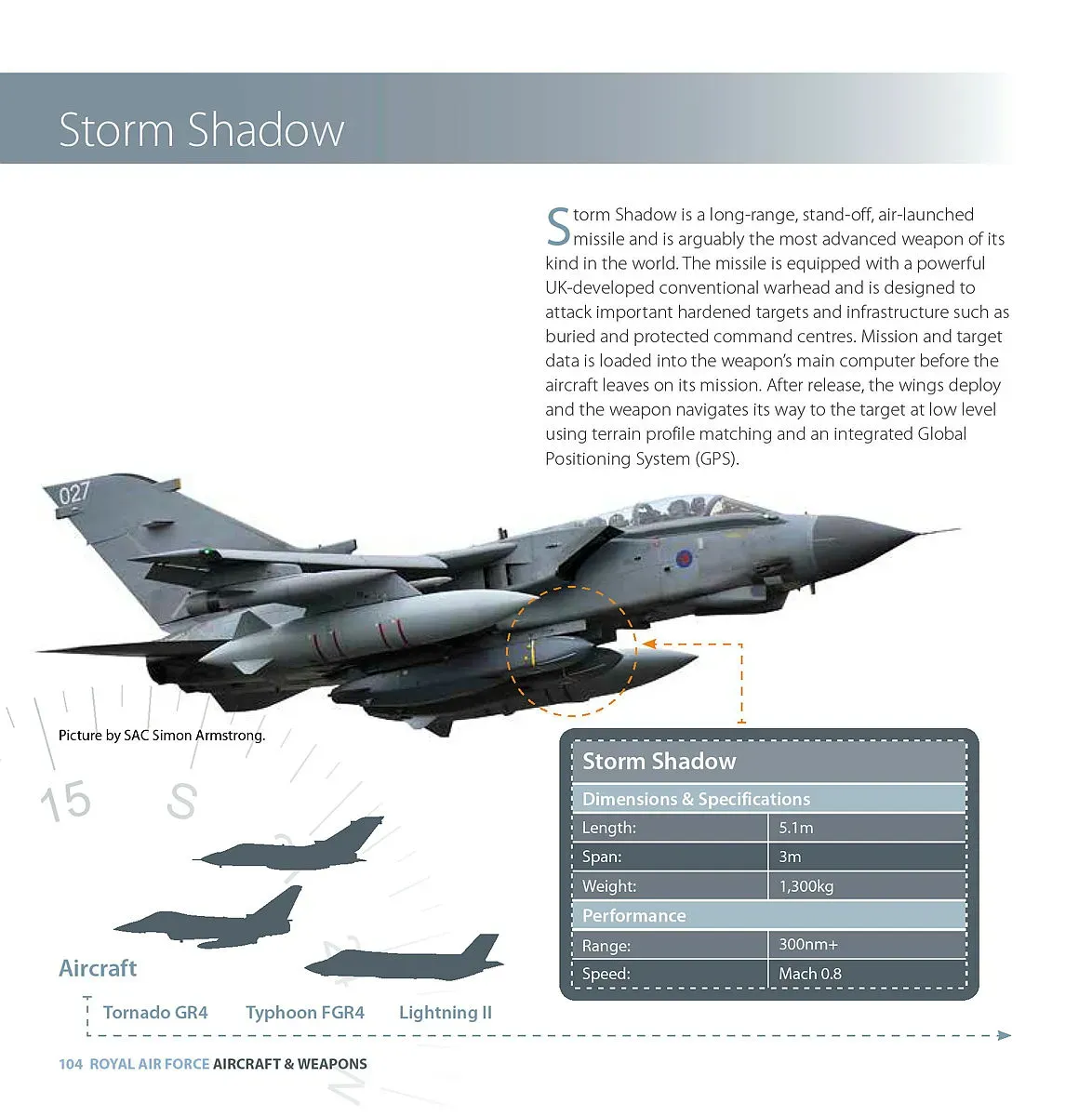
SCALP is the French designation for the air-launched missile known in British service as Storm Shadow. The two variants share substantial French and British technology and are produced by MBDA. According to the U.K. Ministry of Defense, Storm Shadow has a range in excess of 300 nautical miles, although in its export configuration it has an officially stated range of around half that.
An infographic on the Storm Shadow missile prepared by the U.K. Ministry of Defense. (Note that the missile was never cleared for use by the F-35). Crown Copyright
The weapon is an air-launched, conventionally armed cruise missile designed for precision attacks against fixed targets well beyond the immediate battlefield. Its primary targets include command facilities, hardened infrastructure, and other high-value installations.
Storm Shadow/SCALP
The announcement removes a major technology-transfer barrier surrounding British-origin components in the Franco-British weapon, allowing the French-Ukrainian production project to move forward.
Ukraine is already heavily dependent on Western deliveries for some of its most capable long-range weapons, while European stocks of Storm Shadow and SCALP missiles have been depleted by years of procurement limitations and transfers to Kyiv.
Local production could eventually give Ukraine a new source of these weapons closer to the battlefield and reduce its dependence on foreign stockpiles.
The U.K. production line for Storm Shadow at the MBDA factory in Stevenage. Crown Copyright
At the same time, the Storm Shadow/SCALP project is only one part of a much broader Ukrainian effort to build a sustainable deep-strike capability.
Ukraine has spent the past several years rapidly expanding its domestic long-range strike industry, with long-range one-way attack drones currently forming the largest and most mature component of that arsenal. Ukrainian forces are now capable of launching large numbers of domestically produced strike drones against targets hundreds and, in some cases, more than a thousand kilometers from Ukraine. Relatively inexpensive one-way attack drones can be launched in mass and used to overwhelm air defenses, attack energy and industrial infrastructure, and impose a sustained cost on targets deep inside Russia.
Alongside those relatively inexpensive systems, Kyiv is pushing ahead with domestically developed cruise missiles intended to provide a substantially heavier payload and more sophisticated guidance and penetration capability. The most prominent example is the FP-5 Flamingo, developed by Ukrainian defense company Fire Point, while other indigenous cruise-missile programs are also progressing.
Video showing the launch of an FP-5 Flamingo cruise missile:
Випробувальний пуск ракети “Фламінго”
Ukraine is also moving into the ballistic-missile arena. Domestic ballistic-missile programs have progressed toward testing and deployment, with Ukrainian officials and industry working toward serial production of systems intended to extend the country’s ability to strike targets deep inside Russia. With their high speed and steep terminal trajectories, ballistic missiles provide a substantially different challenge to Russian air defenses.
Western-supplied systems such as Storm Shadow/SCALP and the Army Tactical Missile System (ATACMS) short-range ballistic missile have meanwhile provided Ukraine with critical combat experience and an immediate deep-strike capability while its domestic missile industry matures.
Debris from an ATACMS missile launched by Ukrainian forces is seen near the Russian city of Voronezh on November 19, 2025. Photo by Russian Defense Ministry/Handout/Anadolu via Getty Images Anadolu
Rather than simply replacing missiles consumed in previous campaigns, the planned Ukrainian production of Storm Shadow/SCALP is particularly significant because it could eventually give Kyiv another sophisticated cruise-missile type within an arsenal that is becoming increasingly indigenous.
A domestic assembly capability could provide Kyiv with greater control over production rates, sustainment, and replenishment while reducing the logistical burden associated with obtaining complete weapons from foreign stockpiles. Potentially, Ukraine might also have the option to adapt the missile according to its own requirements. This could include changes to the guidance system or warhead, and perhaps even adaptation for launch from the ground.
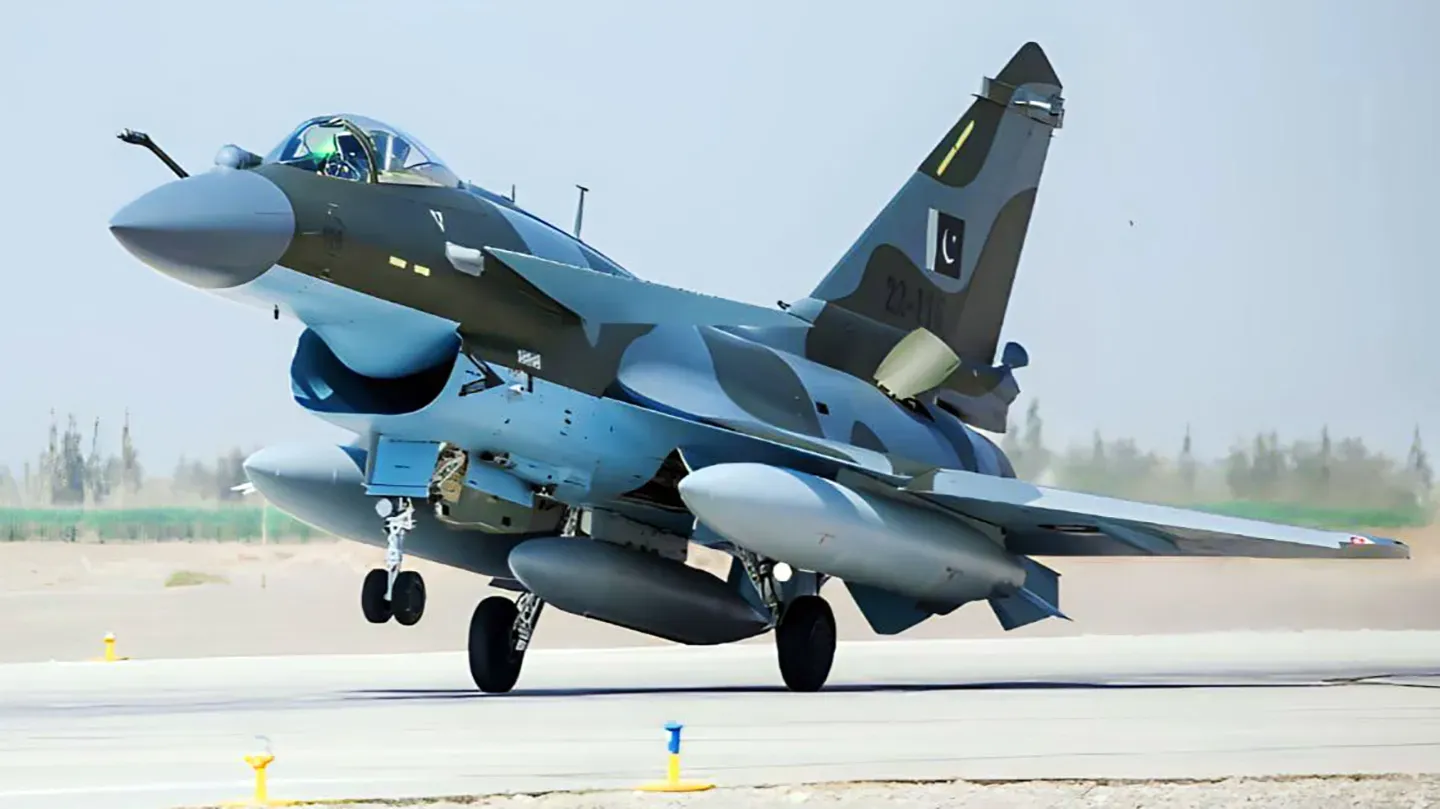
The limited availability of the Su-24M/MR Fencer swing-wing combat jets that currently launch Ukraine’s Storm Shadow/SCALP missiles are currently a limiting factor and there is no realistic means of replacing them. It was expected that Mirage 2000 fighters transferred to Ukraine by France would be modified to launch SCALP, but this has so far not been confirmed. Should Ukraine receive the French-made Rafales that it plans to, then SCALP compatibility would be provided from the outset.
A SCALP-EG long-range cruise missile under the wing of a Ukrainian Su-24. Ukrainian Ministry of Defense screencap
Maybe even more importantly, it would allow these weapons to be used however Ukraine wants, without geographical and target type restrictions that are currently dictated by whoever donates them. It could also result in critical technology transfer, including about low observable cruise missile design, that Ukraine can gestate and deploy into other programs. Finally, it’s possible this could even be a future export for the country, especially if it can produce a variant that is adaptable and economical.
It is unclear when locally built Storm Shadow/SCALP missiles will join Ukraine’s strike arsenal. However, establishing an industrial production line for a sophisticated cruise missile is a major undertaking, particularly inside a country that remains under sustained Russian missile and drone attacks.
As noted in the opening of this article, the United Kingdom supplied Storm Shadow missiles to Ukraine beginning in 2023, giving Kyiv a long-range precision-strike capability that was previously unavailable from most of its Western partners. Soon after, France committed to sending SCALP missiles, and Italy, another Storm Shadow operator, has similarly supplied the missiles to Ukraine.
The weapon has subsequently become one of the most important Western-supplied strike systems in Ukrainian service and has been used against some notably high-profile targets.
Storm Shadow/SCALP has been used against Russian military infrastructure, including targets far behind the front line. The weapon’s combination of range, low-observable design, and tandem penetrator warhead makes it particularly useful against hardened or otherwise heavily defended targets.
Speaking last Friday at Malmen Air Base in Sweden, during an event to celebrate the Swedish Air Force’s 100th anniversary, the commander of the Ukrainian Air Force, Lt. Gen. Anatolii Kryvonozhko, highlighted some of the key issues facing the service now in its conflict with Russia.
Among them was the urgent “need for asymmetric actions,” including effectors capable of striking deep beyond the front lines and into the heart of enemy territory.
“With the enemy having the prevailing in numbers, we need to have technology that can be smartly used, and this is how we can prevail,” Kryvonozhko said. “No matter how big your manpower is, if you don’t have innovative technology, you will not prevail. So innovative technology, smartly used, can be a factor for prevalence and domination in the battlefield.”
For Ukraine, local Storm Shadow/SCALP production would fit squarely into that asymmetric strategy, adding a proven, capable deep-strike weapon to an increasingly diverse arsenal while reducing reliance on increasingly strained Western missile stockpiles.
The U.K. decision to support Ukrainian Storm Shadow/SCALP production is separate from its own effort to develop a new generation of lower-cost long-range strike weapons for Ukraine.
The British government is pursuing that effort through Project Brakestop, intended to produce advanced, low-cost, long-range weapons without relying on U.S. components.
Industry has “risen to the challenge” of Project Brakestop, Armed Forces Minister Louise Sandher-Jones has said
Three UK-designed long-range strike systems undergo flight testing with the aim of delivering low-cost precision strikes against targets more than 500km away pic.twitter.com/mlD7jua4sG
The British prime minister’s visit to Ukraine comes at an especially tense point in U.K.-Russian relations.
Moscow has repeatedly warned Britain over its military support for Ukraine, including assistance connected to Ukrainian long-range strike operations. The Kremlin has now criticized Britain’s decision to facilitate Ukrainian Storm Shadow/SCALP production, accusing London of escalating the conflict and warning that Russia is tracking Ukrainian missile-production facilities.
Russia has also withdrawn its ambassador from London, further highlighting the deterioration in relations between the two countries.
Luke Pollard, the U.K. defense minister, told Times Radio today: “We’ve already seen Russian activities against the United Kingdom, we’ve seen them loitering over our critical undersea cables, we’ve seen cyberattacks on our systems … we’ve also seen them prosecute an illegal war against one of our close friends. So am I surprised that Russia doesn’t like people supporting Ukraine? No, I’m not. Will that stop us from supporting our friends in Ukraine? No.”
Burnham is in Kyiv on Ukraine’s Independence Day to meet President Volodymyr Zelenskyy and chair a meeting of the Coalition of the Willing, the multinational group supporting Ukraine.
The British prime minister has framed the visit as a reaffirmation of London’s long-term commitment to Ukraine, with the transfer of Storm Shadow/SCALP blueprints as tangible evidence of this.
The missile announcement aims to help Kyiv expand its ability to make, replenish, and diversify its long-range strike arsenal, as it works toward developing a deep-strike force capable of reaching far beyond the battlefield without relying entirely on foreign weapons transfers.
Weekly insights and analysis on the latest developments in military technology, strategy, and foreign policy.
Bangladesh is moving toward formal negotiations with China over a potential purchase of J-10CE fighters and attack helicopters, in what could become one of the country’s most significant defense acquisitions in years. The development also underscores the growing international interest in a Chinese fighter that has gained considerable attention since seeing combat in Pakistani service last year.
Bangladesh’s Prime Minister’s Information and Broadcasting Adviser Zahed Ur Rahman said Tuesday that a government panel is preparing a draft agreement that could pave the way for negotiations with Beijing. The government has not disclosed how many aircraft it intends to acquire, the potential value of the deal, or a delivery schedule, with those details expected to be determined during negotiations.
Bangladesh is advancing plans to purchase Chinese J-10CE fighter jets, with a government official pointing to the aircraft’s performance in the recent India-Pakistan conflict https://t.co/EypP8oci6C
Local reporting has previously pointed to a potential requirement for as many as 24 J-10CEs.
If ultimately contracted and delivered, Bangladesh would become only the second confirmed foreign customer of the export version of the J-10C, after Pakistan. However, there has been growing speculation about other potential customers, too, fueled by imagery showing apparent export-standard J-10s being tested in China.
A Pakistan Air Force J-10CE. Pakistan Air Force
The potential acquisition comes as Bangladesh seeks to modernize its aging combat aircraft fleet. Dhaka already maintains a long-standing defense relationship with Beijing, which has supplied Bangladesh with combat aircraft, naval vessels, tanks, missile systems, and other military equipment over the past two decades.
The J-10CE is a much more capable proposition than many of the older fighters still operated by air forces that have historically relied on Chinese or Soviet-designed equipment, of which Bangladesh is a prime example. Currently, the Bangladesh Air Force’s fighter fleet is made up of different versions of the Chengdu F-7 (an updated Chinese version of the MiG-21 Fishbed) and much smaller numbers of MiG-29 Fulcrums.
Three Bangladesh Air Force F-7s perform during celebrations to mark Bangladesh’s 54th Victory Day in Dhaka, Bangladesh, on December 16, 2025. Photo by Zabed Hasnain Chowdhury/NurPhoto Zabed Hasnain Chowdhury
Maintaining aging Soviet-designed fleets increasingly presents challenges in terms of airframe life, avionics, spare parts, weapons, and overall readiness. Meanwhile, the war in Ukraine and accompanying sanctions serve to make Russia an even less reliable source of military aircraft and other arms.
The J-10C is a single-engine multirole fighter equipped with an active electronically scanned array (AESA) radar, modern avionics, electronic warfare capabilities, and the ability to employ a growing range of Chinese precision-guided weapons. The export J-10CE also provides access to weapons such as the much-vaunted PL-15 beyond-visual-range air-to-air missile.
A Chinese J-10C fighter during a training exercise. Xinhua/Xi Bobo/Getty Images Xinhua News Agency
The aircraft’s growing reputation has been helped considerably by Pakistan.
A Pakistan Air Force J-10CE after its arrival at PAF Base Minhas, where it first arrived in 2022. Pakistan Air Force
Nevertheless, the conflict provided the J-10CE with an unusual degree of combat visibility for a Chinese export fighter. Now, Bangladeshi officials have explicitly acknowledged that the aircraft’s reported performance during that conflict has attracted attention in Dhaka.
The J-10CE is also particularly well positioned within China’s emerging fighter-export portfolio.
China is developing more advanced stealth aircraft, including the FC-31/J-35 family, but that program represents a different proposition for prospective customers, coming with greater cost and potential uncertainty attached. The J-10C is a much more mature design already in operational foreign service, giving China an aircraft that can be offered today rather than relying entirely on future capabilities.
A full-scale mockup of an FC-31 fighter is showcased at Airshow China 2022 on November 6, 2022 in Zhuhai, China. Photo by VCG/VCG via Getty Images YANG SHUGUANG
That combination of modern systems and an established production line could prove attractive to countries that need to replace aging fighters without taking on the financial, political, or industrial commitments associated with acquiring a Western combat aircraft.
As well as the potential Bangladesh deal, Uzbekistan has been linked to the J-10CE.
For months, Chinese military aviation observers have speculated that Tashkent could become another customer for the fighter. More recently, imagery of an aircraft carrying the serial number 1020 has generated renewed interest, with low-visibility markings on its tailfin appearing to resemble the Uzbek flag.
While unconfirmed, serial numbers in the 101X and 102X ranges have been associated by some observers with a possible Uzbek order.
In the past, reports have circulated that Uzbekistan also intends to acquire 24 J-10CEs. There have also been unverified accounts that J-10s have already been seen at Karshi Khanabad Air Base in Uzbekistan.
Uzbekistan operates a combat fleet heavily reliant on Soviet-era designs, including MiG-29 fighters and Su-25 Frogfoot attack jets. Replacing at least some of those aircraft with modern Chinese fighters would represent a notable expansion of Beijing’s role in a defense market historically dominated by Russian equipment.
China has increasingly demonstrated an ability to offer modern military equipment across almost every major category. This includes drones, air defense systems, warships, missiles, armored vehicles, transports, and combat aircraft.
Chinese equipment provides a way to acquire increasingly sophisticated military capabilities without making the same political choices that can accompany major Western defense purchases. Beijing is also generally willing to package aircraft with the weapons, training, support, and other systems required to operate them as an integrated capability.
The J-10CE is an important part of that emerging strategy, as China seeks to show that its fighters can move into markets traditionally supplied by Russia and the West.
According to the company’s travel logs, shared with the Press Association, the age of the missing British citizens ranges from 13 to 65.
Alpine Eco Trek said the youngest member of the group is believed to be a 13-year-old girl, according to PA.
It also reported four of the firm’s Nepali tour guides are also missing.
The company’s manager Kumar Adhikari said he was in contact with the guides until 08:40 when they were expected to be at Tibet’s immigration office, but their phones were disconnected.
“We were hoping that inside it was safe,” he told PA, “but later the video came from China’s government which [showed] even Tibet’s side was hit by the flood.”
Adhikari said he was “slowly responding to” the families of the Britons but has been unable to give them any updates, adding he has been in contact with the British consulate and forwarded them copies of the clients’ passports.
“I feel so sad. We are just thinking about what to do next…We are in pain at the moment, deep pain.”
Another tour company impacted by the flash floods, Himalayan Glacier US, told the BBC they have lost contact with a group of 47 guests and staff who where making a pilgrimage to Mount Kailash, which included twoBritish citizens.
Kailash Journeys also reported a group of 27 guests and staff missing, with a spokesperson saying they were last in contact with them early Wednesday morning local time.
A list of names provided to the BBC included two men who are British citizens.
Foreign Secretary Ed Miliband said he is “deeply concerned” by news of the flash flooding, and wrote on social media: “All my thoughts are with those affected and with British nationals in the area and their relatives here at home”.
In a joint statement with Australia, the EU, Finland, France, Norway and Switzerland, the UK embassy in Nepal urged British nationals in Nepal to “exercise caution in affected areas”.
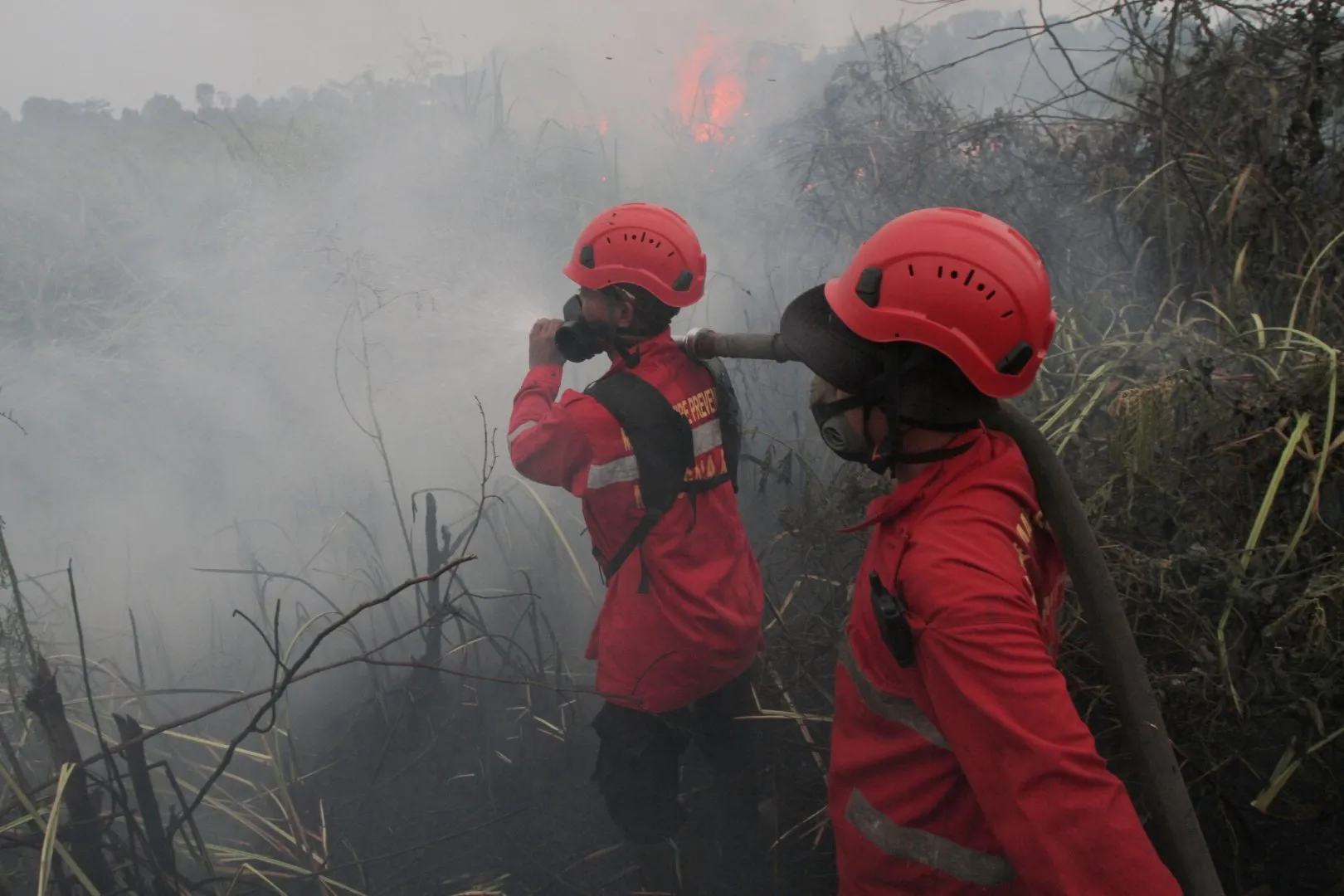
Locals on Indonesia’s Borneo Island are struggling to breathe as the smoke from wildfires is turning the air toxic. Al Jazeera’s Jessica Washington reports from Borneo on how conditions are complicating efforts to stop the fires.
Weekly insights and analysis on the latest developments in military technology, strategy, and foreign policy.
Faced with having to fight as technology rapidly transforms the nature of warfare, the U.S. Marine Corps on Wednesday unveiled its vision for the future of ground combat. Dubbed Ground Combat Element (GCE) 2040, the document lays out how Marines will fight and what kinds of equipment and training they will need to succeed, down to the squad level. Though the document doesn’t mention a specific adversary, it focuses heavily on the kind of littoral, anti-access battle a future Pacific fight would entail.
“I think that you would agree that the global security landscape today demonstrates an intensity for that kind of modernization,”Lt. Gen. Jay M. Bargeron, Deputy Commandant, Plans, Policies, and Operations, said today during a media roundtable to introduce GCE 2040 that TWZ attended virtually. “It’s a landscape that’s defined by rapid technological change and the reemergence, importantly, of peer-level adversaries like China and Russia.”
In a future fight against enemies with ubiquitous sensors, advanced artificial intelligence and machine learning (AI/ML) capabilities, waves of expendable drones, offensive and defensive electronic warfare systems and long-range precision weapons, smaller Marine units like rifle squads will have to act more independently to defend themselves and execute successful attacks.
The new plan recognizes that “widespread use of drones underscores the need for effective organic protective measures across the GCE, down to the squad level. The evolving drone threat presents the most significant risk to ground maneuver, requiring layered active and passive counter-UAS capabilities to retain the initiative. Survivability must be addressed by comprehensively encompassing improved training, updated doctrine, and technological advancements.”
You can see an example of how small drones are being used against Ukrainian forces in the following video.
Video showing a Russian 🇷🇺 fiber-optic FPV drone hitting one of the 4 🇺🇦 IFVs returning from this attack today
The ubiquity of drones on the battlefield has devastated both Russian and Ukrainian forces, which are each using these weapons to create an ever-growing no-go zone. Bargeron acknowledged that providing protection from drones for smaller Marine units presents a major challenge.
“The ability for our lowest echelon units – squad, platoon, company – to defend themselves against one-way attack systems is really maybe one of the biggest holes in our swing, and so we’re working hard on that,” the general admitted.
The Marine Air Defense Integrated System (MADIS). (USMC) US Marine Corps Marine Air Defense Integrated System (MADIS) vehicles. USMC
In addition, Bargeron said the Marines will also rely on a system called “Home Alone,” which a spokesman for the service told us “is a Counter-small Unmanned Aircraft System (CsUAS) that is a semi-fixed site GBAD solution that supports our layered defense structure.” The Marines declined to provide any details about how that system works, citing its classified nature.
For protection at the squad level, “the GCE 2040 integrates both active and passive measures to ensure organic protection,” a Marine official told us. “A key component of this is the Organic Counter-small UAS, or O-CsUAS, initiative. This program has fielded dismounted kits directly to the squads. These kits provide Marines with the ability to actively and passively detect drone threats and to defeat them using both kinetic and non-kinetic means.”
Those kits are “complemented by the use of frangible 5.56 ammunition for standard-issue rifles, which is more effective against aerial targets, and the continued employment of passive countermeasures like multi-spectral camouflage, dispersion, and displacement to degrade enemy targeting,” the official added.
Bargeron noted that the Marines have already purchased 400,000 of the frangible counter-drone rounds and that they are undergoing training on how to use them.
You can read more about the Marines’ emerging doctrine for devolving air defense down to the individual Marine in our story here.
Drone Round: The Next Evolution of Counter-UAS
As noted earlier in this story, GCE 2040 also calls for providing squads with longer-range offensive weapons.
“What we’re trying to do is to bring precision strike capabilities down to the lowest level,” the general noted. “That’s a great example of using advanced technology to enhance the lethality of Marines that are already doing that job. The OPF [Organic Precision Fires] increases the individual Marine’s or Marine rifle squads’ ability to strike targets, at ranges that you had previously needed fixed-wing air or aviation fire support or indirect fire.”
The goal is for squads to be able to strike targets at a range of about 20 kilometers, Bargeron stated.
“So in the hands of the individual Marines to be able to strike targets like that…will be dramatic,” he exclaimed.
They are also being sent to Ukraine, where the use of these systems by small units is a daily fact of life, not a vision for the future.
A Neros Archer first-person view drone sits on a case during a demonstration range at Weapons Training Battalion on Marine Corps Base Quantico, Virginia, March 7, 2025. (U.S. Marine Corps photo by Cpl. Joshua Barker) Cpl. Joshua Barker
Bargeron offered no other details on specific offensive squad-level longer-range weapons options that will be developed and fielded over the coming years.
The plan itself is vague in terms of overall timelines, noting that there will be a “phased approach to modernization” occurring across “three overlapping time periods.”
Near-Term (2026-2030): This period focuses on refining and accelerating ongoing Force Design modernization efforts, addressing the immediate threat of drones, and setting conditions for future investments.
Mid-Term (2031-2035): Investments in AI and autonomous systems will mature, enhancing headquarters functions, streamlining logistics, and improving operational tempo. Drone/unmanned formations and layered counter-UAS capabilities become critical.
Long-Range (2036-2040): The GCE is transformed by AI-enabled command and control, widespread Human-Machine Teaming, and resilient, dispersed formations. It operates with increased combat power and survivability, providing the Joint Force with a decisive advantage on key littoral terrain.
Ukraine has shown American troops up close and personal how difficult it is to defend against drones. In a recent training exercise in Germany, U.S. Army soldiers were trounced by Ukrainian drone operators, only improving their performance after the lessons learned from initial engagements. While there are still many unknowns about the goals and rules put in place for that exercise, which accomplished its mission of learning, it underlines long-standing questions about why the U.S. military has taken so long to adapt to a glaringly different battlefield. Whether the new Marine Corps plan will do so fast enough, especially as major foes, especially China, are moving aggressively in employing new weapons and tactics based on lessons learned in global conflicts, is still up for debate.
That being said, the Marines acknowledge that GCE 2040 is a work-in-progress, but the changes it is trying to address are critical to operating against threats the U.S. military has yet to face at the scale it would against China or Russia.
There have been growing concerns in Europe over expanding Russian aggression and specifically the possibility it could attack a NATO country to test the alliance’s resolve. There are also reports that Putin will drastically increase offensive operations in Ukraine due to the massive damage his country is now taking from long-range drone and cruise missile strikes, as well as failed peace talks. Reports even state that he is mulling the use of tactical nuclear weapon in order to stop these attacks and change the tide of the years-long conflict, a possibility which we will discuss more later in this piece. Iran, of course, is also a major issue, but it seems, at least based on reporting, it had taken a backseat to whatever the director was trying to accomplish in Moscow.
Wednesday evening, The Wall Street Journal reported that Ratcliffe was in Moscow to deliver a message to Putin not to attack NATO countries. His visit “followed new U.S. intelligence assessments, reported earlier by The Wall Street Journal, that Russian President Vladimir Putin could try to test the resolve of the North Atlantic Treaty Organization with a limited assault on an allied country in the next few years,” the newspaper noted. We have been reporting on major concerns over exactly this for weeks now.
U.S. officials “are concerned that Putin, squeezed in Ukraine and under pressure at home, could launch an assault ranging from a cyberattack to a small-scale land incursion, likely on a Baltic nation, the Journal added.
“Kremlin spokesman Dmitry Peskov told reporters in Moscow on Wednesday that Ratcliffe held talks with Russian intelligence officials during his time in the Russian capital, but he didn’t meet with Putin. Putin was briefed on the talks, Peskov said,” according to the publication.
EXCLUSIVE: CIA Director John Ratcliffe made a surprise visit to Moscow this week to deliver a warning to Russia: Don’t attack NATO countries, according to people briefed on the visit
“The U.S. official, who was briefed on the investigation into the alleged sabotage plot, said the explosives fitted to the drone as well as the structure of the lethal device were ‘typical’ of those used by Russia’s GRU,” ABC added. “This U.S. assessment was made in conjunction with German security and intelligence agencies, the source added.
⚡️US intel links explosive drone found at German airport to Russia’s military intelligence.
The drone’s structure and explosives were “typical” of those used by Russia’s GRU, U.S. intelligence officials told ABC News.https://t.co/g7IsdhNOeT
Meanwhile, President Donald Trump downplayed the Ratcliffe trip, which has sparked a wide range of speculation about its purpose.
The president called it “semi-routine.”
That statement is hard to square considering how rare having a CIA director rush to Moscow is. The last time this happened was just prior to the war in Ukraine breaking out into the destructive reality we see today.
Q: Why did CIA Director Ratcliffe go to Russia? Rumors say Putin is going to test NATO’s resolve, or Iranian sanctions, or Russia attacking England?
As we noted earlier in this story, Putin is reportedly considering escalating attacks on Ukraine, including the possible use of tactical nuclear weapons, Bloomberg reported, citing “three people close to the Kremlin.”
“For now, Russia is weighing an intensification of powerful conventional ballistic missile attacks on Kyiv, including the center of the capital, and infrastructure targets in other Ukrainian cities.”
At issue, Bloomberg suggested, is that negotiation “frameworks have all effectively collapsed, leaving the two warring sides back at square one.”
Russia is preparing to escalate attacks on Ukraine after concluding that negotiations for a peace deal have reached a dead end, according to three people close to the Kremlin. https://t.co/y7gMjOmf2J
Moreover, the Kremlin “has also abandoned reliance on what it believed was an understanding reached between Putin and Trump at their summit in Alaska last August,” Bloomberg noted.
You can see video from that encounter below.
Such a deal would have required the Trump administration to force Ukraine into giving up the eastern Donetsk region, a demand Kyiv has rejected as it continues to hold out against a Russian onslaught that has gained little ground.
The White House this evening pushed back on the notion that negotiations between Ukraine and Russia have reached an insurmountable impasse. A peace deal has been a major objective for President Donald Trump, who famously promised that he would end the conflict on his first day in office.
“The president wants this war settled so that the senseless killing ends,” a White House official told TWZ. “The president and his team remain committed to continuing to play a constructive role in ending the war between Russia and Ukraine, and he remains optimistic that we’ll ultimately get a peace deal done.”
The United States “continues to play a constructive role in speaking to both sides in working towards bringing the war to an end,” the official added. “We are the only country in the world that can play that role.”
The level of current U.S. involvement in negotiations is unclear. Trump envoys Steve Witkoff and his son-in-law Jared Kushner were expected to travel to Moscow after an eight-month break and to visit Kyiv for the first time, but no date has emerged for either trip, Bloomberg noted. Last week, Radio Free Europe reporter Alex Raufaglu stated on X that the pair’s trip to Ukraine was delayed, but not canceled, by ongoing Russian attacks on Kyiv.
NEW!! Sources tell me the highly anticipated Witkoff-Kushner trip to Ukraine has been “slightly delayed, not cancelled” — due to last week’s intensified missile and drone strikes on Kyiv.
Putin is not about to cave under economic pressure, Bloomberg suggested, citing its sources. Nor will he end hostilities as Ukraine continues to pound Russian refineries and logistics networks. These attacks are having a devastating effect on the Russian economy and creating increasing frustration among the populace.
Whether Putin actually does escalate attacks remains to be seen. With increased production of ballistic missiles and new ones from North Korea, he may have new means of sustaining conventional attacks. As for a nuclear one, he has constantly rattled that saber for years. As Bloomberg noted, in the past, there have been reports that China and India have frequently urged him to refrain from that steep climb up the escalation ladder.
We raised the question of Putin using tactical nuclear weapons on Ukraine several months after he launched his full-on invasion, asking the world’s top nuclear proliferation experts of the likelihood it would happen. You can read this feature here, but our expert’s sentiments were made long before Ukraine was picking apart Russia infrastructure on a daily basis, with a standoff weapons armada growing by the day.
So, while it isn’t exactly clear what was discussed in this meeting or its primary objective, none of the reported reasons are encouraging. Quite the opposite, they point to the possibility of a darker new phase in the Russia-NATO standoff.
Six people in critical condition as a severe heatwave fuels 154 wildfires across Algeria in a single day.
Published On 27 Aug 202627 Aug 2026
At least 12 people have been killed and 54 others injured as wildfires ravaged parts of northeastern Algeria, an official said, as authorities evacuated dozens of families from the hardest-hit areas.
Minister of Interior Said Sayoud, speaking to reporters on Wednesday, said the deaths occurred in the provinces of Jijel, Bejaia and Tizi Ouzou.
Recommended Stories
list of 3 itemsend of list
“Five deaths were recorded in the prefecture of Jijel, four in that of Bejaia and three in that of Tizi Ouzou,” he said.
Sayoud made the remarks during a visit to a hospital in the city of Souk El Thenine in Bejaia to evaluate treatment for victims suffering burn injuries and smoke inhalation.
According to the official Algeria Press Service, Sayoud reported 54 burn cases at the hospital, including six people who were in critical condition.
Sayoud said Civil Protection teams recorded 154 fire outbreaks across the country on Wednesday, including 36 in Bejaia province, 18 of which had been brought under control.
The fires come as a severe heatwave sweeps across Algeria and neighbouring Tunisia.
Sayoud said firefighting teams have managed to contain the blazes in the provinces of Skikda, El Tarf, Bouira, Tizi Ouzou and Tebessa. Operations were still under way in Bejaia, where 18 hotspots remained active, and in Jijel, where fires were burning in 12 municipalities.
He added that dozens of families had been evacuated from areas affected by the fires.
Images broadcast by regional news website Jijel News showed residents seeking refuge in a post office amid thick smoke.
Algeria frequently endures deadly seasonal wildfires during peak summer months.
At least six people were killed last month alone.
In recent years, intense heatwaves and fierce winds have amplified fire risks across the country’s forested Mediterranean coastline, disasters exacerbated by drought and climate change.
Weekly insights and analysis on the latest developments in military technology, strategy, and foreign policy.
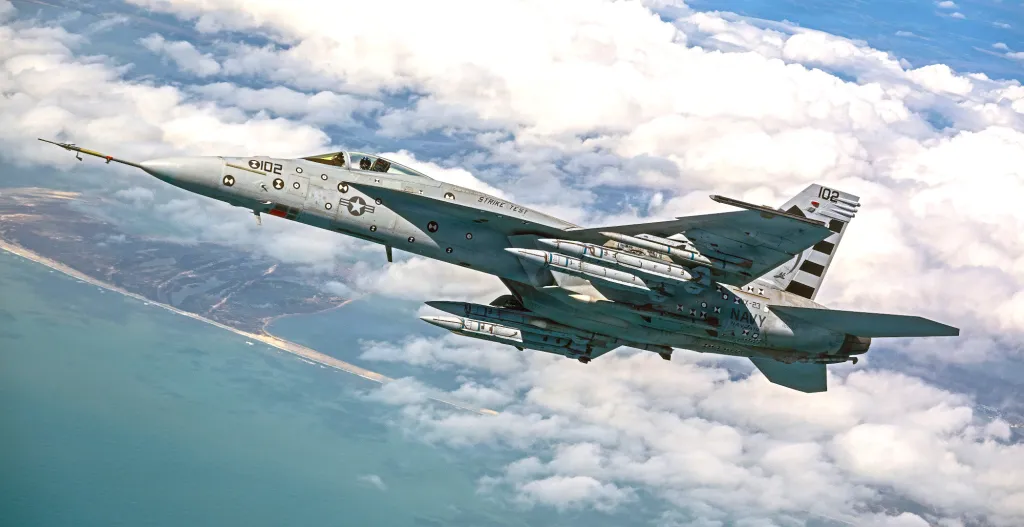
The air-launched version of Castelion’s Blackbeard hypersonic strike missile for the U.S. Navy has now at least been test-loaded onto an F/A-18E/F Super Hornet. Castelion and the Navy are pushing to have the lower-cost Blackbeard ready for a limited early entry into operational service no later than August 2028.
Attendees at the Tailhook Association’s annual convention this past weekend were shown a picture of a pair of Blackbeard test articles under the right wing of a Super Hornet. The image was shown alongside another one offering a general side profile view of the missile, seen at the top of this story, which was first released publicly last week.
TWZ has reached out to the Navy about obtaining the full image and for more information.
Where or when the picture of the Blackbeards loaded on the Super Hornet was taken is unknown. In March, Axios reported that the missile would “fly aboard an F/A-18 in the near future,” without directly naming a source. In a press release the following month regarding a $105 million contract award from the Navy, Castelion said that funding would go in part to “completing the hardware and software integration of Blackbeard onto the F/A-18E/F airframe.”
A Super Hornet test jet carrying AIM-424 missiles. The Navy also revealed the existence of this weapon at the Tailhook Association’s annual convention this year. USN
Whether or not any actual flight tests have been conducted is also unclear. Another slide in the Navy briefing at Tailhook included a bullet point reading “Project Alpha – Hypersonic missile shot in 2026,” but does not explicitly say whether or not that milestone has already been reached. The MACE slide makes clear that the program is directly intertwined with Project Alpha, if they are not just different names for the same effort.
Beyond the confirmation of this important new step in testing, the picture of the Blackbeards on the Super Hornet’s wing offers a new look at the front of the missile, showing what look to be apertures on one side of the design’s wedge-shaped nose. The apparent apertures are also seen pointed up, but many air-launched munitions do flip down after release.
How exactly Blackbeard is guided remains unknown, but a downward-angled aperture at the nose end for a seeker system would make sense for this weapon, which the Navy is pursuing primarily as a new way to target enemy ships. In particular, a wide array of existing anti-ship and land attack missiles, as well as certain anti-air types, have variously shaped apertures in their noses for imaging infrared seekers. Imaging infrared has the benefit of being immune to radio frequency electronic warfare jamming. In addition, it is a passive capability that does not send out signals that can give an opponent advance notice of an incoming attack. Blackbeard’s full guidance package very likely also includes some means of navigating to a target area first, and it could have multiple modes of operation.
The imaging infrared seeker apertures on the AGM-158 Joint Air-to-Surface Standoff Missile (JASSM) family of air-launched cruise missiles are clearly visible in this picture of a US Air Force F-15E Strike Eagle loaded with five of them. USAF
The apertures could also be present in this case for testing or other purposes, though this seems far less likely.
We previously discussed the other visible aspect of the design after last week’s release of the side profile picture, writing:
“A profile photo at the company’s headquarters reveals a weapon with a ballistic missile-like booster, on top of which is mounted what could be an unpowered hypersonic glide vehicle (HGV). A booster brings an HGV to the desired velocity and altitude before releasing it toward its target. The concept is in contrast to air-breathing cruise missiles capable of traveling at hypersonic speeds. Hypersonic speed is generally defined as anything above Mach 5, which larger ballistic missiles also reach in the course of their flights. More precise performance figures for Blackbeard are lacking, but Castelion has previously hinted it could hit targets out to just under 500 miles. Alternatively, the second stage may also have its own motor, allowing it to continue accelerating or sustain high-speed flight. A similar arrangement has been suggested as the propulsion system for the Russian Zircon missile.”
“Both stages of the weapon have cruciform fins, while the upper one features a prominent ‘chine’ line along the length of its body, and a slightly beaklike nose. The trolley on which the weapon is mounted provides some idea of its overall size. The blue stripes seen on each stage normally signify that a munition is an inert, non-explosive round utilized for training or tracking purposes. This would indicate a real (unarmed) missile rather than a dummy or mockup.”
As noted, Castelion and the Navy are hoping to see the air-launched Blackbeard reach an early operational capability (EOC) within the next two years. Castelion’s press release in April said EOC was being targeted for 2027, a timeline that had been previously reported. Just yesterday, the company put out a press release announcing a new nearly $90 million contract from the Navy specifically to help push the weapon closer to that milestone, as well as perform other activities. The release did not explicitly mention a new EOC schedule, but did say the contract covered work through August 2028, by which point the hope is that at least 50 missiles will have been delivered.
Castelion previously released the video below to highlight continued work on Blackbeard, including in an air-launched form for integration on the Navy’s F/A-18E/F Super Hornets.
Blackbeard is coming 🏴☠️
The U.S. Army is also separately funding development of a surface-launched version of Blackbeard. In May, the Pentagon outlined plans for the acquisition of 12,000 Blackbeard missiles over the next three years, but it is unclear whether this covers surface- or air-launched versions, or a mix of both. At that time, the Pentagon also announced a framework for purchases of 10,000 lower-cost surface-launched cruise missiles in that same timeframe.
As underscored by those planned orders, Blackbeard is being developed with an eye toward lower cost and relative ease of production, as well as exportability to U.S. allies and partners. Historically, hypersonic missiles have been viewed as expensive, low-density assets offering a more limited ‘silver bullet’ capability against high-value targets. Depending on the price point that Castelion can achieve with Blackbeard, it could help change this calculus. Expanding sales beyond America’s armed forces could help further spread cost burdens and drive down unit prices through economies of scale.
For the Navy, from an operational perspective, Blackbeard is seen as a particularly important addition to the arsenal available to the service’s carrier air wings. The missile will offer Navy Super Hornets, and potential other aircraft, a boost in the range at which they can hold targets at risk, as well as the ability to cover those longer distances faster. Castelion’s design will also give the service a new stand-off strike weapon that is far more survivable and more capable, especially against time-sensitive targets. The missile’s speed will lessen the need for persistent kill chains, as well.
Greater standoff reach is already becoming more and more valuable, if not vital, as carriers and their air wings are being pushed further and further away from target areas by expanding and evolving adversary anti-access/area denial (A2/AD) bubbles. Similar considerations are pushing the Army and other services toward greater standoff strike capabilities.
If the development schedule for Blackbeard holds, the Navy will see the arrival of its first operational air-launched hypersonic weapon in the next two years. We now know that work on this weapon has already reached another important milestone, with testing on the Super Hornet now underway.
This small land-locked East European nation has always been influenced by the presence of its larger neighbours whose wars and imperial ambitions often had dramatic impacts on the fate of the country.
Moldavia became a principality in 1359 when Bogdan I crossed the Carpathians and took control from the Hungarians. In the middle of the sixteenth century, it came under the influence of the Ottoman Empire becoming a vassal state, though Moldova retained control of its own affairs.
Following the end of the Russo-Turkish War, the 1812 Treaty of Bucharest ceded the eastern half of Moldavia to the Russian Empire, which was named the region Bessarabia.
In 1918, after the end of the First World War and the collapse of the Russian Empire, Bessarabia united with Romania.
The Mileștii Mici wine cellar in Moldova is the world’s largest with nearly two million bottles of wine stored in its vaults.
This unity lasted until 1940 when Romania was compelled to cede the country to the Soviet Union as a consequence of the Molotov–Ribbentrop Pact when Romania was carved up between Hitler’s Germany and Stalin’s USSR.
Like other Soviet regions, the movement for independence gathered pace in the late 1980s with the change in the political situation created by glasnost and perestroika. The first democratic elections were held in early 1990.
The opposition legislator has hired former Reagan administration adviser Steve Hanke. (AFP)
Caracas, August 26, 2026 (venezuelanalysis.com) – Venezuelan opposition lawmaker Antonio Ecarri has proposed dollarizing Venezuela’s economy and abolishing the bolívar, the country’s official currency, as a way to “stop devaluation” and “protect citizens’ purchasing power.”
Ecarri, a National Assembly Deputy from Alianza del Lápiz, has hired US economist Steve Hanke as an advisor for his plan to change the national currency.
“We are working on a serious dollarization proposal to put the brakes on the infernal devaluation that is destroying people’s wages. Enough of bureaucracy financing public spending by confiscating the private property and labor of Venezuelans,” Ecarri said.
Hanke, a Johns Hopkins University academic who served in the Reagan administration, has advised countries such as Ecuador and Zimbabwe on similar initiatives. In an article for business magazine Fortune, he confirmed that he has already drafted “a bill for the Venezuelan parliament.”
According to the US economist, the transition would begin with the establishment of a fixed USD-bolívar exchange rate before converting bolívar-denominated accounts to US dollars. The Venezuelan Central Bank (BCV) would retain administrative functions but lose the ability to issue money or set interest rates.
Hanke previously revealed that he has held meetings with US Treasury and White House officials to discuss an international strategy aimed at strengthening the US currency through dollarization of foreign countries, currency boards, and other instruments.
Ecarri’s proposal drew significant criticism, with Venezuelan National Assembly President Jorge Rodríguez announcing “an investigation process to establish the offenses committed” by the opposition lawmaker. Ecarri was also removed from his position as chairman of the Venezuela-US Parliamentary Friendship Group, a post he had held for just two months.
According to a published statement, the opposition deputy allegedly violated the legislature’s internal procedures as well as the constitutional provision establishing that “the monetary unit of the Bolivarian Republic of Venezuela is the bolívar” and that the Central Bank “is the public entity that, exclusively and mandatorily, exercises monetary policy.”
Rodríguez also described the proposal during a parliamentary session as “absurd and outrageous.” Ecarri, however, defended his stance and decision to hire Hanke, whom he called “an authority in the field and a personal adviser of mine for some time.”
The opposition lawmaker argues that Venezuela is “at a key moment” to debate the adoption of a different currency.
“The country is already de facto dollarized, but those who continue to receive their wages in bolívars that lose value every day are our teachers, nurses, workers, and pensioners,” he stressed. “The government itself has just approved a law allowing rents to be paid in foreign currency.”
Ecarri claimed that growing oil revenues would supply Venezuela with enough foreign currency to adopt the dollarization plan, which he argued “should be accompanied by a Macroeconomic Stabilization Fund to protect the value of the currency against potential external shocks in the United States.”
Since 2018, the Venezuelan government has tolerated the circulation of US dollars amid efforts to control inflation. Though the bolívar remains the official currency, businesses and retailers establish cost structures and prices using US dollars. Venezuelan authorities have also fixed monthly bonus payments, which constitute virtually the entire income for workers and pensioners, in dollars, which are then paid in bolívars using the exchange rate established daily by the BCV.
The Central Bank has continually devalued the bolívar, with the USD-bolívar exchange rate growing by more than 150 percent since the beginning of 2026. The currency depreciation is a key driver of inflation. Prices rose by 19.9 percent in July, and accumulated 12-month inflation presently stands at 576 percent.
Financial authorities have likewise been unable to control a parallel, speculation-driven exchange rate which currently stands 15-20 percent above the official one.
Despite the persistent devaluation-inflation issues, formal dollarization is opposed by most Venezuelan policy analysts, including government critics. Economist Asdrúbal Oliveros warned that dollarization would be an effective mechanism for drastically reducing inflation but “is not the best solution,” since it would be a “nearly irreversible” decision that would limit the country’s monetary policy options.
Right-wing economist José Guerra likewise considers dollarization “a straitjacket” for an oil-producing country. “Without a central bank issuing currency, an external shock will cause deflation, an inability to pay salaries and finance public spending, as happens in Ecuador. It also creates a high dependence on the US and is a one-way path,” he said.
Rodrigo Cabezas, former finance minister under President Hugo Chávez, similarly expressed his “complete opposition” to dollarization, stating that it is “unreasonable” for a country to surrender essential economic tools, losing control over foreign exchange policies and interest rates.
For his part, economist and former United Socialist Party (PSUV) legislator Tony Boza contended that Washington wants to push dollarization in Latin America to “stave off its economic downfall.” Boza went on to criticize the acting Delcy Rodríguez government and the National Assembly for subordinating economic policies and the country’s national resources to US and foreign capital interests.
ICE agent Christian Castro faces criminal charges for shooting a Minnesota man in the leg during an immigration raid.
Published On 26 Aug 202626 Aug 2026
A United States judge has denied a request to compel the extradition of a federal immigration agent charged with shooting a man during an immigration raid in the state of Minnesota and lying about it.
Wednesday’s decision concerns the case of Immigration and Customs Enforcement (ICE) agent Christian Castro, who has been detained in a county jail in Texas since May.
Recommended Stories
list of 3 itemsend of list
Minnesota has sought his extradition as he faces charges of assault and falsely reporting a crime in Hennepin County, which covers Minneapolis.
Under Texas law, the state cannot hold the subject of an extradition order for more than 90 days. At that point, the suspect must either be transferred or released. The deadline for Castro is set to expire on Thursday.
Minnesota argued in a lawsuit this month that Texas Governor Greg Abbott, a Republican, has refused to authorise the extradition for political reasons.
But in Wednesday’s ruling, Judge Fernando Rodriguez Jr wrote that he could not intervene because Abbott has not yet acted – and has therefore not yet violated any law.
“The record reflects only that Governor Abbott has neither agreed nor refused to sign the rendition warrant as to Castro,” Rodriguez wrote.
Castro has been charged in connection with the non-fatal shooting of Julio Cesar Sosa-Celis during an immigration raid in Minnesota on January 14, part of a mass deportation effort under President Donald Trump.
Starting in December, Trump oversaw a large-scale deployment of federal agents to the Midwestern state, dubbed Operation Metro Surge.
The operation, which lasted less than three months, sparked protests and allegations of civil liberty violations from residents and watchdog groups.
Prosecutors say Castro fired a gun through the front door of a Minneapolis home, shooting Sosa-Celis in the leg.
Afterwards, he and another agent accused Sosa-Celis and another man of assaulting federal authorities with a broom handle and snow shovel. Those allegations were later disproven after video of the incident emerged. Criminal charges against Sosa-Celis were subsequently dropped.
Todd Lyons, then-acting director of ICE, confirmed in February that the agents appeared to have made “untruthful statements”. Castro and the second agent were placed on administrative leave.
Castro is currently in custody in Brownsville, Texas. Minnesota officials have warned that he may flee the country if released, citing calls he made from jail to a woman in Mexico.
During those calls, Castro talked “about marrying her and buying a house in Mexico when he is released”, according to Minnesota’s lawsuit.
Minnesota Attorney General Keith Ellison filed a request for a temporary restraining order last week to stop Castro’s anticipated release and force Governor Abbott to sign the extradition warrant.
Ellison has framed Abbott’s decision not to take action as a way of supporting Trump’s mass deportation campaign and skirting federal extradition law.
“For nearly three months, Greg Abbott has refused to return ICE agent Christian Castro to Minnesota, where he’s charged with shooting a Minnesotan in his own home,” Ellison wrote in a social media post.
“Abbott has a legal obligation to return him. Instead, he’s chosen to ignore the law.”
Liverpool will take on Tottenham as the teams who compete in Europe enter in the third round of the Carabao Cup.
Leeds could potentially face Chelsea, should the London club beat Luton on Thursday.
Manchester United face Premier League opposition in Brighton, while holders Manchester City host Norwich.
Fleetwood, the only fourth-tier side left in the competition, host Sheffield United.
The nine Premier League teams that are playing in Europe – Arsenal, Aston Villa, Bournemouth, Brighton, Crystal Palace, Liverpool, Manchester City, Manchester United and Sunderland – all enter the Carabao Cup in the third round.
To avoid clashes with the opening rounds of the Champions League and Europa League, matches will be played across the weeks commencing Monday, 7 and Monday, 14 September.
The final two places will be decided on Thursday when Chelsea host Luton (19:30 BST) and Fulham take on AFC Wimbledon (20:00 BST).
Ukrainian drones have again targeted the Russian online shopping giant Wildberries. Authorities in Russia’s Tambov region said a major warehouse was entirely destroyed in the latest attack. At least 12 people have died in a series of strikes on the company.
Weekly insights and analysis on the latest developments in military technology, strategy, and foreign policy.
U.S. Army soldiers used a Bradley Fighting Vehicle as a carrier for FireAnt uncrewed ground vehicles (UGV) during a recent test exercise. The small 4×4 UGVs can be configured as one-way attack munitions, as well as for electronic warfare, surveillance and reconnaissance, and other missions. Bradleys acting as transports and controllers for swarms of UGVs like the FireAnt could open up important new operational possibilities.
A U.S. Army 1st Cavalry Division M2A4 Bradley IFV was spotted carrying five Swarmbotics AI FireAnt anti-armor UGVs on its side storage racks. Weighing around 27 kg, FireAnt is a low-cost attritable robotic system designed for AI-enabled swarm operations, including ISR,… https://t.co/dbikmUtOeypic.twitter.com/WYIRlLJd9A
“The US Army has picked Swarmbotics AI (SBAI) to build swarming, attritable, small unmanned ground vehicles (sUGVs) to advance Transformation in Contact (TiC) with the 1st Cavalry Division,” the company announced in a press release back in February. “The award results from successful participation at last year’s xTech Overwatch competition.”
“During xTech Overwatch evaluations, soldiers from the 1st Cavalry Division assessed several contractor’s autonomous capabilities that spanned from ground, airborne, payload, and mission planning,” Swarmbotics AI’s release added. “This competitive assessment, facilitated by T2COM [the Army’s Transformation and Training Command] and key stakeholders, aimed to accelerate the adoption of autonomous systems in line with the Chief of Staff of the Army’s directive.”
From what is seen in the video from Swarmbotics AI, it is not immediately clear whether or not the FireAnts can be released remotely from within the Bradley, or if personnel have to unload them manually. Where the UGVs are seen stowed on the side is space that is often taken up by explosive reactive armor (ERA) blocks. A Bradley could carry additional FireAnts internally and deploy them via the rear ramp.
A stock picture of a current-generation US Army M2A4 Bradley Infantry Fighting Vehicle with explosive reactive armor (ERA) blocks fitted on the side, as well as on the front of the hull. US Army
How the roughly 70-pound FireAnts were controlled and otherwise employed during Pegasus Charge 3 is also unclear. Swarmbotics AI has said in the past that human operators are responsible for directing groups of the UGVs. In its press release in February, the company said a squad-sized Army unit had operated 10 FireAnts during the xTech Overwatch competition.
Swarmbotics AI has also said that FireAnt has a significant degree of artificial intelligence (AI) driven autonomy to carry out assigned tasks. When networked together in a swarm, the UGVs are capable of “coordinated behavior across mixed teams and missions,” the company said previously, according to a story from Interesting Engineering.
TWZ has reached out for more information.
As already mentioned, FireAnt is designed to be readily reconfigurable for different missions using modular payloads. The anti-armor configuration, which arms the UGV with an explosively formed penetrator (EFP) warhead, has received the most attention to date. In this role, FireAnt has to get close to its target to be effective. Swarming capability would be very beneficial here for overwhelming defenders, as well as just launching attacks on large groups of tanks and other armored vehicles across a broader area.
FireAnt UGVs armed with explosively formed penetrator (EFP) warheads. Swarmbotics AI Screen captures from a previous Swarmbotics AI video showing a FireAnt launching a kamikaze attack on a test target. Swarmbotics AI captures
With sensor and electronic warfare payloads, FireAnts could also help scout ahead, provide added general situational awareness, and even launch non-kinetic attacks. Swarmbotics AI has also raised the possibility of a counter-drone role for its UGVs. FireAnts could also conceivably act as signal relay nodes, which would also be especially useful when employing the UGVs in semi-autonomous swarms and/or for pushing them further forward of the main body of a friendly force.
“Mass is our objective, by employing swarms of heterogeneous small sUGVs [small UGVs] we create multiple dilemmas for our adversaries at fractions of the cost of exquisite platforms,” Stephen Houghton, Swarmbotics AI’s CEO, said in a statement accompanying the company’s February release.
It is worth noting here that the Army has previously demonstrated the ability of the Bradley to serve as a forward control node for UGVs. Bradleys could also bring groups of FireAnts or similarly-sized designs to the front lines and hand off control to other nodes.
Previous Army-sponsored testing has also involved FireAnts deployed from larger UGVs, as seen in the video below. This demonstrates an additional layer of crewed-uncrewed teaming capability that could push the entire chain further forward on the battlefield. This, in turn, would help keep human personnel even further removed from potential threats.
U.S. Army Tests New Robotic ‘Tank Killer’ Swarm Vehicles
UGVs have already become a notable fixture in the ongoing conflict in Ukraine. This includes types in the same general size category as FireAnt configured for kamikaze attacks, as well as large ones armed with various anti-tank guided missiles, automatic grenade launchers, and machine guns. Various UGVs and other uncrewed capabilities were the centerpieces of the annual Independence Day parade in the Ukrainian capital Kyiv just on Monday, as seen in the video below.
On the battlefields of Ukraine, UGVs are generally being employed via links with an operator, either in first-person direct or a third-person semi-autonomous mode, with the help of cameras on the vehicle. In that conflict, uncrewed ground systems face the same electronic warfare threats as their aerial counterparts, and designs with hard-wired fiber-optic control links have been developed in response. TWZ has also previously highlighted the impacts, in general, that the continued development and proliferation of AI-enabled automated target recognition capabilities and new autonomous technologies are already having on aerial one-way-attack drones. This applies, in broad terms, to uncrewed platforms on the ground, as well.
“The key takeaway is that robot swarms are here to stay,” Drew Watson, Swarmbotics AI’s CTO, said in a statement in the February press release. “Working with 1st Cav in 2026 we’ll baseline concepts for hundreds of robots deployed on the X and at the breach.”
It is still to be seen how FireAnt, specifically, may slot into the Army’s future force structure, overall. That being said, the image of the Bradley at Pegasus Charge 3 carrying a load of the UGVs does look to be a sign of things to come.
Special thanks to user @lfx160219 on X for bringing Swarmbotics AI‘s video from Pegasus Charge 3to our attention.