Discover the latest happenings and stay in the know with our up-to-date today news coverage. From breaking stories and current events to trending topics and insightful analysis, we bring you the most relevant and captivating news of the day.
Syria has been in talks on the fate of Khmeimim and Tartous bases, which Russia used to support ousted Assad regime.
Published On 26 Aug 202626 Aug 2026
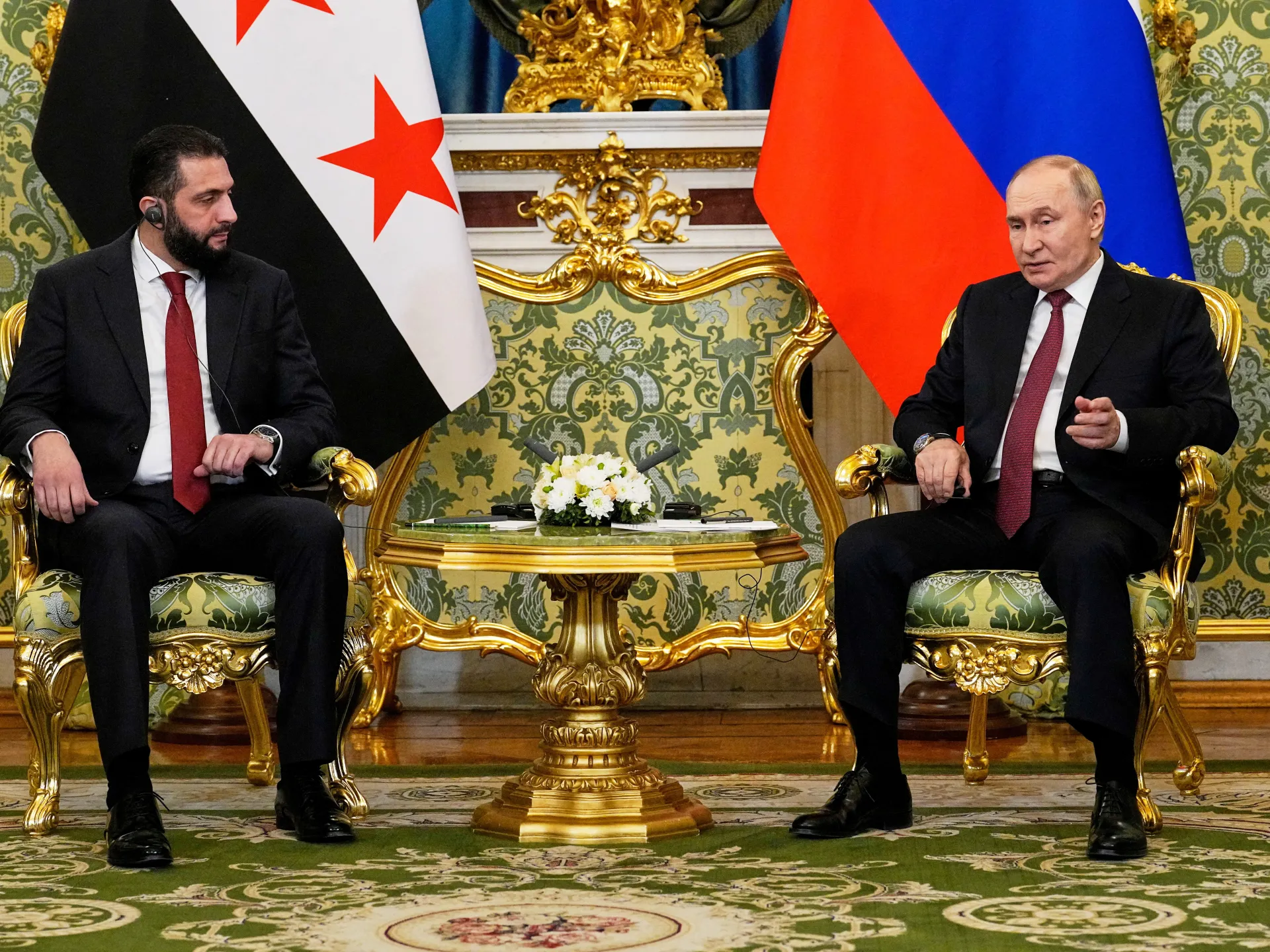
Russian President Vladimir Putin and Syrian President Ahmed al-Sharaa have held discussions, including on the fate of Russia’s military bases in the Middle Eastern country.
During a telephone call on Wednesday, Putin affirmed Moscow’s support for Syria’s territorial integrity and reiterated Russia’s rejection of Israeli attacks and violations of Syrian sovereignty, reports Syrian news agency SANA.
Recommended Stories
list of 3 itemsend of list
The Kremlin stressed that the discussion also concerned deepening political dialogue and cooperation in trade, among other areas.
The talks were aimed at further development of bilateral relations and strengthened cooperation, SANA noted.
However, the status of the Khmeimim airbase and Tartous naval base, which are highly strategic for Russia, remains the key topic between Damascus and Moscow.
The Kremlin said that Russia-Syria relations will continue through continued contact “at various levels” and that “both sides underscored the importance of the Memorandum of Understanding On the Reorganisation of the Khmeimim Air Base and the Tartus Material-Technical Support Point, signed on August 9”.
Syria announced earlier this month that a deal had been agreed after 18 months of negotiations that will see Khmeimim and Tartous turned into “joint training and capacity-building centres”, with Syria to take control of civilian facilities at both bases.
Russia backed former Syrian President Bashar al-Assad throughout Syria’s 13-year civil war, intervening militarily to keep him in power and expanding the Russian footprint at the Khmeimim air base and Tartous naval base on the Mediterranean coast.
Since al-Sharaa led the ouster of the a;-Assad regime, Putin has worked to build relations with the new Syrian government and to secure the future of the bases, which are key to Russian efforts to maintain influence across the Middle East and Northern Africa.
Dutch group Christians for Israel is taking the government to court in the Netherlands over its plans to introduce a ban on importing goods from illegal Israeli settlements in the occupied West Bank and Golan Heights.
The ban, which was announced in July, is due to take effect on September 22 and will run for three years. It bars importing, buying and selling goods produced in Israeli settlements, as well as intermediary services and any attempt to circumvent the rules.
Recommended Stories
list of 3 itemsend of list
But the Israel Product Centre (IPC), part of Christians for Israel (CvI), a Dutch evangelical organisation which a recent study found has donated about $300,000 to illegal settlements in the occupied West Bank, has responded by filing summary proceedings against the state, with the hearing due today.
Here’s what we know about this case.
What is the case about?
The IPC has issued summary proceedings against the Dutch state, seeking to block the July decree.
The IPC argues the measure is “one-sided” and that the window it now has to clear its existing stock – some 20,000 bottles of wine – is too short.
It is also arguing that a national ban conflicts with the European Union’s principle of free movement of goods.
A verdict is not expected for about two weeks.
How has this case come about?
EU rules have long required goods from illegal settlements in the occupied West Bank to be labelled by their origin – Palestine – rather than as “product of Israel”, but the bloc has not placed an outright ban on trading with Israeli settlements. That remains up to individual countries.
In February 2020, the Dutch advocacy group DocP urged consumers to file complaints with the Dutch food safety authority, NVWA, if they found wine and Dead Sea cosmetics had been mislabelled.
Following complaints, the IPC changed its labelling to “product uit een Israelisch dorp in Judea & Samaria [product from an Israeli village in Judea and Samaria],” which it argued accurately reflected the exact geographical and administrative reality of the origins of the products without deceiving the buyer. Judea and Samaria is the biblical name used by the Israeli government to refer to the West Bank. DocP argued this fell short of the requirement to label products correctly, and continued its campaign.
In 2021, the NVWA agreed and fined the IPC 2,100 euros (about $2,500) for mislabelling goods.
Then, in July 2024, the International Court of Justice (ICJ) issued an advisory opinion that Israel’s presence in the occupied Palestinian territory is unlawful and must end “as rapidly as possible”.
This shifted the legal argument beyond mere consumer labelling, with the court saying countries should take steps to prevent trade or investment relations which help to maintain the unlawful presence of Israeli settlers in the Palestinian territories.
The lower house of the Dutch parliament acted on that in September 2025, proposing an import ban.
The national decree against importing goods from Israeli settlements was made in July this year.
Does Christians for Israel describe the West Bank as ‘Israel’?
CvI describes the West Bank as a “disputed territory” rather than accepting the international legal description of it as “occupied Palestinian territory”.
It says it believes that Israel has strong claims to sovereignty there and that Jews have a right to live there.
The vocabulary matters in a legal sense, as “disputed territory” is not the same as “annexed territory”, therefore, the legal apparatus which would make settlement trade unlawful doesn’t straightforwardly apply.
The group’s stated reasons for funding projects there, it says on its website, are rooted in the Bible; it cites Ezekiel 47:21-23: “Peace for the Jewish people and resident foreigners inheriting alongside the tribes of Israel.”
However, the ICJ’s July 2024 advisory opinion is clear that the Fourth Geneva Convention’s Article 49(6) and successive Security Council resolutions treat the territories as occupied and the settlements as unlawful.
(Al Jazeera)
How have other Christian organisations in the West responded to trade with settlements?
Western churches are split on the issue, with CvI sitting at one end of the spectrum.
Mainline Protestants, including the Presbyterian Church in the United States, have divested shareholdings in Caterpillar, HP and Motorola Solutions as early as 2014, and from Israeli bonds in 2024. The United Methodist Church has opposed Israeli settlements since 1996 and sold its Israeli bond holdings last August.
The World Council of Churches called for sanctions against illegal Israeli settlements in 2025, divestment and an arms embargo.
The Vatican calls settlements an obstacle to peace but has avoided divestment so far.
Christian Zionist bodies, however, including Christians United for Israel (CUFI) and the International Christian Embassy Jerusalem, send funding for settlements and fight against boycotts.
How significant is this ban?
It is significant considering that the Netherlands is one of only four EU countries currently imposing a ban on trade with illegal Israeli settlements.
Trade from illegal settlements to the EU is estimated to be worth up to $400m per year.
The Netherlands is also a big market for the illegal settlements; a recent investigation by legal advocacy group Global Echo, which analysed thousands of shipments from Israeli settlements between 2017 and 2026, shows that within the EU, the Dutch market is the largest importer of goods from illegal settlements, with about 30 percent destined for or passing through the country.
Which European countries have banned products from West Bank settlements?
Spain has banned all imports of products from illegal Israeli settlements in the occupied Palestinian territory, including the West Bank, East Jerusalem and the Golan Heights, since September 2025. The decree also enforces an embargo on defence exports and dual-use technology to Israel, bans ships carrying military fuel for Israel from Spanish ports, and restricts advertising for services or goods linked to Israeli settlements.
Ireland’s parliament approved the text of its Israeli Settlements (Prohibition of Importation of Goods) Bill in May and the bill was signed into law in July. It covers all goods produced in Israeli settlements, but excludes services.
Belgium’s federal government approved a draft royal decree in July introducing a specific regime for goods from Israeli settlements in the West Bank and East Jerusalem. The precise details of the new law will be determined by the government in due course.
Slovenia imposed restrictions on imports from Israeli settlements under its previous government, but the new conservative government reversed them in June 2026.
The EU as a bloc remains deadlocked over whether a ban counts as foreign policy requiring unanimity or trade policy needing only a qualified majority, with ministers not meeting again in a decision-making format until October.
Israeli Foreign Minister Gideon Saar last year described the push by some European governments to implement the ICJ advisory opinion as “shameful”.
Which European countries still allow trade with West Bank settlements?
Nearly all of them.
Outside the three European Union states which still have bans in place, settlement goods can be sold legally everywhere, including in most of the EU.
At a July 2026 meeting of EU foreign ministers in Brussels, which addressed trade from Israeli settlements in Palestinian territories, Germany, Austria, Czechia and Hungary were opposed to an EU-wide ban.
Beyond the EU, the United Kingdom does not forbid trade with illegal Israeli settlements, although new Prime Minister Andy Burnham is reportedly considering a ban. In a recent parliamentary briefing, Amnesty International called on the UK government to implement a ban.
It said: “The argument for a UK ban on trade with settlements is clear. The UK government itself accepts it should take stronger action in response to settlement expansion and annexation. The International Court of Justice has directed states not to trade with Israel in relation to the Occupied Palestinian Territory; and there is precedent in UK law and policy to not trade with illegally occupied lands, ie Crimea and other illegally occupied parts of Ukraine.”
Meta settles $16.68bn lawsuit over child addiction claims, agreeing to major changes in Facebook and Instagram features.
Published On 26 Aug 202626 Aug 2026
Meta Platforms has agreed to settle a lawsuit that accused the company of designing Facebook and Instagram in a way that addicted children, misled consumers about safety, and collected personal data of children on the platform.
On Wednesday, the social media giant agreed to pay a maximum of $16.68bn as part of a settlement to resolve claims brought in the United States case, championed by a coalition of 29 US states. The case, which started on August 18, was expected to last six weeks.
Recommended Stories
list of 4 itemsend of list
Meta, based in Silicon Valley in California, has also agreed to make changes to Facebook and Instagram nationwide as part of the settlement. Among these are daily usage limits of two hours for those under the age of 18, which can only be removed by a parent, and nighttime blocks.
The California State Attorney General’s Office said that the Mark Zuckerberg-led company would also identify and remove children under the age of 13 from the platform.
Meta denied any wrongdoing as part of the settlement, which still needs court approval. It had faced up to $1.4 trillion in fines in the case, but the coalition had been seeking a penalty closer to $200bn.
The settlement comes after a loss in a comparable landmark case in New Mexico, where a jury ordered Meta to pay $375m in March and another $567m in August.
Meta’s stock tumbled in early trading on Wall Street, down 0.1 percent since the market opened.
Weekly insights and analysis on the latest developments in military technology, strategy, and foreign policy.
A U.S. Air Force C-17 Globemaster III has made a highly unusual visit to Moscow today, landing at Vnukovo Airport after flying from Riga, Latvia, according to publicly available flight-tracking data. The purpose of the flight remains unclear for now. It does come as Ukrainian President Volodymyr Zelensky says he has identified a potential opportunity for new U.S. mediation to help end the Russian war in Ukraine.
Flight-tracking data identified the C-17, operating under the callsign RCH4555, departing Riga at approximately 8:50 a.m. Moscow time and arriving at Vnukovo at around 10:04 a.m. Video posted to social media also shows the C-17 on approach to Vnukovo.
U.S. Air Force Boeing C-17A Globemaster III strategic airlifter descending to land at the Vnukovo International Airport in Moscow on Tuesday morning.
— Status-6 (War & Military News) (@Archer83Able) August 25, 2026
RCH4555 had flown from Joint Base McGuire-Dix-Lakehurst, New Jersey, to Joint Base Lindsey Graham (formerly Joint Base Charleston), South Carolina, on August 22. A day later, the aircraft touched down at Joint Base Andrews in Maryland, before departing for Riga. The plane then continued to Moscow two days later.
Probably the first US C-17 in years seen over Russia few moments ago
There are unconfirmed reports, citing observers on the ground, that an aircraft that might have been a U.S. Air Force C-40B was also on the ground at Riga earlier today. The C-40B is a militarized version of the commercial Boeing 737-700 and is often used to shuttle high-ranking government and military leaders.
An observer in Riga, Latvia reported a white aircraft, likely a U.S. Air Force C-40B, parked near the C-17A Globemaster III that arrived in Moscow earlier this morning.
The earlier stop at Joint Base Andrews is also notable. Situated just outside Washington, D.C., this is not simply an ordinary transport base. It is the home of the 89th Airlift Wing, which operates the Air Force’s Special Air Mission (SAM) fleet and supports senior U.S. officials and foreign dignitaries. The wing’s mission includes providing airlift for the president, vice president, senior executive staff, high-ranking government officials, and foreign dignitaries.
Joint Base Andrews is also where the Air Force’s Roll-On Conference Capsules (ROCC) are kept. The Air Force deploys ROCCs onboard certain C-17s to give senior leaders a secure, quiet place to conduct business in the middle of a noisy, often-crowded cargo aircraft. They serve as a mobile SCIF, office, and apartment all in one. Their extensive communications include multiple options for unsecured and secure voice, data, and video teleconferencing. These capsules replaced the previous Silver Bullet Command and Control Module, a converted Airstream trailer, which was phased out in recent years for reasons you can read more about here.
A graphic showing the Roll-On Conference Capsule from SelecTech. SelecTech
The C-17 is otherwise well-equipped for carrying high-ranking officials on overseas trips, including into potentially hostile areas. The planes have a defensive suite that includes multiple types of expendable decoys and the laser-based Large Aircraft Infrared Countermeasure System (LAIRCM).
The Globemaster III’s primary mission is as a strategic airlifter, and it is typically used for transporting personnel, equipment, and other cargo. With those capabilities, the aircraft are also regularly used to bring advance parties to countries ahead of major state and other diplomatic visits. For presidential visits, this can even include Marine One helicopters and vehicles for the official motorcade.
A U.S. Air Force C-17A from Joint Base Charleston deploys flares as part of a training event over the Atlantic in a military operating area outside Charleston, South Carolina, June 5, 2021. Master Sgt. Chris Hibben
The presence of an active-duty U.S. military transport aircraft in the Russian capital is highly unusual and immediately attracted attention from open-source intelligence and aviation observers.
Theories on today’s highly unusual movement of a US military aircraft to Moscow Vnukovo airport 1. Prisoner swap 2. Mission by senior intelligence official to warn against escalation by Russia, eg in Baltics 3. New diplomatic opening pic.twitter.com/OhqlHYQeKs
At this stage, the purpose of the Moscow flight and what the aircraft carried are not publicly confirmed. We have reached out to the Office of the Secretary of Defense, Air Mobility Command, and the U.S. Air Forces in Europe for more details about the mission. The Office of the Secretary of Defense directed us to contact the Air Force.
Nevertheless, any kind of U.S. military aircraft traveling from the Washington area via Riga and then into Moscow represents an exceptionally unusual movement based on current relations between Moscow and the West.
Washington and Moscow have maintained official diplomatic channels despite the broader deterioration in relations against the backdrop of the war in Ukraine. Since U.S. President Donald Trump began his second term in 2025, ties between the two countries have both warmed and cooled again at times. Trump notably met with Russian President Vladimir Putin in person at Joint Base Elmendorf-Richardson in Anchorage, Alaska, on August 15, 2025. This was the first summit between leaders of the two nations since Russia launched its full-scale invasion of Ukraine in 2022.
Russian President Vladimir Putin disembarks his presidential aircraft at Joint Base Elmendorf-Richardson, Alaska, August 15, 2025. Staff Sgt. Seth LaCount
More recent U.S.-mediated peace efforts have largely stalled in recent months, including when Ukraine refused Russian demands to cede more territory. However, over the weekend, Ukraine’s President Volodymyr Zelensky did say he saw a window for new diplomatic efforts, at least to reach a ceasefire until the end of next summer. He has also drafted a page of ideas with U.S. and European officials to be presented to Moscow, according to Reuters.
For its part, Moscow has continued to signal that it is prepared to engage with Washington, while U.S. envoys Steve Witkoff and Jared Kushner have been discussed as potential participants in further talks. Witkoff and Kushner were last in Moscow in January.
There have also been reports that FBI Director Kash Patel is planning to visit Russia later this year, although such a trip is not thought to be expected until mid-October.
This is very much a developing story, and we will watch with interest to see when the C-17 departs Moscow, its destination, and any other clues as to the purpose of this mission.
Update, 4:10 p.m., Central European Time (CET) –
RusskayaPravda reports that the Russian government says it has no information about the C-17 flight, and Kremlin spokesman Dmitry Peskov claimed that Russian officials had no meetings scheduled this week with representatives of the U.S. administration.
Other Russian media outlets reported that this is the first time that a U.S. Air Force C-17 had arrived in Moscow since 2017. Kommersant, meanwhile, noted that another U.S. military aircraft — a Gulfstream C-37B — landed at Vnukovo in February 2025 after departing from Andrews Air Force Base.
That earlier flight carried Russian citizen Alexander Vinnik after his release from a U.S. prison. Vinnik returned to Russia as part of a prisoner exchange that also involved American citizen Marc Fogel.
Potentially, the flight today could be related to a prisoner exchange, although a C-17 would be an unsual choice for this.
Unconfirmed reports out of Russia suggest the C-17 may have arrived in connection with American citizen Charles Wayne Zimmerman, who was sentenced to five years in prison in January after Russian authorities found weapons and ammunition aboard his yacht.
Zimmerman sailed from the U.S. to Sochi on June 19, 2025, reportedly to meet a Russian woman he had met online. He pleaded guilty, saying he was unfamiliar with Russian law and believed weapons kept aboard his yacht for self-defense were permitted.
A source cited by Ostorozhno Media said Zimmerman signed a clemency petition at his prison this summer, which was then sent to Moscow.
For now, there is no official confirmation linking the American aircraft’s arrival to Zimmerman.
A convoy of cars with U.S. diplomatic license plates has been spotted in the capital of the Russian Federation.
Update, 4:15 p.m., Central European Time (CET) –
A remarkable capture of the arrival of the C-17A by an individual on the ground confirms beyond a doubt the location. In the foreground is the distinctive Tupolev Tu-104B jetliner, registration CCCP-42507, that is preserved as a gate-guard monument outside Vnukovo International Airport in Moscow.
Update, 4:20 p.m., Central European Time (CET) –
A video being shared on social media shows what is claimed to be a motorcade with American diplomatic license plates spotted on the streets of Moscow today, with a local police escort.
Russian media report that a motorcade with American diplomatic license plates was spotted on the streets of Moscow following reports that a U.S. Air Force Boeing C-17 Globemaster III had landed at Vnukovo Airport. https://t.co/EiKsKdnu6tpic.twitter.com/Hzrppj9fFy
Citing multiple unnamed sources, CBSreports that the C-17 brought CIA Director John Ratcliffe to Moscow for undisclosed meetings. This would be his first known trip to Russia as CIA director, though he has maintained contact with Russian intelligence counterparts.
NEW: CIA Director John Ratcliffe flew to Moscow today aboard a US Air Force C-17 for meetings, according to CBS News citing multiple sources.
The Kremlin said it had “no information” about the visit.
CNN is also now reporting that CIA Director Ratcliffe traveled to Moscow overnight to meet with Russian officials, citing a U.S. official familiar with his travel. The same official declined to share the substance of the meetings or the topics set to be discussed.
If I had to wager, I’d say Ratcliffe is in Moscow to warn about Russian escalation against Europe/NATO. Linked to U.S. intelligence shared with Poles, Balts and Scandinavians, and comes amid a noticeable uptick in suspected GRU sabotage operations and Russian drone activity. See…
The Financial Times now reports that the Trump administration last week requested that Kyiv not strike Moscow, St. Petersburg, and northern regions of Russia with its long-range missiles and drones on Monday, Tuesday, and Wednesday of this week. This was due to Washington planning to end an aircraft carrying a senior-level official to the Russian capital, according to people familiar with the request.
Scoop @FT: Trump administration officials last week requested that Kyiv not strike Moscow, St Petersburg and nothern regions of Russia with its long range missiles and drones on Monday, Tuesday and Wednesday when the US would send a plane carrying a senior-level official to the…
TheWall Street Journal now reports the possibility that CIA Director Ratcliffe was in Moscow to dissuade Russia from mobilizing and launching an attack on Europe. Given the intense NATO intelligence-gathering activity along the eastern flank over the past week, it seems the situation is indeed quite tense.
The U.S. has collected intelligence showing Russia’s early preparations for a possible military mobilization in Ukraine and plans for testing the North Atlantic Treaty Organization’s resolve, the WSJ has reported.
Flight-tracking data identifies the C-17, again operating under the callsign RCH4555, now departing Moscow for Riga.
RCH4555, a U.S. Air Force C-17A Globemaster lll which landed in Moscow early today carrying CIA Director John Ratcliffe for a series of high-level meetings with Russian officials, has just departed Moscow bound for Riga, Latvia. pic.twitter.com/9I4AG8dcA9
A MAN did not notice his wife was keeping a conversation going even though he was not physically present.
Anthony, not his real name, incurred the wrath of his wife Jess, not her real name, by assuming their conversation was over because he had walked into the kitchen ten minutes ago to make a cup of tea.
He said: “I thought my absence and lack of replies were clear enough signs. But now we’re having an even longer conversation about how conversations work.
“Apparently by traipsing into another room during a lull I was ignoring her. How was I supposed to know we were still chatting? She’d purposefully asked me to be quiet while she caught up withLove Island.
“We weren’t even having a proper conversation anyway. She was wondering out loud about changing her phone contract, and I was showing her memes which she didn’t find funny. I would’ve thought she’d want a break from that.
“Great, now she’s giving me the silent treatment. I can’t even point out how hypocritical that is or I’ll make things ten times worse.”
Jess said: “How could he not hear me? I pick him up loud and clear from upstairs when he calls me a ‘miserable cow’, even if the washing machine’s on.”
Football’s biggest club competition returns for the 2026-2027 season as the UEFA Champions League gets under way next month, with the draw for the main round taking place on Thursday.
Back-to-back champions Paris Saint-Germain are chasing a historic third consecutive title, while European giants Real Madrid, Barcelona, Manchester City, Liverpool and Bayern Munich will look to dethrone the two-time champions.
Recommended Stories
list of 4 itemsend of list
The league phase format, now in its third year, will begin in September and run until January. It will be followed by the knockout rounds, with the champions crowned in early June.
Here’s all you need to know about this year’s draw:
Paris St Germain’s Achraf Hakimi lifts the trophy as he celebrates with teammates after winning the UEFA Champions League on May 30, 2026 [Andrew Boyers/Reuters]
When and where is the Champions League draw?
The main round fixtures will be drawn on August 27 at 6pm (17:00 GMT) at the Grimaldi Forum in Monaco.
How does Champions League qualifying work?
Of the 36 competing teams, 29 qualified with their rankings in their respective national leagues. The remaining seven spots were up for grabs in a qualifying competition that began earlier this month and will conclude less than 24 hours before the draw.
Bodo/Glimt, LASK and Sabah became the latest teams to book their place in the elite competition, leaving eight teams to battle it out for the last four places on Wednesday.
Which teams have qualified for the Champions League?
Arsenal
Aston Villa
Atletico Madrid
Barcelona
Bayern Munich
Bodo/Glimt
Borussia Dortmund
Club Brugge
Como
Feyenoord
Galatasaray
Inter Milan
LASK
RB Leipzig
Liverpool
LOSC Lille
Manchester City
Manchester United
Napoli
Paris Saint-Germain
PSV Eindhoven
RC Lens
Real Betis
Real Madrid
AS Roma
FC Porto
Sabah FK
Shakhtar Donetsk
Slavia Prague
Sporting CP
VfB Stuttgart
Villarreal
What are the pots for this season?
Under the new format, each team will play fixtures against eight teams – two teams each from Pots 1, 2, 3 and 4.
Four of the eight matches will be at home, and the other four away.
Pot 1: PSG, Bayern Munich, Real Madrid, Liverpool, Inter Milan, Manchester City, Arsenal, Barcelona, Atletico Madrid
Pot 2: Aston Villa, Manchester United, Borussia Dortmund, Roma, Sporting, Porto Club, Brugge PSV, Eindhoven, Real Betis
Pot 3: Feyenoord, Lille, Napoli, RB Leipzig, Villarreal, Shakhtar Donetsk, Galatasaray, Bodo/Glimt, (winner of League Path)
Pot 4: Slavia Prague, VFB Stuttgart, LASK, Como, Lens, Sabah, (3 winners of Champions Path)
When are league phase and knockout matches?
The league phase matches are scheduled for:
Matchday 1: September 8-10
Matchday 2: October 13 and 14
Matchday 3: October 20 and 21
Matchday 4: November 3 and 4
Matchday 5: November 24 and 25
Matchday 6: December 8 and 9
Matchday 7: January 19 and 20
Matchday 8: January 27
The knockout phase matches are scheduled for:
Playoffs: February 16, 17 and 23, 24 Round of 16: March 9, 10 and 16, 17 Quarterfinals: April 6, 7 and 13, 14 Semifinals: April 27, 28 and May 4, 5 Final: June 5
When and where is the Champions League final?
The upcoming season’s final will be held at the Estadio Metropolitano, home of Spanish club Atletico Madrid.
How did PSG win last season’s Champions League?
The French side held their nerve in a cagey final to retain the title by beating Arsenal 4-3 on penalties as the nail-biting showdown ended 1-1 after extra time.
Arsenal defender Gabriel blasted his spot kick over Matvey Safonov’s crossbar at the Puskas Arena in Budapest, his miss confirming PSG as the first club to retain the trophy since Real Madrid completed their three-year reign from 2016 to 2018.
Earlier in August, PSG won the UEFA Super Cup for a second straight year by beating Aston Villa 2-1, thanks to Desire Doue’s second-half goal in the annual curtain-raiser to the European football season.
Doue’s 61st-minute strike after running onto Ousmane Dembele’s pass was initially ruled out for offside, only for the goal to be awarded following a video review, with Matty Cash adjudged to have marginally played him onside.
India has taken a major step towards opening one of its most sensitive areas of defence production to private companies.
Defence Minister Rajnath Singh approved the transfer of technologies developed by the state-run Defence Research and Development Organisation (DRDO) for all conventional missile systems to Indian industry for domestic production, the country’s Ministry of Defence said on Tuesday.
Recommended Stories
list of 3 itemsend of list
The move marks a significant shift for the sector dominated by government-run firms and research laboratories. Private companies will be able to compete for the technology and production rights, subject to technical qualifications, certifications and other regulatory requirements, the ministry said.
The Narendra Modi-led government says the aim is to move missiles from development into mass production faster, increase domestic manufacturing and reduce India’s dependence on imports.
So, does India’s private defence industry have the capacity to manufacture sophisticated missile systems at the scale and reliability the military needs, is the country moving towards developing its own military-industrial complex, and are there security risks involved?
What did the government announce?
India’s Defence Ministry said Singh had approved the transfer of DRDO-developed technology for all conventional missile systems to Indian defence companies for production inside the country.
“The objective is to enhance domestic manufacturing capabilities, strengthen the defence industrial base, and create opportunities for the participation of Indian MSMEs (micro, small and medium-sized enterprises) and other technology partners in the supply chain,” the ministry said in a statement.
The measure would enable the “successful transition of missile system development to industrial production” and create opportunities for MSMEs and other technology partners, the ministry added.
“DRDO remains committed to working closely with Indian industry to facilitate the transfer and absorption of advanced defence technologies and to further strengthen the country’s indigenous defence capabilities.”
The announcement spans a wide range of missiles, said Aditya Ramanathan, a research fellow with the Bengaluru-based Takshashila Institution.
“It will include surface-to-air missiles, air-to-air missiles, anti-radiation missiles, antitank systems, and so on. It will also include more heavy-duty hardware like land-attack cruise missiles,” he told Al Jazeera.
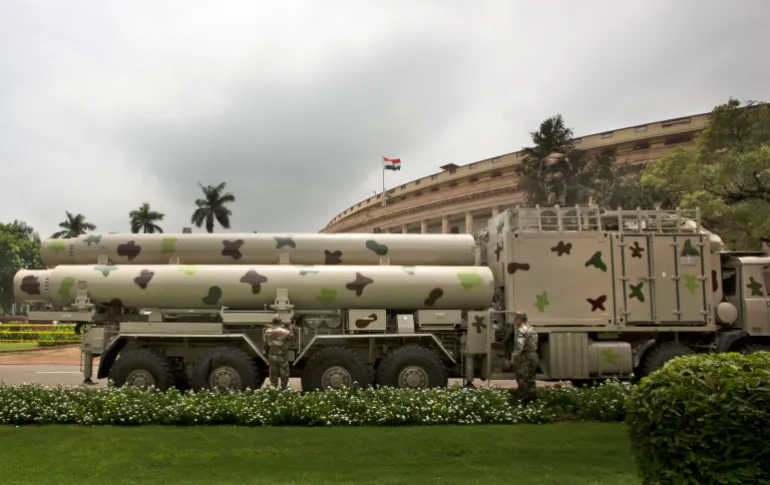
Supersonic BrahMos missiles are seen outside Parliament House, New Delhi [File: Manish Swarup/AP Photo]
Why is India doing this?
India has traditionally relied heavily on state-owned defence companies to turn weapons developed by DRDO into large-scale production. Bharat Dynamics, one such state-owned company, has long held a monopoly in missile production.
Tuesday’s announcement is a “big change” because it ends that monopoly, said Ramanathan.
“Private companies have been making missile components for years, but what this decision does is allow them to move up the value chain and become prime integrators for these systems,” he said.
While India largely relies on domestically made missiles, it also imports missiles — especially from Russia and Israel, two key weapons suppliers to the country.
But under Modi, India has attempted to both encourage self-reliance in defence — a concept that the government calls Atmanirbhar Bharat or self-reliant India — and prod foreign defence majors to manufacture in India.
At a time when geopolitical allegiances are changing fast, and India faces uncertainties on both major borders — with rivals Pakistan and China — the country under Modi has more than doubled its defence budget, from $38bn in 2014 to $86bn in the current financial year.
The brief four-day conflict with nuclear-armed rival and neighbour Pakistan last year has injected fresh urgency into India’s defence preparedness plans. This year’s defence budget is 16 percent higher than the previous year’s.
Other geopolitical events have forced the government’s hand too, suggested Ramanathan.
“I don’t think this move would have happened as soon as it did if not for the experience of recent wars. Indian decision-makers have been looking at Ukraine, they’ve been looking at the US war with Iran, and of course they’ve been imbibing the lessons of operations from last year,” he said.
“One reason you’re going to need large stockpiles is that, as we’ve seen recently, you’re going to burn through your inventory pretty quickly. The other reason is that your adversary could also degrade your stockpiles using their own precision-strike systems.”
China, he said, was a major factor in India’s calculations.
“India believes that to deter China, which is its most capable adversary, it will need to demonstrate that it can both inflict and absorb really punishing attrition over weeks of gruelling warfare,” Ramanathan said.
To that end, India is also creating a tri-services conventional missile force. “To be a viable and effective force, it’s going to require serious magazine depth, and this cannot be achieved without the active involvement of the private sector,” he added.
What is India’s defence industry already manufacturing?
In June, India announced that it was preparing to spend more than $2bn on military drones from domestic manufacturers, reflecting the rapid expansion of the country’s private defence industry.
More than 600 companies were involved in India’s drone industry, including major groups such as Adani, Larsen & Toubro, and Tata Advanced Systems, as well as startups.
In July, India also approved the purchase of a range of military equipment for its defence forces worth $5.46bn, including missiles, electronic warfare systems and Kamikaze drones.
India is also pushing to rapidly modernise its navy with an eye on Beijing’s growing influence in key Indian Ocean shipping lanes. In December, New Delhi announced plans to procure at least 75 ships and submarines, with most expected to be constructed domestically.
At the same time, India is trying to diversify the foreign sources of its weapons. Over the past decade, New Delhi has worked to move away from its longstanding reliance on Russia for military hardware, expanding defence ties with countries such as the United States, France and — increasingly — Israel.
Does the private sector have the capacity to build missiles?
Private arms manufacturers in India have been increasing spending on bolstering military production in the past few years.
Major conglomerates have invested heavily in ammunition, drones, aerospace and military electronics. Of late, they have started to invest in facilities that aim to manufacture missiles.
Adani Defence & Aerospace, owned by business tycoon Gautam Adani, a close associate of Indian Prime Minister Modi, announced plans in 2024 to invest more than 30 billion rupees ($315m) in ammunition and missile manufacturing facilities in Uttar Pradesh.
The facilities would include capabilities for handling explosives used in missiles and precision munitions.
But commitments and intent don’t build missiles.
“Ultimately, I think the success or failure of this move will depend on how the Indian government places orders,” Ramanathan said. “Making missiles is an incredibly complex and costly affair, and companies are going to have to invest a lot in infrastructure, technology and people. These sorts of investments will only pay off if the government places large enough orders to justify them and also, hopefully, leave these companies with some profits that they can pour back into research and development.”
What missiles does India have?
India has a range of cruise and ballistic missiles, several of which are also capable of carrying nuclear warheads.
In May, on the anniversary of the 2025 war with Pakistan, India successfully test-fired the Agni-V, its most advanced nuclear-capable intercontinental ballistic missile that can reach a distance of 5,500km (3,418 miles) — a range that covers all of China, the Middle East and even parts of Europe.
Its other ballistic missiles have ranges from as little as the Prithvi-1 (150km or 93 miles) to the Agni-IV (4,000km or 2,485 miles), again covering everything from border skirmishes with Pakistan to India’s extended neighbourhood.
It also has powerful cruise missiles, like the BrahMos, co-developed with Russia, which has a range of up to 500km (311 miles), and was used in last year’s war with Pakistan.
Is India also exporting missiles and other weapons?
India has dramatically ramped up its military exports in recent years, from just $72m in 2014-15 — when Modi came to power — to $4bn in 2025-2016.
Paras Defence, one of India’s fast-growing defence manufacturers, said this month it expects its exports to more than double in the 2026–27 financial year, up to $14m, driven partly by increased demand linked to conflicts in the Middle East.
Indian arms makers have also been involved in joint ventures with companies abroad. Adani Defence, in partnership with Elbit Systems – Israel’s largest weapons manufacturer – produces the large Hermes 900 armed drone systems.
A 2024 investigation by Al Jazeera exposed how India was exporting rocket parts and ammunition to Israel, even as the Modi government was publicly calling for diplomacy to end the war on Gaza.
In June 2026, Amnesty International said in a report that India’s weapons exports to Israel made it complicit in the genocide in Gaza.
But it isn’t just Israel that has sought and received weapons from Indian manufacturers. Nor is it just bullets and weapons parts that India is exporting today — complete missiles are in demand, too.
In 2022, the Philippines bought three batteries of the BrahMos missiles from India. Since then, Vietnam and Indonesia have signed deals with India for the purchase of these missiles. And India has submitted a proposal to the United Arab Emirates offering to supply the Gulf country these missiles, too.
Is the latest move a step towards building a military-industrial complex?
That appears to be the intention.
While Tuesday’s announcement marks the first time that India’s state-run research and manufacturing facilities will transfer missile technology to the private sector, the government earlier this year shortlisted private firms to manufacture the country’s next-generation fighter jets.
Tata Advanced Systems, a subsidiary of Tata Sons, and Bharat Forge are among companies to be shortlisted, and are emerging as major makers of artillery systems, ammunition and aerospace systems. India has its homegrown jets, but imports the most cutting-edge planes in its arsenal, including the Rafale fighters from France. The Indian Air Force also relies heavily on Soviet-era jets.
Still, while India “wants to build a wider defence industrial base”, said Ramanathan, “it is very far from developing the sort of military-industrial complex that [former US President Dwight] Eisenhower worried about. Power in India still resides overwhelmingly with the government.”
What about India’s military imports?
Despite the surge in domestic manufacturing and exports of specific weapons systems and parts, India on the whole remains a major military importer.
India was the world’s second-largest importer of weapons between 2021 and 2025, according to the Stockholm International Peace Research Institute (SIPRI): Russia was its biggest source, accounting for 40 percent of India’s imported weapons.
Are there risks in transferring sensitive technology to the private sector?
As the US and Israel bombed Iran in March this year, a group of Iranian hackers claimed it broke into the servers of major US defence manufacturer Lockheed Martin, stealing blueprints of components used in the F-35 fighter jets.
The alleged data breach exposed the risks of private companies — which often have lower security standards and oversight than top-secret government laboratories — holding sensitive information.
But Ramanathan pointed out that in India’s case, “the companies that are most likely to get the missile contracts are all old hands”.
“They’ve been involved in the defence sector in some capacity for decades, and they have experience in dealing with confidentiality and secrecy,” he said.
The Indian government, on its part, also “doesn’t want the technology or its missile secrets to go to its adversaries, and it also wants to abide by its commitments to the Missile Technology Control Regime, which gives India several advantages,” he said, referring to one of the world’s major export-control regimes.
“So India has good reasons, in its own self-interest, to ensure that missile technology doesn’t leak.”
Weekly insights and analysis on the latest developments in military technology, strategy, and foreign policy.
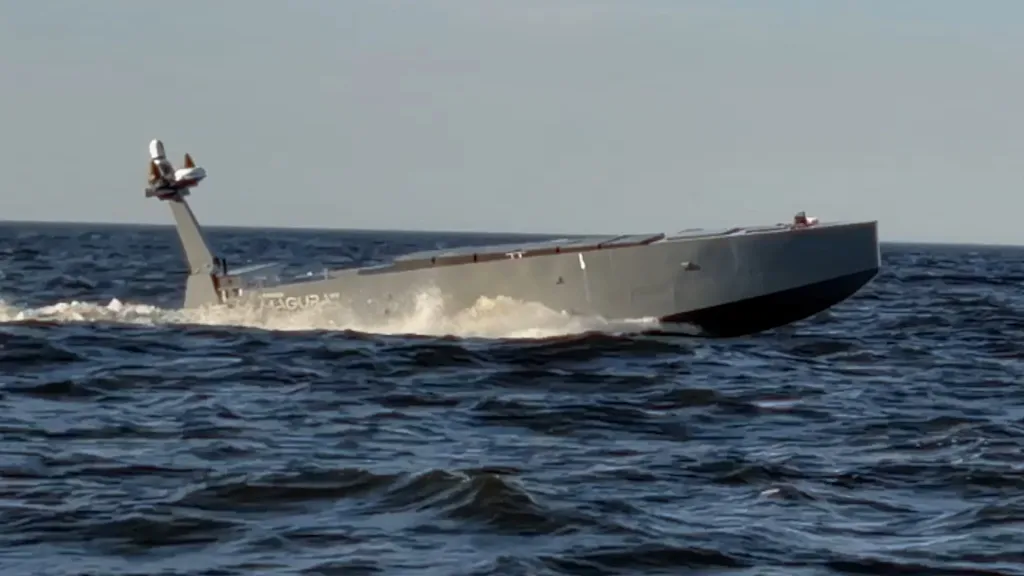
Ukraine’s combat-proven Magura family of uncrewed surface vessels (USV) has gained its largest member to date. The new MV11 is designed for open-ocean operations lasting up to a week and can carry payloads weighing up to 4,850 pounds (2,200 kilograms). The drone boat has so far been shown in one configuration, loaded with 18 small vertically launched Sting interceptors, turning it into a small floating counter-drone battery. Given its significant payload capacity and other capabilities, it could be utilized in other roles, too.
The Magura MV11 USV at speed. UFORCE capture
The MV11 made its public debut yesterday at Ukraine’s Independence Day parade in the country’s capital, Kyiv. The uncrewed air, ground, and maritime systems were the centerpieces of this event, underscoring the central place they now hold in the Ukrainian armed forces. The maritime portion of the parade, which took place along a section of the Dnipro River, featured additional members of the Magura family, as well as other USVs, including kamikaze types and ones armed with repurposed air-to-air missiles. A drone boat with a launcher for first-person-view (FPV) type aerial kamikaze drones and another with an array of small domed antennas (possibly tied to an electronic warfare system or for use as a communications node) were also present. Various types of aerial kamikaze drones, as well as uncrewed ground vehicles (UGV) armed with anti-tank guided missiles, automatic grenade launchers, and machine guns, were also showcased at the event.
The video below shows the various USVs, as well as other uncrewed platforms showcased at Ukraine’s Independence Day parade in Kyiv yesterday.
“We are proud to present the MV11 on Ukraine’s Independence Day. This is not just the largest naval drone – it is a platform that delivers multi-domain capability: a single carrier that transports and launches other unmanned systems far from shore, enabling operations across all domains,” Oleg Roginsky, CEO of UFORCE, said in a statement. “At UFORCE, we are focused on building the best capabilities for Ukraine and its allies who stand for freedom. We are confident the MV11 will become the foundation for many successful missions and for pushing the enemy back even further.”
UFORCE was founded in Ukraine, but has its main headquarters in London in the United Kingdom. It is often described as an uncrewed-focused defense conglomerate with several different enterprises operating under its umbrella. Many of its components are also located outside of Ukraine. For instance, the main design, research, and development bureau for the Magura family is located in Portugal.
As mentioned, the configuration the MV11 has been shown in so far, both at the parade yesterday and in other marketing material released by UFORCE, features a payload of 18 Sting interceptors. They are loaded individually in box-like launchers, which can also be employed in other domains, including mounted on trucks or positioned on the ground. Weighing roughly nine pounds, the Sting interceptor is an electrically powered quad-rotor system with a small explosive warhead. It makes heavy use of 3D-printed components, and each one has a reported cost of around $2,100.
The Ukrainian developer, Wild Hornets, says Sting can reach altitudes up to nearly 23,000 feet (7,000 meters) and has a maximum range of around 23 miles (37 kilometers), depending “on battery capacity, weather conditions, payload weight, and operator flight style.” Typical flying time is said to be shorter, and the system can be recovered for reuse if it does not intercept a target after launch. Sting has proven itself effective at intercepting Russian variants and derivatives of the Iranian-designed Shahed-136 one-way attack drone and other similar designs.
Sting is manually operated by a human controller via a wireless link. How this works exactly with the MV11 as the launch platform is unclear, and TWZ has reached out for more information. Wild Hornets has said in the past that the interceptors can be remotely operated from locations up to 2,000 kilometers away from the launch point via a user interface that can be installed on a laptop.
Wild Hornets 2,000 Km
What capabilities the MV11 has onboard to spot and track targets to begin with is also unknown. However, the USV does have a mast at the rear, and images available so far show it equipped with a camera turret, navigation radar, and two other horn-like antennas. The camera system could be used for target detection and tracking, as well as just to help with situational awareness. The additional antennas might allow for passive detection of aerial targets via their signal emissions, or serve some other purpose. As noted, Ukraine does already have USVs armed with traditional anti-air missiles, which the country has claimed to have used to successfully down Russian fixed-wing jets and helicopters.
A close-up look at the MV11’s mast. UFORCE capture
The MV11 also has a fixed-forward camera on top of the bow, which is a common feature on drone boats to aid general navigation. There are what appear to be a pair of rectangular satellite communications (SATCOM) terminals in the open main deck area, as well. A reliable SATCOM link would be key to linking the Sting interceptors with their operators.
With their own range and endurance, Sting-armed MV11s could offer Ukraine valuable forward-deployed counter-drone nodes out in the Black Sea and along other waterways. Being able to thin out groups of incoming Russian drones further away from their intended targets could help reduce the pressure on land-based forces, including more traditional surface-to-air missile batteries. It is well established at this point that Ukrainian air defense units are under heavy strain from Russia’s constant barrages of drones and missiles on targets across the country.
MV11s could use their ample payload capacity in other ways, possibly including carrying sensor, electronic warfare, or communications packages. In a press release today, UFORCE said that the MV11 could be employed for more general surveillance and reconnaissance missions, as well as to support amphibious operations or transport cargo. In July, video emerged of Ukrainian forces usinga smaller USV to land an armed UGV into a Russian-occupied area. While the exact outcome of that mission is still unclear, it did clearly serve as a proof-of-concept that could be a sign of things to come that could be further enabled by larger USVs.
No soldiers. Just machines.
Ukraine has carried out the world’s first known combat mission in which a sea drone transported and deployed an armed ground robot behind Russian lines on the occupied Kinburn Spit. pic.twitter.com/zyJdFXWxVb
On a more general level, the MV11 underscores the pace at which Ukraine continues to expand and evolve its uncrewed capabilities in the maritime, as well as air and ground domains. Other countries, including the United States, are taking notice and even moving to acquire Ukrainian-developed drone and counter-drone capabilities. Gulf Arab States have notably sought assistance from Ukraine in the wake of Iranian drone attacks this year. In that particular context, an MV11 loaded with Stings could be a very useful and lower-cost system for intercepting Shaheds and other one-way-attack drones heading across the Persian Gulf and the Gulf of Oman, especially when tied in with even a basic early warning network.
Now that the MV11 has been shown publicly, we could well see it in action soon as a counter-drone platform and/or in other roles.
Fernandes rewarded for outstanding season with record assists in the league; Shaw builds on league win and Golden Boot.
Published On 26 Aug 202626 Aug 2026
Manchester United captain Bruno Fernandes was crowned the Professional Footballers’ Association (PFA) Player of the Year, while Manchester City’s Khadija Shaw scooped the Women’s award for the second time.
The award wins on Tuesday highlighted the individual brilliance of both players, with contrasting fortunes for their respective teams during the season.
Portuguese international Fernandes broke the Premier League assists record during an outstanding 2025–26 season, setting up 21 goals as he surpassed Thierry Henry and Kevin De Bruyne’s previous mark.
The 31-year-old also scored nine times as United overcame a poor start to finish third in the Premier League under Michael Carrick and earned a return to the Champions League.
Fernandes also won the Football Writers’ Association Footballer of the Year award in May.
“It is obviously a very proud moment. They are the ones you go on the pitch against, and it’s probably not easy to vote for someone you play against, so it is a very good moment,” said Fernandes.
Khadija Shaw won the Women’s Super League with Manchester City [Paul Childs/Action Images via Reuters]
Shaw was rewarded for scoring 21 goals on the way to a third straight Golden Boot and securing City’s first Women’s Super League title in a decade.
City also saw further success as Nico O’Reilly was named Men’s Young Player of the Year.
The 21-year-old scored twice in the League Cup final as City beat Arsenal and was part of the side that also won the FA Cup last season.
“I’m very proud of the season I had,” said the England international. “I won two trophies with my club and managed to play at the World Cup with my country. I’m over the moon with how it turned out.”
O’Reilly was joined by City teammates Erling Haaland, Rayan Cherki and Antoine Semenyo in the Team of the Year.
Champions Arsenal had five representatives in David Raya, Gabriel, William Saliba, Jurrien Timber and Declan Rice, with Fernandes and Brentford’s Igor Thiago completing the XI.
Iran is betting global economic fallout from the war and Republicans worried about the midterms will force President Trump to back down first. That’s according to Cato Institute’s Doug Bandow who told ‘This is America’ that Tehran is playing a game of ‘chicken’.
McCartney reflected on his history with Parton, which began when he met her in Nashville at the Grande Ole Opry right before starting her solo musical career.
“She was so bubbly and full of life, it is difficult to take in the news that she has passed,” he said. “Her songwriting, her singing and her philanthropy were unrivaled in the world of country music and it is hard to imagine living in a world without Dolly.”
John said he was “shocked and devastated” over the news. “A giant of an artist – unique and irreplaceable, with the kindest heart”.
Swift, who began her professional career in country music as a teen after moving to Nashville, has paid tribute to Parton’s “true grace and true grit, all in one dazzling person”.
“A world without Dolly doesn’t feel possible, real, or right,” the singer said in a statement shared with the BBC. “But because of the eternally generous way she spent her time on this earth and the countless lives she changed for the better, her legacy will be an everlasting one.”
As well as “melodies and lyrics she wrote that thawed even the coldest of hearts,” Swift acknowledged “the millions of books she provided children all over the world so that they might fall in love with stories the way she did”.
She thanked Parton “for the tightropes she walked so that young girls like me could grow up dreaming of joining the circus too”.
Beyoncé said Parton was the “barometer” and the “north star”.
“Bold and brilliant. Talented and tenacious. You taught so many lessons on how to be uniquely oneself. I am grateful for your art, your heart, your generosity, your humor, your entrepreneurship,” Beyoncé wrote.
Cowboy Carter, Beyoncé’s 2024 country album, famously featured a rendition of Parton’s song Jolene.
Former talk-show host Winfrey wrote that one of her fondest memories with Parton was “having a hoot and a holler while wearing Bob Mackie gowns on her show Dolly”.
“This girl from the Smoky Mountains of Tennessee dreamed a life and then lived a life bigger than she could have ever imagined, giving so generously to others in ways we saw and ways we didn’t.”
Israeli soldiers blocked Knesset member Ofer Cassif from reaching a Palestinian family home in the occupied West Bank village of Qusra, where settlers have maintained a 17-day siege. Cassif eventually reached the families and expressed his support.
Families displaced by war in Sudan’s El Obeid refugee camps face crippling water shortages. The paramilitary Rapid Support Forces have been targeting the city’s water sources. Al Jazeera’s Almigdad Alruhaid reports from one of the camps.
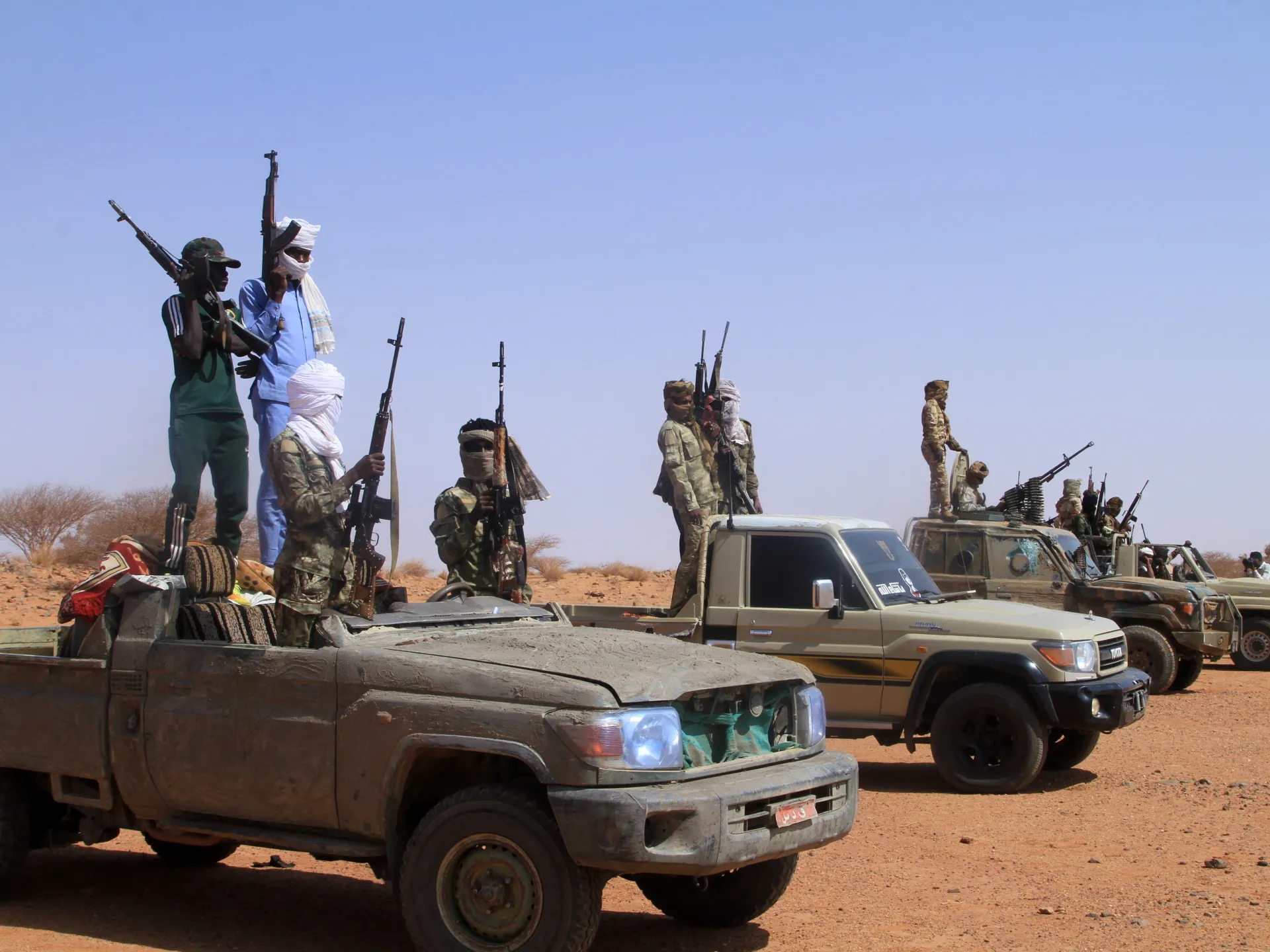
Sudan’s war is showing signs of a changing dynamic. Sudanese armed forces (SAF) have made a series of gains in North Kordofan state; the paramilitary group Rapid Support Forces (RSF) is facing a new wave of defections; and army chief General Abdel Fattah al-Burhan is opening a political track while insisting the military campaign will continue.
Army advances are putting pressure on RSF supply lines; defections are raising questions about the force’s cohesion; and al-Burhan, who also heads the Transitional Sovereignty Council, is seeking to shape a political process from a position strengthened by developments on the battlefield.
But the wider battlefield remains contested. Together, the military pressure, defections and political outreach point to a potentially important shift: battlefield developments may be starting to affect the political balance.
What has the army gained?
The clearest recent gains have come in North Kordofan, a state in central Sudan that links the capital, Khartoum, with the country’s western regions.
In late July, the army announced that it had retaken Bara, Jabra al-Sheikh and Umm Sayala, along with other positions in the state. Al Jazeera reported that the advances also secured the national Exports Road, a key route linking Khartoum, through Omdurman, with el-Obeid, the capital of North Kordofan.
The gains do not amount to control of the wider Kordofan region. But they have significance beyond the territory captured.
The army’s control of the Exports Road has strengthened its position in North Kordofan and added pressure on RSF supply lines. Al Jazeera reported on August 21 that the army was continuing efforts to cut those supply lines as fighting expanded across Kordofan, Darfur and the Blue Nile region.
What do the RSF defections mean?
The battlefield pressure has coincided with a marked increase in defections from the RSF.
On August 20, the army announced that about 318 people, including four officers, had joined its ranks, arriving in Northern state in about 50 combat vehicles before moving to Omdurman. Al Jazeera also reported separate groups from Kordofan and Khartoum, including 270 people, among them 21 field commanders, as well as 45 fighters and commanders from the Bara area who surrendered to the army.
The numbers alone do not tell the story. The timing does.
Al Jazeera’s August 21 analysis links the growing defections to several factors, including battlefield developments, internal problems within the RSF, social and tribal dynamics, and pressure created by the army’s advances and efforts to disrupt RSF supply lines. It also notes that the trend does not by itself mean the RSF is collapsing.
If the trend continues, it could become increasingly significant, particularly if more commanders and fighters conclude that the battlefield balance is shifting against the RSF.
For now, the more cautious conclusion is that battlefield pressure may be affecting the RSF’s cohesion without yet amounting to a broader breakdown of the organisation.
Why is al-Burhan opening a political track?
The SAF chief’s political initiative is unfolding alongside these military developments.
On August 15, he announced that the state would provide temporary immunity and legal, political and security guarantees to participants in a national dialogue managed by an independent national mechanism. Criminal proceedings against participants facing charges would be suspended during their involvement in the dialogue, without removing the rights of those who had filed complaints.
Al-Burhan said the initiative came from a group of Sudanese who had approached him with a proposal for dialogue. He said the group would independently manage the process and that the state would not determine its agenda or outcomes. He also said he had begun engaging with national forces that had supported the state and its institutions, with the aim of involving them in completing state institutions, including a legislative council.
But this is not a move away from the war.
Al-Burhan said he would not accept what he called a “peace without substance” that would bring RSF commander Mohamed Hamdan Dagalo, also known as Hemedti, and his supporters to power. He also said the path to peace begins with the RSF leaving cities and being gathered in designated areas.
On August 21, Al Jazeera reported that al-Burhan said the fighting would continue until what he described as the rebellion was ended, while the army was working to cut RSF supply lines. He also rejected a truce that would allow the RSF to reorganise, while saying he remained open to a just peace and national dialogue that excluded the RSF.
Al-Burhan is therefore not choosing between war and politics. He is pursuing both, maintaining military pressure while opening a political process he says should preserve the state and its institutions.
What does Malik Agar’s position reveal?
Malik Agar, deputy chairman of the Transitional Sovereignty Council, has made the government’s position even clearer.
In an interview with Al Jazeera on August 22, Agar said the current option was military resolution unless serious conditions for negotiations emerged. He said the RSF would have to withdraw from cities and residential areas before negotiations could begin, stressing that the government remained open to initiatives that preserve Sudan’s unity and state institutions.
In a separate Al Jazeera interview published on August 23, Agar said the army would win but that the war would ultimately end through negotiations.
He argued that Sudan’s crisis was rooted in deeper problems, including the weakness of the state and the failure of political elites to manage the country’s ethnic, cultural, religious and geographic diversity.
His position reflects the government’s broader calculation: maintain military pressure while leaving the door open to negotiations from a stronger position on the battlefield.
Can al-Burhan turn battlefield pressure into political leverage?
The army’s gains in North Kordofan have strengthened its position along a strategically important route. The growing defections from the RSF are raising questions about the force’s cohesion. At the same time, the RSF remains active on several fronts, and the wider battlefield remains contested.
That combination gives the recent developments significance beyond individual battles or defections. The changing military balance may now be beginning to shape the terms of Sudan’s next political phase.
For al-Burhan, the potential advantage is not simply territorial. If military pressure continues to produce defections and weaken RSF cohesion, it could give the SAF greater room to shape who participates in a political process and the conditions under which future negotiations take place.
For the RSF, the challenge is therefore not only to hold territory. It is to prevent battlefield pressure from becoming an internal crisis of cohesion.
That has not happened yet. Military setbacks do not automatically translate into political marginalisation.
The army’s recent gains are best understood not as evidence of a decisive victory, but as a shift in the conditions under which the next phase of the war may be fought, and eventually negotiated.
Can the RSF contain the defections and preserve its bargaining position, or will continued military pressure give al-Burhan greater leverage in Sudan’s next political phase?
Repentance Day is intended to be a day of Christian prayer when people come together in church to pray and ask for forgiveness.
The purpose of the day is to encourage citizens to remember Papua New Guinea’s Christian heritage and focus on the repentance of sins for the more than 14 million people living on hundreds of islands in the Pacific Ocean
The holiday was first established by Prime Minister Peter O’Neill shortly after he became Prime Minister in 2011.
It was made a public holiday at the request of a group of churches, who had lobbied O’Neill’s predecessor, Sam Abal.
The date has no obvious religious or historical significance, though at the time, Pastor Jack Edward from the Shema Evangelism Ministry, the Repentance Day co-ordinator, said that public holiday is observed on what was an annual, informal day of prayer.
Papua New Guinea undoubtedly considers itself a religious country with 95% of the population saying they were Christian in the 2011 census, with 70% of those following Protestant denominations.
In March 2025, Papua New Guinea passed a constitutional amendment declaring itself a Christian nation. As it seeks to live up to the way of Christ, it also has high rates of corruption, bribery, crime, and gender-based violence. Additionally, there are frequent cases of tribal and village-based violence, which affects locals, Christians, and missionaries, particularly in rural and highland areas.
Weekly insights and analysis on the latest developments in military technology, strategy, and foreign policy.
Ukrainian drone attacks on targets deep inside Russia have spurred President Vladimir Putin to allow the government to temporarily seize what it deems commercial critical infrastructure that is not sufficiently protection against such strikes. This follows Russia’s move earlier this year to allow private companies to purchase their own air defense systems to protect their own facilities. Beyond calling for increased defenses, the decree signed by Putin also warns that the government will take over facilities that don’t make needed repairs quickly enough once they have been hit.
Russian President Vladimir Putin signed a decree allowing the government to temporarily take control of critical infrastructure if private owners fail to protect it from Ukrainian drone attacks or rebuild it after strikes.
Given the threat to vital economic infrastructure, “we must take measures, we must ensure our own safety,” he added.
Putin’s decree does not specify what actions these facilities are required to take to provide better protection against Ukrainian drone attacks. As we have written about frequently, due to the demands of the battlefield and repeated Ukrainian attacks across a growing portion of Russia, the Russian military already has a shortage of air defense systems. So it’s not clear how much equipment, and of what capabilities, is even available for private firms to purchase. However, the civilian counter-drone industry in Russia is flourishing. Back in May, Russian authorities authorized private companies “to purchase heavy weaponry to defend industrial facilities against drone attacks,” the RBC news website reported at the time, citing sources linked to the Defense Ministry.
“The new system will allow companies to procure anti-aircraft artillery systems, turrets, radar equipment, specialized vehicles and electronic warfare systems,” the outlet added. “In order to promptly provide newly formed mobile fire groups with everything they need, the relevant decisions were recently adopted at the state level.”
In addition, some refineries have already built metal cages around their facilities to help protect against drone attacks.
Russia Puts Cope Cages on Oil Storage Tanks
The Ukrainian drone attacks on Russia’s oil refineries and Black Sea ports are having a dramatic effect on the Russian economy.
“In the four weeks through Aug. 23, overseas crude flows fell to 3.46 million barrels a day,” Bloomberg news reported, citing tanker-movements data it compiled. “Shipments had previously risen as the strikes on Russia’s refineries left more crude available for export, but that increase is now unwinding, after drone hits on oil tankers cut shipments from the Black Sea.”
“Meanwhile, strikes on Russian oil and gas processing plants continue to be an almost nightly occurrence, sending crude processing rates tumbling and creating domestic gasoline supply issues,” Bloomberg explained. “Falling Russian crude shipments come on top of Kremlin-imposed bans on overseas shipments of key refined products, including most gasoline, diesel and jet fuel supplies, which are further reducing inflows to Moscow’s war chest.”
Ukraine’s two-pronged drone strikes on Russia’s refineries and Black Sea shipping hamper Moscow’s oil flows, while refinery crude processing tumbles, writes @JLeeEnergyhttps://t.co/BI3OVPrkJ4
Ukraine, as we noted earlier, has also targeted Russian logistics infrastructure belonging to major online retailers, such as Amazon-style retail giant Wildberries, to increase the financial pain on other sectors of the Russian economy.
“Ozon, Russia’s second-largest online retailer, is now next in Ukraine’s crosshairs,” CNBC reported. “Shares of the company plunged nearly 30% on the Moscow Exchange on Monday after it reported drone strikes in southern Russia, which brought the number of facilities targeted in the last three days to six.”
❗️Ukrainian attack drones struck an Ozon logistics center near Tyube in Russia’s Dagestan overnight, extending the wave of strikes on logistics infrastructure into the North Caucasus. The facility handles large volumes of goods for Ozon across the region. Footage from the attack… pic.twitter.com/vL3Cv7vmtd
Overnight on Monday, Ukraine continued striking inside Russia, attacking the Afipsky Refinery and Gas Separation Units at the Astrakhan Gas Processing Plant, according to the Ukrainian Armed Forces General Staff. The extent of the damage is still being clarified.
“Afipsky Refinery is one of the large oil refining facilities in the Krasnodar region,” the general staff noted. “The project capacity is 6.25 million tons of oil per year. The plant produces, among other things, diesel, gasoline components, and is involved in supplying the Russian occupation army.”
The governor of the Krasnodar region, Veniamin Kondratiev, acknowledged the attack.
“Debris from a drone fell on the territory of the Afipskaya railway station,” he stated on Telegram. “Sadly, two people were killed. I express my deepest condolences to the families. Two more people were injured, and I wish them a speedy recovery. In addition, at least 10 private homes were damaged in the village of Afipsky. A fire broke out in one of them. A fire also occurred on the territory of a refinery. Firefighters and emergency services are currently working at the scene.”
❗️Ukrainian attack drones struck Russia’s Afipsky oil refinery in Krasnodar region overnight, setting the facility on fire. The refinery has an annual crude processing capacity of 9.1 million tons. Debris from the attack also reportedly damaged a railway station. The Afipsky… pic.twitter.com/ao6TWgmR8y
Russia isn’t alone in worrying about Ukrainian drone strikes. Financial Times reporter Christopher Miller noted on X that the Trump administration asked Kyiv not to strike Moscow, St. Petersburg or northern regions of Russia Monday, Tuesday and Wednesday, “when the U.S. would send a plane carrying a senior-level official to the Russian capital.”
On Tuesday, a U.S. Air Force C-17 Globemaster III strategic airlifter arrived in Moscow, reportedly ferrying CIA Director John Ratcliffe. You can read more about that in our initial story here.
Scoop @FT: Trump administration officials last week requested that Kyiv not strike Moscow, St Petersburg and nothern regions of Russia with its long range missiles and drones on Monday, Tuesday and Wednesday when the US would send a plane carrying a senior-level official to the…
Ratcliffe was visiting as the U.S. struggles to end Russia’s full-on invasion of Ukraine and the Iran war, though “the reason for the visit wasn’t immediately clear,” The Wall Street Journal noted. “The U.S. has collected intelligence showing Russia’s early preparations for a possible military mobilization in Ukraine and plans for testing the North Atlantic Treaty Organization’s resolve.”
Analysts said Ratcliffe could meet with Putin to deliver a warning, the newspaper noted.
“It could be to say, ‘We know what you are thinking about doing, and you better not,’” Beth Sanner, a former U.S. deputy director of national intelligence for mission integration, told the Journal. “It could also be about the Iran ceasefire and putting someone else in the discussion,” she said, adding Ratcliffe might also touch upon the Kremlin’s support for Iran following a new U.S. sanctions campaign against the regime.
CIA Director John Ratcliffe made a surprise visit to Moscow, U.S. officials said, his first publicly known trip to the Russian capital. https://t.co/F664tBiV8h
Ukraine is making some small advances in the southern section of the front while Russia continues to put heavy pressure on the Donetsk region in the east. Here are some key takeaways from the latest Institute for the Study of War assessment.
Sumy: Russian forces continued offensive operations in northern Sumy Oblast on August 23 and 24 but did not make confirmed advances.
Kharkiv: Russian forces continued offensive operations in northern Kharkiv Oblast, near Borova, Kupiansk and in the Velykyi Burluk direction on August 23 and 24 but did not advance as Ukrainian forces counterattacked.
Donetsk: Ukrainian forces recently advanced in the Slovyansk direction. Russian forces continued attempts to isolate Ukrainian forces in Mykolaivka (east of Slovyansk), and attacked in the Dobropillya tactical area, the Kostyantynivka-Druzhkivka tactical area, Pokrovsk, Novopavlivka, and Oleksandrivka on August 23 and 24 but did not advance.
Zaporizhia: Ukrainian forces recently advanced in the Hulyaipole direction and in western Zaporizhia Oblast.
Kherson: Neither Russian nor Ukrainian forces reported ground activity in the Kherson direction on August 24.
NEW: Ukrainian forces appear to be conducting a concerted suppression and destruction of enemy air defenses (SEAD/DEAD) campaign against Russian air defense assets in Russian border regions as part of their broader campaign targeting Russian economic and military assets within… pic.twitter.com/JDDH5iUoUn
— Institute for the Study of War (@TheStudyofWar) August 25, 2026
Ukrainian President Volodymyr Zelensky offered some positive news Tuesday about badly needed air defense systems and interceptors.
“We received confirmation regarding several Crotale air defense systems and missiles for them. And AIM missiles, which we use to shoot down enemy missiles. And a little more Patriot missiles have arrived,” Zelensky told reporters. He did not offer specific figures.
Zelensky added that Ukraine had received confirmation from the United Kingdom regarding the production of SCALP long-range missiles.
“We will act. I believe this is a strong positive and a strong decision,” Zelensky said.
Zelensky also said Ukraine expects to receive a schedule for the Freya domestic air defense interceptor initiative within seven to 10 days, including information on meetings and areas where cooperation with defense companies is currently blocked.
Zelensky says Ukraine received some Patriot missiles, AIM missiles and confirmation of several Crotale air-defense systems with missiles. He called the AIM missiles “very important” and said the Patriot delivery remains small: “We need more.” #Ukrainepic.twitter.com/beDn71SLlM
Earlier this month, we told you about two drone-related incidents at Leipzig/Halle Airport in Germany that represented the most serious threats yet in the wave of small drone incursions that have plagued Europe for the past few years. German police said an explosive-laden drone was located on the ground near a Ukrainian Antonov An-124 Condor cargo jet and that there was a midair collision between an object and another cargo aircraft.
More news about that situation emerged today.
German investigators uncovered a third drone and suspected military explosives thought to be connected to the attempted attack on Leipzig airport, the Guardian reported, citing local media.
“The drone was discovered in Kabelsketal, just to the west of the airport, along with about 50g (1.8oz) of a suspected military explosive on 14 August, 10 days after the unsuccessful sabotage,” the publication stated. The office of the prosecutor general, which is leading the investigation, declined to comment on Tuesday. But the German chancellor, Friedrich Merz, said the government would soon provide information about who it believed was behind the drone attacks.
“They will pay for this,” Merz said, stopping short of naming a suspect, before a cabinet meeting in Brandenburg. He added that the government was “working intensively on this together with the security authorities and we will present our findings and comment on them shortly.”
“Intelligence sources cited by the broadcasters NDR and WDR and the newspaper Süddeutsche Zeitung said they suspected the involvement of Russian intelligence in the attempted attack,” the Guardian added. Moscow has denied involvement.
Leipzig airport is a cargo and military logistics hub used by NATO and Ukraine’s Antonov Airlines for transporting military supplies. As we noted in our initial piece, the Condor, in particular, represents an unsurprising target for Russia. Ukraine’s An-124s are a source of national pride and a big flying symbol of the country’s defiance and survival. They also provide much-needed revenue to Ukraine and strategic airlift to support the conflict. Ukraine’s An-124s have long provided charter cargo services for western militaries, companies and NGOs. Since the war began, Antonov Airlines An-124s have been used to deliver war materiel bound for Ukraine.
🚨 🇩🇪 LEIPZIG: ES WAR OFFENBAR NICHT NUR EINE DROHNE
Der Fall am Flughafen Leipzig/Halle wird immer brisanter.
Nach gemeinsamen Recherchen von NDR, WDR und Süddeutscher Zeitung gibt es inzwischen Hinweise darauf, dass rund um den Flughafen mehrere Drohnen, Sprengstoff und… pic.twitter.com/G76gKMwfJw
Britain has signed a partnership with Ukraine to jointly develop artificial intelligence tools for defense and security, ”giving British researchers access to a Ukrainian battlefield data platform used to train military AI systems,” Reuters reported.
Prime Minister Andy Burnham and Zelensky signed the agreement in Kyiv, making Britain the first international partner to access Ukraine’s Avengers AI Labs, a government statement said.
Avengers Labs “was built around an annotated dataset of 5 million battlefield images, Ukraine’s Defense Ministry said earlier in August, largely drawn from the military’s DELTA combat system – a domestically developed battlefield management and situational-awareness system,” the outlet added. “The platform uses data collected from cameras and sensors across Ukraine’s battlefield, including information on tanks, artillery systems, drones and other military targets.”
The Ukrainian ministry said “AI models trained on the data were already being used in an automated target-detection system that analyses more than 100,000 drone video feeds each month and can identify about 70% of enemy targets in real time,” Reuters noted.
The UK became the first foreign nation to gain access to Ukraine’s vast trove of battlefield data in a deal designed to train artificial intelligence models and develop fresh military capabilities https://t.co/qXzTu4UMWA
Fast forward to today and many of those tanks that survived combat “now mostly sit idle, hidden in forests and collecting cobwebs,” according to a New York Times report. “The $10 million machines, procured with great fanfare, proved no match for cheap drones that now dominate the battlefield. Yet Ukraine still maintains them and trains soldiers to use them, while trying to imagine new ways to deploy them.”
“We’re making virtually no use of armored vehicles,” Oleksandr Syrskyi, who until last month was Ukraine’s top general, said recently, the newspaper noted. “This raises the question: How can we neutralize this advantage enjoyed by drones and give our armor a new lease on life?”
The situation has changed so drastically that tanks are being used largely as tractors to tow damaged equipment, the Times proffered. Some of the troops are now more involved with drones than tanks. Newer recruits to a unit that was among the first to receive donated armor “have never even touched a tank. Among them was Korzhyk, 33, who joined the brigade in 2025 and spends his days repairing ground drones in a dark workshop,” the publication added.
❗️Western tanks once coveted by Ukraine now mostly sit idle as cheap drones dominate the battlefield, NYT reports. The 33rd Mechanized Brigade keeps its German-made Leopards hidden, maintained and ready, but combat orders have largely stopped. Tanks are sometimes used to tow… pic.twitter.com/lGaIWnxSv8
❗️Ukrainian MiG-29MU1 fighter using American guided aerial bombs GBU-39 destroys positions of Russian UAV operators in the Belgorod region. pic.twitter.com/y5up0Oyb2m
Ukraine’s mid-range drone attacks against Russian logistics have proven quite successful; however, the following picture shows not every that not every strike resulted in complete destruction. As you can see, a Hornet one-way attack drone got stuck in the windshield of a truck in occupied Crimea.
❗️Ukrainian kamikaze drone “Hornet” failed to detonate and got stuck in the windshield of a Russian truck on the highway to occupied Crimea. pic.twitter.com/ybhakjWpBg
Weekly insights and analysis on the latest developments in military technology, strategy, and foreign policy.
In 2022, a satellite image emerged showing unusual fighter-like ‘shapes’ with a very loosely similar appearance to the stealthy J-20 at a remote Chinese airbase. Three years later, another image appeared showing a broadly similar, but also distinctly different-looking object at a different airport in China. The mystery of these ‘airframes’ now seems to be at least partially solved with new pictures of a mock-up being used for airfield firefighting training.
Another picture showing training utilizing the aircraft fire trainer in question. Chinese internet
The overall design of the vaguely J-20-like aircraft fire trainer also aligns more with the object that previously appeared at Jining Qufu Airport. Both share a distinct modified diamond-like delta planform, as well as canards, and twin vertical tails. It is worth noting that the ground-level images we have now also show a cockpit configuration that is more representative of the newer J-35. Regardless, the articles seen at Lintao had differently shaped wings and longer, more slender noses.
A side-by-side comparison of, left-to-right, one of the ‘shapes’ spotted at Lintao Air Base in 2022, the object seen at Jining Qufu Airport in 2025, and the vaguely J-20-esque aircraft fire trainer. Google Earth/Chinese Internet
In general, aircraft fire trainers can be anything that loosely represents a desired class of aircraft – fighter, airliner, etc – and can range from specially built systems to repurposed old aircraft hulks. Training aids of this kind are designed to offer a readily reusable way to add realism to airfield firefighting drills. They are in widespread use globally by national militaries and civilian fire departments. The shapes previously seen at Lintao could still serve some other purpose as full-scale mock-ups, or decoys, as well.
A US military aircraft fire trainer in the rough shape of an F/A-18 Hornet fighter. US MilitaryA subscale aircraft fire training in the general shape of an F-35 Joint Strike Fighter at the US Air Force’s Hill Air Force Base in Utah. USAF
The emergence of the firefighting trainer also comes as the People’s Liberation Army Air Force’s (PLAAF) fleet of real J-20s continues to expand, something TWZ explored in detail earlier this year. The PLAAF may have some 500 J-20s in service now, with examples assigned to at least 14 operational units and three training bases, according to one estimate. There are projections that the total fleet could grow to 1,000 airframes by 2030 if production of the jets continues apace. This is inclusive of all variants, including a two-seat version that first broke cover in 2021.
One of China’s growing fleet of real J-20 fighters. PLAAF
The growing size of China’s fleets of J-20s, as well as other more modern fighters, can only increase demands for training, both for pilots and ground crew, as well as maintenance and sustainment requirements. Ever larger numbers of routine day-to-day sorties raise the risk of crashes and other accidents just as a matter of course.
Chinese airfield firefighters get close to the trainer. Chinese internetAnother close-up shot of Chinese airfield firefighters hosing down the training aid. Chinese internet
As China’s fleets of more advanced operational aircraft continue to expand in scale and scope, we can expect to see similar growth in the infrastructure and other assets necessary to support their operations, including new aircraft fire trainers.
Special thanks to Andreas Rupprecht, an expert on Chinese aviation and contributor to this website, who goes by @RupprechtDeino on X, for bringing this to our attention.
The amended law was an attempt by state Republicans to crack down on unproven claims of voting by noncitizens.
Published On 25 Aug 202625 Aug 2026
A United States federal court has temporarily blocked an Ohio law that required proof of US citizenship from residents who wanted to register to vote while they obtained a driver’s license.
In his ruling on Tuesday, US District Judge Solomon Oliver Jr granted a preliminary injunction against the law, saying it likely violates the US National Voter Registration Act (NVRA) because it requires more information than necessary to determine a resident’s eligibility to vote.
Recommended Stories
list of 3 itemsend of list
“Election officials do not need documentary proof of citizenship to assess a voter registration applicant’s citizenship because signed attestation of citizenship is enough,” Oliver wrote.
The judge also pointed to a clause in the act that says each US state’s driver’s license application “shall serve as an application for voter registration with respect to election for Federal office unless the applicant fails to sign the voter registration application”.
Oliver said that Ohio must offer applicants the opportunity to register once they’ve submitted their driver’s license application, not after it’s been approved by the state’s Bureau of Motor Vehicles (BMV).
“To interpret this section of the NVRA otherwise would allow States to make registering to vote at the BMV more onerous, and could result in fewer voter registrations because the opportunity to apply was not proactively offered to otherwise eligible citizens,” Oliver added.
In 1995, Ohio passed a so-called “motor-voter” law that allowed residents the opportunity to register to vote when they applied for a driver’s license
But that law was amended last year by the state’s Republican-controlled legislature in an attempt to crack down on unproven claims, pushed in part by US President Donald Trump, that noncitizens were voting in the state’s election. US law prohibits noncitizens from voting in federal elections.
The ruling marks a victory for voting rights advocates like Red Wine & Blue, which sued Ohio’s secretary of state, Frank LaRose, over claims that the law disenfranchised eligible voters and violated the NVRA.
One of the group’s lawyers, Ben Stafford, praised the ruling, calling it “a win for Ohio voters.”
“With the registration deadline just weeks away, eligible Ohioans will now have the opportunity to register to vote at the BMV without having to produce unnecessary paperwork that is not required by federal law,” Stafford, an attorney at Elias Law Group, said in a statement.
LaRose said his office disagrees with the decision and will appeal.
US President Donald Trump has said that the US Navy has removed or detonated all mines in the Strait of Hormuz – the vital waterway which Iran has largely closed since the beginning of the war in the Middle East.
“Iran has been notified that any ship or boat placing new mines will be immediately and systematically destroyed,” Trump said in a post on his Truth Social platform.
There is no comment from Iran.
Closure of the strait has caused wild fluctuations in the price of oil on world markets. Trump has often said the US has control of the area – but Iran has fired against vessels it says have sought to cross without its permission.
Some 20% of the world’s oil and liquefied natural gas used to transit the Strait of Hormuz before the war, which began on 28 February with US and Israeli air strikes against Iran.
In addition to closing the strait, Iran retaliated against Israel and against US bases in the region as well as US Arab allies in the Gulf.
A ceasefire aimed at facilitating talks to end the war has collapsed and there has been intermittent exchange of fire between the US and Iran.
US Treasury Secretary Scott Bessent warned that any nation financially partnering with Iran would be isolated.
Iran and the US signed a Memorandum of Understanding (MoU) in June – a 14-point document which set a 60-day deadline to reach a deal on the Strait of Hormuz, before substantial negotiations on resolving the nuclear issue – allegations that Iran is building a nuclear weapon, which Tehran has consistently denied.
However, that deadline has now expired and talks have collapsed leading to the new US sanctions that Trump believes will lead to the collapse of the Iranian regime.
Iran has been under sanctions for most of the time since the founding of the Islamic Republic in 1979 and Economy Minister Ali Madanizadeh said Tehran was “fully prepared” for the wider sanctions, which he added would lead to “another defeat” for the US.
Its economy, however, has suffered as a result of the war – and a blockade of Iranian ports that the US has been maintaining for weeks not to allow trade to continue.
On Tuesday, China – the biggest buyer of Iranian oil – said it was firmly opposed to what it called the US’s “illegal unilateral sanctions” and would take “all necessary measures” to safeguard its rights.
The US announcement comes ahead of planned talks between Trump and Chinese President Xi Jinping next month.
Washington is likely to be wary of potential retaliation from Beijing, which processes the majority of the world’s rare earths and other critical minerals, crucial in the manufacture of many high-tech products.
Beijing has already tightened export controls on rare earths as part of previous trade negotiations with the US.