Discover the latest happenings and stay in the know with our up-to-date today news coverage. From breaking stories and current events to trending topics and insightful analysis, we bring you the most relevant and captivating news of the day.
The new cases in Uganda include a driver who transported the country’s first confirmed patient and a health worker.
Published On 23 May 202623 May 2026
Uganda has confirmed three new cases of Ebola, bringing the total number of infections in the country in this outbreak to five, as authorities stepped up contact tracing to try to contain the spread.
The update from Uganda’s Ministry of Health on Saturday came a day after World Health Organization Director-General Tedros Adhanom Ghebreyesus announced the risk assessment for the Bundibugyo strain of Ebola was being revised to “very high at the national level, high at the regional level, and low at global level”.
Recommended Stories
list of 3 itemsend of list
Nearly 750 suspected cases and 177 suspected deaths have been recorded in Uganda’s neighbouring country, Democratic Republic of the Congo (DRC), the centre of the outbreak.
The WHO has said late detection, the absence of a vaccine or virus-specific therapeutics, widespread armed violence and high mobility among the population make the DRC especially vulnerable.
Uganda suspended all public transport to the DRC on Thursday after confirming two cases of Ebola – one infection and one death – involving Congolese nationals who crossed the border.
The new cases in Uganda reported on Saturday include a driver who transported the country’s first confirmed patient and a health worker exposed while caring for that patient.
Both are receiving treatment and were identified among known contacts, the Health Ministry said in a statement.
The third case is a woman from DRC who entered Uganda with mild abdominal symptoms and later travelled from Arua, close to the border, to Entebbe before seeking care at a private hospital in the capital, Kampala.
The patient initially improved and returned to DRC but later tested positive for Ebola after a follow-up prompted by a tip-off from a pilot involved in transporting her.
All identified contacts linked to the confirmed cases are being closely monitored, the ministry said, urging the public to remain vigilant and report suspected symptoms.
“At this critical moment in the outbreak response, it is vital that authorities maintain high vigilance to control expansion of the virus,” Tedros said on Saturday.
“The WHO is working side by side with Africa Centres for Disease Control and Prevention, and partners in the DRC and Uganda, to contain the outbreak, support affected people, and bolster a coordinated response.”
The renewed instability could complicate bailout negotiations with the International Monetary Fund.
Published On 23 May 202623 May 2026
Senegal’s President Bassirou Diomaye Faye has dismissed Prime Minister Ousmane Sonko and dissolved the government, a move that risks deepening uncertainty in a country grappling with a debt crisis and ongoing talks with the International Monetary Fund (IMF).
A statement read out by a presidential aide on state media on Friday informed the nation that all ministers were dismissed, with the outgoing government tasked with handling day-to-day affairs.
Recommended Stories
list of 3 itemsend of list
The decision follows months of growing tensions between Faye and Sonko. Sonko, a charismatic figure with a strong youth following, had backed Faye in the 2024 election after being barred from running himself due to a defamation conviction, but the two allies became increasingly estranged.
The split comes as Senegal faces mounting economic pressure. The IMF froze a $1.8bn lending programme following the discovery of misreported debt hidden by the previous government, pushing the country’s end-2024 debt level to 132 percent of its economic output.
Faye’s move raises the risk of further delays in reaching a new agreement with the IMF.
Earlier on Friday, before Sonko’s dismissal, Finance Minister Cheikh Diba told parliament that the government expects to resume talks with the IMF in the week of June 8 and hopes to reach an agreement on key points by June 30.
Sonko was a popular opposition leader under the previous administration of President Macky Sall, whose decision to delay the 2024 election spurred unrest.
Both Faye and Sonko are former tax officials who were jailed ahead of the 2024 election. They were released 10 days before the rescheduled contest, which Faye went on to win with 54 percent of the vote.
Faye then appointed Sonko as prime minister.
Now that Sonko is out of that job, it is unclear what his next steps will be. In March, he said he would be willing to take his Pastef party out of the government and return to opposition if Faye departed from the party’s agenda.
Pastef dominates the National Assembly, meaning it could complicate governance and the passage of reforms needed to secure IMF support. Last month, politicians overwhelmingly approved electoral code changes that could pave the way for Sonko to run for president in 2029.
People in southern Lebanon are living under “psychological terror” from Israeli air attacks and displacement orders.
Published On 23 May 202623 May 2026
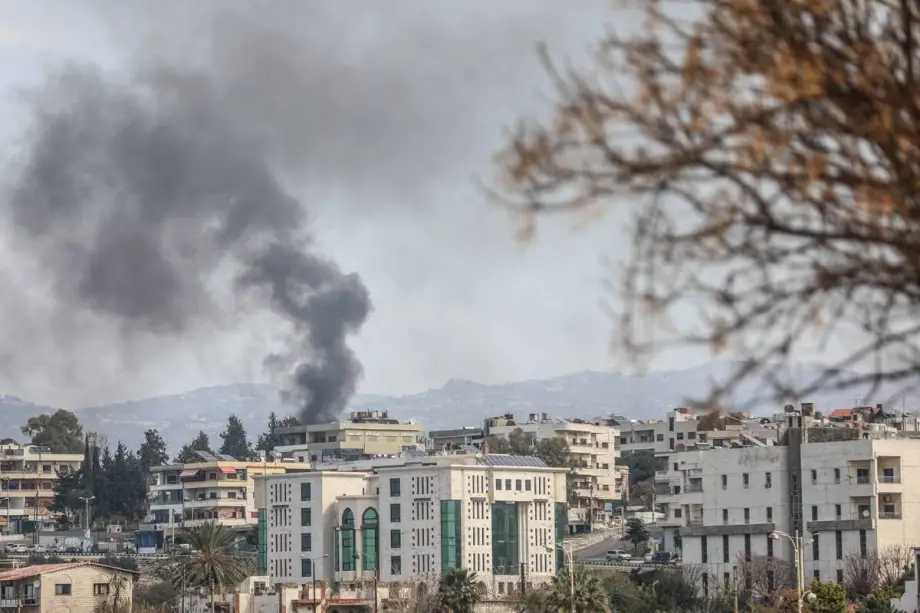
Israeli forces launched a new wave of air attacks in Lebanon on Saturday after earlier raids killed 10 people, targeting an area near the Syrian border and several villages in southern Lebanon.
Lebanon’s National News Agency said there were five Israeli air attacks shortly before midnight in the mountainous Nabi Sreij area on the outskirts of Brital, which had been spared from attacks since April 17. On Saturday, the agency reported large explosions in the towns of Yohmor al-Shaqif in Nabatieh and Taybeh in the Marjayoun district, both in southern Lebanon.
Recommended Stories
list of 3 itemsend of list
On Thursday, an Israeli attack near the Tebnine Hospital in southern Lebanon damaged all three floors of the building, including the emergency room, intensive care unit, surgical ward, and ambulances parked outside, according to the Ministry of Public Health.
Israel’s military had issued two forced displacement warnings since Friday night via its Arabic-language spokesman Avichay Adraee, for the southern Lebanese village of Burj Rahal and the areas of Tyre and Zqouq al-Mufdi.
Al Jazeera’s Obaida Hitto, reporting from Tyre, southern Lebanon, at the edge of the 500-metre (550-yard) perimeter that Israel has designated as the danger zone, said: “There are ambulances here. There are also rescue teams and people who have fled their homes this evening following this forced [displacement] order.”
Many left in fear and panic, he said, seeing these orders as threats while being unsure of when they could return home.
“People are here with their families and their children,” Hitto said. “This is the kind of psychological terror that Israel is forcing people to live in, here in southern Lebanon.”
More than 3,100 people have been killed in Lebanon since Israeli forces escalated attacks on the country on March 2, and attacks have continued despite a ceasefire announced by United States President Donald Trump on April 16. The dead include 123 medics, more than 210 children and nearly 300 women, according to statistics shared by Lebanon’s Health Ministry on Friday.
Weekly insights and analysis on the latest developments in military technology, strategy, and foreign policy.
Recently published imagery confirms that the A-10C attack jet is now operating in the Middle East with its new refueling probe fitted, something that has been achieved remarkably fast. As we reported at the time, the Warthog’s probe-type aerial refueling capability was first demonstrated in early April, and the adaptation comes as the jet cruises into the twilight of its career after it got a small reprieve from final retirement.
The U.S. Air Force has released images showing an A-10C using its Probe Refueling Adapter to take on fuel from an HC-130J Combat King II earlier this month, somewhere in the U.S. Central Command (CENTCOM) area of responsibility. The Warthogs in question belong to the 107th Fighter Squadron from Selfridge Air National Guard Base, Michigan, which deployed to the Middle East in early April.
A U.S. Air Force A-10C Thunderbolt II aircraft approaches an HC-130J Combat King II aircraft for aerial refueling in the U.S. Central Command area of responsibility, May 9, 2026. U.S. Air Force photoTwo A-10Cs approach an HC-130J Combat King II for aerial refueling in the U.S. Central Command area of responsibility, May 9, 2026. U.S. Air Force photo
As we discussed in the past, the Probe Refueling Adapter could be of significant importance to the A-10 and the wider Air Force, during a future fight in the Pacific. Clearly, however, it is equally applicable to ongoing operations in the CENTCOM theater.
Indeed, the Air Force previously confirmed that the Probe Refueling Adapter effort was in response to an urgent combatant command requirement.
Adding the Probe Refueling Adapter is also relatively straightforward, since it makes use of the existing air refueling receptacle on the nose of the A-10. In turn, this means that the A-10 loses its regular nose-mounted receptacle.
An A-10C receives fuel from a KC-135 via its nose-mounted receptacle over an undisclosed location within the U.S. Central Command area of responsibility. U.S. Air Force photo by Airman 1st Class Travis Knauss
As of April, the non-probe-equipped A-10 was only able to refuel from the KC-135, since the KC-10 had been retired, and the KC-46 was not yet certified to refuel the Warthog. This last issue is due to a long-running “stiff boom” problem, which runs the risk of damaging the receiving aircraft. The addition of the probe also means that the A-10s can now refuel from KC-46s too, which have a built in hose and drogue system, as well as a boom.
However, the A-10 can now take on fuel from Air Force HC-130s and MC-130s, or even Marine Corps KC-130s, as well as KC-130Js from other operators. Initial tests of the Probe Refueling Adapter involved an HC-130J from the 418th Flight Test Squadron.
These refuelers can operate from shorter runways and can offload fuel at very low altitudes, something the KC-135 is not able to do. Pairing the A-10 with these kinds of tankers, which can routinely operate from shorter fields and do so with far more flexibility, provides expanded aerial refueling flexibility for mission planners.
A U.S. Air Force loadmaster watches an A-10C approach his HC-130J before conducting aerial refueling in the U.S. Central Command area of responsibility, May 9, 2026. U.S. Air Force photo
Working with the HC-130 and MC-130 is especially relevant for the A-10, bearing in mind its combat search and rescue ‘Sandy’ mission. This involves the jets providing escort and close air support for special operations helicopters working to retrieve personnel from highly contested territory. A-10s have flown this very mission over Iran. Already, HC-130s and MC-130s provide fuel to rotary-wing aircraft during these kinds of operations, and a probe-equipped A-10 would provide extended endurance and range in such scenarios.
The Probe Refueling Adapter also comes with a degree of flexibility. The Air Force describes it as “a field-configurable solution designed for installation by operational flight line personnel.”
“Units can install or remove the adapter in a matter of hours, allowing aircraft to be reconfigured between boom and probe refueling capability based on mission requirements,” the service says.
A U.S. Air Force pilot watches an A-10C approach his HC-130J before conducting aerial refueling in the U.S. Central Command area of responsibility, May 9, 2026. U.S. Air Force photoA head-on view of a probe-equipped A-10C in the U.S. Central Command area of responsibility, May 9, 2026. U.S. Air Force photo
The Angry Kitten had previously been test flown on the A-10, but had not been seen in an operational context. The store is also used operationally by Air Force F-16s and HC-130s and Navy F/A-18E/Fs. Angry Kitten was originally developed to replicate hostile electronic warfare threats during testing and training, as part of a cooperative effort between the Air Force and the Navy, but was so effective that it was adapted to operational use.
Using advanced Digital Radio Frequency Memory (DRFM) technology, Angry Kitten detects and ‘captures’ radio frequency (RF) signals. Those signals are then manipulated and retransmitted. For example, RF signals from an enemy air defense radar can be recorded and sent back in a way that creates false or otherwise confusing tracks. The same data can also be used for broader intelligence-gathering purposes. You can read more about the capabilities of the pod here.
Close-up of the Angry Kitten pod under the left wing of a U.S. Air Force A-10C in the U.S. Central Command area of responsibility. U.S. Air Force photo
As well as the Angry Kitten pod, the A-10C seen in the accompanying imagery carries a Litening targeting pod and a pair of 500-pound-series Joint Direct Attack Munitions (JDAM).
Returning to the Probe Refueling Adapter, the A-10 is now putting it through its paces in an operational context in the Middle East.
But as we have discussed in the past, equipping A-10s and other combat jets with probes makes a good deal of sense for Pacific contingencies, too. They could also be operated alongside smaller tactical tankers, which could also play a very important role in that kind of conflict.
Close-up of a U.S. Air Force A-10C as it refuels from an HC-130J Combat King II aircraft in the U.S. Central Command area of responsibility, May 9, 2026. U.S. Air Force photo
Simply put, the receptacle and boom mode of aerial refueling is optimized for plugging in at higher altitudes, for maximum efficiency and safety. However, in the Pacific, combat operations are likely to require fighters to take off with heavy loads from short runways, potentially battle-damaged ones, then immediately hook up to a tanker. Lower-level refueling using a probe is much more appropriate here and, indeed, is entirely in line with the Air Force’s Agile Combat Employment (ACE) strategy. This envisages fighters hopping from one austere forward airfield to another, keeping them close to the action, but farther away from the enemy’s strikes. Such airfields can also be accessed by standard C-130 transports, which can also help support tactical jets with spares, weapons, crews, etc.
There is also the fact that higher-level aerial refueling puts the tanker and receiver at higher risk of detection and engagement by the enemy. Aerial refueling assets, in particular, will be among the highest-priority targets for China in any confrontation in the Pacific. Indeed, there is a whole Chinese development thread focused on air defenses to engage aircraft like these, and other critical force-multipliers. Having refueling operations and tankers operate at a lower altitude puts them below the radar horizon, providing another layer of survivability, especially when working from islands closer to major target areas.
Three U.S. Air Force A-10Cs fly in formation after aerial refueling from an HC-130J in the U.S. Central Command area of responsibility, May 9, 2026. U.S. Air Force photo
If the Probe Refueling Adapter concept could be extended to fighters like the F-16 and F-15, and potentially even future versions of the F-35A, these aircraft could rely more heavily on C-130 tankers, which are, at least in some cases, better suited to the ACE concept. Meanwhile, the larger KC-46s and KC-135s could operate somewhat further from the battlespace, including dragging tactical aircraft to and from the theater of operations, as well as supporting bombers and transports.
Now that the Probe Refueling Adapter is being proven in a combat theater, its success there could help keep the A-10 relevant throughout the last few years of its service, and perhaps even longer.
President Xi Jinping has called on authorities nationwide to learn from the incident.
Published On 23 May 202623 May 2026
A gas explosion at a coal mine in China has killed at least 90 people.
State media Xinhua said 247 workers had been on duty underground when the blast ripped through the Liushenyu mine in Qinyuan county, Shanxi province, on Friday.
Recommended Stories
list of 3 itemsend of list
China’s coal mines are considered among the deadliest in the world due to poor safety standards, weak regulation, and corruption as companies seek to profit from the country’s rapidly expanding economy.
Rescue operations were ongoing as emergency crews continued searching for survivors of the explosion, the deadliest mining disaster reported in China in more than a decade.
The blast occurred shortly after a carbon monoxide alert was issued, with some reports claiming gas levels had exceeded safe limits.
According to state-run broadcaster CGTN, the person responsible for overseeing the mine has been arrested while authorities investigate the cause of the explosion.
President Xi Jinping has urged authorities across China to intensify efforts to prevent major accidents in the wake of Friday’s blast.
“All regions and departments must learn from the lessons of the accident, remain vigilant regarding workplace safety, thoroughly investigate, rectify all types of risks and hidden dangers, and resolutely prevent and curb the occurrence of major and serious accidents,” Xi said.
Video footage posted online from the scene showed several ambulances gathered near the mine.
Shanxi province, where the incident occurred, is China’s main coal-mining region. More than one billion tonnes of coal were extracted there last year, almost a third of the country’s total output.
China is the world’s largest producer and consumer of coal, accounting for more than half of global consumption.
The country is also the world’s largest annual greenhouse gas emitter, while being the biggest producer of renewable energy.
The video in question, seen below, was included in a new tranche of declassified records that the Pentagon posted online today as part of the Presidential Unsealing and Reporting System for UAP Encounters (PURSUE) initiative. UAP here stands for unidentified aerial phenomena (UAP), which are also still commonly referred to as unidentified flying objects (UFO). This is the second batch of videos, pictures, and documents to be released through PURSUE, with the first having come back on May 8. Overall, what has been disclosed so far has been underwhelming, to say the least.
Lake Huron UAP engagement by F-16
What has already been well established is that a pair of F-16CM Vipers from the Minnesota Air National Guard scrambled in response to the detection of an unidentified object on February 12, 2023. Authorities deemed the object, which was soaring at approximately 20,000 feet, to be concerning and a potential hazard to civil aviation. One of the F-16s shot it down over Lake Huron, which lies right along the U.S. Canadian border, with an AIM-9X Sidewinder missile. Canadian authorities subsequently recovered debris, which we will come back to later on.
One of the F-16Cs from the 148th Fighter Wing that was scrambled on February 12, 2023. The jet’s empty underwing station is highlighted, indicating that it is the one that took an AIM-9X shot. @Badger_wings
The official description of what is seen in the newly video, which is titled “USAF ANG F-16C (callsign [CALLSIGN]) Shoots Down UAP over Lake Huron with [Weapon System], 12 Feb 2023,” reads:
“At the 11 second mark, the sensor focuses on an area of contrast in the center of its field-of-view. At the 20 second mark, the footage appears to depict a kinetic interaction between two distinct areas of contrast, with the initial subject of the footage fragmenting in a radial displacement pattern that suggests a high-energy event.”
“This video description is provided for informational purposes only. Readers should not interpret any part of this description as reflecting an analytical judgment, investigative conclusion, or factual determination regarding the described event’s validity, nature, or significance.”
The footage was shot through an infrared camera. The F-16s involved in the shootdown were seen at the time carrying Sniper Advanced Targeting Pods (ATP), which have both electro-optical and infrared video cameras, among other features. From what can be seen, the object is distinctly balloon-like with a roughly spherical shape. It has a single wire or some other kind of line dangling below, but there is nothing readily visible attached to it.
A screen capture from the newly released video showing the line dangling below. NORTHCOM capture
How the object is seen ‘bursting’ apart at the 20-second mark in the video is also very consistent with a balloon.
A screen capture from the video showing the object ‘bursting’ apart. NORTHCOM capture
At the time of the shootdown over Lake Huron in 2023, which was widely publicized, the object was described as “octagonal” and as having multiple “strings” hanging below, but no visible payload.
“And what a senior administration official described is that it had an octagonal shape and there were strings hanging from it, but with no discernible payload.” pic.twitter.com/7CxrNLdNzK
The description above is in line with unclassified audio recordings of the in-cockpit communications from the two F-16 fighter jets that TWZ published the day after the shootdown.
“I wouldn’t really call it a balloon … I don’t know what … I can see it outside with my eyes,” one of the pilots can be heard saying in that audio. “Looks like something … there’s some kind of object that’s distended… it’s hard to tell, it’s pretty small.”
“I’m gonna call it a balloon,” one of the pilots adds later on.
“In the targeting pod, I can’t tell if it’s metallic or what, but I can see like lines coming down below it, but I can’t see anything below it,” one of the pilots also says at one point.
“The size of it, that would be challenging, it’s so slow and so small, I just can’t see it,” one of the pilots notes, as well.
You can listen to the full 2023 Lake Huron shootdown audio below.
Radio Audio From F-16 Shoot Down Of Object Over Lake Huron
In 2024, Canada’s CTV News also published records that were obtained via a request under Canada’s Access to Information Act, one of which said that a “module” was among the debris recovered after the shootdown and that it was “from a company who sells weather monitoring equipment.” The document in question was an email from Mark Flynn, at the time the Royal Canadian Mounted Police’s (RCMP) deputy commissioner for Federal Policing, to Canadian Armed Forces Brig. Gen. Eric Laforest, then-strategic joint staff director of general operations.
“It will be analyzed to determine if there is anything unusual with it but I suspect not given the size,” Flynn’s email added. “Whether or not it is from the shoot down is uncertain.”
“Debris has been recovered from the shores of Lake Huron but after careful analysis, it was determined not to be of national security concern,” the RCMP also told CTV News directly.
The records the Canadian outlet obtained also included a redacted Royal Canadian Air Force report that further suggested the object might have been a weather balloon launched from a U.S. National Weather Service radar station in Michigan. That same report also highlighted the possibility that the object shot down over the Yukon Territory had been a so-called “pico” balloon, which amateur radio enthusiasts regularly launch across North America, a theory that was widely reported at the time.
A redacted page from a redacted RCAF report describing the Lake Huron object as a “possible weather balloon.” RCAF via CTV NewsAnother page from the same redacted report raising the possibility that the object shot down over the Yukon Territory may have been a pico balloon. RCAF via CTV News
The newly released video all but closes the case on what was shot down over Lake Huron being an innocuous balloon. This, in turn, adds to the existing and serious transparency questions surrounding all three of the still largely unexplained shootdowns in February 2023.
The only image to be released before now was a single still picture of the object downed over the Yukon Territory, which is seen below. You can find our previous analysis of what that picture shows here.
Canadian DND via Access to Information Request Via CTV News
In an interview with TWZ‘s Howard Altman earlier this year, Royal Canadian Air Force (RCAF) Maj. Gen. Chris McKenna also described the object shot down off the coast of Whitehorse in Alaska as a “white balloon” belonging to “either research or a state actor.” McKenna is the commander of 1 Canadian Air Division, operational commander for the Canadian North American Aerospace Defense Command (NORAD) Region (CANR), and the Canadian Joint Forces Air Component Commander.
TWZ and others have noted for years now that it has been, at best, curious that the U.S. military had not released imagery and/or video of any of these unprecedented shootdowns that followed the Chinese spy balloon affair. This disconnect is even pronounced given how quickly higher resolution video footage and pictures of geopolitically charged events, often captured through exactly the same kinds of sensors, are routinely released.
“Data release and footage is prioritized based on the geopolitical environment at the time,” Sean Kirkpatrick, then head of the All-domain Anomaly Resolution Office (AARO) said in response to a question from TWZ about why video or pictures from the February shootdowns had not been released at a press briefing in October 2023. “So engagements with Chinese fighters, Russian fighters have a much larger priority in getting it through the review process or declassification than UAPs or other similar engagements.”
“We are however, working through those processes, which all exist and we’ve got several of them actually already declassified and ready to update on our website [which] we’ll be doing on the next update to the website,” Kirkpatrick, who left AARO in December 2023, added at that time. “And we’re putting them out as quickly as we can get them through their proper steps.”
AARO head Sean Kirkpatrick testifies during a Senate hearing on UAPs in 2023. Senate capture
The Pentagon established AARO in 2022 to serve as a central manager within the U.S. military for policies and procedures for tracking, reporting, and analyzing UAP incidents, as well as to act as a repository for intelligence assessments and other relevant data. Since then, the office has been a focal point for that criticism, especially from members of Congress on both sides of the political aisle, who have complained about stonewalling on UAP-related matters.
With all of this in mind, it’s interesting to note that the Pentagon’s PURSUE website says the newly released video of the Lake Huron shootdown did come via AARO, but in what appears to have been something of a circuitous route.
“On March 6, 2026, eight members of the U.S. House of Representatives requested access to 51 potentially UAP-related records allegedly held by the Department of War and the Intelligence Community,” according to the entry in the PURSUE archive. “The All-domain Anomaly Resolution Office (AARO) identified a collection of responsive materials held on a classified network. Many of these materials lack a substantiated chain-of-custody.”
“AARO assesses that this video, whose uploader-defined title is, ‘USAF ANG F-16C (callsign [CALLSIGN]) Shoots Down UAP over Lake Huron with [Weapon System], 12 Feb 2023,’ is likely derived from an infrared sensor aboard a U.S. military platform operating within the United States Northern Command area of responsibility in 2023. A user uploaded this video to a classified network in February 2023.”
This is a very odd description, suggesting that AARO was somehow not aware of the origin of the footage and/or could not confirm it. The PURSUE archive simply lists “Department of War” as the source of the video. TWZ reached out to the Pentagon and NORTHCOM for more information. The Pentagon confirmed to us that the video is indeed of the well-publicized shootdown.
A screen capture of how the listing for the video in the PURSUE archive appears at the time of writing. US Military
As TWZ has noted in the past, there is evidence that U.S. and Canadian authorities withheld the release of certain materials related to the trio of shootdowns in February 2023, ostensibly to avoid confusion and speculation. We have also pointed out that this looks to have had exactly the opposite effect, and the optics of choosing this course of action remain puzzling.
It remains to be seen whether the release today of the Lake Huron shootdown video leads to more disclosures around that incident, as well as what happened in the skies off the coast of Alaska and the Yukon Territory.
Update: 6:58 PM EST –
It has been brought to our attention that former AARO head Sean Kirkpatrick described the objects shot down between February 10 and 12, 2023, as all being balloons during a talk in April. Kirkpatrick, now an adjunct assistant professor of physics at the University of Georgia, was addressing a gathering of an independent organization called the National Capital Area Skeptics (NCAS) at the time. He is a controversial figure to many in the UFO community for his stark refusal that the government has no proof of truly non human intelligence visiting earth.
“We scrambled jets and shot down a bunch of things. Do you know what we shot down? Balloons,” Kirkpatrick said. “You can imagine the response on the Hill when I briefed that.”
More than 1.6 million Muslim pilgrims have arrived in Saudi Arabia for the annual Hajj pilgrimage, as authorities stepped up crowd-control measures across Mecca. Pilgrims from war-affected Sudan and Yemen spoke about overcoming challenges to reach Islam’s holiest site.
Tulsi Gabbard has resigned as US Director of National Intelligence, citing her husband’s cancer diagnosis. Her departure comes after months of tensions inside President Trump’s administration over foreign policy and intelligence matters, including over the decision to strike Iran.
With almost 750 suspected Ebola cases in the DRC, health measures intensified along the DRC–Uganda border. At the busy Mpondwe crossing near outbreak zones in Beni, authorities deployed health workers and shut weekly border markets, measures that residents say are threatening their livelihoods.
As part of the British Empire, Jamaica had historically had a public holiday on May 24th to mark Queen Victoria’s birthday. This holiday was known as Empire Day. Empire Day was renamed Commonwealth Day in the 1950s, but is still celebrated as Victoria Day in most regions of Canada.
In 1962, Jamaica gained its independence from the United Kingdom. Celebrating Empire Day was no longer seen as relevant to the fledgeling country and in 1961, Jamaican Chief Minister Norman Washington Manley proposed replacing Empire Day with a new holiday called Labour Day.
This new holiday was to be a commemoration of a labour rebellion on May 23rd 1938. The rebellion was led by Alexander Bustamante who gained prominence during the rebellion, becoming a noted trade union leader and eventually becoming Jamaica’s first prime minister following independence.
In 1972, Jamaican Prime Minister Michael Manley started the movement to make Labour Day a day when Jamaicans would get involved in local community projects. Today, on Labour Day, groups, individuals, and communities all over Jamaica will dedicate their time and labour to improve public areas, do repairs, paint or build homes, schools, and churches.
Paragraph 4 of the Schedule to the Holidays (Public General) Act provides that where the 23rd of May falls on a Saturday or Sunday, then the following Monday is observed as a public holiday.
Weekly insights and analysis on the latest developments in military technology, strategy, and foreign policy.
Welcome to Bunker Talk, Memorial Day Weekend Edition. For all our American readers/commenters, I hope you have a great Memorial Day weekend. And, of course, I want to give a huge thanks to all of those who made the ultimate sacrifice for our country.
We owe you everything.
This week’s caption reads:
4th July 1944: An American soldier takes a drink of captured German Cognac, while clearing out a German gun emplacement at Cherbourg. (Photo by Fred Ramage/Keystone/Getty Images)
Directives:
If you want to talk politics, do so respectfully and know that there’s always somebody that isn’t going to agree with you.
If you have political differences, hash it out respectfully, stick to the facts, and no childish name-calling or personal attacks of any kind. If you can’t handle yourself in that manner, then please, discuss virtually anything else.
No drive-by garbage political memes. No conspiracy theory rants. Links to crackpot sites will be axed, too. Trolling and shitposting will not be tolerated. No obsessive behavior about other users. Just don’t interact with folks you don’t like.
Do not be a sucker and feed trolls! That’s as much on you as on them. Use the mute button if you don’t like what you see.
So unless you have something of quality to say, know how to treat people with respect, understand that everyone isn’t going to subscribe to your exact same worldview, and have come to terms with the reality that there is no perfect solution when it comes to moderation of a community like this, it’s probably best to just move on.
Finally, as always, report offenders, please. This doesn’t mean reporting people who don’t share your political views, but we really need your help in this regard.
George Russell bounced back after a difficult recent run to beat Mercedes team-mate Kimi Antonelli to sprint pole at the Canadian Grand Prix.
The Briton, who is 20 points adrift of the Italian after four races this season, headed Antonelli by 0.068 seconds after being fastest on both runs in final qualifying.
Lando Norris headed an all-McLaren second row, 0.315secs off pole and 0.019secs in front of team-mate Oscar Piastri.
Ferrari and Red Bull completed a two-by-two top eight with Lewis Hamilton ahead of Charles Leclerc and then Max Verstappen in front of Isack Hadjar.
Russell came to Montreal looking to turn around what he admitted had been a “turbulent” start to the season, in which Antonelli has won three of the four grands prix so far, and he has started the weekend off well.
“It feels great after a tough Miami but I never doubted myself,” said Russell. “I always knew what I could do. This is an amazing circuit, high grip, and feels like you’re driving a proper grand prix car.”
Mercedes have a major upgrade on their car for this race and Russell said it had made a significant difference.
“It’s definitely feeling great,” he said. “The team have done a great job to bring this forward. Pleased to have it on the car and pleased to be back in P1. It’s been a little while but still a big focus for tomorrow.”
Antonelli said he had started his lap with his tyres under temperature and described his session as “messy”.
McLaren also brought an upgrade to Montreal, their second in as many races, but while it kept them within range of Mercedes it was not enough to counterbalance the effect of Mercedes on this track, where the world champions have often struggled.
Norris said: “A good surprise. After this morning, we were a little bit worried about how far off we were. More just the lack of confidence in the car.
“But we changed some things on the car and seemed to make a good improvement. I could have got more out of it, but not enough to close the gap to the guys ahead.”
Hamilton was 0.361secs off pole and 0.084secs ahead of Leclerc on a circuit where he shares the record number of wins with Michael Schumacher.
The seven-time champion was pleased with his performance, saying his decision not to go into the Ferrari simulator before this race, because of a feeling it was leading to incorrect set-up choices, had paid off.
“Probably the best qualifying session we’ve had for some time,” said Hamilton. “Great work with the engineers.
“The car felt really fantastic from P1. We made just subtle changes going into qualifying. Q1 and Q2 was looking good and then I don’t know what the others are able to turn up a bit more, but I am just happy to be in the fight.
“I was having so much fun out there, and the fact I didn’t do the sim and it was the best I felt all year. I chose a set-up we’ve not used before and its transformed the car for me.”
And Verstappen, struggling with a car he said was “jumping” at the rear, was just 0.101secs clear of tea-mate Hadjar.
“My feeling in the car was not very good,” said Verstappen. “I was struggling a lot with the ride. All over the bumps I couldn’t put my foot down. Actually my feet were even flying off the pedals and it made it very difficult to be consistent.”
Weekly insights and analysis on the latest developments in military technology, strategy, and foreign policy.
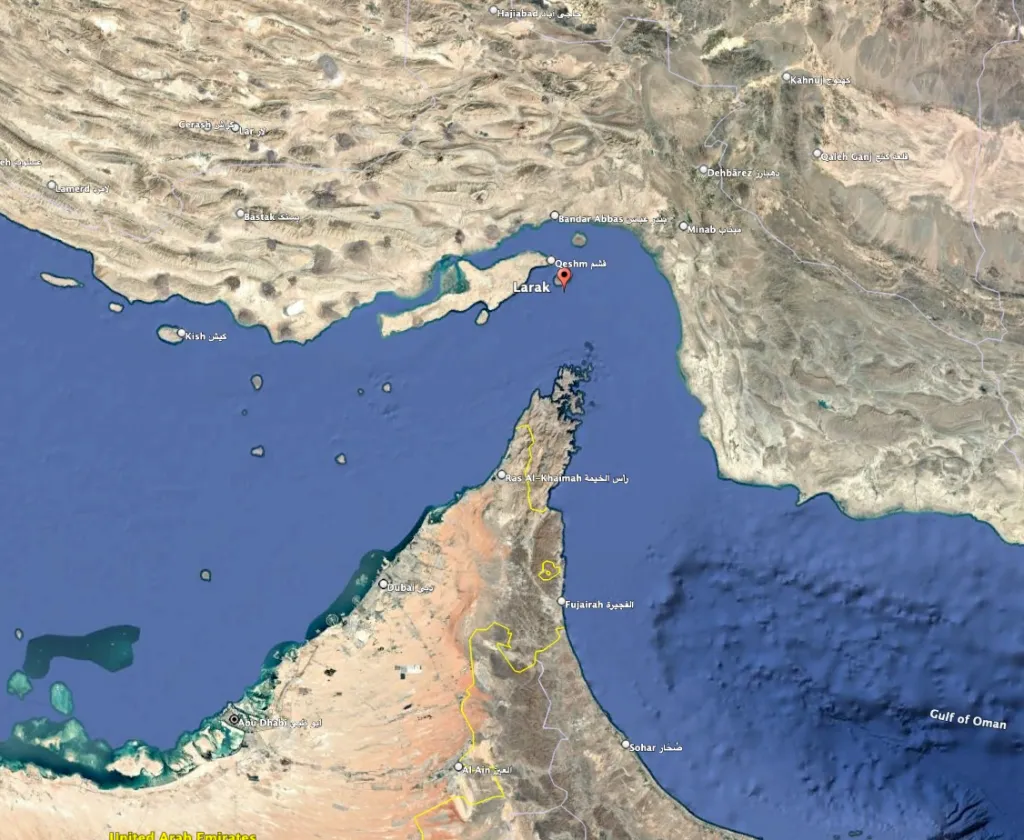
Iran is reportedly working to solidify its control over the Strait of Hormuz despite U.S. objections by seeking a joint deal to impose fees on ships transiting the strategic waterway with Oman. The move comes amid increasing hopes of a peace deal to end the war that began Feb. 28 and highlights just how difficult it will be to reach such an agreement. Iran’s closure of the Strait has created severe global economic impacts and spurred the Trump administration to stand up Project Freedom, a short-lived effort to provide military protection for ships stuck in the Persian Gulf and trying to get out.
Though U.S. President Donald Trump has insisted the Strait remain open and free of any tolls, Iran is in discussions with Oman, a U.S. ally, to impose financial burdens on vessels passing through the critical chokepoint, The New York Times reported. Together, the countries border both sides of the Gulf of Oman, through which any ship must pass to get into or out of the Strait.
Gulf of Oman. (Google Earth)
Two people familiar with the discussions over management of the waterway said that “Iran was not planning a toll system, which would charge simply for transit,” according to the Times. Instead, the talks with Oman have “explored a proposal to charge vessels fees for services.”
“Oman had initially rejected a joint partnership with Iran on the strait but is now in discussion over a share of the revenues,” the newspaper stated, citing two Iranian officials familiar with the talks. “The officials said Oman told the Iranians that it was willing to use its influence with neighbors in the Gulf, including Bahrain, Kuwait, Qatar, Saudi Arabia and the United Arab Emirates, and with the United States to push the plan, having realized the potential economic benefits of a fee system.”
Iran and Oman “appear to be emphasizing that the proposed system would involve fees, not tolls, a legally significant distinction,” the Times posited. “A tolling system that simply charges ships to pass through the waterway would be illegal under international law, but charging fees for actual services rendered to vessels, such as waste disposal at a port, is allowed under certain circumstances.”
Breaking News: Iran and Oman are in talks over a payment system for ships crossing the Strait of Hormuz, despite warnings from the Trump administration. https://t.co/IuBux7BHnV
On Wednesday, Iran’s newly created Persian Gulf Strait Authority declared on X that it has “defined the boundaries of the Strait of Hormuz management supervision area” as the “line connecting Kuh Mobarak in Iran and the south of Fujairah in the UAE in the east of the strait to the line connecting the end of Qeshm Island in Iran and Umm al-Qaiwain in the UAE in the west of the strait.”
Iran’s claimed area of control includes the coastal waters of the United Arab Emirates (UAE) and Oman in addition to its own.
1/ جمهورى اسلامى ايران محدودهٔ نظارتى مديریت تنگه هرمز را به این شرح تعيین کرده است: «خط اتصال كوه مبارك درايران وجنوب فجيره درامارات در شرق تنگه تاخط اتصال انتهاى جزيره قشم درايران و ام القيوین امارات درغرب تنگه.» pic.twitter.com/3ELSwYx5Bp
— PGSA | نهاد مدیریت آبراه خلیج فارس (@PGSA_IRAN) May 20, 2026
In the face of Iran’s insistence on controlling the Strait, Rubio on Friday reiterated that the Trump administration rejects any form of Iranian tolling on the Strait.
“That’s just not acceptable. It can’t happen,” Rubio said of any Iranian effort to impose payment for the safe passage of vessels. “If that were to happen in the Straits of Hormuz, it will happen in five other places around the world.”
🇺🇳Secretary of State Rubio cited Bahrain-led and co-sponsored UN Security Council resolution as the definitive international answer to Iran’s proposed tolling scheme in Strait of Hormuz noting it carries the highest number of co-sponsors in the history of Security Council. pic.twitter.com/RYEiAg5h7M
Rubio added that NATO allies are beginning to think through a worst-case scenario if Iran refuses to open the Strait of Hormuz.
“We all would love to see an agreement with Iran in which the Straits are open and they abandon their nuclear ambitions and so forth,” he told reporters. “We also have to have a plan B…We have to start thinking about what do we do if, a few weeks from now, Iran decides ‘We don’t care, we’re going to keep the Straits closed. We’re going to sink any ship that doesn’t listen to us or doesn’t pay us.’ Then someone’s going to have to do something about it.”
BREAKING: Secretary Marco Rubio says NATO allies are beginning to think through a worst-case scenario if Iran refuses to open the Strait of Hormuz:
“We all would love to see an agreement with Iran in which the Straits are open and they abandon their nuclear ambitions and so… pic.twitter.com/jQvHZd8rLv
Since implementing the blockade on Iranian ports on April 13, “U.S. forces have redirected 97 commercial vessels and disabled 4 since the start of the blockade,” CENTCOM claimed on X.
A U.S. Sailor aboard USS Comstock (LSD 45) observes a commercial vessel while enforcing the U.S. blockade against Iran, May 21. U.S. forces have redirected 97 commercial vessels and disabled 4 since the start of the blockade. pic.twitter.com/1Zgsoykhy4
Regardless of the blockade, Japan is anticipating the arrival of the first tanker full of oil that transited the Strait of Hormuz since the war began.
The Idemitsu Maru, a very large crude carrier that passed through the waterway in late April, could dock as soon as Monday, according to the trade ministry. Hauling two million barrels of Saudi crude, the vessel is on track to arrive at Idemitsu Kosan Co.’s Aichi refinery, the Ministry of Economy, Trade and Industry said in a briefing document on Friday, according to Bloomberg News.
The announcement highlights the difficult choices many nations now have as a result of the war. Japan is a key U.S. ally and risks running afoul of Trump, who maintains opposition to Iranian control of the vital waterway, including tolls on shipping levied by Iran, something Trump vehemently opposes. But Japan is also one of the world’s importers of Middle Eastern oil and the inability to get what it needs as a result of the Iranian Strait closure is having dramatic economic effects.
Japan is about to receive the first Persian Gulf oil shipment to transit the Strait of Hormuz since the Iran war began https://t.co/Inb3yOuGfM
Most of the ships passing through the Strait under the new Iranian system “were linked to Southeast Asian nations that maintain friendly relations with Iran,” the official state broadcaster IRIB claimed on Friday in a post on X.
Most ships that passed through the Strait of Hormuz with Iran’s permission, were linked to Southeast Asian nations that maintain #friendly relations with IRAN. https://t.co/hqPmBBC1Yz
— IRIB (Islamic Republic of Iran Broadcasting) (@iribnews_irib) May 22, 2026
There has been a large increase in the number of Iranian-trading tankers at anchor off the country’s main oil export port of Kharg Island in the past week, according to the Windward maritime intelligence firm’s multi-source intelligence (MSI) analysis.
“MSI images show 27 tankers off Kharg Island as of May 21, including 18 assessed as very large crude carriers (VLCC),” Windward reported. “This has expanded from 14 tankers a week ago on May 14, a 93% increase. All were ‘dark’ and not broadcasting their position via AIS.”
Windward “assesses the majority of VLCCs at anchor off Kharg Island are being used for floating storage. About two-thirds of Iranian-trading tankers are now constrained in the Gulf of Oman or Arabian Gulf by the U.S. blockade. The remaining third are either waiting at ports off China or at anchor off the Riau archipelago, in Malaysia’s EEZ.”
The number of Iranian-trading tankers at anchor off Iran’s main oil export port of Kharg Island has increased by 93% in the past week, according to Windward’s multi-source intelligence analysis.
While numbers observed off Kharg Island are gaining, tankers anchored off the… pic.twitter.com/uYbVQschty
Trump convened a meeting with his senior national security team on the war with Iran on Friday morning, Axios reported Friday evening, citing two U.S. officials.
The president “is seriously considering launching new strikes against Iran barring a last-minute breakthrough in negotiations, sources who have spoken directly with the president say,” the news outlet stated.
Vice President JD Vance, Secretary of Defense Pete Hegseth, CIA Director John Ratcliffe, White House chief of staff Susie Wiles and other officials attended the meeting along with Trump, the sources told Axios.
Hours later, Trump issued his cryptic message on Truth Social about not attending his son’s wedding due to “circumstances pertaining to Government.”
NEW: Trump convened a meeting with his senior national security team on the war with Iran this morning.
He is seriously considering launching new strikes against Iran barring a last-minute breakthrough in negotiations, sources say. https://t.co/dN7UuWUcGe
Iran insists it is ready with new tactics, weapons and a threat to extend the conflict beyond the region should a new round of fighting break out.
Iran’s state-run Tasnim News Agency has said that the Iranian Armed Forces is preparing for any possible U.S. attack, adding that a third round of fighting would involve new equipment, targets, tactics, and war strategy, along with additional trans-regional fronts that extend… pic.twitter.com/fsuv7Dfdx6
There are growing indications that the U.S. and Iran could be moving closer to a deal to end the war. However, both sides are poised to resume fighting as major sticking points remain over Iran’s nuclear ambitions, its control over the Strait of Hormuz and the future of its ballistic missile arsenal as well as U.S. sanctions.
In a sign that progress has been made in talks to reach a deal, Pakistani and Qatari negotiators are now in Tehran.
Pakistan’s Army Chief Field Marshal Asim Munir has arrived in Tehran as part of ongoing mediation efforts and upon arrival he was received and warmly welcomed by Iranian Minister for Interior Eskandar Momeni, per ISPR https://t.co/I6yk6BlpvYpic.twitter.com/DToLp4OJ0J
“Field Marshal Asim Munir, is traveling to Tehran on Friday in an effort to reach a deal under which the U.S. and Iran would agree to end the war and launch negotiations for a broader agreement,” Axios reported on Friday, citing a Pakistani security source.
The Qatari negotiating team arrived in Tehran on Friday ”in coordination with United States to help secure a deal to end the war with Iran and resolve outstanding issues,” Reuters reported on X, citing a source with knowledge of the matter. “Doha, which has worked as a mediator in the Gaza war and other areas international tensions, had till now distanced itself from playing a mediation role in the Iran war after it came under attack from Iranian missiles and drones during the latest conflict.”
(Reuters) – A Qatari negotiating team arrived in Tehran on Friday in coordination with United States to help secure a deal to end the war with Iran and resolve outstanding issues, a source with knowledge of the matter told Reuters on Friday. Doha, which has worked as a…
Confirmation of Munir’s trip to Tehran, from several media outlets, came after U.S. Secretary of State Marco Rubio said there was “slight progress” in negotiations with Iran.
“I don’t want to exaggerate it, but there’s been a little bit of movement, and that’s good,” Rubio said at a meeting of NATO foreign ministers in Sweden, on Friday.
In a post on X, the Saudi-based Al Arabiya news outlet claimed it has obtained a “final draft of a possible agreement between the United States and Iran, mediated by Pakistan” that is “expected to be announced within hours.”
The purported details of the nine-point plan are as follows, according to the publication:
Immediate, comprehensive, unconditional ceasefire on all fronts, including land, sea, air.
Mutual commitment not to target military, civilian or economic infrastructure.
End to military operations and halt media war.
Commitments to respect sovereignty, territorial integrity and non-interference in internal affairs.
Guarantees freedom of navigation in the Arabian Gulf, the Strait of Hormuz and the Gulf of Oman.
Joint mechanism to monitor implementation and resolve disputes
Negotiations on outstanding issues would begin within seven days.
Gradual lifting of US sanctions in exchange for Iran’s commitment to the terms of the agreement.
Draft agreement reaffirms compliance with international law and UN Charter.
🔴 BREAKING: The final draft of a possible agreement between the United States and Iran, mediated by Pakistan, is expected to be announced within hours, according to Al Arabiya sources. Its key terms include the following:
— Al Arabiya English (@AlArabiya_Eng) May 22, 2026
However, the reported draft agreement does not explicitly mention Trump’s key demands, including the dismantling of Iran’s nuclear program and export of its stockpile of 60%-enriched uranium, limiting its ballistic missiles and ending its support for Iranian proxies like Hezbollah, the Houthis and several groups in Iraq.
Trump has repeatedly stated that Iran must dismantle its nuclear weapons program, turn over the enriched uranium and reopen the Strait.
U.S. President Donald Trump on Iran:
“Right now, we’re negotiating, and we’ll see, but we’re going to get it one way or the other. They’re not going to have a nuclear weapon.” pic.twitter.com/wfjJBoOZVi
Given the American leader’s stance on the issues, it seems unlikely that he would agree to such a deal as stated by Al Arabiya. TWZ cannot verify the validity of these details. Asked if they are accurate, the White House gave us the following response:
“Iran will never be allowed to have a nuclear weapon, and while President Trump always prefers a diplomatic solution, he has been clear about the consequences if Iran refuses to make a deal,” a White House official told us. “As the president stated, he will only make a good deal for the American people. He is not going to be rushed into making a bad deal. Due to the successes of Operation Epic Fury, Economic Fury, and the blockade, President Trump holds the cards and has all the time he needs to make the best deal for the United States and the world.”
The White House, however, pushed back on a Reuters report that Iranian Supreme Leader Mojtaba Khamenei told his country’s decision-makers not to agree to any deal to remove enriched uranium out of the country. A White House official told Fox News that the claim is untrue and that as of yet, no decision has been made on the matter by either side.
The White House has told Fox News that recent reports from Reuters on the supreme leader’s edict to Iranian decision-makers not to accede to a deal where enriched uranium is moved out of Iran are untrue and that as of yet, no decision has been made on the matter by both sides. pic.twitter.com/ZF36aCMLit
With the status of the peace process uncertain, Trump claimed he decided not to attend the wedding this weekend of his eldest son, Donald Trump Jr., to socialite Bettina Anderson due to “circumstances pertaining to Government, and my love for the United States of America.”
“I feel it is important for me to remain in Washington, D.C., at the White House during this important period of time,” Trump stated on Truth Social.
President Trump announces his official decision on attending his son’s wedding this week — he’s not going.
This comes after he said yesterday it was bad timing because of the Iran issue. pic.twitter.com/cha3QO14Uo
— Caitlin Doornbos (@CaitlinDoornbos) May 22, 2026
Amid talk of diplomacy, U.S. Central Command (CENTCOM) indicated that the Abraham Lincoln Carrier Strike Group, loitering in the Arabian Sea, “is maintaining peak readiness while enforcing the U.S. blockade against Iranian ports.”
The post messaged that should negotiations break down, the U.S. is ready to resume attacking Iran should Trump so order.
U.S. Navy fighter jets launch from aircraft carrier USS Abraham Lincoln (CVN 72) in the Arabian Sea. The Abraham Lincoln Carrier Strike Group is maintaining peak readiness while enforcing the U.S. blockade against Iranian ports. pic.twitter.com/VdgD1S8jrB
For its part, the Islamic Revolutionary Guard Corps (IRGC) has threatened to push the war “beyond the region” if the U.S. or Israel resume attacks, promising “crushing blows … in places you cannot even imagine.”
Iran has warned the United States of far-reaching consequences in the event of any renewed act of aggression, amid President Donald Trump’s repeated military threats and deadlines.https://t.co/i7ppAoGfym
Despite a bombing campaign that top U.S. officials say has severely crippled Iran’s ability to produce drones and missiles, Tehran has reportedly used the six-week old ceasefire to rearm far faster than anticipated.
“While the time to restart production of different weapons components varies, some US intelligence estimates indicate Iran could fully reconstitute its drone attack capability in as soon as six months,” CNN reported on Thursday, citing a source familiar with those assessments. “The Iranians have exceeded all timelines the IC had for reconstitution,” the US official said.
The network claimed that Iran is “rebuilding…military capabilities, including replacing missile sites, launchers and production capacity for key weapons systems destroyed during the current conflict.”
Iran “also still maintains ballistic-missile, drone-attack and anti-air capability despite the serious damage inflicted by US-Israeli strikes,” the network claimed, citing recent US intelligence assessments. That means “the quick rebuilding of military production capacity isn’t starting from scratch.”
These efforts are being aided by China and Russia, CNN added.
While the time to restart production of different weapons components varies, some US intelligence estimates indicate Iran could reconstitute its drone attack capability in as soon as six months, one of the sources said. https://t.co/u9mxm0hB8D
The U.S. military “has depleted much of its inventory of advanced missile-defense interceptors after expending far more high-end munitions defending Israel amid hostilities with Iran than Israeli forces used themselves,” The Washington Post reported, citing Defense Department assessments.
“The imbalance, according to three U.S. officials who spoke on the condition of anonymity to discuss sensitive security matters, underscores the extent to which Washington has shouldered the burden of countering Iranian ballistic missile strikes duringOperation Epic Fury, and raises questions about U.S. military readiness and security commitments around the world,” the publication added. “The United States launched more than 200 Terminal High Altitude Area Defense, or THAAD, interceptors in defense of Israel — roughly half of the Pentagon’s total inventory — along with more than 100 Standard Missile-3 and Standard Missile-6 interceptors fired from naval vessels in the eastern Mediterranean, said the U.S. officials, who, like others in this article, spoke on the condition of anonymity to discuss sensitive security matters.”
By contrast, the newspaper noted, “Israel fired fewer than 100 of its Arrow interceptors and around 90 David’s Sling interceptors, some of which were used against less sophisticated projectiles fired by Iran-backed groups in Yemen and Lebanon.”
Acting Navy Secretary Hung Cao on Thursday testified before the Senate that the U.S. is pausing arms sales to Taiwan because of the war with Iran.
“Right now we’re doing a pause in order to make sure we have the munitions we need for Epic Fury,” Cao told Sen. Mitch McConnell.
During the Senate Appropriations Committee’s defense subcommittee hearing earlier today, Acting Navy Secretary Hung Cao told senators that arms shipments to Taiwan have been paused, saying “Right now we’re doing a pause in order to make sure we have the munitions we need for Epic… pic.twitter.com/DIcQCBh5hq
Ukraine’s ambassador to the U.S. Olga Stefanishyna, however, told Politico Washington Bureau Chief Dasha Burns that the war with Iran has not yet affected U.S. weapons shipments to Kyiv. Still, she said American military officials told Ukraine “there’s nothing that could be guaranteed for the future.”
Ukraine’s ambassador to the U.S. said the war with Iran has not yet affected U.S. weapons shipments to Kyiv, but said American military officials told Ukraine “there’s nothing that could be guaranteed for the future.”
The war is facing increasing opposition in Washington. House Republicans on Thursday “abruptly canceled a vote on a resolution directing Trump to withdraw U.S. forces from Iran or win approval from Congress to continue the war, after it became clear they lacked the votes to defeat the measure,” The New York Times reported. “The retreat was a striking setback that exposed fractures within the G.O.P. over the conflict at a moment when the party has begun pushing back forcefully on Mr. Trump and his agenda.”
Breaking News: House Republicans abruptly canceled a vote on a resolution directing President Trump to withdraw U.S. forces from Iran or win approval from Congress to continue the war, after it became clear they lacked the votes to defeat the measure. https://t.co/2YCMl8GIbj
In another sticking point to a peace deal, Israel continues to hit Hezbollah targets in southern Lebanon.
The Israeli Air Force (IAF) on Friday released video it claims struck a structure in which five Hezbollah fighters “were located north of the forward defense line in southern Lebanon and eliminated.”
אתמול, חיל-האוויר תקף מבנה בו היו חמישה מחבלי חיזבאללה צפונית לקו ההגנה הקדמי בדרום לבנון וחיסל את המחבלים, בהכוונת כוחות צוות הקרב של חטיבה 551 בפיקוד אוגדה 146. pic.twitter.com/S4fGQLK35e
Judge says the human smuggling probe was reopened after the Salvadoran national filed his lawsuit against his deportation.
Published On 22 May 202622 May 2026
A United States judge has dismissed an indictment against Kilmar Abrego Garcia after finding that he would not have been prosecuted if he had not challenged his deportation.
On Friday, US District Judge Waverly Crenshaw said the Department of Justice only reopened its human smuggling probe stemming from a 2022 traffic stop after Salvadoran national Abrego Garcia filed his lawsuit.
Recommended Stories
list of 3 itemsend of list
“The court does not reach its conclusion lightly,” Crenshaw wrote.
“The objective evidence here shows that, absent Abrego’s successful lawsuit challenging his removal to El Salvador, the Government would not have brought this prosecution.”
Last year, Abrego Garcia became a symbol for President Donald Trump’s drive to clamp down on illegal migration and was sent to a mega prison in El Salvador despite a prior court banning him from being returned there due to a risk of persecution.
While the Trump administration brought Abrego Garcia back to the US in June of the same year, his return came only after prosecutors had secured a criminal indictment charging him with human smuggling and conspiracy to commit human smuggling.
Abrego Garcia pleaded not guilty to the claim and argued that he was being prosecuted in retaliation for suing the government to be returned to the US from El Salvador.
In the ruling to dismiss the indictment, Crenshaw wrote that the timing of the charges was central to the “presumption of vindictiveness”.
With Homeland Security already aware of the traffic stop two years ago and having closed the case against Abrego Garcia when it deported him, the case was only reopened once the US Supreme Court had ruled that he be returned from El Salvador.
Abrego Garcia’s deportation had violated a 2019 immigration court order that granted him protection against being returned to his home country after a judge found that he faced danger from a gang that targeted his family.
Despite his return to the US and his family, Trump officials have said that Abrego Garcia cannot remain in the country and have pledged to deport him again to a third country, a country where the person does not have any ties.
Washington has imposed a semi-colonial tutelage over Caracas. (Archive)
On January 3, the US bombed Venezuela’s capital region and kidnapped President Nicolás Maduro. The unprecedented attack represented the culmination of a quarter-century of imperialist hybrid war, including devastating unilateral sanctions, mercenary incursions, “color revolution”-style insurrections, media disinformation, and NGO infiltration.
The four months since have brought a flurry of developments, from renewed diplomatic ties with the US to an overhaul of key legislative pillars of the Bolivarian Revolution. Additionally, the Trump administration established semi-colonial control over Venezuelan oil revenues, with the amounts and timings of disbursements back to Caracas left entirely at US officials’ discretion. The arrangement is similar to the one Washington has forced on Iraq since the 2003 invasion.
This compromised sovereignty is a catalyst for other issues. On the one hand, it makes it tougher for the Venezuelan government to improve living standards without challenging business interests. On the other, the burden of Venezuela’s external debt might see Washington attempt to impose an IMF loan that will bury the country in debt and dependency for decades.
Venezuelan Acting President Delcy Rodríguez alongside US Energy Secretary Chris Wright at the presidential palace. (Credit: Presidential Press)
The holy grail of foreign investment
The acting Rodríguez government’s tenure has been marked by accelerated political and economic transformations. On the international front, Caracas has restored diplomatic ties with Washington and recently resumed dealings with the US-controlled International Monetary Fund (IMF) and World Bank.
Domestically, Rodríguez has changed key cabinet and military posts, while pushing through the National Assembly a number of reforms with the explicit goal of making the country more attractive for private sector investment, especially from Western multinationals.
Plans to reform pension, tax, housing, and the landmark 2012 labor law are in motion. Mining and hydrocarbons have already undergone pro-business overhauls, with slashed fiscal responsibilities, decreased oversight, and disputes subjected to international arbitration. In contrast to Chávez’s reassertion of oil sovereignty, which underpinned the massive sociopolitical achievements of the Bolivarian Revolution, the reformed energy law brings back the old concession model that puts operations and sales in the hands of private corporations.
In tandem, the Trump administration has issued licenses to pave the way for Western conglomerates to return to Venezuela, and several have already struck deals under the new highly favorable conditions. The licenses maintain and even double down on US sanctions by barring dealings with China, Cuba, Iran, North Korea, and Russia and mandating that all Venezuelan state revenues from oil and mining be deposited in US Treasury-run accounts.
The subordination to US impositions saw Venezuelan authorities extradite former diplomatic envoy and minister Alex Saab to face charges in the US with little to no explanation. The move was shocking but not out of context. In recent weeks, there has been a succession of ceremonies at Miraflores presidential palace where Trump officials get the red-carpet welcome and escort corporate executives to sign contracts under the new pro-business incentives. Far-right tech moguls, including Palantir founder Peter Thiel, are already taking advantage of Trump’s leverage to establish a lucrative foothold in the country. For his part, the US chargé d’affaires holds regular publicized meetings with Venezuelan cabinet ministers.
Caracas’ technocratic and pragmatic approach has dovetailed with a corresponding shift in discourse. On foreign policy, the anti-imperialist rhetoric has all but vanished. As Trump unleashes a savage war against Iran and threatens to “take over” Cuba, Venezuelan leaders have refrained from condemning the escalating imperialist aggression while emphasizing their desire to build good relations with Washington. At the same time, references to Maduro have drastically decreased, as documented in a recent investigation. Domestically, the central focus has become macroeconomic stability and attracting foreign investment. Both Acting President Rodríguez and her brother, National Assembly President Jorge Rodríguez, acknowledged receiving “recommendations” and “suggestions” from oil majors amid the recent hydrocarbon overhaul.
Rodríguez and the Bolivarian leadership, under ongoing US pressure, are betting that the pro-business opening will lead to accelerated economic growth that will trickle down into improved living conditions, thus allowing the government to rebuild social legitimacy and political prospects. However, this plan faces serious roadblocks.
US Chargé d’Affaires John Barrett meeting with Venezuelan Electricity Minister Rolando Alcalá. (Credit: @usembassyve)
Rising domestic pressure
The first issue is that the acting authorities may not have a lot of time to improve the living conditions of the Venezuelan people.
Over the previous seven years, with the economy asphyxiated by the US economic blockade, the Maduro government prioritized macroeconomic stability and reduced inflation first and foremost, through a strict monetarist policy package. While the approach, coupled with a modest oil industry recovery, did lead to slowed down inflation and modest economic growth, it came at a price of freezing wages, consumer credit, and public spending. The minimum wage, last raised in 2022, is now worth less than US $1 per month, with further increases replaced by non-wage bonuses that cheapen labor costs for employers.
Though these bonuses have increased periodically (the income floor is now $240/month for public sector workers), they are still far from covering living costs. On May 1, Rodríguez ignored growing calls for a minimum wage hike, the conversion of bonuses to wages, and the restoration of collective bargaining rights, instead doubling down on the bonus policy. With government officials announcing a labor reform soon, it is likely that the return of the minimum wage will come alongside a significant erosion of workers’ rights and employer responsibilities.
However, apart from its commitment to fiscal discipline, the Rodríguez acting government has little room to maneuver because of its lack of direct management over oil revenues. At the mercy of the Trump administration to return export earnings in the amount and timing of its choosing, Venezuelan authorities are unlikely to commit to anything that might unsettle the budget. Rodríguez herself warned that wage increases must be “responsible.”
There is a delicate balance to strike. To implement the current pro-business agenda, not to mention the US rapprochement, the government needs social peace, and only improved material conditions for the working-class majority can ensure that in the short term.
Venezuelan trade unions have mobilized to demand a restored minimum wage and labor rights. (Credit: La Izquierda Diario)
The specter of debt
It is not just the pressure for better living standards that looms large on Venezuela’s economic front. There is a growing expectation that creditors will soon reengage with Venezuelan authorities to collect on a sizable external debt: a combination of defaulted bonds, unpaid loans, and arbitration awards that, with interest accrued over years, may amount to as much as $170 billion. The Venezuelan government recently announced the launch of a debt restructuring process, while Washington issued a license allowing the hiring of financial and consulting services.
Given the recent overtures to foreign capital, Venezuelan leaders will be hard-pressed to honor whatever commitments necessary to render the country a favorable investment climate. Nevertheless, a major chunk of this debt is illegitimate.
On the one hand, debt ballooned in the mid-2010s as Venezuela’s credit rating was unjustifiably downgraded and borrowing costs went up, as Washington slapped its first rounds of sanctions on the Caribbean country. The Maduro government made a strategic choice to prioritize debt service as the economy reeled following a collapse of global oil prices, hoping that this “discipline” would stave off a scenario where the country was shut out of financial markets. It turned out differently.
Venezuela was gradually locked out of global finance after the Trump administration’s 2017 financial sanctions. Bonds defaulted one after another and have been accruing interest ever since. And the notoriously corrupt US-backed “interim government” also played its part in running up Venezuela’s liabilities and pilfering state assets abroad.
The diverse group of bondholders and corporations owed arbitration awards is sure to receive the backing of the White House, which holds the purse of Venezuela’s export proceeds. This mechanism could be utilized to directly transfer Venezuelan state income to creditors in what would effectively amount to international wage garnishing. Given how Venezuelan bonds have risen in recent months, investors are eagerly eyeing a significant windfall.
Venezuela’s unsustainable debt burden opens the door for further US imperial predations. Even if there is an agreement to pay 50 cents on the dollar for Venezuela’s $170 billion debt for a period of 15 years, that comes to $5.6 billion a year, roughly a quarter of the present budget. It is simply unpayable.
While Caracas may be able to settle with some creditors by privatizing Venezuelan state assets, it will not amount to much. Venezuelan leaders will stress that, with the recent reforms and US opening, the economy will grow tremendously, and they will be able to honor all commitments. But creditors are not willing to wait when they can cash in now, especially given Venezuela’s weak bargaining position. The government cannot maintain a functioning country in the short term with a huge debt burden. As a result, the US might take advantage of the crisis to impose a major loan from the IMF or some lending coalition.
Trump has pushed for the return of Western corporations to Venezuela at the expense of Russian, Chinese and other counterparts. (Credit: VCG)
Sovereignty under threat
An IMF or similar loan program is more than just an agreement to lend some amount under certain repayment conditions. It is an opportunity to impose neocolonial arrangements on Global South countries. In Venezuela’s case it is even more symbolic: it would mean exacting the proverbial pound of flesh for Chávez’s revolutionary audacity to challenge US hegemony in the Western hemisphere.
An eventual long-term credit program would surely come alongside a structural adjustment package of mass privatizations, gutted social expenditure, and all-around liberalization of the economy. Given the current leverage over Venezuela, US officials may attempt to further entrench the rollback of the Caribbean nation’s sovereignty.
Between the growing domestic demands for improved living conditions and the specter of debt renegotiation, the acting Rodríguez government will find it increasingly difficult to walk the tightrope of maintaining social peace while continuing to make one concession after another to monopoly capital and the Trump White House.
With the limits of US imperialism nakedly exposed in Iran, Trump needs a victory in Venezuela. But that victory does not entail a buoyant economic recovery with social justice, let alone the survival of a sovereign and revolutionary project. Victory for the US is a dependent country, mired in debt and underdevelopment, where Western corporations plunder natural resources and geopolitical rivals are kept at bay.
Ultimately, any long-term plan for sovereign development needs to start from the fact that US imperialism, to echo Che Guevara, is “not to be trusted even a little bit,” much less considered a “partner” in a “cooperation agenda.” It will undoubtedly be a major hill to climb. But thankfully, even if it means starting over, the Bolivarian Revolution is not starting from scratch.
Tulsi Gabbard is resigning from her job as United States President Donald Trump’s director of national intelligence, according to her resignation letter posted on her X account.
In her resignation letter, Gabbard told Trump she was “deeply grateful for the trust you placed in me and for the opportunity to lead the Office of the Director of National Intelligence for the last year and a half”.
She cited her husband’s recent diagnosis with a rare form of bone cancer as the reason for her resignation.
WHO chief, Tedros Adhanom Ghebreyesus, urged all countries to monitor passengers who were on the MV Hondius cruise ship.
Published On 22 May 202622 May 2026
The World Health Organization has urged countries to continue monitoring passengers for hantavirus after a case was detected among a Dutch crew member of the ship at the centre of the outbreak.
Tedros Adhanom Ghebreyesus, the WHO chief, told a news conference in Geneva on Friday that he urges all countries to monitor the passengers who were on board the MV Hondius cruise ship and “move carefully for the remainder of the quarantine period”.
Recommended Stories
list of 3 itemsend of list
Tedros said a Dutch crew member had tested positive and was now in isolation, taking the total positive cases to 12.
So far, three people have died due to the virus.
Tedros reiterated that no deaths have been reported since May 2, when the outbreak was first reported to the WHO.
“More than 600 contacts continue to be followed in 30 countries, and a small number of high-risk contacts are still being located,” he added.
Dutch authorities also confirmed that the infected crew member had been taken to hospital.
“The Andes virus has been detected in one person who was in quarantine in the Netherlands. The patient has since been admitted to the hospital as a precaution and is in isolation,” said the Dutch National Institute for Public Health and the Environment (RIVM).
“The RIVM understands that this news may raise questions or concerns. However, the chance of further spread in the Netherlands remains very small,” the statement said.
According to the RIVM, everyone who had evacuated from the Dutch-flagged ship to the Netherlands is tested every week, and two separate laboratories confirmed the positive test.
It added that the person who had tested positive had been isolating at home.
The initial cruise ship had departed on April 1 from Ushuaia, Argentina, before heading to Cape Verde and then Tenerife in Spain’s Canary Islands.
While the WHO is investigating how the virus got on board the ship, it is believed that the first person to contract it could have been exposed to rodents during a bird-watching expedition.
While rodents spread hantavirus, the Andes strain is the only known strain capable of spreading from human to human.
Delcy Rodríguez kicks off the new “pilgrimage” stage at the Cabelum company in Bolívar State. (Presidential Press)
Mérida, May 21, 2026 (venezuelanalysis.com) – Venezuelan Acting President Delcy Rodríguez announced that on 12 July the country will conduct its second popular consultation of the year to fund local projects.
The Venezuelan leader made the announcement during the inauguration of the “City of Entrepreneurship” at the Giant Cacique Tiuna commune in Caracas on Monday, an event with local small-scale entrepreneurs. The upcoming vote follows the first consultation of 2026, which took place on March 8 in 5,336 communal circuits.
“I am pleased to announce that the second popular consultation will take place on July 12. So, everyone should prepare for this national consultation,” Rodríguez stated. “It will be open to projects in any of the Seven Transformations,” she added, referring to the government’s development plan across different areas.
A significant development for the upcoming vote is the incorporation of new types of organizations into the process. The acting president announced that the consultation will include 120,000 condominium boards and 15,000 neighbor associations, emphasizing the importance of consolidating a “common effort” alongside traditional communal projects. Following the March 8 consultation, Rodríguez pledged to expand the process to traditionally middle-class areas where there is no grassroots organization.
Popular consultations have become the main mechanism of government policy to transfer funds to grassroots organizations. Prior to the vote, communities hold assemblies to identify the local priorities, traditionally focusing on infrastructure, public services, or supplying healthcare facilities.
The most-voted initiative receives the equivalent of US $10,000, with the local organizations charged with executing the projects and rendering accounts. According to official figures, the Venezuelan government supported 33,743 initiatives in 2025. On some occasions, state, regional, and municipal offices have funded the second-place projects in several communes.
The upcoming July vote will be the seventh national consultation since the mechanism was consolidated, following two rounds in 2024 and three in 2025.
Venezuelan authorities have yet to specify whether the condominium boards and neighbor associations will access similar funding and if all will be eligible to participate. Their jurisdiction and ability to access state funds have yet to be defined. The move to expand the consultation to organizations in traditionally middle-class apartment complexes and residential areas bypasses the communal instances envisioned by former President Hugo Chávez as “unit cells” for the construction of socialism.
New Phase of ‘National Pilgrimage’
The announcement of the July consultation coincided with the launch of a second phase of the “Great National Pilgrimage” to defend peace and oppose sanctions. The pilgrimage, a large-scale political mobilization strategy, began the new stage on 19 May with a special emphasis on dialogue with the productive sectors of the economy.
According to Interior Minister Diosdado Cabello, this new phase differs from the first stage, which concluded on April 30, by expanding its reach to non-metropolitan areas and focusing on specific regional economic activities such as fishing, agriculture, and the oil industry.
During a rally in the western state of Zulia on Tuesday, Cabello explained that the objective is to establish direct engagement with the population, independent of political affiliation, and to channel proposals on public services, security, and financing to the Rodríguez administration.
At the same time, the Caribbean nation’s acting president held meetings in Bolívar state with the aluminum conductor company Cabelum. She stated that the pilgrimage aimed to go “to the heart of productive Venezuela” to identify structural obstacles and promote productivity. In recent months, the Venezuelan National Assembly has approved several pro-business reforms with the stated purpose of attracting private sector investment, both national and foreign.
Rodríguez explicitly linked the pilgrimage’s goals to the need for diplomatic dialogue with the Trump administration to request a removal of unilateral coercive measures, which she lamented have imposed a “very high cost” on the Venezuelan population.
The pilgrimage, which also includes mass assemblies and the collection of proposals for public management, is expected to run alongside the preparations for the upcoming July consultation. Venezuelan authorities have defended the initiative as an effort to reach out to other political factions under common national goals.
A Ukrainian strike collapsed a five-storey college dormitory in the Russian-occupied city of Starobilsk, killing four people and injuring at least 39 others. Rescue operations continue as more people are believed to be trapped under the rubble.
Weekly insights and analysis on the latest developments in military technology, strategy, and foreign policy.
Special operations MH-47 Chinooks offloading fuel to other aircraft in the air is one possible future scenario that U.S. Army Special Operations Command (SOCOM) is eyeing as it begins to work out what the future Block III iteration of the twin-rotor helicopter might look like. While hypothetical at this stage, a Chinook capable of operating as an aerial refueling tanker could help address the command’s lack of organic tanker capacity and support its future air assault strategies.
A MH-47G Chinook, attached to the “Night Stalkers” of U.S. Army 160th Special Operations Aviation Regiment, flies over Diego Garcia, October 14, 2025. U.S. Navy photo illustration by Mass Communication Specialist 1st Class Samantha Jetzer
At this stage, however, SOCOM is beginning to draft possible requirements for the next iteration of special operations MH-47G — the Block III — expected to come online starting around 2032.
“Currently, we’re in Block II,” explained Sean Godfrey, product manager for the MH-47 at Army Special Operations Aviation Command. “We do not currently have what the Block III looks like, but that aircraft’s not going anywhere. It’s going to have to get upgraded over time.”
A slide from a SOCOM event at the annual SOF Week conference shows a pathway to the Block III MH-47G. Jamie Hunter
“Those next big things that we have to figure out would be how to get more out of the system,” Godfrey continued. “That would have to be enabling the aircraft to go further into more environments.” Another area of interest is increasing options for putting modular equipment on and off the aircraft, he added.
“That increased modularity to be able to rapidly take things on and off the aircraft to reconfigure it very quickly, to meet our mission requirements, is something that we’re always looking at,” added Dr. Steve Smith, SOCOM’s program executive officer for Rotary Wing.
“Anything that we do going forward, we’re going to try to make it as modular as possible. We want to go plug things in when we need them, unplug them, and take them off the aircraft when we don’t need them.”
Even with an aircraft offering the performance and capacity of the MH-47, preserving the allowable combat load is always at a premium. Increased modularity might include removing certain protection systems for operations in more-permissive environments, to give operators additional load. The same could be said for navigational systems, as well.
Two U.S. Army MH-47G Chinooks conduct helicopter air-to-air refueling operations with a U.S. Air Force HC-130J Combat King II, assigned to the 26th Expeditionary Rescue Squadron, over an undisclosed location in the U.S. Central Command area of responsibility, December 27, 2022. U.S. Air Force photo by Staff Sgt. Gerald R. Willis
Smith continued: “There might be cases where I want to fill that aircraft with as much fuel as possible, and maybe that MH-47 becomes a flying FARP, and I put it somewhere, and we refuel other aircraft off of them.”
A FARP, or Forward Arming and Refueling Point, is essential for operating from austere forward bases along (or beyond) the battle lines.
This is already a key mission for the MH-47, with the 160th using these aircraft in “Fat Cow” configuration. Filled with extra tanks, the Chinook then serves as a gas station on the ground for other rotary-wing aircraft. This was a tactic famously used in the Bin Laden raid.
A U.S. Army Soldier assigned to the 160th Special Operations Aviation Regiment loads rockets into a MH-60 Black Hawk during a forward arming and refueling point exercise at Marine Corps Outlying Field Atlantic, May 6, 2025. U.S. Army Soldiers and aircraft from the 160th SOAR utilized MCAS Cherry Point’s training area to conduct a FARP. This training is essential for enhancing the unit’s operational readiness and ensuring efficient support for rapid deployment, as Cherry Point provides the facilities and resources to simulate real world scenarios (U.S. Marine Corps photo by Cpl. Matthew Williams) Cpl. Matthew Williams
At a FARP, aircraft can quickly receive fuel and weapons, even without shutting down their engines. As a result, they can accelerate the fight by dramatically increasing sortie rates, or FARPs can extend the combat range of an aircraft. When it comes to just adding fuel, refueling in mid-air is an even more efficient way of doing this.
“Maybe, maybe we can do in-air refueling off of an MH-47,” Smith mused.
U.S. soldiers assigned to Echo Company, 5-159th General Support Aviation Battalion (GSAB), refuel a CH-47 Chinook helicopter during a Forward Arming and Refueling Point (FARP) training at Felker Army Airfield on Joint Base Langley-Eustis, Virginia, April 25, 2024. U.S. Air Force photo by Zulema Sotelo
While he admitted that he was “just throwing stuff up against a wall,” at this point, Smith also acknowledged that having more modular systems could make that possible.
“Aerial refueling is an amazing capability,” Smith continued. “It allows us to do a lot of things, but that affects your allowable combat load, right? So, is there a way to do something modular for aerial refueling, so that the system could come on and off quickly, so that would allow us to get maybe something in country, rapidly reconfigured, and then do something else.”
An MH-47G Chinook, attached to the 3rd Battalion, 160th Special Operations Aviation Regiment (3/160th SOAR), flies near the flight deck of the aircraft carrier USS Harry S. Truman (CVN 75). U.S. Navy Photo by Mass Communication Specialist Seaman T’ara Tripp
According to Smith, SOCOM is already looking at the possibility of porting mission equipment from its forthcoming MV-75A Cheyenne II tiltrotors onto the MH-47 Block III, and potentially even the Block II or Block III MH-60 fleets. However, he admitted that, at this stage, there is no funding appropriated for this, or even a formal requirement.
When it comes to making Block III a reality for the MH-47, this would likely follow the same procedure that is currently used to produce special operations Chinooks.
For the MH-47G Block II, specifically, Godfrey explained that the procedure starts with selecting a legacy aircraft, some of which are now more than 60 years old. SOCOM then removes all the mission equipment and software equipment, Godfrey continued, and flies the aircraft to Delaware. Here, the aircraft is essentially torn apart, and the parts to be used are recapitalized and returned to the Boeing production line. After a multi-year process, the Chinook re-emerges as a black-painted MH-47 and then goes to have all its mission equipment fitted. Then it is delivered to the unit.
U.S. Army soldiers enter an MH-47G Chinook helicopter assigned to the 3rd Battalion, 160th Special Operations Aviation Regiment at Hunter Army Airfield, Georgia, before it takes off during Weapons School Integration (WSINT) at Nellis Air Force Base, Nevada, December 2, 2020. U.S. Air Force photo by Airman 1st Class Dwane R. Young
Once in SOCOM service, Smith explains that “We’re constantly trying to figure out the best ways to increase range, increase payload, increase speed, reduce weight, all while somehow holding flight-hour costs low. And all these things aren’t rolling in the same direction.”
The MH-47’s need for range is an enduring one and is reflected in its regular use of in-flight refueling itself, using the probe-and-drogue method, as also employed by SOCOM MH-60s. Already, the MH-47 features massive sponson fuel tanks compared to the standard Chinook, making them the longest-range assets of the 160th.
But whether or not some kind of palletized or modular aerial refueling capacity comes to the Chinook remains to be seen.
Expanding the “Fat Cow” role and taking the MH-47 tanker to the air would be very enticing for SOCOM. It would give them their own air-to-air refueling assets, rather than relying totally on the Air Force MC-130/HC-130 fleets. As it is, providing fuel at FARPs can be a very high-risk mission for SOCOM, considering they are often working in contested territory. If the same aircraft could be adapted to refuel MH-60s and MH-47s in the air, they would not have to land in some scenarios, and the Army wouldn’t need to call upon external refueling assets, which might not be available or cannot be risked.
It is also worth noting that questions have also emerged about how the Army will ensure there is adequate tanker capacity to support its aerial-refueling-capable MV-75s. As delivered, all Cheyenne IIs will have the capacity to have a probe fitted, the Army has confirmed, even those in non-SOCOM units, although the exact mix of how many ‘big Army’ MV-75s will get the probe and how many won’t is yet to be determined. Bell, the MV-75’s prime contractor, and the Army have both suggested that tanker drones like the U.S. Navy’s forthcoming MQ-25 Stingray could help extend the Cheyenne II’s reach. An adapted MH-47 could provide another answer, although one with drastically different performance.
A rendering of a special operations configured MV-75 with an in-flight refueling probe. Jamie Hunter
Recent operations in South America and in the Middle East have underscored the need for long-range missions by Special Operations Aviation Command. The prospect of a potential conflict with China across the vast expanses of the Pacific means that longer-range platforms, of all kinds, are an increasing area of interest, and the 160th’s heavy-lifting, far-flying Chinooks are no exception.