SPORT

Get the latest updates on your favorite sports, from thrilling matches and championship events to player transfers and team rivalries. Dive into insightful analysis, expert opinions, and behind-the-scenes stories that bring you closer to the world of sports.

Iran soccer team heads for Mexico to prepare for World Cup

Iran’s national soccer team set off from Turkey for their World Cup training base in Mexico on Saturday, with some members of their entourage reportedly still without U.S. visas, before three group matches in the United States later this month.

The Iranian Football Federation’s secretary-general, Hedayat Mombeini, and its vice president, Mehdi Mohammad Nabi, were among 14 staff and officials without U.S. visas before games in Los Angeles and Seattle, according to Iranian state television.

It was unclear whether the federation’s president, Mehdi Taj, had been issued a visa.

The team’s participation in the World Cup has been complicated by the Iran war. Problems with processing visas had earlier led Iran to move its training base from Tucson, Ariz., to Tijuana, Mexico, which is on the border with California.

The federation accused the U.S. of “vindictive behavior” in refusing visas for “key managerial and administrative members” of the team.

The decision had “effectively denied the Iranian national team the opportunity for a level playing field and a competition free from discrimination,” according to a statement on the federation’s website. It added that the federation would pursue the matter through world soccer authority FIFA.

The Iranian Embassy in Ankara, Turkey, meanwhile, responded to an earlier social media post from U.S. Ambassador Tom Barrack, in which he congratulated his embassy staff for processing the Iran team’s visas.

“You cannot whitewash conduct that violates FIFA regulations and breaches the United States’ host obligations merely by praising yourselves,” the Iranian post read. “This represents the worst possible form of politically biased interference in sport.”

One U.S. official earlier told the Associated Press that all players on the Iranian team were approved for visas, while a second official said visas had been issued for players, coaches, trainers and some support staff. A third official suggested that some applicants affiliated with the team had been rejected for requesting visas “under false pretenses.”

The officials spoke on condition of anonymity because they weren’t authorized to discuss the visas publicly.

The squad has been preparing for the World Cup at a training camp in Antalya. The team said that it has already received visas from the Mexican Embassy in Ankara.

The players, dressed in blue blazers over white T-shirts, left the luxury Mardan Palace hotel in Antalya on Saturday afternoon. They boarded a private jet at the Mediterranean city’s airport and were due to fly directly to Mexico.

Iran plays its first two games in Inglewood against New Zealand on June 15, and Belgium six days later, then heads to Seattle to face Egypt on June 26. Iran and the U.S. could meet in the round of 32 on July 3 in Arlington, Texas, if both teams come second in their groups.

In March, U.S. President Donald Trump had discouraged Iran from participating in the tournament, saying he didn’t think it was “appropriate” and raising concerns over players’ “life and safety.” A day later, Iran’s national team pushed back, saying “no one can exclude” it from playing.

Iran finalized its team on Monday, including 17 home-based players whose clubs haven’t played since February because of the war. Star forward Sardar Azmoun was dropped in March, reportedly because of a social media post that angered Iranian authorities during the war.

Change in water bottle policy

FIFA announced that it will now allow fans to bring their own water bottles to some stadiums during the World Cup, adjusting a policy that had barred spectators from bringing refillable water bottles into the tournament’s 16 stadiums across North America, including some with limited or no shade from the sun.

FIFA in a social media post said fans will be permitted to bring one soft plastic 20-ounce, factory-sealed, disposable water bottle into any match taking place in the United States or Canada.

In a video released by FIFA, Chief Operating Officer Heimo Schirgi said fans will still not be permitted to bring in hard sided, reusable water bottles “due to safety and security reasons.”

Going green

As the tournament opens on Thursday, 13 of the 16 stadiums have earned LEED certification, the world’s most widely used green building rating system, the U.S. Green Building Council said. Ten have been certified since 2024 through the rigorous process to ensure buildings meet strict sustainability standards. The council expects at least two of the three remaining stadiums to achieve certification in the coming weeks.

Together, the LEED-certified stadiums have installed over 11,500 solar panels to generate clean electricity. Because of the changes made, they will save over 100 million gallons of potable water annually and eliminate more than 5 million single use plastics annually, according to information shared by the stadiums. Four venues are reusing, recycling or composting nearly all waste, preventing it from reaching a landfill.

Source link

Kentucky Derby winner Golden Tempo wins 2026 Belmont Stakes

Golden Tempo closed out the Triple Crown season Saturday the same way he began it: In the winner’s circle.

The circumstances were different from the Kentucky Derby, when the late-running son of Curlin was helped by a hot pace that tired out the front-runners.

There was no such setup in Saturday’s Belmont Stakes, but Golden Tempo showed he didn’t need it.

Ridden again by Jose Ortiz, the Derby champion stormed into the stretch and outfinished Commandment to win a thrilling stretch duel by 1¼ lengths at Saratoga Race Course.

“Golden Tempo is amazing. Jose is amazing,” said trainer Cherie DeVaux, who added to her historic win as the first woman to capture the Derby by becoming the first woman to win two Triple Crown races.

“Amazing feeling,” she said on Fox Sports.

Golden Tempo was sent off as the co-fourth choice with Commandment at 6-1 and returned $14 for a $2 win ticket. Renegade, the Derby runner-up, finished third as the 17-10 favorite and Chief Wallabee, the second choice at 5-1, was fourth. The rest of the finishing order: Emerging Market, Growth Equity, Vitruvian Man, Ottinho and Powershift.

This marked the second straight year the Derby winner also captured the Belmont after skipping the Preakness, with Golden Tempo following Sovereignty. It’s the fifth time in the past six years that a horse used that formula to win this race.

Could Golden Tempo have won the Triple Crown?

“It’s not something I want to think about,” DeVaux said. “We made our decision and he won today and we’re going to be happy about that.”

Trainer Cherie DeVaux lifts the August Belmont Trophy as she stands next to winning jockey Jose Ortiz.

Trainer Cherie DeVaux lifts the August Belmont Trophy as she stands next to winning jockey Jose Ortiz, left, after Golden Tempo’s victory in the Belmont Stakes on Saturday.

(Al Bello / Getty Images)

Golden Tempo, a homebred of owners Phipps Stable and St. Elias Stables, won for the fourth time in six starts. He earned $1.2 million from the $2-million purse to push his career total past $4.6 million.

Despite his victory five weeks ago in Kentucky, the general feeling about Golden Tempo entering the Belmont was pessimism. Not one of the 19 experts surveyed in Saturday’s Daily Racing Form selected him to win, with just two picking him second. The consensus was he would not finish in the top four.

The lack of pace was one reason, and sure enough, the race played out pretty much as expected, with Renegade’s stablemate, Powershift, dawdling through the first six furlongs in 1 minute, 12.38 seconds, about a second and a half slower than the same distance for the Derby (1:10.90).

Golden Tempo, ridden by jockey Jose Ortiz, crosses the finish line to win the Belmont Stakes on Saturday.

Golden Tempo, ridden by jockey Jose Ortiz, crosses the finish line to win the Belmont Stakes on Saturday.

(Yuki Iwamura / Associated Press)

As he was in the Derby, Golden Tempo was last for more than half the race, but Saturday he trailed eight horses instead of 17 and never was more than about eight lengths behind the leader.

Growth Equity, who had been stalking Powershift, took the lead as the field turned into the stretch, but he soon was passed by Chief Wallabee. Before the field had run another furlong, though, Golden Tempo had moved around Renegade to the front. Commandment was on Golden Tempo’s outside but was unable to get past in the final furlong. In fact, the winner was pulling away as they reached the finish.

The final time wasn’t fast, 2:03.49 for 1¼ miles at Saratoga, which was hosting the Belmont for the third and final year while Belmont Park is rebuilt. The race started about five minutes after rain began falling in upstate New York.

Baffert’s Nysos dominates Met Mile

Nysos crosses the finish line to win the 133rd running of the Met Mile at Saratoga on Saturday.

Nysos crosses the finish line to win the 133rd running of the Met Mile at Saratoga on Saturday.

(Yuki Iwamura / Associated Press)

The afternoon did not begin well for trainer Bob Baffert, who saw his top 3-year-old, Crude Velocity, routed by DeVaux’s Englishman in the Woody Stephens and his leading sprinter, Imagination, come up empty in the True North. But Nysos, the best horse in Baffert’s barn, salvaged the day — and then some — with a dominant win over Journalism and five others in the Grade 1 Met Mile.

“I’ve always thought he was one of the best horses in training and today he showed it,” Baffert said of the 7-5 favorite, who returned $4.94 after clocking 1:34.85, just 0.13 off the track record.

The victory was not without an anxious moment or two. Jockey Flavien Prat rushed Nysos to the lead out of the gate, but when he was joined on the pace by Antiquarian, Saudi Crown and Knightsbridge, the jockey dropped Nysos back to fourth place at the midway point.

“When he took him back I just thought, ‘I hope he knows what he’s doing,’” Baffert said.

Not surprisingly, Prat did. After Knightsbridge passed Antiquarian on the far turn, Prat took Nysos around those two as they moved into the stretch and pulled away. Knightsbridge was four lengths back in second with Journalism another three-quarters of a length behind in third.

“It felt like down the backside, the pressure from the outside never really stopped,” Prat said. “I figured I had to give him a chance, knowing he was carrying 126 [pounds] and he hasn’t run for [four] months, and it just played out good. When I tipped him out, he gave me a great run.”

It was the eighth win in 10 lifetime starts for Nysos, a 5-year-old son of Nyquist. He was second in the two defeats.

“He’s one of the best horses I’ve ever trained,” Baffert said.

The victory earned Nysos a berth in the Breeders’ Cup Dirt Mile in October at Keeneland, but the horse won that race last year and Baffert has a bigger prize in mind.

“We’re going for the Classic,” he said, mentioning the Aug. 22 Pacific Classic at Del Mar as a possible race to bridge the gap between now and Oct. 31.

Source link

Jared Grindlinger caps off Huntington Beach High career with a title

Jared Grindlinger was right where he wanted to be Saturday afternoon at the end of his last high school baseball game — on the mound with a chance to clinch a championship for the orange and black.

Huntington Beach had a 5-0 lead with two outs and the bases loaded in the top of the seventh inning when the Oilers’ highly touted left-hander came in to relieve Jared Marchbank. The cushion was narrowed to two with runs scored on an error, an uncaught third strike and a wild pitch, but Grindlinger struck out the fourth batter to tie the bow on his team’s 5-3 victory over San Diego Cathedral in the Southern California Regional Division I final.

“I knew I’d be facing the top of their lineup and those guys are all great players but I was ready for it,” Grindlinger said. “To do this with my best friends who I’ve grown up with my entire life means everything to me.”

Grindlinger graduates Wednesday with plenty to be proud of and much to look forward to. The 6-1, 170-pound pitcher/outfielder reclassified in February to make himself eligible for next month’s Major League draft and is a potential first-round pick. Having just turned 17, the University of Tennessee commit has a bright future, but he wants to savor his final days on campus following in the footsteps of older siblings Bradley and Trent, who were back at their alma mater Saturday to cheer on Jared.

“I’ve known him since he was in second grade and he has two brothers who played for me too,” Oilers coach Benji Medure said upon wrapping up his 26th season. “Jared loves to compete and he fell in love with the culture and the family aspect of our program.”

In the first round of regionals on Tuesday, Grindlinger went four for four at the plate with a double, a home run, two singles and a run batted in plus he pitched three scoreless innings with five strikeouts in a 10-3 victory over Patrick Henry in San Diego. Two days later, he singled, tripled and scored two runs in an 11-3 semifinal victory at Corona.

Grindlinger blasted the fourth pitch he saw over the right-field fence to put the Oilers up 2-0 in the first inning Saturday — a lead they held until tacking on three more in the bottom of the sixth. He also patrolled left field and snared a line drive to end the top of the fourth.

“He came with two really good fastballs but then he hung a changeup and I knew I got it,” Grindlinger said of his 41st hit and second homer this season. “I’ve been working on discipline to look for my pitch.”

Medure noted Jared’s similarities to Bradley, the oldest, and Trent, whom he may soon be playing with in Knoxville.

“Bradley was a terrific pitcher and Trent was a super hitter and they’re all very close,” Medure said. “I think Jared picked Tennessee because he wants to be with his brother.”

He could be a Volunteer with his brother Trent next season.

“Jared’s got the best traits from both me and Bradley,” said Trent, who just completed his first season in Knoxville, where he made the SEC All-Freshman team as a catcher. “He has an aura about him and I’m super proud of him.”

“Jared’s a lot better than I was at his age,” admitted Bradley, a 2023 Huntington Beach alum who played at Long Beach State but is entering the transfer portal. “He’s barely 17 and getting to the upper 90s. He’s more polished, plus he’s a lefty.”

The hardest part about skipping his senior year to graduate early was not the extra classes he had to take but knowing he would be missing out on a chance to see his coach reach another milestone.

“He was a freshman and the second game that season I got my 400th win and Jared said, ‘I’m gonna be part of 400 and 500,’” added Medure, who is 28 wins away. “That year, we won 23 and 25 the next year. We had it all planned that 500 would be for the CIF title. When he decided to reclass to make millions of dollars he told him, ‘I feel bad I can’t win that 500th game for you.’ That’s the kind of kid he is.”

Grindlinger credits his mom for helping him meet all of his academic requirements and his brothers for teaching him everything he knows about the sport they all play.

“Whatever happens — whether it’s the draft or college — I’m good,” he said.

Medure is thrilled how the season ended considering he did not believe his team would even be in the regional bracket after losing early in the section playoffs. He is grateful for the three seasons he got to coach his superstar.

“Jared came in to let us know that scenario was on the table and every coach in that room said, ‘Awesome!’” Medure recalled. “He was scared to tell us because he thought we’d be upset. Usually it’s done to buy another year, not to lose one. Of course I’d like to coach one of the best players in America for four years, but ultimately I want him to do what’s best for him.”

Source link

World Cup 2026: England & Thomas Tuchel must get serious after New Zealand game

Tuchel has to take his own share of responsibility for this situation, having made some experimental selections leading up to these final preparations, including in the friendlies against Uruguay and Japan at Wembley in March.

Manchester City’s Phil Foden played up front against Japan. In the Uruguay game, Tuchel fielded Foden, Everton’s James Garner and Spurs striker Dominic Solanke. None of those made his World Cup squad.

Ivan Toney came on for the second half in Tampa after spending a year in the England wilderness, following a three-minute appearance in the friendly defeat against Senegal at the City Ground, Nottingham.

This, in effect, makes it even more important that Tuchel puts a line-up on the pitch against Costa Rica that is as close as possible to the one that will face Croatia. It will be an opportunity to find rhythm and momentum and build combinations before that tournament opener.

Tuchel did, at least, report no injuries from this first warm-up game, while he added: “The better the opponent gets, the better we will get.”

Kane’s goal came just before half-time, which heralded the mass changes, but Tuchel said: “I was happier with the second half. I thought we had more hunger and more desire. We played better but did not score.

“We didn’t play according to our plan in the first half. It slowed the game down, but it was better in the second half.

“We will acclimatise to the humidity and the sun while we are here. Tomorrow will be recovery day, then we have two days to prepare for Costa Rica. Then a chunk of players will get more minutes. The Arsenal players are in now, which is good because it gives us energy and quality, and then we have another one and a half days off.

“Then we go to Kansas and prepare for Croatia.”

Source link

Two amateurs make their mark in third round of U.S. Women’s Open

Two amateurs with unforgettable names made their mark at Riviera Country Club on Saturday.

Asterisk Talley and Aphrodite Deng — both barely old enough to get behind the wheel — turned in remarkable performances in the third round of the U.S. Women’s Open, each proving she belongs among the best players in the game.

On a postcard day, Talley assembled a bogey-free round suitable for framing. The 17-year-old from Fresno had five birdies a day after a 75 put her in peril of missing the cut. By the end of her morning round, she had gone from an afterthought to a tie for 15th.

“I was just feeling like the hole was so big today,” said Talley, who has gone 22 consecutive holes without a bogey. “Couldn’t miss.”

According to Elias Sports Bureau, Talley’s 66 was the third-lowest round by a woman in a major championship since 1980. It was also the lowest score by an amateur in the final two rounds of a U.S. Women’s Open.

Deng, 16, made a similar splash later in the day, opening her round with three consecutive birdies to play her way near the top of the leaderboard. Last year, she became the first Canadian to win the U.S. Girls’ Junior Championship.

Asterisk Talley holds her hands up high as she follows through on a tee shot.

Asterisk Talley watches her tee shot on the fifth hole during the second round of the Chevron Championship tournament in April.

(David J. Phillip / Associated Press)

It’s rare for a player to go from junior champion to contender in the Open in back-to-back years, but not unheard of. In 1975, defending junior champion Nancy Lopez finished tied for second in the Open.

As of press time Saturday, the lowest round of the day — and the tournament — was the 75 of Charley Hull, a crowd favorite who has won three times on the LPGA Tour but is still looking for her first major victory.

Hull, who is English, is a colorful character who went viral during the 2024 Open for smoking a cigarette while signing autographs and playing. She finished second in that tournament at Lancaster (Pa.) Country Club.

Like Talley, Hull was in danger of missing the cut after opening with unspectacular rounds of 73 and 72. On Saturday, she had seven birdies and a bogey. That left her tied for sixth at the end of her round.

“I kind of like chasing,” Hull said of her move up Saturday. “I just find it more fun and just I can then be free and then just play golf how I want to play golf.”

Methodically moving up the board is No. 1-ranked Nelly Korda, the biggest needle mover in women’s golf. She collected five consecutive wins last season and seven overall. Though she finished in a runner-up spot at Erin Hills last year, she has yet to win an Open.

Korda frequently found trouble off the tee in the opening round and shot a 73, but came back strong Friday with a 67 and had two birdies in her first six holes Saturday.

“It was weird because I was striking it so well Monday through Wednesday, and all of a sudden I just really didn’t,” Korda said after her Friday round. “I had no idea what was going on [Thursday] with my driver. So I tried to figure it out on the range after the round and kind of got a little bit of something kind of going.”

A big story heading into the weekend was the rise of Alison Lee, who held the lead after Friday and is balancing motherhood with her chase for her first major championship. She is staying with her parents in Valencia, who are watching her 1-year-old son, Levi, while she plays.

Lee, who played at UCLA, cooled a bit Saturday with two bogeys in her first four holes and was midway through her round at press time.

Also in contention is Jennifer Kupcho, who shot a 66 on Thursday. If she continues to hold her position near the top of the leaderboard, and if former USC standout Allisen Corpuz is in the mix, it could get interesting.

Kupcho’s husband, Jay Monahan, caddies for Corpuz, who won the 2023 Open at Pebble Beach.

“Jay and I don’t talk about golf,” Kupcho said. “We get back, and we don’t talk golf. I think that’s one thing that’s been really good about our relationship. … If I do want to talk about it, I’ll talk to him, but he’s not going to bring it up to me.”

Source link

U.S. falls to Germany in final World Cup tuneup

Leroy Sané scored a tiebreaking goal in the 57th minute, giving Germany a 2-1 win over the United States in a friendly on Saturday and a nine-game winning streak heading into the World Cup.

Kai Havertz put the four-time champions in front with a header from a free kick in the second minute but Antonee Robinson tied the score in the 37th with a left-foot volley from the top of the arc following Christian Pulisic’s corner kick.

Sané scored off a short pass from Havertz, a diagonal shot between the legs of Miles Robinson that appeared to take a slight deflection off the defender and beat goalkeeper Matt Freese to the far post.

The 16th-ranked United States has lost nine straight games to European opponents dating to 2022.

Hosting the World Cup for the first time since 1994, the Americans open against Paraguay on Friday, then play Australia and Turkey. The U.S. hadn’t lost its last match heading into a World Cup since 2002.

No. 10 Germany starts against Curaçao on June 14 in a group that includes Ivory Coast and Ecuador.

The match drew a sellout crowd of 63,636 to Soldier Field, site of the 1994 World Cup opener. Chicago refused to bid to host 2026 World Cup matches, citing what it said was a lack of financial assurances by FIFA.

The U.S. played without top defender Chris Richards, sidelined since tearing a pair of left ankle ligaments on May 17.

Germany was missing 18-year-old midfielder Lennart Karl, ruled out for the World Cup after injuring a thigh in training. Oliver Baumann started in goal as Manuel Neuer rested while recovering from a calf muscle issue.

Freese started in goal for the 15th time in 18 matches.

Die Mannschaft went ahead after Tyler Adams’ foul just outside the penalty area. Joshua Kimmich’s free kick was headed in by Havertz at the top of the 6-yard box for his 22nd international goal,

Robinson scored his fifth international goal after Jonathan Tah’s headed clearance attempt on Pulisic’s corner kick went just outside the area. Robinson celebrated with a cartwheel and a backflip.

Source link

North Carolina’s Jason DeCaro shuts out USC baseball in Game 2

Grant Govel was good, but Jason DeCaro was almost perfect.

USC baseball lost 4-0 in Game 2 of the NCAA Chapel Hill Super Regional, meaning its season and quest to break a 25-year College World Series drought will come down to a single game on Sunday.

North Carolina (49-12-1) turned to DeCaro with its season on the line, the seventh career NCAA tournament start for the veteran right-hander. DeCaro delivered a complete-game masterpiece, allowing just two hits — singles in the first and fifth innings — with eight strikeouts and one walk on a career-high 117 pitches.

Outside of giving up a solo home run to Colin Hynek in the second inning, Govel had a strong performance. After throwing 153 pitches across two appearances in the NCAA regionals, including 64 pitches in Monday’s clinching win over Texas A&M, he gave up just five hits and struck out three over five innings and 83 pitches to keep the Trojans in the game. His final pitch was a crucial one, inducing an inning-ending double play with runners on the corners to hold the game at 1-0.

But for all of his great work, the day was all about DeCaro’s dominance.

North Carolina found success against the Trojans’ bullpen in the sixth. Erik Paulsen hit a 339-foot home run over the left-field corner wall to double the Tar Heels’ lead, just the second home run given up by USC’s Sax Matson all season. The Tar Heels added two more on sacrifice flies in the sixth and seventh innings, but failed to drive in more with the bases loaded in the seventh and ninth innings.

Game 3 will be Sunday, with time and broadcast information still to be determined.

Source link

French Open 2026 results: Maja Chwalinska reflects on ‘unforgettable three weeks’ at Roland Garros

Maja Chwalinska’s French Open ended almost three weeks after it started – but her journey to the brink of a first Grand Slam title began long before that.

A former Australian Open junior doubles finalist alongside fellow Pole Iga Swiatek, Chwalinska has spoken openly about the depression that led her to take a break from tennis early in her professional career.

In the build-up to Roland Garros, she was playing events on the second tier of the women’s tour across Europe.

Her French Open campaign began in the first round of qualifying on Monday, 18 May. Nine wins later, only teenager Mirra Andreeva stood in the way of Chwalinska becoming just the second qualifier to win a Grand Slam singles title in the Open era.

It was not to be for Chwalinska, who fell 6-3 6-2 to Andreeva on Saturday, but finishing runner-up will have a profound effect on her life and career.

She will climb from 114th in the world to a new high of 21st on Monday, while her Roland Garros prize money of 1.4m euros (£1.21m) is almost double what she had previously earned in her entire career.

“It’s been 18 years of hard work, patience and perseverance,” said 24-year-old Chwalinska, who took up tennis as a young girl.

“I had to go through so much to be in this position. Life is weird sometimes and you’ve just got to do your thing and believe it will click someday, and I’m happy that it did.

“It is definitely an unforgettable three weeks for me. I’ll never forget it.”

Source link

Women’s Giro d’Italia 2026: Demi Vollering wins shortened queen stage on day eight

Demi Vollering claimed victory on a shortened queen stage of the women’s Giro d’Italia on Saturday but admitted it was the “weirdest finish line of my life”.

A summit finish in Sestriere had been scheduled for the eighth and penultimate stage, but organisers reduced the route by 28 kilometres as an unstable slab of ice was threatening to fall on to the route.

Ice had already been cleared from an avalanche shortly before the riders passed through the Italian Alps.

Instead the line was hastily moved to one kilometre below the Colle delle Finestre, where Vollering, of FDJ United–Suez, prevailed in a four-way sprint finish.

The pre-race favourite edged out Isabella Holmgren, Antonia Niedermaier and fellow Dutch rider Anna van der Breggen to claim her second stage win of this year’s race.

“It was strange because the Finestre was suddenly the final climb,” said the 29-year-old Vollering. “It was the weirdest finish line of my life, but I’m very happy to take the win.”

Team SD Worx–Protime rider Van der Breggen retains the pink jersey for the final stage, over 145km around Saluzzo at the foot of the Alps, with Vollering having cut the four-time winner’s lead slightly to 49 seconds.

“We hoped that we could get closer to the maglia rosa today,” said Vollering. “Tomorrow’s stage is not as hard as today’s, but we will make a plan and think about how to try to win the Giro.”

Source link

FIFA World Cup: Climate change could create ‘dangerous’ situations

A few hours after Lionel Messi and the Argentine World Cup team checked into their training base in Kansas City, a series of thunderstorms pounded the area, knocking out power, felling trees and bringing flood and tornado warnings.

Hardly ideal conditions for the world’s biggest soccer tournament. Yet that’s likely just the opening salvo of a disruptive weather system that could affect the 38-day competition, which kicks off next week with games in Mexico, Canada and the U.S.

“It’s pretty safe to say climate change is going to have a mark on this World Cup,” said Kaitlyn Trudeau, a senior research associate of climate science for Sacramento-based Climate Central. “With climate change we know it’s not just going to be hotter, but it’s also going to increase the humidity as well.”

And that could make this summer’s World Cup one of the last of its kind. Tournament soccer in June and July has been a tradition dating to the first World Cup in 1930, but since then global temperatures in June have warmed by 1.89 degrees, according to the U.S. National Oceanic and Atmospheric Administration. That may not sound like a lot, but it takes many days and nights of extreme heat to move the needle that much.

“It can be a very dangerous situation,” Trudeau said.

As a result, FIFA President Gianni Infantino has already begun discussions on moving the start of the tournament from June to March or October after 2030. In the meantime, early kickoffs, cooling breaks, air-conditioned stadiums and regular weather-related delays will necessarily become common features of the tournament, according to “Pitches in Peril,” a detailed report on the impact of climate change on global soccer, released in the run-up to the World Cup.

“Football’s all of a sudden starting to reckon with the new climate realities,” said Elliot Arthur-Worsop, founding director of Football For Future, a pioneering U.K. nonprofit and co-publisher of “Pitches in Peril.”

“Extreme weather events are becoming more unpredictable,” he said. “The players, the spectators and the officials, they’re all at risk here, especially when it comes to extreme heat. How can we future-proof the game?

“Adaptation looks like moving the entire tournament to another time of year to deal with the extreme weather. Short term it could be moving the kickoff times, it could be introducing more drink breaks, having more heat protocols and safety regulations.”

Some climatologists fear summer events like the World Cup and Olympic Games are just one heatwave away from a major weather-related tragedy. In fact, Arthur-Worsop said his group’s study found that this men’s World Cup, the first held in North America in 32 years, will likely be the last played here.
“By the time the cycle of awarding the hosting rights would possibly come back, our climate projections show that the tournament in its current form would be unplayable due to extreme weather events,” he said. “Not only heat, but other compounding threats such as extreme wind and flooding and wildfires.”

Trudeau worries that whatever adaptations are eventually adopted won’t keep pace with a rapidly warming planet.

“We are basically pushing ourselves to a limit,” she said. “I’m not saying we’re going to absolutely lose the World Cup. But we are making it so much harder to find time to safely enjoy these kinds of events.

“This is not a safe environment and we should not be putting people’s lives at risk just to watch a game.”

FIFA did move the 2022 World Cup, pushing the start of the tournament in Qatar from June to November. Even then the games had to be played in air-conditioned stadiums, though. Three of the 16 venues to be used this summer — in Atlanta, Houston and Arlington, Texas — are domed and climate-controlled.

But the next World Cup, to be held in 2030, will be played mostly in Spain, Portugal and Morocco, where June and July temperatures frequently top 95 degrees. And just one of the likely venues is climate-controlled.

As for this summer’s tournament, a 2025 study published in the International Journal of Biometeorology found that conditions in 14 of the 16 World Cup host cities are likely to exceed the extreme Wet Bulb Globe Temperature (WBGT) threshold, an advanced index used to measure how the human body experiences heat stress.

A weather delay interrupts a Club World Cup match between Auckland City FC and Boca Juniors in Nashville in June 2025.

A weather delay interrupts a Club World Cup match between Auckland City FC and Boca Juniors in Nashville in June 2025.

(Alex Grimm / Getty Images)

But you don’t have to do complicated math to know it’s hot because there’s also the “feels like” index, which registers how your body feels the heat. That can be vastly different from the reading on a thermometer. In Miami, for example, where seven World Cup games will be played, humidity will make an air temperature of 90 degrees “feel like” 109 degrees.

Under those conditions, it becomes more difficult for the body to cool itself.

“We talk about temperatures all the time, but that is only one part of the equation. It’s not including the amount of heat that you might feel from humidity,” Trudeau said. “It’s so important because once it gets too humid, then our body’s main cooling mechanism, sweating, is no longer possible.

“These are the kinds of situations where you have to be really careful. Not just players, but also people who maybe work at the stadiums, people who are watching the matches. It can be a very dangerous situation.”

Playing games in the cooler evening hours could alleviate that but FIFA, in a nod to TV viewers in Europe, scheduled 40 of the tournament’s 104 games, including the majority of games in the knockout rounds, to kick off at 3 p.m. or earlier local time. And though mandatory three-minute hydration breaks midway through each half have been added, Trudeau questions their impact.

“That’s kind of silly to be like, ‘Oh, we’re going to give an extra water break. But we’re going to be doing it at the hottest time of the day,’” she said. “It kind of sends mixed messages, right? What is the main priority of FIFA here? Is it to get the most views and the most revenue and the most whatever? Or is it to actually protect these players?

“We should not be having these in the hottest parts of the world at the hottest times of day,” she continued. “It’s just common sense.”

Chelsea's Benoit Badiashile puts water on his face before at Club World Cup match against Esperance de Tunis.

Chelsea’s Benoit Badiashile puts water on his face before a Club World Cup match against Esperance de Tunis in Philadelphia in June 2025.

(Francois Nel / Getty Images)

FIFA defended the schedule, saying in a statement that climate-related risks are assessed as part of overall tournament planning and managed in close coordination with the host cities, stadium authorities and national agencies.

“Building on experience from recent tournaments, a tiered heat-mitigation model will apply,” the statement continued. “When forecasts indicate elevated temperatures, venues will activate additional cooling capacity, including shaded areas, misting systems, cooling buses and expanded water distribution. Work-rest cycles for staff and volunteers are adapted accordingly, and first-aid readiness is reinforced with clear triage and escalation pathways for suspected heat illness. These measures scale dynamically based on real-time conditions before and during each event.”

Last summer’s FIFA Club World Cup, a 63-game tournament played in the U.S. as a kind of dress rehearsal for this year’s event, gives an indication of the problems ahead. That tournament was plagued not just by high heat and humidity, but also by thunderstorms and lightning that paused or delayed a half-dozen matches in Orlando, Fla.; Nashville; Cincinnati; Charlotte, N.C.; and East Rutherford, N.J.

“The heat is incredible,” said Argentine midfielder Enzo Fernandez, who played in last summer’s tournament with Chelsea. “I got a bit dizzy during a play. I had to lie down on the ground because I was really dizzy.

“Playing in this temperature is very dangerous.”

But if health risks are the primary concern of summer sporting events on a warming planet, they aren’t the only ones. The weather also affects the quality of play, said Norwegian defender Julian Ryerson, who played for Borussia Dortmund in last summer’s club tournament.

“Football is different when you play in this humidity and heat,” he said. “It is really tough. You take some precautions. That’s the only way to go about it.”

As the planet continues to bake, there are also increasingly fewer ways of going about staging a World Cup. You can play it nontraditional times and in nontraditional places. You can play it indoors in air-conditioned stadiums.

Or you can not play it at all.

“We’re running out of options,” Trudeau said. “We have to understand that unless we are going to address human-caused climate change, you’re going to start losing these things that are culturally important to us or economically important.

“We cannot keep doing these things at the rate we’re doing them and the times that we’re doing them in the ways that we’re doing them while we also continue to warm the planet.”

Source link

Teenager Mirra Andreeva wins French Open for first major victory

Russian teenager Mirra Andreeva was already a tennis phenom at age 15.

At 19, she’s a Grand Slam champion.

The eighth-ranked Andreeva ended the run of 114th-ranked Polish qualifier Maja Chwalinska by 6-3, 6-2 in the French Open final on Saturday.

Andreeva became the youngest player to win the women’s singles title since Monica Seles, who was 18 when she landed her third straight French Open in 1992.

“You’re so young and talented. It’s so annoying,” Chwalinska told Andreeva during the awards ceremony.

When Andreeva executed a backhand cross-court winner on her first match point, she threw her racket into the air and dropped on her knees to the clay to celebrate.

Mirra Andreeva returns a two-handed backhand shot

Mirra Andreeva returns a shot against Maja Chwalinska during the French Open women’s final on Saturday.

(Thibault Camus / Associated Press)

During the trophy presentation, Andreeva took the unusual step of thanking herself “for believing in myself, always giving my 100%, even when it’s tough, trying every day to be better as a person and as a player, believing that I can do this, fighting so many demons inside of me.

“Only I know how tough it was for me,” Andreeva added. “How nervous I was throughout these two weeks.”

Chwalinska was attempting to become the first qualifier to capture the Roland Garros title.

Andreeva was born in Siberia and moved to Sochi and eventually France to develop her tennis career.

She drew loud applause from the crowd on Court Philippe-Chatrier when she spoke a few words of French during the trophy presentation.

“Thanks for your support today and over these past two marvelous weeks here in Paris,” Andreeva said. “It was very important for me.”

Alexander Zverev plays Flavio Cobolli in the men’s final on Sunday to conclude the wildest Grand Slam in recent memory.

Andreeva has been considered a Grand Slam contender since she burst onto the scene as a 15-year-old at the 2023 Madrid Open, where she became the third-youngest player to win a main draw match at a WTA 1000 tournament and made the quarterfinals.

Lately, Andreeva has had to contend with playing under neutral status and without her country’s flag due to the war with Ukraine.

When she beat Marta Kostyuk in the semifinals, Kostyuk refused to shake her hand, as has been the custom for Ukrainian players facing Russians ever since the war started in 2022.

Andreeva has gone a step further than her coach, Conchita Martinez, who lost the 2000 French Open final to Mary Pierce.

Pierce presented the winner’s trophy to Andreeva.

The final was played under mostly sunny skies but wind was a factor in the first Grand Slam final for both players.

Chwalinska double-faulted on the opening point of the match but she was the first player to hold serve in the fifth game for a 3-2 lead.

But then Andreeva won nine straight games to take control as she found a way to hit through the wind and answer Chwalinska’s array of spins and drop shots.

Andreeva produced 25 winners to Chwalinska’s 10 and also had fewer unforced errors: 26 to 29.

There was a strong Polish presence in the crowd.

When Chwalinska was introduced, fans held aloft red-and-white Polish flags and chanted her name: “Ma-ja, Ma-ja.”

Andreeva had little support from the crowd, although there was a shout of “Davai Mirra!” (“Go Mirra”) in Russian late in the match.

In men’s doubles, top-seeded Marcel Granollers and Horacio Zeballos retained their title with a 6-4, 6-2 win against Harri Heliovaara and Henry Patten.

Dampf writes for the Associated Press. Samuel Petrequin contributed to this report.

Source link

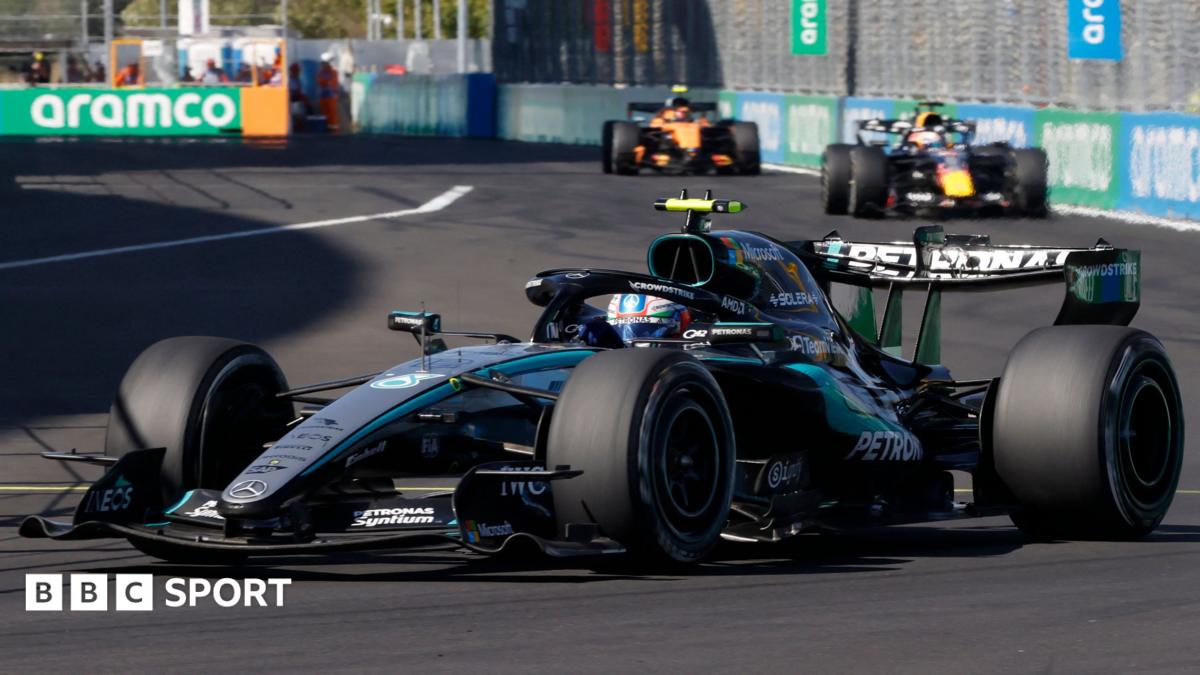
Monaco Grand Prix: Kimi Antonelli pips Max Verstappen pole with Lewis Hamilton third

A Monaco pole is a statement performance for any driver and one of the biggest prizes in Formula 1. To deliver in this fashion, at the age of 19, underlined his potential as the most likely world champion this year at this early stage.

He and Verstappen were separated by just 0.001secs after their first runs in the final session and Antonelli said he had produced a “magic lap” to beat the Dutchman.

Leclerc went out early for the final runs after missing his first lap with a lock-up at Mirabeau, and he put himself at the top with his first effort.

Verstappen then beat that mark by 0.257secs to take top spot, only for Antonelli to displace him.

Leclerc was not finished – he had given himself time to have one final lap as the last driver on track. But he went over the limit and slid wide on the entry to Tabac, crunching his right rear wheel against the wall and breaking his rear suspension.

Antonelli said: “I was able to put everything together. It was such a close qualifying session. The last lap was good.”

Verstappen said he was surprised to be able to compete for pole position.

“If you would have told me yesterday I would be on the front row, I would have taken it,” he said. “So heading into qualifying and being up there was extremely positive. Very happy with how qualifying went. I am happy to be on the front row.”

Ferrari had been quickest on Friday, first and second in both sessions, but Hamilton said the car felt different as soon as qualifying started.

“We were looking so good in practice and then the car was drastically different in qualifying,” Hamilton said, “so we have to take a look at that. But I was giving it everything. What a privilege it is to be one of the 22 drivers who gets to do this. I loved every second of it.”

Russell struggled for grip throughout the session and never looked likely to get into the fight for pole, and he ended up 0.394secs behind his team-mate.

Source link

Letters to Sports: More calls for Angels ownership change

p]:text-cms-story-body-color-text clearfix”>

Bill Plaschke’s and many Angel fans’ desire for Arte Moreno to sell his ownership of the Angels is an overkill. Granted, us Angels fans have suffered under Moreno’s ownership, and the Angels would be better off with new ownership, but over the years Moreno has done many positive and charitable things. I suggest that the Angels provide Moreno with a 10%, non-voting interest, regardless of who the new owners might be. That way the fans are happy, and Moreno will still have a rooting interest.

Michael Gesas
Beverly Hills


Bill Plaschke’s column urging Angels owner Arte Moreno to sell the team hits the bull’s-eye. Clear, concise and comprehensive, it highlights most factors leading the Angels to the bottom of MLB. Most factors, except a significant one: Moreno’s ownership incompetence has been facilitated by the group of sycophants he has apparently surrounded himself with. These same people are now hard at work imploring Moreno, “just don’t read The Times today.”

Rob Fleishman
Placentia


If Bill Plaschke were an attorney delivering closing arguments at a jury trial, his recent article regarding Arte Moreno’s ownership of the Angels would certainly produce a verdict. The jury has reached its decision: the defendant must sell the team.

Wayne Muramatsu
Cerritos


Dear Angels,

I’ll start off by saying it’s not you, it’s me. I tried staying faithful to you but Arte Moreno’s interference in our relationship has clouded my better judgment. I thought I could stick it out knowing how hard you are working trying to reel me back in. It’s not working and I must now turn my back and walk away. What we have now is a shallow affair and it’s not fair to you that the charade continue. In the end, I take great comfort in knowing someday, somehow you will find what you are looking for.

Mark Petrasso
Port Hueneme

Source link

What time does the 2026 Belmont Stakes start? What TV channel?

One thing about the Triple Crown: Fans do not get cheated, at least when it comes to the number of races on the big day.

Just as Churchill Downs did for the Kentucky Derby and Laurel Park did two weeks later for the Preakness, Saratoga Race Course has scheduled 14 races Saturday, highlighted by the Belmont Stakes. It’s the third and final year the Belmont will be run at the upstate New York track while Belmont Park is being rebuilt.

While Laurel started its card at 7:30 a.m. PDT, the Saratoga card follows Churchill’s schedule and begins at 8 a.m. PDT, or 11 a.m. on the East Coast. And, just like the other two headline races, the Belmont is scheduled to start at 4:04 p.m. PDT, or 7:04 p.m. EDT.

It will be the 13th race of the day, with official post time listed at four minutes past the hour.

The biggest difference Saturday from the Derby and Preakness is where fans can watch the races. Fox, not NBC, has the rights to the Belmont.

The first seven races can be seen on FS2 as part of the New York Racing Assn.’s regular “America’s Day at the Races” program, which starts at 7:30 a.m. PDT and continues until noon. The eighth race, at 12:25 p.m. PDT, also will be covered by that crew but will air on Fox.

The network’s official Belmont show begins at 1 p.m. and continues until 4:30. Curt Menefee again is the host, with analysts Tom Amoss and Richard Migliore, plus handicappers Jonathan Kinchen and Chris Fallica, with other contributors such as Charissa Thompson and Tom Rinaldi.

Thompson also will host an alternate telecast geared for horseplayers from 1-4:30 on FS1.

The last of Belmont’s 14 races is set to begin just past 5 p.m. PDT, or 8 p.m. in the East. But don’t worry … FS2 will carry that and it won’t interrupt the Belmont Stakes post-race coverage.

Source link

Katie Taylor: How iconic Irish fighter finally secured dream Croke Park bout

Still, 80,000 seats is a lot to shift and in today’s environment, only the top heavyweights, plus a handful of other stars including Saul ‘Canelo’ Alvarez and Naoya Inoue can hit such heights.

For Taylor, 39, and her team to have ambitions to command such an audience is evidence of the reverence in which she is held.

After Friday’s news conference, the Bray native and team set off on a four-day promotional tour around the island of Ireland, beginning in her home town.

It may be a farewell, but a test and not a testimonial is how Taylor wants to sign off.

The opportunity to regain the WBC portion of the light-welterweight title [which was made vacant after last year’s Serrano win] and retire undisputed is the dream.

But she has no designs on getting swept up in the emotion with undefeated Frenchwoman Flora Pili standing in her way.

The Croke Park door appeared shut when an agreement could not be reached between Hearn and stadium authorities three years ago, so what has changed?

With costs to hire the stadium “twice as much as Wembley” according to the Matchroom chairman, it was difficult to see how the impasse would be broken.

For the company there is “not a whole lot financially” to be gained, but just as the rematch between Carl Froch and George Groves at Wembley Stadium in 2014 proved a big night for Matchroom, 80,000 at Croke Park can do likewise according to Hearn.

“That a female is fighting in front of 80,000 people, I think it’s the greatest moment of our [Matchroom’s] boxing history,” he said.

“We’re not going to be making much money on the night, but this is about more than that. My dad [Barry, Matchroom founder and president] might kill me, but what does it really matter what we make on a night like this?

“What we leave with is something we’ll never forget and also it’s important for the brand of our business.”

Source link

Vaibhav Sooryavanshi, 15, gets first India call-up for England and Ireland tour

Teenage batting sensation Vaibhav Sooryavanshi has received his first international call-up by making the India T20 squad to tour England and Ireland.

If he plays, the 15-year-old would break Sachin Tendulkar’s record as the youngest man to play for India. Tendulkar was 16 years and 205 days when he played a one-day international against Pakistan in 1989.

The call-up comes on the back of Sooryavanshi ‘s stunning Indian Premier League campaign, where he scored 776 runs in 16 innings at a strike rate of 237.30 for the Rajasthan Royals.

The left-hander was named the IPL’s Most Valuable Player and also picked up the emerging player award and the Orange Cap, given to the highest run-scorer.

He also scored 175 in February as India beat England in the final of the Under-19 World Cup.

“We’ve seen what he can do, almost single-handedly carrying Rajasthan Royals towards the play-offs,” said selection panel chairman Ajit Agarkar.

“He had a great start and backed it up in a competition that is as competitive and high-pressure. He’s a game-changer. We’ve got high hopes of him. He has picked himself.”

India play two matches in Ireland later this month, then five T20s in England in July.

Meanwhile, Shreyas Iyer has been named as the new captain, replacing Suryakumar Yadav, who has been dropped from the squad.

Suryakumar led India to victory at the T20 World Cup in March but the 35-year-old struggled with the bat at the tournament and at the recent IPL.

“It’s a tough one, having just won the World Cup, but as happens after most World Cups, you try to reassess what your best way forward is,” Agarkar said explaining Yadav’s omission.

“We thought this was the best way forward.”

Shreyas has not played a T20 international since 2023 but he led the Kolkata Knight Riders to the IPL title in 2024 and captained Punjab Kings to a runners-up finish in 2025.

Fast bowler Jasprit Bumrah and all-rounder Hardik Pandya have been rested, with uncapped fast bowler Prince Yadav called up.

Full squad

Shreyas Iyer (captain), Abhishek Sharma, Sanju Samson, Ishan Kishan, Shivam Dube, Tilak Varma, Nitish Reddy, Axar Patel, Washington Sundar, Varun Chakravarthy, Mohammed Siraj, Arshdeep Singh, Prince Yadav, Vaibhav Sooryavanshi

Source link

Kyle Busch’s wife releases statement weeks after NASCAR legend’s death

Kyle Busch‘s family has dealt with a lot since the NASCAR legend’s sudden death at age 41 last month.

On Friday, however, his wife Samantha and their two children — son Brexton, 11, and daughter Lennix, 4 — “wanted to take a moment to say thank you” for all the support they have received.

“The prayers, messages, flowers, meals, hugs, and countless acts of kindness have carried us through the most heartbreaking days of our lives,” they said in a note posted Friday on Samantha’s Instagram page. “While our hearts are absolutely shattered, we have felt God’s presence and arms wrapped tightly around us through each and every one of you.”

Busch, a two-time champion of the NASCAR Cup Series and the winningest driver in the association’s history, became unresponsive while in a racing simulator on May 20 in Concord, N.C., and was transported to a Charlotte hospital. He died the next day.

According to his death certificate, Busch died from hemorrhagic shock and disseminated intravascular coagulation after complications from bacterial pneumonia led to sepsis. He had been experiencing symptoms of bacterial pneumonia for “days to weeks” before sepsis set in, the certificate states.

The Busch family released a joint statement with NASCAR and his team, Richard Childress Racing, honoring Busch on the day he died. Friday’s social media post marks the first public comment directly from Samantha and her children since then.

“The love that has surrounded our family during this unimaginable time has brought comfort in the middle of so much pain,” they said in the post.

“Knowing the impact Kyle had on others and seeing how they are honoring him through each unique act of generosity is a true testament to how special Kyle is to so many people. There are moments when the weight of this loss feels impossible to carry, yet time and time again God, through you all, has shown us we are not alone.”

Kyle and Samantha Busch were married on Dec. 31, 2010. She and their children were among those who appeared at the Coca-Cola 600 at Charlotte Motor Speedway on May 24 to honor Busch’s memory.

“From family and friends to fans and complete strangers, thank you for showing up for us. Thank you for loving our family so well,” their post concluded. “Thank you for loving Kyle. Thank you for honoring him. We may never find the words to fully express what your support has meant to us, but please know that we are deeply grateful.

“❤️ Samantha, Brexton & Lennix”


Source link

SoFi Stadium workers vote to authorize strike ahead of World Cup

Nearly 2,000 food and beverage workers at SoFi Stadium voted overwhelmingly Friday to authorize a strike just a week before the venue will stage the first World Cup game on U.S. soil in more than three decades.

Negotiations on a labor contract between Unite Here Local 11, the union representing the cooks, dishwashers, concession workers and bartenders at SoFi and, Legends Global, the stadium’s food-service operator, are expected to continue Monday despite the vote. But Kurt Petersen, the union’s co-president, said if an agreement isn’t reached workers will walk off the job and the 70,000 fans arriving for the June 12 match between the U.S. and Paraguay will be greeted by hundreds of picketers.

Union members have been working without a contract for a year and Petersen said Unite Here is demanding salary increases, protection against subcontracting and job loss through automation, and are protesting the collection of sensitive private information such as nationality and home addresses that FIFA, organizer of the World Cup, said it needs to accreditate workers.

Workers are also demanding the right to walk off the job if federal immigration enforcement enters the stadium and creates a reasonable fear for their safety. Ninety-six percent of the vote was in favor of strike authorization.

Legends Global, the stadium’s food-service operator, responded to the vote with a statement.

“Legends Global has presented progressive wage proposals to Unite Here Local 11 throughout our negotiations and remains confident an agreement is within reach,” it read. “While we expect a contract will be finalized in time, a contingency staffing plan is in place to ensure seamless operations and no disruption to fans. We remain committed to delivering an outstanding hospitality experience at the FIFA World Cup matches.”

That contingency plan would involve hiring replacement workers who would have to undergo the same detailed accreditation procedures demanded by FIFA, plus job training. SoFi Stadium is scheduled to play host to eight World Cup matches, including two of the U.S. team’s three group-stage games. The first of those is on June 12 when the U.S. faces Paraguay in its World Cup opener.

Petersen said the union is looking for “substantial increases” in hourly pay, to more than $30 an hour. Legends’ most recent proposal calls for wage freezes for some workers and a 25-cent hourly increase for cooks and dishwashers, the union said.

But perhaps the biggest sticking point is FIFA’s demand for workers’ sensitive personal information, including Social Security numbers and fingerprints, to process background checks. Under California privacy laws, workers have the right to know exactly what personal information their employer collects, how it will be used, and who it will be shared with. Local 11 said its members fears such information, if collected, could be made available to the Department of Homeland Security and ICE.

According to Petersen, when workers were originally hired by Legends they submitted the documentation necessary for employment, and under the current collective bargaining agreement the company does not have the right to request it again for FIFA.

FIFA has refused to comment on the contract talks, saying they are “between Legends Global and Unite Here Local 11.” But its insistence on collecting personal information is something Legends cannot address during contract talks, which makes a resolution impossible.

FIFA said it was partnering with the governments of the U.S., Canada and Mexico, the three countries in which the 39-day tournament will be played, “to enhance safety and security of all workers, staff, team members, vendors, journalists, volunteers, and spectators by mitigating potential insider threats. … Such name checks do not constitute pre-employment checks.”

All data collected during the name-check process, FIFA said, will be processed “in accordance with applicable data protection and privacy laws, and will be deleted by FIFA as soon as it is no longer needed for purposes of adjudicating requests for credentialed access to FIFA-controlled spaces.

Source link

Freddie Freeman hits walk-off homer in Dodgers’ victory over Angels

Freddie Freeman battled in the batter’s box.

No stranger to coming through in a big moment, the Dodgers star was hoping to see a fastball up in the zone from Angels reliever Kirby Yates.

So Freeman stayed patient, working his way into a full count.

Then Yates gave him what he wanted — and Freeman delivered the 20th walk-off hit of his career.

The Dodger Stadium crowd erupted in celebration as Freeman watched the ball soar over the right-center field wall in the ninth inning of a 1-0 victory over the Angels.

Freddie Freeman hits a walk-off home run for the Dodgers in a 1-0 win over the Angels at Dodger Stadium on Friday night.

Freeman grinned as he rounded the bases. He threw a thumbs up at his teammates before they swarmed him in celebration. He finally had given the Dodgers something to cheer for after being held to just two hits over 25 at-bats.

“I’ve been feeling good lately,” Freeman said. “I was tweaking things early on, just trying to find a consistent feel for things. Sometimes it’s just get a couple of hits, get confidence and get going. Nothing really crazy. It’s the same routine, hitting some soft line drives at the shortstop, and things have been working.”

Through most of the game, the excitement was contained to a pitcher’s duel — a chess game of defensive plays, waiting to see who flinched first.

Dodgers pitcher Roki Sasaki was red hot in what would tie for his longest outing of the season. Sasaki, for the first time this season, threw triple digits in back-to-back appearances, topping 100.6 mph. The Japanese pitcher threw all three of his pitches harder than his yearly average.

Freddie Freeman watches his walk-off home run clear the wall in center field.

Freddie Freeman watches his walk-off home run clear the wall in right-center field to cap a 1-0 win over the Angels at Dodger Stadium on Friday night.

(Ronaldo Bolanos / Los Angeles Times)

“I’ve been experiencing a lot of good and bad since 2024,” Sasaki said through interpreter Kensuke Okubo. “But I feel like I’m able to maintain this velocity. I think I’m confident about that, but I’m just keeping working on it to make sure I’m in a better place.”

With the speed uptick, Sasaki has also seen an inverse downtick in the earned runs column on his statline. His monthly ERA reached its zenith at 7.23 in his April starts, descending to its current 4.03 ERA.

In Sasaki’s best starts, the elevated velocity and pitch mix makes the right-hander lethal, giving him extended runway to pitch further into the game. Against the Angels (24-40), the elevated velocity allowed him to throw 4⅓ hitless innings in his career-high 11th appearance of the season. He pitched seven innings, giving up two hits and two walks while striking out 10.

It’s a return to how Sasaki looked when he played in Japan, manager Dave Roberts said. Confidence might be the clearest sign things are clicking. Sasaki thumped his chest after striking out Adam Fraizer in the fifth inning, a rare show of emotion.

“I certainly think we can all agree that the floor for Roki is much higher, and the expectation every time he takes the ball is high, and he’s earned that,” Roberts said. “If you look at the last six or seven stats, it’s been as good as any starter in the big leagues in the consistency of performance. So really proud of him and I know that he wants more, and the floor has just been raised.”

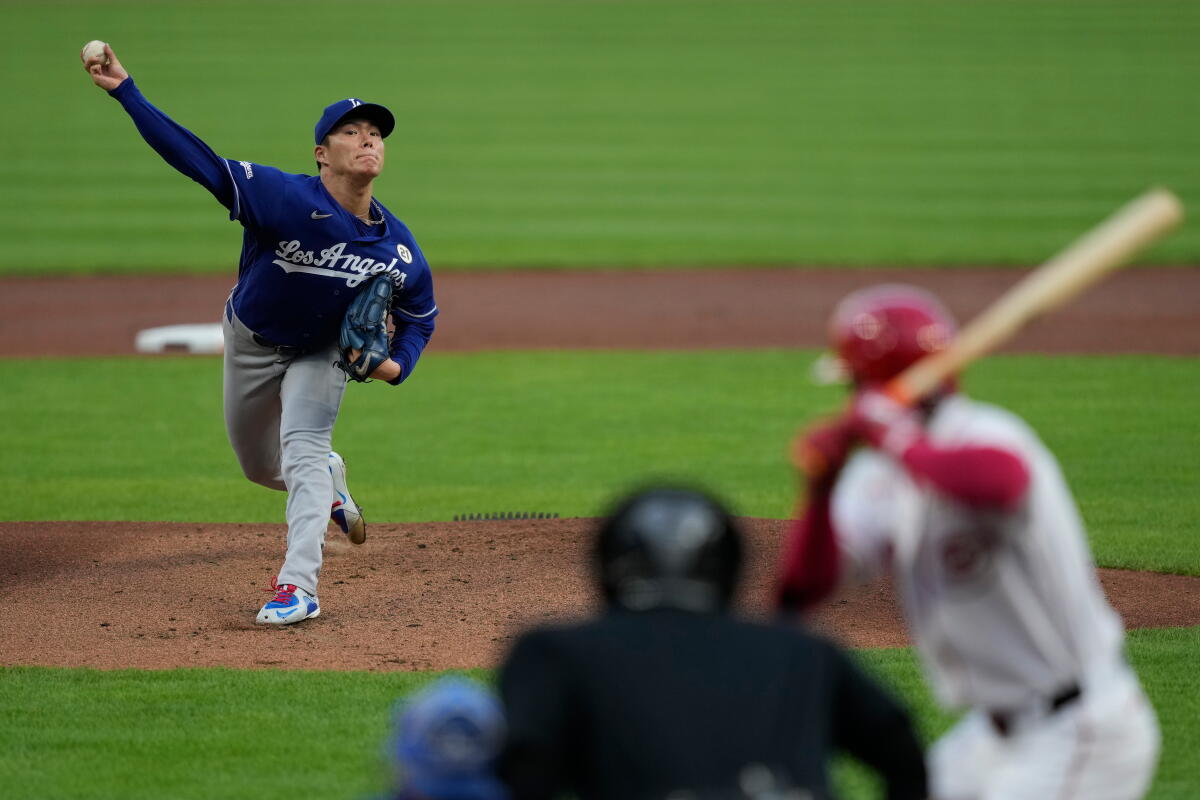
Dodgers pitcher Roki Sasaki delivers in the first inning of a 1-0 win over the Angels at Dodger Stadium on Friday night.

Dodgers pitcher Roki Sasaki delivers in the first inning of a 1-0 win over the Angels at Dodger Stadium on Friday night.

(Ronaldo Bolanos / Los Angeles Times)

Some quick thinking from second baseman Miguel Rojas also helped preserve Sasaki’s strong start. On Nick Madrigal’s sharp line drive in the third inning, the pitcher reached for the ball and popped it up with the tip of his glove. The ball ricocheted off its intended course, but Rojas nabbed it with his bare hand, throwing it to first where a lunging Freeman caught it. The play was initially ruled as an infield single, but it was overturned on review.

“When it hits off a pitcher — you’re already going, committed to one way, then you gotta make another,” Freeman laughed. “The old guy’s still got it.”

Madrigal would break the Angels’ hitless run in the fifth with a double off the left-field wall. But, he was left stranded when Sasaki induced a groundout before his strikeout of Frazier.

The Dodgers (41-23) didn’t fare much better against Angels starter Reid Detmers. In the fourth, Freeman singled and moved to third on a forceout on Kyle Tucker. But, with two outs on the board, Will Smith struck out.

Andy Pages squandered a potential scoring opportunity when he was caught stealing in the sixth. The center fielder, who went one for four, has struggled at the plate in recent games. Against Arizona this week, Pages batted .176, collecting only three hits.

As the innings dragged, both the Dodgers and the Angels failed to find momentum. Reliever Chase Silseth took over in the seventh for Detmers, who gave up just two hits, walked two and struck out six. Silseth silenced the opposing batters, issuing only a walk to Smith.

Edgardo Henriquez took over in the eighth, striking out the first two batters he faced. Then, he hit Zach Neto with a pitch, and after Neto stole second, the Dodgers found themselves in a precarious position with Mike Trout at the plate. Not for long, though, as Henriquez struck out Trout.

Roberts, who had watched Rojas and Santiago Espinal go a combined 0 for 4, pinch-hit for both in the eighth. To a roaring applause, Max Muncy entered the batter’s box, his first plate appearance since a scary collision with the Arizona Diamondbacks’ Ildemaro Vargas on Thursday. Muncy, though, went down swinging.

Tanner Scott took the mound in the ninth a day after he gave up a walk-off home run to Arizona’s Ketel Marte. Jo Adell hit a one-out single then moved to second on a sacrifice bunt by Donovan Walton. Roberts then put Blake Treinen into the game, and he got Oswald Peraza to ground out to first.

With Freeman’s sixth career walk-off home run, the Dodgers beat the Angels for the fourth consecutive time this season.

“Freddie just has aura,” Roberts said. “There’s not too many guys in baseball that you’d want in a game-winning situation, and Freddie does it once again.”

Angels second baseman Oswald Peraza walks back to the dugout after grounding out during the ninth inning against the Dodgers.

Angels second baseman Oswald Peraza walks back to the dugout after grounding out during the ninth inning against the Dodgers.

(Ronaldo Bolanos / Los Angeles Times)

Source link

World Cup 2026: USA pioneer Desmond Armstrong and his legacy

Football came to Armstrong, via a television set, in suburbia.

His family moved from the Southeast part of Washington DC when Armstrong was young and later settled in a largely white neighbourhood in Maryland, where he befriended a soccer coach’s son. One afternoon, the coach called Armstrong over to the television.

He was pointing to a Brazilian in a New York Cosmos jersey.

“It was Pele,” says Armstrong.

“His movement reminded me of a lot of the point guards that played basketball, but he was doing it with a ball at his feet.

“He was one of the few black players on the team, so that connected me.”

While Pele was popularising a game he’d learned barefoot on the streets of Brazil, much of the American grassroots version was being built on privilege.

Unlike the developing youth academies of Europe and South America, where clubs like Ajax and Barcelona were putting money into young talent, development in the US has long run on a pay-to-play model.

Families must meet significant costs or seek sponsorship to give their children a shot at advancing – creating a system that has seldom favoured those from less affluent households.

“It’s kind of antithetical to what this game’s all about,” says Frank Dell’Apa, who has spent 40 years as the Boston Globe’s football columnist, covering the game since the days of the original North American Soccer League (NASL).

“This is the simplest game with the easiest access. Everybody plays it around the world with no money, no soccer balls, no shoes. And here, we had just the opposite thing going on.”

Armstrong knows just how easily his story could have been different.

“If my folks didn’t move into the suburbs, then hands down I’m not playing soccer,” he says.

Socioeconomics was not the only hurdle.

The NASL going under in 1985 during Armstrong’s time as a college player limited professional pathways for him and his peers before their careers had even begun.

“For me, personally, that was crushing,” Armstrong says.

He turned to the Major Indoor Soccer League to play professionally, where his performances earned him a US men’s national team debut in 1987, followed by a spot at the 1988 Seoul Olympics.

“I remember being on the field, hearing the national anthem and just thinking ‘this is where I’m supposed to be’,” he says.

That same year, world football’s governing body Fifa had selected the USA to host the 1994 World Cup finals – the first time the tournament had gone to a country outside Europe or Latin America.

They would be under the global spotlight.

“The US was not a factor in world soccer at all,” says Dell’Apa.

“I remember Des playing a lot of games on artificial turf. It was hard for those guys. They had to fight to get into line-ups, to get a playing field, to get a stadium.”

With no elite outdoor professional league in the country, the player pool was a fragmented mix largely consisting of college, semi-pro and indoor players like Armstrong.

The federation looked to work around this by securing a core group of them on full-time contracts, essentially turning the national team into the country’s professional set-up. It was an unorthodox approach, not unlike something from the Eastern Bloc playbook.

They appointed a German-Hungarian head coach named Bob Gansler. Armstrong was now among a group of young players who were handed a near impossible task: qualify for the 1990 World Cup in Italy.

Source link