POLITICS

Stay informed about the latest developments in politics with our comprehensive political news coverage. Get updates on elections, government policies, international relations, and the voices shaping the political landscape.

King Charles to address Congress as U.S.-British ties face rare strain

King Charles III will address a joint session of Congress on Tuesday, becoming the second British monarch in history to do so as the United States commemorates the 250th anniversary of its independence from England.

The king’s address, the centerpiece of a four-day state visit, comes at a moment of unusual strain between Washington and London. President Trump has repeatedly clashed with British Prime Minister Keir Starmer over the United States’ war with Iran, derided the British government’s refusal to commit forces to the conflict and even mocked the Royal Navy’s battleships as “toys.”

At a welcome ceremony for the king and Queen Camilla at the White House, Trump struck a more appreciative tone, describing the relationship between the two nations as a centuries-old “cherished bond.”

“Long before Americans had a nation or a Constitution, we first had a culture, a character and a creed,” the president said. “Before we ever proclaimed our independence, Americans carried within us the rarest of gifts — moral courage — and it came from a small but mighty kingdom from across the sea.”

Trump said that some may think it is “ironic” to honor the British king during celebrations of America’s independence, but argued the tribute “could not be more appropriate.”

“Americans have had no closer friends than the British,” Trump said. “We share the same root. We speak the same language. We hold the same values. And together, our warriors have defended the same extraordinary civilization under twin banners of red, white and blue.”

Trump said he will not be attending the king’s remarks at the Capitol due to security protocols, but said he planned to watch from afar. He did not elaborate on any security concerns, but the decision comes in the aftermath of a shooting at the White House correspondents’ dinner in which authorities said Trump was a likely target.

Following the welcome ceremony, the king joined Trump in the Oval Office for a closed-door bilateral meeting.

The president appeared to be enjoying the visit. He told the crowd at the White House that his late mother “loved” the royal family and watched their events on television. The president even joked his mother had a “crush” on the king when he was younger.

“I wonder what’s she’s thinking right now,” he said.

Earlier in the day, Trump posted on Truth Social that he planned to raise with the king and queen a media report suggesting his family roots may be tied to the royal family, a prospect he appeared to find amusing.

“I’ve always wanted to live in Buckingham Palace!!!” the president said in the post.

The king is scheduled to address Congress at 3 p.m. EDT. He is expected to delivered prepared remarks about the two nations’ shared history and their enduring diplomatic ties, while offering measured acknowledgment to the tensions defining the current moment.

The only precedent for an address by a British monarch was 35 years ago, when Queen Elizabeth II addressed a joint session of Congress in 1991. The timing of her address came after the end of the Gulf War.

How the king will address the current geopolitical tensions, including the Iran war and Trump’s threats to leave the North Atlantic Treaty Organization, remains to be seen.

But hanging over the king’s visit is the shadow of the Jeffrey Epstein scandal.

Rep. Ro Khanna (D-Fremont), one of the most vocal lawmakers pushing for the release of the Epstein files, last month requested that the king privately meet with some of the women who were sexually abused by the late financier.

The request was made in a letter to Buckingham Palace. In it, Khanna noted that the Epstein scandal extended to Britain, where the king’s brother, Andrew Mountbatten-Windsor, was tied to the alleged misconduct.

In February, the former Prince Andrew was arrested on suspicion of misconduct in public office related to his links to Epstein, marking the first time in nearly four centuries that a senior British royal was criminally apprehended.

But the king declined to meet directly with the survivors, Khanna said in an MS NOW interview on Tuesday morning. The California Democrat said he expects the king to address the issue during his remarks to Congress.

Source link

Jimmy Kimmel explains ‘expectant widow’ comment, declines to apologize

ABC late-night comedian Jimmy Kimmel explained his controversial joke about First Lady Melania Trump, but declined to apologize for offending her.

On Monday, President Trump repeated his demand that ABC fire the longtime show host over a joke that aired on the L.A.-based “Jimmy Kimmel Live!” program two days before the White House Correspondents’ Assn. dinner in Washington. Kimmel, who has headlined that event before, staged a pretend roast during his Thursday night broadcast that featured spliced-in footage of Melania Trump, Defense Secretary Pete Hegseth, Vice President Vance and others.

During the bit, a tuxedo-clad Kimmel called the first lady “beautiful,” saying she had “the glow of an expectant widow.” There wasn’t much reaction to Kimmel’s comment at the time, Kimmel said during Monday’s show.

On Saturday, the White House Correspondents’ Assn. gala, to celebrate the 1st Amendment, was interrupted when a gunman sprinted past security at the Washington Hilton, where the event was being held. He did not reach the ballroom. The suspect, Cole Tomas Allen, of Torrance, has since been charged with attempting to assassinate the president.

“There was no big reaction to [the joke] until this morning, when I greeted the day facing yet another Twitter vomit storm and a call to fire me from our first lady,” Kimmel said during Monday night’s telecast.

“Obviously, it was a joke about their age difference and the look of joy we see on her face every time they’re together,” Kimmel said.

“It was a very light roast joke about the fact that he’s almost 80 and she’s younger than I am,” Kimmel said. “It was not, by any stretch of the definition, a call to assassinate. And they know that.”

Kimmel added that he has long been vocal “speaking out against gun violence,.”

Melania Trump, who appeared visibly shaken during the Saturday night scare, expressed her outrage in a social media post earlier Monday.

“Kimmel’s hateful and violent rhetoric is intended to divide our country,” she wrote. “His monologue about my family isn’t comedy- his words are corrosive and deepens the political sickness within America. People like Kimmel shouldn’t have the opportunity to enter our homes each evening to spread hate. A coward, Kimmel hides behind ABC because he knows the network will keep running cover to protect him.”

ABC has not commented about the flap.

Source link

Trump’s “Transition” in Venezuela is Starting to Reek

One day Delcy Rodríguez calls for a reform to the justice system after announcing the sudden revocation of the amnesty law her brother sponsored. The other, rumors suggest she’ll reshuffle the country’s higher court without providing any indication of who the new magistrates are going to be. The central bank president she recently named prepares to disclose figures to the IMF for the first time in decades.

The public does little else than follow the news, as if things were normal. Futile debate has emerged on social media over whether the new US chief of mission in Caracas is more hawkish than his predecessor. Or if the opposition has racist tendencies because a singer (once popular in the 2000s) called Delcy an ape in the opposition’s largest rally in years.

The picture of the country in recent weeks is one of Delcy Rodríguez calling the shots with near-total freedom. She has been enjoying a clear head start over a potential presidential election, as she crisscrosses Venezuela on what amounts to an unofficial campaign tour. In Caracas, she keeps changing everything so that nothing really changes. She is intent on controlling government offices in the next four years through newly promoted loyalists and a clean inflow of petrodollars. The chavista elite has looked more confident in the meantime, touring with Delcy in sky-blue outfits, leading cartoonish chants for peace and national union as if the internal contradictions that surfaced two months ago were now less important, because the possibility of survival looks clearer.

Back in February, optimists would discuss the scope of Washington’s coercion capacity over the “caretaker” regime, the boundaries that (if crossed) would trigger a “second wave” of attacks, the disappearance of Alex Saab as a prelude of a broader purge against other “untouchables” that overtly normalized the commission of terror. Now, lunatics like Diosdado Cabello’s nephew, Alejandro Rondón, claim on social media that “the recess is about to end” the same day Delcy says the amnesty scheme ran its course and Cabello recounts an unlikely justice system crackdown.

What followed January 3rdwas a paradigm change with positive practical consequences for society that chavismo quickly learned to manage if not reverse.

Alejandro doesn’t look like the brightest dude. He’s another chavista nepo-kid working for the other Cabello uncle that controls Venezuela’s taxing authority, Jose David, though Alejandro made a name for himself with rage-baiting tweets that celebrated Maduro’s “victory” in 2024 and claimed the opposition were terrorists who falsified the official voting records (i.e. Diosdado’s talking points during the tun-tun operation).]

But an emboldened member of the Cabello Rondón clan is a troubling sign for those who fled the country after being placed on “treason” blacklists. It also undercuts the very notions of pluralism and national reconciliation that Marco Rubio invoked three months ago when outlining his vision for Venezuela’s democratic transition before US senators. Shortly thereafter, Rondón drove the point home by publicly wishing Donald Trump well after the shooting at the White House Correspondents’ Dinner. The message seems clear: the arrangement with Team Trump is comfortable enough that, however fraught the geopolitical backdrop, they can afford to be flippant—even in public. They remain, unmistakably, the bullies in town. 

The long wait for elections (or just a calendar?)

What followed January 3rd was a paradigm change with positive practical consequences for society that chavismo quickly learned to manage if not reverse. Allies of Maria Corina  Machado who spent the past two years jailed or hiding are back in the street, even providing testimonies about their imprisonment. The student movement has undergone a revival, liaising with human rights groups to set up carefully-controlled protests. Censorship isn’t what it used to be, so journalists have tried to take advantage of that opening. Pensioners and public workers have perhaps become the loudest actor in confronting Rodríguez, despite having to face colectivos and National Guards whenever they hit the streets.

Repression has become less intense, but the lack of a clear electoral calendar keeps the opposition on the sidelines, waiting for the arrival of Machado, which is no less paralyzing. The amnesty law passed on February 19 effectively funneled the release of political prisoners, shattering expectations of a “landmark outcome” that would speed up the process. 

Indeed, the statute’s contents make more than 180 supposed military rebels ineligible, although the release of a handful of FANB officers in recent days reinforces the idea that a law wasn’t necessary to get people out of jail. Nearly 300 civilians are still imprisoned, and we haven’t seen significant breakthroughs in the past few weeks.

According to figures from NGO Foro Penal (based on documented cases), the political prisoner population fell by 40% in the two months following the US military intervention—dropping from 863 detainees in late December to 526 by March 2. The pace has clearly slowed since then. Chavismo released 36 people between March and April, and 17 over the past 18 days (about 6% of the pre–January 3 total). The regime still resorts to sporadic arbitrary arrests and intimidation. Alexis Paparoni, an opposition figure in Mérida (and brother of Carlos Paparoni), was briefly detained while traveling and later released under precautionary measures. A similar incident occurred last weekend with a government employee in Guárico, who was detained for having a note on his desk bearing the now-infamous slur directed at Delcy.

“These prisoners are currently incarcerated because POTUShas chosen to appease and praise the perpetrators instead of supporting their victims,” Burelli recently told Senator Scott.

The White House appears satisfied with results so far. Venezuela is now subject to sweeping sanctions relief across oil, gas, minerals, and fertilizers, while OFAC has issued waivers allowing operations with public banks. Most notably, Delcy Rodríguez has been removed from the Specially Designated Nationals list—effectively unfreezing her US-based assets and clearing the way for financial dealings under American jurisdiction. 

The opposition leadership has largely stuck to its 2025 strategy of projecting trust and patience toward Donald Trump. María Corina Machado continues to argue that Trump is the head of state who has done the most to advance Venezuela’s liberation and maintains that the Rodríguez government is dismantling the Maduro-era “structures of corruption and repression.” However, she acknowledged last week that a bout of political instability cannot be ruled out. 

“The risk is that if people feel the path [toward freedom and democracy] is beginning to close, they may start to push back in a disorganized and potentially anarchic way,” she told esRadio hosts in Madrid. “That’s why a clearly defined electoral calendar is a guarantee of peace and stability. That would help people accept that this process will last a bit longer, as institutions must be strengthened and we need to take time to prepare for a truly impeccable election.”

Running out of patience

Criticism of the Trump administration’s handling in Venezuela continues to grow among groups of scholars and foreign policy observers, while opposition parties remain largely quiet and prefer to let Machado formulate their stance.

But in general, there’s a tense awareness that the waters are getting muddy. Some in journalism, and other opposition allies are starting to lose their patience.

Venezuelan journalist Sebastiana Barraez, an outspoken critic of chavismo and popular source on repression, told her audience that Venezuelan people have no guarantees about their future. Two days ago, she admitted the overthrow of Nicolás Maduro had raised hopes of a new democracy and true institutional recovery.

“It turns out none of that is happening,” Barráez said. “In Venezuela, Trump is promoting the interests of the United States. The problem is that those interests are not compatible with what we Venezuelans are looking for.”

Pedro Mario Burelli, an independent advisor for the opposition, is among the few figures to be pressing Washington over its ties with Delcy Rodríguez, calling Trump’s decision to elevate her an “incoherent strategy.” He has warned that doing business with Minerven makes the US an effective enabler of environmental crimes in Venezuela’s south. In March, he told The Atlantic that the remaining political prisoners now belong to Trump and Rubio.

“These prisoners are currently incarcerated because POTUS has chosen to appease and praise the perpetrators instead of supporting their victims. Constantly praising Delcy is disgraceful and an insult to the vast majority of Venezuelans”, Burelli told GOP Senator Rick Scott on Sunday.“Faulting her, as you and some of your colleagues do, is disingenuous. Venezuelans rightfully expect, and deserve, much more from democratically elected US officials.”

Source link

Supreme Court will hear Trump’s bid to end legal protection for up to 1.3 million immigrants

The Supreme Court will hear arguments this week over whether the Trump administration may revoke temporary protected status for about 350,000 Haitian and 6,100 Syrian immigrants.

TPS allows people who are already in the United States to legally reside and work here if they are unable to safely return to their home country because of a sudden emergency such as war or a natural disaster. The humanitarian program, enacted by Congress in 1990, has since been used by Republican and Democratic administrations alike.

Since President Trump returned to office last year, his administration has terminated such protections for immigrants from 13 countries. Court challenges on behalf of Haitians and Syrians have been consolidated into a single case, Mullin vs. Doe, which the justices will hear Wednesday.

The high court’s ruling could eventually have sweeping repercussions for all 1.3 million immigrants from the 17 countries that were designated for TPS at the start of this administration. That’s because the federal government is arguing that decisions regarding the program are almost entirely immune from review by courts.

“Temporary means temporary and the final word will not be from activist judges legislating from the bench,” a Department of Homeland Security spokesperson, who did not provide their name, wrote in response to a request for comment.

Lower courts have repeatedly deemed the administration’s actions improper.

“We’re seeing clear gamesmanship from government to insulate all TPS decision-making from any oversight,” said Emi MacLean, a senior staff attorney at the American Civil Liberties Union of Northern California, who is counsel in the case for Syrians and in other cases challenging five of the terminations. “They’ve created a farce of a process to justify the ends that they sought, which was to strip humanitarian protections from over a million people.”

In the Trump administration’s appeal, Solicitor Gen. D. John Sauer argued that Congress gave the Homeland Security secretary the power to grant or end the temporary protected status for troubled countries and barred judges from intervening.

He pointed to a provision that says: “There is no judicial review of any determination of the [secretary] with respect to the designation, or termination or extension of a designation, of a foreign state.”

Citing this hands-off provision, Trump’s lawyers won brief emergency orders last year that allowed the administration to strip legal protections from about 600,000 Venezuelans. In that case, then-Homeland Security Secretary Kristi Noem had quickly reversed an extension granted by the Biden administration three days before Trump was sworn in.

The circumstances surrounding the Syria and Haiti cases are different. Advocates for the immigrants argue that the administration failed to conduct the required process to properly evaluate each country’s conditions.

They point to emails in July from a Homeland Security official to a State Department official. The Homeland Security official listed TPS designations coming up for review — Syria, South Sudan, Myanmar and Ethiopia. In response, the State Department official wrote: “I confirm that State has no foreign policy concerns with ending these TPS designations.”

State Department travel advisories for both countries warn people against traveling to either because of the risk of terrorism, kidnapping and widespread violence. U.S. citizens are advised to prepare a will.

For Syria, the advisory cites active armed conflict since 2011. For Haiti, it says the country has been under a national state of emergency since March 2024.

But Federal Register notices announcing the terminations said country conditions had sufficiently improved. The notice for Syria, for example, says “the Secretary has determined that, while some sporadic and episodic violence occurs in Syria, the situation no longer meets the criteria for an ongoing armed conflict that poses a serious threat to the personal safety of returning Syrian nationals.”

If the government loses, Homeland Security officials would have to reevaluate the TPS decisions in consultation with the State Department and make a decision based entirely on the country conditions themselves.

The government could start over, in that case, and still find that TPS is no longer warranted — if the process bears that out.

In a friend-of-the-court brief led by immigration law scholars at Georgetown and Temple universities, they explained that before TPS existed, similar forms of humanitarian relief were determined by the executive branch “without reference to any statutory criteria or constraints, and with little if any explanation for why nationals of certain countries received protection while others did not.”

With TPS in 1990, Congress sought to end that “unfettered discretion,” they wrote. Instead, the statute requires the Homeland Security secretary to terminate TPS if the review finds that conditions justifying the designation no longer exist. Otherwise, the law states, it “is extended.”

“The point of the TPS statute was to depoliticize humanitarian decisions,” said MacLean, the ACLU attorney. “Secretary Noem in all of her TPS decisions has completely undermined that fundamental goal.”

Ahilan Arulanantham, who is arguing for the Syria case on Wednesday, added that if the government wins, “it also means they could probably grant TPS to countries that don’t deserve it.” Arulanantham, co-director of the Center for Immigration Law and Policy at UCLA, has represented the National TPS Alliance in separate litigation during this administration and Trump’s first.

Top Homeland Security and State Department officials from the George W. Bush, Obama, Trump and Biden administrations filed a brief arguing that the Trump administration’s terminations of TPS for Syria and Haiti were “not based on evidence and sharply departed from past inter-agency practices.”

Haiti was originally designated for TPS in 2010 after a massive earthquake devastated the country and redesignated because of subsequent natural disasters and gang violence. In November, Noem announced that she would terminate TPS for Haiti, effective Feb. 3. She wrote in the Federal Register that “there are no extraordinary and temporary conditions in Haiti” that prevent Haitians from safely returning.

But even if there were, she continued, “termination of Temporary Protected Status of Haiti is still required because it is contrary to the national interest of the United States.”

The Homeland Security spokesperson said TPS for Haiti “was never intended to be a de facto amnesty program, yet that’s how previous administrations have used it for decades.”

Syria, meanwhile, “has been a hotbed of terrorism and extremism for nearly two decades,” the spokesperson wrote, “and it is contrary to our national interest to allow Syrians to remain in our country.”

In the Federal Register notice for Syria, Noem added that maintaining its TPS designation would “complicate the administration’s broader diplomatic engagement with Syria’s transitional government” by undermining peace-building efforts.

The Supreme Court will take up the question of whether the Homeland Security secretary can use national interest as a reason to revoke TPS. Attorneys for the TPS holders believe any decision to revoke TPS must come down to the country conditions alone.

Syria and Haiti are among the countries for which the Trump administration has also paused processing all immigration benefits. If their TPS protections expire, those immigrants would become vulnerable to detention and deportation even if they are eligible for other forms of relief.

U.S. Solicitor Gen. D. John Sauer attends a press briefing at the White House.

U.S. Solicitor Gen. D. John Sauer argued that Congress gave the Homeland Security secretary the power to grant or end the temporary protected status for troubled countries and barred judges from intervening.

(Aaron Schwartz / Getty Images)

Attorneys for the TPS holders say the terminations were also driven by racial animus. They point to various statements by Trump over the years, including his false claim that Haitians were eating the pets of people in Springfield, Ohio, that they “probably have AIDS” and that Haiti is among the “shithole countries” from which he would permanently pause migration.

Among those affected is a 35-year-old Haitian woman who has lived in the U.S. since 2000 and is raising her four U.S. citizen children in a Southern state. The woman requested to be identified by her middle and last initials, B.B., out of concern for her immigration case.

After graduating high school, B.B. got into nursing school but couldn’t attend because she didn’t qualify for financial aid. She said later getting TPS allowed her to become a certified nursing assistant, and she now works as a medical coordinator while owning a nail salon and three real estate properties.

Though B.B.’s TPS remains active because of the court proceedings, her driver’s license expired Feb. 3 and she has since had to rely on friends and rideshares to get around while repeatedly requesting a renewal.

She said she worries most about her children. If she were deported back to Haiti, she said, she would leave them in the U.S. for their own safety.

“It’s like planning your death,” she said. “I’m 35 and I already have a will — not because I’m going to die but because of the situation.”

On a call with reporters, attorneys and advocates, a Syrian man said he earned his master’s degree in the U.S. and now works in the healthcare industry. The man, who was identified by a pseudonym, said he and his wife are afraid of what their future will look like.

“TPS gave us something we had not had in years: a place to settle and a moment to grieve,” he said, later adding that “telling Syrians to go back right now is not a policy — it’s abandonment.”

Among the public, there is broad support for TPS and other humanitarian programs. According to a poll conducted last month by the firm Equis Research, 68% of Latino and 65% of non-Latino voters support fighting to give back legal protection to those who have lost their temporary protected status or asylum protections as a result of the current administration’s actions.

Earlier this month, the House voted in favor of a bill that would require new Homeland Security Secretary Markwayne Mullin to redesignate Haiti for TPS. Among those who crossed the political aisle to support it were 10 Republicans and Rep. Kevin Kiley, an independent from Rocklin, Calif., who caucuses with Republicans. The measure faces an uphill battle in the Senate.

In an interview with The Times, Kiley said his vote was about common sense and being humane.

“It’s particularly dangerous for people that would be returning where the gangs that are ravaging the country are just lying in wait outside the airport in Port-au-Prince,” he said, referring to the Haitian capital.

And because most won’t return willingly, Kiley added, “really all you’d be doing is removing work authorization from 350,000-some people who are going to mostly remain in the country, who will not be able to work anymore and may end up being more reliant on public assistance in states where they’re eligible.”

At the same time, Kiley said, the TPS system hasn’t worked as intended because most so-called temporary designations drag on.

“The system needs to be reformed,” he said. “But that’s all separate and apart from what we do with the folks who were already given this designation.”

Times staff writer David G. Savage in Washington contributed to this report.

Source link

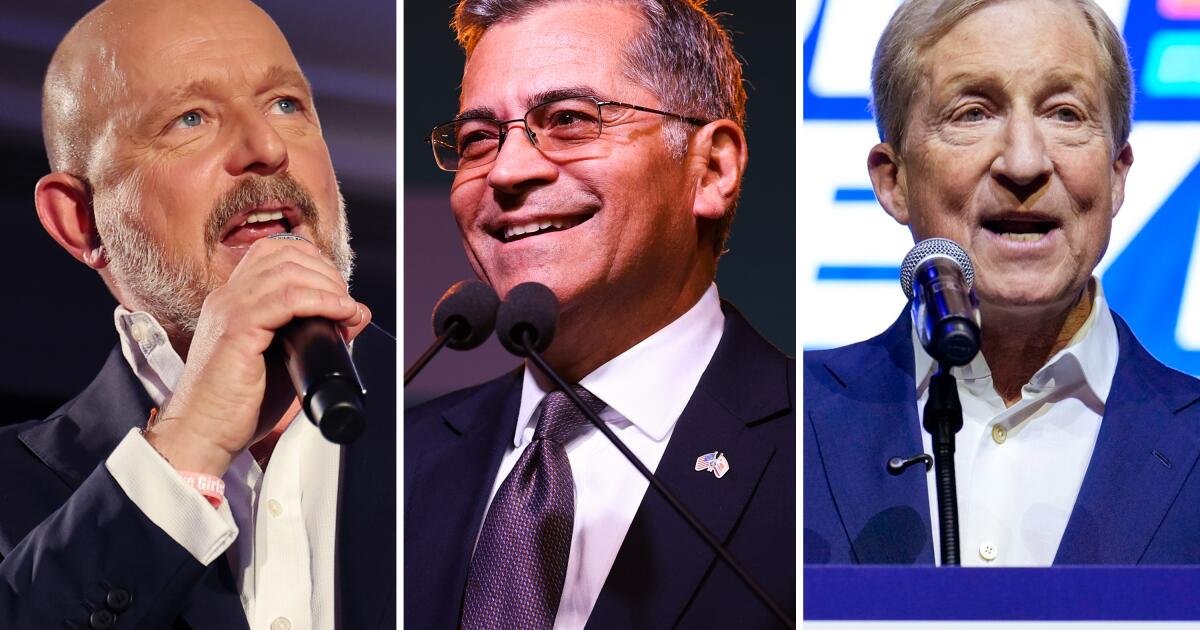
Here’s what to watch for in Tuesday’s California governor debate

Contenders in the race to be California’s next governor will meet on stage Tuesday night for the second of three planned debates before the June 2 primary.

Last week’s meet-up in San Francisco didn’t provide the fireworks or memorable moments the candidates, and many voters, were hoping for — but it did manage to remind us all that ballots will hit mailboxes in coming days and decisions must be made.

Ahead of the forum at Pomona College in Claremont, a trio of our Times columnists — Gustavo Arellano, Mark Z. Barabak and Anita Chabria — weigh in with a cheat sheet on what to look for, what to expect and why it matters.

Chabria: I’ll start us off with the obvious — let’s hope Tuesday gives us at least one breakout candidate who comes with some fire and vision.

After last week’s debate, there was lots of social media posturing about who won and who trolled whom the best. But as one of the six people who actually watched, I can tell you it was mostly bland with no clear winner.

That’s in large part because many of the Democrats have only slivers of daylight between their policies, and ditto for the two Republicans.

So my hope is that at least a single candidate ups their game and comes to voters with not just attacks, but something that inspires, something that sets them apart. This far into the race, that hope is slim, but I’m keeping it alive.

What are your hopes and dreams — and maybe fears — going into this?

Barabak: I know I sound like a broken record. (Google it, kids.) Anita, you and I, in particular, have gone round and round on this one. But I don’t feel a particular need for inspiration from the guys and gal that are running for governor. If I want inspiration, I’ll go back and reread the Rev. Martin Luther King Jr.’s “Letter From Birmingham Jail.” Or listen to a Grateful Dead show from May of ’77.

Give me someone who can work with the Legislature, and as difficult as it may be, President Trump, to get stuff done.

Pursue a “California First” agenda, to borrow a phrase. Put voters and their interests ahead of ego, careerism and personal ambition. Start by pledging, if elected, to serve a full four-year term and not run for president so long as they’re serving as governor.

Of course, that kind of promise can be broken. (See then-Gov. Pete Wilson, who made that vow when he sought reelection in 1994, then turned around and — unsuccessfully — sought the White House in 1995.)

At least we’d have them on the record.

Arellano: I’m all for this morass of democracy. A small part of me wants two Republicans to make it into the general election because the California Democratic Party deserves a meteor-like extinction event. No GOP statewide elected official since Schwarzenegger. Supermajority in Sacramento for most of a decade.

And what do they have to show for their one-party rule? This.

But then I hear Chad Bianco and Steve Hilton mewl, and I’m suddenly hoping alongside Anita that someone vanquishes their foes with an unassailable vision. Problem is, I think all the candidates have reached their ceiling. The only one who has any chance of showing us something new is Xavier Becerra, who needs to drop his Dudley Do-Right shtick for a second and channel the inner cholo we all know is in him.

Instead, he was at a fundraiser in Fullerton over the weekend with professional Latinos — you should’ve been kicking it with my cousins in Anaheim who were watching their Dodgers slaughter the Cubs, loco, because they’re the ones who’ll make or break you.

Chabria: How the first potential Latino governor is failing to excite Latino voters is exactly what I’m talking about. If you don’t give voters something to be excited about, they don’t vote, and our fragile democracy needs every voter it can get.

But if we are forced to vote on nuance, let’s do it informed. Here are some questions I hope these candidates have to answer:

For San José Mayor Matt Mahan, funded in the mega-millions by tech bros, it’s not enough to promise to regulate artificial intelligence, or billionaire influence, for that matter. Tell us what those regulations look like and tell us how you reconcile your own politics with those of big donors such as Joe Lonsdale, co-founder of Palantir, who has called Gen Z the “loser generation.”

For billionaire investor Tom Steyer, who has said he will reform Proposition 13 (which limits property taxes) for corporate land owners: What assurances do homeowners have that they won’t be next?

For former Rep. Katie Porter, polling third among Democrats, the clock is ticking — is there a point where you will drop out and endorse a fellow candidate if you can’t break through? Same-ies for state schools superintendent Tony Thurmond and former L.A. Mayor Antonio Villaraigosa, who are included in this debate but polling in the single digits.

And I agree with you, Gustavo, Becerra is coming across as resolutely bland, but to Mark’s point, he’s using that to position himself as drama-free and experienced. So in an era when fraud and abuse are the words of the day, how does Becerra explain not catching fraud in his own office?

Mark and Gustavo, what are the topics you hope candidates will be grilled on?

Arellano: Slight correction, Anita — California already had a Latino governor: Romualdo Pacheco, the lieutenant governor who replaced Newton Booth in 1875 when the latter became a U.S. senator. Pacheco — a Latino Republican! — served all of 10 months before becoming a Congress member.

See, Californians? Political musical chairs is as much a part of our state as free-spending oligarchs — but enough about Steyer.

Issues? Immigration, of course. I want each one to address the state’s undocumented immigrants for 90 seconds in whatever matter they choose. Water: Believe in climate change or not, but our supply is shrinking faster than the gubernatorial chances of Thurmond. And since I believe that the more random the question, the more you learn about who a candidate truly is: What’s the best song about California, and why? Anyone who says “California Girls” or “California Gurls” deserves disqualification, even if both songs rock.

Barabak: Not an issue, per se. What I’d like to see is a bit of backbone.

The next governor is going to have to make some tough decisions, especially around spending priorities and/or cuts to the state budget. Inevitably, the next governor is going to make some people unhappy. And I’m not talking about just those members of the opposite party, or folks who didn’t vote for them.

So I’d like each of them to name an issue where, for the good of the state, they’re willing to take on their friends and allies, knowing they’ll be displeased. If you’re a Democrat, name something you would do that would, say, tick off organized labor. And for Republicans Bianco and Hilton, what’s an area where you’re willing to say to Trump, “Sir” — the president imagines everyone bowing and calling him sir — “you’re dead wrong about this and California needs to go its own way, whether you like it or not.”

Arellano: Good luck seeing any candidate buck their masters. I think we need to lower our expectations way, way, well, lower. So a simple question to conclude: Who needs to do the most tonight besides Mahan’s beard? I think it’s my fellow Orange Countian, Katie Porter. She’s now to the right of Steyer and left of Becerra, which means she needs to peel off supporters from both of them and grab undecideds if she wants to advance. Not sure how she can pull that off — but if anyone can bring necessary fire, it’s her.

Chabria: Porter definitely has a lot on the line.

One standout moment for her, Steyer or Becerra — good or bad — could tilt this very-much-undecided race — not so much because people will be watching, but because it will fuel the social media and advertising sure to follow. These next two debates are high-stakes, not just to avoid a Biden performance, but to do something, anything, that fires up momentum.

Politics ain’t beanbag, as the old saying goes, and it’s time to bring the heat. So in the spirit of Gustavo’s song request, I’ll leave it with these lyrics from the Rivieras (or the Ramones, if you prefer): We’re out there having fun, in the warm California sun.

Barabak: Not to be the pooper at the party but I think we shouldn’t overstate the import of tonight’s debate. For one thing, as Anita suggested, the audience will be exceedingly small — minuscule, even, relative to the state’s 23 million registered voters.

We know, from experience, that most folks will take away what they do based not on the debate itself but rather the coverage of it and whatever soundbites, memes, chatter and advertising it produces — and that’s only to the extent people are paying attention.

So, yes, what’s said and done in Pomona, will matter some. But we’re still five weeks away from election day, and I suspect many folks will be waiting at least another week or three to start focusing on the race and finally make up their minds.

I’ll end with something that Jerry Garcia sang: All good things in all good time.

Source link

COLUMN ONE : Seymour’s Overdrive for Success : Pete Wilson’s appointed successor settles into his U.S. Senate job with aggressive deal-making. He defends his earlier switches on issues such as abortion and offshore drilling.

In the hush of his office, John Francis Seymour is working what he calls “the levers of power” like a 53-year-old kid running an imaginary earthmover.

His fists grip invisible levers, pushing them back and forth. He bounds forward in his leather chair. His voice rises until it cracks. All that is missing is the grind of an engine.

California’s appointed senator is explaining the thrill of maneuvering a bureaucracy, which excites this self-described real estate millionaire as much as buying and selling the California Dream.

“That is a fantastic challenge!” he crows. “I mean, you gotta be good to succeed in the private sector. But if you’re gonna succeed in getting things done in the public sector, you gotta be better than that! That’s the challenge!”

There is no doubt in Seymour’s mind that he is up to the challenge. Four months after he was wrenched from a Sierra vacation to assume the U.S. Senate seat vacated by Pete Wilson, the diminutive Republican is plying the elegant marble halls of the Capitol with an effusiveness unfettered by humility.

If most of Washington’s power is dispensed in cool and bloodless strokes, Seymour is playing the opposite game. His approach is a blend of gee-whiz and “let’s make a deal”–an assertive, bartering politics that spares no time on the notion that freshmen senators should be seen more than heard.

His is the ambition of a man who has chased success since childhood, sure enough of himself to have set his sights on high statewide office the night in 1978 that he was elected mayor of Anaheim.

His rapid rise in the Legislature in Sacramento left Seymour with the image of a politician who cut deals with relish–helping his supporters in the process–and switches alliances as the need arises. Now that the job of his dreams has been dropped into his lap, Seymour faces the grueling prospect of a contentious and costly campaign in 1992 to win it outright.

In the struggle, Seymour will be almost clinically dissected.

His friends say that he embraces challenges and is unafraid to admit when he is wrong. His foes call him self-serving and accuse him of selling out on principles. His friends say that he is stubborn and tenacious. His foes add that he is relentless and shrill.

Despite an admittedly stumbling start that has inspired his critics to doubt his chances next year, Seymour is brimming with confidence.

He dismisses his critics as jealous, scorning particularly those of his own party who disapprove of the deals he has spent a lifetime cutting. He says that he is a political pragmatist, a born optimist who believes that anybody, anywhere in California, can make it good, just like he did–that anyone can grasp the levers of power.

To most California voters, this man sitting in the U.S. Senate is unknown. Rarely, in his eight years in the California Senate, did Seymour surface amid the state’s telegenic political stars.

He came closest to the spotlight last year, when he fought unsuccessfully for the lieutenant governorship. That campaign broke into the news only occasionally and left Seymour with an image that dogs him to this day–that of a man who changed his tune on two defining issues, abortion rights and offshore oil drilling.

On both, he abandoned long-held conservative views, adopting positions that favored abortion rights and opposed offshore drilling. Because the changes came before an election year and put him in the mainstream of California voters, they inspired charges, which Seymour denies, that the moves were politically motivated.

Suspicion of his motives is a sore spot for the senator and those close to him. When asked what his father stands for, Seymour’s son Jeff, 24, launched into a defense of his integrity.

“People misunderstand who John Seymour is,” he said. They think indecisive, flip-flop. . . . Which just isn’t true. He’s been misunderstood.”

It is tough to see, on some levels, how Seymour could be misunderstood by anyone, for he can be unnervingly blunt.

If the subject is the influence of money on politics, he tells an audience that he qualifies “in that nasty group of millionaires.” Discussing negotiating techniques, he offers that he has angrily stomped out of rooms in attempts to intimidate opponents. His gestures are theatrical, his words expressed in exclamations.

But his statements and actions at times distort reality in a way that serves to protect the image of success Seymour has so carefully created.

Long after he was unceremoniously stripped of a party leadership position in 1987, he insisted that he had intended all along to quit. In a recent interview, he gruffly acknowledged that the job had been taken from him “before I was ready to go.”

He is, acquaintances say, sensitive to public knowledge that he smokes, a habit that he practices in private and has long tried to quit.

His campaign literature notes that Seymour has six children and that “he and his wife, Judy, have lived in Anaheim for more than 25 years.” They have–but not together. Until their divorce 19 years ago, Seymour lived there with his first wife, Fran, the mother of three of his children.

On occasion, Seymour’s directness appears to be an outgrowth of his political ambitions. In the throes of the 1990 lieutenant governor’s primary, he publicly asked to be allowed to watch the state’s planned execution of double murderer Robert Alton Harris. According to him, it had nothing to do with the publicity he would garner; rather, he argued that supporters of capital punishment should be prepared to see it. The request was turned down.

His open quest for success has sometimes put him in conflict with fellow politicians, particularly more conservative Republicans who see him as willing to sacrifice them to his upward climb. It has also earned him the friendship of Democrats, who appreciate his willingness to work with them on major issues.

“I would characterize John Seymour as a deal maker in both the good and bad sense of the word,” said state Sen. Bill Leonard (R-Big Bear), a conservative now second-in-command among GOP members in the upper house. “He wants to be productive. He thinks that people can sit and talk long enough about their cares and concerns that consensus can be built. . . . The bad sense is there’s a time to compromise and a time to hold fast.”

The art of the deal is bred into Seymour’s bones. From his youth, every job he has held has been in sales, following the steps of his father, his uncles and his grandfather. To politics, he brought tactics honed in real estate, selling legislation as he once sold homes and keeping in mind a real estate dictum: Make the sale, or there’s no commission.

“Never have been one to go around dying on my philosophical sword. That is not productive,” he said during a conversation in his office. “I have seen too many in politics go back home and beat their chests over how they fought the battle but they lost the war. And that’s not my idea of why people elected me.”

Seymour sells and compromises with a rare intensity, instilled by a family that valued tenacity.

“An ethic of work, an ethic of discipline, an ethic of positive thinking,” Seymour describes his youth. His father, Jack, and mother, Helen, who live in Garden Grove, moved from Seymour’s birthplace of Chicago to Toledo, Ohio, and then to Mt. Lebanon, Pa., by the time Seymour was in high school.

From the time he was a boy, he had set a goal–to make $1 million. It was his first definition of success.

Seymour recalls his father demanding, when he was merely 10 years old: “What are you going to do when you grow up? What are you going to do when you grow up? What are you going to be? What are you going to do?”

It left an impression.

“You can’t expect a kid to decide what their lifetime career is going to be,” Seymour said. “But I did know I wanted to go into business and I did know that I wanted to make a million. . . . So it was sort of in my head, you know, way back. It never left.”

Seymour says that he did become a millionaire–a claim that has not been independently verified–through his Anaheim-based business, which he started with his parents after a tour in the Marines and a business degree from UCLA. The Marines, he says, turned him around, transforming a poor student into a good one, proving to him that he could make it in the toughest of climates.

His four-year hitch began after his parents suggested that he was not ready for college, and his father, using some home-grown psychology, announced that the military would undoubtedly reject him. Seymour, 17, promptly signed for the maximum enlistment.

Asserting himself in the face of challenge is a Seymour theme, in part a defiant response to his 5-foot, 6-inch stature, those around him suggest.

“Short people fight harder,” his father said. “If you notice on TV . . . it’s usually the big, tall guy that’s successful. You’re always competing with someone tall. Which makes you fight harder.”

Seymour denied being teased because of his height, but sensitivity about it clearly left its mark. In the ninth grade, he was head and shoulders shorter than his teammates–”That was the end of my basketball career,” he said wryly. His football career had ended a year earlier.

“To be a Marine,” he said, his voice sarcastically deepening to mimic a military recruitment commercial, “You’ve got to be six feet tall and able to lift 450 pounds or whatever. And I knew I couldn’t do that.

“But what does that mean? In sports, I remember in high school, in order to compete I had to try harder. In college, in order to get good grades I had to study longer. It just took more hours for me. In order to succeed in business I had to work longer hours–and so it’s just sort of a natural habit. Anything I do, whether it’s recreational or work, it’s never at 80%. It’s always at 110.”

And 110% to win–or Seymour is tempted not to compete at all. “He doesn’t arm-wrestle me now, because he knows I’ll beat him,” said his son Jeff.

“He does not like to be defeated,” said Seymour’s mother, Helen. “He always loves to win.”

Politics did not present itself as a natural extension of Seymour’s drive for success. The way he explains it, he began volunteering for city commissions much in the same way he served on the boards of the Chamber of Commerce and YMCA. In 1974, he was elected to the City Council.

“At that particular point, I don’t believe I had ever contributed to somebody’s campaign, never worked in a campaign, was not active in the Republican Party,” he said.

That would soon change. In 1978, he spent more than $55,000 in an unopposed campaign for mayor, according to reports at the time. The same year, he helped negotiate the deal that brought the Los Angeles Rams to Anaheim. He also backed Wilson’s unsuccessful run for governor, which would both whet Seymour’s appetite for statewide politics and tighten links between the two that would pay off handsomely 13 years later.

By 1982, aided by strong name identification in central Orange County and by his fund raising–he outspent all competitors combined by a 40-1 margin–Seymour was elected to the state Senate. From the outset in Sacramento, it was clear that Seymour was not wasting time.

“He never went through the usual freshman period of being seen and not heard. And not everybody liked that,” said Robert Naylor, a Seymour supporter who was GOP Assembly leader when Seymour came to Sacramento. “He had the reputation of being a little abrasive because he was not willing to sit back.”

What ranks in many minds as a defining moment came little more than a year after Seymour joined the Senate, when conservatives led by state SenL. Richardson labored to oust Republican leader William Campbell.

“He was perceived as part of the Campbell group, but I needed the votes to put together the overthrow,” said Richardson, now a consultant to U.S. Rep. William E. Dannemeyer of Fullerton, who is opposing Seymour in his bid for a first elected term. “The only way to do it was to promise him the caucus chairmanship.”

The caucus chair is the second-ranking party leadership position and a heady role for a freshman. The political plum dangled before him, Seymour switched his vote and moved with the majority to strip Campbell of his power.

Shrugging off fellow legislators’ anger, Seymour said that he was simply doing business the way it is done in Sacramento. Whatever his motives, the move made it easier years later for Seymour to be accused of expediency when he switched to popular positions on abortion rights and offshore oil drilling.

Seymour said he decided to favor abortion rights and oppose coastal drilling only after the circumstances surrounding both issues had changed. His abortion switch followed the U.S. Supreme Court’s 1989 decision allowing states to regulate the practice. His decision that same year on drilling came after oil spills despoiled Alaska’s Prince William Sound and Huntington Beach.

His positions changed, Seymour said, after deliberative discussions with representatives from both sides–a contention supported by friends who consulted with him.

“Times change, people change, conditions change. And thank God they do,” Seymour said. “Changing the mind in a changing environment–I don’t know that there’s anything wrong with that.”

Whatever its repercussions among Republicans, Seymour’s flexibility made him a player in Sacramento. Early on, he was part of the team that framed SB 813, the landmark education reform bill of 1983. Democrat Gary K. Hart of Santa Barbara, a Senate powerhouse on education matters, said he found Seymour “easy to work with–and more than anything else, a good negotiator.”

Seymour’s support for increased money for teachers and his interest in special education and vocational education were not common among Republicans at the time. He also took on, early in his tenure, other issues that won notice on both sides of the aisle.

As early as 1983, he pressed for new programs in child care, ranging from cash payments to poor parents who could not take advantage of child-care tax credits to placing pressure on the insurance industry to offer liability policies to providers of child care.

“It’s not the kind of legislation that you would normally expect from a Republican male,” said Rep. Maxine Waters (D-Los Angeles), a former assemblywoman who engaged in some heated battles with Seymour on other issues.

“That stands out in my mind–and maybe one or two other issues–that seemed nonpartisan, almost like he was just truly interested in the issue. . . . He worked on them and he seemed sincere about them.”

But as often, Seymour aimed his attention at traditional Republican constituencies. Seymour, whose campaigns have been heavily financed by the real estate industry, pressed bills that would benefit developers and brokers, and was a particularly fierce opponent of rent control.

That Seymour trait–helping industries that helped finance his campaigns–recurred throughout his career. Seymour, in an interview, said he would only support a bill out of genuine personal belief, not because it could help his benefactors.

For eight years in Sacramento, Seymour rolled up reelection victories and built an impressive statewide fund-raising network. Still, few saw him as U.S. Senate material.

“Look, John’s where he is today because of one individual’s ability to put him there,” said Steven A. Merksamer, former chief of staff to Gov. George Deukmejian and a Seymour friend. “It could have just as easily been someone else. Politics is so much of a crapshoot.”

For months, Wilson pondered whom to appoint to the U.S. Senate. He interviewed several contenders and watched as others took themselves out of consideration. He and Seymour never discussed the Senate seat, Wilson said, not even in a 90-minute conversation held 10 days before Wilson offered Seymour the job.

Wilson said he based his decision on their similar views on issues, and on Seymour’s personal characteristics.

“He is honest, he is smart, he is tough-minded and he is tenacious,” Wilson said.

But none of those qualities fully prepared Seymour for his early days in office, he conceded recently as he strode through the Capitol.

“I felt like I was standing in the surf of a tidal wave, one wave after the other just crashing over my head and hardly being able to keep up, keep from drowning in all of it,” he said.

Sometimes it showed. More than a month after he was appointed, Seymour met with former President Ronald Reagan. Publicized by Seymour’s staff, the meeting was an opportunity for the senator to court, by extension, the conservatives who idolize Reagan and disdain Seymour.

After the meeting, Seymour bounded out of the elevator at Reagan’s Century City offices. Reagan, he said, deserved the credit for the military buildup that propelled the Persian Gulf effort–and in return, he suggested, the Strategic Defense Initiative that Reagan championed should be approved by Congress.

But the Bush Administration had significantly scaled back this so-called “Star Wars” initiative. Which version did he support–Bush’s or Reagan’s, Seymour was asked?

“Well, to be honest . . . I haven’t had the opportunity to review the details of it,” he said.

Occasionally, he still stumbles. Seymour’s bill to help the state deal with the drought would allow the secretary of the Interior to defer payments incurred by users of the federal water system. No interest would be charged to agricultural users, but others would have to pay interest at current rates.

Asked why he would hold farmers and urban areas to different standards, Seymour said he was “not aware” that that distinction was in the bill.

“It doesn’t sound logical to me,” he said. “Maybe I ought to check on that.”

As he has acclimated, Seymour has displayed increasing ease.

At a recent Capitol luncheon with other senators and reporters, he analyzed a host of measures, including the Endangered Species Act and the Social Security payroll tax. Often, he said, he had not come to a decision on particular issues, but he did grasp the arguments on both sides.

Seymour’s friends and political allies say that there can be no underestimating the overwhelming transition he has had to make into federal office, without benefit of a lengthy campaign to hone his positions and reflexes.

“Most people, when they arrive in the Senate, do so after seeking the post. He did not seek it. It was thrust upon him, without warning, and suddenly he was literally within a matter of days cast into an arena without having had any preparation,” Wilson said.

“He’d never dealt with SDI, never dealt in defense or foreign policy matters. These are new and they are complex, and John is not a hip-shooter,” the governor said.

Seymour is a product of the California where all seemed possible, where a young Marine could come West, set down roots and get rich. His view of the state virtually glows with possibilities. It is not a place of traffic jams and smog and urban chaos. Asked his vision of California, he cited “California Gold,” a John Jakes novel about the post-Gold Rush frontier.

“My dream, my vision for California, is the California Dream,” he said. “It is an environment in which the individual has the opportunity to become everything they’ve ever dreamed of–if they’re willing to try hard and if society is willing to give them half a chance. That’s the California Dream–it’s the epitome of the American Dream.”

His friends and political allies say that Seymour has consciously tried to broaden himself beyond the stereotype of Orange County Republicans, a mostly white, mostly male, mostly wealthy class. Seymour said he feels “very close” to the state’s poor and its minority populations. He points to his support of child care, vocational education and drug treatment.

Republican state Sen. Becky Morgan of Los Altos Hills, who served with Seymour on the substance abuse committee Seymour headed, said its hearings helped the senator understand poverty.

“While he does not live the life of the poor,” she said, “he has empathy.”

But Seymour has not always reinforced that image. He has long targeted welfare as a way to cut back government spending–most notably at February’s state GOP convention in Sacramento, where he came under criticism for appearing to equate welfare with a luxury item.

“Sometimes you lose your job,” he said. “Maybe you’ve got to sell your boat to keep your family going.”

Today, Seymour argues that he was unfairly criticized, and draws a distinction between yachts and mere boats.

“I wasn’t speaking of yacht owners,” he added. “ Boat owners! There’s hundreds of thousands, perhaps millions (of boats) in California.”

But Seymour’s son Jeff hints at a more personal reason for Seymour’s attitude toward welfare–and by extension, the poor.

“I think what he has said is–there are enough jobs out there. People just don’t want to take the jobs that are out there,” he said. “He can feel for the little man and the nobody–he was at one time a nobody. . . . He feels that anyone can do it.”

In 13 months, Seymour faces his first race for the U.S. Senate in the Republican primary. If he survives that, the general election will follow five months later.

At this early date, Seymour is feeling pressure from two quarters. On his right, Dannemeyer has already christened Seymour with a pejorative–”Senator Flip-Flop”–because of Seymour’s changed positions. From his left, Seymour is being challenged by Democrat Dianne Feinstein, who closely trailed Wilson in 1990’s tight race for governor. More combatants may follow.

What Seymour can accomplish before Election Day will be minimal, officials in Washington suggest, but he should be able to begin sketching his image for Californians.

Already, he has pushed for compromise on long-fought legislation to preserve millions of acres of California desert, which was ditched last year in a dispute between its sponsor, Sen. Alan Cranston (D-Calif.), and then-Sen. Wilson.

“I think he looks on this as a chance to show that he can accomplish,” Cranston said.

Moderate moves on some social issues, along with conservative positions on crime and foreign policy, seem likely to achieve the same sort of image for Seymour that Wilson enjoyed through two Senate elections.

“I have to say, I think he will be more formidable than some have estimated he might be,” said U.S. Rep. Vic Fazio (D-Sacramento). “He is not going to be, however, at any time, unbeatable. He is not a guy with a great deal of visibility even now.”

Seymour is trying to change that, traveling to California virtually every weekend, visiting a military base here, a schoolyard there, talking to farmers about the drought, and to business leaders about the recession.

Sometimes, in the subtle sweetness of a spring afternoon in the capital, the sun glinting off the Washington Monument down the Mall, he floats on the “constant high” the Senate has provided him.

“I tell you, I love it!” he said. “Love every minute of it! All of it!”

Source link

Virginia Supreme Court considers whether to block voter-approved U.S. House map favoring Democrats

Virginia Supreme Court justices on Monday questioned whether the state’s Democrat-led legislature complied with constitutional requirements when it sent a congressional redistricting plan to voters, in a case that could help decide the balance of power in the U.S. House.

The new districts, which could net Democrats four additional seats, won narrow voter approval last week. But a Republican legal challenge contends the General Assembly violated procedural rules by placing the constitutional amendment before voters to authorize the mid-decade redistricting. If the court agrees that lawmakers broke the rules, it could invalidate the amendment and render last week’s statewide vote meaningless.

The Virginia court proceedings mark the latest twist in a national redistricting battle between Republicans and Democrats seeking an advantage in a November midterm election that will determine whether Republicans maintain their narrow majority in the U.S. House.

President Trump kicked off a tit-for-tat round of gerrymandering last summer when he urged Texas Republicans to redraw districts to their favor in an attempt to win several additional House seats. That set off a chain reaction of similar moves in other states, leading to the voter approval last week of Virginia’s new map.

Next up is Florida, where Republican Gov. Ron DeSantis has included congressional redistricting on the agenda for a special session of the GOP-controlled Legislature beginning Tuesday.

Virginia arguments focus on what counts as an `election’

During Monday’s arguments, the Virginia Supreme Court focused on whether the new congressional districts should be invalidated because of the process used by lawmakers. The justices issued no immediate ruling.

Because the state’s redistricting commission was established by a voter-approved constitutional amendment, lawmakers had to propose an amendment to redraw the districts. That required approval of a resolution in separate legislative sessions, with a state election sandwiched in between, to place the amendment on the ballot.

The legislature’s first vote occurred in October — while early voting was underway but before it concluded on the day of the general election. Judicial questioning focused on whether that was too late, because early voting already had begun.

Attorney Matthew Seligman, who defended the legislature, argued that the “election” should be defined narrowly to mean the Tuesday of the general election. In that case, the legislature’s first vote on the redistricting amendment occurred before the election and was constitutional, he told judges.

But an attorney arguing for the plaintiffs, Thomas McCarthy, said “election” means the entire period during which people can cast ballots, which lasts several weeks in Virginia. If that’s the case, then the legislature’s initial endorsement of the redistricting amendment came too late to comply with the state constitution, he said.

Attorneys argue over the rights of voters

The purpose of Virginia’s two-step amendment process, with an intervening election, is so voters can know whether legislative candidates support or oppose a proposed constitutional amendment, McCarthy said.

He pointed to the case of Democratic voter Camilla Simon, one of the plaintiffs in the lawsuit alongside Republican state lawmakers, who cast an early vote last fall for Democratic Del. Rodney Willett. After she voted, Willett sponsored the Democratic redistricting amendment, and Simon wished she could have undone her vote, McCarthy said.

“None of these voters had any idea this was coming, and that’s not how this process is supposed to work,” McCarthy told the justices.

Those defending the Democratic redistricting plan also contend that the voters’ will should be respected.

The people voted to ratify the constitutional amendment, “and the challengers are asking to overturn that democratic result,” Seligman told reporters after the arguments.

Nationwide redistricting battle has no clear winner so far

So far, the two major parties have battled to a near draw in the states that have redrawn their congressional maps for this year’s midterms.

Republicans think they could win up to nine more seats under revised districts in Texas, Missouri, North Carolina and Ohio. Democrats think they could win as many as 10 additional seats under new districts in California, Utah and Virginia. But legal challenges remain in both Virginia and Missouri.

Virginia currently is represented in the U.S. House by six Democrats and five Republicans who were elected from districts imposed by a court after a bipartisan redistricting commission failed to agree on a map after the 2020 census. The new districts, which narrowly won voter approval on April 21, could give Democrats an improved chance to win 10 districts.

Some candidates already have begun campaigning based on the new districts in advance of the state’s Aug. 4 primary election.

More court battles could remain in Virginia

In January, a judge in rural Tazewell County, in southwestern Virginia, ruled that lawmakers failed to follow their own rules for adding the redistricting amendment to a special session last fall. Circuit Judge Jack Hurley Jr. also ruled that lawmakers failed to initially approve the amendment before the public began voting in last year’s general election and that the state had failed to publish the amendment three months before the election, as required by law. As a result, he said, the amendment is invalid and void.

The Virginia Supreme Court placed Hurley’s order on hold and allowed the redistricting vote to proceed before hearing arguments on the case.

During Monday’s arguments, justices also raised questions about the ability of lawmakers to expand the agenda for their special session and whether the three-month public notice requirement was important enough to thwart a voter-approved amendment.

Republicans have filed at least two additional legal challenges, which also are winding their way through the courts.

Robertson and Lieb write for the Associated Press. Lieb reported from Jefferson City, Mo. AP writers Allen G. Breed in Richmond and Nicholas Riccardi in Denver contributed to this report.

Source link

A sudden shift: ICE arrests drop nearly 12% after Minneapolis killings and immigration shake-up

At the peak of the crackdown, carloads of masked immigration officers were a common sight in the streets of Minneapolis, while thousands of people were being arrested every week in Texas, Florida and California.

“Turn and burn,” top Border Patrol commander Gregory Bovino called the strategy, with relentless displays of force and teams of agents descending on restaurant kitchens, bus stops and Home Depot parking lots.

In December, arrests by Immigration and Customs Enforcement agents peaked at nearly 40,000 nationwide and were nearly as high the next month, according to data provided to UC Berkeley’s Deportation Data Project and analyzed by the Associated Press.

In late January, the killings in Minneapolis of two American citizens by immigration officers and growing concerns over the government’s heavy-handed tactics led to a shake-up of top immigration officials. In the weeks that followed, ICE arrests across the country dropped on average by nearly 12%.

Polling has found the public felt the immigration enforcement operation in Minnesota went too far, a factor that may have contributed to the abrupt firing of Homeland Security Secretary Kristi Noem in early March.

The numbers don’t follow the same pattern everywhere

Bovino, who swaggered through raid scenes in tactical gear and was the public face of the Trump administration crackdown, was pushed aside following the killings in Minneapolis of Renee Good and Alex Pretti. Border advisor Tom Homan was then sent to the Twin Cities to chart a new course for immigration enforcement, and he announced the drawdown of immigration agents in the state on Feb. 4.

An AP analysis of ICE arrest records show the department averaged 7,369 weekly arrests nationwide in the five weeks after Homan’s drawdown announcement, , the most recent period for which data is available, down from 8,347 per week in the previous five weeks. Those arrest numbers were still higher on average than during much of the first year of President Trump’s second term, and were dramatically higher than during the Biden administration.

The numbers were not, however, uniform across the country.

ICE arrests rose significantly in Kentucky, Indiana, North Carolina and Florida during those five weeks, in some cases hitting their highest weekly count since the start of Trump’s second term.. In Kentucky alone, weekly arrests more than doubled, reaching 86 by early March.

Those increases were offset by steep drops in a handful of large states, including Minnesota and Texas.

Many arrested were not Trump’s ‘worst of the worst’

The Trump administration insists it is targeting the most vicious criminals living illegally in the U.S., and the president has referred to them as “ the worst of the worst.”

In some cases the description is accurate, but the reality is complicated.

Many of the toughest criminals taken into ICE custody were already in prison, but many others who were arrested have no criminal history.

Nationally, some 46% of the people ICE arrested in the five weeks before Feb. 4 had no criminal charges or convictions, dropping to 41% in the five weeks that followed.

Yet that’s still above the 35% weekly average for the time since Trump returned to office. And in a number of states, even after Feb. 4, the share of noncriminals being arrested went up, not down.

Has there been a change in approach?

Across the country, thousands of federal court filings offer an imperfect window into how the Trump administration’s deportation tactics remain in high gear, even if activity has waned.

Like the 21-year-old Honduran man with no criminal record who has filed a petition for release after being arrested Feb. 22 in a suburban San Diego traffic stop. The father of three U.S. citizen children — ages 5, 3 and 10 months — had been under ICE surveillance, the petition says, before officers in tactical gear pulled him over.

Or the 33-year-old Venezuelan woman, a well-known south Texas doctor who worked in a region designated as medically underserved, who was arrested earlier this month with her 5-year-old daughter, a U.S. citizen, on her way to her husband’s asylum hearing.

She was arrested, officials said, for overstaying her visa.

Aaron Reichlin-Melnick, a senior fellow with the research and advocacy group the American Immigration Council, says he sees signs of change in lower arrest and detention numbers but warns it’s too early to know if those shifts are permanent.

“The Trump administration says: ‘We’re not slowing down,’ ‘Nothing has changed,’” in immigration enforcement, he said. “But it’s very clear that they have pulled back from some of the tactics of Operation Metro Surge,” the crackdown that swept Minneapolis.

Kessler and Sullivan write for the Associated Press. Kessler reported from Washington and Sullivan from Minneapolis. AP reporters Elliot Spagat in San Diego and Gisela Salomon in Miami contributed to this report.

Source link

Torrance man charged with attempt to assassinate Trump; records detail alleged ‘manifesto’

Federal prosecutors on Monday charged 31-year-old Torrance resident Cole Tomas Allen with attempting to assassinate President Trump after rushing past security at the White House Correspondents’ Assn. dinner in Washington on Saturday.

The domestic terrorism charge, announced during a brief arraignment hearing in federal court in Washington and detailed in a subsequent charging document, carries a potential sentence of life in prison for the Caltech graduate and high school tutor.

Prosecutors also charged Allen with transporting firearms across state lines while traveling by train from California to Washington and with discharging a firearm during the incident at the Washington Hilton, where officials said a federal agent was shot in his ballistic vest.

In the charging document, prosecutors also detailed an email Allen allegedly sent to family members just as he was preparing to breach the event perimeter, in which he allegedly wrote that top Trump administration officials were his target but that he was willing to “go through” others at the event to reach them.

Allen was instead taken down by agents shortly after rushing past them and before descending stairs and entering a ballroom where Trump and other top administration officials were seated. No officials were injured during the incident, which the White House described as the latest in a string of attempts on Trump’s life.

Federal public defenders assigned to represent Allen did not respond to a request for comment Monday. Allen could not be reached for comment. A person previously reached at the Allen family home in Torrance — which was searched by the FBI over the weekend — declined to comment.

At the morning hearing, Asst. U.S. Atty. Jocelyn Ballantine said Allen “traveled across multiple state lines with a firearm” and “attempted to assassinate the president with a 12-gauge pump-action shotgun.”

Top administration officials — including acting Atty. Gen. Todd Blanche and FBI Director Kash Patel — echoed those claims at a subsequent news briefing. Blanche described Allen as a serious threat, while also downplaying his proximity to the president and the likelihood that he ever could have caused harm to administration officials.

“Law enforcement did not fail. They did exactly what they are trained to do,” Blanche said. He said Allen had either fallen or was tackled to the ground while under fire from law enforcement.

Blanche and Jeanine Pirro, the U.S. attorney for the District of Columbia, said Allen was charged with attempting to assassinate the president because of his writings — which Trump and others in the administration have referred to as a “manifesto.”

Blanche said officials have seized devices from Allen’s hotel room and his home in Torrance, which could add additional context to his motivations, but officials were not prepared to discuss what may have been found on those devices. Pirro said additional charges were pending.

Blanche emphasized that the investigation into the incident is in its early stages. It still isn’t clear, for example, who fired the shot that struck the Secret Service agent.

“We’re still looking at that,” Blanche said.

In the charging document, prosecutors included the text of the manifesto — an emailed document they allege Allen had scheduled to automatically send to family members around the time he entered the secured area at the hotel, in which he declared that Trump administration officials were his targets.

In the emailed document, titled by the writer as an “Apology and Explanation,” Allen allegedly wrote that Trump administration officials would be “prioritized from highest-ranking to lowest” in terms of how he targeted them.

“I would still go through most everyone here to get to the targets if it were absolutely necessary (on the basis that most people *chose* to attend a speech by a pedophile, rapist, and traitor, and are thus complicit) but I really hope it doesn’t come to that,” he wrote, according to the charging document.

Allen allegedly wrote that Secret Service agents were “targets only if necessary, and to be incapacitated non-lethally if possible”; that police, hotel employees and hotel guests were not his targets; and that he would be using buckshot to “minimize casualties,” according to the document.

“I don’t expect forgiveness, but if I could have seen any other way to get this close, I would have taken it,” he wrote, according to the documents. Allen, a tutor in Torrance, also apologized to his family, colleagues and students, but said he felt he had to act as a U.S. citizen represented by the Trump administration.

“What my representatives do reflects on me. And I am no longer willing to permit a pedophile, rapist, and traitor to coat my hands with his crimes,” he allegedly wrote.

The charging document also described the initial moments when Allen entered the secured area and a Secret Service agent was allegedly shot in his ballistic vest.

Prosecutors wrote that federal agents “heard a loud gunshot” as Allen rushed through a metal detector holding a long gun, that a Secret Service officer identified only by the initials “V.G.” was “shot once in the chest” in a ballistic vest, and that he “drew his service weapon and fired multiple times at ALLEN, who fell to the ground and suffered minor injuries but was not shot.”

Allen was found in possession of a 12-gauge pump-action shotgun and a Rock Island Armory 1911 .38-caliber pistol, the document alleged.

Prosecutors requested Allen be held in detention. U.S. Magistrate Judge Matthew J. Sharbaugh, who presided over the hearing, set a second hearing for Thursday morning to determine whether Allen will be held in custody.

Federal public defenders assigned to Allen after he submitted a financial affidavit to the court requesting representation noted that Allen has no prior criminal record, a factor in determining a criminal suspect’s handling before trial.

Those attorneys — Tezira Abe and Eugene Ohm — did not respond to a request for comment after the hearing.

Allen, clad in a royal blue jumpsuit, showed no visible injuries and said little at the hearing, aside from identifying himself and acknowledging that he understood the legal proceedings.

Allen had allegedly outlined his disdain for and intent to kill Trump administration officials in the manifesto written before the correspondents’ dinner. According to the New York Post, Allen in that document described himself as a “Friendly Federal Assassin” who wouldn’t hesitate to shoot any of the more than 2,600 people in attendance to reach officials.

Those at the event included hundreds of journalists and many Trump administration officials — including Vice President JD Vance and First Lady Melania Trump.

Allen had booked a room at the Washington Hilton, where the dinner took place.

Trump in a “60 Minutes” interview Sunday said he “wasn’t worried” at the sound of gunshots. “We live in a crazy world,” he said.

Trump, who has been dogged by questions about his relationship with the deceased sex trafficker Jeffrey Epstein throughout his second term, bristled at the shooter’s reference to a “pedophile” and “rapist” in the manifesto.

“I’m not a rapist. I didn’t rape anybody,” Trump said in the interview with CBS reporter Norah O’Donnell. “I’m not a pedophile.”

He also railed against O’Donnell for quoting that portion of the manifesto, saying it was inappropriate to do so.

During an earlier news conference Monday, White House Press Secretary Karoline Leavitt said the White House was considering whether to revise Secret Service protocols for large events attended by the president, despite his satisfaction with the agency’s performance at Saturday’s event.

Leavitt said the Secret Service successfully neutralized the suspect and cleared the president, first lady and vice president from the room within minutes.

Still, with major celebrations planned around the nation’s 250th anniversary, the World Cup and the Olympics, discussions on potential updates to Secret Service plans will begin this week, led by Chief of Staff Susie Wiles, Leavitt said. For security reasons, the results of those discussions will likely be kept a secret, she added.

“If adjustments need to be made to protect the president, they will be made,” she said.

Leavitt also called on Congress to pass funding for the Department of Homeland Security, which houses the Secret Service, after a political impasse has led to an historic 73-day lapse in such funding.

Leavitt also suggested anti-Trump rhetoric from the president’s detractors played a role in him being targeted and needed to be toned down.

“It is inspiring these crazy people across the country to target not just the president, but those who work for him and those who support him,” Leavitt said.

“Nobody is recent years has faced more bullets and violence than President Trump,” she added. “This political violence stems from a systemic demonization of him and his supporters by commentators — yes, by elected members of the Democrat Party, and even some in the media.”

Blanche echoed that argument — pointing blame at the media, many of whom had been in the ballroom with Trump.

“When you have reporters, when you have media just being overly critical and calling the president horrible names for no reason and without evidence, without proof, it shouldn’t surprise us that this type of rhetoric takes place,” he said.

Source link

Supreme Court wary of barring police from phone searches to find crime suspects

A divided Supreme Court heard arguments Monday on whether the police use of phone tracking data violates the Constitution’s protection against “unreasonable searches.”

Most of the justices sounded wary of barring investigators from obtaining precise location history from Google or cellphone providers if it helps find a murderer or a bank robber.

“I’m trying to figure out why this was bad police work,” Justice Brett M. Kavanaugh told an attorney representing the defendant, Odell Chatrie.

He said a police detective in Virginia was seeking clues to find a bank robber and sought a “geofence warrant” from a judge that told Google to turn over data from phones that were near the bank during the hour of the robbery.

“In the end, he got three names,” Kavanaugh said, including Chatrie, who pleaded guilty. He said these searches have proved to be practical for finding criminals.

But other justices said the court should not rule broadly to endorse digital searches of vast data bases held by private companies.

What about emails or Google photos, asked Justices Sonia Sotomayor, Neil M. Gorsuch and Amy Coney Barrett.

All three said this information deserves more privacy protection than location data.

In the past, the court has said the 4th Amendment protects against government searches that intrude upon a “reasonable expectation of privacy.” The two sides in this case differ on whether a digital search of location data violates privacy rights.

Gorsuch said he was generally skeptical of broad searches if the government had no particular suspect.

Is it OK to search “all the rooms in a hotel for a gun or all the storage units or all bank deposit boxes for the pearl necklace that has been stolen?” he asked.

Eric Feigin, a deputy solicitor general, said the government probably could not obtain a search warrant for all storage units or hotel rooms, but a Google search is different because it is a software filter.

Chief Justice John G. Roberts Jr. proposed a narrow ruling.

Perhaps unwittingly, Chatrie had agreed to have Google store his location history data. Roberts said he could have turned off the public location data, and for that reason, he may have lost his right to appeal.

“If you don’t want the government to have your location history, you just flip that off,” he said.

Justice Samuel A. Alito Jr. agreed. Chatrie “voluntarily disclosed to Google the information about where he was going to be,” he said.

Eight years ago, Roberts wrote an opinion for a 5-4 majority that said investigators needed a search warrant before they could obtain 127 days of cell tower records that helped convict a Michigan man of several store robberies.

Four of the court’s liberal justices joined that majority, but only two of them — Sotomayor and Elena Kagan — remain on the court.

Since then, Kavanaugh, Barrett and Justice Ketanji Brown Jackson have joined the court.

The National Assn. of Criminal Defense Lawyers and other civil liberties groups backed Chatrie’s challenge to the government’s use of geofence warrants.

Chatrie had “a reasonable expectation of privacy in his location history given both its sensitive and revealing nature and the fact that it was stored in his password-protected account,” Washington attorney Adam Unikowski told the court. “There was not probable cause to search the virtual private papers of every single person within the geofence merely because of their proximity to the crime.”

Feigin, the Justice Department attorney, said a ruling for Chatrie “would impede the investigation of kidnappings, robberies, shootings and other crimes.”

He agreed, however, that email should be protected because it involves personal communication.

The justices will hand down a ruling in Chatrie vs. U.S. by the end of June.

Source link

Google co-founder Sergey Brin confronted Gavin Newsom — then launched a political war

In a treehouse nestled in redwoods north of San Francisco, Gov. Newsom stood cold and hungry as Sergey Brin, the world’s fourth-richest man, and his wellness-influencer girlfriend told him they were leaving the state.

It was late in the evening at a Christmas party hosted by crypto titan Chris Larsen — featuring singer Janelle Monáe and a towering abominable snowman with glowing red eyes — when Brin and his partner, Gerelyn Gilbert-Soto, confronted Newsom about a new proposal to tax billionaires in California, according to people who’ve spoken with the governor. Such a levy could hit Brin’s stake in Alphabet Inc. and his $272.6 billion fortune.

Newsom, who opposes the wealth tax, was still telling people about the lengthy exchange at the party months later, complaining of a lingering cold the pair had given him, according to the people, who asked not to be named discussing private conversations with the governor.

Brin, meanwhile, followed through. He left the state, bought a lakeside mansion in Nevada, and started bankrolling a billionaire political uprising in California.

Newsom, through a spokesperson, declined to comment on the interaction. “The governor has been very clear with everyone, no matter who they are, that this effort will do serious damage to the state, including for public safety workers and schools, at the expense of one special interest group,” Izzy Gardon, a spokesperson, said.

A representative for Brin didn’t respond to requests for comment.

Brin’s political push reflects a broader awakening among California’s ultrawealthy. Over the past six months, the proposed billionaire tax and a heated governor’s race have drawn tech titans and business leaders more directly into the state’s affairs — a space many of them have traditionally kept at arm’s length.

Prior to this year, Brin’s last contribution in a California election cycle was 2010 when Arnold Schwarzenegger was governor and the Google co-founder largely backed climate causes. He’s now spent more than $58 million in the last four months, including an extra $9 million disclosed late Friday, but more importantly has helped mobilize a network of fellow tech titans in a push to sway state issues.

“The wealth tax was a wake up call, it was a fire that just lit up Silicon Valley literally in a matter of weeks,” said Steven Maviglio, a veteran Democratic strategist. “I’ve never seen anything like it.”

Altogether, ultrawealthy donors have injected more than $270 million into California’s political scene in this election cycle. Outside of the wealth tax, billionaire Tom Steyer is emerging as a top Democratic candidate for governor after the downfall of former Representative Eric Swalwell following allegations of sexual assault. Steyer, a former hedge fund manager, has spent more than $140 million in his election bid, crowding TV airwaves with ads and labeling himself a “class traitor” with a campaign modeled after Vermont Senator Bernie Sanders.

Ballots for the June 2 primary election start going out next week. Brin and a cohort of the ultrawealthy including Coinbase CEO Brian Armstrong and venture capitalists Vinod Khosla and John Doerr have plowed millions into supporting Matt Mahan, a Silicon Valley mayor, with a back-to-basics agenda and a penchant for taking on the state’s Democratic establishment.

That money has helped Mahan buy airtime and attracted controversy, but his polling numbers remain stuck in the single digits while Steyer’s well-funded progressive campaign is gaining favor with voters. Brin has also backed Republican Steve Hilton, who’s currently leading polls.

“You have two polar opposites going on. You have a billionaire running who has actually fully adopted an agenda that the vast majority of voters agree with: Taxing billionaires, funding healthcare, fighting back against ICE,” said Lorena Gonzalez, head of the state’s largest union group, the California Federation of Labor Unions. “And then you have billionaires pushing a candidate whose talking points are apologetic to the tech industry.”

The billionaire political activism in California mirrors larger shifts in Silicon Valley and the nation. President Donald Trump has given tech billionaires broad access to the White House, inviting Brin and other industry captains over for dinner and to join advisory boards.

Back in September, Trump singled out Gilbert-Soto as Brin’s “really wonderful MAGA girlfriend” at a White House dinner also attended by Mark Zuckerberg, Tim Cook and Sam Altman. She has publicly supported Republican Steve Hilton for California governor, a candidate Trump endorsed and Brin has also donated to.

In California, Brin’s newfound political action was catalyzed by the wealth tax proposal, which would levy a one-time 5% tax on billionaires to help offset federal healthcare cuts. In a Signal group chat earlier this year with other Silicon Valley elite, Brin floated the idea of raising hundreds of millions of dollars to influence California politics, according to a person who saw the message.

Brin left California for Nevada ahead of a Jan. 1 residency deadline for the proposed wealth tax. He moved to a $42 million mansion on the Nevada side of Lake Tahoe, featuring two glass-walled funiculars.

Shortly after leaving California, Brin contributed $20 million to a new group dedicated to fighting the tax while also pushing pro-business and housing affordability policies, Building a Better California, making him the single largest contributor. He added $37 million over the spring, as the group quickly started supporting a trio of anti-wealth tax measures that could nullify a billionaire tax if it gets passed in an election. One of the measures, the so-called Transparency Act, has enough signatures to qualify for the November ballot, its backers claimed on Monday.

Building a Better California “remains fixed on long-term reforms supported by most Californians: housing affordability, stable funding for education, infrastructure investments, and government accountability,” a spokesperson said.

Joining Brin in the effort were other billionaires, including former Google CEO Eric Schmidt, Stripe CEO Patrick Collison and venture capitalist Michael Moritz. Peter Thiel, who also left California ahead of the New Year’s Day deadline, gave $3 million to a separate committee opposing the wealth tax.

“They don’t trust California anymore,” said David Lesperance, a tax attorney who specializes in relocations and has helped move five families out of the state because of the wealth tax threat.

Brin and his fellow billionaires helped push up the costs to gather the more than 870,000 signatures required to qualify a ballot measure. This forced the union behind the wealth tax, SEIU-UHW, to spend more on their efforts.

Now, the union says it has succeeded in getting the signatures it needed, which will likely force the business leaders opposing it into further spending.

“A very small group of the most controversial billionaires on the planet tried to stop Californians from being able to save their local emergency rooms and hospitals — but our current signature tally proves frontline healthcare workers will prevail in bringing this commonsense proposal to voters,” said Suzanne Jimenez, SEIU-UHW’s chief of staff. “When our growing coalition files these signatures, David will have won the first round against Goliath.”

Other billionaires have bankrolled their own political initiatives, including Larsen, who set up his own network of influence groups with names like Grow California and Golden State Promise.

Many in Sacramento are skeptical that Brin and his fellow ultra-rich will succeed in swaying California state politics. They point to the failed candidacy of former eBay executive Meg Whitman, who spent around $144 million of her own fortune to become governor, or even venture capitalist Tim Draper’s longshot initiative to split California into six separate states.

“They’re trying to extrapolate from their own industry, which might have been fabulously successful, that they know something about political advertising, when they don’t,” said Garry South, a veteran Democratic strategist. “They think, ‘Hey, I’ve got money I can throw it around,’ and they don’t really do their homework.”

Political consultants describe their frustration with some wealthy tech donors, who often view their political giving through an investment lens, promising big checks and not following through if they don’t see momentum. That’s led to questions about whether the California billionaire activism would continue if Mahan’s governor bid fails and the wealth tax passes.

Even Larsen, who’s worth around $13 billion, has expressed anxiety that not enough business leaders are stepping into politics. “It’s a lot of talk, and they’re happy, but we don’t see the firepower we need to take on the SEIUs,” he said, referring to the state’s largest union.

Newsom, for his part, acknowledges that many of the state’s wealthiest residents are willing to donate significant sums of money, but want to do it on their own terms and not through a tax.

“Some will never give a penny away,” he said at a Bloomberg News event in January, not long after his encounter with Brin in the treehouse. “Some I respect. Some I don’t.”

Kamisher and Carson write for Bloomberg.

Source link

King Charles III heads to Washington on a delicate mission to restore the U.K.-U.S. relationship

Two and a half centuries after the American colonies declared independence from Britain under King George III, his descendant King Charles III lands in Washington on Monday with trans-Atlantic ties under strain and security in the spotlight.

A shooting at a Washington dinner attended by President Trump on Saturday sparked a last-minute security review of the four-day state visit, intended to celebrate the United States’ 250th anniversary, and the U.S.-U.K. “special relationship.”

Buckingham Palace said the king “is greatly relieved to hear that the president, first lady and all guests have been unharmed.” After a security review, the palace said the trip “will proceed as planned.”

Trump praises the king but derides Starmer

A rift between the U.K. government and Trump over issues including the Iran war had already raised the political stakes for the British monarch’s visit.

In recent weeks, Trump has lambasted Prime Minister Keir Starmer over his unwillingness to join U.S. military attacks on Iran, dismissing Britain’s leader as “not Winston Churchill,” the World War II prime minister who coined the phrase “special relationship” for the U.K.-U.S. bond.

It’s part of a wider rift between Trump and the United States’ NATO allies, whom he has called “cowards” and “useless” for not joining action against Iran. A leaked Pentagon email suggested the U.S. could reassess support for the U.K.’s sovereignty over the Falkland Islands in the south Atlantic. Britain and Argentina fought a 1982 war over the islands, also known as the Islas Malvinas.

The president insists the political chill won’t affect the royal visit. Charles “has nothing to do with that,” Trump said in March, meaning NATO.

The president has spoken in glowing terms about Charles, repeatedly referring to the monarch as his “friend” and a “great guy.”

He also continues to mention his “amazing” trip to the U.K. in September with first lady Melania Trump for an unprecedented second state visit. Starmer hand-delivered the invitation from the king in the Oval Office five weeks after Trump returned to office, in a very public attempt to woo the Republican president.

The U.K. royal family laid on pomp and pageantry for the Trumps, with scarlet-clad guardsmen, brass bands and a sumptuous banquet at Windsor Castle.

“President Trump has always had great respect for King Charles, and their relationship was further strengthened by the president’s historic visit to the United Kingdom last year,” White House spokesperson Anna Kelly told The Associated Press. “The president looks forward to a special visit by Their Majesties, which will include a beautiful state dinner and multiple events throughout the week.”

Trump, meanwhile, told the BBC that the king’s visit could “absolutely” help repair the trans-Atlantic relationship.

“He’s fantastic. He’s a fantastic man. Absolutely the answer is yes,” the president said.

Some have called for the trip to be canceled

Kristofer Allerfeldt, a University of Exeter professor specializing in American history, said the two governments have very different objectives for the trip.

He said that for Charles, the trip is about “reinforcing long-term ties, showcasing the monarchy’s soft power and reminding the world that Britain still carries diplomatic weight.”

For Trump, it’s more about “a media event,” with emphasis on the optics of a visit that resembles a meeting of “two gilded monarchs.”

Some U.K. politicians worry that the trip is fraught with opportunities for embarrassment. Trump’s recent broadsides at Pope Leo XIV have heightened those concerns.

Ed Davey, leader of the U.K. centrist opposition Liberal Democrats party, earlier this month called Trump “a dangerous and corrupt gangster” and implored the government to cancel the trip.

“I really fear for what Trump might say or do while our king is forced to stand by his side,” Davey said in the House of Commons. “We cannot put His Majesty in that position.”

Starmer defended the visit, saying “the monarchy, through the bonds that it builds, is often able to reach through the decades” and bolster important relationships.

Andrew and Epstein cast a shadow

Raising the stakes is the shadow of the king’s younger brother Andrew Mountbatten-Windsor, who has been stripped of his royal title of Prince Andrew, exiled from public life and put under police investigation over his friendship with Jeffrey Epstein. He has denied committing any crimes.

Epstein victims have urged the king to meet with them and other sexual abuse survivors. It’s unlikely he will do so.

Charles has visited the U.S. 19 times, but this is his first state visit to the country since becoming king in 2022. His mother, Queen Elizabeth II, made four state visits to the U.S.

The king, who is 77 and was diagnosed in early 2024 with an undisclosed form of cancer, will spend four days in the U.S. accompanied by Queen Camilla.

In Washington, the king and queen will have a private tea with the Trumps and attend a garden party and a formal White House state dinner. The president and the king will also have a one-on-one meeting.

The royal couple will also visit the Sept. 11 memorial in New York and attend a 250th birthday block party in Virginia, where Charles will also meet Indigenous leaders involved in nature conservation — a favorite cause of the environmentalist king.

Three centuries after Britain’s kings and queens gave up any real political power, the royals remain symbols of soft power, deployed by elected governments to smooth international relationships and send messages about what the U.K. considers important.

A key moment will be the king’s speech to the U.S. Congress on Tuesday. It’s only the second time, after Queen Elizabeth II in 1991, that a U.K. monarch has addressed a joint meeting of both houses.

Elizabeth praised liberalism on that trip, spoke against the idea that “power grows from the barrel of a gun” and praised the “rich ethnic and cultural diversity of both our societies.”

The king’s treasured causes, including the environment and harmony among religious faiths, are in contrast to Trump’s. He’s unlikely to accentuate differences, but Allerfeldt said that, in the monarch’s subtle way, the king could use his speech to send a message.

“He does have an unorthodox way of looking at the world, and I think maybe he can actually have something valid to say when he addresses Congress,” Allerfeldt said.

Superville and Lawless write for the Associated Press. Jill Lawless reported from London.

Source link

Latino leaders surge into local office as Trump-era attacks fuel new urgency

Rhetoric dehumanizing immigrant and Latino communities may appear more open and in-your-face in the current political climate. But that has not been a barrier for Latinos seeking elective office or high-level roles in government.

Voters are choosing an increasing number of nonwhite Hispanic leaders to local elective office — and many of the leaders are the first Latinos to hold their seats. Some political science experts attribute the rise of Latino leadership to years of grassroots organizing, coupled with ongoing demonization of their communities by Trump administration officials and conservative activists.

“That’s the difference now, is that there’s this extra incentive of an unrelenting attack on Latinos across the country,” said Anna Sampaio, an ethnic studies professor at Santa Clara University who specializes in race and gender politics.

There are currently an estimated 7,700 Latino elected officials nationwide, according to data from the National Association of Latino Elected and Appointed Officials. That’s up from 6,883 officials in 2020.

Estimated to number as many as 55 million people — 16% of the U.S. population — Latinos are the largest ethnic minority in the country, with politics, interests and priorities as diverse as the national origins represented within their population. But Latinos also are underrepresented as a demographic across elective offices.

Since the beginning of President Trump’s second term, Latino communities have been a target of his hard-line immigration tactics. The feeling of attack doesn’t stop there. From memes shared from the official White House page perpetuating Hispanic stereotypes, a federally led English-only initiative and an anti-diversity, equity and inclusion push have painted a target on Latinos across the country.

It’s all led to more Latinos seeking office to defend their communities and give voice to those who may be afraid to speak out in the current political climate. As a result, legislators have proposed measures that include providing community members with protections against the U.S. Immigration and Customs Enforcement, halting the approval of ICE detention centers in their cities, and calling for a stop to ICE funding, among other actions.

Pennsylvania Latino mayor makes history

Lancaster, Pennsylvania, with a roughly 40% Hispanic population, recently elected Jaime Arroyo their first Latino mayor. Arroyo took office in January, after being elected with 85% of the vote.

“I think being the first Latino to be in this role and the first person of color to be mayor of Lancaster City has been exciting,” Arroyo told The Associated Press, adding that he finds it “extremely exciting to lead and represent our community in this role.”

With rhetoric and national policies — such as heightened immigration enforcement — hurting the Latino communities, Arroyo said, diverse representation in government is more important than ever. He also believes that the rise of elected Latino officials over the last couple of years is the result of generations of Latinos being politically active fighting for civil rights.

“We’re starting to see a lot of the fruits of that labor come to fruition,” Arroyo said. “There’s never a perfect time to serve your community, there’s the right time. And I think right now is the right time for a lot of Latinos to step up into these roles, especially with everything that is going on.”

Latino representation expanding in city councils

Many more Latinos made history when they took office in earlier this year.

In Iowa, Rob Barron was sworn in Jan. 12 as the first Latino representative on the Des Moines City Council. Antonio Pacheco was sworn on Jan. 7 to be the first Latino member of the city council in Conyers, Georgia. In Ohio, Eileen Torres became the first Mexican American women to win a city council seat in Lorain. Sabrina Gonzalez also took office there as the first Puerto Rican women to serve.

And in Michigan, Clara Martinez and Deyanira Nevarez Martinez were sworn in Jan. 1 to the Lansing City Council, making the city the first in the U.S. to have a council with majority Latino representation.

Martinez said her election, and that of Nevarez Martinez, makes a bit statement about “what people are truly open to despite the national rhetoric.”

“I think because of the rhetoric that we are having to face and some of the backlash on the national stage, I think that’s just fueled the fire for so many people,” she said.

The Salt Lake City Council also has a Latino majority, with four of seven seats, after Erika Carlsen, the granddaughter of Mexican immigrants, was sworn in on Jan. 5. Carlsen said her success is possible because of current and previous generations that put in the work to create spaces where Latinas were encouraged to take leadership positions.

“I feel like I’m building on early generations of leadership,” Carlsen said. “That’s both an honor and responsibility to improve Salt Lake City for the people who live here.”

Carlsen said even if representation at the federal level is not high or visible she said having representation at the local level can have a huge impact.

“I think that it’s critically important that we continue to build on this momentum,” Carlsen said. “The majority of change that can happen starts locally, it doesn’t start in Washington but in City Hall, school boards and neighborhoods conversations. That’s the kind of momentum I’d love to see all across the United States.”

Carolina Welles, executive director of The First Ask, an organization that supports first-time female candidates at the state level, said the reason why Latino representation is more visible at the local level is because those leaders are able to built trust with their community much easier given their proximity.

“They actually know what people care about,” Welles said. “They have a stake because they are facing similar things.”

Local level Latino leadership builds on state and federal representation

It’s not just at the local level. Latinos are making inroads at the federal level too.

The 119th Congress has 56 Hispanic or Latino members. That shakes out to 10.35% of total membership, according to the Congressional Research Service.

For comparison, there were only 14 Hispanic or Latino members and all were male in the 99th Congress, 40 years ago.

At the start of 2025, there were seven Hispanic U.S. senators. That number decreased to six when then Sen. Marco Rubio resigned to become the Secretary of State, the first Latino to hold the position.

Last year also marked a record for Latinas at the state level. Latinas held 214, or 2.9%, of seats in state legislatures, according to the Center for American Women and Politics. That was up from 192 seats in 2024.

Currently, New Mexico Gov. Michelle Lujan Grisham is the only active Latina governor in the U.S. Only two Latinas have been elected governor in U.S. history, and both were in New Mexico.

In March, Gina Hinojosa won the Democratic nomination for governor, making her the second Latina to win a major party gubernatorial nomination in Texas.

Latinos saw the biggest rise in elected officials during the Trump administration in response to attacks on their fundamental rights, said Sampaio, the Santa Clara University professor. She said that trend is likely to continue as the administration continues its attacks on immigrant communities.

“We’re likely to see more Latinos run for office at the local level, at the state level and even at the national level in response to the attack on simply their existence,” Sampaio said. “It is unwittingly both terrorizing the Latino community as well as mobilizing communities.”

Figueroa writes for the Associated Press.

Source link

Column: After Swalwell scandal, a ‘safe choice’ for Democrats emerges

Xavier Becerra seems like the type of steady, trustworthy fellow you’d like your daughter to marry. But she’s attracted to a charming party animal.

Then the flashy dude does something really stupid and repulsive. Daughter is jarred into her senses and decides to size up the unexciting but reliable guy.

That’s how I’m seeing the suddenly captivating contest to succeed termed-out Gov. Gavin Newsom.

OK, it’s not a perfect analogy. Becerra is 68, been happily married for 37 years and the couple have three grown children. But the principle’s the same: He’s the safe choice. The hot other character merely fooled lots of people for a while.

You’re reading the L.A. Times Politics newsletter

George Skelton and Michael Wilner cover the insights, legislation, players and politics you need to know. In your inbox Monday and Thursday mornings.

Becerra is suddenly getting a hard look because the fast-stepping, front-running Democrat Eric Swalwell revealed himself to be totally unworthy of public office.

Five women accused the married Bay Area congressman of sexual misconduct, including rape. He denied the allegations but apologized to his wife for past “mistakes in judgment.” Donors, endorsers, staffers and voters immediately fled his campaign. And he quickly slunk away.

And Becerra surged.

Why?

“People are looking for something stable,” Becerra answered when I asked. “Everybody likes pizzazz and glitter. Then all of a sudden their hero falls from grace. And they look for who they can trust.”

Dan Schnur, who teaches political communications at USC, UC Berkeley and Pepperdine, says: “Democrats had a near-death experience with Swalwell. They don’t seem to be in the mood to take more risks.”

Schnur calls Becerra “this year’s version of Joe Biden’s 2020 campaign.” He’s the safe choice. “Sometimes being ‘none of the above’ is good enough.”

Since Swalwell’s collapse, the once-floundering Becerra has had a meteoric rise in the polls.

A survey conducted for the state Democratic Party showed Becerra rising by 10 points from single digits to tying Tom Steyer, a billionaire hedge fund founder turned climate warrior. Close behind was former Orange County Rep. Katie Porter.

Those three are now the leading Democratic competitors for a slot on the November ballot. The top two vote-getters in the June 2 primary, regardless of party, will advance to the general election.

Republican former Fox News host Steve Hilton was leading the entire field in the poll, followed closely by Riverside County Sheriff Chad Bianco.

Steyer and Porter are both liberals in their ideology and personalities. Neither are flamethrowers, but they‘re fiery. In contrast, Becerra also is an ideological liberal, but with a low-key demeanor that might cause one to mistake him for a political moderate.

San José Mayor Matt Mahan is clearly a Democratic centrist. But in this era of intense polarization, moderation may be a hard sale. At least, it has been so far for Mahan.

Among those six Democratic and Republican candidates, Becerra boasts by far the most outstanding political resume.

He was U.S. secretary of Health and Human Services under President Biden. Before that as state attorney general, California’s mild-mannered “top cop” showed his aggressiveness by suing the first Trump administration 123 times and winning the vast majority of cases. He also served 12 terms in Congress from Los Angeles and became part of the Democratic leadership. And he served one term in the state Assembly.

That’s an impressive list. But Schnur says Becerra was “the least impressive” candidate in a 90-minute televised debate last week.

“He talked in very vague generalities,” the former political operative says, but adds: “In the middle of the other candidates’ drama and emotional outbursts, he seemed very calm and safe.”

Some pundits and pols have been calling on Becerra to show more fire. But that’s not him. He’s guarded and understated. It’s how he’s wired. If he attempted a personality change, it probably wouldn’t work. There’s a risk of it seeming contrived and phony.

But Becerra should be more specific on issues. Exactly how would he make life better for Californians?

His basic answer when asked how he’d solve a given problem pestering California is essentially: Trust me. I’ll meet with all sides and figure it out.

That’s not just a cop-out. It’s his pragmatic modus operandi.

That reserved style prompted this shot during the debate from Porter, who tends toward specificity:

“Mr. Becerra, you have all these lovely plans. But there are never any numbers, any revenue plan, any details. … The how, the why and how much, it’s all missing.”

Becerra responded with some rare emotion: “That’s very rich to hear from someone who’s never had to actually run a government.” The former Cabinet secretary said he’d balanced four federal HHS budgets that were larger than the California state budget.

I asked Becerra about some issues last week. Here’s partly what he said:

Housing costs: Expedite building by streamlining more regulations. “We’ll continue to have rules, but let’s make them smart rules.”

Gas prices: Keep more refineries from closing. “Let them know they can operate and produce and not lose money. That’s an easy one.”

High-speed rail: ”We’re going to build the bullet train, but not this bullet train. It’s too expensive. Sit everybody down and come out with a position.”

Banning new gas cars by 2035: Is Newsom’s goal realistic? “Seeing what I see, no. We can’t make it by ‘35, but we can make it.”

But let’s be honest. Elections usually turn more on likability than policy positions.

“Decency may be a quality that goes a long way” in the governor’s race, says longtime Democratic strategist Darry Sragow. “In part that’s because of the Swalwell revelations and also because of Trump, who’s not decent. Decency may be what people are looking for.”

But Democrats are riled up by Trump and they’re also demanding backbone and fight.

Many are eyeing Becerra as someone perhaps worth partnering up with. A bit more passion from him could help sustain their interest.

What else you should be reading

The must-read: The congressional landmine stirring fears about the midterm election — and a Trump power grab
Brace yourself: Voter ID controversy headed for California with initiative on November ballot
The L.A. Times Special: How a Trump-endorsed Republican could become California’s next governor

Until next week,
George Skelton


Was this newsletter forwarded to you? Sign up here to get it in your inbox.

Source link

Hollywood residents want more for their tax dollars. Councilman says he’s trying

Hold everything. Hollywood’s Lexington Park will not be getting a new playground after all, and that’s both good news and bad news.

To explain, let me take you back to April 15, when I tagged along with Sabine Phillips on her weekly three-hour inspection of the neighborhood’s chronic trash problem. Phillips, a housekeeper by trade, was hired by one of her clients a few years ago to help clean up their streets.

So each Wednesday, Phillips went out on her yellow Huffy cruiser and routinely logged 50 or more illegally dumped items and reported them to the city’s 311 system for pickup. And each Saturday, she filled up to four or five big bags with smaller bits and scraps of debris.

Near the end of my three hours with Phillips, who got help that day from volunteer Keith Johnson, we visited the Lexington pocket park. There were no kids there, and there never are, Phillips said. That’s because of the glass and needles in the sand, drug activity, sporadic violence, gang tags on the slide and homeless camps.

A guy from the Recreation and Parks Department showed up and said the park was in line for a possible upgrade that could cost as much as $300,000. In my April 18 column, I questioned the wisdom of investing in a playground that would remain unsafe unless there was a plan to address all the aforementioned issues.

Nick Barnes-Batista, communications director for L.A. City Councilmember Hugo Soto-Martínez, wrote to tell me his office was unaware of any playground projects planned for that park.

A spokesperson for Recreation and Parks told me that despite what was said by the employee I met in the park, there is no “immediate playground replacement project on the books.” But the department is “working closely” with the councilman’s office “to identify funding sources and to work with the community on broader park improvements and/or uses.”

OK, so it’s good news that taxpayer funds won’t be plowed into a park that could well be lost to the neighborhood almost immediately, due to all the aforementioned problems.

But it’s bad news and sad commentary that a park in the densely populated heart of the city will remain unusable for the foreseeable future.

The more important consideration, though, is the question of what’s being done to prevent the illegal dumping of furniture, mattresses and other items that sit curbside and often end up as the building blocks of new homeless encampments.

There’s a concentration of social service agencies in the neighborhood, said Stefanie Keenan, a longtime neighborhood volunteer and activist. She’s the one who hired her housekeeper to help look after the neighborhood, and she insists there is not enough enforcement of existing laws to address problems that are both a nuisance and a public safety threat, given the crime and all-too-frequent fires.

A woman pushes her walker past debris in Los Angeles.

A woman pushes her walker past debris in Council District 13 in Los Angeles on Friday.

(Genaro Molina / Los Angeles Times)

Soto-Martínez agreed to talk to me about all of this on Friday morning, when he dropped by the Bresee Foundation, a nonprofit with a range of enrichment activities for youngsters and families in the largely low-income immigrant community, as well as homelessness prevention programs. Staff and volunteers, recruited with support from the council office, were about to head into nearby streets with shovels, brooms and trash bags.

Soto-Martínez acknowledged his district’s many challenges, told the gathering that the strength of a community is its people, and thanked them for their service.

The councilman, a former labor leader who joined the growing progressive wing of the L.A. City Council in 2022 with support from the local chapter of Democratic Socialists of America, has three challengers in the June 2 primary (Colter Carlisle, Dylan Kendall and Rich Sarian). He told me the city has to do a better job of educating people about illegal dumping and how to report it. A related challenge, he said, “is how quickly can we get to it. And that is a budget issue because we’ve cut so many positions on trash pickup.”

Soto-Martínez said his office used discretionary funds to hire two crews from the L.A. Conservation Corps for trash pickup. On homelessness, he said, he has a team strategizing to address the needs, and a medical team that works the streets, and a tiny home village is in the works.

But the housing shortage is a major challenge, he said, and when it comes to entrenched homelessness, “we’re now starting to deal with much more difficult cases.” Namely severe mental illness and serious addiction, both of which generally come under county jurisdiction.

“We created another team that goes out every single day. We door-knock, email and phone-bank people who are at risk of eviction,” Soto-Martínez said, adding that homelessness has declined by 25% during his three years in office.

So what is his message to constituents who say they don’t see enough progress?

“We ask them to give us patience and grace,” he said. “There’s a lot of examples like this, where we’re not just dealing with one thing. We’re dealing with four or five things.”

All of that is true, but the patience he asks for is wearing thin among some constituents.

“We need to find common ground and work together,” Soto-Martínez said. “You know, they see trash as an issue, and they’re doing it their way and we’re doing it our way. But how can we team up and do it together? You know, we’re happy to build those networks out, and under many of the issues they describe, I’m not disagreeing. … We all have the same goal.”

Los Angeles City Councilmember Hugo Soto-Martínez talks about confronting issues in his district.

L.A. City Councilmember Hugo Soto-Martínez gives a pep talk to volunteers before they leave to clean their neighborhood streets of garbage and debris.

(Genaro Molina / Los Angeles Times)

When Soto-Martínez departed for another appointment, the volunteers took to the streets, filling trash bags. They worked their way up Vermont, and a Bresee employee told me he works the same streets every day, trying to clear a path for “safe passage” as students walk to and from school.

As I said in the earlier column, it’s an inspiration to see people step up for their communities, whether out of pride or frustration. And it’s also reasonable to expect more from City Hall.

I drove over to Western and Sierra Vista, met up with Keenan, and told her about my conversation with Soto-Martínez. She said lax city policies and frequent non-response to citizen pleas for help have created the unsolved problems residents deal with daily. She said city officials have to do a better job of helping homeless people off the streets and preventing further deterioration of neighborhoods.

She was encouraged by a message she got from a representative of Mayor Karen Bass’ office who wants to tour the neighborhood with her.

We walked west on Sierra Vista and came upon a dumped sofa, some cabinets, mattresses, and a man who has been living in a curbside encampment for months. He sat near his belongings, which spilled into the street.

Why hasn’t this been addressed? Keenan wondered aloud. She has decided to stop paying her housekeeper to help address the neighborhood’s needs, and she predicted things will only get worse because of it.

I drove over to the Lexington pocket park, which Soto-Martínez called a priority, among many other priorities. Friday was a holiday — Armenian Genocide Remembrance Day. With schools closed, the park would have been a great little neighborhood asset.

But the entrance was closed, with a lock on the gate, and two tarped dwellings were set up against the iron fencing of the empty park.

steve.lopez@latimes.com

Source link

Becerra’s surge in California governor race draws fresh attention to candidacy, long government record

After winning his first race for Congress in 1992, 34-year-old Xavier Becerra credited a wave of community supporters in Los Angeles, many Latino, for backing his upstart campaign, saying he hoped his win was proof that grassroots politics was more valuable than “heavy dollars.”

More than 30 years later, Becerra, 68, is again an upstart candidate — this time for California governor. Again he is facing monied competition — including from chief Democratic rival Tom Steyer, a self-funded billionaire — and relying on Latino and other grassroots support.

California gubernatorial candidate Xavier Becerra speaks during a campaign event in Los Angeles on April 18.

California gubernatorial candidate Xavier Becerra speaks during a campaign event in Los Angeles on April 18.

(Jae C. Hong / Associated Press)

“You are the people power that it takes,” he told a crowd of supporters at a recent “Fighting for the California Dream” town hall in Los Angeles. “California wasn’t built by billionaires. It was built by your families. It was built by our families.”

That Becerra is still fighting in the race — and drawing new people to his events — reflects a remarkable and hard-to-explain turnaround for a campaign that appeared all but dead less than a month ago, then bounded back into contention after Rep. Eric Swalwell dropped from the race and resigned from Congress amid sexual assault allegations.

Before Swalwell’s collapse, Becerra’s biggest splash in the race came in March, when USC excluded him and other low-performing candidates from a planned debate. The criteria left every candidate of color out, and after Becerra and others complained, the forum was canceled.

A California Democratic Party tracking poll, released in early April before the Swalwell scandal broke, showed Becerra near the bottom of the field with 4% support among likely voters. In a party poll taken after it broke, Becerra’s support jumped to 13% — the biggest increase of any candidate.

Certainly some of Swalwell’s supporters shifted to Becerra, but political observers are still pondering why so many did — and not to Steyer, former Orange County Rep. Katie Porter or other Democrats with single-digit support, such as former L.A. Mayor Antonio Villaraigosa or San José Mayor Matt Mahan.

Whatever the answer, Becerra’s surge has sparked fresh interest in his candidacy. It also has raised questions about his time as California attorney general, when he sued the first Trump administration more than 120 times, and U.S. Health and Human Services secretary, when he backed the Biden administration’s strict COVID-19 rules and oversaw the agency’s response to a massive influx of unaccompanied minors at the southern border.

It has also put a growing target on Becerra’s back — including at Wednesday night’s gubernatorial debate, when rivals criticized him as a “D.C. insider” with poorly detailed plans for the state — and sparked hope among many Latinos that California will elect one of them as governor for the first time in state history, sending a strong message of resistance to the intensely anti-immigrant Trump administration.

Of course, Becerra faces hurdles. Steyer, a hedge fund founder who has donated more than $130 million to his own campaign, has been ahead of him in polling, as have two Republicans: Silicon Valley entrepreneur and former Fox News host Steve Hilton, who has President Trump’s endorsement, and Riverside County Sheriff Chad Bianco. Only the top two candidates in the June 2 primary advance to the November election.

Still, Becerra now has a path to victory, one that did not exist even a month ago, and new funding. Many Democratic voters remain undecided, and many — shocked by the Swalwell scandal — are looking for another Democratic front-runner to back.

In an interview with The Times, Becerra said he’s the man for the job, because “California needs a work horse, not a show horse.”

Los Angeles mayoral candidates gather for a portrait in 2000.

Xavier Becerra, left, gathers with other candidates for Los Angeles mayor in 2000.

(Gary Friedman / Los Angeles Times)

Rising wave of Latino political power

A Sacramento native and the son of a Mexican immigrant mother and a Mexican American father, Becerra graduated from Stanford Law School and served as a deputy to California Atty. Gen. John K. Van de Kamp before being elected in 1990 to the California Assembly.

In 1993, Becerra entered Congress on a rising wave of Latino political power and the heels of a fractious presidential election in which former White House aide Pat Buchanan challenged President George H.W. Bush in the Republican primary on a stridently anti-immigrant, “America First” message — one Trump repurposed in both 2016 and 2024.

It was a defining political moment for Latinos across the country, and for Becerra personally, said Fernando Guerra, founding director of the Center for the Study of Los Angeles at Loyola Marymount University.

“He certainly has been and is part of the incorporation of Latinos into California history and California politics, and it really begins in the early ’90s,” Guerra said. “His rise and political career is really a reflection of the rise and political incorporation of Latinos.”

In 1994, Becerra helped oppose Proposition 187, a state initiative to deny undocumented immigrants access to public education and healthcare. In 1996, he sharply criticized the passage of the Personal Responsibility and Work Opportunity Reconciliation Act, which cut federal benefits for many legal immigrants. By 1997, Becerra — just 39 — was chair of the Congressional Hispanic Caucus and the first Latino member to serve on the powerful House Ways and Means Committee.

By 2016, Becerra, 58, was the highest-ranking Latino in Congress when then-Gov. Jerry Brown tapped him to replace a Senate-bound Kamala Harris as California attorney general. There, Becerra played a key role in defending the Affordable Care Act, known as Obamacare, against Republican attacks.

In early 2021, Becerra was confirmed to serve as President Biden’s health secretary, another first for a Latino and a critical post given the COVID-19 crisis, and remained in that role until Trump’s second inauguration.

Xavier Becerra removes a face mask during a hearing

Then-U.S. Health and Human Services Secretary Xavier Becerra arrives for a hearing to discuss reopening schools during the COVID-19 pandemic in 2021.

(Greg Nash / Associated Press)

Criticism and praise

In a rush of endorsements in recent days, Becerra’s supporters have lauded his executive experience, calling him a “proven leader” who, amid constant threats from the Trump administration, is “ready to fight back on day one.”

Becerra’s critics also have pointed to his leadership record, but to highlight what they contend are glaring failures.

Steyer spokesman Kevin Liao alleged Becerra was “absent, ineffective, or too late” in responding to COVID-19 and other public health crises as health secretary, and that California “cannot afford incompetence, or someone who disappears when things get hard.”

The remarks echoed others made during the pandemic, including by Eric Topol, who is executive vice president of Scripps Research in La Jolla, a professor of translational medicine and a cardiologist. During the pandemic, Topol accused Becerra of being “invisible” in the fight to control it. In a recent interview, he said he still believes that.

Topol said the Biden administration’s COVID response was defined by poor data collection and “infighting” among agencies such as the National Institutes of Health, the Centers for Disease Control and Prevention and the Food and Drug Administration, including on vital issues such as when Americans should receive booster shots and how long they should isolate after infection.

Becerra “basically took a very absent, low profile — didn’t show up, didn’t harmonize the remarkable infighting,” Topol said. “The buck stops with him.”

Dr. David A. Kessler, the Biden administration’s top science official on COVID-19 and now a professor of pediatrics and epidemiology at UC San Francisco, fiercely defended Becerra, crediting him with rolling out some 676 million vaccines and steering the nation out of a wildly unfamiliar health crisis with substantial success — what Kessler called a “historical achievement” that proved government “can do big things.”

Kessler said Becerra rightly assessed that the country needed to hear from medical experts, not politicians, and so deferred at times to the doctors, epidemiologists and vaccinologists he smartly surrounded himself with and trusted — but he was never absent. “He enabled us. He was there. Anything I needed, he helped deliver,” Kessler said.

Becerra said there were a lot of people involved with the COVID-19 fight, including a White House team launched before his confirmation as health secretary. Still, it was his agency that ultimately led the response, and helped bring the pandemic to an end, he said.

“At the end of four years, when we had put some 700 million COVID shots into the arms of Americans and pulled the country and our economy out of the COVID crisis, it was HHS — and I was the secretary of HHS,” he said.

Becerra’s rivals in the governor’s race also have attacked him for how he responded to an influx of unaccompanied immigrant minors during the pandemic. They allege Becerra rushed their release to relatives and other sponsors while ignoring concerns from career health staff that some of those placements weren’t safe — resulting in thousands of kids being lost to the system, forced into child labor or trafficked.

The criticism stems in part from a sweeping New York Times investigation that found the health department couldn’t find some 85,000 children it had released, that Becerra had relaxed screening processes for sponsors and that placement concerns from career health staff went ignored or were silenced.

The investigation by reporter Hannah Dreier found that thousands of the 250,000 or so migrant children who arrived in the U.S. between early 2021 and early 2023 had “ended up in punishing jobs across the country — working overnight in slaughterhouses, replacing roofs, operating machinery in factories — all in violation of child labor laws.”

Atty. Gen. Xavier Becerra holds a news conference in Border Field State Park in San Diego in 2017.

Atty. Gen. Xavier Becerra holds a news conference in Border Field State Park in San Diego in 2017.

(Francine Orr/ Los Angeles Times)

It found there were many signs of “the explosive growth of this labor force,” and that staff had repeatedly flagged concerns about it in reports that reached Becerra’s desk. It also reported that, during a staff meeting in the summer of 2022, Becerra had pressed staff to move children even more quickly through the process, comparing them to factory parts.

“If Henry Ford had seen this in his plants, he would have never become famous and rich. This is not the way you do an assembly line,” Becerra said, according to a recording of the meeting obtained by the newspaper.

Danni Wang, another Steyer spokesperson, said children “were handed to gang members, traffickers, and abusers because [Becerra] stripped the background checks that had protected them for years.”

Becerra said the controversy is one he has addressed publicly for years, including in multiple congressional hearings. He said his team worked diligently to properly vet sponsors and do right by the thousands of children in their care, despite Congress failing to provide the budget needed to restore a system of licensed care facilities that the first Trump administration had dismantled.

“It was a wreck. They had closed facilities, they had fired the licensed caregivers. And remember, this was during COVID, [when] you didn’t want anyone to be near each other,” he said. “How do you take care of thousands of kids in a center that could house maybe 50 kids?”

He said he led an aggressive push to stand up temporary facilities — including in places like the San Diego Convention Center — while rebuilding the licensed care facilities Trump had dismantled and working to place kids into the community as quickly and safely as possible.

Ron Klain, who served as Biden’s chief of staff for the first two years of the administration, said Becerra helped lead the administration out of the crisis by being “an outspoken advocate” for the children in its care.

“Xavier was very, very insistent in meetings and very outspoken on the risk that some of these people [the kids] were being placed with were not the proper people to place them with, and pushed hard for more rigor in the process,” Klain said.

Becerra also has faced criticism and questions related to the federal indictment of his former chief of staff Sean McCluskie, who pleaded guilty to conspiracy to commit fraud after authorities accused him of stealing some $225,000 from Becerra’s dormant state political campaign account.

Becerra was not implicated in the scandal — which he’s previously described as a “gut punch” — and said he did everything he could to ensure McCluskie and others were held accountable once it came to light, including by providing “testimony and documents” to the FBI and federal prosecutors.

Hilton has said the scandal, which also implicated a former aide to Gov. Gavin Newsom, showed that “corruption has become totally ingrained and systemic” under Democratic rule in California.

Looking ahead

Experts said Becerra’s long resume will help him stand out in a race with less experienced competitors and no household names — and that Californians electing a Latino for the first time, as the Trump administration conducts one of the largest ever deportation campaigns, dismantles immigrant rights and targets people on the street based largely on their looking and sounding Latino, would be a major political moment.

Becerra said his extensive experience should matter to voters, because such experience will be necessary in the pivotal and no doubt chaotic Trump years ahead, when “pizzazz and dazzle” will matter less than steady competence from “someone who’s actually been in the midst of that hurricane” before.

“It helps to have gone through these things. I’ve been there, I’ve done that, and I’ve done it successfully,” he said. “I’ve proven that, whether it was taking on Donald Trump toe to toe as the [attorney general], whether it was getting us out of COVID working closely with the White House to deploy the resources and get that done, we made it happen.”

Source link

Billionaire-tax backers say they have enough signatures — times two — to qualify for ballot

Supporters of a billionaire tax said Sunday that they had gathered nearly twice as many signatures as necessary to qualify the controversial proposal for the November ballot.

Opponents of the proposal argue that it already has driven wealthy Californians — crucial to funding the state’s volatile budget — to other parts of the nation. Advocates, however, say the proposed tax is critical to compensate for federal healthcare funding cuts that will harm the state’s most vulnerable residents.

“Most Californians and most billionaires recognize how reasonable and necessary this proposal is — both to keep emergency rooms open and to save California businesses from closing,” said Suzanne Jimenez, the chief of staff of the Service Employees International Union-United Healthcare Workers West, the chief proponent of the effort. “A very small group of the most controversial billionaires on the planet tried to stop” this effort, she added, but when “our growing coalition files these signatures, David will have won the first round against Goliath.”

The union, which represents more than 120,000 healthcare workers, patients and consumers, launched the effort to counter massive healthcare funding cuts that President Trump signed last year. The California Budget & Policy Center estimated that as many as 3.4 million Californians could lose Medi-Cal coverage, rural hospitals could shutter, and other healthcare services would be slashed unless new funding was found.

The proposal would impose a one-time tax of up to 5% on taxpayers and trusts with assets valued at more than $1 billion, with some exclusions, such as property. The levy could be paid over five years. Ninety percent of the revenue would fund healthcare programs, and the remaining funds would be spent on food assistance and education programs. The proposal would cost the state’s richest residents about $100 billion if a majority of voters support it.

Supporters need to submit the signatures of nearly 875,000 registered voters to county elections officials by June 24. They say they have gathered nearly 1.6 million signatures.

Opponents of the measure, which has divided liberals — Sen. Bernie Sanders (I-Vt) supports it while Democratic California Gov. Gavin Newsom opposes it — said the proposal would destroy California’s economy and budget, while doing nothing to address the state’s underlying financial issues.

“This wealth tax would have a devastating impact on our economy, state budget, and the cost of living for all Californians,” said Rob Lapsley, president of the bipartisan California Business Roundtable. “The measure doesn’t do anything to reduce the state’s $35-billion-plus budget deficit and does nothing to address the decade of overspending that led to the structural deficit. In fact, because the state relies so heavily on high-income-earner tax revenue, this measure could lead to reduced budget revenue in the long term as highly mobile wealthy individuals leave the state to avoid this new tax.”

He also argued that the proposal could result in higher taxes for all Californians.

“This is an everyone tax that is called a billionaire tax,” Lapsley said, “and we will ensure Californians understand the truth on the devastating consequences this initiative will have.”

Source link

White House correspondents’ dinner becomes the news as reporters take cover

A night devoted to celebrating the 1st Amendment and journalism turned into a breaking story of its own.

The attendees at the White House Correspondents’ Assn. dinner Saturday took cover under the tables in the Washington Hilton ballroom when they heard gunshots outside, which led to the evacuation of President Trump and many of his Cabinet officials at the gala.

But instinct kicked in swiftly, and many of the journalists in the crowd of 2,600 people were using their phones to capture video. Uploading pictures to social media was a challenge as the internet coverage in the ballroom was poor, but they would eventually provide a detailed chronicle of the night.

“I reached for my phone as soon as I could and started shooting video to capture as much of the moment as I could,” said Sara Cook, a CBS News producer and press association board member seated on the dais near the president, First Lady Melania Trump and Vice President JD Vance, who were hustled out while a SWAT team swarmed the stage.

“I could hear Secret Service officers saying, ‘Where is it coming from?’” Cook said. “They seemed to be quite confused onstage about exactly what was happening, where the threat was coming from and if there still was a threat.”

Authorities identified the suspect as Cole Tomas Allen, a 31-year-old teacher from Torrance. He was apprehended after rushing a security checkpoint one floor above the ballroom. Law enforcement officials said Allen was armed with a shotgun, a handgun and multiple knives.

After guests were told the evening program would not proceed, many of the TV anchors and correspondents in the crowd headed to their Washington studios. Many didn’t wait. CNN’s Wolf Blitzer, who was returning from a restroom on the floor where the incident occurred, delivered an eyewitness account from the Hilton lobby using a Webex app on a smartphone.

There was at least one fog-of-war moment as well. CNN anchor Kaitlan Collins reported on air that the armed suspect was killed by the Secret Service, attributing it to security for Education Secretary Linda McMahon. She had to correct the report after Fox News said Allen was alive and detained by agents.

“CBS Evening News” anchor Tony Doukopil and CBS News editor-in-chief Bari Weiss walked several blocks from the Hilton to waiting vehicles that took them to the network’s offices and studios on M Street. (Weiss granted a reporter’s request to go behind the scenes to observe the news-gathering operation.)

Four people around a desk.

Matt Gutman, Nancy Cordes, Tony Dokoupil and Bari Weiss at the CBS News Washington bureau on April 25, 2026.

When Doukopil and Weiss arrived at the bureau, CBS News national correspondent Matt Gutman and Nancy Cordes, chief White House correspondent, were already on the air with a special report, showing video shot by its journalists in the ballroom.

Doukopil joined his colleagues, all still dressed in formal wear, and took over the coverage. The newsroom soon filled with executives and producers arriving from the Hilton, several dressed in long gowns and carrying their high-heeled shoes.

CBS News President Tom Cibrowski stood over a large multiview screen, monitoring his network’s broadcast alongside the competition.

When Cibrowski was on the floor of the ballroom when the commotion began, he texted his family to let them know he was OK. He then called David Reiter, the executive producer of special events for CBS News, to alert him that they would be breaking into regular programming on the network, a rarity lately with so many 24-hour news sources available.

Reiter left his seat at a Broadway show and headed to the CBS News studios on the west side of Manhattan to get the feed on the air.

Weiss walked over to the Washington set and consulted with Doukopil, Cordes and Gutman during a break, providing a bipartisan list of government officials and activists who were subjected to politically motivated violence in recent years. She settled in at a workspace to turn out a memo to staff, acknowledging the rapid work of getting its images from inside the ballroom on the air.

“This is what we do,” wrote Weiss, a digital entrepreneur who has dealt with criticism over her lack of experience in TV news since taking on her high-profile role in October. “Most importantly, we are thankful that everyone is safe.”

Later, she led a lengthy meeting to plan further coverage, which included Norah O’Donnell interviewing Trump for Sunday’s edition of “60 Minutes.”

After Doukopil finished his special report, he was off to prepare a segment to air on “CBS Sunday Morning.”

“It’s very strange to go from drinking wine to drinking coffee,” Dokoupil said as he departed the set.

Every journalist in the ballroom left with a story.

Tom Llamas, anchor of “NBC Nightly News,” was seated next to Secretary of State Marco Rubio when Secret Service agents pulled Rubio and his wife away as White House officials were evacuated. Llamas had to alert the agents that another, less high-profile Cabinet member, Energy Secretary Christopher Wright, and his wife were at the table as well.

Llamas made his way from the hotel to the NBC News bureau with “Meet the Press” moderator Kristen Welker and veteran Washington correspondent Andrea Mitchell. The anchor took over the network’s special report and felt compelled to explain his attire.

A man in a tuxedo and bow tie.

“NBC Nightly News” anchor Tom Llamas reports on the shooting at the dinner on April 25, 2026.

“It is unusual to come on the air in a tuxedo, but this is a very unusual night,” he told viewers.

Llamas praised the performance of his peers who have seen the image of their profession take a beating in recent years.

“There was a while there, we did not know what was going on,” he said. “For all the crap that is written about our industry, I saw people jump into action immediately, and it was incredible. I was proud of all my colleagues.”

The canceled dinner created a predicament for MS NOW and NBC News, which both planned lavish after-parties late Saturday evening. Many of the big-name on-air talent stars and executives expected to attend were working on the story.

After a half-hour of deliberations, both networks decided their parties would go on. But planned stunts for the MS NOW soiree at DuPont Underground — such as a performance by a university drum line — were scrapped.

NBC’s event at the home of the French ambassador was billed as “The After Party.” A text message told attendees to expect a more subdued affair described as “a gathering for people who wanted to convene, eat and drink and be with community.”

Privately, one network executive explained why the festivities moved forward. “Nobody died,” he said.

Source link

Trump was set to ‘let it rip’ with the press. Then came shots, chaos and a call for unity

President Trump was preparing to take the stage at the White House Correspondents’ Assn. dinner Saturday night, eager — by his own account — to “let it rip” before a room of Washington’s elite and reporters he has spent years calling the enemy of the people.

Then shots were heard. Secret Service agents rushed him off the stage. And within hours, the president was at the White House calling for unity, offering overtures to a press corps that he had long clashed with.

“I just want to say you did a fantastic job, what a beautiful evening and we are going to reschedule,” Trump told Weijia Jiang, the president of the White House Correspondents’ Assn., at a news briefing after the shooting at the dinner.

His magnanimity did not last long. On Sunday night, sitting down for an interview with Norah O’Donnell of CBS’ “60 Minutes,” Trump reacted with fury to her reading of the suspected shooter’s manifesto, calling her a “disgrace.”

The manifesto characterized his targets as rapists and pedophiles.

“You’re horrible people. Horrible people,” Trump said. “He did write that. I’m not a rapist. I didn’t rape anybody.

“I’m not a pedophile. You read that crap from some sick person? I got associated with all — stuff that has nothing to do with me,” he added. “You should be ashamed of yourself reading that because I’m not any of those things.”

It marked a return to the familiar dynamic between the president and the press after a night of shared crisis and purpose — raising doubts about how long the goodwill would last.

Just hours before, at the briefing, Trump expressed dismay at the violent outburst at the Washington Hilton, where the black-tie event has been held for more than 50 years.

“I will tell you, I fought like hell to stay, but it was protocol,” the president said. On Sunday he repeated his desire to reschedule the event, telling Fox News that he is committed to attending it in the near future, even proposing to do it within 30 days.

Trump appeared to be enjoying himself moments before Cole Tomas Allen, a 31-year-old tutor from Torrance, allegedly ran past a security checkpoint at the hotel and fired off two shots. Oz Pearlman, a mentalist and the entertainer for the night, seemed to be doing a trick for the president and the first lady when the shots were fired, videos show.

Trump was preparing to deliver remarks at the end of the night. His team was excited about it, and the president had been making tweaks to his speech on Air Force One up until Saturday morning.

“It will be funny. It will be entertaining,” White House Press Secretary Karoline Leavitt said at a red carpet event ahead of the dinner.

The speech was going to mark Trump’s first at the White House correspondents’ dinner. He told Fox News on Sunday that he was “really going to let it rip,” and that he had considered the moment an “important event” until it came to a halt.

Trump said he would like to reschedule the event within the next month, adding that he will make an “entirely different speech” — one that he said will be focused on “love.”

It is unclear how long Trump’s media-friendly tone will last, but some Republicans continued to blame reporters for the violent act. Kari Lake, the senior advisor to the U.S. Agency for Global Media, said some reporters attending the event “have spent a decade spreading absolute lies” about Trump.

Trump, for his part, used the security breach at the event to make the case for his White House ballroom project, claiming that the Washington Hilton is “not a particularly secure building” and is a prime example of why legal challenges holding up its construction need to be dismissed.

“We need the ballroom,” Trump told reporters. “Today, we need levels of security that probably nobody’s ever seen before.”

However, the annual dinner’s venue is picked not by the White House, but by the White House Correspondents’ Assn., an independent organization of journalists who cover the president.

Trump has vowed to return to the event in the near future, and has called for it to take place within the next month to show that “bad people” cannot “change the course of the country.” But the ballroom project could not be ready that quickly.

It remains under construction and “ahead of schedule,” Trump has said. Earlier this month, a federal appeals court allowed construction on the project to continue through early June, as legal challenges remain ongoing.

The construction of the $400-million ballroom on the White House grounds has come under searing scrutiny. The National Trust for Historic Preservation, which sued last year to stop the project, has argued that Trump lacked authority to make architectural changes to the White House grounds.

Carol Quillen, president and chief executive of the National Trust for Historic Preservation, has argued the White House is “the most evocative building in our country” and any changes should go through a review process, including a public comment period. Trump on Sunday described the lawsuit as one brought by a “woman walking a dog.”

The attempted attack, which marks the third time in less than two years that Trump has faced the threat of a gunman, has reignited questions about the tense political environment besetting the United States.

Trump, for his part, called his job a “dangerous profession” and said he believed he has become the target of attacks because of his presidency’s own consequence.

“The people that do the most, the people that make the biggest impact, they are the people that they go after,” Trump told reporters at the White House after being rushed out of the hotel.

In an interview with Fox News on Sunday, he added: “If you’re a consequential president, you’re in much more danger than if you’re not a consequential president.”

As an example, Trump pointed to his war in Iran, a conflict that recent polling shows has contributed to his approval rating falling to around 40%. The president said the war “should’ve been done by previous presidents … but nobody did anything about it.”

At Saturday night’s dinner, people infiltrated the hotel to protest the Iran war and Defense Secretary Pete Hegseth.

Two demonstrators, wearing suits, crashed a red carpet photo shoot in the hotel lobby and called for Hegseth to be arrested for war crimes, underscoring how the foreign conflict is fueling the political rhetoric at home.

In the hours after the shooting, Trump remained defiant. In an interview, he said he was determined to show a unified front and not let “one nut” derail his agenda or events.

“I hate it when a sick, bad person,” he told Fox News on Sunday. “I hate someone like that changing the course of our country.”

Source link

We were there: Hearing gunfire and ducking for cover at the D.C. gala shooting

Directly outside the Washington Hilton ballroom, as the yearly White House Correspondents’ Assn. dinner got underway Saturday, a Times reporter had just entered the men’s room when he heard a handful of loud pops ring out.

“Shooter!” someone shouted. “Get down! Shots fired!”

Inside the ballroom, thousands of journalists and politicians began to duck for cover as the event devolved from a celebration of free speech to a scene of fear.

The Times had six reporters at the dinner, seated at a table near the right side of the stage.

The Times reporter in the restroom, Gavin Quinton, heard the gunfire around 8:30 p.m. He had left The Times’ table minutes earlier, moving past the TV cameras and up toward the raised terrace near the ballroom’s security entrance. He crossed paths with CNN anchor Wolf Blitzer.

Outside the restroom, Cole Tomas Allen, 31, had broken into a sprint through the metal detectors, security footage would later show, getting within feet of the ballroom entrance.

Five or six shots fired by Secret Service agents missed Allen before agents brought him down near a staircase leading to the main floor, where Trump sat prominently in view.

A federal agent was hit in the chest in the exchange of gunfire but was wearing a bullet-proof vest and not seriously injured.

Inside the restroom, Quinton crouched near a corner. Others rushed into the room, including three hotel security guards who flung themselves in so quickly their backs slammed against the tiled wall. Within moments, a Secret Service agent positioned himself at the bathroom entrance, his pistol drawn.

“Head count?” he asked.

“A dozen — no, 15!” someone shouted back.

People stayed locked in bathroom stalls. Some tried to overcome the poor cellphone service to call loved ones. Confused, the mix of tuxedo-clad attendees, uniformed hotel guards and waitstaff tried to piece together what had happened.

“He had a gun,” one of the hotel guards said.

Another witness told Quinton that he initially thought Blitzer had been the shooter’s target.

“I look around and I hear shots as I’m opening the door. And I turn and I see him,” the man said of the gunman. “I look again and I’m like, ‘Oh, they just shot someone.’ ”

Blitzer, who was tackled to the floor by officers during the incident, would later say that “the first thing that went through my mind was whether he was going to shoot me.”

As the group speculated over whether the shooter had died in the volley, one man wondered aloud whether the event would continue. Initially thinking the gunman must have been killed, Quinton replied no.

“Why not?” the man asked. “It’s a bad guy who’s dead. It was a good f— ending. Seriously.”

The Washington Hilton has hosted the annual correspondents’ dinner for decades. The event, referred to locally as “Nerd Prom,” now comes with a slate of pre-parties and after-parties.

This was the president’s first appearance at the dinner since 2015; he had skipped it during his entire first term.

Questions now surround the security protocols. Guests faced little screening to enter the hotel on Saturday — a quick flash of a paper ticket — before heading down escalators to the only area with magnetometers, where bags were also searched.

Trump had entered the ballroom at 8:15 p.m. as the Marine band played “Hail to the Chief.”

Twenty minutes later, videos show, Secret Service officers with ballistic vests and long guns barked instructions to clear a path as they rushed into the ballroom and onto the stage.

One agent pulled Vice President JD Vance away. Another escorted Trump, who appeared to trip, but later explained he had been urged to drop to the floor.

Other officials — Secretary of State Marco Rubio, Defense Secretary Pete Hegseth, FBI Director Kash Patel, Homeland Security advisor Stephen Miller — were quickly whisked away too.

At The Times’ table in the ballroom, nothing appeared amiss at first.

Waiters had just begun to clear plates of spring pea and burrata salad. The reporters did not hear the gunshots, but watched as the room fell silent and others began to drop from their seats and duck under the floor-length white tablecloths.

One reporter lost a shoe in the process and then feared a gunman would spot it. She dragged it under the table.

They stayed in place for several minutes, texting loved ones and waiting for an all-clear, but none came.

From under the tablecloth, reporters heard someone yell out, “God bless America! USA!” They feared that was the shooter.

It turned out to be Dan Scavino, White House deputy chief of staff. The chant did not catch on.

Eventually, others could be heard speaking loudly and dishes clanking. Guests began to peek out from under their tables and warily stand up. Uneasy laughter flickered about the ballroom.

Cellphone service inside the ballroom was spotty. There was confusion at first about whether a shooting had occurred or whether plates dropping to the floor had been mistaken for gunshots.

“I thought it was a tray going down,” Trump said later.

Just before 9 p.m., Weijia Jiang, a senior White House correspondent for CBS News who is president of the White House Correspondents’ Assn., told guests the program would “resume momentarily.”

A half hour later, Jiang returned to the stage and announced that law enforcement had requested guests leave the premises. She said Trump had told her no one was hurt and that he, the first lady and members of the Cabinet were safe.

In closing remarks, Jiang said journalism is a public service “because when there is an emergency, we run to the crisis — not away from it.”

“And on a night when we are thinking about the freedoms of the 1st Amendment, we must also think about how fragile they are,” she said. “I saw all of you reporting, and that’s what we do.”

Law enforcement and media leaders offered conflicting guidance. Quinton was among the first to evacuate the building, though the vast majority of guests waited inside for longer.

On his way out, he noticed a metal detector had already partially been dismantled when the shooter ran through.

Quinton passed the grounded shooter, restrained on his stomach, near the staircase just 20 or so feet from the bathroom entrance. He lifted his phone and recorded a brief, shaky video of the scene before security forced him out of the hotel and onto the street.

The entire spectrum of emotion was on display when security finally ordered everyone to evacuate. Women in gowns ran in fear. One man sobbed into the sleeves of his evening jacket.

Photos on social media showed others stopping to take selfies. Some drank wine straight form the bottle.

Quinton spotted the presidential motorcade outside of the hotel lobby at about 8:45 p.m. Around the same time, an ambulance arrived as about 100 event attendees were escorted out of the secured event perimeter.

More law enforcement was inside the hotel as guests exited the building, including agents from the Secret Service, ATF, FBI and the Department of Homeland Security. National Guard soldiers replaced celebrities and politicians at the red carpet entrance.

Outside, Metropolitan police ushered people north on Columbia Road NW. Hungry guests in tuxedos filed into a nearby 7-Eleven. The dinner’s main course — prime beef and Maine lobster — had not been served.

At the White House afterward, Trump said the event would be rescheduled.

“We’re not going to let anybody take over our society,” he told reporters who had rushed to the news conference still dressed in gowns and black tie. “We’re not going to cancel things out because we can’t do that.”

Meanwhile, the night’s after-parties continued, though organizers attempted a more somber tone. MS NOW, for instance, told those who had RSVP’d that their “Democracy After Hours” party would be a “space for friends and colleagues to be together.”

Independent journalist Tara Palmeri posted a photo on the social media site X of a full party with blue mood lighting.

“People were still partying, still hitting WHCD afterparties last night,” she wrote. “Epstein corruption, an escalating Iran conflict, and an active shooter— and Washington just… kept going. The cognitive dissonance is the system.”

On Sunday morning, the Washington Hilton appeared back to normal, except for the presence of journalists using the hotel as a backdrop for their live shots.

Source link

Shooter’s path to White House press gala prompts security questions

An attack on the White House correspondents’ dinner by a gunman who came within feet of the ballroom where President Trump sat raised immediate questions about the night’s security protocol — and the future of large, high-profile events in a country with easy access to firearms and increasingly high political tensions.

The man breached metal detectors in front of the Washington Hilton ballroom and sprinted dozens of feet ahead before exchanging fire with federal agents. Shots were fired in an anteroom that had not an hour before seen thousands of guests, including senior government officials, streaming through.

A manifesto allegedly written by the suspect described his targets as members of the Trump administration, ranking from the highest to the lowest — but said he was willing to “go through” any guest standing in his way in order to kill the president’s aides.

The attempted attack on a room full of dignitaries underscored domestic unrest in Trump’s second term and deepened questions about how to effectively create security in a modern era of lone actors, online radicalization and mass shootings. It was the third known time an attempted assassin has come close to Trump since his 2024 presidential campaign began.

Acting Atty. Gen. Todd Blanche on Sunday called the U.S. Secret Service response a “massive security success story.” But within hours of the incident, bipartisan leaders of the House Oversight Committee demanded a hearing on the agency’s security plans for the dinner.

In the manifesto sent to his family, the alleged gunman, Cole Tomas Allen, of Torrance, marveled at a lack of security.

“No damn security. Not in transport. Not in the hotel. Not in the event,” he wrote. “I walk in with multiple weapons and not a single person there considers the possibility that I could be a threat.”

The Hilton, in a ritzy Washington neighborhood, has long hosted the White House correspondents’ dinner. It is the same hotel where President Reagan and three others were shot in 1981.

The shooting caused terror among guests, some of whom noted they had expected more security to enter the event and Trump was whisked offstage within the first minute of shots being fired. While the event has traditionally hosted sitting presidents in the past, Trump’s decision this year to appear for the first time since taking office made the event particularly high profile.

His presence, alongside Vice President JD Vance and much of the Cabinet and line of succession, brought with it added security protocols and personnel — raising questions over whether the storied dinner and its guests of congressional members, diplomats and mid-level officials would have been even more susceptible to attack without Trump in attendance.

Trump on Sunday said it is “tough” to secure a hotel in the middle of a city with “buildings all around and hotel rooms on top,” but praised the Secret Service and law enforcement officers. One officer was shot, not fatally.

Talking to reporters after the incident Saturday night, Trump swiftly likened it to the attempt on his life by a gunman in Butler, Pa., during the 2024 presidential campaign, and suggested that it justified his controversial plans to construct a fortified ballroom on the White House grounds. He called the hotel “not a particularly secure building,” though he later said the room was “very, very secure.”

Plans to reschedule the dinner are under review. White House Correspondents’ Assn. President Wiejia Jiang of CBS News said the organization’s board would meet to assess what had happened.

Blanche said Sunday an investigation into what had happened was ongoing. He had attended a reception before the dinner on the first floor of the hotel hosted by CBS News, one of many that did not require any security check by law enforcement authorities.

“The first takeaway, or the takeaway that should be obvious, is that the system worked. And that we stopped the suspect, and we stopped him as soon as he tried to do what he was trying to do,” Blanche said on NBC’s “Meet the Press.”

But the attack raises a question about whether presidential security protocols are effective for modern tactics, or whether the country is “in a new domain” in which those procedures no longer meet the nature of the possible threats, said Neil Shortland, director of the Center for Terrorism and Security Studies at the University of Massachusetts Lowell.

Federal investigators should examine what the security policies were, what type of attacks they were designed to prevent, and whether that protocol was out of date, Shortland said.

“Did you follow the policy is a great question,” he said. “Was the policy correct in this modern day and for this modern situation is a separate question.”

The country is facing “the most complex threat environment in our nation’s history,” particularly from lone actors who are often radicalized online, Sam Vinograd, a former official at the Department of Homeland Security, said on CBS’ “Face the Nation.”

“It can be true that law enforcement and intelligence professionals prepared exhaustively for last night,” she said Sunday. “But it can also be true that in this moment, in this security environment, the paradigms of the past may not be sufficient to meet the moment.”

That raises the “need to rethink what it is going to take to actually secure these mass gatherings,” she said.

Trump appeared to voice the same idea Saturday evening, telling reporters, “Today, we need levels of security that probably nobody’s ever seen before.” He went on to say that “this is why we have to have” the East Wing ballroom, which he described as drone-proof and having bulletproof glass.

Kris Brown, president of the gun control organization Brady — which is named after Reagan’s press secretary, James Brady, who was shot in the 1981 attack — said lawmakers should instead consider passing legislation to help prevent gun violence.

“Not every public event can take place in the ballroom, in that kind of protection — nor can we afford to live in a society where our solution to gun violence is to barricade our public officials, our children, away in fortresses,” Brown said.

About 2,000 journalists, dignitaries and other guests attended the event, rushing through rain to enter using multiple hotel entrances. They were asked to show their tickets as they walked past security guards, but there was no check-in procedure or ID check. A Times reporter was waved toward the entrance without showing a ticket as she tried to get it out of her purse.

Inside, guests milled about on multiple levels where pre-dinner receptions were occurring. Hotel guests mingled with the crowd, granted full access to the hotel’s amenities, including its boutiques and restaurants.

Two protesters briefly took over a small red carpet where guests were lined up to take professional photos; Times reporters saw a third woman dressed in a formal gown and shouting protest slogans being escorted out by security guards after apparently having entered the event.

Guests were required to flash their tickets to go down an escalator to the ballroom level, then present the ticket before walking through metal detectors and having bags searched ahead of the ballroom entrance.

Allen, who had reserved a room as a hotel guest, said in his manifesto obtained by the New York Post that security was far less stringent than he had expected. Two U.S. officials told The Times that the contents of the manifesto are authentic.

“I expected security cameras at every bend, bugged hotel rooms, armed agents every 10 feet, metal detectors out the wazoo. What I got (who knows, maybe they’re pranking me!) is nothing,” he wrote.

He noted that security guards appeared to be focused on protesters and arrivals outside, writing, “apparently no one thought about what happens if someone checks in the day before.”

It is possible that steps to further restrict access to the ballroom level, keep guests away from the event location and check attendees’ identities outside could have provided additional security, said Erin Kearns, director of law enforcement partnerships at the National Counterterrorism Innovation, Technology and Education Center.

“The lesson that can be taken away is just thinking about how to harden and strengthen security at future events when you have so many high-profile people,” she said.

The hotel was a “soft target” with a makeshift perimeter, and there were “almost zero intervention points” where the shooter could have been apprehended before arriving, Shortland said. That was partly because he traveled by train, which does not have security screenings.

Authorities should also examine whether Allen was known to authorities and, if so, whether intelligence operatives could have pieced together his train travel and arrival in the president’s orbit, Shortland said.

The attempted shooting added to a growing list of instances of political violence in the United States. Last year, one Minnesota state legislator and her spouse were killed by a gunman while another lawmaker and his wife survived; the conservative activist Charlie Kirk — whose wife, Erika, was in attendance Saturday — was shot and killed at a speaking event; an arsonist attacked the residence of Pennsylvania Gov. Josh Shapiro.

Some of that violence has been directed toward Trump, something he frequently talks about. He was injured in the Butler incident, but has used his survival to argue that God saved him so he could become president. Two months later, a Secret Service agent shot at a gunman pointing a rifle on Trump’s golf course as the president golfed.

On Feb. 22, an armed man was shot and killed after entering the secure perimeter around Trump’s Mar-a-Lago home, when the president was in Washington.

“It’s always shocking when something like this happens. It’s happened to me a little bit,” Trump said Saturday.

Source link

Despite Iran tensions, King Charles will follow his mother’s lead in celebrating U.S.-U.K. bonds

The challenge for King Charles III as he arrives in the United States this week is, as always, to live up to his mother’s example.

The late Queen Elizabeth II wowed Congress in 1991 with a speech that celebrated the shared democratic traditions of Britain and the United States, quoted Abraham Lincoln, Franklin D. Roosevelt and Ralph Waldo Emerson, and highlighted the deep bonds between the two nations.

Those themes will also be at the top of Charles’ agenda as he celebrates America’s 250th birthday and seeks to calm tensions surrounding Prime Minister Keir Starmer’s refusal to support President Trump’s war against Iran, said Douglas Brinkley, a presidential historian at Rice University in Texas.

“We’ve got to always make the distinction that there’s a difference between the government of the U.K. and the kings and queens of Great Britain, who are really always coming to try to put [on] a good face,” Brinkley told the Associated Press. “Politics come and go; prime ministers, presidents, come and go; but there’s something deeper about the special relationship between the United States and the U.K.”

Charles and Queen Camilla begin a four-day trip on Monday, when they will have tea with the president and First Lady Melania Trump, then tour the White House beehive, in a nod to the king’s focus on the environment.

The formal arrival ceremony will take place Tuesday, with a 21-gun salute, brass bands playing the national anthems of both countries and a contingent of U.S. service members passing in review. The ceremonies will be followed by a meeting between Trump and Charles.

Behind the scenes

But beneath the pomp and pageantry will be a carefully choreographed diplomatic event staged, like all royal visits, at the request of the British government. Starmer resisted pressure to cancel it after Trump belittled the British military’s sacrifices in Afghanistan and criticized him personally for failing to back the U.S. in its war alongside Israel against Iran.

Despite those tensions, Trump has continued to speak warmly about Charles.

“History has shown that President Trump really tries to be impressive whenever he’s dealing with British royalty,” Brinkley said. “And I’m sure it’ll be the same this time around.”

Ever since 1939, when King George VI became the first British monarch to set foot on the soil of the country’s former colony, there’s been a special sort of excitement whenever the royals come to the United States.

Take that first visit, which took place as World War II loomed over Europe. The royals toured the East Coast and attended a picnic at President Roosevelt’s private home in Hyde Park, N.Y. “King tries hot dog and asks for more,’’ declared the New York Times.

But the big moment was when the royals traveled to Mount Vernon to lay a wreath at the tomb of George Washington. It showed respect at a time of isolationism.

“People could see the handwriting on the wall and know that it was going to be important for the United States and Britain to stay strong for fighting against Hitler,” said Barbara Perry, a presidential scholar at the University of Virginia’s Miller Center.

But bonding over sausages had broader benefits, helping the royals build links to the general public as well as its leadership. After war broke out in September 1939, Queen Elizabeth, the wife of George VI and mother of the future Elizabeth II, wrote to First Lady Eleanor Roosevelt to say how moved she’d been by letters from Americans who enclosed small sums for British forces.

“Sometimes, during the last terrible months, we have felt rather lonely in our fight against evil things, but I can honestly say that our hearts have been lightened by the knowledge that friends in America understand what we are fighting for,’’ she wrote.

The queen’s connection

Queen Elizabeth II built on those relationships, making four state visits to the U.S. during her 70-year reign. She joined President Ford in celebrating America’s bicentennial in 1976 and met with President George W. Bush in 2007 as British and American forces fought in Iraq and Afghanistan.

Smoothing turbulent waters and reminding both sides about their common bonds were what those trips were all about.

Charles’ visit will be no different. It includes a commemoration of the Sept. 11, 2001, attacks, a ceremony honoring fallen service members and an event to be attended by Queen Camilla to mark the 100th anniversary of Winnie the Pooh stories by British author A.A. Milne.

Certain events will be avoided.

The royals won’t meet with Jeffrey Epstein’s victims, despite calls for the king to address his accusations related to his brother Andrew’s links to the convicted sex offender. Nor are there plans for Charles to meet with his son Prince Harry, who has been a critic of the monarchy since giving up royal duties and moving to California.

Those issues aren’t the priority, said Robert Hardman, author of “Elizabeth II: In Private. In Public. The Inside Story.”

“He’s going because 250 years ago the Founding Fathers of the USA kicked out his great-times-five grandfather, and he’s going to say, `No hard feelings, it’s been a great divorce, we’ve had a lovely 250 years and let’s reflect on the high points,’’’ Hardman said. “I mean, there are going to be some very, very large elephants in the room during that visit … but, you know, there are plenty of other things for the king to focus on.”

History, not politics

Charles’ speech to a joint session of Congress offers the chance to deliver the message that long-term friendship is more important than transient disputes.

He is also likely to offer a bit of humor, as his mother did when she addressed lawmakers in 1991.

Wearing soft peach amid a sea of gray suits, the diminutive monarch began her remarks with a joke about an earlier blunder at the White House when her lectern was so tall it obscured the audience’s view of her.

“I do hope you can see me today from where you are,’’ she deadpanned.

The chamber erupted in laughter. A standing ovation followed. Then she launched into a speech about democratic values, the rule of law and the Atlantic Alliance — the foundation of NATO.

Those are values that critics of the current U.S. administration say it has retreated from in recent years. But Charles will offer his own take on those ideas, Brinkley said.

“The theme of the speech is going to be American exceptionalism, American history, the importance of U.S.-British alliance, and some memories from the past,” he said. “But also about the love affair the two countries share with each other, even though it goes over rocky rapids from time to time.”

Kirka writes for the Associated Press.

Source link