Stay informed and up-to-date with the latest news from around the world. Our comprehensive news coverage brings you the most relevant and impactful stories in politics, business, technology, entertainment, and more.
Spanish Prime Minister Pedro Sanchez has called a snap election for November 29. He’s seeking a renewed mandate after parliament rejected proposed measures aimed at easing Spain’s housing crisis amid growing public anger.
Sanchez calls early vote after Parliament rejected housing relief measures proposed by his minority government.
Published On 5 Oct 20265 Oct 2026
|
Updated: a few seconds agoUpdated: a few seconds ago
Spanish Prime Minister Pedro Sanchez has announced a snap general election after Parliament rejected housing relief measures proposed by his minority government.
Sanchez said on Monday the vote would take place on November 29. “We need to renew people’s support,” he said in a televised address.
Recommended Stories
list of 3 itemsend of list
“We need to mobilise and win a much larger progressive majority in Parliament, one that will allow us to overcome vested interests, deliver new social advances and continue transforming Spain.”
He also acknowledged having made mistakes and falling short of previous campaign promises.
“I also know that part of that social majority is dissatisfied today,” Sanchez said.
The government’s defeat in Parliament on Friday was the latest in a series of political setbacks for the centre-left leader, followed by mass protests across the country over the housing crisis.
The government said more than 70,000 people took part in a housing protest in the capital, Madrid, on Saturday.
Anger had been building since late last month, when an 87-year-old woman, Marai del Carmen Abascal, was evicted from her home of 70 years in Madrid after an international investment fund bought her building and increased the rent.
Far right gains ground
But facing the electorate is a risky move for Sanchez. Opinion polls suggest that a coalition led by the conservative People’s Party (PP), with support from the far-right Vox party, is the most likely outcome in the election.
If they win, it would be the first time since the death of dictator Francisco Franco that a far-right party has entered central government.
If Sanchez loses the election, it would also mark the end of one of Europe’s last left-leaning governments as the far right continues to gain ground across the continent.
Sanchez has stood out worldwide for his strong stance on progressive ideas, from defending the rights of Palestinian people to defending multilateral institutions and cracking down on tech oligarchs.
The prime minister, who has never won enough votes to form a majority government, has brought together a series of fragile and seemingly impossible coalitions, ranging from the far left to the separatist right, to remain in power for three successive terms, lasting eight years.
The election was due next year before Sanchez brought it forward.
Teenage athletes have headlined some of the biggest Asian Games triumphs, leading their countries to historic gold medals, breaking records and cementing their legacy as formidable forces in the field.
Far from being intimidated by competitors double or triple their age, these schoolchildren remained cool and unfazed as they cruised to gold at their Asian Games debut.
Recommended Stories
list of 4 itemsend of list
Many are already familiar with the pressure and expectations of the world stage and have dominated their sport all season.
Al Jazeera Sport looks at some of the stars who left their mark in Japan:
Yu Zidi, 13
China: Swimming
At just 13, Yu was named female Most Valuable Player (MVP), as she bagged three gold medals and broke as many Asian Games records in a fairytale debut.
The schoolgirl stormed to victory in the women’s 200m butterfly, 200m and 400m individual medley (IM) and had a comfortable lead over her competitors.
Her time of two minutes and 6.10 seconds (2:06.10) in the 200m IM stands as a world junior record and second-fastest time ever.
“I don’t think I am what people describe as a prodigy,” she said after being crowned MVP. “I will continue to train hard, push myself and work alongside young athletes across Asia to inspire more young people to love and take part in sports, especially swimming.”
Yu Zidi celebrates after winning the 400m Individual Medley [Atsushi Tomura/Getty Images]
Zhang Zhanshuo, 19
China: Swimming
Zhang held up seven fingers after his 400m freestyle win to count out his gold medals at the Games – the most at this edition, and more than what 27 of the 45 participating nations had in their medal tally at the conclusion of the event.
He set Games records in the 400m and 800m freestyle, an Asian record in the 200m, and helped power China to gold and Asian records in the men’s 4x100m and 4x200m freestyle relays.
But the 19-year-old has bigger victories in sight.
“The Asian Games is not the goal. I’m still aiming for the Olympics and competing with the best,” he said.
The teenager’s haul helped China sign off from swimming with 30 golds out of 41 medal events in the pool, with chief rival Japan a distant second with seven titles.
Zhang at the end of the men’s 400m freestyle [Andy Chua/Reuters]
Shin Ohashi, 17
Japan: Swimming
Ohashi broke the world record in the men’s 200m breaststroke (2:04.83) in front of a home crowd to become the first swimmer under the 2:05 mark.
The gold added to his title in the 100m breaststroke shared with China’s Dong Zhihao, bronze in the 50m breaststroke, and silver in the mixed and men’s 4x100m medley relays.
The teenager said he was surprised and honoured that Olympic champion Leon Marchand knew who he was, after the Frenchman described the 17-year-old as a “scary” prospect ahead of the 2028 Los Angeles Olympics.
“I respect him because I know just how strong he is. But if I want to win, he’s someone I know I’ll have to beat.”
Ohashi’s world record performance came just a week after the teenager recovered from COVID-19.
Shin Ohashi broke the world record in men’s 200m breaststroke [Atsushi Tomura/Getty Images]
Yan Ziyi, 18
China: Athletics
Yan was already javelin world number one and Asian record holder when she stepped onto the field for her Games debut – her first and only throw of 70.46 metres was enough for gold and a Games record.
It was the sixth-best of all time and well ahead of Olympic champion and home hero Haruka Kitaguchi’s 62.70m.
Yan is closing in on the world record of 72.28m set by Barbora Spotakova in 2008. In May, she hurled a world-leading, record-breaking 71.74m to open an unprecedented season.
Yan during the women’s javelin throw final [Mohd Rasfan/AFP]
Chen Yujie, 17
China: Athletics
Chen stormed to a new Games record in the women’s 100m en route to her first gold as she announced herself as the new sprint queen in Asia.
“I have no limits,” was her response when asked how much faster she hopes to run.
She followed up her podium finish with a silver in the 200m and gold in the women’s and mixed 4x100m relays.
Chen celebrates after winning the women’s 100m final [Mohd Rasfan/AFP]
Taiju Goto, 17
Japan: Athletics
Goto narrowly missed gold in the men’s 400m hurdles, but his 47.93s was enough for a world under-18 best time, Asian under-20 best time, and a new personal best.
The teen star has run sub-50 seconds eight times this season alone, an impressive feat for a 17-year-old. His Asian Games silver added to the World Under-20 one he bagged in August.
Bassem Hemeida of Qatar crosses the finish line to win the gold medal ahead of Japan’s Taiju Goto in the men’s 400m hurdles final [Yong Teck Lim/Getty Images]
Kumkum Mohod, 17
India: Archery
Mohod scripted history for India when she became the first Indian to win an individual recurve archery gold at the Games. The 17-year-old helped India to gold in the women’s team recurve, and partnered with Dhiraj Bommadevara for mixed team silver.
Mohod’s gold was no stroke of luck; she defeated South Korea’s reigning world champion and Olympic medallist Kang Chaeyoung in the quarterfinals before dominating China’s Zhu Jingyi in the semifinals.
“Ever since I’ve made it to the national team, I’ve been visualising this moment. I had visualised shooting an X, and that is exactly what happened,” she told reporters after the match, according to Indian media.
Kumkum Anil Mohod [Anushree Fadnavis/Reuters]
Anahat Singh, 18
India: Squash
World junior champion Anahat Singh has been India’s finest in the sport for several years now. Despite only being 18, Aichi-Nagoya was Singh’s second Asian Games outing after competing at Hangzhou 2023, where she won two bronze medals in the mixed doubles and women’s team events.
This time round, she won a silver in the women’s singles against world number five Sivasangari Subramaniam of Malaysia. However, her semifinal match against Japan’s Satomi Watanabe was what she called the “best win” of her career after producing a stellar comeback to defeat the world number six.
India’s Anahat Singh in action during the women’s singles gold medal match [Chalinee Thirasupa/Reuters]
Yuki Kurihara, 11
Japan: e-sports
At just 11 years of age, e-sports prodigy Kurihara became the youngest gold medallist in Asian Games history when he won Puyo Puyo Champions.
“I’m really happy. The gold medal is really beautiful, shiny and heavy,” Kurihara said after his final, where he barely broke a sweat.
Kurihara started playing Puyo Puyo in his first year of primary school – where he still studies – and soon started competing and winning in tournaments. He obtained his pro licence in April this year and regularly beats adults, often triple his age.
Yuki Kurihara of Japan poses on the podium [Toru Hanai/Getty Images]
Ku Yong-yan, 12
Taipei: Skateboarding
Ku took silver in the men’s skateboarding park with 87.33 points, and was just one of several teenagers – in his case, a pre-teen – who medalled in skateboarding at the Games.
Japan’s Izuru Nagahara, 15, took gold in the event. China’s Zhu Yuanling, also 15, won gold in the women’s street skateboarding competition.
China’s Cao Shiqi finished fourth in women’s skateboarding park and was the youngest athlete in China’s delegation at the Games.
Ku Yong-yan in action during the men’s park final [Andrew Couldridge/Reuters]
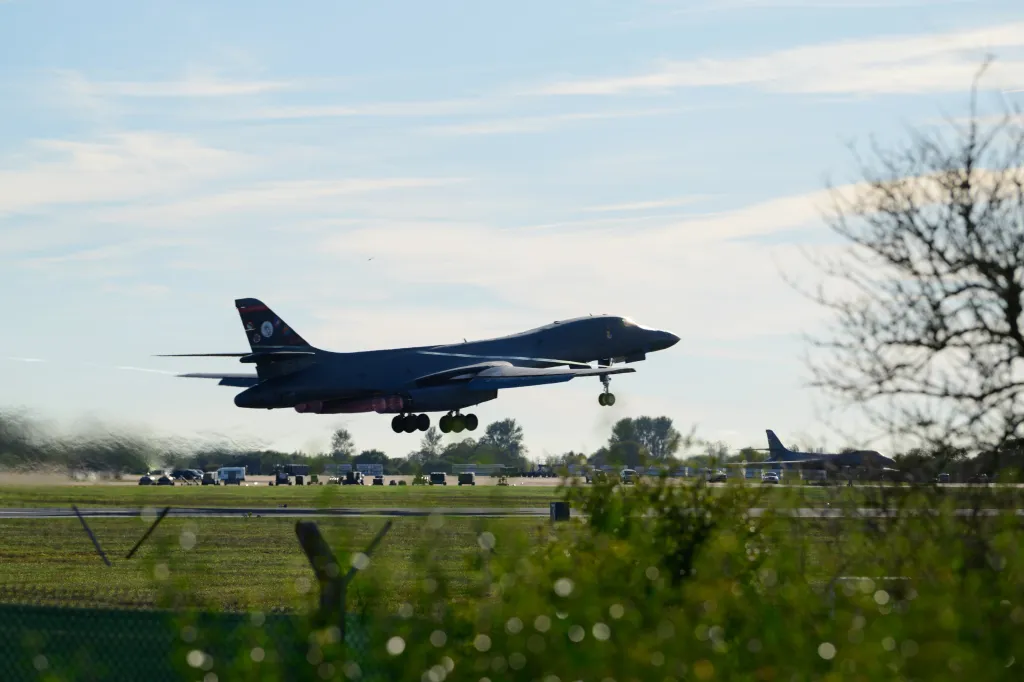
U.S. Air Force B-1B Lancer bombers that had been deployed to RAF Fairford in the U.K. since operation Epic Fury have returned to their home stations, a U.S. defense official confirmed to TWZ. The hasty movement was reportedly sparked by new Iranian threats against the base, although the Pentagon doesn’t confirm that assertion.
The sudden withdrawal came a week after a major incident was declared near Fairford following the arrest of five men on suspicion of driving bomb-laden vans toward it. They were later released on bail after no explosives were found. However, Counter-Terrorism police are continuing the investigation and said they were considering whether a foreign state had been involved. On Wednesday, British Prime Minister Andy Burnham said the incident might have had an Iranian link.
A U.S. Air Force B-1B Lancer heavy bomber takes off from runway 27 to depart for home at RAF Fairford on Oct. 4, 2026 in Fairford, United Kingdom. (Photo by David Bown/Getty Images) DAVIDBOWN
Bomber strikes launched from Fairford, which included ones executed by both B-1s and B-52s, were a central aspect of major U.S. combat operations against Iran earlier this year. In addition, the installation is a major hub for U.S. military aircraft in the United Kingdom. It is a regular host of strategic assets, including bombers and U-2 spy planes. It also acts as a pit stop for other aircraft, including fighters, that are being ferried to and from the United States.
The U.S. withdrew all 12 B-1s “after commanders received new threats about an Iran-backed plot against the installation,” The New York Times reported, citing two U.S. officials.
U.S. Air Force B-1 bombers depart RAF Fairford for home bases on Oct. 4, 2026. (Photo by David Bown/Getty Images) DAVIDBOWN
“The withdrawal was highly unusual: Such moves are rarely made so quickly from an allied air base in a peacetime country thousands of miles from a combat zone,” the publication added. “The need to move the bombers out of the base, R.A.F. Fairford, was deemed so urgent that some of the planes and their flight crews left while aerial refueling aircraft were still being scrambled to support their flights to the United States. At least three of the planes had landed at their home base in South Dakota by Sunday.”
U.S. officials declined to tell the Times the specific nature of the new information that prompted the Lancer withdrawal, some of which had just arrived in the past week as part of a normal rotation of forces to maintain the B-1 forward presence in Europe.
“One U.S. official said the new information was part of the same threat warnings that surfaced three weeks ago, but specific details and a sense of urgency spiked in the past 24 hours, alarming commanders,” the publication noted.
As we previously reported, Tehran directly threatened RAF Fairford in July over its use as a base to launch attacks against Iran.
“The American aggressor army, which used to launch cruise missiles from its vessels in the Indian Ocean in its aggression after the official resumption of the war, with the end of the missile reserves of the aforementioned vessels, yesterday switched to using B1 planes flying from Fairford Air Base, England,” Tasnim News Agency, a quasi-state outlet in Iran with ties to the country’s powerful Islamic Revolutionary Guard Corps (IRGC), claimed on Telegram on July 23. “As the officials of the Ministry of Foreign Affairs also stated, any base that is used to invade Iran’s territory is our legitimate goal.”
the enemy must pay the price for its breach of promises, and this time we will not allow America to use deceptive ceasefires to replenish its oil and ammunition stockpiles and then resume attacks once again.
Local aircraft spotters and aviation photographers began to notice the aircraft departing in large numbers earlier on Sunday.
The aircraft left in several waves, according to the DefenceGeek X account, run by the senior editor of the U.K. Defence Journal.
IN FULL: US Bomber Force Withdrawal from RAF Fairford #IranWar
OK so now we know the full scale of this withdrawal, here’s the details – 10 of the 12 B-1B “Lancer” bombers remaining at the base (including the aircraft that only arrived 6 days ago on a rotation) are heading… pic.twitter.com/LSBHuomAcz
B-1 MAYAN42 departing for home just now🇺🇸 it was with MAYAN41 86-0111 which only recently arrived at RAF Fairford suggesting not a rotation. That’s 10 today now. pic.twitter.com/sfvDjmgdgK
The defense official who confirmed the withdrawal said the aircraft movements won’t affect overall readiness.
“The Airmen that operate America’s bomber force, including B-1s, B-2s, and B-52s, remain ready to deliver precision global strike capabilities – including through operations that launch and recover from the continental United States – anywhere, anytime,” the official added.
When we asked the Pentagon about the retrograde movement of bombers from the U.K., they did not confirm the security issue that prompted it, stating:
“U.S. Air Force bombers routinely operate around the world to support global force readiness and operational requirements. While operational security precluded us from confirming the movement of our assets and forces in real-time, we can acknowledge now that all U.S. bombers that were deployed to RAF Fairford have re-deployed to their home stations in the United States. The Airmen that operate America’s bomber force, including B-1s, B-2s, and B-52s, remain ready to deliver precision global strike capabilities – including through operations that launch and recover from the continental United States – anywhere, anytime.”
Regardless, this is the first time in months that RAF Fairford has not hosted U.S. bombers.
A Russian agency links the lab worker’s death to ‘pneumonia of unknown’ origin.
Published On 5 Oct 20265 Oct 2026
An employee of a Russian anti-plague institute in the remote Siberian region of Irkutsk has reportedly died of a suspected pneumonic plague infection, according to a United States official.
“We are aware of reports of a fatal case of suspected pneumonic plague in Irkutsk Oblast, Russia. We are monitoring the situation closely with the CDC [Centers for Disease Control and Prevention] and our other interagency partners,” a State Department official told Al Jazeera
Recommended Stories
list of 3 itemsend of list
“Many details have not been confirmed. We encourage Russian authorities to share accurate information quickly and openly,” the official said.
Alexei Tsydenov, the governor of the Buryatia region, said in a post on his Telegram channel on October 3 that a woman in the neighbouring Irkutsk region had “died, maybe of the plague”.
Russia’s official TASS news agency reported on Sunday that the country’s consumer watchdog, Rospotrebnadzor, said in a statement that an employee of the Irkutsk Anti-Plague Research Institute of Siberia and the Far East had been diagnosed with “pneumonia of unknown aetiology”.
The watchdog also said it expanded testing of samples from the patient and found no microorganisms associated with her professional activities.
Pneumonic plague is caused by the bacterium Yersinia pestis, usually found in small mammals and their fleas. According to the World Health Organization (WHO), the plague is highly infectious and can be fatal if not treated early.
Local media named the woman who died as 28-year-old laboratory technician Darya Shipilova.
Media reports say that authorities in Siberia’s Irkutsk region have placed nearly 200 people under medical observation.
Debris found off Nantucket island after the air ambulance disappeared while flying from Bermuda to Boston.
Published On 5 Oct 20265 Oct 2026
The United States coastguard has suspended its search for six people on board a medical transport jet that crashed while flying from Bermuda to Boston.
“Suspending a search is not an easy decision,” Rear Admiral Matthew Lake, commander of the coastguard’s Northeast District, said in a statement on Sunday.
Recommended Stories
list of 2 itemsend of list
The search was called off after teams spent about 66 hours covering 4,445 miles (7,150km) by air and sea and confirmed that debris found off the shore of Massachusetts’s Nantucket Island came from the aircraft.
The Gulfstream G100 carried two pilots, two medical staff, a patient and a relative, Clarence Togeretz, director of flight operations at Canada-based Latitude Air Ambulance, told Canada’s public broadcaster CBC.
The four crew members were Canadian, and the two passengers were Bermudian, according to authorities.
In a statement on Sunday, Latitude Air Ambulance said, “Given the information shared by authorities and the conclusion of the search-and-rescue phase, we must now face the heartbreaking reality that the four members of our Latitude team, our patient and the patient’s family escort, who were aboard Heartbeat 104, are presumed to have died.”
Attention has turned to what happened in the jet’s final minutes, when flight-tracking data showed a steep descent and air traffic controllers struggled to re-establish contact.
Authorities have not determined what caused the aircraft to come down.
The aircraft had flown to Bermuda to collect the patient and was heading to Boston Logan International airport.
The US Federal Aviation Administration alerted the coastguard at about 2am on Saturday (06:00 GMT) after contact with the jet was lost.
Lake said at a Sunday news conference that the water around the debris was about 80 to 90 feet (24-27 metres) deep.
He offered condolences to the families of those on board and thanked the agencies involved in the operation.
Latitude Air Ambulance specialises in medical evacuation and repatriation flights, carrying patients home from other countries.
The company says its missions are normally staffed by two pilots and medical personnel.
Brazil’s closely watched presidential election is heading to a second round between leftist President Luiz Inacio Lula da Silva and right-wing Senator Flavio Bolsonaro, prolonging a deeply polarised race with major implications for the country and the wider region.
Brazil’s electoral court confirmed on Sunday that the two candidates will advance to a run-off on October 25 after neither won the majority needed to secure the presidency outright, with Bolsonaro leading at 55.8 million votes to Lula’s almost 53.2 million.
Recommended Stories
list of 4 itemsend of list
Lula, 80, is seeking a fourth, non-consecutive term after a political career spanning nearly five decades.
Bolsonaro, 45, is the eldest son of former President Jair Bolsonaro and is trying to return his father’s right-wing movement to power, even as the former president serves a 27-year prison sentence for plotting a coup after losing the 2022 election.
The election comes at a pivotal time for Latin America’s largest economy. Brazilians are grappling with concerns over crime and the cost of living, while the country faces an increasingly tense relationship with the United States. The vote is also being closely watched across a region that has shifted sharply to the right in a series of recent elections.
While a second round was widely expected, the first-round result did not play out quite as pollsters had predicted.
Here are some of the key takeaways from the election so far.
Brazil is heading for another Lula-Bolsonaro run-off
With nearly 99 percent of votes reported, Bolsonaro had about 47 percent of valid votes, compared with 44.9 percent for Lula. Neither reached the 50 percent threshold needed to win in the first round.
That sets up another Lula-Bolsonaro showdown, four years after Lula narrowly defeated former President Jair Bolsonaro. This time, he will face the former president’s eldest son.
The race could be extremely close, as polling ahead of Sunday’s vote suggested Lula and Flavio Bolsonaro were roughly tied in a potential run-off.
That puts voters who backed one of the other 10 candidates in the first round at the centre of the fight for the presidency over the next three weeks.
Ronaldo Caiado and Renan Santos, who together received about 5.3 million votes, have previously said they will not endorse either candidate in the run-off.
Flavio Bolsonaro did better than polls suggested
Most polls leading up to election day predicted the race would be pushed into the second round, but had Lula finishing the first round ahead of Bolsonaro.
Instead, Bolsonaro emerged with a lead of two percentage points, raising questions about why the final polls underestimated his support.
On Sunday, Bolsonaro said the results showed that Brazilians want change.
Analysts told the Reuters news agency that Bolsonaro may have benefitted from “protest votes” from people who may have preferred another candidate but saw defeating Lula as the priority. Many had been expected to shift their support to Bolsonaro only in a second round, meaning this could have consequences for his support in three weeks.
“The protest vote foreshadows what is to come in the run-off,” political analyst Rafael Favetti told Reuters. “While this should benefit Flavio Bolsonaro now, his growth potential in the second round drops precisely because that support has already been front-loaded.”
After the results came in, Lula said the votes were “unexpected” but that he would come back stronger in the run-off.
“I admit, I was convinced I would win in the first round. The game is about to start. We are in extra time. In extra time, we will win over the Brazilian people,” the 80-year-old said.
The right had a strong night in Congress, too
Bolsonaro’s surprising performance in the first round was part of a broader show of strength for Brazil’s right.
Right-wing parties, led by Bolsonaro’s Liberal Party (PL), were performing strongly in both houses of Congress, with the PL on track to emerge as the largest force in the Chamber of Deputies and making gains in the Senate.
This included victories for other members of the Bolsonaro family, including former First Lady Michelle Bolsonaro, Flavio’s stepmother, who won a Senate seat in the Federal District, her first elected office.
His brother, Carlos Bolsonaro, was elected to the Senate in Santa Catarina.
The results show that the political movement built around former President Jair Bolsonaro – known as “bolsonarista” – remains a powerful electoral force, even with the former president barred from running himself.
“The fact that far-right candidates for the legislature have exceeded all expectations suggests a deeper popular grounding for the bolsonarista project than many expected,” Andre Pagliarini, an assistant professor of history and international studies at Louisiana State University and author of a book on Lula, told Al Jazeera.
“Millions of Brazilians right now evidently feel the right best reflects their values and vision for the future,” he added.
The congressional results matter beyond election night, too. Both houses were already dominated by conservative lawmakers, and a stronger right-wing presence could make it even harder for Lula to push through his agenda if he wins another term.
A Bolsonaro victory, meanwhile, could give him more room to pursue his own priorities, including his pledge to seek an amnesty for his father.
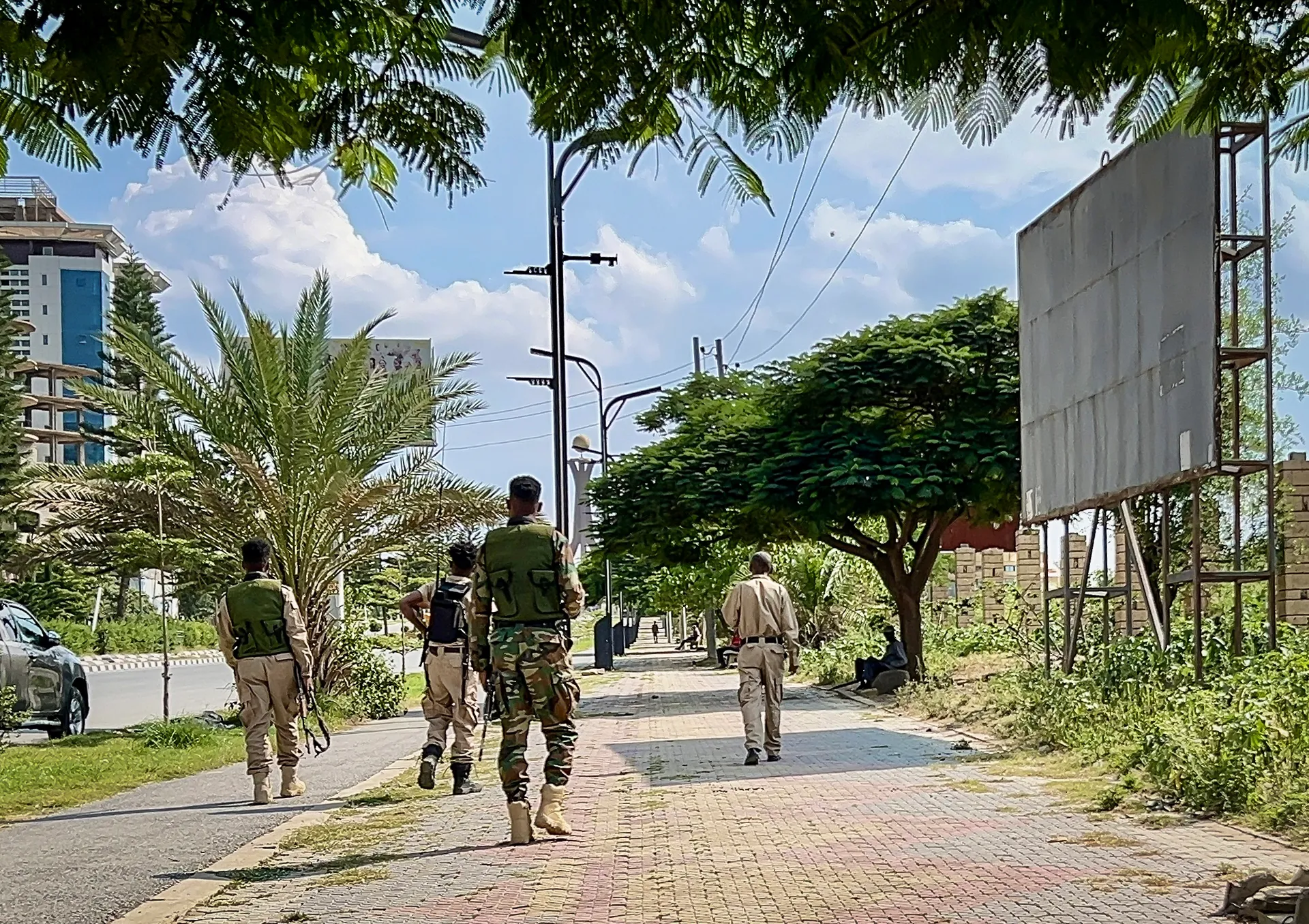
Addis Ababa, Ethiopia – The capture of Tigray’s regional capital Mekelle by Ethiopian federal forces and allied Tigray Peace Force fighters has revived painful memories of the 2020–22 Tigray war, with residents fearing a return to prolonged violence, displacement and economic hardship.
The Tigray People’s Liberation Front (TPLF) confirmed on Saturday that it had withdrawn from Mekelle, saying its regional administration would temporarily operate from another location. Government forces and allied fighters entered the city on Saturday, with a pro-government militia source, a humanitarian worker and a Mekelle resident confirming to the Reuters news agency on Sunday that they were in control of the city.
The development comes less than four years after the Ethiopian government and the TPLF signed the Pretoria agreement that ended two years of devastating fighting.
Berihu, a 32-year-old bajaj driver in Shire, northwestern Tigray, said the latest fighting had been particularly difficult to watch.
“I feel very heartbroken knowing that Tigray has gone back to full-scale war,” he said in a phone interview with Al Jazeera. “We have already seen what the last war did to our people, and now it feels like we are going through it all over again.”
The 2020–22 war killed hundreds of thousands of people, according to estimates, displaced millions and caused extensive damage to infrastructure and livelihoods.
The African Union-facilitated agreement, signed in Pretoria in November 2022, ended the large-scale fighting, but key issues, including the status of disputed territories, the return of displaced people and the disarmament of Tigrayan forces, remained unresolved.
In July, the TPLF said the Pretoria agreement had effectively collapsed, accusing the federal government of failing to implement key provisions. The federal government rejected that characterisation, saying it remained committed to the peace process while accusing the TPLF of undermining the agreement.
The political dispute was accompanied by growing military tensions, including reports of sporadic clashes and drone strikes in parts of Tigray. The two sides also traded accusations over troop movements and preparations for renewed fighting.
The capture of Mekelle marks a major development in the renewed conflict, putting the city once again at the centre of the fighting.
Fear spreads beyond Tigray
In Addis Ababa, the developments have also alarmed residents who remember the consequences of the previous war.
“I woke up and heard that my city had been hit,” he said. “You hear about fighting in Tigray, and it feels far away. But when you hear about explosions in Addis Ababa, you start asking yourself what will happen next.”
Diplomatic sources said explosions were heard in several parts of the capital, including near the headquarters of Ethiopia’s military. Reuters separately reported that a source linked to an opposition alliance claimed the group had carried out drone strikes in Addis Ababa, including against military facilities. The claim could not be independently verified.
For Abel, the economic consequences are as concerning as the fighting itself.
“If the war becomes bigger, ordinary people will suffer,” he said.
Bisrat, a college student in Addis Ababa, said the overnight explosions had reinforced his fear that Ethiopia could be entering a much wider conflict.
“If Ethiopia goes into a full-scale war, ordinary people will suffer,” he said. “I fear seeing another Sudan.”
Sudan has been engulfed in war since April 2023, when fighting broke out between the army and the paramilitary Rapid Support Forces, displacing millions and creating a major humanitarian crisis.
The current fighting also involves a wider set of actors than the Tigray war that ended in 2022. The TPLF is part of a broader opposition alliance that includes armed groups from several parts of the country.
Fighting has also spread into Afar, while relations between Ethiopia and Eritrea have sharply deteriorated.
Ethiopian officials have accused Eritrea of interfering in Ethiopia’s internal affairs and supporting forces opposed to the federal government. Eritrea has rejected the accusations.
On Thursday, Ethiopia’s Ministry of Foreign Affairs announced the closure of its embassy in Asmara and declared 10 Eritrean diplomats persona non grata, saying they had been involved in activities that posed a threat to Ethiopia’s national security.
Eritrea subsequently announced that it was severing diplomatic relations with Ethiopia.
The diplomatic rupture has added to concerns that the renewed fighting could acquire a wider regional dimension.
Mekelle changes hands again
In Mekelle, residents were left trying to understand what comes next after the TPLF withdrawal.
Goitom, 37, said there was a period of uncertainty after TPLF forces left the city, with what he described as a security vacuum allowing theft in some areas, including government offices.
“On Friday night, we were hearing gunfire but did not know what was happening,” he said.
By Saturday, Ethiopian federal forces and allied fighters had taken control of key locations, including the airport, according to Goitom. Reuters and The Associated Press news agency also reported that government-aligned forces had entered Mekelle following the TPLF withdrawal.
“It feels like we are back to square one,” he said. “We have already seen what war can do to this city and to our families. People are worried about what will happen next.”
The TPLF, however, portrayed the withdrawal as a tactical decision rather than an end to the fighting.
In a statement issued on Saturday, the group said it had “temporarily moved out of Mekelle” and that the regional government would “operate from somewhere else”. It said the decision was intended to prevent further destruction in the city and indicated that its forces would continue the conflict from other positions.
For the federal government, the capture of Mekelle represents a significant step towards restoring federal control over the region.
Abraham Belay, former president of the Tigray Interim Administration, said on Sunday that preparations were under way to establish a new interim administration in Tigray, with the aim of holding regional elections within months.
“We are working to establish a new administrative structure that will enable the people of Tigray to govern themselves,” Abraham said in an interview with Fana Broadcasting Corporate.
He said new administrative structures would be organised from the kebele level upwards, with community participation, before regional elections were held.
The competing accounts leave the next phase of the conflict uncertain. The federal government says it is seeking to restore its authority and establish a new regional administration, while the TPLF says its forces will continue fighting from elsewhere.
Civilian fears return to the fore
For people who lived through the previous war, the return of fighting has brought back fears of displacement, destruction and another prolonged humanitarian crisis.
Berihu, the bajaj driver, said he had seen villages bombed and civilians caught up in the fighting during the previous conflict, experiences that have shaped his fears about what could follow.
“It is painful to even think that civilians could once again bear the cost,” he said.
After years of displacement, loss and disruption, he said, many people in Tigray simply want the fighting to stop.
“We have already suffered enough,” Berihu said. “We just want peace. We don’t want to go through the same thing again.”
Venezuela’s electrical grid was hard hit by US sanctions. (Venezuelanalysis)
Friday morning. The electric fluctuations were so frequent that I decided to go to the gym and work out for a bit. Though I was tempted to get angry with my work being interrupted, I remembered that Caracas is a bubble when it comes to electricity. In other parts of the country, blackouts happen sometimes twice a day, sometimes lasting for 16 hours in total.
In their anguish, people have taken to the streets, burning tires and blocking highways. Without fans or air conditioning it is hard to survive the Super El Niño phenomenon, which recently joined our catalog of misfortunes by raising temperatures across the board. Children who can’t sleep at night end up falling asleep in school the next day.
Not only that, these blackouts and power surges damage appliances and put water pumping stations offline, leaving communities without water supply. What makes everything worse is that authorities do not publish rationing schedules, making it impossible for families and businesses to undertake any minimal planning.
To “explain” things, the acting Delcy Rodríguez government celebrated the fact that national electricity demand exceeded 16,424 megawatts (MW) on September 22, calling it a “historic milestone” and highlighting a 9% increase compared to the peak demand in 2025.
What officials failed to mention is that in 2013 Venezuela recorded a demand of 18,700 MW, far, far higher than the figure announced this month, without any blackouts.
Furthermore, the supposed economic improvement is that oil production rose to 1.23 million barrels per day, but it appears that the United States is the only one benefiting from the additional revenue. The vast majority of the Venezuelan population is seeing absolutely no economic benefit, neither before nor after the twin earthquakes. Between shady business deals and power outages, we are truly in the dark.
Meanwhile, Interior Minister Diosdado Cabello assured that he “wouldn’t sugarcoat things for the people” and admitted that the electricity crisis “is a serious problem.” However, his solution was to ask mayors and governors to request that private companies with power plants generate their own electricity. We will then surely see a “record high” diesel demand, which will leave the agricultural sector without fuel.
The truth is that the blackouts are causing massive paralysis, costing the industrial sector up to 44% of its productive hours. In a country that has advocated “economic diversification” for years, the little energy that is available is prioritized to keep oil production going in the oil-producing regions – lest Trump and the corporations get upset – and to try and mitigate the impact on the country’s capital.
What is rarely mentioned is that although Venezuela has a nominal installed capacity of approximately 35,000 MW, a figure that doubles the national peak demand, actual stable generation barely reaches 12,000 MW. This operational deficit is what causes the constant blackouts the population is currently enduring. The 1,300 MW that the authorities promise to bring back online in the coming months will only slightly alleviate the issue.
The deterioration of the National Electric System (SEN) is structural and affects both transmission and distribution. The transmission grid exceeds its technical safety limits almost daily by transmitting more power than allowed, causing voltage fluctuations. At the same time, the distribution system has been deteriorating for years. There is a shortage of basic spare parts, transformers, and distribution cables resulting from years of US sanctions.
To add to the paradox, what is the proposed solution? Privatization! At a time when service is at its worst, the National Assembly has preliminarily approved reform of the Organic Law of the National Electricity System and Service to open up generation, transmission, distribution, and commercialization to private operators. The incentive is a new tariff structure designed to reflect “the real costs” of the service and generate “reasonable returns” for investors.
Truth be told, if we were to pay “the real costs” of the current service, we would have to be compensated day after day. Perhaps people will go from having no electricity due to the condition of the power grid to having no electricity because they cannot afford the bill.
Even in a country where we’ve grown accustomed to hearing extravagant promises – ranging from millions of barrels of daily crude output to imminent economic prosperity – the outlook for electricity is far from encouraging. Preliminary assessments from experts suggest that a complete overhaul to prevent blackouts and modernize the grid in the medium and long term could cost up to $40 billion.
Maybe the US would be willing to “lend” us some of our own money to do this? Even if it did, we would obviously have to do it through US corporations, because if there’s one thing Washington knows how to do, it’s paying itself and keeping the change.
The best example is the recent oil deal, “the biggest in history” according to Trump. From what has been reported, Venezuela is going to hand over 17 prime oil fields, some producing extra-heavy crude in the vast Orinoco Belt and others producing light crude in Lake Maracaibo, to a company that seems straight out of a lazy Hollywood movie script.
The company in question is NABEP, owned by Alejandro Betancourt – who deserves a column all to himself – and which will now be under the control of the Pentagon. The US will have preferential access to the oil produced, including 20% at cost. The most screwed-over country in the hemisphere, handing over subsidized oil to the superpower that kept it under a vicious blockade for more than a decade.
Which brings us back to the electricity problem. From the oil deal to the state of the electrical grid, propagandists want us to believe that once the US is satisfied, once the transnational corporations and their local allies are making enough money, things will improve for the Venezuelan people. We have seen that movie before and it turns out differently. Let the last one out turn off the lights.
Jessica Dos Santos is a Venezuelan university professor, journalist and writer whose work has appeared in outlets such as RT, Épale CCS magazine and Investig’Action. She is the author of the book “Caracas en Alpargatas” (2018). She’s won the Aníbal Nazoa Journalism Prize in 2014 and received honorable mentions in the Simón Bolívar National Journalism prize in 2016 and 2018.
The views expressed in this article are the author’s own and do not necessarily reflect those of the Venezuelanalysis editorial staff.
Some countries, from which Brazilians living overseas are able to vote, have also already released preliminary vote count data.
In China, Lula won 56.63% of the votes, while Bolsonaro came in second with 31.33%. Lula also won in countries including South Korea, New Zealand and Saudi Arabia.
In Israel, however, Bolsonaro won 74.40% of the valid votes. He also won 71.59% of the valid votes in Japan.
Today’s result will also determine the composition of the Senate from February 2027 onwards, as 54 of the Senate’s 81 seats are being contested, representing two-thirds of the chamber.
Currently, the largest bloc in the Senate is Bolsonaro’s Liberal Party (PL), followed by the Social Democratic Party (PSD), which has served in a coalition government under Lula.
In the last election four years ago, Lula narrowly defeated Flávio Bolsonaro’s father, Jair. But the tumultuous aftermath of the election, which saw Jair Bolsonaro convicted of plotting a coup after thousands of his supporters stormed the Brazilian Congress, has had a lasting impact on the nation’s political life and this election.
Jair Bolsonaro is serving a 27-year sentence for plotting a coup and is barred from standing for office.
Because of recurrent health problems, he is currently under house arrest rather than in a cell, but he has been prohibited from posting on social media or making public statements.
Despite these restrictions, there is little doubt that Flávio Bolsonaro has his father’s backing.
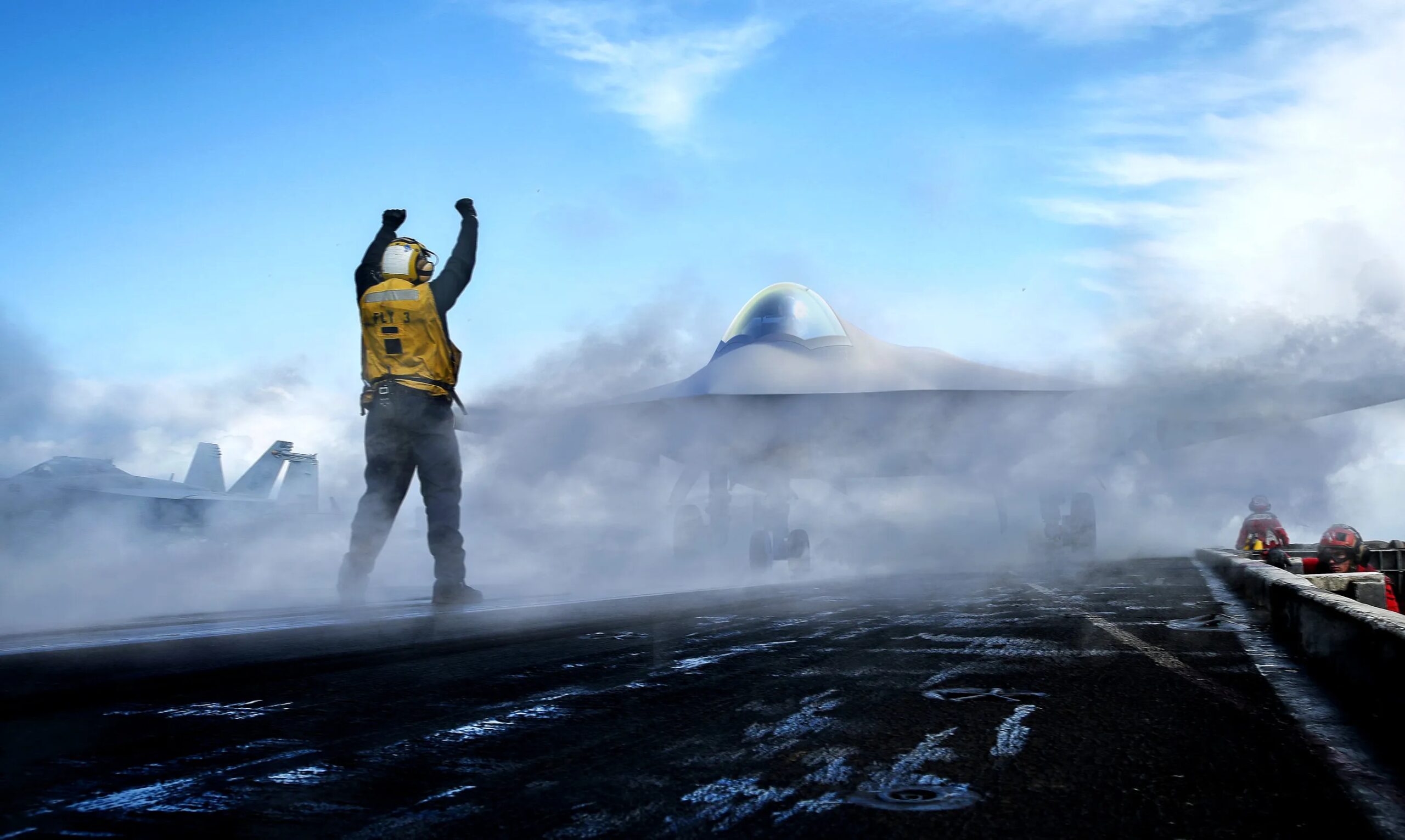
We have officially received our second rendering of Boeing’s F/A-XX concept, which has now officially won the tender, beating out Northrop Grumman to build the Navy’s next-generation stealth fighter. Let’s take a look at what we can see in this new image and discuss what insights it may provide.
Before we start, it’s worth reminding our readers that we are basing this analysis on two publicly released renders of a highly classified aircraft design. There are deliberate choices made in these renderings to obscure critical features and capabilities and mislead foreign intelligence as to the jet’s intended capabilities. So please keep in mind that the details are bound to change. This is also just a preliminary analysis. We will expand on it once we have more time to digest what we are seeing.
The front quarter view of the jet taxiing to a catapult aboard a carrier shows us a very broad, tailless, heavy tactical aircraft. This is a large jet. Clearly internal volume was a driving design factor, as it should be. You can read more about this in our past reporting here.
Boeing’s new F/A-XX render. Boeing
The aircraft is depicted with what appears to be a large single-piece canopy with a cockpit for just a pilot. Visibility to the rear looks limited at best. There has been much speculation about the possibility that F/A-XX will have the provisions for two crewmen in order to better take on its complex roles over long distances — in particular acting as a battle manager, including for Collaborative Combat Aircraft (CCA) and other drones. This appears not to be the case, and a high degree of automation and artificial intelligence (AI) will have to help with what will be extremely complex tactical problems the single pilot will face. It’s also worth noting that U.S. Navy carrier air wings have retained two-seat tactical jets for frontline use, with the F/A-18F Super Hornet and EA-18G Growler serving today. If F/A-XX replaces these aircraft, it will be the end of frontline two-seat tactical jet operations for the seagoing service.
Boeing’s only other F/A-XX render, released months ago. Boeing
We see a very broad nose section, which could (and likely would) contain a relatively giant active electronically scanned array (AESA) radar. There is also a prominent chine-line edge wrapping around the forward fuselage, which is a normal trait of low-observable (stealthy) aircraft. The nose looks a bit more contoured, similar to the only other rendering we have of Boeing’s F/A-XX, compared to the shovel-like design of the company’s F-47 for the U.S. Air Force. Below the rear of this visible chine-line appears to be the engine intakes, mounted on the sides of the lower fuselage. They look to be a blended trapezoidal arrangement and are also set far back from the nose.
The F/A-XX’s extremely stout landing gear are depicted prominently in this new image, with a twin-wheel nose gear and thick mains. These are customary features for a carrier-based fighter and especially a heavy one like this.
The USAF’s second rendering of Boeing’s F-47. Secretary of the Air Force Publi
The jet’s wings have a positive dihedral just like the F-47 renders, which seems to be something of a trademark of Boeing’s next-generation fighter design. This Klingon Bird of Prey look harkens back to the Boeing Bird of Prey demonstrator, which you can read more about here. We also see the wing’s large trailing edge flaps extended, which would be critical to slow-speed terminal operations around the carrier.
Finally, one thing we don’t see clearly is of particular note: the canard foreplanes that have been featured in F-47 imagery, as well as hinted at in Boeing’s only other F/A-XX rendering. It isn’t clear if they may be blended with the fuselage above the inlet areas and are obscured by the steam, or if they simply do not exist in this rendering. The inclusion of canards has been one of the most debated aspects of the F-47 and Boeing’s F/A-XX design, although they seem to make more sense for a naval fighter considering the tailless jet’s low-speed requirements that are needed to fly off the carrier. Again, you can read our past feature about the canards and our follow-up here and here.
The USAF’s first rendering of the Boeing F-47.
While the aircraft clearly shares distinct attributes with the F-47, it isn’t clear exactly how far the commonality between them goes. We could end up with a literal navalized F-47, which would leverage as much efficiency as possible between the two designs, or we could see major design elements and even proportional changes. The requirements imposed by carrier operations do dictate size and weight, to a certain degree. What lives beneath the jet’s skin – hardware and software – will have the most commonality regardless.
There is also the question of the aircraft caught on a thermal imager flying outside of Area 51, which was likely a Next Generation Air Dominance (NGAD) demonstrator from Boeing, or at least an aircraft related to those efforts based on how unique Boeing’s design clearly is. It’s always possible that the Navy flew its own NGAD demonstration program. The service has been notoriously tight-lipped about its NGAD risk reduction efforts.
The matter of the F/A-XX aircraft’s formal designation is also a question that remains unanswered. If this is a navalized F-47, then F/A-47 could be the jet’s official designation. If it differs substantially, or the Navy just wants to differentiate their design for whatever reason, we could see a different moniker applied. F/A-45 is possible, too, considering the F-47 was partially named in honor of President Trump, who approved the decision to move the Air Force’s program forward. Trump is the 45th and 47th President of the United States.
So, even on this day of long-awaited F/A-XX revelations, it’s also a reminder of just how much we do not know about both the Navy and the Air Force’s NGAD enterprises and their resulting designs, both of which will now be officially brought to you by Boeing.
Ireland players again wore black armbands in recognition of Palestinians killed in Gaza and bowed their heads during the Israeli national anthem before the teams’ second UEFA Nations League football match on Sunday.
The League 3 Group B match ended in a 1-1 draw and, despite being played behind closed doors and on neutral ground, was once again played out in a confrontational manner.
Recommended Stories
list of 4 itemsend of list
Ireland goalkeeper Caoimhin Kelleher stepped in as captain for Dara O’Shea, who was excused to be with his wife for the birth of their child, and pointedly avoided shaking hands with Israel captain Dor Peretz, despite completing the usual pre-match formality with the referee and one of his assistants.
Kelleher’s action was a repeat of O’Shea’s, who refused to shake Israel captain Manor Solomon’s hand before the first match in Debrecen, Hungary, last week. Ireland went on to win that game 3-0 through three first-half goals.
Solomon was dropped to the bench for Sunday’s match in Backa Topola, Serbia. Israel forward Sayed Abu Farchi was back in the squad after serving a suspension for getting sent off following his gun-simulation goal celebration during Israel’s 3-1 defeat to Austria on September 25.
Finn Azaz, whose mother has Israeli heritage, was among the Irish substitutes after playing from the start against Austria on Thursday.
Troy Parrott’s penalty in the 39th minute, after a foul by Peretz on Jimmy Dunne, gave Ireland a 1-0 halftime lead. A disagreement also broke out on the sidelines as the players made their way off the field for the interval, although the referee quickly intervened.
Peretz secured a point for Israel with a poked effort from close range in the 47th minute.
Sunday’s game was initially supposed to be played in Dublin, but the Football Association of Ireland (FAI) moved it to a neutral venue for “operational reasons” in June following widespread calls for a boycott in protest of Israel’s genocidal war on Gaza. The FAI said the game would be played with no fans present.
It followed the FAI’s motion the previous November calling on UEFA to ban Israel from club and international competitions.
All the Irish players had been under pressure from home – where affinity with Palestinians is strong – to boycott the second match against Israel, though the pressure was greater during the first game.
“I felt that pressure growing day by day, and it’s getting almost to a breaking limit now,” Ireland coach Heimir Hallgrimsson said at the time.
Ultimately, only reserve goalkeeper Gavin Bazunu decided to skip both of the contentious games, saying in a statement that it was his “personal belief that the killing of innocent people is wrong”.
More than 160 Irish sportspeople had signed an open letter urging the FAI to reconsider its decision to go ahead with the two games.
Before the departure for Hungary, people protested outside the team hotel in Dublin for the players to boycott the matches. The SIPTU trade union displayed a huge poster in central Dublin beside the River Liffey asking the players to “Go with your conscience!” and “Don’t play with genocide” beside an image of a blood-splattered ball.
Former Ireland coach Brian Kerr said the FAI had “lost the respect of the Irish people” for going ahead with the games.
But the FAI argued UEFA could sanction the team. Ireland is cohosting the 2028 European Championship with England, Wales and Scotland.
Protesters threw tennis balls with Palestinian flags onto the field during Ireland’s 2-2 draw with Austria on Thursday. A man with a Palestinian flag also tried running onto the field.
On Saturday, an Israeli journalist stated during the pre-match news conference that the Irish players had called the Israeli players “monkeys” during last week’s game, leading to an immediate rebuke from Irish communications officer Kieran Crowley, who said it was “a lie” and ended the news conference.
The players had only decided to go ahead with the fixtures after a dramatic day in Debrecen before the first match, when both the news conference and training were delayed for hours while they deliberated. They reportedly voted 14-8 in favour of continuing after Bazunu’s withdrawal that morning.
Ireland’s national broadcaster RTÉ was only providing stripped-back coverage of both games against Israel to meet contractual obligations. There was no studio presentation, commentary on the international feed, or analysis. RTÉ said it was not accepting advertising or sponsorship around either game.
RTÉ also recently announced that Ireland will boycott the Eurovision Song Contest for a second year due to Israel’s participation.
The U.S. government set off conventional explosives inside a tunnel deep in the Nevada desert this week in a test designed to replicate a so-called “decoupled” nuclear detonation. Data collected is now being used to help improve methods for detecting this kind of nuclear testing. Just earlier this year, American authorities accused China of using decoupling to conceal new nuclear tests despite the country’s stated moratorium on such activities.
The test, which involved the use of chemical high-explosives and radiotracers, was conducted yesterday inside P Tunnel in Area 12 of the Nevada National Security Site (NNSA), according to a press release from the National Nuclear Security Administration (NNSA). The NNSS, which is situated within the boundaries of the U.S. Air Force’s Nevada Test and Training Range (NTTR), is used for a wide variety of testing purposes today. An agency under the Department of Energy, NNSA’s main jobs are to oversee the development and production of nuclear weapons, as well as manage America’s nuclear deterrent stockpile.
A map giving the general sense of the location of the NNSS with the NTTR. Center for Radiological Nuclear TrainingAnother map showing the specific testing areas within the NNSS. Area 12 is at the northern end of the complex. United States Geological Survey
“This experiment is especially focused on further enhancing the U.S. capabilities to detect a ‘decoupled’ explosion,” per NNSA’s release. “Data collected from the experiment will be used to validate scientific models and refine algorithms that are critical to U.S. nuclear explosion detection efforts.”
“Just as a stealth aircraft looks smaller on radar, decoupling can greatly muffle the signals detected by nuclear detection sensors, making a large explosion appear smaller,” the release explains. “In a conventional, or ‘coupled,’ underground nuclear test, a device is placed deep in a hole in close contact with the rock, allowing much of the explosion’s shockwave to reach sensors. In a decoupled test, by contrast, the device is detonated inside a large underground chamber, substantially reducing the explosion’s seismic signature.”
“In this experiment, researchers gathered measurements using a broad suite of advanced sensors, including accelerometers, seismometers, infrasound sensors, electromagnetic sensors, chemical and radiotracer samplers, and meteorological sensors,” it adds. ”Together, these measurements will improve scientists’ understanding of the signatures produced by underground explosions and strengthen the United States’ ability to detect and characterize nuclear explosive events.”
Overview of the NNSS
The U.S. already maintains a U.S. Atomic Energy Detection Systems (USAEDS) network, which is overseen by the U.S. Air Force Technical Applications Center (AFTAC). USAEDS is made up of more than 3,600 sensors positioned around the world. USAEDS is also tied in with the International Monitoring System (IMS), which is managed by the organization responsible for overseeing the Comprehensive Nuclear-Test-Ban Treaty (CTBT). AFTAC also supports the mission to monitor for potential nuclear testing globally using a fleet of specially configured WC-135R Constant Phoenix aircraft. In addition, those planes are used to help keep watch for unusual spikes in atmospheric radiation that could point to nuclear or radiological accidents or other incidents leading to the spread of potentially dangerous radioactive material.
Video 1: How CTBTO’s International Monitoring System works (subtitles)
With regard to the USAEDS network specifically, “once a disturbance is detected underground, underwater, in the atmosphere or in space, the event is analyzed for nuclear identification, and the findings are reported to command authorities,” according to AFTAC’s website.
As mentioned, the U.S. government has accused its Chinese counterparts of using decoupling to conceal new nuclear testing, and NNSA’s press release draws explicit attention to these allegations. At the annual Conference on Disarmament in Geneva, Switzerland, in February, Thomas DiNanno, Under Secretary of State for Arms Control and International Security, said that China had conducted at least one such test at Lop Nur on June 22, 2020. The Comprehensive Nuclear-Test-Ban Treaty Organization (CTBTO) subsequently said the IMS had not detected an event matching that description at that location on that date. For its part, the Chinese government has denied the accusation.
The social media posts below include satellite imagery showing activity at Lop Nur that could point to new nuclear testing activities in recent years.
参考 Satellite Imagery Analysis of China’s Alleged 2020 Nuclear Test at Lop Nurhttps://t.co/aafvU5Szh7 CSIS 20260213 ROLES SAT ANALYSIS No.7 中国に核実験実施の動き ー Lop Nur核実験場の画像分析 ーhttps://t.co/n66yYk0hLg ROLES 20250522
While China is a signatory to the CTBT, the country has never ratified it. The Chinese government last acknowledged a critical-level nuclear test in 1996, after which a self-imposed moratorium was put in place, at least publicly. As an aside, the United States has also signed, but never ratified, the CTBT, and has a similar self-imposed moratorium on nuclear testing since 1992. It is worth noting that the treaty does not ban so-called sub-critical testing, which involves fissile material, but does not result in a full-fledged nuclear reaction.
Last week, The Wall Street Journal reported that the Trump administration has been holding new talks with the Chinese government regarding various aspects of the country’s massively and rapidly expanding nuclear arsenal, including the testing allegations. That story immediately preceded a state visit by China’s President Xi Jinping to Washington, D.C., to meet with Trump.
President Donald Trump (at left) and President Xi Jinping (at right) walk together at the White House last week. White House/Joyce N. Boghosian
“The discussions between American and Chinese officials have centered on measures to reduce nuclear risks and haven’t been aimed at negotiating a formal arms-control pact, an effort Beijing has sharply rebuffed in the past,” according to that report. “The Trump administration has begun to highlight the possibility of implementing new verification measures.”
“Independent experts say seismic instruments might be placed on or near test sites,” The Journal‘s story also noted. “Another possibility, which was floated during the Biden administration, is to install radiation-detection equipment at test sites.”
NNSA’s announcement about the test at the Nevada National Security Site is certainly an example of the development underway already of new means of verification that could be deployed at sites around the world.
The Russian government has said it is ready to conduct new nuclear tests if the United States pursues this course of action. The last official nuclear test in Russia came in 1990 right before the fall of the Soviet Union.
“It takes nuclear expertise to detect nuclear activities and experiments like these [to] ensure America remains unmatched in detection,” NNSA Administrator Brandon Williams said in a statement yesterday in light of the test in Nevada. “The Trump Administration has made it clear that the United States will lead from a position of strength. You cannot evade American innovation. With this experiment, we are sending a clear message: under this administration, America will never be outmatched.”
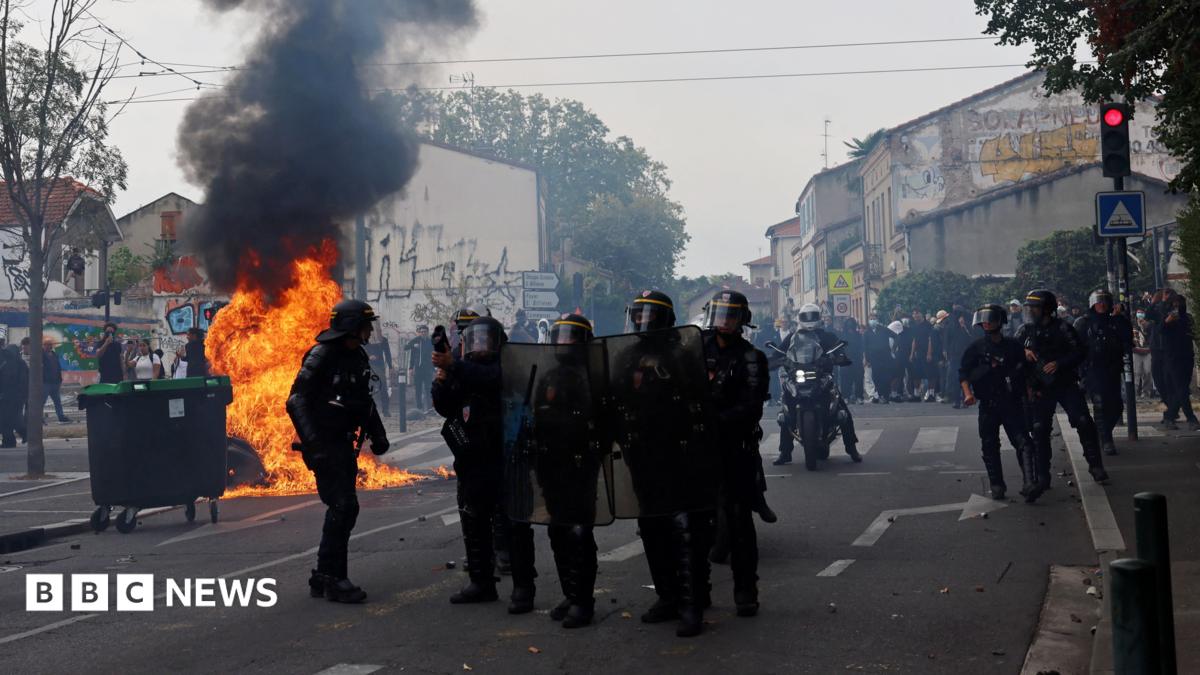
Up to 500 schools across France will be partially or totally closed on Monday after clashes between riot police and student protesters in recent days, the French education minister said on Sunday.
Lessons will be “totally or partly suspended” in some “400 to 500” high schools as security conditions “have not been fulfilled”, Édouard Geffray said.
He also said 24 schools had been “burned or ransacked” since the start of the protests.
Thousands of students have been demonstrating over education standards and the protests, which started last week, have spread from Paris to other cities, including Montpellier, Nantes and Marseille.
High school pupils and others have objected to a lack of teachers, overcrowded classrooms and run-down buildings.
On Friday, French Justice Minister Gérald Darmanin said 735 of France’s 3,700 schools had been affected “one way or another” by violent protests.
The education minister warned the number of schools potentially affected on Monday could be comparable to Friday’s figure but promised a “partial, progressive return to lessons”.
“There are activists – particularly from the far-left – who have infiltrated the high school student movement, hijacked it from the students themselves, and engaged in extreme violence,” Édouard Geffray claimed.
“Clearly, this poses a risk to both our staff and our students,” he said. Geffray added that 78 staff members in education had been wounded, which he described as “something we have never seen before”.
On Friday 1,747 people were arrested, according to French Interior Minister Laurent Nuñez.
German Chancellor Friedrich Merz, on a surprise visit to Kyiv, announced $1.5 billion in military and reconstruction aid and expanded drone cooperation with Ukraine, giving Kyiv greater capability to strike deeper inside Russia. He also urged Russian President Vladimir Putin to end the war.
Trilateral talks could happen this month in UAE or another US-proposed venue, says the president.
Published On 4 Oct 20264 Oct 2026
Ukraine is ready to hold trilateral talks with the United States and Russia this month, President Volodymyr Zelenskyy has said.
The Ukrainian president made the comments on Sunday during a news conference alongside German Chancellor Friedrich Merz in Kyiv. He said Ukraine supports a swift timeline for returning to talks to try to end the war fought for over four and a half years.
Recommended Stories
list of 3 itemsend of list
US efforts to broker a ceasefire have been paused since Washington launched its war on Iran. However, Washington is now pushing for technical-level talks by the end of October, Zelenskyy said.
He confirmed earlier reports that the United Arab Emirates, which has hosted previous talks, could again be the setting for a meeting.
“I confirmed to [the US] that our side is ready to support this timeline,” Zelenskyy said, adding that Kyiv is open to meeting in the UAE or “another country proposed by the American side”.
Washington had also been in touch with Moscow about the plan, Zelenskyy said. The Kremlin said last month that it did not rule out the possibility of three-way talks this month.
Despite suggestions of their willingness to discuss an end to the conflict, both Russia and Ukraine have also said they will ramp up long-range attacks on military and related targets.
Moscow has said it is targeting Ukraine’s energy sector as winter approaches. Last year, similar attacks knocked out power and heating for days on end as temperatures plummeted to minus 20C.
Zelenskyy on Sunday said he was “amazed” by Russia’s “savage desire to escalate the situation every day”.
He yet again accused Moscow of targeting “civilian infrastructure, including data centres and mobile network facilities”.
“Honestly speaking, I am not surprised by this approach to the war – by Russia’s hatred towards Ukraine – but I am surprised by the specific tactics used”, the Ukrainian leader said.
Alongside the return of the US to efforts to broker a ceasefire, India on Sunday said that it aims to step up its efforts to play a larger role in mediating an end to the conflict.
Speaking at the Munich Security Conference in New Delhi, Foreign Minister Subrahmanyam Jaishankar said his country had become more involved in recent months, specifically regarding shipping in the Black Sea, which has been plagued by mines and attacks on commercial vessels.
India was also “going beyond that,” said Jaishankar, including with discussions on grain and energy exports and “on non-attack possibilities,” he said.
After nearly seven years of waiting, Taiwan has received the first two aircraft from its long-delayed purchase of 66 new-build F-16C/D Block 70 fighters from the United States.
The two single-seat F-16Cs, serials 6727 and 6728, touched down at Chihhang Air Base near Taitung on October 2. They are the first factory-new fighter aircraft delivered to Taiwan in 25 years and mark the beginning of the aircraft acceptance and integration phase of the Republic of China Air Force’s (ROCAF) so-called Peace Phoenix Soaring project.
2架F-16V戰機飛抵台東|中央社即時影音
The two jets have also had an unusually eventful trip to Taiwan.
They began their journey to the island on August 17, flying from Lockheed Martin’s production facility in Greenville, South Carolina, to Hawaii. The aircraft were subsequently forced to remain there for more than a month after an unexpected issue prevented them from continuing across the Pacific as planned. The reasons for the delay have been the subject of considerable speculation, including weather and tanker availability.
ROCAF F-16C Block 70 serial 6727 arrive in Taitung. Peter Ho, Formosa Aviation & Military Image Press
The two jets finally departed Hawaii again on October 1, stopping in Guam before making the final leg to Taitung today.
Taiwanese Defense Minister Wellington Koo said today that more of the aircraft will arrive before the end of the year, although he did not provide a specific number.
Taiwan receives first 2 F-16V Block 70 fighter jets
Taiwan took delivery Friday of the first two of 66 F-16V Block 70 fighter jets purchased from the United States, with the aircraft landing at Chihhang Air Base in the eastern county of Taitung at around noon. pic.twitter.com/hbqdV6io26
— Focus Taiwan (CNA English News) (@Focus_Taiwan) October 2, 2026
The 66-aircraft purchase is worth approximately $8 billion. Taiwan originally expected deliveries to begin much sooner, but production-line adjustments, supply-chain problems, and software issues contributed to delays. COVID, too, had an impact on the production line.
The program’s delivery schedule has slipped repeatedly. Defense Minister Koo said in March, May, and again through his deputy in June that the first aircraft were expected to arrive by the end of September. That deadline passed without an F-16 reaching Taiwan.
ROCAF F-16C Block 70 serial 6727 touches down earlier today. Peter Ho, Formosa Aviation & Military Image Press
Taiwan’s Ministry of National Defense acknowledged in late September that development and production of the aircraft’s new electronic warfare self-protection system had also been a factor.
The Block 70s are being equipped with L3Harris’ AN/ALQ-254(V)1 Viper Shield electronic warfare suite, and the system was not yet fully through its development and production process when the first aircraft were otherwise ready for delivery. L3Harris announced on September 3 that it had completed production of the first 35 Viper Shield systems, underscoring that the electronic warfare equipment was itself still moving into production as Taiwan’s fighters were approaching delivery.
Viper Shield Electronic Warfare System
Taiwan chose to acquire the AN/ALQ-254 rather than the AN/ALQ-257 electronic warfare system used on U.S. Air Force F-16s.
Lawmakers have questioned whether the system meets requirements associated with earlier work to modernize earlier F-16A/B Block 20 fighters to the F-16V standard. Meanwhile, Defense Minister Koo argued that those requirements applied to the earlier Block 20 upgrade rather than the new Block 70 purchase. Other international F-16 Block 70 operators are also using Viper Shield.
Taiwanese officials have defended the decision, citing the specific requirements of Taiwan’s F-16 fleet and associated procurement considerations. The system is intended to provide the new fighters with a modern electronic warfare and self-protection capability against increasingly sophisticated radar and missile threats.
There are also still questions about when the Viper Shield system itself will be fully ready.
ROCAF F-16C Block 70 serial 6727. Peter Ho, Formosa Aviation & Military Image Press
Weapons deliveries have also not kept pace with the aircraft themselves.
Taiwan is receiving AIM-120C-8 AMRAAM air-to-air missiles as part of the F-16 package, with 200 ordered. The C-8 version incorporates upgrades from the U.S. Air Force’s Form, Fit, Function Refresh (F3R) effort, including new electronics and improved electronic-counter-countermeasures intended to make the missile more capable in a heavily contested electromagnetic environment. For Taiwan, the missile will provide the new F-16s with a modern beyond-visual-range air-to-air weapon that can be cued by the aircraft’s AN/APG-83 Scalable Agile Beam Radar (SABR), as well as other sources of targeting information through the F-16’s networked systems.
An AIM-120 AMRAAM is prepared to be loaded onto an F-16V at Chiayi Air Base, in Chiayi on January 28, 2026. Photo by I-Hwa Cheng / AFP
The AIM-120C-8 is particularly relevant as Taiwan fields more F-16s against China’s increasingly capable fighter fleet, which includes aircraft equipped with long-range air-to-air missiles such as the PL-15.
Taiwan’s F-16 Block 70s will also be armed with the AGM-88 High-speed Anti-Radiation Missile (HARM), intended for attacks against enemy air defense systems. According to Roy Choo, a defense journalist and TWZ contributor, the first of the new AGM-88F (remanufactured from U.S. Air Force AGM-88B) missiles arrived in Taiwan back in 2022, for the F-16V fleet.
The major gap is the AGM-154C Joint Standoff Weapon (JSOW). The precision glide weapon is intended to give Taiwan a longer-range strike capability against ground targets without requiring the launching aircraft to fly directly over heavily defended areas. According to the latest reporting from Taiwan, deliveries of the AGM-154C have been held up by delays on the U.S. production line and may not begin until 2027 or 2028 at the earliest. Existing stocks of these weapons were also heavily used in Operation Epic Fury.
The two aircraft now sitting at Chihhang are significant for another reason. Unlike Taiwan’s existing F-16V fleet, they are new-production aircraft rather than older fighters that have been upgraded.
Taiwan received 141 F-16A/B Block 20s that were upgraded to the F-16V configuration under a separate modernization program completed in 2023. The new Block 70s incorporate many of the same technologies — including the APG-83 — but are built from the ground up as new aircraft.
A Taiwan Air Force F-16V taxis out during a spring military exercise at Chiayi Air Base, in Chiayi on January 28, 2026. Photo by I-Hwa Cheng / AFP
The Block 70s will also bring a significant new passive-sensing capability to Taiwan’s F-16 fleet. Under a $328.5-million U.S. Foreign Military Sales contract awarded to Lockheed Martin in February, Taiwan is receiving the company’s IRST21 Legion-ES infrared search and track system. Designed specifically for the F-16, the long-wave infrared sensor can passively detect and track airborne targets without emitting radar energy. That gives the aircraft another way to search for and track threats while reducing its own electromagnetic signature. The IRST21 also gives the F-16s a passive way to detect and track low-observable targets, potentially providing another means of finding Chinese stealth aircraft without relying solely on radar.
In 2019, Lockheed Martin displayed a model of a Block 70 F-16 with what appeared to be a podded IRST system on one of its chin stations at the biennial Taipei Aerospace & Defense Technology Exhibition in Taiwan:
The new fighters will therefore complement Taiwan’s upgraded F-16A/Bs while expanding the overall number of modern F-16s available to the ROCAF.
The timing matters.
People’s Liberation Army (PLA) aircraft operate around Taiwan on an increasingly routine basis, forcing the ROCAF to maintain a persistent air-defense posture. The additional F-16s will provide more aircraft for missions ranging from air defense and counter-air operations to maritime strike.
Ground crew prepare to load AGM-84 Harpoon anti-ship missiles in front of an F-16V during a drill at Hualien Air Force base on August 17, 2022. Photo by SAM YEH/AFP via Getty Images
The F-16V fleet is also being tested for a more specialized intelligence, surveillance, and reconnaissance role. The ROCAF has recently been conducting flight and systems integration testing of the MS-110 advanced reconnaissance pod, part of its Phoenix Scout project. The service plans to acquire six pods to replace older reconnaissance equipment. Based on the DB-110 digital sensor architecture, the system combines visible-light and infrared imaging with long-range, day-and-night reconnaissance, and real-time image transmission, allowing imagery to be passed more rapidly to ground command and intelligence elements. Integrating the pod with the F-16 and associated ground systems will give Taiwan another means of monitoring activity around the island and its surrounding waters.
A ROCAF F-16V carrying an MS-110 reconnaissance pod. Peter Ho, Formosa Aviation & Military Image Press
But Taiwan remains heavily outnumbered across the Taiwan Strait.
A J-20 fighter during the Changchun Air Show on September 22, 2025 in Changchun, Jilin Province of China. Photo by Zhang Xiangyi/China News Service/VCG via Getty Images
And the F-16s will face the same fundamental problem as Taiwan’s other combat aircraft in a major conflict: staying operational.
China possesses extensive missile and air capabilities that could threaten Taiwan’s airbases, aircraft shelters, fuel supplies, command-and-control infrastructure, and other elements needed to keep fighters flying. You can read more about how the ROCAF would likely go to war with China in this previous in-depth feature.
Basing the new F-16s at Chihhang Air Base, operated by the 7th Tactical Fighter Wing, is significant, Choo told us.
“The basing of the aircraft at Chihhang allows the ROCAF to readily project air power south and eastwards, especially over the Bashi Channel, which is one avenue PLA can gain access to the Philippine Sea and beyond,” he explained. “Previously, ROCAF fighters from other bases maintain QRA detachments there”
A new F-16C Block 70 lands at Chihhang Air Base in Taitung on October 2, 2026. Photo by CHENG Yu-chen / AFP
The F-16 delivery today is only the beginning of a much larger effort to get all 66 aircraft into Taiwanese service.
According to the latest information from the ROCAF, 63 F-16C/D Block 70s remain in various stages of production and delivery in the United States, with some already moving through the handover process. The remaining aircraft will be delivered according to production, flight-test, and acceptance milestones before being ferried to Taiwan.
Once the full order is delivered, Taiwan will operate more than 200 F-16s when the new Block 70s are combined with its existing fleet.
That will give the ROCAF a considerably larger force of modern F-16s, with substantial commonality between the upgraded F-16V fleet and the new-production Block 70s.
The aircraft will still need to go through Taiwan’s acceptance procedures, while pilots and maintenance personnel complete the necessary conversion and training work. The new jets will then be progressively incorporated into the ROCAF’s operational units.
Remarkably, the arrival of the first Block 70 fighters today marks the first delivery of new fighters to Taiwan since 2001, when the last of the 150 F-16A/B Block 20s were delivered.
“The ROCAF’s surviving fleet of 139 F-16s, 53 Mirage 2000s, and 129 F-CK-1s was largely inducted in the 1990s, when Taiwan held the upper hand in the cross-Strait air-power balance,” Choo explained. “Even then, there remained a requirement for additional fighters, prompting the island’s first formal request to purchase 66 F-16C/Ds during the 2006 Monterey Talks.”
F-CK-1s taxi for takeoff during a scramble as part of a combat readiness exercise at Ching Chuan Kang Air Base in Taichung on January 7, 2025. Photo by I-HWA CHENG / AFP
“By the late 2000s, these fighters were approaching the limits of their combat effectiveness as the PLA air fleet expanded in both size and capability. Fortunately, substantial upgrades began to be rolled out to the F-CK-1s and F-16s from the 2010s.”
In the wake of the 2019 acquisition of the F-16C/D Block 70s, questions arose over the aircraft’s asymmetric value as the Taiwan military increasingly focused on developing a plan for asymmetric capabilities in response to the PLA’s growing combat power.
“However, developments in recent years have underscored the continued importance of a capable fighter fleet not least for policing Taiwan’s airspace amid the PLA’s sustained gray-zone air operations around the island,” Choo added.
ROCAF F-16C Block 70 serial 6728. Peter Ho, Formosa Aviation & Military Image Press
The timing of today’s arrival is also notable.
The aircraft reached Taiwan just days after U.S. President Donald Trump met Chinese President Xi Jinping in Washington. The delivery comes amid questions in Taipei about the future pace of U.S. arms transfers, after Trump said in May that a proposed $14-billion Taiwan arms package was being held in abeyance. He had approved an $11-billion package in December 2025.
Washington continues to say that its policy toward Taiwan has not changed.
Beijing, for its part, continues to oppose U.S. arms sales to Taiwan and regards the island as part of Chinese territory.
It has taken nearly seven years to get the first two F-16C/D Block 70s, to Taiwan. But their arrival marks the first step in a major modernization of the ROCAF’s F-16 fleet, adding new-production fighters with improved radar, electronic warfare, sensors, and weapons to a force that is already operating upgraded F-16Vs.
As Israel prepares to mark three years since the October 7 attacks and with less than a month to go to parliamentary elections, one topic is dominating the electoral agenda.
Media reports that Prime Minister Benjamin Netanyahu was warned by the United Arab Emirates before the attacks have put his alleged responsibility back in the spotlight.
“Did he know?” is the question on everyone’s lips.
Listening to the accusatory choir, one might think that Israeli society finally is acknowledging the real meaning of October 7. Yet the opposite is true.
Instead of giving a platform to a reckoning, the elections function to scapegoat Netanyahu for his alleged role in facilitating Hamas’s attack while absolving Israeli society and the Zionist movement of its collective responsibility for the preceding violence and ensuing genocidal aggression.
For example, it does not insist on investigating whether the “Hannibal Directive” was deployed as part of the Israeli military response on October 7 and whether it killed Israeli citizens and how many.
It does not scrutinise subsequent Israeli military operations or whether they put the Israeli hostages in danger or how many were killed by Israeli bombs.
There is no questioning of why key Palestinian negotiators were attacked during ceasefire and hostage negotiations, including Ismail Haniyeh, Hamas’s chief negotiator, in July 2024 in Tehran and Hamas’s negotiating delegation in September 2025 in Doha.
There is no debate about why the Israeli government repeatedly rejected ceasefire proposals that could have brought the hostages back much earlier.
There is little attention paid to the fact that Netanyahu and former Defence Minister Yoav Gallant face arrest warrants from the International Criminal Court for crimes against humanity.
None of these made the cut. Why?
The answer lies in the psychological state of Israeli society. For many Israelis, October 7 became a psychological rupture, making it difficult to reconcile their sense of humanity with their complicity in the criminal reality that followed.
The problem, then, is not that Israelis are in denial or misinformed. It is that a large portion of the society is complicit in criminality and actively avoids reckoning with it.
The absence of Gaza and Palestinians more broadly from Israeli political discourse is because of their complete dehumanisation by Israeli society.
How else could one explain the absence from the election rhetoric of questions about, and subsequent accountability for, actions against the Palestinian people?
Why has the Israeli military killed at least 74,000 Palestinians, the vast majority of them civilians? Why has it carried out mass and arbitrary detentions, torture and enforced disappearances of Palestinians?
Why has the sadistic and often sexually deviant celebration of destruction, subjugation, ethnic cleansing and death by Israeli soldiers been allowed?
What’s more, there is also little interrogation of the consequences of bombing and invading Lebanon, killing nearly 9,000 people since October 2023. Or bombing Syria and Yemen.
These are not isolated abuses. They are symptoms of a system of theft and domination driven by greed and sustained through psychological conditioning, segregation, fear and rewards for aggression. In line with the “Wired to Steal” model, dehumanisation helps produce consent for aggression while escalation following acts of resistance leads to normalisation of further expansion and robbery.
Thus, this election is not about a reckoning with October 7 or its horrifying aftermath. It is a lens onto a fascistic settler society engaged in denial and dehumanisation of an Indigenous “other” as a means of evading and normalising its own ongoing genocidal actions. Although Netanyahu may become the scapegoat, replacing him does not address the underlying machinery of domination and may instead serve to entrench it further.
That machinery remains firmly in place. The continuity between the violence unleashed since October 7 and the longer history of Zionist colonial expansionism is striking, with no lessons learned other than how to improve and grease the machinations of genocide. Fear, victimhood and the construction of a permanently besieged “us” against a dehumanised “them” continue to produce consent for further aggression and expansion.
October 7, therefore, has become not an occasion for genuine reckoning but another means of avoiding one. Netanyahu seeks to focus responsibility for the attacks on questions of what he knew and when while leaving the much broader record of what Israel has done since largely outside the electoral debate. His opponents, meanwhile, have their own complicity and ambitions to answer for. Thus, there is little political interest in a genuine reckoning with October 7. The fixation on Netanyahu allows the wider political establishment and Israeli society to avoid confronting the system of domination in which they remain invested.
The views expressed in this article are the author’s own and do not necessarily reflect Al Jazeera’s editorial stance.
The British Museum has announced changes to how visitors see the Bayeux Tapestry exhibition after concerns over long queues and overcrowding.
The measures include plans for longer opening hours, as well as an audio guide, additional seating and clearer signage.
A museum spokesperson said the public response to the 11th Century embroidery had been “extraordinary”, but acknowledged that some visitors had waited longer than they would have wanted.
Some people reported waits of up to two hours, while hundreds of ticket holders were reportedly turned away due to backlogs when the museum closed early last week due to a private event.
Some ticket holders took to social media to complain about the disruption.
One disappointed visitor said the trip had been a “big event” they had looked forward to, while another wrote she had been waiting since she was seven to see the Bayeux Tapestry, and bought tickets only to be turned away after queuing.
The museum later apologised to those who had been unable to enter and said they would be issued refunds and priority booking slots for a rearranged time.
From Monday, visitors will be offered an audio guide with more information about the embroidery, while additional signage and seating will be provided for those queuing to reach the main exhibition.
The museum said it planned to introduce longer opening hours to prevent queues building during the day and allow people with later bookings more time to view the exhibition.
Details of the extended hours have not yet been disclosed.
Missing Q2 was disappointing but he responded with a strong recovery on Sunday. Climbed from 15th on the grid to finish just outside the points and comfortably ahead of Audi team-mate Bortoleto after the Brazilian’s penalty.
Lance Stroll – 6.5/10
A much more competitive weekend for Aston Martin generally. Stroll joined Alonso in Q2 and kept himself out of trouble through a chaotic race to finish 12th, even if his team-mate ultimately extracted more from the opportunity.
Franco Colapinto – 7/10
Started 21st due to grid penalties, so 13th represented a very respectable recovery. Kept things clean after his costly mistake last time out and made up plenty of ground in difficult conditions.
Oliver Bearman – 5/10
Another fairly anonymous weekend for Haas. Knocked out in Q1 and although he gained a couple of places during the race, 14th was about all there was to show for it.
Esteban Ocon – 5/10
Frustrated with Haas’ qualifying run plan after going out in Q1 and never really recovered from there. Great start and was fighting well inside the top 10. Ultimately finished behind Bearman and was unable to make the changing conditions work sufficiently to threaten the points.
Pierre Gasly – 5.5/10
Qualifying ninth was an excellent start but Sunday unravelled almost immediately. Nearly lost the car on slicks during the formation procedure and ultimately fell all the way to 16th as Alpine’s gamble failed to pay off.
Carlos Sainz – 6/10
Williams struggled for pace throughout the weekend but 13th represented a good qualifying. His race was then further compromised by contact with Bortoleto, for which the Audi driver was penalised, so 17th doesn’t tell the whole story.
Gabriel Bortoleto – 4.5/10
There was plenty to like about reaching Q3 in the Audi, but the race undid that good work. Contact with Sainz earned him a penalty and left him 18th after starting inside the top 10.
Sergio Perez – 4/10
Qualified last and never looked likely to make meaningful progress even amid all the chaos. Reaching the chequered flag was at least something for Cadillac, but 19th completed another difficult weekend.
George Russell – 8/10
A far better race than his eighth place in qualifying suggested. Made an excellent start, ran inside the top three for virtually the entire afternoon and, even if he couldn’t match Mercedes team-mate Antonelli, was heading for another podium before a power-unit failure stopped him with five laps remaining.
Alex Albon – 4.5/10
Williams lacked pace from the outset and qualifying 20th left him with an enormous amount of work to do. His eventual retirement was caused by a gearbox problem rather than a driving error, but there had been little sign of any kind of meaningful challenge before then.
Valtteri Bottas – 3.5/10
A weekend to forget. Qualified ahead of Cadillac team-mate Perez but admitted his decision to run slicks was a risk before spinning into the gravel on lap nine and triggering the first safety car.
Major bridges in Kyiv have been hit by Russian drone strikes for four consecutive days, as Moscow ramps up attacks on critical infrastructure in Ukraine’s capital.
Two people were injuredwhen the Pivnichnyi (Northern) Bridge was struck on Sunday morning for the second day in a row, while the Pivdennyi (Southern) Bridge was hit multiple timesearlier in the week.
The latest attack came as German Chancellor Friedrich Merz made a surprise visit to Kyiv in a show of support against Russia’s continuing full-scale invasion.
Russia’s military said it would be intensifying strikes on Kyiv and other Ukrainian regions. It earlier said it had hit the two bridges used to transfer Ukrainian troops.
Video footage of Sunday’s strike, verified by the BBC, shows cars moving on Pivnichnyi Bridge as a drone crashes into it before exploding, creating a ball of fire. A cloud of black smoke can be seen rising above the bridge.
Other videos and pictures have emerged on social media showing a gaping hole in the middle of a traffic lane on the bridge.
Kyiv Mayor Vitali Klitschko said two people were injured in the latest Russian attack. He earlier said that the Pivnichnyi Bridge’s roadway was hit.
Kyiv’s eightbridges across the wide Dnipro River link the western (right) and eastern(left) parts, and many of the capital’s estimated three million residents rely heavily on the metro lines and trains to travel across the city.
Some 500,000 vehicles use the bridges every day.
The two struck bridges are still standing – but the damage and restrictions to traffic and public transport have caused gridlock in parts of the capital at times.
“To get from the left bank to the right one and back – it’s just hell,” Kyiv resident Roman told the BBC on Sunday.
Large numbers of commuters cross the river, especially on weekdays. Repair teams are working to fix the damage and officials say they are planning temporary pontoon bridges, ferry services and even a tunnel under the river to keep Kyiv connected.
Klitschko also said a separate Russian drone strike had damaged a heating main, adding that there would be a temporary lack of hot water in the north-eastern Desnyanskyi district as a result.
Ukrainian President Volodymyr Zelenksy said on Sunday morning Russian drones had also attacked a warehouse in the north-eastern region ofSumy, killing one person.
Meanwhile, in the central city of Dnipro, six people were injured after a communications facility was struck, he said.
Ukraine’s Air Force said that overnight Russia had launched 135 drones, including 52 jet-powered ones. It said that 125 projectiles had been shot down.
As emergency services responded to the incidents, Germany’s Merz met Zelenksy in Kyiv. They laid wreaths to Ukrainian soldiers who have been killed in the war.
Merz reaffirmed his country’s support for Ukraine, writing on X: “Ukraine is facing decisive weeks. That is why I travelled to Kyiv today with the message: You can rely on us.
“Germany’s security also depends on the outcome of this war. That is why we are helping out of our own self-interest as well.”
Iran’s Foreign Ministry says reopening the strait has been its main goal, while the US continues to focus on nuclear talks.
Published On 4 Oct 20264 Oct 2026
The Strait of Hormuz is going to remain closed until the United States accepts Tehran’s seven-day plan to reopen the waterway, Iran’s top negotiator and parliament speaker has said.
Iranian state-linked news agency Nournews, quoting Mohammad Bagher Ghalibaf, reported on Sunday that Washington made “some proposals through a mediator” days after the US replied to Iran’s diplomatic proposal.
Recommended Stories
list of 4 itemsend of list
The US should know “that the era of wasting time and dictating unilateral demands is over”, Ghalibaf said, adding Iran’s position remains “clear and definite”.
He emphasised that “the Strait of Hormuz will not open until our seven conditions based on the Islamabad memorandum are met”, and that Iran is “present on the military battlefield and will confront them with new surprises”.
He added that Iran was neither “excited” nor “intimidated” by the latest US proposals and would “both fight and negotiate”.
US President Donald Trump ruled out an Iranian proposal to reopen the Strait of Hormuz last week, hours after Iran put forward a roadmap to reopening the strait, through which one-fifth of global oil and natural gas is shipped during peacetime.
Last month, Trump threatened to “annihilate” Iran in his speech on the floor of the United Nations General Assembly (UNGA).
On Sunday, Iranian Foreign Minister Abbas Araghchi also said Iran is “serious about finding diplomatic solutions just as we are serious about defending ourselves”.
Speaking to foreign ambassadors and diplomats in Tehran, Araghchi said Iran had clearly explained its conditions for reopening the strait and that Tehran hoped Washington would choose diplomacy and accept its proposal.
However, Araghchi warned that if the US takes military action again, Iran is “more prepared than before and will take whatever action is necessary to defend ourselves”.
Iranian Ministry of Foreign Affairs spokesman Esmaeil Baghaei added that Tehran used the UNGA platform last month to provide world leaders with its position on ending the US-Israel war on Iran.
He said the US has continued to focus on nuclear talks, while reopening the strait has been Iran’s main goal.
“We are at this stage mainly focusing on the strait, and our principal concern is to reach a solution and to have peace and stability restored within this waterway,” Baghaei said.
The Strait of Hormuz has been largely blocked and disrupted for more than seven months, since the US and Israel launched strikes on Iran on February 28, driving one of the worst maritime shipping disruptions in decades.
About one-fifth of global oil and natural gas is shipped through the Strait of Hormuz during peacetime, as the US-Israel war on Iran has created several trade chokepoints [File: Al Jazeera]
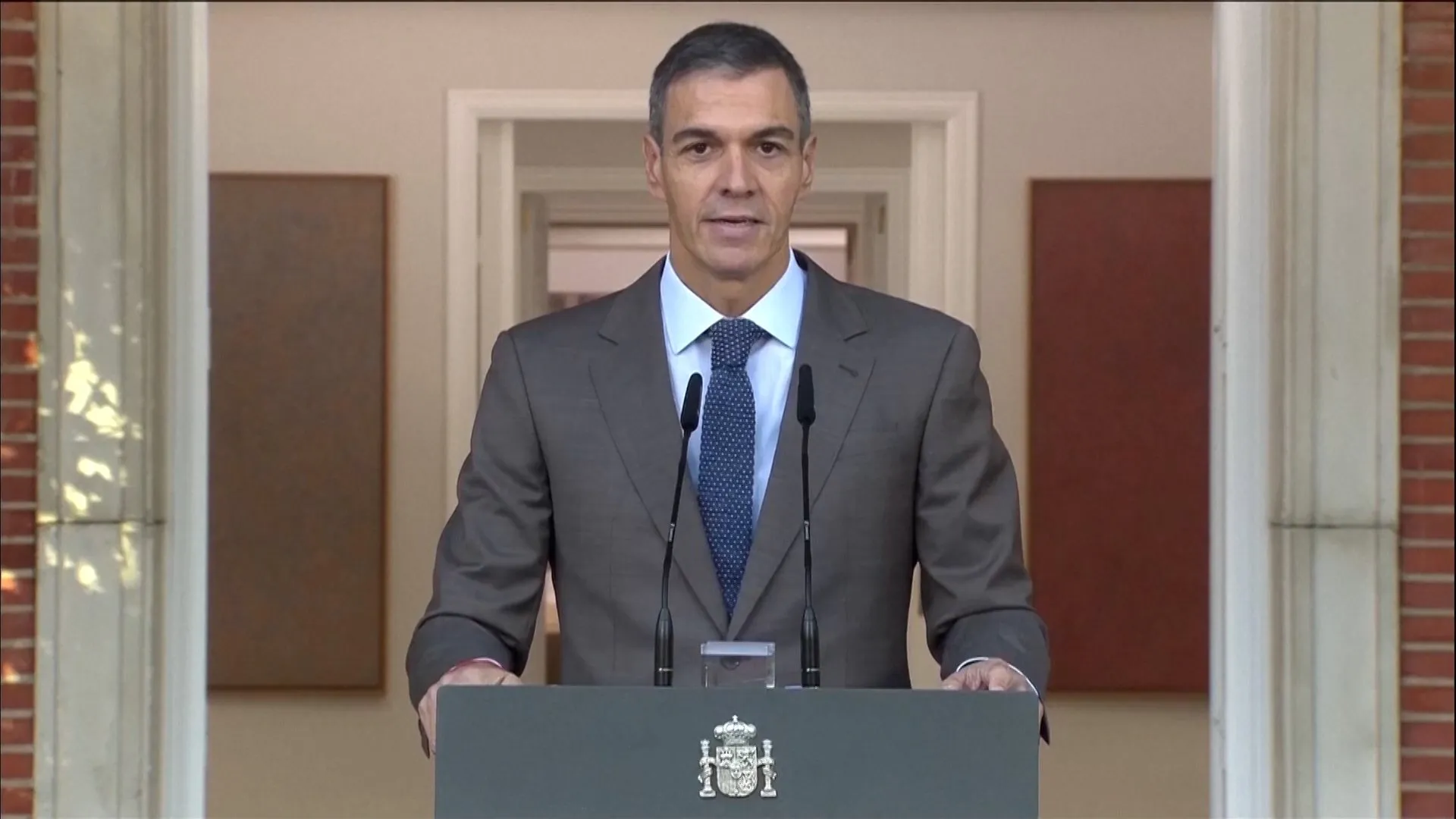




![TOKONAME, JAPAN - SEPTEMBER 26: Gold medalist Yuki Kurihara of Japan poses on the podium at the medal ceremony for the Esports Puzzle [Puyo Puyo Champions] on day seven of the 20th Asian Games Aichi-Nagoya at Aichi Sky Expo on September 26, 2026 in Tokoname, Aichi, Japan. Kurihara becomes the youngest gold medalist at the Asian Games at the age of 11. (Photo by Toru Hanai/Getty Images)](https://i0.wp.com/www.aljazeera.com/wp-content/uploads/2026/10/getty_6ac2424a21-1791115850.jpg?w=640&ssl=1)