Stay informed and up-to-date with the latest news from around the world. Our comprehensive news coverage brings you the most relevant and impactful stories in politics, business, technology, entertainment, and more.
Iran’s Foreign Ministry says reopening the strait has been its main goal, while the US continues to focus on nuclear talks.
Published On 4 Oct 20264 Oct 2026
The Strait of Hormuz is going to remain closed until the United States accepts Tehran’s seven-day plan to reopen the waterway, Iran’s top negotiator and parliament speaker has said.
Iranian state-linked news agency Nournews, quoting Mohammad Bagher Ghalibaf, reported on Sunday that Washington made “some proposals through a mediator” days after the US replied to Iran’s diplomatic proposal.
Recommended Stories
list of 4 itemsend of list
The US should know “that the era of wasting time and dictating unilateral demands is over”, Ghalibaf said, adding Iran’s position remains “clear and definite”.
He emphasised that “the Strait of Hormuz will not open until our seven conditions based on the Islamabad memorandum are met”, and that Iran is “present on the military battlefield and will confront them with new surprises”.
He added that Iran was neither “excited” nor “intimidated” by the latest US proposals and would “both fight and negotiate”.
US President Donald Trump ruled out an Iranian proposal to reopen the Strait of Hormuz last week, hours after Iran put forward a roadmap to reopening the strait, through which one-fifth of global oil and natural gas is shipped during peacetime.
Last month, Trump threatened to “annihilate” Iran in his speech on the floor of the United Nations General Assembly (UNGA).
On Sunday, Iranian Foreign Minister Abbas Araghchi also said Iran is “serious about finding diplomatic solutions just as we are serious about defending ourselves”.
Speaking to foreign ambassadors and diplomats in Tehran, Araghchi said Iran had clearly explained its conditions for reopening the strait and that Tehran hoped Washington would choose diplomacy and accept its proposal.
However, Araghchi warned that if the US takes military action again, Iran is “more prepared than before and will take whatever action is necessary to defend ourselves”.
Iranian Ministry of Foreign Affairs spokesman Esmaeil Baghaei added that Tehran used the UNGA platform last month to provide world leaders with its position on ending the US-Israel war on Iran.
He said the US has continued to focus on nuclear talks, while reopening the strait has been Iran’s main goal.
“We are at this stage mainly focusing on the strait, and our principal concern is to reach a solution and to have peace and stability restored within this waterway,” Baghaei said.
The Strait of Hormuz has been largely blocked and disrupted for more than seven months, since the US and Israel launched strikes on Iran on February 28, driving one of the worst maritime shipping disruptions in decades.
About one-fifth of global oil and natural gas is shipped through the Strait of Hormuz during peacetime, as the US-Israel war on Iran has created several trade chokepoints [File: Al Jazeera]
Tens of thousands of people have rallied across Spain as protests have spread since the conservative-dominated parliament rejected a bill proposing measures to tackle a housing crisis.
Parliament on Friday voted down two decrees proposed by Prime Minister Pedro Sanchez’s minority left-wing coalition government that were intended to address the housing crisis.
Recommended Stories
list of 3 itemsend of list
The protests erupted late last month after an 87-year-old woman was evicted from her home of 70 years in the capital, Madrid. Maria del Carmen Abascal’s eviction came after an international investment fund bought her building and hiked the rent.
Local media reports have suggested that Sanchez could call snap elections for as early as November after watching the strength of Saturday’s protests across the country. Spain’s current legislative term is set to end next summer.
Will the housing crisis trigger snap elections? Here’s what we know:
What happened on Friday in parliament?
The emergency measures proposed by Spain’s leftist government to tackle the country’s housing affordability crisis failed to pass on Friday.
The government had proposed two measures to protect renters in the country. The first decree was meant to stop evictions of vulnerable people, make real estate speculation harder, impose tighter restrictions on short-term leases and provide tax incentives to encourage renting and the construction of housing.
The second decree proposed making leases automatically renew when they are set to expire, essentially making them indefinite. A property owner would have to pay a tenant 12 months of rent to break the contract.
Sanchez, who leads a coalition government composed of his Socialist Party and the far-left Sumar, appealed to lawmakers in the run-up to the vote to put aside political calculations and pressure.
“Think about ordinary people, about those who most need the protection of public institutions. Think about the millions of young people who cannot afford to move out of their parents’ homes. Think about the families living with the constant anxiety of ever-rising rents,” he said before the voting.
But his government’s proposed measures were shot down by the majority of the 350-seat lower house of parliament.
The right-wing Catalan separatist party Junts refused to back the housing decrees, saying they would ultimately tighten the housing market. The centre-right Popular Party and far-right Vox also voted against the measures.
Miriam Nogueras of Junts argued the decrees would lead only to owners removing their properties from the rental market and thus driving up prices even further.
“If they really wanted to protect people, collar the vulture funds, and reactivate housing, they would have already done it. They’ve had eight years,” she added on X, referring to Sanchez’s government.
Health Minister Monica Garcia said on X that the right-wing parties “have voted for a feudal economy in which a minority extracts the salary from a majority that works for their luxuries. And they do it against their own voters, who also suffer increasingly high rents, live in fear that the contract will end and can even be evicted.”
“Today the right has given rent-seeking a parliamentary majority that it doesn’t have on the street, but it’s going to pay for it sooner rather than later,” she added.
Before the parliamentary vote, Marta Soler Gallart, head of the Department of Sociology at the University of Barcelona, explained that neither of the two decrees addressed the housing problem in the medium or long term.
“Models such as Vienna’s with its low rents are cited in support of these decrees, but it is overlooked that the Vienna model and others have low rents because of their long history of creating and maintaining public social housing,” Soler Gallart told Al Jazeera on September 30.
“In Spain, however, public funds are invested in social housing which, after a while, the recipients sell at market price.”
Soler Gallart also said the new measures disadvantage landlords with small or few properties by extending five-year tenancy agreements by a further two years and by providing an indefinite extension of their leases.
“However, these extensions are not compulsory if the landlord can prove that they need the property for their own use,” she said.
Why are people protesting across Spain?
Protests erupted across Spain in late September after 87-year-old Abascal was evicted from her home. The investment fund that bought her building hiked her rent by more than 200 percent to roughly $1,880 a month, a move aimed at pushing out the long-term tenant to make way for lucrative tourist apartments.
In recent years, Spain has seen protests against mass tourism, which has been linked to the housing crisis and soaring cost of living. Spain is the second most visited country in the world, attracting 97 million tourists last year.
While Abascal has returned to her home, according to her representatives, she has become the face of the country’s housing crisis, and people across Spain have been demanding the government address the issue.
Angered by parliament’s rejection of the government measures, tens of thousands of people took to the streets.
“It’s a shame,” Nando de Anguulo, 26, who joined Saturday’s protest in Madrid, told the Reuters news agency.
“It only proves that it is us, the people, who have to adapt to the political parties and not the politicians to what the people want, and this can’t go on like that.”
While the protests were mostly peaceful, in the southeastern city of Valencia, police fired rubber bullets and tear gas to break up demonstrations. About 30 protesters managed to get inside the City of Arts and Sciences, a landmark cultural building, before police removed them.
Meanwhile, in Madrid, Spanish police arrested three members of a far-right group and fired rubber bullets on Saturday night.
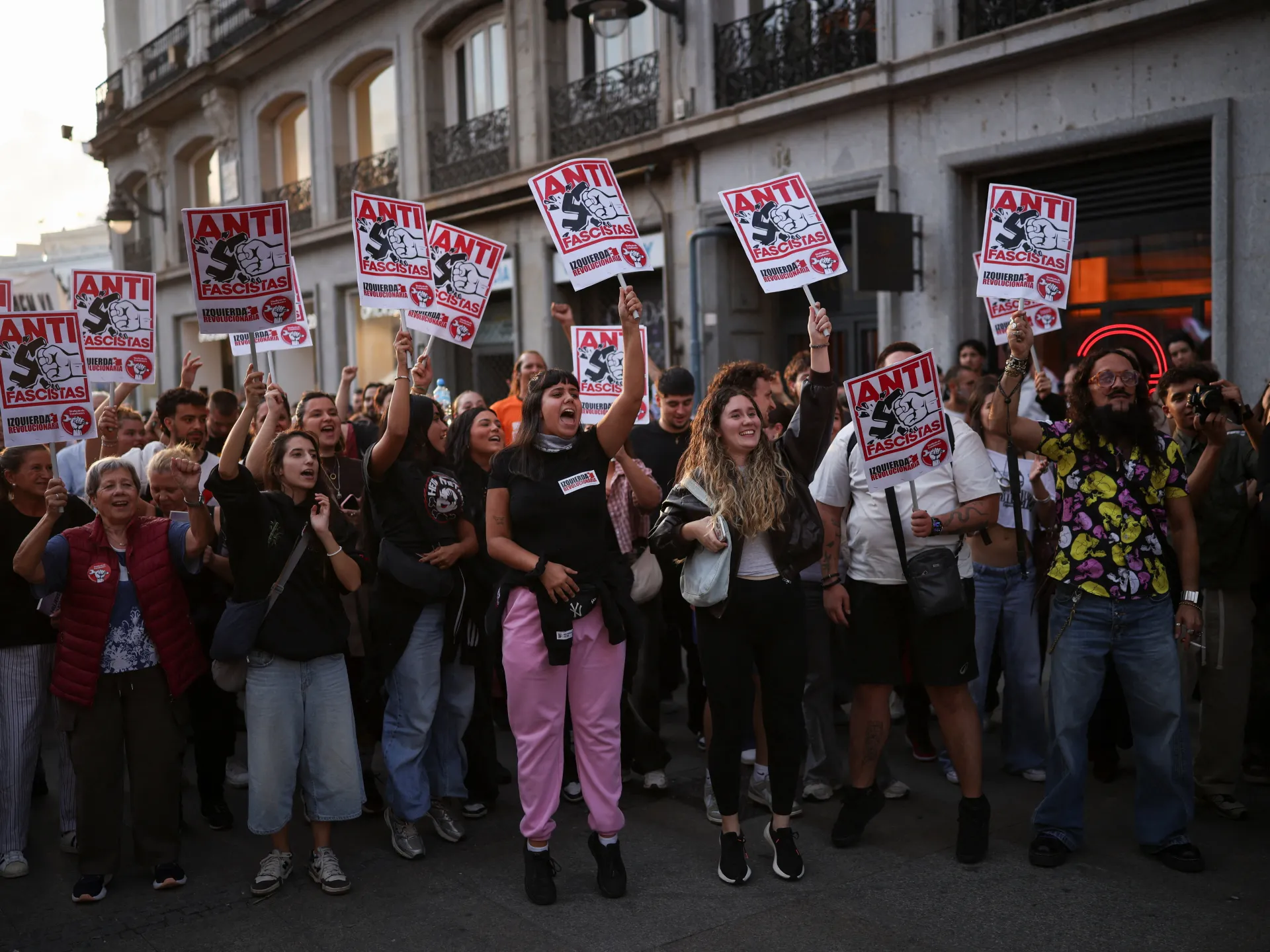
Far-right activists, some of whom performed Nazi salutes, tried to reach demonstrators camped out in the Puerta del Sol, a central square in the Spanish capital, the Spanish government said.
Valeria Racu, a spokesperson for the Tenants’ Union, said Saturday’s rallies revealed “a new energy that we haven’t seen in a long time and energy that is showing that eight days of people’s power can achieve more than eight years of progressive government”.
“Now begins real politics – politics which has always belonged to the people and which will return once and for all to the streets,” Racu added.
Could the housing crisis lead to snap elections?
Housing is a sensitive issue in Spain because it impacts how people vote. The average rent in the country has almost doubled in the past 10 years. The average price per square metre has risen from 8.20 euros (about $9.08 at the time) in 2016 to 15.1 euros ($17.15) this year, according to the real estate website Idealista.
In an October 1 article for Vanity Fair, Spanish journalist Jorge Dioni Lopez noted that after eight years in power, housing is what is causing Sanchez to lose support among educated young people, children of the middle classes.
“The government faces a difficult situation. Firstly, because most of the relevant powers lie with other levels of government. Secondly, because Spain is a nation of homeowners. Unlike in other European countries, almost all the public housing that has been built has ended up in private hands, and historically, homeownership has been more attractive than renting,” he wrote.
“Housing is our savings system and also the primary means of transmitting wealth between generations,” he added.
After Spain’s parliament rejected the government’s housing reform bills on Friday, the leader of the centre-right People’s Party, (PP) Alberto Nunez Feijoo, urged Sanchez to “call elections as soon as possible”, claiming he had the support of “neither the streets nor parliament”.
While Sanchez has not officially announced new elections, the Spanish online news site El Diario has reported that elections could take place as early as November 29. Spain’s general elections are currently scheduled for July 2027.
Voters cast their ballots for a dizzying number of officials across multiple tiers of government.
Published On 4 Oct 20264 Oct 2026
Polls have opened in Bosnia and Herzegovina for a general election to choose new leaders at the national and regional levels, in a vote that could affect the country’s European Union membership bid.
On Saturday, about 3.4 million voters are choosing the three members of the country’s multiethnic presidency, lawmakers for the national Parliament and heads of institutions for the country’s two entities: the Federation of Bosnia and Herzegovina (FBiH) and Republika Srpska, which is dominated by ethnic Serbs.
Recommended Stories
list of 3 itemsend of list
Bosnia’s complex web of governing institutions was created by a United States-brokered peace agreement in 1995 in an effort to manage the ethnic divisions between Muslim Bosniaks, Orthodox Serbs and Catholic Croats that gave rise to the 1992-95 war.
A voter identifies himself using an optical scanner at a polling station during the general election in Sarajevo, Bosnia and Herzegovina, October 4 2026 [Hazim Aljovic/EPA]
The major parties’ repeated focus on war-era rhetoric and division was frustrating for some voters, activist Adi Selman of the Karton Revolucija protest group told the AFP news agency.
“I don’t think these new elections in Bosnia will change anything,” the 34-year-old said in the northern Bosnian town of Tuzla, ahead of the vote.
“The choice is limited to political parties that have already been around for 30 years and basically pick up votes by harping on about war, tensions, divisions and the past.”
“Bosnia and Herzegovina is dead; it is an impossible country,” Republika Srpska’s former president, Milorad Dodik, told the final rally of his right-wing Alliance of Independent Social Democrats (SNSD) in the entity’s capital Banja Luka late on Friday.
EU membership bid
In the FBiH, Bosniak parties are pushing for a stronger central state, with incumbent Bosniak presidency member Denis Becirovic pledging a renewed path to the EU and NATO.
The EU granted Bosnia candidate status in December 2022, but accession negotiations scheduled for 2024 were delayed as Brussels demanded the country pass stronger anticorruption laws and reform its judicial system.
A voter feeds a paper ballot into an optical scanner at a polling station during the general election in Sarajevo, Bosnia and Herzegovina, October 4 2026 [Hazim Aljovic/EPA]
Croat nationalist parties are also pushing for electoral reform, demanding a greater say in choosing the Croat member of the presidency in the entity they share with the more numerous Bosniaks.
Meanwhile, Russia is accused of slowing down the country’s path towards joining the EU, while also holding close ties with the SNSD, which favours secession for Republika Srpska.
This general election is the first in the country in which new electronic tools are being used to scan ballot papers and carry out biometric fingerprint verification in a move to reduce fraud during the election.
Polls close at 7pm (17:00 GMT) and first results are expected later on Sunday.
Maysa Abu Daoud and her daughter Mary al-Najjar among five Palestinians killed in Gaza City attack.
Published On 4 Oct 20264 Oct 2026
The Latin patriarch of Jerusalem, Cardinal Pierbattista Pizzaballa, has expressed his “deep sorrow and grief” over the “tragic” killing of two Christian women in an Israeli air attack on Gaza City.
Maysa Abu Daoud and her daughter Mary al-Najjar were among five Palestinians killed in the attack that hit the ground floor of a building in the Remal neighbourhood on Saturday, in the latest Israeli violation of a United States-brokered “ceasefire” agreement with the Palestinian group Hamas.
In a statement, the patriarch extended his “heartfelt condolences” to the loved ones of the two women and to the Christian community in Gaza.
Their funeral took place on Saturday at Saint Porphyrius Church in Gaza City’s Old City.
The two women were Palestinian Christians from Gaza City who devoted their time to helping parishioners and displaced people sheltering at the Holy Family Church, according to Palestine’s Higher Presidential Committee for Church Affairs.
The committee’s chairman, Ramzi Khoury, described their deaths as a “painful loss” for their families, the church and its parishioners.
People inspect the damage after an Israeli attack on a residential apartment in the Remal neighbourhood of Gaza City [Omar al-Qattaa/AFP]
Mary’s son, 14-year-old Fouad al-Najjar, told the Anadolu news agency the strike hit the building at about 1:30am (22:30 GMT).
“My grandmother and my mother died. May God have mercy on them,” he said.
Al-Najjar appealed for an end to Israel’s genocidal war on Gaza, saying Palestinians were losing their loved ones every day.
“We are exhausted by this war and have endured so much,” he said. “For almost three years, we have been living through the same destruction, the same grief and the same war.”
Palestinian Lutheran pastor Munther Isaac, who serves in Ramallah and directs the Bethlehem Institute for Peace and Justice, wrote on X: “The genocide continues in Gaza.”
Civil Defence members carry the bodies of Maysaa Abu Daoud and her daughter Mary al-Najjar during their funeral at the Greek Orthodox Church of Saint Porphyrius in Gaza City [Omar al-Qattaa/AFP]
The Gaza Strip is home to fewer than 1,000 Christians. The community was already small before the war, and many of its members have been killed since then in attacks on their homes and churches throughout the war that began in October 2023.
On October 19, 2023, an attack on the Saint Porphyrius Church compound killed at least 18 people. Two months later, the Latin Patriarchate of Jerusalem said an Israeli sniper shot dead a woman and her daughter inside the Holy Family parish compound in Gaza.
An Israeli strike on the Holy Family Catholic Church compound on July 17, 2025 also killed three people and wounded others, including parish priest Father Gabriel Romanelli.
According to the Ministry of Health in Gaza, Israeli attacks have killed at least 74,228 people, including at least 1,445 since the start of the “ceasefire” in October 2025.
Seven companies are said to now be in the running to develop a lower-cost and highly modular drone to succeed the MQ-9A Reaper. Though the field has some well-established entrants and some far lesser known names, the inclusion of Otto Aerospace in this group is particularly unexpected and interesting to examine. Otto has made bold, but still unrealized pronouncements about disrupting the aviation industry with potentially revolutionary high-efficiency designs that could have civilian and military applications. TWZ has been steadily tracking the company’s developments since we first reported on the existence of the Celera 500L aircraft back in 2017.
Air & Space Forces Magazinefirst reported on Wednesday that Otto Aerospace (previously Otto Aviation), as well as Anduril, Chaos Industries, General Atomics Aeronautical Systems, Grid Aero, Shield AI, and Swarm Aero, had “made the cut” for the Massed Modular Aircraft (MMA) program, citing anonymous sources. The MMA effort formally kicked off in July, and the Air Force is now aiming to have a fleet of at least 500 of these drones by 2032.
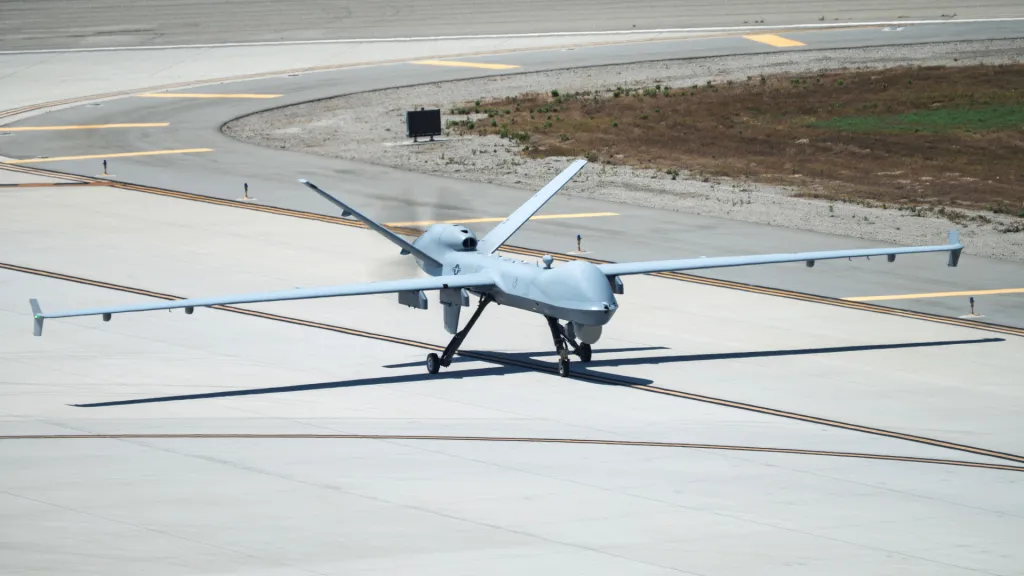
The Massed Modular Aircraft (MMA) program is seeking a successor to the MQ-9A Reaper, an example of which is seen here. USAF
An industry source has also told us that these seven companies are moving ahead in the MMA program. The Air Force has not yet offered an official confirmation.
“The Air Force’s partnership with the Defense Innovation Unit is accelerating requirements development and rapid prototyping by leveraging commercial innovation and reducing timelines,” a spokesperson for the service said when we asked for more information. “We continue working with industry to inform requirements and assess potential solutions as we shape the future MMA capability.”
TWZ has also reached out to all of the companies on the list for more details.
As mentioned, it is unexpected and especially interesting to see Otto named here in the context of MMA. The company’s core design philosophy centers around what is called laminar flow. Broadly speaking, this refers to liquid or gaseous “fluids,” including air, flowing in smooth, regular layers across a surface with little to no mixing between them. In aviation, optimization for laminar flow translates to reduced drag and improved aerodynamic efficiency. This, in turn, can offer a host of benefits, including when it comes to fuel economy, extended range, and overall performance, as well as reductions in operating costs.
With this in mind, all of the designs that Otto has shown to date, starting with the Celera 500L, have been based around teardrop-shaped fuselages to maximize laminar flow benefits. Many of them also feature long, slender glider-like wings. The sudden and unannounced appearance of the very exotic and futuristic-looking Celera 500L at the Southern California Logistics Airport in 2017, at which time nothing was known about the aircraft or its manufacturer, caused a stir in the broader aviation community. TWZ was the first to report on the plane and then unmasked its identity.
The Celera 500: Technology Demonstrator with a Lasting Impact
On top of the laminar flow-optimized shaping, the Celera 500L was a pusher-propeller design powered by a single high-efficiency, turbocharged, multi-fuel V12 piston engine. A relevant patent held by Otto also describes a novel exhaust system with a heat exchanger that provides an additional boost in thrust.
Otto conducted an extensive test campaign with the Celera 500L, taking the aircraft up to an altitude of 15,000 feet and to a speed of 250 miles per hour. The company posited that this would translate to a cruising speed of around 460 miles per hour at the design’s intended operating ceiling of 50,000 feet.
The Celera 500L seen during a test flight. Otto Aerospace
Development focus at the company has since shifted to the jet-powered Phantom 3500, which has a much revised design compared to the Celera 500L. Otto has said previously that it expects this aircraft to burn just 115 gallons of fuel per hour, further underscoring the benefits of its laminar-flow-centric approach. Comparably sized business jets like the Bombardier Challenger 350, Cessna Citation Latitude, and Embraer Praetor 500 consume around 300 gallons per hour, according to the company, citing data from Jet Support Services, Inc. (JSSI).
A rendering of Otto Aviation’s Phantom 3500, a business jet the company is currently developing. Otto Aviation
It is also worth noting here that Otto has already developed a drone with a “highly laminar-flow efficient airframe” for the U.S. Defense Advanced Research Projects Agency (DARPA). The company announced the successful completion of a flight test campaign in May. The pusher-propeller design has a teardrop-shaped main body, a glider-type main wing, and a T-tail at the end of a boom that extends to the rear of the aircraft. DARPA plans to use that drone to demonstrate laser-based power beaming technology that could be used to relay electricity to forward operating locations. The technology could also dramatically extend the endurance of an electrically-powered drone, potentially allowing it to stay in the air indefinitely.
Otto Aerospace DARPA EOS Flight Test
The drone for DARPA is far too small to meet the Air Force’s MMA requirements. However, “the program leveraged Otto’s aerodynamic expertise to design and flight-test an unmanned vehicle that could inform design parameters for future energy-relay systems or more extremely fuel-efficient, long-endurance platforms,” per a press release Otto put out in May.
Otto Aerospace developed this drone, seen here rigged up for launch from a pickup truck, for the US Defense Advanced Research Projects Agency (DARPA). Otto Aerospace
TWZ has highlighted in the past how the general range, fuel economy, and other advantages inherent to Otto’s designs could be even more pronounced in a configuration that does not need to support a human crew. Furthermore, Otto has previously shown militarized concepts, crewed and uncrewed. As we’ve written in our earlier coverage of the Celera 500L:
“Though primarily aimed at civilian and commercial operators, Otto’s new website also highlights the potential for the Celera 500L to use its long-range and high fuel economy to support military missions, including transporting personnel and cargo, as well as conducting intelligence, surveillance, and reconnaissance (ISR) missions. A version of the aircraft, possibly unmanned, equipped with any number of sensor suites could be an impressive persistent surveillance and communications relay platform able to orbit over particular areas for very long periods of time and cover a wide swath of the battlefield from its high perch. It could also be able to reposition itself quickly and transit to its tasking area at jet-like speeds.”
A rendering of a concept for an uncrewed derivative of the Celera 500L. Otto Aerospace
While we have yet to see an explicit MMA proposal from Otto, a laminar flow-optimized drone could be a very attractive offering, given the program’s focus on reducing costs while having an unrefueled combat radius of at least 2,300 nautical miles, among other capabilities. A more efficient design could further translate to a drone that needs less fuel to meet range and other requirements, which, in turn, could allow for a smaller and/or cheaper design overall. Weight and physical space savings afforded by reduced fuel demand could be used to increase ordnance and other payload capacity, too. You can read more about what is known about the MMA requirements here.
There are more companies beyond Otto in the running. With the Air Force aiming to buy hundreds of MMA drones in the coming years, there will be stiff competition.
General Atomics, which developed and produced the MQ-9A, has publicly put forward its own proposal for a successor, called Wildfire. The new drone draws heavily on experience with the Reaper, as well as other drones in the company’s portfolio, and you can read more about what is known about that design here. General Atomics declined to offer additional comment in response to questions regarding the current state of the MMA program. As an aside, General Atomics is also now on contract to build higher-end FQ-42 Vengeance drones for the Air Force, one of two designs intended for higher-end air combat the service is acquiring under its Collaborative Combat Aircraft (CCA) program.
A rendering of General Atomics’ Wildfire drone. General Atomics
The other company building CCA drones for the Air Force is Anduril, with its FQ-44 Fury, and it has now also been named in relation to the MMA effort. Anduril has unveiled two other very different tactical drones since 2025, the twin-engine hybrid-electric tail-sitting Omen, designed primarily for surveillance and reconnaissance, and Thunder, an armed tiltrotor pitched as an uncrewed companion for crewed rotorcraft. Neither of those uncrewed aircraft would seem to directly align with the stated MMA requirements, but might serve as a starting place. Anduril also has a history now of developing new uncrewed platforms and other systems discreetly, and sharing them with the public only when they have become relatively mature.
Anduril’s Omen drone, which was unveiled in November 2025. Anduril TREVOR DALTONThe Thunder tiltrotor, which Anduril unveiled earlier this year. Anduril
What design Shield AI might be offering is unknown. The MMA requirements would seem to sit between the company’s V-BAT drone, which is in service with several armed forces today, including in the United States and Ukraine, and the much higher-end X-BAT that is now in development. Shield AI has been working to expand on the V-BAT design, including plans to integrate air-launched munitions. Both V-BAT and X-BAT are also vertical-takeoff and landing designs. Beyond drones, Shield AI remains a major developer of artificial intelligence-driven autonomy packages for the U.S. military and others.
Unveiling the Future of Defense Tech: Shield AI’s V-BAT Teams for Autonomous Missions
X-BAT: Earth Is Our Runway
Earlier this month, newcomer Swarm Aero unveiled a new drone with performance and capabilities that align with the stated MMA requirements earlier this month. Called Gamera, the design has a single propeller at the front of a small central fuselage, together with sponsons holding large fuel cells on either side and a twin-boom tail configuration broadly reminiscent of the OV-10 Bronco light attack aircraft, as TWZ previously reported on in more detail.
Meet Gamera: A New Category of Group 5 Strike and Sensing UAS
Grid Aero is publicly developing a twin-engine cargo drone called the Lifter Lite, in part with funding from AFWERX, the Air Force’s internal technology incubator. Whether the company might work to adapt the Lifter Lite, which has been undergoing testing at least on the ground, to meet the MMA requirements or has proposed something entirely different is not known.
A picture of the first Lifter Lite cargo drone prototype. Grid Aero
The last firm on the list, Chaos Industries, does not appear to show any drone designs on its website at the time of writing. It is primarily known as a developer of radar systems, especially for use in counter-drone systems. The company declined to comment in response to TWZ queries regarding the MMA program.
To reiterate, the Air Force still has not confirmed the full list of MMA program contenders. Otto’s participation would be a standout, but the field as it is understood now features a number of very established drone makers, as well as emerging start-ups, all vying for a very lucrative opportunity. On top of the potential just to supply hundreds of drones upfront, those uncrewed aircraft look set to be a key part of the Air Force’s force structure for years to come, and will need to be supported throughout their lifecycles. The MMA requirements put heavy emphasis on modularity and open-architecture systems to allow for the rapid integration of new and improved capabilities and functionality down the line.
The Air Force has also previously raised the possibility of selecting multiple vendors to produce designs under the MMA program, or to pursue follow-on rounds of competition to help meet its operations requirements. This is exactly how the service has been running the CCA program, and has already led to the aforementioned production contracts with General Atomics and Anduril. In addition, the Air Force is targeting a base $10 million unit cost for each MMA drone, a price point that would help make losses more tolerable, and could open the door to acquiring a fleet of far more than 500 examples.
It is also important to remember that the Air Force has tried and failed on several occasions to develop and field an MQ-9A replacement. As TWZ has previously explored in great detail, the service’s view of what that drone should be has also evolved over time, with the current MMA program squarely focused on a more affordable option that does not put a heavy premium on survivability. The Air Force has acknowledged potential budget and other hurdles to its new effort. At the same time, heavy continued operational demand for Reapers, coupled with dozens of losses in the course of the war with Iran, as well as other operations in and around the Middle East in recent years, have put major new emphasis on finally finding a successor.
Overall, beyond what is already known about potential MMA offerings, it will be very interesting to see what Otto and the other contenders put forward to finally succeed the iconic Reaper.
Australian authorities are investigating the links between the country and a Flydubai co-pilot who attempted to take control of a plane travelling to Israel.
The co-pilot is alleged to have attacked the captain with a crash axe during a flight from Dubai to Tel Aviv before passengers managed to overpower him and successfully take control of the plane.
The Australian authorities have not identified the co-pilot, who has been named by multiple media outlets including Reuters, CNN and The New York Times as Hamam al-Hammami.
The prosecutor in the UAE has said it is investigating the incident and any possible motives.
In a statement to the BBC, the Australian Federal Police (AFP) confirmed its investigation into “the man’s links to Australia”.
The investigation involves state police and the country’s security agency, it said, adding that an update would be “provided at the appropriate time”.
Sources familiar with the case, who have spoken to Australian media, have said the co-pilot was issued a student visa in 2014, and studied in Australia between 2015 and 2017, until he left the country.
The Australian Broadcasting Corporation (ABC) said the co-pilot’s student visa was cancelled in 2019 as he was no longer enrolled in a course, making him ineligible for it.
Counter-terrorism officials will look at whether the man was radicalised in Australia, the ABC reported.
Israeli Prime Minister Benjamin Netanyahu has said he was an Omani national.
The flight from Dubai to Tel Aviv on 30 September was carrying more than 170 passengers to Israel.
Two and a half hours into its journey, the plane plunged 17,000ft (5,200m) when the Omani co-pilot attacked the pilot with a crash axe, the United Arab Emirates prosecutor general has said.
The pilot flying the plane, Capt Smit Machchhar, described how he was lying on the floor injured when he realised the plane was sinking and he had to act, explaining: “I told myself to go for one last push to open the door from inside”, which allowed the passengers in.
Two reserve pilots then landed the plane safely in Saudi Arabia.
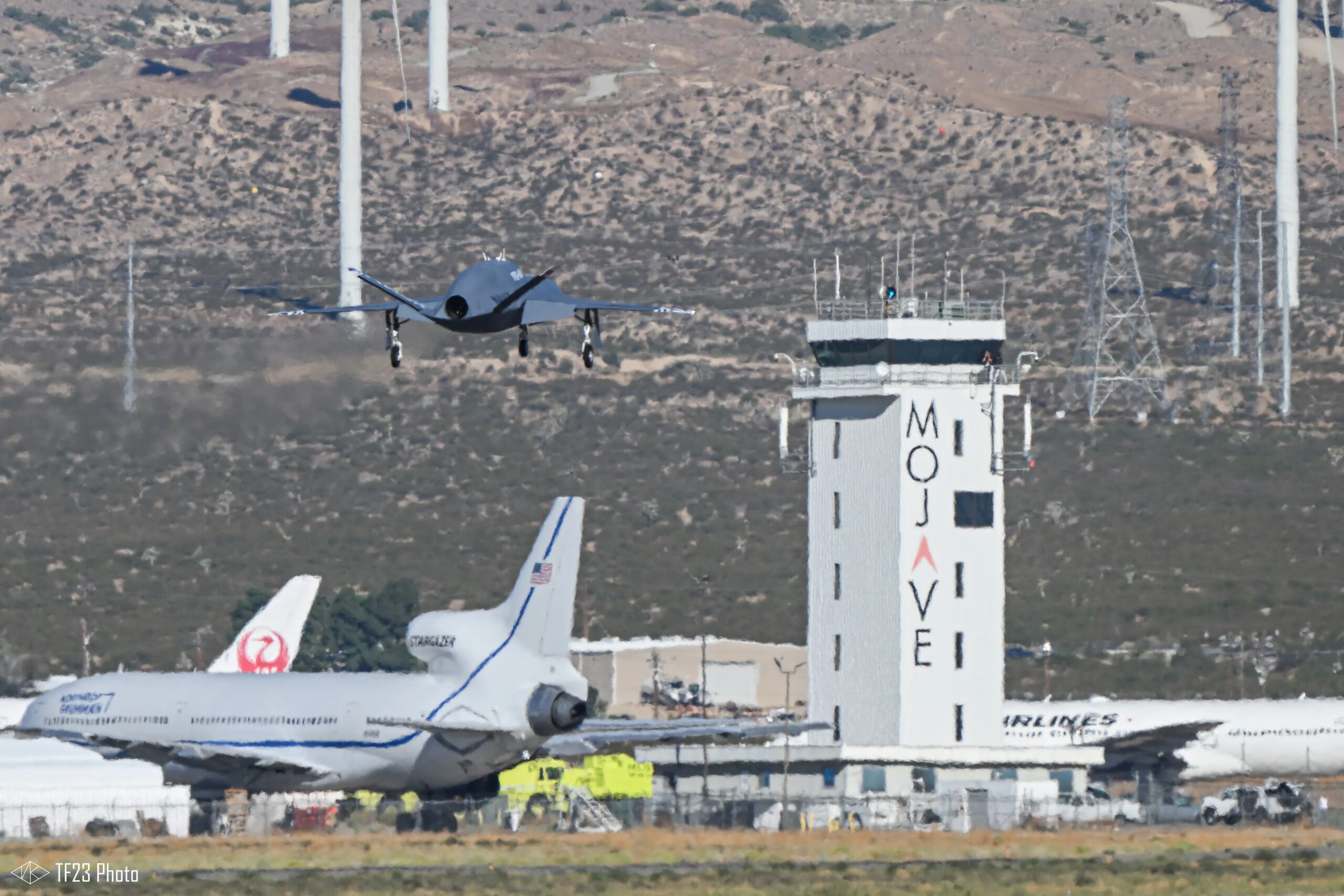
We have a significant update on the fast-moving world of Collaborative Combat Aircraft (CCA) out of Mojave, California today. Northrop Grumman’s Talon Blue, which now has the official designation YFQ-48A, has taken to the skies for the first time. The existence of Talon Blue was first officially disclosed in December of 2025 at a media event in Mojave that we attended.
Talon Blue flying out of Mojave Air and Space Port for the first time. (@Task_Force23) TASK_FORCE23
The uncrewed aircraft took to the skies over Mojave Air and Space Port, home of famed ‘bleeding0edge’ airframer and Northrop Grumman subsidiary Scaled Composites, which built the aircraft. A release from Northrop Grumman reads:
“MOJAVE, Calif. – Oct. 3, 2026 – Northrop Grumman’s (NYSE: NOC) YFQ-48A Talon Blue completed its first fully autonomous flight, including taxi, takeoff, in-flight maneuvers, and landing. Developed through company investment, Talon Blue combines modular design and advanced manufacturing to lower cost and support faster production without compromising mission capability. The flight builds on Northrop Grumman’s seven decades of autonomy experience and more than 500,000 autonomous flight hours, with lessons from Talon Blue informing future autonomous systems.
Details on YFQ-48A Talon Blue:
Talon Blue is part of Northrop Grumman’s internally-funded Project Talon portfolio focused on accelerating the development of mission-ready autonomous airpower capabilities.
Manufacturing and design innovations cut part count and overall weight, lowering cost and enabling faster production to meet growing demand for autonomous systems.
Designed with flexible operational concepts in mind, Talon Blue’s high air intake, wide wheelbase and integrated weapons bay support a wide variety of mission needs for U.S. and allied partners.
Craig Woolston, vice president and general manager, research and advanced design, Northrop Grumman: “Our customers made it clear they need autonomous systems that can be fielded faster and more affordably without sacrificing mission effectiveness. We listened. Talon Blue’s first flight is one step toward a new generation of autonomous capabilities. Every flight and lesson strengthens our broader autonomy work and sharpens what comes next.”
Talon Blue flying above the Mojave Desert in California. (Northrop Grumman)
While the Talon Blue aircraft draws most of the attention, Northrop Grumman has put great emphasis on its back-end autonomy development ecosystem, which includes its purpose-built Model 437 demonstrator aircraft, now under the Talon IQ badge (formerly Beacon).
With the loss of the F/A-XX next-generation naval fighter program to Boeing, Northrop Grumman winning a contract from the U.S. services for Talon Blue has become more important. Doing so would get the company back into the Pentagon’s tactical air combat portfolio. As we have discussed for years, advanced uncrewed tactical systems are set to be less risky and potentially more lucrative than traditional fighter programs as air combat rotates to predominantly uncrewed capabilities and mass production of them. Beyond U.S. needs, the demand for CCAs is likely to explode internationally in the coming years, so programs like Talon Blue could find success elsewhere if the Pentagon goes another direction, but getting the U.S. armed services’ stamp of approval and the scale of production that comes with it would surely help there too.
Author’s note: A big thanks to our friend @Task_Force23 for providing us with great photos for this story.
Yemen’s Saudi-backed government forces claim to have killed hundreds of Houthi fighters as they attempt to retake swathes of lost territory. The Houthis said they targeted an Aramco facility in Riyadh, although Saudi authorities have not confirmed the strike.
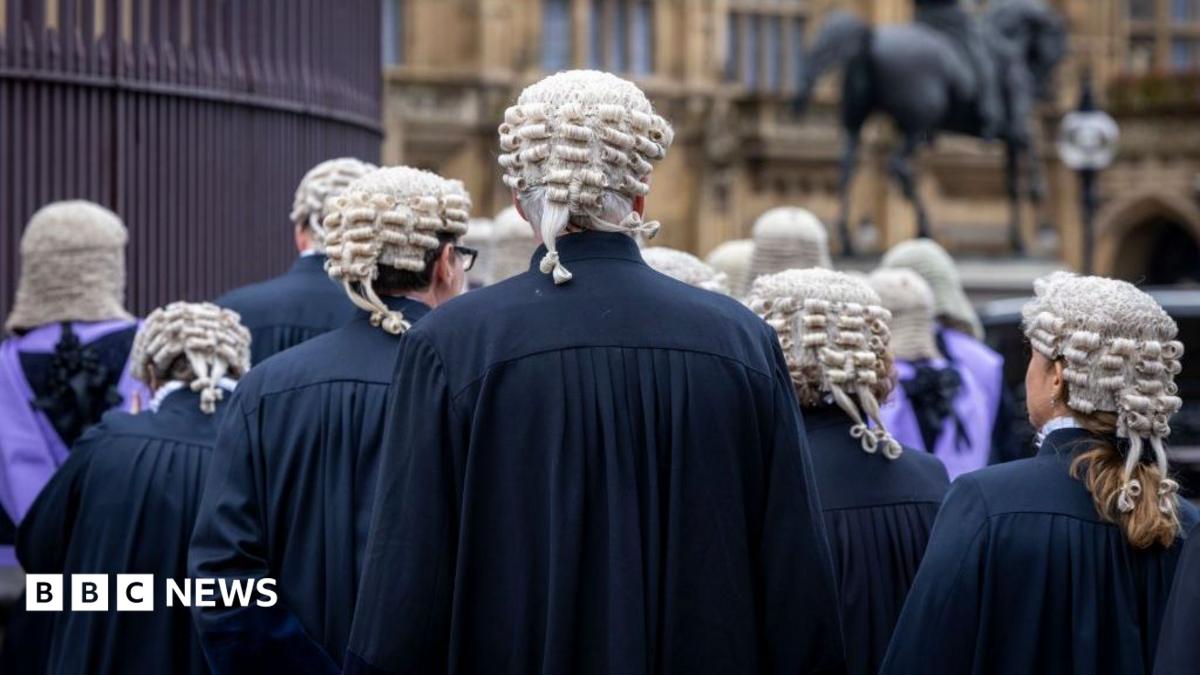
Prime Minister Andy Burnham has scrapped controversial plans to curb some jury trials.
Sir Keir Starmer’s government had introduced proposals to allow judges to make the sole decision on cases that would lead to a sentence of less than three years.
The Ministry of Justice (MoJ) said only complex fraud and financial offences would be judge-alone – and it proposes that thousands of medium-level crimes should stay with volunteer magistrates, who sit without a jury.
Justice Secretary Alex Norris said he had changed course came after hearing the “strength of feeling”. Criminal lawyers have welcomed the decision and the Conservatives say it is a “major victory” for those who fought to defend trial by jury.
Former Justice Secretary David Lammy first announced the plans in December following a recommendation in a major review of the court system in England and Wales.
The series of radical reforms, including scaling back jury trials, were presented as the best way of turning around record backlogs which, in turn, were exacerbating the prison population crisis.
The backlog – which has led to record delays for defendants and victims – currently stands at nearly 81,000 cases – having rocketed largely thanks to cuts before the pandemic and court closures during the national lockdowns. Official projections have estimated it could reach 100,000 before the next general election and, in a worst case scenario, climb to double that number by 2035.
There are, however, indications the backlog is now stabilising after the government committed unlimited funding to pay for more judges to sit in courts that were otherwise being unused.
Under the original plans, Lammy had wanted to reserve jury trials for the most serious “indictable” offences – meaning cases that are always sent to Crown Court, including murder and rape.
Less serious offences, where the sentence would be no more than three years, would be decided without a jury in the Crown Court by a judge alone. Even less serious offences would stay in magistrates’ courts, abolishing defendants’ right to ask for a trial by jury when they feel that is their best chance of beig cleared.
The proposals triggered an outcry across many parts of the criminal justice world, with many opponents saying that eroding the 800-year-old right to trial by jury would not solve the backlogs.
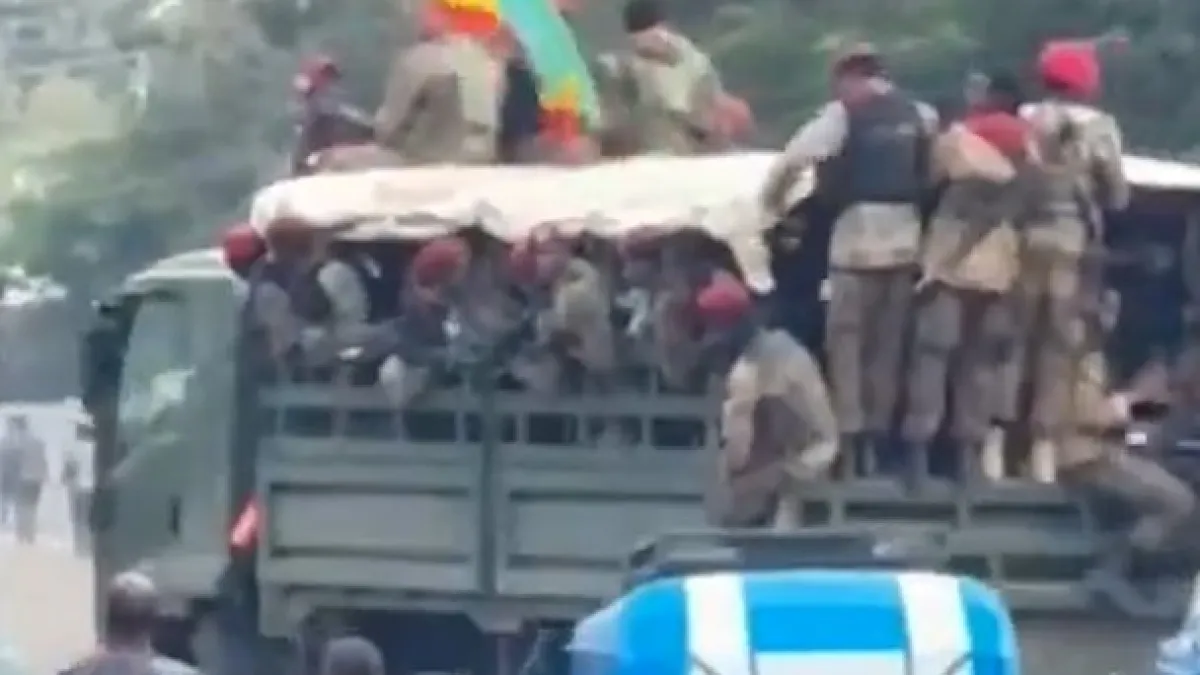
Ethiopia’s government forces say they’ve seized Mekelle from Tigray fighters after a week of intense battles. The fighting has reignited fears of a full-scale war that could draw in neighbouring countries.
Latest polls suggest Lula’s lead over Bolsonaro is narrowing, with neither candidate likely to win outright on Sunday.
Published On 4 Oct 20264 Oct 2026
Brazilian President Luiz Inacio Lula da Silva and right-wing Senator Flavio Bolsonaro have wrapped up their election campaigns, each voicing confidence in victory ahead of Sunday’s tightly contested first-round presidential vote.
Lula, 80, closed his re-election bid on Saturday with a march through Sao Paulo, Brazil’s economic powerhouse, drawing what his campaign called a record crowd for a closing rally.
Recommended Stories
list of 3 itemsend of list
“Tomorrow, we’re going to win the elections in the first round,” he told supporters, describing Sunday’s vote as a choice between “democracy and barbarism” and promising to “defeat the far right”.
He has also framed the election as a test of Brazil’s sovereignty, warning against “meddling” by Washington.
Bolsonaro led a motorcycle caravan through towns in Sao Paulo state, echoing the campaign style of his father, before rallying later in Rio de Janeiro. “I am convinced that everything is in place for us to win this election in the first round,” he said.
The 45-year-old is the son of former President Jair Bolsonaro, a close ally of US President Donald Trump. The former leader, 71, is serving a 27-year prison sentence for attempting to overturn his 2022 election loss to Lula.
The younger Bolsonaro was photographed at his rally holding a portrait of his father.
Trump has not formally endorsed Bolsonaro but has said he is watching the election “very closely”, a level of US interest that has become a flashpoint in the campaign.
Lula’s supporters have seized on it as evidence Washington is trying to meddle in the elections, while some Bolsonaro supporters, frustrated by the cost of living, say they would welcome US pressure if it helped force change at home.
Polls released on Saturday suggested Lula was still ahead but his lead was narrowing, with neither candidate likely to win outright on Sunday. Such a result would send the race to a run-off on October 25 between the two frontrunners, a contest polls suggest would also be close.
It is a far tighter race than Lula’s last victory in 2022, when he beat the elder Bolsonaro by less than two percentage points.
Meanwhile, the Bolsonaro campaign has faced scrutiny over a film-funding scandal. Flavio Bolsonaro is under investigation over financing for Dark Horse, a biopic about his father, bankrolled by a jailed banker tied to one of Brazil’s biggest financial scandals.
Brazil’s Supreme Court authorised federal police in April to investigate whether Flavio Bolsonaro made defamatory statements about Lula.
Bolsonaro has pledged to seek his father’s release from prison if elected, and has echoed his father’s unsubstantiated claims questioning the reliability of Brazil’s electronic voting system, which analysts say could be laying the groundwork to contest the result if he loses.
Beyond the presidency, Brazil’s nearly 160 million registered voters will also choose lawmakers, governors and senators on Sunday.
Ben Gannon-Doak turned North Macedonia inside out and upside down. He is woefully short of minutes for his club, Bournemouth, and lacks sharpness and ruthlessness as a consequence. His delivery has always lacked accuracy.
His raw materials, though, are exhilarating. His pace, his involvement, his number of touches, his chances.
He never left North Macedonia alone. They survived only because he blasted over with one of his chances, shot tamely with another, lost composure with a third one. Having tormented North Macedonia, he allowed them off the hook, but he was a one-man thrill-fest.
He’s 20, that can’t be forgotten. He’s going to be around for a lot of years and will play a heap of big games, but with his club he’s got some decisions to make.
Two minutes against Liverpool, 19 against Sociedad, eight against Brentford, one minute against Newcastle and Man City. The only game he has started this season was a League Cup tie against Lincoln.
Bournemouth is a tough team to get into, but he needs more time on the grass, more opportunity to develop. Maybe a loan move in January would make sense for him, if his club allows him to go. A big ‘if’.
That’s a situation Gannon-Doak needs to resolve for himself – and for Scotland.
William Serafino is a political scientist with a master’s degree in history. His research and analysis have focused on geopolitics. In this interview, he discusses Venezuela’s current relationship with the United States, including a major oil deal and what Donald Trump and Delcy Rodríguez seek to gain from it.
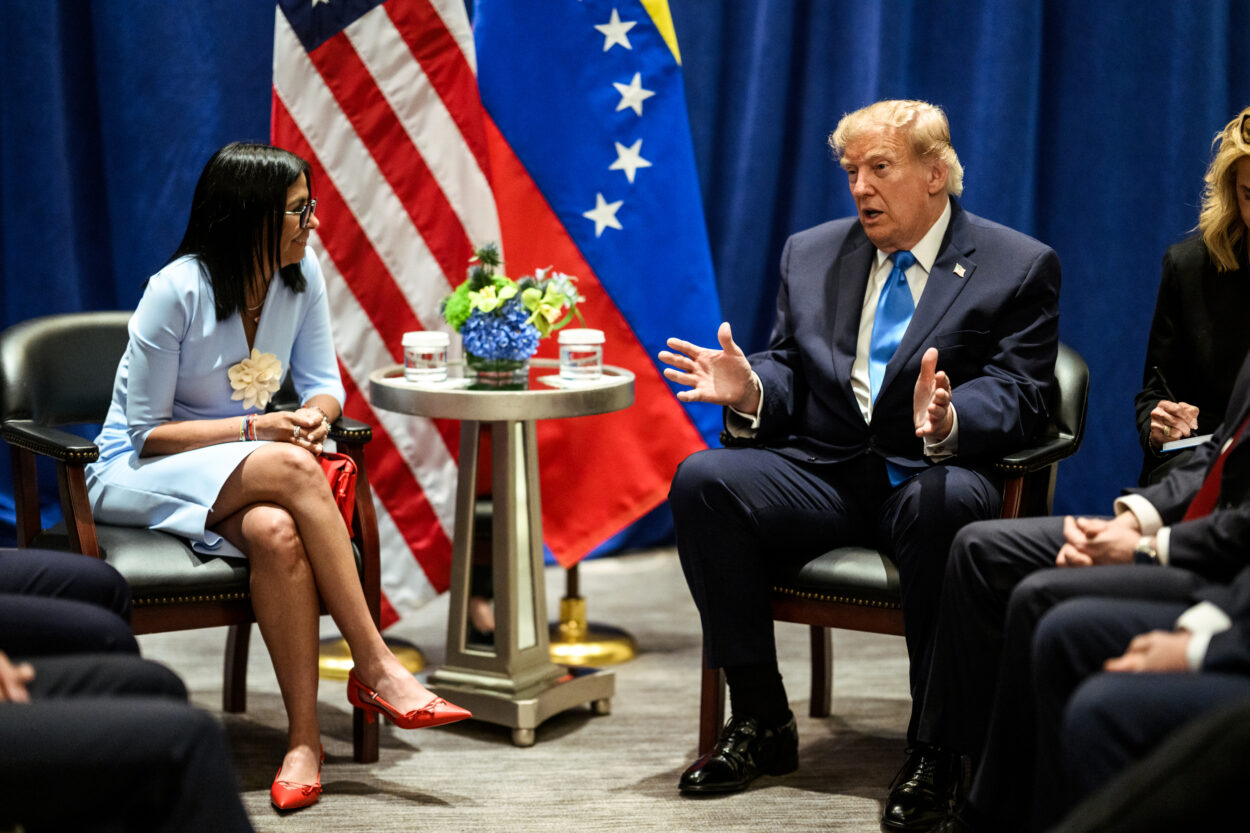
In New York, Venezuelan Acting President Delcy RodríguezthankedTrump for his support and described their bilateral meeting as “historic.” Nearly nine months after the January 3 US bombing and kidnapping of President Maduro, how would you describe the current relationship between Caracas and Washington? Which elements are short-term Trump gimmicks, and which ones will structurally define the relationship in the future?
It is difficult to find a precise definition. Many speak of a protectorate-like condition; some even go so far as to describe it as a relationship of colonial or neocolonial subjugation. Others, however, define it as a process of political, economic, and energy normalization in which the Venezuelan acting government makes tactical concessions, but without formally compromising national sovereignty. I believe the devil is in the details, not in one-size-fits-all approaches. At the level of inter-state relations, what I observe is a strategic attachment of Venezuela to the US sphere of influence and an energy realignment that operates with significant geopolitical restrictions in what concerns relations with Russia, China, and Iran.
At the governmental level, an asymmetrical alliance (favorable to Trump) has been forged in the wake of the military defeat on January 3, from which Caracas and Washington derive immediate and existential gains: Trump cherishes the sole geopolitical achievement of his second term, and Rodríguez gains relief and fresh revenue to govern after more than a decade of suffocating sanctions, within a framework defined by US interests. This reality can hardly be classified as a protectorate, in which a foreign power takes control of diplomacy, defense, and other strategic elements of the subordinate state. Could one speak of a sui generis, or “soft,” protectorate? Perhaps, but that would be an acknowledgment that the concept is not entirely effective in explaining the situation.
The same is true of the thesis of a “retreat with full sovereignty,” which is difficult to sustain when the US is clearly shaping the portrayal of the new national political dynamic and controlling the country’s oil revenues. That is why I have ventured –at the risk of being wrong –to speak of “joint governance” or “co-government,” in which Washington and Caracas divide areas of responsibility and share the political costs of each move so that the alliance endures and each party can, albeit unequally, reap its corresponding share of the benefits.
Trump, despite his constant demeaning tone, needs the Rodríguez administration to be strong enough to lead the country in order to get what he wants; only under such conditions can he extract the oil. And she, too, needs Trump to remain in power so that the oil agreement and other commitments can move forward in the medium term. This is the only way to stay in power and hope to gain legitimacy through performance. I believe that, described in this way, we are talking neither of classic colonialism nor of uncompromised sovereignty, but of something more unique that requires developing other analytical categories.
Rodríguez met Trump on the sidelines of the UN General Assembly in September. (Presidential Press)
In your articles, you have pointed out that the US-Venezuela oil deal must beanalyzedbeyond the announced figures. What do you consider to be the true political and geopolitical scope of this agreement, and what benefits do the various actors seek to extract from it?
I see it more as a political arrangement than a formal agreement. Its function is not legal or institutional, but political. The announcement gave Trump narrative ammunition to promise that gas prices will drop, a necessity driven by his debacle in Iran. By not having signed anything, he avoids going through Congress, sends a message to his core electorate that he is guaranteeing the country’s energy security, and reassures energy corporations to go ahead and invest in Venezuela because the relationship with Caracas is solid and unshakable. Rodríguez, on the other hand, benefits from the fact that the agreement shuts the door on María Corina Machado in Washington’s power circles and thereby helps reestablish her domestic legitimacy, promising a secure path to economic and social recovery underpinned by US investment.
I would go as far as saying that the agreement is Rodríguez’s trump card in a potential presidential campaign, where she will be able to present herself as the only political actor capable of boosting the economy, as opposed to potential rivals who lack influence in the White House and do not have a reliable plan to pull the country out of the spiral of inflation and economic frustration in which it finds itself after years of sanctions.
Both sides stand to gain politically, and the agreement appears to be designed to avoid institutional resistance: neither is forced to face the hassle of legislative approval nor the criticism from political opponents. Since there are no specific clauses, they can more easily divert attention and focus their message on the eventual economic benefits. This level of coordination is a sign of partnership, not of one-sided imposition. If that were the case, Trump could force Rodríguez to sign a bilateral treaty in the National Assembly, and that is not what we are seeing.
You have paid special attention to the role of the Pentagon and the involvement of its Office of Strategic Capital in the structure of the agreement. Why is it so significant that the US defense establishment is a formal actor in a Venezuelanoil deal?
It seems to me that the Pentagon’s involvement serves as a coercive cover—an insurance policy backed by force—to ensure, in the medium and long term, US commercial and financial advantages in the exploitation of the oil fields included in the agreement. Let us imagine that the current government, or another one in the future, wants to modify the arrangement and secure better terms. At that point, it would not be dealing with a conventional transnational corporation, but with one controlled by the Department of War. It doesn’t take much thought to realize that negotiating under such conditions would scare anyone off: the language of business would be replaced by the language of weapons, and after January 3, no one would want to venture into this murky territory.
Furthermore, I believe that the Pentagon’s involvement sends a message to companies to invest and feel secure in the knowledge that the Department of War guarantees their investments and capital commitments in the Venezuelan energy sector. For the US, Venezuela’s oil reserves are not being treated as an economic asset, but rather as a matter of “national security.” As we well know, when that term is used, any coercive tool is fair game against a country’s sovereignty.
Serafino argues that the oil deal with Trump could be a “trump card” for Delcy Rodríguez in a future electoral campaign. (El Salto)
You have argued that the relationship between Caracas and Washington is taking on the characteristics of a negotiation marked by a profound power asymmetry. And many official spokespeople or analysts ask, “But what alternative do we have?” whenever criticism is raised about the path the government has chosen. What real ability does Venezuela have today to negotiate different terms or reject certain demands from the United States?
Right now, those capabilities are very limited, because, as I said, it’s not just a matter of US impositions, but also of calculating how to obtain tangible benefits from an asymmetrical relationship. But politics also takes place outside institutional spaces, and I believe there is much to be done there. What I’m about to say won’t, I don’t think, resolve the dilemma you’ve raised, but it could be a path toward regaining political vitality and initiative: strengthening social consensus on national sovereignty, refusing to concede the battle for historical memory regarding a century-long history of US plunder, and fostering a broad discussion on the vision for the nation’s future. These steps could help break the inertia somewhat and prepare the country for more favorable political conditions in the near future. In contrast, suggesting specific policies or positions to the current government would be irresponsible, because I’m not the one who has to deal with a Trump and his violent ego.
My message is directed at all of us who do not hold such high-stakes positions and can contribute, from our own small spheres of influence or through our individual activism, to rebuilding a patriotic consciousness that must adapt to a new reality. How many open forums are being promoted to discuss the educational model, the economic model, and the model of income distribution? Which bodies are evaluating the trajectory of the bilateral relationship with the US in order to better address it? Are these discussions conceptually limited? Perhaps these debates will not change the current situation of Trump’s disproportionate influence, but they would give us autonomy in our vision and in shaping the future. If Venezuela does not have its own vision on major national issues, there is a risk that they will end up being imposed from Washington. That would be committing the perfect crime, and I believe we must avoid it: with national unity, transcending political divisions.
In your articles and social media posts, you have criticized political elites who, historically, have lacked “imagination” beyond offering lucrative deals to the US. How did Chávez manage to break that mold? How could Venezuela return to a more sovereign path?
To be fair, Chávez broke the mold but the political and geopolitical conditions were ripe for it. The weakness of the national elites, discredited by a society weary of inequality and injustice, coincided with the US being drunk on power at the end of the Cold War. In its plans to establish itself as a unipolar superpower, Latin America did not figure as the central battleground. The inattention of an empire more concerned with reshaping West Asia, forcing China into the “rules-based order,” and eliminating the last strongholds of the socialist bloc (Tito’s Yugoslavia) in turn allowed Chávez to implement his agenda without facing a full-scale war, although he did face numerous coup attempts.
The present conditions are different. There is a hemispheric imperial retreat underpinned by a militarized reinterpretation of the Monroe Doctrine, which drastically raises the cost of sovereignty-oriented proposals. Still, I believe that what is most commendable about Chávez, and which can be of use in this new context, is his ability to clearly identify favorable conditions and act upon them.
I believe that anyone who considers themselves a political figure must build upon these principles to take on the new challenges of the present, developing and defending a dignified vision of the nation’s future. I believe that, rather than waiting for another Chávez to emerge, we should instead study his thought in depth and draw on the best of it to renew political practices, always interpreting the situation for what it is: changing, volatile, and full of opportunities. Chávez is a great political school, but it has been reduced to a crude tool for private interests of all kinds.
Serafino referred to Chávez as “a great political school.” (Comando Creativo mural in Ciudad Caribia)
United States President Donald Trump has increased the pressure on US Senate Republicans to make Daylight Saving Time permanent, singling out one of the body’s members for stalling legislation to end the twice-a-year changing of clocks.
In a social media post on Saturday, Trump blasted US Senator Tom Cotton for “holding up” the Sunshine Protection Act, which Trump has personally opted to call the “No More Changing of Clocks Act”.
Recommended Stories
list of 3 itemsend of list
“For some reason, Tom is stopping the Bill and, in the Senate, it’s very easy to do, it only takes one!” Trump wrote on his Truth Social account about the Arkansas Republican. “It should pass overwhelmingly, in a Bipartisan fashion”.
“Nobody wants to spend their precious time running all over the place, turning Clocks back twice a year and, having sunshine in the afternoon is better than early in the morning!” he added.
Trump went even further, publishing what he claimed was Cotton’s phone number as he implored Arkansas residents to pressure him. The move echoed a moment during the 2016 Republican presidential primaries, when then-candidate Trump gave out US Senator Lindsey Graham’s number after the former rival criticised him.
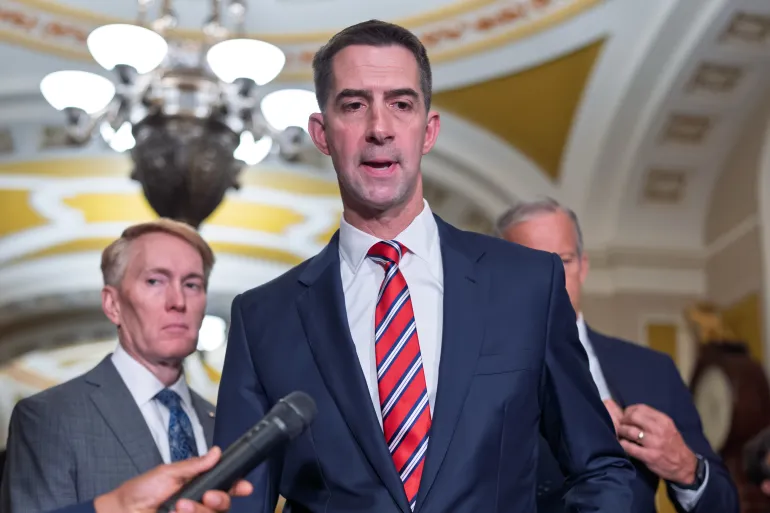
US Senator Tom Cotton speaks to reporters at the US Capitol in Washington [File: J. Scott Applewhite/AP Photo]
Al Jazeera called the number listed in Trump’s post, but an automated message stated the voicemail box was full. Cotton’s spokesperson and the White House did not respond to requests for comment.
The president has routinely pushed Senate Republicans to pass legislation mandating year-round daylight saving, which would end Americans’ decades-long practice of changing their clocks twice a year to increase daylight hours. On Friday, Trump urged the US Senate to approve the bill, which passed the US House in July by a 308-117 vote.
Cotton has previously opposed the bill, arguing in a US Senate floor speech last year that farmers, construction workers, commuters and children heading to school would begin their days in the dark during the winter.
Trump disputed that argument in a separate post on Saturday, saying the bill “would be a very nice and easy WIN for the Republican Party”.
“If Tom Cotton were putting Arkansas first, he would give them an extra hour of daylight and, more importantly, they wouldn’t have to run all over their houses, farms, workplaces, and everywhere else, twice a year, having to change their Clocks, and often forgetting to do so”, Trump wrote.
Trump, an avid golfer, also highlighted what he considered to be another selling point of the bill: the North American Professional Golfers’ Association (PGA) tour.
“The PGA TOUR, as an example, needs more Daylight in the afternoon in order to finish their Tournaments”, he wrote in a post, which included a letter from PGA Tour CEO Brian Rolapp supporting the bill. “Likewise, regular Golfers, Tennis Players, Hunters and, perhaps more importantly, Farmers who want more Daylight to play or work.”
The US president, who spent part of Saturday at his golf club in Sterling, Virginia, indicated in a subsequent post that he had received personal feedback on the proposal: “I don’t know about anyone else, but a table full of very distinguished people just told me that they HATE, immediately after a mandatory time change, going home at night – and it’s DARK. It’s depressing!”
In 1974, the US Congress briefly adopted year-round daylight saving time in response to the country’s energy crisis. But Congress repealed the law less than a year later over safety concerns as children commuted to school before sunrise.
US senators left Washington this week and have no set plans to return until after the November 3 midterm elections.
Some members, such as Senator John Kennedy, weren’t optimistic that Senate Republican Leader John Thune would bring the bill up for a vote before polling day.
“It’s dead as disco,” the Louisiana Republican told Reuters this week of Trump’s push to make daylight saving time permanent. “My sense is it would have trouble passing … I don’t think the leader is going to bring it up.”
The emperor is a symbol of Bulgarian national identity whose repatriation stoked tensions with Greece.
Published On 3 Oct 20263 Oct 2026
More than 1,000 years after his death, the remains of medieval ruler Czar Samuel have arrived in Bulgaria.
A symbol of Bulgarian national identity, Samuel was a warrior emperor who battled the Byzantine Empire to expand his kingdom before suffering defeat and dying soon after in 1014. His supposed remains were discovered in a Greek border area in the 1960s.
Recommended Stories
list of 4 itemsend of list
The coffin and remains were flown on Saturday to the Bulgarian capital, Sofia, on board a military aircraft that was surrounded by air force fighter jets.
Thousands of people poured into a public square to honour the czar’s arrival, which capped years of fraught negotiations between Bulgaria and Greece until an accord was reached this week.
Bulgarian politicians across the spectrum paid tribute to the medieval ruler, listening to the national anthem and a 21-gun salute.
“Today, we Europeans are learning to read history with a desire to belong not only to our homeland, but also to the culture that unites us across the entire European continent,” Bulgarian Prime Minister Rumen Radev said.
“That is why Europe must not reopen old wounds but must work for peace as the supreme good,” Radev continued, referring to the centuries-old rivalry between neighbouring Greece and Bulgaria.
Crowds cheered as fighter jets performed a flypast.
Martin Nestorov, a 42-year-old software engineer, told the AFP news agency he attended the ceremony “to welcome Czar Samuel back to Bulgaria, where he belongs”.
“I am here because I am Bulgarian, and a Bulgarian is returning to his homeland,” added Tsanka Zlatkova, 65, a retired art historian.
A procession brought the remains to be laid in the Church of Saint Sofia, a sixth-century basilica that is the capital’s namesake and where church officials say Samuel was baptised.
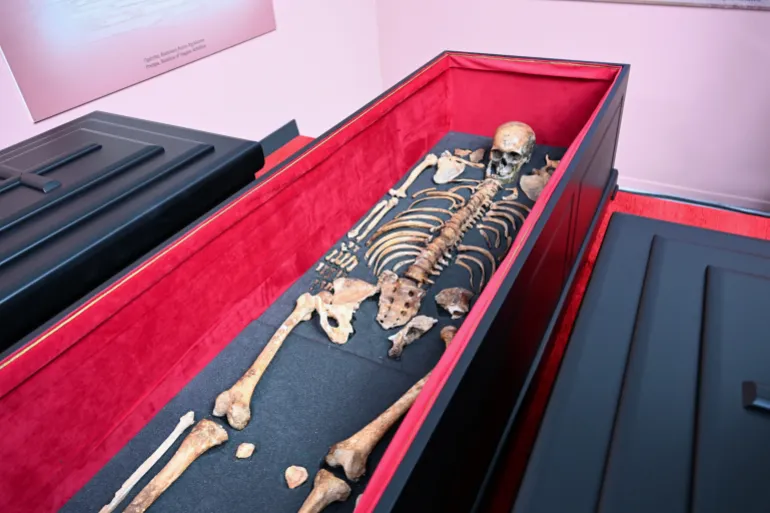
The remains of medieval ruler Czar Samuel inside a coffin Saturday, October 3, 2026 [Giannis Papanikos/AP]
Competing claims
The handover of Samuel’s remains is part of a broader accord between the Greek and Bulgarian culture ministers.
In exchange, Greece is slated to receive 48 objects that Bulgarian troops pillaged from churches and monasteries in Greece during World War I.
Speaking before the handover, Greek Prime Minister Kyriakos Mitsotakis said he hoped the ceremony would boost Greece’s campaign to repatriate the Parthenon Marbles, a collection of 2,500-year-old marble sculptures taken from the Acropolis in Athens and later displayed in the British Museum.
“The global community is essentially re-evaluating its longstanding stance on protecting cultural heritage,” Mitsotakis said, adding that historical heirlooms “cannot be treated as the spoils of war”.
Bulgaria is not the only country to have claims on Samuel. A huge statue of the czar stands in the North Macedonian capital of Skopje, with Macedonians claiming him as “their” ruler.
In 2022, a bilateral commission recommended presenting Samuel as the head of a state that “most contemporary historiographers consider to be the Bulgarian Empire”, based in what is currently North Macedonia.
A progressive move down the right gave Gloucester fly-half Charlie Atkinson – three days after he signed a new deal committing his long-term future with the club – the opportunity to find Ben Loader free on the left with a pinpoint kick, and the winger dotted down to open the scoring.
Harlequins, in their desperation to keep Gloucester out on their own try line, lost Will Evans to the sin bin and mere seconds later Wales flanker Morgan barged over in the left corner to extend Gloucester’s lead.
On the stroke of half hour, Morgan’s strong carry allowed Will Trenholm to force over Gloucester’s third try from close range before George Barton slotted the conversio superbly from touch.
A spectacular 50:22 from scrum-half Caolan Englefield then put Gloucester in another great position and Charlie Atkinson broke a tackle to go over next to the sticks, as Barton kicked an easy extra two to give the hosts a 24-point advantage at half-time.
The interval did not change the momentum as two short passes saw Seb Atkinson race to the line and power over Gloucester’s fifth of the evening and Quins’ day was perhaps summed up best when Connor Slevin’s poor restart failed to go 10 metres.
Gloucester ruthlessly made their visitors pay once more as with their next attack Will Joseph’s outstanding run and offload allowed Englefield to dive over.
Joseph then grabbed the try his own performance deserved, diving in to the right of the posts to claim Gloucester’s seventh try and third inside 12 minutes after half-time.
Another kick to the corner from Charlie Atkinson found Barton who juggled successfully and managed to extend over for Gloucester’s eighth.
Joseph thought he had scored his second with the final act of the match to take Gloucester past 50 points, but his try was chalked off for a knock-on in the build up.
Gloucester: Barton; Thorley, Joseph, S. Atkinson, Loader; C. Atkinson, Englefield; Rapava-Ruskin, Lake (capt), Fasogbon, Kleyn, Clark, Thomas, Morgan, Trenholm.
Replacements: Innard, Bleuler, C. Knight, Clement, Ludlow, Robson, W. Knight, Denny.
Who: Portugal vs Norway What: UEFA Nations League 2026-27, Group A4 match Where: Estadio do Dragao, Porto, Portugal When: Sunday, October 4, at 8:45pm local time (18:45 GMT) How to follow: Al Jazeera Sport will bring you all the build-up and live updates from 15:45 GMT.
For the second time in a week, Portugal and Norway clash in the UEFA Nations League. But this time, things are not quite the same in the Selecao camp.
Recommended Stories
list of 4 itemsend of list
Sunday’s fixture in Porto will see the Nations League title holders play without their talisman, Cristiano Ronaldo, after the 41-year-old abruptly left their camp, raising questions about his international future.
Ronaldo’s dramatic exit and apparent rift with new coach Jorge Jesus have dominated headlines worldwide. Portuguese players have largely blocked the outside noise, however, maintaining a perfect record at the tournament where they are chasing a record-extending third crown.
However, their striker Erling Haaland – one of Europe’s most lethal players – poses enough danger to put Portugal under pressure ahead of this weekend’s thrilling encounter.
What is the UEFA Nations League?
The UEFA Nations League was founded in 2018 to reduce the number of meaningless friendlies and give nations competitive matches against top-ranked teams.
In this competition, countries from across Europe participate in a league structure which features promotion and relegation.
What is the latest news on Cristiano Ronaldo?
Ronaldo left the squad late on Wednesday, shortly after a news conference in which coach Jesus confirmed the five-time Ballon d’Or winner would be left out of his starting line-up for a second consecutive Nations League game.
The 41-year-old’s decision to walk out came as a shock as he had been due to train with his teammates at the Parken Stadium in Copenhagen.
Portugal’s leading scorer with 146 goals had already spent the entirety of last weekend’s 2-1 Nations League win in Norway on the bench, having captained the side in the 1-0 home victory over Wales last Thursday.
He appeared to indicate that the reasons behind Jesus’s decision ran deeper and hinted at a departure from the national team he has graced for more than two decades.
“In due course, I will tell the truth to all the Portuguese people about my reasons for leaving the national team, to which I have always been dedicated,” Ronaldo said in a cryptic Instagram post, announcing his sudden exit from the camp.
Spanish sports daily Marca said that Jesus and Portuguese federation president Pedro Proenca followed Ronaldo to Copenhagen airport in an attempt to persuade him to stay with the squad, before the player boarded his private jet.
Jesus insisted earlier on Wednesday that there was no rift between them, although the 72-year-old, who was appointed in July, acknowledged that his captain was disappointed to remain on the bench against Norway.
How have Portugal and Norway played in the Nations League?
Portugal are on top of Group A4 on nine points, with three wins out of three. They started their campaign with a 1-0 home win over Wales, before adding a 2-1 victory over Norway in Oslo. In the last match, they thrashed Denmark 4-2 in Copenhagen.
Norway are second-bottom in the group, with only three points. They started their campaign with a 3-2 home win over fellow Scandinavians Denmark but suffered identical 2-1 defeats at home to Portugal and to Wales in Cardiff.
Joao Felix and Goncalo Ramos scored for Portugal, while Haaland struck the consolation goal for Norway.
Portugal vs Norway: Head-to-head
Matches: 12
Portugal wins: 9
Norway wins: 1
Draws: 2
Portugal vs Norway: Form guide
(Last five games, latest results first)
Portugal: W-W-W-L-W
Norway: L-L-W-L-W
Who are the top players to watch?
Joao Felix and Goncalo Ramos (Portugal): Al Nassr forward Felix has emerged as the reliable scorer in the Portugal setup, finding the net in each of the three games this term. Meanwhile, Ramos, playing in place of Ronaldo, has made up for CR7’s absence with goals in the last two matches.
João Felix of Portugal has scored in every Nations League game this season [File: Diogo Faria Reis/MB Media/Getty Images]
Erling Haaland and Oscar Bobb (Norway): All of Norway’s goals in the ongoing competition have come through Haaland (three) and Bobb (two). While their partnership proved successful in the opening match, their goals were not enough in the following matches, as the Norwegians suffered back-to-back defeats. Norwegians will demand better from Haaland, especially after the Manchester City talisman’s incredible start to the club season that features seven goals in as many games.
Team news and predicted lineups
Portugal
Winger Francisco Conceicao is doubtful for the game due to a thigh injury.
Probable Portugal XI: Diogo Costa; Joao Cancelo, Ruben Dias, Renato Veiga, Nuno Mendes; Ruben Neves, Vitinha; Pedro Neto, Bruno Fernandes, Rafael Leao; Goncalo Ramos
Norway
Wing-back Julian Ryerson is doubtful with a muscle injury, while centre-back Torbjorn Heggem is suspended.
Probable Norway XI: Orjan Nyland; Julian Ryerson, Kristoffer Ajer, Torbjorn Heggem, David Moller Wolfe; Martin Odegaard, Sander Berge, Patrick Berg; Oscar Bobb, Erling Haaland, Antonio Nusa
Norwegians need Erling Haaland to be on the scoresheet if they are to beat Portugal [File: Marius Nordnes / Nordnes Foto/Getty Images]
Portugal vs Norway: TV channel, livestreaming
Portugal
Norway
United Kingdom: ITV1
United States: FOX Sports, FuboTV, ViX
India: Sony Sports Network
Middle East and North Africa: beIN SPORTS
South Africa: DStv Stream
You can find your regional broadcaster on UEFA’s official broadcaster listing.
Multiple media reports have named the Flydubai co-pilot as Omani national Hamam al-Hammami, who UAE’s prosecutor general said attempted a ‘terrorist’ attack.
Washington, DC – Democrats have the momentum; Republicans are surging in defence and cash.
That narrative has emerged ahead of the United States midterm elections in November, as races across the country enter their final stretch.
Recommended Stories
list of 3 itemsend of list
With control of the US House of Representatives and the US Senate at stake, Democrats begin October with a surprisingly rosy outlook as more congressional seats are seen as in play.
Republicans, meanwhile, appear to be in damage control, pouring millions of dollars into races once seen as secure victories while injecting more funding into a handful of marquee showdowns.
The party’s standard bearer, President Donald Trump, who has embraced the notion of the election being a referendum on his leadership, enters the final month with staggeringly low approval ratings.
The most recent Associated Press-NORC polling, released on Thursday, showed Trump with 31 percent approval, the lowest during either of his two terms. Only 26 percent of respondents approved Trump’s handling of the economy, dipping two points below his predecessor, former President Joe Biden’s lowest rating on the topic.
Surveys continue to show voters rank the economy as their top issue, with topics like gas prices, made higher by the US-Israel war with Iran, dominating their concerns. Immigration and corruption have also regularly ranked high.
“The broad stroke is that Americans are disappointed, bordering on angry that President Trump hasn’t delivered on the core promises he made when he won re-election,” according to Henry Olsen, a senior fellow at the conservative Ethics and Public Policy Center in Washington, DC.
House looking solid for Dems
Political trackers have long projected Democrats will take control of the US House of Representatives in the November 3 vote.
Winning a majority in the 435-member chamber from Republicans would give the party renewed legislative power to assert leverage over Trump, while launching investigations into his administration’s dealings. Top Democrats have already signalled that probes into Trump’s family business dealings would be top priorities.
Two election non-partisan prediction authorities, the Cook Political Report and the University of Virginia’s Sabato’s Crystal Ball, have recently assessed that the likelihood of Democrats taking the House has only increased.
The Cook Political Report recently shifted 15 House races in the direction of Democrats, moving some considered “toss-ups” to “leans Democrat” and some previously considered “lean Republican” to “toss-ups”.
One such shift was for a Texas border district represented by Republican Monica De La Cruz. Her district was emblematic of a wider Latino shift towards Trump in 2024. Once seen as holding the advantage over her challenger, Democrat Bobby Pulido, Cook now rates her race as a “toss-up”.
All told, the political analysis clearinghouse now predicts Democrats are on track to win 5 to 15 House seats.
Senate in play
With 30 days left to go, “there’s much more drama in the Senate than the House races”, according to Kyle Kondik, the managing editor at Sabato’s Crystal Ball.
Once considered a pipe dream for Democrats, who need a net gain of at least four seats to win a slim majority, the 100-member chamber has moved within a more comfortable striking distance.
Unlike in the House, where every seat is up for re-election, only 35 Senate seats are up for grabs in this cycle, creating a far narrower pathway to control.
“The trajectory of the polling since Labor Day (September 7) has generally been that a bad Republican environment is just getting worse,” Kondik said, adding that “the Senate just seems to get more and more competitive as the cycle has gone on”.
To be sure, the quality of polling can vary across the country, with Kondik cautioning that gauging the political temperature of the Midwest has been particularly challenging for pollsters.
Still, in North Carolina, former Democratic Governor Roy Cooper is expected to trounce former Republican National Committee chairman Michael Whatley in the race for a Senate seat currently held by Republicans. Top conservative donors have already begun to divert funds from the contest.
Surveys have consistently shown Democrats leading in three other races for seats currently held by Republicans: Democrat James Talarico against Republican Ken Paxton in Texas; Democratic challenger Sherrod Brown against Republican incumbent Senator John Husted in Ohio; and Democratic Mary Peltola against Republican Dan Sullivan in Alaska.
Races for Republican held seats in Iowa, between Republican Ashley Hinson and Democrat Josh Turek, and in Maine, between Republican incumbent Susan Collins and Democratic challenger Troy Jackson, remain separated by less than one point, according to Real Clear Politics polling averages.
Democrats, meanwhile, have consistently led in polling in Senate races in Georgia, New Hampshire and Michigan for seats the party currently holds.
Big money in the race
For Republicans, salvation could be in the spending, with this year’s race continuing a US phenomenon of small fortunes poured into politics.
All told, at least $4bn had been spent on gubernatorial and congressional midterm advertising buys as of September 17, putting the race on track to become “perhaps the most expensive midterm on record”, according to Michael Franz, co-director of the Wesleyan Media Project.
Republicans entered September with a considerable funding edge. The Republican National Committee had $125.6m on hand, with the Democratic National Committee trailing far behind with $16.9m and $17.6m in debt.
When accounting for the three major committees associated with both groups, the Republican Party had $233.4m in cash, according to a CNBC analysis, while the Democratic Party had $130.4m.
Trip Yang, a Democrat strategist based in New York City, told Al Jazeera such spending can be deployed to help boost a candidate’s name recognition or to tear down a competitor.
According to AdImpact, Republicans and their allies were set to spend $888m on advertising from mid-September to election day, with Democrats and their supporters set to spend $666m.
The firm found pro-Republican ad spending would be particularly pronounced in the key Senate races in Ohio, Texas and Michigan, outpacing Democratic spending by at least $24m in each state.
Trump’s unpopularity, Yang said, means “Republicans spending millions or hundreds of millions of dollars improving their candidates’ images by itself may not be enough”.
“If you’re a little bit handicapped because your president is so toxic, you try to spend your hundreds of millions of dollars attacking the Democrats to make it more of a food fight,” he said.
A New York Times analysis estimated by the end of August at least $1bn in so-called “dark money” had been poured into the midterms. The term refers to spending where the donor’s identity is shielded, typically through nonprofit and shell-company donations to Super PACs.
Industry groups, including those supporting Crypto, AI and online betting firms, are expected to be top spenders in key races, although their support tends to cut across partisan lines.
Trump, meanwhile, has pledged to spend between $400m and $500m from his MAGA Inc Super PAC, though it has so far spent about $15m to support Paxton’s Senate bid in Texas.
Pro-Paxton ad reservations far outpaced Talarico in September, according to AdImpact data analysed by NPR, with $94m spent compared with $30m to support the Democrat.
The Trump factor
Trump has pledged to spend the final days before the election in non-stop campaign mode, after urging supporters during his Republican Midterm Convention in Dallas, Texas, to “vote like I’m on the ballot”.
His plan to criss-cross the country for rallies underscores a “base turnout” strategy meant to energise voters already loyal to the party, according to conservative analyst Olsen.
“But the Republican problem is a persuasion problem with people in the middle,” Olsen said. “[Trump’s campaigning] might help with some turnout … but their real problem is persuasion, and it’s not something that’s going to help with that in the slightest.”
Polls have spelt trouble for Republicans when it comes to swaying independents, with a PBS News, NPR and Marist poll from September 23 showing unaffiliated voters breaking for Democrats at 57 percent compared with 32 moving towards Republicans.
US President Donald Trump participates in a midterm election rally for Oklahoma Republican gubernatorial candidate Mike Mazzei at the Choctaw Event Center in Durant, Oklahoma, US, October 1, 2026. [Nick Oxford/Reuters]
The scenario has created a dilemma for some top Republican candidates over whether to break from the president on his most controversial actions, according to Lee Miringoff, the director of the Marist University Institute for Public Opinion.
Senate candidates Ashley Hinson in Iowa, Jon Husted in Ohio and Mike Rogers in Michigan all recently put daylight between themselves and Trump on the war with Iran.
One Republican House candidate, Representative Maria Elvira Salazar, has criticised Trump’s aggressive immigration enforcement policies as she seeks to rally Latino voters in South Florida.
Trump, in turn, reposted a social media message calling Salazar a “backstabber”.
“You need to have, you know, something else going for you other than endorsement of Trump,” said Miringoff. “Some Republicans are starting to have self-preservation kick in because they’re concerned.”
What can change?
Achieving a wide-scale shift in public opinion remains a tall order for Republicans in the final stretch of the race.
Many of the defining issues are unlikely to change before November, with Trump signalling a possible escalation with Iran following the vote as he has downplayed the prospect of short-term affordability relief.
At the same time, the US president has also not ruled out actions that rights groups say could upend voter turnout. Most recently, he refused to commit to not invoking the Insurrection Act or declaring a state of emergency surrounding the vote during an interview with Time magazine.
Miringoff said he believed that the “potential for more than just a marginal shift is there”, as he assessed some Democratic candidates have struggled to present clear visions beyond opposition to Trump.
“The result isn’t formed in concrete,” he said, “to the degree that there’s going to be a lot of money still spent.”
Analyst Olsen saw less remaining wiggle room for the party.
“Republicans have the time and the resources to change the outcome with respect to a few close Senate races,” Olsen said. “But to change direction, they would need something that would be apocal.”
The multi-vehicle crash occurred in the Salama area, 90km southeast of Nairobi, killing mostly Catholic pilgrims.
Published On 3 Oct 20263 Oct 2026
At least 17 people, most of them Catholic pilgrims on the way to a prayer site, have been killed in a crash involving multiple vehicles on the highway to the Kenyan coastal city of Mombasa.
The crash in the Salama area, about 90 kilometres (about 55 miles) southeast of the capital Nairobi, happened after midnight, police said on Saturday.
The crash occurred when a truck driver tried and failed to overtake another truck; that caused a collision with vehicles including a van carrying pilgrims, police said.
Kenyan media reported that the pilgrims were travelling in a 14-seater minibus.
The van’s driver and 16 passengers, most of them women, died at the scene, police said.
The pilgrims were going to a prayer site in Nakuru County, west of Nairobi, said Martin Kivuva, archbishop of the Catholic Archdiocese of Mombasa.
The archbishop said in a statement that he and others were “saddened with lots of grief” over the deaths.
President William Ruto offered condolences to the families, friends, parishioners and the entire Catholic community “who are mourning this painful loss”.
Kenya’s National Transport and Safety Authority (NTSA) launched an investigation into the crash.
The NTSA said it dispatched investigators “to establish the full circumstances leading to the collision”.
But it noted that the stretch of road where the crash occurred is a known “black spot” and that “recommendations have been made to address safety concerns” regarding the route.
Road accidents are a problem across Africa. In Kenya and elsewhere in the region, the accidents are often blamed on poorly maintained vehicles, excess speed and poor road conditions.
Kenya recorded 5,009 road traffic deaths last year, while 2,150 deaths were reported in the first six months of 2026, local media reported, citing numbers from the NTSA.