Politics Desk

FBI probes cases of missing or dead scientists, including four from the L.A. area

Amid growing national security concerns, the FBI said Tuesday that it has launched a broad investigation in the deaths or disappearances of at least 10 scientists and staff connected to highly sensitive research, including four from the Los Angeles area.

“The FBI is spearheading the effort to look for connections into the missing and deceased scientists. We are working with the Department of Energy, Department of War, and with our state and state and local law enforcement partners to find answers,” the agency said in a statement.

The FBI’s announcement comes after the House Oversight Committee announced that it would investigate reports of the disappearance and deaths of the scientists, sending letters seeking information from the agencies involved in the federal inquiry as well as NASA, which owns the Jet Propulsion Laboratory in La Cañada Flintridge, where three of the missing or dead scientists worked.

“If the reports are accurate, these deaths and disappearances may represent a grave threat to U.S. national security and to U.S. personnel with access to scientific secrets,” Reps. James Comer (R-Ky.), chairman of the committee, and Eric Burlison (R-Mo.) wrote in the letters.

President Trump told reporters last week that he had been briefed on the missing and dead scientists, which he described as “pretty serious stuff.” He said at the time that he expected answers on whether the deaths were connected “in the next week and a half.”

Michael David Hicks, who studied comets and asteroids at JPL, was the first of the scientists who disappeared or died. He died on July 30, 2023, at the age of 59. No cause of death was disclosed.

A year later, JPL physicist Frank Maiwald died at 61, with no cause of death disclosed.

Two other Los Angeles scientists are part of the string of deaths and disappearances.

On June 22, 2025, Monica Jacinto Reza, a materials scientist at JPL, disappeared while on a hike near Mt. Waterman in the San Gabriel Mountains.

On Feb. 16, Caltech astrophysicist Carl Grillmair was fatally shot on the porch of his Llano home. The Los Angeles County Sheriff’s department arrested Freddy Snyder, 29, in connection with the shooting. Snyder had been arrested in December on suspicion of trespassing on Grillmair’s property.

Snyder has been charged with murder.

There is no evidence at this point that the deaths and disappearances, which occurred over a span of four years, are connected.

A spokesperson for NASA, which owns JPL, said in a statement on X that the agency is “coordinating and cooperating with the relevant agencies in relation to the missing scientists.

“At this time, nothing related to NASA indicates a national security threat,” agency spokesperson Bethany Stevens wrote. “The agency is committed to transparency and will provide more information as able.”

Representatives from Caltech did not immediately respond to a request for comment.

Source link

Warsh says he got no pressure from Trump to cut rates even as president publicly pushes for them

President Trump’s nominee to chair the Federal Reserve said Tuesday that he never promised the White House that he would cut interest rates, even as the president renewed his calls for the central bank to do so.

“The president never once asked me to commit to any particular interest rate decision, period,” Kevin Warsh, a former top Fed official, said under questioning by the Senate Banking Committee. “Nor would I ever agree to do so if he had. … I will be an independent actor if confirmed as chair of the Federal Reserve.”

Warsh’s comments came just hours after Trump, in an interview on CNBC, was asked if he would be disappointed if Warsh didn’t immediately cut rates and responded, “I would.”

The comments underscore the challenge faced by Warsh, 56, a financier and former member of the Fed’s board of governors whom Trump named in January to replace the current Fed chair, Jerome H. Powell. Democrats on the committee accused Warsh of flip-flopping on interest rates over the years, supporting higher interest rates under Democratic presidents and advocating rate cuts during Trump’s time in office. Investors are watching the hearing closely to see how Warsh balances Trump’s demands with worsening inflation, as the war in Iran pushes up the price of gasoline.

Higher inflation typically leads the Fed to raise rates, or at least keep them unchanged, rather than cut them. When the Fed changes its key rate, it can affect mortgages, auto loans and business borrowing.

Yet Warsh’s account was challenged by Sen. Ruben Gallego, an Arizona Democrat, who said that Wall Street Journal reporting last year found that Trump had urged Warsh to reduce borrowing costs.

“Who’s lying here? Is it you or the president?” Gallego asked.

“I think those reporters need better sources,” Warsh responded.

For all the back and forth, the hearing didn’t appear to advance Warsh’s nomination, which has been delayed by a Justice Department investigation into the Fed and Powell, over brief testimony Powell gave last June before the same panel about a building renovation.

Sen. Thom Tillis, a North Carolina Republican on the committee, reiterated Tuesday he wouldn’t vote for Warsh until the investigation is dropped. With the committee closely divided and all Democrats opposed to his nomination, Tillis’ opposition is enough to bottle it up in committee.

“We have got to get rid of this investigation,” Tillis said, “so I can support your nomination.”

Tillis has previously said that all seven Republicans on the committee have signed a letter stating that Powell did not commit a crime when he testified before the panel last June. Federal prosecutors, led by U.S. Atty. Jeanine Pirro, are investigating his testimony for potential perjury, though a judge said last month they offered no evidence to support the charge when he threw out subpoenas Pirro had issued.

Prosecutors from her office as recently as last week sought access to the Fed’s building project but were turned away, revealing that the Trump administration has not reversed course despite opposition from members of his own party that are essential to Warsh’s confirmation.

In his opening remarks, Warsh told the Senate Banking Committee that one of his top goals would be to fight inflation, which remains elevated at 3.3% annually.

“Congress tasked the Fed with the mission to ensure price stability, without excuse or equivocation, argument or anguish,” Warsh said. “Inflation is a choice, and the Fed must take responsibility for it.”

Warsh would be in a tough spot if confirmed. Inflation is worsening, making it much harder for the Fed to implement the interest rate cuts Trump so desperately seeks. The conflict could also slow the economy, as well as hiring. And if Warsh ultimately becomes chair, he may very well find his predecessor, Powell, still sitting on the Fed’s governing board, an uncomfortable arrangement that hasn’t occurred since the late 1940s.

Warsh said the Fed’s political independence is “essential,” and that the central bank wasn’t threatened when “elected officials — presidents, senators, or members of the House — state their views on interest rates.” Trump has repeatedly urged Powell to cut the Fed’s key rate from its current level of about 3.6% to as low as 1%, a view almost no economist shares.

Sen. Elizabeth Warren, a Massachusetts Democrat, said that Trump has not just stated his opinions on rates, but has sought to fire a Fed governor and is investigating Powell.

“The Senate should not be aiding and abetting Donald Trump’s illegal takeover of the Fed by installing his chosen sock puppet as chair,” she said Tuesday.

Warren also noted that Warsh has not disclosed all of his financial holdings, which include investments in startups and private companies, or the size of those financial stakes. For example, Warsh has said he has holdings in SpaceX and Polymarket, but has not said how large those investments are.

Warren charged that Warsh is not in compliance with ethics requirements. Warsh argued that the Office of Government Ethics has signed off on his plan to sell all his assets within 90 days of his confirmation.

The turmoil could make a potential transition from Powell to Warsh an unusually turbulent one for the world’s most pivotal central bank, which has historically experienced smooth transfers of power. Should the change in leadership prove particularly bumpy, it could unnerve markets and lift longer-term interest rates.

Powell’s term as chair ends May 15. He said last month that he would remain as chair until a successor is named. Powell also is serving a separate term as a member of the Fed’s governing board that lasts until January 2028. Fed chairs typically leave the board when their terms as chair end, but Powell said last month he would remain on the board, even if a new chair is approved, until the investigation is dropped.

Trump said he would fire Powell if he attempted to remain at the Fed. Yet Trump’s previous attempt to remove a Fed governor, Lisa Cook, has been tied up in court. During oral arguments in January, a majority of justices on the Supreme Court appeared to lean toward leaving Cook at the Fed.

Rugaber writes for the Associated Press.

Source link

Democratic Rep. Sheila Cherfilus-McCormick of Florida resigns amid ethics investigation

Rep. Sheila Cherfilus-McCormick is resigning from Congress rather than be formally disciplined by the House as part of an ethics investigation into her use of campaign funds.

Explaining her decision in an extended social media statement on Tuesday, the Florida Democrat decried the internal investigation process as unfair. She said the House Committee denied her and her new attorney adequate time to prepare a defense.

“Rather than play these political games, I choose to step away,” she wrote.

Members of the House Ethics Committee on Tuesday had been set to weigh what punishment to recommend after they found she committed 25 violations of House rules and ethical standards, including breaking campaign finance laws.

Republicans had already called for the expulsion of Cherfilus-McCormick, who was in her third term and was running for reelection in a southeastern Florida district. She is also facing federal criminal charges accusing her of stealing $5 million in coronavirus disaster relief funds and using the money to buy items such as a 3-carat yellow diamond ring.

Cherfilus-McCormick has pleaded not guilty to the criminal charges and says she is not guilty of ethics violations, either.

The allegations against the congresswoman center on how she received millions of dollars from her family’s healthcare business after Florida mistakenly overpaid the business by roughly $5 million with COVID-19 disaster relief funds. She is accused of using that money to fund her 2022 congressional campaign through a network of businesses and family members.

Cherfilus-McCormick declined to testify during a previous Ethics Committee hearing, citing her Fifth Amendment right against self-incrimination. Her attorney, William Barzee, sparred with some of the lawmakers and argued that they should have allowed a thorough ethics trial, at which he could present witnesses and evidence to counter the conclusions of House investigators.

A group of supporters in Cherfilus-McCormick’s congressional district had weighed in on her behalf with the lawmakers who lead the Ethics Committee, urging committee leaders to proceed with caution.

“Our communities deserve stability. Our voices deserve to be heard. And our right to representation must be protected,” said one of the letters sent to the committee signed by about a dozen local faith leaders, union officials and others.

In all, the panel’s two-year investigation led to the issuance of 59 subpoenas, 28 witness interviews and a review of more than 33,000 pages of documents.

Rep. Greg Steube, a Florida Republican, had said he would move to expel Cherfilus-McCormick once the Ethics Committee made a determination on what punishment it would recommend.

That move could in turn prompt Democrats to seek the expulsion of Rep. Cory Mills, a Florida Republican who is the subject of a wide-ranging investigation by the Ethics Committee that includes whether he violated campaign finance laws, misused congressional resources and engaged in sexual misconduct or dating violence. That investigation is ongoing. Mills has denied any wrongdoing.

The focus on lawmaker wrongdoing comes just one week after two lawmakers resigned during ethics investigations into alleged sexual misconduct. Democratic Rep. Eric Swalwell of California and Republican Rep. Tony Gonzales of Texas headed off possible expulsion votes with their resignations.

House Democratic leaders had declined to condemn Cherfilus-McCormick, saying they wanted to see the ethics process play out. Potential punishments included a reprimand or a censure, which serve as forms of public rebuke. The committee could also have recommended a fine. The most severe form of punishment was expulsion, but the House has historically been reluctant to serve as the final arbiter of a lawmaker’s career, preferring to give that final say to the voters.

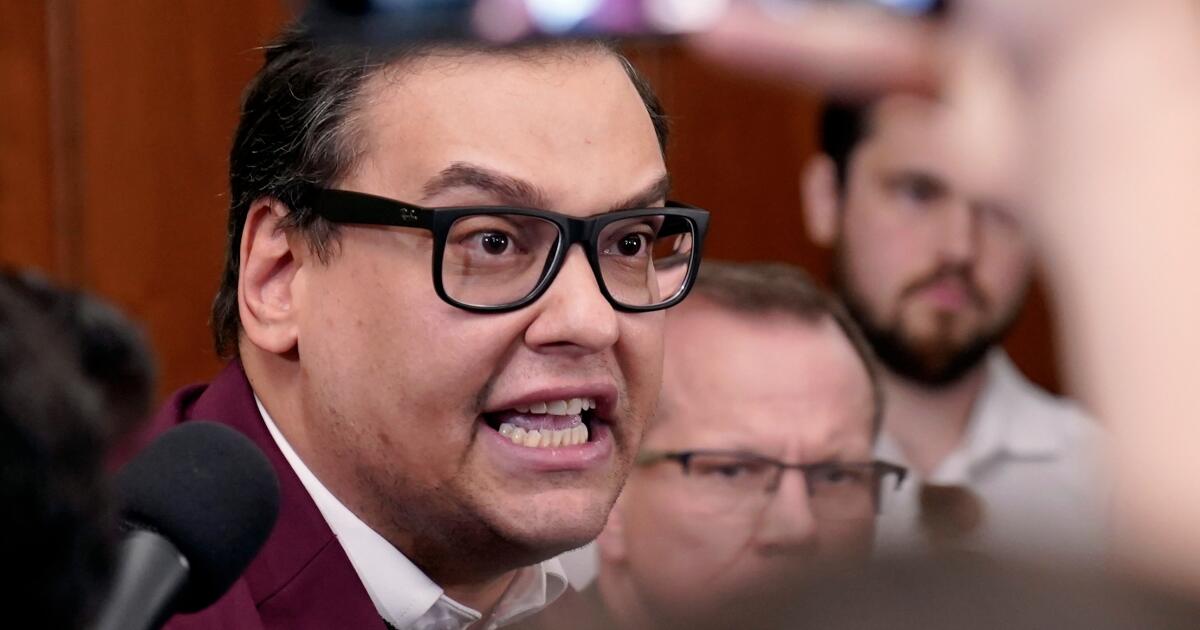
Only six members of the House have been expelled. The first three fought for the Confederacy during the Civil War and were expelled for disloyalty. The next two had been convicted of crimes. The final one was George Santos, the scandal-plagued freshman who was the subject of a blistering ethics report on his conduct as well as federal indictment. Santos, a New York Republican, served time in prison for ripping off his campaign donors before President Trump granted him clemency, and he has apologized to his former constituents.

Under the Constitution, at least two-thirds of the House has to vote for expulsion for it to occur, a high threshold that requires enormous bipartisan support.

House Speaker Mike Johnson (R-La.) told reporters last week he believes the House will move to expel Cherfilus-McCormick.

“The facts are indisputable at this point, and so I believe it’ll be the consensus of this body that she should be expelled,” Johnson said.

Freking and Groves write for the Associated Press.

Source link

As U.S.-Iran ceasefire deadline nears, uncertainty hangs over possible talks

Last-minute ceasefire talks between the United States and Iran looked uncertain Tuesday as a two-week truce was set to expire and both countries warned that, without a deal, they were prepared to resume fighting.

U.S. Vice President JD Vance, expected to lead U.S. negotiators if talks continue in Pakistan, remained in Washington on Tuesday, a White House official said. And Pakistan, which has been urging both sides to return to Islamabad, said it was still awaiting confirmation on whether Iran would participate.

Earlier in the day, two regional officials said Washington and Tehran had signaled they would hold a second round of talks, with Vance leading the U.S. team and Iranian parliament speaker Mohammad Bagher Qalibaf as its top negotiator. Both spoke on condition of anonymity because they were not authorized to brief reporters.

But Pakistan’s information minister, Attaullah Tarar, said later Tuesday on X that Iran had not formally confirmed its participation, which was set to expire Wednesday.

Vance had policy meetings scheduled at the White House on Wednesday morning, said a White House official who was not authorized to speak publicly and spoke on condition of anonymity. The vice president’s office and the White House did not immediately respond to messages asking whether Vance still intends to travel to Pakistan.

Trump says he doesn’t favor extending ceasefire

Both sides remain dug in rhetorically. President Trump has warned that “lots of bombs” will “start going off” if there’s no agreement before the ceasefire deadline, and Iran’s chief negotiator said that Tehran has “new cards on the battlefield” that haven’t yet been revealed.

The ceasefire, which began April 8, could be extended if talks resume, though Trump said in an interview Tuesday with CNBC: “Well, I don’t want to do that.”

“We don’t have that much time,” Trump said, adding that Iran “had a choice” and “they have to negotiate.”

White House officials have said that Vance would lead the American delegation, but Iran hasn’t said who it might send. Iranian state television on Tuesday broadcast a message saying that “no delegation from Iran has visited Islamabad … so far.”

U.S. says its forces board sanctioned oil tanker

On Tuesday, the U.S. said its forces boarded an oil tanker previously sanctioned for smuggling Iranian crude oil in Asia. The Pentagon said in a social media post that U.S. forces boarded the M/T Tifani “without incident.”

The U.S. military did not say where the vessel had been boarded, though ship-tracking data showed the Tifani in the Indian Ocean between Sri Lanka and Indonesia on Tuesday. The Pentagon statement added that “international waters are not a refuge for sanctioned vessels.”

The U.S. military on Sunday seized an Iranian container ship, the first interception under a blockade of Iranian ports. Iran’s joint military command called the armed boarding an act of piracy and a violation of the ceasefire.

Strait of Hormuz control key to negotiations

The U.S. imposed the blockade to pressure Tehran into ending its stranglehold on the Strait of Hormuz, a key shipping lane through which 20% of the world’s natural gas and crude oil transits in peacetime.

Iran’s grip on the strait has sent oil prices soaring. Brent crude, the international standard, was trading at close to $95 per barrel on Tuesday, up more than 30% from Feb. 28, the day that Israel and the U.S. attacked Iran to start the war.

Before the war began, the Strait of Hormuz had been fully open to international shipping. Trump has demanded that vessels again be allowed to transit unimpeded.

European Union transportation ministers were meeting Tuesday in Brussels to discuss how to protect consumers after the head of the International Energy Agency warned that Europe has “ maybe six weeks ” of jet fuel supplies remaining.

Over the weekend, Iran said that it had received new proposals from Washington, but also suggested that a wide gap remains between the sides. Issues that derailed the last round of negotiations included Iran’s nuclear enrichment program, its regional proxies and the strait.

Qalibaf on Tuesday accused the United States of wanting Iran to surrender.

“We do not accept negotiations under the shadow of threats,” he wrote in an X post.

Pakistan hopeful talks will proceed

Pakistani officials have expressed confidence that Iran will also send a delegation to resume talks that mark the highest-level negotiations between the U.S. and Iran since the 1979 Islamic Revolution. The first round April 11 and 12 ended without an agreement.

Pakistan said Foreign Minister Ishaq Dar met Tuesday with the acting U.S. ambassador in Islamabad to urge a ceasefire extension. Dar also met with the ambassador from China, a key trading partner with Iran.

Security has been tightened across Pakistan’s capital, where authorities have deployed thousands of personnel and increased patrols along routes leading to the airport.

Israel jails soldiers for defacing Jesus statue in Lebanon

Israel’s military said Tuesday it has sentenced two soldiers to 30 days in jail and removed them from combat duty for smashing a statue of Jesus Christ in Lebanon. Images of an Israeli soldier with a sledgehammer smashing the statue’s head emerged over the weekend, bringing widespread condemnation.

Israel said one of the soldiers being punished hammered the statue to the ground. The other filmed the destruction. The Israeli military said it replaced the statue.

Meanwhile, historic diplomatic talks between Israel and Lebanon were set to resume on Thursday in Washington, an Israeli, a Lebanese and a U.S. official said. All three spoke on condition of anonymity to discuss the behind-the-scenes negotiations.

The Israeli and Lebanese ambassadors met last week for the first direct diplomatic talks in decades. Israel says the talks are aimed at disarming Hezbollah and reaching a peace agreement with Lebanon.

A 10-day ceasefire began on Friday in Lebanon, where fighting between Israel and Iranian-backed Hezbollah militants broke out two days after the U.S. and Israel launched joint strikes on Iran to start the war. Fighting in Lebanon has killed more than 2,290 people.

Since the war started, at least 3,375 people have been killed in Iran, according to authorities. Additionally, 23 people have died in Israel and more than a dozen in Gulf Arab states. Fifteen Israeli soldiers in Lebanon and 13 U.S. service members throughout the region have been killed.

Ahmed, Gambrell and Bynum write for the Associated Press. Gambrell reported from Dubai, and Bynum reported from Savannah Ga. AP journalists Michelle Price, Aamer Madhani and Darlene Superville in Washington; Samy Magdy in Cairo; David Rising and Huizhong Wu in Bangkok; Sam McNeil in Brussels; Julia Frankel in New York; Bill Barrow in Atlanta and Russ Bynum in Savannah, Ga., contributed to this report.

Source link

‘If my people’: Here’s why the Bible passage Trump will read aloud is so potent and polarizing

The scriptural passage that President Trump plans to read Tuesday evening in a livestreamed Bible-reading marathon dates back to the depiction of an ancient event — but it’s one that carries a highly charged significance in the current religious and political climate.

It has long been quoted and promoted by those who believe America was founded as a Christian nation and should be one. It’s from the seventh chapter of 2 Chronicles, a book in the Hebrew (Old Testament) portion of the Bible.

The 14th verse — the one most often quoted — says:

“If my people, which are called by my name, shall humble themselves, and pray, and seek my face, and turn from their wicked ways; then will I hear from heaven, and will forgive their sin, and will heal their land.”

Trump is among hundreds who are taking turns reading the entire Bible aloud over the course of a week. Most of the readings are taking place at the Museum of the Bible in Washington, though Trump’s is coming by video from the Oval Office.

A passage often quoted at National Day of Prayer events

The Chronicles passage has for decades been a major theme at annual National Day of Prayer events. Organizers of the America Reads the Bible marathon invited Trump to read from it. “It’s a powerful statement that he decided to read that passage,” said Bunni Pounds, founder of Christians Engaged, which organized the project.

The passage has been recited over the decades at countless rallies, services and events, often organized around the disputed belief that America was created as a Christian nation and needs to repent of its sins and return to God. The passage has particularly been associated with annual events commemorating the National Day of Prayer, which has taken various forms since the mid-20th century and became fixed by law on the first Thursday in May since the 1980s.

The verse is set in a context far from modern America — during the reign of King Solomon in ancient Israel some 3,000 years ago. Solomon is presiding over the dedication of the first temple in Jerusalem, and in a lengthy prayer he asks for divine mercy if a future generation sins, is punished with military or natural disaster and then repents. In the key passage, God replies with a promise of restoration.

Critics say the passage is used out of context

But the use of the passage in modern settings has its critics.

The Chronicles passage is “a popular verse among Christian nationalists and has been for quite some time,” said Brian Kaylor, a Baptist pastor and president and editor-in-chief of Word&Way, a progressive site covering faith and politics.

He said its use has taken on a partisan and polarizing tone, often used in tandem with a promotion of a belief in a Christian America in an increasingly diverse country.

“This verse is not about the United States,” said Kaylor, author of “The Bible According to Christian Nationalists: Exploiting Scripture for Political Power.” It is “a promise made to one particular person in one particular moment. It doesn’t really work to pull it out of context and apply it to whatever you want to.”

But many have done so recently and in decades past, either saying America has a divinely ordained destiny similar to ancient Israel’s or simply that they believe every nation has a duty to follow God and repent when needed.

President Dwight D. Eisenhower took the oath of office in 1953 with his hand on a Bible opened to the 2 Chronicles passage. President Ronald Reagan quoted the passage in a proclamation declaring 1984’s National Day of Prayer. A speaker at the 2024 Republican National Convention also quoted it.

The National Day of Prayer, while officially nonsectarian, has long been drawn particular promotion and participation from evangelical Christians. Readings of the “If my people” passage has been a staple of such events.

Politicians, others joining in the Bible-reading marathon

Evangelicals — a loyal Republican voting bloc for decades — have formed a crucial part of Trump’s electoral base. His rallies have featured a fusion of Christian and national symbols and rhetoric, featuring songs like “God Bless USA” and T-shirts with slogans like “Jesus is my savior, Trump is my president.”

Many other Republican politicians are taking part in the Bible reading, along with celebrities, pastors and others. And Trump isn’t the only one reading a passage significant to his office or mission.

Mike Huckabee, a Baptist pastor and U.S. ambassador to Israel, is reading from a Genesis passage in which God says he will bless those who bless Abraham — a passage popular with many evangelicals who believe they have a biblical mandate to support Israel.

David Barton, whose Wallbuilders promotes belief in America as a Christian nation, will read from a passage that gave his organization its name, in which Nehemiah rebuilds the broken walls of Jerusalem.

Smith writes for the Associated Press.

Source link

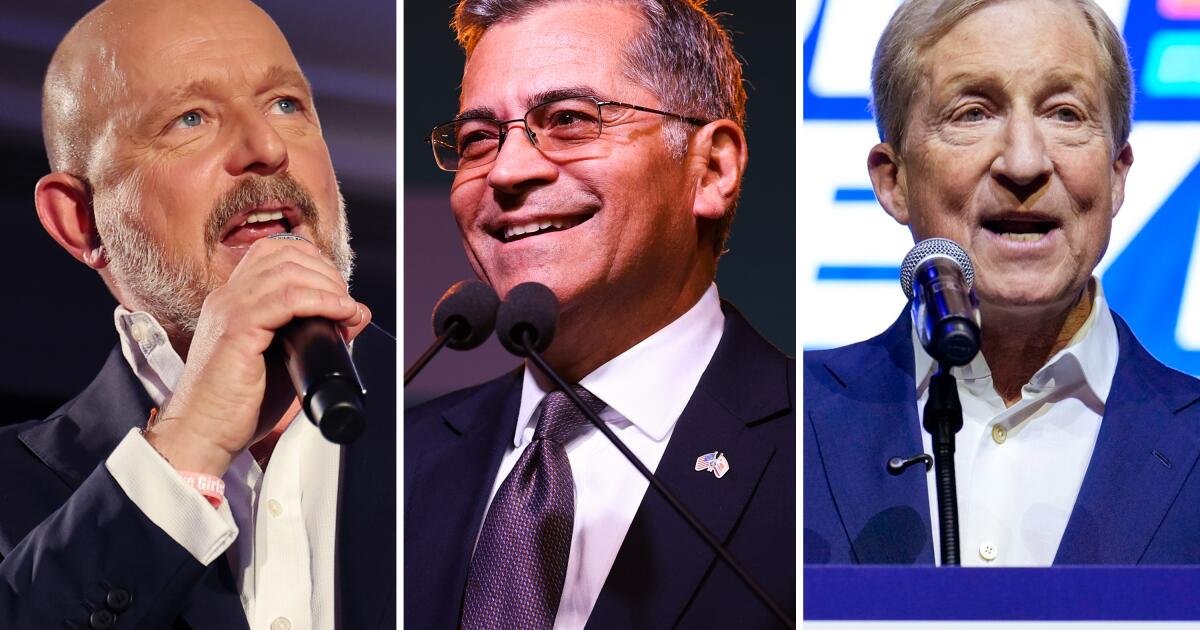
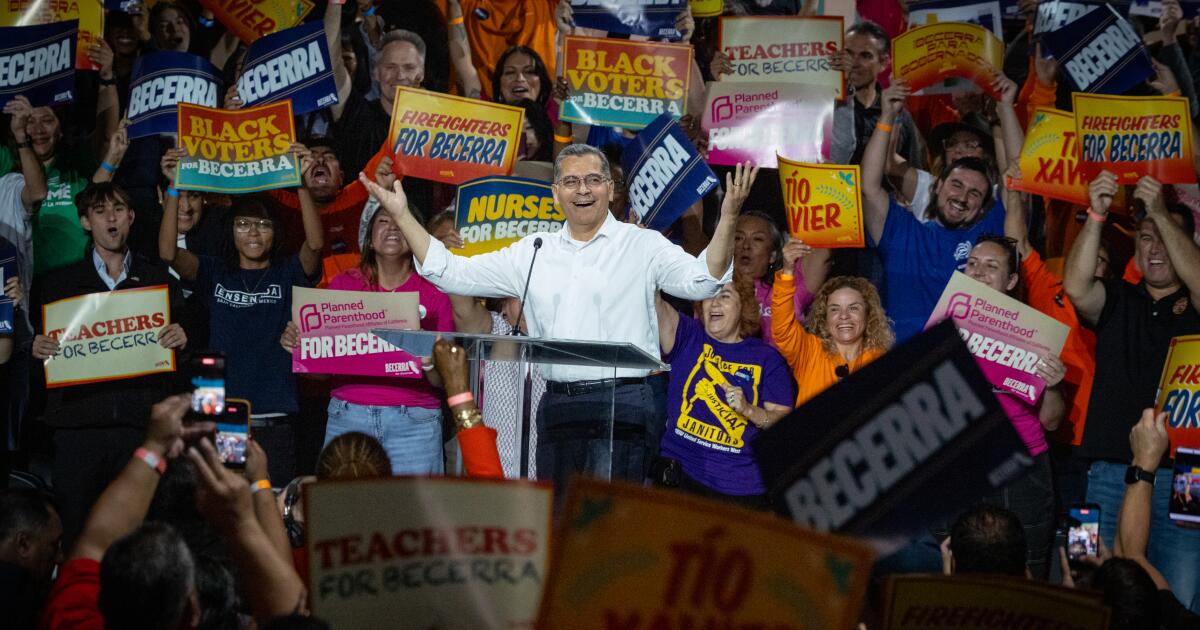
Becerra sees momentum, money and movement in the polls in governor’s race

Xavier Becerra, a former cabinet secretary in President Biden’s administration, appears to be surging in the curiously unsettled California governor’s race.

Until recently, the former U.S. Health and Human Services secretary had been mired in the single digits in polling to replace termed-out Gov. Gavin Newsom and lead the nation’s most populous state.

But after former Rep. Eric Swalwell, (D-Dublin) dropped out of the race earlier this month amid accusations ofsexual assault and other misconduct Becerra has seen a boost in polls, fundraising and endorsements.

On Tuesday, Assembly Speaker Robert Rivas endorsed Becerra alongside 14 Democratic members of the legislative body.

Arguing that Californians are under constant threat from President Trump’s policies, Rivas cited Becerra’s decades-long record in public office, including defending Obamacare and young immigrants, or dreamers, to argue that Becerra is best positioned to lead the state.

“There’s no time to learn on the job — we need a governor who’s ready to fight back on day one,” Rivas said in a statement, noting that Becerra sued the Trump administration 122 times while he was California’s attorney general. “We have a strong Democratic field for governor. But right now, we need someone ready on day one. Xavier Becerra is that leader.”

Becerra said he was honored to receive the legislators’ backing.

“I look forward to working with the Speaker and legislators on Day One to tackle the problems Californians care about most — from the skyrocketing cost of groceries and housing to our unyielding fight against the Trump Administration’s disastrous policies,” he said in a prepared statement. “Californians need an experienced and trusted leader who doesn’t need on-the-job training.”

Despite Becerra’s long tenure in state and federal office, the unflashy politician is not well-known among California voters. He was among the underdogs in the 2026 gubernatorial race. Swalwell, by contrast, was among the leading Democratic candidates.

Amy Thoma, a former Republican strategist who is no longer affiliated with a political party, noted that Becerra’s surge comes at a critical moment in the election, shortly before ballots land in Californians’ mailboxes.

“Voters are starting to tune into the race. Yes, they want someone who will stand up to Trump, but it also seems they want someone with experience who can address the very real issues facing the state,” Thoma said.

She added that Becerra’s life story is “incredibly compelling.”

“The word authentic is overused, but every time he talks about his love for this state, for his family and wanting to make California work for everyone, it comes across incredibly sincere,” Thoma said. “Voters can see through candidates who fake it.”

Becerra was respected by colleagues across the aisle, including former GOP legislative leader and state Republican party chairman Jim Brulte. Both men were elected to the state Assembly in 1990 and though their politics often sharply differed. However, they had a warm relationship.

“He was progressive and I am a conservative,” Brulte said. “We never agreed much on policy, but he is a good man with a great heart.”

The 2026 governor’s race has been unlike any in recent memory, with no clear front-runner in a crowded field of candidates and voters just beginning to pay attention to the contest shortly before the June 2 primary.

There were two prominent Republicans and eight prominent Democrats in the race, leading to fears among Democratic leaders in the state that their party’s candidates could be shut out of the governor’s race in the general election because of California’s unique primary system. The two candidates who win the most votes in the June 2 primary will move onto the November general election, regardless of party affiliation.

Democratic leaders remain concerned that despite California’s sapphire-blue tilt, the number of their party’s candidates in the race could lead to a splintering of Democratic voters that results in two Republicans advancing to the November ballot.

Six prominent Democrats remain in the race, after Swalwell and former state Controller Betty Yee dropped out.

The race — lacking a global superstar such as Arnold Schwarzenegger or the scion of a storied political family and former governor like Jerry Brown — is ephemeral. Anything can happen before the June 2 primary.

But Becerra is having a moment. In addition to the new endorsements, he has seen notable movement in polls, most recently in a survey released Monday by the state Democratic party. Becerra jumped nine points from the party’s last poll, tying with billionaire Tom Steyer at 13%.

While Becerra will never be able to match Steyer’s deep pockets, he raised more than $1 million on ActBlue, the top Democratic fundraising platform, in the week ending on April 18, making him the biggest fundraiser on the site in the nation.

“Ninety-seven percent were first-time donors,” Becerra’s campaign said in a statement. “This is not a donor base being recycled. It is a movement being born.”

Source link

Southern Poverty Law Center says it faces a Justice Department criminal probe over paid informants

The Southern Poverty Law Center says it’s the subject of a criminal investigation by the Justice Department and faces possible charges over its past use of paid informants to infiltrate extremist groups.

The civil rights group made the announcement on Tuesday, saying President Trump’s administration appears to be preparing legal action against it or some of its employees.

“Although we don’t know all the details, the focus appears to be on the SPLC’s prior use of paid confidential informants to gather credible intelligence on extremely violent groups,” CEO Bryan Fair said in a statement.

The Justice Department had no immediate comment.

The SPLC previously paid informants to infiltrate extremist groups and gather information on their activities, often sharing it with local and federal law enforcement, Fair said. It was used to monitor threats of violence, he said, adding that the program was kept quiet to protect the safety of informants.

“When we began working with informants, we were living in the shadow of the height of the Civil Rights Movement, which had seen bombings at churches, state-sponsored violence against demonstrators, and the murders of activists that went unanswered by the justice system,” Fair said. “There is no question that what we learned from informants saved lives.”

He said the organization “will vigorously defend ourselves, our staff, and our work.”

The SPLC, which is based in Montgomery, Alabama, was founded in 1971 and used civil litigation to fight white supremacist groups. The nonprofit has become a popular target among Republicans who see it as overly leftist and partisan.

The investigation could add to concerns that Trump’s Republican administration is using the Justice Department to go after conservative opponents and his critics. It follows a number of other investigations into Trump foes that have raised questions about whether the law enforcement agency has been turned into a political weapon.

The Southern Poverty Law Center has faced intense criticism from conservatives, who have accused it of unfairly maligning right-wing organizations as extremist groups because of their viewpoints. The SPLC regularly condemns Trump’s rhetoric and policies around voting rights, immigration and other issues.

The SPLC came under fresh scrutiny after the assassination last year of conservative activist Charlie Kirk brought renewed attention to its characterization of the group that Kirk founded and led. The SPLC included a section on that group, Turning Point USA, in a report titled “The Year in Hate and Extremism 2024” that described the group as “A Case Study of the Hard Right in 2024.”

FBI Director Kash Patel said last year that the agency was severing its relationship with the SPLC, which had long provided law enforcement with research on hate crime and domestic extremism. Patel said the SPLC had been turned into a “partisan smear machine,” and he accused it of defaming “mainstream Americans” with its “hate map” that documents alleged anti-government and hate groups inside the United States.

House Republicans hosted a hearing centered on the SPLC in December, saying it coordinated efforts with President Joe Biden’s Democratic administration “to target Christian and conservative Americans and deprive them of their constitutional rights to free speech and free association.”

Binkley and Richer write for the Associated Press.

Source link

Virginia voters deciding on redistricting plan that could boost Democrats’ seats in Congress

Virginia voters on Tuesday are deciding whether to ratify an unusual mid-decade redrawing of U.S. House districts that could boost Democrats’ chances of flipping control of the closely divided chamber, as the state becomes the latest front in a national redistricting battle.

A proposed constitutional amendment backed by Democratic officials would bypass the state’s bipartisan redistricting commission to allow use of new congressional districts approved by state lawmakers in this year’s midterm elections.

The referendum, which needs a simple majority to pass, tests Democrats’ ability to push back against President Trump, who started the gerrymandering competition between states after successfully urging Texas Republicans to redraw congressional districts in their favor last year. Virginia is the second state, after California last fall, to put the question to voters.

It also tests voters’ willingness to accept districts gerrymandered for political advantage — coming just six years after Virginia voters approved an amendment meant to diminish such partisan gamesmanship by shifting redistricting away from the legislature.

Even if Democrats are successful Tuesday, the public vote may not be the final word. The state Supreme Court is considering whether the redistricting plan is illegal in a case that could make the referendum results meaningless.

Virginia Democrats are following California’s lead

Congressional redistricting typically is done once a decade after each U.S. census. But Trump urged Texas Republicans to redistrict ahead of the November elections in hopes of winning several additional seats and maintaining the GOP’s narrow House majority in the face of political headwinds that typically favor the party that is out of power during midterms.

The Texas gambit led to a burst of redistricting nationwide. So far, Republicans believe they can win up to nine more House seats in newly redrawn districts in Texas, Missouri, North Carolina and Ohio.

Democrats think they can win up to five more seats in California, where voters approved a mid-decade redistricting effort last November, and one more seat under new court-imposed districts in Utah. Democrats hope to offset the rest of that gap in Virginia, where they decisively flipped 13 seats in the state House and won back the governor’s office last year.

Voters focus on fairness, with different perspectives

The stream of voters was steady Tuesday at a recreation center in the Old Town area of Alexandria, Virginia.

Matt Wallace, 31, said he votes regularly but this election has additional emphasis.

“I think the redistricting issue across the country is unfortunate, that we’ve had to resort to temporary redistricting in order to sort of alter our elections across the country,” Wallace said. He said he voted for the Democratic redistricting amendment “to help balance the scales a bit until things get back to normal.”

Joanna Miller, 29, said she voted against the redistricting measure, “because I want my vote to count in a fair way.” Miller said she was more concerned about representation in Virginia than trying to offset actions in other states.

“I want my vote and my representation to matter this fall,” she said.

Political parties made a big push in Virginia

Leaders of both major parties see Tuesday’s vote as crucial to their chances to win a House majority in the fall. Trump weighed in via social media Tuesday morning, telling Virginians to “vote ‘no’ to save your country!”

Former Virginia Gov. Glenn Youngkin, a Republican, rallied with opponents of the measure Monday night, calling the redistricting plan “dishonest” and “brazenly deceptive.” House Minority Leader Hakeem Jeffries told reporters at the Capitol earlier in the day that a vote to approve the redraw “will serve as a check and balance on this out-of-control Trump administration.”

A committee supporting the Democratic redistricting effort had raised more than $64 million — three times as much as the roughly $20 million raised by opponents, according to finance reports filed less than two weeks before the election.

The back-and-forth battle over congressional districts is expected to continue in Florida, where the Republican-led legislature is scheduled to convene April 28 for a special session that could result in a more favorable map for Republicans.

A lobster-like district could aid Democratic efforts

In Virginia, Democrats currently hold six of the 11 U.S. House seats under districts that were imposed by the state Supreme Court in 2021 after a bipartisan commission failed to agree on a map based on the latest census data.

The new plan could help Democrats win as many as 10 seats. Five are anchored in Democratic-heavy northern Virginia, including one shaped like a lobster that stretches into Republican-leaning rural areas.

Revisions to four other districts across Richmond, southern Virginia and Hampton Roads dilute the voting power of conservative blocs in those areas. And a reshaped district in parts of western Virginia lumps together three Democratic-leaning college towns to offset other Republican voters.

The Virginia redistricting plan is “pushing back against what other states have done in trying to stack the deck for Donald Trump in those congressional elections,” Democratic Gov. Abigail Spanberger said during an online rally last week.

Ads for the “yes to redistricting” campaign featuring former President Barack Obama have flooded the airwaves.

Opponents have distributed campaign materials citing past statements from Obama and Spanberger criticizing gerrymandering, but those were before Trump pushed Republican states to redraw their congressional maps in advance of this year’s midterms.

Democrats “were all against gerrymandering before they were for it,” Virginia Republican Party Chairman Jeff Ryer said.

Virginia court weighs whether lawmakers acted illegally

Virginia lawmakers endorsed a constitutional amendment allowing their mid-decade redistricting last fall, then passed it again in January as part of a two-step process that requires an intervening election for an amendment to be placed on the ballot. The measure allows lawmakers to redistrict until returning the task to a bipartisan commission after the 2030 census.

In February, they passed a new U.S. House map to take effect pending the outcome of the redistricting referendum. Republicans have filed multiple legal challenges against the effort.

A Tazewell County judge ruled that the redistricting push was illegal for several reasons. Circuit Court Judge Jack Hurley Jr. said lawmakers failed to follow their own rules for adding the redistricting amendment to a special session.

He ruled that their initial vote failed to occur before the public began casting ballots in last year’s general election and thus didn’t count toward the two-step process. He also ruled that the state failed to publish the amendment three months before that election, as required by law.

If the state Supreme Court agrees with the lower court, the results from Tuesday’s vote could be rendered moot.

Lieb writes for the Associated Press. AP writers Gary Fields in Virginia and Lisa Mascaro in Washington contributed to this report.

Source link

Machado’s Return Is the Real Test of Venezuela’s Political Opening

The real test of Venezuela’s current political moment will not be institutional, but political. It will not lie in the appointment of a new prosecutor, or in any decision taken by a parliament that, by design, reflects the preferences of those in power. It will lie in something far less controllable: the return of María Corina Machado.

For months, there has been talk of normalization, of technocratic adjustment, even of a transition managed from within. It is an appealing idea, but an illusory one. As usual, chavismo does not administer space, it occupies it. The notion that it would suddenly evolve into a system governed by technocratic restraint, even under US pressure, was always more wishful thinking than analysis.

What has changed is not the nature of the system, but our understanding of it. For years, it was assumed that power rested on a rigid internal balance, a kind of tripod between civilian leadership, party machinery, and the military. The uneventful sidelining of Vladimir Padrino López suggests otherwise. Now relegated to an almost theatrical role as Agriculture Minister, he makes appearances at cattle shows in Borsalino hats and Panerai watches. We have long known that chavismo’s superpower is its adaptability. It can reshuffle, absorb shocks, and reallocate power without fracturing, even at its highest levels, and carry on.

That adaptability cuts both ways. It helps explain why Delcy Rodríguez has been able to consolidate authority despite presiding over the country under the tutelage of the “yankee devil”, and despite earlier doubts about her staying power. It also explains why the government has been able to pursue a limited opening without losing control. But it also sets the limits of that opening.

Because the one problem the system has not been able to solve is credibility.

An empty pitch

The effort to attract investment has run into a wall that legal reforms and external signaling cannot easily overcome. Investors are not simply looking for incentives, they are looking for guarantees, that power is legitimate, that rules will be upheld, that today’s opening will not be reversed tomorrow. So far, those guarantees do not exist.

As I have argued before, none of this means that capital will stop flowing into Venezuela altogether. It won’t. There are firms that know how to operate in this environment, firms that have built their business models around political risk rather than in spite of it.

Take Grupo Cisneros, which is moving to secure a $1 billion investment fund aimed at Venezuela’s recovery. Or Chevron, which has doubled down on its presence through a major asset swap with PDVSA, expanding its stake in key projects in the Orinoco Belt.

What is not arriving, at least not yet, is transformational capital, the kind that requires predictability, legal certainty, and a credible political horizon.

These are not naïve entrants. They are actors with long experience navigating the Venezuelan system. Cisneros has remained a player despite fines and suspensions over the years. Chevron, for its part, has effectively become the most important American economic partner of the current government, maintaining operations through multiple political cycles and regulatory frameworks.

But that is precisely the point.

This is not the kind of capital Venezuela needs.

What is arriving, or staying, is adapted capital, capital that knows how to survive volatility, negotiate through informal institutions, and operate without full guarantees. What is not arriving, at least not yet, is transformational capital, the kind that requires predictability, legal certainty, and a credible political horizon.

And that gap cannot be closed through reforms alone. It cannot be legislated into existence, nor negotiated deal by deal. It requires something more fundamental: confidence that power in Venezuela is not entirely discretionary.

The pressure map

The timing of this becomes even more significant in light of Venezuela’s re-engagement with the IMF and the World Bank. After years of isolation, the country is once again being folded back into the international financial system, opening the door to technical assistance, debt restructuring, and eventually, fresh financing. It is the clearest signal yet that normalization, at least at the institutional level, is moving forward.

But this only sharpens the underlying problem.

These institutions can help stabilize accounts, restructure liabilities, and provide liquidity. What they cannot do is manufacture credibility where it does not exist. Their return signals that Venezuela is being treated, once again, as a country with which business can be conducted. It does not guarantee that the rules of that business will hold.

In some ways, Delcy has the easier hand to play. The current arrangement in Venezuela has become useful to Donald Trump in ways that go beyond the country itself. With the Iranian campaign failing to deliver the results he had anticipated, Venezuela has quietly taken on the role of a foreign policy success story, something tangible he can point to, both in terms of energy security and geopolitical leverage.

That utility is not uniform across his coalition. For more isolationist voters in what is often referred to as flyover country, a stable Venezuela that does not require further military involvement, and that contributes to stabilizing US energy prices, is a net positive. 

Detaining Machado, after appearances at CERAWeek and high-level meetings in Europe and Washington, would send a clear and immediate signal to the very actors the government has been trying to court.

Venezuelan crude is already easing pressure on US fuel costs, reinforcing the perception that the current arrangement delivers practical benefits.

But in South Florida, the picture is different. Latino voters, particularly Venezuelans, are already uneasy with the administration’s immigration policies, and are far less inclined to accept stability under a reconfigured chavista leadership as an acceptable endpoint. They are drawn instead to Machado’s message, and increasingly wary of what a prolonged Delcy Rodríguez-led government would mean. For them, the issue is not stability alone, but the absence of a credible electoral horizon.

This creates a tension within Washington’s own political logic. On one hand, there is an incentive to consolidate what appears to be working: restored oil flows, renewed financial channels, and growing international engagement with Caracas. On the other, there remains a constituency that expects something more, a path toward elections, not just normalization.

Machado, in this context, faces a more complex task than it might appear. She is not only trying to pressure the Venezuelan government, she is also trying to persuade a cautious administration that pushing beyond the current equilibrium is worth the risk, that the next step is not to stabilize the system as it is, but to open it further.

And she is doing so with limited institutional backing. Much of the Venezuelan civil society ecosystem aligned with MAGA politics appears more focused on maintaining its own access to the White House than on advancing a coherent strategy for Venezuela itself. That leaves Machado in a familiar position, carrying the burden of political escalation largely on the legs of her own prestige, but now within a much tighter set of constraints.

This is where María Corina Machado reenters the picture, not just as a political actor, but as a structural variable. Her return forces a choice that cannot be deferred. Allow her back into the country, or stop her.

Detaining her, after appearances at CERAWeek and high-level meetings in Europe and Washington, would send a clear and immediate signal to the very actors the government has been trying to court. These are not abstract observers, they are the same executives and investors now being asked to commit capital. Arresting her would not simply be a domestic political decision, it would be read as a statement about the limits of the current opening.

Allowing her to return is not costless either. It risks projecting weakness toward a base that has been conditioned to expect control. It creates space for mobilization, for coordination, for a reactivation of political pressure that the system has worked hard to contain.

But at this stage, that is a more manageable risk.

A constrained confrontation

Chavismo has shown that it can absorb internal contradictions. It can tolerate limited openings while maintaining overall control. What it is less equipped to manage, at least at this point, is a collapse in external credibility at the precise moment it is trying to rebuild it.

This is also not a confrontation between unconstrained actors. Machado is operating within limits of her own. She understands that an uncontrolled escalation could be interpreted in Washington as an attempt to derail a strategy that, for now, tolerates the current arrangement. Her leverage depends not only on mobilization, but on preserving her external legitimacy.

What emerges from this is not a clean confrontation, but a constrained one. Both sides are pushing, but neither is free to push all the way. Machado needs to generate pressure without triggering a rupture that works against her. The government needs to contain that pressure without closing the space in ways that undermine its own economic strategy.

That is what makes her physical presence in the country so consequential. Without it, the reactivation we are beginning to see, student movements regaining traction, party structures reopening, political figures cautiously returning, remains fragmented. With it, that energy has a focal point. 

And that is precisely why her return has become the real test. Not whether the system can produce institutional outcomes aligned with its interests, but whether it can tolerate, and ultimately absorb, the presence of the one actor it does not fully control, without undoing the fragile equilibrium it is trying to build.

Source link

Governor’s race wildly unpredictable two weeks before Californians receive ballots

The most unpredictable California governor’s race in recent history took another set of dizzying turns on Monday, with former Health and Human Services Secretary Xavier Becerra surging after former Rep. Eric Swalwell dropped out in the face of sexual assault and misconduct allegations, and former state Controller Betty Yee ending her bid.

The race to replace termed-out Gov. Gavin Newsom is the first in a quarter of a century with no clear front-runner and a sprawling field of candidates who have been jockeying for the attention of Californians, who are just beginning to pay attention to the campaign two weeks before ballots arrive in their mailboxes.

“I certainly could not have imagined the twists and the disturbing turns that this race has taken,” Yee said as she announced she was dropping out. “But through it all, my values and my vision for California has never wavered.”

A poll released Monday by the state Democratic Party — its first since Swalwell (D-Dublin) dropped out — showed Becerra’s support jumped nine points to 13%, placing him in a tie with Tom Steyer, the billionaire hedge fund founder turned environmental warrior. Former Rep. Katie Porter of Orange County saw a slight bump to 10% from 7%, while the remaining Democrats in the contest were mired in the low single digits.

The party began the surveys out of concern that Democrats could be shut out of the governor’s race because of California’s unique primary system, where the top two vote-getters in the June 2 primary move on to the November general election regardless of political party.

“I continue to believe there are too many Democrats in the field,” California Democratic Party Chairman Rusty Hicks told reporters Monday. “My call for candidates to honestly assess the viability of their candidacy and campaigns still stands, especially if you are stalled in the single digits, seeing financial resources dry up and/or are failing to pick up additional support.”

Hicks and other party leaders and allies had unsuccessfully urged low-polling candidates to reconsider their candidacies before the filing deadline in an attempt to cull the field and avoid splintering the Democratic vote. Though most did not name candidates who they thought should think about their viability, Yee was widely believed to be among them.

Yee became emotional as she said on Monday that she decided to withdraw from the race because she wasn’t able to raise the resources necessary to compete in the state. She also said her message of competency and experience wasn’t resonating among voters who were seeking a fiery foil to President Trump, not “Boring Betty,” as she dubbed herself. Yee said she would assess the field before making an announcement on whether she would endorse one of her fellow Democrats.

Becerra was another candidate believed to be a target of party leaders’ efforts to shrink the field. But he held on and apparently benefited from Swalwell’s downfall.

“I’m not the richest candidate, I’m not the slickest candidate, but I am the guy that’s got you,” Becerra said, rallying supporters in Los Angeles on Saturday.

The audience was filled with members of labor groups backing the longtime politician, and Becerra told them he’d serve as a “union man” in the governor’s office.

Pro- and anti-Becerra forces tussled outside the town hall after two people, who declined to identify whom they were working for, passed out fliers highlighting critical media investigations of the U.S. Department of Health and Human Services during the migrant crisis when the agency was led by Becerra.

Pro-Becerra attendees grabbed the fliers and told the men to go away, prompting a security guard to intervene.

The question is whether Becerra, who also served as state attorney general, a member of Congress and a state Assembly member, can raise the funds necessary to compete in a state with some of the nation’s most expensive media markets. And he was tied in the state party poll with a billionaire who dumped an additional $12.1 million of his own money into his campaign last week.

Steyer’s total investment in his bid reached $133 million, according to the California secretary of state’s office. He also received the endorsement of Our Revolution, a progressive political organization founded by U.S. Sen. Bernie Sanders (I-Vt.).

“We’ve never endorsed a billionaire — but Tom Steyer is using his position to upset the system,” the group posted on X on Monday. “As Our Revolution executive director Joseph Geevarghese told @theintercept, ‘He’s been a partner in the movement. Most billionaires have used their wealth and privilege to lock in the status quo. Tom is doing the opposite.’”

San Jose Mayor Matt Mahan, who is also running for governor, accused Steyer of hypocrisy for the hedge fund he founded profiting from investments in private prisons being used to house ICE detainees, and Steyer calling for the abolishment of ICE.

Steyer got “rich investing off the ICE infrastructure he now wants to abolish,” Mahan posted on Instagram.

Steyer, who sold his stake in the hedge fund in 2012, has said he ordered the company to divest from the private prison company and has repeatedly expressed remorse about his former firm’s ties with the detention company.

Mahan also appeared Monday at a Hollywood production lot to announce his proposal for a special fund to lure sporting events, concerts and other productions to California as part of his plan to help the struggling film and television industry.

An independent effort supporting Mahan has also raised roughly $11 million since Swalwell left the race.

Mehta reported from Los Angeles and Nixon from Sacramento. Times staff writer Dakota Smith contributed to this report.

Source link

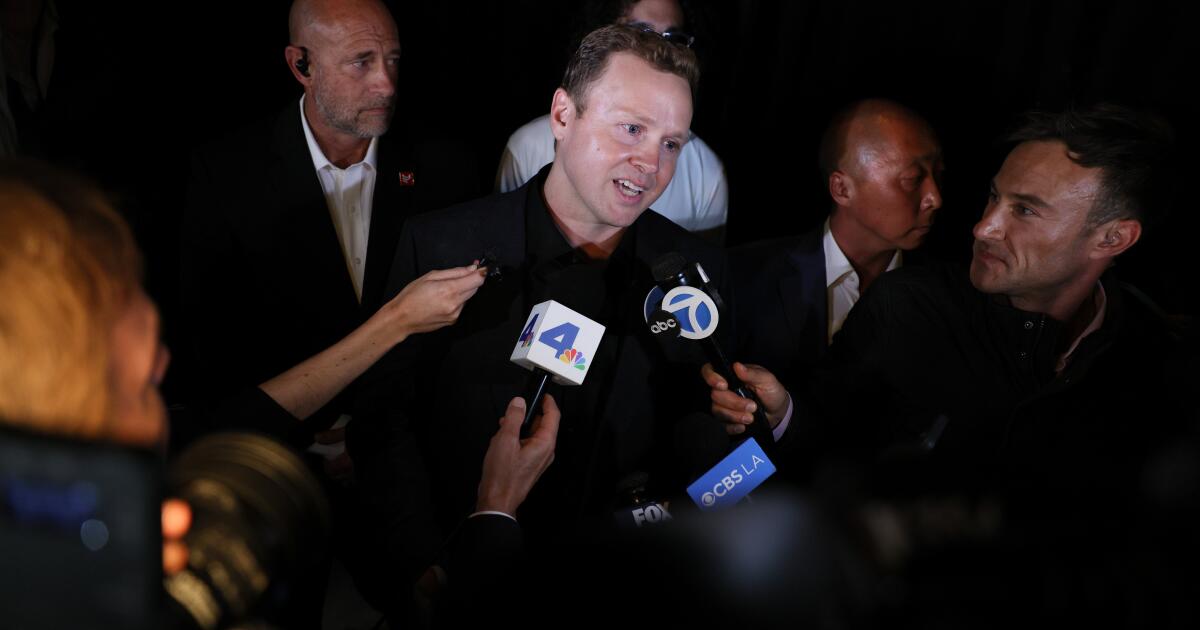
Labor Secretary Lori Chavez-DeRemer is leaving Trump’s Cabinet after abuse of power allegations

Labor Secretary Lori Chavez-DeRemer is out of President Trump’s Cabinet, the White House said Monday, after multiple allegations of abusing her position’s power, including having an affair with a subordinate and drinking alcohol on the job.

Chavez-DeRemer is the third Trump Cabinet member to leave her post after Trump fired his embattled Homeland Security Secretary Kristi Noem in March and ousted Atty. Gen. Pam Bondi earlier this month.

Unlike other recent Cabinet departures, Chavez-DeRemer’s exit was announced by a White House aide, not by the president on his social media account.

“Labor Secretary Lori Chavez-DeRemer will be leaving the Administration to take a position in the private sector,” White House communications director Steven Cheung said on the social media site X. “She has done a phenomenal job in her role by protecting American workers, enacting fair labor practices, and helping Americans gain additional skills to improve their lives.”

He said Keith Sonderling, the current deputy labor secretary, would become acting labor secretary in her place. The news outlet NOTUS was the first to report Chavez-DeRemer’s resignation.

Labor chief, family members faced multiple allegations

Chavez-DeRamer’s departure follows reports that began surfacing in January that she was under a series of investigations.

A New York Times report last Wednesday revealed that the Labor Department’s inspector general was reviewing material showing Chavez-DeRemer and her top aides and family members routinely sent personal messages and requests to young staff members.

Chavez-DeRemer’s husband and father exchanged text messages with young female staff members, according to the newspaper. Some of the staffers were instructed by the secretary and her former deputy chief of staff to “pay attention” to her family, people familiar with the investigation told the Times.

Those messages were uncovered as part of a broader investigation of Chavez-DeRamer’s leadership that began after the New York Post reported in January that a complaint filed with the Labor Department’s inspector general accused Chavez-DeRemer of a relationship with the subordinate.

She also faced allegations that she drank alcohol on the job, and that she tasked aides to plan official trips for primarily personal reasons.

Both the White House and the Labor Department initially said the reports of wrongdoing were baseless. But the official denials became less full-throated as more allegations emerged — and when Chavez-DeRemer might be out of a job became something of an open question in Washington.

At least four Labor Department officials have already been forced from their jobs as the investigation progressed, including Chavez-DeRemer’s former chief of staff and deputy chief of staff, as well as a member of her security detail, with whom she was accused of having the affair, the New York Times reported.

She enjoyed union support — rare for a Republican

Confirmed to Trump’s Cabinet in a 67-32 vote in March 2025, Chavez-DeRemer is a former House GOP lawmaker who had represented a swing district in Oregon. She enjoyed unusual support from unions as a Republican but lost reelection in November 2024.

In her single term in Congress, Chavez-DeRemer backed legislation that would make it easier to unionize on a federal level, as well as a separate bill aimed at protecting Social Security benefits for public-sector employees.

Some prominent labor unions, including the International Brotherhood of Teamsters, backed Chavez-DeRemer, who is a daughter of a Teamster, for Labor secretary. Trump’s decision to pick her was viewed by some political observers as a way to appeal to voters who are members of or affiliated with labor organizations.

But other powerful labor leaders were skeptical when she was tapped for the job, unconvinced that Chavez-DeRemer would pursue a union-friendly agenda as a part of the incoming GOP administration. In her Senate confirmation hearing, some senators questioned whether she would be able to uphold that reputation in an administration that fired thousands of federal employees.

She was a key figure in Trump’s deregulatory push

Aside from reports of wrongdoing in recent months, Chavez-DeRemer had been one of Trump’s more lower-profile Cabinet picks but took key steps to advance the administration’s deregulatory agenda during her tenure.

For instance, the Labor Department last year moved to rewrite or repeal more than 60 workplace regulations it saw as obsolete. The rollbacks included minimum wage requirements for home healthcare workers and people with disabilities, and rules governing exposure to harmful substances and safety procedures at mines. The effort drew condemnation from union leaders and workplace safety experts.

The proposed changes also included eliminating a requirement that employers provide adequate lighting for construction sites and seat belts for agriculture workers in most employer-provided transportation.

During Chavez-DeRemer’s tenure, the Trump administration canceled millions of dollars in international grants that a Labor Department division administered to combat child labor and slave labor around the world, ending their work that had helped reduce the number of child laborers worldwide by 78 million over the last two decades.

The Labor Department has a broad mandate as it relates to the U.S. workforce, including reporting the U.S. unemployment rate, regulating workplace health and safety standards, investigating minimum wage, child labor and overtime pay disputes, and applying laws on union organizing and unlawful terminations.

Kim writes for the Associated Press. AP writers Cathy Bussewitz in New York and Will Weissert in Washington contributed to this report.
Source link

Witnesses subpoenaed to testify before D.C. grand jury in John Brennan investigation, AP sources say

The Justice Department has subpoenaed several witnesses to testify before a federal grand jury in Washington as part of its investigation into former CIA Director John Brennan, three people familiar with the matter said Monday.

The subpoenas were issued in recent days and represent an effort by the Justice Department to press forward with the investigation even as a Florida-based career prosecutor who’d been helping lead the inquiry left the case after expressing doubts about the legal viability of a potential prosecution.

A former Justice Department lawyer who served as a top prosecutor in the 1980s and later supported legal efforts by President Trump to overturn his 2020 election loss has since been sworn in to serve as a special counselor to the attorney general, and is expected to work on the investigation.

The months-old Brennan investigation is one of several criminal probes the Justice Department has opened over the last year against Trump’s perceived adversaries. It centers on one of the Republican president’s chief grievances — a U.S. intelligence community finding that Russia interfered on his behalf during his successful 2016 presidential campaign.

The subpoenas were described by people with knowledge of them who spoke on condition of anonymity to the Associated Press to discuss an ongoing criminal investigation. At least three were said to have been issued, said two of the people. CBS News earlier reported the issuance of subpoenas.

Brennan served as CIA director under President Obama and was in that role when the intelligence community in January 2017 published an assessment detailing Russian interference aimed at helping Trump defeat Democratic nominee Hillary Clinton in 2016. An investigation led by special counsel Robert S. Mueller III concluded that Russia meddled on Trump’s behalf and that his campaign welcomed the assistance, but it did not find sufficient evidence to prove a criminal conspiracy.

The Justice Department last year received a criminal referral from Rep. Jim Jordan of Ohio, the Republican chairman of the House Judiciary Committee, alleging that Brennan made false statements before the panel in 2023 about the preparation of the intelligence community assessment. Brennan and his lawyers have vigorously denied any wrongdoing.

The investigation has been unfolding for months in Florida, with investigators having lined up interviews and issued subpoenas for records. The latest subpoenas seek grand jury testimony in Washington, an indication that prosecutors expect they would have to bring any criminal case in Washington since that is where Brennan’s testimony took place.

On Friday, it was revealed that a key national security prosecutor in Florida who’d been handling the investigation, Maria Medetis Long, left the case. She expressed doubts about the case and was removed, another person familiar with the matter said.

The Justice Department since then has tapped Joseph diGenova, 81, a Trump loyalist who served as the U.S. attorney in Washington for part of the 1980s, to serve as a special counselor to the attorney general. He was sworn in Monday in Florida and is expected to work on the Brennan investigation.

DiGenova supported Trump’s false claims that the 2020 election was stolen from him. He made headlines that year when he said Chris Krebs, a top Trump administration cybersecurity official who said the election was not tainted by fraud, should be killed. DiGenova later apologized and a lawsuit filed against him by Krebs was withdrawn.

Tucker writes for the Associated Press. AP writer Alanna Durkin Richer in Washington contributed to this report.

Source link

Former state Controller Betty Yee drops out of the governor’s race

Former state Controller Betty Yee dropped out of the 2026 governor’s race on Monday, citing low levels of support from voters and donors.

Yee, a Democrat, was part of a sprawling field of politicians vying to replace termed-out Gov. Gavin Newsom. But despite the bevy of prominent candidates running to lead the nation’s most populous state and the world’s fourth-largest economy, this year’s governor’s race has long lacked a clear front-runner well known by the electorate.

“The whole notion that voters are looking for experience and competence is not a top priority, and that’s been really my wheelhouse in terms of how we grounded this campaign was based on my experience,” she said in a virtual press conference Monday morning. “The donors have felt the chill of the polling … and it really just came down to where I’m not going to have sufficient resources to get us to the finish line.”

The former two-term state controller did not immediately endorse another candidate and said she would take a few days to assess the field before making an announcement.

The race was upended earlier this month when then-Rep. Eric Swalwell, among the leading Democrats in the race, was accused of sexual assault and other misconduct. The East Bay Democrat, who is facing multiple criminal investigations, promptly ended his gubernatorial bid and resigned from Congress.

Yee, 68, was well regarded by Democrats during her tenure in Sacramento. And she highlighted her no-drama persona on Thursday.

“California — had enough chaos, fear and horrendous political scandals? Ready for calm, cool, collected change? Some may consider that boring. But that’s the point. We need Boring Betty,” Yee posted on the social media site X. “No crisis. No circus. Just competent, drama-free leadership you can trust. #BoringisBetter”

But she never had the financial resources to aggressively compete in a state with many of the most expensive media markets in the nation.

Yee reported raising nearly $583,000 for her gubernatorial bid in 2025, according to campaign fundraising reports filed with the California secretary of state’s office. Yee’s announcement that she is dropping out of the race came days before the latest financial disclosures will be publicly reported.

Despite being elected to the state Board of Equalization twice and as state controller twice, Yee was not widely known by most Californians. She never cracked double digits in gubernatorial polls.

Her name will still appear on the ballot. She was among the candidates who rebuffed state Democratic Party leaders’ request earlier this year to reconsider their viability amid fears that the party could be shut out of the November general election because of the state’s unique primary system. The top two vote-getters in the June primary will move on to to the November general election, regardless of party affiliation.

Though California’s electorate is overwhelmingly Democratic, the makeup of the gubernatorial field makes it statistically possible for Republicans to win the top two spots if Democratic voters splinter among their party’s candidates. Yee said fear of that scenario playing out “kind of took over” the gubernatorial race.

“Was it possible? Yes. Was it plausible? No, we’re in California. That was not going to happen,” she said, adding that the top-two primary system should be done away with.

Still, Yee was beloved by Democratic Party activists, and previously served as the party’s vice chair.

No Democratic candidate reached the necessary threshold to win the party’s official endorsement at its February convention, but Yee came in second with support from 17% of delegates despite calls for her to drop out of the race.

“Every poll shows that this race is wide open, and I know this party,” she said in an interview at the convention. “Frankly, I’ve been in positions where it’s been a crowded field, and we work hard and candidates emerge.”

The gubernatorial primary will take place June 2, though voters will start receiving mail ballots in about two weeks.

Source link

Carney says Canada’s economic ties with U.S. are a weakness that must be corrected

Canadian Prime Minister Mark Carney said in a video address released Sunday that Canada’s strong economic ties to the United States were once a strength but are now a weakness that must be corrected.

In the 10-minute address, Carney spoke about his government’s efforts to strengthen the Canadian economy by attracting new investments and signing trade deals with other countries.

“The world is more dangerous and divided,” Carney said. “The U.S. has fundamentally changed its approach to trade, raising its tariffs to levels last seen during the Great Depression.

“Many of our former strengths, based on our close ties to America, have become weaknesses. Weaknesses that we must correct.”

Carney said tariffs imposed by President Trump have affected workers in the auto and steel industries. He added that businesses are holding back investments “restrained by the pall of uncertainty that’s hanging over all of us.”

Many Canadians have also been angered by Trump’s comments suggesting Canada become the 51st state.

Carney said he plans to give Canadians regular updates on his government’s efforts to diversify away from the U.S.

“Security can’t be achieved by ignoring the obvious or downplaying the very real threats that we Canadians face,” he said. “I promise you I will never sugarcoat our challenges.”

It’s not the first time Carney, who served as a central bank governor, first at the Bank of Canada and later with the Bank of England, has spoken about a shift in world power.

During a speech in January at the World Economic Forum in Davos, Switzerland, he received widespread praise for condemning economic coercion by great powers against small countries.

His remarks brought a rebuke from Trump.

“Canada lives because of the United States,” Trump said after the speech. “Remember that, Mark, the next time you make your statements.”

There was no immediate White House reaction Sunday to the address.

Carney’s comments came days after securing a majority government following special election wins and as the opposition Conservatives push him to deliver a U.S. trade deal, which was among his promises in last year’s election.

A review of the current version of the North American Free Trade Agreement among Canada, the U.S. and Mexico is scheduled for July.

In his address, Carney said he wants to attract new investments into Canada, double the size of clean energy capacity and reduce trade barriers within the country. He also emphasized Canada’s increased defense spending, reduction in taxes and efforts to make housing more affordable.

“We have to take care of ourselves because we can’t rely on one foreign partner,” he said. “We can’t control the disruption coming from our neighbors. We can’t control our future on the hope it will suddenly stop.

“We can control what happens here. We can build a stronger country that can withstand disruptions from aboard.”

Carney said simply hoping the “United States will return to normal” is not a feasible strategy.

“Hope isn’t a plan and nostalgia is not a strategy,” he said.

Carney said Canada has “been a great neighbor,” standing with the U.S. in conflicts including Afghanistan, plus two World Wars.

“The U.S. has changed and we must respond,” he said. “It’s about taking back control of our security, our borders and our future.”

Morris writes for the Associated Press.

Source link

FBI Director Kash Patel sues the Atlantic over article alleging he drinks excessively

FBI Director Kash Patel sued the Atlantic magazine for $250 million on Monday, claiming an article that talked about his alleged excessive drinking was false and a “malicious hit piece.”

The Atlantic, in response, said it stood by its reporting and would vigorously defend against the “meritless lawsuit.”

In the article, posted on the magazine’s website on Friday, author Sarah Fitzpatrick said Patel is deeply concerned about losing his job and that “he has good reasons to think so — including some having to do with what witnesses described to me as bouts of excessive drinking.”

His behavior, including “both conspicuous inebriation and unexplained absences,” has alarmed officials at the FBI and Department of Justice, the Atlantic said. Fitzpatrick was named as a defendant in the lawsuit.

Patel, in the lawsuit filed in district court in Washington, denied the allegations of his behavior and criticized the magazine for relying on anonymous sources. Fitzpatrick wrote that she interviewed more than two dozen people and granted them anonymity to “discuss sensitive information and private conversations.”

“Defendants cannot evade responsibility for their malicious lies by hiding behind sham sources,” the lawsuit said.

Bauder writes for the Associated Press.

Source link

Column: Swalwell scandal exposed flaws in top-two primary

California Democrats caught a huge break with Eric Swalwell’s sexual assault scandal. It surfaced in early spring rather than midsummer.

Just think of the Democratic debacle that could have occurred.

What if the accusations of sexual misconduct, including alleged rape, had come to light after the gubernatorial candidate had triumphed in the June 2 primary and qualified for the November ballot?

Under California law, it would have been impossible to remove him from the ballot and insert a Democratic replacement.

“It would have been pretty devastating,” notes Assemblywoman Gail Pellerin (D-Santa Cruz), who heads the Assembly Elections Committee.

“It has given us a lot to think about.”

There’s a glaring flaw in California’s election system that should be fixed for the future. But exactly how is trickier than it might seem.

Here’s what I’m talking about:

Prior to April 10 — doomsday for Swalwell — the then-congressman from the East San Francisco Bay was leading the large field of Democratic candidates for governor. Just barely. But he was starting to pull away, based on polling and endorsements.

A survey conducted by the independent Public Policy Institute of California just before Swalwell’s accusers went public showed him leading all candidates — Democrats and Republicans — with 18% support among likely voters.

He was closely trailed by Republican Steve Hilton, a former Fox News host, with 17%. Another Republican and a Democrat — Riverside County Sheriff Chad Bianco and billionaire climate activist Tom Steyer respectively — were tied for third at 14% each. Democratic former Orange County Rep. Katie Porter followed at 10%.

You can now toss all those numbers in the trash. But the point is that Swalwell was headed for victory in the primary. His next stop was the governor’s mansion because no Republican has won a statewide race in California in two decades.

The Democratic front-runner was raking in endorsements from interest groups and democratic politicians. He was considered the safest bet in a generally unimpressive field, a regular middle-class guy — and a white male, the only ethnicity and gender that has ever been elected governor in California.

Former state Controller Betty Yee, a Democratic darkhorse candidate for governor, was pretty much on target when she observed after Swalwell’s campaign collapsed:

“The obsession with who looks the part [of governor] almost got us an alleged sexual predator in Sacramento — ignoring the reality we need to actually fix our fraught state.”

But what if the victims of Swalwell’s alleged sexual improprieties — five women at last count — had waited a few more months to go public? And that’s conceivable. After all, they had remained silent for years. Apparently the nightmare of their alleged assailant becoming governor inspired them to talk now.

Although Swalwell quickly dropped out of the race, there’s no way to erase his name from the primary ballot. But at least voters can choose among seven other “major” Democratic contenders.

If he had already won in the top-two primary, however, and a Republican had also qualified for the November ballot, Democratic voters would have been left high and dry.

Presumably no sane person, no matter how partisan, would vote to elect an alleged rapist as governor. But the only other choice would have been a Republican lackey of President Trump. He’d undoubtedly win by default in a landslide.

“If Democrats had been stupid enough to nominate Swalwell, they’d have been stuck with him,” says Tony Quinn, a Republican elections analyst.

“Even dying doesn’t get you off the ballot. You don’t want to be the party nominee? So what, you are.”

No write-in candidacies are allowed in California’s general elections, although they are in the primary. That’s an inexplicable flaw.

“I’ve thought for years there should be a write-in option to deal with such a problem,” says UCLA law professor Rick Hasen, an expert on elections law.

Also, he points out, California’s top-two primary system — which advances only the top two vote-getters regardless of party — “cuts out minor parties from being relevant. You ought to be able to write in a minor party candidate.”

One reason a candidate can’t be removed from the ballot, election officials claim, is that tens of millions ballots have to be printed early enough to mail to every registered voter one month before election day.

Nonsense. In this era of rapidly expanding technology, you’d think that dilemma could be resolved even within snail-paced government bureaucracies. If nothing else, mail out a supplemental ballot just for the governor’s race.

But a bigger question is exactly who would choose the replacement for a departed candidate.

In a presidential election, the party hierarchy — a convention or national committee — would choose another nominee.

But there are no party nominees in California’s top-two open primary system. Parties don’t choose candidates for the November election. Voters regardless of their party do. So, in Swalwell’s case, the Democratic Party alone wouldn’t be entitled to select his substitute — unless the law were changed.

Or, perhaps the No. 3 vote-getter in the primary could automatically be elevated to the general election. We then could wind up with two candidates from the same party. But at least there’d be a better choice than an alleged sexual predator.

“I kind of miss those days” when parties nominated, says Pellerin, who was Santa Cruz County’s chief elections official for 27 years. “It’s something I’ve been thinking about — whether this is the best primary system.”

As I recently wrote, my vote would be to junk the top-two system and return to pre-”reform” party-nominating primaries.

Advocates of the top two primary — including myself — thought it would produce more centrist officeholders. It really hasn’t. It has just caused additional problems — like occasionally sending two candidates of the same party to the November runoff.

Meanwhile, all California voters should be grateful that Swalwell’s accusers courageously went public in April, not August.

You’re reading the L.A. Times Politics newsletter

George Skelton and Michael Wilner cover the insights, legislation, players and politics you need to know. In your inbox Monday and Thursday mornings.

What else you should be reading

The must-read: Swalwell supporters scramble after he drops out of governor’s race. Who will benefit?
California love: Californians are pouring money into Democrats’ Senate races in other states
The L.A. Times Special: There’s a wide gap between rumor and fact. That’s where Eric Swalwell lurked

Until next week,
George Skelton


Was this newsletter forwarded to you? Sign up here to get it in your inbox.

Source link

Stumbling in Afghanistan – Los Angeles Times

IT WAS HARDLY A SURPRISE that President Bush made a brief stop in Afghanistan on Wednesday, and not just because word of the “unexpected” trip leaked to the media beforehand. With Iraq ever more messy and his administration on the defensive on multiple fronts, Bush undoubtedly wanted to evoke that sweet moment of victory in November 2001 when U.S. forces ended the Taliban’s rule.

Yet Afghanistan is not such a simple story. Democratic elections brought a reasonable government into office, but it remains weak and ineffective outside of Kabul. Over the last year, the Taliban has made a strong revival, drug trafficking is up and the number of suicide bombings has steadily climbed. Bush’s advisors said his visit was so brief because it was hard to guarantee security.

Back in Washington, the director of the Defense Intelligence Agency, Michael Maples, testified before Congress on Tuesday that attacks by Taliban and other insurgents increased by 20% last year, and they are expected to intensify this spring. Aid workers report that villagers across the south of Afghanistan tell them not to visit anymore because Taliban forces punish anyone who accepts Western help.

Lest anyone forget, the Taliban was target No. 2 in the U.S. war against terrorists provoked by the 9/11 attacks. Target No. 1 was Osama bin Laden — Bush wanted him “dead or alive” — and he is still at large. Bush promised in Afghanistan that the leader of Al Qaeda would eventually be brought to justice. At this point, we are not holding our collective breath. Bin Laden is believed to be hiding in the mountainous region straddling Afghanistan’s border with Pakistan, spooning out taped messages to the West, but there has been little sign of progress in the hunt for him.

Like too many administration projects, the situation in Afghanistan appears to be the victim of a lack of follow-through. After the invasion of 2001, Bush promised to rebuild Afghanistan, ravaged by years of civil war and horrific destruction at the hands of the Taliban. There are 18,000 soldiers in the country, and in 2004 the United States and other donors pledged or spent $3.6 billion on humanitarian aid and reconstruction.

Yet once the war in Iraq was launched, Washington’s attention went there, as did most of its troops. The political will to bring security and basic services to Afghanistan clearly fizzled. Secretary of Defense Donald Rumsfeld likes to argue that the United States is capable of fighting two wars at once, but the evidence from Afghanistan and Iraq suggests that it may not be capable of fighting two wars well.

The United States is not the first world power to stumble in Afghanistan. The British and the Russians each failed to subdue the warlords who roamed the nation’s treacherous terrain. Yet the U.S. efforts that began there with great promise in 2001 remain, as yet, unfulfilled.

Source link

True Conservatives Would Back Kerry

If they were true to their principles, moderate Republicans and consistent conservatives would be supporting John Kerry. Instead, their acquiescence to the reckless whims of George W. Bush marks a descent into that political abyss of opportunism where partisanship is everything and principle nothing.

How else to explain their cynical support for this shallow adventurer, a phony lightweight who has bled the Treasury dry while incompetently squandering the lives of young Americans in a needless imperial campaign? If Al Gore had been knighted president by the Supreme Court and overseen this mess instead of Dubya, the rational remnant of the Republican Party would be rightly calling for his head.

Instead, a century’s worth of conservative ideals are tossed out the window for political expediency. Soaring budget deficits suddenly don’t matter, and not a tear is shed for the wasted surplus accumulated during Bill Clinton’s tenure. Despite two huge tax cuts for the super-rich, Bush turns out to be a big believer in that old GOP boogeyman, Big Government. An equal-opportunity spendthrift, he throws billions into the sinkhole of Iraq as easily as he doles out corporate handouts.

In the newspapers we read about American mothers and fathers working in deadly Iraq as drivers and security guards because they can’t find work at home. More than a million jobs have been lost since the end of the prosperous Clinton era, while real wages are stagnant. The rich have enjoyed unprecedented tax breaks even as the middle class has eroded and millions have fallen below the poverty line.

Healthcare costs are spiraling, nothing has been done to shore up Social Security and Medicare against the impending flood of retiring baby boomers, and the number of those without medical insurance is a national embarrassment — though perhaps not to the former governor of Texas, a state that far and away leads the country in this disquieting statistic.

Bush’s startling inattention to our serious problems is explained away by reference to the new burden of the war on terror. How odd, then, to note that it was Bush’s preoccupation with Iraq both before and after 9/11 that has left us so vulnerable to Muslim hatred and terrorist attacks. Before Sept. 11, 2001, ignored warnings and flaccid response; afterward, a campaign of lies to justify a military occupation at the Muslim world’s heart.

Instead of making the U.S. safer, the hasty and unilateral dive into the Iraq quagmire shredded the post-9/11 international unity of purpose indispensable to any serious effort to root out terrorism.

But don’t take my word for it: That the occupation of Iraq is a festering disaster was finally acknowledged by some Republican senators on Sunday’s talk shows in the wake of the latest depressing prognostications of U.S. intelligence agencies.

“The fact is, we’re in deep trouble in Iraq,” Sen. Chuck Hagel (R-Neb.) conceded. “We made serious mistakes,” said Sen. John McCain (R-Ariz.). Richard G. Lugar (R-Ind.), the chairman of the Senate Foreign Relations Committee, blamed the glaring failures in Iraq on “the incompetence in the administration.”

Unfortunately, the solution offered by these Republican critics was an escalation of the U.S. military effort, the root cause of the rising anti-U.S. nationalism in Iraq that is crossing ethnic, religious and regional lines. A true conservative would heed George Washington’s warning to avoid such foreign entanglements. This is why in 2000, candidate Bush, pretending to be conservative, said he was against “nation-building.” Now, led by radical ideologues way outside the conservative mainstream, he’s got us trying to build two nations — and failing — with many in his administration hoping to take on a few more in a second term. Talk about flip-flopping.

On Monday, Kerry made his strongest case yet that Bush was leading us dangerously astray. “Invading Iraq has created a crisis of historic proportions and, if we do not change course, there is the prospect of a war with no end in sight,” Kerry said, calling Iraq a “profound diversion” from the war on terror. “The satisfaction we take in [Saddam Hussein’s] downfall does not hide this fact: We have traded a dictator for a chaos that has left America less secure.”

Kerry has now framed the debate we need to have concerning American priorities. And in their hearts, responsible Republicans and independents must now realize that Kerry is right.

Source link

California could launch a wildlife coexistence program amid anger over mama bear’s death

A month after a public uproar over a mama bear being euthanized after swiping at a resident in Monrovia, state lawmakers are considering mandating the use of nonlethal ways to help allow wildlife and humans to coexist.

Sen. Catherine Blakespear (D-Encinitas) said she believes the bear’s death, and the state’s decision to kill four wolves last year that were preying on cattle, raised public concern.

“That made everybody realize we have to do better here,” she told The Times on Thursday. “We need to recognize the importance of seeing ourselves, humans, as part of a larger ecosystem that includes animals and plants and our world and trying to protect it.”

Senate Bill 1135, introduced by Blakespear, would direct the California Department of Fish and Wildlife to create the Wildlife Coexistence Program, which would provide public education, offer technical assistance and maintain a statewide incident reporting system. It would help communities deploy nonlethal devices to deter predators, like barriers or noise and light machines.

At a legislative hearing on Tuesday, Blakespear told the Senate Committee on Natural Resources and Water that a three-year state initiative offering similar services was seeing positive results — until it was discontinued two years ago after funding ran dry. She said it was time to implement a permanent program.

“Human population growth, habitat loss and the growth of industry across California inevitably leads to interaction between humans and wildlife,” Blakespear told legislators. “No two animal species are the same and each has unique behavior patterns and territories. SB 1135 recognizes these differences and gives communities the tools to prevent conflict and respond when it occurs.”

The bill would also rename a state program that reimburses ranchers who lose livestock to wolves, calling it the Wolf-Livestock Coexistence and Compensation Program. It would require ranchers seeking compensation to show they were using nonlethal deterrents approved by the department.

Sen. Shannon Grove (R-Bakersfield) stressed that life in rural areas is different than living in a city. She said some families and cattle ranchers have a genuine fear of predators.

“When these baby calves drop on the ground and then two wolves start ripping them apart, it’s not the prettiest thing you’ve ever witnessed,” said Grove, who abstained from voting on the measure. “These wolves are not puppies.”

More than 30 organizations are supporting the legislation, including the National Wildlife Federation, Defenders of Wildlife, California State Assn. of Counties, Animal Legal Defense Fund and Citizens for Los Angeles Wildlife.

The California Farm Bureau and the California Cattlemen’s Assn. are in opposition due to concerns over funding.

Last month, Blakespear sent a letter to the chair of the Senate Committee on Budget and Fiscal Review requesting $48.8 million to implement the legislation, with $25 million earmarked for addressing wolf encounters. Half of the money for wolf conflicts would go toward deterrents; the remainder would compensate ranchers for their losses.

Kirk Wilbur, vice president of government affairs cattlemen’s association, said the organization is concerned about that division of funding — especially if funding is reduced.

Wilbur told legislators Tuesday that the organization supports some aspects of the bill and was having productive conversations with Blakespear to address their concerns.

The bill ultimately passed the committee with a 5-to-1 vote and now heads to the Senate Committee on Appropriations.

Human wildlife conflicts have made headlines in California recently, with a bear refusing to leave a basement for weeks in Altadena and a mama bear dubbed Blondie crossing paths last month with a woman walking her dog in Monrovia.

Blondie swiped the woman’s leg, and was subsequently euthanized by the California Department of Fish and Wildlife. Her two cubs were sent to the San Diego Humane Society’s Ramona Wildlife Center. The bear’s death upset many in the community, as thousands had signed a petition calling for other solutions, like relocation.

Deadly wildlife attacks on humans, however, are rare in California.

There have been six reported human fatalities from mountain lions since 1890, according to the state Fish and Wildlife Department. The agency recorded one human fatality from a coyote in 1981 and another fatality from a black bear in 2023. The department has no recorded human fatalities from gray wolves.

Source link

Supreme Court weighs phone searches to find criminals amid complaints of ‘digital dragnets’

A man carrying a gun and a cellphone entered a federal credit union in a small town in central Virginia in May 2019 and demanded cash.

He left with $195,000 in a bag and no clue to his identity. But his smartphone was keeping track of him.

What happened next could yield a landmark ruling from the Supreme Court on the 4th Amendment and its restrictions against “unreasonable searches.”

Typically, police use tips or leads to find suspects, then seek a search warrant from a judge to enter a house or other private area to seize the evidence that can prove a crime.

Civil libertarians say the new “digital dragnets” work in reverse.

“It’s grab the data and search first. Suspicion later. That’s opposite of how our system has worked, and it’s really dangerous,” said Jake Laperruque, an attorney for the Center for Democracy & Technology.

But these new data scans can be effective in finding criminals.

Lacking leads in the Virginia bank robbery, a police detective turned to what one judge in the case called a “groundbreaking investigative tool … enabling the relentless collection of eerily precise location data.”

Cellphones can be tracked through towers, and Google stored this location history data for hundreds of millions of users. The detective sent Google a demand for information known as a “geofence warrant,” referring to a virtual fence around a particular geographic area at a specific time.

The officer sought phones that were within 150 yards of the bank during the hour of the robbery. He used that data to locate Okello Chatrie, then obtained a search warrant of his home where the cash and the holdup notes were found.

Chatrie entered a conditional guilty plea, but the Supreme Court will hear his appeal on April 27.

The justices agreed to decide whether geofence warrants violate the 4th Amendment.

The outcome may go beyond location tracking. At issue more broadly is the legal status of the vast amount of privately stored data that can be easily scanned.

This may include words or phrases found in Google searches or in emails. For example, investigators may want to know who searched for a particular address in the weeks before an arson or a murder took place there or who searched for information on making a particular type of bomb.

Judges are deeply divided on how this fits with the 4th Amendment.

Two years ago, the conservative U.S. Court of Appeals for the 5th Circuit in New Orleans ruled “geofence warrants are general warrants categorically prohibited by the 4th Amendment.”

Chief Justice John Roberts poses for an official portrait at the Supreme Court building in 2022.

Chief Justice John Roberts sided with the court’s liberals in a 4th Amendment privacy case in 2018.

(Alex Wong / Getty Images)

Historians of the 4th Amendment say the constitutional ban on “unreasonable searches and seizures” arose from the anger in the American colonies over British officers using general warrants to search homes and stores even when they had no reason to suspect any particular person of wrongdoing.

The National Assn. of Criminal Defense Lawyers relies on that contention in opposing geofence warrants.

Its lawyers argued the government obtained Chatrie’s “private location information … with an unconstitutional general warrant that compelled Google to conduct a fishing expedition through millions of Google accounts, without any basis for believing that any one of them would contain incriminating evidence.”

Meanwhile, the more liberal 4th Circuit in Virginia divided 7-7 to reject Chatrie’s appeal. Several judges explained the law was not clear, and the police officer had done nothing wrong.

“There was no search here,” Judge J. Harvie Wilkinson wrote in a concurring opinion that defended the use of this tracking data.

He pointed to Supreme Court rulings in the 1970s declaring that check records held by a bank or dialing records held by a phone company were not private and could be searched by investigators without a warrant.

Chatrie had agreed to having his location records held by Google. If financial records for several months are not private, the judge wrote, “surely this request for a two-hour snapshot of one’s public movements” is not private either.

Google changed its policy in 2023 and no longer stores location history data for all of its users. But cellphone carriers continue to receive warrants that seek tracking data.

Wilkinson, a prominent conservative from the Reagan era, also argued it would be a mistake for the courts to “frustrate law enforcement’s ability to keep pace with tech-savvy criminals” or cause “more cold cases to go unsolved. Think of a murder where the culprit leaves behind his encrypted phone and nothing else. No fingerprints, no witnesses, no murder weapon. But because the killer allowed Google to track his location, a geofence warrant can crack the case,” he wrote.

Judges in Los Angeles upheld the use of a geofence warrant to find and convict two men for a robbery and murder in a bank parking lot in Paramount.

The victim, Adbadalla Thabet, collected cash from gas stations in Downey, Bellflower, Compton and Lynwood early in the morning before driving to the bank.

After he was robbed and shot, a Los Angeles County sheriff’s detective found video surveillance that showed he had been followed by two cars whose license plates could not be seen.

The detective then sought a geofence warrant from a Superior Court judge that asked Google for location data for six designated spots on the morning of the murder.

That led to the identification of Daniel Meza and Walter Meneses, who pleaded guilty to the crimes. A California Court of Appeal rejected their 4th Amendment claim in 2023, even though the judges said they had legal doubts about the “novelty of the particular surveillance technique at issue.”

The Supreme Court has also been split on how to apply the 4th Amendment to new types of surveillance.

By a 5-4 vote, the court in 2018 ruled the FBI should have obtained a search warrant before it required a cellphone company to turn over 127 days of records for Timothy Carpenter, a suspect in a series of store robberies in Michigan.

The data confirmed Carpenter was nearby when four of the stores were robbed.

Chief Justice John G. Roberts, joined by four liberal justices, said this lengthy surveillance violated privacy rights protected by the 4th Amendment.

The “seismic shifts in technology” could permit total surveillance of the public, Roberts wrote, and “we decline to grant the state unrestricted access” to these databases.

But he described the Carpenter decision as “narrow” because it turned on the many weeks of surveillance data.

In dissent, four conservatives questioned how tracking someone’s driving violates their privacy. Surveillance cameras and license plate readers are commonly used by investigators and have rarely been challenged.

Solicitor Gen. D. John Sauer relies on that argument in his defense of Chatrie’s conviction. “An individual has no reasonable expectation of privacy in movements that anyone could see,” he wrote.

The justices will issue a decision by the end of June.

Source link

A renewed threat to JPL as the Trump administration tries again to cut NASA

NASA recaptured the world’s attention with Artemis II, which took astronauts to the moon and back for the first time in half a century. But the agency’s scientific projects could again be under threat as the Trump administration makes a renewed push to drastically cut their funding — including at the Jet Propulsion Laboratory.

The cuts, proposed in the Trump administration’s 2027 budget request to Congress, would pose further challenges to the already weakened Caltech-managed lab and could be broadly damaging to American efforts to bring back new discoveries from space. They echo last year’s attempt by the administration to slash NASA funding, which Congress rejected.

Though the Artemis project is billed as laying a foundation for a crewed NASA mission to Mars, exploration of the Red Planet is among the endeavors that could be slashed. The rover currently exploring Mars’ ancient river delta and a mission to orbit Venus are among projects with JPL involvement targeted for spending cuts, according to an analysis of the NASA budget proposal by the nonprofit Planetary Society.

“This isn’t [because] they’re not producing good science anymore. There’s no rhyme or reason to it,” said Casey Dreier, chief of space policy at the Planetary Society, which led opposition to the administration’s similar effort to cut NASA funding last year.

Storm clouds hang over the Jet Propulsion Laboratory on Feb. 7, 2024.

Storm clouds hang over the Jet Propulsion Laboratory on Feb. 7, 2024.

(David McNew / Getty Images)

This time, the administration is asking Congress to cut NASA funding by 23% — including a 46% cut to its science programs, which are responsible for developing spacecraft, sending them into outer space to observe and analyzing the data they send back.

The proposal would cancel 53 science missions and reduce funding for others, according to the Planetary Society analysis. The effort to pare down NASA Science comes amid the Trump administration’s broader effort to cut scientific research across federal agencies.

The plan swiftly drew bipartisan criticism from members of Congress, who rejected the administration’s similar 2026 proposal in January. Republican Sen. Jerry Moran of Kansas, who chairs the Senate appropriations subcommittee that oversees NASA, indicated last week that he would work to fund NASA similarly for 2027, saying it would be “a mistake” not to fund science missions.

Moran plans to hold a hearing with NASA Administrator Jared Isaacman before the end of April to review the budget request, a spokesperson for his office said. The president’s budget request is an ask to Congress, which ultimately holds the power to allocate funding.

But until Congress creates its own budget, NASA will use the plan as its road map, which could slow grants and contracts. The proposal “still creates enormous chaos and uncertainty in the meantime for critical missions, the scientific workforce, and long-term research planning,” said Rep. Judy Chu (D-Monterey Park), whose district includes JPL.

A NASA spokesperson declined to comment Friday. In the budget request, Isaacman wrote that NASA was “pursuing a focused and right-sized portfolio” for its space science missions in order to align with Trump’s federal cost-cutting goals.

The budget “reinforces U.S. leadership in space science through groundbreaking missions, completed research, and next-generation observatories,” Isaacman wrote.

Jared Isaacman testifies during his confirmation hearing to be the NASA administrator

Jared Isaacman testifies during his confirmation hearing to be the NASA administrator in the Russell Senate Office Building on Capitol Hill on Dec. 3, 2025.

(Anna Moneymaker / Getty Images)

At JPL — which has for decades led innovation in space science and technology from its La Cañada Flintridge campus — questions had already swirled about the lab’s role in the future of NASA work.

Multiple rounds of layoffs over the last two years, the defunding of its embattled Mars Sample Return mission and a shift by the Trump administration toward lunar exploration and away from the type of scientific work that JPL executes had pushed the lab into a challenging stretch.

It has had a steady stream of employee departures in recent months, and those left have been scrambling to court outside funding from private investors, sell JPL technology to companies and increase productivity in hopes of keeping the lab afloat, according to two former staffers, who requested anonymity to describe the mood inside the lab.

“If we’re not doing science, then what are we doing?” asked one former employee, who recently left JPL after more than a decade there.

A spokesperson for the lab declined to comment, referring The Times to the budget proposal.

The NASA programs marked for cancellation or cutbacks support thousands of jobs at JPL and other centers, said Chu, who has led a push for increased funding for NASA Science. After last year’s layoffs, JPL “cannot afford to lose more of this expertise,” she said in a statement.

Among the JPL projects that appear to be slated for cancellation are two involving Venus, Dreier said. One, Veritas, is early in development and would give work to the lab for the next several years, he said.

The project would be the first U.S. mission to Venus in more than 30 years, Dreier said, and aims to make a high-resolution mapping of the planet’s surface and observe its atmosphere.

The Perseverance rover, which is on Mars collecting rock and soil samples, could face spending reductions. The budget request proposes pulling some funding from Perseverance to fund other planetary science missions and reducing “the pace of operations” for the rover.

Though how the Mars samples might get back to Earth is uncertain, the rover is still being used to explore the planet and search for evidence of whether it could have ever been habitable to life.

Researchers hope the tubes of Martian rock, soil and sediment can eventually be brought back to Earth for study. The team has about a half a dozen more sample tubes to fill and the rover is in good shape, said Jim Bell, a planetary scientist and Arizona State University professor who leads the camera team on Perseverance, which works daily with JPL.

He said NASA’s spending proposal put forth “no plan” for the future of the agency’s work.

“Are people just supposed to walk away from their consoles,” Bell asked, “and let these orbiters around other planets or rovers on other worlds — just let them die?”

The NASA document did not clearly show which programs were targeted for cuts and did not list which projects were targeted for cancellation. The Planetary Society and the American Astronomical Society each analyzed the proposal and found that dozens of projects appeared to be canceled without being named in the document.

Across NASA, other projects slated for cancellation according to the Planetary Society’s analysis include New Horizons, a spacecraft exploring the outer edge of the solar system; the Atmosphere Observing System, a planned project to collect weather, air quality and climate data; and Juno, a spacecraft studying Jupiter.

The administration’s plan also doesn’t prioritize new scientific projects, Bell said, which further jeopardizes long-term job stability and space discovery at centers like JPL.

“We’re going through this long stretch now with very few opportunities to build these spacecrafts,” Bell said. “All of the NASA centers are suffering from the lack of opportunities.”

Last year, the Trump administration proposed to slash NASA’s 2026 funding by nearly half. Instead, Congress approved funding in January that provided $24.4 billion for the agency — a cut of about 29% rather than the proposed 46%. The 2027 budget request asks for $18.8 billion.

Congress kept funding for science missions nearly steady, allocating $7.25 billion for science missions, about a 1% decrease from 2025. The administration had proposed cutting the science investment down to $3.91 billion. This time, the budget requests $3.89 billion.

Under the Trump administration, NASA has put an emphasis on moon exploration, including this month’s successful Artemis II mission. Isaacman, who defended the proposed cuts on CNN last week, touted the agency’s lunar plans, including a project to build a base on the moon.

The agency has indicated commitment to some existing science missions, including the James Webb Space Telescope, the to-be-launched Nancy Grace Roman Space Telescope, the Dragonfly spacecraft set to launch for Saturn’s moon in 2028, and other projects.

“NASA doesn’t have a topline problem, we just need to focus on executing and delivering world-changing outcomes,” Isaacman said on CNN.

Scientists have urged the government not to choose between funding science and exploration but to keep up investment in both.

“It’s ultimately kind of confusing, especially on the heels of the Artemis II mission,” said Roohi Dalal, deputy director for public policy at the American Astronomical Society. “The scientific community … is providing critical services to ensure that the astronauts are able to carry out their mission safely, and yet at the same time, they’re facing this significant cut.”

Source link