Politics Desk

Live Election 2026 primary results, updates: California, Los Angeles County and local races

p]:text-cms-story-body-color-text clearfix”>

The Times’ results pages reveal how Californians voted for governor, U.S. House seats and in local city, school board and ballot measure races.

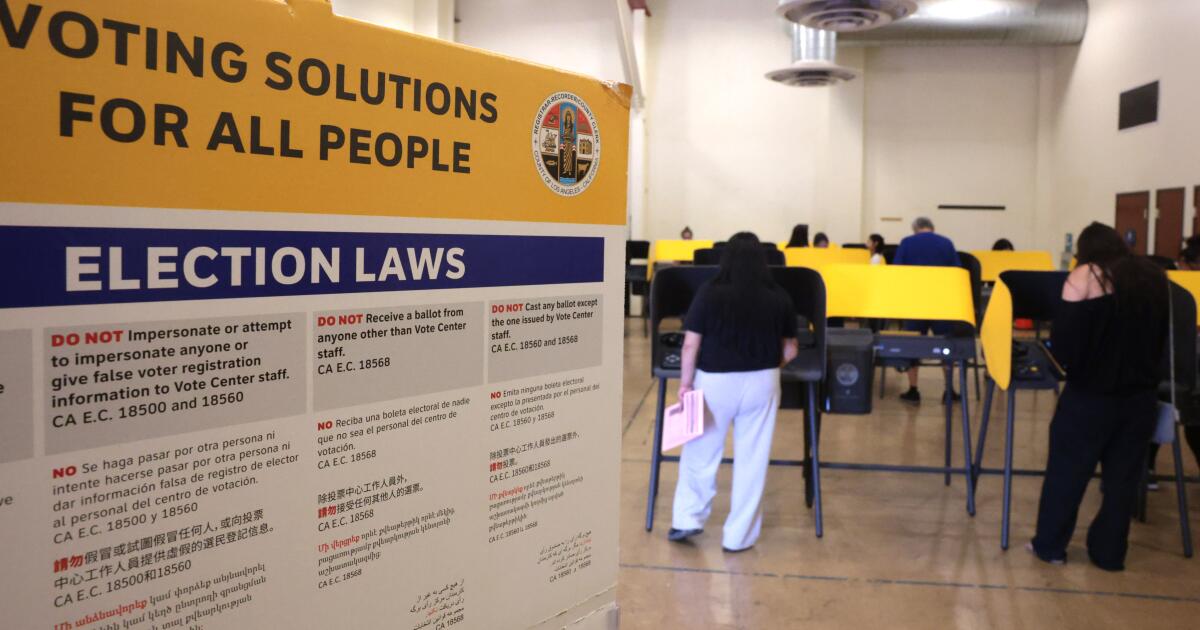
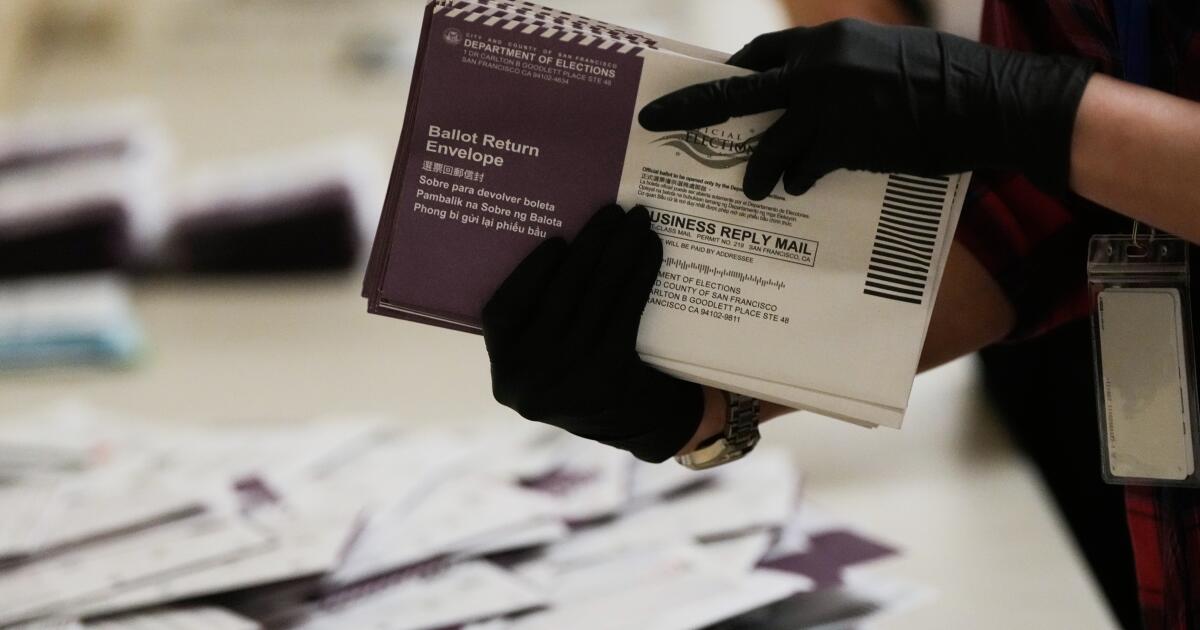
Every registered voter in the state receives a ballot by mail. Polls close at 8 p.m. on June 2, and mailed ballots need to be postmarked on or before that day. Winners may not be known on election night due to the high volume of mail-in ballots arriving after election day.

The vote counts on these pages update periodically as results are reported by the Associated Press and the L.A. County registrar. On election day, those results include in-person voting as well as any mail-in ballots already received. In the days and weeks following, votes will be reported approximately once a day, as they are processed by county registrars. Voters can track their own cast ballot here.

The Associated Press surveys the numbers posted by local election officials. The AP projects the winner for all statewide and federal races using vote returns and other data. A race may be called before all expected votes are in. Results can change as more ballots are counted.

These pages will update until the secretary of state certifies results on July 10.

Source link

3 things to watch on California election night as ballots are counted

The most important thing political junkies might need this week is patience.

With so many key races expected to be tight, officials are warning it could takes days — perhaps even more than a week — to know the outcome of Tuesday’s primary election.

Here are some important things to watch as the results roll in:

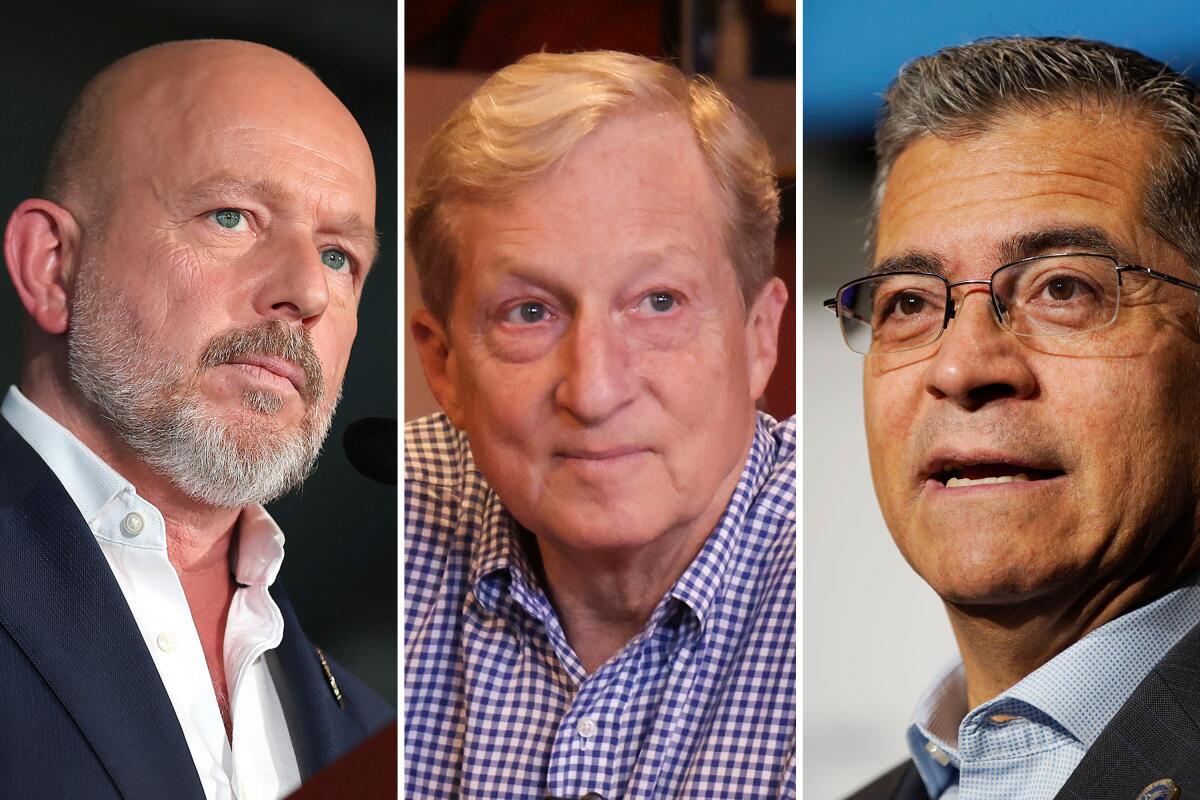
From left; Steve Hilton; Tom Steyer; and Xavier Becerra.

From left; Steve Hilton at the California Republican Convention in San Diego; Tom Steyer campaigning in downtown Santa Ana; and Xavier Becerra in San Diego.

(Los Angeles Times)

1. The fight for the second top spot

Most polls and pundits say Democrat Xavier Becerra is likely to be the top voter-getter in the primary to replace Gavin Newsom as California governor.

Until recently, it was assumed that Republican Fox News host Steve Hilton would also advance, especially after he was endorsed by President Trump.

But a new poll suggested Hilton was in a tight race for second place with Democratic billionaire Tom Steyer, who is spending heavily from his own fortune. If he is successful, California could see a competitive Democrat-versus-Democrat general election come November.

Under California’s election rules, the top two vote-getters move on to the general election regardless of party preference.

Hilton is urging Republicans to unite around him to avoid being shut out. His main GOP opponent is Riverside County Sheriff Chad Bianco.

A few months ago, Hilton and Bianco led some polls amid a crowded Democratic field, prompting fears that Democrats might be locked out of November’s general election. But those concerns have subsided somewhat with Becerra’s rise in the polls.

More to read:

Karen Bass on Friday, April 8, 2022; Spencer Pratt on April 16, 2025; Nithya Raman on March 3, 2026.

Left to right: Karen Bass on Friday, April 8, 2022; Spencer Pratt on April 16, 2025; Nithya Raman on March 3, 2026.

(Christina House / Los Angeles Times; Jordan Strauss / Invision/AP; Genaro Molina / Los Angeles Times)

2. Is the mayor’s race really a tossup?

It’s rare for the Los Angeles mayor’s race to become a national story. But that has happened this year thanks to a showdown few would have predicted.

Former reality TV star Spencer Pratt is a big reason for all the attention, running from the right in a very liberal city. Embattled Mayor Karen Bass is the incumbent, with City Councilwoman Nithya Raman running from the left.

A UC Berkeley-L.A. Times poll released last week found a close race with Bass at 26%, Raman at 25% and Pratt at 22% among likely voters. Other polls have shown Pratt doing better.

Pratt had overshadowed his opponents when it came to social media (and old media) attention. But is that enough to get him into the runoff? Bass has big labor on her side, and we’ll see whether that helps her get out the vote. But Bass is also unpopular, according to polls. Does that give Raman an opening among Democrats who are looking for an alternative?

More to read:

Dan Egelhoff plays with his dog in a room with patriotic decorations

Dan Egelhoff plays with his dog at a “Barbecue, Beer and Ballots” event at Rep. Ken Calvert’s office.

(Christina House / Los Angeles Times)

3. The fallout from California redistricting

When it comes to congressional elections, this should be a good night for Democrats, by design. That’s because California voters last year approved Proposition 50, which redrew congressional districts to favor Democrats.

It was part of a national battle by both red and blue states designed to help their respective parties secure control of Congress. The new California maps give Democrats an advantage in some areas, but it’s still unclear how sweeping the victories will be. There are some notable intra-party battles in “safe” districts as well.

The Times’ data and graphics team has identified a few races to watch:

  • Rep. Ken Calvert (R-Corona) lost his seat in redistricting and is now challenging incumbent Young Kim (R-Anaheim Hills) in the 40th District.
  • In San Francisco, several factions of the Democratic Party are vying to replace former House Speaker Nancy Pelosi in the 11th District.
  • California’s 48th Congressional District in San Diego and Riverside counties has traditionally been red. But the sudden retirement of longtime Republican incumbent Darrell Issa and redistricting puts it in play.
  • Veteran Rep. Brad Sherman is facing a strong challenge from fellow Democrat Jake Levine in the 32nd District.

More reading:

Want more information about the ballot-counting process? Times reporter Grace Toohey breaks it down, including how to track your mail-in ballot, how races get called and why it takes so long.

Source link

The final 2? California waits to see who advances in governor’s race

The outcome of the hotly contested race for California governor remained uncertain Tuesday night, but Republican Steve Hilton and Democrat Xavier Becerra held leads in the large field running to replace termed-out Gov. Gavin Newsom.

Hilton, a former conservative commentator, and Becerra, a longtime elected official who served in the Biden administration, were roughly tied in early returns, with Democratic billionaire Tom Steyer in a distant third. Only two of the candidates will advance to the November general election.

In Tuesday night remarks, Becerra cited his upbringing as the child of hardworking immigrant parents. When it came to his run for governor, he said, he was counted out, was outspent by competitors and faced calls to drop out to clear a path for a Democrat to rise to the top of a crowded field.

In the end, Becerra appears to have been that Democrat.

“Like my parents, I never gave up … and thankfully neither did you,” he told supporters Tuesday evening at the Plaza de Cultura y Artes in downtown Los Angeles. “While I take nothing for granted [and] there are lots of ballots left to be counted, it appears that we are on track to advance to November.”

Hilton, a former Fox News commentator who was endorsed by President Trump, took the stage at his party in Huntington Beach just after 10 p.m. as results showed him leading the race. “This is the first stage, but the fight really starts tomorrow,” he told supporters.

Hilton spoke of himself and Spencer Pratt, who had a strong showing in the Los Angeles mayoral race, as “a couple of outsiders who’ve never run for office before” who had taken on a broken system.

Steyer remained hopeful Tuesday night, urging supporters to be patient as the statewide vote is counted. He called out corporations, including Chevron, PG&E and the insurance industry, for rigging the system and making the state unaffordable for working people.

“Never before in all our history have these forces been so united against one candidate,” he said.

Other candidates in the race included Republican Riverside County Sheriff Chad Bianco and Democrats including former Rep. Katie Porter, San José Mayor Matt Mahan, former Los Angeles Mayor Antonio Villaraigosa and state Supt. of Public Instruction Tony Thurmond.

Villaraigosa, Mahan and Porter conceded the race Tuesday night.

Sonia Molina of Hancock Park said she came to Becerra’s election night party to support the Democrat, whom she has known since college. The local dentist described him as an honest, hardworking person who understands the importance of healthcare policy. Still, she was initially surprised at his rise in the polls.

“He’s very low-key and not very pompous — a lot of people [didn’t] really know him,” Molina said. “But I’m glad people are actually paying attention.”

Supporters of Hilton were gathered at the Waterfront Beach Resort in Huntington Beach, where cheers erupted in the ballroom with each wave of incoming results.

“He’s a true conservative,” said Hilton supporter John Merguerian, 52, of Glendale, who works as a security guard. “This is a chance for real change. We have the highest gas prices in the nation. We have the highest sales tax. One-party rule has done all this.”

California’s 2026 race for governor started slow but entered its next phase with a flourish, including the demise of a scandal-plagued Democratic favorite, the anointing of a Republican by Trump and Becerra’s unexpected rise from the depths of the crowded field of candidates.

Unlike gubernatorial elections in the last quarter century, this year’s race lacked a clear crowd-pleasing front-runner able to win over voters like Hollywood movie star Arnold Schwarzenegger or Jerry Brown, a sage of the California electorate and scion of a storied political family. But it unfolded at a crucial time as the state’s residents are overwhelmed by high housing costs, steep gas prices and overall unaffordability that threatens the “California dream” that once drew millions of people to the state.

Many voters appeared exhausted by Trump’s policies that disproportionately affected California, such as immigration raids, and the costly special election in the fall to redraw the state’s congressional districts. They did not tune in to the gubernatorial contest until weeks before Tuesday’s primary.

A fundamental question in recent days was whether the state’s 23.2 million registered voters, who all received mail-in ballots, were waiting to vote or if they would skip the election because of malaise. Low early Democratic voter turnout alarmed party leaders, but it increased in the lead-up to the primary.

Tuesday’s initial results are the culmination of one of the most unpredictable and expensive gubernatorial primaries in decades and a race that was shaped just as much by who opted not to run as by the candidates who did.

Former Vice President Kamala Harris signaled interest in the seat shortly after her bruising 2024 loss to Trump. The race was in effect in limbo as Harris, one of the state’s most high-profile politicians, weighed whether to enter.

She ultimately decided against it, as did Sen. Alex Padilla. If they had run, political strategists said, either would have been favorites to win, with high name recognition and previous experience running for statewide offices.

Others bowed out too, including Atty. Gen. Rob Bonta and billionaire developer Rick Caruso. Candidates who had initially declared for the seat — former state Senate leader Toni Atkins, Lt. Gov. Eleni Kounalakis and billionaire Stephen Cloobeck among them — dropped out or pivoted to other races.

“I don’t ever recall a playing field that looks like this one. Usually there’s a clear front-runner,” said veteran Democratic strategist Darry Sragow. “It’s easy to say that it reflects a lack of talent [but] that’s absolutely not true. Almost any of the candidates running could make a good governor.”

Still, candidates struggled for months to break through to voters.

In February, polls showed the crowded field of Democrats splitting liberal voters and opening a statistical possibility that the party would be boxed out of November under California’s open, top-two primary, which places all candidates on the same ballot. Only the first- and second-place finishers in the primary advance to the general election, regardless of their party affiliation.

Republicans Hilton and Bianco led many polls, prompting Democratic officials and allies to urge their party’s low-polling candidates to drop out of the race.

“Normal people are not living and breathing politics on a daily basis,” said Tim Rosales, a strategist who ran Republican John Cox’s 2018 gubernatorial campaign. In today’s information-saturated environment, Rosales said, the race and its roster of “extremely milquetoast candidates” didn’t break through to voters until scandal erupted.

Just when former Rep. Eric Swalwell appeared on the cusp of becoming the Democratic front-runner — rising in polls and gaining support from influential labor unions — the San Francisco Chronicle and CNN published allegations that he sexually assaulted a former staffer and acted inappropriately with other women.

Swalwell, a top Trump critic in Congress, vehemently denied the allegations as “flat false” and vowed to fight them, but the damage was done. His campaign staff and supporters abandoned him and some donors sought refunds. Two days after the allegations were published, Swalwell suspended his campaign.

In the vacuum created by Swalwell’s collapse, his Democratic rivals frenetically cast about for momentum. Porter saw a new bump in fundraising. Silicon Valley executives poured new millions behind Mahan. Former state Controller Betty Yee — who languished at the bottom of the polls — held on for a few more weeks before calling it quits.

It was Becerra who benefited most, though his critics and supporters alike have a hard time explaining exactly how or why. In less than two months, he vaulted from polling in the low single digits to the top of the field of candidates, according to surveys conducted by UC Berkeley’s Institute of Governmental Studies that were co-sponsored by the Los Angeles Times.

“Becerra caught lightning in a bottle,” Rosales said. “It could have easily gone to any of the other candidates,” but many had baggage. Videos of Porter losing her temper hurt her image, the source of Steyer’s wealth and his unbridled campaign spending weighed on voters’ minds, and Villaraigosa and Mahan were “more centrist than what most Democrats wanted, and so Xavier Becerra was really the safe choice,” Rosales said.

Before Democratic voters began to narrow down their choices, Trump endorsed Hilton in early April. It helped the former Fox News host break away from Bianco but diminished the chances of a Republican primary sweep.

In the days before the primary election, the race solidified into a three-way contest involving Becerra, Steyer and Hilton. Now fearing a scenario with two Democrats on the November ballot, Hilton called on Republicans to unite behind him and ramped up pressure on Bianco to drop out of the race, warning that having Becerra and Steyer on the November ballot would “be a disaster for California.”

“There’s one person who can stop this doomsday scenario, and that is my friend Chad Bianco,” Hilton said in an Instagram video Friday. “Chad, the best time to have dropped out would have been a couple of weeks ago, but the second best time is right now.”

Steyer stepped up his fight in the remaining days, seeking to squeeze into one of the top two spots by relentlessly battering Becerra in ads and at campaign rallies as a politician propped up by corporate special interests.

“We cannot afford to have a governor who’s been bought off by Big Oil. Period,” he said at a Sunday rally in Los Angeles.

Corporations, along with labor unions and interest groups including the California Assn. of Realtors, had spent more than $18.7 million to boost Becerra, according to the election spending tracker California Target Book. Many of the same groups also gave money to a committee intended to attack Steyer.

As the election neared, Becerra sharpened his own attacks against Steyer, calling the billionaire a “liar” and accusing him of trying to buy the election.

“We are not going to let a billionaire or Trump’s handpicked candidate take over this state,” he said during a Sunday rally in Long Beach.

Steyer’s wealth has been a central theme of the race. He has so far dropped more than $216 million into his campaign, shattering records set by other wealthy self-funded candidates before him and prompting attacks from critics who accuse him of trying to buy an election.

“Everybody assumes money is the most important thing, that you can quote-unquote ‘buy an election’ with all that money,” said Jason McDaniel, an associate professor of political science at San Francisco State University. “You still have to have a candidate who is able to be well-liked, and policy stances that are aligned with where voters are in general.”

Times staff writers Susanne Rust, Andrew Khouri and Christopher Goffard contributes to this report.

Source link

Park leads Malik in battle for District 11 L.A. City Council seat

Los Angeles City Councilmember Traci Park opened up a commanding lead over public interest attorney Faizah Malik in the race to represent the city’s coastal neighborhoods, according to early election returns Tuesday night.

Park has been a close ally of the police and fire unions in the city, calling for more cops and firefighters. Malik has been endorsed by the Democratic Socialists of America and also is backed by the Los Angeles County Federation of Labor and Unite Here Local 11, which represents hotel and airport workers.

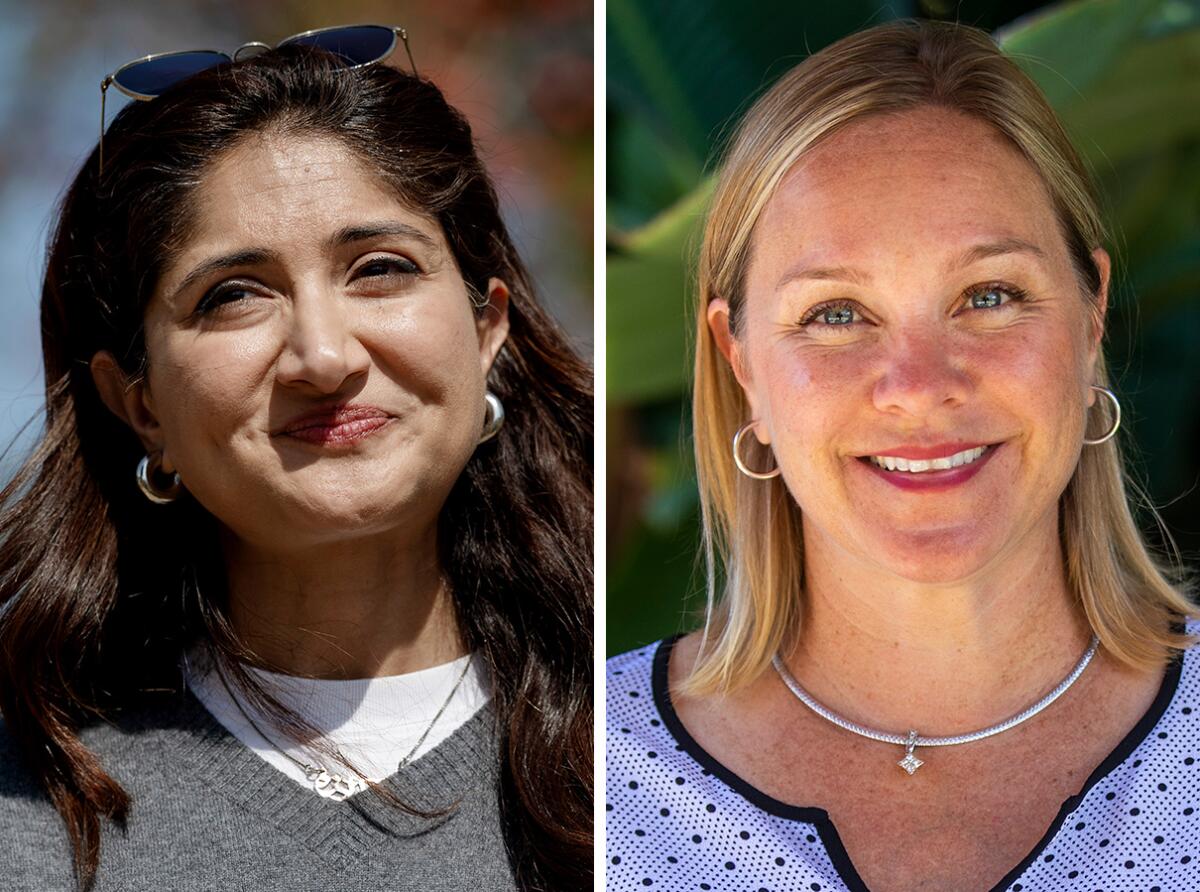
Faizah Malik and Traci Park.

L.A. City Council candidate Faizah Malik, left, and incumbent Traci Park.

(Eric Thayer and Francine Orr / Los Angeles Times)

Park reported raising $1.3 million in campaign contributions, according to the latest campaign finance reports filed with the city, compared with about $540,000 for Malik.

Park said she felt good about the early returns.

“It confirms that we have been right on the priorities and the results have spoken for themselves,” she said. “I have been writing a comeback story for the Westside for the last three years, and I’m super excited to finish it.”

In a speech to supporters at the Lincoln, a bar on the Westside, Malik remained upbeat.

“This campaign has demonstrated that we can chart a new course for a sustainable future and we can lead the way here on the Westside,” Malik said.

Los Angeles voters cast ballots for eight of the 15 City Council seats in Tuesday’s election, including races in two districts where the incumbents are leaving because of term limits.

In races with more than two candidates, the top two vote-getters will compete in a Nov. 3 runoff unless a candidate gets a majority vote in the primary.

Jose Ugarte was leading Estuardo Mazariegos in the field of six candidates in the District 9 race held by termed-out Councilmember Curren Price.

Jose Ugarte and Estuardo Mazariegos, both running for Los Angeles City Council District 9.

District 9 candidates Jose Ugarte, left and Estuardo Mazariegos.

(Genaro Molina / Los Angeles Times)

Ugarte is a former deputy chief of staff for Price, and Mazariegos is co-director of the Alliance of Californians for Community Empowerment Los Angeles and is backed by the Democratic Socialists of America.

Mazariegos said he felt confident he would make it into the Nov. 3 runoff against Ugarte.

“I feel a sense of relief and accomplishment,” he said.

The other candidates in the race were trailing Ugarte and Mazariegos in early returns. They are Elmer Roldan, executive director of Communities in Schools of Los Angeles; Martha Sánchez, a therapist; Jorge Nuño, an entrepreneur; and Jorge Hernandez Rosas, an educator.

The district includes the Convention Center, USC and communities along the Harbor Freeway.

In the San Fernando Valley’s District 3, Tim Gaspar and Barri Worth Girvan were leading the field of three candidates vying for the seat being vacated by Bob Blumenfield.

A smiling woman with dark hair, in a magenta jacket, is flanked by portraits of two men, also smiling

Christopher “C.R.” Celona, left, Barri Worth Girvan, center, and Tim Gaspar are running for L.A. City Council District 3.

(Stephanie Lorens, Yauma Olstead and Tim Sullens)

Gaspar is the founder of an insurance company, and Worth Girvan is a district director for Los Angeles County Supervisor Lindsey Horvath.

Worth Girvan said she was confident she would face Gaspar in a runoff in November.

“[The campaign] has been about ensuring the West Valley gets its fair share of resources,” Worth Girvan said.

In a statement, Gaspar said he was feeling “incredibly optimistic” about the coalition of business owners and community leaders he built during his campaign.

“They are showing they want a fresh perspective in City Hall,” he said.

The third candidate, tech entrepreneur Christopher Robert “C.R.” Celona, trailed behind.

In District 13, Councilmember Hugo Soto-Martínez was leading three challengers — Dylan Kendall, who runs Grow Hollywood, an economic development corporation; Rich Sarian, vice president of strategic initiatives for downtown’s South Park Social District; and Colter Carlisle, vice president of the East Hollywood Neighborhood Council.

Clockwise from top left; Hugo Soto-Martinez; Colter Carlisle, Rich Sarian, and Dylan Kendall.

City Council District 13 candidates, clockwise from top left: Councilmember Hugo Soto-Martinez; Colter Carlisle; Rich Sarian; and Dylan Kendall.

(Los Angeles Times)

Soto-Martínez also was backed by the Los Angeles chapter of the Democratic Socialists of America for the district that includes Atwater Village, Glassell Park, Elysian Valley, Echo Park, Silver Lake and Hollywood and East Hollywood.

Soto-Martínez said in a statement he was feeling optimistic about the early returns.

In District 1, which covers Highland Park in the northeast to University Park in the southwest, Councilmember Eunisses Hernandez was leading a pack of four challengers in the race, according to early returns.

Maria Lou Calanche, executive director of the nonprofit Expanded Learning Alliance, trailed Hernandez, according to early returns. They were followed by Raul Claros, chief executive of UNO Partners; Nelson Grande, president of Grande Enterprises; and Sylvia Robledo, who worked as an aide to several elected L.A. officials and who has fallen into last place.

Hernandez was grateful for the support that put her far ahead on the first night of results.

“I just feel reassured that all these fights we’ve been taking on for the last 3½ years have been worth it and people have been watching,” Hernandez said.

In other races, Councilmember Tim McOsker had a wide lead over Green Party member Jordan Rivers for the 15th District seat, which includes Harbor City, San Pedro, Watts and Wilmington. But the incumbent said while the early returns were encouraging, it was too early to declare victory before 9:30 p.m.

“I’ll be back in City Hall early tomorrow morning to get back to work,” McOsker said from his campaign party at the Dalmatian-American Club in San Pedro.

His campaign, he said, was focused on moving forward projects “past the point of no return” to make real change in the district that encompasses Watts, Wilmington, Harbor Gateway, Harbor City and San Pedro.

In the 5th District, which includes Bel-Air, Westwood, Cheviot Hills and Hancock Park, Councilmember Katy Yaroslavsky declared victory in her race around 9 p.m. after early ballots pushed her far ahead of the two challengers.

“Across the spectrum, people are looking for lights to be fixed and sidewalks to be usable,” she said.

In the north San Fernando Valley’s 7th District, Monica Rodriguez was running unopposed.

Source link

Conservative Sonja Shaw leads California State Superintendent race;

Sonja Shaw — a Trump-aligned conservative Republican whose public profile rose as she became identified with culture-war causes, including banning transgender athletes from girls’ sports — has emerged as the leading vote-getter in the June primary for California’s superintendent of public instruction.

With more than 80% of precincts at least partially reporting, Shaw was well ahead of Democrat Richard Barrera, holding a lead that would be difficult to surmount.

Both Shaw and Barrera are school board presidents.

Shaw heads the elected Board of Education for Chino Valley Unified in San Bernardino County, a diverse but substantially conservative inland portion of Southern California.

Barrera heads the school board of San Diego Unified, the state’s second largest school district, serving an area with liberal leanings, but that is also politically diverse.

In the primary Shaw was greatly helped by a candidate field that included seven Democrats — most with a voter and financial base that would make them competitive. Incoming results show they divided votes among themselves.

Shaw managed to consolidate the Republican vote, which put her on top for the primary. A second Republican candidate finished far behind her.

On Tuesday night, Shaw sounded hopeful and confident that her campaign themes were resonating beyond her conservative roots.

“I am humbled and grateful that Californians from every corner of our state have rallied behind this campaign,” Shaw said in a statement. “What we’ve built is more than a campaign. It’s a diverse movement of communities who believe our schools can do better and who are determined to make that happen.”

Among its high-profile actions, the Chino Valley board majority put forward a policy that would require parents to be notified if their child expressed gender-identity issues at school. Shaw and her allies also approved a policy that allows parents to challenge the content of library books.

Positioned in a runoff against one Democrat — in a state where Democrats dominate — makes for a challenging campaign.

“Tonight is not the finish line,” Shaw said. “It’s the beginning of the final stretch.”

Barrera, who was not available for comment late Tuesday night, benefited immensely from a $5 million independent expenditure campaign from the California Teachers Assn., which, in the recent past, has seemed determined to spend whatever it takes to get an ally into the state superintendent’s office.

Barrera, besides his work as a longtime public official, has been a senior aide to current state Superintendent Tony Thurmond. Thurmond could not run again because of term limits and instead mounted an unsuccessful campaign for governor.

The state superintendent has limited authority over school districts, which are locally managed. The officeholder instead manages the California Department of Education. This agency guides local school districts and also provides partial oversight. The state superintendent also typically takes advantage of the bully pulpit on education issues.

The office has an uncertain future because Gov. Gavin Newsom is pushing a proposal to reimagine the office and redistribute some of its duties.

Source link

Los Angeles city attorney trails challengers early; incumbent city controller holds lead

Los Angeles City Atty. Hydee Feldstein Soto lagged behind her two well-funded challengers based on early returns Tuesday night. But her incumbent colleague, City Controller Kenneth Mejia, appeared to be faring better in his bid to stay in office, holding a double-digit lead over finance executive Zach Sokoloff.

Progressive Marissa Roy led the field vying to serve as Los Angeles’ top lawyer in the first batch of returns surfacing around 8:20 p.m.

L.A. County Deputy Dist. Atty. John McKinney sat in second, while Feldstein Soto was positioned third. The top two finishers will advance to November’s general election. It could be days before the outcome of the race is clear. Mail-in ballots with a Tuesday postmark will be accepted by county election officials for another week.

With only two candidates running, the controller’s race will be decided this month and will not go to a runoff in November.

The city attorney’s race transformed suddenly this spring after the Los Angeles Police Department’s largest union broke with Feldstein Soto and backed McKinney. Independent expenditure campaigns have thrown $3 million behind McKinney in recent weeks, with much of that money coming from a political action committee controlled by Airbnb.

Feldstein Soto sued the rental giant for violating price gouging laws in the wake of the Palisades fire last year and has openly questioned whether McKinney would shy from aggressive litigation against Airbnb if elected.

“Special interests have gotten really accustomed to special treatment at City Hall. They get special treatment all the time,” Feldstein Soto said in a recent interview, suggesting that both McKinney and Roy had been compromised by outside spending. Independent expenditure campaigns supporting Roy also received roughly $725,000.

McKinney told The Times that if elected, he would “absolutely” sue Airbnb if necessary.

A representative for Feldstein Soto’s campaign declined to comment on the early returns late Tuesday night.

The three leading candidates often sounded like they were campaigning for different jobs.

Roy said she would run the city attorney’s office as L.A.’s “largest public interest law firm,” focusing on tenants’ rights, wage theft and other issues affecting working-class Angelenos. A deputy attorney general in the California Department of Justice, she also vowed to sue the Trump administration, linking arms with the attorney general’s office and other city attorneys in aggressive litigation to curb what many Californians see as targeted abuses of power.

McKinney talked more like he was running for city prosecutor, leaning heavily on his experience winning high-profile felony trials in the downtown courthouse. He said he would improve the way the city attorney prosecutes gun crimes and animal abusers. Despite his lack of experience as a civil litigator, McKinney also said he could bring down the city’s litigation costs, which exploded under Feldstein Soto.

“While all votes have not yet been fully counted, we feel optimistic about qualifying for the General Election in November. People want political courage. They want leadership,” McKinney said in a statement Tuesday night. “What is already clear, is that this election has been shaped by the pressing and undeniable concerns of the people of Los Angeles.”

McKinney previously ran for L.A. County district attorney in 2024 but disappeared in a crowded primary field.

While her term has been marked by financial strain, allegations of misconduct and mistreatment of employees and recent questions about her handling of a data breach that led to the leak of a trove of LAPD records, Feldstein Soto maintained that her opponents are far too inexperienced to serve as the city’s top lawyer.

She said she improved public safety by repairing her office’s relationship with the LAPD and filed more misdemeanors than her predecessor. Although legal costs surged, Feldstein Soto said she did her best to mitigate damage on a number of difficult cases she inherited when taking office in 2022. The rise of so-called “nuclear verdicts” in civil claims reflects a nationwide trend rather than a fault of her leadership, she said.

Feldstein Soto was endorsed by Mayor Karen Bass and U.S. Sen. Adam Schiff (D-Calif.). Roy had the support of the L.A. County Democratic Party, the city chapter of the Democratic Socialists of America and U.S. Sen. Bernie Sanders (I-Vt.). In addition to the police union, McKinney was backed by his boss, L.A. County Dist. Atty. Nathan Hochman.

The city controller’s race, normally a fairly sleepy affair, has turned into the second-highest-spending race in the city.

Mejia, 35, known for his two corgis that he often features on billboards across Los Angeles, sought to retain his seat as the city’s accountant and auditor.

His only challenger was Sokoloff, a senior vice president for asset management at Hackman Capital Partners. Sokoloff, 37, alleged Mejia did not properly utilize the controller’s office to run audits on city departments and failed to keep up the auditing pace of his predecessor.

Sokoloff’s mother, Sheryl, has spent $7.5 million on independent expenditures in the race, mostly on attack ads and mailers against Mejia. Often, the ads point to allegations that Mejia in 2023 fostered a toxic workplace and made inappropriate sexual remarks to female subordinates.

A woman who identified herself as Sheryl Sokoloff hung up on a Times reporter last week when asked about the race expenditures.

Mejia said Sokoloff’s mother — married to Jonathan Sokoloff, managing partner of private equity firm Leonard Green & Partners — was trying to bankroll the seat for her son.

Mejia has long run on accountability and transparency for the city’s budget and made public-facing databases across dozens of topics on the controller’s website in his first term.

A licensed certified public accountant, Mejia is a member of the Green Party and does not accept endorsements from political parties or politicians. He was endorsed by the Los Angeles Daily News and multiple labor unions, including the United Teachers of Los Angeles and United Auto Workers.

Sokoloff, a Democrat, was endorsed by multiple former controllers, notable Democrats — including Schiff — and the L.A. County Democratic Party, along with other business advocacy groups.

Source link

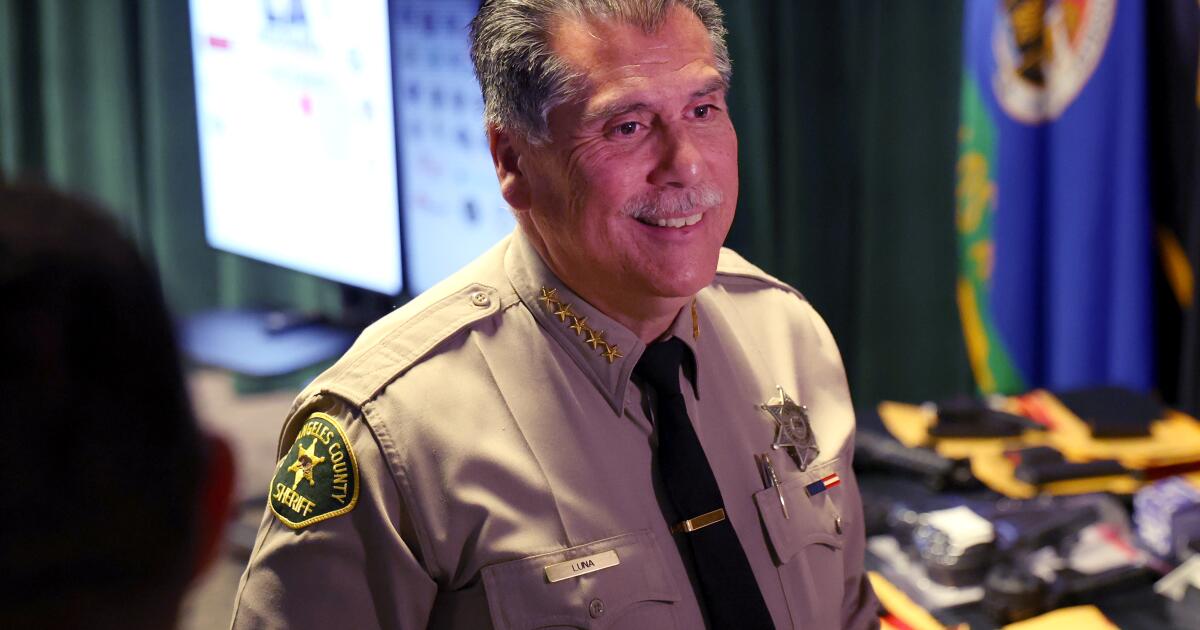
Luna leads Villanueva in early L.A. County sheriff’s race results

Los Angeles County Sheriff Robert Luna jumped out to an early lead over former sheriff Alex Villanueva, his predecessor and leading opponent in the race for the county’s top law enforcement job.

If Luna ultimately receives more than half of the vote, he wins the contest outright and will serve a second term at the helm of the largest sheriff’s department in the U.S.

If Luna falls below the 50% mark, it’s likely that he and Villanueva will head to a runoff once again, reprising their 2022 face-off, when the former Long Beach Police chief unseated Villanueva by a 61% to 39% margin.

This time around, the sheriff’s race was relatively muted. Luna mostly avoided major controversies during his term — unlike Villanueva, who clashed with elected officials and journalists, and was involved in multiple lawsuits. There were no public debates that included the leading candidates and no public polling was done.

Ahead of primary day, Luna touted his leadership and a list of accomplishments. He took credit for reducing the rate of violent crimes and homicides, and said he repaired the relationship with county leaders and others that had been fractured under his predecessor.

Villanueva criticized the sheriff for plunging the department into “chaos and dysfunction,” blaming Luna for the department’s struggles to retain deputies. Luna described both claims as unfounded.

Retired sheriff’s Lt. Eric Strong was in third place as of 8:30 p.m. Tuesday, the same position as when he ran four years ago. He was followed by Sgt. Karla Carranza, who has worked for the department for more than two decades.

Oscar Martinez, who joined the sheriff’s department after fighting in Iraq and Afghanistan, was in fifth, followed by Capt. Mike Bornman, who has decades of experience at the sheriff’s department.

Andre White, a detective with about a dozen years at the department, was in seventh, while Brendan Corbett, a former assistant sheriff for custody operations, was in last place.

Source link

LAUSD school board incumbents ahead in early returns in races devoid of pro-charter money

Los Angeles Unified School District incumbents — Rocio Rivas, Kelly Gonez and Nick Melvoin — surged strongly ahead in early returns Tuesday night for three seats on the Board of Education.

The first reported results were trending toward one-sided outcomes because the major political forces of recent years declined to do battle against each other: The teachers union supported Rivas, who represents a largely Eastside district; a charter-friendly retired businessman supported Melvoin, whose district is centered on the Westside. And the largest union representing nonteaching employees all but avoided the fray.

The third incumbent, Gonez, was the only candidate on the ballot in District 6, and faced one write-in challenger, Jose Sagredo. Thus, Gonez is poised to continue to represent a district centered in the east San Fernando Valley for a third and final term.

With no challengers boosted by high special-interest funding, the three incumbents had a virtually unobstructed campaign path.

If the early returns hold as expected, the Los Angeles Board of Education will continue to lean against charter schools and would stand in general agreement on most policies — including assertive support for immigrants and a continued holding pattern on the future of Supt. Alberto Carvalho, who remains on administrative leave as a federal investigation proceeds.

District 4, Westside

Well ahead in District 4 was two-term incumbent Melvoin. His challenger was Ankur Patel.

The funding advantage in Melvoin’s campaign was sizable through just before election day: Melvoin, $378,803; Patel: $22,662.

In addition, Melvoin benefited from an independent expenditure of $367,093 on his behalf by retired businessman Bill Bloomfield, who has been a major funder in recent campaigns, typically for candidates who also are acceptable to charter-school advocates.

Charters are privately operated public schools, most of which are nonunion. About 1 in 5 L.A. public-school students is enrolled in an independent charter operating within L.A. Unified.

District 2, downtown and Eastside

Also with a huge funding advantage was Rocio Rivas, who was headed toward a second term in District 2.

A woman in a red top wearing glasses.
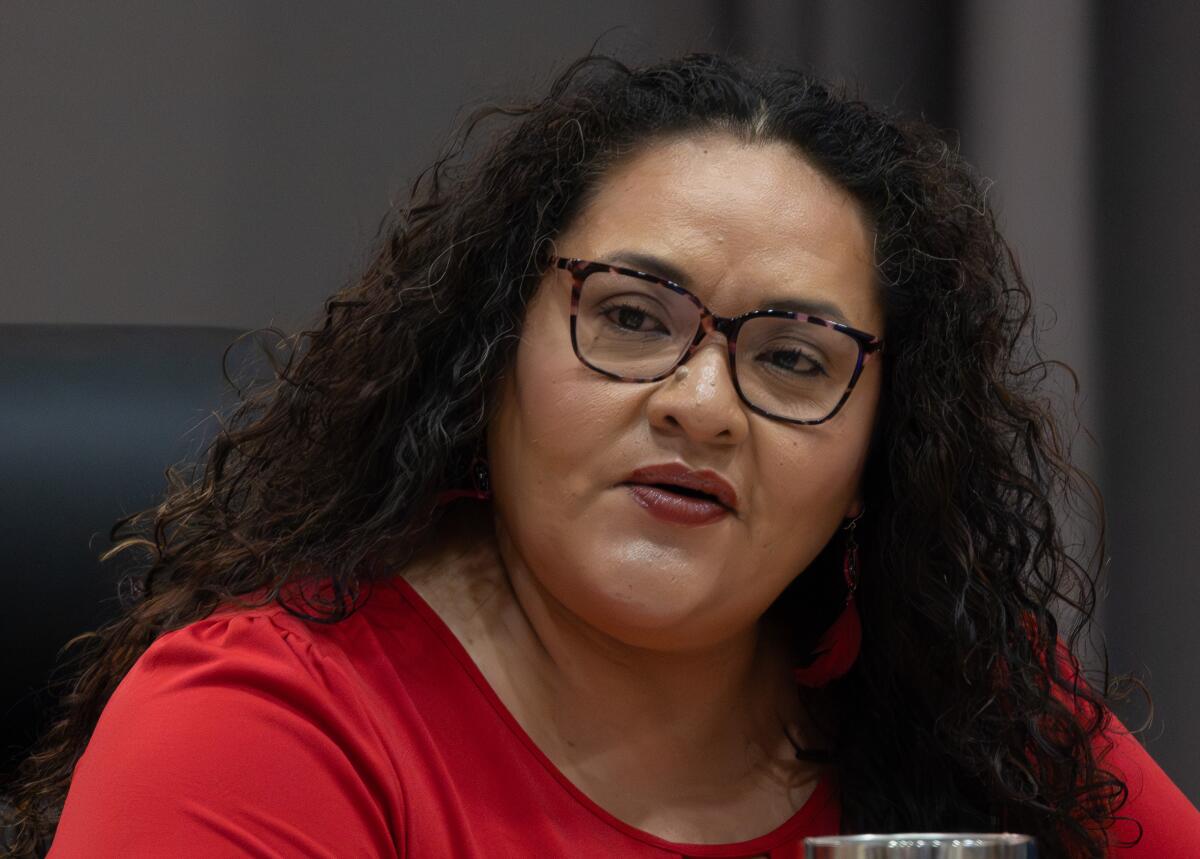
LAUSD Board Vice President Rocio Rivas was headed toward a second term in District 2. Her major funding source was $889,469 in an independent-expenditure campaign on her behalf, nearly all of it from the United Teachers Los Angeles union.

(Myung J. Chun / Los Angeles Times)

Rivas’ own campaign raised $66,218. But the major funding source was $889,469 in an independent-expenditure campaign on her behalf, nearly all of it from the United Teachers Los Angeles union. The union also spent more than $4,000 in communications to its members about the election.

These figures compare with $2,525 raised by challenger Raquel Zamora, who reported spending $5,089.

In Rivas’ successful 2022 run, her main funding opponent was Local 99 of the Service Employees International Union, which backed Maria Brenes for an open seat. Historically, Local 99 has not been inclined to oppose an incumbent, which Rivas has become. And, true to history, Local 99 has endorsed Rivas, but without spending money on her behalf.

An end to charter school wars

More broadly, this election cycle marks the end to a generation of bitterly contested Los Angeles school board races that became the most expensive in the country, with the L.A. teachers union and charter school advocates slugging it out to advance their vision for public education.

Charter school supporters — who had poured tens of million of dollars into races to elect board members sympathetic to their cause — largely stepped aside, a reflection of their diminished resources and evolving strategy.

The bottom line is that, if current vote-count trends hold, the board will be unchanged for the next two years.

This situation is less than ideal for charter schools. Charters with a mixed record face a tough review when they come up for renewal — about once every five years. Charter opponents want the board majority to move more aggressively to shut down charters when possible and to force them off district campuses — where, under state law, they have a legal right to operate.

Big board decisions looming

Big decisions before the board include how to manage a projected structural deficient — with union leaders calling the dire predictions an accounting mirage.

Meanwhile, Supt. Alberto Carvalho remains in limbo after a February FBI raid of his home and office. The investigation relates at least in part to a failed district chatbot project.

Carvalho maintains his innocence and would like to return to work. The board, however, has turned the reins over temporarily to acting Supt. Andres Chait.

Words on a wall say "Los Angeles Unified School District, Administrative Offices."
This election cycle marks the end to a generation of bitterly contested Los Angeles school board races that became the most expensive in the country, with the L.A. teachers union and charter school advocates slugging it out to advance their vision for public education. Above, LAUSD headquarters in downtown Los Angeles.

(Ronaldo Bolaños / Los Angeles Times)

Source link

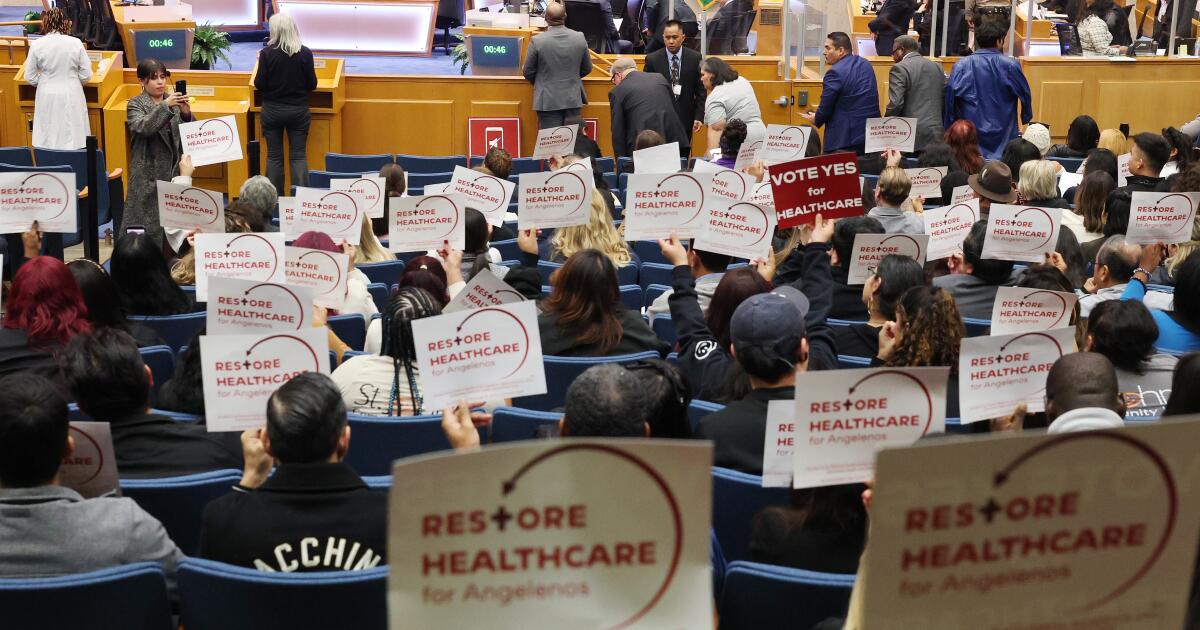
Early returns show L.A. County voter doubts about healthcare sales tax

Los Angeles County’s half-cent sales tax to fund healthcare services was trailing Tuesday, with early returns showing a majority of voters rejecting the measure.

The tax — a half-penny of every dollar spent in the county — is meant to prop up local hospitals and clinics that are hemorrhaging funding after recent federal cuts.

The sales tax, which needs a simple majority to pass, would take effect Oct. 1 and last five years. Officials say it would pull in $1 billion annually to help plug the budget holes hitting local hospitals and clinics.

L.A. County health officials anticipate the One Big Beautiful Bill Act, signed into law by President Trump last summer, will slash more than $2 billion from the county’s health services budget within the next three years. Due to eligibility changes, the county will no longer be able to get reimbursements for many Californians who have lost Medi-Cal.

The measure was championed by a coalition of healthcare advocates called Restore Healthcare for Angelenos who warned that mass layoffs and emergency room closures could be imminent if new funding didn’t come fast. The Department of Public Health recently closed seven clinics — a grim sign, supporters said, of service cuts to come.

Voters haven’t rejected a sales tax hike since 2012, when a transportation measure fell just short with 66.1% support. It needed 66.7% to pass.

A majority of county supervisors had supported the new tax proposal, voting 4 to 1 this February to put it on the ballot. But the measure faced significant opposition from local cities, with opponents arguing the sales tax hike would unfairly burden the poorest county residents and encourage people to spend their dollars across the county line.

Supervisor Kathryn Barger, the board’s lone opponent of the tax, said she was concerned it was a “general” tax, meaning the money wouldn’t be earmarked for healthcare costs. Instead, she argued, politicians would have final say over how the money gets spent.

The supervisors have created a plan for spending the tax money, with the largest chunk of the money meant to cover the costs for patients without insurance. The measure also asked voters to sign off on a nine-member oversight committee.

The county currently has a base sales tax rate of 9.75%, and cities impose local taxes on top of that.

Source link

Early California congressional race results threaten GOP power in Washington

Buoyed by a new Congressional map favoring their party, California Democrats were eyeing Tuesday’s primary elections as a critical first step toward flipping a handful of House seats and taking back power in Washington.

Results from California’s massive and slow-moving election process were not immediately clear late Tuesday, as polls closed and mail ballots continued to be processed and counted. Still, Democrats were bullish about their chances of advancing candidates to November’s general election in all five districts that were redrawn in their favor as a result of last year’s Proposition 50 ballot measure.

“The path to winning back the House starts with voting in the June 2nd primary,” the California Democratic Party posted online Monday.

Meanwhile, California Republican Party Chairwoman Corrin Rankin urged Republican voters to make their own voices heard too.

“Like President Trump said, we need to make it too big to rig,” Rankin said on “The Benny Show.” “We need to swamp the vote.”

One of the most closely watched races was in the redrawn 22nd Congressional District in the Central Valley, where incumbent Rep. David Valadao (R-Hanford) is facing challenges from moderate Assemblymember Jasmeet Kaur Bains (D-Delano) and progressive college professor Randy Villegas.

Another closely watched race was in the redrawn 48th Congressional District in San Diego and Riverside counties, where Rep. Darrell Issa (R-Bonsall) decided to retire rather than run for reelection, and where Republican San Diego County Supervisor Jim Desmond — who is endorsed by Trump — is running against a pack of Democrats.

Prop. 50 — which Californians passed with nearly 65% of the vote a year ago — was California Democrats’ response to Texas Republicans redrawing their state’s Congressional maps in the GOP’s favor, at President Trump’s behest. It was also the only major Democratic counterpunch in the wider mid-decade redistricting brawl that has spread across the country in the last year.

Experts expect the redistricting battle to deliver a net gain of a handful or more House seats to Republicans. But Democrats could gain even more ground given Trump’s lousy approval ratings and the long history of midterm election losses for the president’s party.

Combined, those factors make the battle for control of the House incredibly close, which in turn makes the five seats up for grabs in California pivotal — and potentially decisive.

Tuesday’s primaries won’t determine if any of those five seats will indeed flip parties in November. However, the primaries will define those head-to-head races to come and better inform the odds of Democrats toppling Republican incumbents, experts said.

In addition to flipping the seats currently held by Valadao and Issa, Democrats are hoping to pick up three additional seats.

In the 1st Congressional District — which after Prop. 50 lost rural reaches of northeast California and picked up liberal North Bay communities — various candidates were vying for the seat long held by the late Rep. Doug LaMalfa (R-Richvale), who died in January. They include Democratic state Sen. Mike McGuire and Republican Assemblymember James Gallagher, who is endorsed by Trump.

Voters from the existing district are also voting in a special election Tuesday to fill the remainder of LaMalfa’s term.

In the 3rd Congressional District, which lost an eastern rural stretch along Nevada and now holds more tightly to the Sacramento suburbs, Rep. Ami Bera (D-Elk Grove) — who currently represents a different district — is running to remain in Congress in a new seat.

Meanwhile, the 3rd Congressional District’s incumbent, Rep. Kevin Kiley (I-Rocklin), is seeking to do the opposite. He quit the Republican Party, became an independent and is now running for Bera’s current seat in Congressional District 6, which includes the city of Sacramento and Placer County suburbs.

In the 41st Congressional District, which became more liberal after Prop. 50 by losing voters in Riverside County and gaining them in Los Angeles County, a slate of candidates — including Rep. Linda Sánchez (D-Whittier), who currently represents a different district — are running to replace Rep. Ken Calvert (R-Corona). Calvert, a 17-term incumbent, decided to run in the neighboring 40th Congressional District instead.

In the 40th Congressional District, which covers a swath of inland Orange County and portions of San Bernardino and Riverside counties, incumbent Rep. Young Kim (R-Anaheim Hills) is now going head-to-head with Calvert, while also facing several Democratic challengers.

Other districts that were not part of the Prop. 50 shuffle are also attracting attention.

In the 11th Congressional District in San Francisco, several Democratic candidates are vying to replace Rep. Nancy Pelosi (D-San Francisco), the retiring former House Speaker, including state Sen. Scott Wiener; tech millionaire and Democratic political operative Saikat Chakrabarti; and Connie Chan, a member of the San Francisco board of supervisors who Pelosi endorsed.

Democrats are also closely watching several races where younger Democrats and progressives are challenging older incumbent Democrats, and where newer Democratic incumbents are seeking to hold onto their seats in relatively competitive districts.

Source link

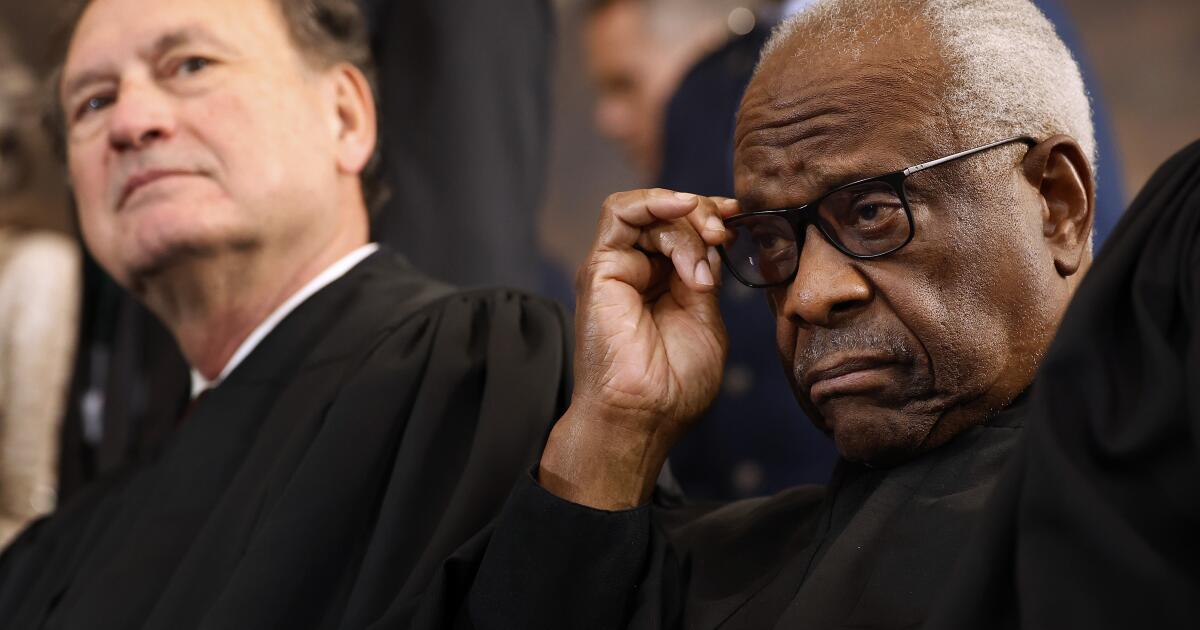
Supreme Court rules Alabama may redraw congressional maps to oust a Black Democrat

The Supreme Court ruled Tuesday night that Alabama Republican leaders may redraw their congressional voting districts to oust a Black Democrat and elect a white Republican.

The court’s conservatives, who ruled for Louisiana Republicans in a redistricting dispute, extended that decision to Alabama. The three liberals dissented.

The decision clears the way for the governor and state lawmakers to redraw their congressional voting map with six districts that favor Republicans and one that favors a Democrat.

“Weeks ago, I warned that vacating the District Court’s injunction in these cases would ‘unleash chaos and … confuse voters,’ ” Justice Sonia Sotomayor wrote in dissent. “Yet just as Alabama doubled down on racial discrimination, the Court today doubles down on chaos. Because I choose to defend the rule of law and the right of all Alabamians to participate equally in democracy, I respectfully dissent.”

The justices granted an emergency appeal that was backed by the Trump administration and set aside the decision of a three-judge panel in Alabama.

The court in a brief opinion said the three judges should not have blocked Alabama’s new map.

“While federal courts should not impose changes close to an election, states are free to decide for themselves whether last-minute changes to an election are in their best interests,” the court said.

Alabama’s emergency appeal went to Justice Clarence Thomas, who referred it to the full court.

Those three judges, two of them Trump appointees, ruled that Alabama’s state lawmakers discriminated against Black voters, who made up a near majority in the center of the state.

Three years ago, the Supreme Court agreed.

In a 5-4 decision written by Chief Justice John Roberts, the justices upheld the creation of a second district in the center of the state where Black voters had a near majority.

The result then was an Alabama state voting map that favored five Republicans and two Democrats for the House of Representatives.

But last month, in the wake of the Louisiana decision, Alabama’s lawmakers went back to court, arguing that the state may return to the voting map with only a single Black majority district.

In his appeal to the Supreme Court, Alabama’s Atty. Gen. Steven Marshall argued that the high court’s decision in favor of Louisiana “vindicates Alabama position on the lawfulness” of its earlier voting map. He said the state should not be penalized for “refusing to intentionally discriminate” to favor Black voters.

The court’s decision has cleared the way for Republican-led states in the South to flip congressional districts in Louisiana, Tennessee, Florida and now Alabama.

Source link

L.A. Rep. Jimmy Gomez reportedly faces House investigation over sexual misconduct allegations

Democratic Rep. Jimmy Gomez of Los Angeles is reportedly under investigation by the House Ethics Committee over sexual misconduct allegations.

The investigation came after the New York Post reported in April that the 51-year-old, five-term congressman had been spotted kissing a much younger congressional staffer from a different office in 2023.

According to CNN, which on Tuesday first reported news of the investigation, the congressional committee learned of other allegations of sexual misconduct as it investigated the report of Gomez’s 2023 conduct with the staffer.

Gomez was friends with former California Rep. Eric Swalwell, who earlier this year resigned from Congress and suspended his California gubernatorial campaign after multiple women accused him of sexual assault. Gomez had been a co-chair of Swalwell’s campaign.

The 2023 incident with Gomez and a younger staffer reportedly occurred at a party hosted by Swalwell, according to the New York Post. Gomez’s office denied the report at the time.

Another lawmaker, Texas Republican Rep. Tony Gonzales, also resigned from Congress in April in the wake of allegations of sexual misconduct with a former staffer who later committed suicide.

Both Swalwell and Gonzales were under investigation by the ethics committee before they resigned, but those investigations ended when they left office as the committee only has jurisdiction to investigate sitting members.

Gomez’s office didn’t respond to multiple requests for comment, but, in a statement to CNN, Gomez said he would cooperate with the ethics investigation. While he acknowledged making “personal mistakes” outside his marriage and apologized to his family, he said his actions didn’t violate House ethics rules.

“Years ago, I made personal mistakes outside my marriage that have caused real pain to my wife and family. Although my actions were consensual in nature and haven’t violated the law or House ethics rules, that doesn’t diminish the impact that these mistakes have made on those I care about the most,” Gomez said.

The House Ethics Committee declined to comment on the reported investigation.

Gomez is married to Mary Hodge, a past top aide to former Los Angeles Mayor Eric Garcetti. The couple have a son whom Gomez wore in a baby carrier during the lengthy House speaker election in 2023. That same year, Gomez founded the Congressional Dads Caucus, which has advocated for expanded child tax credits and other parent-friendly legislation.

The disclosure of the congressional investigation comes as Gomez faces a campaign challenge from Angela Gonzales-Torres, a Pasadena City College counselor with the backing of the progressive Justice Democrats.

Gonzales-Torres has criticized Gomez for receiving the backing of the American Israel Public Affairs Committee, or AIPAC, though Gomez has at times taken political stances at odds with the group.

After news of the ethics investigation broke, Gonzales-Torres wrote on the social media platform X, “I take political corruption seriously … I also take very seriously what appears to be a culture in Congress in which men abuse women.

“If @RepJimmyGomez has nothing to hide, he should have no concern. But if there was any criminal behavior that he witnessed, participated in, or helped conceal, we will find out and we will help ensure accountability and justice.”

Gomez was first elected to Congress in a 2017 special election to succeed Xavier Becerra, who is now running for governor and has seen the biggest boost in support following Swalwell’s departure from the race in April.

Gomez previously served in the state assembly from 2012 to 2017 and was political director for the United Nurses Assn. of California before that.

Source link

Federal court hears arguments over efforts to halt Trump’s mail-in executive order

A federal judge on Tuesday heard from voting rights groups and a coalition of two dozen states that want the courts to halt President Trump’s executive order seeking to create a federal voter list and limit who can receive a mail ballot.

The plaintiffs argued in two lawsuits that Trump’s order should be found unconstitutional because the states and Congress, not the president, have the power to set election rules. They also told the court that the move imposes a costly burden on state election officials to comply and would spread fear about the possibility of prosecution.

“This is going to be a sea change in the way that some states administer their ballots,” said Michael Cohen, who was part of a team representing California, adding that “it will be difficult to overstate the disruption that this will cause.”

Trump’s executive order, the second one aimed at elections during his second term, comes as he continues to raise the specter of widespread voting by noncitizens as a reason to change election rules. But states already have detailed processes aimed at keeping their voter rolls accurate, and voting by noncitizens has been shown to be rare. It also is a felony that can be punishable by deportation.

His latest order is being challenged through multiple lawsuits, including two filed in U.S. District Court in Boston.

The American Civil Liberties Union, which represented the League of Women Voters in one of the two Boston cases, has called the order “a dangerous attempt to disenfranchise eligible voters nationwide.” The group said the order transforms “the U.S. Postal Service from a neutral mail carrier to an arbiter of who may cast a ballot by mail.”

“This case challenges an extraordinary and abusive assertion of executive power over the administration of federal elections,” the organization said in its complaint.

The hearing comes less than a week after another judge declined to halt the order. U.S. District Judge Carl Nichols, a Trump appointee in Washington, agreed with the Trump administration’s contention that it was too early to block the order because it has yet to be implemented.

The administration, in its motions to dismiss the lawsuits, argued that the plaintiffs lack standing to bring their claims. They also argued the motions are premature and that plaintiffs lack the legal basis to bring their Administrative Procedure Act claim, which governs how federal agencies develop and issue regulations.

Stephen Pezzi, a lawyer for the Trump administration, said the harms the plaintiffs referred to were subjective, since much can change with the voting list before it is finalized. He also said no one would be prosecuted for violating the executive order.

Missouri Solicitor Gen. Lou Capozzi, speaking for the states supporting the list, argued it was too early to say how his state might use the list, but that it was “unlikely” any voter would be removed this year from the voter rolls because of it.

“We are not exactly sure how we would use it,” Capozzi said, adding that “we don’t want this process to be strangled in the crib, so to speak.”

U.S. District Judge Indira Talwani took the requests for motions to halt the order, along with motions to dismiss the cases under advisement.

During oral arguments, Talwani expressed concerns about whether the federal system envisioned under the executive order could be ready for the upcoming midterm elections and about the risks posed to election workers who rely on a state list that differs from the federal one. She also raised doubts about the reliability of a federal list — noting, for example, women who changed their names after getting married or someone who has moved from state to state might be missed.

“Isn’t there a reasonable fear and concern on behalf of voters that they will be precluded?” Talwani asked.

Trump issued the order in March after a bill he supported to overhaul voting stalled in Congress. The order would have had the federal government create a list of eligible voters and then directed the postal service to deliver mail ballots only to those on the list. Election officials argued that it was ripe for abuse and could cause chaos, and the postal union has objected to the idea of mail carriers policing ballots.

The postal service has published a proposed rule required by Trump’s executive order in the Federal Register. Among other things, the rule would not apply to primary elections or overseas ballots.

Since his 2020 presidential election loss to Democrat Joe Biden, Trump has groundlessly claimed mail voting is rife with fraud and has launched a federal investigation into that year’s vote, even though repeated audits and investigations, including ones run by Republicans, found it was free of widespread fraud. Trump also has said he wants to “take over” election administration in Democratic areas.

Casey writes for the Associated Press.

Source link

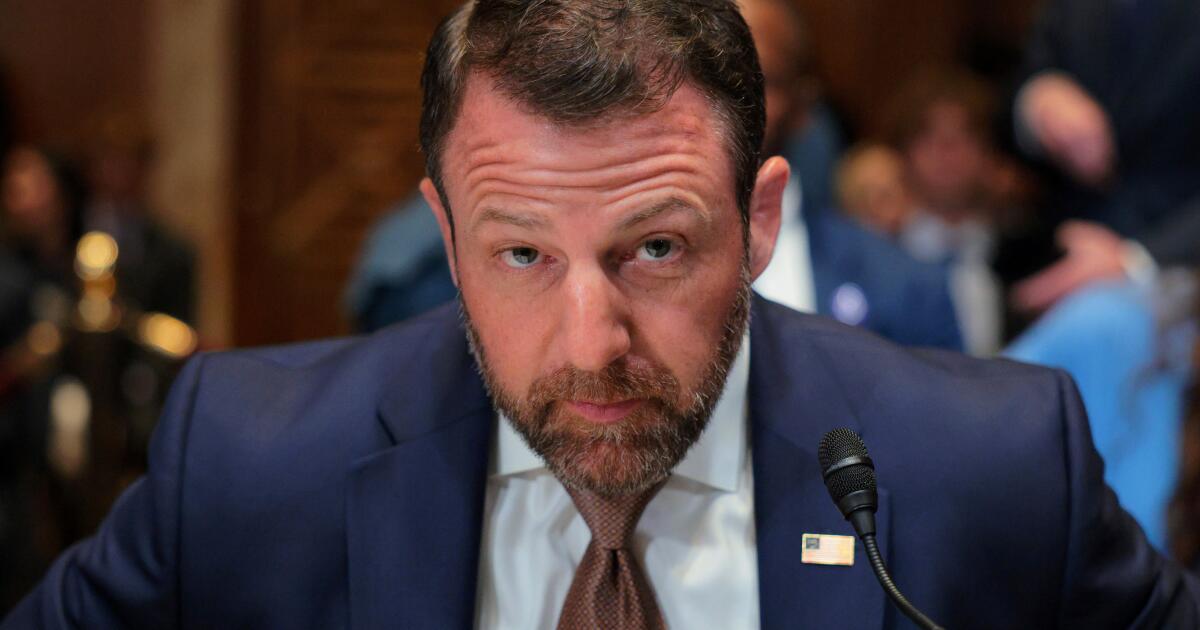
Homeland Security Secretary Markwayne Mullin refuses to commit to following court orders

Homeland Security Secretary Markwayne Mullin, under intense grilling at a Senate hearing Tuesday, refused to commit to abiding by federal court orders.

Mullin also conceded that his predecessor as secretary, Kristi Noem, had inaccurately described two shootings involving immigration officers in Minneapolis.

His refusal to commit to complying with court orders came during a testy exchange with Sen. Chris Murphy (D-Conn.). Murphy quoted Chief U.S. District Judge Patrick Schiltz in Minnesota — a Republican appointee — who said Immigration and Customs Enforcement had violated nearly 100 court orders and had “likely violated more court orders in January 2026 than some federal agencies have violated in their entire existence.”

When Murphy asked Mullin to commit to complying with court orders in the future, Mullin replied that his agency would not break the law.

So you’ll pick and choose which court orders you’ll obey?

— Sen. Chris Murphy

“But that doesn’t sound like the same thing as committing that you will obey a court order,” Murphy said.

“If we didn’t think the courts were politicized, then I would probably be able to answer that. But we see courts over and over again that use their bench for political opinion and not just the rule of law,” Mullin said.

“So you’ll pick and choose which court orders you’ll obey?” Murphy asked,

Mullin told Murphy not to put words in his mouth.

Addressing his fellow senators, Murphy said, “If you’re a Democrat or a Republican on this committee, you should be really, really freaked out.”

Murphy later returned to the court orders question, saying that ignoring judges erodes democracy.

“I agree that there is politics involved in judicial decisions,” he said. “I do not think that gives an excuse to either Democratic or Republican administrations to ignore those court orders. I think that’s actually the end of our republic, if the administration willfully ignores a court order because they disagree with it or its motivation.”

Mullin faced the Senate Appropriations Committee amid scrutiny over the agency’s budget and immigration enforcement ahead of the World Cup. President Trump tapped Mullin to take over leadership of the embattled Department of Homeland Security after Noem was fired in March.

Mullin’s appearance came as the Senate is considering legislation that would fund immigration enforcement agencies through the end of Trump’s term. Republicans intend to use a legislative maneuver that would bypass the need for support from Democrats, who have pushed for reforms since two U.S. citizens were killed by immigration agents in Minneapolis.

During his previous appearance before senators, Mullin projected himself as diplomatic, saying he would work to bring confidence to the agency and keep it out of the news. But recently, he has set the travel industry on edge by threatening to remove Customs and Border Protection officers from airports in so-called sanctuary cities, which limit collaboration with immigration enforcement agents.

Millions of people are preparing to visit the United States for the World Cup, which starts June 11 and includes host cities such as Los Angeles, San Francisco and Seattle. Mullin said he will attend his first soccer game June 12 in Los Angeles.

Murphy, the committee’s top Democrat, made note of Mullin’s promise to keep Homeland Security out of the news. He said the agency has repeatedly broken the law, wasted billions in taxpayer dollars and lined the pockets of private prison corporations.

“Nothing has really gotten better,” he said. “In fact, you spent the first two months of your tenure threatening to suspend international arrivals in states represented by Democrats. Not only would that throw our entire air travel system into chaos, it’s completely illegal.”

Mullin took issue with Murphy’s characterization of the agency’s behavior, calling it political theater. Murphy sat with his head propped up on his hand, looking directly back at his former Senate colleague.

Mullin said threats against immigration agents are up significantly and that Murphy’s “reckless tone is getting people hurt.”

Protests erupted last month outside an immigrant detention facility in New Jersey after detainees launched a hunger and labor strike over what they called inhumane conditions such as rotten food and medical neglect. Tensions have escalated over several days as protesters clashed with law enforcement and counterprotesters.

On Monday in Dallas, Mullin said he would pull Customs officers from airports around the country to help with the security in Newark, if it became necessary.

Addressing the issue of officer training, Mullin said Tuesday that the agency will return next month to 72 days of training for new recruits, including training on crowd control. Last year, then-acting ICE Director Todd Lyons told Congress the agency had reduced the number of training days to 42.

He also said the agency is not “actively patrolling” sensitive locations, such as schools, and said that the agency has stopped relying on administrative warrants to enter a residence by force and is now seeking judicial warrants before doing so in most cases.

Asked by Sen. Patty Murray (D-Wash.) about body-worn cameras, Mullin said the agency doesn’t have the money to supply enough body cameras for every immigration officer. Homeland Security received an unprecedented windfall last year of $170 billion under Trump’s sweeping tax bill, the One Big Beautiful Bill Act.

Mullin said the agency suffered a blow to morale because of the historic 76-day shutdown of ICE and CBP after a congressional stalemate over funding.

“Some people couldn’t sustain it,” he said. “We lost a tremendous amount of workforce, about 8%.”

During an exchange with Sen. Chris Van Hollen (D-Md.), Mullin acknowledged that Noem had unfairly and inaccurately described two shootings involving immigration officers in Minneapolis.

An ICE agent was recently arrested over the nonfatal shooting of a Venezuelan man, whom Noem had called an attempted murderer.

“That’s an untrue statement, isn’t it?” Van Hollen said.

“From what we have been briefed on, yes,” Mullin replied.

Next, Van Hollen brought up Alex Pretti, who was shot and killed by CBP agents. Noem called him a domestic terrorist.

“You agree the facts don’t support that statement?” Van Hollen said.

“The investigation would say that’s probably not accurate,” Mullin replied.

Mullin was scheduled to appear before the House on Wednesday.

Source link

Rubio is optimistic on eventual Iran nuclear talks despite congressional skepticism

Secretary of State Marco Rubio said Tuesday that he is optimistic about the potential for a resumption in nuclear talks with Iran despite a shaky ceasefire in the war that is looking increasingly in doubt.

Rubio defended the Trump administration’s approach to Iran and other global hot spots in back-to-back hearings before the Senate Foreign Relations Committee and a House Appropriations subcommittee. He was briefly disrupted by protesters at each session.

In his first public testimony since the Iran war began at the end of February, Rubio said the Iranians have agreed to negotiate on nuclear points that they had not been willing to address in the past but would not offer an assessment on what those talks might produce.

“They have agreed to negotiate aspects of their nuclear program that just a month ago, just a year ago, they were refusing to even mention,” Rubio told the Senate. He noted, however, that there was no guarantee “it will lead to a deal that’s acceptable” and that negotiations have been made difficult by the instability of Iran’s leadership.

Rubio’s optimism ran counter to pessimistic reports from two semiofficial Iranian news agencies that Iran has stopped communicating with mediators after Israel threatened to bomb Beirut as it fights the Hezbollah militant group. President Trump disputed that Iran has cut off communication with mediators, calling Iranian reports of a cessation in talks “false and erroneous.”

Democrats criticize Trump administration’s approach to Iran, and Rubio defends it

Rubio’s wide-ranging testimony was met with fierce objections from Democrats, including tough questions about the status of U.S. foreign assistance to respond to diseases such as the Ebola outbreak in Africa. Rubio insisted that the dismantlement of the U.S. Agency for International Development had not affected Washington’s ability to assist with global humanitarian responses.

Sen. Chris Van Hollen (D-Md.) blasted Rubio and Trump for foreign aid cuts and overseas intervention. Van Hollen specifically took aim at the U.S. and Israeli decision to strike Iran, accusing the Republican president of entering the war on behalf of Israel.

Israeli Prime Minister Benjamin Netanyahu “said he’s been waiting 40 years to do this,” Van Hollen said. “It turns out he finally found a president who was both stupid and reckless enough to join him. Let’s face it, Mr. Secretary, the Trump foreign policy has become a dumpster fire.”

Rubio’s testimony, which was taking place as Israel and Lebanon began a new round of political talks at the State Department with the situation between Israel and Hezbollah still uncertain, did not provide definitive answers on any of the main questions of the day.

He said Iran is not guaranteed a massive payout for reopening the Strait of Hormuz, the crucial waterway for global oil shipments, and would have to commit to further concessions on its nuclear program to get significant sanctions relief.

“The more they give, the more they would get,” he said, later adding, “They’re not going to get it as a signing bonus.”

Rubio also said there are indications that Iran’s new supreme leader, Mojtaba Khamenei, is taking a bigger part in the discussions despite not being seen publicly since the war began.

“I think there are indications out there that he is increasingly engaging at some level, although all of his communications have been in writing and through intermediaries,” he said.

Democratic senator says drugs being on boats isn’t a targeting criterion for U.S. strikes

On other issues, Rubio dismissed questions about the legality of Pentagon strikes against dozens of alleged drug-smuggling vessels in the Caribbean Sea and the eastern Pacific Ocean, which have killed more than 200 people since early September.

Sen. Tim Kaine (D-Va.) said the military’s targeting criteria for those strikes does not include drugs being present on the boat. He called it “odd” but said he could not share much more because the criteria are classified.

Rubio pushed back, saying every strike has a legal officer who makes a determination on whether a strike is legal. He also said the U.S. military has “walked away from strikes” multiple times because they did not meet the targeting criteria.

The Trump administration says the U.S. is at war with drug cartels, while many Democrats have questioned the legality and effectiveness of the strikes.

The Republican former senator faces a second congressional hearing Tuesday and a pair of others Wednesday about the State Department’s annual budget request, though questions have mostly focused on top foreign policy issues.

Rubio wades into Taiwan arms sales opposed by China

Rubio acknowledged that the Trump administration is holding up a new potential $14-billion arms sale to Taiwan but said it remained under consideration and would not be canceled. He noted that the U.S. recently sold arms to Taiwan in December worth $11 billion.

He said the deal is not under review because of pressure from China, although he said the Chinese bring up the issue in discussions with the United States. Trump also has described it as a great negotiating chip.

“They are constantly talking about Taiwan arms sales, but that in no way is what is holding up our decision-making or the White House’s decision-making,” Rubio said. “It is something the president will have to decide on the timing of when and how that is executed on.”

Protesters chant at Rubio about Cuba

Rubio, the son of Cuban immigrants, also was questioned about the Trump administration’s escalatory behavior toward Cuba, as Trump has hinted that the small island country could be the next U.S. target after operations in Iran are wrapped up.

He faced chants from protesters who urged him to “stop killing Cubans” when he entered the Senate briefing room. The protesters were quickly pulled from the room. Their chants also included “Let Cuba live!”

Rubio defended the administration’s approach to Cuba and said it would remain focused on changing the Cuban government’s policies.

“I really don’t believe this system is capable of reform unless new people take over or a new mindset takes hold,” he said.

Despite a series of meetings between U.S. and Cuban officials, Trump and Rubio have renewed threats against the island’s government, which take on greater weight following the administration’s announcement of criminal charges against former President Raúl Castro.

Over his congressional career and now as America’s top diplomat, Rubio has maintained that Cuba is a national security threat due to its ties to U.S. adversaries, and that Trump is intent on addressing it.

Amiri, Lee and Finley write for the Associated Press. Amiri reported from New York.

Source link

Blanche says Trump administration is scrapping $1.8B fund meant to compensate president’s allies

Acting Atty. Gen. Todd Blanche said Tuesday that the Trump administration was scrapping plans to create a $1.8 billion fund meant to compensate allies of the Republican president after widespread political backlash and setbacks in the courts.

“We are not moving forward with the fund, period,” Blanche said in response to questions at a House hearing on the Justice Department budget.

““Not moving forward, ever?” asked Rep. Grace Meng, a New York Democrat.

The blunt declaration marked an extraordinary turnabout for a Trump Justice Department that just two weeks ago had pronounced the fund as essential to make up for what officials insist was weaponized law enforcement during President Biden’s Democratic administration. Since then, though, the idea has faced mounting pressure from Republicans who demanded reassurances that plans for the fund were off the table before they would move forward with legislation funding President Trump’s immigration enforcement agencies.

Blanche said the Justice Department was not abandoning an element of a settlement with the IRS that gave Trump and his family immunity from tax audits.

The hearing before a House Appropriations subcommittee was scheduled for discussion of the Justice Department’s budget, but lawmakers quickly focused their questioning on the creation of a fund that has provoked outrage over the mere possibility that violent pro-Trump rioters who stormed the U.S. Capitol on Jan. 6, 2021, could be eligible for payouts.

Signs for the retreat surfaced Monday when a person familiar with the matter said the Republican president was now reconsidering whether to move forward with the fund established to resolve his lawsuit against the Internal Revenue Service over the leak of his tax returns. The Justice Department also said Monday it would comply with a Virginia court temporarily blocking the administration’s “Anti-Weaponization Fund,” effectively agreeing to pause the plan for at least two weeks.

Another judge in Florida raised the prospect of reopening the IRS lawsuit because of “grievous allegations” of improper dealing made against the administration by settlement critics.

The Trump administration has defended the fund as an appropriate measure to make up for what officials insist was a weaponized Justice Department during President Joe Biden’s Democratic administration, a claim the Biden administration strongly denied. Though some Trump supporters, including participants in the Capitol riot, have celebrated the announcement, the reaction among Republicans in Congress has been decidedly more hostile, forcing Blanche to try to assuage a GOP constituency that generally operates in close alignment with the administration.

The furor has especially complicated matters in the Senate, where Republicans defiantly left town 10 days ago without passing legislation to fund Trump’s immigration enforcement agencies. Republicans who returned to Washington on Monday said they won’t have the votes to pass the Homeland Security spending bill until the White House works with them to place parameters on the fund. Many have pushed the administration to impose limits or scrap the idea altogether.

At a Senate budget hearing last month, Blanche refused to rule out the possibility that those who carried out violence on Jan. 6 could be eligible for payouts and has repeatedly said in interviews that anyone who feels persecuted by the criminal justice system is free to apply. Payouts will be decided by a five-member commission appointed by Blanche.

But he has apparently struck a more conciliatory tone in private when confronted by Republican anger.

Blanche encountered a groundswell of opposition last month at a tense private meeting with GOP senators, with more than half raising concerns, including by shouting at the Justice Department’s top official, Republican Sen. Ted Cruz of Texas said in a recent episode of his podcast.

“There were fireworks at an epic level — and I’ve got to say, it’s one of the roughest meetings I’ve seen in my entire time in the Senate,” Cruz said.

Behind closed doors, Blanche was “adamant” that no one who assaulted police at the Capitol would receive compensation, according to Cruz.

“He said not just ‘no,’ but ‘hell no,’” the senator recalled.

Tucker and Richer write for the Associated Press.

Source link

Competition to run JPL comes at fraught moment

Weeks after Trump administration officials announced that management of NASA’s Jet Propulsion Laboratory would open to competitive bidding for the first time, questions remain as to why Caltech could lose control of the lab its researchers founded in 1936.

On one hand, observers note, high-profile delays and cost overruns on significant recent JPL projects earned sharp criticism from NASA even before the 2024 presidential election.

On the other, the second Trump administration’s record of squeezing scientific funding and attacking institutions in Democratic-led states make it difficult to consider any action as separate from the charged political atmosphere, analysts say.

“My first instinct is that this [competition] isn’t necessarily a bad thing. It’s not written in stone that Caltech must run JPL, and it wouldn’t be the worst thing to have some competition for running the place,” said Casey Dreier, chief of space policy at the nonprofit Planetary Society.

“That said, that requires this contract evaluation to be fair and unbiased, and this administration has no credibility in such things,” he added. “The responsibility is on NASA to earn the trust and ensure such an evaluation is open and free from political meddling. That’s almost impossible.”

JPL became part of NASA when the space agency was formed in 1958, and Caltech has been awarded the contract to run the institution outright ever since.

Its current 10-year contract with NASA, which is valued at up to $30 billion, runs through Sept. 30, 2028.

NASA Administrator Jared Isaacman announced the competition on May 22 as part of a slate of sweeping organizational changes at the space agency.

“When you step back, it is worth considering how many additional missions we could have undertaken with the resources lost to program cancellations and cost overruns over the years,” Isaacman wrote in a memo to staff. “That is the problem we must fix, so the American taxpayer and space-loving community can receive the highest scientific return on every dollar we spend at NASA.”

Allowing competition on the contract for JPL, the lone Federally Funded Research and Development Center (FFRDC) in NASA’s portfolio, was an effort to address cost-efficiency concerns, Isaacman wrote.

“This process will take several years, and I do not anticipate it having any impact on the projects underway or the location of the facilities,” he wrote. “It does, however, provide an opportunity to evaluate management costs, overhead burdens, and ideally find ways to get after the science faster and more affordably.”

In a joint statement, Caltech President Thomas F. Rosenbaum and JPL Director Dave Gallagher said that the competition was “no surprise” and that a team was already in place “to ensure we are positioned for success.”

In July, NASA’s Office of Procurement held an informational event for companies and institutions interested in the upcoming FFRDC contract.

The dozens of registered attendees included universities such as USC, Texas A&M and Georgia Tech; aerospace companies such as Boeing and Lockheed Martin; and nonprofit corporations like MITRE, which manages several FFRDCs, and Universities Space Research Assn., a university consortium founded by the National Academy of Sciences in 1969. (SpaceX, which has been awarded more than $13 billion in NASA contracts in the last decade, was not on the list.)

“Lockheed Martin has more than 50 years of deep space exploration success with JPL, supporting landmark missions to Jupiter, Venus, Saturn, Pluto, including nearly a dozen missions to Mars,” said Bob Behnken, vice president of exploration and technology strategy. “We look forward to building on that unmatched partnership in the years ahead. We are closely following NASA’s review and will continue to assess how we can best contribute to the agency’s mission.”

Other attendees contacted by The Times declined to discuss their involvement.

Isaacman indicated that JPL could come under scrutiny even before he took over NASA. The billionaire entrepreneur referenced high costs at the La Cañada Flintridge institution in a memo prepared in advance of his confirmation hearings on his priorities for the space agency.

“Contract structure: Very expensive,” Isaacman wrote of JPL in a table outlining organizational issues at each of NASA’s centers. “Must increase the output and ‘time-to-science’ KPI,” or key performance indicator.

The institution has recently suffered a number of high-profile management stumbles.

After the JPL-managed Psyche mission to a metal-rich asteroid failed to meet its 2022 launch date, NASA commissioned an independent review that said internal reorganizations and personnel changes created distracted and uninformed managers and burned-out, stretched-thin staffers.

After a 2023 independent review found there was “near zero probability” of the JPL-managed Mars Sample Return mission making its proposed 2028 launch date, and “no credible” way to bring rocks back from the Red Planet within the stated budget, Isaacman’s predecessor, Bill Nelson, put out a call for proposals to industry and all other NASA centers, forcing JPL to compete for its own project.

After Trump’s election, Nelson announced that the final decision would be in the next administration’s hands.

The White House pushed for massive cuts to NASA’s 2026 budget that Congress overturned, and has lobbied for similarly steep cuts again this year. JPL has instituted painful cost-cutting measures of its own, reducing staffing from roughly 6,500 employees in 2023 to 4,500 last year through layoffs and attrition.

Its struggles come at a point when NASA is enthusiastically embracing private industry. Last month the agency awarded several key contracts for its upcoming lunar missions to Jeff Bezos’ Blue Origin and other private companies.

Trump has also made no secret of his willingness to punish states that haven’t voted for him through job losses. In announcing his decision to move U.S. Space Command from Colorado to Alabama, Trump acknowledged that his loss in Colorado in three presidential elections played a part in the move.

It’s impossible to consider any decision on JPL’s future as separate from the administration’s track record of politically motivated decisions, Dreier said.

“At the heart of this is why? Why now? If this is not just some rank political attack on California, what do they hope to gain from this?” he said. “That deserves explanation, because the administration otherwise has no credibility here.”

Source link

In deep blue California, frustration with Democratic status quo fuels governor, L.A. mayor race

As primary voters head to the polls Tuesday to determine which candidates will face off in November to become California’s governor and Los Angeles’ mayor, both races are wide open, with a new crop of candidates challenging the Democratic status quo.

For Democrats, little clear consensus has emerged so far on who should lead the city and state into the future.

In California’s crowded gubernatorial race, Democrats have struggled in recent months to settle on a candidate to succeed term-limited Gov. Gavin Newsom.

After former Rep. Eric Swalwell suspended his campaign in April amid allegations of sexual misconduct, Xavier Becerra, a former Biden cabinet member, inched ahead by positioning himself as the safe, experienced Democratic candidate. Another Democrat, billionaire climate activist Tom Steyer, and Republican Steve Hilton, a former Fox News commentator, trail close behind.

In L.A., experience seems to be as much a liability as an advantage.

Mayor Karen Bass finds herself in the extraordinary position, as an incumbent, of fighting to make the runoff as she is assailed from the left and the right. The latest UC Berkeley-L.A. Times poll shows Bass leading with just 26% of the vote, one point ahead of City Councilmember Nithya Raman, a wonkish Democratic socialist, and four points ahead of Republican Spencer Pratt, a former reality TV star.

“There’s a clear sense of frustration with the Democratic Party,” said Sara Sadhwani, a professor of politics at Pomona College. The reason a wave of conservative outsiders like Pratt and Hilton are doing so well in such a solidly liberal city and state, Sadhwani said, is that they’re more willing to spell out the challenges that L.A. and California face.

“Democrats tend to be very concerned about not upsetting one coalition or another, so it’s politics as usual with many of the Democratic candidates,” Sadhwani said. “Spencer Pratt has blown a hole in that by just naming the problems that everyday residents and voters are seeing and feeling on the ground.”

On homelessness, many Angelenos are frustrated Bass hasn’t significantly moved the needle.

“We can point to facts and figures that might suggest that things have changed,” Sadhwani said. “But when you walk down the streets of Los Angeles, it doesn’t feel like it, so she hasn’t passed the field test. That’s the problem.”

A growing segment of Angelenos also chafe at the city’s high cost of living. And many are angry about the Bass administration’s lack of preparation and response to the 2025 Palisades fire.

“The Democrats have to account for those challenges,” Sadhwani said. “They have been in power for all of this time.”

California, of course, remains a Democratic stronghold, and polls show state voters are overwhelmingly opposed to President Trump. His second-term agenda — including a sweeping immigration crackdown, tariffs and the war in Iran — only seems to have cemented California’s status as a resistance state.

But after so many years of Democratic dominance, in Sacramento and at Los Angeles City Hall, leaders have to answer for voter frustrations.

The top two vote-getters in California’s nonpartisan primaries will advance to theNovember runoff, unless one candidate manages to pick up more than 50% of the vote.

Republicans have turned out at higher rates than Democrats in early voting. Paul Mitchell, vice president of the Sacramento-based bipartisan firm Political Data Inc., said that older Democrats who reliably turn in their ballots were slower to vote this year, likely because two Republicans were on the gubernatorial ballot and the Democratic field was fractured.

“That has caused them to dive into a lot more strategic voting,” Mitchell said, noting many seemed to be waiting to cast their ballots for the Democrat who looks to have the best chance of moving on to November.

For the GOP, getting a candidate on the November ballot for governor means more than just demonstrating Republicans are players in California. A GOP candidate would bring out more Republicans to vote in the general election, raising the party’s prospects of winning down-ballot races and passing a GOP-led ballot initiative on voter ID.

For Democrats, the midterm races offer the party its first major chance to chart a new path for the future.

As polls show Trump cratering in popularity, Democrats in California and beyond are struggling a year and a half after Kamala Harris’ bruising 2024 defeat to agree on what went wrong.

The Democratic National Committee’s long-awaited autopsy of that election — which said Harris “wrote off rural America,” wrongly assumed identity politics would win over voters of color and failed to develop “defined or consistent” strategy against Trump — has only generated more hand-wringing.

“There is not a clear vision, there is not a clear policy agenda, and the Donald Trump presidency upended the policy world as we knew it,” Sadhwani said. “It’s unclear how any Democrat, including any of the individuals in these two races, is going to navigate the waters into the future. One thing is for certain: We aren’t going back. So, which of these candidates is going to lead us into an uncertain future?”

Referendum on Bass

In L.A., the election is a referendum on Bass, who pledged in 2022 to solve homelessness, cut crime and make the city more affordable.

“How has L.A. changed in four years?” said Christian Grose, a professor of political science and public policy at USC. “The Bass campaign is saying it has changed for the better and she still needs more time. All the other candidates, from very different perspectives, are saying that it’s much worse than it was four years ago, and it’s time for new leadership.”

Bass told The Times she plans to win in November by demonstrating her administration’s progress in clearing homeless encampments and accelerating the building of affordable housing. She has also noted that data shows homicides in the city are at their lowest since 1966.

Challenging Bass from the left is Raman, who was elected in 2020 as the first DSA-backed L.A. City Council member. Pitching herself as the viable progressive in the race, Raman has accused Bass of not doing enough to make the city affordable and critiqued Bass’ spending on Inside Safe, her program to move unhoused people into stable housing. Although Raman presents herself as an outsider, she is a former Bass ally who has chaired the council’s Housing and Homelessness Committee for more than three years.

“She’s absolutely a part of the establishment,” Sadhwani said. “She’s been in City Hall longer than Karen Bass.”

As Raman tacked to the center during the campaign to appeal to more moderates and distanced herself from past calls to defund the police, she alienated some DSA members who complained they didn’t know what she stood for. Her three fellow DSA City Council members endorsed Bass.

Pratt is challenging Bass and the entire Democratic status quo.

A former star of “The Hills” who lost his home in the Palisades fire, he has surprised many political observers with his success assailing the city’s handling of the 2025 firestorms. He has called unhoused people drug-addled “zombies” and argued that L.A.’s housing crisis requires heavy-handed policing.

Pratt has raised vastly more campaign contributions than Bass and Raman. He has also generated national online buzz by waging an aggressive social media campaign and inspiring supporters to post a stream of viral AI election campaign ads.

Still, most political experts agree that Bass has the most viable path to victory, starting with a solid base of Black voters and a large share of Latino voters, plus support from powerful unions.

“Under normal circumstances, or at least under historic circumstances, that would be plenty to get her over the finish line,“ said Jim Newton, executive director of UCLA Blueprint magazine and a former political journalist for The Times. “What’s problematic for her is that there are people who are angry with her.”

A reset in California

Newsom has emerged in recent years as the national face of Democratic resistance to Trump, bolstering California’s status through a barrage of lawsuits and all-caps trolling against Trump.

Whatever candidate replaces Newsom, things are going to be different.

The emerging front-runner, Becerra, is a safe-bet career politician who has served as California attorney general and U.S. secretary of Health and Human Services. Asked recently why he had climbed in the polls, Bercerra said he thought voters wanted experience, not “glitz and sizzle.”

He has pledged to issue executive orders declaring California’s housing shortage a state of emergency and directing state agencies to maintain coverage for every Californian affected by federal or Medi-Cal cuts. He also touts his record, as the state’s attorney general, of suing Trump 122 times.

Steyer, a hedge-fund billionaire, calls himself “the most progressive candidate on the ballot.” He has pledged to build one million affordable homes, make the wealthy pay more taxes, and defend the environment — stances that are certain to unsettle Sacramento lobbyists and test the limits of California’s progressivism. But his past investments in coal plants and ICE prisons raise questions for some voters.

“His wealth is in one way his Achilles heel in the election,” Grose said. “Voters think of him as a billionaire more than progressive.”

Republicans seem to have rallied around Hilton — a British immigrant and former top strategist forconservative prime minister David Cameron — who has secured Trump’s backing and is campaigning on the message that California is a failed state in need of radical reform.

Hilton has pledged to cut government spending, make housing more affordable and bring gas prices down. But to achieve some of his goals he would scale back public services and environmental regulations and ramp up domestic production of oil and natural gas — strategies that many Californians might hesitate to get behind.

Whichever candidates make it to the runoff, the California Democratic Party will face questions about its strategy and vision. Less than two months ago, the party chair had urged Becerra to drop out of the race to make way for Swalwell.

“Clearly, the party itself has lost its way in California,” Sadhwani said. “I would not be surprised if the California Democratic Party looks for new leadership after this election.”

Can a Republican win?

Because the top two spots in each contest are up for grabs, elections experts warn that the vote results may not be known for days.

If Republicans make it to the runoff, they face steep odds of being elected in November in a state where Democratic registered voters outnumber Republicans by more than 20 percentage points.

Rob Stutzman, a GOP strategist, said neither Hilton nor Pratt was likely to win. But if they made the runoff they could have a huge impact on the political environment by advancing “grievance issues that really put up a spotlight on what I call the blue state incompetence.”

Of all the candidates, Mitchell said, Pratt as an outsider adept at Instagram and TikTok has the greatest opportunity to create a new surge electorate. But he’s also going after the hardest voters to get to turn out: disaffected voters who are upset at the system.

Pratt had more retweets and viral videos than any other candidate, Mitchell said. “But that doesn’t buy him the vote of the disaffected DoorDash driver who believes that the system is broken, and who hasn’t voted in the last five elections.”

If Republicans don’t make it past the primary, Mitchell said, Democrats would likely hit the reset button.

“Pratt running has kind of obfuscated the differences between Raman and Bass,” Mitchell said. “It’s like a WWE match versus a chess match. I think Raman versus Bass would be more of a strategic and nuanced election than Spencer Pratt trying to hit Karen Bass over the head with a chair.”

Source link

Trump signs an executive order to vet top AI models for national security risks

President Trump signed an executive order on artificial intelligence Tuesday, less than two weeks after postponing a White House ceremony over his concerns that a similar policy could dull America’s edge on AI technology.

The order establishes a framework for the federal government to vet the national security risks of the most advanced AI systems for up to a month before their public release. The government will be able to work with trusted partners “that will have early access to covered frontier models to promote secure innovation and strengthen the cybersecurity of critical infrastructure,” the order says.

It was not immediately clear to what extent the order differed from the one he declined to sign on May 21.

Trump canceled an Oval Office event with tech industry executives last month because he did not like what he saw in the earlier version of the order’s text. “We’re leading China, we’re leading everybody, and I don’t want to do anything that’s going to get in the way of that lead,” Trump told reporters at the time.

That directive was characterized as a voluntary collaboration with participating U.S.-based tech companies, including Anthropic, OpenAI and Google.

O’Brien writes for the Associated Press.

Source link

Live Election 2026 primary results, updates: Who won California’s governor, congressional races?

We’re tracking races across California, including primary elections for U.S. congressional districts that were recently redistricted. Results for governor, statewide officers such as the attorney general and insurance commissioner, as well as state Senate and Assembly contests are available on this page.

In state-level primary races, the top two finishers will move on to the general election in November. Their names will be indicated with checkmarks once their races are called by the Associated Press.

Initial results are expected shortly after the polls close at 8 p.m.

Every registered voter in the state receives a ballot by mail. To vote by mail, these ballots must be postmarked by June 2. They may take several days to process. Results from provisional and conditional ballots also take longer, and will be added to the tally once they are cleared.

The data on this page updates periodically as results come in from the Associated Press. The secretary of state will certify results in early July.

Icon: Figure standing at podium

Governor

The California governor’s race is a tight battle between 24 Democrats , 12 Republicans and 25 candidates from other parties or with no party preference . Half a dozen of which had real support in the polls. The crowded field is vying to replace Democratic Gov. Gavin Newsom. California has never elected a woman as governor and only once a person of color, making this race potentially historic for the state. The top two vote-getters move on to the general election regardless of party preference.

Back to top

Election live results section icon showing a map of California.

Statewide races

Back to top

Board of Equalization

Back to top

Icon: Capitol building

U.S. House

California’s congressional map was redrawn last year after the passage of Proposition 50. Several seats are expected to flip from red to blue due to Newsom’s redistricting effort. In some cases, districts were moved slightly and incumbents remain unchallenged. However, in one area, lines have been redrawn with no overlap at all with their current boundary: Rep. Ken Calvert’s 41st District in the Inland Empire was eliminated and completely redrawn in Los Angeles County. Calvert is now challenging Republican incumbent Young Kim in the 40th District. Both are marked as incumbents on the table below.

The 1st Congressional District — which was redrawn further south to cover portions of Butte, Colusa, Glenn, Lassen, Modoc, Shasta, Siskiyou, Sutter, Tehama and Yuba counties — is holding a special primary election to fill the seat left vacant by Rep. Doug LaMalfa’s death in January.

Back to top

State Senate

Back to top

State Assembly

Back to top

Source link

Live Election 2026 primary results, updates: who won Los Angeles mayor, city council, LAUSD

Elections in the city of Los Angeles include mayor, City Council, three ballot measures and Los Angeles Unified School District board seats and, if you live in the city, you’ve maybe seen an ad about them.

The high-profile competition between incumbent Mayor Karen Bass, City Councilmember Nithya Raman and conservative reality star Spencer Pratt has been tumultuous. And that is to say nothing of Rae Huang, Adam Miller and the nine others contenders.

With leaked files, millions in campaign fundraising donated by a candidate’s mother, and a multi-campaign effort by L.A.’s chapter of Democratic Socialists of America, the race for mayor isn’t the only one making headlines this primary.

A candidate can win by getting a majority of the vote. If no one receives 50% + 1 vote, the top two advance to the November election.

Mayor

The Associated Press, which surveys the numbers posted by local election officials and projects the winner using vote returns and other data, will call a winner (or a runoff) for L.A. mayor.

City Council

Back to top

Officers

Back to top

Ballot measures

Back to top

Los Angeles Unified School District

Back to top

Source link

Live Election 2026 primary results, updates: who won California’s competitive congressional districts

On the ballot this year is an entirely new congressional map.

Redrawn with the passage of Proposition 50, the new districts favor Democrats in November. But those gains aren’t guaranteed. Candidates have to make it through California’s primary, where the top two vote-getters move on to the general election regardless of party preference.

While many districts shifted only slightly, some Republican districts were split, some Democrat districts were strengthened, and in one district lines were redrawn with no overlap at all with their 2024 boundary.

Several seats are competitive — either with a tight race between Republicans or because the seat is expected to flip from red to blue. With redistricting, only four seats are considered solidly Republican, according to the Cook Political Report, down from the nine GOP seats won in 2024.

The 1st Congressional District — which was redrawn farther south to cover portions of Butte, Colusa, Glenn, Lassen, Modoc, Shasta, Siskiyou, Sutter, Tehama, and Yuba counties — is one to likely flip.

Rep. Ken Calvert’s 41st District in the Inland Empire was eliminated and completely redrawn in Los Angeles County. Calvert is now challenging Republican incumbent Young Kim in the 40th District. Both are marked as incumbents in the results below.

In its new position, the 41st District was carved, in part, out of the previous 38th District. The current representative for the 38th District, Democrat Linda Sánchez, is running in the 41st District and is marked as an incumbent.

Several seats, such as former House Speaker Nancy Pelosi’s 11th District, are competitive between candidates from differing wings of the Democratic party. While in District 22, Democrats are competing to challenge Republican Rep. David Valadao in a redrawn, Latino-majority swing district.

Also on this page are noncompetitive local districts that may still be of interest to Times’ readers in Southern California.

Not seeing the race you’re looking for? See all of California’s U.S. House races on the statewide election page.

Source link