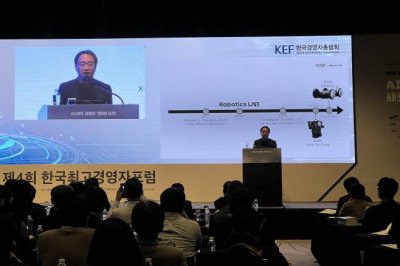

Hyun Dong-jin, head of the robotics lab at Hyundai Motor Group, speaks at the fourth Korea CEO Forum in Seoul on Wednesday. Photo by Asia Today
Feb. 5 (Asia Today) — Business leaders, academics and policymakers gathering in Seoul agreed Thursday that South Korea’s push to become an artificial intelligence powerhouse will require a broad, system-wide response extending well beyond technological development.
The fourth Korea CEO Forum, hosted by the Korea Employers Federation, was held at the Westin Chosun Hotel under the theme “The AI Era: New Opportunities and Challenges.” The event drew large attendance from industry, academia and government, reflecting growing concern over how Korean industries should prepare for an AI-centered economic structure.
Participants repeatedly raised a central question: how Korea should respond strategically as industries move beyond the Fourth Industrial Revolution toward an AI-driven paradigm. Speakers argued that becoming an AI leader will require coordinated changes across politics, the economy, society and culture.
Opening the forum, Sohn Kyung-shik, chairman of the Korea Federation of Business Associations, underscored the need for long-term competitiveness. The first keynote was delivered by Kim Dae-sik, a professor of electrical engineering at Korea Advanced Institute of Science and Technology, who spoke on “The Era of AGI Market Dominance.”
Kim said advances in artificial intelligence will reshape not only productivity but also human thinking and decision-making, calling for education and industrial policies that can keep pace with the speed of technological change.
The forum’s highlight presentation came from Hyun Dong-jin, head of the robotics lab at Hyundai Motor Group, who outlined the expansion of human-centered AI robotics. He said the convergence of AI and robotics is transforming manufacturing and service industries, with collaborative robots and automation emerging as key competitive factors.
Hyun emphasized that robotics should complement human labor rather than replace it. He introduced the wearable robot “X-Schroder,” which adjusts assistive force based on a user’s posture, and “MobED,” an autonomous mobile platform under development. He noted that while robotic autonomy shares core elements with self-driving vehicles, robots must operate safely in spaces shared directly with humans.
Geopolitical and strategic dimensions of AI were also discussed. Kang Jun-young, a professor at Hankuk University of Foreign Studies, analyzed the impact of U.S.-China technological rivalry on global supply chains, arguing that AI leadership is increasingly intertwined with diplomacy and national security.
The forum extended beyond industry to health and demographics. Yoo Tae-woo, director of the Dr. U Together Center, discussed how AI could transform healthcare and lifestyle management in a super-aged society, stressing prevention-focused approaches to physical and mental health.
An industry participant said AI is no longer an issue limited to specific sectors but a determinant of national competitiveness, adding that AI-driven robotics will be a core pillar of future manufacturing innovation.
Participants concluded that the AI era demands a multilayered strategy encompassing talent development, industrial ecosystem building and global cooperation, alongside technological advancement.
— Reported by Asia Today; translated by UPI
© Asia Today. Unauthorized reproduction or redistribution prohibited.