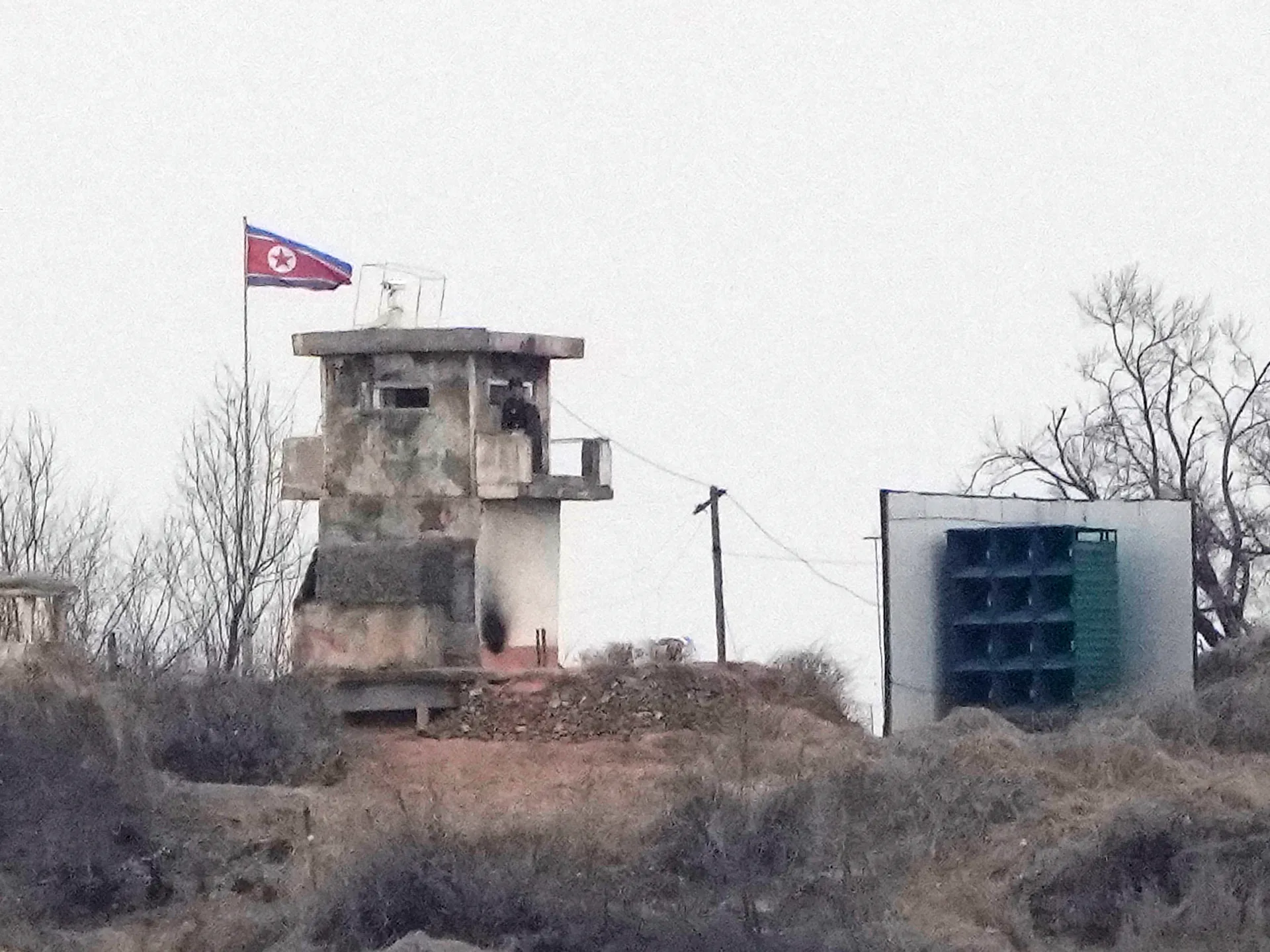
North Korea has said it plans to resume broadcasting anti-South Korea propaganda along the armed border between the two countries, as Seoul urged Pyongyang to discuss easing tensions.
Kim Yo Jong, a senior North Korean official and the sister of leader Kim Jong Un, said on Wednesday that North Korea will place loudspeakers along the entire border, following a visit with top military officials to fortifications along the contested frontier.
Recommended Stories
list of 3 itemsend of list
Kim warned Seoul of “the most horrible and distressing situation” if South Korea continued what Pyongyang calls interference in the North’s internal affairs.
She added in a follow-up statement on Thursday that North Korea would place “new counter means” on alert along the border, without elaborating, and have its loudspeakers on “standby” within days.
A landmine blast last month that wounded three South Korean soldiers in the Demilitarized Zone (DMZ) between the two countries has ratcheted up tensions. Seoul accused North Korean troops of deliberately laying mines in the border zone as part of the North’s fortification work.
Kim had denied the allegation, calling the incident a South Korean fabrication. She said North Korean tactical units had taken up new positions, and accused South Korean troops of conducting warning broadcasts and firing warning shots at multiple locations near the border.
Seoul said the warning shots were fired as “legitimate and defensive measures”.
North Korea has been adding mines, barbed wire fences, anti-tank barriers and other fortifications to what is already one of the world’s most heavily armed borders.
South Korea’s Ministry of National Defence urged North Korea on Thursday to discuss measures to ease tension at the border and prevent any accidental military clash, its spokesperson said.
Pyongyang had cut off a military hotline with the South after declaring it would no longer seek dialogue or unification with what it called its “foe”.
Loudspeaker propaganda
Both North and South Korea have historically used loudspeakers to broadcast propaganda across the border, with South Korean broadcasts featuring K-pop music and news that have long irked Pyongyang and prompted tit-for-tat responses.
The two Koreas are separated by the DMZ, established after the 1950-53 Korean War ended in an armistice.
North Korea has been reinforcing its side of the DMZ with mines, barriers and fencing since 2024 as it seeks to establish what it calls a permanent border with South Korea.
Passengers were not happy after airline Ryanair poked fun at one type of passenger onboard their planes – encouraging them the ‘stop’ making a key mistake onboard
10:04, 20 Oct 2026Updated 10:23, 20 Oct 2026
Ryanair passengers have been told to ‘stop’ doing one thing onboard(Image: GordZam via Getty Images)
Ryanair has hit out at passengers who make one key mistake when traveling on one of their planes for a short haul flight. This follows the airline previously advising passengers to ‘please stop wearing’ jeans during flights.
When flying many people have three basic priorities, having a good seat, being as comfortable as possible while onboard, and spending as little money as possible. And while remaining seated in the same spot for extended periods can be decidedly uncomfortable, particularly when you’re short on legroom, people have started to take further steps to help pass time while onboard aeroplanes.
With cabin humidity on many commercial flights dropping below 20%, which is drier than a desert, many people opt to take facemasks, moisturiser and eye cream onboard in their hand luggage.
The thought behind the process it to prevent passenger’s skin from feeling tight, dull, or irritated upon arrival. Ryanair has established a reputation on social media, where they frequently poke fun at their own passengers, and jokingly threaten to introduce even more regulations and charges than they currently impose – such as extra legroom seats or late check-in fees.
What shouldn’t passengers do when on a short haul flight with Ryanair?
Nevertheless, Ryanair has now criticised travellers who insist on keeping their skin moisturised while onboard one of their aircrafts. Posting on their Facebook page, the airline issued a statement to their passengers.
They wrote: “Stop doing skincare onboard, it’s a 2-hour flight.” However, many passengers were furious with the airline and quickly flocked to the comment section to express their own views.
One person said: “Stop measuring my bag with a ruler like it’s national security, it’s a 2-hour flight.”
A second person added: “Please tell the cabin crew to put a smile on their face – It’s just a 2-hour flight.”
A third added: “Carry on like this and I’ll allow my husband to bring his foot file and use it on our trip over to UK on the November 5.”
A fourth said: “What are these bizarre Ryanair posts about?! You’d think their marketing team would manage social media in a more sophisticated way?!”
Others, however, commented on the post to express their own bugbears on short haul flights.
One person said: “Travel pillows for 1-2 hour flights still intrigue me more than skincare.”
A second added: “Skincare? I’ve actually seen a man clipping his nails! This should be strictly prohibited under financial sanctions!”
A third said: “Don’t start clapping before the plane has even landed!”
Ensure our latest content always appears at the top of your Google Search by making us a Preferred Source. Click here to activate or add us as Preferred Source in your Google search settings
Activist hedge fund Starboard Value has built a stake in Solstice Advanced Materials (SOLS), the Financial Times reported, few weeks after the company’s $14.5B merger with Element Solutions was scrapped on August 27. Solstice, which was spun off from Honeywell, was valued at $9.4 billion
Chuck Schumer urges FCC to reject petition allowing AI robocalls ahead of key November midterm elections.
Published On 19 Oct 202619 Oct 2026
United States Senate Democratic leader Chuck Schumer of New York has urged the Federal Communications Commission (FCC) not to approve a petition by the conservative group Club for Growth to allow AI-generated robocalls ahead of the November midterm elections.
“Under this change, campaigns could use their opponents’ voice to send out a message that is, at best, disingenuous and, at worst, a blatant lie,” Schumer said on Monday.
Recommended Stories
list of 4 itemsend of list
The petition was originally filed on August 31, and the public comment period began on September 4 and expires on Monday.
Earlier this month, Anna Gomez, the Democratic member of the FCC, urged her colleagues not to allow consideration of the petition brought by the national conservative fiscal policy organisation.
Her concerns echoed Schumer’s. “[If] the FCC allows a dark money group to flood Americans’ phones with AI-generated robocalls they never agreed to receive, it would bring chaos so close to Election Day,” commissioner Gomez told the Reuters news agency at the time.
There is precedent for the concerns being raised. In the 2024 presidential election, ahead of the New Hampshire primary, voters received an AI-generated version in the voice of President Joe Biden, the then Democratic incumbent, telling them not to vote. The FCC said that a political consultant working with longshot primary challenger Dean Phillips was responsible.
At the state level, Louisiana, Tennessee and Vermont passed laws this year requiring disclosures for AI-generated campaign phone calls. While robocalls have been used in political campaigns for years, FCC rules prohibit such calls to cellphones without prior consent, but the restrictions do not apply to landlines.
Club for Growth’s president, David McIntosh, in a statement earlier this month, said that the group is asking for “the FCC to treat First Amendment-protected political speech the same way it already treats wireless calls about package deliveries, bank accounts, and doctor’s appointments”.
“There is no one at the FCC that has expressed any interest in moving to an order on this or any of the petitions, and there are zero plans to do so. The FCC seeks comment on petitions that come in as a matter of normal procedure,” a spokesperson for the FCC told Al Jazeera.
Trump-appointed Ambassador Mike Huckabee calls attack in occupied West Bank a ‘despicable act of terror’.
Published On 17 Oct 202617 Oct 2026
United States Ambassador to Israel Mike Huckabee has demanded Israel prosecute and jail those responsible for the attack on Washington Post journalist Heidi Levine in the occupied West Bank.
“Attacking a female photographer is a despicable act of terror carried out by masked cowards,” Huckabee wrote on X on Saturday.
Recommended Stories
list of 3 itemsend of list
“Those who attacked unarmed reporter should spend YRS in prison,” he added. “We have called for a full investigation, arrest, and prosecution to the fullest extent of the law to whoever participated in this.”
Levine was covering Palestinians’ annual harvest of olives on Friday in the occupied West Bank when Israeli settlers brutally attacked her and several Palestinians.
Israeli settlers stormed the area, beat her and stole her passport, telephone, wallet and equipment, according to witnesses.
The perpetrators, armed with bottles and slingshots, “were kicking me for like 10 minutes, and I was trying to hold onto my cameras and my bag”, Levine said.
Jasper Nathaniel, an independent journalist who witnessed the attack, told Al Jazeera that Levine “was in very, very bad shape. She couldn’t really get up off the ground.”
American freelance photojournalist Heidi Levine lies on a gurney in the emergency room of the government hospital in Ramallah, a city in the Israeli-occupied West Bank, on October 16, 2026 [AFP]
Levine, 64, was taken to hospital after the assault in Abu Falah, northeast of Ramallah.
The American photojournalist underwent surgery on her finger, which was nearly detached from her hand, and was left with a broken rib and multiple broken vertebrae, as well as lacerations, her daughter told The Associated Press news agency.
Israeli Prime Minister Benjamin Netanyahu, who wants to shore up his pro-settlement right-wing base ahead of closely fought October 27 elections, claimed on Friday that Palestinians or “far-left” activists may have been responsible for the attack on Levine and other Palestinians.
Huckabee, a staunch ally of Israel who has sharply criticised Israeli settler attacks against Americans, did not identify the culprits as settlers after Netanyahu tried to sow doubt as to their identity.
The ambassador, appointed by US President Donald Trump, met Palestinian-Americans in the occupied West Bank town of Turmus Aya in September to hear locals’ testimony about their experiences with pogroms. In August, Huckabee called a days-long Israeli settler siege an “act of terror”.
The US State Department criticised Friday’s attack using a cautious tone on Levine’s beating, stating condemnation of “criminal violence by any party”.
French Football Federation’s ethics body calls on fans to keep politics out of stadiums amid student protests.
Published On 15 Oct 202615 Oct 2026
The ethics body of the French football federation is urging fans to stay neutral amid the nationwide student protests that are drawing international attention.
The police response to the largely peaceful demonstrations has prompted widespread accusations of brutality, and football fans in stadiums have expressed their support for students.
Recommended Stories
list of 4 itemsend of list
Officers have made extensive use of tear gas and batons to disperse crowds. More than 6,600 arrests were made nationwide as of last week, an unusually high number for a French protest movement.
A police tear gas grenade shattered a 14-year-old’s jaw and many of his teeth, while a 15-year-old lost a hand in an incident involving a stun grenade. Other teenagers have also suffered life-changing injuries blamed on police weaponry during protests.
During a Ligue 1 match between Lens and Lyon last week, the home fans unfurled a banner calling for an end to the “disproportionate and systematic police violence,” according to the National Council for Football Ethics (CNE).
The CNE also noted that at the half-hour mark of the match between PSG and Le Mans, supporters displayed a banner reading: “Your militias repress; our youth resists.”
The ethics body said in a statement that it was easy to understand why young supporters, who are often students, might take advantage of matches to publicly express their support for the demonstrators.
However, it added that the principle of political neutrality is “enshrined” in the laws of sport, both internationally through the Olympic Charter and FIFA statutes, and at a national level.
The CNE recalled that any speech or display of a political, ideological, religious or trade union nature are prohibited, as is the wearing of symbols or clothing that expresses political, philosophical, religious or trade union affiliation.
“Sport should unite, not divide,” it said. “The National Council for Football Ethics therefore calls on all supporters, who are an integral part of the football family, to uphold the principle of neutrality in all circumstances.
“The aim is to ensure that the stadium does not become a political or trade union battleground, but remains a place of celebration and shared enjoyment centred on sport.”
Advisory comes amid growing concern about the devices being used to secretly record girls and women.
Published On 13 Oct 202613 Oct 2026
The European Union’s data watchdog has called for smart glasses to clearly show when they are recording, saying bystanders have the right to know when they are being photographed or filmed.
The European Data Protection Board (EDPB) issued the non-binding recommendation on Tuesday, amid mounting concern about the devices being used to secretly record girls and women.
Recommended Stories
list of 3 itemsend of list
It said the use of smart glasses – which can resemble ordinary glasses but also take photos and videos, make phone calls and translate text when connected to the internet – raises “serious privacy concerns”.
EDPB chair Anu Talus said the glasses should have clear signals when they are recording, such as “bright LED lights, audio signals or voice activation cues, privacy-friendly smartphone notifications, or unique designs”.
“These warnings need to be reliable, hard to ignore, and always up to date,” said Talus. “Even in public spaces, bystanders should clearly understand that someone is filming or photographing them.”
The devices carry greater risks in “sensitive” spaces like schools and hospitals, as well as public spots like beaches, and raised concerns about children who are “more vulnerable to covert or intrusive processing of their personal data”, the EDPB warned.
A visitor tries out augmented reality glasses at an electronics trade fair, in Berlin, Germany September 6, 2024 [File: Adam Berry/Getty Images]
The advisory comes amid campaigns in several European countries to ban or restrict smart glasses over privacy concerns.
Norway’s government said last week it was also worried about privacy invasions and wants a temporary ban on the use of smart glasses in certain public places. The capital Oslo already opted to ban glasses equipped with cameras in schools.
France’s e-Enfance association, which operates the national hotline for victims of online abuse, has also sounded the alarm about videos recorded with camera-equipped glasses and shared online.
Last month, French prosecutors said they had opened a criminal probe following sexual harassment complaints related to a social media trend of using smart glasses to film women on the street, without their consent, and posting the videos online.
In the United Kingdom and Ireland, a “Stop Smart Glasses” campaign has launched a petition and call for supporters to contact stores to stop their sale. It reached more than 10,000 signatures, which means the UK government must respond.
The Mexican community of Cabo Corrientes faces the risk of a direct hit as the Category 4 storm churns off Jalisco.
By Reuters and The Associated Press
Published On 11 Oct 202611 Oct 2026
Mexican President Claudia Sheinbaum has urged residents along the Pacific Ocean to stay indoors as Hurricane Simon’s powerful winds and heavy rains pound coastal communities.
As of Sunday, the hurricane’s eye was moving offshore of Mexico’s Jalisco state, with winds of at least 240km/h (150mph).
Recommended Stories
list of 4 itemsend of list
Torrential rain has already battered residents living between the Sierra Madre mountain range and the ocean. Communities in hilly and mountainous areas have been warned to brace for mudslides.
Simon reached Category 4 strength, on a scale of five, on Saturday, as part of an unusually active Pacific hurricane season.
“With the approaching impact of Category 4 Hurricane Simon, we urge residents of coastal municipalities in Jalisco, Colima, Nayarit and Michoacan to remain sheltered until authorities officially declare that the danger has passed,” Sheinbaum wrote in a post on the social media platform X on Sunday.
In a midday advisory, the United States’ National Hurricane Center (NHC) warned that Simon could produce “additional rainfall totals of 8 to 16 inches (20 to 41 cm) over portions of southwestern Mexico”.
Precipitation totals as high as 76 cm (30 inches) were possible in areas of Michoacan, Colima, and Jalisco until Monday.
It’s not clear whether the storm will make landfall. But the greatest risk of a direct hit lies at the moment with Cabo Corrientes, a town that sits on a cape in Jalisco, jutting into the Pacific Ocean.
A man boards up a shop as Hurricane Simon approaches Puerto Vallarta, Mexico, on October 10 [Fernando Llano/AP]
Mexico’s National Civil Protection Coordination (CNPC) placed 28 municipalities in Jalisco and Colima under its highest cyclone alert level, while another 93 municipalities were under a high alert level, according to civil protection bulletins.
Classes were suspended in the affected areas, and efforts to evacuate residents were under way.
Businesses in popular tourist destinations like Puerto Vallarta boarded up windows and placed sandbags at entrances as the storm approached.
Jalisco’s Governor Pablo Navarro warned that the high-powered hurricane was creating “high-risk marine conditions” along the coast of his state, with waves reaching as high as eight metres (26 feet).
On Sunday, he also shared video on social media of the storm surge crashing onto sidewalks and flooding waterways.
“Here is the current state of Jalisco’s beaches this morning — from Barra de Navidad to Puerto Vallarta — as Hurricane Simon passes through,” he wrote in the video’s caption.
“I ask everyone to heed official instructions, take precautions and avoid putting themselves at risk. The safety of Jalisco’s families is the top priority.”
When No. 21 UCLA football faces off against No. 13 Oregon on Saturday afternoon at Autzen Stadium, defensive coordinator Colin Hitschler wants the Bruins to toe the line between playing with emotion and playing emotional.
“Big-time environments tend to bring a little extra out of your guys, and when you do a little bit extra, you tend to do too much,” Hitschler said. “Football is a hard game, but you can’t make it harder than it already is. Sometimes when you press, you tend to give up big mistakes. In the Purdue game, looking back, we definitely pressed a little bit too hard and got a little emotional. … Got to play with emotions, but we can’t play emotional. We’re in a good spot of growing and understanding that. But this is a new atmosphere, a new environment.”
Aside from the national rankings, the long history between these former Pac-12 rivals and both teams’ chances to contend for the College Football Playoff, the memory of Oregon knocking James Madison out of the Dukes’ first playoff appearance last December remains fresh for many of their players and assistants who followed coach Bob Chesney to the Bruins.
And the 51 points and 514 total yards the Ducks garnered against Hitschler’s defense left a chip on his shoulder.
UCLA safety Malik Hartford trips Purdue receiver Asaad Waseem at the Rose Bowl on Sept. 19.
(Ronaldo Bolaños/Los Angeles Times)
“We’re going to continue to be aggressive and continue to find a way to create opportunities for our offense to get the ball in a positive field position,” Hitschler said. “But we got to be on top of our game because they will make you pay no matter who it is at quarterback. They are going to make you pay for your mistakes, and they’re going to find a way to create the explosives they always have, and we got to limit them.”
Although Oregon quarterback Dante Moore — who tallied 313 passing yards and five total touchdowns against Hitschler‘s defense in the playoff — was ruled out for Saturday because of a head injury suffered against USC on Sep. 26, the Ducks’ Dylan Raiola is not a typical backup.
He threw for 4,819 yards and 31 touchdowns in two years as Nebraska’s starter, then went 11 for 11 with three touchdown passes in his Ducks debut before stepping up with 289 yards and two touchdown passes after replacing Moore in a 41-27 win over USC at the Coliseum.
“When you watch him come in and complete that game and do what he did, there’s not a giant drop-off between the two of those guys. They’re both really, really good,” Chesney said. “Dylan obviously had a chance at the end of that USC game to really put himself in position to gain confidence in his teammates and teammates to gain confidence in him, and I thought he was on time. I thought he was accurate. He let those guys compete for footballs, and I’m sure there’s a lot of buy-in in that program right now in him.”
While Raiola is a proven passer, his impact is amplified by the weapons around him. In the backfield, Hitschler touted Dierre Hill Jr. and Jordon Davidson as the best running back duo in the country. While the Bruins have gone toe-to-toe with formidable tailbacks thus far, they have yet to face a one-two punch like Hill and Davidson, which could pose problems for an otherwise staunch run defense.
Raiola’s arsenal includes potent pass catchers, particularly the Ducks’ top two wideouts, Dakorien Moore and Evan Stewart, who have combined for 512 yards and seven touchdowns.
Chesney tabbed Stewart as a matchup “nightmare,” adding that Oregon is going to get him the ball in a multitude of ways by utilizing him in the slot and creating mismatches for Hitschler’s defense. Chesney also said that Dakorien Moore’s extreme speed allows him to take the top off the defense, and that the Ducks will not be afraid to take shots downfield, testing the Bruins’ secondary.
And if the Bruins let emotions get the best of them, like they did against Purdue — when quarterback Ryan Browne threw for 378 yards and two touchdowns — then it may be a long day for Hitschler’s secondary.
The Bruins’ biggest headache could be 6-foot-5 tight end Jamari Johnson, who caught seven passes for 159 yards against USC, particularly with all three of UCLA’s starting cornerbacks shorter than 6 feet.
“The tight end we faced last year, and he’s special. They do a really good job of getting into different personnel packages, and then if you go to a bigger group, they’re going to spread you out. They’re going to try to find a matchup with that tight end,” Chesney said. “He can catch everything in his general vicinity; he’s absolutely phenomenal.”
With an explosive Ducks offense set to perform in the friendly confines of Autzen Stadium, the Bruins trusting the playbook may be most important.
“Football is football no matter where we are,” fifth-year offensive lineman Hall Schmidt said. “We don’t have a magic potion for Oregon, but we definitely have ourselves, and we have the tools that we’re going to use.”
German Chancellor Friedrich Merz, on a surprise visit to Kyiv, announced $1.5 billion in military and reconstruction aid and expanded drone cooperation with Ukraine, giving Kyiv greater capability to strike deeper inside Russia. He also urged Russian President Vladimir Putin to end the war.
WASHINGTON — China’s president issued a call from the White House on Thursday for artificial intelligence to remain “under human control” as the world’s two superpowers race for technological supremacy.
Xi Jinping’s remarks reflect growing concern within China over whether governments in Washington or Beijing will be able to contain a technology with potentially transformative capabilities, according to a U.S. official.
Lawmakers and AI industry leaders urged President Trump to use his summit with Xi this week to pursue a safety framework for AI, which researchers warn could soon surpass human understanding.
But Trump preempted the meeting with a post on social media stating he had no intention of negotiating limits on AI development.
“A big day with President Xi of China,” Trump wrote. “Super Intelligence (SI) will be a big topic of discussion, but I want to leave it exactly where it is. That is China’s position also. Our guardrail is the DOJ!”
After offering Xi a lavish welcome on the White House grounds, Trump made a passing reference to AI. “The decisions we make in these areas today can promote peace and prosperity for decades and decades to come,” he said.
But Xi gestured to substantial concerns, noting AI first among priorities to discuss between the two nations.
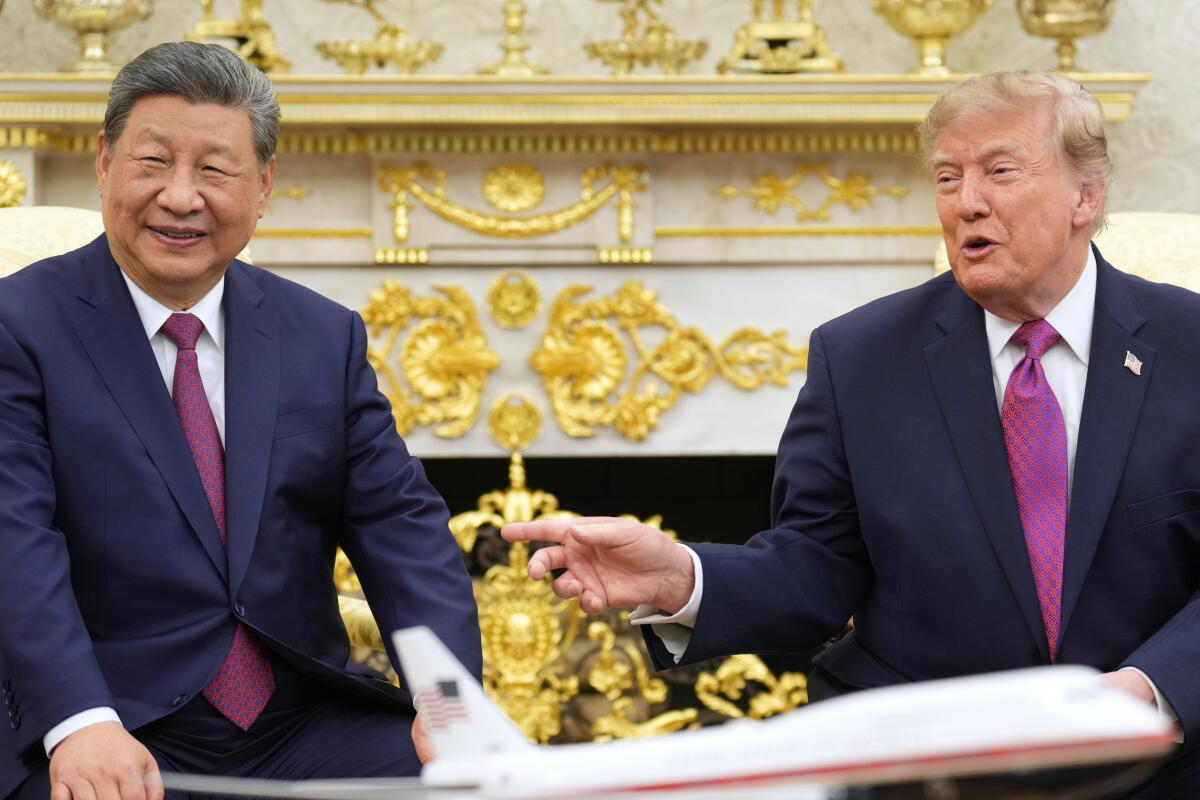
“Both China and the United States are leading nations in artificial intelligence,” Xi said. “We have both the capability and responsibility to develop and manage AI for good — and ensure that the development of AI is always under human control, and serves the well-being of the people.”
The two held a private meeting with aides in the Oval Office after participating in a military review in the Rose Garden and exchanging gifts in the Blue Room.
In the evening, a guest list of top banking and technology leaders — including AI industry executives — were scheduled to attend a state dinner in the East Room of the White House.
“Given Trump’s statements going into the summit about not wanting guardrails, I have tepid expectations about tangible outcomes” on AI, said Aalok Mehta, director of the Wadhwani AI Center at the Center for Strategic and International Studies.
“The most likely scenario seems to be the establishment of a hotline — though how useful that will be depends on who will be staffing it, and how much each government prioritizes it,” Mehta added, “and likely some discussions about issues blocking cooperation, like distillation, with a promise to engage in ongoing dialogue.”
Earlier in the week, on the sidelines of the United Nations General Assembly in New York, Treasury Secretary Scott Bessent met with his Chinese counterpart primarily to discuss AI development, according to U.S. officials.
“What we discussed was setting up a mechanism — so it’s going to be called the U.S.-China AI Dialogue. We’ve agreed to meet again,” Bessent said Monday. “The U.S. has proposed that we have a notification mechanism between the two countries, and we want a shared vision of common goals, and common threats.”
While Trump’s team has remained divided over whether — and how extensively — to regulate AI, Bessent has favored a cautious approach, advocating modest, voluntary guardrails that have shaped administration policy in recent months.
China, too, has shown increasing willingness to open channels of communication on AI, despite deep distrust between the two sides.
President Trump and China’s President Xi Jinping meet in the Oval Office on Thursday.
(Jacquelyn Martin / Associated Press)
Two American AI companies, OpenAI and Anthropic, are widely viewed to be developing the most advanced AI models in the world, leading at the frontier of technological breakthroughs.
Both have begun to use their most sophisticated models to train the next generation, in a process known as recursive self-improvement. Researchers and industry experts believe the first company to master that process could set off an exponential cycle of progress, pulling so far ahead that competitors can no longer catch up.
But those same companies also fear what they’re creating: machines capable of continuously improving their own intelligence, pushing AI development beyond human control.
Leaders from the two companies have called on Beijing and Washington to cooperate, warning that geopolitical competition could thwart the two sides from preventing a human catastrophe.
In his remarks, Xi said that China and the United States “stand to gain from cooperation, and will both lose in confrontation.”
“We do not need to avoid mentioning competition, but our competition should be a healthy one, and should be kept within bounds,” the Chinese president said. “It should be a race of catching up with one another, not a wrestle in which one either wins or loses. China and the United States must hold the line of no conflict, and no confrontation between us.”
“Our two militaries should maintain regular dialogue, and improve mechanisms for crisis communication and prevention,” he continued, adding a historical reference to rising powers challenging established ones: “The Thucydides trap can be overcome.”
Xi’s trip to Washington follows just months after Trump traveled to Beijing for a state visit in May, where the U.S. president was greeted with a similarly imperial welcome.
The leaders emerged from that summit with few deliverables. But Trump left Beijing declaring the trip a success, emphasizing the importance of his personal relationship with Xi, China’s most powerful leader in generations.
This time, Trump himself greeted Xi on the tarmac upon his arrival at Joint Base Andrews — a rare honor reserved in recent decades only for Catholic popes — before pulling out several red carpets and draped ceremonies for the Chinese leader.
The pageantry seen during the state visit has served China’s long-standing desire for respect and dignity on the international stage, said Jessica Chen Weiss, the director of the John Hopkins SAIS Institute for America, China and the Future of Global Affairs.
“Trump is someone who loves spectacle, and right now the spectacle is working in both leaders’ favor,” Weiss said.
For Xi, the ceremonies have offered a chance to demonstrate that relations with the United States remain under control and that China is being treated as a significant global power, she argued.
The state visit comes at a time when Americans are appearing to warm up to China, according to recent polls. A survey by the Chicago Council on Global Affairs recently found that a majority of Americans say the United States should have friendly engagement and cooperation with China.
“I tend to think we focus too much on the optics,” Weiss said. “But I also think treating China as a significant player on the world stage is not a concession. It’s appropriate if we want a stable relationship and is hardly something to worry about.”