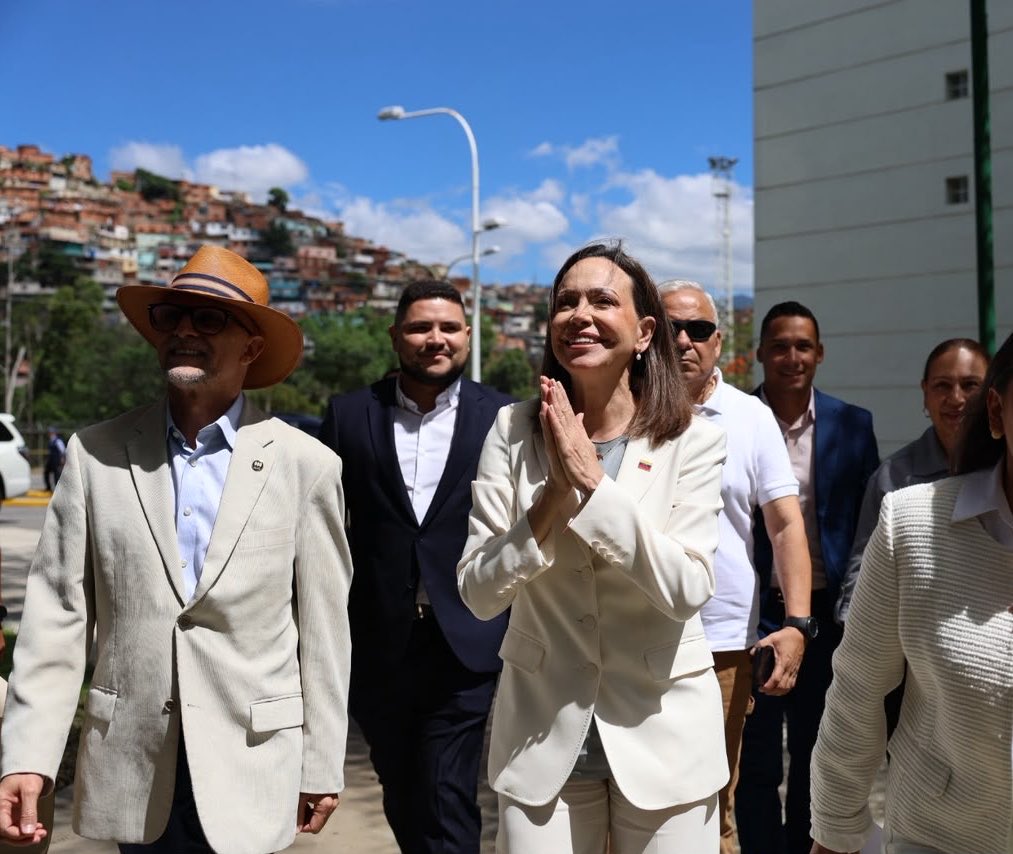
October 29 was a good day for the post-Maduro optimists. María Corina Machado gave her first public address after coming back, in front of an enthusiastic student crowd in the private Andrés Bello Catholic University. Legacy TV network Venevisión broadcasted the event, where she didn’t rule out a meeting with Delcy Rodríguez, said a negotiation was the best shot for the regime and the nation moving forward, and spoke positively of the opposition-chavismo talks.
“We not only refrain from obstructing [the US-sponsored agenda], we are very interested in seeing it succeed and fulfil its mission.”
Becoming Venezuela’s stateswoman-in-waiting starts with building trust with actors with whom tensions have flared in recent years, but with whom she will likely have to work in the near future.
Talks between the delegations led by Jorge Rodríguez and Dinorah Figuera have both lagged and half-delivered in some important areas. Yet, for Machado, the negotiations revolve around five crown jewels, a political ladder she must climb in the leadup to the next presidential vote, even if addressing each step is far from simple.
The first rung begins with what Rubio envisions as a robust Supreme Tribunal of Justice (TSJ). The nomination process began last week, and according to Rubio, appointments will bypass the Rodríguez-led National Assembly, running through the Judicial Nominations Committee.
A star-spangled TSJ?
The Supreme Court represents a big opportunity for Machado. The US is driving that train, a slower one than the oil and gas train, as economist Asdrúbal Oliveros has said. However, Henry Alviarez, her most senior party aide until she arrived on Sunday, has criticized the talks where TSJ reform is getting its initial shape. The day after Machado’s return, he called the ongoing negotiating table a “stool” that doesn’t listen to the people.
As hard as it sounds, Machado can’t afford to snub a process whose first landmark was the decision to exclude her. Not because the other parties involved could try to mold the new institutions to her detriment, but because the US might try to build a train custom-made for its interests in Venezuela. The new judges could decide over important commercial deals where foreign powers participate, reverse decisions deemed unconstitutional, rule over key issues concerning transitional justice, among other subjects.
Machado must carefully coordinate her allies from other parties and exert influence over the restitution process if she hopes to secure her next objectives.
In Monday’s off-the-record statement, Secretary Rubio said he views the new Venezuelan Supreme Court as an anchor of the chavista regime, and made it sound like he wants the nascent one to be the backbone of the new republic.
We don’t need to go too far to understand the practical implications. In neighboring Brazil, the Supreme Court is not shy to twist the arm of politicians, huge companies and fellow institutional actors alike—even in contentious ways, becoming a headache to the Trump administration and the Bolsonaros. Drawing from that example, and the likelihood that our republic won’t be perfect or perfectly balanced straight away, either Machado tries to influence some of these reforms and new appointments, or her future government could be shaped by conflict with a crop of powerful men in robes. Perhaps that sounds alien right now, but it’s the game in the inefficient democracies and hybrid regimes that abound.
Stairway to power
Next comes the National Electoral Council (CNE), which Rubio insists must be purely technical and “nonpolitical.” Here, too, Rubio claims the National Assembly will not participate at all. The State Department has hinted at dismantling the existing electronic voting infrastructure, though that detail was conspicuously absent from the official statement. Whether that State Department post was tied to domestic midterm political posturing—amid Trump’s warnings that he might not recognize results if opponents cheat “like in 2020”—remains an open question. What is clear is that both Machado and Trump share a deep aversion to electronic voting machines, and Machado’s team has been preparing proposals and expertise to help Washington shape a new system for Venezuela.
The restitution of political parties to their legitimate leadership represents a third, critical battleground. This is a common cause for thousands across the country, unless your name is Brito or Bernabé. Some of Machado’s most vital allies lead traditional opposition parties, and she will inevitably need their territorial machinery and clout when the time comes: Juan Pablo Guanipa in Zulia, Andrés Velásquez in Bolívar, Henry Ramos Allup wherever he may be, and so on. Machado must carefully coordinate these allies and exert influence over this process if she hopes to secure her next objectives. The restitution process is delicate because it could require the reshuffling of party leaderships, which could trigger factional unrest. Machado has refrained from committing her support to anyone, though some leaders have become closer to her organization than others.
Then comes the official registration of Vente Venezuela as a recognized political party. Machado’s electoral advisor suggests this could happen simultaneously with the previous step. For Delcy Rodríguez and the remnants of chavismo, the ideal scenario would be to sideline Vente Venezuela and rush regional, municipal, or legislative contests ahead of any presidential election. As Pedro Garmendia has noted, holding sub-national races first could dilute Machado’s momentum and boost the older, “mainstream” party apparatuses. Forcing a breakthrough here hinges on her maneuvering in the “party restitution” stage, ultimately requiring Machado to submit her party’s standing to the newly constituted TSJ and CNE—regardless of how imperfect those institutions prove to be.
While her Jorge Rodríguez jeered at the apellidos in public, these pragmatists found a shared dialect with the State.
The final and most contentious hurdle remains the lifting of Machado’s political ban. Unlocking her eligibility will likely demand recognizing Delcy and Jorge Rodríguez as legitimate interlocutors, whatever cognitive dissonance that pill carries. After all, one of them would inevitably hand her the presidential sash in the future, and nobody wants curses and insults inaugurating a new republic. It will require recognizing whoever the PSUV settles on as its candidate. Right now, Delcy looks like an uninspiring choice.
That is the five-step ladder Machado must navigate ahead of the next presidential election, whose actual date remains unknown regardless of what Rubio, Figuera, Axios, or La Divina Pastora seem to suggest. These hurdles represent her greatest challenges, especially since the electoral calendar is not hers to set.
Hovering over all of this is another crucial detail: Rubio’s statement (the most consequential since January 28) made no mention of parliamentary elections. If a presidential vote were to take place between 2027 and 2029, a hypothetical President Machado would face the immediate prospect of governing in direct confrontation with a chavista-dominated parliament within an intensely presidential system, or being forced into uncomfortable compromises. That is a bitter toad she may be watching with caution, one she may have to swallow to govern the country, or one that might compel her to reconsider her current trajectory.
“Business is business”
An effective domestic presence not only requires a positive influence on the Supreme Court and electoral board designations, but also mending ties with a key constituency that was punished (and at times manipulated) by chavismo: the Venezuelan private sector.
When Machado emerged as the opposition’s undisputed frontrunner, the table was tilted clean: the CNE was an arm of the ruling elite, the Supreme Court was run by thugs or close friends of Cilia Flores, and Parliament was packed with loyalists. In the background, the opposition lost some of its staunchest economic allies as chavismo’s predatory omnipresence exhausted legacy companies and proud family businesses. Some fled abroad. Others opted for quiet, apolitical survival just to break even. A few big shots decided that surviving meant engaging, finding a receptive ear in a rising, ostensibly “more competent” Delcy Rodríguez. Assertions like “Delcy is no Maduro” or “I’d have Delcy over Diosdado” soon became common currency over rounds of Scotch in Caracas country clubs.
While her brother Jorge jeered at the apellidos in public, these pragmatists found a shared dialect with the State: peace, dialogue, cooperation and sanctions relief. If single-party China could pull off the miracle of Deng Xiaoping, they reasoned, so could an oil-rich Venezuela sitting right on America’s doorstep.
Machado must treat Delcy like a lame duck, engaging with the people that, from outside the government, have helped her to run the country.
Nowadays, the relationship between some business leaders and acting president Delcy Rodríguez doesn’t look as central as it used to be. Sanctions are out of the way, or at least most of them. New investors and foreign companies are considering whether it’s time to come in. Maduro and Cilia are living in Brooklyn. Some of the things I find most refreshing are the groups of pundits, business figures and scholars speaking out over several subjects that were taboo before January 3—no elections and political uncertainty, lacking public services, poor policymaking in PDVSA and the central bank—the same subjects some important people learned not to discuss on the record.
That certain actors are already behaving like this, while retaining direct personal and/or financial stakes in the country, is an encouraging sign that incentives have shifted.
In this sense, Machado should recast her relationship with the Venezuelan private sector, even with those elements that have been associated with Delcy or Maduro before her. Some will be easier to navigate than others.
In my view, Machado must treat Delcy Rodríguez like a lame duck, engaging with the people that, from outside the government, have helped her to run the country. Rodríguez has done so in the past few years not because she’s a genius technocrat, but because she reached an understanding with a series of actors that allow the country to operate amidst material struggle and daunting economic inefficiencies.
We expect Machado to do a much better job than Delcy. She has a first-100-days plan, a program, and an experienced set of advisors that have spent years preparing to command energy, education and electoral reforms. Her children, who are having careers in some of the world’s most important technology and financial organizations, could also help her in private. Still, we know governance is more than world-class personnel and projects under your belt. The story of CAP 2 seems to teach that sometimes, not dealing with longstanding power players while pursuing groundbreaking reforms can outweigh having the brightest minds in your cabinet.
The example of 1958 also comes in handy. The private sector had had a beneficial relationship with the military dictatorship, yet backed Wolfgang Larrazábal when incentives shifted. Betancourt, with a radical and ideologically-charged background, learned to embrace them.
Venezuelan businesses face other steep challenges today, including the absence of a functioning banking system, a severe lack of investment, and restrictive labor laws. Delcy is already opening up the economy; Colombian capital, for instance, has secured access to profitable businesses. An avowed proponent of Friedman-style liberalism, a President Machado would also need to navigate the necessities of a dwarfed Venezuelan private sector with the urgent need for foreign investment and fresh competition.
For now, the opposition leader is back home, embracing friends, victims, students, and survivors. She is free to move and embrace almost whomever she pleases. The possibilities, at least on the surface, have never looked brighter than they do today.