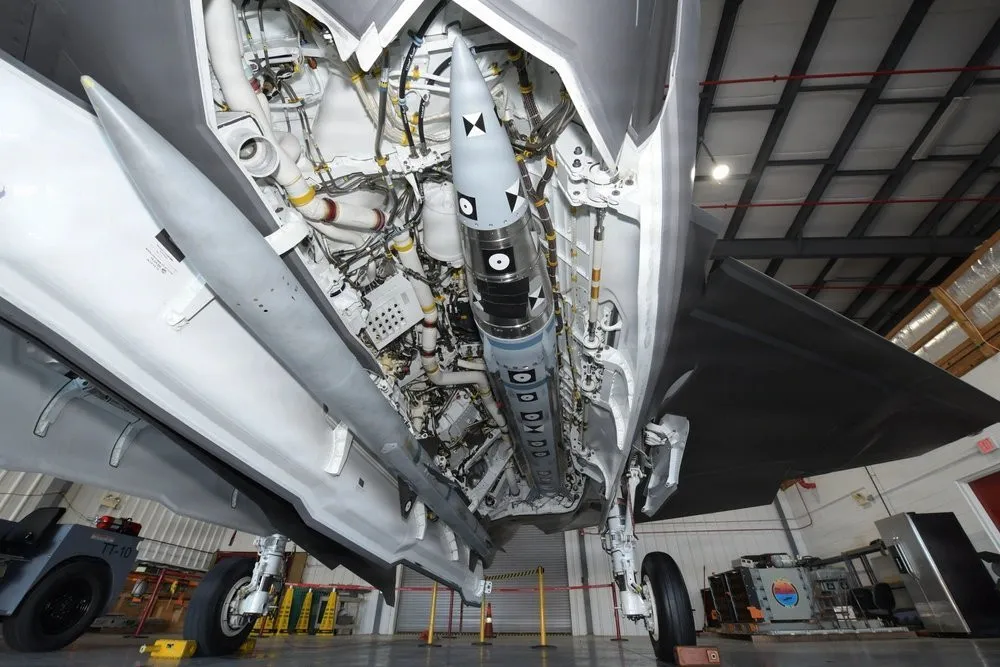
The U.S. Navy made a major splash this weekend when it revealed the existence of the AIM-424 Malice Long-Range Air-to-Air Missile (LRAAM), which is already deep in development. At the same time, the service also highlighted plans for a new Compact Air-to-Air Missile (CAAM) optimized for shorter-range engagements and internal carriage on stealthy fighters like the F-35 and future drones as part of its larger future missile vision. Readers can first get caught up on what is known about the long-range AIM-424 in our initial reporting on that missile here.
As described so far, the core goals for CAAM sound virtually identical to what the service has outlined previously in relation to a “Compact Variant” of the AIM-9X Sidewinder (AIM-9X CV), which TWZ was first to report on. A missile in this general category would offer a boost in magazine depth that could be especially valuable for more localized defense of carriers and other high-value assets against large waves of missiles and drones.
The “Compact Air-to-Air Missile (CAAM) effort is a future inner boundary weapon. Requirements are being evaluated and assessed by N98 [the Air Warfare Division of the Office of the Chief of Naval Operations] at this time,” a Navy official told TWZ when asked for more information. “The Navy does not plan to provide routine updates beyond approved public releases because of operational security and program sensitivity.”

Mention of CAAM was included in the same briefing where the AIM-424 was first unveiled at the Tailhook Association’s annual convention this weekend. A central focus of the CAAM is on “increasing internal carriage capacity for inner boundary weapon,” according to that presentation.
For the Navy, at present, “internal carriage” is a consideration most applicable to the service’s F-35Cs and, by extension, other variants of the Joint Strike Fighter. Internal weapons bays will also be a feature on whatever design the Navy may ultimately select as its future sixth-generation carrier-based combat jet, currently referred to as F/A-XX. Future Collaborative Combat Aircraft (CCA) type drones or other uncrewed aircraft the service might acquire in the future could also have internal bays. We will come back to this later on.
The description of CAAM as an “inner boundary weapon” points to a focus on shorter-range engagements, where there could also be less total time to react overall.
In terms of what the Navy’s core requirements for the CAAM might be beyond internal carriage, details are limited. A rendering included in the presentation at Tailhook this weekend shows a relatively generic-looking design with fins only at the tail and a yellow band around the front of the body indicating the presence of a high-explosive warhead.
However, earlier this year, the Naval Air Warfare Center Weapons Division (NAWCWD), part of Naval Air Systems Command (NAVAIR), did put out a contracting notice regarding rocket motor developments to support CAAM and other developments.
NAWCWD “intends to procure on a Full and Open competition basis to develop and demonstrate technology that results in greatly enhanced kinematic capability for the next generation of tactical missiles,” the notice explained. “To support this technological development efforts, NAWCWD is interested in maturing high total impulse loaded and energy tailorable solid propulsion systems for transition into compact weapon systems, including a Compact Air-to-Air Missile (CAAM).”
“Requirements will include tasking and products needed to provide a Concept Design with build-to-print data package, identify critical technology gaps, conduct critical component and rocket motor experiments, conduct a Design for Manufacturing & Assembly study to identify features required to meet manufacturing and cost goals, and provide a plan to mature the CAAM HLG Concept Design to a maturity state ready to enter a Department of Defense (DOD) Engineering and Manufacturing Development (EMD) program,” the notice added.
“HLG” here stands for “Highly Loaded Grain.” This, in turn, refers to solid-fuel rocket motors designed to maximize output per volume. This is an area of missile technology where the Navy has already been heavily investing for years with a broad eye toward increasing the range and improving the performance of future missiles. Furthermore, a missile with an HLG rocket could offer substantially increased capability over a similarly-sized design with a non-HLG motor. This, in turn, offers particular advantages when designing missiles for carriage in internal bays with rigid dimensions.
“The Next-Generation Highly Loaded Grain project team has matured the technology and seeded the development of future mission-modular propulsion systems that can increase weapon ranges by up to 1.5x while maintaining inner boundaries for short-range and time-critical missions,” according to one fact sheet detailing notable achievements by NAVAIR’s Naval Air Warfare Center Weapons Division (NAWCAD) in 2023. Note here also the explicit mention of ‘inner boundary’ design considerations.
As mentioned earlier, the Navy has previously used virtually identical language to describe the planned AIM-9X CV, which is also a joint program with the U.S. Air Force.
“The AIM-9X CV repackages the SIP IV technology into a compact airframe optimized for internal carriage on advanced aircraft with improved kinematic performance,” according to the Navy’s Fiscal Year 2027 budget request, released earlier this year. “The program will deliver increased capability to the warfighter with greater standoff range, increased aircraft weapon station capacity, and maintains inner boundary performance.”
How exactly the CAAM and the AIM-9X CV programs may be related is unknown, but they clearly have the same general goals if they are not different names for the same development effort. From what was shown this weekend, CAAM is a distinctly different-looking missile from the AIM-9X, and plans for a compact Sidewinder variant or derivative could also be a stepping stone to a new design intended to fill the same general role.
U.S. defense contractors have been publicly showing concepts for compact air-to-air missiles for years now. This includes Raytheon’s Peregrine, unveiled in 2019, which was said to be roughly half the size of an AIM-120 Advanced Medium Range Air-to-Air Missile (AMRAAM) while still offering comparable range. The company said it also had equivalent maneuverability to current-generation Sidewinders. Raytheon is the prime contractor for the AIM-120 and the AIM-9, as well as the newly unveiled AIM-424.
In the late 2010s, Boeing also put forward a concept for a multi-stage Long-Range Air-to-Air Missile (LRAAM), which had a design that raised the possibility of whether the first stage could be used as a more compact, stand-alone weapon. In 2022, Boeing notably received funding for further development of that missile under a contract from the Air Force Research Laboratory (AFRL) to “investigate advanced missile sub-system components to support the Compact Air-to-Air Missile [CAAM] and Extended Range Air-to-Air Missile Systems [ERAAM].”

During the 2010s, Lockheed Martin promoted a compact anti-air missile design called Cuda, with a focus on internal carriage, as well. However, Cuda had largely disappeared from the company’s marketing materials by the end of the decade.
Regardless, the use case for such a CAAM-type missile is clear-cut, especially for the Navy and its carrier air wings. In particular, the service is facing a threat ecosystem that is rapidly evolving in scale and scope, including multiple different classes of anti-ship missiles (ballistic, cruise, hypersonic) and long-range one-way attack drones. There is a very real prospect of large-volume and complex attacks made up of very different tiers of weapons incoming from multiple vectors simultaneously, creating a greater risk that both long- and short-range defenses will be overwhelmed. TWZ previously explored this reality in depth in discussing how the long-range AIM-174B, an air-launched version of the Standard Missile-6 (SM-6) that was officially unveiled in 2024, fits into the service’s larger plans.

How The Navy’s New Very Long-Range AIM-174 Will Pierce China’s Anti-Access Bubble
Added localized defensive capability and capacity could also be relevant for aerial force packages pressing their way to a target in hostile territory, where similarly growing aerial threats could materialize suddenly and in close proximity. Depending on its capabilities, CAAM might even be able to provide a new layer of defensive capability against incoming anti-air missiles, including for larger aircraft. So, giving individual aircraft more total engagement opportunities will only become more valuable, if not vital, as time goes on.
As noted, stealth platforms with limited internal bay space face particular constraints in this regard. For years, more magazine depth via smaller missiles has been seen as a key avenue for improving payload limitations for platforms like the F-35 and F-22 when operating in their most low-observable (stealthy) configuration. In many scenarios, these aircraft can get closer to their targets without detection, offering different options for the employment of what could be shorter-range weapons. A compact air-to-air missile design that still offers comparable performance to larger existing designs, through the use of a high-load-grain rocket motor and other features, would be even more of a boon. Having something that is capable of short-to-intermediate-range engagements, but that can be loaded in greater numbers internally would expand tactical flexibility, amplify lethality, and increase utility of the aircraft as they can down more targets on a single sortie in certain scenarios.
The continued growth of drone threats, especially those posed by long-range one-way attack types, has added another dimension to this equation. Limited magazine depth limits the ability to rapidly retask stealthy platforms to respond to often unpredictable high-volume drone attacks. Furthermore, the anti-air version of the 70mm Advanced Precision Kill Weapon System II (APKWS II) laser-guided rocket, the U.S. military’s current go-to lower-cost air-to-air weapon against drones, cannot be fired at all from the internal bays on the F-35 or the F-22. CAAM can offer the ability to address these threats better than aircraft like the F-35 and F-22 can today.
A weapon like CAAM would also be especially relevant for future collaborative combat aircraft, which have extreme constraints on payload capacity, internal and external, as well as total takeoff weight. For CCA-type uncrewed aircraft, keeping the airframe size as small as possible to meet requirements is also essential for meeting affordability and producibility targets. Arming these platforms with an AIM-120-sized missile might not necessarily be required, or even be ideal, especially when operating along the leading edge of the air-to-air battle, closer to threats. In those scenarios, having the option of carrying even twice as many missiles per sortie, internally (if available) or externally, even if they have shorter reach, could be hugely beneficial.

There could easily be interest in a CAAM-like missile from other branches of the U.S. military, if it is not already a joint service effort. The Air Force is already known to be involved in the AIM-9X CV effort. The service has publicly pursued new compact and lower-cost air-to-air missile concepts over the years under various different project names. This includes its own CAAM effort, through which Boeing previously received funding.
What is clear now is that the Navy is pushing to maximize the anti-air capabilities of its aircraft at both the shorter- and longer-range ends of the engagement spectrum.
Contact the author: joe@twz.com