Pictures by Jesús Vizcaya
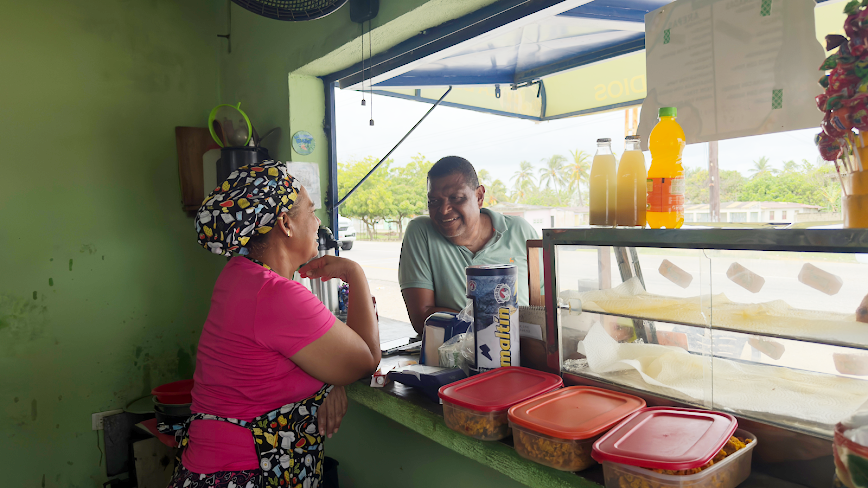
In Boca de Aroa, a village on the coast of Yaracuy state, Yaritza and her husband Fernando await the arrival of tourists who, for the past twelve years, have stopped for breakfast at their food stand “La Bendición de Dios”. This business has been the family’s main source of income. However, after the earthquakes of June 24, almost no vehicles are going through the road to the beaches.
Fernando says that traffic decreased significantly after the earthquakes. The epicenter of the first quake was very close to them, to the south, and some houses in the area were damaged. “Before the earthquake, the flow of travelers was considerably high, but our sales are now only 25% of what they used to be. Now we live on daily earnings. What we earn each day, we use to buy what we need.”

Fernando and Yaritza are not alone. In Boca de Aroa, as in other coastal communities near Morrocoy National Park, a large part of the economy depends on the constant flow of visitors from different parts of the country. To reach its keys and beaches from Valencia, many travelers take Troncal 3, the road that runs through Boca de Aroa before reaching the most popular beaches. After the earthquakes, the road shows evident damage: several sections remained closed, and traffic had to be diverted along alternative routes, further hindering access to the region. Buses that once arrived full of travelers now carry only a handful of passengers, mostly locals who get off one by one as soon as they recognize their usual stops.
Along this route, tourists sustain an economic chain of restaurants, small businesses, and people who work in the sea. Local fishermen find their main customers in hotels, inns, and restaurants, while others depend directly on tourism, relying on the sale of food, coconut products, fish and shellfish to make a living.
Tulio, owner of La Negra, a family restaurant specializing in seafood supplied by local fishermen, says the drop in tourism has hit both the business and its employees hard. “We couldn’t open the restaurant for three weeks after the earthquake. There’s no tourism, and people aren’t coming to town anymore,” says Tulio, sitting at one of the tables. “My employees keep coming to work because I want to help them financially, but this situation is really difficult.”

There was a reason for the lack of customers. Structural damage to the bridge leading to Punta Brava Beach, within Morrocoy National Park, forced the closure of this land access for weeks. The bridge reopened to light vehicles on July 25, yet the flow of visitors remained far below normal levels. Tourists could still board boats from the Tucacas pier to reach the keys, but the weeks-long closure disrupted the economic chain that sustained Boca de Aroa and Tucacas.
The day before authorities allowed light vehicles to pass again, local beach workers protested on that same road, demanding the lifting of the measures that prevented access to the coast.
The Food and Agriculture Organization of the United Nations (FAO) warns that small-scale fishing communities are among the most vulnerable to crises and natural disasters in Latin America and the Caribbean, due to their dependence on daily income and their limited capacity to absorb prolonged disruptions to their economic activity.
The Tierra Viva Foundation, a non-governmental organization dedicated to sustainable development, environmental conservation, and the strengthening of local communities, has been working for several years with coastal communities through its Costa Viva project. This sustained presence in the territory has allowed the organization to gain firsthand knowledge of the economic and social conditions that make these populations especially vulnerable to natural disasters. Just two weeks before the emergency, on June 9, the foundation announced a fundraising campaign—which had to be suspended after the earthquakes—to provide residents of the country’s main coastal communities with work tools and vocational training to strengthen their livelihoods. The initiative responded to a situation of vulnerability that these populations already faced before the earthquake.
This is also the conclusion of Alejandro Luy, the organization’s general manager. “Venezuela is going through a complex humanitarian situation, and the earthquake aggravated it by leaving people homeless, and the contraction of tourism in the area generated unemployment,” he says. “To support their activities, we implemented training programs to help improve the services many of them offer during 2025. If tourism decreases in these areas, their livelihoods are affected.”
But the vulnerability of these communities isn’t measured solely in economic figures. It’s also present in the stories of those who saw how the earthquake disrupted a way of life built over generations.
Jesús belongs to a family that has been connected to the sea for decades. For more than 60 years, his family has lived off fishing in Boca de Aroa, a way of life that Jesús continued and that for years allowed him to sell the fish he caught. For his family, this has been the most difficult situation caused by a natural disaster.
“In 2022, the Aroa River rose and overflowed, flooding the entire Cayumar sector and the dock area where we boarded boats to go fishing, but the flooding only lasted a couple of days. But because of the earthquakes, we haven’t sold anything we catch from the sea for several weeks.”
On June 24, Jesús had decided to return home earlier than usual. At 11 a.m., he left the sea and returned to land. Hours later, his father advised him not to go fishing again, just a couple of minutes before the earthquakes.
“I went out to buy a Coca-Cola, and on my way back home, the shaking started. My wife was at home with my parents. They managed to get out when the wall of the garage collapsed,” he recalls.
The destroyed space wasn’t just part of the family home. It was also a workplace. There, his father prepared the fishing nets, and his mother prepared the food she sold to the community members and, on weekends, to the tourists who came to the area.
“We want to rebuild our garage because my dad uses it to prepare the nets.” “My mom sells food to people in the community, but on weekends she sells to tourists,” Jesús explains.
Now he’s trying to turn the loss into an opportunity. While he waits for the debris to be removed from his mother’s porch, he started planting coconuts with the idea of selling them to visitors who return to Boca de Aroa and creating a small commercial area there, but it won’t be until five years from now that he’ll see the fruits of the barely sprouted coconut trees.

His story reflects a reality that is repeated in small-scale fishing communities around the world. According to the Food and Agriculture Organization of the United Nations (FAO), this sector represents about 40% of the world’s fish catches and supports approximately 90% of fishery workers. However, those who depend on this activity often have limited capacity to absorb prolonged interruptions in their income, due to their reliance on daily work and local markets.
In Boca de Aroa, that phrase sums up the uncertainty of a community that for years lived at the pace of those who arrived seeking the sea. The absence of tourists not only left empty tables in restaurants and fewer customers for the fishermen; it also disrupted an economy built around small commercial exchanges with visitors, which sustained hundreds of families in Falcón state.
The most significant damage in the cluster of coastal towns within the country occurred in Tucacas and Boca de Aroa, unlike other tourist areas. The condition of the roads leading to these towns, along with the preventative closure of the region’s most important national park, were the main causes of the economic slowdown in these villages.
Just a few streets away from where Jesús planted the first coconuts, traces of what happened that June morning remain. Some houses are damaged, and families who lost their homes continue to wait for a solution while living in tents set up near their land.

The recovery of these fishing villages will not depend solely on removing the debris or repairing the access roads. It will also depend on those who live there being able to reconnect with an activity that for generations defined their relationship with the sea: the possibility of working, selling and supporting oneself on a coast where, after the earthquake, many are still waiting for people to return.