2026 earthquake

How the Military Replaced Scientists at Venezuela’s Seismological Institute

Originally published in Spanish by Runrun.es

The mission of the Venezuelan Foundation for Seismological Research (Funvisis) is to guide life-saving actions during earthquakes. Its capacity to fulfill this purpose was severely diminished when, on June 24, the earth shook twice, devastating the country’s central coastline.

Multiple sources consulted separately for this report agree that the institution suffered a progressive dismantling following a pivotal change in command: the historical tradition of having scientists lead the agency was replaced by military leadership. Simultaneously, the entity was transferred from the Ministry of University Education, Science, and Technology to the Ministry of Internal Relations, Justice, and Peace, now under Diosdado Cabello.

Former employees look back at the institution with nostalgia. They speak of an era when budgets were always tight, but the sheer dedication to the job was enough to prioritize science, training, and prevention. Today, the landscape reveals a significantly reduced monitoring network, shuttered educational programs, and a lack of specialized personnel after they left the country in a state of heightened vulnerability.

Declining precision in seismological activity

Presently, the National Seismological Network represents a mere quarter of what it was a decade ago. A clear sign of this institutional weakness is that it took the Foundation 4 hours and 26 minutes to inform the public about the details of the dual earthquake. By comparison, the United States Geological Survey (USGS) maintains an average standard of 20 minutes to process and publish data for earthquakes outside its territory. For events within the state of California, where its seismic network is extensive, reports are issued within 2 to 5 minutes.

According to the institution itself, the National Seismological Network is responsible for recording Venezuela’s tremors in real-time using broadband stations “to reduce vulnerability across the country.”

André Singer, president of the institution between 1996 and 2000, noted that in 1999, the necessary funds were secured to acquire a modern seismological network. This network featured 35 broadband stations and began installation in the year 2000. That same year, Funvisis became an attached agency of the newly created Ministry of Science and Technology.

By 2014, Funvisis’s website stated that Venezuela had 40 stations distributed across areas of highest seismic activity. Regional networks complemented local data, such as the Seismological Network of the Venezuelan Andes (RedSAV) and the Seismology Center of the Universidad de Oriente (CSUDO).

The network in the Venezuelan Andes used to cover 25 seismological stations. Now, it is completely inoperative.

Curiously, in the 2015 annual report from the Ministry of University Education, Science, and Technology, Funvisis reported expanding the network to 38 stations. This was achieved after putting two satellite seismological stations into operation and building and installing two others.

“The network must currently have at least ten operational stations, in addition to several accelerometers and satellite GPS stations in service,” Singer explained in an interview with Runrun.es, adding that this was only possible due to a recent restoration effort.

During a forum on July 2, Dr. Raúl Estévez, founder of the Geophysics Laboratory at the Universidad de los Andes (ULA), asserted that this reduction in stations occurred due to “an absolute lack of budget and technical support.” He added that the western regional network, managed by ULA—which at one point operated 25 of its own stations—became completely inoperative due to a lack of resources.

In Sucre, the Venezuelan state with the highest seismic risk, the UDO Seismology Center is also inactive, its director, Janette Castillo, confirmed to Runrun.es. The institution previously managed a network of stations covering the northeastern region.

The specialist explained that they were severely affected following the pandemic by the dismantling of UDO’s Sucre campus and a dwindling university budget. However, she noted that efforts are currently underway to try and recover the institution. She emphasized that local networks are vital for enabling more detailed monitoring and study of seismic activity in each region of the country.

The closure of flagship public spaces

Following the 1967 Caracas earthquake—a magnitude 6.5 event that left approximately 283 dead and 2,000 injured—the need arose to create a specialized institution for the study and investigation of earthquakes. Thus, Funvisis was born in July 1972. Following the 1997 Cariaco earthquake, which claimed 73 lives, the entity modernized how earthquakes were recorded nationwide, transitioning from heat-sensitive paper to the digital-satellite screens still used today.

In 1998, one of the institution’s flagship programs was created: the Madeleilis Guzmán Seismic Classroom, named after the schoolteacher who died during the Cariaco earthquake after saving two of her students. It served as a laboratory to understand how different sectors of the population responded to tremors, allowing the institution to tailor training and prevention guidelines accordingly.

Through this program, seismic classrooms managed by local authorities were established across various corners of the country’s seismic geography, including Cariaco, Lagunillas de Mérida, El Tocuyo, and at the Cagigal Observatory, before the former Seismological Museum of Caracas ceased operations, Singer detailed.

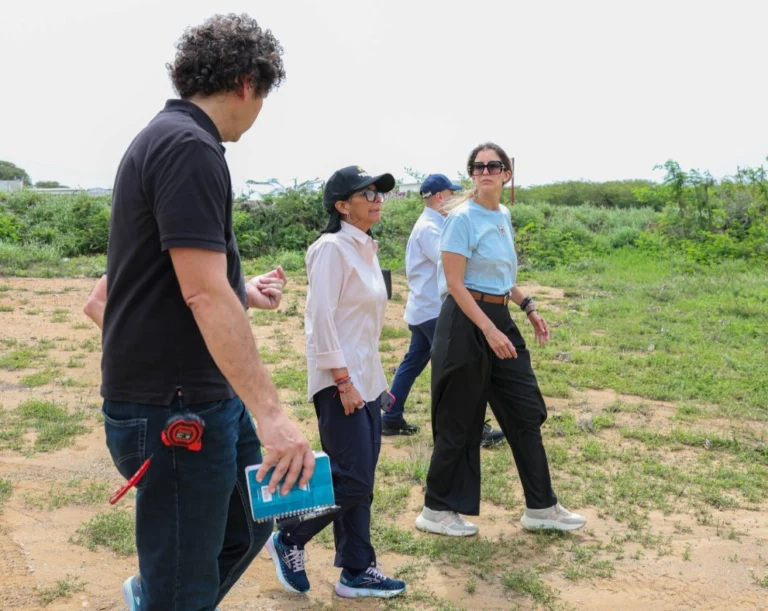
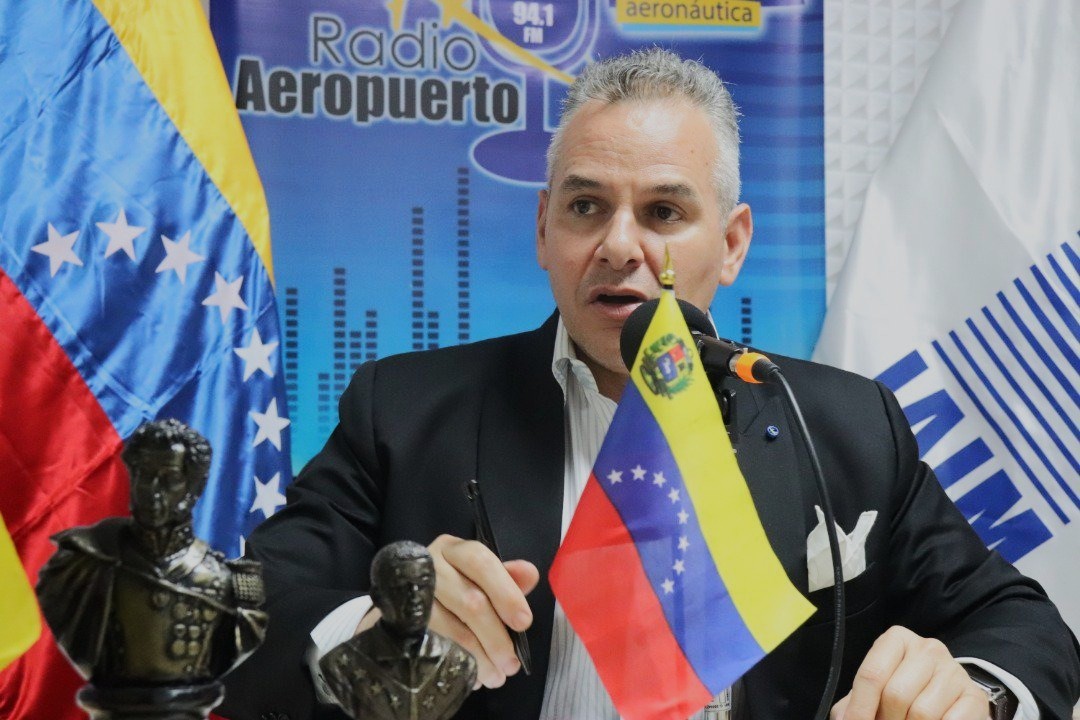
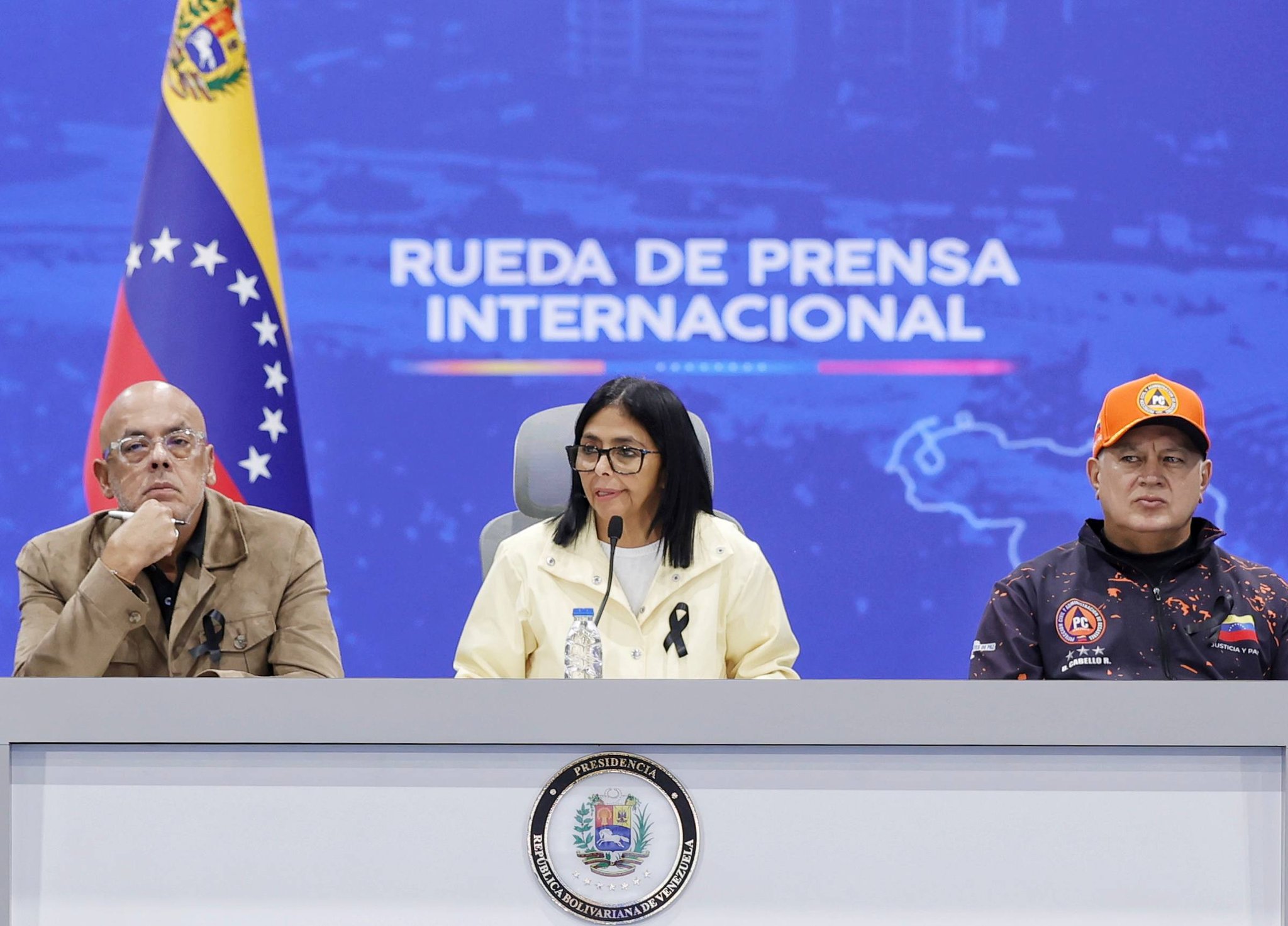
The program was shut down in 2018 under the administration of Vice Admiral Roberto Antonio Betancourt Arocha, the man photographed above. The space where it operated was converted into an auditorium.

In 2018, former Interior Minister Néstor Reverol promised to strengthen Funvisis’ stations and guarantee their security. After the June quakes, Funvisis reported the theft of a vital seismological sensor.

A former employee with experience in the comprehensive management of socio-natural and technological disaster risks explained that under that administration, the goal was to commercialize training and charge for workshops. “That was the reason I resigned from Funvisis, because knowledge and learning are universal rights,” they told Runrun.es.

Despite five separate sources reporting the suspension of the program, Funvisis claimed in a press release on February 16 of this year that they were celebrating the 28th anniversary of its creation.

It was also under this military administration that the Seismological Museum of Caracas was closed. The museum operated out of the historic Juan Manuel Cagigal Observatory, where, among other equipment, a mid-20th-century Wiechert seismometer was preserved.

“That museum featured a seismic simulator so the public could experience the shaking of an earthquake, along with instructors, specialized technical personnel, and a library maintained by Funvisis. It fulfilled a major role in addressing the social demands of the communities most in need of seismic prevention, specifically the working-class areas surrounding the Cagigal Observatory and western Caracas,” Singer detailed. He added that some of the instruments and personnel from that museum were transferred to a room at the Museum of Natural Sciences in Bellas Artes.

According to the former worker who preferred to keep their name confidential, the free 0800-TEMBLOR telephone service was also suspended during the tenure of Vice Admiral Betancourt. Runrun.es called the number multiple times during the first week of July, but the calls went unanswered.

The dwindling financial lifeline

The former president of the institution during the 1990s explained that “Funvisis’s deficit-ridden budget situation has been a recurring ailment throughout its history.” He recounted facing these difficulties firsthand and avoiding the technical shutdown of the entity through a budget rectification and the support of lawmaker Walter Márquez across political factions in Congress. He added: “The institution was sustained by income generated from contracts for seismic hazard studies, which the oil industry continuously requested for over 20 years starting in 1980 to ensure the safety of its installations.”

“During the peak demand for contracted studies, that revenue source represented nearly half of Funvisis’s annual budget,” he said.

However, over the last 15 years, this funding stream dried up in tandem with the collapse of the oil industry. Consequently, Funvisis came to depend almost exclusively on the budgets of the ministries to which it was subordinated.

“There was very little qualified staff left [when Jiménez Villarruel took over last year] given that most had been made persona non grata by Vice Admiral Betancourt (…) to the point where he blocked visits from anyone wishing to use Funvisis’ public library.”

In 2015, while attached to the Ministry of University Education, Science, and Technology, the institution acknowledged among its obstacles that “delays in foreign currency liquidation have paralyzed the purchasing processes for technological equipment acquired abroad, leading to delays in the physical execution of projects, as well as hindering the proper tracking of national seismic activity by Funvisis.”

By decree of then-President Nicolás Maduro, Funvisis was transferred in 2018 to the Ministry of Internal Relations, Justice, and Peace, which was then headed by Néstor Reverol. The minister at the time indicated that the change aimed to strengthen the National Seismological Service with investments in various stations across the country and to guarantee their security.

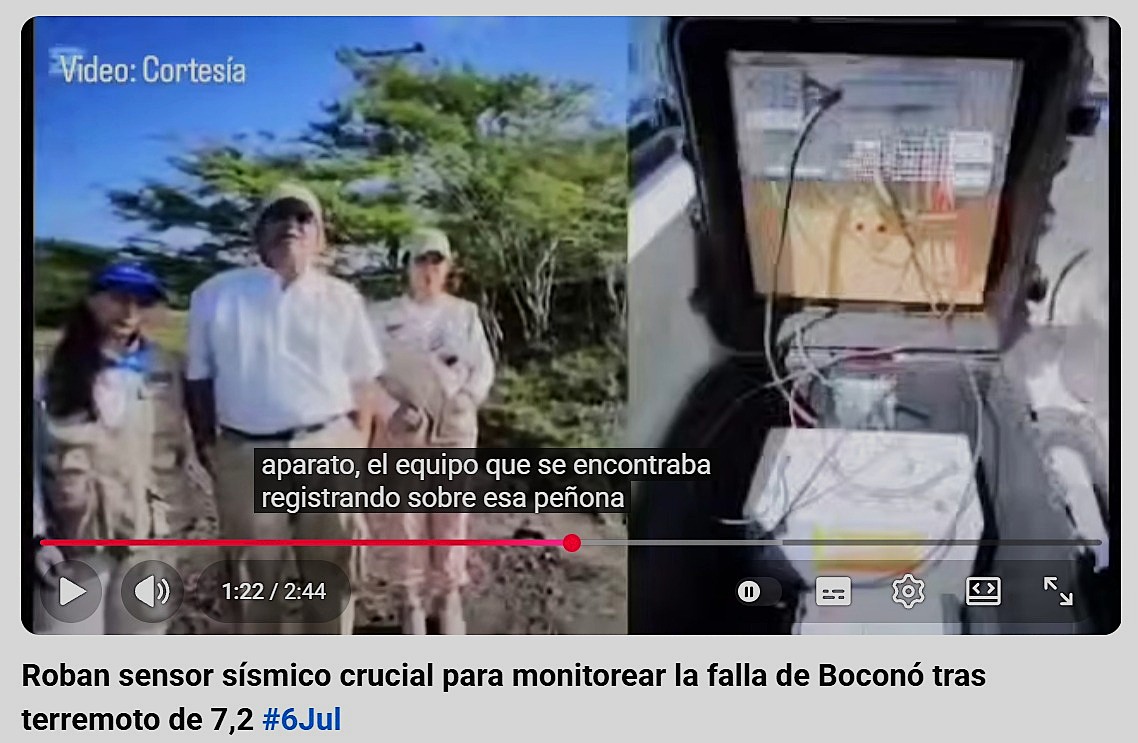
Nonetheless, this security guarantee was far from absolute. Just days after the June 24 earthquakes, Funvisis geologist Franck Audemard reported the theft of a sensor installed to monitor tectonic movements along the Boconó fault, which is linked to the first of the earthquakes recorded last month. The equipment had been installed in 2013 in the La Chicharronera sector, between Morón and Barquisimeto, on a property owned by former Venezuelan Major League Baseball player Melvin Mora. “The data from this equipment is vital for what is happening seismically in the country,” Audemard said in a video shared on social media.

A critical shortage of specialists

One of the interviewed sources pointed out that in September 2025, the current president of Funvisis, Major General (G/D) Luis Alejandro Jiménez Villarruel, took command.

“He inherited the hardest part, because he took over a foundation already lacking supplies, equipment, tools, and logistical materials. Furthermore, there was very little qualified staff left, given that most had been made persona non grata by Vice Admiral Betancourt and the majority of his executive team—to the point where he blocked visits from anyone wishing to use the foundation’s public library,” the source expressed.

Estévez, from ULA, agreed that there is a severe shortage of experts in the field nationwide, attributing it to a brain drain caused by the financial asphyxiation of universities and research centers. “The next generations in this field have left. Only us retirees remain,” he lamented during a forum at the Mérida College of Engineers.

Days after the dual earthquake, geological engineer Luiraimar Salazar denounced via her X account that the deterioration of Funvisis directly aligns with the military management that took over in 2017. During this period, she alleged that experienced scientists were forced to retire, while other specialists were pushed out of the institution, and the personnel who remain working do so under precarious salaries and with increasingly limited resources.

The expert insisted that citizens have the right to question what decisions were or were not made, and how those actions impacted the country’s capacity to monitor and study seismic threats.

Runrun.es visited the Funvisis headquarters in Caracas to seek an official statement. The staff at the entrance indicated that no one was available to address the request. They stated they would contact the outlet to arrange an interview, but at the time of this publication, no such call had been received.

Source link

A Japanese Study Warned Chávez About the Earthquake Risks

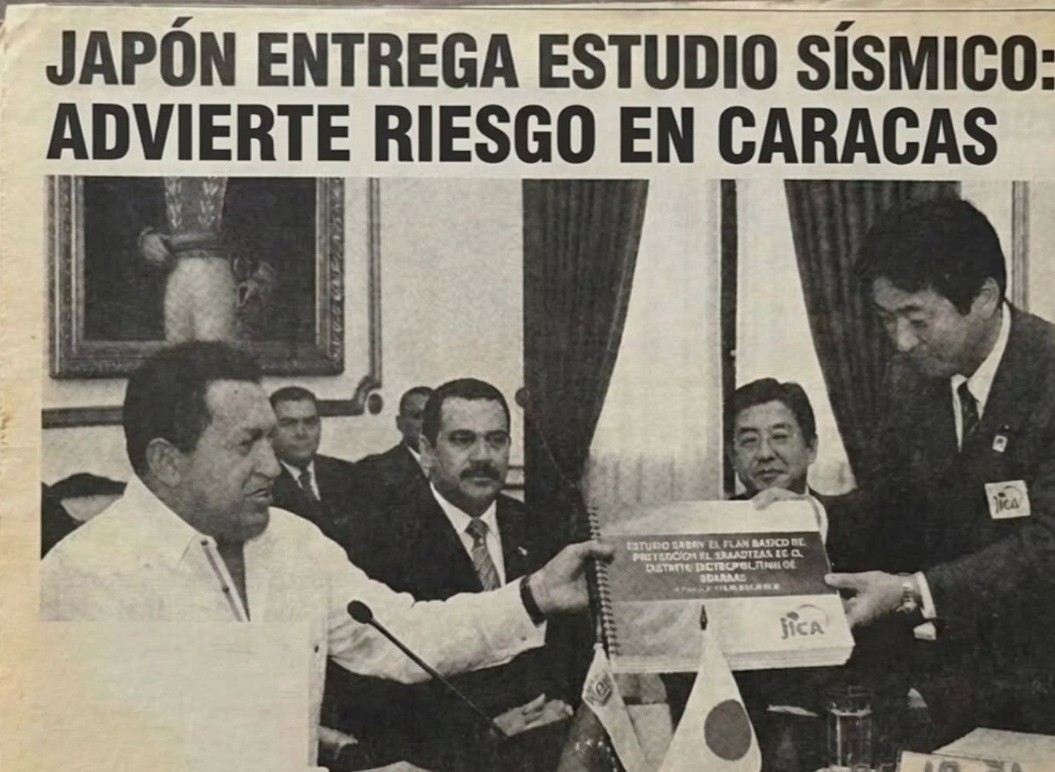
Less than 48 hours after the earthquakes of June 24, X (formerly Twitter) users mentioned that a Japanese team did a study on seismic risk in Caracas in the early 21st century. That’s true. In March 2005, the Japan International Cooperation Agency (JICA), the primary government agency responsible for managing Japan’s Official Development Assistance (ODA), released the report Basic Plan for Disaster Prevention in the Metropolitan District of Caracas in the Bolivarian Republic of Venezuela.

The technical report presented a Disaster Prevention Plan as requested by the Venezuelan government. The plan’s goal was to save lives during an earthquake by minimizing asset damage and improving the State’s response capacity.

The study covered only three of the five municipalities that form Metropolitan Caracas: Libertador, Chacao, and Sucre, because the government committed to apply its conclusions to Baruta and El Hatillo. It did not consider what is currently called La Guaira state (Vargas back then).

The Japanese team was headed by Mitsuo Miura (Pacific Consultants International, PCI) and composed of staff members of PCI and OYO International Corporation. They visited Venezuela seven times, from December 2002 to March 2005, when they discussed the results with the Venezuelan officials and conducted field surveys. Upon returning to Japan, the team finished additional studies and prepared this final report.

The diagnosis

The study defined several scenarios to estimate risks, soil displacement, and potential damage. It projected that, in the worst case, a considerable number of buildings in Caracas, depending on their age and type, would collapse, with a high human cost. Only the ones built after 2002 showed high seismic capacity. Twenty years ago, those buildings made up no more than 0.1% of the studied area. 

On the other side, 98,237 buildings were vulnerable. Those built before 1967 (the year of the previous great earthquake in Venezuela) had low seismic capacity, while those built from 1968 to 2001 had a moderate capacity. Of the 1968-1982 buildings, 82% were made of brick and mortar. 

“The project will reduce the number of heavily damaged buildings from around 10,000 to around 1,300, and the number of casualties from around 4,900 to around 400 in the case of a 1967 earthquake.”

The Japanese team evaluated, using Japanese standards, office buildings, homes, bridges and viaducts, and established a range of risks in several seismic scenarios. After surveying the Metro tunnels and stations, they suggested reinforcing columns and structures, as well as adding resistant materials in the gas and water networks, and improving the structure of gas stations to avoid dangerous combustible spills. 

By 2005, shantytowns covered approximately 20% of Caracas’ urban area, and hosted 51.2% of the capital’s population. This study conducted, for the first time, seismic reinforcement tests on four full-scale models of the typical rancho. It demonstrated that the unengineered constructions have low seismic resistance and require reinforcement, as they could not withstand minor loads and showed failures in columns and connections. The bricks did not contribute significant resistance. If those homes were reinforced with beams, their resistance increased by 40% at an additional cost of 5% to 7%. 

The solution

Their plan recommended seven big tasks. To improve safety, reinforce buildings and bridges, control the flux of sediments, and relocate the population living in high-risk areas. To improve response, implement early alert systems and emergency command centers. And to improve coordination, educate the population and stimulate citizen participation. By that time, local technologies made all these projects possible.

“The project”, they assured in the report, “will reduce the number of heavily damaged buildings from around 10,000 to around 1,300, and the number of casualties from around 4,900 to around 400 in the case of a 1967 earthquake.”

There was no plan, no authorities, no clear responsibilities to allow Venezuela’s capital and most populated city to coordinate the response in case of a disaster, the Japanese warned.

When they did the calculations back in 2005, they estimated the plan would cost around 2,800 million dollars (most of them to reinforce all the buildings that could be damaged in an earthquake) and would take 16 years to fully implement. So, if the Chávez and Maduro governments had done their part of the deal, Venezuela would have finished five years ago a seismic prevention and safety strategy in Caracas designed by the experts from a country that knows earthquakes as much as Japan, paying a quarter of the costs estimated for the 2026 earthquakes.

The Japanese team also recommended an early alert system for landslides, to be developed from 2005 to 2007, with a cost of one million dollars. This was meant to protect 19,000 Venezuelans.

The responsibilities

The Venezuelan entities involved in the plan would be the ministries of Public Works and Housing, Transportation, and Planning and Development; the Caracas Metropolitan Mayor’s office; the capital’s five municipalities; and the National Civil Protection and Disaster Management Organization (Protección Civil). 

But by 2005, only a civil protection law from 2001 defined some of the corresponding responsibilities. The capital’s Disaster Prevention Administration was being developed. As the Japanese experts warned in their report, there was no plan, no authorities, no clear responsibilities to allow Venezuela’s capital and most populated city to coordinate the response in case of a disaster.

When Japan’s JICA delivered the report to Hugo Chávez, the area under assessment had 17 firefighter stations, 15 municipal police stations, 17 civil protection stations and two emergency control centers. Since then, the only visible change for the inhabitants is the increase of National Police (PMB) command centers.

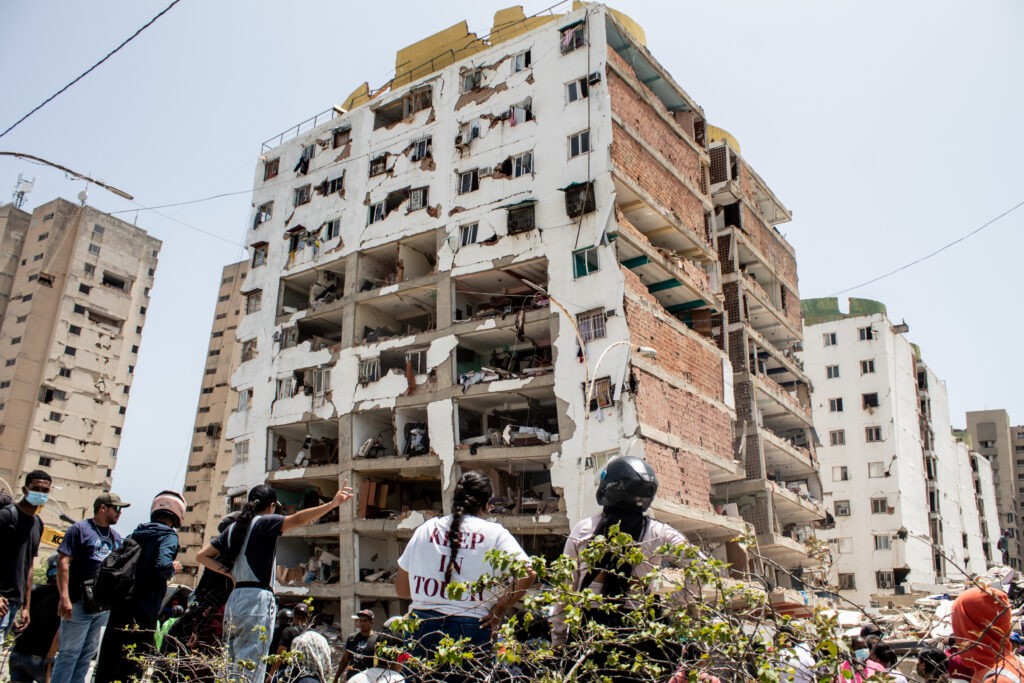
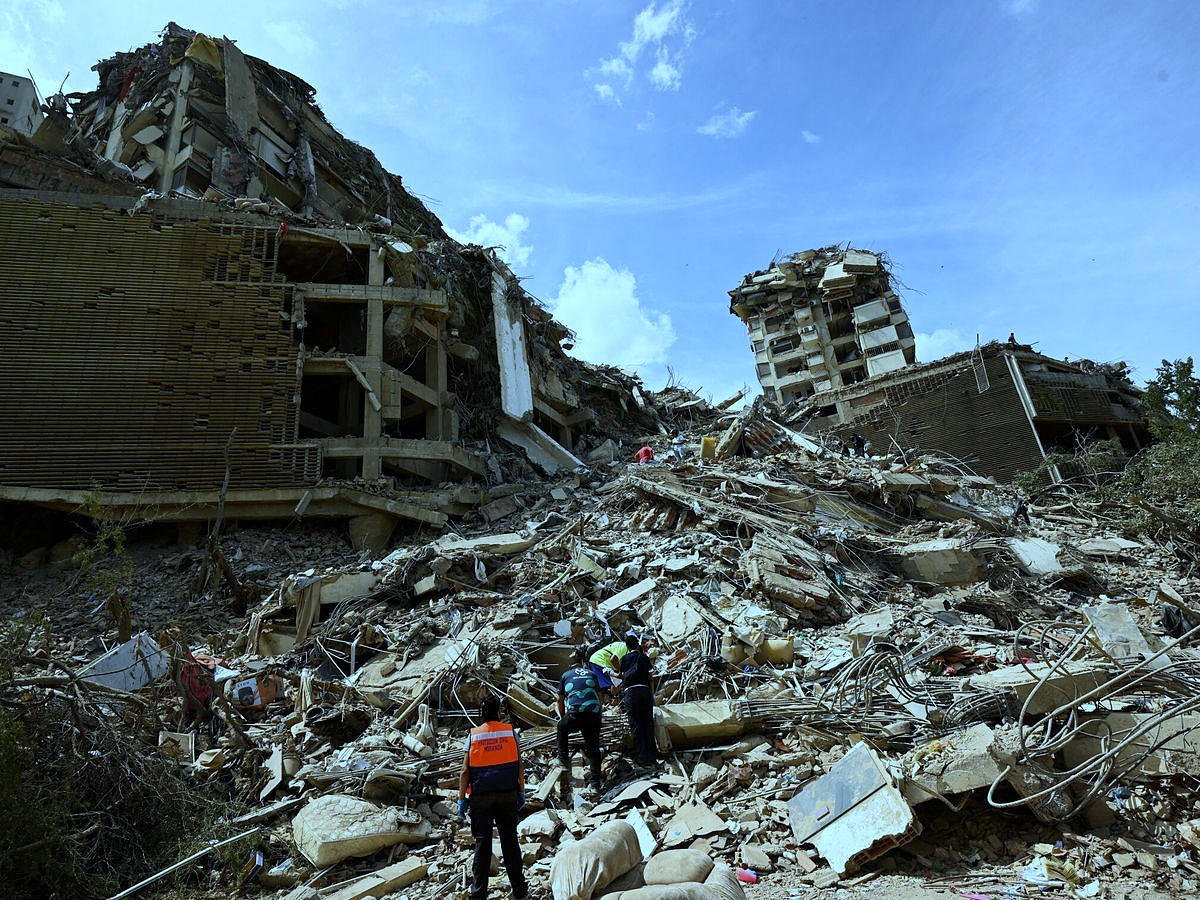
On June 24, 2026, three buildings went down in Chacao municipality, and inspections are being made to assess the structural damage of several more. In Libertador municipality, at least two residential towers collapsed in San Bernardino, and there’s important damage across the city. In parts of Petare, in Sucre municipality, where many buildings are ranchos, an undetermined number of lodgings collapsed totally or partially, and basic services are not available in some places.

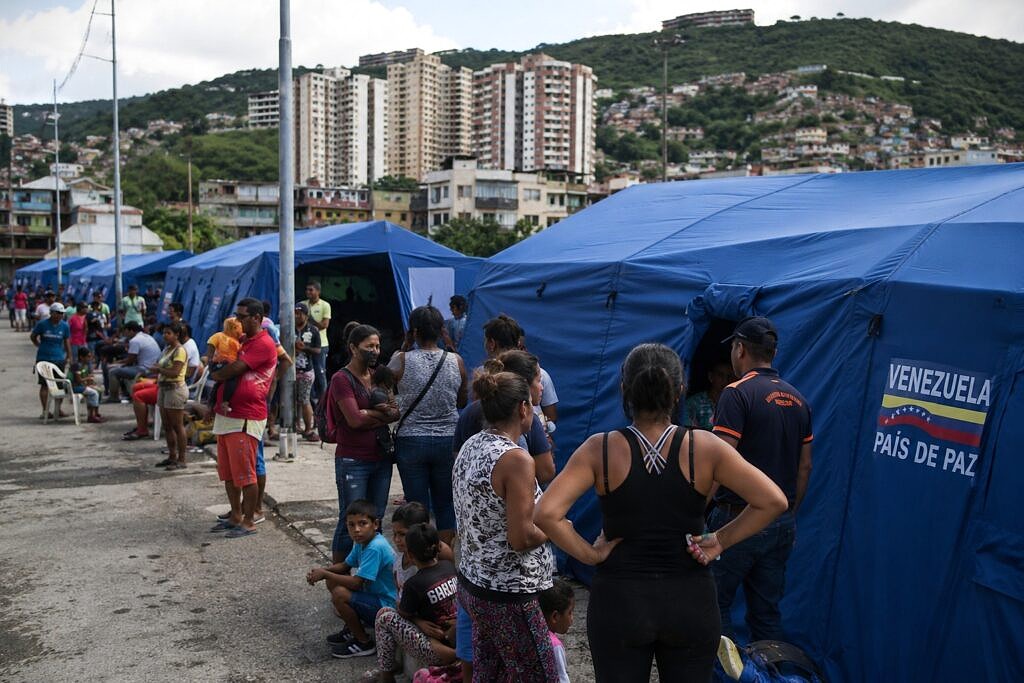
Many foreign crews came to help, especially in La Guaira. One of them is a new research team with seven JICA specialists that arrived in Caracas four days after the earthquakes to design the support measures Japan would contribute to. On June 30, after a request from the interim government, Japan sent tents, water tanks and purification equipment, and erected two campaign hospitales, one in Caraballeda, in the middle of the disaster zone in La Guaira, and another by the Dr. Domingo Luciani Hospital in Caracas.

Besides this, Miyamoto International, a Japanese organization of disaster prevention engineering, came to assess earthquakes’ impact. The team is headed by the famous engineer Hideki “Kit” Miyamoto, the organization’s founder and director. He said they are talking with the Japanese government and reviewing the previous reports. Maybe they will issue a new body of knowledge like the 2005 investigation by JICA. Let’s hope that, this time, the Japanese expertise will be used.

Source link

Chavismo, Not Sanctions, Depleted Venezuela’s Reconstruction Capital

The first days after the earthquake were defined by what had been lost. Apartment blocks lay in ruins, entire neighborhoods disappeared beneath the rubble, hospitals overflowed, hundreds of thousands of Venezuelans found themselves without a home. Yet as the emergency slowly gave way to recovery, another realization has emerged, one less dramatic but perhaps more consequential. 

Venezuela did not only lose buildings: it is now discovering that it has very little left with which to rebuild them.

Reconstruction is often described as something that begins after disaster strikes. In reality, it begins years earlier, with the reserves a country accumulates while times are good. Wealth matters, but so do things that rarely appear in economic statistics: functioning institutions, domestic industries, engineering firms, construction companies, reliable electricity, access to credit, insurance markets, emergency planning, skilled workers and the public trust needed to mobilize them all. These are the hidden reserves that allow societies to absorb shocks. The earthquake revealed that Venezuela had spent much of them long before the ground began to shake.

That depletion has become evident in almost every aspect of the response. Venezuela imports a significant share of the food it consumes and much of its medicine. The emergency quickly exhausted whatever inventories existed. Heavy machinery needed to clear debris had to be sought abroad. Medical supplies became scarce almost immediately. Temporary shelters proved insufficient, forcing thousands of survivors to remain in tents erected in parks and public spaces weeks after the disaster. The government is now considering housing many of them in schools, an understandable emergency measure made possible only because classes are suspended for the summer.

Temporary solutions, however, have a habit of becoming permanent in Venezuela. Families displaced by the Vargas Tragedy of 1999 and by the 2010 floods spent years, in some cases decades, living in shelters that were never meant to become homes. The earthquakes risk repeating a familiar pattern, not because Venezuelan authorities necessarily want it to, but because they have long lacked the capacity to offer anything else.

The Venezuelan diaspora contains an extraordinary concentration of precisely the human capital required to rebuild the country. Whether that expertise can be persuaded to return, even temporarily, remains an unlikely scenario.

Some will inevitably attribute this lack of preparedness primarily to sanctions. It is an understandable argument, but one that struggles to explain what the earthquakes actually exposed. The collapse of domestic industry, the deterioration of public infrastructure, chronic underinvestment in the electrical grid, the shrinking of Venezuela’s manufacturing base and the erosion of emergency response capacity all began years before oil sanctions were imposed.

Recent research has also challenged the idea that sanctions caused a discrete collapse in access to food and medicine, showing instead that essential imports had already fallen dramatically before sanctions and later stabilized as the government dismantled some of its own economic controls. The sanctions era itself demonstrated that Venezuela retained the ability to import consumer goods. Supermarkets gradually refilled for those able to pay. Construction cranes returned to Caracas’ wealthiest neighborhoods. Restaurants multiplied. Consumption recovered far more quickly than productive capacity.

The earthquake exposed the difference.

The destruction of resilience

Disasters ask questions that ordinary economic life does not. They care little about how many imported products sit on supermarket shelves or how many luxury apartments are being built in eastern Caracas. They ask whether a country can mobilize excavators, engineers, trauma surgeons, logistics networks, emergency housing, electricity, financing and public institutions at scale. They ask whether resilience has been accumulated or consumed. Venezuela’s answer has been painfully clear.

That is perhaps one of the least understood legacies of chavismo. Much has been written about the destruction of wealth, the collapse of oil production or the country’s prolonged recession. Less attention has been paid to the destruction of resilience itself. For years, the Venezuelan State approached institutions with the same extractive logic that governed its relationship with oil. Productive assets became sources of immediate political or fiscal returns rather than investments to be maintained and strengthened. Private companies were expropriated rather than incorporated into development. Public enterprises became instruments of patronage rather than production. Infrastructure was consumed faster than it was repaired. The country did not merely become poorer. It gradually spent the reserves that societies rely upon when catastrophe arrives.

Resources that may have financed future growth must now finance immediate recovery.

The consequences extend far beyond physical infrastructure. Reconstruction is ultimately carried out by people, and Venezuela has spent the last two decades exporting many of those it now needs most. Engineers who now design highways in Spain, petroleum specialists managing fields in Texas or Guyana, architects working across Latin America, doctors practicing in Colombia and Chile, electricians, project managers and construction supervisors who left because opportunities disappeared at home. The Venezuelan diaspora contains an extraordinary concentration of precisely the human capital required to rebuild the country. Whether that expertise can be persuaded to return, even temporarily, remains an unlikely scenario.

Money presents an equally daunting challenge. Before the earthquake, Venezuela’s slow economic reopening had begun to attract cautious international interest. Much of it remained exactly that, cautious. Memoranda of understanding outnumbered signed investment agreements, access to financing remained limited and investors continued to price Venezuela’s political risks accordingly. The expectation, however tentative, was that new investment would increasingly flow toward rebuilding the electrical grid, expanding oil production and modernizing neglected infrastructure. The earthquake has fundamentally altered those priorities. Resources that may have financed future growth must now finance immediate recovery. Every home rebuilt is a home that cannot wait. Every hospital repaired is indispensable. Every bridge reconstructed delays another project that might otherwise have expanded productive capacity. Reconstruction does not replace development. It postpones it.

Reconstruction-era uncertainty and challenges

The financing challenge has also become more complicated politically. Investors had already approached Venezuela with understandable caution. The humanitarian emergency has increased the country’s fiscal needs precisely as political uncertainty has deepened. The constitutional arrangements established after Nicolás Maduro’s removal were always presented as exceptional. As they become more prolonged and their legal basis increasingly contested, companies considering long-term reconstruction projects must ask whether contracts signed today will remain secure under whatever government eventually succeeds the current one. Investors do not need constitutional certainty, they simply need enough legal certainty to believe that agreements lasting ten or twenty years will survive political change. Venezuela offers remarkably little of it.

This is also why Delcy Rodríguez’s recent call for the lifting of sanctions misunderstands the country’s central problem. Whatever benefits further sanctions relief might provide, it cannot eliminate the uncertainty surrounding Venezuela’s legal and political environment. Investors deciding whether to finance ports, housing developments or power plants are unlikely to base their decisions on sanctions alone. They also ask whether contracts will survive a change of government, whether courts will enforce them and whether today’s authorities will still possess the legal authority to honor them tomorrow.

Reconstruction depends on trust, functioning institutions, access to capital, legal certainty and a productive economy capable of sustaining the effort long after international solidarity inevitably fades.

There is another irony hidden beneath the rubble. The Venezuelan insurance industry will likely survive this catastrophe better than many expected, not because losses have been modest, but because so much of what was lost was never insured. This was an under-insured disaster. Homes, businesses and families that lacked coverage will inevitably look toward the state for assistance. Yet the state that spent years hollowing out its own fiscal and institutional capacity now finds itself acting as insurer of last resort, precisely when it possesses the fewest resources to fulfill that role.

Natural disasters often become moments of national renewal. Reconstruction can modernize infrastructure, attract investment and accelerate reforms that politics alone struggles to produce. Those opportunities exist in Venezuela as well. Rebuilding cities will require new housing, new roads, new power systems, new telecommunications infrastructure and new industries capable of supplying them. But opportunities are only as valuable as a country’s ability to seize them. Reconstruction depends on trust, functioning institutions, access to capital, legal certainty and a productive economy capable of sustaining the effort long after international solidarity inevitably fades.

The earthquake destroyed thousands of buildings. Rebuilding them will take years. What it ultimately revealed, however, is something far more difficult to reconstruct. Over the last quarter century Venezuela has steadily depleted much of the industrial, institutional, financial, human and political capital that countries quietly accumulate before disasters occur. Those invisible reserves are what determine whether recovery becomes a matter of years or generations. They cannot be imported as easily as food or medicine. They have to be rebuilt, patiently, one institution at a time.

Source link

Nicolasito Faces the Ire of La Guaira Survivors

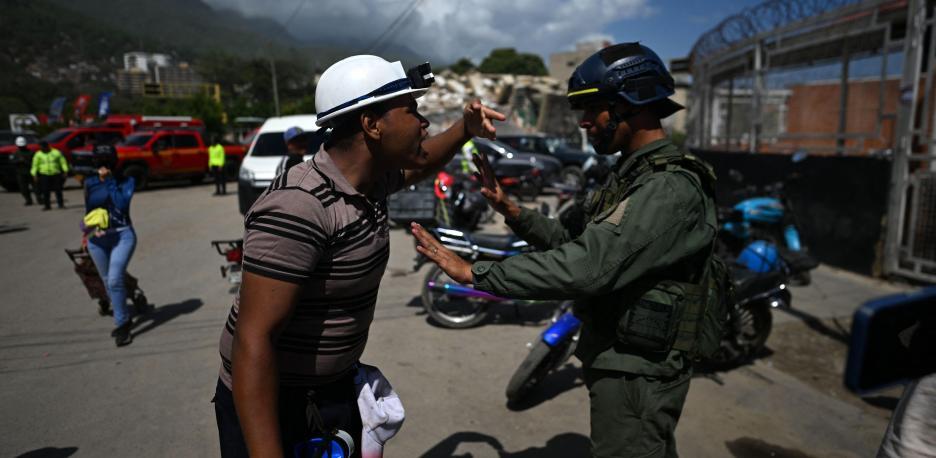
We have seen several scenes of relatives of victims of the earthquakes telling soldiers they are not helping, or even forcing them and police officers to return or destroy the goods and money they were caught looting in the ruins. Rather than the return of freedom of speech with Maduro’s capture, what we have witnessed in La Guaira is the crisp, absolute ire of someone who already lost everything, someone who is living the ultimate experience of struggling to find the body of a loved one to bury them in a cemetery instead of smelling them decompose under the rubble of a building.  

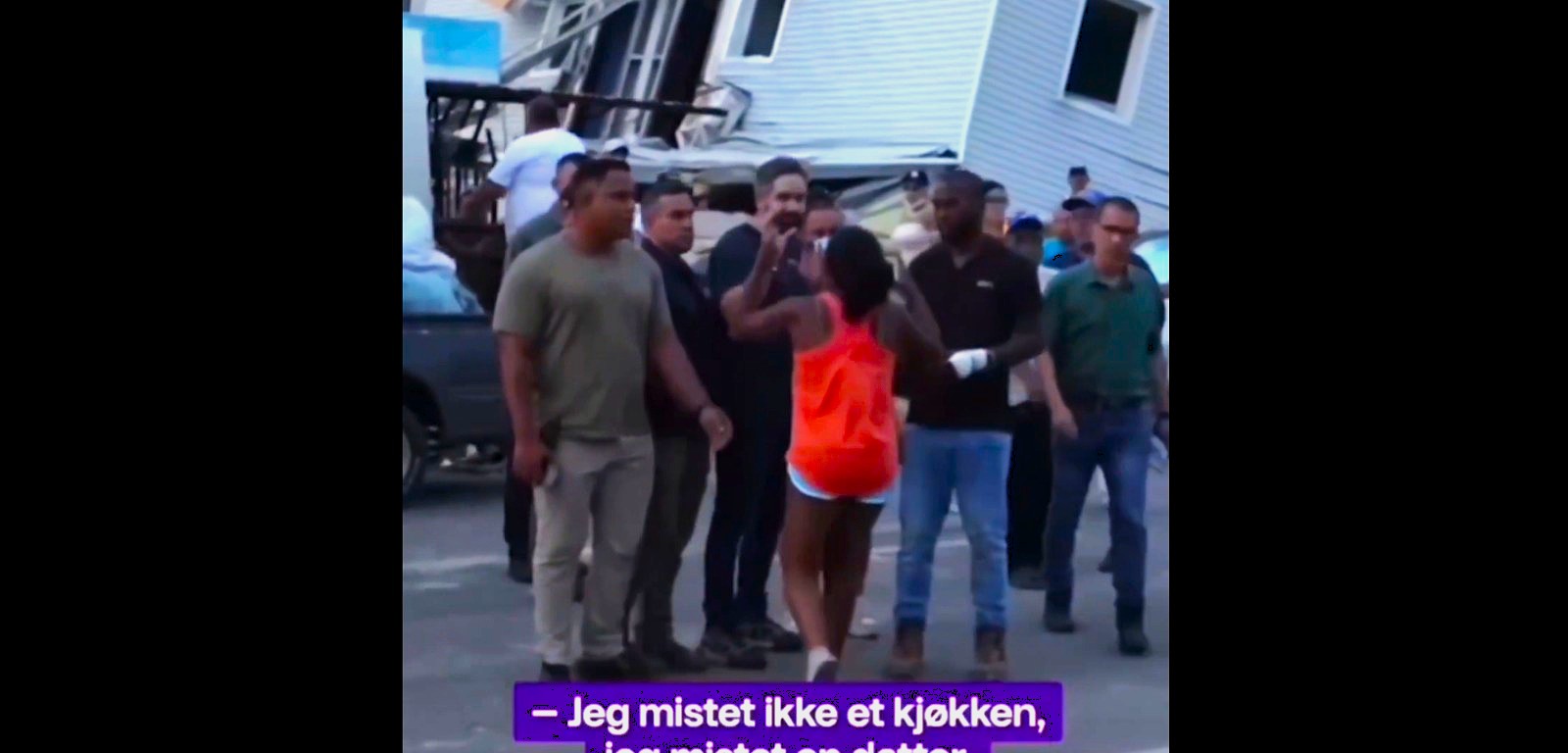
But we hadn’t seen something like this: a woman who lost a daughter and a home walking through a security detail and screaming in the face of Nicolás Maduro Guerra, a local lawmaker and son of the imprisoned dictator.

This scene is a powerful proof of the reality exposed by this tragedy: collective anger against a useless regime that lost its leadership even among the people who once supported it, and that failed to prevent the truth from reaching the world.

This happened when Sonja Skeistrand Sunde, Simen Askjer and Synnøve Gjerstad, journalists from TV 2, the second-largest TV station in Norway, were interviewing former residents of a State-built neighborhood destroyed on June 24. 

First, Moraima Antón showed them what was left of her home in the 200-house complex: 

“These buildings are very poorly constructed. They should never have been built,” Antón rages. It is still not known how many lives were lost right here. “The smell from the ruins bears witness to the fact that deceased victims still lie under the debris.”

Then, Damely Díaz talked to them to tell them her story: 

“Damely Díaz was among those who survived. She was standing just outside her house when the ground began to shake. Her six-year-old daughter, Daymaris, was inside. Within seconds, the building collapsed on top of her. ‘My daughter was buried for four days. She could have been saved during that time. She was a little child who didn’t ask to be born, and who didn’t ask to die either,’ Díaz says. The mother is convinced that poor foundations and weak construction caused her daughter’s death. She cries incessantly and demands that those responsible be held accountable. While she is speaking with TV 2, a motorcade slowly rolls into the neighborhood. It turns out that Nicolas Maduro Guerra is sitting in one of the cars… ‘You need to go to prison! Go to prison, all of you!’ Díaz shouts at the motorcade. ‘That bastard Nicolas,’ another shouts. When Maduro Guerra gets out of the car, Díaz storms toward the entourage. ‘I didn’t just lose a kitchen, I lost a daughter! You are responsible for all of this and you must pay for it!’ she screams until her voice cracks. ‘They built garbage! Garbage!’ she yells”.

Maduro Guerra did his best to calm the woman and look reasonable before the Norwegian crew, but his escort attempted to hide the whole thing:

“Maduro Guerra’s security guards try to prevent TV 2 from filming the incident, but the people in the neighborhood form a ring around the TV crew and demand that the documentation continue. ‘Film it! Film it!’ a man urges.”

This scene is a powerful proof of the reality exposed by this tragedy: collective anger against a useless regime that lost its leadership even among the people who once supported it, and that failed to prevent the truth from reaching the world.

This case also confirms how the Rodríguez regime lost the battle to control the narrative. After they recorded the scene, two officers from the Maduro Guerra detail asked the Norwegian journalists for their names, and later they contacted them to “have a meeting”. The crew refused to go, left Venezuela, and once they were back home, they ran the story today, on July 9:

“TV 2 declines the meeting with the authorities. It is difficult to know what the risks are. Equipment or recordings could be confiscated, or in the worst-case scenario, they could face arrest.” 

The chavista regime was slow and lousy to corral so many foreign correspondents they had to let in, and Delcy Rodríguez only looked worse in her press conference. TV 2’s story in particular shatters the image of efficiency and moderation that Maduro’s successor is trying to sell to the country and the world. 

This feature from TV 2 also quotes political scientist Benedicte Bull, a Latin America researcher at the University of Oslo’s Center for Global Sustainability: “There is an enormous anger among the people against the authorities because they were slow to respond. I am getting reports of this anger through all channels now. The disaster has exposed all the deficiencies that have actually been there for a long time, but have now become visible to everyone…The discourse we are now hearing from President Delcy Rodríguez…suggests that the authorities are ready to implement harsher repression again, and this is what people are afraid of,” Bull says…While the situation felt unsafe for the journalists, it is Díaz who lives with the greatest risk by openly defying the regime. ‘These people must leave Venezuela. They can kill me, I don’t care. I’m not afraid to die anymore, Díaz says.

Source link

An Earthquake-Prone Country Without a Seismic Monitoring System

Over two weeks have passed after the June 24 Venezuelan earthquakes. The main concerns at the moment are coping with the human and material costs of the disaster, while laying down the work ahead for what looks to be a slow path to recovery. Meanwhile, a recent news report that is curiously connected to the seismic event itself caught attention. 

A video recorded by renowned Venezuelan geologist Franck Audemard, along with staff from Funvisis (the Venezuelan Foundation for Seismological Research), denounced that a high-precision GPS monitoring device, used to track movements along the Boconó Fault, was missing from its location at “La Chicharronera”, by the Morón-Barquisimeto highway (part of the Cimarrón-Andresote Highway), inside a piece of land owned by the former Major League Baseball player Melvin Mora.

“In the year 2013, we installed equipment in the rock that we have behind us”, says Audemard in the video. “This equipment is a global positioning device, which was sown in a giant rock to follow the movement of the Boconó Fault, which was responsible for the first of the two earthquakes of June 24th, 2026… The equipment that was registering on that rock has disappeared, it’s no longer in the location where it was.” 

“Therefore, we are making this public call to the person who put it into safety to be kind enough to return at least the sensor from such equipment… The data being registered there is vital to what’s currently happening in the central, center-west part of the country.”

Funvisis issued its first report about the quakes several hours after its Colombian and US counterparts did.

Audemard publicly asked whoever has this equipment or sensor to deliver it to any public office or entity nearby. He and the Funvisis staff were visiting the area of one of the two quakes’ epicenters in Veroes municipality, Yaracuy state. In the small town of Palmarejo, a 300-meter crack opened up. There was serious material damage but no loss of life. Unfortunately, there were at least 15 people dead at the neighboring Juan José Mora municipality (Morón) in Carabobo state. 

Audemard didn’t explain, though, the mystery of when Funvisis realized that one of its most important monitoring stations ceased to transmit data, assuming it’s true that it stopped because someone stole the equipment. It’s like they are using this story to justify the lack of response from the Venezuelan seismological agency Funvisis, which issued its first report about the June 24th quakes several hours after its Colombian (SGC) and North-American (USGS) counterparts did. 

In recent days, Audemard spoke to several media outlets about what caused the earthquakes. Worth recommending is this long interview with Colombian private TV channel Caracol, in which he explains how the Boconó Fault accumulated enough energy to provoke a 7-7.5 earthquake based on a study he helped with in 2017. He has written articles on the Boconó Fault as well.

At first glance, this news report could be considered as not that relevant in the large scale of things with all what’s happening around us. But it cannot be dismissed either, as it reflects some of the criticisms regarding the management of seismic monitoring in Venezuela by Funvisis, the entity in charge since 1972, and its state of declining operability at the time of the recent quakes.

1% of former capacity

An article published on the Spanish website of Deutsche Welle (DW) on June 26 offers a picture of how the country found itself at such a moment by interviewing two local experts on the matter. One of them was Raúl Estévez, the founder of the Geophysics Laboratory at the University of Los Andes (ULA) and the Seismological Network of the Venezuelan Andes.

Estevez told DW that “the occurrence of these earthquakes wasn’t totally unexpected”, adding that specialists noticed for some time “a seismic breach” in Western Venezuela. “We expected the next big quake to happen there and with a magnitude of seven or more… We knew that.”

“We used to have between 250 and 300 seismological stations all across the country. In Mérida alone, we had around 25. Funvisis only has 3 to 5 functioning stations.”

As for Funvisis and the situation of the national seismic monitoring system, Estévez said that “politics went above everything else and neglected all the institutions that did seismology”.

A week after the DW piece was published, Estévez and three of his ULA colleagues held a forum in Mérida state titled “The Earth Shakes: analysis and challenges after the June 24th earthquake.”

Estevez said that the operativity of Funvisis is minimal: “We used to have between 250 and 300 seismological stations all across the country. In Mérida alone, we had around 25. Funvisis only has 3 to 5 functioning stations. The infrastructure is gone because we didn’t get resources.”

Chavista official Francisco Garcés became one of the most visible public faces of the official disaster response.

He also pointed to the lack of enough specialized personnel during the forum event in Merida and in his interview with DW. “The next generation of seismologists had to leave the country, not because they wanted to but because simply there were not enough resources to survive”.

Related to this, Estévez told DW that because of our lack of capacity we are more dependent on foreign institutions like the United States Geological Service (USGS). “…as a good part of the monitoring is from stations outside of Venezuela, any seismic activity information can only be inferred.”

“Mistakes are paid dearly”

Another callback is that many Venezuelans were able to know about the quakes right before they happened through their phones thanks to Google’s Android Earthquake Alert System.

Going back to DW’s article, the other local expert consulted didn’t directly address any issues regarding Funvisis. Which is somewhat curious as that person was its former head Francisco Garcés, who held the position between 2009 and 2010. 

Instead, he mostly focused on how singular the June 24th quakes were: “It isn’t normal to suffer two consecutive earthquakes of this magnitude. This is extraordinary in any part of the world”. Yet, he acknowledged the lessons to be learned from this disaster: “Mistakes are paid dearly.”

The June 24 doublet  was not an ordinary seismic event, but there must be serious reflection on the State’s failures when it comes to monitoring and reporting.

Garcés has become one of the most visible public faces of the official response to the disaster by giving multiple media interviews explaining in detail the causes and impact of the earthquakes.

Now, he was given a double new role by Delcy Rodríguez: first up, as the Chairman of the new Presidential Commission for the Evaluation of Housing Habitability and General Infrastructure, which will be in charge of reviewing houses and other kinds of structures like roads and bridges. The other role is of Transportation Minister, a position he already occupied between 2010 and 2011.

Garcés has already met with the national civil engineering guild (Colegio de Ingenieros de Venezuela) to unify the technical criteria to be used for the ongoing round of inspections. He has also explained the traffic light-style methodology to identify the state of any given infrastructure. 

It’s true that what happened on June 24th was not an ordinary seismic event. But as the nation begins to pull itself back on its feet, there has to be serious reflection on the failures in properly monitoring and reporting these kinds of natural disasters. I agree with what Mr. Audemard just told State TV channel VTV about having a “seismic culture”, but that has to come along with proper preparation by the authorities who should be in charge of helping us when it’s needed.

Source link

Chávez’s Civic-Military Union: Another Collapsing Legacy

Photo: Juan Barreto / AFP

In 1999, Hugo Chávez coined the ‘civic-military union’ as a founding concept for the Bolivarian Revolution. At its core, he sought to blur the line between soldier and militant: the armed forces would no longer be subordinate to the civilian authorities, but become active political actors, essential not only to build and sustain the Bolivarian project, but to merge with the rest of society in conducting the nation. The old fuerzas armadas, FFAA, formed by the Army, the Navy, the Air Force, and the National Guard, were transformed into a single Fuerza Armada Nacional Bolivariana, FANB. Soldiers were granted the right to vote. Officers flooded the bureaucracy and started to give orders to civilians. They were, in practice, sworn to a movement rather than a constitution.   

In its later years, chavismo stretched the phrase to unión cívico-militar-popular, supposedly integrating the whole of el pueblo into the martial body of the revolution. In 2008, Chávez created the Bolivarian Militia to provide military training to millions of civilians, and turned it into a branch of the armed forces in 2020, when it started to operate more as a propaganda and clientelism resource rather than a defensive corps. 

How, then, were Venezuela’s armed forces made “useful”?

A government and an armed forces that claim to be in union with its people were caught outside of the massive, spontaneous popular mobilization Venezuelans pulled off…

In the Maduro years, soldiers guarded the ration lines of CLAP boxes and the gasoline pumps of the country with the largest oil reserves in the world. Others were stationed in the southeast of the country to run the Orinoco Mining Arc, formally assigned to FANB, in tandem with non-state armed groups—some pocketing up to $800,000 a month in gold as bribes. The luckier or best-positioned of the bunch got handed high-ranking positions in public companies and ministries. The “popular” leg, then, was never el pueblo but its keepers, united to protect the Bolivarian Revolution and themselves over their fellow countrymen.

In the morning of June 24th, the Financial Times revealed that Caracas would acknowledge a debt of roughly 240 billion dollars and prepare for the largest restructuring on record. Hours later, two M7.2 and M7.5 earthquakes changed the landscape of the country. As the news broke, Venezuelan civilians quickly organized to save relatives, friends, and strangers. For the first forty-eight hours, a somewhat coordinated response from FANB was nowhere to be seen, even after Delcy Rodríguez said a joint staff led by a National Guard general was managing the emergency response. It was as if Venezuela didn’t have soldiers.

What the State guarded most jealously was not the living, but keeping the credit. A government and an armed forces that claim to be in union with its people were caught outside of the massive, spontaneous popular mobilization Venezuelans pulled off after the earthquake. When civilians pulled strangers from the rubble with their bare hands without waiting for an order, they proved that el pueblo is perfectly capable of being a body on its own, and most notably, that the State is not the vital organ that Chávez envisioned, but a dead weight.

So the aid had to be captured, rerouted, or rebranded. On June 27, Delcy Rodríguez ordered the militarization of roads and access points to devastated areas like La Guaira, slowing down the flow of ordinary citizens delivering supplies for survivors and machinery for those trying to find more of them. Just a day after the quake, opposition party Vente Venezuela reported that police had stopped a truck of supplies in Altamira and would let it move only if the cargo were transferred into the officials’ own vehicles, and the UCV student movement denounced that seven trucks of supplies en route from Bolívar to Caracas were seized by state agents before they could arrive.

“When you are [repressing] on the Francisco Fajardo highway, you are badasses. Show me you’re a badass here, then. Show me with a pickaxe and shovel.”

Organizers from a donation center at Escuela Francisco Pimentel were informed that CONAS, a joint unit of police commandos and National Guards, would be taking over the site and its supplies. Would they have done the same if a PSUV banner hung next to the supplies? A video shows the truck carrying the donations away belongs to SENIAT, the tax authority commanded by Diosdado Cabello’s brother for 18 years until yesterday. Even digital efforts were policed: a network matching volunteer interpreters to foreign rescue teams shut down and wiped its database after participants were allegedly harassed by DGCIM and SEBIN officers.

When the authorities did appear where they could help, soldiers and policemen scrolled on their phones, posed in front of the rubble and left before their uniforms got dirty. They were the last responders. Why so late, then so heavy? Incompetence covers part of it, but watch what the greens reached for in the most critical moments of this crisis and the reason why the ‘union’ has propped up chavismo for decades becomes clearer. 

DGCIM agents diverted an active rescue to recover an official’s rifles from a penthouse while people were still alive below. Neighbors stopped four CICPC policemen in Catia La Mar from trying to take cash found in the rubble, tearing the bills apart so they couldn’t. Chilean rescuer Francisco Lermanda says a soldier seized a colleague’s phone over suspicions of espionage after the crew videocalled their doctors to guide a rescue. At the Residencia Gradisca in La Guaira, where Mexican Topos had marked three points with signs of life, a Corpoelec crew sealed the site on a general’s order because a body, “por orden de arriba”, had to be recovered first. Our ‘protectors’ were filmed carrying off televisions and refrigerators, drinking the liquor they had found, lying on piles of donated clothes while giggling away.

When push came to shove, the union was not incompetent to protect the regime’s weapons, the regime’s secrets, the regime’s chain of command. The FANB did not forget how to save people during the earthquake. It never learned because saving people was not supposed to be part of the job. Faced with people to rescue instead of people to subdue, they stood guard over the dying. A man looking for his family among the collapsed buildings of Tanaguarena dared soldiers to be as brave as when they face dissidence: “When you are [repressing] on the Francisco Fajardo highway, you are badasses. Show me you’re a badass here, then. Show me with a pickaxe and shovel.”


Source link

The Earthquake Chavismo Wasn’t Built For

For nearly six months, Delcy Rodríguez’s interim government has tried to project a different image: less ideological, more administrative; less revolutionary, more technocratic. The earthquakes became the first real test of whether that transformation ran deeper than economic policy. It didn’t. Faced with the country’s worst humanitarian disaster in decades, the Venezuelan state reverted almost instinctively to the habits it had spent 25 years learning.

The earthquake handed Delcy Rodríguez something politics rarely does: a chance, however limited, to soften public perceptions of her government. Nobody expected it to prevent the earthquake or even manage it flawlessly. The bar was much lower than that. Venezuelans expected a government that communicated at least somewhat honestly, remained visible, welcomed help wherever it came from, and, above all, stayed out of the way of those trying to help. Instead, many of its decisions seemed almost designed to produce the opposite effect, leaving an already angry public even angrier.

For the crucial first hours after the earthquake, Venezuelan civil society largely filled the vacuum left by the state. By the time the government moved to reclaim the space it had forfeited, the nature of its response had become clear. The emphasis was no longer on expanding the rescue effort, but on reasserting control over it. The government’s administrative response had been slow. Its political reflexes were anything but that.

Why?

The obvious explanation is incompetence. Of which there was certainly plenty. But incompetence alone cannot explain why a government whose political identity has been built on the appearance of public support repeatedly embraced decisions that seemed to generate even greater public anger. Something deeper appears to have been at work.

Responding to earthquakes requires a very particular kind of approach. Unlike ordinary governance, disaster response cannot be centralized for long. Every collapsed building becomes its own command center. Every neighborhood develops different priorities. Every rescue team faces different engineering challenges. Governments do not succeed because they directly coordinate thousands of decisions. They succeed because they remove obstacles that allow thousands of other people to make good decisions simultaneously.

As civil society increasingly assumed functions the state could not perform, it also threatened to accumulate visibility, legitimacy, and influence outside government control.

During normal times, governments can afford to centralize decisions and insist that major initiatives pass through official channels. Earthquakes punish those instincts. Rescue operations cannot wait for permission, and civil society and the private sector suddenly become indispensable partners in the state’s response. The democratic governments (like the one overseeing Venezuela’s “transition”) that perform best recognize this early, spending the first critical hours empowering society rather than attempting to direct every aspect of the response themselves. For twenty-five years, chavismo taught its institutions almost the opposite lessons.

The government could not lead the humanitarian response with the effectiveness the moment demanded. Society therefore began leading significant parts of it instead. Volunteers organized rescue brigades. Churches became shelters. Journalists became emergency information networks. Engineers inspected damaged buildings. Diaspora organizations coordinated donations. Foreign rescue teams rapidly became the public face of many rescue operations. None of this was unusual. This is how major disasters are managed around the world.

What was unusual was the kind of state confronting the disaster.

Every major political crisis reinforced the same institutional lesson: autonomous organization reduced the state’s control over society. Independent organization was rarely viewed as something to harness, but was something to supervise. NGOs are suspected of serving foreign interests, until proven innocent. Independent journalists and universities are seen as political adversaries. Neighborhood networks are just three doritos away from becoming opposition structures. Enemies abound in the schizophrenic chavista view of societal organization. Because for a chavista state that has banked its continuous survival on complete, centralized control, such a degree of civil organization represents an extinction level threat.

Those lessons make sense for a political system primarily concerned with its own survival. They become profoundly maladaptive during natural disasters. Thus, the humanitarian response itself gradually became part of the government’s problem. As civil society increasingly assumed functions the state could not perform, it also threatened to accumulate visibility, legitimacy, and influence outside government control. Administratively, this strengthened Venezuela’s response. Politically, it displaced the government from the center of its own national emergency. Most democratic governments would welcome that trade-off. 

What authoritarian systems find difficult to tolerate is not civilian participation itself, but civilian participation they neither direct nor control. The rescue volunteers were not political activists. The churches distributing food were not organizing protests. The programmers building databases of missing persons were not preparing electoral campaigns. Yet institutions do not respond only to intentions; they respond to patterns. For a security apparatus that had spent years dismantling decentralized civic networks, from the humanitarian aid operation of 2019 to the comanditos of 2024, the potential may have mattered more than the differences.

Search-and-rescue operations have become increasingly militarized, with rescue crews at the Tahití building reportedly prevented by the military from reaching survivors for hours.

Seen through that lens, what initially looked like a series of political blunders begins to look more like institutional habit. Faced with a humanitarian emergency it lacked the capacity to fully manage, the government fell back on the institutions it trusted most: those responsible for regulating information, supervising autonomous actors, and maintaining political control. Much of the administrative state had long ceased to be valued primarily for its capacity to govern, functioning instead as an instrument of patronage and political management, while the coercive apparatus remained the regime’s principal institutional investment.

Faced with the limitations of both its own incompetence and the state it had spent decades constructing, havismo has increasingly resorted to the tactics with which it is most familiar. Survivors who expressed their anger at the government’s lackluster response, such as Wilmer Cruz, have reportedly been arrested. Search-and-rescue operations have become increasingly militarized, with rescue crews at the Tahití building (Caraballeda, La Guaira) reportedly prevented by the military from reaching survivors for hours. Intelligence agencies such as the DGCIM have been deployed to intimidate the families of victims, while, as the Sky News Trump 100 podcast reported, authorities have obstructed reporting from Caracas.

For months, the debate surrounding Venezuela’s transition has centered on whether chavismo was truly changing or merely adapting. The earthquake suggests the answer is both. Markets can be liberalized. Diplomatic priorities can shift. Revolutionary rhetoric can soften. Institutional instincts are far more resistant to change because they are built over decades of incentives, routines, promotions, and crises.

The earthquake did not create those instincts. It merely forced the government into a situation where it could no longer avoid relying on them.

Every state becomes good at what it repeatedly practices. The chavista regime spent twenty-five years investing in political control rather than disaster response; in supervising society rather than empowering it; in preserving power rather than preparing for catastrophe. When the country’s greatest humanitarian emergency in decades arrived, society responded with the institutions it had built to save lives. The state responded with the institutions it had built to preserve power. The earthquake did not force the Venezuelan state to choose between control and effective governance. That choice had been made long before the ground began to shake.

Source link

One Hundred Hours of Hope and Government Absence

Story and pictures by Erick Franco

A short drive along the Playa Grande coastal boulevard provides a glimpse of the scale of the disaster, 100 hours after the June 24 earthquakes. Businesses burned due to gas leaks, while the limited police presence began to give way to theft and looting throughout La Guaira’s commercial district. Along the 8.8-kilometer stretch between the Playa Grande Caribe Hotel and Calle Real de Mare, vacation and residential buildings from the mountainside collapsed onto the roadway, blocking much of the route and making access to Playa Verde extremely difficult. Once there, the damage to the smaller beachfront buildings becomes immediately apparent. As night falls, makeshift shelters appear along the coastline, high-voltage power lines lie across the roads, and damaged buildings continue to shed debris.

By 8:00 am of June 26, after the first 36 hours following the tragedy, the upper areas of Playa Grande and Playa Verde reveal an even more devastating reality. Daylight exposes nearly three kilometers of destruction, from Playa Grande’s Main Avenue to South CV Avenue, now reduced to ruins. Near the César Nieves Stadium, one resident helps distribute water throughout the community while telling us that he lost his three daughters, ages 7, 11, and 14. Despite his unimaginable loss, he says he must keep going because his mother is still alive.

Local residents report that about 40 people were inside the Chipi’s Beach Hotel when the building collapsed, but only two managed to escape alive. Using only their own resources, community members worked to rescue 10 people whose cries could still be heard beneath the rubble. Finally, after more than 30 hours without assistance, firefighters arrived following an appeal made by volunteer students from the Central University of Venezuela.

Next to Chipi’s Beach is the home of Mary, who has spent the past two days beside the body of her mother. As they attempted to flee during the earthquake, her mother became trapped in the narrow passage between the hotel’s exterior wall and the wall of their home. Mary explained that a forensic team determined her mother died instantly and without suffering after a structural column fell across her torso. University volunteers spent two hours attempting to recover her body, but were unsuccessful.

The same scene repeats itself on Fifth Street in Playa Grande, where residents and volunteers at the Residencias Malecón buildings recover three bodies from the rubble. At the same time, paramedics and rescue teams from El Salvador gradually arrive to assist in rescuing a children’s dance group trapped inside the Aguja Azul building.

Venezuelan military personnel, volunteer rescue teams from El Salvador, Venezuelan firefighters, and police officers began to experience the physical toll caused by the odors, dust, and debris in the La Páez area of Catia La Mar. Cases of diarrhea, nasal allergies, and back pain were treated by volunteer medical personnel. Family members gathered at Block 3 of La Páez, where 13 people had been rescued alive, while search teams used probe technology in an effort to locate additional survivors.

These first 100 hours after the earthquake revealed the complete collapse of an entire sector and the social abandonment of the affected communities by government institutions. Residents remained outside hospitals hoping to receive medication, surviving through donations, supplies, and the generosity of others while conducting physically demanding rescue efforts with little training and driven only by the hope of finding their loved ones.

One week after the tragedy, access to water remains limited, the smell of decomposition permeates the entire Catia La Mar area, the businesses that could provide food and essential supplies remain closed, telephone coverage is still incomplete, and power service is being restored only gradually.

Source link

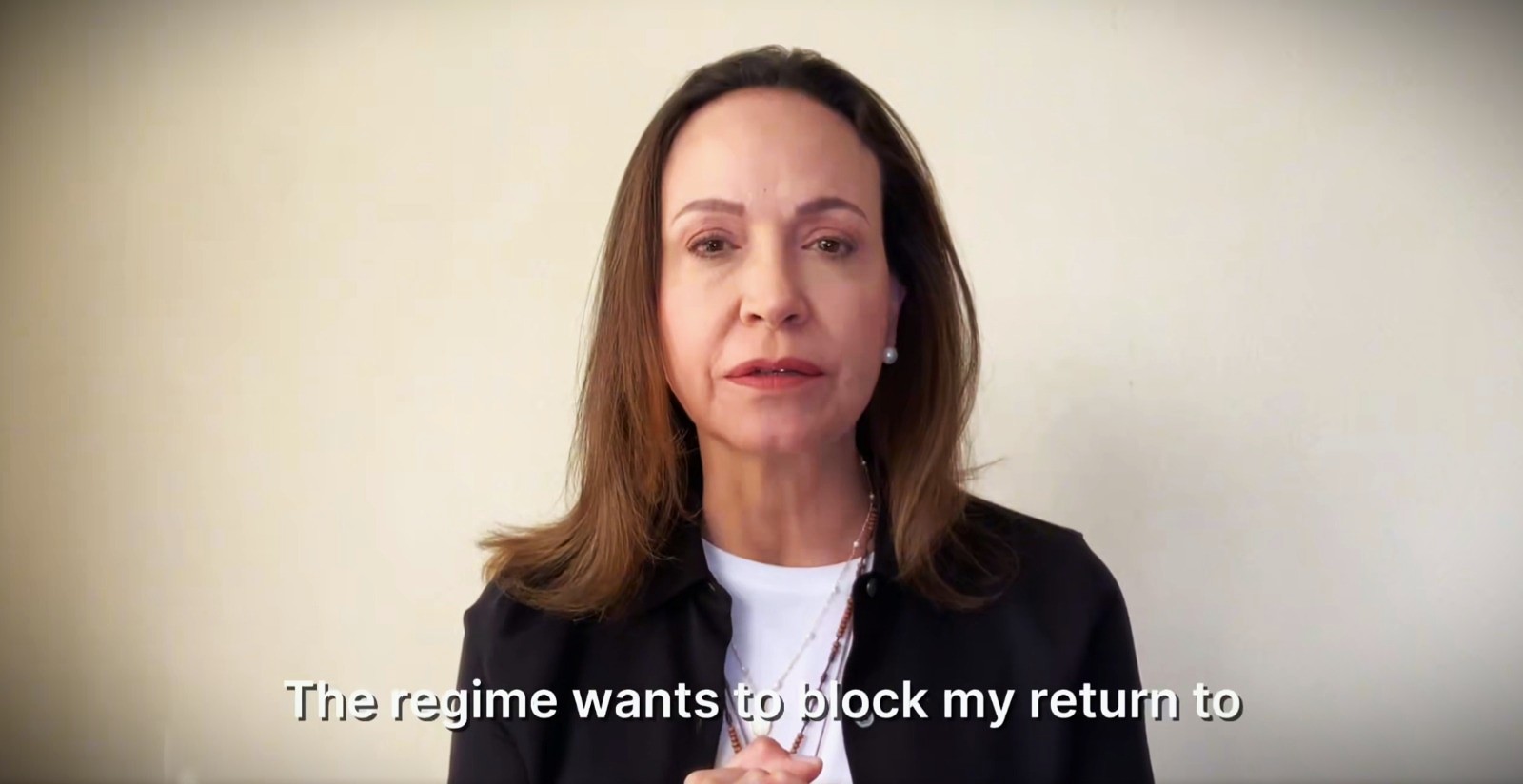
Why Venezuela Needs María Corina to Go Home

Maria Corina’s return to Venezuela is looking imminent. Her willingness is hurried by her desire to stand next to Venezuelans after the devastating earthquakes, and by the risks of remaining in exile while the emergency unfolds. Her return trip now looks like a matter of when, not if.

Last weekend, Bloomberg’s Eric Martin reported that US officials made it clear to both Dutch and chavista authorities that Washington wouldn’t support her return, when she was planning to fly to Venezuela from Curacao. Machado countered in a video distributed Tuesday, claiming she intends to do “whatever is necessary” and speak to “whoever is needed” to serve the Venezuelan people. 

Meanwhile, officials in Washington are backing the regime and trying to distance themselves from her intentions. In a recent interview, the chargé d’affaires in Caracas praised the commitment of Delcy’s regime to work and collaborate with the US. A State Department spokesperson said on the record that chavismo remains “the ultimate authority over their territory,” further empowering the Venezuelan State to react negatively if the opposition leader shows up. 

An unprecedented catastrophe once again exposed the incompetence of the Venezuelan government. Yet the Trump administration continues to tilt the scales in Delcy’s favor. This time, by offering no guarantees and taking no official position on Machado’s return, contradicting the assurances given by Marco Rubio and Ambassador Michael Kozak during congressional hearings earlier this year. 

A complex set of stakeholders is determining the terms of this event. Machado’s return will have a direct impact on the challenges she is set to face in the first days and weeks after arriving. Blocking it entirely will only intensify the social tensions already simmering within the country. However, an arrival without a clear operational contribution risks undermining her leadership.

While exile has helped Machado advance the democratic cause across the world and coordinate closely with allies, the benefits of staying outside the country no longer outweigh the costs.

The Venezuelan people await a leader that steps up to fill the institutional and operational vacuum left by a regime that has abandoned the population. The last seven days have been characterized by the lack of adequate relief to rescue survivors and assist refugees on ground zero. The Venezuelan State has been exposed in what should be its core mission. Time is running against everyone involved. 

While exile has, to an extent, helped Machado advance the democratic cause across the world and coordinate closely with allies, the benefits of staying outside the country no longer outweigh the costs.  For many, the clock is ticking under the rubble and their grievances can no longer be addressed with digital messaging.

Since Nicolás Maduro and Cilia Flores were captured, every passing day has raised more doubts regarding Machado’s autonomy and political agency. The saga surrounding her return is casting doubts on Washington’s ultimate support for the Nobel laureate, putting a large question mark over long-term plans to have her truly involved in a purported transition. For the opposition leader, recognizing Trump as an ally in the pursuit of a democratic Venezuela is understandable. Allowing him to dictate your decisions in one of the most crucial moments in Venezuela’s history is a very different thing.

Trump’s intentions over post-Maduro Venezuela have definitely eroded. Elite expectations of a swift economic recovery that pervaded post-January 3 conversations changed dramatically. But as the little credibility the Rodríguez siblings had evaporated in a matter of days, the Trump government continues to hold María Corina down. This happens as we know the US retains more than enough influence to allow the Nobel laureate to return to her country during a national tragedy, with or without a valid passport.

For María Corina to regain Washington’s support, she has to succeed in becoming a figure that inspires stability. 

Since 2025, María Corina has tried to communicate that she can persuade the Trump administration over Venezuela. For instance, when it came to the need to pressure Maduro to step down, to finally resort to military means to remove him, to press for the release of political prisoners, and so it goes. Trump himself has repeatedly shown he doesn’t need Machado to have his goals met in Caracas. This emergency could now emerge as a train crash between Trump’s interests and those of the democratic opposition. Unlike Delcy, whose main goal is to retain power and survive chavismo’s demise, María Corina cannot afford to have minimal leverage over Washington. At least not anymore. The earthquakes’ aftermath, then, is also an opportunity for her to forcefully drive a realignment of US tutelage over reconstruction and democratization efforts. Or to finally expose Trump over conflicting interests.

Civil defiance against regime forces is increasing on the ground, a sign that social unrest is emerging among a population without someone to look up to for help. Blocking María Corina’s entry might feed tensions created by the vacuum produced by the State. If people continue to be left to their own devices, this could spark a new, critical chapter of social conflict in the country’s history.

Relief efforts have already provided a positive platform for local leaders who have delivered. A good example is Chacao mayor Gustavo Duque, who has been able to establish and communicate the most effective operational coordination from a local government official. María Corina would need to replicate this at a larger scale while raising the standards, relying on non-government tools and human capital at her disposal. 

The regime’s complete lack of response and its attempts to block relief efforts need to be challenged. Machado’s ability to organize efforts through civil society and allied NGOs, coordinate with international rescuers and foreign governments, muster operational capacity through Vente Venezuela’s comanditos and local political structures, and deliver sensible (and sensitive) communications could be crucial to contrast with the regime’s negligence. Her responsibility would not be to engage in political campaigning with other opposition leaders, but to establish a backbone for operational organisation, even a chain of command that makes the efforts of Venezuelan civilians more effective. When it comes to logistics involving civilian volunteers, the famous electoral strategy of 2024 showed what Machado’s leadership can achieve. The stakes are even higher this time.

Chavismo’s negligence is fueling instability that could jeopardize the economic and political gains the US hopes to secure in Venezuela.

Machado must demonstrate that she can contain the threats to Trump’s post-Maduro narrative that inevitably emerge from the country’s current state of political and institutional orphanhood

The likes of Delcy and Cabello will try to obstruct Machado’s networks and allies from providing assistance and support. Their goal would be to secure Machado’s failure in supporting the people. Nonetheless, the costs of repression are currently at the highest due to the state of widespread desperation. Attempting to block or even capture Machado could come at a high price, yet they will use every resource available to hinder her initiatives.

For María Corina to regain Washington’s support, she has to succeed in becoming a figure that inspires stability. 

Chavismo’s negligence is fueling instability that could jeopardize the economic and political gains the US hopes to secure in Venezuela. Machado must demonstrate that she can contain the threats to Trump’s post-Maduro narrative that inevitably emerge from the country’s current state of political and institutional orphanhood. If Washington cannot mitigate those risks soon, as it has sought to do in the wake of its February strike on Iran, a Venezuela policy in crisis could become yet another political liability for the Trump-dominated GOP ahead of the November elections. 

Between Trump’s continued support for the regime and Delcy’s incompetence in addressing the emergency, there is an opportunity for María Corina to make a consequential return. Throughout the history of anti-chavista politics, no leader has been able to withstand the political test that coming back from exile poses. If the ambitions of María Corina and her supporters become reality, she will inherit the long-term consequences of the tragedy. Her return offers a critical opportunity to take immediate responsibility, show the type of public-servant leadership she should offer, and channel the frustration of Venezuelans into collective actions.

Venezuelan civil society has risen to the occasion. The people have become the heroes lifting the country’s ruins. But Venezuelans remain in desperate need of a leader. Not to raise our hopes, which I believe we have found among each other. But for the guidance necessary to face the wreckage chavismo continues to leave behind.

Source link

How the Earthquakes Reshape Venezuela’s Economic Future

Originally published in Spanish on Asdrúbal’s personal Substack

There are weeks that change a government. And there are weeks that change a country. This is one of them.

Until just a few days ago, the economic debate regarding Venezuela revolved around how much we would grow this year. Around whether the figure would be 4% or 6%, and at what point that growth would materialize in people’s daily lives: exchange rate stabilization, the reestablishment of relations with multilateral organizations, and the possibility of slowly beginning a recovery process.

On the morning of June 24th, a Financial Times scoop centered the discussion on the actual size of our foreign debt. That was the horizon. Today, the horizon no longer looks like that. The earthquakes that struck this week not only leave a human tragedy of dimensions still difficult to quantify; they also profoundly alter the country’s economic outlook. International evidence shows that a major earthquake can generate losses equivalent to between 3% and 10% of GDP, depending not only on physical damage but on the State’s capacity to respond.

Anyone who thinks the problem is limited to the cost of rebuilding highways, hospitals, or housing is seeing only a part of the picture. Earthquakes destroy infrastructure, but they also destroy productivity, employment, tax revenues, logistical chains, and confidence. Thousands of businesses interrupt operations, families postpone consumption and investment decisions, and economic activity loses momentum for months or even years. The expectations and decisions of economic agents are disrupted by a widespread sense of loss and uncertainty.

The economic literature is quite consistent on this point. Studies by the World Bank, the IMF, and numerous academic papers conclude that the impact of a natural disaster depends far less on the intensity of the phenomenon itself than on the institutional strength of the affected nation. Economies with solid States tend to absorb the initial shock and recover relatively quickly. Conversely, in fragile States, a natural disaster often mutates into a prolonged economic crisis because institutional weakness amplifies the damage and delays reconstruction.

The economic agenda will no longer be dominated exclusively by growth, but by reconstruction. We need to prevent the disaster from destroying a large part of Venezuela’s remaining physical and human capital.

That is precisely Venezuela’s primary challenge. Over the years, the country lost fiscal, technical, and operational capacity. This is not a political assessment, but an observable fact. The State’s capacity to design public policy has been significantly reduced. The prolonged economic crisis and hyperinflation led us to a state of “save yourself if you can.”

The difficulties in maintaining basic infrastructure, public utilities, or the hospital network were already evident before the earthquake. Rebuilding cities like La Guaira demands far more than financial resources: it requires planning, engineering, contracting capacity, technical supervision, and a public administration capable of coordinating thousands of projects simultaneously. Today, the Venezuelan State lacks a good portion of those capabilities.

Our recent history shows how society has demonstrated resilience where the State has lost capacity. The private sector, non-governmental organizations, churches, universities, and multiple civil society initiatives have, through years of crisis, developed a remarkable ability to organize, mobilize resources, and respond swiftly to emergencies. We saw it during the pandemic, during the landslides in Las Tejerías, and in so many other humanitarian crises. And we are seeing it now. This accumulated experience will be one of the most critical assets in confronting this tragedy, though on its own, it remains insufficient to undertake a reconstruction of this magnitude.

It would be a mistake to turn international aid into a battleground for confrontation. Venezuela doesn’t need speeches on sovereignty, but engineers, heavy machinery, hospitals, drinking water, electricity, and the capacity to rebuild.

That is why I maintain that this earthquake completely changes the economic conversation. Just a few weeks ago, we were discussing how to accelerate growth, attract investment, or deepen reforms. We argued that institutional reform was necessary for Venezuela to achieve sustained and inclusive growth. Today, the priority has shifted to preventing the disaster from destroying a large part of the country’s remaining physical and human capital. The economic agenda will no longer be dominated exclusively by growth, but by reconstruction.

An inevitable conclusion emerges from this: Venezuela cannot face this challenge alone. This is not merely a matter of securing financing. It will be indispensable to mobilize technical assistance, specialized teams, field hospitals, temporary infrastructure, fast-access credit, and international coordination mechanisms. International cooperation will cease to be a mere complement and will become a necessary condition for recovery.

There’s some good news, however: for the first time in many years, the conditions exist for such cooperation to be possible. The reestablishment of relations with international financial institutions opens a window that until a few months ago seemed firmly shut. It would be a mistake to turn this aid into a new battleground for political confrontation. Countries do not need speeches on sovereignty after an earthquake. They need engineers, heavy machinery, hospitals, drinking water, electricity, and the capacity to rebuild.

The country needs to design a roadmap to achieve broad political agreements, leading to a democratically elected government able to drive the necessary reforms.

Economic history demonstrates that major disasters can become turning points. Some countries seized these tragedies to modernize their infrastructure, strengthen their institutions, and build more resilient economies. Others remained trapped for decades in a cycle of destruction and precariousness. The difference was never solely the magnitude of the earthquake, but the quality of the collective response.

Beyond the immediate emergency, this tragedy also leaves a political lesson that is impossible to ignore. The reconstruction of Venezuela demands more than financial resources or international assistance. It requires leadership with democratic legitimacy and the capacity to build consensus. The country needs to design a roadmap to achieve broad political agreements, leading to a democratically elected government and providing it with the necessary backing to drive the economic and institutional reforms that recovery demands. No reconstruction program will be sustainable unless it rests upon legitimate institutions, clear rules, and a political pact that offers stability, generates trust, and allows for the mobilization of support from the international community and private investment.

That is why I believe this earthquake has not only moved the earth. It shifted Venezuela’s economic horizon. The projections we made just a week ago likely no longer describe the country we will have at the close of this year. The Venezuelan economy has just entered a new phase, and the speed with which we manage to combine the efforts of the State, the proven capacity of the private sector and civil society, and the decisive support of the international community will determine not only the economic performance of 2026, but the real possibilities for recovery over the next decade.

Source link