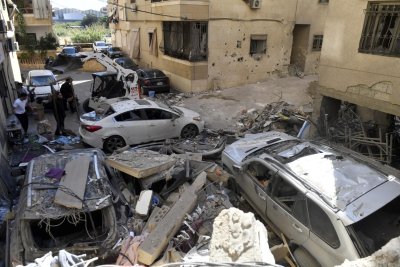

Damaged vehicles are seen following an Israeli airstrike that targeted an apartment in Choueifat, south of Beirut, Lebanon, on May 28. File Photo Wael Hamzeh/EPA
BEIRUT, Lebanon, June 16 (UPI) — Lebanon’s economy, shattered by the 2019 financial collapse, has suffered another major shock from the Israel-Hezbollah war, which has disrupted recent recovery efforts and hit the tourism sector — the country’s main revenue generator — particularly hard.
The war, which began in October 2023 when Hezbollah opened a support front for Gaza, escalated as Israel intensified its attacks and the Iran-backed regime resumed fighting in solidarity with Iran last March after 15 months of inactivity. It further deepened Lebanon’s economic crisis and left the country grappling with its repercussions.
Direct and indirect losses are initially estimated at $20-30 billion, reflecting extensive destruction and mass displacement caused by the conflict, along with severe disruptions to economic activity. Inflationary pressures have also intensified due to the closure of the Strait of Hormuz.
Nearly every sector of the economy has been affected.
The escalation in March dramatically expanded the scale of destruction, with more than 70 villages in southern Lebanon reduced to ruins by advancing Israeli troops. Entire neighborhoods were leveled, while businesses, public infrastructure, schools, hospitals, and roads suffered extensive damage.
Beirut’s southern suburbs and parts of the Bekaa Valley in eastern Lebanon were also heavily targeted by Israeli airstrikes, resulting in similar devastation.
Beyond the heavy casualty toll of 3,826 killed and 11,851 injured since March 2, the widespread physical destruction, and the displacement of 1.2 million people forced to flee their homes and villages under Israeli evacuation orders, the war has also resulted in significant indirect losses.
Unemployment rose as job losses mounted, while recession and inflation eroded household purchasing power, making people poorer.
The tourism sector was also badly hit, and the economy is expected to contract by between 7% and 10% in 2026 if the war continues, according to estimates by Finance Minister Yassine Jaber.
More critically, the recent escalation came as the reform-minded government of Prime Minister Nawaf Salam had begun putting the country on a path to recovery, and the economy was starting to pick up.
Despite the war — largely concentrated in southern Lebanon at that time — 2025 ended on a positive note, with the World Bank reporting modest GDP growth of 3.5 percent and a rebound in tourism.
A key highlight was a visit by Pope Leo XIV, which raised hopes and called for peace, alongside approximately 1.63 million visitors; an increase of 44.6% compared with the previous year.
“That showed that demand for Lebanon was returning… The escalation in March interrupted that momentum,” Tourism Minister Laura Khazen Lahoud told UPI.
Lahoud explained that the collapse became visible in cancellations, empty restaurants, very low hotel occupancy, and travel agencies shifting from selling trips to managing cancellations.
According to figures released by the relevant syndicates, travel and tourism activity declined by around 80%, while hotel occupancy in Beirut fell to roughly 7-10%, occasionally reaching 12%.
Tourism activity became concentrated in “a very small number of spots,” where hotels sought to attract displaced people seeking refuge in safer areas, according to Lahoud.
Charles Arbid, President of Lebanese Economic Social and Environmental Council, explained that the country was in “a state of stagflation,” with little economic activity or production, inflation reaching 20%, and businesses closing down or partially operating.
“This is a catastrophic economic situation, following a prolonged period of weak growth and the accumulation of structural economic problems,” Arbid said in an interview with UPI, referring to the drop in government revenues due to the inability to pay taxes and the complete halt of economic activity in southern Lebanon.
He was particularly concerned about the impact of the war on the population, as many were losing their jobs and depleting their remaining savings to cope with the spiraling inflation.
He said Lebanon is facing “a social and societal crisis,” exacerbated by the massive displacement, and would need a “Marshall Plan” for reconstruction, rehabilitation of its crumbling infrastructure, securing the return of the displaced to their villages, and supporting economic recovery.
In the meantime, many are struggling to keep their businesses afloat and secure an income.
Mohammad Farid, who has been displaced three times with his wife and son from their home in Beirut’s southern suburbs since 2024, has not given up despite suffering heavy losses: $250,000 after an Israeli strike destroyed a solar panel project he had co-partnered in the village of Ansar in southern Lebanon, and about $100,000 from two shops badly damaged in Israeli strikes in Beirut’s southern suburbs.
Farid and his wife, Malak, had started a new business, Oilganic, specializing in cold-pressed organic oils shortly before the 2023 war erupted, importing oil press machines from China and renting their first shop.
Their business began to flourish, expanding into online sales and building a strong reputation.
“That came to a halt when the war extended to our area, forcing us to leave and then return after a truce was reached, rent a new shop, and see it destroyed again months later,” Farid told UPI.
They were again displaced, taking refuge at their friends’ house in the mountains, where they resumed production on a smaller scale using small oil-press machines.
“We are doing our best so as not to lose our clients,” Farid said, determined to grow his business and relocate to his native border village of Naqoura in southern Lebanon after the war ends. “I want to go back to the south, rebuild our house, and continue my oil business there. This is our land, and we will never give it up.”
A glimmer of hope for ending the longest and most devastating war between Israel and Hezbollah emerged after the United States and Iran reached a memorandum of understanding, which was due to be signed in Geneva on Friday.
The agreement includes a full ceasefire in Lebanon, which has not yet been fully observed by either side.
A cessation of hostilities, or even a durable de-escalation, could bring much-needed relief, starting with salvaging part of the summer tourism season, largely relying on Lebanese expatriates and the diaspora.
Lahoud said the diaspora would help sustain the sector but noted that a very large segment of the diaspora, whether in West Africa or northern Europe, originates from southern Lebanon and would be less likely to visit this year.
She explained that the tourism sector has survived repeated shocks, but emphasized that “businesses cannot absorb losses indefinitely,” with hotels, restaurants, travel agencies, transport companies, event organizers, and seasonal workers remaining under real pressure.
As the region is being reshaped by major developments, Lebanon is looking to close the chapter of war and move into a period of peace, engaging in U.S.-mediated direct negotiations with Israel for the first time.
Arbid appeared confident that Lebanon “is heading into a better phase,” one that would require a new political understanding and security stability.
“That would pave the way for reconstruction and recovery… It will be a long journey, but we will make it in the end,” he said.