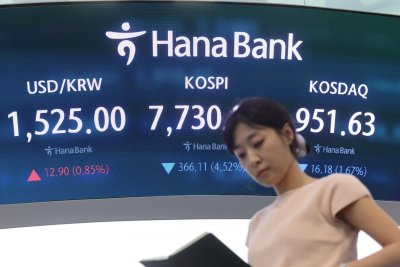

This photo, taken Wednesday, shows the trading room of Hana Bank in Seoul as South Korean stocks fell more than 4 percent amid escalating Middle East tensions and a tech sell-off. Photo by Yonhap
South Korean stocks plummeted more than 4 percent Wednesday amid escalating tensions between the United States and Iran and a tech slump fueled by concerns over the valuation of stocks related to artificial intelligence (AI). The local currency was trading lower against the U.S. dollar.
The benchmark Korea Composite Stock Price Index (KOSPI) shed 366.11 points, or 4.52 percent, to close at 7,730.82, almost eclipsing most of the over 8 percent surge from the previous day.
At one point, the index fell as low as 7,541.11.
Due to the sharp fall, the Korea Exchange had activated a sell-side sidecar for the index at 1:16 p.m., halting program trading for five minutes.
Trade volume was moderate at 457.5 million shares worth 39 trillion won (US$25.6 billion), with losers outnumbering winners 547 to 343.
Foreigners continued their sell-off for the 23rd consecutive session, dumping a net 2.77 trillion won, while retail investors and institutions purchased local shares worth 4.86 trillion won. Institutions sold 2.27 trillion won.
Market analysts said the KOSPI lost ground as tensions resurfaced in the Middle East after the U.S. struck Iran in response to the shooting down of an American Apache helicopter in the Strait of Hormuz and then Tehran hit back.
The risk-on appetite was also sapped by an overnight tech slide on Wall Street caused by concerns over the valuation of the AI stocks on news that Crusoe Energy Systems, a data center developer, suspended one of its projects upon the request of an unidentified big tech customer.
The tech-heavy Nasdaq composite closed 0.97 percent lower, and the S&P 500 dropped 0.26 percent, while the Dow Jones Industrial Average rose 0.17 percent.
Major tech shares led the market decline, with Broadcom losing 1.12 percent, Apple sliding 3.64 percent, Micron falling 1.4 percent and Nvidia down 0.2 percent.
Investors’ eyes are now on the upcoming release of the U.S. Consumer Price Index (CPI), which could give further clues on the U.S. Federal Reserve’s monetary policy amid bets on a hawkish pivot and the initial public offering of SpaceX later this week.
“The South Korean stock market was weighed down as risk aversion sentiment strengthened ahead of the U.S. CPI and Oracle’s earnings release, once triggering a sell-side sidecar,” Lee Kyoung-min, an analyst at Daishin Securities, said.
Lee said a hot inflation report could further contract the market sentiment, raising concerns over a possible U.S. rate hike.
In Seoul, market top-cap Samsung Electronics slid 6.06 percent to 302,500 won, while its chipmaking rival SK hynix plunged 7.54 percent to 2.05 million won.
AI investment firm SK Square shed 6.78 percent to 1.18 million won, and Samsung Electro-Mechanics shot down 8.38 percent to 1.8 million won.
Samsung Life Insurance dipped 6.36 percent to 368,000 won, and Samsung C&T plummeted 5.01 percent to 407,500 won.
Auto shares were also weak, with Hyundai Motor down 5.79 percent to 602,000 won, and its sister Kia losing 2.8 percent to 159,700 won. Hyundai Mobis dropped 4.2 percent to 570,000 won.
Internet portal operator Naver, which had recently rallied on news on its partnership with Nvidia, nosedived 11.67 percent to 227,000 won. Home appliances maker LG Electronics shot down 9.68 percent to 224,000 won.
Major shipbuilder HD Hyundai Heavy was among the few gainers, jumping 4.74 percent to 641,000 won.
Defense giant Hanwha Aerospace also climbed 1.48 percent to 1.03 million won.
The Korean won was quoted at 1,524.2 won against the U.S. dollar at 3:30 p.m., down 12.1 won from the previous session.
Bond prices, which move inversely to yields, closed mixed. The yield on three-year Treasurys added 2.5 basis points to 3.881 percent, and the return on the benchmark five-year government bonds dropped 3.2 basis points to 4.070 percent.
Copyright (c) Yonhap News Agency prohibits its content from being redistributed or reprinted without consent, and forbids the content from being learned and used by artificial intelligence systems.