won

Seoul shares again dip over 4 pct amid U.S.-Iran tensions, tech sell-off; won down

This photo, taken Wednesday, shows the trading room of Hana Bank in Seoul as South Korean stocks fell more than 4 percent amid escalating Middle East tensions and a tech sell-off. Photo by Yonhap

South Korean stocks plummeted more than 4 percent Wednesday amid escalating tensions between the United States and Iran and a tech slump fueled by concerns over the valuation of stocks related to artificial intelligence (AI). The local currency was trading lower against the U.S. dollar.

The benchmark Korea Composite Stock Price Index (KOSPI) shed 366.11 points, or 4.52 percent, to close at 7,730.82, almost eclipsing most of the over 8 percent surge from the previous day.

At one point, the index fell as low as 7,541.11.

Due to the sharp fall, the Korea Exchange had activated a sell-side sidecar for the index at 1:16 p.m., halting program trading for five minutes.

Trade volume was moderate at 457.5 million shares worth 39 trillion won (US$25.6 billion), with losers outnumbering winners 547 to 343.

Foreigners continued their sell-off for the 23rd consecutive session, dumping a net 2.77 trillion won, while retail investors and institutions purchased local shares worth 4.86 trillion won. Institutions sold 2.27 trillion won.

Market analysts said the KOSPI lost ground as tensions resurfaced in the Middle East after the U.S. struck Iran in response to the shooting down of an American Apache helicopter in the Strait of Hormuz and then Tehran hit back.

The risk-on appetite was also sapped by an overnight tech slide on Wall Street caused by concerns over the valuation of the AI stocks on news that Crusoe Energy Systems, a data center developer, suspended one of its projects upon the request of an unidentified big tech customer.

The tech-heavy Nasdaq composite closed 0.97 percent lower, and the S&P 500 dropped 0.26 percent, while the Dow Jones Industrial Average rose 0.17 percent.

Major tech shares led the market decline, with Broadcom losing 1.12 percent, Apple sliding 3.64 percent, Micron falling 1.4 percent and Nvidia down 0.2 percent.

Investors’ eyes are now on the upcoming release of the U.S. Consumer Price Index (CPI), which could give further clues on the U.S. Federal Reserve’s monetary policy amid bets on a hawkish pivot and the initial public offering of SpaceX later this week.

“The South Korean stock market was weighed down as risk aversion sentiment strengthened ahead of the U.S. CPI and Oracle’s earnings release, once triggering a sell-side sidecar,” Lee Kyoung-min, an analyst at Daishin Securities, said.

Lee said a hot inflation report could further contract the market sentiment, raising concerns over a possible U.S. rate hike.

In Seoul, market top-cap Samsung Electronics slid 6.06 percent to 302,500 won, while its chipmaking rival SK hynix plunged 7.54 percent to 2.05 million won.

AI investment firm SK Square shed 6.78 percent to 1.18 million won, and Samsung Electro-Mechanics shot down 8.38 percent to 1.8 million won.

Samsung Life Insurance dipped 6.36 percent to 368,000 won, and Samsung C&T plummeted 5.01 percent to 407,500 won.

Auto shares were also weak, with Hyundai Motor down 5.79 percent to 602,000 won, and its sister Kia losing 2.8 percent to 159,700 won. Hyundai Mobis dropped 4.2 percent to 570,000 won.

Internet portal operator Naver, which had recently rallied on news on its partnership with Nvidia, nosedived 11.67 percent to 227,000 won. Home appliances maker LG Electronics shot down 9.68 percent to 224,000 won.

Major shipbuilder HD Hyundai Heavy was among the few gainers, jumping 4.74 percent to 641,000 won.

Defense giant Hanwha Aerospace also climbed 1.48 percent to 1.03 million won.

The Korean won was quoted at 1,524.2 won against the U.S. dollar at 3:30 p.m., down 12.1 won from the previous session.

Bond prices, which move inversely to yields, closed mixed. The yield on three-year Treasurys added 2.5 basis points to 3.881 percent, and the return on the benchmark five-year government bonds dropped 3.2 basis points to 4.070 percent.

Copyright (c) Yonhap News Agency prohibits its content from being redistributed or reprinted without consent, and forbids the content from being learned and used by artificial intelligence systems.

Source link

KOSPI crashes over 8 pct on tech hemorrhage, U.S. rate woes; won rises after verbal intervention

This photo, taken Monday, shows the trading room of Hana Bank in Seoul as South Korean stocks dropped more than 8 percent on concerns over AI profitability and fears over a possible rate hike by the U.S. Fed. Photo by Yonhap

South Korean stocks nosedived more than 8 percent Monday, extending their losing streak to a third consecutive session, as investors dumped market heavyweights on renewed woes over artificial intelligence (AI) profitability and concerns over a possible hawkish pivot of the U.S. Federal Reserve.

The local currency rose against the U.S. dollar after opening at a 17-year low, in the face of verbal intervention by financial authorities.

The benchmark Korea Composite Stock Price Index (KOSPI) plunged 676.18 points, or 8.29 percent, to close at 7,484.41, after falling as low as 7,442.73. The secondary KOSDAQ index sank more than 9 percent to end at 911.39.

The KOSPI’s trade volume was heavy at 448.3 million shares worth 47.8 trillion won (US$31.2 billion), with losers sharply outnumbering winners 873 to 42. Foreigners and institutions dumped local shares worth 355.5 billion won and 1.6 trillion won, respectively, while retail investors scooped up 1.76 trillion won.

The Monday crash was largely anticipated on sharp losses on Wall Street last week, fueled by semiconductor shares’ biggest daily percentage drop since March 2020 and fears over a possible rate hike by the Fed sparked by a hotter-than-expected U.S. jobs report for May.

The Dow Jones Industrial Average closed 1.35 percent lower Friday (local time), while the S&P 500 dipped 2.64 percent and the tech-heavy Nasdaq composite slid 4.18 percent.

Major U.S. chip shares sharply lost ground, with Nvidia slumping 6.2 percent, Broadcom contracting 7.92 percent and Micron shooting down 13.25 percent.

The Korea Exchange (KRX) had activated a circuit breaker for the KOSPI about three minutes after opening, halting trading for 20 minutes, and implemented a consecutive sell-side sidecar at around 9:34 a.m.

The KRX had also issued a sell-side sidecar for the secondary KOSDAQ market about six minutes after opening, suspending trading for five minutes, and activated a circuit breaker for the index later in the day after the KOSDAQ fell by more than 8 percent.

“Today’s pullback appears to be driven not by the weakening of market fundamentals, but by profit-taking sentiment among investors, mainly targeted at the semiconductor sector, as the market reacted more sensitively to negative developments after an extended rally of chip shares,” a report by Samsung Securities said.

The KOSPI has been one of the best performing stock indexes across the world in recent months, surging to near the unprecedented 9,000-point mark on Tuesday last week from the 5,000-point level earlier this year, mainly driven by major semiconductor shares, including Samsung Electronics and SK hynix.

“There is a lot at stake in this week’s financial market, with U.S. inflation data, treasury yields and the ongoing debate over the sustainability of AI-related investment all unfolding simultaneously,” said Seo Sang-young, an analyst at Mirae Asset Securities.

Han Ji-young, a researcher at Kiwoom Securities, also anticipated a “challenging” week for the KOSPI, noting that the release of the U.S. Consumer Price Index for May, the SpaceX listing and Oracle’s earnings results planned for this week may weigh on the market.

Market analysts also said news that Iran and Israel traded strikes dampened investors’ risk appetite, dimming hopes for peace in the Middle East.

Market top-cap Samsung Electronics slid 10.18 percent to 295,500 won, while its chipmaking rival SK hynix dipped 7.68 percent to 1.91 million won.

AI investment firm SK Square nosedived 11.13 percent to 1.12 million won.

Samsung Life Insurance lost 8.97 percent to 375,500 won, and Samsung C&T plunged 11.29 percent to 408,500 won.

Top automaker Hyundai Motor plummeted 8.71 percent to 639,000 won, and its auto parts making affiliate Hyundai Mobis shot down 12.2 percent to 612,000 won.

Leading battery maker LG Energy Solution pulled back 6.16 percent, and its smaller rival Samsung SDI sank 11.44 percent.

Home appliances maker LG Electronics slipped 11.55 percent to 268,000 won, while power plant manufacturer Doosan Enerbility shed 10.25 percent to 85,800 won.

Internet portal operator Naver was among the few winners, jumping 9.2 percent on news that the company is conducting a joint project with U.S. AI chip giant Nvidia to build a massive global AI factory and the nomination of Han Seong-sook, former chief executive officer (CEO) of Naver and incumbent minister of small and medium-sized enterprises (SMEs), as South Korea’s new prime minister.

SK Networks surged 30 percent to 14,170 won on SK Group and Nvidia’s announcement of a broader partnership for AI infrastructure.

The Korean won was quoted at 1,535.0 won against the U.S. dollar at 3:30 p.m., up 4.1 won from the previous session, after opening at 1,555.2 won, the lowest mark since March 6, 2009, when the global markets were in a financial crisis.

The local currency turned higher after financial authorities vowed stern action against excessive volatility and one-sided movements in the foreign exchange market.

Bond prices, which move inversely to yields, closed lower. The yield on three-year Treasurys added 5.8 basis points to 3.940 percent, and the return on the benchmark five-year government bonds gained 7 basis points to 4.190 percent.

Copyright (c) Yonhap News Agency prohibits its content from being redistributed or reprinted without consent, and forbids the content from being learned and used by artificial intelligence systems.

Source link

California voters are eager to know who won. Here’s the holdup

After the 2022 Los Angeles mayoral primary, developer Rick Caruso looked to have a surprising, and sizable, lead over then-U.S. Rep. Karen Bass.

The morning after the polls closed, Caruso was ahead by 5 percentage points — 42% to Bass’ 37% — and the former Republican called the early results “a victory story.”

But that lead did not last as the vote count continued. By the time all votes were tabulated two weeks after election day, Bass had come out on top, with 43% of the vote compared with Caruso’s 36%.

Welcome to the postelection vote-count slog in California, where tight races are often impossible to call even when the initial results seem clear-cut.

The California governor’s race still has not been called even though Republican Steve Hilton has been the top voter-getter and Democrat Xavier Becerra has been in second place since election night. The same is true in the battle over who will face Bass in the mayoral election: reality TV personality Spencer Pratt, who is now in second place, or L.A. City Councilmember Nithya Raman, who is in third place.

At this point in the vote tally, “everybody has an opinion and very few facts” about what the results will be, said Mike Murphy, a Republican strategist.

“Nobody in politics wants to be patient,” Murphy said, adding that California has “adopted a system that’s slow and deliberate.”

It’s not just the L.A. mayor’s race where mail-in ballots have swung election outcomes. Other contests, including those for highly competitive Orange County congressional districts and L.A. City Council seats, have come down to extremely narrow margins that have shifted long after election day.

On election night in November 2024, just over 1,000 votes separated Democrat Dave Min and Republican Scott Baugh in their bid for the 47th Congressional District, with Baugh enjoying a slight lead.

But, ultimately, as more ballots were counted, Min pulled ahead. He ended up winning by about 10,000 votes.

Similarly, in the race between Democrat Derek Tran and then-incumbent Michelle Steel to represent Congressional District 45, it took until Nov. 27 to determine that Tran had won the contest by just over 650 votes.

In 2022, the race between then-incumbent Gil Cedillo and community activist Eunisses Hernandez for L.A. City Council was similarly unsettled. On election day, Cedillo had a comfortable lead with 56% of the vote. But two weeks later, Hernandez ended up in the lead with 54% of the vote to Cedillo’s 46%.

Experts say confirming the final spot in the mayor’s race could still take several more days, depending on how close the contest becomes and how many ballots still need to be counted. Only an estimated 62% of ballots from the city of Los Angeles had been counted as of Thursday morning.

“Of the 40% remaining, or outstanding, there could still be a chance that there would be a significant return of more left-leaning votes, which would certainly benefit Raman,” said Pete Peterson, dean of the School of Public Policy at Pepperdine University.

Late results tend to favor Democrats — as seen in the 2022 Bass-Caruso contest — as Democrats tend to be more likely to vote by mail, a system that accepts ballots up to seven days after election day as long as they are postmarked by that Tuesday. And this year, Democratic voters held on to their ballots longer amid an unsettled governor’s race, which could further boost that phenomenon.

“The major difference between ’26 and ‘22, you had two candidates versus three,” Peterson said. “Mathematically, it’s a different situation.”

Three experts The Times interviewed said Raman still had a chance to pass Pratt, but it seemed more likely at this point that Pratt would survive and challenge Bass in November.

The remaining ballots to count, even if they are overwhelmingly left-leaning, will probably be split between Raman and Bass, which means Raman needs to outperform not just Pratt but Bass to make such a comeback possible, Peterson said.

He called her chances of ousting Pratt “dastardly remote … but it’s not impossible.”

In L.A. County, the registrar of voters reported late Wednesday that officials estimate they still have about 713,000 ballots to process and count, which primarily includes vote-by-mail ballots postmarked by election day but not yet received, as well as ballots returned to drop boxes and vote centers on election day. The registrar only made countywide estimations, which includes a much larger pool than L.A. city voters who will decide the mayor’s race.

Kamy Akhavan, the managing director at the USC Dornsife Center for the Political Future, said there’s a theory circulating among pundits that ballots submitted later are going to break more progressive, meaning they’ll be more friendly to Raman.

“Whether there is enough of them to tilt the outcome in favor of Raman taking a second place position, right now, it seems unlikely,” he said.

Pratt is pulling from the same electorate in Los Angeles that voted for President Trump and could snag a few more voters who are angry about the state of the city. But his lead very well could shrink a bit as more Democrats’ ballots are counted, Murphy said.

“Nithya, she’ll probably go up because there’s going to be a fair amount of Democratic votes and she’ll get her chunk, but will she catch Pratt? You can extrapolate it either way,” Murphy said.

A similar left-leaning shift also occurred as more ballots were counted in November 2022 when Bass and Caruso faced off in the general election. Results on election night wavered between the two candidates, but by the following morning Caruso had a thin lead with 51.25% of the counted votes. Bass sat at 48.75%.

Caruso remained in the lead — though it continued to shrink — as the week dragged on, but by Saturday, Bass had pulled ahead with 50.78% of the counted vote. Caruso had fallen to 49.22%.

Her momentum continued to grow as more ballots were processed. Eight days after polls closed the following week, the Associated Press called the race for Bass. At that point, she led Caruso by six points with 53% of the vote.

The final tally would have her winning almost 55% of the vote.

California officials have worked to dispel rumors and falsehoods about slow election results — explaining that it’s part of the process to accurately count and confirm ballots, especially those mailed in — though there has been a growing push to expedite results to build voter trust.

The process has been particularly slow in L.A. County, though experts say that is mostly a result of the county’s massive voter base. Mail-in ballots are also heavily scrutinized with workers verifying signatures and giving voters a chance to remedy the situation if their signature doesn’t match, a process that takes time.

“They’re using that level of care because they’re supposed to — that’s their protocol — and also because it could make a big difference,” Akhavan said. “We’ve seen some elections in Southern California decided by single digits. And that just means this is going to take time. That can be very frustrating, even annoying, to Angelenos.”

Source link

Live Election 2026 primary results, updates: who won in Los Angeles County, Pasadena, Inglewood, Beverly Hills

Los Angeles City Council, District 1

Los Angeles City Council, District 3

Los Angeles City Council, District 5

Los Angeles City Council, District 7

Los Angeles City Council, District 9

Los Angeles City Council, District 11

Los Angeles City Council, District 13

Los Angeles City Council, District 15

Los Angeles City Attorney

Los Angeles Measure CB

To apply the existing cannabis business tax to unlicensed cannabis businesses.

Los Angeles Measure TC

To apply the transient occupancy tax to online and other travel companies.

Los Angeles Measure TT

To increase the transient occupancy tax to fund general city services.

Bell Measure BB

To establish a sales tax to fund city services such as emergency services, prevent crime, maintain streets and after-school and anti-gang programs.

Bell Gardens Measure BG

To raise sales tax to fund city services such as police and emergency response, street repairs, park maintainence and youth and senior programs.

Beverly Hills City Treasurer

Beverly Hills City Council

Carson Measure FW

To allow the sale of “safe and sane” fireworks from up to 12 permitted temporary stands within the city around Fourth of July.

Commerce Measure PC

To enact a sales tax to fund police services, 911, youth and senior programs, library services, parks, streets and infrastructure.

Compton City Council, District 2

Compton City Council, District 3

Covina City Council, District 1

Covina City Council, District 3

Covina City Council, District 5

Covina Measure CC

To enact a sales tax to fund emergency services, clean up encampments, address homelessness, improve parks, repair streets and provide senior and youth programs.

Gardena Measure GG

To enact a sales tax to fund city services such as emergency response, hiring police officers, keeping parks clean, repairing streets and maintaining after-school and senior services.

Inglewood Measure I

To repeal the city’s ban on the public’s use of “safe and sane” fireworks, permit their sale under a regulated framework and establish rules and penalties for violations.

La Cañada Flintridge City Council

La Puente Measure LP

To raise the sales tax to fund public safety, street and sidewalk maintenance, park maintenance, youth and senior programs and other services.

Lakewood City Council, District 2

Lomita Measure LW

To enact a sales tax to fund services such as emergency response, property crime prevention, maintain parks, repair streets and sewers, maintain gang prevention efforts and address homelessness.

Long Beach City Council, District 1

Long Beach City Council, District 3

Long Beach City Council, District 5

Long Beach City Council, District 7

Long Beach City Council, District 9

Monterey Park Measure NDC

To prohibit data centers in the city.

Palos Verdes Estates Measure PF

To extend the parcel tax for 10 years to fund emergency services and prepare for wildfires.

Pasadena City Council, District 3

Pasadena City Council, District 5

Pasadena City Council, District 7

Pasadena Glen Community Services District Measure B

To enact an special parcel tax to maintain and improve roads and culverts within the district.

Pomona City Council, District 2

Pomona City Council, District 3

Pomona City Council, District 5

Pomona Measure Z

To restructure funding for the Pomona Children and Youth Fund using city sales tax rather than the general fund.

San Fernando City Council

San Marino Measure S

To enact a transaction and use tax to fund street and infrastructure repairs, improve public safety, provide youth and senior programs and library and parks maintenance.

Sierra Madre Measure GL

To increase the city’s spending limit to fund general governmental services for four years.

Torrance City Council, District 1

Torrance City Council, District 3

Torrance City Council, District 5

Source link

Live Election 2026 primary results, updates: Who won California’s governor, congressional races?

We’re tracking races across California, including primary elections for U.S. congressional districts that were recently redistricted. Results for governor, statewide officers such as the attorney general and insurance commissioner, as well as state Senate and Assembly contests are available on this page.

In state-level primary races, the top two finishers will move on to the general election in November. Their names will be indicated with checkmarks once their races are called by the Associated Press.

Initial results are expected shortly after the polls close at 8 p.m.

Every registered voter in the state receives a ballot by mail. To vote by mail, these ballots must be postmarked by June 2. They may take several days to process. Results from provisional and conditional ballots also take longer, and will be added to the tally once they are cleared.

The data on this page updates periodically as results come in from the Associated Press. The secretary of state will certify results in early July.

Icon: Figure standing at podium

Governor

The California governor’s race is a tight battle between 24 Democrats , 12 Republicans and 25 candidates from other parties or with no party preference . Half a dozen of which had real support in the polls. The crowded field is vying to replace Democratic Gov. Gavin Newsom. California has never elected a woman as governor and only once a person of color, making this race potentially historic for the state. The top two vote-getters move on to the general election regardless of party preference.

Back to top

Election live results section icon showing a map of California.

Statewide races

Back to top

Board of Equalization

Back to top

Icon: Capitol building

U.S. House

California’s congressional map was redrawn last year after the passage of Proposition 50. Several seats are expected to flip from red to blue due to Newsom’s redistricting effort. In some cases, districts were moved slightly and incumbents remain unchallenged. However, in one area, lines have been redrawn with no overlap at all with their current boundary: Rep. Ken Calvert’s 41st District in the Inland Empire was eliminated and completely redrawn in Los Angeles County. Calvert is now challenging Republican incumbent Young Kim in the 40th District. Both are marked as incumbents on the table below.

The 1st Congressional District — which was redrawn further south to cover portions of Butte, Colusa, Glenn, Lassen, Modoc, Shasta, Siskiyou, Sutter, Tehama and Yuba counties — is holding a special primary election to fill the seat left vacant by Rep. Doug LaMalfa’s death in January.

Back to top

State Senate

Back to top

State Assembly

Back to top

Source link

Live Election 2026 primary results, updates: who won Los Angeles mayor, city council, LAUSD

Elections in the city of Los Angeles include mayor, City Council, three ballot measures and Los Angeles Unified School District board seats and, if you live in the city, you’ve maybe seen an ad about them.

The high-profile competition between incumbent Mayor Karen Bass, City Councilmember Nithya Raman and conservative reality star Spencer Pratt has been tumultuous. And that is to say nothing of Rae Huang, Adam Miller and the nine others contenders.

With leaked files, millions in campaign fundraising donated by a candidate’s mother, and a multi-campaign effort by L.A.’s chapter of Democratic Socialists of America, the race for mayor isn’t the only one making headlines this primary.

A candidate can win by getting a majority of the vote. If no one receives 50% + 1 vote, the top two advance to the November election.

Mayor

The Associated Press, which surveys the numbers posted by local election officials and projects the winner using vote returns and other data, will call a winner (or a runoff) for L.A. mayor.

City Council

Back to top

Officers

Back to top

Ballot measures

Back to top

Los Angeles Unified School District

Back to top

Source link

Live Election 2026 primary results, updates: who won California’s competitive congressional districts

On the ballot this year is an entirely new congressional map.

Redrawn with the passage of Proposition 50, the new districts favor Democrats in November. But those gains aren’t guaranteed. Candidates have to make it through California’s primary, where the top two vote-getters move on to the general election regardless of party preference.

While many districts shifted only slightly, some Republican districts were split, some Democrat districts were strengthened, and in one district lines were redrawn with no overlap at all with their 2024 boundary.

Several seats are competitive — either with a tight race between Republicans or because the seat is expected to flip from red to blue. With redistricting, only four seats are considered solidly Republican, according to the Cook Political Report, down from the nine GOP seats won in 2024.

The 1st Congressional District — which was redrawn farther south to cover portions of Butte, Colusa, Glenn, Lassen, Modoc, Shasta, Siskiyou, Sutter, Tehama, and Yuba counties — is one to likely flip.

Rep. Ken Calvert’s 41st District in the Inland Empire was eliminated and completely redrawn in Los Angeles County. Calvert is now challenging Republican incumbent Young Kim in the 40th District. Both are marked as incumbents in the results below.

In its new position, the 41st District was carved, in part, out of the previous 38th District. The current representative for the 38th District, Democrat Linda Sánchez, is running in the 41st District and is marked as an incumbent.

Several seats, such as former House Speaker Nancy Pelosi’s 11th District, are competitive between candidates from differing wings of the Democratic party. While in District 22, Democrats are competing to challenge Republican Rep. David Valadao in a redrawn, Latino-majority swing district.

Also on this page are noncompetitive local districts that may still be of interest to Times’ readers in Southern California.

Not seeing the race you’re looking for? See all of California’s U.S. House races on the statewide election page.

Source link

Trump won over more Latino voters in 2024. Can he keep them?

As Sandra Ramirez watched footage of immigration officers cracking down on migrants over the past year, she knew her 2024 vote for Donald Trump was a mistake.

“There are a lot of people who are being harassed for the color of their skin, and that’s not right,” said Ramirez, who broke from her Democrat-voting family to cast a ballot for Trump.

“I’ll never go Republican again,” she said.

Trump made inroads with Latino voters like Ramirez during the 2024 elections, earning support that helped propel him to a second term in the White House.

As Republicans gear up for midterms this fall and look ahead to presidential elections in 2028, all eyes are on whether they can hold on to that key support or whether the administration’s sweeping immigration crackdown and an economy beset by high prices may drive Latino voters away.

In a sign of looming danger, recent polling from the Pew Research Center shows support for Trump falling fast among that electorate.

Support among Latino Trump voters shows signs of softening

Latino voters have historically been largely aligned with the Democratic Party but during the 2024 election, they shifted significantly toward Trump. A majority still supported Democrat Kamala Harris for president, but Trump made big gains: 43% of Latino voters nationally voted for him, compared with 35% in the 2020 presidential election, a change attributed in part to their concerns about the economy.

Trump returned to office pledging to crack down on immigration, a promise that prompted arrest sweeps, often against Latino migrants, in homes, workplaces and schools, among others. According to an AP-NORC poll, more than half of Latino adults report knowing someone impacted by the Trump administration’s aggressive immigration enforcement.

More than a year into Trump’s second term, polling suggests a significant drop in support for the president among Latinos who voted for him in 2024, although a majority still supports him.

According to a Pew Research Center poll conducted in April, support for the president fell among non-Latino voters from 95% to 79% between February of last year and April of 2026. But among Latino voters who cast their ballot for Trump, the drop-off was more dramatic: 66% approved of his job performance in April compared with 93% at the beginning of his second term.

That national drop could prove crucial in a tight election in swing counties like Maricopa, the largest battleground county in the nation, which encompasses Phoenix and its suburbs. A third of Maricopa County residents are Latino, and one in four of them is an immigrant, according to the Latino Data Hub at UCLA.

Arizona, which also saw a slight increase in Latino support for Trump in 2024, has been a flashpoint in the immigration debate for years. Maricopa County Sheriff Joe Arpaio conducted high-profile raids in Latino communities and, later, the state saw large influxes of migrants during the Biden administration.

In outh Phoenix, opinions on Trump reflect deep divisions

On a warm afternoon in the predominantly Latino neighborhood of south Phoenix, a vendor at a street fair sold shirts imprinted with phrases like “Lowriders Sunday” while car club members polished their Chevrolets. The parking lot of the nearby Catholic church was full of parishioners attending Spanish-language Sunday Mass.

Albert Rodriguez, a Phoenix tattoo artist, said he once supported Trump. But then he saw how the administration was carrying out enforcement operations in Chicago, Minneapolis and Los Angeles.

He said the president promised to go after immigrants who were criminals, but instead Immigration and Customs Enforcement agents have been “hitting the paleta man,” referring to ordinary people trying to make a living from selling frozen treats.

“Big time, I regret it,” Rodriguez said of his 2024 vote for Trump.

Phoenix resident Ronnie Martinez, an Army veteran, backs Trump’s effort to stem crossings at the southern border.

“The border is only a hop, skip and a jump to our south. And I don’t want illegal alien criminals coming from Guatemala, Venezuela, Central America,” he said.

He didn’t like some of the images he’d seen of ICE arresting people in front of their children. But he was also sympathetic to ICE officers, who he said were doing the best they could in difficult situations, and he blamed Democratic officials who weren’t cooperating with immigration enforcement. He also cited economic initiatives as a reason for his continued support for the president, including the removal of taxes on tips and overtime.

Guadalupe Alaffa, another Phoenix resident, blamed President Biden’s policies for prompting Trump’s immigration crackdown.

“He left that damn border wide open,” said Alaffa.

Arizona battleground politics shaped by Latino voter influence

The growing influence of Latino voters is one of several factors that have eroded the GOP’s decades-long dominance in Arizona, putting the state at the center of congressional and presidential elections. Both of Arizona’s senators are now Democrats, along with the top three state officials.

Winning back some of the Latinos who shifted to Trump will be crucial to the reelection prospects of Gov. Katie Hobbs, Secretary of State Adrian Fontes and Atty. Gen. Kris Mayes, all Democrats first elected in 2022.

Democrats in Maricopa County have benefited from more than a decade of political organizing among Latinos mobilizing against hard-line immigration enforcement. The Republican-controlled Legislature in 2010 passed a state law known as SB1070, which required police to check the immigration status of anyone they suspected of being in the country illegally.

Around the same time, Arpaio was building a national profile on the right with immigration sweeps in largely Latino neighborhoods.

Some activists see the nationwide crackdown on immigrants as an extension of what Latinos in Arizona endured under Arpaio.

“We were the lab where they implemented a lot of this with Sheriff Joe and now it’s all over the United States,” said Salvador Reza, a longtime activist in Phoenix who advocates for the rights of day laborers.

For more than two decades, Arpaio was repeatedly elected while his department faced accusations of racially profiling Latino drivers and conducting sweeps in Latino neighborhoods and day labor areas. Deputies often stopped residents for traffic violations and turned noncitizens over to ICE, according to rights groups.

In 2013, a federal judge ruled his office had illegally profiled and detained Latinos, and a 2011 Justice Department report found widespread discrimination. After losing reelection in 2016, Arpaio was convicted of criminal contempt for defying court orders. He was later pardoned by Trump.

Rising prices and immigration enforcement erode Latino support

The GOP is at risk of losing some of the Latinos that Trump won over, said former Republican Gov. Jan Brewer, who signed the controversial 2010 bill. She cited economic concerns as a possible reason for the drop in support.

“With the inflation and the cost of living and the gasoline and the wars, I don’t know if they can afford to be a Trump Republican,” Brewer said.

Earl Wilcox, a longtime activist and restaurant owner in Phoenix, said between affordability issues and immigration enforcement, he believes Latino support for Trump is waning. Wilcox’s restaurant hosted Biden in 2024 when he launched an initiative meant to rally Latino support for the Democratic ticket.

“I don’t think the Republican Party will have the support it did the second time around,” Wilcox said, “and I think it started with the raids.”

Santana writes for the Associated Press. AP writers Jonathan J. Cooper and Amelia Thomson DeVeaux contributed to this report.

Source link

How Arsenal won the title: Boats, fire, an AI song and long-term plans coming to fruition

For Arteta, building a legacy of sustained success is the ambition. Winning once is impressive, but repeating it is the mark of a truly great team.

With the Spaniard’s contract up at the end of the next season, the immediate priority for all parties is to agree an extension.

That process is under way and will accelerate after the Champions League final, with a will from all parties to have the new contract tied up before next season.

The expectation is Arteta will sign a new contract that will earn him a sharp increase on his current financial package of a basic £10m per season plus a further £5m for Champions League qualification.

There has been some internal talk, too, about Berta possibly engaging in conversations to extend his contract having been linked with potential moves to Saudi Arabia.

Arsenal are a club now moulded in Arteta’s image, with his job title changing from head coach to manager in September 2020.

The manager sits on the football leadership team with Kroenke, Garlick, James King and Berta. It is that five-man group that makes decisions on the direction of football at the club.

Arteta’s coaching staff are like him – passionate and intense, with even the analysts shouting from the stands.

And the manager was joined last summer by long-term friend and former team-mate Gabriel Heinze, who is an assistant coach. The Argentine has had a big impact this season, and has introduced a motivational huddle for defenders before each game.

Arteta is very hands-on and knows when to make an impact on his players with a strong telling-off and when he should coach.

But he has become good at delegating, too, with all of the backroom team delivering sessions so the squad don’t get tired of hearing one voice.

And now Arteta has guided this group to silverware, the focus can shift to the next campaign.

Arsenal are keen to recruit a midfielder, left-winger and striker, but we should expect a sharper focus on outgoings after last year’s £250m splurge.

The only senior player to depart last summer was Albert Lokonga.

This time, Arsenal have already agreed to sell defender Jakub Kiwior to Porto for an initial £14.7m. It is understood Christian Norgaard, who arrived in a deal worth up to £15m, will be allowed to leave, and the club are expected to listen to offers for Ben White, Gabriel Martinelli, Gabriel Jesus and Fabio Vieira.

Arsenal are also giving consideration to a significant homegrown sale that would represent ‘pure profit’ on their balance sheet.

There have been internal discussions about selling Nwaneri, who is on loan at Marseille, or Lewis-Skelly though the latter’s emergence as a genuine central-midfield option for Arteta in recent weeks has been noted.

There is also a desire to keep the wage bill manageable. That is easier said than done, though, with defender Jurrien Timber and midfielder Declan Rice both in line for new deals in the not-too-distant future and Gabriel Magalhaes, William Saliba, Lewis-Skelly, Saka and Nwaneri having recently renewed their contracts.

With lucrative bonuses to be paid to players in light of this season’s success – not to mention the expectation Arteta’s salary will move closer to the £20m mark – keeping a rein on the club’s overheads will not be easy.

There is a growing sense behind the scenes the club must start planning a squad rebuild given a number of key players are in their late 20s.

This summer, they have a keen interest in Leicester teenager Jeremy Monga, and with Dowman, Marli Salmon, Edwin and Holger Quintero and Lewis-Skelly all in their teens, there is hope the rebuild may not prompt a noticeable drop in levels.

Source link

Greek stocks vs. Nasdaq 100: Which market won in the last 5 years?

On the morning of 29 June 2015, Greeks woke up to find their banks closed.


ADVERTISEMENT


ADVERTISEMENT

ATMs were limited to €60 a day. The Athens Stock Exchange did not open for trading.

Capital controls, the kind associated with crisis-era emerging markets rather than members of a developed-economy currency union, had arrived.

Five years earlier, in April and June 2010, Standard & Poor’s and Moody’s had cut Greek sovereign debt to junk, the first eurozone member to lose investment grade.

By February 2016 the Athex Composite had bottomed at 516.7 points, a fall of more than 90% from its October 2007 high of 5,334.5. The FTSE Athex Banks index, the country’s lenders, had collapsed by 99.6%.

Greek equities had ceased to function as an asset class.

They had become an obituary.

A decade on, the obituary needs rewriting. The Athens Composite Index has returned roughly 146% over the past five years on a total-return basis.

The Nasdaq 100, riding the artificial intelligence supercycle that has dominated global equity narratives, returned 116% over the same window. The S&P 500 delivered only about half of Greece’s gains, while European large-cap equities – tracked by the Euro STOXX 50 – achieved barely one-third.

This is the story of how Europe’s cautionary tale became one of the best turnaround trades of the modern era.

Greek stocks beat Nasdaq 100 over 5 years: Here is why

To understand the rally, start with the lenders. National Bank of Greece, Eurobank, Piraeus Bank and Alpha Bank carried the heaviest load through the crisis decade.

By late 2016 their combined non-performing loan ratio peaked near 47%, the worst in the European Union. For perspective, most other troubled European banking systems peaked at between 5% and 8%.

Greek lenders were not facing a credit problem. They were carrying a depression on their balance sheets.

The clean-up unfolded in two stages.

The Hellenic Asset Protection Scheme, known as Hercules, allowed the banks to securitise and offload roughly €57bn of bad loans through state-backed guarantees on the senior tranches.

The second leg was the slower work of organic profitability: stabilising deposits, restructuring cost bases, restoring net interest margins.

From bailout to bull market: The Athens turnaround

Combined net profits of the four largest Greek banks reached close to €5bn in 2025.

Shareholder payouts followed suit. Piraeus, Eurobank and Alpha Bank distributed around 55% of earnings, while National Bank of Greece pushed its total payout ratio to 86%, supported by aggressive buybacks.

Konstantinos Hatzidakis, then Greece’s minister of economy and finance, captured the moment in the IMF’s Finance & Development journal in June 2025.

“We have cleaned up bank balance sheets and curbed nonperforming loans. This major milestone has enabled lenders to regain their essential role in financing the real economy,” he wrote.

Hatzidakis pointed to rising deposits, stronger capital buffers and what he described as “a tangible vote of confidence” in the system: the successful sale of the Hellenic Financial Stability Fund’s bank stakes to long-term foreign investors.

“The Greek economy,” he added, “has consistently outperformed expectations, often by a significant margin.”

The quiet engine behind Greece’s economic miracle

The fiscal side of the recovery has received far less attention, but it has been equally important.

In a paper published by the IMF last week, economists Andrew Okello, Stoyan Markov and Chenghong Wang described the transformation of Greece’s tax administration as “one of the quiet engines behind Greece’s broader economic recovery”.

They divided the reform process into three overlapping stages.

The first, between 2010 and 2012, focused on stabilising government revenues under Troika supervision. One of the earliest breakthroughs came via VAT digitalisation: only 65% of registered taxpayers filed VAT returns on time in 2010, compared with 96% by 2014.

The second stage, between 2013 and 2017, centred on institution-building. Greece consolidated 288 local tax offices into 119 and established the Independent Authority for Public Revenue under a landmark 2016 law.

By 2017, the authority had become operational with its own budget and independently selected management board. During that period, the tax-to-GDP ratio rose from 25.8% to 27.6%.

The third stage, from 2018 onwards, introduced real-time electronic invoicing, point-of-sale connectivity and digital analytics systems. VAT revenues climbed from 7.1% of GDP in 2010 to around 9.5% in 2025.

Overall, Greece’s tax-to-GDP ratio rose from 20.5% in 2009 to roughly 28% in 2025.

The result has been a dramatic fiscal turnaround.

Greece recorded a primary surplus close to 5% of GDP in both 2024 and 2025, making it one of only a handful of EU countries running a fiscal surplus at all.

Meanwhile, sovereign spreads over German bunds — which once exceeded 30 percentage points during the peak of the crisis — have returned to levels last seen before the 2008 financial crisis.

According to the IMF’s March 2026 Article IV statement, Greece’s public debt-to-GDP ratio fell by around 10 percentage points in 2025 alone, reaching roughly 145%, down from a peak near 210% in 2020.

The IMF estimates the cumulative decline at roughly 65 percentage points from the pandemic-era peak.

Credit-rating agencies eventually followed. Scope Ratings restored Greece to investment grade in August 2023, followed by DBRS later that year, S&P in October 2023 and Fitch in December 2023.

Moody’s — the final holdout among the major agencies — upgraded Greece to Baa3 in March 2025 and reaffirmed the rating in April 2026.

For the first time in more than a decade, every major ratings agency now classifies Greek sovereign debt as investment grade.

Cheap when nobody wanted to look

The third pillar of the rally was valuation.

Greek equities entered the recovery period trading at discounts that became increasingly difficult to justify once balance sheets stabilised.

Even after the surge, Eurobank Equities estimates Greek banks are trading at roughly 9 times expected 2026 earnings and 1.4 times tangible book value — still more than 20% below European peers.

UBS estimates the sector’s average 2027 price-to-earnings ratio – a key measure of how cheaply or expensively stocks trade relative to expected profits – at 8.4x, compared with 9.5x for European banks overall. For comparison, US equities currently trade at more than 20 times forward 12-month earnings.

Over the past five years, shares of National Bank of Greece and Piraeus Bank have each surged by roughly 500%. Yet despite the extraordinary rally, both lenders still trade at single-digit earnings multiples.

The most structural financial change arrived last.

On 24 November 2025, Euronext completed its acquisition of the Athens Stock Exchange after roughly 74% shareholder acceptance of the all-share offer.

Greek stocks now sits inside Europe’s largest equity listing venue, alongside more than 1,800 listed companies.

The mechanical consequence is a broader pool of natural buyers. International index funds tracking pan-European benchmarks now hold Greek names automatically.

MSCI – the world’s largest index provider – is reviewing Greece for a potential upgrade to Developed Market status, effective September 2026 if approved, which would shift the country out of the small bucket of emerging-market money still chasing it and into the much larger pool of developed-market index allocations.

JP Morgan has forecast a 16% return for the MSCI Greece index in 2026.

Inside the sector, the maturing is showing up in mergers and acquisitions. In May 2026 Eurobank agreed to acquire 80% of Eurolife FFH Life Insurance for around €813m, a deal expected to lift group fee income by roughly 12%.

National Bank of Greece signed a Memorandum of Understanding with Allianz on a 30% stake in Allianz Hellas, with the partnership projected to add 4% to earnings per share.

The Optima offer for Euroxx underscores the same dynamic.

Greek financials are no longer just rebuilding. They are consolidating.

A decade later, Greece looks different

None of this means Greece is insulated from external shocks.

The IMF warned in March 2026 that the outlook remains “clouded by the conflict in the Middle East”. Tourism still accounts for roughly 21% of Greek GDP, leaving the economy vulnerable to geopolitical disruptions.

The Recovery and Resilience Facility — which has underpinned much of the country’s recent investment boom — is also due to wind down in August 2026.

Inflation remains elevated, running at 3.1% year-on-year in February 2026.

Hatzidakis himself acknowledged the remaining weaknesses in his June 2025 essay: investment still trails the EU average, productivity remains below European peers, and female labour-force participation is still among the lowest in the bloc.

Piraeus chief executive Christos Megalou told analysts during the bank’s first-quarter earnings call that a prolonged period of elevated energy prices could slow Greek GDP growth to between 1.5% and 1.6%, albeit still above the EU average.

Still, Greece stands as one of the clearest examples in modern financial history of how a country pushed to the edge of sovereign default managed to engineer a broad-based recovery through fiscal repair, banking-sector restructuring and institutional reform.

Ten years ago, Greek debt was rated junk, banks were shut and the stock market had lost more than 90% of its value.

Today, the sovereign carries investment-grade ratings across the board and the Athens Composite Index has achieved something few thought possible five years ago: it has outperformed the Nasdaq 100.

Whether the next five years will deliver the same kind of returns remains uncertain.

But for the first time in a generation, Greece is no longer a symbol of financial collapse. It is increasingly becoming a case study in recovery.

Source link

Who won Eurovision 2026? Results in full and finishing order for the public and jury vote

THE glitter has settled, the nerve-shredding votes are in, and Europe has crowned its brand-new pop royalty for 2026.

In a night packed with spectacular high notes, outrageous outfits, and the usual dose of nail-biting voting drama, one country managed to come out on top.

Austria Eurovision Song Contest
The Grand Final of the 70th Eurovision Song Contest has come to an end Credit: AP

Whether your favourite act walked away with the grand prize or suffered the absolute dread of the infamous ‘nul points’ the night has not been short of entertainment.

Here is everything you need to know about who won Eurovision, how they managed to pull off the ultimate musical heist, and where the world’s biggest party is heading next year!

Who won Eurovision 2026?

Lifting the iconic glass microphone trophy for 2026 was Bulgaria.

The country came through at the last moment to smash its competitors out of the water on 516 points.

After hearing the result, Dara performed her song Bangaranga for a second time before lifting the iconic glass trophy.

It’s also the first time Bulgaria has ever won the contest.

Grand Final - 70th Eurovision Song Contest 2026
DARA representing Bulgaria with the song Bangaranga was the winner of the 2026 Eurovision Song Contest Credit: Getty

The UK suffered yet another crushing defeat in tonight’s grand final as Look Mum No ­Computer’s Sam Battle sadly didn’t do enough to win over the voters.

He ended up with just one point from the jury and zero points from the public, placing him in the bottom spot.

Here is the breakdown of tonight’s votes in full:

JURY VOTES

  • Bulgaria: 204
  • Australia: 165
  • Denmark: 165
  • France: 144
  • Finland: 141
  • Italy: 134
  • Poland: 133
  • Israel: 123
  • Norway: 115
  • Czechia: 104
  • Malta: 81
  • Greece: 73
  • Romania: 64
  • Albania: 60
  • Ukraine: 54
  • Croatia: 53
  • Moldova: 43
  • Cyprus: 41
  • Serbia: 38
  • Belgium: 36
  • Sweden: 35
  • Germany: 12
  • Lithuania: 10
  • United Kingdom: 1
  • Austria: 1

AUDIENCE VOTES

  • Bulgaria: 312
  • Romania: 232
  • Israel: 220
  • Moldova: 183
  • Ukraine: 167
  • Greece: 147
  • Italy: 147
  • Finland: 138
  • Australia: 122
  • Albania: 85
  • Denmark: 78
  • Croatia: 71
  • Serbia: 52
  • Cyprus: 34
  • Norway: 19
  • Poland: 17
  • Sweden: 16
  • France: 14
  • Lithuania: 12
  • Czechia: 9
  • Malta: 8
  • Austria: 5
  • United Kingdom: 0
  • Germany: 0
  • Belgium: 0

FINAL RESULTS IN FULL

  • Bulgaria: 516
  • Israel: 343
  • Romania: 296
  • Australia: 287
  • Italy: 281
  • Finland: 279
  • Denmark: 243
  • Moldova: 226
  • Ukraine: 221
  • Greece: 220
  • France: 158
  • Poland: 150
  • Albania: 145
  • Norway: 134
  • Croatia: 124
  • Czechia: 113
  • Serbia: 90
  • Malta: 89
  • Cyprus: 75
  • Sweden: 51
  • Belgium: 36
  • Lithuania: 22
  • Germany: 12
  • Austria: 6
  • United Kingdom: 1

How was the winner decided?

Countries are unable to vote for themselves, but may vote for countries they consider friends.

This may be because the countries are close geographically, or if the nations have historical links, which could be culturally or in political terms.

The contest has been eager to avoid links to politics, with a view to avoiding bias.

The votes are split between public votes and national juries, often with celebrities from the various countries appearing to confirm where the juries have given their points.

RuPaul’s Drag Race UK and Strictly star, La Voix, announced the UK’s results.

Who will host Eurovision in 2027?

The victorious nation is handed the honour of hosting the following year’s competition.

That means, thanks to Dara’s success this year, Bulgaria will have the chance to welcome all the other competing countries in 2027.

Source link

Bruno Fernandes: How Man Utd captain won FWA award and got to brink of record – and what comes next?

Manchester United captain Bruno Fernandes has not come close to winning the Premier League or Champions League since joining the club in 2020.

He did lift a couple of domestic cups under Erik ten Hag – and if United finish third this season, it will be a position they have only bettered once during Fernandes’ time at Old Trafford.

But it represents a meagre return for a player many argue is United’s best signing since legendary manager Sir Alex Ferguson retired in 2013, and someone, they argue, who deserves a place among the club’s best in the Premier League era.

On Friday, he was named the Football Writers’ Association’s footballer of the year. But Fernandes is not one for coveting individual awards.

When he spoke to the media in October, he said: “I don’t see it that one player is better than another because he wins more trophies. Not every time the best player in the world is the one that wins the Ballon d’Or.

“I want to win trophies. I want to be recognised by the many good things I did for the club, for bringing something back to the club, not just my individual numbers.”

United will not win a trophy this season, but there are still a couple of significant milestones ahead of Fernandes.

He needs just one more assist to equal the individual Premier League record of 20 in a single campaign – jointly held by Arsenal great Thierry Henry and former Manchester City star Kevin de Bruyne.

Fernandes is eight clear of Manchester City’s Rayan Cherki in the Premier League’s assists chart this season, with West Ham’s Jarrod Bowen third with 10 assists.

Beating the record clearly means a lot to Fernandes, who will be a key part of Portugal’s World Cup squad this summer. So much so, one of his United team-mates told him he felt Fernandes would previously have taken a shot against Brentford recently, rather than set up striker Benjamin Sesko. Fernandes rejected that notion.

Fernandes is also favourite to win the prestigious PFA Players’ Player of the Year award, which Henry and De Bruyne both took twice.

Despite the lack of major trophies, would the assist record and another player of the year award confirm his status as one of the most creative forces of the Premier League era?

Source link

Seoul shares shoot up nearly 6.5 pct to over 7,300 on chip rally, Mideast hopes; won rises

Employees take part in a ceremony at the trading room of Woori Bank in Seoul on Wednesday to celebrate the benchmark KOSPI closing at an all-time high of 7,384.56. Photo by Yonhap

South Korean stocks shot up nearly 6.5 percent Wednesday, extending a record-breaking run to top the 7,300-point mark, driven by a semiconductor rally and optimism for a potential peace deal in the Middle East. The local currency also strengthened against the U.S. dollar.

The benchmark Korea Composite Stock Price Index (KOSPI) added 447.57 points, or 6.45 percent, to a fresh record high of 7,384.56.

It marked the second-largest daily gain in terms of points following 490.36 points reached on March 5.

Trade volume was heavy at 984.4 million shares worth 58.2 trillion won (US$40 billion), with losers outnumbering winners 199 to 677.

Foreigners bought 3.1 trillion won worth of local shares, while institutions and individuals dumped a net 2.3 trillion won and 571.2 billion won, respectively.

Overnight, U.S. President Donald Trump said he would pause operations to escort ships through the Strait of Hormuz as part of efforts to reach a final agreement with Iran.

The KOSPI opened 2.25 percent higher to surpass the landmark 7,000-point threshold for the first time and extended the gains throughout the session.

The main index has been on a bullish run in recent months, surpassing the 5,000-point mark in late January and topping another milestone of 6,000 points in February.

After recouping its losses in March following the outbreak of the U.S.-Iran war in late February, the KOSPI breached the 7,000-point level on continued optimism over the artificial intelligence (AI) boom and hopes for the reopening of the key waterway.

“Global tech giants’ strong performances and the strengthened value chain for AI data centers boosted the AI-related shares,” Lee Kyung-min, an analyst at Daishin Securities, said. “In particular, the market’s top-three shares of Samsung Electronics, SK hynix and SK Square led the rally.”

Top-cap Samsung Electronics surged 14.41 percent to close at 266,000 won, pushing its market capitalization above 1.5 quadrillion won and becoming the second Asian company to surpass the $1 trillion milestone after Taiwan Semiconductor Manufacturing Co.

SK hynix soared 10.64 percent to 1.6 million won, and AI investment firm SK Square jumped 9.89 percent to 1.1 million won.

Hanmi Semiconductor, a chip manufacturing company, rose 4.37 percent to 394,500 won, and LG Electronics vaulted 8.17 percent to 154,900 won.

However, shipbuilding and defense shares dropped. Major shipyard HD Hyundai Heavy Industries fell 4.71 percent to 648,000 won, and defense giant Hanwha Aerospace lost 2.18 percent to 1.4 million won.

Leading biotech firm Samsung Biologics declined 0.34 percent to 1.48 million won, and top mobile carrier SK Telecom backtracked 1.95 percent to 95,500 won.

The Korean won was quoted at 1,455.1 won against the U.S. dollar at 3:30 p.m., up 7.7 won from the previous session.

The quotation marks the highest since February 27, when the currency closed at 1,439.7 to the greenback.

Copyright (c) Yonhap News Agency prohibits its content from being redistributed or reprinted without consent, and forbids the content from being learned and used by artificial intelligence systems.

Source link

‘Hegemonic power’: How Modi’s BJP won India’s Bengal for the first time | Elections

New Delhi, India – Seema Das, a househelp in New Delhi, took on a two-day journey to reach her village in India’s West Bengal state, changing trains to make sure she got home in time to vote in provincial elections.

Das had previously always voted for the All India Trinamool Congress (TMC) party under Chief Minister Mamata Banerjee, a centrist political force that has been in power in the eastern Indian state since 2011. But this time, she said, her mother-in-law had convinced her that “Didi” – a nickname for Banerjee, which translates to elder sister in Bangla  – “favours Muslims”.

Das, a Hindu, added: “Didi has lost the track and only appeases Muslims to stay in power.”

That’s an accusation that Prime Minister Narendra Modi’s Hindu majoritarian Bharatiya Janata Party has long levelled against the TMC, which emphasises religious pluralism and the protection of minority rights. But for 15 years, Banerjee and her party have ruled the state of more than 90 million people, even as the BJP gained ground in a state where it had traditionally been a marginal player.

On Monday, that changed. Modi’s party won West Bengal. Early results from elections to the state’s legislature – which were held in April, but votes were counted on May 4 – show that Modi’s well-oiled election machinery is poised to deliver a thumping majority for the BJP in a state that its ideological founder was from, but that it has never won before. By 4:30pm India time, the BJP had won or was leading in 200 out of the state’s 294 seats, where its previous best performance was 77 seats in 2021. Banerjee’s TMC, meanwhile, was leading or had won just 87 seats.

The West Bengal elections were among five whose results were declared on Monday. In the southern state of Tamil Nadu, actor C Joseph Vijay threw up a surprise, defeating dominant parties to win with his upstart TVK party; in its neighbouring state of Kerala, the Congress party – the largest national opposition party – beat a coalition of left parties. A BJP-led alliance won the self-administered territory of Puducherry, once a French colony. And in the northeastern state of Assam, Modi’s party returned to power with a sweeping majority.

Yet it is the outcome in West Bengal that analysts say is by far the most consequential of the results that were declared on Monday, with the BJP walking the trails of religious polarisation and leveraging underlying anti-incumbency to win, experts told Al Jazeera.

bengal
Chief Minister of West Bengal and Chairperson of All India Trinamool Congress, Mamata Banerjee (C), greets her supporters during a rally before the second phase of the legislative assembly elections in Kolkata on April 27, 2026 [Dibyangshu Sarkar/AFP]

Inside Banerjee’s bastion in East

Banerjee founded the TMC in 1998, breaking with the Congress party, disillusioned with its refusal to frontally take on a coalition of communist parties that had ruled West Bengal since 1977.

Rising from a humble background, the lawyer-turned-student-activist-turned-politician finally defeated the communists to win the state in 2011. Since Modi became prime minister of India in 2014, she emerged as a key challenger to the BJP – framing her politics, especially her defence of Bengal’s Muslims, as an act of opposition to Hindu majoritarianism.

She also launched a series of women-centric welfare schemes and pushed back against controversial land acquisition projects sought by big industry.

“There is visible support for Mamta and she remains popular, but there is anti-incumbency against the TMC machinery, and people were not happy with their interference in everyday life,” said Rahul Verma, an election observer who teaches politics at the Shiv Nadar University in Chennai.

He added that the BJP also ran a better-managed campaign this time, noting that he is not “shocked” by the results. “It was a difficult election for the BJP, but not impossible.”

To Verma, “there was a corridor available to them [in West Bengal], and one can now say everything aligned in a way to produce this outcome for them.”

Verma emphasised that “without serious anti-incumbency, West Bengal would not have gotten this kind of result.”

Nearly 68.2 million people voted in the election, or about 92.93 percent, a record high for the state.

Banerjee’s party failed to “offer anything new to the voters and to beat strong anti-incumbency sentiments against it”, said Praveen Rai, a political analyst at the Centre for the Study of Developing Societies, in New Delhi.

“The party system had turned hostile towards the people who did not subscribe to their ideology,” he argued, adding that “the TMC failed to read the growing resentment against economic deprivation and aspirational needs of the common people.”

Rai added that the loss in West Bengal also weakens Banerjee’s hopes of emerging as a national challenger for Modi’s job.

But the implications of the result extend beyond Banerjee, he said. The BJP’s win, and the TMC’s dramatic defeat, would “decrease the political capital of [all] the parties opposed to [Modi]”.

That’s a major shift from two years ago. In the 2024 national elections, Modi’s party had fallen short of a majority, leaving it reliant on allies’ support for survival. The election wins on Monday “offset the electoral setback” suffered in the national vote, Rai said.

“It substantially increases the national standing of Modi’s leadership and extends the hegemonic power of the party [BJP] to govern India,” Rai told Al Jazeera.

bengal
A voter shows her inked finger after casting her ballot during the second and final phase of West Bengal Legislative Assembly elections in Kolkata on April 29, 2026 [Dibyangshu Sarkar/AFP]

‘BJP ran on Hindu-Muslim polarisation’

Neelanjan Sircar, a senior fellow at the Centre for Policy Research in New Delhi, who travelled across West Bengal before the polls, told Al Jazeera that his team identified “a big urban-rural gap among voters’ preferences”.

“We found urban men are very polarised,” he added. “In Bengal, the Muslim population is disproportionately rural, and given the levels of polarisation, the result ended up in a big difference for the BJP.”

Historically, election analysts have argued that due to the BJP’s Hindu majoritarian politics, the party did not stand a chance of winning West Bengal. More than a quarter of the state’s population is Muslim. “That has, of course, not turned out to be true, something we did pick during our research,” Sircar said.

The BJP has not shied from projecting itself as the party of Hindu voters.

Suvendu Adhikari, leader of the BJP in the state and potential chief minister candidate, said, “There has been a Hindu consolidation [of votes].”

He claimed, however, that many Muslims also did not vote for Banerjee’s TMC like earlier, and got swayed towards the BJP. It is impossible to verify the claim until the Election Commission of India (ECI) has released details of the vote count, expected in the next few days.

“I want to thank every Hindu Sanatani who cast their votes in favour of the BJP,” Adhikari said, referring to Banerjee’s TMC as a “pro-Muslim party”. Sanatan Dharma is an endonym for Hinduism.

For the BJP, the win in West Bengal is also deeply symbolic: Shyama Prasad Mukherjee, who founded the Bharatiya Jana Sangh – the forerunner of the BJP – in 1951, was from the state.

Al Jazeera reached out to TMC spokespersons but has not received any response.

SIR
Election officials count votes of the West Bengal state legislative assembly elections, inside a counting centre in Kolkata, India, May 4, 2026 [Sahiba Chawdhary/Reuters]

Pre-poll voter revision in spotlight

Before the polling in West Bengal, the ECI carried out a so-called revision of its electoral rolls through a Special Intensive Revision (SIR), which authorities have conducted in more than a dozen states so far.

The exercise in West Bengal controversially removed more than nine million people – nearly 12 percent of the state’s 76 million voters – from the voting list, snatching their right to cast a ballot in the elections.

Nearly six million of them were declared absentee or deceased, while the remaining three million were unable to vote because no special tribunals could hear their cases in the short timeframe available before the elections.

Banerjee’s TMC and other opposition parties in several states have called out the discrepancies in the revision of the voter list, accusing the ECI of siding with Modi’s BJP. Right activists and observers believe that the exercise disproportionately disenfranchised Muslims before the election.

Banerjee also appeared before India’s Supreme Court, challenging the “opaque, hasty, and unconstitutional” revision process. The top court did not restore the voting rights of millions affected but directed the ECI to publish a list of affected voters.

“Once the question of whether ‘I should be on the voter list’ became the dominant question for vulnerable populations, it’s not politics as usual,” said Sircar. “The level of polarisation that the voter revision caused is something that people outside the state do not really grasp.”

The Modi government also deployed 2,400 companies of paramilitary troops to West Bengal for the elections – a record for such provincial votes. The federal government claimed this was to assist election officials in carrying out the exercise without fear of political violence.

But the TMC and other opposition parties argued that the forces served to intimidate – or influence – voters.

“The heavy presence of security forces could have also created a favourable situation for the BJP,” argued Verma, of Shiv Nadar University. “Those who might be fence sitters and might have been afraid of TMC’s machinery on the ground were moved by this.

“There is no doubt that the trust level between opposition parties in India and the Election Commission of India is very low,” added Verma.

However, the analysts who spoke with Al Jazeera, including Sircar and Verma, agreed that the voter revision exercise alone could not have delivered such a decisive victory for the BJP – and that it reflects several other factors, including anti-incumbency and religious polarisation.

Still, analysts said, Banerjee will likely not go out without a fight.

In her first reaction to the vote counting, Banerjee addressed her party workers in a video statement, calling all workers and leaders not to leave vote-counting booths until the last ballots are counted.

“It’s a total forceful use of central forces to oppress the Trinamool Congress everywhere, breaking offices, and forcibly occupying them,” she said. “We are with you. Don’t be afraid. We will fight like the cubs of a tiger.”

Those aren’t empty warnings, Sircar said. “We are definitely in for drama.”

Source link

Seoul shares spike over 5 pct to approach 7,000 on chip rally; won sharply up

This photo, taken Monday, shows the trading room of Hana Bank in Seoul as South Korean stocks rose more than 5 percent to reach a record high. Photo by Yonhap

South Korean stocks shot up by more than 5 percent to close at a fresh high Monday, approaching the 7,000-point mark, as investors scooped up semiconductor shares while awaiting developments in U.S.-Iran peace talks. The Korean won rose sharply against the U.S. dollar.

The benchmark Korea Composite Stock Price Index (KOSPI) added 338.12 points, or 5.12 percent, to a fresh record high of 6,936.99.

Trade volume was heavy at 864.3 million shares worth 41.3 trillion won (US$28.2 billion), with losers outnumbering winners 473 to 392.

Foreigners bought 3 trillion won worth of local shares, and institutions purchased a net 1.9 trillion won, while retail investors dumped a net 4.8 trillion won.

The index opened 2.79 percent higher after U.S. President Donald Trump announced a plan to guide ships not involved in the Iran conflict through the Strait of Hormuz as a “humanitarian gesture” starting this week.

Later, a senior Iranian official warned that Tehran would consider any U.S. interference in the strait a ceasefire breach.

However, the KOSPI extended its gains in the afternoon, supported by foreign and institutional buying.

“Tech shares were driven by gains on Wall Street over the weekend,” Lee Kyung-min, an analyst at Daishin Securities, said. “Also, foreign investors expanded their net purchase ahead of the market closure for Children’s Day on Tuesday.”

The main index surpassed the 5,000-point mark in late January and topped another milestone of the 6,000-point level in February.

After recouping its losses in March following the outbreak of the U.S.-Iran war in late February, the KOSPI is now approaching the uncharted 7,000-point level on continued optimism over the AI boom and hopes for the reopening of the key waterway.

Semiconductor stocks led the rally.

Chip giant Samsung Electronics jumped 5.44 percent to 232,500 won, and its chipmaking rival SK hynix surged 12.52 percent to a fresh record high of 1.4 million won, surpassing 10 trillion won in market capitalization for the first time.

Hanmi Semiconductor, a chip equipment manufacturer, rose 2.72 percent to 378,000 won, and Samsung Electro-Mechanics, an electronic components affiliate of Samsung Electronics Co., soared 10.34 percent to 918,000 won.

Defense shares were also strong as industry leader Hanwha Aerospace advanced 3.39 percent to 1.4 million won and LIG D&A gained 4.46 percent to 983,000 won.

Top carmaker Hyundai Motor climbed 1.51 percent to 539,000 won, and leading battery maker LG Energy Solution increased 2.5 percent to 472,000 won.

However, bio shares went south as Celltrion fell 1.35 percent to 197,800 won, and Samsung Biologics dropped 2.58 percent to 1.4 million won.

The Korean won was quoted at 1,462.8 won against the U.S. dollar at 3:30 p.m., up 20.5 won from the previous session.

The quotation marks the highest since February 27, when the currency closed at 1,439.7 to the greenback.

Bond prices, which move inversely to yields, closed lower. The yield on three-year Treasurys added 2 basis points to 3.615 percent, while the return on the benchmark five-year government bonds gained 1.7 basis points to 3.797 percent.

Copyright (c) Yonhap News Agency prohibits its content from being redistributed or reprinted without consent, and forbids the content from being learned and used by artificial intelligence systems.

Source link

Here’s who (we think) won the chaotic California gubernatorial debate

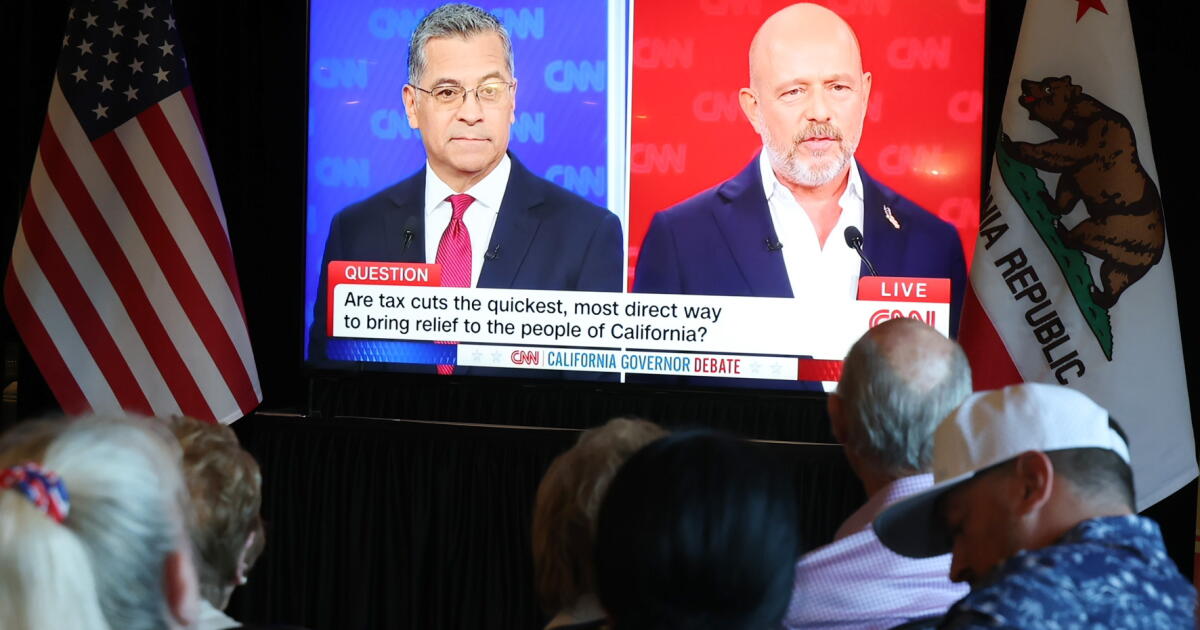
Eight candidates for California governor shared a stage for 90 minutes Tuesday night, their second of three scheduled debates before the June 2 primary.

My colleagues Gustavo Arellano and Mark Z. Barabak joined me to decide who the winner was, or if there was a winner at all.

Arellano: The real MVP in this debate? State Supt. Tony Thurmond.

He brought up his family story — child of a Panamanian immigrant who lost his parents young, someone familiar with “government cheese” as sustenance growing up — in a way that didn’t sound forced or pedantic.

He usually stayed within the time limits that were barely enforced by moderators. And he kept knocking down Chad Bianco again and again, drawing applause when he brought up the Riverside County sheriff’s takeover of hundreds of thousands of ballots.

Thurmond is the only gubernatorial candidate currently holding a statewide position, a former Richmond City Council member and Assembly member. “Elect someone with a lived experience,” he told the audience in his closing statement.

So why has Thurmond polled so low again and again to the point that he keeps not getting invited to debates and therefore not getting in front of California voters?

California has never elected a Black governor — in fact, the state is notorious for not voting in Tom Bradley in 1982 even though polls showed him leading George Deukmejian all the way to Election Day (the phenomenon of voters telling pollsters what they think they want to hear instead of what they actually feel is now known as the Bradley Effect).

As California’s Black population keeps shrinking, it would’ve been wonderful to see Thurmond do better than he has.

Chabria: Gustavo is spot on with his take on Thurmond. He came across as polished, capable and knowledgeable. But also, he’s just too far down in the polls for any kind of comeback.

In my mind, though, Xavier Becerra was the clear winner. No, he didn’t blow the other candidates away.

But he landed more than one punch that will almost certainly be on social media feeds for weeks to come, especially when he went at Republican Steve Hilton. Early on, he called President Trump “Hilton’s daddy.” Later, he quipped at Hilton, “We don’t need a talking head for Fox News to tell us how the government works.”

The debate was chaotic in more than one moment, but Becerra managed to get more than his share of airtime and use it wisely. Tom Steyer, the other Democratic front-runner, mired himself in wonk-talk. He wanted to get deep into policy, and got lost in complicated issues such as oil refineries.

Steyer didn’t have a single memorable line, though his closing statement did redeem him somewhat. He called himself the “change maker,” and promised, “if you want change, there is only one person on this stage they are afraid of” — they being tech titans, oil companies and other gods of industry.

It was the same for Katie Porter and Matt Mahan, who didn’t do anything wrong, but also, didn’t break out.

But those back-and-forths of Becerra and Hilton are priceless because they’re quick and shareable. I won’t be surprised to see voters drift Becerra’s way, even if only a bit.

Barabak: No runs, no hits, no errors. Seven men — and one woman — left standing.

I didn’t see, or hear, anything that seems very likely to drastically shake up or dramatically reorder the governor’s race. No breakout performance that will launch any of the candidates into clear-cut front-runner status. No major gaffes to leave any of the contestants sprawled on the killing floor.

So to that extent, I would score Becerra as the evening’s (modest) winner. He’s clearly having a moment, surging from political near-death to the top tier in polls. (Though, let’s be clear, it’s still a muddle, with several candidates bunched in the 15%-20% support range.)

There have been suggestions Becerra needs to show a bit more fight and he did so Tuesday, in particular taking on Hilton. Some of his jabs seemed a bit forced and stagy. (That line about Trump as “Hilton’s daddy.”)

Better, as Anita noted, was the jab from the former congressman, state attorney general and Biden cabinet secretary about a Fox “talking head” explaining how government works.

I found Porter to be crisp and authoritative on policy; Steyer to be repetitive (I’m the only change agent on this stage, look how much money is being spent to stop me — though it’s a small fraction of the sum he’s sunk into his vanity-cruise campaign); Mahan and Antonio Villaraigosa to be largely afterthoughts, and Bianco to have all the warmth and appeal of the grouchy old man telling kids in the neighborhood to get off his damn lawn!

The Riverside County sheriff seemed not to be running for governor of California, but rather mayor of MAGA-ville, a strategy apparently intended to nab one of two spots in the June primary, allowing him to go on to crushing defeat in November.

I agree that perhaps the night’s most surprising performance came from Thurmond. The state schools superintendent is mired in bare single digits in polls and only just made the debate stage after being left out of last week’s meetup in San Francisco.

His chances of being California’s next governor are somewhere between zero and nil, which is why he escaped serious scrutiny. That said, he made the most of the 90 minutes on stage, laying out his compelling up-from-poverty life story and seeming to relish taking on Bianco in particular.

Too little, too late. But Thurmond certainly acquitted himself well.

What else you should be reading
The must-read: ‘This is like the Russian mafia’: L.A. judge elections see unusual drama
The deep dive: Gavin Newsom wants to break up with Elon Musk. Tesla is making that difficult.
The L.A. Times Special: John Seymour, Anaheim mayor and U.S. senator, dies at 88

Stay Golden,

Anita Chabria

Was this newsletter forwarded to you? Sign up here to get it in your inbox.

Source link

Who won I’m A Celebrity 2026? Adam Thomas triumphs to be Legend despite ‘unbroadcastable’ row

Adam Thomas is the I’m A Celebrity South Africa winner 2026 despite ‘unbroadcastable’ row

Adam Thomas defeated the bullies and the other finalists to be crowned the winner of I’m A Celebrity All Stars in South Africa.

In a live final back in London, the actor beat runner up Mo Farah, third placed Harry Redknapp, and Craig Charles in fourth to be named an I’m A Celebrity ‘legend’.

Looking surprised and a bit shaken after a night of controversy, Adam said: “Thank you guys, thank you so much. I love ya.”

Earlier in the live show there had been chaos as he came face to face with David Haye and Jimmy Bullard and the verbal clash led to two other campmates – Gemma Collins and Sinitta – storming off stage.

The 37-year-old actor had faced abuse in camp from boxer Haye, had a row with quitter Jimmy Bullard and also got emotional at times on the ITV show. But he put it all behind him to come out on top.

Before he did his final trial in South Africa, Adam admitted there had been “a lot of drama” in camp. And there was a lot of drama in the final too as hosts Ant and Dec struggled to stay on top of things as it got chaotic with the crowd booing comments and celebs speaking out of turn.

Just minutes before Adam was crowned champ there were awkward scenes in the studio as Jimmy Bullard said Adam was “aggressive, abusive and intimidating” when Jimmy quit and Adam feared his own jungle adventure was also over. Thankfully the other campmates let him stay in the camp.

Adam reflected on it and said he had apologised to Jimmy several times. Looking serious he said: “Listen I take full responsibility for my actions. Yes emotions were definitely running high in that moment. But, you know, I have got nothing but love for Jimmy.”

When David Haye tried to interrupt him Adam also said “will you just let the finalists speak”. Adam then said: “I take everything he said into account. That is not how I want to show myself off and I have never showed myself off in that light before that or after that. And I am sorry Jimmy.”

Adam was given a final eating trial in South Africa called Swallow the Odds, and looking ahead to the prospect of winning said: “I am gonna be a legend baby” He then proceeded to smash the trial, eating five courses with the likes of five pig teats, two century fermented eggs, tarantula and fermented tofu.

He even cheered himself on, saying “come on Adam, ” in between mouthfuls. After watching Gemma said: “You done so well, you amazing.”

But he also had to cope with a backlash from other contestants, as David Haye interrupted the show at this point and said: “Do you think you deserve to win it after calling Jimmy the C-word a couple of times?”

Adam replied: “After that trial I deserve it yeah.”

Trying to restore order, host Dec said: “We are going to come to this a bit later.”But David continued: “Don’t you think you should ask Jimmy…a lot of that stuff was cut out.”Ant said: “There was a lot of stuff which was unbroadcastable which is why, look we will get into this later in the show.”Dec added: “I knew it was going to smoothly.”

Actor Adam first appeared on the show in 2016 making the final.

Asked about the South African version he said: “It was completely different but at the same time, so much better because of the people there. Everything was stepped up a lot, especially the trials and challenges. It was like going back to being a kid again. In my eyes there’s no comparison, this was definitely for the legends and it felt legendary.”

He had paired up with Jimmy Bullard for a trial where the bottom two left the show, but when Jimmy refused to take part and said “get me out of here” Adam had been due to leave too and verbally attacked Jimmy. He was so furious the scenes were edited down, something Jimmy is unhappy about. During the final he urged ITV to show the full contents of Adam’s rants.

Commenting on his clash with Jimmy Bullard when the ex-footballer quit, Adam had said on Thursday: “It was just really random and unexpected to be honest. I didn’t see it coming.

“Safe to say, I don’t think I was too happy about it. The fact I felt like I was leaving because of someone else just really broke my heart more than anything as I wanted to do my kids proud. Emotions can get the better of you in there and in hindsight, I probably would never have reacted the way I did but I was just really upset.”

On social media this week he had claimed even getting to the final he had felt a winner. But he had also said in a podcast chat with his brother this week he was still getting therapy for the way he had been treated in camp by David Haye.

Like this story? For more of the latest showbiz news and gossip, follow Mirror Celebs on TikTok , Snapchat , Instagram , Twitter , Facebook , YouTube and Threads .


Source link