pct

Seoul stocks spike over 4 pct to settle again in 8,000 territory on hopes for end to Mideast crisis

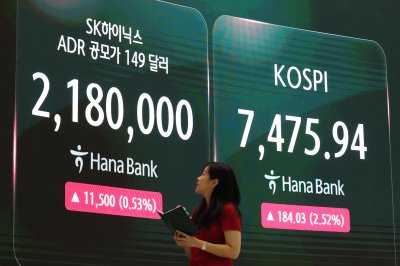
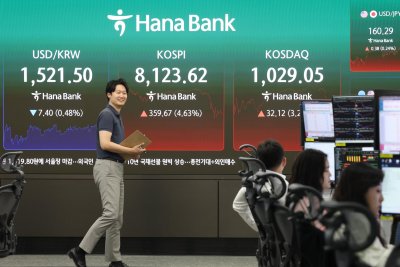
This photo, taken Friday, shows the trading room of Hana Bank in Seoul as South Korean stocks spiked more than 4 percent amid hopes the war between the United States and Iran could end soon. Photo by Yonhap

Seoul stocks rose by more than 4 percent Friday, as investors snapped up tech heavyweights amid hopes the war between the United States and Iran could end soon.

The benchmark Korea Composite Stock Price Index (KOSPI) closed up 359.67 points, or 4.63 percent, at 8,123.62 after rising as high as 8,434.40.

After opening sharply higher on renewed hopes that the war between the U.S. and Iran is near its end, the index trimmed earlier gains on profit taking ahead of the closing bell.

Trade volume was heavy at 490.3 million shares worth 51.1 trillion won (US$33.6 billion). Winners outnumbered losers 753 to 144.

On Thursday (U.S. time), U.S. President Donald Trump said he has reached a “great settlement” that would resolve the monthslong conflict with Iran and the deal would be signed as early as over the weekend, possibly in Europe.

Media outlet Axios also reported that four U.S. Air Force C-17 planes departed for Europe on Thursday, moving equipment for possible travel by Vice President J.D. Vance, raising the possibility a signing ceremony could take place in Geneva, Switzerland.

“Market sentiment improved as foreign investors shifted to net buying after a 25-session selling streak, on anticipations for peace negotiations,” said Lee Kyoung-min, an analyst from Daishin Securities.

But the rise was limited, amid reports that global banks are curbing hedge funds’ leveraged bets on the country’s two semiconductor heavyweights: Samsung Electronics and SK hynix, Lee added.

Foreigners and institutional investors net purchased a combined 4.4 trillion won. Retail investors net sold 4.3 trillion won.

In Seoul, shares closed higher across the board.

Market top-cap Samsung Electronics rose 7.86 percent, to 322,500 won, while its chipmaking rival SK hynix moved up 2.33 percent to 2,150,000 won.

Semiconductor equipment maker Hanmi Semiconductor vaulted 24.05 percent to 361,000 won, after the company said in a regulatory filling it is seeking to invest in SpaceX, Elon Musk’s space company set to make its Nasdaq debut on Friday (local time).

Shipmakers also gathered ground as investors went bargain hunting. Hanwha Ocean added 7.85 percent to 112,700 won and HD Hyundai Heavy Industries increased 0.62 percent to 650,000 won.

Portal operator Naver jumped 10.27 percent, to 247,000 won, financial firm KB Financial climbed 6.4 percent to 161,200 won, and top car maker Hyundai Motor added 1.68 percent to 607,000 won.

The Korean won was quoted at 1,519.8 won against the U.S. dollar as of 3:30 p.m., up 9.1 won from the previous session’s close.

Bond prices, which move inversely to yields, closed higher. The yield on three-year Treasurys fell 9.6 basis points to 3.808 percent, and the return on the benchmark five-year government bonds declined 10.9 basis points to 3.971 percent.

Copyright (c) Yonhap News Agency prohibits its content from being redistributed or reprinted without consent, and forbids the content from being learned and used by artificial intelligence systems.
Source link

Seoul shares again dip over 4 pct amid U.S.-Iran tensions, tech sell-off; won down

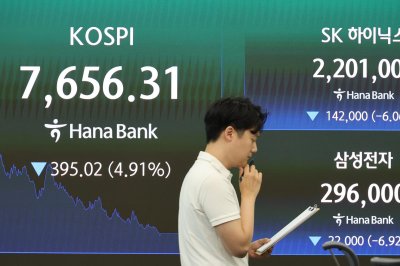
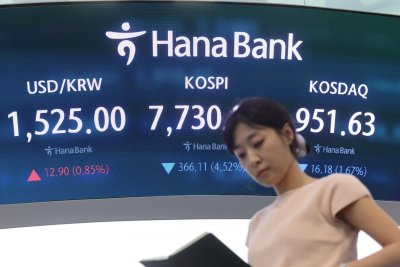
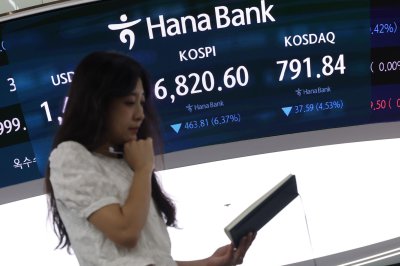
This photo, taken Wednesday, shows the trading room of Hana Bank in Seoul as South Korean stocks fell more than 4 percent amid escalating Middle East tensions and a tech sell-off. Photo by Yonhap

South Korean stocks plummeted more than 4 percent Wednesday amid escalating tensions between the United States and Iran and a tech slump fueled by concerns over the valuation of stocks related to artificial intelligence (AI). The local currency was trading lower against the U.S. dollar.

The benchmark Korea Composite Stock Price Index (KOSPI) shed 366.11 points, or 4.52 percent, to close at 7,730.82, almost eclipsing most of the over 8 percent surge from the previous day.

At one point, the index fell as low as 7,541.11.

Due to the sharp fall, the Korea Exchange had activated a sell-side sidecar for the index at 1:16 p.m., halting program trading for five minutes.

Trade volume was moderate at 457.5 million shares worth 39 trillion won (US$25.6 billion), with losers outnumbering winners 547 to 343.

Foreigners continued their sell-off for the 23rd consecutive session, dumping a net 2.77 trillion won, while retail investors and institutions purchased local shares worth 4.86 trillion won. Institutions sold 2.27 trillion won.

Market analysts said the KOSPI lost ground as tensions resurfaced in the Middle East after the U.S. struck Iran in response to the shooting down of an American Apache helicopter in the Strait of Hormuz and then Tehran hit back.

The risk-on appetite was also sapped by an overnight tech slide on Wall Street caused by concerns over the valuation of the AI stocks on news that Crusoe Energy Systems, a data center developer, suspended one of its projects upon the request of an unidentified big tech customer.

The tech-heavy Nasdaq composite closed 0.97 percent lower, and the S&P 500 dropped 0.26 percent, while the Dow Jones Industrial Average rose 0.17 percent.

Major tech shares led the market decline, with Broadcom losing 1.12 percent, Apple sliding 3.64 percent, Micron falling 1.4 percent and Nvidia down 0.2 percent.

Investors’ eyes are now on the upcoming release of the U.S. Consumer Price Index (CPI), which could give further clues on the U.S. Federal Reserve’s monetary policy amid bets on a hawkish pivot and the initial public offering of SpaceX later this week.

“The South Korean stock market was weighed down as risk aversion sentiment strengthened ahead of the U.S. CPI and Oracle’s earnings release, once triggering a sell-side sidecar,” Lee Kyoung-min, an analyst at Daishin Securities, said.

Lee said a hot inflation report could further contract the market sentiment, raising concerns over a possible U.S. rate hike.

In Seoul, market top-cap Samsung Electronics slid 6.06 percent to 302,500 won, while its chipmaking rival SK hynix plunged 7.54 percent to 2.05 million won.

AI investment firm SK Square shed 6.78 percent to 1.18 million won, and Samsung Electro-Mechanics shot down 8.38 percent to 1.8 million won.

Samsung Life Insurance dipped 6.36 percent to 368,000 won, and Samsung C&T plummeted 5.01 percent to 407,500 won.

Auto shares were also weak, with Hyundai Motor down 5.79 percent to 602,000 won, and its sister Kia losing 2.8 percent to 159,700 won. Hyundai Mobis dropped 4.2 percent to 570,000 won.

Internet portal operator Naver, which had recently rallied on news on its partnership with Nvidia, nosedived 11.67 percent to 227,000 won. Home appliances maker LG Electronics shot down 9.68 percent to 224,000 won.

Major shipbuilder HD Hyundai Heavy was among the few gainers, jumping 4.74 percent to 641,000 won.

Defense giant Hanwha Aerospace also climbed 1.48 percent to 1.03 million won.

The Korean won was quoted at 1,524.2 won against the U.S. dollar at 3:30 p.m., down 12.1 won from the previous session.

Bond prices, which move inversely to yields, closed mixed. The yield on three-year Treasurys added 2.5 basis points to 3.881 percent, and the return on the benchmark five-year government bonds dropped 3.2 basis points to 4.070 percent.

Copyright (c) Yonhap News Agency prohibits its content from being redistributed or reprinted without consent, and forbids the content from being learned and used by artificial intelligence systems.
Source link

KOSPI crashes over 8 pct on tech hemorrhage, U.S. rate woes; won rises after verbal intervention

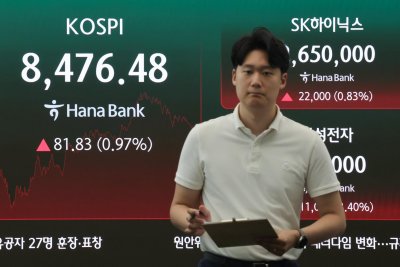
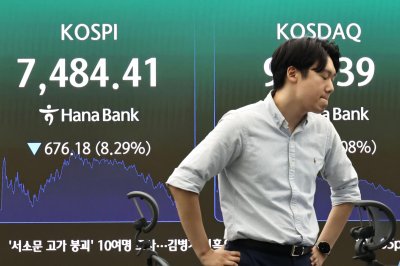
This photo, taken Monday, shows the trading room of Hana Bank in Seoul as South Korean stocks dropped more than 8 percent on concerns over AI profitability and fears over a possible rate hike by the U.S. Fed. Photo by Yonhap

South Korean stocks nosedived more than 8 percent Monday, extending their losing streak to a third consecutive session, as investors dumped market heavyweights on renewed woes over artificial intelligence (AI) profitability and concerns over a possible hawkish pivot of the U.S. Federal Reserve.

The local currency rose against the U.S. dollar after opening at a 17-year low, in the face of verbal intervention by financial authorities.

The benchmark Korea Composite Stock Price Index (KOSPI) plunged 676.18 points, or 8.29 percent, to close at 7,484.41, after falling as low as 7,442.73. The secondary KOSDAQ index sank more than 9 percent to end at 911.39.

The KOSPI’s trade volume was heavy at 448.3 million shares worth 47.8 trillion won (US$31.2 billion), with losers sharply outnumbering winners 873 to 42. Foreigners and institutions dumped local shares worth 355.5 billion won and 1.6 trillion won, respectively, while retail investors scooped up 1.76 trillion won.

The Monday crash was largely anticipated on sharp losses on Wall Street last week, fueled by semiconductor shares’ biggest daily percentage drop since March 2020 and fears over a possible rate hike by the Fed sparked by a hotter-than-expected U.S. jobs report for May.

The Dow Jones Industrial Average closed 1.35 percent lower Friday (local time), while the S&P 500 dipped 2.64 percent and the tech-heavy Nasdaq composite slid 4.18 percent.

Major U.S. chip shares sharply lost ground, with Nvidia slumping 6.2 percent, Broadcom contracting 7.92 percent and Micron shooting down 13.25 percent.

The Korea Exchange (KRX) had activated a circuit breaker for the KOSPI about three minutes after opening, halting trading for 20 minutes, and implemented a consecutive sell-side sidecar at around 9:34 a.m.

The KRX had also issued a sell-side sidecar for the secondary KOSDAQ market about six minutes after opening, suspending trading for five minutes, and activated a circuit breaker for the index later in the day after the KOSDAQ fell by more than 8 percent.

“Today’s pullback appears to be driven not by the weakening of market fundamentals, but by profit-taking sentiment among investors, mainly targeted at the semiconductor sector, as the market reacted more sensitively to negative developments after an extended rally of chip shares,” a report by Samsung Securities said.

The KOSPI has been one of the best performing stock indexes across the world in recent months, surging to near the unprecedented 9,000-point mark on Tuesday last week from the 5,000-point level earlier this year, mainly driven by major semiconductor shares, including Samsung Electronics and SK hynix.

“There is a lot at stake in this week’s financial market, with U.S. inflation data, treasury yields and the ongoing debate over the sustainability of AI-related investment all unfolding simultaneously,” said Seo Sang-young, an analyst at Mirae Asset Securities.

Han Ji-young, a researcher at Kiwoom Securities, also anticipated a “challenging” week for the KOSPI, noting that the release of the U.S. Consumer Price Index for May, the SpaceX listing and Oracle’s earnings results planned for this week may weigh on the market.

Market analysts also said news that Iran and Israel traded strikes dampened investors’ risk appetite, dimming hopes for peace in the Middle East.

Market top-cap Samsung Electronics slid 10.18 percent to 295,500 won, while its chipmaking rival SK hynix dipped 7.68 percent to 1.91 million won.

AI investment firm SK Square nosedived 11.13 percent to 1.12 million won.

Samsung Life Insurance lost 8.97 percent to 375,500 won, and Samsung C&T plunged 11.29 percent to 408,500 won.

Top automaker Hyundai Motor plummeted 8.71 percent to 639,000 won, and its auto parts making affiliate Hyundai Mobis shot down 12.2 percent to 612,000 won.

Leading battery maker LG Energy Solution pulled back 6.16 percent, and its smaller rival Samsung SDI sank 11.44 percent.

Home appliances maker LG Electronics slipped 11.55 percent to 268,000 won, while power plant manufacturer Doosan Enerbility shed 10.25 percent to 85,800 won.

Internet portal operator Naver was among the few winners, jumping 9.2 percent on news that the company is conducting a joint project with U.S. AI chip giant Nvidia to build a massive global AI factory and the nomination of Han Seong-sook, former chief executive officer (CEO) of Naver and incumbent minister of small and medium-sized enterprises (SMEs), as South Korea’s new prime minister.

SK Networks surged 30 percent to 14,170 won on SK Group and Nvidia’s announcement of a broader partnership for AI infrastructure.

The Korean won was quoted at 1,535.0 won against the U.S. dollar at 3:30 p.m., up 4.1 won from the previous session, after opening at 1,555.2 won, the lowest mark since March 6, 2009, when the global markets were in a financial crisis.

The local currency turned higher after financial authorities vowed stern action against excessive volatility and one-sided movements in the foreign exchange market.

Bond prices, which move inversely to yields, closed lower. The yield on three-year Treasurys added 5.8 basis points to 3.940 percent, and the return on the benchmark five-year government bonds gained 7 basis points to 4.190 percent.

Copyright (c) Yonhap News Agency prohibits its content from being redistributed or reprinted without consent, and forbids the content from being learned and used by artificial intelligence systems.

Source link

BOK lifts S. Korea’s growth forecast to 2.6 pct for this year amid robust chip-driven exports

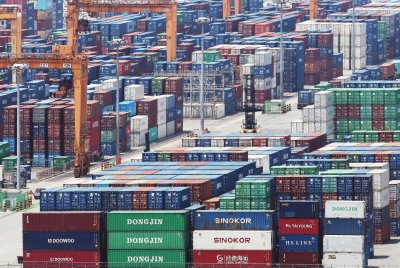
The central bank on Thursday raised its economic growth forecast for South Korea to 2.6 percent for 2026 amid solid semiconductor exports. This file photo shows containers stacked at a port in Pyeongtaek on May 8. Photo by Yonhap

The central bank on Thursday raised its economic growth forecast for South Korea to 2.6 percent for 2026 amid solid exports driven by a semiconductor super cycle.

The revision by the Bank of Korea (BOK) represents a 0.6 percentage-point increase from its previous forecast of 2 percent issued in February.

It is the largest upside revision since May 2021, when the BOK raised its growth projection by 1 percentage point from 3 percent to 4 percent.

For 2027, the central bank estimated its growth outlook at 2.1 percent.

The South Korean economy grew 1.7 percent in the first quarter, marking the sharpest quarterly growth in 5 1/2 years.

The revised outlook broadly aligned with forecasts from other institutions.

The International Monetary Fund (IMF) projected growth of 1.9 percent this year, while the Asian Development Bank (ADB) projected 1.9 percent growth.

The Korea Development Institute (KDI) earlier improved its growth forecast to 2.5 percent for 2026 from 1.9 percent.

The BOK also revised up its inflation prediction to 2.7 percent from 2.2 percent, citing higher international oil prices in the aftermath of the U.S.-Iran war.

For 2027, consumer prices are estimated to rise 2.3 percent, according to the BOK.

“The Korean economy is projected to expand by 2.6 percent this year, well above the February forecast of 2 percent, driven by robust semiconductor exports, while government measures, including the supplementary budget, partially offset the Middle East-driven supply shock,” the BOK said in a release.

BOK Gov. Shin Hyun-song said in a press conference that strong exports will likely contribute 0.7 percentage point to the country’s growth this year, alongside the 0.2 percentage point gains generated by the government’s fiscal support and the 0.1 percentage-point increase brought on by the local stock market rally. On the other hand, the ongoing U.S.-Iran war will drag down the economy by 0.4 percentage point, he added.

“Based on our analysis, we concluded that if the situation in the Middle East is resolved early, this year’s growth rate could exceed 2.6 percent,” he said. “We do not think the growth is a short-lived trend.”

The central bank presented an optimistic scenario in which semiconductor-driven exports gain further momentum, raising its growth forecast by 0.5 percentage point for 2026 and 0.3 percentage point for 2027.

Under a pessimistic scenario, however, a possible slowdown in artificial intelligence investments would lower economic growth by 0.3 percentage point this year and 0.2 percentage point next year, the central bank said.

In line with the upbeat outlook, the BOK kept the key interest rate unchanged at 2.5 percent but signaled a possible rate hike in the second half.

Copyright (c) Yonhap News Agency prohibits its content from being redistributed or reprinted without consent, and forbids the content from being learned and used by artificial intelligence systems.
Source link

Seoul shares shoot up nearly 6.5 pct to over 7,300 on chip rally, Mideast hopes; won rises

Employees take part in a ceremony at the trading room of Woori Bank in Seoul on Wednesday to celebrate the benchmark KOSPI closing at an all-time high of 7,384.56. Photo by Yonhap

South Korean stocks shot up nearly 6.5 percent Wednesday, extending a record-breaking run to top the 7,300-point mark, driven by a semiconductor rally and optimism for a potential peace deal in the Middle East. The local currency also strengthened against the U.S. dollar.

The benchmark Korea Composite Stock Price Index (KOSPI) added 447.57 points, or 6.45 percent, to a fresh record high of 7,384.56.

It marked the second-largest daily gain in terms of points following 490.36 points reached on March 5.

Trade volume was heavy at 984.4 million shares worth 58.2 trillion won (US$40 billion), with losers outnumbering winners 199 to 677.

Foreigners bought 3.1 trillion won worth of local shares, while institutions and individuals dumped a net 2.3 trillion won and 571.2 billion won, respectively.

Overnight, U.S. President Donald Trump said he would pause operations to escort ships through the Strait of Hormuz as part of efforts to reach a final agreement with Iran.

The KOSPI opened 2.25 percent higher to surpass the landmark 7,000-point threshold for the first time and extended the gains throughout the session.

The main index has been on a bullish run in recent months, surpassing the 5,000-point mark in late January and topping another milestone of 6,000 points in February.

After recouping its losses in March following the outbreak of the U.S.-Iran war in late February, the KOSPI breached the 7,000-point level on continued optimism over the artificial intelligence (AI) boom and hopes for the reopening of the key waterway.

“Global tech giants’ strong performances and the strengthened value chain for AI data centers boosted the AI-related shares,” Lee Kyung-min, an analyst at Daishin Securities, said. “In particular, the market’s top-three shares of Samsung Electronics, SK hynix and SK Square led the rally.”

Top-cap Samsung Electronics surged 14.41 percent to close at 266,000 won, pushing its market capitalization above 1.5 quadrillion won and becoming the second Asian company to surpass the $1 trillion milestone after Taiwan Semiconductor Manufacturing Co.

SK hynix soared 10.64 percent to 1.6 million won, and AI investment firm SK Square jumped 9.89 percent to 1.1 million won.

Hanmi Semiconductor, a chip manufacturing company, rose 4.37 percent to 394,500 won, and LG Electronics vaulted 8.17 percent to 154,900 won.

However, shipbuilding and defense shares dropped. Major shipyard HD Hyundai Heavy Industries fell 4.71 percent to 648,000 won, and defense giant Hanwha Aerospace lost 2.18 percent to 1.4 million won.

Leading biotech firm Samsung Biologics declined 0.34 percent to 1.48 million won, and top mobile carrier SK Telecom backtracked 1.95 percent to 95,500 won.

The Korean won was quoted at 1,455.1 won against the U.S. dollar at 3:30 p.m., up 7.7 won from the previous session.

The quotation marks the highest since February 27, when the currency closed at 1,439.7 to the greenback.

Copyright (c) Yonhap News Agency prohibits its content from being redistributed or reprinted without consent, and forbids the content from being learned and used by artificial intelligence systems.

Source link

Seoul shares spike over 5 pct to approach 7,000 on chip rally; won sharply up

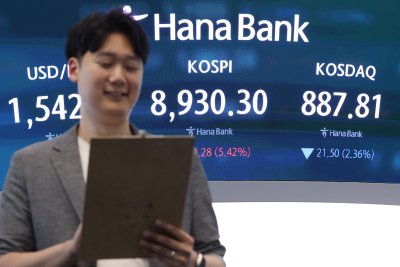
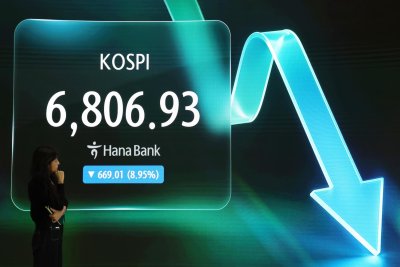
This photo, taken Monday, shows the trading room of Hana Bank in Seoul as South Korean stocks rose more than 5 percent to reach a record high. Photo by Yonhap

South Korean stocks shot up by more than 5 percent to close at a fresh high Monday, approaching the 7,000-point mark, as investors scooped up semiconductor shares while awaiting developments in U.S.-Iran peace talks. The Korean won rose sharply against the U.S. dollar.

The benchmark Korea Composite Stock Price Index (KOSPI) added 338.12 points, or 5.12 percent, to a fresh record high of 6,936.99.

Trade volume was heavy at 864.3 million shares worth 41.3 trillion won (US$28.2 billion), with losers outnumbering winners 473 to 392.

Foreigners bought 3 trillion won worth of local shares, and institutions purchased a net 1.9 trillion won, while retail investors dumped a net 4.8 trillion won.

The index opened 2.79 percent higher after U.S. President Donald Trump announced a plan to guide ships not involved in the Iran conflict through the Strait of Hormuz as a “humanitarian gesture” starting this week.

Later, a senior Iranian official warned that Tehran would consider any U.S. interference in the strait a ceasefire breach.

However, the KOSPI extended its gains in the afternoon, supported by foreign and institutional buying.

“Tech shares were driven by gains on Wall Street over the weekend,” Lee Kyung-min, an analyst at Daishin Securities, said. “Also, foreign investors expanded their net purchase ahead of the market closure for Children’s Day on Tuesday.”

The main index surpassed the 5,000-point mark in late January and topped another milestone of the 6,000-point level in February.

After recouping its losses in March following the outbreak of the U.S.-Iran war in late February, the KOSPI is now approaching the uncharted 7,000-point level on continued optimism over the AI boom and hopes for the reopening of the key waterway.

Semiconductor stocks led the rally.

Chip giant Samsung Electronics jumped 5.44 percent to 232,500 won, and its chipmaking rival SK hynix surged 12.52 percent to a fresh record high of 1.4 million won, surpassing 10 trillion won in market capitalization for the first time.

Hanmi Semiconductor, a chip equipment manufacturer, rose 2.72 percent to 378,000 won, and Samsung Electro-Mechanics, an electronic components affiliate of Samsung Electronics Co., soared 10.34 percent to 918,000 won.

Defense shares were also strong as industry leader Hanwha Aerospace advanced 3.39 percent to 1.4 million won and LIG D&A gained 4.46 percent to 983,000 won.

Top carmaker Hyundai Motor climbed 1.51 percent to 539,000 won, and leading battery maker LG Energy Solution increased 2.5 percent to 472,000 won.

However, bio shares went south as Celltrion fell 1.35 percent to 197,800 won, and Samsung Biologics dropped 2.58 percent to 1.4 million won.

The Korean won was quoted at 1,462.8 won against the U.S. dollar at 3:30 p.m., up 20.5 won from the previous session.

The quotation marks the highest since February 27, when the currency closed at 1,439.7 to the greenback.

Bond prices, which move inversely to yields, closed lower. The yield on three-year Treasurys added 2 basis points to 3.615 percent, while the return on the benchmark five-year government bonds gained 1.7 basis points to 3.797 percent.

Copyright (c) Yonhap News Agency prohibits its content from being redistributed or reprinted without consent, and forbids the content from being learned and used by artificial intelligence systems.
Source link