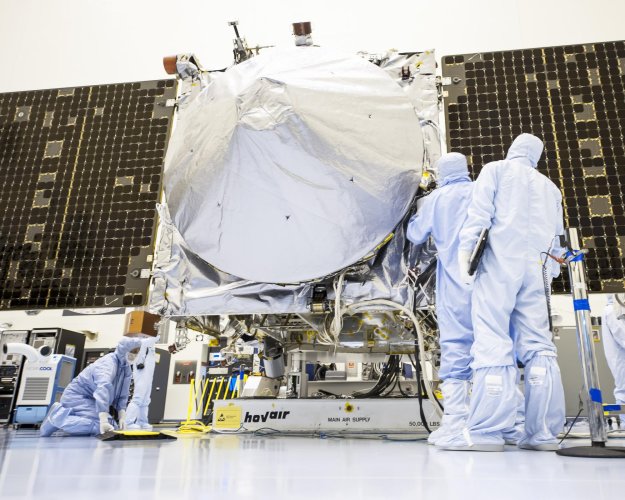
June 3 (UPI) — Almost six months after NASA lost contact with the spacecraft, the agency has declared the Mars Atmosphere and Volatile Environment satellite unrecoverable and its mission concluded.
NASA’s Deep Space Network (radio antennas that connect Earth with spacecraft) last received a transmission from the MAVEN satellite on Dec. 6, just before its orbit passed behind Mars. When it emerged, communications did not resume, NASA said. The cause of this lapse was under investigation, but the agency said the satellite was rotating at an usually high rate, leading to drained batteries.
The MAVEN mission was the first successful one dedicated to observing Mars’ atmosphere and its evolution. It orbited the planet for more than 11 years, far longer than its planned one-year lifespan.
NASA hosted a media teleconference Wednesday about the end of the mission and issued a statement.
“The MAVEN mission has truly advanced our understanding of the Martian atmosphere and evolution,” said Shannon Curry, MAVEN principal investigator and a professor at the Laboratory for Atmospheric and Space Physics at the University of Colorado Boulder. “This dataset has had a tremendous impact onthe field. Our science team is exceptionally proud of all of these amazing discoveries.”
The mission launched in November 2013 on an Atlas V rocket from Cape Canaveral, Fla., and arrived in Mars orbit 10 months later, Space.com reported.
During its mission, MAVEN provided information about Mars’ atmosphere and how it became the planet it is today, changing from a planet with a more Earth-like atmosphere that could host liquid water on the surface. It discovered new types of auroras across the planet and studied Mars’ dust storms.
MAVEN also played a key role as a communications link to the Curiosity and Persistence rovers on Mars. The Mars Odyssey and Mars Reconnaissance Orbiter spacecraft remain in operation to play that role.
“The science MAVEN has given us is key to informing what kind of radiation protection and safety measures we must take before sending humans to Mars,” said Louise Prockter, director of the planetary science division at NASA. “The data collected from MAVEN will continue to provide valuable insight into Mars for decades to come.”
