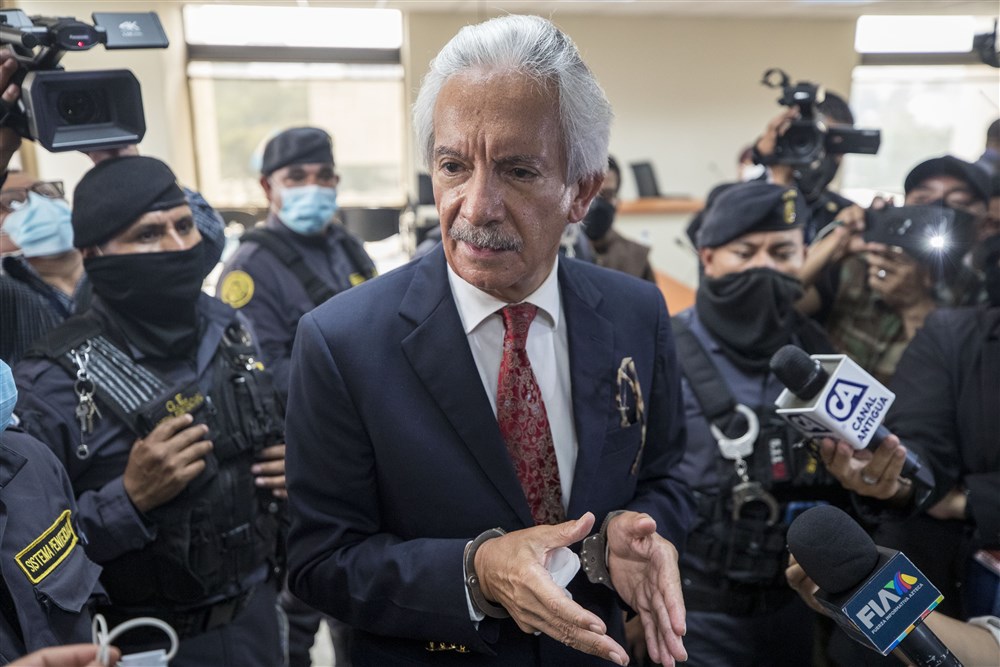
Venezuela is far from being the only country in the Americas where State institutions have been used to crack down on independent media and protect the interests of ruling elites. In Guatemala, the case of journalist José Rubén Zamora became one of the clearest examples of how prosecutors, courts and political power can converge to silence investigative journalism.
In early April 2025, I interviewed Ramón Zamora, son of Guatemalan journalist and elPeriódico founder José Rubén Zamora. His arrest following years of investigations into alleged government corruption led to the newspaper’s closure and the persecution of people close to him. During our conversation, Ramón Zamora described how Guatemala has developed a tacit network of complicity between State institutions and political authorities, a system that raises broader questions about this new form of power in Latin America and may also help explain how the chavista State in Venezuela operates.
After elPeriódico published two investigations on May 2 and May 3, 2021 into apparent cases of corruption in the government of former President Alejandro Giammattei, the media outlet was subjected to legal persecution that culminated in the arrest of Rubén Zamora, who had dedicated his work to investigating corruption in the Central American country.
The persecution began with an investigation into alleged bribery by the newspaper to obtain information related to the publications. The judge who heard the case dismissed it. Later, in 2022, an investigation into money laundering related to the sale of works of art owned by Zamora to cover elPeriódico‘s costs was reopened, leading to his arrest.
The imprisonment of Zamora caught the attention of the Inter-American Commission on Human Rights and the Office of the Special Rapporteur for Freedom of Expression. In their 2022 and 2023 annual reports, the IACHR requested information from Guatemala regarding the country’s human rights situation and recalled that Zamora has benefited from precautionary measures since 2003 due to risks linked to his journalistic work. Guatemala rejected parts of the assessment as lacking objectivity. Amnesty International described Zamora as a prisoner of conscience and condemned his detention. Zamora was granted house arrest for the second time on February 12, 2026.
Reducing chavismo to a simple narco-structure simplifies the scope that the organization can have, since apparent drug trafficking would not be the essence of the system but rather an activity within it.
During the arrest and initial detention of journalist José Rubén Zamora in 2022, Guatemala was governed by Alejandro Giammattei, a conservative president whose administration faced strong criticism from international organizations over corruption, institutional deterioration, and pressure against journalists and anti-corruption actors. Since January 14, 2024, Guatemala has been governed by Bernardo Arévalo, a progressive and anti-corruption reformist whose presidential term is scheduled to end in January 2028.
His son, Ramón Zamora, says that his father’s persecution is the result of an unwritten agreement between various powerful sectors within the State that aim to protect their interests. “In Guatemala, there is something my father called the “Pact of the Corrupt.” The Pact of the Corrupts is a tacit agreement that forms a network of corruption spread across political parties and institutions, where those who reach positions of power must govern according to the pact.”
This explanation describes the composition of a de facto cross-cutting network, which has political parties, institutions, and security forces under its control, punishing dissent as a means of survival, subjecting its detractors to exile, imprisonment, and discredit.
“The judge presiding over the case ordered an investigation into my father’s defense attorneys and witnesses, causing his lawyer to go into exile just five days after his arrest. Currently, six of the twelve lawyers who have defended my father have been detained,” says Ramón, who is also outside Guatemala with his mother after the court issued an arrest warrant against both of them.
“They also persecuted my family. My mother and I were outside Guatemala visiting the United States when the judge handling my father’s case issued an arrest warrant against us, so we decided not to return.”
But how can the Pact explain the nature of the chavista State?
Corruption as political capital
Chavismo is not exclusively a militarized organization or simply a drug trafficking operation. As in Guatemala with the Pact of the Corrupts, the institutions of the chavista State are co-opted and work in the tacit interest of their members, where one of the main means of maintaining the pact is loyalty based on impunity, while corruption operates as political capital.
Consequently, the exercise of power is not oriented toward citizens or the satisfaction of public demands, but rather toward preserving the internal balance of the Pact itself. Governing involves administering concessions, distributing power quotas, and avoiding any decision that could alter the network of interests that sustains the regime. Reforms, when they exist, do not constitute a project of institutional transformation but are carefully calibrated to avoid destabilizing the architecture of loyalties on which the system rests.
This model of governance, the pacted State, is complemented by a logic of repression, combining massive and indiscriminate terror against actors whose actions threaten the balance of the pact. Similar dynamics can be observed in regimes such as Russia, Belarus, Nicaragua, and several Central Asian States. Journalists, judges, political leaders, and internal and external dissidents are the main targets of a system of coercion designed not to mobilize the masses, but to send clear and disciplining signals to those who break the pact. The selectivity of repression does not mitigate its severity. On the contrary, it makes it more efficient and functional in sustaining the apparatus of power.
Reducing chavismo to a simple narco-structure simplifies the scope that the organization can have, since apparent drug trafficking would not be the essence of the system but rather an activity within it. The Venezuelan State has become a web of systematic corruption that makes crime a functional activity of power.
The stability of the system is due to a network of mostly informal agreements between civilian, military, and economic actors who share a common interest: preserving an order in which rupture is more costly than continuity.
In this context, ideology ceases to serve as the system’s organizing principle and takes on a strictly instrumental role. It is not the compass that guides the action of power, but rather an adaptable rhetorical resource used to justify decisions already made to sustain the pact. Chavismo does not act primarily to carry out an ideological project, but rather to preserve a balance of interests between civilian, military, and criminal elites, in which ideas can mutate without the system suffering. Ideology, thus, does not guide the organization: it accompanies it, decorates it, or excuses it, but does not determine it.
The thesis of a pacted State suggests that authoritarian stability rests not only on repression or ideology, but on a shared understanding among political, military, and economic elites that preserving the existing order is preferable to risking rupture. Such systems can appear remarkably resilient precisely because their survival depends less on ideological coherence than on the mutual guarantees exchanged within the ruling coalition.
The notion of a pacted State helps explain why chavismo has shown a capacity for survival that goes beyond personalistic or circumstantial explanations. The stability of the system is due to a network of mostly informal agreements between civilian, military, and economic actors who share a common interest: preserving an order in which rupture is more costly than continuity. As long as that calculation remains valid, the system does not collapse; it adapts, reconfigures itself, and absorbs pressures without altering its fundamental logic. Yet the resilience of pacted States is not immutable.
Such systems begin to weaken when influential actors within the ruling coalition conclude that the regime can no longer guarantee protection, resources, or political survival. Economic decline, succession disputes, international pressure, social unrest, or weakening coercive institutions can alter the cost-benefit calculations sustaining the pact. Similar dynamics were visible in Eastern Europe after November 1989, when regimes in the German Democratic Republic, Romania, and Bulgaria rapidly collapsed once the elite coalitions sustaining them began to fracture internally, a process that would also unfold in Albania.
History suggests that pacted States often project an image of permanence precisely until the internal understandings sustaining them begin, almost imperceptibly, to dissolve.