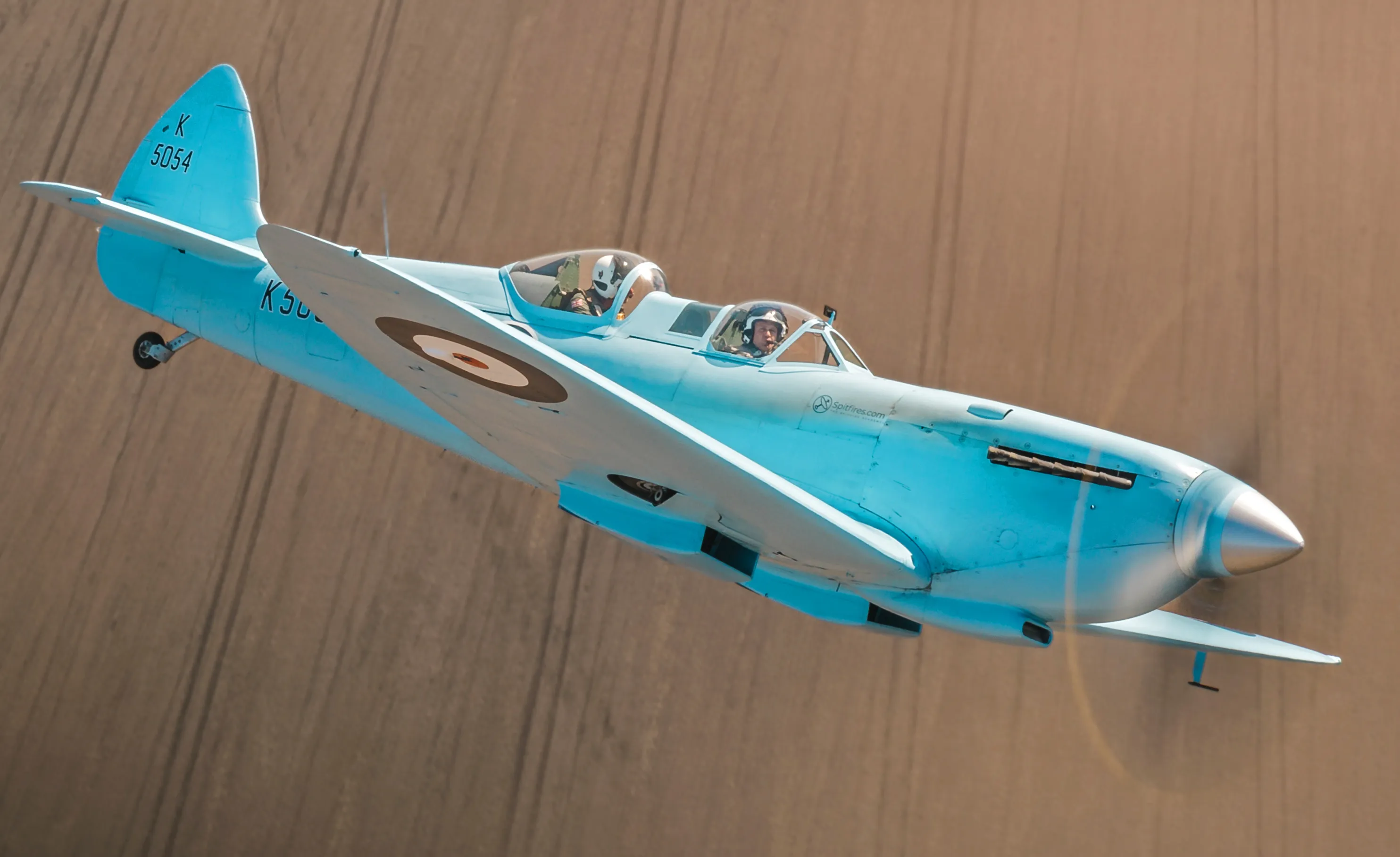
An example of the U.K. Royal Air Force’s most iconic fighter, the Spitfire, flew in a series of air-to-air formations around the United Kingdom over the last two weeks, part of the 90th anniversary celebrations for the aircraft, which became legendary on account of its service in World War II. The nine-leg flight around the United Kingdom was completed Friday.

The Spitfire in question, a two-seater, was painted blue to represent the first prototype, K5054. The original K5054 first flew on March 5, 1936, and was piloted by Capt. Joseph “Mutt” Summers. It took off from Eastleigh Aerodrome, now Southampton Airport.

On this day in 1936 was the prototype Spitfire’s maiden flight. Captain Joseph “Mutt” Summers, chief test pilot for Vickers, took off in K5054 from Eastleigh Aerodrome (later Southampton Airport). pic.twitter.com/7bbjlOBGxf

— RAF BBMF (@RAFBBMF) March 5, 2021

Popular history records that Summers uttered the words “I don’t want anything touched” when he climbed down from the cockpit. If he did say those words, it was almost certainly an instruction to the ground crew to leave the plane as it was before he took it up for his next test sortie. But the legend stuck.

Image of Spitfire “K5054”, seen during transit to RAF Coningsby in the UK. The first flight of the eagerly anticipated commemorative Spitfire90 tour has successfully landed at RAF Coningsby. The nine flights have been organised to celebrate 90 years since the Supermarine Spitfire’s maiden flight. Departing from Southampton International Airport earlier today, the very site where Captain Joseph ‘Mutt’ Summers piloted the original Spitfire prototype K5054 on 5th March 1936, the specially painted two-seat Spitfire, replicating the original K5054, was escorted by the Dakota and Spitfire AB910 belonging to the Royal Air Force’s Battle of Britain Memorial Flight (BBMF) as it made its way to RAF Coningsby, the home of the BBMF. During the flight, "K5054" was also joined in the vicinity of RAF Marham by two F35 Lightning II aircraft.
Spitfire “K5054” seen during transit to RAF Coningsby in the UK. Crown Copyright

Regardless, so promising was the new fighter that the Air Ministry placed a production order less than three months later, with trials still incomplete.

Eventually, more than 20,000 production examples would be built, and the Spitfire would be considered among the best all-round fighters of World War II, in which it played a key role from start to finish. The Royal Air Force didn’t fly its last operational Spitfire sortie until 1954, in Malaya.

The blue Spitfire seen in the accompanying images is actually a Mk IX, BS410, which crashed in May 1943, was recovered and rebuilt in the 2000s, and was converted into a two-seater, allowing for a passenger. It is currently privately owned.

Starting on April 7, the K5054-lookalike Spitfire joined up in the air with a host of modern types.

For the first flight, the Royal Air Force’s most advanced fighter, the F-35B Lightning, flew in formation with the Spitfire. This came just a matter of weeks after British F-35Bs shot down their first enemy aircraft — hostile drones over Jordan, during the conflict in the Middle East.

The formation flight involved two frontline F-35Bs from RAF Marham and two preserved Spitfires.

Image of Spitfire “K5054”, seen here alongside two F35 Lightning II Jets from RAF Marham as they transit to RAF Coningsby in the UK. The first flight of the eagerly anticipated commemorative Spitfire90 tour has successfully landed at RAF Coningsby. The nine flights have been organised to celebrate 90 years since the Supermarine Spitfire’s maiden flight. Departing from Southampton International Airport earlier today, the very site where Captain Joseph ‘Mutt’ Summers piloted the original Spitfire prototype K5054 on 5th March 1936, the specially painted two-seat Spitfire, replicating the original K5054, was escorted by the Dakota and Spitfire AB910 belonging to the Royal Air Force’s Battle of Britain Memorial Flight (BBMF) as it made its way to RAF Coningsby, the home of the BBMF. During the flight, "K5054" was also joined in the vicinity of RAF Marham by two F35 Lightning II aircraft.
Spitfire “K5054” seen here alongside two F-35Bs from RAF Marham. Crown Copyright

The other Spitfire, a Mk Vb, AB910, also saw combat in World War II, including covering the D-Day landings in Normandy. It is now part of the storied Battle of Britain Memorial Flight (BBMF).

Image of Spitfire “AB910”, seen during transit to RAF Coningsby in the UK. The first flight of the eagerly anticipated commemorative Spitfire90 tour has successfully landed at RAF Coningsby. The nine flights have been organised to celebrate 90 years since the Supermarine Spitfire’s maiden flight. Departing from Southampton International Airport earlier today, the very site where Captain Joseph ‘Mutt’ Summers piloted the original Spitfire prototype K5054 on 5th March 1936, the specially painted two-seat Spitfire, replicating the original K5054, was escorted by the Dakota and Spitfire AB910 belonging to the Royal Air Force’s Battle of Britain Memorial Flight (BBMF) as it made its way to RAF Coningsby, the home of the BBMF. During the flight, "K5054" was also joined in the vicinity of RAF Marham by two F35 Lightning II aircraft.
Spitfire AB910 seen during transit to RAF Coningsby in the UK. Crown Copyright
Image of Spitfire “AB910” and Spitfire “K5054”, seen during transit to RAF Coningsby in the UK. The first flight of the eagerly anticipated commemorative Spitfire90 tour has successfully landed at RAF Coningsby. The nine flights have been organised to celebrate 90 years since the Supermarine Spitfire’s maiden flight. Departing from Southampton International Airport earlier today, the very site where Captain Joseph ‘Mutt’ Summers piloted the original Spitfire prototype K5054 on 5th March 1936, the specially painted two-seat Spitfire, replicating the original K5054, was escorted by the Dakota and Spitfire AB910 belonging to the Royal Air Force’s Battle of Britain Memorial Flight (BBMF) as it made its way to RAF Coningsby, the home of the BBMF. During the flight, "K5054" was also joined in the vicinity of RAF Marham by two F35 Lightning II aircraft.
Spitfires AB910 and “K5054” seen during transit to RAF Coningsby in the UK. Crown Copyright

For the first leg of its flight, the K5054-lookalike Spitfire flew from its birthplace of Southampton Airport to RAF Coningsby in Lincolnshire, still a major fighter hub.

While the Spitfire and F-35 could hardly be more different in terms of performance and technologies, both have served the Royal Air Force as its premier frontline fighter. Like its forebear, the F-35B is also now proven in aerial combat, albeit against drones.

On March 6 this year, the Royal Air Force announced that an F-35B pilot had carried out the aircraft’s first combat shootdown in British hands, intercepting and destroying two hostile drones during an operation over Jordan the same week.

An F-35B from No. 617 Squadron at RAF Akrotiri. Crown Copyright

“The pilot, flying alongside two Typhoons from RAF Akrotiri, detected the drones on radar and engaged them with two ASRAAM missiles,” the Royal Air Force said in its statement. The pilot, although assigned to No. 617 Squadron of the Royal Air Force, was serving with the Royal Navy, reflecting the joint nature of the U.K. F-35B force.

The incident followed a separate attack in which a small, low‑speed drone struck RAF Akrotiri in Cyprus after evading base defenses, which were subsequently much enhanced.

Flight two, out of RAF Coningsby, on April 8, saw the Spitfire fly alongside Royal Air Force Red Arrows Hawks and a Phenom T1 trainer.

The Red Arrows flying alongside the Spitfire on Day 2 of the commemorative tour of GB. Two Hawks accompanied her for part of the flight from RAF Coningsby to Leuchars Station. (Photo: Darren Harbar) #Spitfire90 pic.twitter.com/Y4ioabXnoI

— Jane (@JaneFranklin99) April 8, 2026

The third flight, out of RAF Leuchars, on April 9, involved a Royal Air Force P-8 Poseidon maritime patrol aircraft.

Image of a Spitfire aircraft, seen here flying with a P-8A maritime patrol aircraft over RAF Lossiemouth as part of it's tour (Spitfire 90) around the United Kingdom. SPITFIRE 90 is a collaborative commemorative event between the Battle of Britain Memorial Flight (BBMF) and Spitfires.com. The Spitfire Academy. Marking 90 years since the first flight of the Spitfire prototype K5054 from Eastleigh Aerodrome on 5 March 1936, a specially painted twin-seat Spitfire TR9 will complete a nine-leg circumnavigation of Great Britain, with each leg representing a decade of the aircraft’s history. Operating from nine UK locations between 7 and 17 April 2026, the event coordinates with current RAF aircraft to demonstrate the evolution of air power, while raising funds for the RAF Benevolent Fund and the Mark Long Trust.
Spitfire and Poseidon over Scotland. Crown Copyright

Flight four, on April 10, brought the Spitfire to Scotland, where it flew out of RAF Lossiemouth with a pair of Royal Air Force Typhoon fighters.

Image of a Spitfire and Typhoon aircraft seen here at RAF Lossiemouth as part of it's tour (Spitfire 90) around the United Kingdom. SPITFIRE 90 is a collaborative commemorative event between the Battle of Britain Memorial Flight (BBMF) and Spitfires.com. The Spitfire Academy. Marking 90 years since the first flight of the Spitfire prototype K5054 from Eastleigh Aerodrome on 5 March 1936, a specially painted twin-seat Spitfire TR9 will complete a nine-leg circumnavigation of Great Britain, with each leg representing a decade of the aircraft’s history. Operating from nine UK locations between 7 and 17 April 2026, the event coordinates with current RAF aircraft to demonstrate the evolution of air power, while raising funds for the RAF Benevolent Fund and the Mark Long Trust.
A Spitfire and Typhoons seen at RAF Lossiemouth. Crown Copyright

Remaining in Scotland, the fifth flight, on April 13, out of Prestwick Airport, teamed the Spitfire with a Royal Air Force Hawk T2 trainer.

Flight six, on April 14, out of RAF Valley, Wales, involved the Spitfire and two current Royal Air Force training types: a Texan T1 turboprop and a Jupiter HT1 helicopter.

Pictured is the iconic Spitfire TR9 “K5054”, flying alongside a Texan from MOD St Athan in the UK. The sixth flight of the eagerly anticipated commemorative Spitfire90 tour has successfully left RAF Valley and landed at MOD St Athan. The commemorative SPITFIRE 90 event is celebrating 90 years of the infamous WWII aircrraft taken Wednesday 15th April 2026. SPITFIRE 90 is a collaborative commemorative event between the Royal Air Force and Spitfires.com. The nine-day event presents a unique and valuable opportunity to honour the legacy of the iconic Spitfire, celebrating its pivotal role in shaping the UK and RAF's history and inspiring future generations. It also serves to promote the modern-day RAF, showcasing its continued excellence, innovation and dedication to protecting the nation. Additionally, it has raised over £100K for RAF charities, supporting the welfare of our personnel, veterans and their families, while also providing aviation opportunities for disabled individuals. SPITFIRE 90 circumnavigates Great Britain and conducts over nine legs, each of which coordinates with modern RAF aircraft to demonstrate the progress of air power during the last nine decades. SPITFIRE 90 will operate from/ to nine UK locations: Southampton Airport, RAF Coningsby, RAF Leuchars, RAF Lossiemouth, RAF Valley, MoD St Athan, RAF St Mawgan/ Newquay Airport and Exeter Airport during the period 7–17 Apr 26.
The Spitfire alongside a Texan T1. Crown Copyright

Flight seven, on April 15, out of MOD St Athan, provided a formation with two QinetiQ Pilatus PC-21 trainers.

Flight eight, on April 16, out of MOD St Mawgan, involved a Royal Air Force A400M transport.

Image of Spitfire “K5054”, seen during transit to RAF Coningsby in the UK. The first flight of the eagerly anticipated commemorative Spitfire90 tour has successfully landed at RAF Coningsby. The nine flights have been organised to celebrate 90 years since the Supermarine Spitfire’s maiden flight. Departing from Southampton International Airport earlier today, the very site where Captain Joseph ‘Mutt’ Summers piloted the original Spitfire prototype K5054 on 5th March 1936, the specially painted two-seat Spitfire, replicating the original K5054, was escorted by the Dakota and Spitfire AB910 belonging to the Royal Air Force’s Battle of Britain Memorial Flight (BBMF) as it made its way to RAF Coningsby, the home of the BBMF. During the flight, "K5054" was also joined in the vicinity of RAF Marham by two F35 Lightning II aircraft.
Crown Copyright

For the ninth and final flight, on April 17, the Spitfire departed Exeter Airport and met up alongside the BBMF’s Dakota as it flew back to Southampton Airport.

For the final flight of Spitfire90, we were joined by Major Timothy Nigel Peake CMG, a retired British European Space Agency astronaut, Army Air Corps officer and author who flew on board the Dakota from Exeter to Southampton. SPITFIRE 90 is a collaborative commemorative event between the Royal Air Force and Spitfires.com. The nine-day event presents a unique and valuable opportunity to honour the legacy of the iconic Spitfire, celebrating its pivotal role in shaping the UK and RAF's history and inspiring future generations. It also serves to promote the modern-day RAF, showcasing its continued excellence, innovation and dedication to protecting the nation. Additionally, it has raised over £100K for RAF charities, supporting the welfare of our personnel, veterans and their families, while also providing aviation opportunities for disabled individuals. SPITFIRE 90 circumnavigates Great Britain and conducts over nine legs, each of which coordinates with modern RAF aircraft to demonstrate the progress of air power during the last nine decades. SPITFIRE 90 will operate from/ to nine UK locations: Southampton Airport, RAF Coningsby, RAF Leuchars, RAF Lossiemouth, RAF Valley, MoD St Athan, RAF St Mawgan/ Newquay Airport and Exeter Airport during the period 7–17 Apr 26.
For the final flight, the Spitfire was joined by a Dakota for a flight from Exeter to Southampton. Crown Copyright

While not unique, the Royal Air Force doesn’t regularly pair current and historic fighters for displays in the way the U.S. Air Force does with its Heritage Flight. This puts together formations of modern jets flying with fighters from the World War II, Korean War, and Vietnam War eras, such as the P-51 Mustang and F-86 Sabre.

The F-35 Lightning II flies in formation with the P-38 Lightning and two P-51 Mustangs during the Heritage Flight Conference at Davis Monthan Air Force Base in Tucson, Ariz., March 4-6, 2016. The F-35 heritage flight team from Luke Air Force Base, Ariz. is the first F-35 team to participate in the Heritage Flight Program. The program features modern USAF fighter aircraft flying alongside World War II, Korean and Vietnam era aircraft in a dynamic display of our nation's air power history. (U.S. Air Force photo by Staff Sgt. Staci Miller)
A U.S. Air Force F-35A flies with a pair of P-51 Mustangs and a P-38 Lightning as the Heritage Flight at Davis Monthan Air Force Base in Tucson, Arizona, in 2016. U.S. Air Force photo by Staff Sgt. Staci Miller

This makes the series of Spitfire flights all the more special. On each of these flights, one lucky (and deep-pocketed) passenger was in the backseat of the Spitfire, having bid for the chance to do so. The money earned will go to support service-related charities.

For the rest of us, we can enjoy some of the spectacular imagery captured as this special Spitfire completed its countrywide odyssey.

Contact the author: thomas@thewarzone.com

Thomas is a defense writer and editor with over 20 years of experience covering military aerospace topics and conflicts. He’s written a number of books, edited many more, and has contributed to many of the world’s leading aviation publications. Before joining The War Zone in 2020, he was the editor of AirForces Monthly.


Source link

Leave a Reply

Discover more from Occasional Digest

Subscribe now to keep reading and get access to the full archive.

Continue reading