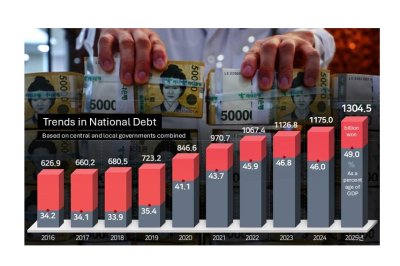

Data from the National Data Agency and the Ministry of Economy and Finance illustrate South Korea’s national debt and fiscal trends. Graphic by Asia Today and translated by UPI
April 6 (Asia Today) — South Korea’s national debt exceeded 1,300 trillion won ($864.0 billion) for the first time in 2025, while the government posted a managed fiscal deficit above 100 trillion won ($66.3 billion) for a second straight year, according to official data released Monday.
The government’s annual settlement report showed total national debt reached 1,304.5 trillion won ($864.0 billion), up 129.4 trillion won ($85.8 billion) from a year earlier.
The debt-to-GDP ratio rose to 49.0%, up 3.0 percentage points from 46.0% the previous year.
Government debt has risen sharply since the COVID-19 pandemic, increasing by nearly 500 trillion won ($331.5 billion) over the past five years as authorities expanded borrowing to support economic stimulus and welfare spending.
Per capita national debt climbed to about 25.2 million won ($16,700), an increase of about 2.8 million won ($1,900) from a year earlier.
Officials attributed the rise largely to increased government borrowing as tax revenue fell short of spending needs, leading to expanded issuance of treasury bonds.
Central government debt accounted for 1,268.1 trillion won ($840.0 billion) of the total, with most of the increase driven by additional bond issuance. Foreign exchange stabilization bonds also rose as authorities sought to manage currency volatility.
Total revenue and spending were 637.4 trillion won ($422.6 billion) and 684.1 trillion won ($453.6 billion), respectively, resulting in a consolidated fiscal deficit of 46.7 trillion won ($31.0 billion).
The managed fiscal balance, which excludes social security funds and is a key indicator of fiscal health, recorded a deficit of 104.2 trillion won ($69.1 billion). Although slightly lower than the previous year, the deficit remained above the government’s fiscal rule target of 3% of GDP, coming in at 3.9%.
Officials warned that continued fiscal deficits, combined with rising spending pressures linked to global uncertainties including the Middle East conflict, are adding to concerns over the country’s fiscal sustainability.
— Reported by Asia Today; translated by UPI
© Asia Today. Unauthorized reproduction or redistribution prohibited.
Original Korean report: https://www.asiatoday.co.kr/kn/view.php?key=20260406010001683