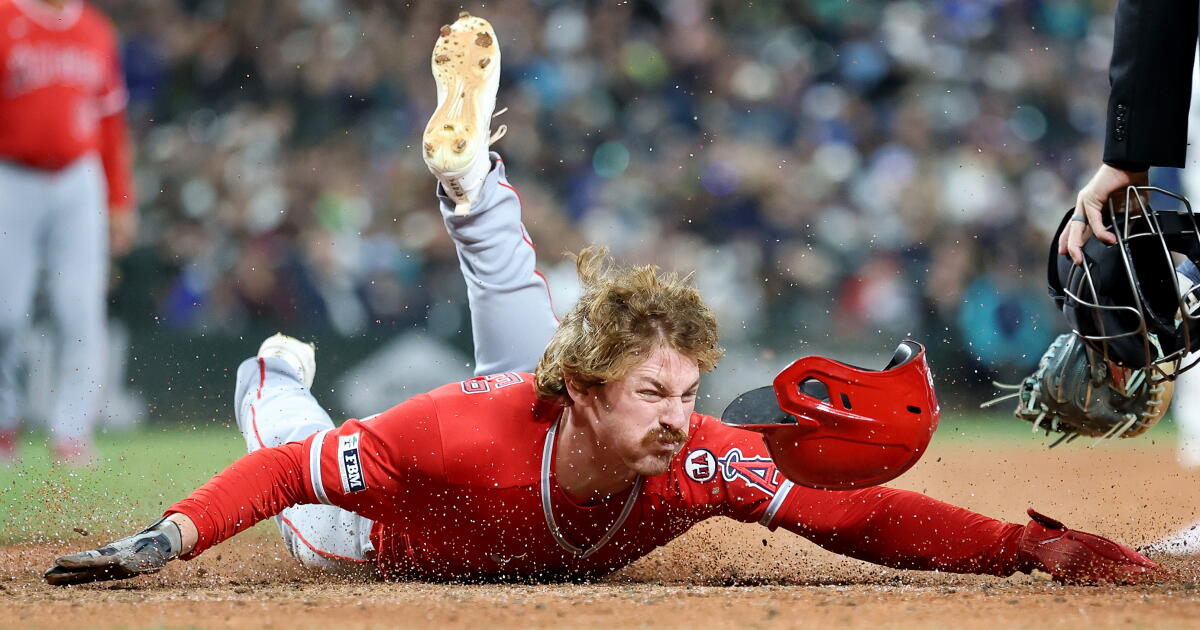
SEATTLE — Taylor Ward put Seattle ahead with a pinch-hit two-run single in the seventh inning, J.P Crawford followed with a two-run homer and the Mariners beat the Angels 8-4 on Saturday night.
Mariners left-hander Kade Anderson threw 3⅓ scoreless innings but left in the fourth after taking a 104-mph line drive to the left arm hit by Christian Moore. Michael Rucker came on in relief. The Mariners (75-86) said Anderson had a left forearm bruise.
Ward, who has struggled since joining the Mariners from Baltimore at the trade deadline, drove in Cole Young and Michael Arroyo with his hit off Angels lefty Mitch Farris (1-4).
Crawford hit Farris’ next pitch into the right field stands.
The Angels (62-99) tied the game with four runs in the sixth. Bryce Teodosio drove in a two-run single off reliever Jose Ferrer, Wade Meckler scored from third on a sacrifice bunt from Tyler Heineman and Jose Siri tied it on a groundout to third base that scored Teodosio.
In the ninth inning, Josh Naylor reached on a walk and stole second base, becoming the first first baseman since George Sisler in 1920-1922 to have consecutive 30-steal seasons.
Gabe Speier pitched a scoreless ninth inning for the Mariners. Carlos Vargas (3-0) got the win.
Up next: Angels left-hander Yusei Kikuchi (1-6, 4.88 ERA) will face Mariners right-hander Logan Gilbert (12-11, 3.81 ERA) in Sunday’s season finale.
Texas quarterback Arch Manning has apologized for his public reaction to a video that was altered by AI to show Longhorns coach Steve Sarkisian slapping ESPN reporter Holly Rowe and knocking her to the ground.
Talking to reporters on Monday, Manning brought up the video, then laughed about it and called it “a good one” and “hilarious.”
The next day, the grandson of Archie Manning and nephew of Peyton and Eli Manning posted an apology on his Instagram Story.
“In my press conference yesterday, I made an insensitive comment about an AI video,” Manning wrote. “There is nothing funny about it. It’s easy to say I didn’t mean it, but I know my words and actions were hurtful to a lot of people. I do not take that lightly and am deeply sorry for that.
“I specifically want to apologize to Holly Rowe for what she has personally had to deal with because of my comments. I have a ton of respect for her and appreciate her showing me grace in this moment. I need to do better and will be more thoughtful going forward.”
Rowe posted Manning’s apology on X and indicated she’s not holding a grudge.
“Thank you Arch. I appreciate our conversation about this — which will remain private,” Rowe wrote. “Apology accepted. We move forward with respect and kindness for one another.”
On Saturday, Manning rallied the then-No. 4 Longhorns from a 20-point deficit in the fourth quarter to defeat top-ranked Ohio State 24-23. In the real video of Rowe attempting to interview Sarkisian, the coach yelled a few Texas cheers before rushing away from the veteran sideline reporter to join his team’s celebration.
Folks confuse the medicine with the symptoms when they ask for dollarization or argue against it, as if the magic wand of switching to the dollar would cure the deep debt and the fiscal imbalances of the broken State-led model that crippled Venezuela.
Marcos Planchart wrote on this site last week that “it is certainly not the paper where the bolívar is printed the element that corrupts people or destroys the economy: it is the system behind it.” I agree with that sentence entirely. However, dollarization is not the first decision. There is a sequence that comes before it, and it is the sequence, not the currency, that determines whether any of this holds.
Antonio Ecarri and Steve Hanke want to change the unit of account. Planchart wants to keep it and repair the institutions standing behind it. Both are arguing about the currency. The currency is the second question, and it answers itself once you have answered how to fix the fiscal imbalance.
Those imbalances have four fixes: a legitimate and credible government, a closed deficit, restored conditions for private investment, and an open and transparent market for trading bolívares and dollars. Or you can dollarize. Notice that the first four require no change in the unit of account at all.
Here is the simplified mechanism: A government running a deficit it cannot finance has the Central Bank issue bolívares to cover it. The new money goes looking for dollars and for hard assets, and the rate moves. Running an official rate alongside the market one does not stop that. It only decides who captures the difference.
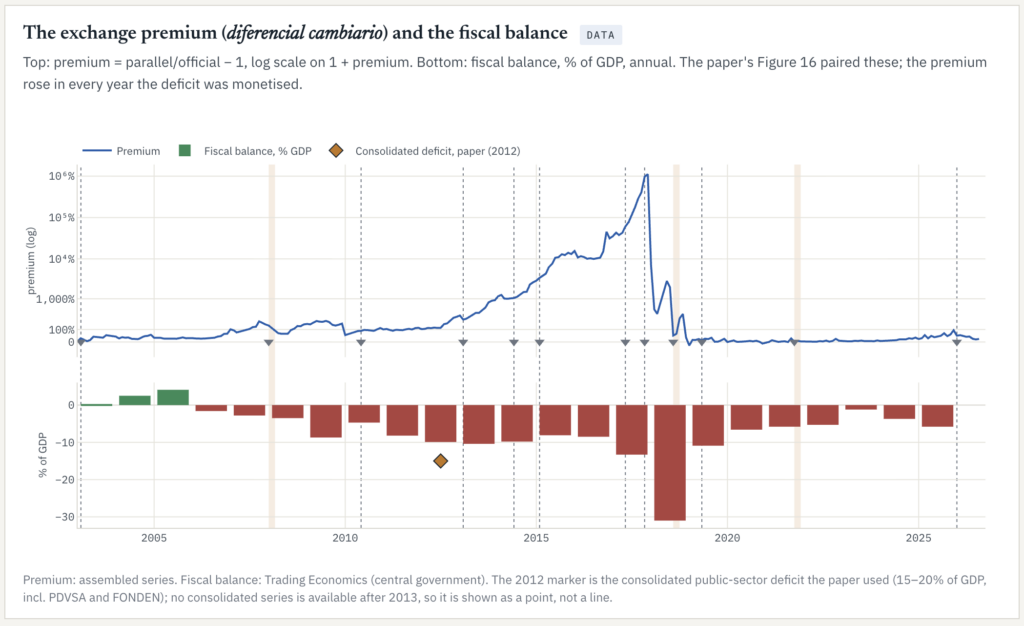
Top: Venezuela’s exchange premium, the parallel rate over the official rate, on a log scale, rising from near zero to over a million percent in 2017 and back down. Bottom: the fiscal balance as a share of GDP, in deficit every year from 2006. The exchange premium and the fiscal balance. The premium rose every year the deficit was monetized. Premium from the assembled official and parallel series. Fiscal balance from Trading Economics, central government. The 2012 diamond is the consolidated public sector deficit used in the 2013 paper, which included PDVSA and FONDEN; no consolidated series is published after 2013.
Dollarization is a reasonable destination after the fiscal work and a ruinous substitute for it. Do the work and you may not need it, because the inflation it was sold to cure will already be gone. Skip the work and it will cost you more than the bolívar does. Redundant or ruinous. There is no third case.
The three consequences, one at a time
Planchart lists what the case for dollarization claims: eliminating inflation, forcing fiscal discipline, eradicating corruption. Take them in that order.
First: it does eliminate inflation. This is Hanke’s most popular claim, and it is true. Ecuador dollarized in January 2000. Inflation averaged 39% a year through the 1990s and 2.9% from 2003 to 2024. The policy does achieve inflation reduction, and it does so quite fast.
Top: Venezuela’s exchange premium, the parallel rate over the official rate, on a log scale, rising from near zero to over a million percent in 2017 and back down. Bottom: the fiscal balance as a share of GDP, in deficit every year from 2006. The exchange premium and the fiscal balance. The premium rose every year the deficit was monetized. Premium from the assembled official and parallel series. Fiscal balance from Trading Economics, central government. The 2012 diamond is the consolidated public sector deficit used in the 2013 paper, which included PDVSA and FONDEN; no consolidated series is published after 2013.
Now notice what that concession costs the other side. Inflation is the entire platform. It is why the argument is popular in Caracas, and why anyone is listening to Ecarri in 2026. The harder thing to see is this: if we stabilize the fiscal accounts and jump-start private investment, inflation can be tamed and the case for dollarization goes with it. You cannot sell a cure for a disease the patient no longer has.
Second, it does not force fiscal discipline. Ecuador ran deficits in twelve of the thirteen years from 2013. The one exception was 2022, by four hundredths of a percentage point. Public debt went from 19% of GDP in 2011 to 64% in 2020, and Ecuador defaulted that year. It is 54% now. Growth averaged 6.4% a year from 2011 to 2014 and 1.4% from 2015 to 2019.
The mechanism is the one Planchart names himself. He warns that dollarization leaves a country “even more vulnerable to external shocks, such as a sudden plunge in oil prices.” That is precisely what happened to Ecuador after 2014. Oil fell, Ecuador could not devalue, and the shock had nowhere to go except the budget, and from the budget into debt and into lost growth. He states the fear and never uses the country it happened to. It is the best evidence in his own case and he leaves it on the table.
The deficit does not disappear when the currency changes. It simply has to be paid in a currency you cannot print.
Dollarization took away the printing machine, not the deficit, so the adjustment fell on debt instead of on prices. Ecuador does not show that dollarization is harmful. It shows that it is not enough. Of its two defaults, 2008 is the weaker example: it fell in a surplus year and was a choice rather than a financing crisis.
Third, regarding corruption, Planchart has already answered it, and I will not repeat a good argument badly. The exchange differential was never an oversight. It was an instrument. Change the currency and the people who built it still hold the pen.
What getting the sequence wrong costs
Planchart says a failed dollarization would force the government into more debt and severe cash shortages. He is right. Here is the size of it.
We ran the model with the same economy twice from the same starting position, $13.4 billion of reserves in 2026, changing one thing. Dollarize now on today’s deficit, alter nothing else, and the state’s dollar position will fall through zero in the third year and reach minus $24 billion by 2034. Dollarize after fiscal consolidation, with private investment recovering, and the same position accumulates to plus $127 billion. Same reserves, same model, one difference.
The deficit does not disappear when the currency changes. It simply has to be paid in a currency you cannot print.
Two lines from the same starting point of $13.4 billion in 2026. The green line, dollarization after the deficit is closed, rises steadily to about $80 billion by 2031. The red line, dollarization alone with the deficit unchanged, falls steadily and crosses zero in 2029, marked “dollars run out, 2029”. Dollarizing without fiscal reform is a recipe for disaster. Shown to 2031; the simulation runs to 2034, by which point the red path is minus $24 billion and the green one plus $127 billion. Every assumption behind it is a control the reader can move at https://www.bolivarjesus.com/KangarooPegRevisited2026/
Why 576% inflation sits on a deficit near 6%
Planchart gives the number: inflation reached 576% year on year in July. The mechanism above explains the direction. It does not explain the size, and the size is the interesting part.
The bolívar base has collapsed; measured at the parallel rate, it was around $15 billion in 2011 and 2012. In July 2026, it was $1.7 billion. The base that can be monetised is a ninth of what it was.
In 2013, Gino Bettocchi and I wrote about a State running a consolidated deficit of 15% to 20% of GDP, including PDVSA and FONDEN. On the narrower central government measure that is still published, the deficit has roughly halved since then, from 9.9% in 2012 to 5.8% last year. A far smaller deficit now carries the inflationary force that an enormous one carried then, because there is so little left to dilute. That cuts against both camps. It is not evidence that the bolívar is cursed, and it is not evidence that only the dollar can fix it. It is arithmetic about a very small base.
Where I actually disagree
Planchart wants to keep the bolívar permanently, in part to preserve room for industrial policy. The unit of account does not carry that weight, in either direction.
What breaks or holds a monetary regime is the deficit, private investment, and the institutions behind them. Those three decide the outcome, whether prices are quoted in bolívares or in dollars.
The argument about maintaining the unit of account in bolívares is about the State’s capacity to protect and nurture strategic industries. But industrial policy is paid for by a State with fiscal room, and Venezuela has neither. It becomes possible after stabilization, not instead of it.
Without credible rules, there is no private investment. Without investment, there is no oil and no tax base. Without revenue, there is a deficit. And a deficit breaks any exchange rate regime, whether it is denominated in bolívares or in dollars.
Planchart may well be right. His is a claim about what Venezuela becomes over the medium and long term; mine is about what stops the bleeding now. Our hope is that between the two visions, readers get the order of operations.
His best line is that starting dollarization under chavista rule is like handing the reconstruction of the oil sector to a man who helped destroy the electricity grid. I would make it structural rather than personal, because it is an argument about order.
Stage one is not monetary. It is a legal framework credible enough that private capital comes back. Without credible rules, there is no private investment. Without investment, there is no oil and no tax base. Without revenue, there is a deficit. And a deficit breaks any exchange rate regime, whether it is denominated in bolívares or in dollars. Once those policies are in place, they will open the market and the premium will close on its own. Then, the decision about Venezuela adopting the dollar formally can be taken calmly, from strength, rather than desperately as a rescue.
In 2013 we wrote that the choice was reform or hyperinflation. Maduro chose hyperinflation, and it ran from 2017 to 2021. The 2026 version of that choice is not dollar or bolívar. A currency is imported. A State is built.
“The Kangaroo Peg” was written by Gino Bettocchi and Jesús Bolívar, Second Year Policy Analysis, Harvard Kennedy School, 2013, advised by Ricardo Hausmann. The thirteenth year update, with both figures, the model and its sources, is available here.
Angel City and the Denver Summit played to a 3-3 draw at BMO Stadium on Friday.
Angel City (9-8-6) opened the scoring in the 45th minute when defender Sarah Gorden intercepted the ball and immediately played it to Maiara Niehues for a goal. The midfielder matched the club record with her eighth goal of the season.
Denver forward Yuzuki Yamamoto scored for the third straight game in the 49th minute with a shot from inside the box. A minute later, Lindsey Heaps scored her first goal for the Summit (8-8-7) on a rebound.
Janine Sonis added a long-range goal for the Summit in the 61st minute to give Denver a 3-1 lead.
On a breakaway in the 63rd minute, Angel City’s Sveindís Jonsdottir passed the ball to Prisca Chilufya for a tap-in. It was initially ruled offside but video review overturned the call.
Later, Denver defender Ayo Oke’s high boot in the box caught Angel City midfielder Ally Sentnor in the face. Sentnor converted on the ensuing penalty kick for the final goal in the 74th minute.