The U.S. Army says it hopes to see production of a finalized version of the next-generation M1E3 Abrams tank begin next year. The exact timeline will depend on the performance of early prototype tanks in testing by operational units, which is slated to kick off later this year.
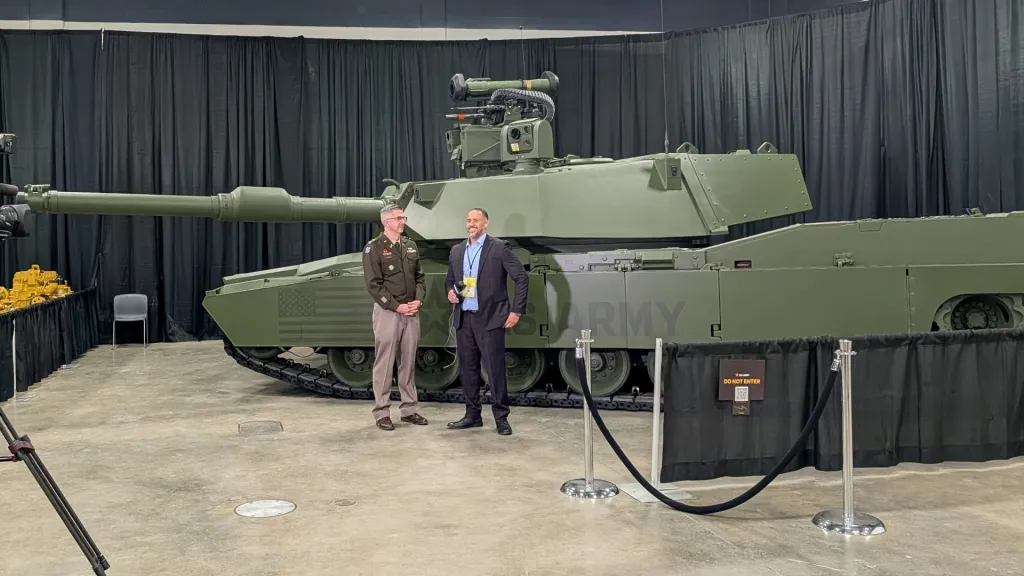
Brent Ingraham, Assistant Secretary of the Army for Acquisition, Logistics, and Technology, discussed current plans for the M1E3 program with TWZ and other outlets at a media roundtable on the sidelines of the Association of the United States Army’s (AUSA) annual Global Force Symposium yesterday. The Army officially unveiled the first early prototype M1E3 at the Detroit Auto Show in January, which was delivered years ahead of the program’s original schedule.
“That will again be this summer, early fall,” Ingraham said when asked about the schedule for M1E3 early prototypes arriving at so-called Transformation In Contact (TIC) units. These are operational formations that have been given a test role as part of the Army’s larger TIC effort, which is intended to help accelerate the fielding of new and improved capabilities, as well as tactics, techniques, and procedures to go with them.

Beyond that, the central goal for the M1E3 program is “to get to production as fast as possible,” Ingraham continued.
The Army’s top acquisition official added that “it’s going to depend on how well they [the early prototypes] perform,” but that “hopefully” production of the new tanks will then start “in the next 12 months or so.”
It also remains to be seen how the M1E3’s configuration may evolve between now and production start. Whether the next-generation tanks will be entirely new production vehicles is also not entirely clear. The early prototype shown at the Detroit Auto Show featured a substantially reworked hull and now uncrewed turret, but that was clearly still derived from the configuration of the latest M1A2 System Enhancement Package Version 3 (SEPv3) Abram variant. Prime contractor General Dynamics Land Systems had previously rolled out an AbramsX next-generation demonstrator with a much more significantly evolved design.


AbramsX Technology Demonstrator on the Move
That being said, the M1E3 early prototype does differ in a host of other very important ways from the M1A2 SEPv3. At the top of that list is a new hybrid propulsion in place of the fuel-hungry gas turbine found on previous Abrams models. The new propulsion configuration includes a modified Caterpillar C13D six-cylinder diesel engine and an ACT1075LP transmission from SAPA. Army officials have previously said the M1E3 will be between 40 and 50 percent more fuel efficient compared to previous versions.
The M1E3 also has new lightweight tracks from American Rheinmetall and a hydropneumatic suspension system understood to have come from Horstman Group. In a post on X in January, the latter firm noted that switching “to external hydropneumatic suspension” helps “free up crew space by removing torsion bars,” but did not explicitly confirm its involvement in the program. A suspension system of this kind, which has been tested on Abrams in the past, also allows for the hull of the tank to be raised and lowered in ways that can help improve survivability and offer other operational benefits.
The M1E3’s crew configuration differs significantly from existing variants, as well. The next-generation tank’s turret is intended to be entirely remotely operated, with the truncated three-person crew (instead of the traditional four) moved down into the front of the hull. The loader role is eliminated, and an autolaoder is set to be utilized instead. Historically, the U.S. military, as well as many Western armed forces, have eschewed autoloaders in their tanks. Soviet and now Russian tank designs, along with Chinese ones, have more typically had this feature. In terms of the M1E3’s main gun, the Army otherwise looks to be sticking with the same 120mm smooth-bore type used on Abrams variants now.
Interestingly, what has been seen so far of the expected crew compartment for the M1E3 is also similar in many broad respects to the design of Russia’s T-14 Armata. Despite having made its public debut in 2015, the T-14 has, at best, seen very limited operational service. In addition, the M1E3’s driver will operate the tank via a controller that looks like one that might come with a video game console, which the Army has said is a deliberate choice.
“It now takes just 30 seconds to train a young soldier to drive that tank – something that used to take us days, even weeks,” Col. Ryan Howell, the program manager for the M1E3, told Fox News back in January in Detroit. “I’ll share a quote from one of the soldiers who helped us early in the process. When we first sat him down at the crew station, he was already in the process of transitioning out of the Army, but he was assisting us by informing key design decisions. He told us, ‘If I had known I could work on a platform like this, I would have stayed in the Army.’”
These various design elements are key to the Army meeting its goals for the overall weight of the M1E3. The service has previously said that it hopes the next-generation tank will tip the scales at around 60 tons. Weight creep has been a major issue for the Abrams since it first entered service in the 1980s, with the latest M1A2 SEPv3 variant coming in at 78 tons.
“This next-generation Abrams is designed to transform how armored units operate globally,” Michelle Link, the Army’s Deputy Capability Program Executive for Ground Combat Platforms, had said in a press release in January. “By streamlining its sustainment needs and increasing deployment speed, the M1E3 Abrams ensures faster movement from ports to the front lines, making it more agile and accessible in any environment.”
In terms of other capabilties, the M1E3 early prototype presented in Detroit had a Leonardo DRS Stabilized Sight System (S3), which features a mix of electro-optical and infrared cameras, and a remote weapon station (RWS) from EOS on top of the turret. The RWS was armed with a 40mm automatic grenade launcher, a 7.62x51mm machine gun, and a Javelin anti-tank guided missile. The M1E3’s complete armament package could still expand, including with the addition of launchers for loitering munitions.

The Army currently says the M1E3 will be fitted with a version of the Israeli-design Iron Fist active protection system (APS). The service is already fielding that APS, which it has now designated as the XM251, on the M2A4E1 variant of the Bradley infantry Fighting Vehicle. It is also expected to be integrated onto 8×8 Stryker wheeled light armored vehicles and the future replacement for the Bradley family, tentatively designated the XM30. Iron Fist’s prime contractor, Elbit Systems, notably just recently disclosed that the system has at least some capability to defeat incoming kamikaze drones, as well as anti-tank guided missiles and other infantry anti-armor. The Army is also now pursuing add-on passive anti-drone armor for existing Abrams tanks and other armored vehicles, which could make its way onto the M1E3.


Iron Fist APS | Active Protection System for Armored Vehicles
In Detroit, other cameras were seen positioned at various points around the M1E3’s hull and turret, providing the crew with what looks to be a distributed vision system. This would allow the crew to ‘see’ through the hull of the tank while sitting nestled under its armor with all the hatches sealed. The camera feeds could be integrated into a helmet-mounted system and paired with augmented reality to create an overlay with various important data.
The next-generation tank is also expected to feature a variety of other advanced systems, including new targeting capabilities and other onboard sensors, as well as a networked communications suite.
The Army clearly expects the M1E3’s design to further evolve, at least to some degree, based on Soldier feedback and other data collected during testing that will start later this year. Time will tell how different the final configuration is from the early prototype the service unveiled in January.
If the core design performs well and the program otherwise keeps to its aggressive schedule, production of the Army next main battle tank could well start next year.
Contact the author: joe@twz.com