NextGen

UK And Dutch Partner On Next-Gen Amphibious Assault Ships

The United Kingdom and the Netherlands will jointly develop a new fleet of amphibious transport ships under a maritime partnership announced by the British government. Each country will operate four vessels, strengthening NATO’s amphibious capabilities and improving the alliance’s ability to respond rapidly to crises.

“Combining the U.K.’s industrial expertise with the Netherlands’ design and seafaring experience to deliver ‌first-rate platforms for our elite amphibious forces, this partnership will strengthen ⁠NATO,” U.K. Prime Minister Keir Starmer said in a statement issued while he attended the NATO Summit in Turkey.

The new landing platform docks (LPD) will be based on a Dutch design and will be built in U.K. shipyards “alongside Dutch industry,” as part of a deal worth £2.4 billion ($3.2 billion), covering the four ships for the U.K. Royal Navy and four for the Royal Netherlands Navy. These are expected to enter service from the early 2030s.

What the United Kingdom refers to as the Amphibious Transport Ship Program supersedes the previous Multi-Role Strike Ship (MRSS) program, which was judged “too complex” and not reflective of the future U.K. Commando Forces.

The arrangement has some parallels with the recently announced program to build five Type 26 frigates for Norway, with the warships coming out of British shipyards.

Although the final design has not been confirmed, Dutch shipbuilder Damen is widely expected to provide the design basis, likely drawing from its Enforcer amphibious ship family.

A three-view rendering of one of the Enforcer amphibious ship family. Damen

The U.K. government says the vessels will be 525 feet (160 meters) long and will have a displacement of 15,000 tonnes. Damen offers a total of seven different Enforcer designs, ranging in displacement from 9,000 tonnes to 17,000 tonnes. It is unconfirmed if the vessels will be of the conventional LPD-type layout, as seen at the top of this article, or if they will be of the through-deck type, providing a longer flight deck for helicopter and drone operations.

As well as transporting troops, vehicles, and equipment, the vessels will have flight decks designed to operate current and future long-range drones and autonomous systems. This is in line with the U.K. Royal Navy’s shift to what it describes as a ‘hybrid navy.’

For construction, it appears that the program will rely upon the Harland & Wolff shipyard in Belfast, Northern Ireland. Navantia UK, the owner of Harland & Wolff, shared the following statement:

“Amphibious transport ships will be a vital component of Britain’s sovereign naval defense capability going forward. As outlined in the Defense Investment Plan, they will enable troops to be deployed around the world and are a necessary replacement for the Albion class assault ships.”

HMS Albion is pictured operating with Dutch Royal Marines. The Albion Class, Landing Platform Dock ships (LPD) primary function is to embark, transport, and deploy and recover (by air and sea) troops and their equipment, vehicles and miscellaneous cargo, forming part of an Amphibious Assault Force.
HMS Albion is pictured operating with Dutch Royal Marines. Crown Copyright LA(PHOT) Dan Hooper

After the United Kingdom officially decommissioned HMS Ocean in 2018 and sold it to Brazil, the Royal Marines had to rely on the Royal Navy’s two Albion class LPDs. However, in 2024, the U.K. Ministry of Defense announced that both Albion and Bulwark would be withdrawn from service the following year.

HMS Ocean's embarked helicopters carry out training whilst heading for the Caribbean during Op RUMAN. In 2017 HMS OCEAN was one of the ships to be tasked to support the government's Humanitarian Aid and Disaster Relief (HADR), providing assistance in the aftermath of Hurricanes IRMA, JOSE and MARIA in the Caribbean. The Royal Navy's flagship, a large helicopter carrier, HMS Ocean was diverted from her NATO deployment in the Mediterranean to provide assistance. The HADR team on board HMS OCEAN included Royal Marines, Medics, and Engineers, specialising in electronic, mechanical, structural disciplines as well as damage control experts. HMS OCEAN carried a large tailored Air Wing of Royal Navy and Joint Helicopter Command Helicopters and with four landing craft and was able to make a significant contribution to the recovery and reconstruction effort in the region. This image was part of the 2018 Royal Navy Photographic Competition, The Peregrine Trophy.
HMS Ocean is seen in 2017, before its transfer to Brazil. Crown Copyright LPhot Kyle Heller

Since then, the Royal Marines have made use of the three Bay class landing ship docks. The Royal Fleet Auxiliary (RFA), a civilian mariner service akin to the U.S. Military Sealift Command, operates these ships, which have more limited capabilities than the LPDs.

RFA Lyme Bay sails into the Red Sea for operations in the Gulf and Strait of Hormuz. Crown Copyright LPhot Damien Bye

At one point, the British were planning to procure up to six Multi-Role Strike Ships (MRSS) to replace the two Albion class, three Bay class, and the single RFA Argus. Budget pressures reduced those ambitions. While the Royal Navy will now get four new assault ships, they will form something like a joint force with the same number of Dutch vessels.

As for the Royal Netherlands Navy, it currently operates two Rotterdam class LPDs and a single Karel Doorman class multifunction support ship, also outfitted for amphibious operations. The new LPDs are expected to replace the Rotterdam class.

The Royal Netherlands Navy Joint Logistic Support Ship (JSS) Karel Doorman arriving in Freetown, Sierra Leone with a consignment of vehicles to help in the fight against Ebola in the region. The Karel Doorman is a support ship with the Royal Netherlands Navy and is equipped with a crane and lift to hoist heavy materiel. The ship can transport about 5,000 tonnes of heavy rolling (armoured) materiel and has a hospital with two operating theatres. The JSS also has landing pads for helicopters, such as Chinooks, Cougars and the NH90.
The Royal Netherlands Navy Joint Logistic Support Ship (JSS) Karel Doorman. Crown Copyright PO (Phot) Carl Osmond

Significant is the fact that the eight new LPDs are involved, representing a considerable boost for the amphibious forces of both navies.

These services already operate closely together under the U.K.-Netherlands Amphibious Force, which dates back to the Cold War.

“This partnership is not just about building ships; it is also about delivering long-term security for both the U.K. and the Netherlands, ensuring we are able to stay ahead of the threats of tomorrow,” Prime Minister Starmer said.

U.K. Defense Secretary Dan Jarvis added: “We are building an even stronger amphibious force with the Netherlands, strengthening our defense and deterrence as close NATO allies and JEF [Joint Expeditionary Force] partners.”

The commonality of LPDs will also see the Royal Navy and Royal Netherlands Navy increasingly train, deploy, and operate together, the U.K. government has confirmed.

Operating from RFA Mounts Bay, U.K. personnel from the Commando Force load a Dutch landing craft with U.K. vehicles as part of training to confirm interoperability. Crown Copyright Cpl Katrina Knox

The drone aspect is also important, with the new LPDs being viewed as a way of accelerating industrial and military cooperation on autonomous and uncrewed technology.

While the kinds of drones that will go aboard the vessels have not been disclosed and are probably still a work in progress, it’s clear that the LPDs fit in with the United Kingdom’s vision for future warfare. The recently published Defense Investment Plan provides a budget of more than £5 billion ($6.6 billion) over four years just for drones and related capabilities, as you can read about here.

There is also further scope for cooperation here, with the U.K. government confirming that there are plans for future drone and uncrewed technology to be developed between the two nations.

The partnership also has significant implications for security in the North Atlantic and High North, regions that have become increasingly strategic as NATO bolsters its northern defenses in the face of increasing tensions with Russia.

Wildcat helicopters from 847 Naval Air Squadron conduct load-lift training with the Mobile Air Operations Team (MAOT) and their Dutch equivalents while deployed to northern Norway, for an exercise in the Arctic Circle, Operation Clockwork. Crown Copyright POPhot Lee Blease

Alongside other NATO and JEF allies, the new LPDs will be expected to work together to protect critical undersea infrastructure and strengthen deterrence against emerging threats in these waters.

The new amphibious transport ships represent a major reset of Britain’s amphibious capability after years of uncertainty and force reductions. Operating alongside Dutch vessels, autonomous systems, and NATO partners, they are expected to become central elements of the Royal Navy’s future expeditionary and hybrid warfare model.

Contact the author: thomas@thewarzone.com

Thomas Newdick is a staff writer at TWZ, where he covers military aviation, defense technology, weapons systems, and international security. Based in Berlin, Germany, he reports on conflicts, military modernization efforts, and emerging aerospace technologies around the world, with a particular interest in airpower and its role in contemporary warfare. His reporting is informed by deep expertise in modern and historical airpower, particularly in Europe, with a focus on military aviation, air campaigns, and aerospace developments across the continent and beyond.


Source link

Germany And Spain Launch ‘Team Gen 6’ After Europe’s Next-Gen Fighter Effort Collapses

In a significant development for Europe’s future air combat ambitions, Airbus is trying to restart the program to develop a sixth-generation combat jet, now under German and Spanish leadership. This comes less than a week after the Franco-German-led New Generation Fighter (NGF) effort effectively collapsed in its original form, amid acrimony between Paris and Berlin. The NGF was planned as the crewed centerpiece of the pan-European Future Combat Air System (FCAS), which Airbus, as the leading European aerospace corporation, now hopes to get back on track.

Airbus’s Defense and Space unit launched the ‘Team Gen 6’ initiative today with a message on X, declaring that it was “an exciting step for European sovereignty.” So far, eight German defense and aerospace contractors have signed a strategic positioning paper as part of the effort. Those firms are Autoflug, Diehl Defense, Hensoldt, Liebherr, MBDA Germany, MTU Aero Engines, and Rohde and Schwarz.

Reflecting the German-Spanish nature of the new program, those companies are now “closely integrated” with firms from Spain, comprising GMV, Grupo Oesia, Indra, ITP Aero, and Sener.

“While the development of the overarching [FCAS] ‘system of systems’ is progressing as before, the sixth-generation fighter aircraft integrated within it requires a new, agile industrial setup,” Airbus said.

A screencap from an Airbus video showing a notional future fighter working with remote-carrier-type drones. Airbus screencap

“As Team Gen 6, we have the capabilities and the capacities. Now, we are looking for close alignment with policymakers and the air force[s] to drive forward a superior European air combat system for collective security,” the X post stated.

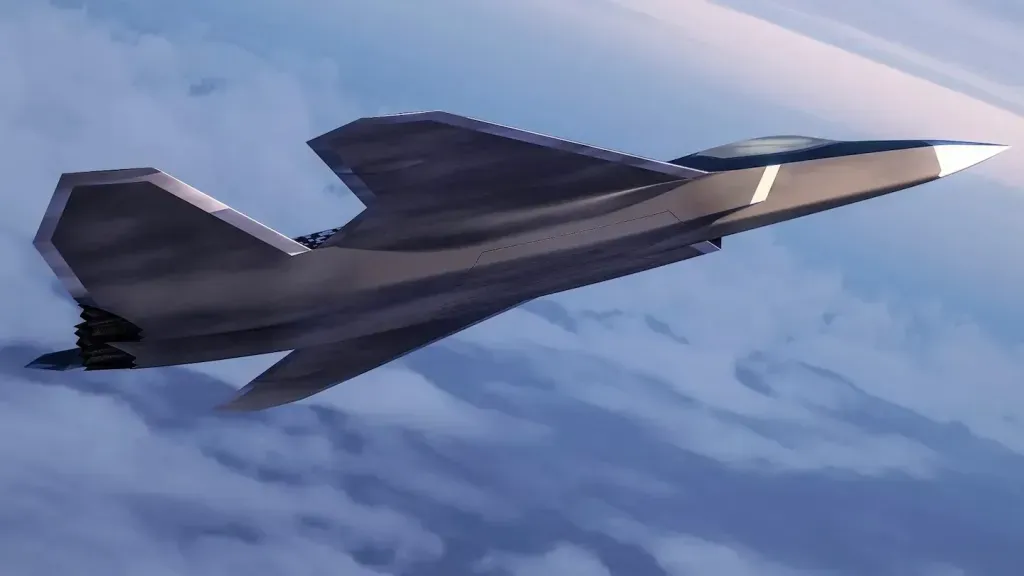
Airbus also presented a video showing a notional concept aircraft flying with multiple uncrewed platforms. While not too much (as in not much at all) should be read into this, the crewed aircraft features canard foreplanes, a chin intake, and an unusual cranked wing.

Speaking just ahead of the announcement, at the ILA Berlin airshow today, where TWZ was in attendance, Jean-Brice Dumont, head of air power at Airbus Defense and Space, said the company remains committed to delivering a sixth-generation combat jet. “There is a need for a bit of a reshaping and reconsidering the reality of today,” Dumont added.

SYMBOL - 10 June 2026, Brandenburg, Schönefeld: Federal Chancellor Friedrich Merz (2nd from left, CDU) and Jean-Brice Dumont (2nd from right), Head of Air Power at Airbus Defence and Space, stand in front of a drone during a tour of the International Aerospace Exhibition (ILA). Photo: Sebastian Gollnow/dpa (Photo by Sebastian Gollnow/picture alliance via Getty Images)
German Federal Chancellor Friedrich Merz (second from left) and Jean-Brice Dumont (second from right), head of air power at Airbus Defense and Space, stand in front of a drone during a tour of the International Aerospace Exhibition (ILA). Photo by Sebastian Gollnow/picture alliance via Getty Images

Dumont explained that the now-abandoned NGF was one of seven separate “pillars” of technology development being worked on under FCAS. As well as the crewed jet, pillars include powerplant, remote carrier vehicles, precision-guided weapons, and data connectivity.

“We have to consider safeguarding areas where it works, and how we reshape,” he added. “At the moment, we are going to seek guidance from our governments [on] what they want us to do. There has to be demonstrated an industrial feasibility of what is being asked — not only technical. That’s probably a lesson now,” Dumont added.

Dumont continued: “The world in 2026 is very different to the world of 2017 when the [FCAS] programme was launched. We have to accept that fact and reshape it — we need another way to get to the same goal, with faster milestones.”

“The problem we had is that we had drawn a line to 2040, and new technologies for everything,” Dumont added, referring to the goal of having the FCAS, including the NGF, in service by that date. “Today, you see demonstrations of connectivity, systems of systems and unmanned vehicles all around the world. The need is there, and in the countries that we are competing with, they are using it already.”

According to Dumont, the company has “put a number of options on the desk of our ministers and ministries of defense,” and is now awaiting further guidance from officials.

As the centerpiece of FCAS, in its original form, the NGF element was the most high-profile and challenging component of the project. However, it had long been dogged by disagreements over industrial workshare and leadership between Airbus and Dassault Aviation, which were the prime contractors for Germany and Spain, and France, respectively.

A 1:1 scale model of the NGF is unveiled at the Paris Airshow in 2019. Dassault Aviation

Dassault had demanded that it play the defining role in NGF, reflecting key requirements for the jet driven by the French Armed Forces. These included the ability to operate from aircraft carriers, and provision to deliver nuclear weapons. Germany or Spain needed neither of these functions.

Despite the disagreements that derailed NGF, Dumont argued that there had still been useful lessons learned from the FCAS program.

“What Phase 1A and 1B [of the program] have given is a very thorough analysis of the repartition of the work between the crewed and uncrewed platforms, and this remains. That kind of shapes what the manned aircraft will have to do.”

As an example of this work, Dumont pointed to ongoing work that will involve trials of a Eurofighter operating as a “command fighter” — a crewed jet that can operate in collaboration with drones, or what Airbus now refers to as uncrewed collaborative combat aircraft (UCCAs). The tests will see a Eurofighter fitted with a Rafael Litening 5 targeting pod modified to serve as the interface between the crewed jet and UCCAs. This should pave the way toward an in-service command fighter capability being introduced to the Eurofighter, something that will be incorporated in the sixth-generation combat jet from the outset.

Kampfflugzeug vom Typ Eurofighter mit Lenkbombe GBU-48 (Guided Bomb Unit 48) fliegt im Übungsgebiet im Rahmen der multinationalen Übung Green Flag West, am 08.05.2018. ©Bundeswehr
A German Eurofighter with a Litening laser targeting and reconnaissance pod on the centerline station. Crown Copyright

Initial trials will involve a Learjet test configured as a surrogate command fighter and flying with drones in an “enhanced teaming” mode. Airbus hopes to have the command fighter-configured Eurofighter ready for operational service in 2029.

“The demand from the customers is: be ready early,” Dumont explained. “This is not a contradiction to the Future Combat Air System challenge — it is the need to have our platforms evolved earlier than we had traditionally planned.”

A model of a notional sixth-generation fighter displayed at ILA as part of a command fighter study by the German Aerospace Center (DLR). Thomas Newdick

The termination of NGF and the launch of Team Gen 6 leaves plenty of questions over the future of Europe’s air combat landscape.

TWZ spoke to Douglas Barrie, senior fellow for military aerospace at the International Institute for Strategic Studies (IISS) research institute in London, for his take on what might happen next.

On the matter of Germany and Spain now teaming up under the Airbus umbrella, Barrie said that the relationship makes a lot of sense, but its success is far from certain. On the one hand, the two countries already work together within Airbus, and both Germany and Spain are seeking a replacement for their Eurofighter fleets.

SONY DSC
A pair of Spanish Air and Space Force Eurofighters. Spanish Ministry of Defense

“In terms of Team Gen 6, I do wonder if there’s an element of trying to kind of scramble to recover something from the wreckage of NGF, as it were, that the collapse of NGF doesn’t signal the end of Spanish industrial interest in next-gen combat aircraft development,” Barrie said. “But if somebody asked me, do I think between Germany and Spain, they can put together a credible program if nobody else is involved? I think that the numbers would be very difficult to stack up.”

Putting the German and Spanish future fighter requirements together, the two countries might, at best, need to build 300 new combat jets, with a figure of 250 more likely, Barrie contended. Team Gen 6 would then face a real struggle to break even.

This reality will, Barrie believes, force Germany and Spain to look for other partners, which will likely come down to a choice between the British-led Global Combat Air Program (GCAP) and the Swedish next-generation combat aircraft program, led by Saab. Of these, GCAP has the Tempest crewed fighter as its centerpiece, and also involves Italy and Japan. Sweden’s crewed fighter requirements are less clear at this point.

A scale model of a possible Tempest configuration, in Italian Air Force markings. Leonardo

Building a role for Airbus in GCAP would be difficult at this point. With the industrial architecture already in place, bringing not one, but two more partners into that program would be disruptive, particularly in terms of timeline. Already, the Japanese in particular are concerned about the pace of the program, especially since the United Kingdom has not yet fully committed to it in terms of funding.

“My own view is that the United Kingdom remains committed to the program, but there are financial pressures elsewhere,” Barrie noted. “I think that the more likely outcome in all of this is a kind of German, Spanish, Swedish tie-up. The kind of requirements in some ways are aligned a bit better.”

This extends to the size of the aircraft, Barrie observed.

“The kind of aircraft that the Swedes seem to be thinking about, the crewed element is probably more of a bigger Gripen E/F, heading towards Typhoon, in terms of size. This is more in keeping with what the Germans and the Spanish seem to be looking for. Obviously, the United Kingdom and Japan, in particular, need something with longer legs and bigger internal payload, hence GCAP.”

The Saab Gripen E. Saab

“GCAP will be highly capable,” Barrie continued. “That will come with a unit cost to go with it. Maybe what the Swedes, the Germans, and the Spanish might do will be cheaper.”

Provided a German, Spanish, Swedish teaming arrangement could work, the resulting combat jet could still enter a space where it would face competition for important export orders from France, which looks set to continue the development of the Rafale, especially now that NGF has collapsed. Further competition could be provided by South Korea with further developments of its KF-21 and Turkey with the TF Kaan, although these are notably less-ambitious fifth-generation designs.

The Tempest, as currently envisaged, with its very different set of requirements, would not necessarily be a direct competitor to Team Gen 6, Barrie argued, since it would be a closer match to the F-47 in terms of size, capabilities, and cost. While the potential size of this market would be more limited, probably U.S. reluctance to export the F-47 would play in the Tempest’s favor.

An official rendering of the Boeing F-47. U.S. Air Force

As to the possibility of the United States offering a ‘watered-down’ export model of the F-47, Barrie considers this unlikely to generate much interest.

“Yeah, you can have a downgraded version of my super airplane — as a kind of marketing slug that hardly sells, does it?” Barrie continued. “Even if it’s 10 percent less capable, even if it’s 10 percent less expensive, it’s still a likely unit cost of $250 million or more, which is eye-watering.”

This leaves us with the French, and what they might be able to recover from NGF.

If France goes it alone with a sixth-generation combat jet, Dassault will likely be strongly backed by the French government, and the company has traditionally punched well above its weight.

In the medium term, Dassault has a healthy backlog of orders for the Rafale and is very much at the right end of the cost curve. Barrie considers that the Rafale will remain a profitable airplane for the foreseeable future, but at some point, France will need to think about a successor based on an all-new airframe. Industrially, France has the capability to go alone with this, but they would likely look to a partner or partners to come on board. The likelihood of those partners coming from Europe has now been reduced, but other possibilities might be found in the Gulf states.

A pair of Rafales from the Qatar Emiri Air Force. Dassault Aviation www.twz.com

Then there is the question of India, which may still buy more Rafales but which, in the fullness of time, is likely to look for a new-generation fighter, and could be a potential partner for France.

“I don’t see the Indians ever being fully committed to only one country,” Barrie continued. India has already hinted that it might want to try and join the pan-European FCAS or GCAP. Meanwhile, Russia has been a long-term military partner for India, and Barrie thinks that the recent appearance of a two-seat version of the Su-57 Felon may well indicate another effort to sell that fighter to India.

Imagery has emerged that appears to show a previously unknown two-seat version of the Sukhoi Su-57 Felon, Russia’s most modern and capable fighter. Provided the available photo is legitimate, and there is nothing obvious to suggest otherwise, at this point, the Russian development would parallel China’s work on a two-seat version of the stealthy J-20.
The previously unknown two-seat version of the Sukhoi Su-57 Felon, which appeared earlier this year. UAC UAC

Were India to continue its pattern of buying Russian combat aircraft, that would give any potential European partner serious pause for thought, based on the security implications. Meanwhile, India also remains committed to developing its own next-generation fighter.

What the NGF debacle has demonstrated is that any potential partner with France on its next-generation combat aircraft program will likely have to be happy taking a junior role, with Dassault calling the shots.

The collapse of the New Generation Fighter could well be a pivotal moment for European defense cooperation, but it does not signal the end of Europe’s sixth-generation combat aircraft ambitions.

Airbus’s Team Gen 6 announcement marks the start of a German-Spanish-led industrial approach that its backers hope will be more agile and less contested than its Franco-German-led predecessor. However, significant political, financial, and industrial challenges remain, including the search for a reliable partner, or partners. As with NGF, the success of Team Gen 6 will ultimately depend on whether European governments can align their strategic priorities and industrial interests to deliver a sovereign future air combat capability.

Contact the author: thomas@thewarzone.com

Thomas Newdick is a staff writer at TWZ, where he covers military aviation, defense technology, weapons systems, and international security. Based in Berlin, Germany, he reports on conflicts, military modernization efforts, and emerging aerospace technologies around the world, with a particular interest in airpower and its role in contemporary warfare. His reporting is informed by deep expertise in modern and historical airpower, particularly in Europe, with a focus on military aviation, air campaigns, and aerospace developments across the continent and beyond.


Source link

Eli Lilly: Next-gen weight loss drug may be more effective than others

May 21 (UPI) — Eli Lilly said its weight loss drug, retatrutide, helped nearly half of participants in a phase 3 trial to lose more than 30% of their weight.

Many of the people who lost that much weight were on the highest dose of retatrutide for up to two years, but the company said that the weekly injection was effective for weight loss across all doses of the drug.

Retatrutide affects three hormones — GLP-1 and GIP, each of which are targeted by similar weight loss drugs, and glucagon, which none of them targets — and could be best for people looking to lose larger amounts of weight, said the company’s chief scientific and product officer, Dan Skovronsky.

“We haven’t seen that level of weight loss before with these kinds of medicines,” Skovronsky said, referring to a group of drugs that includes Eli Lilly’s Zepbound.

“For some patients, 30% weight loss may be more than what they’re seeking,” he said. “For other patients, that may be what they need to get healthy. So, not everyone will go up to the highest dose level and stay on it for two years.”

The phase 3 trial included 2,339 people who were obese or overweight. They were evaluated after 1 1/2 years or two years having injections.

Those who received the highest dose lost an average of 70 pounds, roughly 28% of their body weight, after 1 1/2 years, with patients who were assessed after two years losing an average of 85 pounds, or 30.3% of their weight, the company reported.

Side effects from the drug were reported to be similar to other weight loss drugs, which include nausea, diarrhea and constipation, and some patients also experienced upper respiratory tract infections and a nerve condition called dysesthesia, the company said.

The side effects were also similar to those seen in phase 3 trials evaluating retatrutide for use against diabetes and a specific type of arthritis.

Eli Lilly has not yet applied to the Food and Drug Administration for approval of the drug for any of the three uses.

Source link