USC’s decision to dismiss top scorer and three-point shooter Chad Baker-Mazara on the doorstep of the postseason left many wondering Sunday why coach Eric Musselman would willingly sabotage his team’s already-tenuous hopes of making the NCAA tournament.
To Gilbert Arenas, the former NBA star and podcast host whose son, Alijah, is a freshman guard with the Trojans, the move was particularly baffling. So he took to social media Sunday, wearing Baker-Mazara’s No. 4 USC jersey, to share his frustration.
“Right before the tournament? This is what we’re doing?” Arenas said in the video. “Our best player? Mr. I-Get-Buckets? Every night, he brings it every night. Guaranteed 18, 20 every night.”
“When you the best player on the team, whatever you say, you right,” he continued.

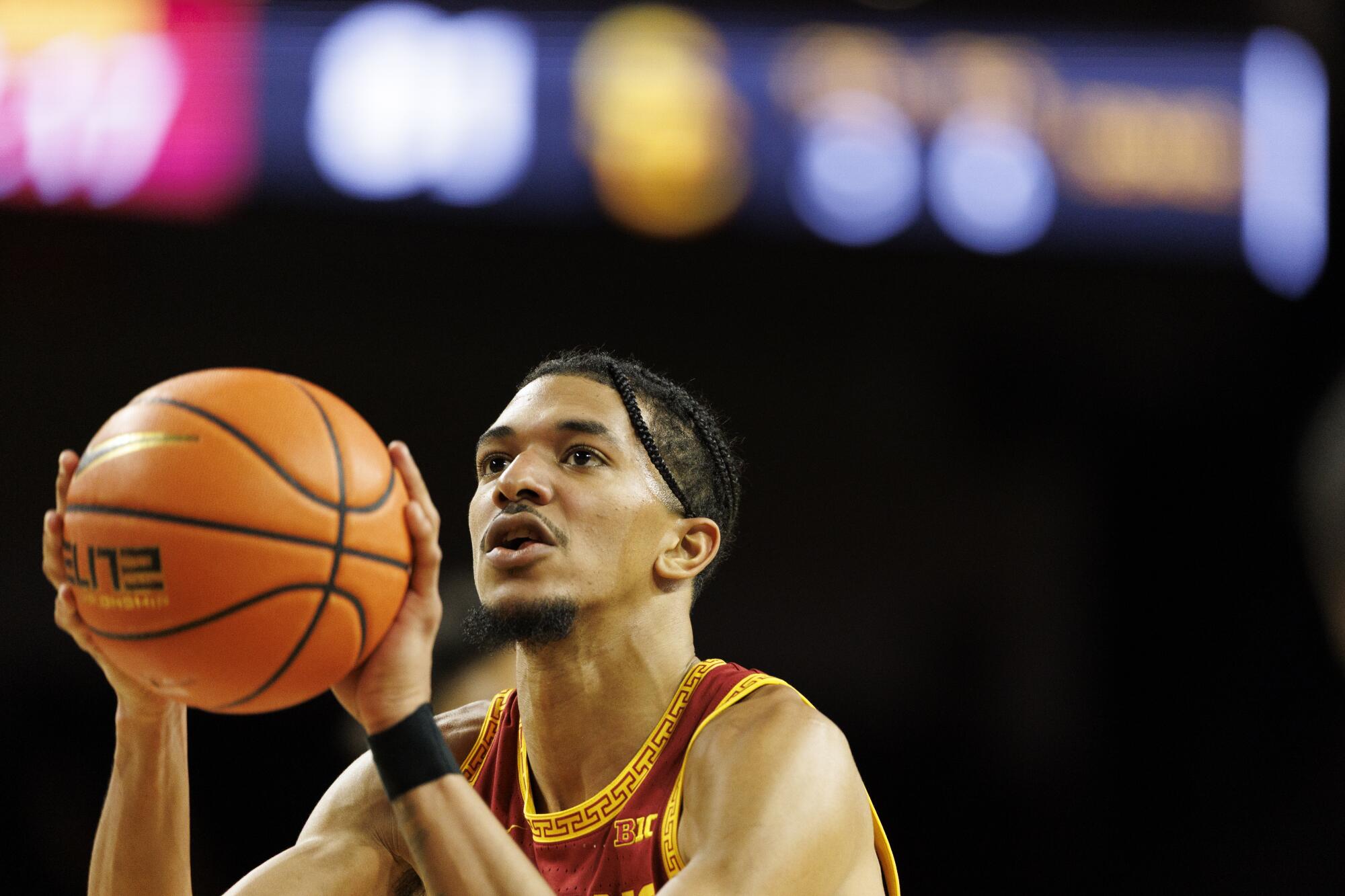
LOS ANGELES, CA – DECEMBER 17, 2025: USC Trojans guard Chad Baker-Mazara (4) shoot a foul shot against the UTSA Roadrunners at Galen Center on December 17, 2025 in Los Angeles, California.(Gina Ferazzi / Los Angeles Times)
(Gina Ferazzi/Los Angeles Times)
But the move to part ways with Baker-Mazara was not based on an isolated incident, a person familiar with the decision but not authorized to discuss it publicly told The Times, but rather a culmination of a season’s worth of issues that boiled over after the second half of Saturday’s loss to Nebraska.
The Trojans were trailing by three points three minutes into the second half when Baker-Mazara took off in transition after Huskers forward Pryce Sandfort, who was driving for a layup. Baker-Mazara closed the gap and swatted the ball. Then he fell hard on the hardwood.
Baker-Mazara had missed three games last month with a Grade I knee sprain and sat out practices throughout the season with other nagging minor injuries. But after a few seconds lying still on the court, he walked on his own down the Galen Center tunnel toward the USC locker room.
Baker-Mazara emerged from the tunnel a couple minutes later with a noticeable limp. He took a seat in a courtside seat on the baseline, two chairs down from injured guard Rodney Rice.
The sight of Baker-Mazara sitting away from the rest of the team sparked questions after the game, but the seating arrangement wasn’t that unusual for Baker-Mazara, who’d sat there at various times this season. What was odd was how Baker-Mazara handled the rest of the half after he told the USC staff he wasn’t able to resume play.
As USC unraveled without him in the second half, Baker-Mazara was mostly detached from the action. At one point, he went behind the USC bench and chatted with fans in the first row.
The incident on its own could have been innocuous. But at the end of a season filled with similar such moments, patience had worn thin.
By the next morning, Baker-Mazara was no longer with the team.
USC did not disclose the reasons for his departure. But the staff was well aware when they brought in the sixth-year senior last spring that his long history in college hoops was littered with similarly volatile moments. USC was Baker-Mazara’s fifth school in six seasons.
“There will never be a dull moment,” Musselman said in May. “Might be that I’ve got a little more on my plate.”
Baker-Mazara spent his freshman season at Duquesne before transferring to San Diego State. He was named Mountain West as a sophomore, but was kicked off the team by coach Brian Dutcher after he skipped classes, failed tests, missed assignments and fell so far behind on his classes he couldn’t catch up.
Baker-Mazara told the San Diego Union Tribune last spring that it was “a growing-up moment” for him. He assured he’d “learned [his] lesson.”

USC forward Chad Baker-Mazara goes up to dunk under pressure from Indiana forward Sam Alexis at the Galen Center on Feb. 3.
(Jae C. Hong / Associated Press)
“Some people have to go through it in different ways,” Baker-Mazara told the Union Tribune. “I had to go through it that way. … My parents were both mad. That was weeks of earfuls: ‘Man, what are you doing?’ It was weeks. I had to get my ear chewed off a couple times.”
He ended up at Northwest Florida State, a junior college in Niceville, Fla., before signing with Auburn. At the time, according to the Union Tribune, Dutcher spoke with then-Auburn coach Bruce Pearl on the phone. He told him that Baker-Mazara’s issues weren’t on the court, but that he “just needs to get his life in better order, be more organized, be more on time, do all the little things.”
Pearl and Auburn proved to be a good fit; though, Baker-Mazara earned some ire there, too, after he was ejected in the second half of Auburn’s two-point tournament loss to rival Alabama for elbowing a Tide player in the back of the head. Pearl later defended him on social media.
Pearl, now a college basketball analyst, said Monday in light of Baker-Mazara’s dismissal that the guard was “an incredibly talented kid with a real gift,” but that his “emotions at times have gotten the better of him.”
“He helped us get to the Final Four, we won a league championship with him,” Pearl said during FS1’s Wake Up Barstool on Monday. “On a good day, he would’ve been about the 20th-best player taken in the NBA Draft last year.
“But we all know that Chad has bad days.”
Routinely this season, Baker-Mazara jolted the Trojans’ offense to life. When Rodney Rice went down with a season-ending shoulder injury in November, Baker-Mazara became even more vital to USC’s offense and responded to the call, averaging 26 points per game during the Trojans’ first seven without Rice. Even in his final game against Nebraska, Baker-Mazara scored 14 points in 16 first-half minutes. Against UCLA, he knocked down three consecutive three-pointers. The previous Saturday, he scored 14 straight.
But there were also stretches of the season during which Baker-Mazara’s status remained mysterious He sat out practices ahead of Big Ten play and dealt with what was deemed, at the time, to be a nagging neck injury, only to show up in the Trojans’ lineup against Michigan and Michigan State. He averaged just 20 minutes across both games.
By March, Baker-Mazara’s more volatile moments had started to outweigh his other contributions in the eyes of USC’s staff. Though, with time running out to save their season, how the Trojans plan to replace that production is a question everyone — not just Gilbert Arenas — is asking.