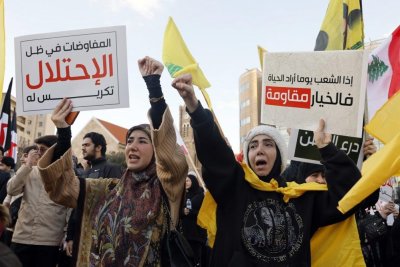

Supporters of Hezbollah shout slogans during a protest organized by the group under the slogan “The entire country is resistance” outside the United Nations Economic and Social Commission for Western Asia headquarters in Beirut, Lebanon, on February 4. The demonstrators condemned the ongoing Israeli attacks on Lebanon and restrictions preventing southern residents from returning to their villages. Photo by Wael Hamzeh/EPA
BEIRUT, Lebanon, Feb. 18 (UPI) — The United States is tightening the noose on Iran-backed Hezbollah, stepping up pressure with new sanctions aimed at cutting it off from the global financial system and hindering its efforts to regroup and secure new funding sources.
Severely weakened by the recent war with Israel, the group is seeking to recover after losing much of its military capacity, senior leadership and key funding channels that once enabled it to become a powerful regional actor.
With the loss of Syria as its primary supply corridor from Iran after the ouster of Syrian President Bashar al-Assad, and of Venezuela as a suspected financial safe haven amid allegations of drug trafficking and money‑laundering operations, Hezbollah’s financial strains have emerged as one of its most pressing challenges.
Gone are the days when Hezbollah could generously support its popular base, paying reconstruction grants, salaries and stipends that helped it secure loyalty and maintain influence.
Today, the group is increasingly forced to prioritize its financial obligations, redirecting scarce resources to maintain core operations.
Limiting housing allowances or delaying payments to villagers whose homes were destroyed or damaged during the recent war in southern and eastern Lebanon, as well as Beirut’s southern suburbs, illustrates Hezbollah’s growing inability to meet its regular financial obligations.
Its efforts to secure funds, generate revenue and evade international sanctions were again targeted by the U.S. Treasury Department, which last week sanctioned Jood SARL, a Lebanon-based company linked to the group’s gold trading network.
The firm is accused of creating a chain of businesses to trade gold within Lebanon and potentially abroad, converting Hezbollah’s gold reserves into liquid funds.
The sanctions also extend to an Iran-based shipping network with connections involving Turkey and a Russian national based in Moscow, underscoring the global reach of Hezbollah’s revenue-generating activities.
According to Mohammad Fheili, a risk strategist and monetary economist, the U.S. Treasury is attempting to “pollute the ecosystem” Hezbollah uses to convert assets into operational cash.
“The immediate effect is less about ‘zeroing funding’ and more about raising the friction cost of money,” Fheili told UPI, explaining that the sanctions increase counterparty caution among dealers, shippers and intermediaries, and can effectively freeze access to “clean” trade channels.
He pointed out that procurement then becomes slower and more expensive. When networks are exposed, replacement channels tend to be costlier, involving more intermediaries, greater leakage and a higher risk of interception.
“Even when Hezbollah can move value through cash-heavy channels, everyone around it — licensed exchange houses, logistics firms and commodity traders — faces higher compliance and reputational risks,” Fheili said. “This, in turn, shrinks the pool of ‘willing’ facilitators.”
Some Lebanese businessmen, who have long acted as Hezbollah’s facilitators both in the country and across the diaspora, are reportedly becoming more cautious, fearing they could be targeted by U.S. sanctions and face civil or criminal penalties.
Ali Al-Amin, who runs the “Janoubia” website from southern Lebanon, which focuses on the Shiite community and Hezbollah, said those businessmen were initially drawn to Hezbollah’s rising power — not its ideology — for financial gain.
Al-Amin said that some people, particularly those with established operations in African countries, worry they could face pressure or become targets of the new financial restrictions on Hezbollah in the coming phase.
“They are distancing themselves and keeping away from Hezbollah to protect themselves,” he told UPI. “Being close to the group has become more costly than rewarding.”
He contended, however, that if the Americans had wanted to put Hezbollah — which he said has long enjoyed freedom of movement in Europe and Africa — in check, they could have done so a long time ago.
“It gave facilitators the impression that they had some kind of cover, even internationally,” he said.
Although Hezbollah has long been under U.S. and international sanctions as a designated terrorist organization, U.S. Treasury officials say the group has managed to evade many of these restrictions by maintaining a complex global financial network and using front companies to launder funds.
At the height of the Hezbollah-Israel war, Lebanon tightened security at Beirut-Rafic Hariri International Airport and indefinitely suspended flights to and from Iran to prevent Israeli strikes on the country’s main air and sea gateways, which Israel claimed were being used to smuggle funds and weapons to Hezbollah.
Rigorous security checks have been implemented at the airport, with stricter inspections on flights from Iraq and other designated destinations and thorough screenings of passengers and baggage. Even diplomatic pouches carried by visiting Iranian officials were denied clearance.
The measures forced Hezbollah to seek new smuggling methods, including passengers or pilgrims to Iraq’s holy sites in Najaf and Karbala carrying back cash money , or concealing funds in parcels from various countries.
Even if some of these attempts were successful, the smuggled funds remain limited and insufficient to meet Hezbollah’s actual needs, according to al-Amin, who said the group has “100,000 salaries to pay every month” and has shifted to dealing in gold and digital currencies.
He said that although Hezbollah’s followers are “worried and cautious,” they still view the group as a safety net, capable of leveraging its power and influence within public institutions “to secure government compensation, a hospital bed, or a school seat.”
“But the Shiites [in Lebanon] also realized that Hezbollah led them into disaster, leaving them without allies in Syria, Lebanon, or the wider world,” al-Amin said.
In a surprise move early this month, Kuwait placed eight Lebanese hospitals on its terrorism sanctions list, citing suspected involvement in or facilitation of terrorism — a move aimed at Hezbollah.
“This is significant because it extends ‘pressure targeting’ from financiers and front companies to service institutions such as healthcare, which are socially sensitive and politically symbolic,” Fheili said.
To confront the challenges stemming from the Israeli war, Hezbollah’s new leader, Sheikh Naim Qassem, has embarked on what appears to be a comprehensive restructuring of the group, sidelining some figures, promoting others and dissolving or merging units.
The resignation of Wafic Safa, head of the Liaison and Coordination Unit — a post that allowed him significant influence and interference over security, political and judicial authorities — was a clear sign of structural change within Hezbollah.
Safa, who survived an Israeli assassination attempt during the war, will be reassigned as part of the group’s internal restructuring that began after the cease-fire agreement, according to Kassem Kassir, a political analyst who specializes in Islamic movements and is close to Hezbollah.
With Safa gone, reports suggest that merging the group’s security units under a central authority has limited its dealings with the Lebanese state to political intermediaries.
Kassir said a new media unit, consolidating all the party’s outlets, has been set up under Ibrahim Mousawi, a Hezbollah deputy in parliament. Former minister and MP Mohammad Fneish was appointed to oversee political relations and preparations for the upcoming parliamentary elections scheduled for May.
“Hezbollah is preparing more measures for the post-war phase to showcase its stability and evolution, highlighting its civil society organizations — from scouting and cultural groups to women’s and educational institutions,” he told UPI. “This is intended to reaffirm its commitment to the state option, to political engagement, and to the decline of its military role.”
However, that commitment may not be enough.
“Hezbollah knows its military role is over, but still cannot admit it,” al-Amin said. “Moving from being a resistance and a regional power to something else requires courage.”
He said the group is evading “difficult questions” and has failed to reassess its relations with Iran and Lebanon now that it is no longer a regional power.
“It seems there is confusion within Hezbollah, and much of it is tied to Iran and what its future holds — whether there will be a [U.S.-Israeli] war against Iran or not,” he said.