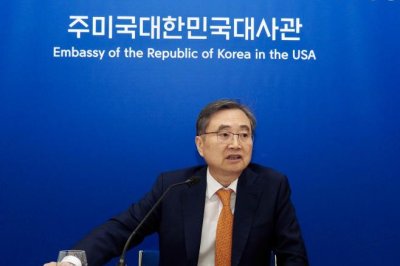

South Korean Foreign Minister Cho Hyun speaks during a briefing with Korean correspondents at the South Korean Embassy in Washington on Feb. 5. Photo by Asia Today
Feb. 6 (Asia Today) — U.S. Secretary of State Marco Rubio has conveyed growing unease in Washington over South Korea’s implementation of bilateral trade commitments, South Korean Foreign Minister Cho Hyun said Thursday, as Seoul moves to contain fallout through intensive diplomatic outreach.
Cho told Korean correspondents in Washington that Rubio raised the issue directly during their meeting at the State Department on Monday, noting that while bilateral ties are not in crisis, the internal U.S. mood regarding delayed trade-related commitments is “not favorable.”
According to Cho, Rubio stressed that trade and investment issues fall outside his direct portfolio but said he felt obliged to flag the concern in his broader role overseeing U.S. foreign policy and national security. Rubio also urged closer diplomatic coordination to prevent trade friction from spilling over into security cooperation.
Cho said he responded by firmly rejecting any suggestion that Seoul is deliberately delaying implementation. He emphasized that South Korea remains committed to fulfilling trade agreements and that legislative and procedural timelines reflect domestic processes rather than political intent.
Cho underscored Seoul’s position that trade and security should be handled separately, pointing to the structure of the bilateral summit’s Joint Fact Sheet, which divides cooperation into economic and security pillars. He warned that differences in implementation speed should not impede cooperation in strategic areas such as nuclear energy, nuclear-powered submarines and shipbuilding.
Cho said Rubio agreed that neither side wants delays in implementing agreements across either domain and pledged personal oversight, noting that the matters fall under the purview of the State Department and the White House National Security Council.
During his Washington visit, Cho pursued what officials described as a broad diplomatic push, engaging not only on security but also on trade and investment. On Tuesday, he met sequentially with Rubio, Energy Secretary Chris Wright and U.S. Trade Representative Jamieson Greer on the sidelines of a critical minerals ministerial meeting.
Cho said Greer acknowledged the potential economic impact of renewed tariffs but stressed the importance of South Korea demonstrating tangible progress not only in strategic investment but also in addressing non-tariff barriers. Talks with Wright focused on nuclear cooperation, including enrichment, reprocessing rights and collaboration on nuclear-powered submarines.
A senior South Korean official said Washington had long harbored frustrations over the pace of Korea’s domestic procedures but noted that President Donald Trump’s decision to air concerns publicly on social media last month marked a departure from past communication practices. Trump had warned that tariffs on South Korean goods could be restored to 25% if legal steps tied to the trade agreement were not completed.
The official said Cho cautioned Rubio that such public announcements could complicate bilateral relations and burden domestic efforts needed to advance U.S.-bound investment.
On a separate controversy involving e-commerce firm Coupang, the official said Seoul views the issue as corporate lobbying rather than a diplomatic dispute, adding that congressional interest reflects pressure from private-sector advocacy. Given the potential for legal escalation, the government is exercising caution, the official said.
Cho also met with U.S. lawmakers from both parties, including Sens. Tom Cotton, Tim Kaine, Andy Kim and Jeff Merkley, to discuss the U.S.-South Korea alliance, regional security and economic cooperation.
Cho urged congressional support for accelerating cooperation in nuclear energy, submarine technology and shipbuilding, calling them central to elevating the alliance amid a shifting global landscape. Lawmakers expressed bipartisan backing for the alliance and signaled openness to deeper cooperation, while emphasizing adherence to nonproliferation norms.
South Korea, Cho said, will pursue implementation of the Joint Fact Sheet with strict separation between military and civilian nuclear use, transparency and close coordination with the United States and the International Atomic Energy Agency.
— Reported by Asia Today; translated by UPI
© Asia Today. Unauthorized reproduction or redistribution prohibited.
Original Korean report: https://www.asiatoday.co.kr/kn/view.php?key=20260206010002394