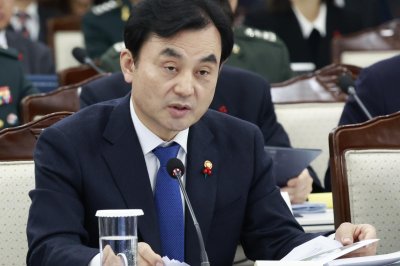

South Korea’s Defense Minister Ahn Gyu-back speaks during a work report to President Lee Jae Myung from the ministries of defense and patriots and veterans affairs at the defense ministry in Seoul, South Korea, 18 December 2025. File. Photo by YONHAP / EPA
Jan. 16 (Asia Today) — South Korea’s push to apply artificial intelligence to defense is moving from slogans to implementation with the launch of a new collaboration platform linking policy, technology, security and talent development, organizers said.
The Defense Innovation Technology Security Association, the Korea Artificial Intelligence Association and KT said they launched the Defense AI Leaders Forum on Thursday at the Defense Convention Center and signed a three-party memorandum of understanding.
More than 150 representatives from government, industry, academia, research institutes and the military attended the event, according to organizers.
Organizers described the forum as a standing platform meant to connect policy with field needs and technology with operational demand, rather than a one-time seminar.
The forum set out five goals: helping shape defense AI policy and strategy, proposing key AI technologies and application models to enhance combat capability, building training and education systems for AI personnel, establishing a trusted defense AI system emphasizing security and safety and fostering an innovation ecosystem across the military, industry, academia and research institutes.
Co-chair Yang Yong-mo, a former chief of naval operations, said the forum is intended to boost both defense AI innovation and the country’s broader AI competitiveness by linking government, the military, industry, universities and research organizations.
Kim Seung-joo, chairman of the Korea Defense Innovation Technology Security Association, said defense AI “cannot be achieved by technology alone,” adding the association would work to connect policy and field operations and security and industry.
Kim Hyun-chul, president of the Korea Artificial Intelligence Association, said the priority is linking member companies’ AI technologies to real-world defense use cases and developing viable business models where technology meets demand.
KT Vice President Ahn Chang-yong, who heads the company’s enterprise division, said applying AI in defense requires understanding the security environment and building an ecosystem in which industry, academia, research institutes and the military work as one team. He said KT would support defense development through its AI and communications capabilities and experience in public and defense projects.
Jeon Jun-beom, director of the Defense Artificial Intelligence Planning Bureau at the Ministry of National Defense, said AI is already reshaping defense by increasing combat efficiency and speeding decision-making. He said defense AI must be “safe, responsible and trustworthy,” not only fast and powerful.
At the forum, Shim Seung-bae, head of the defense and security subcommittee under the Presidential Committee on National AI Strategy, presented what he called a defense AI action plan focused on governance reform, AI infrastructure and expanding the defense AI ecosystem. Shim said the aim is to build a smarter military that collaborates through data and AI as South Korea adapts to changes such as troop reductions and evolving battlefield conditions.
Organizers said the forum’s next test will be whether it delivers sustained outcomes such as practical application models, policy recommendations and measurable results.
— Reported by Asia Today; translated by UPI
© Asia Today. Unauthorized reproduction or redistribution prohibited.