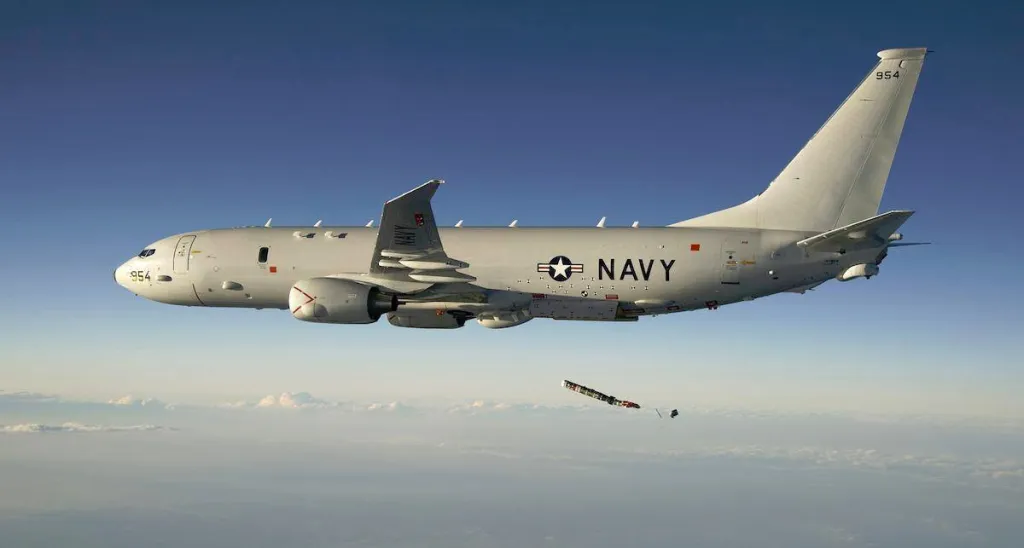
A U.S. plane with a civilian-style outward appearance and the ability to launch munitions from within its fuselage carried out the first controversial strike on an alleged drug smuggling boat, according to multiple reports. Questions have been raised about this line of reporting. However, there are very real discreet munition launch options available for aircraft that can retain a distinctly civilian outward appearance, enabled heavily by one specific system called the Common Launch Tube (CLT).
The New York Times was first to report yesterday on the use of the civilian-looking aircraft, which it also described as a “secret” capability, in the strike on the boat in the Caribbean Sea on September 2, 2025, citing anonymous sources. The Washington Post and The Wall Street Journal published additional reports today, again citing unnamed sources, on the involvement of this as-yet unidentified plane.
“It is not clear what the aircraft was. While multiple officials confirmed that it was not painted in a classic military style, they declined to specify exactly what it looked like,” according to the story from the Times. “The aircraft also carried its munitions inside the fuselage, rather than visibly under its wings, they said.”
“Its transponder was transmitting a military tail number, meaning broadcasting or ‘squawking’ its military identity via radio signals,” that report added.
It was “a secretive military aircraft painted to look like a civilian plane,” according to the Post‘s report. “The munitions were fired from a launch tube that allows them to be carried inside the plane, not mounted outside on the wing.”
“The Pentagon has told lawmakers that it chose an aircraft painted in civilian colors to carry out a lethal Sept. 2 strike on an alleged drug boat in the Caribbean because the unit could be the quickest ready for the operation,” per the Journal. That report also included statements from the Pentagon and the White House that did not expressly confirm or deny the use of a civilian-looking plane.
All three pieces discuss whether the use of an armed aircraft with a civilian-style appearance may have violated international law in this instance, something that remains very much open for debate. The September 2 strike, which killed 11 people, has already been a subject of particular controversy over the decision to hit the boat twice, and whether doing so constituted a crime. Since then, the U.S. military has attacked dozens of boats in the Caribbean and the Eastern Pacific Ocean, all alleged to be involved in drug smuggling, and this campaign has faced intense legal scrutiny and criticism. MQ-9 Reaper drones and AC-130J Ghostrider gunships are known to have participated in those subsequent attacks.
Much debate had already erupted about the details in The New York Times‘ piece after it was initially published. Many questioned whether the unnamed sources may have been confused about the aircraft in question and/or its appearance. Around the time of the September 2 strike, online flight tracking data had shown a U.S. Navy P-8A Poseidon maritime patrol plane in the area, which is primarily painted white rather than a more typical military gray and is based on a version of the Boeing 737 airliner. P-8As can carry munitions in an internal bay in the rear of the fuselage, as well as under their wings. It may potentially have the ability to dispense small munitions from inside the fuselage. We will come back to all of this later on. The Navy, as well as the U.S. Air Force and U.S. Marine Corps, fly a number of other variations of the 737, primarily as transports, under the C-40 designation.

A truly secretive 737 with a civilian-type paint scheme is said to have been in the general area at the time of the strike, but is not known to be armed in any way, although that means little in this case. This particular aircraft, which is covered in unusual antennas, currently has the U.S. civil registration number N235JF. The Federal Aviation Administration’s (FAA) public database shows the jet has been registered to “GWP LLC TRUSTEE”, which looks to be a shell company, since 2023, but it has been linked to the U.S. military since then. It notably appeared last year directly alongside one of the U.S. Air Force’s AC-130Js and a Navy P-8A at a known U.S. forward operating location in El Salvador.
One of the U.S. Air Force’s P-9A surveillance and reconnaissance aircraft, also referred to by the nickname Pale Ale, is said to have been in the vicinity, as well. The P-9As wear overall white paint schemes and carry civilian registration numbers. They are based on the de Havilland Canada DHC-8 (or Dash-8), versions of which are also in service as airliners. They are also not known to be capable of employing munitions.
What other aircraft may have been present during the strike on September 2 last year is unknown. Not all aircraft that are flying at any one time, civilian and especially military, are visible via online flight tracking sites.
What we do know is that companies in the United States openly offer ways to discreetly arm a host of crewed fixed-wing aircraft, especially smaller turboprop-powered types, with precision-guided munitions. All of this has been made easier by the advent of the aforementioned CLT. Each one of these tubes can accommodate payloads up to 42 inches in length and 5.95 inches in diameter, and that weigh up to 100 pounds. Payloads can be fired forward or ejected backward, depending on their design. GBU-44/B Viper Strike and GBU-69/B Small Glide Munition (SGM) glide bombs, AGM-176 Griffin missiles, and ALTIUS 600 drones are just a few of the payloads known to be launchable via CLT. The tube’s flexibility makes it extremely probable that even more options exist in the classified realm.
It is worth noting here that The Washington Post previously reported that the September 2 boat strike involved the use of GBU-69s and AGM-176s. The P-8A is not known to be capable of employing either of these munitions, lending further credence to the new reporting that another aircraft was used, though not necessarily to it having had a civilian-like appearance. In the past, TWZ has laid out a case for turning the Poseidon into a multi-role arsenal ship with CLT launchers and other capabilities.


Originally developed by Systima Technologies, which was acquired by Karman Missile & Space Systems in 2021, CLTs have been in U.S. service for years now. Munitions launched via CLTs are part of the armament package for the AC-130J Ghostrider gunships, and this had also been a feature on the now-retired AC-130W Stinger IIs. The U.S. Marine Corps’ Harvest Hawk armament kit for its KC-130J tanker-transports also includes a CLT launch system. U.S. MQ-9 Reaper and MQ-1C Gray Eagle drones are also capable of employing payloads via CLT using launchers loaded on pylons under their wings. As mentioned earlier, AC-130s and MQ-9s are among the aircraft known to have been involved in strikes on alleged drug smuggling boats since September 2 of last year.
The CLT’s diminutive size opens up a host of options for launching whatever payload is inside from somewhere within the internal structure of a wide swath of aircraft. Launchers can be readily set up to fire through parts of the fuselage. AC-130Js have an array of CLT launchers built into the upper portion of the aircraft’s rear cargo ramp. The latest iteration of the Marine’s Harvest Hawk kit has a so-called “Derringer Door” with two launchers that replaces one of he rear paratrooper doors on the KC-130J. This took the place of a launch system strapped to the aircraft’s rear cargo ramp, which had to be open for it to be employed, found on earlier iterations of Haverst Hawk.


Internal CLT launcher arrays are known to be available for Dash-8s and Cessna Model 208 Caravan fixed-wing aircraft, as well as MD Helicopters’ Explorer series helicopters, among many other types. The Sierra Nevada Corporation’s (SNC) losing entry in the Air Force’s Armed Overwatch competition was a heavily modified version of the Polish PZL M28 Skytruck, dubbed the MC-145B Wily Coyote, which would have come with eight CLT launchers in its main cargo bay, among other features, as you can read more about here.
Generally speaking, they could be adapted to fit onto pretty much any aircraft large enough to accommodate them, and do so in a very discreet way, only needing a small aperture for their weapons to exist the aircraft from.


CLT launchers mounted internally are typically reloadable in flight, offering magazine depth benefits and giving the crew more flexibility to select the most appropriate payload for the task at hand, as well as to just launch multiple payloads in relatively rapid succession. With launchers built into doors, it is also easier to add or remove this capability, as desired. This, in turn, can enhance its discreet nature, as the launchers might only be installed right before a mission and removed immediately afterward. In this way, there could be little to no obvious outward signs that an aircraft has this capability during routine movements or other day-to-day activities.
Launch systems built into certain parts of an aircraft might not even be readily apparent, to begin with. One company, Fulcrum Concepts, openly offers a launch system compatible with the CLT that fits into the rear of the engine nacelles on variants of the Beechcraft King Air, which is something the U.S. military has at least tested in the past.

Within the U.S. military, Air Force Special Operations Command (AFSOC) publicly operates various fixed-wing aircraft, such as its U-28A Dracos and C-146A Wolfhounds. The U-28As are intelligence, surveillance, and reconnaissance (ISR) aircraft, while the C-146s are light transports. AFSOC has also flown ISR-configured variants of the Beechcraft King Air over the years. Any of these types would be well-suited to these kinds of discreet CLT launcher installations on account of the space available in their main cabins. It’s highly probable that this is an option for some of them already. These planes also often have minimal U.S. military markings. Sometimes they wear civilian-type paint schemes, as is notably the case with the Wolfhounds today and has been observed on U-28s, or related types in U.S. service, in the past.


There are even more secretive aircraft in service in the classified ends of the U.S. special operations world, and with the U.S. Intelligence Community that could align with the descriptions found in the New York Times, Washington Post, and Wall Street Journal stories, which might have a discreet ability to employ munitions, especially via internally-mounted CLTs. Covert and clandestine strike capabilities would also be well in line with the missions that those aviation elements are often tasked to carry out. On the military side, many of those aircraft are tied to the secretive Joint Special Operations Command (JSOC), which was involved in the September 2 strike.
All this being said, we still do not have anywhere near enough information to identify the aircraft referenced in the recent reports. At the same time, the versatility of the CLT means that essentially any aircraft can be converted to a strike platform that can be armed with small and highly accurate precision munitions capable, including ones capable of hitting targets on the move. Unassuming aircraft equipped in this way, and with liveries atypical of what is usually seen on military types, would be able to get even closer to their objectives with much less chance of raising suspicions. Equipping transport and/or corporate aircraft, and especially one like a 737 with its jet speeds and long-range, in such a way could allow it to strike, even by executing the preverbal ‘hammer toss’ as it flies over a target, while hiding in plain sight, potentially anywhere commercial aircraft can fly.
Contact the author: joe@twz.com