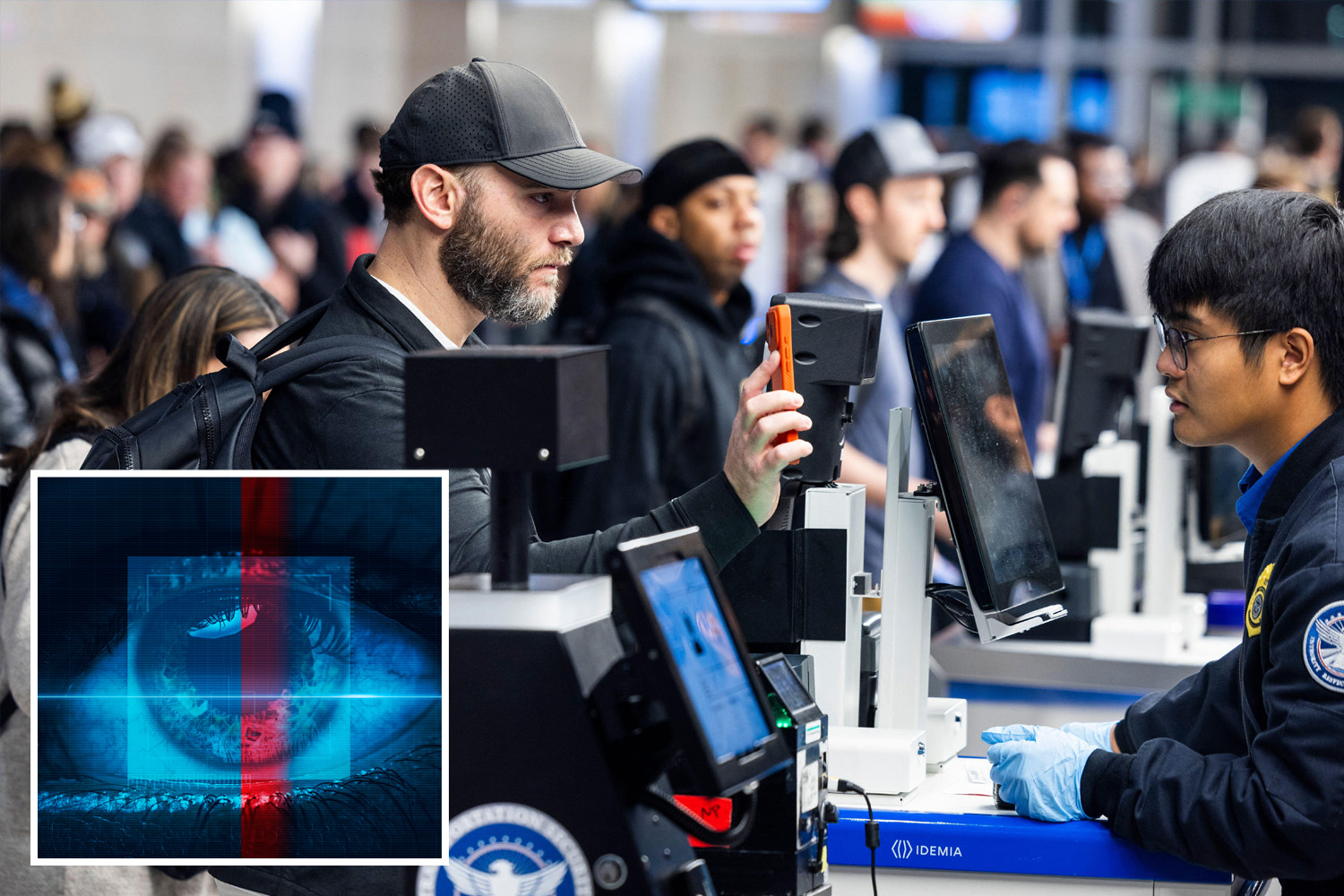

NEW strict customs laws have gone into effect, allowing government officials to request tourists’ DNA in some cases.
The new biometric data collection started on December 26, just ahead of the new year.


The new rule targets non-citizens entering or leaving the US, according to government documents seen by Reuters.
Travelers will now be subjected to facial recognition photos at the airport to help match them against existing records.
Those facial recognition pictures will be stored for up to 75 years, according to the documents.
Under the new law, Department of Homeland Security officials may request additional biometric information, including fingerprints or DNA, from non-citizens.
The updated security measures are meant to “deter the filing of frivolous claims and provide operational consistency,” according to the government.
The new biometric rules would also remove any age restrictions on facial recognition, meaning that any foreigner is now subject to the biometric measures.
Up until now, there were restrictions on who could be scanned using facial recognition.
Travelers under 14 years old and those over 79 years old were exempt from those requirements.
Biometric data has been collected from foreign visitors for years, but now the government is pushing to collect more information to tighten border security.
The new rules expand what officials are legally allowed to ask for.
Select visitors planning to stay in the US for more than 29 days are now required to pay a $30 fee.
Those who refuse to pay the fee and be fingerprinted could be hit with a $5,000 fine.
The new rules come one day before one of the busiest travel days of the year, according to United Airlines.
The popular airline said that December 27 is expected to be a record-breaking day in the winter travel season.
Acceptable identification at TSA checkpoints
All passengers 18 years and older must show valid identification at airport checkpoints in order to travel. The following is a full list of identification accepted at TSA checkpoints.
- Driver’s licenses or other state photo identity cards issued by Department of Motor Vehicles (or equivalent)
- Beginning May 7, 2025, if you plan to use your state-issued ID or license to fly within the US, it must be REAL ID compliant. If you’re not sure if your ID complies with REAL ID, check with your state department of motor vehicles.
- A temporary driver’s license is not an acceptable form of identification
- State-issued Enhanced Driver’s License
- US passport
- US passport card
- DHS trusted traveler cards (Global Entry, NEXUS, SENTRI, FAST)
- US Department of Defense ID, including IDs issued to dependents
- Permanent resident card
- Border crossing card
- An acceptable photo ID issued by a federally recognized Tribal Nation/Indian Tribe, including Enhanced Tribal Cards (ETCs).
- HSPD-12 PIV card
- Foreign government-issued passport
- Canadian provincial driver’s license or Indian and Northern Affairs Canada card
- Transportation worker identification credential
- U.S. Citizenship and Immigration Services Employment Authorization Card (I-766)
- U.S. Merchant Mariner Credential
- Veteran Health Identification Card (VHIC)
Travelers should brace for longer security lines and make sure everything they have complies with TSA rules and restrictions.
“You will probably be waiting an extra-long time in the security line this Christmas,” Air passenger rights expert Ivaylo Danailov, CEO of SkyRefund, warned.
“There are going to be many more people than normal carrying much more stuff than usual for the Christmas season, both of which result in longer security waits.”
Most importantly, Danailov urged travelers to “check the TSA’s website” before they fly.
“Unfortunately for Christmas travellers, this scrutiny also extends to wrapped goods,” he said.
“It doesn’t matter what you have wrapped, or how nicely, the TSA will unwrap anything to get a good look at it and are not always gentle in the process.”