Travel experts have shared their top holiday packing tips, all agreeing on the one packing mistake you should avoid on your next getaway and why you shouldn’t bother packing it
Knowing what to put in your bag is tricky (Image: Oscar Wong via Getty Images)
Everyone adores jetting off on holiday, but cramming a fortnight’s worth of belongings into a Ryanair or easyJet underseat bag is nobody’s idea of fun. That’s precisely why knowing what to take and what to ditch is absolutely vital.
I consulted more than a dozen travel gurus for their essential picks and items to skip when heading abroad. The must-have list featured an array of items, from a sarong to a fully charged battery pack, cereal bars and even ‘your favourite comb’.
However, there was considerably more agreement on what holidaymakers should steer clear of packing.
Do you have a travel story to share? Email webtravel@reachplc.com
The travel gurus reckon you should steer clear of overpacking clothes.
“Many travellers say they regret taking too many ‘just in case’ outfits which take up valuable space in your luggage. Before packing anything, ask yourself whether you’ll genuinely wear it and whether it works with at least two other items in your suitcase. If the answer is no, it probably doesn’t need to come with you. Pack versatile pieces that can be mixed and matched, with a simple colour palette so everything works together,” Natasha Inglis, client experience director at Good Business Travel, said. Joe Cronin, president of International Citizens Insurance, shared this view.
He explained: “What I leave at home is the ‘just in case’ wardrobe. After years of living out of a suitcase in places as different as Tokyo and Buenos Aires, I have learned that you never wear the extra pair of shoes and the extra jacket. Laundry is easy to find nearly everywhere, and anything I truly forget I can buy on arrival, often for less than the cost of checking a heavier bag.”
Jim Webber, a retired teacher who now runs the travel blog Travelwidstom, commented: “I leave as many clothes at home as possible when I travel. So, my strategy focuses on packing light and doing laundry on extended trips. For example, my wife and I travelled for 17 days out west. We each had a carry-on and a personal item backpack. We were able to wash our clothes a few times on the trip at the hotels we stayed at.”
Aman Thakran, founder of BharatFare, argued that the ‘just in case’ items were for occasions “that never happen”. “I travel with clothes that all go together, so everything mixes and matches and nothing extra comes along. It saves weight, and often means you can skip the checked bag altogether,” Aman noted.
Vummy Kihaule, founder of Tanzania Safaris, highlighted that excessive clothing is especially unnecessary when embarking on safari. “Most hotels and lodges wash your clothes every day and return them to you the same evening. So three shirts will last you 10 days. Ask your hotel if they do washes every day and you’ll be able to cut half of your clothes from your bag. Weight is also a huge issue with small aircraft on regional routes, and most have a 15kg maximum weight including your hand luggage,” Vummy explained.
Netflix replaced one of its top executives in a major management shake-up on Thursday, a day after the company announced it was laying off 6% of its staff.
Chief Content Officer Bela Bajaria is leaving the company after a decade, Netflix said in a statement. She will be replaced by former Disney executive Peter Rice, who was most recently chairman of Walt Disney Television and chairman of general entertainment for Walt Disney Co.
“Peter is one of the most effective at-scale operators in the entertainment industry,” Netflix Co-Chief Executive Ted Sarandos said in the statement. “His business acumen is sharp, his talent relationships are exceptionally strong, and his experience across TV and film is deep and broad.”
Bajaria’s exit comes as Netflix has been under pressure from investors to turn out more hit shows and movies and increase the amount of time consumers spend on the platform amid rising competition from other streamers.
“Due to the slowdown in massive hits and viewer growth, an ax was gonna fall on some executives who led content strategy,” said Ross Benes, senior analyst at research firm Emarketer.
Bajaria oversaw the teams responsible for Netflix content around the world. She joined Netflix in 2016 and was named chief content officer in 2023. She was instrumental in expanding Netflix’s reach internationally and the streamer’s push into live events.
Hits released on Netflix during Bajaria’s tenure include the 2025 animated movie “KPop Demon Hunters” and crime drama series “I Will Find You.” Under her leadership, Netflix grew its reach in live programming, streaming NFL games as well as WWE matches. The company also changed its film strategy to focus on fewer movies that aimed to be bigger and better.
She also played a key role in helping Netflix generate large audiences for its non-English-language original series, reality shows and programs that featured talent from underrepresented communities.
But her tenure also coincided with mounting challenges to growing Netflix’s business.
Free, ad-supported streaming services like YouTube are increasingly taking up more streaming hours and investors are concerned about how Netflix will continue to grow. YouTube represented 14.2% of streaming time in the U.S. on TVs compared to Netflix’s 7.8% in July, according to Nielsen data.
Netflix has said efforts like live programming have been successful at getting significant subscription sign-ups. While live programming represents 5% of Netflix’s content budget, it holds 1% of watch time on the streaming service, Sarandos has said.
The company also was poised to buy Warner Bros. Discovery, which would have dramatically increased its library of content, but Netflix bowed out of the auction after the price became no longer “financially attractive.”
Netflix stock has declined 40% from a year ago. Shares closed Thursday at $72.61, up 3%.
“The drop in share price has been staggering,” said Stephen Galloway, dean of Chapman University’s Dodge College of Film & Media Arts. “That plunge, plus the negative reaction to its move to buy Warner Bros. left it vulnerable, and so you have to do two things. One is right the ship, but you also need to send a message to shareholders that you’re taking action.”
In a memo to staff announcing the change in leadership, Sarandos wrote, “I know this is a big change in a year that has already had its share. But I also see an opportunity to take our slate to the next level, especially in UCAN [U.S. and Canada] where we have an outsize impact in creating big, buzzy hits that our members love and drive conversation around the world.”
Rice is an experienced corporate executive who spent nearly three decades navigating Rupert Murdoch‘s media empire, serving as president of 21st Century Fox and CEO of Fox Networks Group.
He also brings deep roots in the feature film world, having previously run Fox Searchlight Pictures, which could mean he will want to put his own stamp on Netflix’s film group, Galloway said. That group is currently led by executive Dan Lin.
“Netflix has fundamentally changed the way stories are made, shared and experienced around the world,” Rice said in a statement. “They’ve shown again and again that they’re willing to take chances on distinctive voices and fresh ideas, and I’m excited to work with the team to help bring even more great stories to members everywhere.”
European CFOs face mounting economic uncertainty, shifting priorities toward cost discipline and resilience.
A Deloitte CFO survey conducted in April showed that 48% of respondents are less optimistic about their companies’ prospects than they were six months earlier. Their pessimism in autumn 2025 was limited to 25%.
Economic uncertainties explain that state of mind: 76% of respondents put energy shocks, inflation, the conflict in the Middle East, and disruption of the supply chain at the top of their risk list.
“CFOs across Europe are entering the second half of 2026 with a noticeably more cautious outlook,” said Richard Muschamp, Deloitte EMEA CFO program leader, attributing their pessimism to “a more challenging operating environment.” EY’s CEO Outlook found similar concerns, with 60% of these respondents citing geopolitical tensions as a near-term risk.
“The real question is, What are you doing about it?” said Myles Corson, EY global finance leader. “CFOs need to build resilience into their organization.” In the short term, that means localizing the supply chain, with a focus on energy security and energy pricing. “Leaders are increasingly prioritizing resilience, productivity and cost discipline over expansion and risk-taking” he said.
According to the Deloitte survey, only 26% of CFOs expect to increase capital expenditures over the next 12 months, and 36% anticipate workforce reduction. Consumer goods sectors, impacted by the slowdown of demand, are at the forefront of the workforce adjustment. Unilever PLC declared a hiring freeze that would last at least three months. In Germany, luxury car maker Porsche AG announced one in five job cuts by 2035, and Deutsche Lufthansa AG said it will eliminate 4,000 white-collar roles by 2030.
In France, executives at the industrial engineering firm Fives Group see no immediate need to downsize. Defense and aeronautic clients, warehouses in need of automatization, industries looking for decarbonization, keep Fives busy. Still “10% of our activities have been impacted,” said Suresh Abye, the finance director. “We are very vigilant about our costs structure. In that sector we stopped recruiting and transferred some employees to different activities.”
Fives has clients in a dozen countries, including France, Germany, Italy, China, Japan, and America. “Compared to America and Asia, Europe is the most impacted by inflation, unemployment, and tepid demand,” added Abye. “The regulatory framework is too laborious and there is no policy favoring local producers.”
Nevertheless, Europe also has a few tricks up its sleeve. Corson highlighted the “quality of its talent pool, the diversity of the market, and its focus on sustainability.”
To take full advantage of these strengths, the EY finance leader suggested maintaining investments in artificial intelligence. “Companies will be able to identify where opportunities are, they will adjust quicker and be able to repurpose their people” said Corson, an eager advocate of cost optimization.
Caroline Crosdale is a contributing writer to Global Finance.
For every five plates of food served around the world, roughly one ends up in the bin. That adds up to more than a billion tonnes of food a year.
Meanwhile, 645 million people, about one in 13 of the world’s population, went hungry in 2025, according to the UN.
That gap is the focus of World Food Day on October 16, the annual UN observance marking the founding of the Food and Agriculture Organization (FAO) in 1945. This year’s theme, “Innovate today, nourish tomorrow”, calls for food systems that feed more people and waste less.
In this visual explainer, Al Jazeera looks at global hunger, which countries waste the most food and simple ways to waste less at home.
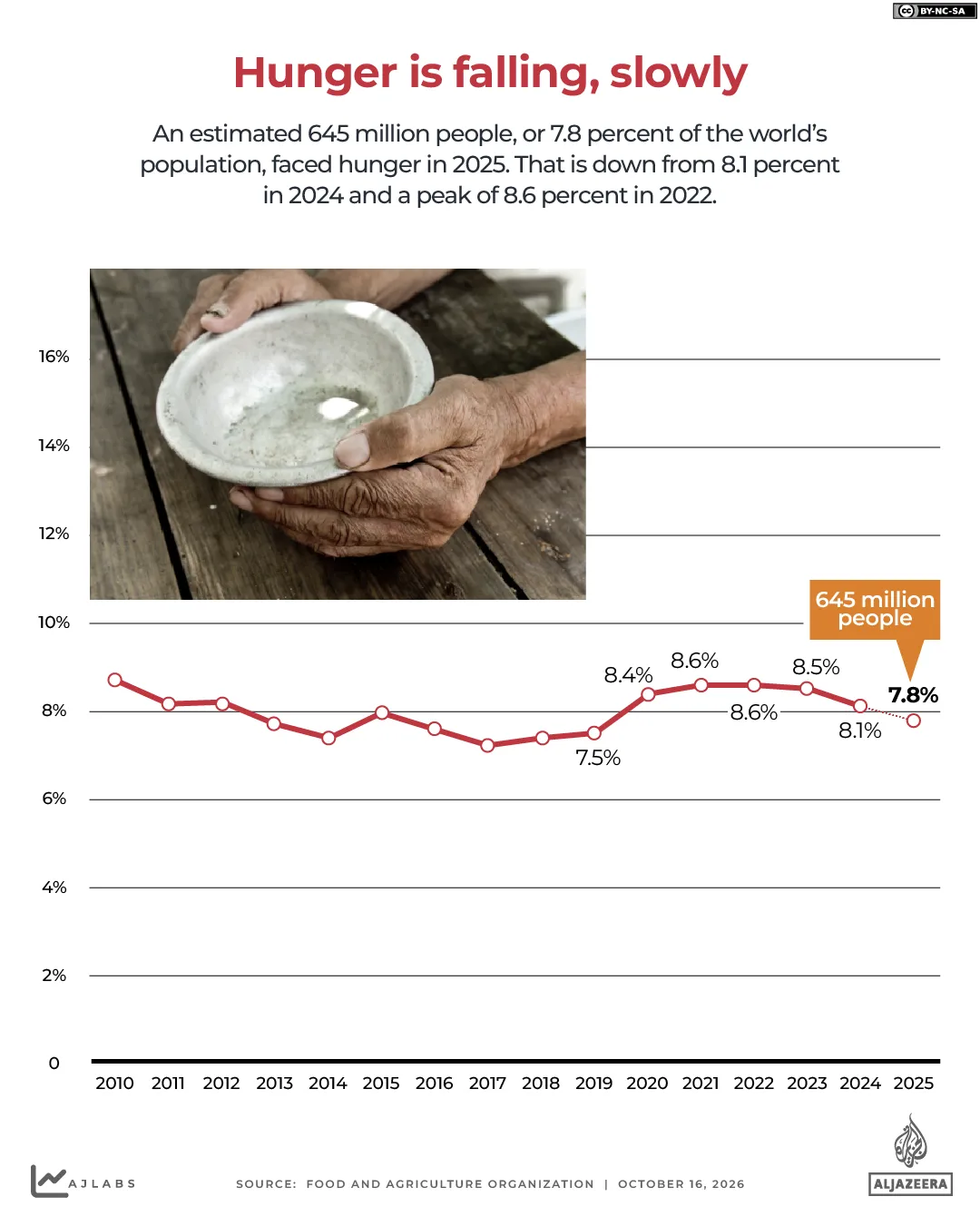
Hunger is falling, slowly
Global hunger has fallen for a third year in a row, but it remains above levels seen before the COVID-19 pandemic.
According to the UN’s annual State of Food Security and Nutrition in the World report, an estimated 645 million people, or 7.8 percent of the world’s population, faced hunger in 2025. That is down from 8.1 percent in 2024 and a peak of 8.6 percent in 2022, but still about 61 million more people than in 2019.
[Al Jazeera]
Where are people the most hungry?
Africa has more hungry people than any other region.
In 2025, an estimated 309 million people in Africa were undernourished. That is one in five people on the continent and almost half of the world’s hungry people.
By comparison, 292 million people in Asia (6 percent of the population) and 32 million in Latin America and the Caribbean (4.8 percent) were undernourished.
The 2026 Global Hunger Index shows a similar pattern at the country level. The index scores countries out of 100, combining undernourishment with child stunting, child wasting and child mortality. Scores of 35 or more are considered “alarming”.
Hunger is classed as alarming in eight countries, seven of them in Africa. Somalia has the worst score of the 122 countries ranked, followed by the Democratic Republic of the Congo, Chad and Madagascar.
Sudan, South Sudan, Burundi and Yemen were also classed as alarming, but conflict and data gaps meant the index could not calculate their scores.
At the same time, a large share of the food the world grows never reaches a plate.
How much food is wasted every year?
Food is lost and wasted at every stage of its journey from farm to table.
According to the FAO, about 13 percent of the food produced globally is lost after harvest and before it reaches shops, spoiling in storage, during transport or in processing. Fruits and vegetables suffer the highest losses.
Food lost before it reaches shops is worth more than $400bn a year, according to the FAO.
Shops, restaurants and households then throw away almost a fifth of the food available to consumers, about 1.05 billion tonnes in 2022, according to the UN Environment Programme (UNEP). That is equivalent to 52.5 million trucks, each carrying 20 tonnes.
Households account for the most, 60 percent, followed by restaurants and other food services at 28 percent and shops at 12 percent.
How to reduce food waste at home
Most food waste happens at home, which means households can make a real difference. Here are some simple steps recommended by food waste campaigners and UN agencies:
Plan before you shop: Check what you already have, plan meals for the week and shop with a list to avoid buying more than you need.
Understand date labels: “Use by” dates are about safety, but “best before” dates are about quality. Food is often still safe to eat after its “best before” date.
Store food properly: Keep your fridge at 5C (41F) or below, and store fruit and vegetables where they last longest. Bananas, for example, speed up the ripening of other fruit nearby.
Use the freezer: Bread, cooked meals, meat and many fruits and vegetables can be frozen before they go off.
Cook the right amount: Measuring portions, especially for rice and pasta, cuts down on leftovers that get thrown away.
Eat the oldest food first: Move older items to the front of the fridge and cupboard so they get used before newer ones.
Use leftovers and scraps: Turn leftovers into new meals, and use vegetable peels and stalks in soups and stocks.
Compost what you can’t eat: Composting inedible parts such as peels and eggshells keeps them out of landfills, where rotting food releases methane.
A ‘best before’ label on Heinz baby food tells shoppers when the product is at its best quality, not when it stops being safe to eat [Anthony Devlin/Getty Images]
Which country wastes the most?
On average, every person in the world wastes about 132kg (291 pounds) of food a year, roughly the weight of two adults. Of that, 79kg (174 pounds) was thrown away at home.
But the amount varies widely. Hotter countries tend to waste more at home, UNEP says, possibly because of more fresh produce and less refrigeration.
The Maldives wastes the most food, with each person throwing away about 260kg (573 pounds) a year, about twice the global average. Syria, the Dominican Republic, Seychelles, Mexico and Tunisia follow, each wasting more than 210kg (463 pounds) per person, according to UN estimates.
Spain recorded some of the lowest levels, at around 39kg (86 pounds) or less per person.
What does food waste cost?
Food loss and waste costs the global economy more than $1 trillion a year, according to the UN.
To put that in perspective, what else could $1 trillion buy?
Use the + buttons to add items to your cart and see how the money would be spent across 35 categories.
Throwing food away also wastes the money, land and energy used to produce it.
About 1.4 billion hectares (3.5 billion acres) of land, or 28 percent of the world’s agricultural land, is used to grow food that is never eaten. That is an area larger than Canada.
Food loss and waste also generate an estimated 8 to 10 percent of global greenhouse gas emissions, including methane released as food rots in landfills.
Vibe coding allows people to use AI to build software without writing code themselves. And now, free AI-generated alternatives to popular programmes like Premiere Pro and Excel are emerging, sparking security concerns and hidden costs.
Actor Tom Arnold unleashed on Chuck Lorre on X in response to the former “Roseanne” writer-producer’s claims in his new memoir, “Sitcom.”
“He thinks he’s brilliant & beloved like Norman Lear but Chuck ‘Chuckles’ Lorre’s a terrible human, an angry dry drunk who lies every time he opens his mouth,” Arnold wrote Tuesday.
Arnold and the ’90s sitcom’s co-creator and titular star, Roseanne Barr, were married Jan. 20, 1990, four months after he first appeared on the show as a poker pal of Barr’s TV husband and four days after Barr’s real-life divorce from her husband of 14 years, William Pentland, was finalized.
Barr and Arnold were hostile to their writing and producing colleagues on the show and the network, Lorre told the Los Angeles Times’ culture critic Mary McNamara in an interview published Tuesday, the day of the book’s release.
“We were punished, the writers,” Lorre told The Times. “The word ‘cruelty’ comes to mind. And I still don’t know why, why so much cruelty. It wasn’t like we didn’t want to make a great show. We were proud to be on that show.”
Hired in 1990 after Barr fired all of the show’s writers, Lorre recalls in the book that he had a rude awakening when he took the job.
“I was now the co–executive producer on the number one show on television. I swaggered into the office assigned to me and met Danny Jacobson (a world-class comedy writer who would go on to cocreate ‘Mad About You’ with, sorry, Paul — ‘My Two Dads’ — Reiser),” Lorre writes in “Sitcom.”
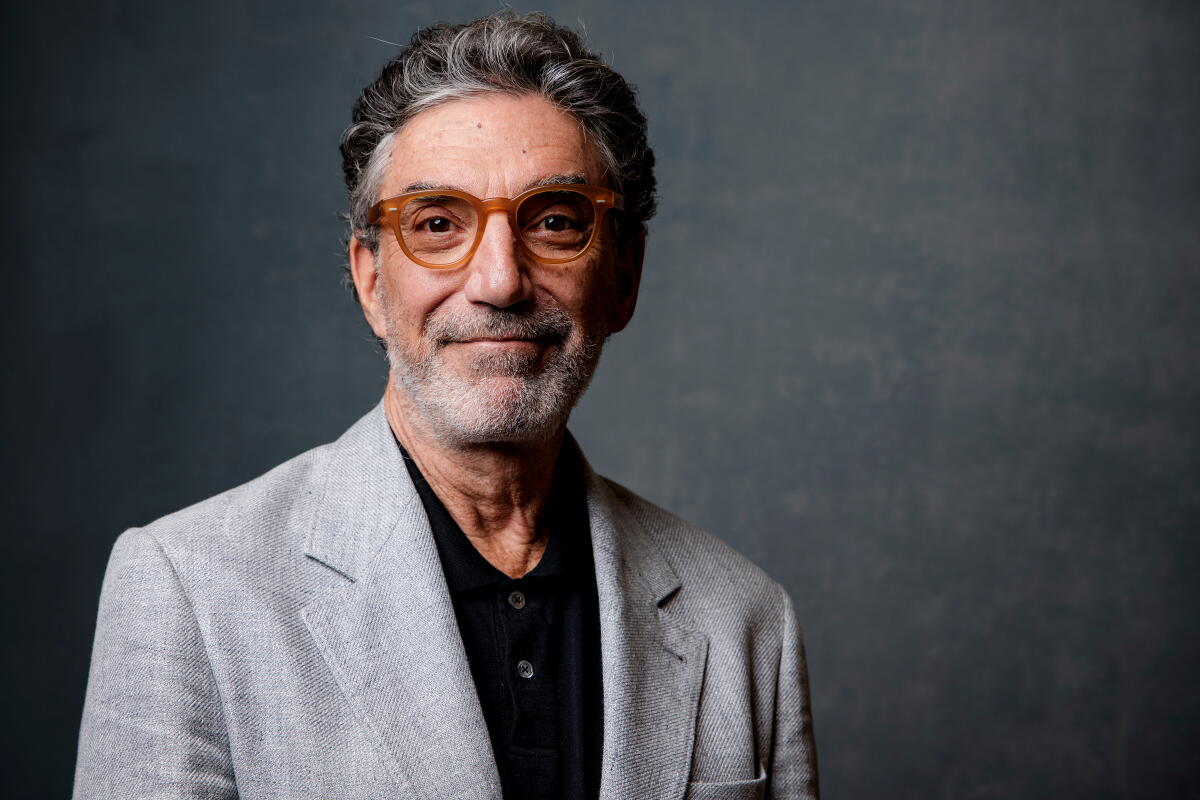
Chuck Lorre, pictured in 2024, related several anecdotes in his book “Sitcom” that didn’t sit well with Tom Arnold.
(Willy Sanjuan / Invision / Associated Press)
“Danny, having been fired by Roseanne for being talented, was packing up his stuff when I walked in. He showed me a sloppy, hand-scribbled couple of pages and explained this was a ‘script’ by the show’s new executive producer, Tom Arnold. It had been part of Danny’s job to write real scripts and put Tom’s name on the front page — as if Tom had written them,” Lorre continues. “Bob, myself, and several other staff writers would be ordered to do this on many occasions…. Was it a portent of bad things to come? You tell me.”
For her part, Barr admitted after the 1990 firings, “Yeah, I probably was difficult to work with, now looking back.”
“I don’t think I was as especially clear as I could have been,” Barr told former Times television writer Rick Du Brow in a November 1990 article. “It’s like being a woman and an administrator — I never had any background like that. I didn’t know how, like I do now, to go in and say, ‘This is what I want you to do.’ I think that’s common with women in business. I would go in there and try to get them to agree with me rather than tell them what I want to do.”
Arnold’s social media screed doesn’t directly address any of Lorre’s claims in the book but resorts to name-calling and his own claims against the producer, who went on to create or co-create sitcom hits including “Cybill,” “Dharma & Greg,” the Charlie Sheen-starring “Two and a Half Men” and “The Big Bang Theory” and its offshoots.
“He trashes Trump but he is Trump & he’s a bitter hack who actually believes his lame vanity cards at the end of his lame shows are Paddy Chayefsky worthy,” Arnold wrote, invoking the three-time Oscar-winning writer of “Network.” “Chuckle’s made $800,000,000 off the backs of very talented women & a naive cracked up Charlie Sheen (clean & sober since he’s not under Lorre’s strange, abusive tutelage) then trashes them all to make him feel cool but don’t worry, Chuck hates himself more than we ever could.”
Some thoughts on uber producer Chuck Lorre’s new book… https://t.co/KaUN4fen9h
Lorre’s accounts of Arnold in “Sitcom” included several other anecdotes, including one seemingly questioning the “True Lies” and “The Stupids” star’s trustworthiness.
“Executive Producer Tom was angrily explaining to Bob [Myer] and me that some bastard had stolen Roseanne’s love letters to him and sold them to the National Enquirer. His plan was to hire a private detective and get to the bottom of this treachery. And he did. It took one day. The detective found a cashed check for twenty-five grand from the National Enquirer made out to Tom Arnold. Mystery solved.”
Lorre was famously fired after two years on the show, which Arnold recalled in concluding his X post: “I wish everyone could’ve seen his arrogant, sad clown face the day Roseanne made me fire him.”
Barr later fired Arnold from “Roseanne” in 1994 amid their divorce. In 2018, after posting a racist tweet, Barr was fired from the “Roseanne” reboot, which was resurrected as spinoff “The Conners.”
The veteran infielder stood by his locker at Dodger Stadium, his eyes red and watery, his uniform covered in dirt, knowing that when he pulled them off, it would be for the last time.
“This is it, guys,” he said, announcing his retirement, after the Dodgers were swept by the Milwaukee Brewers in the National League Championship Series on Thursday. “It’s been a lot, the last four years of my life here. And obviously making my debut here in 2014 changed my life, not just for me but for my whole family. They took care of my son, my daughter, my wife, and everybody in my family. It’s really amazing what I can think about, what happened to me and to my family the last few years.”
Rojas addressed the team after the 6-4 loss to the Brewers. He said he was going to stay loyal to the Dodgers organization but in a different role.
Rojas, 37, has a player development role lined up, the first step in a post-playing career that he hopes eventually will land him in a manager’s seat.
“I just wanted to say thank you to all the veteran guys for allowing me to be myself when I got here, even though I didn’t play one game for the Los Angeles Dodgers for the last eight or nine years before I came here,” Rojas said. “They allowed me to be the leader that I wanted to be, the person that I wanted to change the culture and kind of give a little bit more of a culture, chemistry to the clubhouse. I feel like that is going to be a legacy that I wanted to leave here, other than my performance on the field. … I want them to remember me as a guy who always did everything possible to help my teammates win and to help the team get better every single day.”
Rojas put together a 13-year career split between the Dodgers and Miami Marlins. He had a career .260 batting average, won two World Series rings and three straight Roy Campanella Awards for his leadership in the Dodgers’ clubhouse.
Miguel Rojas hits a single during Game 3 of the NLCS against the Brewers on Wednesday.
(Gina Ferazzi / Los Angeles Times)
After Rojas made his major league debut with the Dodgers in 2014, the team traded him to the Marlins. He played eight seasons there. Then in 2023, the Marlins traded him back to the Dodgers.
Rojas, a key contributor in the Dodgers’ back-to-back championship seasons, saved the Dodgers’ 2025 World Series with his Game 7 home run. He re-signed in December for what was expected to be his last season.
Right before the playoffs, Rojas, who is from Venezuela, took his U.S. citizenship test. He said the person administering his interview didn’t realize he was a baseball player until she asked who his employer was.
“I actually wanted it to be that way because I didn’t want to have any kind of preference or anything because this process has nothing to do with baseball,” he said last week. “I felt like, as a citizen, as a human being, I always wanted to be a good person off the field and not let my performance influence anything, because we all know how hard this game can be and how high you can be and how low you can be one day. I don’t want to be judged by my performance on the field. I want to be judged by the person I am and my preparation.”
Lebanon’s president reaffirms the commitment to bring all arms under state control.
Published On 16 Oct 202616 Oct 2026
Lebanon’s President Joseph Aoun has discussed the confiscation of explosives intended for use against Israel during a telephone call with United States Secretary of State Marco Rubio, the Lebanese Presidential Palace has announced.
Aoun received the call on Thursday, assuring Rubio that Lebanese security forces are fully carrying out their duties in confiscating illicit arms across the country.
Recommended Stories
list of 3 itemsend of list
Last week, an explosive-laden truck carrying 780kg (1,720lb) of explosives was intercepted on a highway between Beirut and the eastern Bekaa Valley.
On Thursday, Hezbollah lawmaker Hassan Fadlallah acknowledged the group’s connection to the shipment, stating that the materials were intended for operations against Israel.
Speaking to reporters at the Lebanese parliament, Fadlallah said Hezbollah had immediately contacted security agencies to clarify ownership of the vehicle and cargo, demanding the materials be returned and detained personnel released.
Rubio urged Aoun to hold accountable those who ordered, financed, and directed the shipment, warning that “returning explosives to [Hezbollah] should be out of the question,” a State Department official told US media.
The official added that Rubio also advocated for direct military-to-military communication between Lebanese and Israeli forces “for deconfliction”.
In response, the Presidential Palace reported that Aoun asked Rubio to press Israel to halt its attacks and destruction in southern Lebanon.
Separately on Thursday, Rubio spoke with Israeli Prime Minister Benjamin Netanyahu regarding Iran, according to Israeli media reports.
The explosives-laden truck
On Monday, Prime Minister Nawaf Salam confirmed that Lebanon would conduct an investigation to track down members of Hezbollah linked to the incident.
Judicial officials told The Associated Press news agency that the truck was carrying 780kg (1,720lb) of explosives, including 250kg (550lb) of TNT and 550lb of C4 plastic explosives.
Salam described the transport as a “criminal operation” and praised security forces for intercepting the vehicle along the strategic highway linking Beirut with the Bekaa Valley.
For years, Hezbollah moved weapons freely across parts of the country. However, in March, the Lebanese government declared all military activities by the group illegal. Despite the government’s pledge to bring all weaponry under state control, the group has stated its intention to continue transporting arms in its confrontation with Israel.
Earlier this spring, Lebanese and Israeli envoys met in Washington under the auspices of US Secretary of State Marco Rubio, marking the first direct diplomatic contact between the two nations in decades.
Despite that diplomatic push from Washington, Israel has repeatedly violated the November 2024 ceasefire deal between it and Hezbollah, with Lebanon frequently reporting civilian casualties.
The renewed diplomatic friction comes as heavy Israeli attacks continue across southern Lebanon, where dozens of villages have been systematically demolished and large areas remain under Israeli military occupation, despite a framework agreement signed in June.
Last October, while I was cycling around south-west France, near the Spanish border, a tip from a local waiter led me to Collioure, near Perpignan. The town was like a Mediterranean dream, where the summer crowds had faded, leaving behind a peaceful, artistic haven of soft light, warm sunshine, cobbled streets, sandy beaches – and the Pyrenees as a backdrop. In the early evening, the still balmy autumn air was perfect for wandering through the quiet, pastel-coloured alleyways of the Le Mouré district to enjoy €5 off-season happy hour wine with fish tapas. I had planned to stay a weekend but ended up staying a week, seduced by Collioure’s perfect autumn cocktail of chilled Catalan culture and sunkissed seaside sensuality.
April
Peaceful Portuguese sunsets
Tagus River in Lisbon. Photograph: Mauricio Abreu/Alamy
Sitting outside in T-shirt and shorts on the deck of a boat gliding along the Tagus River in Lisbon, sipping a glass of crisp Portuguese wine as the setting autumn sun illuminated the pastel-coloured hills, is a lasting travel memory for me. October temperatures were still in the mid-20s, perfect for exploring fascinating areas on foot, or hanging out of trams as they rattled up and down the cobbled streets. In the evenings, I joined local people basking in the remaining warmth of the year at outdoor cafes or waterside tavernas like Ponto Final, enjoying coffee and pastries, or anchovies and beer, while watching magnificent sunsets without the summer masses.
Nicoletta
Wild times in St Davids, Pembrokeshire
Whitesands bay, near St Davids. Photograph: Drew Buckley/Alamy
My autumn escape is St Davids on the Pembrokeshire coast. Once the summer crowds disappear, it feels wonderfully wild and tranquil. We walk the coast path towards Whitesands, stopping to watch for seals below the cliffs, before heading back into tiny St Davids for something warm to eat. The beaches are often almost empty and, even when the weather turns, the dramatic sea and windswept coastline are part of the charm. My tip is to visit in early autumn; pack proper walking boots and layers, and embrace the weather – you get one of Britain’s loveliest coastlines almost to yourself.
Tess
Baroque beauty in eastern Germany
Rakotzbrücke (Devil’s Bridge) in Kromlau park, Gablenz, in Saxony. Photograph: Andrew Mayovskyy/Alamy
Görlitz makes for a fascinating autumnal base, with its location on the German-Polish border to the east of Dresden. The highlights were day excursions to Bad Muskau, where there is a wonderful baroque palace, and the Rakotzbrücke (Devil’s Bridge), reached by a narrow gauge forest railway (waldeisenbahn.de). It’s a part of Germany rarely visited, but those who go there will be rewarded with amazing photographs.
Martin
Bliss on a lesser-visited Canary island
Charco Azul swimming hole on El Hierro. Photograph: Henner Damke/Alamy
The Canary Islands are well-trodden choices for autumn sun, but the island of El Hierro remains a wilder alternative to Tenerife or Lanzarote. The scenery is beautiful and bizarrely varied: from pine forests to black volcanic lava flows – most of which you’ll have to yourself. You can pass hours exploring the rugged coastlines, where volcanic swimming holes such as Charco Azul can be found. We spent a blissful few hours there, relaxing on the rocks and looking out at the Atlantic. There are no big resorts but plenty of guest houses and smaller hotels, and sunshine is almost guaranteed into November.
Leo Mark
Profile
Readers’ tips: send a tip for a chance to win a £200 voucher for a Coolstays break
Show
Guardian Travel readers’ tips
Every week we ask our readers for recommendations from their travels. A selection of tips will be featured online and may appear in print. To enter the latest competition visit the readers’ tips homepage
–
Dramatic Devon walks
Endless sand … at Woolacombe beach, north Devon. Photograph: James Cassap/Getty Images
We stayed in Woolacombe, north Devon, with our three-year-old in October 2023 and the off-season suited us well. The three-mile beach gave us room for proper sandcastle engineering, and the Atlantic offered drama rather than deckchair weather. We watched the sunset turn the sea orange and purple from the hill above the bay. We could walk into the village, then use Woolacombe as a base for Mortehoe and the South West Coast Path. Pack waterproofs as well as sunglasses: north Devon makes no promises. But on a bright autumn day, those enormous sands feel almost privately hired.
Funchal on Madeira is my pick for an autumn escape because it still feels properly alive after summer. The seafront is made for slow walks in the sunshine, with cafes and gardens open year-round. You can browse the colourful Mercado dos Lavradores, ride the cable car for views over the terracotta rooftops and Atlantic, then cool off at one of the city’s lidos. The weather is pleasantly warm rather than overpowering, while the mountains and levada (aqueduct) walks are within easy reach. It combines coast, culture and dramatic scenery without feeling like a resort that closes down for winter.
Bernice
Clifftops and crab rolls in the Scottish Borders
Rugged charm … St Abbs. Photograph: Jason Baxter/Alamy
If you’re looking for a cracking wee coastal escape, head straight to St Abbs in the Scottish Borders. My wife and I absolutely fell in love with its rugged charm and bonny views. First off, Marvel fans will know it as New Asgard from Avengers: Endgame, and taking a selfie by the official sign set the right tone. Beyond the film fame, the dramatic clifftop walk up to St Abb’s Head is brilliant, packed with seabirds and proper fresh sea air. Afterwards, grab a fresh crab roll down at the harbour cafe – nae hassle, just proper good cheer.
Craig
Nonstop sun in a Cretan haven
‘A year-round magic place’ … Palaiochora on Crete. Photograph: Witold Skrypczak/Alamy
Autumn came brutal and early to Crete this month. But the ferocious northerly that drenched the northern coast got stuck on the White Mountains. And on just one tiny south-west speck of the island, the sun shone all and every day. Palaiochora is a year-round magic place anyway. No big hotels. Still proudly Greek. A place where the town’s rhythms are set by the comings and goings of the Loutro ferry. But this past week, while thunder stalked the mountains, we swam and walked every day. “We’re unique,” said the man at the cafe. “Please don’t tell anyone.” What have I done?
Kay Jones
Winning tip: Fiestas and feasts in Zaragoza, Spain
Making a floral tribute to the Virgin Mary is a key part of the Fiestas del Pilar, held in October in Zaragoza. Photograph: Visual and Written/Alamy
For an autumn city break, Zaragoza comes alive during the Fiestas del Pilar in October. We spent a week there, wandering bustling streets lined with people, many in traditional dress, queueing to lay flowers at the vast floral tribute to the Virgin Mary in Plaza del Pilar. Along the river, food stalls served Aragonese specialities, from chistorra (sausage) and stews to roast chestnuts and sweet wine. Between festivities, we explored the stunning Aljafería Palace and discovered tiny tapas bars tucked down side streets. The city felt wonderfully local, lively and full of surprises.
A woman holds a sign that reads in Spanish, “Corruption has left us in the dark,” during a protest against power cuts in Valencia, Venezuela, on Oct. 2, 2026. (Graphic by Truthdig; images by AP Photo, Adobe Stock)
The “biggest oil deal in history” was announced almost simultaneously by acting Venezuelan President Delcy Rodríguez and U.S. PresidentDonald Trump on Aug. 28. However, many Venezuelans didn’t find out until the next day because massive blackouts — up to 16 hours a day and partly caused by increased oil production — kept them from scrolling the news.
At the United Nations a month later, Trump bragged that he had taken Venezuela’s “spoils,” while Rodríguez said the deal with the U.S. would contribute to resolving the energy needs of “the hemisphere and the international economy.” Venezuelans then asked: What about our energy needs and economy?
The oil deal, the legal and operational details of which are still unknown, covers the exploitation of 17 fields and 65 billion barrels, which equates to 20% of Venezuela’s total reserves — the world’s largest, at an estimated 303 billion barrels. U.S. companies will invest $100 billion in exploiting the fields, a figure which — according to Venezuelan government projections — would translate into more than $209 billion in tax revenue for Venezuela over the years of the contract.
The announcement sparked questions and criticism from different sectors of the country, with concerns about the lack of information and the impact on sovereignty. In response, Rodríguez tried to explain the deal’s benefits in a nationally televised address, noting, “How much does Venezuela receive? Based on a barrel price of $65 … revenue would reach $209.3 billion for the state. In concrete terms, this means that for every barrel produced and sold, about $19 goes to [Venezuela].”
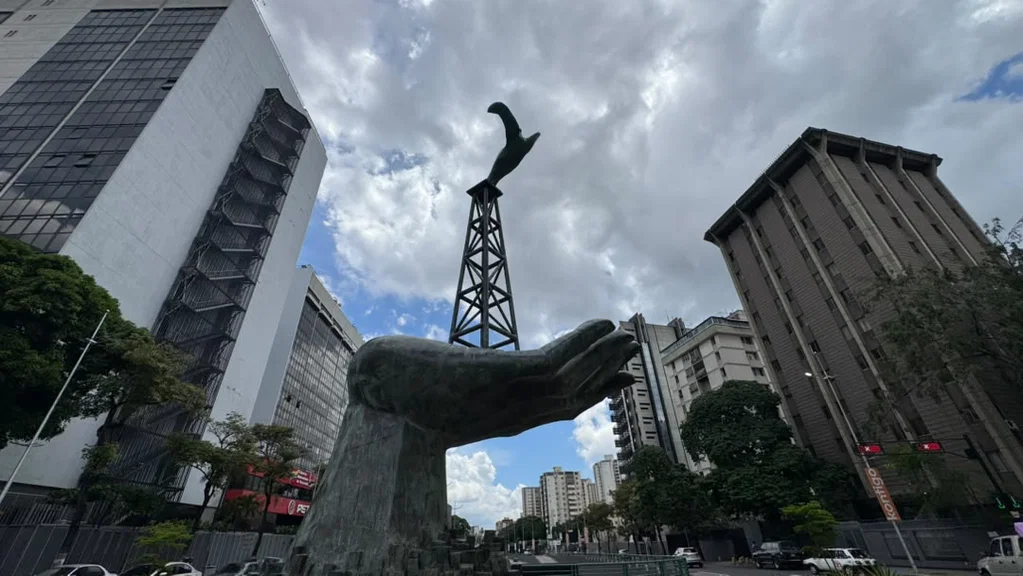
Paúl del Río’s Monument to Peace, erected in 2003, honors the recovery of the Venezuelan oil industry after the government increased state control in 2001, and after the opposition strike ended. (Jessica Dos Santos Jardim)
Oil drives the Venezuelan economy. Currently, it accounts for 71% of the nation’s total exports, but now much of that revenue goes to the U.S. In the first quarter of this year, out of a total of $7.76 billion in exports, $5.5 billion came from oil activity. As the acting president’s address went on, many of us only had more doubts.
A few hours later, Venezuelan economist Francisco Rodríguez summed up some of the nation’s concerns: “Do the projected tax revenues … correspond to nominal amounts, inflation-adjusted amounts, or net present values? A nominal amount of $19 per barrel in 2051, the project’s final year, would correspond to a real value of about $9 today.”
“The $209 billion equates, over 25 years, to about $8.4 billion annually, a relatively low amount compared with the tax revenue Venezuela has collected in the past at similar production levels. The amount would be even lower if it corresponds to a nominal total.” According to Central Bank of Venezuela data, Venezuela took in a record $82.8 billion in 2008 alone from oil sales.
Contradictions
Trump later contradicted Delcy Rodríguez’s 25-year timeline, saying the deal would involve a century of concessions. Francisco Rodríguez, the economist, noted that extracting 65 billion barrels in 25 years would be impossible, due to lack of infrastructure.
“What rights does the U.S. acquire over these resources after 25 years? Can a future Venezuelan government decide to withdraw from this deal if it doesn’t like it?” he asked.
And why wouldn’t they like it? Trump said on Truth Social that Venezuela will begin supplying the U.S. strategic oil reserve immediately through “a gift.” Nobody knows what that means exactly, but since the military intervention on Jan. 3, the revenue generated by the sale of Venezuelan oil — we don’t know how much that is either — is already “in the custody” of the U.S. Treasury.
“It doesn’t look like Venezuela will benefit broadly in the long term. It’s like being on floor minus-18 and going up to minus-10,” Venezuelan researcher Blas Regnault, who specializes in energy policy and oil governance, told Truthdig from The Hague, Netherlands.
“There could be an indirect reactivation of the economy because of the indirect jobs that may emerge in some regions. But let’s also keep in mind that the country has been 100% blockaded, suffocated, so any door that opens will bring some benefits, but this is not the benefit one would expect for a sovereign country,” he said.
“That’s the other problem: There’s no sovereignty of any kind over the resource itself, over what’s being sold. On top of that, there’s a lot of opacity — you’re analyzing blind.”
This “opacity” is also illegal. Articles 150 and Article 187, Paragraph 9, of Venezuela’s Constitution state that contracts of national public interest with foreign states or entities require approval from the National Assembly. However, although the Assembly endorsed the announcement of the deal on Sept. 1, its president, Jorge Rodríguez, said it had not yet been “submitted” to the legislature. Then, a month later he said that “according to some legal experts, it doesn’t need to be reviewed.”
It’s clear that Venezuela is once again, as it was for much of the 20th century, a kind of “U.S. oil province,” Regnault says, “Recovering sovereignty won’t be easy because Venezuela is strategic to U.S. interests.”
“On top of that, the other side of the coin is that China has become a key player [globally]. Today the Chinese do what Saudi Arabia used to do when it cut production and pushed prices up. With this Strait of Hormuz crisis, after the naval blockade of Iran, it was discovered that China had more reserves than previously thought, and that kept the crisis from being bigger and the price from reaching $150.”
That is precisely why U.S. Secretary of State Marco Rubio celebrated the fact that several of the oil fields included in the deal were once “dominated by China and Russia and Iran.” At the same time, the U.S. government has decided to maintain sanctions against Venezuela, thereby preventing any new economic players. In fact, the U.S. Treasury Department, through its Office of Foreign Assets Control, updated its oil licensing policy for Venezuela in late September through Orders 46E, 48D and 49B, which benefit U.S. businesses but maintain an absolute ban on Russia, Iran, Cuba, North Korea and China.
“The [Venezuelan] government has already amended the Hydrocarbons Law to try to create more favorable conditions for investors in the oil and gas sector, but … the [U.S.’] problem isn’t domestic supply. They need to monopolize the world’s energy reserves, markets and prices in order to prevail in the rest of their economic activities,” oil expert David Paravisini explains to Truthdig from Caracas, referring to a legal reform that was passed on Jan. 29 and created the possibility of technical and operational management and direct commercialization by private companies. He believes that for Venezuela, the deal is a diplomatic “quest” to survive.
People block a street during a protest against power cuts in Valencia, Venezuela, on Oct. 2, 2026. (AP Photo/Jacinto Oliveros)
Trump is also maintaining some of his domestic support by presenting Venezuela as the great economic and geopolitical victory of his administration, especially after the war against Iran — which was supposed to last “only a couple of weeks” — reached the six-month mark and cost more than $37.5 billion through the end of July. In fact, Trump has claimed again and again that this oil deal will lower fuel costs inside the U.S. and come “at no cost whatsoever to the American taxpayer.””
Does this mean the $100 billion investment will come from private companies? The deal also aims to exploit eight greenfield blocks, areas where crude has been identified but which have not yet been developed. But what happens if that investment does not materialize? Since Jan. 9, Trump has been trying, without success, to persuade U.S. oil companies to invest in Venezuela.
Corruption is fine if the U.S. profits
So far, the only company we’ve heard about is North American Blue Energy Partners (NABEP), which was selected on Aug. 31 by the Trump administration to lead oil extraction projects in the 17 Venezuelan fields.
According to the White House, the Department of Defense will hold a 35% equity stake in NABEP and, in addition, the Barbados-registered company will grant Washington the right to buy 20% of the oil it produces at the cost of production.
NABEP, which has only operated in Venezuela for two years, was awarded the deal without a prior bidding process. The company belongs to Venezuelan businessperson Alejandro Betancourt, who was under investigation by federal prosecutors in Florida until January 2026 for allegedly laundering more than $1 billion from the state-owned Petróleos de Venezuela (PDVSA). The case was then closed suddenly under the orders of U.S. Deputy Attorney General Todd Blanche (now the attorney general), after a decade-long investigation. He is still the subject of open investigations in Switzerland and Spain.
Betancourt comes from a middle-class family but studied at the private religious school Instituto Cumbres de Caracas, where he befriended Javier Alvarado Pardi, son of Javier Alvarado Ochoa, who later became president of Electricidad de Caracas, deputy energy minister and a PDVSA executive.
Back in 2009, Alvarado Ochoa presented Betancourt and his engineering firm, Derwick Associates, as the best solution to Venezuela’s power generation crisis. Betancourt went on to receive 12 government contracts, awarded without competitive bidding, worth a total of $5 billion, which were either never completed or were implemented improperly, according to Transparency Venezuela and the Organized Crime and Corruption Reporting Project (which is funded by the U.S. government, among other countries).
So why Betancourt? Rubio said that he is no longer under investigation by the U.S., has supported the Venezuelan opposition and he has demonstrated his ability to produce oil. In that vein, NABEP claims it produces 200,000 barrels of crude a day, just behind Chevron.
However, Victor Hugo Majano, a Venezuelan investigative journalist and director of the well-known outlet La Tabla, told Truthdig that Betancourt overbilled the Venezuelan state by billions of dollars for power plants that never worked. He cited information from Thor Halvorssen, an anti-Chavista activist and cousin of Venezuelan opposition leader Leopoldo López. With that money, Betancourt bought a Dassault Falcon private jet and the historic Alamíin Castle in Spain.
Halvorssen also says Betancourt, who is also linked to 50 companies spread across 15 countries, paid former New York prosecutor Adam S. Kaufmann to halt prosecutions; former Wall Street Journal reporters to discredit whistleblowers; and former New York City Mayor Rudy Giuliani to bring the U.S. Justice Department over to his side.
“Despite this, the U.S. still doesn’t attack Venezuelan corruption. They want to protect the dollar and the U.S. financial system. They are only worried about securing capital flow, money that is not controlled by the state, the [Venezuelan] government,” Majano said.
More oil for the U.S., less electricity for Venezuela
Meanwhile, Venezuelans are paying the price for both Betancourt’s alleged corruption and the oil deal. So far this year, oil production has increased by 29.9%, going from 924,000 barrels per day (bpd) in January to an average of 1.2 million bpd. The increase has been driven by the need to deliver oil to U.S. companies, and it has directly worsened the nation’s electricity crisis.
Authorities acknowledge this; Venezuela’s interior minister, Diosdado Cabello, said in May the country is seeing higher electricity demand due to the growth in oil production, which “is a very serious problem.” The Ministry of Electrical Energy also noted that demand has reached 15,625 megawatts (MW), “the highest energy consumption figure in the last eight years, an increase of 3.6% compared with the peak reported in 2025.”
However, this statement omits that Venezuela actually has a nominal installed capacity of approximately 35,000 MW, double the country’s peak demand, but stable real generation barely reaches 11,000 MW. This shortfall is a result of both U.S. sanctions and domestic corruption, which together have led to disinvestment, lack of maintenance, fuel shortages (plants designed to run on natural gas have been forced to use low-quality diesel) and transmission problems.
Where does oil production come in? Víctor Poleo, an electrical engineer and former vice minister of Energy and Mines from 1999 to 2001, told Truthdig that “the national oil industry uses up about 1,500 MW, of which about 250 MW is self-generated, but another 1,250 MW is taken from the national interconnected system. This draw is 24/7 and must be continuous in order to carry out crude extraction, transport, pumps and compressors and refining.”
High-voltage transmission lines cross the Waraira Repano mountain range overlooking Caracas, Venezuela. (Jessica Dos Santos Jardim)
Poleo, who bases his analysis on studies by fellow electrical engineer Nelson Hernández, says light, medium and heavy crudes are estimated to require between 9 kilowatt-hours and 15 kilowatt-hours per barrel to produce. For extra-heavy Orinoco crudes, the estimate is 24 kilowatt-hours per barrel. “As a result, citizens lose their quality of life so that oil can be produced.”
This deterioration is particularly notable in Zulia state, Venezuela’s so-called oil cradle, where production has risen to between 350,000 and 370,000 barrels per day of light and medium crude — far below the historic peak of 1.5 million bpd in 2004, but a figure that, for its residents, has translated into daily blackouts exceeding 12 hours.
From the Isla Dorada residential complex in northern Maracaibo, capital of Zulia, José Javier León tells Truthdig that power failures “have worsened dramatically.” In his area, outages used to last four hours but now exceed seven.
“In many places there are double rounds, meaning the power goes out in the morning and at night, or at night and then before dawn. All the problems have gotten worse, and we don’t know the real reasons. In the suburb of Cuatricentenario, one of the most working-class areas and where the government had the most electoral support, the cuts are the worst,” he says.
León complains that residents are not alerted when the outages will happen. There is nothing like the electricity rationing schedules of the past, which would at least let them plan better. “In my area, there is no domestic gas, so we have electric stoves. Also, these are apartment buildings, where we have to turn on pumps to get water.” To make matters worse, the temperature in Zulia often reaches 39 degrees Celsius (102 Fahrenheit) because of the humidity.
In the Andes, outages add up to as many as 12 hours a day, and 16 hours in rural or border areas. From La Hechicera, an urban neighborhood in the city of Mérida, Silvana Solano tells Truthdig that the power used to go out for seven to eight hours, once a day, “but for the past two months, it goes out twice a day, the first time for seven hours and the other for around five hours, and we can’t predict the schedule. This also affects phone signals, which keeps us from communicating, making payments, etc.”
Some government institutions, including the Mérida mayor’s office, are open only from 8 a.m. to noon. Solano says she is worried that public schools, which operate until 3 p.m., will also adopt this schedule, in turn affecting parents’ working hours. Throughout September, residents of the towns of Caja Seca (Zulia state) and Nueva Bolivia (Mérida state) blocked the Pan-American Highway to protest the power outages.
To Venezuela’s north, on the famous Margarita Island, Alejandro Pérez tells Truthdig there are areas that have gone seven to eight months without water service. “Here we pay for water trucks, $50 for 10,000 liters of water, sometimes with $60 we get 13,000 liters, but you have to pay in foreign cash or at the parallel rate because the Central Bank of Venezuela exchange rate isn’t accepted here.” The black market or informal exchange rate is worth more, for those with foreign currency, than the official exchange rate.
Unlike other Caribbean islands, Margarita doesn’t have significant natural sources of fresh water. Some 90% of the area’s water comes from the mainland, crossing the sea through underwater pipelines that require gigantic pumping stations.
The contradictory rhetoric and the endless problems we face daily mean that, according to the latest AtlasIntel poll conducted for Bloomberg News, only 10% of Venezuelans believe the country will benefit from the oil pact with the U.S. — data that also aligns with the most recent study by the firm Meganálisis, the same one that after Jan. 3 said 92.2% of Venezuelans loved Trump. Emotions change, social problems persist, and without electricity, no economic improvement will be possible.
The views expressed in this article are the author’s own and do not necessarily reflect those of the Venezuelanalysis editorial staff.
Emma Willis has shared an update on Delta Goodrem after she was forced out of Strictly Come Dancing and admitted she could tell “something wasn’t right” with the pop star
19:28, 15 Oct 2026Updated 19:28, 15 Oct 2026
Emma Willis ‘knew something wasn’t right’ with Delta Goodrem before she was forced out of Strictly with an injury(Image: BBC)
Emma Willis has shared an update on Delta Goodrem after she was forced out of Strictly Come Dancing.
Pop singer Delta is currently in the lineup of celebrities trying their luck on the dancefloor. Whilst she and Kai Widdrington managed to top the leader board last week with their Salsa, it quickly emerged that the singer had done the show in “absolute agony” and on the Sunday, she went to hospital with a rib injury.
Appearing on Thursday’s edition of It Takes Two, Emma told host Ellie Taylor that it was somewhat obvious that something was amiss with Delta’s health at the time. She said: “It’s such a shame. I think it became quite apparent after the show that last week that something wasn’t right.”
Delta has been given a free pass – or bye – to the next round of the competition and, even though she will miss out on Icons Week, Emma said the cast and crew are hopeful this will mean she will be back and fighting fit.
She added: “We’re just hoping that because she has this bye week, by the week after, she’ll be good to get back. Fingers crossed!”
Delta, who is best known for starring in Australian soap Neighbours and released hits such as Innocent Eyes before representing her home country at Eurovision earlier this year, has broken her rib but is hoping to recover in time for next week and – following her doctor’s order – has been getting rest at home.
Taking to social media, she wrote: “Just wanted to come on here and say a big Thank you to everyone who has sent messages and wrote lovely comments the last couple of days, I see them all.
“Not the start to the week I’d hoped for but your support has meant the world. Also special big thank you to my amazing dance partner @kaiwidd who I will miss dancing with this weekend but I am so beyond grateful for his guidance and friendship through it all.. as well as the wonderful Strictly team!!”
She added: “Resting and recovering at home and will be cheering everyone on from my couch on Saturday night xx.” Delta had previously said she was “absolutely gutted” to be out the show for the week, and hoped she’d be back the following week.
It was revealed today that Delta’s planned dance to Dolly Parton’s Jolene with Kai Widdrington will be performed instead by Amy Dowden.
A spokesperson for the show had said: “Due to injury, Delta Goodrem has been advised by doctors to rest and, as a result, will not dance on this weekend’s Strictly Come Dancing.
“In line with the rules of the show, Delta and Kai will receive a bye through to next week when it is hoped they will be able to dance again. We wish Delta the very best as she continues her recovery.”
Delta added: “I’ve been loving every second of this experience, so having to sit this one out is heartbreaking – especially after the high of Saturday night.” “I cannot tell you how much I love being a part of this magical show. I’m going to focus on resting and recovering, and hopefully I’ll be back on that dancefloor very soon. Thank you so much to everyone for all the love and support. It’s so appreciated. I’ll be cheering everyone on from the sidelines this week!”
Sources revealed that Delta’s rib injury “deteriorated” and she was “in absolute agony” performing. She was later rushed to hospital to undergo tests but is now resting at home.
A source said: “Delta has been pushing herself as far as possible to impress Strictly viewers. A small injury at the start of last week has quickly deteriorated. On Saturday night, despite putting on a brave face and smiling, she was in absolute agony.
“Filming didn’t wrap until late Saturday night and she was exhausted. The plan was to go home and get some rest but she could hardly sleep. On Sunday morning she was raced to A&E and then spent most of Monday also at the hospital.”
Thousands gather for funeral prayers in Pakistan’s Peshawar after a school rooftop collapse killed at least 34 children and a teacher and injured more than 50 people. Police have attributed the collapse to weak infrastructure.
There are just weeks to go until the US midterm elections that will decide control of Congress, with campaigning in full swing around the country and voters weighing who to back at the ballot box.
The elections will have a potentially major impact on the remainder of President Donald Trump’s time in office. He is facing challenging political headwinds with concerns over rising costs and the war in Iran high on the minds of voters.
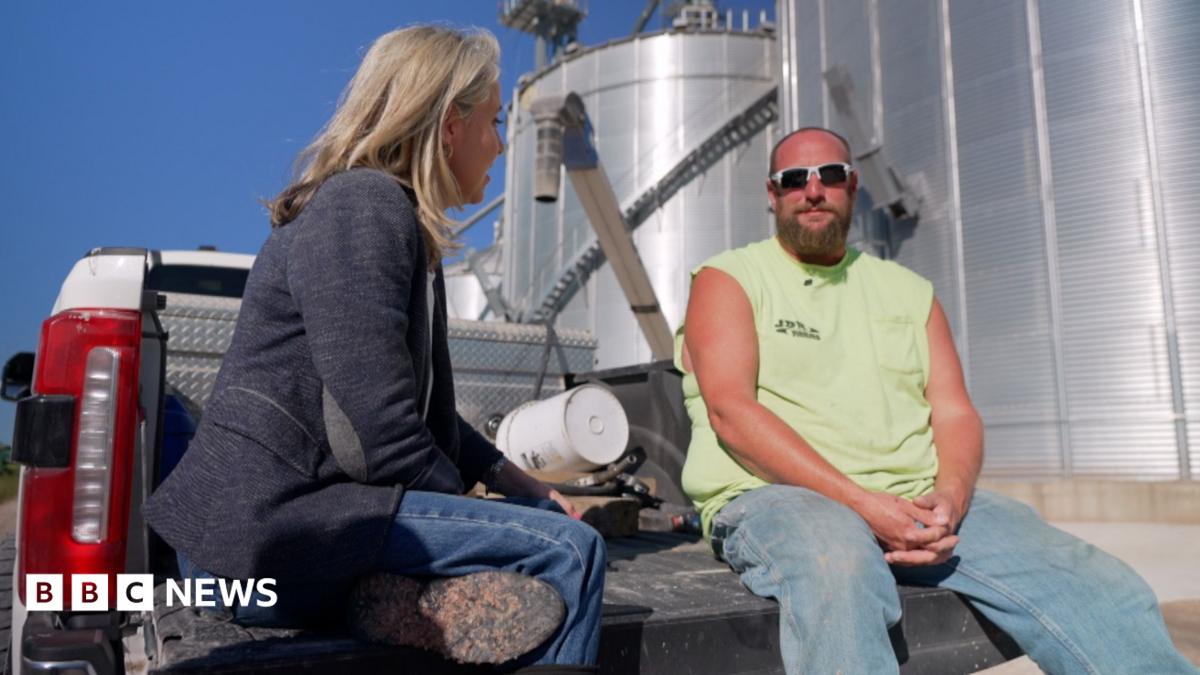
Ahead of the elections, the BBC’s Sarah Smith travelled across Iowa to speak to voters in the predominately Republican state.
Produced by Cai Pigliucci, filmed by John Landy and edited by Blanca Estrada
Rob’s murder left all the Faithful confused while banished Hannah admitted her spreadsheets hadn’t helped her as a Traitor
Beckett’s kicked the bucket – as Claudia described his murder
While comedian Rob Beckett found being murdered funny in The Celebrity Traitors, Professor Hannah Fry said she’d cried more during her five days of playing the game than at any other point in her life.
Hannah was banished at the round table last night with 12 of the 15 remaining players writing her name on the slate – giving them a landslide 80% victory. Speaking straight after leaving the castle, she admitted that she’d found her time there to be a rollercoaster of emotions. “I laughed more, cried more and got more excited than I ever have in the entirety of the rest of my life combined,” she explained.
“I really preferred being Faithful. I think it’s just a much more authentic experience,” she added, saying that one of the lessons learned was that she hated “lying to people’s faces”. “I think there’s actually some pride in being a rubbish Traitor.”
The maths guru, who has two daughters aged eight and six with her ex-husband, said that being a Traitor had been far harder than playing as a Faithful – which is what she’d gone into the game to do. “One of the reasons why I didn’t want to be a Traitor is because the only way your game ends is by being banished or winning – having people vote for you and having heat on you is part of the role of being a Traitor.”
Hannah confessed she’d avoided voting for Julie Hesmondhalgh out of guilt because the actress was “lovely” and had instead gone for Jerry Hall as “the one person on that whole table who could handle being voted for”.
The 42-year-old said she always knew she might not last long in the game. “On the first day, I asked Michael Sheen who he would murder, and he said, ‘You’. At that point I knew I was really in trouble.”
And the BBC presenter also confessed that getting the roman numerals right in her final mission – to help with the group £8,000 – had been far tougher than it looked. “I knew that everyone was going to expect me to be the one to solve it, but I think people have this image in their heads that mathematicians just sit around thinking of big numbers all day – it couldn’t be further from the truth. I haven’t used a number since I was about 16, I’m all about the x’s and y’s.”
Along with the trickier moments, there was also some highs. “Killing Rob Beckett was one of the best evenings I’ve had in my entire life,” she laughed. “I was running through the woods in the middle of the night, opening the door to Rob’s face. It was delightful.”
Speaking after being killed face-to-face with the traitors, dad-of-two Rob said that he cared less about the game and more about the juicy stories the other celebs were sharing in the castle. “What I loved most was meeting everyone and talking to them,” he explained. “When you have Michael Sheen, Richard E . Grant, Jerry Hall, James Blunt, I don’t care who’s a Traitor. Give me the anecdotes, I want the gossip. So everyone was going back to the hotel writing ideas of who it might be in their notepad, and I’ve got a notepad full of anecdotes that they told me that can only get wheeled out when I’m drunk at a party.”
When The Traitors arrived as his crypt to tell him he’d been murdered, he responded jovially: “Thank you very much James Acaster!” But he did say he expected comedy sidekick Romesh Ranganathan to “avenge my death”.
Rob, 40, reckoned the only Traitor he’d potentially identified at the start was Richard E Grant – so was “gutted” when the actor blurted it out. But the funnyman realised too late how James Acaster had been giving him a wide berth. “I gave James the benefit of the doubt because he desperately wanted to be a Faithful, but then that’s the oldest trick in the book, saying that. He had been really quiet, and on reflection, he’d avoided me a lot which makes sense, because I know him quite well. And then Maya Jama does not change her personality, whatever’s happening. So she’s going to be a great Traitor, I think she could win it.”
Confessing he was happy to go home because he’d been missing his kids, aged eight and 10, Rob said his highlight in the castle has been hitting it off with Jerry Hall. “I love her. She’s got such an amazing energy. She’s just so chilled. We just floated on together. She tells me her life motto probably every eight minutes, and that is ‘what will be, will be’.”
He now wants Jerry, 70, to win – along with his close pal Romesh. “Jerry Hall’s my pick, a rank outsider, but she’s my pick. The ultimate finale would be Leigh-Anne, Jerry and Romesh staring down Acaster. Three on one and they take his sorry ass to the cleaners.”
He believes his relaxed way of playing the game far outweighs the high-pressure path that Hannah had been forced down. ”I’d say, don’t stress yourself about it. All the money goes to charity. Have a good time for a long time.”
One of the surprising things Hannah discovered in The Celebrity Traitors was that she is actually related to Irish comedian Joanne McNally because their cousins are married. “We’re basically sisters,” she laughed. “I really loved her so much. She described herself as coming out of the womb as a show pony – that’s the perfect description of that woman. She is phenomenal. She knows exactly who she is, and she is totally unapologetic about it. I cannot tell you how much I admire her.”
While she’d like to see Joanne win, Hannah now thinks that fellow Traitor Maya or Faithful Leigh-Anne are the most likely to reach the final. “I think Maya is playing the most amazing game. When someone looks like that, I think that you expect her to have a bit of a chip on her shoulder because she’s one of the most beautiful women alive, but she’s also just so much fun. No airs and graces, totally delightful to be around.”
She also believes that Leigh-Anne has a great chance in the game, because she’s been woefully underestimated. “My God, that woman hasn’t got a single thing wrong. She’s the most perceptive person I’ve ever come across in my entire life. Is she psychic?
“Leigh-Anne needs to keep quiet about how good she is because I don’t think people have necessarily noticed. As soon as Maya notices that Leigh-Anne is that good, she’s going to kill her.”
Last night’s episode ended with boxer turned YouTube star King Kenny being recruited into the turret – much to his enormous surprise. “Being a Faithful was fun, but being a Traitor is going to be better,” he declared.
Urging Maya Jama and James Acaster not to double-cross him, he admitted he had concerns about joining them halfway through the game. “I worry the Traitors can switch on me at any time.”
The school visit was followed by the event in Dolgellau’s Eldon Square, where crowds had gathered despite the persistent rain.
Most of the supporters were local, but some had travelled significant distances to be at the event.
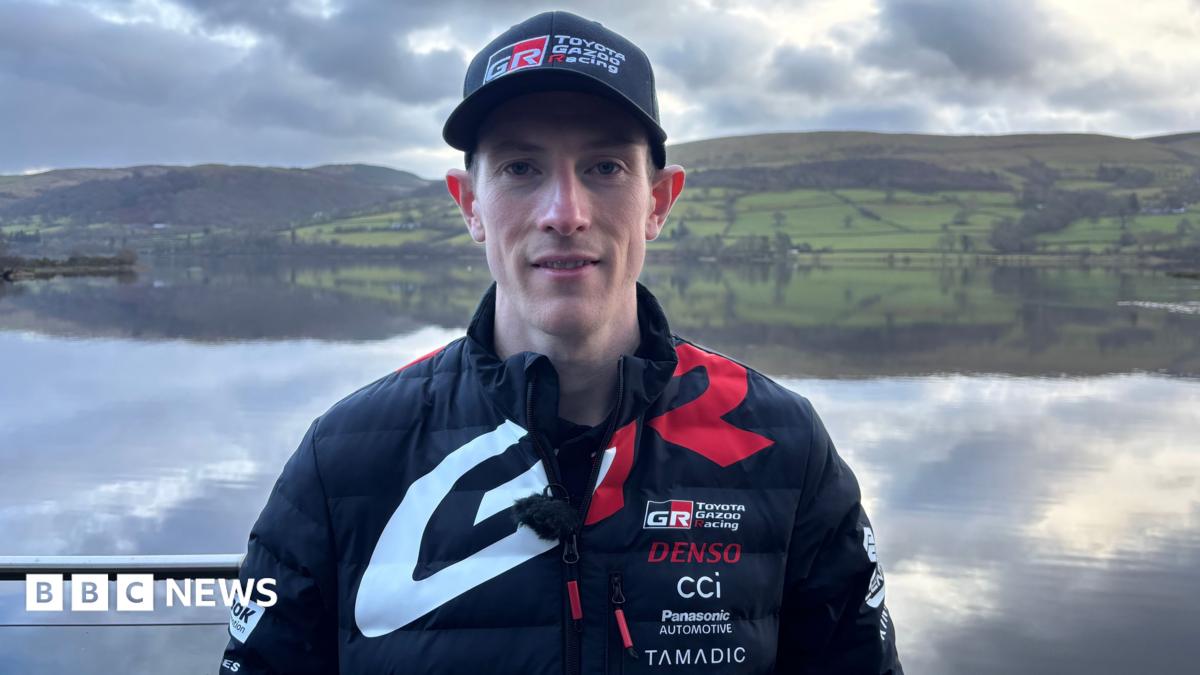
When Elfyn Evans spoke from the podium, he thanked his family for supporting him throughout his career, saying his grandfather had “taught me to drive probably far too early”.
Wyn Williams from Llanrwst and Neil Pringle from Betws-y-Coed were in Sardinia when Evans clinched the championship.
Williams said the celebration was “the icing on the cake after being in Sardinia”.
Pringle added that the evening was “fantastic” and that the first minister’s presence “shows what this means to Wales”.
“This is for Elfyn, his family and the country.”
Heledd Edwards travelled from Talerddig to Dolgellau and described Elfyn’s perseverance as an inspiration.
Several members of Elfyn’s family were also in the crowd. His aunt, Lowri Edwards, had travelled from Glan Conwy, saying she was immensely proud to have a world champion in the family.
“We’re absolutely thrilled, to be honest. He’s come so close and been terribly unlucky, finishing second five times – we’re absolutely thrilled.”
Dolgellau Town Council helped organise the celebration, with Deputy Mayor Nia Wyn Evans, saying: “We are absolutely thrilled and delighted to be able to welcome Elfyn back as a world champion; there’s a real buzz in the town.”
A bystander has filmed residents of a condemned building in Peru’s Huancayo throwing flaming gasoline on officials trying to evict them. Nine workers suffered severe burns in the attack.
“The Palestinian question is the greatest historical injustice of this century,” China’s foreign minister said.
Published On 16 Oct 202616 Oct 2026
China’s Foreign Minister Wang Yi has told Israeli President Isaac Herzog during a meeting in Azerbaijan that Israel should stop and reverse its “forced establishment” of West Bank settlements, China’s foreign ministry said in a statement.
Wang told Herzog that China has consistently viewed the Palestinian question as the greatest historical injustice of this century, the ministry said in the statement on Friday.
Recommended Stories
list of 3 itemsend of list
Wang emphasised that the “two-state solution” is the right path to a resolution and said the immediate priority is to fully open access to the Gaza Strip so a humanitarian “catastrophe” is not allowed to spread.
Wang added that China is willing to work with the international community to push all parties to return to dialogue as soon as possible and seek a political settlement.
Wang is attending the Seventh Summit of the Conference on Interaction and Confidence-Building Measures in Asia, held in Baku, Azerbaijan, as the special representative of President Xi Jinping, China’s state news agency Xinhua reported.
China urges new Middle East framework
In September, Chinese President Xi Jinping visited Cairo for the first time in a decade and called on Middle East countries to oppose external influence and consider reshaping the region’s security order.
Xi’s rare visit arrived as Beijing seeks to expand its influence in the region amid the US-Israel war on Iran.
The talks covered the US-Israel war on Iran, with both presidents urging “diplomatic solutions” to reach a “comprehensive agreement to end the war”, according to a statement from Egyptian President Abdel Fattah el-Sisi’s spokesperson.
In March, China criticised the US and Israeli attacks on Iran, with Beijing demanding an immediate halt to the joint attacks. Wang told his Israeli counterpart, Gideon Saar, that the attack on Iran came as negotiations between Washington and Tehran had “made significant progress, including addressing Israel’s security concerns”, China’s foreign ministry said in a statement following the start of the war.
China was Iran’s largest trading partner, buying up to 90 percent of its oil, according to the US-China Economic and Security Review Commission. In 2021, Beijing signed a 25-year “comprehensive strategic partnership agreement” with Tehran.
At the same time, Beijing has spent the past decade cultivating closer ties with Gulf countries, including Saudi Arabia, Qatar and the United Arab Emirates, and remains a top trade partner of both the US and Israel.
REVIEW: The recruited comedian has bragged that he hasn’t told one lie during his time in the game but surely he’ll come unstuck soon?
21:06, 15 Oct 2026Updated 21:07, 15 Oct 2026
James never wanted to be a Traitor and so it’s fair enough that he is struggling to behave like one
James Acaster is playing Celebrity Traitors in a brand new way, having been recruited to the dark side very much against his will. But against all expectation, he’s acing it.
The comedian, who told host Claudia Winkleman that he had no desire to be a Traitor at the start of the show, was picked to be one anyway, by Maya Jama and short-lived eejit Richard E Grant.
And while it was almost annoying when he simply refused to join in with Maya’s murderous glee as they pulled the plug on Bella Ramsey, I’ve come around to the idea so much that I’m finding his gameplay quite admirable.
Somehow James is managing to succeed as a Traitor while playing as a Faithful. Yes, it’s quite weird, but against the odds he’s making it work. And watching him try to justify every little thing he does – presumably so he can sleep at night and also so he can point this out to everyone afterwards – is fascinating.
In tonight’s episode he told King Kenny, the latest Faithful to make it through the turret’s revolving door: “I’m basically playing the game as a Faithful – I haven’t told a single lie yet, but I’m protecting Maya.”
He seemed almost happy, presumeably on the back of the previous night’s murder having gone so well. Because while Ross Kemp would have been FURIOUS to get murdered, and Romesh Ranganathan might have been a bit miffed too, Rob Beckett just laughed at them.
Afterwards James said he wished ALL the murders could be done face to face, because it had helped to ease his conscience when he saw that Rob, at least, was very much remembering it was all just a game.
Because he’s more Faithful than Traitor James has had no qualms about voting out two fellow baddies so far – Richard E Grant and Hannah Fry. So Kenny is right to be worried about being double crossed by him or Maya Jama, but for now James is genuinely delighted to have the fellow avid Faithful on board. “I’m feeling much more relaxed now that Kenny’s on the case,” he said. “You know when you get someone who comes in at work who you know will actually do all the jobs – and you can just hold a broom and look like you’re doing something.” Yup, James is going to hide behind Kenny for all he’s worth.
Meanwhile Maya is having a tough time of it because the Traitors are dropping like flies. I mean yes, she does keep voting for them too. But still, she must be feeling a bit lonely.
Now the Faithful are all pumped up again and Bash (Sebastian Croft) keeps mentioning James Acaster as a potential Trator so it might not be long before he’s forced to defend himself.
I wish someone would just ask him: “Are you a Traitor?” because if he can’t lie, it’ll be Richard E Grant all over again. Roll on tomorrow’s episode…
It was already going to be a short week, but Sean McVay navigated unexpected business that affected the start of preparation for Sunday’s game against the Arizona Cardinals.
“He says, ‘How’s that tube?’” McVay recalled. “I said, ‘What do you mean?’
“He said, ‘That tube of [s—] that never stops coming down over your head when you’re a head coach.’
“But honestly, it’s part of it.”
The Rams hope that Grupe can clean up the kicking game and relieve criticism of the Rams’ struggling special teams. McVay said this week that he has “a lot of confidence” in special teams coordinator Bubba Ventrone, and that “no changes” are going to be made to that staff position.
“You’re continuing to figure out some of our identity,” McVay said Thursday, adding, “I have seen the intentionality from the group that I’m looking for.”
Grupe was signed off the New York Jets practice squad. Last season, he was released by the New Orleans Saints in late November after he made only 18 of 26 field-goal attempts. The Indianapolis Colts signed Grupe and he made all 11 of his attempts.
“For these last five weeks, I’ve been staying ready, been doing what I need to do to take advantage of an opportunity,” Grupe said.
Quessenberry, 36, is a ninth-year pro. But he has not started a game since 2023, when he played for the Minnesota Vikings.
Quessenberry played only 18 snaps on offense last season, none this season.
But McVay said Quessenberry was a “consummate pro” who has played “a lot of meaningful snaps” in his career and worked with the Rams’ first-team offense when Jackson has been held out while managing blood-clot issues.
“This is kind of why I’m here, when things like this happen,” Quessenberry said. “So I’m ready to go. This is what I’ve worked for. I’ve played this position my whole life. Go out there on Sunday and play ball. I’m fired up.”
This will be the first game without Jackson since last season’s late December game against the Atlanta Falcons. With D.J. Humphries starting at left tackle, the Falcons swarmed Matthew Stafford. Humphries was called for two crucial penalties, the Falcons sacked Stafford three times and intercepted three passes.
“He’s proven himself in this league,” Stafford said, adding, “ton of trust in what he’s capable of.”
Rookie lineman Keagen Trost practiced Thursday for the first time since he was placed on injured reserve before the season because of a hamstring injury suffered in the preseason opener against the Kansas City Chiefs.
Trost, a third-round draft pick out of Missouri, could be activated to the roster.
“It’s been a little bit of time since he’s played football,” McVay said. “But if he’s feeling good, expect him to be up for the game.
“But not at the expense of putting him in a situation that, if he did have to play, wasn’t good for him.”
Offensive lineman Justin Dedich, who has been on injured reserve because of a hand injury, also is eligible to return. But interior linemen such as guards Kevin Dotson and Steve Avila have remained physically sound.
“We’ll pray that we stay healthy,” McVay said, “but at some point we’ll start his clock and get him in there.”
Judge fines government for failing to fund universities as protests over Milei’s cuts turn violent.
Reporting from Buenos Aires
Published On 16 Oct 202616 Oct 2026
“This cannot go on!” students shout during an assembly in the middle of the central hall of the University of Buenos Aires Exact and Natural Sciences building.
It is part of Argentina’s prestigious public university system.
Recommended Stories
list of 3 itemsend of list
The faculty’s central hall is covered with dozens of banners protesting President Javier Milei’s spending cuts. Students have called an assembly to announce the occupation of the university, a traditional form of protest in Argentina meant to raise public awareness and pressure the government.
They say they will take over the building for a day. Many students and professors here are concerned about the impact of Milei’s austerity policies on public universities and say the future of free higher education is at risk.
Students gather in protest at a university in Buenos Aires [Lagmi Chavez/Al Jazeera]
“Our best professors are leaving en masse. With salaries that cannot cover their basic needs, they are leaving for private universities,” Emiliano Gato, a physics student who is part of the group, told Al Jazeera.
“I dream of doing research and teaching at the public University of Buenos Aires. It’s a prestigious school. But now, with this austerity plan, I don’t know what will happen.”
Public universities in Argentina have become a major battleground of Milei’s austerity plan. Students and professors are protesting the lack of funding and the erosion of salaries, which they say is a major threat to the country’s public education.
Milei is implementing one of the harshest austerity plans in Argentina’s history.
Since taking office in 2023, he has laid off thousands of state employees, shut down ministries, reduced subsidies and cut government-funded programmes. The measures were meant to fight high inflation, which was a major problem in Argentina. Almost three years later, inflation has fallen to around 2 percent a month. Milei says his plan is going well.
“Argentina is growing at a remarkable pace. We have now recorded 27 consecutive months of sustained growth, and today the country is expanding at four times its historical rate. This growth is being felt across almost every sector of the economy,” said Milei during a recent visit to Washington.
Ripple effects
But not everyone agrees. His plan is also having a profound impact on public education, welfare plans for people with disabilities, pensioners and others who depend on state support. The opposition has tried to block many of Milei’s reforms.
Last year, Congress overturned presidential vetoes and approved two laws, one increasing funding for public universities and another declaring a disability emergency. But Milei’s government has refused to implement them, arguing that Congress failed to identify how they would be financed.
A federal judge has now begun fining the government 100,000 pesos (around $70) a day for failing to implement parts of the financing law, which requires Milei’s government to restore university salaries and student scholarships lost to inflation, regularly update budgets and provide funding for research, hospitals and infrastructure.
And that’s why thousands of people took to the streets on Thursday to demand that the government implement it. All around Buenos Aires, long columns of people blocked the centre of the city as they called for a general strike. Although the protest was meant to be peaceful, it soon turned violent. Police fired tear gas and rubber bullets as protesters threw rocks.
The plaza in front of Congress resembled a battleground. At least 25 people were detained, and several others were injured, including members of the security forces.
Maria Teresa de Jesus is a professor in the University of Buenos Aires chemistry department. She says she makes around $700 a month and it has become difficult to make ends meet. “I have come to this protest as a last resort. I am professor. I love teaching, doing research. I shouldn’t be here,” she told Al Jazeera. “Public education is crucial in this country, to make education accessible to all. And the government is ignoring it.”
Many in Argentina continue to support Milei’s economic plan. They are hoping the government’s plan to exploit the country’s vast natural resources will pay off and translate into more jobs, higher wages and improved living standards.
But many others have stopped believing and are prepared to raise the stakes. They accuse Milei’s government of protecting the interests of a privileged few while asking the rest of the country to bear the cost of his economic plan.