Month: July 2026

‘Free’ holiday souvenir could quietly land tourists a £1,300 fine

People holidaying in France might bring this keepsake home without thinking twice

It may seem like a harmless memento to slip into your suitcase before heading home, but one common holiday habit could end up proving very expensive. Beach holidays are hugely popular, and while many travellers like to collect natural souvenirs as keepsakes or gifts, doing so in France could land them with a fine of up to €1,500 – which is around £1,300.

The little-known rule applies to natural materials including sea shells, pebbles and sand collected from French beaches. While many holidaymakers think nothing of taking home a small reminder of their trip, doing so is prohibited under French environmental laws designed to protect the country’s coastline.

Authorities say taking such items from beaches contributes to coastal erosion and can damage fragile ecosystems. Shells provide shelter for small marine creatures, while pebbles and sand play an important role in maintaining the stability of beaches.

France is home to more than 5,500 kilometres of mainland coastline and thousands of beaches stretching from the English Channel and Atlantic Ocean to the Mediterranean Sea. According to Atout France, the country’s official tourism development agency, its coastline attracts millions of visitors every year, making conservation efforts increasingly important.

The restrictions form part of France’s Environmental Code (Code de l’environnement), which protects the country’s natural coastal heritage. Anyone caught removing these materials without authorisation can face fines of up to €1,500, depending on the circumstances.

Environmental experts say the impact of individual tourists taking just a handful of sand or shells can quickly add up when millions of people visit beaches each year. According to the European Environment Agency, coastal erosion is already affecting many parts of Europe’s shoreline because of a combination of natural processes and human activity.

France remains one of the world’s most popular holiday destinations, welcoming millions of international visitors every year. Many head to coastal hotspots along the French Riviera, Normandy and the Atlantic coast, where authorities encourage people to leave beaches exactly as they found them.

The UK Foreign, Commonwealth and Development Office advises travellers to familiarise themselves with local laws before visiting overseas destinations. Even seemingly harmless actions can carry penalties if they breach environmental regulations.

Holidaymakers planning a trip to France are therefore encouraged to resist the temptation to pocket shells, pebbles or sand as souvenirs. Taking photographs instead is a simple way to preserve memories without risking an expensive fine or harming the environment.

Source link

‘Adventures with a touch of magic’: readers’ favourite family days out in the UK | Day trips

Winning tip: a boat tour in County Fermanagh

The MV Kestrel has been taking boat tours out from Enniskillen on Lower Lough Erne for as long I can remember. We were brought out as primary schoolchildren on a geography field trip and I was recently a passenger for a civilised stag party. It’s popular for a reason: the tour (adults £15, under-12s £11) passes the old alma mater of Oscar Wilde and Samuel Beckett (Portora Royal School), and stops at the sixth-century monastic settlement on Devenish island. The silence out here has to be heard (or rather not heard) to be believed. The lough is beautiful regardless of the weather – and with this being Fermanagh, if you don’t like the weather just give it 10 minutes.
Tom

A fun-packed day on Glasgow’s riverside

The Riverside Museum was designed by Zaha Hadid Architects. Photograph: Joseph King/Alamy

My family loves a day trip to Glasgow’s Riverside Museum (free entry) on the north bank of the Clyde, quite near the Kelvingrove art gallery. It’s a great place for all generations to explore, and we love that it has interactive displays for children and a wealth of detail on Glasgow’s technological and industrial past for adults. Quite often there will be pop-up events, and the museum regularly runs holiday activities and workshops for families. It also has a purpose-built skateboarding spot outside and just over the Govan footbridge, there is the Maple Leaf, a newly opened artisan bakery that produces Scotland’s best croissants.
Katie

Bowled over by Bolsover in Derbyshire

Bolsover Castle. Photograph: Eye35/Alamy

I’ve lived 30 minutes from Bolsover Castle (adults from £15.38, children from £7.65, free for English Heritage members) for more than three years, but only decided to visit when trying to entertain my visiting parents and nephews (aged from two to 75). It was brilliant. The site has gardens and ruins to explore, a wall you can walk on and a castle to climb, but we also loved the interactive activities. In the basement, my nephew was wide-eyed at how his voice echoed through the chambers.
Sarah Rose

Profile

Readers’ tips: send a tip for a chance to win a £200 voucher for a Coolstays break

Show

Guardian Travel readers’ tips

Every week we ask our readers for recommendations from their travels. A selection of tips will be featured online and may appear in print. To enter the latest competition visit the readers’ tips homepage

Thank you for your feedback.

A wetland wonder in London

Walthamstow Wetlands. Photograph: Abs/Alamy

Not many Londoners know that there is a real treasure of a nature reserve just 20 minutes from the city centre by tube, perfect for a free family day out. The Walthamstow Wetlands is a protected area in the Lee valley, easily reached via Tottenham Hale station. I often spend a day there with my kids in spring and summer. We make up a picnic together, take a bird guide, a flask of tea and a pair of binoculars each. That, and a sense of curiosity and appreciation, is all you need for a great family day out. My teenagers especially enjoy the circular bird walk, viewing platforms and hides to enjoy unusual wildlife. There are also guided walks and talks about the wildlife.
Nigel

Hidcote’s gardens. Photograph: Nick Hatton/Alamy

Inspired by a family reading of Laurie Lee’s As I Walked Out One Midsummer Morning, we decided to follow his footsteps and have a walking day in the Cotswolds. It was brilliant. The sweet rolling hills stretching from Broadway to Bourton-on-the-Water are easy on the feet and easy on the eye for youngsters, parents and grandparents alike. The paths are well signposted and straying into little villages like the Slaughters – with their honey-coloured houses, village greens, pubs and tea rooms – is a joy. And don’t miss the National Trust’s Hidcote and Upton House for heavenly buildings, gardens and views over the Cotswolds.
Nicoletta

Be inspired by Isaac Newton in Lincolnshire

The apple tree at Isaac Newton’s home is still alive. Photograph: Martin Bache/Alamy

The National Trust’s Woolsthorpe Manor (adults from £15, children from £7.50), with its mix of history, science and a great picnic spot, has everything for a brilliant outing. It’s where Isaac Newton grew up and sheltered from the plague, and the house tells this story in a fascinating, family-friendly way. The gardens are a beautiful and peaceful spot to enjoy an ice-cream – next to the famous apple tree, of course. The discovery centre’s activities and experiments are brilliant for budding scientists of all ages. It’s our favourite stop off the A1 – a lovely day out which packs a punch for its small size.
Laura K

skip past newsletter promotion


A quirky destination in the Yorkshire Dales

A green man figure at the Forbidden Corner. Photograph: John Morrison/Alamy

The Forbidden Corner (adults from £16.99, children from £14.99, pre-booked tickets only) on the Tupgill Park estate on the eastern edge of the Yorkshire Dales offers a day of mysteries and surprises. We loved exploring its maze of tunnels, secret doors, strange statues and hidden passages. It’s wonderfully quirky and just as entertaining for adults as for children. We also walked round the estate, discovering the herb garden and Fish Temple. We enjoyed a picnic, but you could eat in the cafe or restaurant.
Susanna B

A magical woodland in Gloucestershire

Photograph: Image Professionals/Alamy

Puzzlewood (adults from £9.90, children from £8.50) is one of our favourite hidden gems in the UK. Within the ancient Forest of Dean, this magical woodland feels as if you’ve stepped into a fairytale. Our children loved winding through the twisting paths, clambering over mossy rocks and discovering hidden corners, while we enjoyed the peaceful atmosphere and spotting TV and film locations. There’s also a small farm, picnic areas and a cafe, making it easy to spend the whole day here. If your family enjoys outdoor adventures with a touch of magic, I can’t recommend Puzzlewood highly enough.
Susanna Callaghan

A country park in Bedfordshire

Photograph: Andrew Greaves/Alamy

Rushmere country park in Bedfordshire is our favourite summer day out. Our boys love the woodland play areas and den-building, while the walking trails through the trees are perfect even on hot days because there is plenty of shade. We usually take a picnic and stay the whole day there without spending very much at all. There are wildlife trails, cycling routes and lots of open space for football or games. It feels miles away from everyday life, and is perfect for families wanting an affordable summer adventure.
Nicola Hart

Fruit-picking in Surrey

Fruit grown at Crockford Bridge farm is used in gelato on sale in its barn

When my family needs an easy summer day out, we head to Crockford Bridge farm in Surrey to fill our baskets with juicy strawberries, raspberries and rhubarb before rewarding ourselves with homemade gelato from local favourites Gelateria Danieli, served in the Wilding Barn. There are up to 24 flavours – some made using fruit grown on the farm – plus excellent vegan sorbets. Afterwards, the children can burn off any remaining energy in the playground. We leave with sticky fingers, punnets of fruit and the feeling we’ve made the most of a summer afternoon.
Carrie


Source link

Dark truth about Brit model Lucia Bartoli’s worrying disappearance amid heartbreaking custody battle with designer ex

MOST young mothers cannot fathom the agony of losing custody of their babies, but for British model Lucia Bartoli, an unimaginable nightmare has taken a dark and twisted turn after a ‘social media ban’.

The 30-year-old Luton-born mum has spent the last year fighting a desperate, David-and-Goliath legal battle against her ex-boyfriend, the £700million German fashion designer Philipp Plein.

Lucia has spent the last year fighting a desperate, David-and-Goliath legal battle against her ex-boyfriend, the £700million German fashion designer Philipp Plein Credit: supplied
Philipp Plein attends the Philipp Plein x Snoop Dogg sneaker unveiling at private LA residence Credit: Getty

Now, in a devastating new blow, Lucia has been silenced after a bizarre move wiped her only lifeline – her Instagram account – off the internet, leaving her isolated and on the brink of homelessness in a foreign country.

Her devoted fans have expressed concern about her internet disappearance.

With celebrity supporters such as actress Alice Evans posting: “Lucia you are SO STRONG. No mother should have to go through this. We are all here for you. Don’t break. We have a collective voice and we can speak for you.. Silence is violence.”

Since her bitter split from Philipp in 2023, Lucia had bravely used her Instagram account to document the destruction of her family and rally support from more than 300,000 followers.

The platform became a crucial tool, helping her raise over £50,000 through GoFundMe to pay her mounting legal bills in her fight to be reunited with her two young sons.

But days after a crushing blow was dealt on June 30, when her Instagram profile appeared to have disappeared.

Friends of the model claim the account was abruptly suspended after five of her own personal family posts, dating back to 2019, 2023, and 2024, were hit by copyright claims.

It is not known who is reporting the young mum’s social media accounts.

A friend of the distraught mother told The Sun: “Lucia is devastated. She is alone in Switzerland and, she has a few good friends there but her main support network is either at home in the UK or online. Losing the account has therefore been a huge blow.”

The digital wipeout has left the young mother feeling completely bewildered and targeted.

Her pal continued: “This came out of nowhere, and Lucia is very confused as to why old content that had been online for years was suddenly flagged for copyright.

“She is desperate to get the account back and has been following all the official steps to try and appeal.”

Lucia’s erasure from the internet has even followed her to other apps, according to pals, who say she has had difficulty posting on TikTok.

The timing of this high-tech silencing campaign could not be worse for the desperate mother.

Lucia was recently evicted from an apartment owned by her billionaire ex and is now rapidly running out of funds.

She has been living in a temporary Airbnb in Lugano, Switzerland, to stay near the jurisdiction where her children reside, but that lifeline is about to be cut.

Revealing the terrifying reality of her living situation, her friend said: “Lucia won’t be able to afford to live in Switzerland for much longer.

“Right now, she is living in a temporary Airbnb where the booking runs out in the next 10 days and she is unable to fund another place with ongoing legal costs.

“She is financially dependent on strangers’ kind donations through her GoFundMe, and she is worried that she may have to fly back to the UK.”

Without her Instagram platform to share her story, those vital donations are at risk of drying up completely, threatening to physically separate her from her boys while her ex pushes ahead with an application to permanently relocate the children to the United States.

At the heart of this digital warfare is a very human tragedy: a mother fighting simply to see her children.

The estranged couple faced each other in court in Lugano, Switzerland again in June for a new hearing, but no settlement was reached.

The estranged couple faced each other in court in Lugano again in June for a new hearing, but no settlement was reached Credit: instagram/xluciabartoli
Lucia has not seen her eldest child for nearly a year after Philipp was given full custody Credit: Supplied

Consequently, matters relating to custody and residency of the children remain undecided, and Lucia’s court-ordered custody arrangement has not changed.

She continues to endure the pain of having absolutely no visitation or contact with her eldest child – a heartbreaking reality she has faced for nearly a year.

While her contact with her youngest child remains restricted.

The emotional toll of fighting on multiple fronts is becoming unbearable. Her friend admitted: “Dealing with her account suspension, on top of preparing for the next stage of her custody battle, has been exhausting for Lucia, and it has been almost impossible for her to stay positive.”

Philipp, 48, who is dubbed the “King of Bling” for his jewel-encrusted and extravagant designs, won temporary full-time custody last year.

While Lucia battles to restore her Instagram account and faces the very real prospect of homelessness, Philipp has previously maintained that he never wanted the legal fight.

In a prior statement to The Sun, a spokesman for the designer: “Mr Plein always believed, with pure heart and total integrity, in the Swiss judicial system and defended his rights and those of his children in procedures that were not started by him, that he did not want and that he tried everything he could to avoid and prevent.

“He is now facing the big challenge of protecting his children, himself, his family and his business.

“He will continue this fight to achieve respect and protection for his children.”

For Lucia, however, the fight is simply about survival and a mother’s desperate hope to hold her children again.

But with her funds drying up, her legal options narrowing, and her voice systematically erased online, the odds against this British mum have never looked so terrifyingly steep.

Source link

‘China’s model is flawed’: top MEP says trade pressure could test Beijing’s stability

Published on

Restricting Chinese access to the EU’s market of 450 million consumers could undermine Beijing’s export-driven economy and pose a risk to the country’s political stability, German liberal MEP Engin Eroglu, chair of the European Parliament’s delegation for relations with China, told Euronews, arguing that China’s model is “flawed.”


ADVERTISEMENT


ADVERTISEMENT

His comments come as tensions between Brussels and Beijing have ramped up in recent weeks. The EU has set an October deadlinewith China last month to discuss how they can reduce their trade imbalance, after the bloc’s deficit with China reached a record €1 billion in 2026.

With low-cost Chinese imports continuing to flood the EU market, the European Commission, which is negotiating on behalf of the bloc’s 27 member states, could impose measures to restrict access to the European market before the two sides reach a breakthrough.

“If Europe were to restrict access to its market even slightly, Chinese domestic companies would be affected—especially since China’s domestic consumption is stagnating,” the MEP told Euronews.

“China’s model is flawed despite dancing robots and great fanfare,” he added, referring to China’s display of technological prowess during its latest Lunar New Year gala, when a performance by humanoid robots drew global attention.

According to him, if Chinese companies had to lay off workers because of EU’s restrictions “this could lead to political problems for the Chinese government.”

“There is high youth unemployment”

The European Commission said on Tuesday that it intends to implement “unilateral” trade defence measures to protect the EU market from the surge of Chinese imports before the October deadline.

These measures could include tariffs and quotas on Chinese imports that threaten specific sectors of European industry.

After the US began closing its market to Chinese imports through tariffs in 2025, China redirected its industrial overcapacity to the EU, putting pressure on key sectors of European industry, including steel, cars and chemicals.

However, according to Alicia Garcia Herrero, chief economist for Asia-Pacific at French corporate bank Natixis, state-backed “zombie” companies accounted for more than 12% of all registered firms in China in 2026, more than double their share in 2018.

In a report published in early June, the Organisation for Economic Co-operation and Development (OECD) also said that Chinese companies receive between three and eight times more subsidies than companies in OECD member countries.

According to Eroglu, that model is far from sustainable, undermining Beijing’s claim to global dominance as it seeks to replace the US as the world’s leading economic and political power through an aggressive trade policy.

“There is already high youth unemployment. China’s current self-confidence may not reflect the actual situation. This means that by controlling access to our market, we hold leverage over China.”

The European Commission could also impose new anti-dumping duties on Chinese products, as it has done in several cases in recent years.

The number of unfair trade practice complaints filed by EU producers is rising, and for the first time, the EU’s trade enforcement authority opened an investigation last Thursday into the agricultural sector by targeting China’s Peking duck.

“I hope we can avoid a trade conflict, but the rapid decline of European industries makes it difficult not to react,” Eroglu said.

Source link

The financial winners and losers from the World Cup

The 16 host cities across the US, Canada and Mexico have been welcoming an influx of fans and tourists boosting hospitality, hotels and local businesses.

But while the Scots drank Boston dry and have won the heart of the city and its people, experts say the long-term economic benefits are minimal.

Fifa estimated some $41bn would be added to the global economy, of which $17bn would boost the US economy alone, with 185,000 jobs created, mostly in hospitality and accommodation.

But Alexander Budzier, a fellow in management practice at Oxford University and chief executive of project management company Oxford Global Projects, says the long-term economic benefits of hosting such a big sporting event just do not materialise.

Host cities actually typically see a big drop in visitors, he says, as many seek to avoid the tournament chaos.

And while there may be a spike in hiring, he argues it is typically only for lower-paid jobs in hospitality. “It creates jobs, but it does not create wealth,” he says.

Official figures show that hiring in US pubs, bars and restaurants ramped up ahead of the tournament in May, but the boom was short-lived.

The only “worthwhile” economic benefit, Budzier argues, is the regeneration projects that can be done, such as the redevelopment and housing built in Stratford in London following the 2012 Olympic Games.

But due to much of this World Cup using existing stadia, hotels, training complexes and travel infrastructure, “there won’t be any economic benefits from development”.

Source link

South Korea weighs lowering criminal responsibility age

Minister of Gender Equality and Family Won Min-kyung discusses the ministry’s policy achievements and plans during a briefing at the Government Complex Seoul on Wednesday. Photo by Asia Today

July 16 (Asia Today) — The South Korean government is considering lowering the maximum age for exemption from criminal punishment from 14 to 13 for juveniles who commit violent, serious or repeated offenses.

The debate intensified after President Lee Jae-myung ordered officials Tuesday to reconsider an initial proposal that would lower the age by only one year and apply the change to limited categories of crimes.

Lee questioned whether the proposed change was substantial enough during a Cabinet meeting.

Under South Korean law, children younger than 14 cannot be held criminally responsible. Those ages 10 through 13 who commit offenses may instead receive protective measures under the Juvenile Act.

The Ministry of Gender Equality and Family presented the Cabinet with the results of a public consultation on the issue. It proposed making some 13-year-old offenders eligible for criminal punishment when they commit particularly serious or repeated crimes.

Cabinet members, however, raised concerns that applying different ages of criminal responsibility depending on the type of offense could create legal problems.

The minimum age of criminal responsibility has remained unchanged since South Korea enacted its Criminal Act in 1953.

A deliberative survey of 212 citizens showed that 46.7% supported lowering the age only for violent, serious or repeated offenses while 30.2% favored lowering it for all offenses.

Among participants who supported a reduction, 55.8% favored lowering the threshold by one year.

The government is expected to conduct a second public consultation to determine whether the change should apply only to specified offenses or to all crimes. The process also will consider whether the current threshold should be lowered from younger than 14 to younger than 13 or younger than 12.

The Ministry of Justice is expected to lead the second consultation because the proposal requires a detailed legal review.

Officials will need to determine which offenses qualify as violent or serious and whether applying different criminal responsibility standards according to the offense would conflict with the purpose of the juvenile justice system.

The second consultation could begin this month and conclude within one or two months.

The government said it would gather additional public input before reaching a final decision.

The Ministry of Gender Equality and Family also plans to pursue revisions to the Criminal Act and Juvenile Act while considering the creation of an interagency committee focused on preventing juvenile delinquency.

Officials said the government would strengthen post-offense management and rehabilitation programs designed to reduce repeat offenses regardless of whether the age threshold is lowered.

— Reported by Asia Today; translated by UPI

© Asia Today. Unauthorized reproduction or redistribution prohibited.

Original Korean report: https://www.asiatoday.co.kr/kn/view.php?key=20260716010006327

Source link

Key takeaways from Donald Trump’s controversial speech on election security | Donald Trump News

United States President Donald Trump has delivered an extraordinary primetime speech, alleging government “cover-ups” and “vulnerability” in the nation’s electoral system.

But experts were quick to point out that Trump failed to present any conclusive evidence that past presidential elections had been swayed by malfeasance.

Recommended Stories

list of 3 itemsend of list

In many ways, Trump’s speech on Thursday revisited any themes familiar to the Republican leader.

He made broad accusations about a “deep state” conspiracy involving his Democratic predecessors, Barack Obama and Joe Biden, and he lashed out at familiar foes, including the news media and China.

For years, Trump has spread baseless claims that his loss in the 2020 presidential election was “rigged” and “stolen”.

Trump stopped short of repeating his false claim that he had, in fact, won that race. But in his remarks, he sought to raise suspicion about the election’s outcome, pointing to declassified government documents.

Those files, however, painted a more nuanced picture than Trump portrayed, and they failed to substantiate his claims of a conspiracy.

After the speech, Democrats criticised Trump for attempting to mislead the public and reduce confidence in US electoral systems, with months to go until the November midterm election.

Here are the key takeaways from his address:

Trump claims China compromised election data

One of the biggest accusations of the night was levied against China, the US’s geopolitical rival.

“Starting during the 2020 election cycle, the People’s Republic of China carried out what is believed to be the largest compromise of election data in history,” Trump said near the outset of his speech.

He claimed that Beijing, through “illicit” means, had acquired 220 million US voter files, including names, addresses and party preferences.

“Think of that: Tens of millions of voters’ data in 18 states have been bought, stolen or hacked by China,” Trump said.

A spokesperson for China’s embassy denied such claims, saying the country “has never and will never interfere in the presidential elections of the US”.

Trump, however, did not say that the information had been used to influence any election.

But critics pointed out that such voter information is already publicly available. Some states even sell that public data, for prices ranging from $0 to $37,000, as the US Election Assistance Commission explained in a 2020 report.

The documents declassified by the White House also appeared to indicate Beijing was, at least in part, drawing from publicly available data. It did, however, express curiosity at China’s increasing interest in such information.

“While the PRC [People’s Republic of China] government has historically demonstrated interest in US elections, this is a newly-identified interest for this individual actor,” a heavily redacted assessment said.

“The US voter registration information is available for public download, with 2021 voter registration information available for some states.”

Trump claims a ‘deep state’ cover-up, vows retribution

In Thursday’s speech, Trump returned to a conspiracy theory that helped define his first successful bid for public office in 2016: that so-called “deep state” actors had sought to undermine his presidency.

He claimed there was a “shadow government” with “rogue bureaucrats” who attempted to cover up Chinese efforts to influence the 2020 vote.

They even sought to suppress information from his daily presidential brief, Trump alleged.

“ These were briefings I would get almost every day. Everything was kept out that was of importance,” he said.

Experts, however, have noted that presidential briefs are usually heavily curated to contain intelligence perceived to be of high importance.

An intelligence community report compiled in January 2021 assessed with “high confidence” that China had considered launching an influence campaign in 2020 — but that it eventually decided against it.

The report was declassified in March 2021. It contained a minority opinion that indicated China “took at least some steps” to undermine Trump’s re-election chances “primarily through social media and official public statements and media”.

The publication of the report would appear to contradict Trump’s claims of a “cover-up”.

Still, in his speech, Trump said he had instructed his top law enforcement officials to “fire those involved in the cover-up and to file criminal charges, if appropriate, against these people”.

Trump says public ‘blatantly lied to’ about election security

Critics had warned that Trump could use Thursday’s speech to undermine confidence in US elections by spreading falsehoods.

Some television news outlets, including ABC, NBC and CNN, even opted not to air the speech in full on their main broadcast channels.

The timing of the speech is significant, as it comes less four months ahead of the midterm elections, which decide control of Congress.

Trump did indeed spend part of his speech voicing allegations that American voters had been deceived by the same “deep state” actors he accused of targeting him.

“For many years, Americans were blatantly lied to about the security of our election infrastructure, including voting machines and ballot counting systems,” Trump said.

“They’re vulnerable, and they’re easily compromised, and people within our government knew that.”

But the declassified documents released by the White House did not appear to contain any major revelations about such claims. Potential vulnerabilities have long been known, and local and federal officials have sought to address them.

The fact that elections are administered on the state and local level has also been cited as a barrier against any widespread tampering.

Given the decentralised nature of US election administration, the US intelligence community has long assessed that large-scale voting manipulation would be all but impossible.

After Trump’s speech, Democrats dismissed Trump’s remarks as distortions designed to disincentivise voters from participating in elections.

“President Donald Trump continues to lie, distort the truth to try to sow doubt and suppress the 2026 election,” US Representative Jason Crow said in a video statement. “He doesn’t want Americans to vote. He doesn’t want their voice to be heard.”

Trump rehashes Michigan investigation

Trump made a gesture at unity in Thursday’s speech, arguing that election security should not be a “partisan issue”.

“It should cause to unite us, not to divide us,” he said at one point.

But the Republican leader fired off dubious claims against targets big and small.

He called for broadcasters that did not air his speech to lose their licenses. He berated California as “worse than any third world country”. And he rehashed a incident in the swing state of Michigan that took place well before the 2020 election.

The case involved allegations of fake voter registration forms. But the forms were not processed and did not have any bearing on that year’s election; they were flagged months before the vote took place.

The state Attorney General’s Office probed the incident, as did the Federal Bureau of Investigation.

Neither found evidence that fraud had been successfully committed. It is believed that the forms were not part of an election scam but rather an attempt to meet workplace quotas.

Still, Trump portrayed the incident as a significant breach in Thursday’s speech.

“It was pay, play, and cheat,” he alleged, proceeding to blame former President Biden for failing to pursue the case. “The Biden Department of Justice slow-walked the investigation and killed it.”

He added that he had instructed the FBI to re-open its investigation, although the declassified documents the White House released did not appear to provide new evidence in the case.

Speech sought to cast doubt, but contained few revelations

Trump’s speech had been hyped as a major moment in the president’s second term.

On Tuesday, when the primetime address was first announced, Trump said it would contain “really big news”. His press secretary, Karoline Leavitt, warned reporters earlier in the day that the speech would “shock”.

But Democrats and election experts have argued that the speech was underwhelming — and would mostly serve to fire up Trump’s Republican base.

Indeed, Trump opened his remarks on Thursday with a resume of his second-term accomplishments, from border security to efforts to combat crime.

And he closed his speech with an appeal to pass the SAVE America Act, a piece of legislation he has repeatedly championed to heighten voter requirements.

The bill would increase voter identification standards, requiring proof of citizenship in the form of documents like birth certificates and passports that some US citizens may not have.

Rights groups have argued the requirements could disenfranchise some citizens.

Speaking to Al Jazeera, political analyst Eric Ham said the speech was yet another push in Trump’s effort to bring elections under federal control.

“This is something that the president has had an ambition of doing for quite some time, and I think what we saw tonight was another shot across the bow at trying to fundamentally change elections,” Ham said.

Hakeem Jeffries, the top Democrat in the House of Representatives, also decried the speech as a distraction from Trump’s political woes ahead of the midterms.

“Donald Trump is a feeble, unhinged conspiracy-peddling 80-year old failed President,” Jeffries wrote on social media. “The economy is a disaster under this guy and the American people know it.”

Source link

Love Island’s Ellie breaks silence after quitting the villa saying ‘all hell broke loose’

Love Island’s Ellie Chadwick has spoken out after quitting the show shortly after a series of explosive scenes played out on the dating series following her doomed romance with Finley Maddock

Love Island’s Ellie Chadwick has spoken out after dramatically quitting the show. The real estate videographer, 24, had been taking part in the hit ITV2 reality dating series and was enjoying a blossoming romance with Finley Maddock, but it all started to go wrong when he fell for a bombshell who entered the villa.

In explosive scenes that aired on Thursday night, Ellie stormed out of the villa for good, having decided to leave when Finley was voted out by the other Islanders, and has now insisted that everything stated to kick off after bombshell Elicia set her sights on Finley during a recoupling.

She said: “When Elicia chose Fin at the recoupling, all hell broke loose. I was angry. As all the girls were saying, I just lost my cool. There had already been a little bit of back and forth. I more or less knew what was coming, but it had been back and forth and I just lost it. I had too much emotion in me to let out. I’d laid my cards out.

“I couldn’t do any more. I was just hurt. It wasn’t like she had done anything wrong. She had a job to do,she was a Bombshell. I was just feeling a type of way about it, and that was okay. Everyone in that situation was feeling a type of way, mine just came out in a louder way than everyone else’s.”

The reality star then admitted that she had hoped to remain in a couple with Finley and then accused of him of dealing with the situation in such a “poor” way to begin with, but ultimately thinks she has grown from her experience on the dating programme.

She said: “Obviously, seeing Finley up there was hard because it was a recent event and he hadn’t been in the bottom before. Then, when we got told about the second dumping and that we had to choose, I already kind of knew in my gut that it wasn’t going to go the way I was hoping, which was for me and Finley to stay there and continue to grow. There were no ifs, buts or maybes, or what ifs, or how could this play out.

“Finley knows fine well that I feel like he navigated it very poorly. I made that very vocal and I will stand on that. I always will. I think the communication was poor.

“A lot of the things that happened were not relayed to me in a proper way, which I would have appreciated. I’m big enough to take the truth on the chest.

“I’m happy with that. I’m a very direct, upfront person. I just think the communication was poor and the way he handled it wasn’t great. I understand he was confused. I was understanding the whole time, but there was only so much understanding I could do.

“There are definitely ways it could have been better, but we live and we learn. That’s what Love Island is. It’s about living and learning. I’ve learned a lot about myself there and I’ve got to give him grace on that.

“It doesn’t mean the grafting boots are off because we’re out now, those boots are still on. I believed in the connection we had so much. I just knew in my heart that it was going to work, regardless of what was going on.

Love Island continues tonight at 9pm on ITV2 and ITVX

Source link

World Cup 2026: New York issues air quality health alert days before World Cup final

Officials in New York and New Jersey have issued an air quality health alert because of wildfire smoke just days before the World Cup final.

Haze caused by Canadian wildfires has blanketed the New York region, prompting officials to urge residents to reduce outdoor exertion and stay indoors if possible.

New York New Jersey Stadium – which is in East Rutherford, New Jersey – will host the final between Spain and Argentina on Sunday, 19 July (20:00 BST).

Conditions deteriorated just before Spain landed in New Jersey on Wednesday night, a day after their semi-final victory over France in Texas.

Spain spent Thursday training outdoors, looking unaffected by the air quality. They have not commented on whether they are concerned.

Argentina, meanwhile, stayed in Georgia after their semi-final win over England, but will begin training in New Jersey on Friday afternoon.

Contractor Dan Edgar said his daughter Kaitlynn was practising at New York New Jersey Stadium on Thursday, where she will be dancing and performing for the final.

“She’s texting me that it’s bad out there,” he said. “It’s hard to dance, she says you can feel the air, it’s heavy.”

The smoke-filled sky and extremely hot temperatures have already been experienced by some footballers. The National Women’s Soccer League (NWSL) went ahead with a match between Gotham FC and Washington Spirit on Wednesday night in front of a record crowd at Citi Field in Queens despite the orange haze.

The air quality index meant players were mandated to take two breaks per half according to NWSL policy.

Washington Spirit’s Trinity Rodman said after the match that the air quality was rough, and in her opinion, they shouldn’t have played.

Rodman said: “Not to make excuses at all, but I think on both sides we were all like, ‘another break, another break, another break’.”

New Yorkers are relieved conditions are not as intense as they were in June 2023, when the skies turned completely orange because of Canadian wildfires.

New York New Jersey Stadium is an open-air facility, but at the moment there is no suggestion the World Cup final, with more than 80,000 spectators and a star-studded half-time show, will be affected.

The air quality in the area is expected to improve on Friday while forecast rain on Saturday should further help disperse some of the smoke.

On Thursday, the Major League Soccer match between Chicago Fire and Vancouver Whitecaps was postponed because of poor air quality conditions in the Chicago area.

Former Bayern Munich and Barcelona striker Robert Lewandowski was set to make his debut for Chicago having joined as a free agent last month.

Source link

China rebukes UK over nationalisation of British Steel | News

The UK has appropriated its last working steelworks, following fears its former Chinese owners would shut it down.

Beijing has warned the United Kingdom that its nationalisation of British Steel has “severely undermined” Chinese companies’ confidence in investing in the UK.

The UK nationalised the loss-making company on Thursday in what the government said was a move taken to protect national interests.

Recommended Stories

list of 3 itemsend of list

British Steel is the only source of primary steelmaking in the UK. It supports approximately 2,700 jobs across its main steelworks in Scunthorpe and across the wider supply chain.

The company’s former owner, Jingye – which is among the 100 biggest companies in China – bought British Steel for 70 million pounds ($94m) in 2020. By 2025, Jingye said it was losing 700,000 pounds ($942,000) every day.

British Steel’s nationalisation has been in the works for more than a year.

In March 2025, Jingye carried out a consultation that concluded that the British Steel furnaces were not financially sustainable. The following month, it emerged that Jingye had cancelled orders for a key material used in the steelmaking process, stoking fears that it was planning to shut down the blast furnaces.

That month, the UK government seized operational control of British Steel from Jingye to stop that from happening. The Chinese company retained ownership, but lost operational control.

Thursday, though, saw ownership officially transfer to the UK government, which says it will appoint an independent valuer to “assess whether any compensation is payable” to Jingye.

The process has angered Beijing. The expropriation of British Steel “seriously damaged” Jingye’s legitimate rights and interests and “severely undermined” Chinese companies’ confidence in investing in the UK, China’s Ministry of Commerce said in a statement on Friday.

The UK, the ministry said, has “forcibly” taken over the company and “disregarded” Jingye’s contributions to the British economy and society.

The ministry urged the UK to fulfil obligations under the China-UK Investment Protection Agreement and said it would assist Chinese companies in protecting their rights.

Source link

UK Unveils Storm Fighter Loyal Wingman Program

The U.K. Royal Air Force has launched a new collaborative combat aircraft (CCA) program, named Storm Fighter, reviving a British push into the autonomous ‘loyal wingman’ arena as the service seeks to build what officials describe as “Europe’s first sixth-generation air force.” The announcement, made by a senior government official today, marks a renewed effort to field uncrewed combat aircraft designed to operate alongside crewed combat jets after earlier British CCA initiatives lost momentum.

Storm Fighter forms part of a much broader U.K. push to introduce uncrewed and autonomous systems across the armed forces under a defense modernization effort backed by around $6.6 billion over the next four years. You can read more about this Defense Investment Plan (DIP) here.

Speaking at the Air & Space Power Association Global Air and Space Chiefs’ Conference in London today, Luke Pollard, the U.K. minister for defense readiness and industry, said that Storm Fighter will be funded using the $406 million investment in CCAs included in the DIP published earlier this month.

“We are maximizing our air power in the eye of the storm of future combat, that will be swarming with drones, sixth-generation fighter jets and ever evolving EW [electronic warfare] capabilities,” Pollard said, adding, “I am delighted to reveal that our new autonomous CCA program will be named Storm Fighter […] to deliver guardian angel and attack dog drones to fly into combat with the Typhoon, F-35, and Tempest. Storm Fighter will make the RAF Europe’s first sixth-generation air force.”

The Storm Fighter nomenclature is in line with a set of ‘Storm’ programs in the air warfare domain. Previous ones include Storm Shroud, which will provide the Royal Air Force with a new uncrewed electronic warfare drone, that will enter service this year. Meanwhile, the Royal Air Force today also announced a new EW drone, named Storm Chrome, as well as Storm Fire, a 1,000-mile-range one-way attack drone.

A Storm Shroud drone during trials. Crown Copyright

As an example of the experimental programs that could feed into Storm Fighter, Pollard highlighted Project Vanquish, which is intended to demonstrate a fixed-wing, short takeoff and landing autonomous collaborative platform (ACP) from a Queen Elizabeth class aircraft carrier before the end of 2027. The ACP terminology has been used in the United Kingdom in the past and is broadly equivalent to CCA.

The Royal Navy has explored various drone options for its carriers in the past. It has tested the General Atomics Mojave short takeoff and landing (STOL) drone from HMS Prince of Wales class, as well as catapult-launching smaller, jet-powered drones.

Mojave Aircraft Carrier Takeoff and Landing thumbnail

Mojave Aircraft Carrier Takeoff and Landing


Pollard referencing the Royal Navy Vanquish ACP program is noteworthy and reflects the struggles that the Royal Air Force has faced in getting similar efforts off the ground.

The Royal Air Force had been working on the Project Mosquito as part of the broader Lightweight Affordable Novel Combat Aircraft (LANCA) initiative. Project Mosquito called for a prototype “uncrewed fighter aircraft” flying by 2023, and in 2021 a contract for the aircraft was awarded to Spirit AeroSystems. Mosquito was canceled in 2022 for reasons that are not entirely clear, although it may well have become clear that the ambition couldn’t be realized with the relatively tiny budget, just $41 million across three years.

Speaking at the Global Air and Space Chiefs’ Conference, a Royal Air Force official stressed that Storm Fighter should result in a vehicle “that is good enough, that is cheap enough, that can be produced fast enough, and we need enough of them.” The official added: “If you’re building something that takes 70 percent of the build time of an F-35 and costs three-quarters of it, then rip up your CCA program and start again.”

Clearly, however, the Royal Air Force still needs a loyal wingman-type platform. This is the same ambition outlined by the U.K. Ministry of Defense in the past, when it described drones that would “fly at high speed alongside fighter jets” and would carry “missiles, surveillance and electronic warfare technology.”

When Project Mosquito was still active, the U.K. Ministry of Defense also stressed that its future loyal wingman would be expected to target and shoot down enemy aircraft and “survive against surface-to-air missiles.”

A rendering of a Project Mosquito loyal wingman drone. U.K. Ministry of Defense

While Pollard’s words today were ambiguous, his reference to providing “guardian angel and attack dog drones” suggests that both aerial combat and strike missions could be covered. On the other hand, this might also describe both offensive and defensive counter-air missions.

It’s notable, too, that the new CCA should fly into combat with the F-35, Tempest, and Typhoon. The last of these is currently planned to be withdrawn from service by 2040, so the drone would have to be in operational use ahead of the arrival of the sixth-generation Tempest.

A Royal Air Force Typhoon fighter, part of 903 Expeditionary Air Wing deployed on Op SHADER, seen returning to RAF Akrotiri following a flight in the Middle East. Typhoon can carry a vast range of Air-to-Air and Air-to-Surface weapons, including the Storm Shadow conventionally armed stand-off missile, the Brimstone anti-armour weapon and laser guided bombs, as well as the Litening laser targeting and reconnaissance pod. The Typhoon FGR.Mk 4 is a highly capable and extremely agile fourth-generation multi-role combat aircraft, capable of being deployed for the full spectrum of air operations, including air policing, peace support and high-intensity conflict. The aircraft has a potent, precision multi-role capability. The pilot performs many essential functions through the aircraft’s hands on throttle and stick (HOTAS) interface which, combined with an advanced cockpit and the Helmet Equipment Assembly (HEA), renders Typhoon superbly equipped for all aspects of air operations. Although Typhoon has flown precision attack missions in all its combat deployments to date, its most essential role remains the provision of quick reaction alert (QRA) for UK and Falkland Islands airspace.
A Royal Air Force Typhoon fighter lands at RAF Akrotiri following a mission in the Middle East. Crown Copyright

As to who might build the Storm Fighter, Janes reports that “several contractors have already indicated their interest, most prominently BAE Systems and Boeing,” although a formal set of requirements is yet to be published.

In the case of Boeing, the company’s MQ-28 Ghost Bat has already attracted some official interest in the United Kingdom. In 2023, Rear Adm. James Parkin, Director Develop for the Royal Navy, gave a presentation that included a slide with a Boeing rendering showing a variant or derivative of the MQ-28 with a visible tailhook landing on a Queen Elizabeth class carrier.

TWZ has also made the case for the Australia-United Kingdom-United States defense cooperation agreement, or AUKUS, to be extended to cover the MQ-28 and other uncrewed technologies.

Meanwhile, BAE Systems is also involved in the MQ-28 program, providing the autonomous Vehicle Management System (VMS) and elements of the Ground Control Station (GCS) that monitor and control the drone. The company has also presented a rendering of a notional stealthy CCA, as seen at the top of this story. This has some features reminiscent of renderings of the Tempest crewed combat jet, including large-area trapezoidal wings and cropped outward-canted tailfins. The drone has a wedge-shaped nose intake, partially shrouded by a prominent ‘lip.’

A Boeing Defence Australia’s MQ-28 Ghost Bat, a production representative test aircraft, prepares to conduct a taxi test during Exercise Valiant Shield 2026 at Rota, Commonwealth of the Northern Mariana Islands, June 21, 2026. The Department of the Air Force and its partners will analyze the aircraft’s contribution as a force multiplier that extends the reach, awareness and survivability of crewed platforms in contested environments.
An MQ-28 Ghost Bat. Australian Department of Defense U.S. Air Force photo by Senior Airman Adrien Tran

In its work on CCAs, BAE Systems is also working in collaboration with Lockheed Martin’s Skunk Works division, which is also heavily involved in this field. This includes a higher-end stealthy CCA-type drone named Vectis. The uncrewed aircraft is designed to be highly adaptable to an operator’s requirements, which would appear to place it particularly well for the U.K. Storm Fighter initiative, especially if paired with BAE Systems.

The Vectis CCA. Lockheed Martin

When it comes to stealthy drones, BAE Systems’ experience dates back far longer, including a proof-of-concept UCAV testbed called Taranis.

BAE Systems - Taranis Unmanned Combat Air Vehicle (UCAV) First Flight [1080p] thumbnail

BAE Systems – Taranis Unmanned Combat Air Vehicle (UCAV) First Flight [1080p]


Apart from the two contractors mentioned, the Royal Air Force CCA effort is likely to attract attention from others, too.

General Atomics has pitched to the United Kingdom a carrier-capable member of its Gambit drone family, which is based around a common modular core ‘chassis’ concept, and which could fit into a future air wing aboard the Queen Elizabeth class. The company already provides the Royal Air Force with Protector drones.

A rendering featuring a catapult-equipped HMS Prince of Wales with a Gambit-series drone ready to launch. GA-ASI

Other U.S. pitches could come from Northrop Grumman or Kratos, while there is also a growing pool of potential European players.

For now, Storm Fighter remains little more than a name attached to an emerging requirement, with no design, contractor, or acquisition timeline yet formalized — as far as we know. Even so, today’s announcement signals that the Royal Air Force is once again serious about fielding a loyal wingman capability after the demise of Project Mosquito. This comes as other European nations are already firming up their CCA requirements and setting in-service goals, while more major players are now deeply involved in proving out operational concepts.

With autonomous aircraft now central to the broader U.K. defense strategy and the Tempest program steadily advancing, the pressure will be on to turn Storm Fighter into an operational capability.

Contact the author: thomas@thewarzone.com

Thomas Newdick is a staff writer at TWZ, where he covers military aviation, defense technology, weapons systems, and international security. Based in Berlin, Germany, he reports on conflicts, military modernization efforts, and emerging aerospace technologies around the world, with a particular interest in airpower and its role in contemporary warfare. His reporting is informed by deep expertise in modern and historical airpower, particularly in Europe, with a focus on military aviation, air campaigns, and aerospace developments across the continent and beyond.


Source link

Hal Williams dead: ‘Sanford and Son,’ ‘227’ actor dies

Hal Williams, a veteran actor known for his roles as a friendly neighborhood police officer on “Sanford and Son” and a hard-working patriarch on “227,” has died. He was 91.

Williams died Wednesday morning at his home in Rancho Mirage, his representative Zna Portlock Houston told The Times in an email on Thursday.

“Hal Williams is legendary for his acting skills, his compassion and his community engagement,” Houston wrote, describing the actor as “an icon and a true professional.” “He never turned away a fan. He was always embraced so warmly, like he was truly their own family, because he was a cultural touchstone who represented an image of Black fatherhood that was loving and steadfast. Offscreen he was a sound advisor, lively debater and devoted friend.”

His death follows a recent trip to Ohio celebrating his work on the NBC sitcom “Sanford and Son,” on which he portrayed Officer “Smitty” Smith from 1972 to 1977.

In one of his final television interviews just days prior to his death, Williams spoke about one of the show’s recurring bits, which saw his character translate his partner Officer “Hoppy” Hopkins’ (Howard Platt) police talk into a vernacular that Fred (Redd Foxx) and Lamont Sanford (Demond Wilson) could understand.

“A lot of the stuff we created ourselves off camera and put it in the script,” Williams said when he appeared with Platt on a morning news show on Cleveland’s Fox 8. “A lot of the times, they didn’t have jokes in the script … because they didn’t know the jargon from the Black community.”

Born Halroy Candis Williams on Dec. 14, 1938, in Columbus, Ohio, Williams was working as a juvenile corrections officer when he decided to pursue his dreams of becoming an actor. He took the plunge and headed to Hollywood in 1968.

“I gave myself three years in California to see what I could do,” Williams told Fox 8. “And at the end of the three years I was on ‘Sanford and Son,’ ‘The Waltons’ and ‘Harry O.’ ”

Williams became a regular television presence, appearing on shows such as “Kung Fu,” “Good Times,” “Roots: The Next Generation,” “The Jeffersons,” “Magnum P.I.” and “The Sinbad Show” over the years.

Besides his breakout role of Officer Smitty in “Sanford and Son,” which he reprised in its follow-up, “Sanford,” Williams is perhaps best known for starring as Lester Jenkins, the husband of Marla Gibbs’ Mary Jenkins, in the NBC sitcom “227.” The show, which aired from 1985 to 1990, was notable for the portrayal of its middle-class Black family.

“ ‘227’ kind of set the bar a little higher because it was a totally intact family,” Williams told the “Today” show in 2020. “It was a mother, father, daughter and they were very positive. There were very few negatives. It addressed all kinds of social issues and it gave oncoming shows the opportunity to explore new avenues and new issues comfortably because the networks and production companies were open to that kind of a pitch idea.”

Gibbs took to social media Thursday to share a tribute to her “TV husband,” who she described as “a generous man who freely gave his time, his talent and his heart to the community.”

“Our journey together began long before 227 came to television,” Gibbs wrote on Instagram. “Hal was part of the original stage production at our Crossroads Theater. … Hal was always there to help. He even secured donated theater seats and helped organize the seating chart because he believed in supporting young artists.”

“When 227 became a television series, I fought to make sure my character had a husband. I’m so glad I did,” she added. “Hal, Regina King and I became a television family that showed the love, strength and stability of a Black family for five wonderful seasons. … Even after the show ended, Hal never stopped checking on me.”

Actor Jackée Harry, who portrayed the Jenkins’ young neighbor Sandra Clark in “227,” was also among those who shared tributes to Williams on social media.

“What a gentleman. Hal always carried himself with grace, and he always had me laughing,” Harry wrote Wednesday on Instagram. “He was also a stand-up guy who believed Black fathers on TV should be loving, present and compassionate. He helped show America what that looked like.”

“For as long as I can remember, Hal has been a steady, comforting presence on our television screens,” Holly Robinson Peete wrote in her Instagram tribute Thursday. “His warm smile, sharp comedic timing, kind spirit and gentle energy made him feel like family to so many of us. … Rest in peace, Hal. … You were one of the greats … a true television legend, but an even greater human being.”

Williams most recently appeared as Autry in a couple episodes of CBS’ “Matlock” reboot.

His survivors include his two children, three grandchildren and three great-grandchildren. Williams was predeceased by one son.


Source link

Quinn Likely to Head New Bradley Effort to Capture Governor’s Chair

Tom Quinn, who helped manage Edmund G. (Jerry) Brown Jr. to the governorship, is expected to be chairman of Los Angeles Mayor Tom Bradley’s gubernatorial campaign, while Deputy Mayor Tom Houston has decided against a top campaign post and will remain in City Hall, where he has worked to give the veteran mayor a more vigorous new image.

The Times Friday learned of these developments as Bradley’s expected second race against Republican Gov. George Deukmejian began taking shape.

Houston said in an interview that while Bradley has not definitely made up his mind to run, he is “certainly moving in that direction. Has he made an absolute decision? No. But the ducks are being put on line.”

Quinn, the Times learned, is expected to take the same role he had in Bradley’s successful fourth term mayoral race earlier this year–chairman, with a strong hand in day-to-day supervision.

Declines Confirmation

However, while Bradley sources said Quinn is expected to be named chairman, Quinn, in an interview, declined to say whether he will take the job. “The mayor must make a decision,” he said. “I would have to finalize that with him. When the mayor reaches that decision I am sure I will be active” if Bradley runs. But as of now, Quinn said, “it is not accurate to state at this time that I will be his campaign chairman.”

Quinn, a radio station owner, also owns City News Service, a news service for Los Angeles area papers and broadcast stations.

Ever since Houston joined the mayor as deputy mayor in 1984, there has been speculation among Bradley supporters and other participants in politics that he would run a Bradley gubernatorial campaign.

Houston, who had been head of the state Fair Political Practices Commission and a practicing attorney before coming to work for Bradley, said Bradley had offered him a choice of remaining as deputy mayor or becoming campaign manager. Houston said he also discussed the matter with Quinn. In past Bradley campaigns, the chairman has been overall supervisor, while the manager handled day-to-day operations.

‘Best That I Stay Here’

“I talked to the mayor at 3 p.m. today (Friday) and told him I thought it was best that I stay here,” Houston said. “Emotionally I would like to do it but rationally there is too much going on here.”

Houston’s decision to remain a powerful figure in City Hall meshes with a strategy employed since he arrived–pushing new and sometime controversial city policies that would be a political plus for Bradley and would give him an image of youthful effectiveness, despite his age, 69. In the past, Bradley had been criticized, even by friends, as a passive mayor, reluctant to initiate policies.

With Houston as his deputy, Bradley became a strong advocate, for example, of city pension funds divesting themselves of stocks and bonds in firms doing business with South Africa–a policy that pitted the mayor against some city employee unions concerned about the safety of their retirement funds.

His City Hall job, Houston said, “is going to take a lot of time, a lot of concentration on big issues.”

In addition, Houston said, he wants to remain as deputy mayor to try to guard against City Hall mishaps that Deukmejian could use against Bradley. “We don’t want to make any mistakes,” he said.

Farrakhan Speech

That comment came after what friend and foe considered a major Bradley mistake–his refusal to criticize Black Muslim minister Louis Farrakhan until after Farrakhan’s speech last Saturday night. Jewish groups, angry with Farrakhan’s repeated anti-Semitic speeches, had asked Bradley to speak out before the speech and many Jewish leaders criticized him for waiting. Bradley waited because he pledged to black leaders that he would delay a comment in an attempt to see if Farrakhan would moderate his remarks.

Houston said he will be involved in the gubernatorial campaign, despite his decision. “I will be spending every weekend and evening, except when my kids are here,” said Houston, a divorced man whose children visit him in Los Angeles every other weekend.

Quinn first won a reputation as an expert in use of radio and television for political campaigns as an adviser to Brown.

After Brown was elected governor, Quinn served as head of the California Air Resources Board. He also advised Brown on politics during the governor’s presidential campaigns.

Source link

England vs India: Joe Root says young batters are learning on the job in ODI cricket

Joe Root says some England players are having to “learn on the job” in 50-over cricket because of a lack of exposure to the format.

Root was a class apart in the second one-day international at Cardiff with a chanceless 99 that led England to a four-wicket win in tricky conditions.

In domestic cricket, the One-Day Cup is played in the same window as The Hundred and has therefore become more of a developmental tournament.

Collectively, England’s top six batters on Thursday had played more than 400 matches fewer than their India counterparts in List A cricket (which combines one-day internationals with major domestic white-ball competitions).

“I think that’s one of the biggest challenges for this team and the young guys coming through,” Root, 35, said after England’s win.

“Not just now, but in the next little while, anyone coming into this team does not have the wealth of experience and understanding of 50-over cricket because we are not exposed to it any more.

“There is not that element of grounding that happens before you get to this level, which happens elsewhere around the world, so it’s understanding that there are going to be times where guys have to learn on the job and they have to learn quickly.”

England reached their target of 234 in the 45th over in a game which resembled a more traditional ODI, where Root’s knock – alongside Virat Kohli’s 65 in India’s innings – was based on strike rotation, playing the ball late and punishing anything loose.

Due to the conditions, it was a stark contrast to some of the batting produced by England’s World Cup-winning squad of 2019, but Root highlighted the importance of being able to adapt.

“You’ve got to be brave and know that you can absorb pressure, because you have always got more time than you think and you can really make things up,” Root added.

“The more gears you can have, then it’ll make you a better player in the long run.

“Some guys will get out their tricks, sometimes you’ll be on a pitch where 400 is a par score which can happen.

“But you have got to have range and the hardest bit for guys coming through in English cricket is that everyone who plays T20 cricket can manipulate the field and take the game on – but when you find yourself in a situation like that, a wicket like that, can you find a way of doing it ugly and just getting over the line?”

Source link

Thick, hazardous wildfire smoke spreads from Great Lakes to East Coast

July 16 (UPI) — Thick smoke from Canadian wildfires poured into northeastern quarter of the United States on Thursday after similarly darkening skies across and prompting health warnings across much of the Great Lakes region.

Dangerous levels of smoke were noted across Canada and the northeastern and midwestern United States, sparking memories of the historically severe wildfire smoke outbreak in 2023.

Entire states including New York, New Jersey, Connecticut, Delaware, Massachusetts, Michigan, New Hampshire, Ohio, Pennsylvania, Rhode Island and Wisconsin were under air quality alerts.

By early Thursday, Minneapolis, Duluth, Minn., and Detroit were among the most heavily impacted areas of the country.

Very heavy smoke from large wildfires in northern Minnesota and northwestern Ontario spread over Minnesota from late Wednesday into Thursday morning, the Minnesota Pollution Control Agency reported.

Hourly observations of smoke concentrations broke records for the Twin Cities on both days, the agency said.

In Detroit, businesses and attractions closed due to poor air quality.

A planned concert by rocker John Mellencamp at Pine Knob Music Theatre in Clarkston, Mich., was canceled while some workers inside Ford Motor‘s Michigan Assembly plant in Wayne, Mich., were hospitalized amid the smoky haze and intense heat, the Detroit Free Press reported.

Michigan’s statewide air quality alert was extended through Friday before cooler weather was expected to move the smoky pall out of the Great Lakes region.

In Chicago, the city closed all of its public beaches and outdoor pools, while Milwaukee recorded the worst air quality in its history — a record-breaking Air Quality Index measured at over 600, according to the Milwaukee Journal.

Further east, smoke from the Canadian wildfires enveloped New York City, prompting Mayor Zohran Mamdani to urge residents to “take precautions to stay cool and out of harm’s way” while dealing with both the smoke and high temperatures.

“In our city, we pride ourselves on being resilient,” the mayor told reporters early Thursday. “Today is not a day to say, ‘In spite of the air quality, I’m going to do everything I was going to do yesterday.’ This is very serious. We are reaching into a level of air quality that is dangerous for every single New Yorker.”

Smoke from fires in Northern California lowers visability of the Bay Bridge and San Francico as viewed from Yerba Buena Island on October 2. Photo by Terry Schmitt/UPI | License Photo

Source link

Blasts reported in Iran as US launches new wave of strikes

The US launched a new wave of strikes against Iran for a sixth night in a row, its military said, as the two sides battled for control of the Strait of Hormuz.

US Central Command (Centcom) said the attacks were intended to “further degrade Iranian military capabilities”, before saying it had boarded a vessel as part of its blockade of the strait.

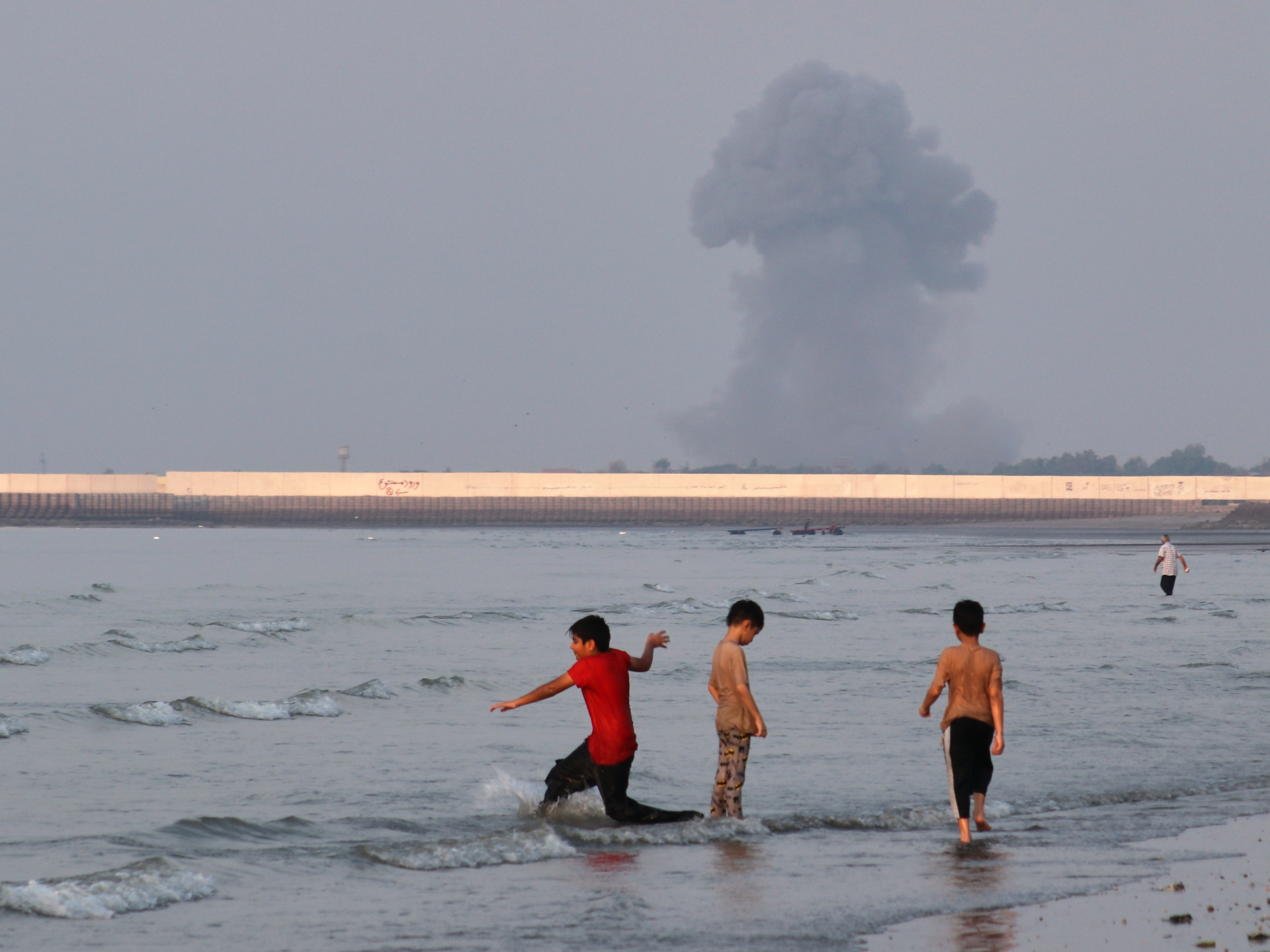
Iran’s state media reported US missiles struck close to the island of Qeshm, near the strait, as well as in Bandar Abbas and Bushehr – the site of a nuclear power plant.

In an apparent escalation, it also said two bridges in Hormozgan province had been hit. The BBC has verified an attack on one bridge to the west of Bandar Abbas in Hormozgan province.

Earlier this week, US President Donald Trump threatened to strike Iran’s bridges and power plants if the country did not return to talks.

After Trump said in April that the US would bomb civilian infrastructure in Iran, including bridges and power plants, UN human rights chief Volker Türk said “deliberately attacking civilians and civilian infrastructure is a war crime”.

The 1949 Geneva Conventions on humanitarian conduct in war prohibit attacks on sites considered essential for civilians.

Centcom also said marines had boarded an oil tanker in the Gulf of Oman as part of the renewed US blockade of Iran’s ports that began on Tuesday night.

It added it had “redirected 3 commercial vessels trying to run the blockade”.

According to Centcom, US forces disabled nine ships and redirected more than 140 under its previous blockade of Iranian ports between 13 April to 18 June.

As the the renewed hostilities further strained the preliminary deal to end the war, White House press secretary Karoline Leavitt said on Thursday that Trump remained open to talks with Iran.

“The president will hold them accountable when they turn their back on the words that they state to the United States. But he is always open to diplomacy at the very same time,” she told reporters.

She said Iran has expressed it still wants to make a deal with the US, adding: “We’re talking to them, but again, the president is not going to allow them to fire on ships in the strait without paying a consequence for that.”

As attacks escalate, the Strait of Hormuz – a critical waterway off Iran’s coast that Tehran effectively blocked in response to US-Israeli strikes – has remained shut.

Earlier on Thursday, Tehran said it had struck US military bases in Jordan, Kuwait and Bahrain, while the US said it had inflicted a six-hour wave of strikes on multiple locations in the strait.

Those exchanges came after Trump warned Iran it had “better behave” or face further military action should Iran not return to negotiations.

Iran’s top negotiator, Mohammad Bagher Ghalibaf, told state media that Tehran had “no reason” to abide by any agreement that did not benefit the country.

He added that Iran’s national security depended on maintaining what he described as “Iranian arrangements” in the Strait of Hormuz.

Source link

Watch the moment Matty Healy joins 1975 tribute act for on-stage duet after booking band for his OWN stag do

THIS is the moment Matty Healy performed with a The 1975 tribute band – having booked the act for his stag do.

Brit Award winner Matty, 37, has been lead vocalist of pop rock band The 1975 since 2002.

The 1975 lead singer Matty Healy put a special spin on his stag party Credit: Instagram/The9075musicbythe1975
Having booked a The 1975 tribute act to perform, he joined them on stageCredit: Instagram/The9075musicbythe1975

The singer-songwriter put a unique spin on his stag do – as he joined a The 1975 tribute act on stage.

A clip of the moment begins with tribute group The 9075 singing The Sound, which was released in 2019.

Matty jumps on stage mid-performance and performs alongside the band.

One person commented: “Matty Healy attending a 1975 tribute is very Matty Healy coded.”

HEAL BREAKS LOOSE

Matty Healy gives Ross Kemp a run for his money with England celebration


POP PAL

Charli XCX and husband George arrive in Italy for Dua Lipa’s lavish wedding

Matty has been lead singer of The 1975 since 2002 Credit: Getty
The Brit Award winner is soon set to marry American singer and model Gabbriette Credit: Alamy

Another added: “I thought the real Matty was the fake Matty until he started counting things on his fingers that don’t need to be counted, that’s when I knew.”

A third wrote: “He wanted to experience a 1975 concert for his stag party and I respect it.”

Matty – the son of Denise Welch and Tim Healy – is set to marry American model and singer Gabbriette.

He and the 28-year-old – whose real name is Gabriella Bechtel – announced their engagement in June 2024.

Gabbriette showed off a huge black ring on social media at the time and wrote: “Marrying the 1975 is very Brat.”

Back in February, The Sun revealed the couple had set a July 2026 wedding date.

Source link

Alcoa outlines ~$900M NPV AliGroup synergies as it lowers 2026 alumina output to 9.5M-9.6M tons (NYSE:AA)

Earnings Call Insights: Alcoa Corporation (AA) Q2 2026

Management View

  • “We announced the largest transaction for Alcoa Corporation,” said President, CEO & Director William Oplinger, describing the planned acquisition of South32’s upstream aluminum value chain assets (“AliGroup”) as “about creating long-term shareholder value,” and stating Alcoa has identified “approximately $900 million

Seeking Alpha’s Disclaimer: This article was automatically generated by an AI tool based on content available on the Seeking Alpha website, and has not been curated or reviewed by humans. Due to inherent limitations in using AI-based tools, the accuracy, completeness, or timeliness of such articles cannot be guaranteed. This article is intended for informational purposes only. Seeking Alpha does not take account of your objectives or your financial situation and does not offer any personalized investment advice. Seeking Alpha is not a licensed securities dealer, broker or US investment adviser or investment bank.

Source link

Trump repeats debunked claims about voting vulnerabilities

President Trump used a rare prime-time address Thursday night to renew his attacks on the security of U.S. elections, telling Americans that the nation’s voting system is “so broken” that “no one can possibly defend it,” an unprecedented effort by a sitting president to undermine public confidence in domestic elections.

Many of the claims he made, which echo those he made after he lost the 2020 election, have been debunked by investigations, audits and court proceedings. Trump did not claim that vote counts were changed or election systems were hacked, and his warnings that the nation’s elections could be vulnerable to foreign influence have long been made by members of both parties.

But the president amplified those claims and others in an effort to cast fresh doubt over what he said was a “stolen” and “rigged” election and renew calls to pass a federal voting law ahead of the November election.

“Addressing this crisis of elections security demands that Congress will pass the SAVE America Act,” Trump said. “How easy is that to do? Unless you want to cheat.”

Trump said he directed the White House to release a tranche of heavily redacted documents that purport to show “vulnerabilities” in the nation’s voting system, with the goal of “correcting them very, very quickly.”

The 26-minute address to the nation — a platform traditionally reserved for rare moments of national importance — was the latest effort by Trump to attempt to assert more federal control over state elections.

Major broadcast networks declined to air Trump’s speech in full, instead reporting on it. Trump complained about NBC and ABC as he spoke, saying they should lose their broadcasting licenses. He falsely claimed that “they and others in the media are part of a plot” to “continue this fraud.”

In his remarks, Trump alleged China carried out what is believed to be the “largest compromise of election data history” starting during the 2020 election cycle and claimed that “members of the deep state” in the American intelligence community covered it up.

He directed the FBI, the director of national intelligence and other agencies led by some of his loyalists to investigate and prosecute the people responsible for the cover up.

Democrats swiftly condemned Trump’s claims as baseless and rehashed ideas that have little to do with actual election administration.

“Donald Trump is releasing unverified, meaningless documents to appease his own delusions about an election he lost resoundingly, all while continuing to withhold 3 million pages of the Epstein files,” Senate Minority Leader Chuck Schumer said on X.

Multiple reviews of the 2020 election have concluded that Democrat Joe Biden won legitimately, and election experts say there is no evidence that widespread fraud affected the outcome of the election.

“It’s been more than half a decade, with numerous audits, recounts, and more than 60 court cases, each finding no evidence of widespread voter fraud,” Sen. Alex Padilla (D-Calif.) said in a statement. “Clearly, this is no longer about an election Donald Trump lost six years ago. It’s about him laying the groundwork to try to ‘take over the voting’ in the upcoming midterm elections.”

Ahead of the speech, elections and democracy experts had cautioned that the president may attempt to sow doubt in the security of the nation’s election system or bolster debunked fraud claims.

Trump has taken a series of steps since retaking office aimed at exerting control over elections. Some experts said Thursday’s address could be interpreted as a sign that Trump is running out of moves in the lead up to the midterm elections, where Republican control of the House is at stake.

“The fact that they’re throwing everything up on the walls at this point demonstrates panic,” said David Becker, executive director of the nonpartisan Center for Election Innovation and Research. “They are not operating from strength right now. They are operating from weakness.”

Trump delivered the address with his approval rating stagnating at 37%, according to a Washington Post-Ipsos poll released Thursday, with weakening enthusiasm among Republicans.

This is a breaking news story and will be updated.

Source link

How Spain recaptured ‘spirit of 2010’ in run to the World Cup final

If something happened once, it can happen again. That’s kind of what Yogi Berra was getting at when he said “it’s like deja vu all over again.”

Berra, the late Yankee catcher and once New Jersey’s unofficial poet laureate, spent most of his life within walking distance of East Rutherford, N.J., where history could repeat itself all over again in Sunday’s World Cup final between Spain and Argentina. And that makes his words newly relevant.

Argentina and Lionel Messi, the reigning champions, will be seeking to become the first to repeat in 64 years while Spain will be playing in the title game for just the second time ever. And the similarities to its first trip, in 2010, are uncanny.

Sixteen years ago Spain became just the second reigning European champion to win a World Cup. It will enter Sunday’s game as the reigning European champion.

In the run-up to the 2010 World Cup, Spain ran off a 35-game unbeaten streak, which matched the longest in history at the time. La Roja will enter Sunday’s game with a 37-game unbeaten streak, which matches the current longest streak in history.

And that 2010 team was known for an absence of ego and a depth of character, a blue-collar collection of quiet superstars built around a core of Andrés Iniesta, Xavi Hernández and Carles Puyol, players who emphasized humility, unity and selflessness.

This team? It’s the same.

“We’re one big family,” center back Pau Cubarsí said in Spanish.

A family that has already achieved its goal, according to coach Luis de la Fuente. So while Argentina may be feeling the pressure of chasing World Cup history, De la Fuente said his team is playing with house money

“I don’t believe in the idea that finals are there to be won. They’re there to be enjoyed,” he said. “What’s to come could be the icing on the cake.”

Of course a cake is nothing without the icing. But then Spain hasn’t had to separate joy from success in this World Cup, enjoying an unbeaten run to the final whose only blemish has been a tournament-opening draw with Cape Verde.

That was the first of six clean sheets for Spanish keeper Unai Simón, though it’s really been a group effort with Simón facing an average of just two shots on goal a game.

De la Fuente, 65, whose only senior international appearance as a player came in the 1988 Olympics, coached Spain’s U-23 team to a silver medal in the Tokyo Games in 2021 then took over the national team a year later, after it crashed out of a second straight World Cup in the round of 16.

De la Fuente spent nearly two decades coaching at the youth level, including nine years with Spain’s U19 and U21 national teams. But seven months after taking over the senior team, he led Spain to its first UEFA Nations League title and a year after that it won its first Champions League title in more than a decade. La Roja has lost just twice in 48 games under De la Fuente, who has the highest winning percentage of any man who has managed more than nine games for Spain.

Given his background, De la Fuente trusts young players — with an average age of 26.7, Spain has the sixth-youngest roster in the World Cup — and his starting lineup includes two teenagers in Cubarsí and forward Lamine Yamal. The core of the team — Simón, Mikel Merino, Dani Olmo, Rodri, Mikel Oyarzabal, Fabián Ruiz — are players he coached to European youth-level championships and ones he has known for half their lives.

That has given the team a level of familiarity and trust that goes both ways.

“This team never ceases to amaze me,” the coach said. “The scope for improvement is endless. It was a labor of love, a process. It was about reaching the crucial moment in the best possible shape.”

And they’ve gotten there, said right back Pedro Porro, another product of De la Fuente’s youth teams, by all pulling in the same direction.

“From the very first day we got here — not just me, but the whole team — we’ve been working toward a common goal,” Porro said. “That’s part of the process. There are no excuses.”

That, too, is something De la Fuente brought to the job, though it’s not an original concept for Spain. It’s more like deja vu all over again.

“We are ordinary, generous people,” the coach said. “We’ve recaptured the spirit of 2010.”

Source link

Trump airs sweeping election claims in national address

July 16 (UPI) — President Donald Trump on Thursday made sweeping, largely unsupported claims of widespread problems with U.S. elections, many of which have been debunked or overstated, as he called on Congress to pass legislation he says would protect the electoral system but critics describe as voter suppression.

During his roughly 25-minute prime-time speech to the nation, Trump attempted to make his case for measures needed to address the alleged vulnerabilities, stating, “Our elections were left vulnerable to being rigged and stolen, and the trust of the American people was lost.”

“This cannot be allowed to continue,” he said.

The speech was delivered only months before November’s midterm elections, on which Trump has increasing focused, having repeatedly warned that if Republicans lose their slim majority in the House to Democrats, impeachment proceedings and investigations will follow.

Democrats and other critics have accused the president of attempting to sow confusion and distrust ahead of the midterms while pushing the election SAVE American Act, which would require photo identification to vote, documentary proof of citizenship to register and restrict mail voting to certain eligible groups. Opponents say those requirements would disproportionately burden Black and other minority voters and prevent some otherwise eligible citizens from voting.

This is a developing story.

Source link

How three Ivorian firms are competing with global brands | Economy News

Abidjan, Ivory Coast – For decades, many of Ivory Coast’s biggest consumer markets were built around international companies with established brands, global supply chains and deep financial resources.

But a number of Ivorian businesses are now finding room to grow.

From petroleum distribution and digital banking to cosmetics manufacturing, these companies are entering sectors where foreign firms have long been dominant, building customer bases at home and looking beyond Ivory Coast’s borders.

Their rise does not signal the retreat of multinational companies, which remain major players across the economy. Instead, the experiences of Petro Ivoire, Djamo and Kaira Holding show how some domestic firms are competing by moving quickly, understanding their markets and investing in production.

Fuel challenge

When Petro Ivoire entered Ivory Coast’s petroleum sector in 1994, international oil companies controlled much of the market.

Today, the company says it is the country’s largest locally owned fuel distributor and ranks third overall behind TotalEnergies and Shell.

Sebastien Kadio-Morokro, Petro Ivoire’s chief executive, said the company’s founders believed a domestic business could compete by combining knowledge of the market with international standards.

“In the 1990s, the market was managed exclusively by multinationals,” Kadio-Morokro told Al Jazeera. “My late father’s idea was that, given the local expertise we had acquired in this industry, it was important to offer something authentic to the local market while strictly adhering to international standards.”

A Petro Ivoire petrol station in Abidjan. The company is among a group of Ivorian firms challenging established international brands
A Petro Ivoire petrol station in Abidjan. The company is among a group of Ivorian firms challenging established international brands [AbdulHadi Heriba/Al Jazeera]

The company says it now holds about 15 percent of Ivory Coast’s fuel market. Kadio-Morokro said being locally owned allows the company to make decisions faster than larger international rivals.

“When a strategic decision needs to be made, we can convene our board immediately and move forward,” he said. “We don’t have to navigate a long chain of decision-making through headquarters overseas.”

That approach helped Petro Ivoire move into the butane gas market in 2007, a sector the company says it now leads. It is also investing in electric-vehicle charging infrastructure as Ivory Coast prepares for changes in transport and energy use.

For Kadio-Morokro, the company’s experience reflects a broader challenge facing African businesses: building confidence that companies created on the continent can compete at scale.

“Africans must trust their countries, themselves and their continent,” he said. “There is no reason why we cannot succeed at home.”

Digital banking

In West Africa’s financial sector, another company is challenging traditional ways of accessing banking services.

Djamo launched in Ivory Coast in 2020, offering accounts, savings and investment products through a mobile application. The company says it now serves more than two million customers and 10,000 small and medium-sized enterprises.

For cofounder Hassan Bourgi, one of the biggest obstacles was convincing investors that francophone West Africa could produce a technology company capable of scaling.

Djamo cofounders Adis Labi, left, and Hassan Bourgi are building a digital banking platform aimed at changing how consumers access financial services in francophone West Africa
Djamo cofounders Adis Labi, left, and Hassan Bourgi are building a digital banking platform aimed at changing how consumers access financial services in francophone West Africa [AbdulHadi Heriba/Al Jazeera]

“The biggest hurdle we encountered was that our region was completely off the radar for global venture capital investors,” Bourgi told Al Jazeera. “Historically, tech investment flowed almost exclusively into four main hubs: Nigeria, Kenya, South Africa and Egypt.”

Djamo sought to challenge that perception by showing investors that companies from francophone markets could grow beyond their borders.

“We showed investors that it was possible to build a large company here,” Bourgi said. “We highlighted the stability of our economy and the CFA franc, which created a strong environment for us to build and expand.”

The company focused heavily on younger consumers, designing a platform around the habits of a generation already familiar with digital services.

“Generation Z was the cornerstone upon which we built our product,” Bourgi said. “We wanted to provide an experience that matched what people encountered every day on international platforms.”

Scaling up

The growth of companies such as Petro Ivoire and Djamo comes as Ivory Coast seeks to strengthen its domestic private sector and help businesses move beyond the national market.

The International Finance Corporation (IFC) and Ivory Coast’s employers’ association, CGECI, have launched programmes aimed at helping promising companies improve access to finance, strengthen management and prepare for regional expansion.

For many entrepreneurs, the challenge is not only building a successful business at home but creating companies large enough to compete across borders.

Few stories capture that journey more clearly than Kaira Holding.

From cot to cosmetics

In 2009, Fode Kaira Yatabare launched his cosmetics company from a two-room apartment in Abidjan.

The apartment served as both home and office. Each night, he slept on a folding military cot that had to be packed away each morning to make space for work.

Today, Kaira Holding exports beauty and personal care products to 32 countries across Africa, Europe and the Middle East.

Products from Kaira Holding, an Ivory Coast-based cosmetics manufacturer, have expanded from a small apartment operation into an export venture serving 32 countries
Products from Kaira Holding, an Ivory Coast-based cosmetics manufacturer, have expanded from a small apartment operation into an export venture serving 32 countries [AbdulHadi Heriba/Al Jazeera]

“I belong to a new generation of African entrepreneurs who passionately believe in local manufacturing and value addition,” Yatabare told Al Jazeera.

“When we started, capital constraints were immense. We launched from a tiny two-room flat. We only managed to scrape together four million CFA francs [about $7,000] to start producing soap.”

The company has since invested in its own packaging, printing and manufacturing processes, reducing its dependence on imported inputs.

“Many people fail to realise that manufacturing costs in Africa can actually be lower than in China if you fully integrate your value chain,” Yatabare said. “This vertical integration has made us more competitive.”

Kaira Holding is now expanding its research capacity and preparing to enter new markets, including China.

The experiences of Petro Ivoire, Djamo and Kaira Holding do not represent the end of multinational influence in Ivory Coast. But they show how some African businesses are building an advantage by staying close to consumers, making decisions quickly and investing in their own capacity.

For Yatabare, that ambition reflects a changing mindset among entrepreneurs on the continent.

“Africa has changed,” he told Al Jazeera. “We are moving forward guided by a singular ambition: from Côte d’Ivoire to the world.”

Source link