Weekly insights and analysis on the latest developments in military technology, strategy, and foreign policy.
In the latest twist in Canada’s long-running saga to field a new fighter, the country’s defense minister has said that Ottawa is “interested in learning more about” the Global Combat Air Program (GCAP) next-generation fighter. GCAP is currently a trinational effort, led by the United Kingdom and involving Italy and Japan. Its centerpiece is the Tempest crewed fighter. A demonstrator for this jet is currently taking shape with BAE Systems in the United Kingdom.
David McGuinty, the Minister of National Defense of Canada, made the remarks after a meeting in Tokyo with his Japanese counterpart, Shinjiro Koizumi. Breaking Defensereports that McGuinty confirmed he had spoken with Koizumi about the GCAP, which the Canadian official described as a “promising initiative.”
Japanese Defense Minister Shinjiro Koizumi and Canadian Defense Minister David McGuinty before an earlier meeting in Tokyo, Japan, on February 6, 2026. Photo by David Mareuil/Anadolu via Getty Images Anadolu
“We are interested in learning more about it. I’ll take it back to my team and see what it looks like,” McGuinty told Reuters.
Until now, no senior Canadian official appears to have spoken publicly about interest in GCAP. However, the development comes as Ottawa weighs up the option of a split fighter buy, which would involve acquiring the U.S.-made F-35 and one other type. This thinking has been driven by a growing rift between Ottawa and Washington.
However, the possibility of Canada coming on board GCAP as an ‘observer’ had been raised in March of this year. According to The Asahi Shimbun, a Japanese daily newspaper, unnamed Japanese officials disclosed that, during a previous meeting, McGuinty and Koizumi discussed such an arrangement.
An official artist’s concept of a potential Tempest configuration, with Mount Fuji in the background. MHI
Canada’s joining GCAP with observer status would provide it access to information on the program and could be a stepping-stone to deeper involvement.
Earlier this week, Italian Defense Minister Guido Crosetto raised the possibility of other nations joining GCAP, noting that, were that to happen, “we would be completely willing, because the more there are, the greater the chances of creating something and bringing down costs.”
Crosetto then identified Canada as “the country most interested [in GCAP] at the moment.” He said he would be “fully open” to Canada joining as an observer.
For Canada, however, GCAP would require a rethink of Canada’s potential pursuit of a split-buy approach to its new fighter.
Until now, the Saab Gripen E had been identified as the most likely candidate to be bought alongside the F-35.
A pair of Gripen Es. Saab Linus Svensson @Saab
Sweden has made a strong push to sell Gripen to Ottawa, and Saab offered to build the jet in Canada, in an effort to secure support for its previous bid, which it lost to Lockheed Martin. Since then, Saab has also emerged as the preferred candidate to supply Canada with its future airborne early warning and control (AEW&C) via its GlobalEye.
In April of this year, McGuinty confirmed that Ottawa was still reviewing its earlier plan to buy 88 F-35s.
“The review of the purchase of the F-35s is continuing… We are taking the necessary time to study very, very closely the question of the fighter fleet,” McGuinty told the Senate’s defense committee.
The split-buy option emerged since Canada has already made a firm commitment to buy 16 F-35As to start replacing its aging CF-18 Hornets. Canada’s industry also has a significant degree of involvement in the Joint Strike Fighter program.
An infographic showing Canadian industrial participation in the F-35 program. Lockheed Martin
Canada currently has around 75 CF-18A/B+ jets and has also added 18 upgraded former Royal Australian Air Force (RAAF) F/A-18A/Bs, plus seven more as spares, to help bolster its fleet.
Of Canada’s first 16 F-35s, four have already been paid for in full, while parts for eight others have also been purchased. The first Canadian F-35s were expected to be delivered for training at Luke Air Force Base, Arizona, in 2026.
Back in 2023, Canada’s Liberal government announced plans to buy 88 F-35s, a decision that appeared to bring closure to what had already been a very protracted process. You can read about this here.
Infographic outlining the key features of Canada’s future F-35As. RCAF
However, amid growing trade tensions and a war of words with the United States, Liberal Prime Minister Mark Carney launched a review of the F-35 program shortly after taking office in the spring of 2025.
There are other arguments for a split buy, too. Back in 2019, the cost of buying the planned 88 F-35s was put at $19 billion. Now it has rocketed to $27.7 billion, not including weapons and infrastructure.
Bill Blair, who was Canada’s defense minister when the review of the F-35 buy was launched last year, pointed to the advantages of a mixed fleet, saying it would give the RCAF more options to handle different types of threats.
“What happens if you have to persist in that space for months and months and years? The tool that you use, is it the right tool to do that job?” Blair said. “We need to have a whole wide range of capability sets to deal with all the eventualities that we could face.”
Were Canada to procure the Tempest, it would surely have to wait longer than 2035 — the prospect of GCAP’s fighter entering service at this date, as planned, is highly unlikely. Canada would be fourth in line behind the three core partners. Ottawa would need to buy more F-35s, perhaps around two thirds of its original intended number, or around 60 aircraft, and also keep the best of its CF-18s in service for longer, if that’s even possible. The Hornets are getting very old and disappearing from service abroad. Supporting them will become increasingly problematic. When the Tempest finally arrived, it would provide a flipped high-low fighter mix. This is essentially the same approach that the United Kingdom, Italy, and Japan — all current F-35 operators — are taking.
However, the Tempest does appear to be especially well-suited to Canada’s fighter requirement.
The design of the jet will stress extreme range and a large payload — roughly twice that of the F-35A. Senior GCAP officials have said the jet could potentially carry enough internal fuel to fly across the Atlantic without refueling.
A rendering of a pair of Tempests of the latest configuration overflying the U.K. coastline. BAE Systems
While these attributes are optimized for a future conflict in the Indo-Pacific region, they are equally applicable to dealing with the ‘tyranny of distance’ and the increasing Russian threat posed around Canada’s enormous land mass, which extends far into the highly strategic Arctic region.
“Both China and Russia have fifth-generation fighter aircraft and fifth-generation missiles that are able to go at much greater speeds and with much more that are holding Western allies at risk at this moment in time,” the commander of the Royal Canadian Air Force (RCAF), Lt. Gen. Jamie Speiser-Blanchet, said in the past.
Plans to arm the Tempest with larger air-to-air missiles offering a longer range than those currently used by any of the three GCAP partner countries have also been revealed, as you can read about here.
If Canada decides it wants a sixth-generation combat aircraft to tackle current and emerging threats from China and Russia, the GCAP might be the only realistic choice. The rival pan-European Future Combat Air System (FCAS) has collapsed, and there is little chance of Canada getting its hand on the Boeing F-47.
But any kind of split buy “would duplicate a certain amount of infrastructure and training,” Speiser-Blanchet admitted.
In some cases, however, there could be cost-benefit arguments in having a mixed fighter fleet, as well as the important factor of not relying entirely upon one source of this type of combat equipment.
There is also the question of how feasible it would be for Canada to join GCAP at this point, at least in terms of industrial participation and steering requirements. The latter point seems next to impossible, with national requirements already set, and most of the workshare agreement has also been divided up between the three partners.
There has been talk of Saudi Arabia possibly joining GCAP in some capacity, and, more recently, Poland has been reported as being interested in buying the aircraft, too.
With that in mind, Canada’s best shot might be to buy the jet ‘off the shelf,’ rather than hope for industrial windfalls.
At the same time, Canada and the United Kingdom are partners on some other key military programs, including the Royal Canadian Navy’s future River class Canadian Surface Combatants, derived from BAE Systems’ Type 26 design for the U.K. Royal Navy.
Meet The River-Class Destroyer – State-of-the-art WARSHIP!
Returning to the Tempest, the broader GCAP program still has to survive considerable challenges, both technical and political, that lie ahead.
As we have explained many times in the past, the process of creating an all-new fighter, especially one incorporating stealth technologies, brings very lengthy development times and high costs.
At this point, BAE Systems is in the process of building a demonstrator as part of the GCAP program, with a first flight planned by the end of 2027.
The latest rendering of that demonstrator appears at the top of the story. Notably, it retains the Typhoon’s EJ200 turbofan engines, with non-stealthy nozzles. The Tempest will have an all-new powerplant.
As we have argued in the past, the more time that passes, and the more deeply intertwined with the F-35 Canada becomes, the arguments in favor of a split fighter buy become harder to justify. Buying the Tempest would certainly not be the cheapest option, and would force a rethink of timelines, but it does underscore the fact that Canadian officials are casting their net wider, looking at very high-end capabilities, and seeking to build deeper strategic relationships outside of the United States.
Lionel Messi comes off the bench to score his sixth goal of the 2026 World Cup as Argentina beat Jordan 3-1 in Dallas and becomes the first player to score in seven World Cup games in a row.
June 27 (UPI) — Kentucky Gov. Andy Beshear declared an emergency in the state on Saturday because of widespread floods that have claimed at least four lives.
The declaration came after two waves of severe storms on Friday that caused flash floods, high winds and a tornado — and ahead of another round of heavy rain expected overnight on Saturday.
Beshear started sounding the alarm ahead of a few days of heavy rain early Friday, warning residents that areas around the Ohio River were likely to flood over the weekend.
In announcing the declaration of emergency, Beshear said heavy rain was expected to continue in the state through at least 11 p.m. EDT on Saturday, with the expectation for dangerous road conditions, limited visibility and up to seven inches of rain in some areas.
Local states of emergency were also declared in five Kentucky counties — Bullitt, Madison, Meade, Mercer and Spencer — the governor’s office said.
“This is a serious flooding event, where teams have already had to conduct multiple water rescues from vehicles and homes across the commonwealth,” Beshear said in a press release.
“As more heavy rain continues through late night, we need folks to remain alert and to avoid driving,” Beshear said. “We’ve sadly already received reports of fatalities that we are working to confirm, and we need everyone to stay alert and do what’s needed to keep each other safe.”
Madison County Coroner Jimmy Cornelison confirmed that three people between the ages of 40 and 59 had died in the county in incidents linked to the storms, with one killed in a car accident and a couple that were killed in their flooded basement, NBC News reported.
Jackson County Executive Paul Hays confirmed to LEX-18 that a person there had also died, in their case because of a car accident linked to the storms.
“We had multiple rescues of people that were in cars on the roadways that had to be rescued, and we’ve had eight or nine rescues from homes that were surrounded by water and flooded,” Hays said.
Hays said the county had received about six inches of rain, as well as seen property damage and debris strewn across roads, which in some cases had displaced residents from their homes.
The National Weather Service in Kentucky forecast multiple rounds of thunderstorms and heavy rain overnight on Saturday, which are likely to result in more flash flooding, and has left a flood watch in effect for entire state until Sunday morning.
Although forecasters predicted total rainfall of about 1 to 3 inches, they said that 3 to 5 inches, or more, is possible in some areas.
White House Border Czar Tom Homan speaks during the Faith and Freedom Coalition 2026 Road to Majority Policy Conference at the Washington Hilton on Friday. Photo by Bonnie Cash/UPI | License Photo
Weekly insights and analysis on the latest developments in military technology, strategy, and foreign policy.
The U.S. military has now confirmed the acceptance of at least six F-35 Joint Strike Fighters for the U.S. Marine Corps without radars. This is due to issues tied to the development of the new AN/APG-85 radar, the first production lot of which is scheduled to be delivered in 2028. The prospect of radarless F-35s had first emerged publicly back in February. The AN/APG-85 is a critical component of the larger Block 4 upgrade package for all variants of the F-35, an effort that has been mired in cost growth and delays.
Marine Corps Lt. Gen. Gregory Masiello, head of the F-35 Joint Program Office (JPO), disclosed the acceptance of the six radarless F-35Bs at a hearing before members of the Senate Armed Services Committee earlier this week. This came as part of a larger back-and-forth between Masiello and Senator Mark Kelly, an Arizona Democrat and a retired naval aviator, about F-35 readiness rates across the U.S. Air Force, Marine Corps, and Navy, which have long been a point of concern.
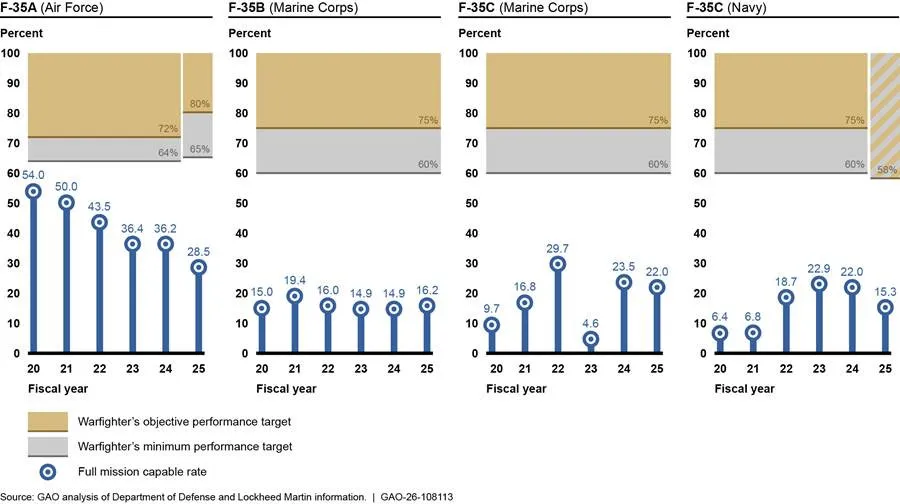
Two weeks ago, the Government Accountability Office (GAO), a Congressional watchdog, released a report stating that the average F-35 full mission capable (FMC) rate across all variants had fallen from 38 to 25 percent between Fiscal Years 2020 and 2025. GAO defines FMC as an aircraft “that can perform all of its missions.” The F-35 JPO has not disputed GAO’s figures directly, but has openly disagreed with the methodology it uses to determine FMC.
The full breakdown of Full Mission Capable (FMC) readiness rates between Fiscal Years 2020 and 2025 for all F-35 variants included the report GAO released two weeks ago. GAO
“So, the GAO FMC rate is, they said, 25 percent. Your office claims it’s 56 percent,” Kelly said, leading up to his question. “We’ll go with your number, 50 percent. So, half of the airplanes are not fully mission capable, and I think it’s the Marine Corps that has been accepting airplanes with no radar in it. Is that correct?”
“We have accepted six aircraft for the Marine Corps that do not have a radar installed. That is correct,” Masiello confirmed.
Kelly then asked if this was due to a lack of available AN/APG-85 radars, which Masiello also confirmed.
US Marine Corps F-35Bs. USMCA US Marine Corps F-35C seen on the deck of the US Navy’s Nimitz class aircraft carrier USS Abraham Lincoln. CENTCOM
“The Block 4 modernization program is necessary to ensure that the Marine Corps and Joint Force can continue to project air superiority against future threats,” a Marine Corps spokesperson told TWZ today when asked for more information. “The Department of War deliberately undertook a highly concurrent development and production program for Block 4 capabilities (Technical Refresh 3 (TR-3), APG-85, etc.) and the largest fighter aircraft production line in the world. DoW officials made this decision with full understanding of the risk of having production aircraft ready ahead of the Block 4 capabilities. The Services’ decision ensured that production aircraft could accept Block 4 capabilities, rather than continuing to build Block 3 F-35s that would require extensive retrofit for Block 4 capabilities, thereby saving multiple years of retrofit hardware installation. ”
The Marine Corps deferred any further questions to the F-35 JPO. TWZ had already reached out to that office for more information, as well.
“F-35 Lightning II aircraft are being built to accommodate the F-35 advanced radar (APG-85) for U.S. Air Force, Navy, and Marine Corps. When delivered, the F-35 with APG-85 will provide unmatched capability against current and future threats. Initial fielding for some F-35 aircraft is planned for Lot 17,” the F-35 JPO previously told TWZ in May when asked for an update on the radar situation. “The Program in coordination with the Services deliberately undertook a highly concurrent development and production program for advanced capabilities. This decision was made with full understanding of the risk of having production aircraft ready ahead of the capabilities.”
A view of Lockheed Martin’s F-35 production line. Lockheed Martin
“The program has plans to accelerate APG-85 production capacity to deliver radars that meet capability, stability, and maintainability requirements needed to meet emerging threats,” the office added at that time. “F-35s with APG-85 radars, actual modernization plans, capabilities, and schedules remain classified to maintain program security.”
The F-35 JPO had provided TWZ with a similar statement when asked about whether radarless F-35s were already being accepted back in February.
In February, the U.S. Air Force also explicitly denied receiving F-35As without radars. There is no confirmation yet that the F-35 JPO has accepted any Joint Strike Fighters for the Air Force or the Navy without radars. Previous reports have said that foreign customers are not expected to be impacted at all, at least in the near-term, since none of them are currently in line to receive AN/APG-85-equipped jets.
Today, the standard radar in use on F-35A, B, and C variants is the AN/APG-81, an active electronically scanned array (AESA) type with air-to-air and air-to-ground modes that traces its roots back to the 1990s. It also has a synthetic aperture radar (SAR) mode, which allows it to produce high-resolution map-like images. These can be used for target acquisition and identification, as well as general reconnaissance purposes.
A Lockheed Martin briefing slide giving a general overview of the capabilities the APG-81 provides the F-35. Lockheed MartinExamples of the existing APG-81’s SAR mapping capability. Lockheed Martin
Details about the new AN/APG-85, which Northrop Grumman is developing, continue to be limited. At the hearing this week, Lt. Gen. Masiello declined to talk about its specific capabilities in an unclassified setting.
The AN/APG-85 is also an AESA design, and is expected to offer an array of new and improved functionality compared to the AN/APG-81. As TWZ has previously noted, it will also just be able to leverage decades of additional general technological advancements since its predecessor was developed. In general, the use of gallium nitride (GaN) has had a major impact on modern radar developments when it comes to physical size, weight, and power requirements.
Another briefing slide offering a general overview of the fusion of sensors and other systems on existing F-35s. Lockheed Martin
As the F-35 JPO noted in its statement in May, the plan had been to start integrating the AN/APG-85 onto F-35s starting with production Lot 17. Deliveries of aircraft from that lot began last year. However, per official budget documents released earlier this year, the first production AN/APG-85s are not expected to be delivered before April 2028. This would actually be a nine-month improvement on the much-delayed delivery timeline for the new radars, the unit cost of which is currently pegged at nearly $9 million.
A compounding factor here is that the hardware used to mount the AN/APG-85 on the F-35 is not backwards compatible with the AN/APG-81. According to a report last year from Breaking Defense, the Joint Strike Fighter’s prime contractor, Lockheed Martin, has reportedly at least raised the possibility of developing a common mounting solution, but also said that this would not be ready before Lot 20 aircraft start being delivered. The first Lot 20 jets are not expected to arrive until sometime between 2027 and 2028.
A row of APG-81 radars. Northrop Grumman
How the Marine Corps, or any other service, might utilize its radarless F-35s in the meantime is unknown. This was among our queries to the Marines today.
“The currently fielded Block 3 (TR-2) F-35 Lightning II is the most capable fighter in the world today, having proven its capabilities in combat,” the Marine Corps spokesperson added in their statement. “Its advanced mission systems enable the F-35 to deter, and if necessary, dominate in any clime and place.”
Senator Kelly also prodded Lt. Gen. Masiello about this, indirectly, at the hearing this week.
“So, I assume that those airplanes can’t count as fully mission capable with no radar?” Kelly asked the JPO head.
“I don’t think I would count them as fully mission capable,” Masiello said in response.
“You say you don’t think. I can’t imagine a scenario where an F-35 with no radar could be an FMC airplane,” Kelly retorted, which Masiello did not push back on.
A US Air Force F-35A heads out on a sortie in support of Operation Epic Fury against Iran in March 2026. USAF
TWZ has previously noted that F-35s without radars would not be completely useless, but their capabilities and survivability would certainly be severely degraded. As we previously wrote:
“As long as one F-35 in a formation has a radar, all of the other aircraft in said group should be able to benefit from the data it provides via their Multifunction Advanced Data Links (MADL). As such, even without a radar installed, a Joint Strike Fighter would not be without F-35-derived radar data if at least one other was flying cooperatively with it within MADL’s transmission reach.“
“It is possible that radar-less jets could be sent into combat, at least in an emergency scenario, though doing so would still require accepting greater risks. It would limit tactical flexibility, as well, since remaining linked together with other radar-equipped jets would be key. Those jets would also have to rely on using their radars more heavily, which can be a vulnerability. The F-35 also has a host of passive sensors that it can rely on for battlespace information, although none are capable of replacing the radar’s functionality. Data from other platforms transmitted via Link 16 is also available to all F-35 pilots.“
“Maybe one of the biggest issues with having no radar is that it is a major part of the jet’s electronic warfare suite. Its ability to transmit narrow, extremely powerful beams of energy adds to the jet’s potent electronic attack capability. So, without the radar, its ability to defend itself and others by leveraging the electromagnetic spectrum is also curbed.“
Remarks from Lt. Gen. Masiello at the hearing this week also raise new concerns about the capabilities that the AN/APG-85 radars will offer even when they do finally start being integrated onto F-35s. This is tied to what it will take to sufficiently cool the radar and other elements of the Block 4 upgrade package. Thermal management is another long-standing issue for all variants of the F-35, which has already had major negative impacts on readiness rates and maintenance demands, as you can read about in more detail here.
An F-35 takes off with its afterburner engaged. Lockheed Martin
“So, right now, you’re cooling, you got about 30 kilowatts [of cooling],” Senator Kelly said as part of another question posed to the head of the F-35 JPO. “Block 4 requires 32 [kilowatts of cooling], is what I have here. But to get to the cooling needed to – for the full capability of the APG-85, needs to be somewhat higher, it seems like 62 kilowatts of cooling?”
“The requirement that we have for the program going forward is 62 to 80 [kilowatts of cooling],” Masiello said in response. “The challenge I see is if the totality of Block 4, when it’s installed, and on the aircraft, it takes the complete power available, which is 32 [kilowatts].”
“There’s no margin, which as you know, is not a smart way to go,” he continued. “So, we have an incremental approach to increase that. And we have an ongoing program to look at a more systemic and affordable upgrade to the power thermal management across the program.”
“For the engine core upgrade that we anticipate and have asked for additional funding on that, we anticipate that being fielded in 2031, and it will come with a marginal increase in the power thermal management,” he explained. “The actual system that’s under review and looking for the forward program will come a few years later into the system, which is when we would have the additional capabilities beyond Block 4, not yet to be determined that will require that.”
Pratt & Whitney F135 engines for the F-35. Pratt & Whitney
At the same time, as Masiello himself acknowledged, the current plan offers no margin when it comes to cooling before the PTMS upgrade is available. In response to further questioning by Senator Kelly, he declined to speak in an unclassified setting about what that might mean for the initial fielding of the AN/APG-85 radar.
As noted, the entire Block 4 upgrade effort continues to be beset by delays and cost growth, despite efforts to reorganize and accelerate certain components thereof. As of September 2025, the schedule for delivery of a truncated portion of the upgrade package was still running five years behind, according to GAO. The original goal had been for F-35s with the full suite of Block 4 improvements to begin arriving this year.
The F-35 program as a whole continues to face growing costs and other challenges associated with operating and maintaining the jets, which are key factors in the low readiness rates of all variants in service today. Spare parts shortages have been a particularly persistent and serious problem, as you can learn more about in this past TWZ feature.
US Air Force F-35As undergoing maintenance. USAF
“That is now what we’re putting forth is the requirement, which is the reason why, in this generational investment of the 2027 budget will help us. So, we will fill up the available parts,” Lt. Gen. Masiello also said at the hearing this week. “It’s not a systemic issue with the system having the ability. It’s the fact that we didn’t put enough parts and pieces on the shelf. And we’ve increased the demand exponentially with the number of aircraft fielded, and we didn’t do the same thing with the spare parts and the system.”
As of last year, the total project cost of the entire program, from initial development in the 1990s through the end of the type’s expected lifecycle in the 2070s, was pegged at $2.1 trillion. The JPO has stressed in the past that this figure includes the acquisition of thousands of jets and that inflation is expected to account for roughly half of the total cost.
When it comes to the continuing saga of the AN/APG-85, F-35s are now being delivered without any radars, and it could be years still before that changes.
MOLLY-MAE Hague has shared some sweet new snaps of baby Midas, and they look absolutely adorable.
The reality TV stunner and her beau Tommy Fury welcomed their second child together four weeks ago.
Sign up for the Showbiz newsletter
Thank you!
Molly-Mae Hague shared some sweet new snaps of baby MidasCredit: Intagram / mollymaeThe star marked the one month mark, saying it’s been four weeks as a family of fourCredit: Intagram / mollymae
Now marking the milestone of four weeks as a family of four, Molly-Mae took to her Instagram story to share a series of unseen baby photos.
In the first snap Tommy is cradling tiny Midas in his arms and laughing with glee.
The couple’s daughter Bambi, 3, is sitting playfully on Tommy’s leg and looking up at him as he laughs.
Over the top of the photo Molly-Mae penned: “One month as a crazy family of four,” followed by emojis of a laughing face, white heart and a family.
Molly-Mae also posted a throwback snap to the day she gave birth to her sonCredit: Intagram / mollymaeThe star shared snaps of her baby’s nursery as well, which she had been updating her followers on while renovatingCredit: Intagram / mollymae
A second snap shows Midas being held outside on some patio furniture.
The little one is swaddled up in a white blanket, sleepily keeping his eyes open.
Above his head, Molly-Mae gushed yet again: “4 weeks of you.”
A final snap shows Molly-Mae holding Midas while still in a hospital bed.
Tommy is looking down at his son with his hands held up to his face in disbelief and joy.
Molly-Mae said of the moment: “One of the best moments of my life. Will never get over it.”
This is Frenchman Sebastien Desabre’s 11th coaching role in Africa.
The 49-year-old has qualified DR Congo for successive Africa Cup of Nations, reaching the semi-finals in 2023, as well as the World Cup. He had previous success with Uganda.
How did DR Congo get to the last 32?
They earned the first World Cup point in their history by holding strongly-fancied Portugal to a 1-1 draw but then lost 1-0 to Colombia. That left DR Congo needing to beat Uzbekistan, which they duly did 3-1 to progress to the last 32 as one of the best third-placed teams.
Where can I watch DR Congo?
Their last-32 tie against England will be live on BBC One on Wednesday 1 July, with build-up from 16:00 BST.
The match will also be covered live on BBC Radio 5 Live, the BBC Sport website and app.
Give me a fact to impress my friends
Superfan Michel Kuka Mboladinga, who went viral at the Africa Cup of Nations for his eye-catching patriotism during games, has been included in DR Congo’s official World Cup delegation at the request of the players.
Since 2013, Mboladinga has worn colourful suits and silently imitated a statue of revered revolutionary leader Patrice Lumumba, with one arm raised, for entire matches.
Now give me some proper detail
The Congolese proverb little by little, grow the bananas emphasises the virtues of patience and steady progress. But during the national football team’s 52-year gap between World Cups – the joint-fourth longest of any nation – patience has been exhausted and progress stalled. Until now.
There has been a determination to change the country’s World Cup narrative after a 1974 debut that left them ripe for ridicule. Zaire, as DR Congo was then known, lost all three games – including 9-0 against Yugoslavia.
Then came the infamous moment when right-back Mwepu Ilunga charged out of a defensive wall to boot the ball away as Brazil lined up a free-kick.
Bemused onlookers were unaware it was an act of political protest. The players had learned their expected wages and bonuses wouldn’t be paid – and Zaire President Mobutu then threatened them with exile if they lost by more than three goals against Brazil.
By kicking the ball away, Ilunga had hoped to waste time and get sent off. He was only booked and Zaire lost 3-0; they were allowed home but President Mobutu cut their funding.
Ever since, the 1968 and 1974 African champions have been kept on the game’s periphery by a combination of conflict, corruption, poor football governance and a lack of facilities.
Current head coach Desabre has brought in fresh talent from the vast Congolese diaspora – all but six of the World Cup squad were born in Europe – and the nation is now seeing the fruits of his endlessly patient nurturing.
How have DR Congo done at previous World Cups?
The central African nation has only played in the World Cup once before – in 1974, when the country was named Zaire. They lost all three group games without scoring, including 9-0 against Yugoslavia.
Anger is mounting in Venezuela after the military barred citizens from entering zones devastated by Wednesday’s twin earthquakes. As Teresa Bo explains, thousands of people have travelled to help rescue victims, not trusting the government to save survivors in time.
The ongoing armed violence in the eastern Democratic Republic of Congo (DRC) has stalled national examinations, putting the future of students at risk. Many students in the region have complained about not being able to reach the locations of their examinations due to roadblocks mounted by rebels and local militants.
Michel Buingo, the chief of the provincial sub-division for primary, secondary, and new citizenship education in Walikale 4, North Kivu, said that 540 final-year students were expected to sit two examinations at different centres within the sub-division. However, only 387 students arrived, while 153 were unable to access the examination centres due to security issues.
Local authorities in the education sector attribute the low student participation at examination centres to ongoing insecurity affecting several areas from which the candidates come. Recent armed clashes, population movements, and forced displacements in the DRC’s eastern region have disrupted the educational activities of many students, making it difficult for them to access examination centres.
This situation illustrates the consequences of the security crisis for the education sector in several zones of North Kivu. While authorities said they are doing their best to ensure that students write their national examinations, several students continue to pay the price of security instability, with their educational futures compromised.
Cases of stalled examinations have become a recurring issue in recent years. In 2025, the continuation of national exams in active conflict zones was only made possible in part by the United Nations Children’s Fund (UNICEF). They facilitated the transport of sealed trunks containing exam papers from Kinshasa to various locations in North Kivu, including areas controlled by rebel groups. In 2024, hundreds of students were also unable to write their examinations due to widespread violence in the city of Bweremana in the North Kivu region.
The ongoing armed violence in the DRC has significantly impacted the quality of education. A 2025 UNICEF report states that more than 1.6 million children are currently out of school due to escalating conflict and mass displacement. In the North Kivu and South Kivu provinces, over 2,500 schools and learning centres have been forced to close, leaving approximately 795,000 children without access to education.
“Even before the latest escalation of the conflict, the education system in eastern DRC was under immense strain, due, in part, to the high number of displaced people,” the report partly noted.
The ongoing armed conflict in the eastern Democratic Republic of Congo (DRC) has disrupted national examinations and threatened students’ educational futures. Many students in North Kivu’s Walikale 4 region were unable to access examination centres due to rebel-controlled roadblocks, leading to only 387 out of 540 expected final-year students sitting for their exams. This highlights the broader impact of insecurity and forced displacements on education in the region.
In recent years, stalled examinations during conflict have been frequent. In 2025, UNICEF assisted in conducting national exams by transporting exam papers to conflict-affected areas. The conflict has led to the closure of over 2,500 schools, affecting approximately 795,000 children in North and South Kivu, according to a 2025 UNICEF report. This crisis worsens the strain on an already challenged education system burdened with high displacement rates.
COUNTRY legend Alan Jackson is preparing to take the stage one final time – but behind his emotional farewell has been a grueling 15-year battle with a degenerative nerve disease that has changed his life.
The music icon was diagnosed with Charcot–Marie–Tooth disease in 2011, but kept it private for a decade before publicly revealing the condition in 2021.
Sign up for the Showbiz newsletter
Thank you!
Alan Jackson first opened up about his health and Charcot-Marie-Tooth disease diagnosis when he revealed his diagnosis on the TODAY show in 2021Credit: NBCAlan Jackson performs at Shoreline Amphitheater on July 21, 1991 in Mountain View, CaliforniaCredit: Getty
The hereditary disorder causes nerve damage, mostly in the arms and legs, leading to muscle weakness, loss of sensation, balance problems, and difficulty walking.
Behind Alan’s final curtain call is a brutal health battle that has quietly followed him for more than 15 years.
“It’s been affecting me for years,” he said in 2021 while first revealing the diagnosis on the Today Show.
“And it’s getting more and more obvious. I know I’m not going to be able to tour like I have.”
Alan, 67, also revealed the diagnosis runs in his family, explaining: “I have this neuropathy and neurological disease. It’s genetic that I inherited from my daddy.”
The disease affects balance, coordination, and muscle control – making even simple movement more difficult as it progresses.
For a performer known for commanding massive stages and playing live instruments, the condition has made touring especially challenging.
Most read in Entertainment
Alan has opened up about his struggles, saying: “I know I’m stumbling around on stage. And now I’m having a little trouble balancing, even in front of the microphone.”
Over the years, Alan has continued performing despite worsening symptoms, though he acknowledged the disease has forced him to adjust.
“I don’t feel comfortable,” he said of performing while navigating the disorder. “It’s going to disable me eventually.”
While Charcot-Marie-Tooth does not always directly impact life expectancy, there is no cure, according to the Mayo Clinic.
What is Charcot–Marie–Tooth Disease?
Charcot–Marie–Tooth disease (often shortened to CMT) is a group of inherited disorders that damage the peripheral nerves, which are the nerves outside the brain and spinal cord that control movement and sensation. The condition causes the nerves to send weaker signals to muscles, which can lead to muscle weakness, shrinking of muscles, and loss of feeling, especially in the feet, legs, hands, and arms.
Early warning signs can include:
Frequent tripping or clumsiness
Difficulty balancing
Foot deformities such as high arches or hammertoes
Weakness in the legs or hands
Numbness or tingling
A diagnosis usually comes after a neurological exam, family history review, nerve conduction studies, genetic testing, and sometimes electromyography (EMG).
There is no cure for CMT, and the condition is progressive – meaning symptoms can worsen over time. Treatment focuses on managing symptoms and maintaining mobility through physical therapy, occupational therapy, braces, orthopedic devices, pain management, and in some cases surgery.
The disease is not typically fatal and most people live a normal lifespan, but it can significantly impact mobility, independence, and quality of life as it advances. Because it is genetic, family members may also carry or develop the condition, which is how Alan Jackson said he inherited it from his father.
CMT is one of the most common inherited neurological disorders, affecting about 1 in 2,500 people worldwide.
Symptoms often begin in adolescence or early adulthood, but some people, like Alan Jackson, may not be diagnosed until later in life when symptoms become more noticeable.
Treatment typically focuses on managing symptoms through physical therapy, braces, pain management, and mobility support.
Still, Alan said he has refused to let the diagnosis define him, pushing through multiple tours and live shows while accepting that the end of his road on stage would come in the nearer future.
Now, the singer is set for his final full-length concert, Last Call: One More for the Road – The Finale, on June 27 at Nissan Stadium.
The massive send-off will bring Alan back to Nashville – the city where his career first took off – and feature an all-star lineup including Luke Bryan, Eric Church, Luke Combs, Miranda Lambert, George Strait, Carrie Underwood, Lainey Wilson, Little Big Town, Thomas Rhett, Jake Owen, Jon Pardi, and Lee Ann Womack.
Alan Jackson’s final concert ever will include a superstar lineup of his friends for Last Call: One More For The RoadCredit: Instagram / officialalanjacksonAlan Jackson performs onstage at The 56th Annual CMA Awards at Bridgestone Arena on November 09, 2022 in Nashville, TennesseeCredit: Getty
The sold-out show will begin in the early evening and rock on all night, with more than 50,000 fans expected in attendance.
And for those who can’t make it in person, the historic farewell will be filmed for an NBC primetime special titled Alan Jackson: The Last Show, before streaming the following day on Peacock.
For the country crooner, it’s a full-circle moment – and the closing chapter of one of music’s most enduring careers.
The Georgia native has sold more than 75 million records worldwide, with a staggering 35 Number 1 hits and 50 Top 10 singles to his name.
Alan Jackson performs live on stage during the 2015 Country Music Awards festivalCredit: AlamyAlan poses with his wife, Denise, and their daughtersCredit: Facebook / Alan Jackson
He’s won two Grammy Awards, 16 CMA Awards, 17 ACM Awards, and was inducted into the Country Music Hall of Fame in 2017.
The singer is also a member of the Grand Ole Opry and has long been praised for helping preserve traditional country music through hits like Chattahoochee, Livin’ on Love, Remember When, and Where Were You (When the World Stopped Turning).
Alan has long credited his family as the backbone of his decades-long career.
He has been married to his high school sweetheart, Denise Jackson, since 1979 after the pair met as teenagers in their hometown of Newnan, Georgia.
Denise famously helped launch his music career after running into country legend Glen Campbell on a flight and passing along Alan’s demo – a moment that helped change their lives forever.
Together, Alan and Denise share three daughters: Mattie Jackson Smith, Alexandra Jane Bradshaw, and Dani Grace Jackson.
GUADALAJARA, Mexico — Spain, ranked second in the FIFA rankings and the favorite to win the World Cup, did not play its best game, but did enough late Friday to defeat Uruguay 1-0 and eliminate the South American team in one of the most anticipated matches of the first round.
Spain finished first in Group H, while first-time participant Cape Verde advanced in second place with just three points, the result of three draws. Uruguay was eliminated from the tournament with only two points, following two draws and one loss.
For much of the match on Friday, Spain lacked better offensive coordination ahead of facing more dangerous opponents in the upcoming do-or-die rounds.
Alex Baena scored a goal in the 42nd minute by connecting with the ball after a cross from the right. The ball slipped past goalkeeper Fernando Muslera, who at first seemed to have no trouble blocking the shot, but the ball found the back of the net, making all the difference on Friday night in Guadalajara in front of 45,065 fans — most of whom were rooting for Spain. Muslera did not return for the second half and was replaced by Sergio Rochet.
“We have to celebrate because, honestly, it’s hard to finish first in a group like this,” said Baena, a midfielder for Atlético Madrid.
“It was a physically demanding match — extremely intense — and we rose to the occasion,” said Spain coach Luis de la Fuente, who emphasized that winning the World Cup requires winning tough matches against tough teams like Uruguay.
“I’m proud of this team because they want to keep growing. I have complete faith in this team. We’re where we are, and that’s exactly where we wanted to be,” added De la Fuente, who noted that the team needed to improve its fluidity of play.
Uruguay failed to beat Saudi Arabia or Cape Verde — two teams that, on paper, seemed inferior at the start of the tournament. Coach Marcelo Bielsa’s team couldn’t find its rhythm or play at its best.
“I wasn’t able to bring out the full potential of Uruguay’s players,” Bielsa said, visibly shaken by his failure with the Uruguayan national team. “What I’m leaving behind for Uruguayan soccer is nothing, because any contribution a coach might make to the soccer of a country where he worked for three years never takes root if results aren’t achieved.”
At the end of the match, Uruguay’s Agustín Canobbio was sent off after committing a hard foul on Spanish defender Pau Cubarsí in the 95th minute, prompting several Uruguayan players to protest the decision by U.S. referee Ismail Elfath.
For Bielsa and Uruguay, this marks the end of an era in which many believe the Argentine coach lost control of the locker room and his relationship with the media became strained because of his eccentric and explosive personality, but, above all, a lack of wins.
Cape Verde will face Argentina in the round of 32 on Friday in Miami. Spain will face the second-place finisher in Group J, which will be determined late Saturday by the match between Algeria and Austria. The game will be played at SoFi Stadium.
The match was the fourth and final World Cup game played in Guadalajara. Before the game began, a minute of silence was observed in memory of the victims of the earthquakes in Venezuela. So far, Venezuelan authorities have reported that more than 900 people have died and that thousands are missing.
Colombia and Portugal played out a breathless 0-0 draw to a wall of sound at Miami Stadium, with both teams advancing to the last 32 of the 2026 FIFA World Cup as the top two in Group K.
The Colombians will rue their profligacy in front of goal on Saturday, but take encouragement from dominating quality European opposition for large periods as they head off to Kansas City as group winners to take on Ghana on Friday.
Recommended Stories
list of 4 itemsend of list
Portugal, who needed to win to top the group, go north to Toronto to play Croatia on Thursday, knowing they have not quite yet found a way to blend all the talent in their squad into an effective team.
The match started to a cacophony of noise from the massed ranks of yellow-shirted South Americans, and the decibel levels went up a notch when striker Jhon Cordoba headed the ball over the bar in the first minute.
Jhon Arias caused Portugal problems every time he ran at them, and he set Cordoba free in the 17th minute, the big target man unleashing a rocket of a shot that keeper Diogo Costa did well to stop.
After a lovely flowing move five minutes later, winger Arias took the shot himself and screwed the ball towards the far corner of the net, only for Ruben Neves to arrive just in time to flick it off the line.
Colombia struggled to clear their lines cleanly sometimes, however, and it was this frailty that allowed Portugal their best chances towards the end of the first half.
Bruno Fernandes found himself free in front of goal in the 39th minute, with his shot bringing a fine point-blank save out of Camilo Vargas in the Colombia goal.
Three minutes before half-time, Joao Felix cleverly chested the ball over a defender and flashed an acrobatic volley over the bar.
Colombia pressed forward, looking for the goal their dominance deserved, and both Gustavo Puerta and playmaker James Rodriguez troubled the goalkeeper with shots before the break.
Portugal attacked more after the break, but it was Colombia who continued to carve out the best chances, with Arias setting up substitute Richard Rios for a shot that went wide.
Arias curled a shot at goal, which was well saved by Costa, and Puerta drilled another chance wide just before the hydration break.
A Rodriguez volley was deflected away from its target in the 73rd minute, just before he and Arias were substituted, but Colombia continued to tear forward at every opportunity.
Davinson Sanchez thought he had scored the winner with a far-post header a minute from time, but it was called back for a very tight offside after a VAR check.
Rafael Leao went close to winning it for Portugal in stoppage time with a shot that flashed across goal, before the referee finally called time on the entertaining match, played out in front of a crowd of 64,478 sweltering in the Miami evening heat.
Portugal’s totem Cristiano Ronaldo, booed every time he touched the ball and starved of service, had barely a sniff of a chance, his one shot on target a long-range free kick that went straight to the goalkeeper.
Wissa sends DR Congo into last-32 clash with England
In the group’s other game, Yoane Wissa scored twice as the Democratic Republic of the Congo beat Uzbekistan 3-1 and qualified for the last 32 of the World Cup for the first time in their history on Saturday.
They will meet England after registering their first-ever World Cup win.
Eldor Shomurodov’s lob over Lionel Mpasi gave Uzbekistan a perfect start in Atlanta.
But Newcastle striker Wissa levelled from the penalty spot, before Fiston Mayele’s goal sent the mainly Congolese crowd into a frenzy.
Wissa rounded off a historic night for the Africans with a fine strike in stoppage time for his third goal of the tournament.
Earlier on Saturday, Jude Bellingham dragged England through a stubborn Panama test, scoring and setting up Harry Kane in a 2-0 win that sent them into the World Cup round of 32 as Group L winners.
England were made to work for more than an hour in rainy New Jersey, before Bellingham broke the deadlock, crossing for Kane to head in his 11th World Cup goal, lifting him above Gary Lineker as England’s all-time leading scorer at the tournament.
Meanwhile, Nikola Vlasic headed in Luka Modric’s 83rd-minute corner to lift Croatia to a 2-1 victory over Ghana on Saturday and a second-place finish in World Cup Group L.
Vlasic’s perfect finish off the inside of the left post came 10 minutes after Derrick Luckassen had pulled Ghana level on his international debut, with half the time in between spent on a VAR review determining whether he was onside.
Petar Sucic scored early for Croatia, who needed only a draw to reach the last 32. Claiming the second-place spot guaranteed the 2022 third-place finishers a meeting with Portugal, the second-placed team in Group K, on Thursday in Toronto.
Weekly insights and analysis on the latest developments in military technology, strategy, and foreign policy.
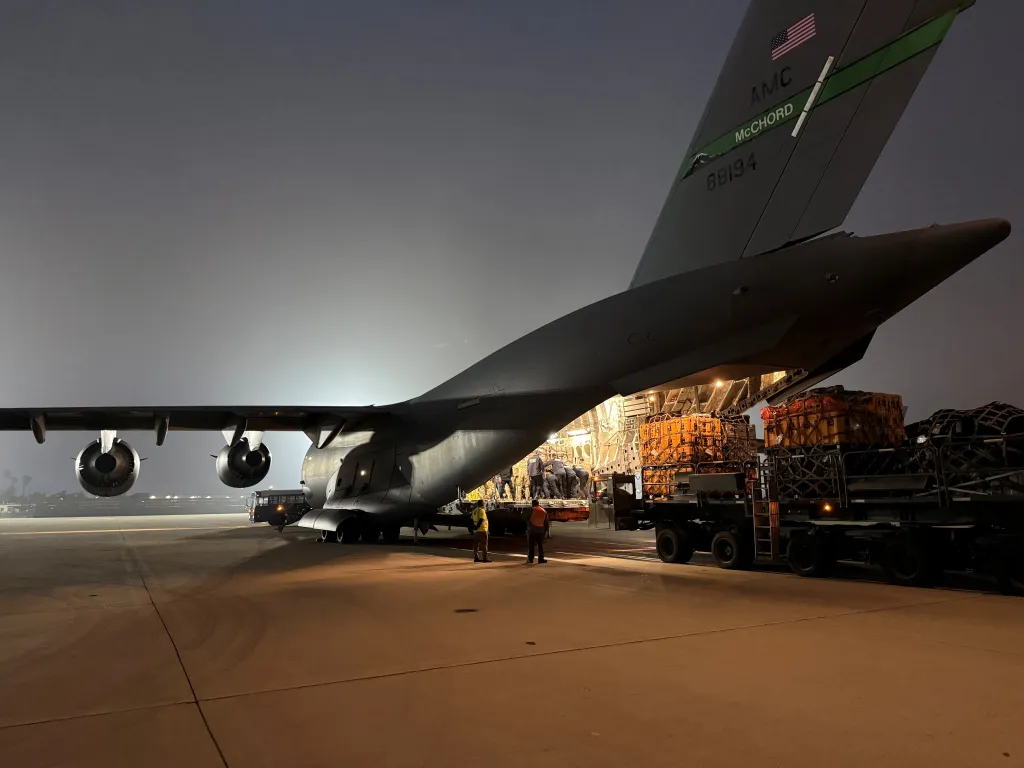
U.S. Air Force C-17 Globemaster III cargo jets have arrived in Venezuela, packed with personnel and equipment for the ongoing earthquake relief efforts. The aircraft are joining U.S. forces already in the country as well as on the amphibious transport ship USS Fort Lauderdale, the littoral combat ship USS Billings and at American bases around the region.
The flights are part of a growing U.S. military presence being run by U.S. Southern Command (SOUTHCOM) in support of the U.S. State Department. The movements are in response to 7.2- and 7.5-magnitude earthquakes Wednesday night that Venezuelan authorities say devastated much of the northern part of the country and have killed more than 900.
Utter devastation seen across the Northern Venezuelan coastal city of La Guaira, following tonight’s pair of major earthquakes, measuring 7.2 and 7.5 magnitude with an epicenter just to the west of Caracas. pic.twitter.com/BQv4YixUiB
WATCH: Inside Caracas Simon Bolivar International Airport during a powerful earthquake that struck Venezuela.
The first 7.2-magnitude quake was followed just 39 seconds later by a stronger 7.5-magnitude quake, according to the US Geological Survey (USGS), with witnesses… pic.twitter.com/3eZk7RV86h
— Breaking Aviation News & Videos (@aviationbrk) June 25, 2026
The first C-17 arrived in Venezuela this morning. Online flight trackers show that at least four of the cargo jets have left the U.S.
“The first air shipment of equipment has arrived to support the two specialized U.S. search and rescue teams, which are arriving in Venezuela to join ground operations as soon as possible,” the U.S. Embassy in Caracas said in a post on X. “With nearly 80 experts per team—firefighters, doctors, structural engineers—12 canines trained for detection in rubble, these groups bring advanced capabilities to locate survivors and assist in complex emergencies. Their personnel and specialized equipment are being positioned to head to the hardest-hit areas and begin operations when conditions allow.”
La primera carga aérea de equipamiento ha llegado para apoyar a los dos equipos especializados de búsqueda y rescate de los EE.UU., que están llegando a Venezuela para integrarse lo antes posible a las operaciones en el terreno. Con cerca de 80 expertos por equipo – bomberos,… pic.twitter.com/ZCaQMcBM6J
— Embajada de los EE.UU. en Caracas (@usembassyve) June 26, 2026
A second one reportedly landed in the stricken nation as well.
A second USAF C-17 carrying humanitarian aid and search and rescue teams has landed at El Libertador airbase in Maracay, also seen in the background are two Mexican air force planes that delivered aid this morning #Venezuelapic.twitter.com/LR9WuSbOh2
“A C-17 Globemaster III was loaded overnight at Dover AFB with Urban Search and Rescue personnel and equipment for transport to Venezuela in support of State Department-led humanitarian response efforts,” SOUTHCOM said in a post on X Friday morning. “America’s military is delivering the people and capabilities needed to save lives.”
When called, the @DeptofWar moves. A C-17 Globemaster III was loaded overnight at Dover AFB with Urban Search and Rescue personnel and equipment for transport to Venezuela in support of @StateDept-led humanitarian response efforts.
A C-17 Globemaster loaded specialized U.S. search and rescue teams overnight bound for Venezuela. (SOUTHCOM)
When disaster strikes, we answer the call. USA-01 is enroute to #Venezuela following the devastating earthquakes, w/ 79 personnel, six K9s, and 70k lbs of equipment. We are honored to represent the US, bringing our expertise, compassion, & unwavering dedication to those affected. pic.twitter.com/8snA89Qwae
— VA-TF1 / USA-01 – Urban Search and Rescue (@VATF1) June 26, 2026
Another C-17 landed in Curaçao. The island is serving as one staging area for international efforts to search for survivors and victims and bring in much-needed humanitarian aid.
The US response to the earthquake disaster in Venezuela is well underway. 📍The first related C-17, #AE1449 as RCH234, arrived in Curacao overnight. 📍#AE2FA6 as RCH525 is en route with members of USA-02 urban search & rescue team. 📍#AE07F8 as RCH421 is en route with members of… pic.twitter.com/4mznPCySI7
U.S. Marine Corps Maj. Gen. Kevin J. Jarrard arrived in Caracas on Thursday to oversee the Pentagon’s Venezuela earthquake relief efforts, SOUTHCOM stated.
“Jarrard is serving as the senior U.S. Southern Command (SOUTHCOM) official on the ground and is working closely with partners to plan, coordinate, and direct the U.S. military’s unparalleled logistical and operational capabilities to support the rapid, life-saving movement of response personnel, equipment, and humanitarian assistance into affected areas,” the command said in a media release.
RELEASE: SOUTHCOM Leadership Arrives in Venezuela to Coordinate Earthquake Relief Support
U.S. Marine Corps Maj. Gen. Kevin J. Jarrard arrived in Caracas, Venezuela, today, to oversee Department of War support to Venezuela earthquake relief efforts.
In another post on X, SOUTHCOM included a photograph of a USMC MV-22B Osprey tiltrotor aircraft. The Osprey is part of an array of fixed- and rotary-wing assets deployed for the relief effort around the region.
A U.S. Marine Corps MV-22 Osprey tiltrotor aircraft landed in Venezuela Thursday as part of U.S. humanitarian relief efforts. (SOUTHCOM)
Jarrard is leading SOUTHCOM Commander Gen. Francis L. Donovan’s deployment of “significant forces to the effort,” according to the command. This includes the aforementioned cargo jets and Navy vessels, as well as C-130 Hercules transports, unspecified reconnaissance platforms and rotary-wing aircraft.
“These forces will provide specialized mobility services and support to U.S. government personnel, search and rescue teams, and U.S. interagency partners as they assess damage, locate the injured, and deliver critical, life-saving assistance,” SOUTHCOM said in a statement.
The Pentagon released images of a U.S. Army CH-47 Chinook transport helicopter loading up personnel and supplies in Honduras for potential participation in this mission.
A 1st Battalion 228th Aviation Regiment CH-47 Chinook is prepped for potential support for Venezuela’s disaster relief response at Soto Cano Air Base, Honduras, June 25, 2026. (U.S. Air Force photo by Staff Sgt. Ethan Sherwood) Staff Sgt. Ethan SherwoodMembers of Joint Task Force-Bravo load equipment into a CH-47 Chinook in preparation for potential support to Venezuela’s disaster relief response at Soto Cano Air Base, Honduras, June 25, 2026. (U.S. Air Force photo by Staff Sgt. Ethan Sherwood) Staff Sgt. Ethan Sherwood
All this is being anchored by the two Navy vessels, which have been in the region for months.
Earthquake relief support from the sea: The @USNavy has a proud legacy of providing disaster relief directly from the sea.#SOUTHCOM has directed USS Fort Lauderdale (LPD 28) and USS Billings (LCS 15) to Venezuela to support @DeptofState-led U.S. government relief operations in… pic.twitter.com/z1JJ0aLjSl
Of the two, Fort Lauderdale has been in the Caribbean the longest and took part in the counternarcotics operation that led to the capture of former Venezuelan dictator Nicolás Maduro, now in custody in the U.S. The rest of the ships assigned to that mission left the region months ago.
Fort Lauderdale can embark multiple types of rotary wing aircraft, including Marine MV-22B Ospreys and UH-1Y Venoms. Other helicopters can use their large deck area for resupply and refueling, as well. The vessel could be used as a staging area to deliver aid and extract wounded from a nearby port or off the coast of Venezuela. Hundreds of sailors and Marines aboard could assist with humanitarian efforts, from the ship or on the ground.
The San Antonio class amphibious transport dock USS Fort Lauderdale (LPD 28) is taking part in the U.S. military’s humanitarian aid response to the Venezuelan earthquakes. (U.S. Navy photo by Mass Communication Specialist 2nd Class Savannah L. Hardesty) Petty Officer 2nd Class Savannah Hardesty
The flight deck of Billings, which arrived in the Caribbean in March, is much smaller and supports the ship’s MH-60 Seahawk helicopter and drones. It can also be used by other helicopters.
If needed, there are additional Navy assets operating off the East Coast that could be re-tasked to SOUTHCOM.
The amphibious assault ship USS Iwo Jima recently returned to Norfolk from a 10-month deployment in the Caribbean. If it has not yet entered its planned maintenance availability, the vessel could be redeployed if called upon.
The Wasp class amphibious assault ship USS Iwo Jima (LHD 7). (U.S. Navy photo by Mass Communication Specialist Seaman Logan Goins) Seaman Logan Goins
Much less likely is moving the aircraft carrier USS Nimitz. The fleet’s oldest carrier left Mayport, FL, on Wednesday and is now participating in large-scale FLEETEX before a planned transit to New York for America 250 events.
Rolling deep ⚓💪🌊
Twenty-six ships from 13 partner and allied nations steam in formation with Nimitz-class aircraft carrier USS Nimitz (CVN 68) during a multinational maritime exercise as part of Fleet Exercise (FLEETEX) 250 in the Atlantic Ocean, June 25, 2026. Nimitz is… pic.twitter.com/0p0yyvm0QV
Meanwhile, America’s unique array of ISR assets can be critical to Venezuela’s relief efforts.
Platforms like MQ-9 Reaper and MQ-4C Triton drones and piloted aircraft like P-8 Poseidon maritime patrol craft and even U-2 Dragon Lady spy planes could bring a lot of sensor power to bear to help with search and rescue, mapping and provide other geospatial intelligence benefits to develop a clearer picture of the situation.
U.S. Navy P-8 Posiedon martime patrol jet. (USN)
This relief effort is still unfolding and the full extent of the damage is still coming to light. As we previously noted, the disaster offers an opportunity for the U.S. military to foster improving relations with Venezuela almost half a year after Maduro was snatched out of Caracas.
This is where the US military can broadly impact the relationship with Venezuela again. They are now our friends? Go big helping them here. We are prepared and ready for this mission. Huge opportunity here. https://t.co/pu8RSRMjUK
U.S. President Donald Trump appears to have seized on this chance, at least to some degree, announcing America would play a key role in helping Venezuela in a post on his Truth Social site.
“The two major earthquakes that just hit the great people of Venezuela are both massive in scale and have left a devastating number of deaths,” Trump proclaimed. “The U.S.A. stands ready, willing, and able to help! I have instructed all agencies of our government to get ready to move quickly. We will be there for our new and great friends. Early reports are not good!!!”
We thank U.S. President Donald Trump and his administration, who have been in constant contact with Venezuelan authorities, offering support and solidarity to the people of Venezuela in the face of this tragedy that has plunged us into mourning. https://t.co/nw2bupuN7C
It is unclear how much larger the U.S. military presence will grow for this mission. Several other countries are taking part as well and China has pledged to. Trump has made keeping the Caribbean under the control of the U.S. a major part of his administration’s plans and a top reason for removing Maduro was to stem the influence of China and Russia there.
MOFA: China to provide humanitarian assistance to Venezuela
China will provide emergency humanitarian assistance to Venezuela, Chinese Foreign Ministry spokesperson Guo Jiakun said on Friday. He added that China is prepared to provide further support as the disaster situation… pic.twitter.com/zpge2sGNXb
We will continue to monitor the situation and provide updates when warranted.
UPDATE: 3:28 PM EDT –
SOUTHCOM provided an update on the assets being deployed:
Two U.S. Air Force C-17 Globemaster aircraft are transporting U.S. Urban Search and Rescue teams based in Los Angeles and Fairfax, Virginia, and one U.S. Air Force C-17 will deliver load-movement equipment to Caracas.
U.S. Marine Corps MV-22 Ospreys will transport an airfield assessment team to Venezuela to support airport operations that were impacted near the earthquake epicenter.
The U.S. Navy’s San Antonio-class amphibious transport dock USS Fort Lauderdale (LPD 28) and Freedom-variant littoral combat ship USS Billings (LCS 15) have arrived in waters near Venezuela and will begin supporting relief and live-saving efforts.
Three U.S. Army CH-47 Chinooks and crews from Joint Task Force-Bravo will depart Soto Cano Air Base in Honduras en route to support the transport of key personnel and supplies aiding impacted Venezuelan communities.
The command’s U.S. Space Force component is providing satellite imagery of devastated areas to disaster relief planners in Venezuela to aid them in assessing where immediate live-saving and aid efforts are needed most and identifying what capability requests to prioritize.
RYLAN has apologised after being forced to pull out of his BBC Radio Two show.
The 37-year-old was due to be on air today, but failed to make it home from Nice, France.
Sign up for the Showbiz newsletter
Thank you!
Rylan forced to pull out of his BBC Radio 2 show after being stranded abroad – as he details desperate attempt to get homeCredit: InstagramHe hosts a weekly show on BBC Radio 2Credit: Instagram
The radio host had to be replaced at the eleventh hour after being stranded abroad.
Calling into Emma Willis‘ show to explain his predicament, Rylan said: “I decided to go away with my partner and a couple of my friends to Nice for a few days and just enjoy the sun.
“I didn’t have work this week, I’d managed to clear my diary and I was like, that’s amazing.
“I was flying back very early this morning, so I went to the airport and it was like, ‘no’.
“At one point I was going to get on an eight-hour train, which still would have made me late for work, but would have got me home today.
“In the end I thought, ‘you know what, you’ve done well for yourself, I’m just going to stay another day’.
“What can I do? I’m not going to be able to make the show today so I thought I can either really stress myself out about this and sweat my foundation off my forehead or I’m just going to have to swallow it and deal with it and go, ‘what a shame, there’s worse places to be’.”
Rylan was replaced by Mark Goodier, with a BBC rep confirming on social media: “Rylan got stranded somewhere Nice…”
Rylan replied in the comments, writing: “So unprofessional.”
He also went on his Instagram, telling fans: “Soz about today’s show.
“I blame everyone but myself.
“Genuinely had it all sussed out and then flights all cancelled.
“Thanks Mark for stepping in you legend. Gonna have a rosé and think of you all.”
Mark stepped up to the hotseat for Rylan to host the film and TV quiz Couch Potatoes and discovered how listeners’ holiday dilemmas turned into a feel-good success story.
Rylan will be back next week to host his three-hour show Rylan On Saturday which airs weekly at 3pm.
Rylan explained why he was missing from his BBC Radio 2 showCredit: InstagramHis radio two colleague Emma Willis didn’t look impressedCredit: Instagram
BBC Sport World Cup pundits Micah Richards and Wayne Rooney believe Thomas Tuchel should have included more full-back cover in the squad, following the withdrawal of Tino Livramento and injury concerns for Reece James, and now Jarrell Quansah.
Lance Schroyer, who is a 29-year veteran of law enforcement and has been working as a senior advisor to Homeland Security Secretary Markwayne Mullin, was nominated on Saturday by President Donald Trump to be director of Immigration and Customs Enforcement. Photo by Department of Homeland Security
June 27 (UPI) — President Donald Trump on Saturday announced that he nominated former Oklahoma state trooper Lance Schroyer to be director of Immigration and Customs Enforcement.
Schroyer, a senior advisor at the Department of Homeland Security and retired U.S. Marine, will replace former acting ICE Director Todd Lyons, who announced in April that he would leave the agency on May 31.
Trump announced that he is nominating Schroyer for the position in a post on Truth Social, touting his 29 years in law enforcement, including in previous partnership roles with ICE.
“He is a PATRIOT with real operational experience, and proven leader with DECADES of experience locking up the worst of the worst,” Trump said in the post.
“Lance has firsthand experience getting Illegal Aliens OFF our streets and, just like ME and our Secretary of Homeland Security Markwayne Mullin, he LOVES the men and women of ICE!” Trump said.
DHS said in a press release endorsing the nomination that Schroyer’s role as senior advisor to Mullin has included overseeing coordination of immigration enforcement and serving as a liaison between involved law enforcement agencies.
Before his position at DHS, Schroyer was a major in the Oklahoma Department of Public Safety with responsibility for its Emergency Services Unit and a longtime Oklahoma state trooper.
In a statement, Mullin noted that ICE has not had a Senate confirmed director in more than a decade and, echoing Trump’s post, said the Senate needs to quickly confirm Schroyer.
“Lance will play a vital role in helping deliver on the President’s mandate from the American people to target, arrest and deport illegal aliens,” Mullin said.
“Lance is coming straight from the operational field where he ran large scale operations and worked alongside state and federal partners to remove illegal aliens from Oklahoma under the 287g program,” he said.
Lyons was appointed by Trump in March 2025 after his predecessor, Caleb Vitello, did not start removing people from the United States who allegedly were illegally in the country.
In his roughly one year in the job, Lyons oversaw more than 475,000 removals of people from the country and nearly 379,000 arrests.
Protestors and federal agents clash outside Delaney Hall Detention Center in Newark, N.J., on May 27, 2026. Photo by Angelina Katsanis/UPI | License Photo
Sir Rod Stewart’s Glastonbury 2025 performance was rebroadcast on the BBC on Saturday night
The BBC has aired a repeat of Rod’s Glastonbury performance(Image: Getty)
Singer Sir Rod Stewart left BBC viewers distracted just minutes into his performance.
Sir Rod’s Glastonbury performance, originally broadcast in 2025, was reshown on Saturday evening. In a repeat episode of Rod Stewart at Glastonbury, audiences watched the rock legend once more commanding the Pyramid Stage on the festival’s closing day at Worthy Farm in 2025.
One delighted viewer commented on X at the time: “80 years old. Just feel good throughout. What a star,” while another declared, “Rod Stewart still looks great at the age of 80. He’s still got it.”
Another admirer gushed: “All those eyes on Rod. He looks fabulous for his age.”
One supporter commented, “He deserves that crowd after all these years,” as another enthused, “Sir Rod Stewart… phenomenal! 80 years old and had us all in rapture. Best there is,” the Express reports.
Someone else continued, ” Wait – Rod Stewart 80, Ronnie Wood – 76, Lulu 76, thanks and massive respect for you all. Shows age is a number, but talent…. ageless.”
Back in 2025, Rod shared his enthusiasm ahead of Glastonbury and told Radio Times, “I’m really looking forward to it. And it is a different gig, it’s like when you’re playing a cup final, you’re trying to treat it like another game. But, of course, it’s not. It’s special. It’ll be glamorous, it’ll be sexy.
“And we’ve got a little orchestra coming on to play with us. And we may have some bagpipes.”
More recently, Rod has been forced to withdraw from several performances due to health issues. This week, Rod was also spotted with an oxygen tank, prompting worry amongst fans.
His wife, Penny Lancaster, said during an appearance on Loose Women that it “looked a lot scarier than it really was”. She told her co-stars, “He had to cancel a couple of shows prior to that because of a respiratory infection.
“He was recovering and well enough to perform. But he wasn’t aware that Salt Lake City, where he was performing, was way above sea level. So the altitude levels, just for your regular person, is a challenge. If you’re not acclimatised, like sportsmen would arrive before an event, a week before to acclimatise.”
She added, “Rod just flew in on the day of the show, wasn’t aware of this particular altitude. So he was already down on his juice because of recovering from his respiratory infection. And then he was also down another 17% of oxygen because of the altitude. So when he’s on stage, and of course, his two-hour show involves him running around, he doesn’t sit still for a minute, it suddenly hit him.
“But there are oxygen tanks at these particular shows for that reason, because even the young ones, if they’ve had a late night out before a show, they can suffer, and they do.”
Rod Stewart at Glastonbury 2025 is available to watch on BBCiPlayer.
This article explores the historical journey and cultural significance of Independence Day in Djibouti, which is celebrated annually on June 27th. After decades of French colonial rule and several disputed referendums, the nation finally achieved sovereignty in 1977 as the last French colony in Africa to do so. The text highlights Hassan Gouled Aptidon as a pivotal figure who transitioned from an activist to the country’s first president. Modern festivities are characterized by military parades in the capital, political addresses, and vibrant public celebrations involving fireworks and music. Furthermore, the source notes the importance of traditional cuisine, su …
Saint Vitus was a Christian saint from Sicily. He died as a martyr during the persecution of Christians by co-ruling Roman Emperors Diocletian and Maximian in 303.
In the late Middle Ages, people in Germany celebrated the feast of Vitus by dancing before his statue. This dancing became popular and the name “Saint Vitus Dance” was given to the neurological disorder Sydenham’s chorea.
The Battle of Kosovo took place on St. Vitus’ Day (June 15th in the Julian calendar) 1389 between an army led by the Serbian Prince Lazar Hrebeljanović and an invading army of the Ottoman Empire.
While the Ottomans suffered huge losses, they eliminated all of Prince Lazar’s forces. This led to Ottoman control in the region which lasted for several centuries.
John Mozeliak is in Anaheim for one clear-cut reason: to set the foundation for the Angels to get back on track.
At his introductory news conference at Angel Stadium on Saturday, the team’s new baseball operations consultant and interim general manager laid out his vision for success — while acknowledging recent woes — alongside Molly Jolly, one day after the first-year Angels president relieved general manager Perry Minasian of his duties amid his sixth straight losing season.
“Obviously, [the Angels] lacked consistency in terms of when you think about winning, right? Because that’s the proxy,” Mozeliak said. “There’s a lot of things we can use to determine if the organization is healthy or not. … Where Molly and I are connecting on this is like, we understand wins and losses matter, but how do you get to a place where that becomes consistent?
“Look at the best clubs in baseball [and] what you admire; whether they’re large-market or small-market, they have a philosophy, they have direction, and they stick to it, right? … That’s ultimately what we need to do here, and that’s hopefully something I can help bring to them.”
Mozeliak spent 18 seasons (2008-25) as general manager of the St. Louis Cardinals, a tenure consisting of 10 playoff appearances and a World Series victory in 2011.
The 57-year-old intends to “audit” the Angels in this new role alongside Jolly, with plans to hire a general manager by the time Mozeliak’s contract is up “sometime in December.”
“I brought on board John Mozeliak to assist me in preparing a baseball operation strategy as well as guide me in the search for a new general manager,” Jolly said, mentioning that her decision to fire Minasian and bring in Mozeliak had brewed for weeks.
“I did this because John has a proven track record of building and maintaining winning baseball cultures, and my goal is to bring that here to the Angels.”
Mozeliak didn’t rule himself out as the long-term answer at general manager and was emphatic about not speaking in absolutes. However, the longtime executive said he’d rather help Jolly “bridge the gap” during the Angels’ transformative period before anything else.
The Angels have plenty of gaps entering Saturday’s matchup with the Athletics. The Angels are tied for last in the American League with a 34-49 record while on the road to a 12th consecutive finish out of the playoffs.
And all of that is before mentioning the “sell the team” chants that flood the right-field upper deck at Angel Stadium at each home game oas ex-Angel Shohei Ohtani thrives with the Dodgers.
Mozeliak understands that the Angels have lacked direction in recent seasons. He asked for patience in rebuilding the team alongside Jolly.
“I knew coming in, this isn’t going to be something where Molly and I had a light switch and everything just starts working perfectly,” Mozeliak said. “It’s not going to work that way. … I would ask for some patience. We need a little time to sort of work through this … when we come out on the other end of this tunnel, we hope to be in a very successful place.”
Jolly said of Angels fans’ discontent, “I know what’s happening. I see it, I hear it. Fans have a right to have their voices be heard. Didn’t influence the decision that I wanted to make, but we all want to win. Our owner wants to win. I do. The fans deserve that, and that’s what we’re going to work toward.”
Mozeliak acknowledged he’d already forgotten some names of Angels personnel he was introduced to Saturday. But he also said that first-year manager Kurt Suzuki and the rest of the coaching staff’s jobs are secure through the season.
“I met with most of them this morning, and I told them they’re all fine for this year,” Mozeliak said. “There’s nothing they have to worry about. We’re not making any coaching changes right now. I really just need to get to know them, right?”
Mozeliak spoke to Suzuki on Saturday and said that he and his staff are “very impressive.”
Across the board, Mozeliak — who hasn’t yet met owner Arte Moreno since moving into this role — is focused on knowing who the Angels are at this point, with an “aggressive timeline” looming in the background.
With that said, Mozeliak shared that he isn’t “overly concerned” with the Aug. 3 trade deadline, nor is he worried about the MLB Draft, which starts July 11.
“My philosophy on the draft is to let the scouting director and his team do their jobs,” Mozeliak said. “The only real input I’m going to have is … understanding their process … and then if there are some financial decisions that are being banked into who we pick and why.”
Jolly brought in Mozeliak to help the Angels hire their fourth full-time general manager since 2012.
And while many might believe not much will change as long as Moreno remains the owner, Jolly said she has “autonomy” to assess the Angels’ baseball operations and is “confident in my authority and scope within the organization.”
Those invested in the Angels will believe it when they see it.
“When I think about the Angels right now, I just look at it as a very opportunistic time here,” Mozeliak said. “New leadership on the business side; we’re going to put a great team on the baseball side.
“But it’s going to be a place that I hope, in a couple years, we’re all proud of.”