Month: June 2026

Britain’s weirdest Wetherspoons is a pub that serves guests inside a prison cell

A night on the beers could start in a jail cell in this unique pub, but it’s just one of the unusual buildings that has seen new life after being turned into a ‘Spoons – here’s a roundup of some unique places you can enjoy Curry Club or just a quiet pint

Love or hate Wetherspoons, you have to admit that the giant pub chain has a knack for turning some unique venues into places to grab a pint and enjoy a cheap lunch.

Across the UK, many abandoned buildings are being turned into drinking venues, and while the settings are unique, all the places have the same classic ‘Spoons menu and deals, so you know what you’re getting when you visit.

Here are some of the weirdest venues snapped up by Wetherspoons, from an old bank where you can sit in the vault, to a dramatic opera house that has kept its opulent vibes for a classy start to your night on the town.

1. The Chief Justice of the Common Pleas – a courthouse with jail cells

Built around 1901 in the Lake District town of Keswick, The Chief Justice of the Common Pleas was originally a magistrates’ court and a police station, where unlucky criminals would often be caught and thrown in one of its cells for the night before trial. No doubt many a drinker ended up here after a few too many beers.

Nowadays, the sturdy brick cells have been turned into booths where you can enjoy a drink with friends, and while there’s a much cheerier atmosphere, you can still see the remains of the building’s old life. There are heavy metal doors with locks and high windows covered with bars that once kept people securely inside. However, punters are free to roam outside for a drink in the beer garden, surrounded by the classic Lake District stone buildings of this charming market town.

2. The Rawson Spring – former swimming pool

Kids who grew up in the 70s and 80s around Sheffield may well have taken their first dip in the former Hillsborough Baths, which are now a ‘Spoons called The Rawson Spring. These vast council-run baths opened in 1926 and closed in 1991, hosting many decades of swimming lessons and summer fun.

The cavernous space has since been turned into a giant Wetherspoons, and many of the original features may still be recognised by eagle-eyed former customers. The balcony around the top where spectators once stood is still intact, and you can still see the old poolside changing rooms where tables are now set up.

3. Opera House

If you’re looking for a classy and cultural setting in which to enjoy your chicken basket, then head to the Opera House in Tunbridge Wells. The name pretty much sums it up. This ornate Grade II listed building was designed by famous architect John Priestley Briggs and completed in 1902, becoming a bingo hall in the 60s before Wetherspoons snapped it up in 1996.

Its red interiors with gold accents and chandeliers still make it feel much like a space for a grand performance, and occasionally the local opera group will put on a show worthy of this beautifully preserved building.

4. The Counting House – former bank with vault

Wetherspoon has converted plenty of old banks over the years, but one of the most notable is The Counting House in Glasgow, where you can drink inside a former vault.

Once a major branch of the Bank of Scotland, this Italian Renaissance-style building was constructed between 1867 and 1870, with a high domed ceiling, marble fireplaces, Corinthian columns, and stone statues. Nowadays, the main bar sits under the dome, and punters can also sit behind bars in the old vault. Although luckily, with Wetherspoons prices, you won’t need to rob a bank to get a round in.

5. Piccadilly Hall – former amusement park loved by 90s kids

If you were a 90s kid on a day out to the capital, odds were you’d beg your parents to take you to London Trocadero. This iconic building set at 30 Shaftesbury Avenue was once the ultimate indoor amusement park, with several floors of arcade machines and even an indoor drop ride at its centre. It’s perhaps best remembered as the home of SegaWorld, which was reached by a giant rocket escalator.

When Trocadero closed, parts of it became a pod hotel, and now there are plans to turn some of the building into one of London’s largest ‘Spoons in the heart of Theatreland. Reportedly set to open in late 2026, Piccadilly Hall will span over 3,600 square feet, offer a massive 280 covers, and open from 7am until midnight, seven days a week.

Have a story you want to share? Email us at webtravel@reachplc.com

Source link

Brian McFadden and Keith Duffy ‘sign up’ for new I’m A Celeb spin-off with major twist

Sources claim the cheeky chaps have joined the new series, set in Canada, that will air as part of the celebration to mark 25 years of I’m A Celebrity…

Brian McFadden and Keith Duffy have reportedly become the first stars lined up for ITV’s brand new I’m A Celebrity… Get Me Out Of Here! spin-off.

The Westlife singer, 46, and Boyzone star, 51, are said to have agreed to take part in The Wild Frontier, a new version of the hit reality show which is expected to begin filming in Canada later this year.

Unlike the Australian series, the spin-off will see celebrities competing in pairs, with friends, relatives and couples taking on Bushtucker-style trials together before facing elimination as a duo.

The show is reportedly due to air in 2027, as part of celebrations marking 25 years of I’m A Celebrity – which first hit our screens in August, 2002.

According to The Sun, the long-time friends have signed lucrative deals to appear in the series, with a source claiming: “Bosses are delighted that Keith and Brian will be taking part, they’ll each bring a lot of fun and mischief to the camp.”

The insider added that producers are excited by the new format, claiming it is expected to get viewers talking as famous duos battle it out together.

Rather than competing individually, contestants will reportedly tackle challenges as pairs, working together to win food and survive eliminations before one winning duo is crowned.

The Sun also reports that casting teams are hoping to secure a mix of celebrity friends, couples and famous faces alongside their non-famous relatives or partners.

Filming is expected to take place in Canada’s Callaghan Valley, near Whistler Olympic Park, replacing the Australian jungle for the special spin-off series.

The area is known for its rugged wilderness and is home to wildlife including grizzly bears, black bears and mountain lions, providing a dramatically different backdrop for the celebrity survival show.

Brian already has a link to the I’m A Celebrity franchise through his former wife Kerry Katona, who was crowned Queen of the Jungle in 2004.

Meanwhile, the main I’m A Celebrity… Get Me Out Of Here! series will continue to be filmed in Australia as normal later this year.

The Mirror has contacted ITV, Brian McFadden, and Keith Duffy for comment.

Like this story? For more of the latest showbiz news and gossip, follow Mirror Celebs on TikTok, Snapchat, Instagram, Twitter, Facebook, YouTube and Threads.


Source link

Angels lean on late surge, strong bullpen effort to defeat Athletics

Denzer Guzman hit a tiebreaking single with two outs in the seventh inning Saturday night that sent the Angels to a 5-2 victory over the Athletics.

The Angels tacked on two insurance runs in the eighth on RBI singles by Oswald Peraza and Logan O’Hoppe.

Angels reliever Ryan Zeferjahn (4-3) struck out two in a scoreless seventh to earn the win and increase his hitless streak to 10 innings, with 19 strikeouts, over his last nine appearances.

Kirby Yates threw a 1-2-3 ninth for his 100th career save and second this season.

Josh Lowe sparked the go-ahead rally with a one-out single off left-hander Geoff Hartlieb (0-1) in the seventh. Lowe stole second and scored for a 3-2 lead when Guzman hit a hard grounder down the line that third baseman Max Muncy couldn’t get his glove on.

Angels right-hander Sam Bachman escaped a bases-loaded, one-out jam in the eighth when he struck out pinch-hitter Carlos Cortes with a 100-mph sinker and got Muncy to fly out.

Angels starter Reid Detmers gave up two runs and four hits in 5⅔ innings, striking out eight and walking three. The left-hander increased his strikeout total to 112, third-most in the majors behind Milwaukee ace Jacob Misiorowski (146) and Toronto right-hander Dylan Cease (128).

A’s starter Jack Perkins gave up two runs and four hits in five innings, striking out five and walking one.

The A’s took a 1-0 lead in the second when Jonah Heim crushed a first-pitch fastball that Detmers left over the heart of the plate. Heim sent a 109-mph drive 445 feet over the left-center field wall for his seventh homer.

The Angels countered with two runs in the fourth, a rally that began with Nolan Schanuel’s walk and Jorge Soler’s single. Wade Meckler struck out, but Jo Adell ripped a two-run triple into the left-field corner for a 2-1 lead.

The A’s tied it in the sixth when Nick Kurtz singled, Lawrence Butler walked and Colby Thomas lined a two-out RBI single to left.

The A’s, already playing without injured shortstop Jacob Wilson and second baseman Zach Gelof, lost Tyler Soderstrom when the left fielder was pulled in the third inning because of left hip soreness.

Source link

U.S. strikes Iran drone sites; Iran hits Bahrain

June 27 (UPI) — The United States attacked Iranian drone sites Saturday morning, and Iran hit Bahrain in response.

In Bahrain, two one-way attack drones hit the country, according to the New York Times. One was shot down by a ground-launched air-defense weapon, a U.S. official told the Times, and the other landed without harm in a remote airfield.

“This constitutes a flagrant violation of its sovereignty, a blatant threat to the safety of citizens and residents,” Bahrain’s foreign ministry said in a statement.

The United States used six F35 and F16 Air Force jets to hit four Iranian sites in the strait, an anonymous official told The Times.

Ebrahim Azizi, a conservative Iranian lawmaker, said in a social media post that the U.S. attacks on Friday were a “reckless violation of the cease-fire” and warned that the attacks would lead the United States to “retreat and regret.”

Azizi added that the strikes show that President Donald Trump “has no commitment to the principles of negotiations.”

On Friday afternoon, Trump ordered strikes on Iran after it staged a drone strike on a shipping vessel transiting the Strait of Hormuz. The president had made vague threats on Iran and said that the country had attacked ships in the strait.

Vice President JD Vance, who has been handling the negotiations, posted on X that the United States had honored the MOU.

“If they have disagreements about how the MOU is being applied, they can pick up the phone,” he posted. “But violence will be met with violence.”

Saturday morning, another ship was hit in the strait by an “unidentified projectile” damaging its bridge but causing no injuries to the crew, according to the United Kingdom Maritime Trade Operations Center. The organization didn’t say who launched the attack.

Mohsen Rezaei, a former Iranian military chief who advises Supreme Leader Mojtaba Khamenei, accused the United States of “continuing to create tensions” in the strait. “The response to the violation of any article of the memorandum of understanding will be swift and decisive,” he said in a post on social media, The Times reported.

White House Border Czar Tom Homan speaks during the Faith and Freedom Coalition 2026 Road to Majority Policy Conference at the Washington Hilton on Friday. Photo by Bonnie Cash/UPI | License Photo

Source link

The giant European waterpark with new outdoor pool that you can fly to for less than a Domino’s pizza

WHILE the UK does have waterparks, some in Europe are just bigger and better – and one of them is cheaper to fly to than a Domino’s pizza.

Rulantica waterpark in Rust, Germany, can be found at Europa-Park Resort and is spread across 32,600sqm.

Rulantica waterpark in Germany is less than two hours from the UK Credit: Trip Advisor
Collage of travel items including a plane, sunscreen, passport, suitcase, and plane tickets, advertising The Sun's travel Instagram account.

The waterpark is both indoor and outdoor, with over 50 attractions across 10 themed areas.

And there’s even a new pool at the attraction called Svømmepøl.

The Nordic-inspired pool has spraying geysers, a grotto and even a swim-up bar in the middle of the water.

Pine trees and giant rocks then surround the pool and there is also direct access from the main attraction.

Read more on travel inspo

TRAVEL TIP

The £2.99 SIM hack that can save Brits HUNDREDS abroad


STAYCAY

Our travel experts’ best-kept-secret UK holiday spots for summer – from £37 a night

Major attractions at the park include Vikingløp which is Europe’s largest speed slide, where up to eight people can race in parallel mat slides.

As for other areas across the water park, there is Lumafals with a huge pool with waves as well as a shop selling swimming gear.

Inside, visitors will find lots of different themed areas Credit: Rulantica

There’s Rangnakor, which is a ‘city on stilts’, with big slides as well as sofa areas for relaxing.

Kids who love adventure and pirates shouldn’t miss Skip Strand, where there is a huge pirate ship hovering above the water to explore.

The ship even has three slides off of it and into the water.

Families can head on Snorri’s Saga too, where each visitor sits in a rubber ring and bobs on a river that travels through caves and past shipwrecks.

Ideal for smaller children, there is the Trølldal area – a water playground ideal for those just learning to play in the water.

There is also a new outdoor pool with a swim up bar Credit: Europa Park

If you want to relax a bit, then head to the Skog Lagune area, where there are trees and pools with gentle bubbles.

In this area you can also grab a drink from the Skogbar, which sits in the middle of the water.

One recent visitor said: “Exceeded all expectations! Rulantica is beautiful, clean, and incredibly well-run.

“Both the indoor and outdoor zones are phenomenal, and every single pool and slide is heated.

“A flawless, stress-free family day out. We’ll absolutely be returning!”

You can also stay at a hotel right by the waterpark, at the four-star Krønasår Hotel.

And there are a number of different rides and water experiences Credit: Trip Advisor

The hotel is themed like a history museum with rooms costing from €88.50 (£76.75) per person, per night.

A ticket to the waterpark costs from £32.93 per child and £35.53 per adult.

The best way to get to the waterpark is by flying to Karlsruhe/Baden-Baden Airport.

This takes about an hour and a half and costs less than a Domino’s pizza at £13 each way in July.


Source link

All the holiday add-ons and extra fees to be aware of after Ryanair U-turn

Millions of Brits are due to pack up the budgie smugglers and inflatable doughnuts and head abroad – but there are plenty of sneaky charges and questionable practices that can easily ruin a holiday

Are you due to travel abroad for a holiday in the coming months? You’re not alone.

Despite dire warnings of cancelled flights, raising prices and stifling heatwaves, millions of Brits are due to pack up the budgie smugglers and inflatable doughnuts and head abroad.

However, there are lots of extra charges, shoddy practices and other travel traumas that can catch out the unwary traveller. So here’s my guide to some of the holiday horrors that you might not be aware of, so you can get away without a care in the world.

Don’t get caught out by a non-compliant cabin bag

So you’re travelling with just a cabin bag, but it’s looking a bit overstuffed. Beware…

It’s been reported that Ryanair has been paying bonuses to staff for every oversize cabin bag they spot – and are considering increasing this incentive. Meanwhile, other airlines are allegedly paying £1.20 to airline staff who do the same.

Airlines all have specific rules around the size of your cabin bag (the bigger one) and your hand luggage (the smaller one). Despite what it may say on your suitcase, there is no definitive size for cabin bags, though as a general rule the standard is 56 x 45 x 25cm for the cabin bag and 40cm x 30cm x 15cm for an under-seat (hand)bag. There are also weight restrictions too, with most cabin bags limited to a maximum of 7kg to 10kg.

Standard sizes are all well and good, but airlines can set their own, more restrictive rules around the size of both types of carry-on luggage. So before you travel, it’s vital that you understand their rules – and the consequences of not meeting them.

You’ll need to measure the height, depth and width of your carry-on bags. Missing off the wheels when you check the height is one of the more common mistakes.

But the biggie is over-stuffed bags. Having a bag that meets the criteria when empty doesn’t mean it does when you’ve jammed it full of holiday items. Remember that the bag must fit in to that metal box at the boarding gates if you want to get on your flight without paying extra.

Cheeky add-on charges on your flights

Chances are you’ve already booked your luggage costs as part of your flight booking. But make sure you pack your bags a few days before you travel so you know if you need to add on a hold bag, or are at risk of being caught out by those cabin bag rules.

The closer you get to travel, the higher the price you pay for your bags. So if you’ve not paid for your luggage yet, do it now.

So how much extra will you pay for essential add-on charges? By my calculations, the average prices hover around:

  • £40 to £50 if you want to take a 23kg hold bag one way.
  • £30 to £50 for an overhead cabin bag (this has almost doubled since last year – it might be cheaper to share a hold bag for two people).
  • £6 to £25 for the most basic seat reservation

That’s £76 to £125 each way or £152 to £250 for a return. However, you’ll pay more the closer you are to your flight date.

In addition, watch out for charges to book a specific seat. I was charged over £320 for two return flight seat reservations alone through British Airways recently, just so I could sit with my partner! For shorter haul, the seat prices aren’t as high, but are still outrageous.

In fact, Ryanair has U-turned on charging £8 for families to sit with kids after the the Competition and Markets Authority (CMA) announced an investigation.

You can usually book a specific seat 24 to 48 hours before check in opens. But watch out! There’s usually a massive rush to book and you may miss out. I tested the BA website after I’d paid for my shocking seat prices and the website and app went down on both occasions when check in opened.

Apartment traps and questionable locations

Using online travel marketplaces and apartment rental websites can be a great way to find a fabulous place to stay for your big holiday. But you do have to be a bit cautious about what’s on offer and you’ll need to check to see if the places you like are as good as they seem.

You may already be aware of the warnings about ‘tickers’ – those on-screen alerts that say there are only two rooms left in the hotel, or things are ‘booking fast’. Despite numerous warnings and fines, the industry is still finding sneaky ways to panic us in to buying without checking things thoroughly.

But there are other things to watch out for. Many websites offer hotels and aparthotels alongside private lets. There’s nothing wrong with a private let in theory, but with a hotel, you can complain to the reception if things aren’t as advertised, whereas a private let might limit your options if the host is a bit rubbish.

Check photos thoroughly to see if the advertised facilities are all there, ask questions before booking and look at the reviews – focus on recent ones. Watch out for things like extra bedrooms that turn out to be a sofa bed in the living room. I always look for a personal handover and return of keys too as this is a guide to how good your host is.

The latest thing to watch out for is the location of the property. Many sites list properties as being ‘500 metres from the centre’.

Yet, some of the sites I checked don’t specify which centre. You may find that you’re not 500 meters from the centre of Barcelona, but 500 meters from the centre of a suburb nearby. Check out a map online so you know where the main tourist areas are for your destination and cross reference with the details on the booking website.

  • Martyn James is a leading consumer rights campaigner, TV and radio broadcaster and journalist

Source link

Tenerife tourist praised for ‘getting own back’ on ‘rude’ sunbed hoggers

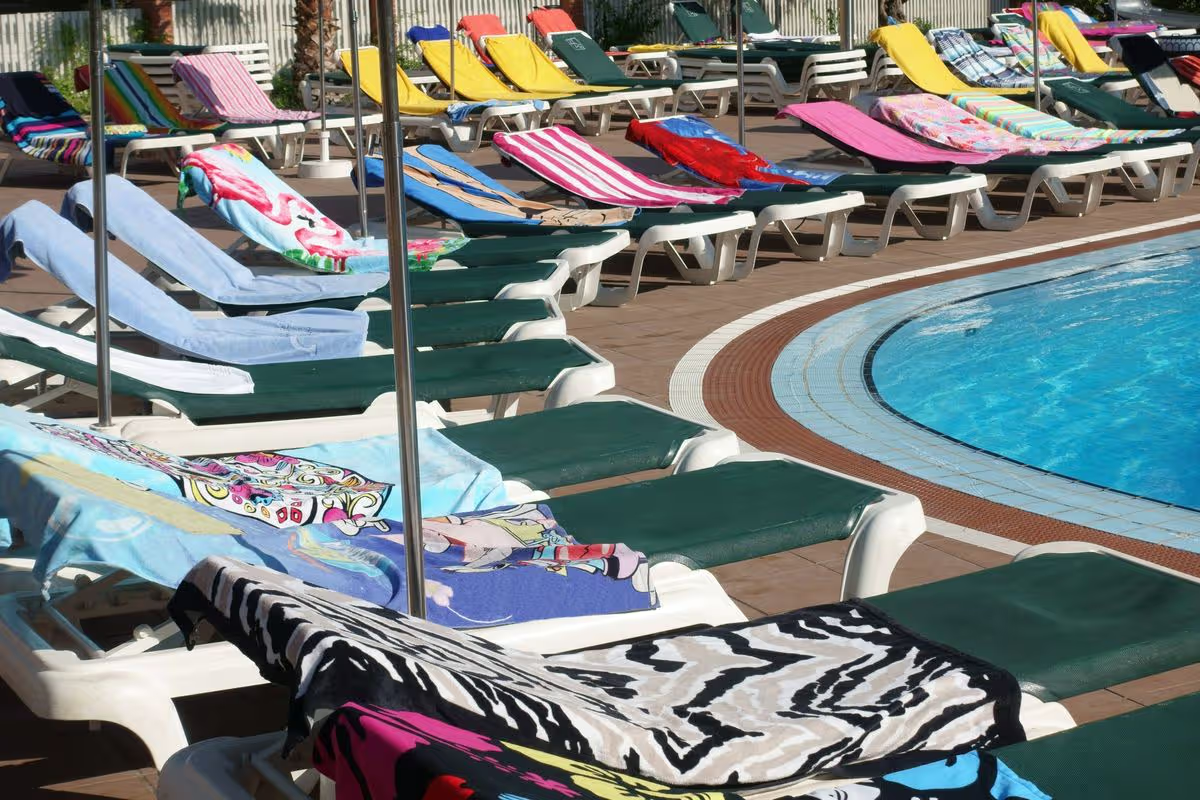
A tourist who has been on holiday in Tenerife has been praised for “getting her own back” on alleged “rude” holidaymakers who were apparently reserving sunbeds with towels. Ellie McAdams decided to take action

A woman has been praised for “getting her own back” on “rude” tourists who allegedly used their towels to reserve sunbeds that weren’t in use, and it’s not the first time such an event has happened. Ellie McAdams recently opened up about her experience in Tenerife where she claimed some people were trying to “hog” sunbeds that weren’t in use.

She explained what happened in a TikTok video when she was relaxing by the pool recently while on holiday, and she admitted she doesn’t think people should be able to “reserve” their sunbeds for hours without using them. In her opinion, other people should be able to enjoy them instead.

It’s not the first time the topic has come up either. Previously, someone else claimed they had been called “selfish” for actually attempting to reserve sunbeds while abroad.

Ellie said: “So we’ve been wondering aimlessly all morning, looking for a sun lounger, and we then notice that there was a group of sun loungers right by the pool that have been currently unoccupied for four hours. So, what did we do?

“We removed their towels and sat on the beds. We went and asked the lifeguard, and said ‘they haven’t been there for four hours, maybe move their towels?’ and he said ‘yeah, go for it’.

“So, stay tuned and see if we end up having an argument, but it’s our last day, so we don’t really care.” A while later, she added: “Just an update, it is now 1.15pm, those beds were unoccupied for five hours, so I’m very happy that we moved those towels off.

“And did we put them back? No. You can’t claim beds and then f*** off out for the day. You can’t do it. It’s rude and it’s selfish.”

The video has been viewed over 11,000 times since it was shared, and people were quick to comment too. Hundreds chimed in to express their thoughts, and many offered praise.

One said: “No sun lounger should be reserved and unoccupied for more than an hour.”

Another added: “No problem in reserving sunbeds before breakfast and then having breakfast before you occupy the sunbeds. But for people who claim them first thing in morning then not to be seen most of the day is not on.”

A third replied: “Well done. I remove towels every day when I’m away on holiday. People have to learn.”

Meanwhile, a fourth commented: “I find people absolutely selfish for even putting towels down, first come first served. Don’t blame you moving them, we do it all the time.”

What are the rules when it comes to reserving sunbeds?

When it comes to reserving sunbeds, there is no universal rule. However, some hotels and resorts enforce their own specific guidelines, so it’s always best to check.

Many resorts have a policy stating that towels left on unoccupied loungers for one to two hours will be removed by staff and placed in lost property to free them up for other guests. Then, there are other hotels where pre-booking is required.

Some resorts allocate sunbeds to specific rooms or require you to reserve a parasol at reception when you arrive. Other hotels may not have any rules in place at all.

However, according to online forums like Reddit, the act of “reserving” beds by putting towels down at dawn and returning hours later is generally frowned upon. Many deem the act as “selfish”, and it can cause tension.

However, in Ellie’s case, she did point out that it wasn’t a problem throughout the whole holiday. In the comments, she added: “I’ll be honest, we never once woke up early to get a bed, and we never struggled.

“There was three of us and one little boy. This was our last couple hours by the pool before our transfer, and was the only time we walked about and couldn’t find one!”


Source link

Brits desperate to sample beaches and culture on the same holiday will adore this island

Crete welcomed approximately 6.6 million visitors last year, with British tourists averaging 8.1-night stays — but the Mirror has discovered the hidden gems of the island away from the beaches…

Goats bleat and their bells clang as they amble through the steep hillside shrubs, pausing to graze on wild thyme beneath a cloudless Cretan sky. I peer in the other direction and see the Aegean Sea sparkle, with waves kissing the rugged coastline.

Beaches are within a stone’s throw to my left – a northerly direction – yet I can pick my way to the right – to the south – and wander through grassland and hills to explore a trove of history. Crete, the largest and most populous island of Greece, offers that fascinating beauty – coasts and mountains in one spectacle.

It makes for a great holiday. The island is defined by rugged mountains, fertile valleys and endless olive groves. I made my home near Mochlos, a fishing village in the northeast of the island, which meant I could spend a couple of hours splashing in the sea at the beach in the mornings before exploring the history and nature inland in the afternoons.

The hills are dotted with historical attractions, including Toplou Monastery. Founded in the 14th century, it is still functioning. The monks there make wine and treat me to a splendid tasting session.

Crete’s history stretches back far beyond classical Greece. Archaeological evidence suggests people have lived here for more than 130,000 years, making it one of Europe’s oldest inhabited regions.

Tourism arrived in earnest during the late 1960s and early 1970s, when artists such as Joni Mitchell and Cat Stevens helped put the island on the map. While modern tourism has transformed parts of the coastline, much of Crete retains its timeless character.

And I enjoyed this charm along the north coast. One afternoon, I travelled west along the coast, hopped on a little boat and spent a short while on Spinalonga. This island, maintained as a fortress for centuries under Venetian rule, became a leper colony in the early 20th century. It has been uninhabited since 1962, and is now the second-most visited tourist site in Crete.

Head to Archanes, a town with roots stretching back some 5,000 years to the Minoan civilisation. The cobbled streets there are particularly beguiling. There is not a tourist in sight and barely an English voice to be heard. It feels as though little has changed for centuries.

But the atmosphere there and across the rural charms of northern Crete feels wonderfully authentic. Elderly locals in padded jackets sip beer, smoke cigarettes and play backgammon as the afternoon drifts by.

Venture into most of these rural towns and villages, and you’ll see colorful houses draped in bougainvillea. It is stunning to discover such genuine slices of Cretan life in a region that attracts so many visitors.

But this agricultural heritage is one of Crete’s greatest treasures — and the tourism helps protect and sustain it. This glorious island has indeed struck a chord between the modern sun-kissed holiday trap and the quaint traditional charm.

Book it

Rooms at Ella Rocrita start from approx. £184 per night, depending on season.

Source link

Simon Calder says Ryanair is ‘best airline in the world’

The travel expert said it had an exceptional safety record

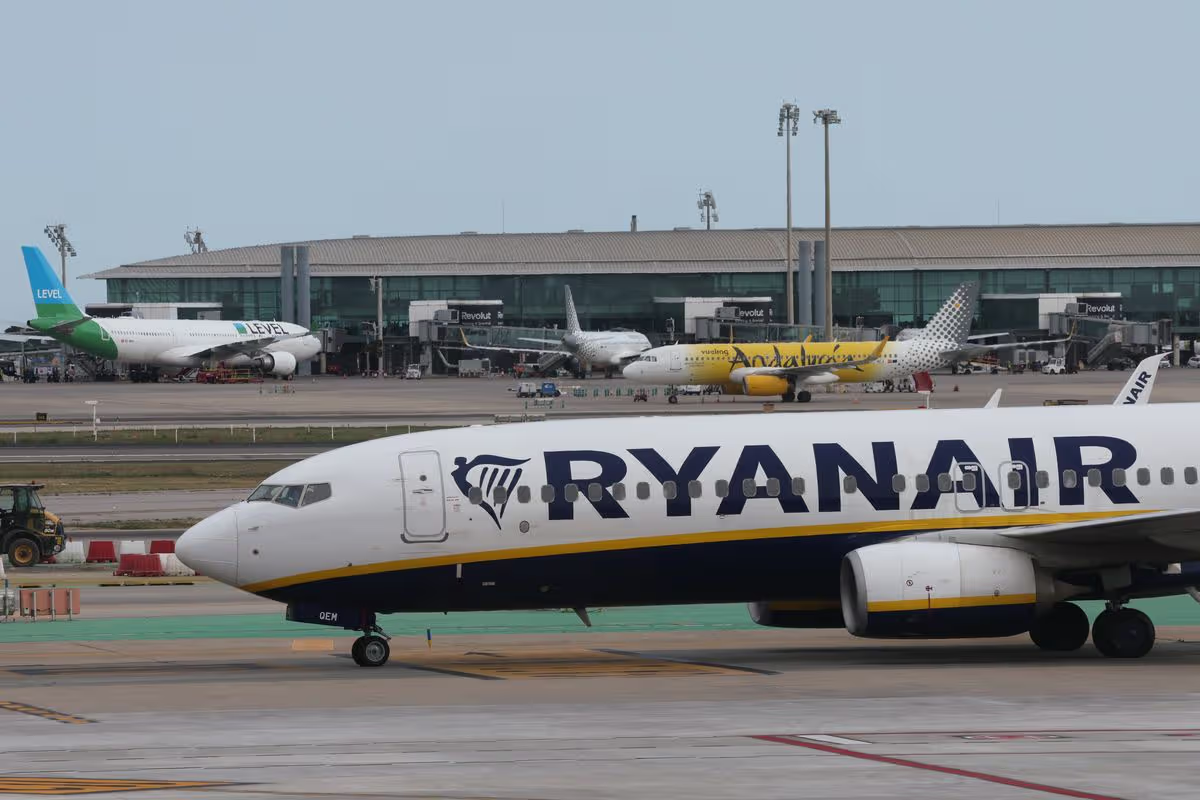
Travel expert Simon Calder has revealed which airline he believes is the best in the world. Speaking on his The Travel Expert podcast on the Daily Telegraph, he said that budget carrier Ryanair deserves the top position.

He pointed to safety, value for money, and the crew as crucial factors behind his choice. The verdict may surprise some, with Ryanair frequently receiving flak for its bare-bones flying experience, its multitude of extras when purchasing a ticket, and its uncompromising enforcement of baggage rules.

It is also unashamedly combative on social media, while CEO Michael O’Leary is renowned for his forthright and commercially-driven views. Nevertheless, it does possess an outstanding safety record and an extensive range of flights at remarkably cheap prices.

This has enabled it to emerge as the largest airline in Europe by scheduled passengers transported annually. Across the globe, it is the biggest airline by international passengers flown.

Justifying his verdict, Mr Calder said: “Ryanair is not just the biggest budget airline in Europe, I think it’s probably the best carrier in the world.”

“The world? !” host Greg Dickinson replied, taken aback. “It’s got the best safety record of any airline, it’s flown 2.2 billion people without any fatal accidents. It’s mostly on time, I found the staff to be uniformly very friendly and hospitable, and best of all is the price,” Mr Calder continued.

Content cannot be displayed without consent

“For my three flights, I paid a grand total of £52, and I didn’t have any paninis.

“I think sometimes, Simon, we will just have to agree to disagree,” Mr Dickinson answered.

In 2025, Ryanair ran more routes than any other airline across the globe, serving 5,400 airports. Italy remains its most sought-after destination with 46 million seats per annum, with Spain close behind at nearly 39 million seats.

The budget carrier has established itself as Italy’s biggest domestic airline, commanding 48 per cent of the market in 2025. London Stansted remains its busiest hub, with Dublin coming in second place.

This year, Ryanair posted an operating profit of €2,374.2m, operating a short-haul fleet of 647 aircraft and carrying 208 million booked passengers.

Source link

MQ-28 Ghost Bat Drone Debuts In Large-Force Combat Exercise In The Pacific

The MQ-28 Ghost Bat drone will gain a valuable opportunity to prove its relevance in a high-end coalition environment as part of Valiant Shield 26, the sprawling U.S.-led military exercise spanning Japan, Guam, Hawaii, and Australia, which began this week. It is also, as far as we know, the first time that the MQ-28 has taken part in a multinational large-force exercise of any kind. The participation of the collaborative combat aircraft (CCA) comes soon after Boeing confirmed it was conducting a separate series of test flights of the drone off the coast of southern California, part of efforts to validate autonomous operations and demonstrate rapid deployment from an allied location.

While Australia’s contribution to Valiant Shield includes a P-8A Poseidon maritime patrol aircraft and around 80 personnel, one of the more notable aspects is the involvement of Australian Defense Forces (ADF) aviator observers alongside a U.S.-led MQ-28 component. The arrangement will allow Australian personnel to work with operators and planners as the uncrewed aircraft is employed in a complex, multi-domain operational environment for the first time.

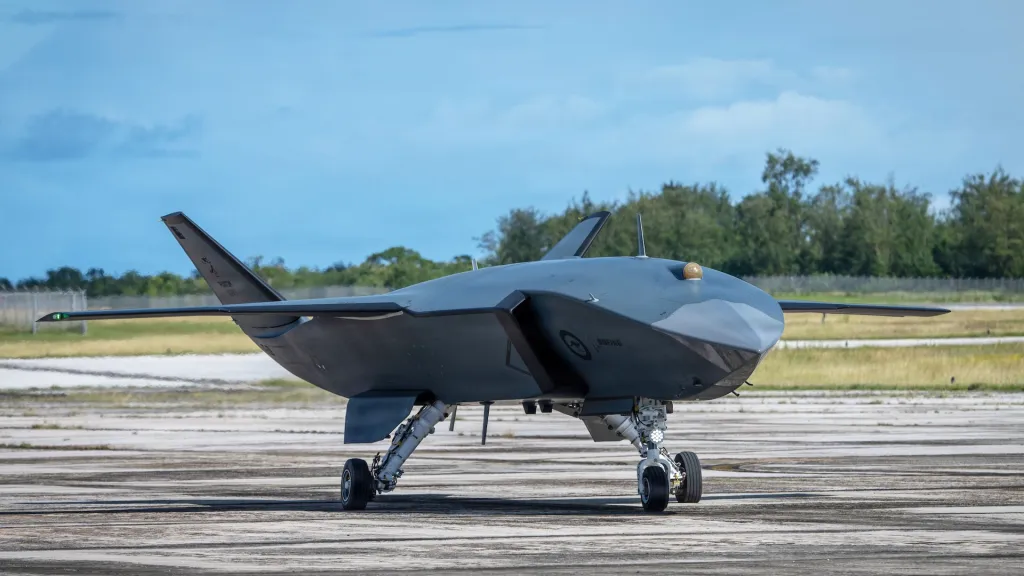
A Boeing Defence Australia’s MQ-28 Ghost Bat, a production representative test aircraft, prepares to conduct a taxi test during Exercise Valiant Shield 2026 at Rota, Commonwealth of the Northern Mariana Islands, June 21, 2026. The Department of the Air Force and its partners will analyze the aircraft’s contribution as a force multiplier that extends the reach, awareness and survivability of crewed platforms in contested environments.
An MQ-28 prepares to conduct a taxi test during Exercise Valiant Shield 2026 at Rota, Commonwealth of the Northern Mariana Islands, June 21, 2026. U.S. Air Force Senior Airman Adrien Tran U.S. Air Force photo by Senior Airman Adrien Tran

Directed by the U.S. Indo-Pacific Command, Exercise Valiant Shield 2026 kicked off on Monday and continues through July 1.

“Valiant Shield demonstrates our enduring commitment to a free and open Indo-Pacific,” Adm. Steve Koehler, commander of U.S. Pacific Fleet, said in a media release. “Exercising advanced multidomain capabilities with our allies ensures we continue to seamlessly innovate and operate together, project combat power together, and prevail over any challenge — together.”

A Boeing Defence Australia’s MQ-28 Ghost Bat, a production representative test aircraft, returns from a taxi test during Exercise Valiant Shield 2026 at Rota, Commonwealth of the Northern Mariana Islands, June 21, 2026. Valiant Shield is a biennial, multinational, joint exercise focused on integrating the joint force in a multi-domain environment. (U.S. Air Force photo by Senior Airman Adrien Tran)
An MQ-28 returns from a taxi test during Exercise Valiant Shield 2026 at Rota, Commonwealth of the Northern Mariana Islands, June 21, 2026. U.S. Air Force Senior Airman Adrien Tran

The U.S. Air Force today released a series of photos showing an MQ-28 taking part in Valiant Shield. The drone was photographed at Rota, in the Northern Mariana Islands, on June 21. Accompanying captions state that the Ghost Bat will be used to advance human-machine teaming, including flying in concert with crewed fighters.

“The Department of the Air Force and its partners will analyze the aircraft’s contribution as a force multiplier that extends the reach, awareness, and survivability of crewed platforms in contested environments,” the U.S. Air Force adds.

The MQ-28 involved in the exercise is configured with an infrared search and track (IRST) sensor system in the nose. The Ghost Bat is a highly modular design, with the nose section designed to be readily swappable.

A Boeing Defence Australia’s MQ-28 Ghost Bat, a production representative test aircraft, undergoes preflight checks during Exercise Valiant Shield 2026 at Rota, Commonwealth of the Northern Mariana Islands, June 21, 2026. During the exercise, the uncrewed MQ-28 will fly in concert with crewed fighter platforms. (U.S. Air Force photo by Senior Airman Adrien Tran)
An MQ-28 undergoes preflight checks during Exercise Valiant Shield 2026 at Rota, Commonwealth of the Northern Mariana Islands, June 21, 2026. Note the IRST sensor mounted above the nose. U.S. Air Force Senior Airman Adrien Tran

The Ghost Bat’s participation in Valiant Shield comes as Australia continues efforts to mature collaborative combat aircraft concepts, an increasingly important component of future air warfare, with the Royal Australian Air Force (RAAF) currently very much at the forefront. Designed to operate alongside crewed fighters and other assets, like tankers and airborne early warning and control aircraft, the MQ-28 is intended to extend sensor coverage, serve as a weapons platform, and perform a variety of other missions while reducing risk to human pilots.

Valiant Shield offers a particularly relevant proving ground for the MQ-28. The exercise brings together forces from the United States, Australia, Japan, Canada, and New Zealand to train in responding to coordinated threats across the maritime, air, land, cyber, and space domains. Participants will be required to detect, track, and engage shared threats while operating across a vast geographic area and under realistic conditions.

For the Ghost Bat program, exposure to this type of coalition environment is significant. Future conflicts in the Indo-Pacific will require seamless integration between allied forces, crewed aircraft, and increasingly sophisticated autonomous systems. Observing how the MQ-28 is incorporated into a large-scale multinational exercise should provide valuable insights as Australia moves toward making its collaborative combat aircraft capabilities operational. Currently, the MQ-28 is slated to be in service with the RAAF in 2028, which would likely make it the first operational CCA anywhere in the world.

A Boeing Defence Australia’s MQ-28 Ghost Bat, a production representative test aircraft, conducts a taxi test during Exercise Valiant Shield 2026 at Rota, Commonwealth of the Northern Mariana Islands, June 21, 2026. Collaborative Combat Aircraft are semi-autonomous aircraft that operate under the oversight of human operators. (U.S. Air Force Senior Airman Adrien Tran)
An MQ-28 conducts a taxi test during Exercise Valiant Shield 2026 at Rota, Commonwealth of the Northern Mariana Islands, June 21, 2026. U.S. Air Force Senior Airman Adrien Tran

The exercise also reflects growing allied interest in integrating uncrewed systems into complex command-and-control architectures and air defense networks. As autonomous aircraft move from experimentation toward operational service, events such as Valiant Shield are becoming important venues for testing how these systems contribute to the broader fight rather than operating as standalone assets. Valiant Shield has served as a diverse test crucible in recent years, with advanced capabilities being put through their paces in a realistic, joint-force environment.

According to defense reporter Carter Johnston, the Ghost Bat’s Indo-Pacific deployment will include operations from an austere airfield led by the U.S. Air Force. This will be conducted under the Agile Combat Employment (ACE) concept, something that is seen as fundamental to survival in a future conflict with China in the Indo-Pacific region. It is also notable that the U.S. Air Force’s new CCA drones are being developed from the ground up around concepts for distributed and disaggregated operations.

The exact status of the MQ-28 with the U.S. military testing community is somewhat unclear, as we have discussed before. There have been indications of Ghost Bat flight testing in the United States in the past, and the U.S. Air Force previously said it had made use of at least one MQ-28 to support advanced uncrewed aircraft and autonomy development efforts. Regardless, the Air Force, at least, has test units set up to explore exactly how to use CCAs operationally, including in an ACE-type environment. This kind of testing is now also involving the first two Air Force Increment 1 CCAs, with the YFQ-44 Fury ‘fighter drone’ prototype notably having been tested out of Edwards Air Force Base, California, helping to demonstrate how CCAs can be deployed and sustained in contested environments.

Other U.S. participants in Valiant Shield 2026 include the George Washington Carrier Strike Group, based around the aircraft carrier USS George Washington with the embarked Carrier Air Wing 5, the cruiser USS Robert Smalls, and the destroyers USS Benfold and USS Shoup.

U.S. Navy aircraft, attached to Carrier Air Wing (CVW) 5, and U.S. Air Force F-35A Lightning IIs fly during joint operations with U.S. Navy George Washington Carrier Strike Group and Japan Maritime Self-Defense Force, as part of Valiant Shield 2026 while underway in the Philippine Sea, June 21, 2026. Valiant Shield is a biennial, multilateral field training exercise conducted by the U.S. Armed Forces and partner nations in the Western Pacific focusing on joint, cross-combatant integration operating seamlessly across sea, air, land, and cyberspace. Exercises like Valiant Shield allow U.S. Pacific Command the opportunity to integrate forces from all branches of service and with our allies to conduct precise, lethal, and overwhelming multi-domain effects that demonstrate the strength and versatility of the Joint Force and our commitment to a free and open Indo-Pacific. (U.S. Navy photo by Mass Communication Specialist 3rd Class Estrella Velarde)
U.S. Navy aircraft, attached to Carrier Air Wing 5, and U.S. Air Force F-35As during joint operations with U.S. Navy George Washington Carrier Strike Group and Japan Maritime Self-Defense Force, as part of Valiant Shield 2026, while underway in the Philippine Sea, June 21, 2026. U.S. Navy photo by Mass Communication Specialist 3rd Class Estrella Velarde Petty Officer 2nd Class Bruce Morgan

Valiant Shield 2026 will also see the deployment of the containerized Typhon missile system in Japan. According to the Japan Ministry of Defense, the Typhon and the High Mobility Artillery Rocket System (HIMARS) will participate in Joint Integrated Anti-Ship Warfare training carried out in the waters around Kanoya and Amami Oshima Island. However, no live firing is scheduled.

The U.S. Army’s Typhon was first deployed to Japan last year, as you can read about here. The system, which can fire Tomahawk cruise missiles and SM-6 multi-purpose missiles, is a growing feature of U.S. military activities in the wider Indo-Pacific region.

U.S. Marines and Sailors observe and familiarize themselves with the U.S. Army’s Typhon missile system during a training opportunity at Marine Corps Air Station Iwakuni, Japan, Sept. 12, 2025. The hands-on session allowed personnel from various units to learn about the system’s capabilities as part of Resolute Dragon 25, an annual bilateral exercise across Japan, including the Southwest Islands, that strengthens the command, control and multi-domain maneuver capabilities of the III Marine Expeditionary Force and the Japan Ground Self-Defense Force’s Western Army personnel with a focus on controlling and defending key maritime terrain. (U.S. Army photo by Sgt. Perla Alfaro)
U.S. Marines and sailors observe and familiarize themselves with the U.S. Army’s Typhon missile system during a training opportunity at Marine Corps Air Station Iwakuni, Japan, September 12, 2025. U.S. Army photo by Sgt. Perla Alfaro Sgt. Perla Alfaro

Returning to the Ghost Bat, it now seems that the test flights of the MQ-28 off the coast of southern California from the U.S. Navy’s base in Point Mugu, California, were an important precursor to Valiant Shield. In fact, the same drone that was flown out of Point Mugu, ATS-008, is the example now involved in Valiant Shield.

Boeing had previously said its main goals of those flights were to demonstrate the maturity of the design and promote export sales. As we noted at the time, the choice of testing location also seemed to be relevant given Boeing’s involvement in the Navy’s still-evolving carrier-based CCA plans.

As for the MQ-28’s previous test campaigns, the drone has been flying in Australia since 2021, with the RAAF having received eight Ghost Bats in the pre-production Block 1 configuration.

Boeing is now building the first of a batch of nine Block 2 drones for the RAAF, which will provide an intermediate stepping stone to the fully operational Block 3 version. The Block 3 aircraft is expected to be substantially larger and have a greater range. It will also feature an internal weapons bay that can accommodate a single AIM-120 Advanced Medium Range Air-to-Air Missile (AMRAAM), two GBU-39/B Small Diameter Bombs (SDB), or equivalently sized stores.

An AIM-120 is launched from a Block 1 MQ-28 Ghost Bat during Trial Kareela at RAAF Base Woomera, South Australia. Australian Department of Defense

The RAAF has employed Block 1 MQ-28s to demonstrate some important capabilities in testing so far. This includes crewed-uncrewed teaming with RAAF E-7A Wedgetail airborne early warning and control aircraft and F/A-18F Super Hornet fighters.

When it comes to potential export sales, participation in Valiant Shield will give Japan, Canada, and New Zealand a closer look at the drone and its capabilities. Of these, Boeing has already publicly named Japan as a potential customer and has said it is exploring potential opportunities with other unnamed countries in the Indo-Pacific region.

MQ-28 Engineering Manager, Wing Commander Rupert Walker, briefs the personnel from the Indian Air Force about the MQ-28A Ghost Bat during a visit to RAAF Base Amberley, Queensland. *** Local Caption *** Deputy Chief of Air Force, Air Vice-Marshal Steven Pesce, AM, hosted Air Vice-Marshal Sanjeev Taliyan of the Indian Air Force during a bilateral visit aimed at strengthening Australia's defence relationship with India through professional dialogue on air operations. The engagement highlighted Australian capabilities in air logistics support, airborne and special operations, VIP transport, air-to-air refuelling, search and survivor assistance, and aeromedical evacuation, with participation from representatives from the Heavy Air Lift Systems Program Office (HALSPO) and 86 Wing Units 33 Squadron and 36 Squadron. The visit reaffirms India is a top tier defence partner for Australia. It highlights the hard work between our aviators to foster and strengthen relationships in pursuit of deepening interoperability. This includes supporting shared understanding, trust-building between subject matter experts, and identifying opportunities for enhanced cooperation. Such engagements strengthen our defence partnership in support of regional security.
Personnel from the Indian Air Force receive a briefing about the MQ-28 Ghost Bat during a visit to RAAF Base Amberley, Queensland. Australian Department of Defense

Valiant Shield should offer the clearest indication yet of how the Ghost Bat can contribute to a coalition fight. As the United States and its allies increasingly embrace autonomous combat aircraft, the MQ-28’s performance in one of the Indo-Pacific’s largest and most complex military exercises will be watched closely as an indicator of how collaborative combat aircraft could be employed across the region in the future.

Contact the author: thomas@thewarzone.com

Thomas Newdick is a staff writer at TWZ, where he covers military aviation, defense technology, weapons systems, and international security. Based in Berlin, Germany, he reports on conflicts, military modernization efforts, and emerging aerospace technologies around the world, with a particular interest in airpower and its role in contemporary warfare. His reporting is informed by deep expertise in modern and historical airpower, particularly in Europe, with a focus on military aviation, air campaigns, and aerospace developments across the continent and beyond.


Source link

‘Excellent’ action movie ‘as good as Fast and Furious’ is now streaming

Fans are hailing the film as a ‘masterpiece’ and calling it their favourite movie of the year

A gripping thriller based on a popular novel has finally landed on streaming and viewers are calling it a ‘masterpiece’.

The action-packed movie, adapted from a novel by Stephen King, hit cinemas last year and is tailor-made for fans of nail-biting franchises such as Mission: Impossible or Fast and Furious.

Its IMDb synopsis reads: “A man joins a game show in which contestants, allowed to flee anywhere in the world, are pursued by ‘hunters’ hired to kill them.”

The film was helmed by legendary director Edgar Wright, celebrated for cult favourites such as Shaun of the Dead, Hot Fuzz and Baby Driver.

The Running Man is the most recent 2025 adaptation of King’s iconic novel, with Glen Powell taking on the lead role of Ben Richards – a part previously made famous by Arnold Schwarzenegger in the 1987 original.

The supporting cast boasts an impressive line-up including Josh Brolin, Colman Domingo, Lee Pace, Michael Cera, Emilia Jones and Martin Herlihy, reports the Express.

The film currently holds a 61% fresh score on Rotten Tomatoes alongside a 6.4 rating on IMDb, with legions of fans applauding this fresh take on the dystopian tale.

Now available on Paramount Plus, the streaming platform has teased: “The Running Man is a fun, unhinged deadly game show where contestants must survive 30 days while being hunted by professional assassins, with every move broadcast to a bloodthirsty public and each day bringing a greater cash reward.”

Over on IMDb, one enthusiast awarded the film a perfect 10/10, declaring: “Let me put it this way. I saw it at a matinee this afternoon and now I’m going back with my husband. I’m not a Glen Powell fan but I do live Edgar Wright movies and this one delivers. Don’t go see it if you want to relax!

“I read the Stephen King novel years and years ago and saw the Arnold Schwarzenegger movie years ago as well, so i can’t tell you how it compares, but this one stands on its own as the best action movie of the year… and maybe the decade…so far.”

A second viewer hailed the film as a ‘masterpiece of literary adaptation’, remarking: “Hands down the best adaptation of King’s work. You can literally watch the movie and turn pages. Powell’s Richards jumps out of the book.

“The ending got the Hollywood treatment, but still accomplished the same goal. I waited 34 years for a faithful version of this, and now we have it. The casting feels like they all read the novel.”

Get Paramount+ free for a week

This article contains affiliate links, we will receive a commission on any sales we generate from it. Learn more
Content Image

£4.99

£0

Amazon/Paramount+

Get Paramount+ here

Telly fans can get seven days of free access to Paramount+ shows like Tulsa King and Dexter: Original Sin by signing up for a free trial via Amazon Prime’s Paramount+ channel.

Another cinema-goer commented: “One of the best movies of the year. After being trailer after trailer at the cinema for what seems the whole year, I was fearing this would be a total flop.

“I need not have worried because this is an action packed, well scripted remake of the original. Everyone is cast perfectly and all performances are great. It keeps you guessing throughout the movie and the twists and turns keep it going. Thoroughly enjoyed it. Well worth a visit.”

One further viewer chipped in: “It was perfect. Edgar Wright nailed I.T. on this expensive movie. The action, everything. A lot better than the 1987. It follows the book. Glen Powell did a great Job on playing the character Ben Richards.”

They even drew comparisons to other beloved action franchises, adding: “This film feels like a big mix of Fast and Furious and Mission: Impossible. I love the chase scenes.”

Over on Rotten Tomatoes, one enthusiastic viewer gushed: “Excellent film! Glen Powell did great with his character, Ben Richards.”

“Fresh! Intensely gripping all the way through. Great acting on all parts,” another remarked, while a further viewer noted: “Loved this. Im 100% certain that Stephen King will be so happy with this version of his brilliant book. Great all round really enjoyable watch.”

Not everybody was won over, however, with one person writing: “A real disappointment, falling flat both as social commentary and as an action movie.”

Another disgruntled viewer complained: “The first one was way better. Loved the satire and Richard Dawson, who was a game show host in real life, as the host in the original. Tired of remakes with all the social commentary without improving the whole movie.”

The Running Man is available to stream on Paramount Plus now.

Source link

Underrated city used to be major capital but now barely any tourists visit – not Colchester

A ranking of Europe’s most underrated cities has named a historic spot that many Brits may not have even heard of, and visitors can explore Roman ruins, gothic monasteries, and a doll museum

Portugal has long been a major city break destination for Brits, and while most head to either Porto to explore its colourful, hilly streets, or Lisbon for a lively, cultural atmosphere, there’s one spot that gets overlooked.

For over a hundred years, Coimbra was Portugal’s capital, a thriving walled city that had monasteries, grand cathedrals, and a university that’s still operational today making it one of the world’s oldest. When the King moved the capital to Lisbon, it became a centre of Renaissance art, bringing French and Italian influences to the area and becoming a town where intellectuals flocked, inspired by the peaceful riverfront scenery.

Recently, Which? identified Coimbra as one of Europe’s underrated cities, noting: “It’s a historic, cultural and academic hub, with a Unesco-listed university complete with a gilded baroque library that’s open to the public for visits and tours.

There’s also a winding old town that, unlike Lisbon and Porto, isn’t bottlenecked with tourists in peak season — and you’ll also find plenty of atmospheric tascas for truly Portuguese lunches and dinners.”

Despite its close proximity to Lisbon and Porto, trains take 90 minutes and an hour, respectively.

It’s not a destination visited by many Brits. It’s perfect for a day trip from the Portuguese coast, although you may want to stay longer and soak up the authentic atmosphere among its sun-soaked streets.

Visit the ruins of Mosteiro de Santa Clara-a-Velha, a Gothic monastery that dates back to the 1300s, which has become a major archaeological site, and explore a museum full of treasures from ancient tombs.

Santa Cruz Church is another must-see in the town. The whitewashed church has incredible blue-tiled mosaic murals that cover entire walls, and a peaceful, if eerie, mausoleum that is the final resting place of Portugal’s first king.

National Museum Machado de Castro has artworks and sculptures from the Renaissance artists who once lived in this town and honed their skills.

Built on a set of Roman tunnels, the museum is housed in a serene 11th-century cloister where you can enjoy the peaceful atmosphere of its cool marble walls.

A short drive outside the city are a number of tiny Schist Villages, traditional mountain settlements that are being restored to capture the country’s heritage. There are 12 villages in the Lousã Mountain, and from Coimbra you can take a guided tour through the winding mountain roads to explore these areas where time stands still.

Popular stops include Cerdeira, once abandoned but now the home of an arts and crafts school, and Talasnal – famous for its rustic stone cottages and incredible views across the pine-covered. mountains. On the way back, visit Arouce Castle, a medieval fortress that overlooks a river beach. There are areas for swimming in the pure mountain waters, and waterfalls that add to the untamed scenery.

Have a story you want to share? Email us at webtravel@reachplc.com

Source link

Little-known app could help Brits skip huge queues in Portugal this summer

Many Brits heading to the EU are dreading their journey through the airport due to the new European Entry/Exit System (EES), but many don’t realise there’s an app available to cut waiting times at certain destinations

Peak holiday season is upon us, and the launch of the European Entry/Exit System (EES) is reportedly causing queues at destinations such as Spain, Greece, and France.

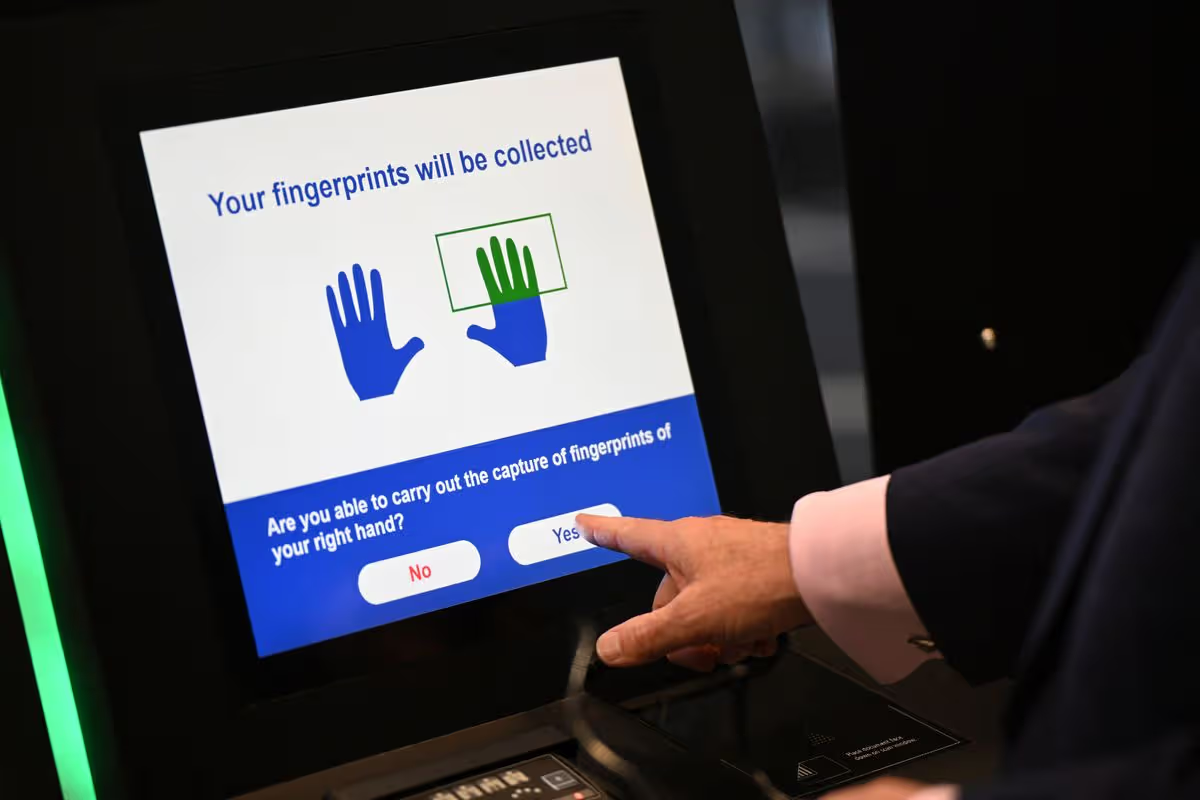
Local media in Spain has warned that Brits could face six-hour queues, and there have been reports of passengers missing flights, with airports blaming “additional processing requirements”. All non-EU visitors to the European Union, including Brits, are now required to have biometric information such as facial images and fingerprints taken on arrival, and must also use the machines on departure to help the EU flag overstays.

One of the reasons why Brits often face longer queues at the airport is that, while EU passport holders have their own lanes, Brits have to queue alongside other non-EU nationalities. But for those going to Portugal or Sweden this summer, there is a way to speed up the process.

An official (but not very well-known) app could potentially get you through the airport quicker. At the moment, the Travel to Europe app is only available for visitors to two EU countries, but it could be rolled out to other destinations in the future, according to its developers.

Brits heading to these countries can download the app on the App Store or Google Play – making sure you download the right app and not a third-party one.

Create a new journey by selecting the country you’re arriving in or departing from, this can be done up to 72 hours before your travels begin. You can then add a border crossing point and your estimated time of arrival.

Travellers can then scan the personal details page and chip of their passport, take a selfie to confirm their identity, and answer a few questions about their plans. Normally, these steps would be done at the EES kiosks, so by doing them on the app at home, you can save time at the airport.

Families travelling together can also add other passengers before submitting their journey. Once registered, you’ll get confirmation that your journey has been accepted. Then you simply need to follow the signs at the airport to make your way through security. The app developers are careful to point out that using the app doesn’t guarantee border entry, and that anyone passing through the airport can still be flagged for additional checks.

But for the majority of holidaymakers, this could cut down on the time they spend queuing and waiting to enjoy the Portuguese sunshine.

Reviews of the app have been mixed so far. One user said: “Pointless to have an app that supports only one country – I understand it is optional for Member States to incorporate the app into their systems, but it doesn’t mean this couldn’t have been arranged better.” But there were success stories, with one user saying: “I went to Stockholm…. long queues for UK passports. I had already used the app, and used the pre-registered lane. Two people in front of me. The whole process took about three minutes. Very impressed!!”

Around 2.4 million British tourists visit Portugal every year, making up the majority of the country’s tourism, although this is a fraction of the 19 million British visitors Spain saw in 2025. Overall, foreign tourists contribute €5.2 billion a year to the country’s economy (about £4.5 billion), with Brits as the biggest spenders followed by Germans.

Have a story you want to share? Email us at webtravel@reachplc.com

Source link

Ben Whittaker produces impressive win against Richard Rivera on US debut

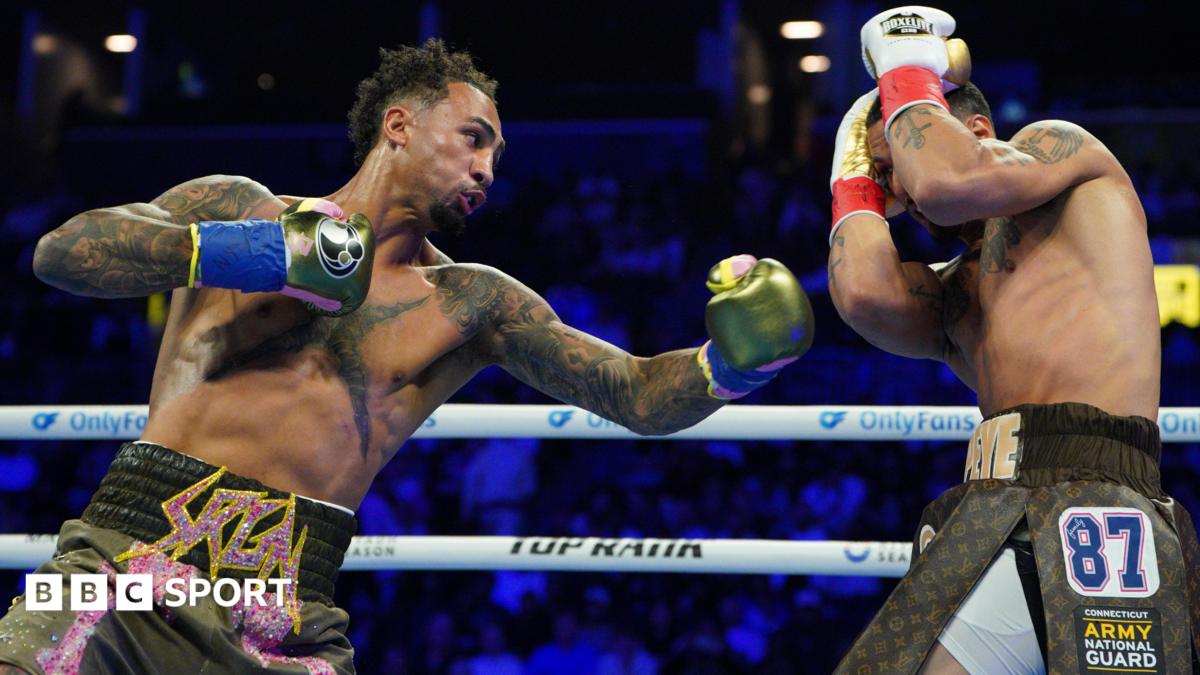
Great Britain’s Ben Whittaker marked his American debut with an impressive second-round victory against Richard Rivera at Barclays Center in Brooklyn.

The flamboyant Whittaker dropped the American at the end of the first round with a right hand, although Rivera pointed that the punch had caught him on the back of the head.

But Whittaker, nicknamed ‘The Surgeon’, clinically caught his rival with a left-hander at the start of the second and, although Rivera staggered to his feet, the referee stopped the light-heavyweight bout.

The win improved Whittaker’s record to 12 wins and a draw from his 13 professional fights, while Rivera suffered the third defeat of his 30 fight career.

“Brooklyn, that’s how you do it man,” said Midlands boxer Whittaker, who is renowned for his showboating and did a little dance at the end of the first round on the way back to his corner.

The fight took place on the undercard of Xander Zayas, who attempted to defend his WBA and WBO super-welterweight titles against Jaron Ennis.

But Zayas succumbed to a seventh-round stoppage, with the referee ending the contest after the Puerto Rican boxer had been knocked down for a third time in the fight.

It was the first defeat Zayas had suffered in his 24-fight career, while unbeaten American Ennis has 36 wins from as many fights.

Source link

I visited a pretty UK seaside town and had the best fish and chips of my life

The UK is home to some of the most beautiful seaside towns, but one stands out for a key reason

The UK has been so hot this week that I made three trips to the beach in seven days, despite not living particularly close to one. Still, an hour or so’s drive is a small price to pay when there’s a brilliant day or evening by the sea waiting for you.

I’m aware the pleasant weather won’t stick around, which explains my eagerness to spend as much time outdoors as I can. Of my several seaside trips, one location really caught my attention for one particular reason — the food.

Troon, roughly 45 minutes from my home city of Glasgow, proved the ideal spot to spend a warm evening as the heatwave drew to a close.

It’s been over six months since I last went to Troon, which was on a bitterly cold and snowy January day. This week’s outing couldn’t have been more different. After finishing work one evening, we hopped in the car and made our way down to the coastal town overlooking the Firth of Clyde, with one clear goal in mind.

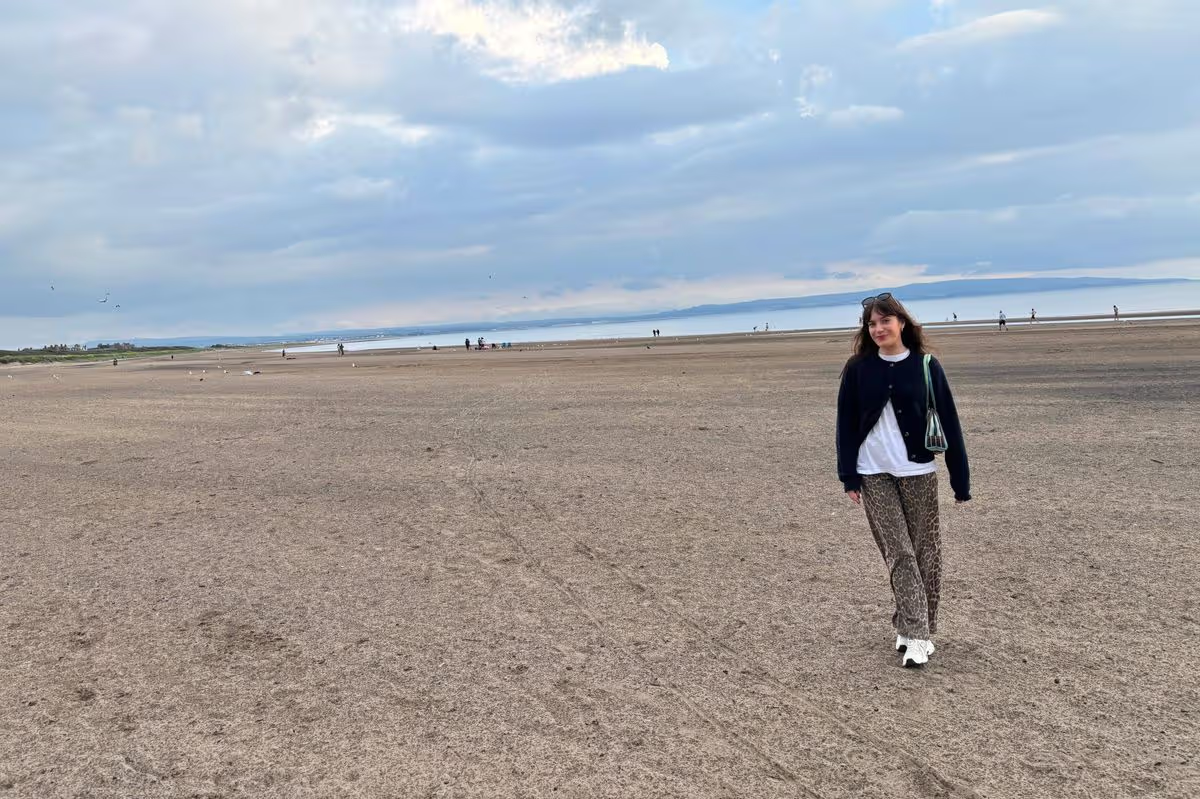
Despite Scotland’s heatwave coming to a sudden halt during the day with a torrential thunderstorm, the sun managed to emerge once more as we strolled along the shoreline. Likely due to the earlier weather, it was pleasantly peaceful, with just a handful of people wandering about on the sand.

While it was lovely to be able to walk on the beach without the bitter wind battering us like last time, the stroll was fairly brief, as it was time to head up to the harbour to get some food. We finally managed to make it to The Wee Hurrie for dinner.

The Scottish fishing fleet had been tied up back in January so it hadn’t been open, which although was our own fault for not checking, still put a major dampener on the day — especially given the icy cold weather.

This award-winning chippy is renowned for its fresh seafood and its prime spot right on the harbour. And it was 100% worth the hype, being one of the best meals I’ve ever had the pleasure of eating.

The scampi was incredibly fresh, coated in a delicate batter that left me feeling neither bloated nor uncomfortable afterwards — a genuine rarity for a chip shop. Choosing just one dish was actually really hard, given how varied and imaginative the menu is.

Where else would you find fritto misto, noodles and lobster all on the same menu?

It arrived alongside a gorgeous tartare sauce and a wedge of lemon, generously seasoned with salt and vinegar. Despite being light and crispy, it was wonderfully filling and satisfying, and the portion sizes were spot on.

At £14.30, it was worth every single penny, and I genuinely can’t stop thinking about it.

It’s a takeaway so you can’t sit in, but loads of people were queuing up to order before taking it home in their cars. We ate standing up outside the shack, which I think says everything about how tasty it was.

The food may have been our main reason for heading to Troon that evening, but with the weather still pleasantly warm after we’d finished eating, a stroll down the high street seemed the perfect way to round off the night.

By this point it was around 7pm, so many of the smaller independent shops and cafes had shut up for the day, but the pubs appeared reasonably busy, with people popping in and out of takeaways, restaurants, shops or simply strolling about as we were.

If I hadn’t been driving, I would have definitely nipped into Lido on the high street for a couple of drinks, but sadly it wasn’t to be on this occasion.

It was a shorter visit than previously, but far more enjoyable thanks to the delicious food and the beautiful evening sunshine. Whether you’re in the area with a few hours to spare, or travelling from further away, Troon is a wonderful place to explore.

Source link

European nations break more records amid historic heat wave

A dog called Minou stands in the water of the Lustgarten fountain in front of Berlin Cathedral during the historic heatwave that has seen nations across Europe break temperature records for this time of year — including Germany, which set a record two days in a row. Photo by Clemens Bilan/EPA

June 27 (UPI) — Europe may have to brace for even broken records as the historic heat wave that has roasted the continent over the last week is unlikely to let up.

Temperatures in Germany, Belgium and the Netherlands all set heat records on Friday, and events in both Spain and France were cancelled, while most of central Europe issued the latest in days of warnings about the dangerous temperatures, The BBC and The Washington Post reported.

Although some meteorologists, including those in the United Kingdom, have said that temperatures in some areas will start cooling off, forecasters in Czechia, Austria and some Balkan nations are bracing for their own broken heat records this weekend.

The heat wave, which experts at the World Meteorological Organization have called the worst in Europe since the mid-1970s, reinforces what the organization has called “the world’s most rapidly warming continent.”

“In the 50 years since the historic heatwave of 1976, Europe as a whole has warmed by around two degrees,” John Kennedy, head of climate information at WMO, said in a press release.

“It’s the fastest warming continent, and extremes of temperature have increased, too,” Kennedy said.

France this week recorded it’s hottest June temperature three days in a row, the United Kingdom and Spain set records two days in a row, and Germany, Belgium and the Netherlands all saw historic June heat records fall.

The WMO said on Friday that it expects the heatwave to keep spreading cross large swaths of Western, Central and Southern Europe during the next two weeks, with a significant focus of the heat expected to blast the Balkans.

WMO said that Portugal, Spain, France, Belgium, Luxembourg, the Netherlands, the United Kingdom, Germany, Switzerland, Austria, Italy, Czechia, Slovakia, Hungary, Slovenia, Croatia, Bosnia and Herzegovina, Serbia, Montenegro, Albania, North Macedonia, Greece, Bulgaria and Romania all should expect heat that is 3 degrees Celsius to 10 degrees Celsius above weekly June averages.

White House Border Czar Tom Homan speaks during the Faith and Freedom Coalition 2026 Road to Majority Policy Conference at the Washington Hilton on Friday. Photo by Bonnie Cash/UPI | License Photo

Source link

US and Iran exchange strikes and accuse each other of violating ceasefire

The US has conducted new strikes on Iran, following a drone attack on a Panama-flagged vessel in the Strait of Hormuz on Saturday.

US Central Command (Centcom) said it hit multiple targets across Iran in direct response to “continued aggression” against commercial shipping.

In retaliation, Iran’s Islamic Revolutionary Guard Corps (IRGC) said it has launched missiles and drones at US infrastructure in Kuwait and Bahrain, in a statement shared to state media.

Following the exchange of fire, the US and Iran accused each other of violating the ceasefire agreement.

Centcom said in a statement, “Iran was given a chance to honor the ceasefire agreement but elected not to when its forces launched a one-way attack drone that hit MT Kiku,” a Panama-flagged tanker.
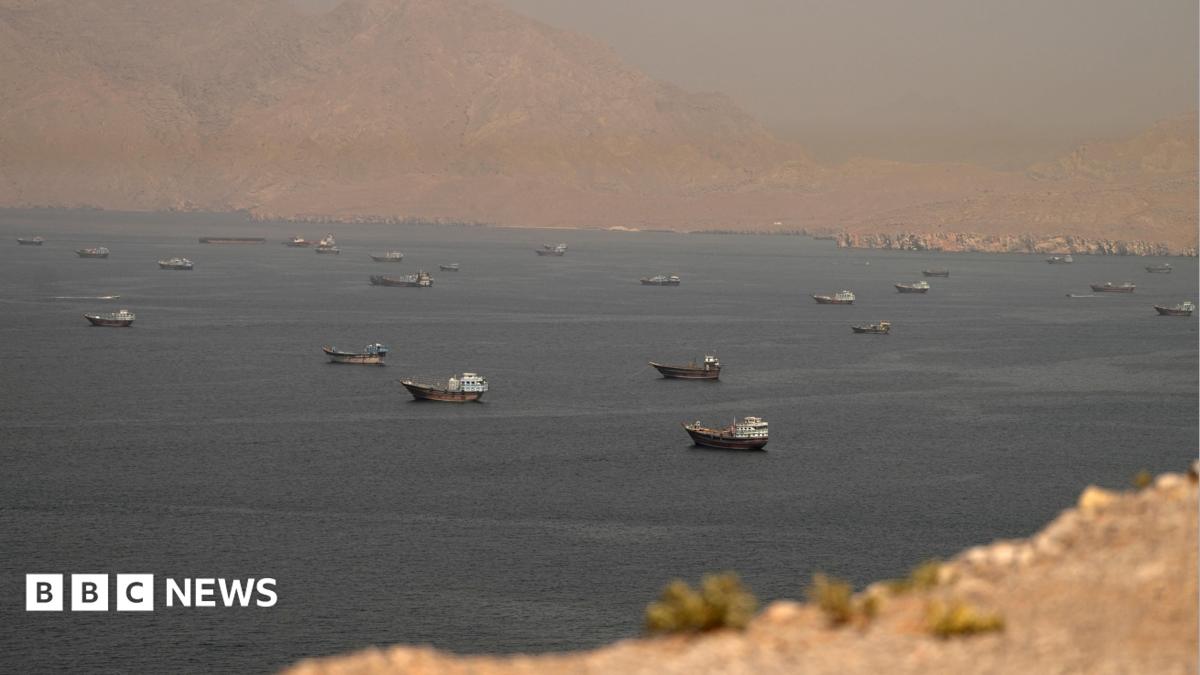
In response, it said, US fighter jets conducted strikes on 10 Iranian military targets at multiple locations in and near the Strait of Hormuz. These included military equipment, communication systems, air defense sites and drone storage facilities.

In the IRGC’s statement, it said the US had attacked five coastal posts in Iran under what it called “the pretext of the IRGC Navy confronting the offending ship”.

In retaliation, the IRGC said it had launched ballistic missiles and drones at “eight key pieces of infrastructure” at the Ali al-Salem base in Kuwait and the Fifth Naval Fleet in Port Salman, Bahrain, “destroying them”.

A US official has told Reuters that there were no reported US casualties or major impacts or damage to US facilities in the Middle East.

The IRGC said that under the Memorandum of Understanding signed earlier this month, Iran has arrangements for controlling passage and navigation in the Strait of Hormuz, and from now on, violating ships will be dealt with more forcefully than in the past.

“Any potential enemy aggression, under any pretext, even if the aggressions are against minor targets, as happened last night and tonight, will have a crushing response,” read the statement.

It also accused the US of violating the ceasefire agreed to in the memorandum of understanding between the two nations, warning that it “will lead to a complete halt to the process”.

The Iranian Foreign Ministry has also condemned what it described as the “brutal attacks” a violation of the ceasefire, adding it showed that the US “does not place the slightest value and credibility on its commitments, and breaking promises is part of its nature.”

Shortly after the latest US strikes on Iran were announced, Trump said on Truth Social that it was “very possible” that Tehran would “never learn”.

“There may come a point when we are no longer able to be reasonable, and will be forced to militarily complete the job that we very successfully started,” he wrote on Saturday evening.

The post went on: “If that happens, the Islamic Republic of Iran will no longer exist!”

In the hours following the US strikes, Kuwait and Bahrain both reported that their air defence systems had been activated.

“Kuwaiti air defenses are currently confronting hostile missile and drone attacks,” the Kuwaiti Armed Forces said in a statement shared to X, asking the public to adhere to security instructions.

Bahrain’s Ministry of Interior has urged citizens to “remain calm and head to the nearest safe place”.

Centcom said that commercial vessels are continuing to operate in the Strait of Hormuz.

The latest strikes come less than a day after the US launched retaliatory strikes on Iran that it said were in response to a drone attack on Singapore-flagged cargo ship, MV Ever Lovely, on 25 June.

Centcom described the American strikes as “a powerful response” to the attack on the cargo ship, adding that the “unwarranted aggression against commercial shipping by Iranian forces clearly violated the ceasefire”.

Tehran said the cargo ship was attacked because it was using an unauthorised route to transit through the Gulf waterway, and said that the retaliatory strikes qualified as a ceasefire violation by the US.

In a statement released on Saturday morning, Iran’s foreign ministry said it had carried out more strikes against targets linked to American forces in response, and blamed the “treaty-breaking US regime” for the situation.

The US and Iran agreed on 17 June to end hostilities under a 14-point memorandum of understanding, which had also called for Iran to use its “best efforts for the safe passage of commercial vessels with no charge for 60 days”.

The Strait of Hormuz is a key waterway for oil and gas shipments, and was effectively closed by Tehran after the US and Israel launched attacks on Iran at the end of February.

The shutdown of the critical channel caused a spike in global oil prices and prevented shipments of other crucial commodities such as fertiliser.

Source link

‘Best series ever’ returns to Netflix and fans ‘can’t get enough’

The Netflix crime drama has been hailed as “perfect” and “the best series ever”

Fans of crime dramas on the hunt for their next binge-worthy series should give this Netflix show a go.

Crooks follows the chaotic exploits of Charly (played by Frederick Lau), a man desperately trying to rescue his kidnapped family after his murky past comes back to haunt him, reports the Express.

Charly is forced, alongside getaway driver Joseph (Christoph Krutzler), to attempt the theft of a priceless gold coin.

When the heist unravels spectacularly, Charly and Joseph find themselves hurtling across the Continent in a bid to save his family, coming up against organised crime outfits from Berlin to Vienna to Marseilles. Netflix described Crooks as “an adventurous and action-packed road trip across three national borders begins”.

The series has earned widespread acclaim on IMDb, with one viewer awarding it a perfect 10/10 review, declaring: “The Story is Perfect.”

They concluded: “I haven’t had such an intense series experience in a long time. For me, it’s easily one of the best series I’ve ever watched.”

A second reviewer gave Crooks 9/10, calling it an “excellent series” that “keeps you engaged”.

They added: “The series captivates with its compelling narrative, keeping viewers glued to their screens.”

While a third viewer hailed Crooks a “fantastic series” in their own 9/10 review, explaining: “Brilliant show – elements of Dogs of Berlin with a Guy Ritchie edge.

“Very well done and hits the mark of a gangland action drama, but with an under thread of a real friendship story with a very human touch.”

A fourth viewer titled their review: “Entertaining thriller with action and suspense.”

They elaborated: “Crooks is a good crime, action show which lulls you into binge watching all eight episodes without much thought. Thoroughly enjoyable!”.

Get Netflix free with Sky

This article contains affiliate links, we will receive a commission on any sales we generate from it. Learn more
Content Image

£5.99

£0

Sky

Get the deal here

Sky is giving away a free Netflix subscription with its new Sky Stream TV bundles, including the £15 Essential TV plan.

This lets members watch live and on-demand TV content without a satellite dish or aerial and includes hit shows like Stranger Things and The Last of Us.

Crooks initially arrived back in 2024, with Season 2 recently dropping on Netflix this April.

Season 2 unfolds in Thailand as Crooks expands internationally.

This time around, Charly finds himself compelled to steal the same gold coin from the government, which is threatening to jail him and his family for a crime he didn’t commit.

Crooks Season 2 is streaming on Netflix now.

Source link

BBC Sport quiz: Who am I? Guess World Cup star footballer No 21

Welcome to our Who am I? game.

The rules are simple. Each day there’s a new footballer and the challenge is to guess who they are in as few attempts as possible.

After each wrong guess you unlock a new clue. Guess the answer after as few clues as possible to score more points.

Three is a good score, four or five points is exceptional.

So take part and return for more tomorrow.

Today’s player and clues set by BBC Sport’s Joe Rindl.

After more quizzes? Go to our dedicated Football Quizzes and Sports Quizzes pages and sign up for notifications to get the latest quizzes sent straight to your device.

Source link

Between English and mother tongue: Kenya’s education language dilemma | News

Kericho, Kenya – When Lona Chepkemoi walked into a technical college classroom in 2023, she found something she had rarely experienced during her years in school: She could understand what the teacher was saying.

After leaving primary school in 2008, Chepkemoi had failed her final exam, and her family could not afford to send her to secondary school. For years, the dream of becoming a fashion designer seemed out of reach.

Then a scholarship from her local member of parliament gave her a second chance.

But what surprised the now 33-year-old mother of five was not returning to education. It was hearing lessons delivered partly in Kalenjin, her mother tongue, she said.

“When I got to college, I felt at home because the language of instruction was my mother tongue [Kalenjin], and was mixed with a bit of Swahili and English, unlike in school when teachers only taught in English and exams were strictly only in English. Language here was accommodating, and it made me feel happy because I understood the concept quite well,” she told Al Jazeera.

For Chepkemoi, the difference went beyond comfort, it was comprehension.

Her experience reflects a wider global reality. According to UNESCO’s Global Education Monitoring (GEM) reports, about 40 percent of learners worldwide are not taught in a language they understand well, rising to about 90 percent in some low- and middle-income countries.

A second chance through familiar language

In Kenya, education policy provides for mother-tongue instruction in the early years of primary school, typically up to grade 3, before English becomes the main language of instruction from grade 4, with Kiswahili also widely used. In practice, however, classrooms often shift between languages depending on region, teacher capacity and student background.

Kenya Inclusive Education
After years away from school, Lona Chepkemoi discovered that learning in her mother tongue made education feel possible again [Dominic Kirui/Al Jazeera]

Across much of Africa, the language of schooling still reflects colonial legacy systems, where English, French or Portuguese dominate classrooms even when children grow up speaking entirely different languages at home.

UNESCO’s Global Education Monitoring work shows multilingual classrooms are now the norm in many countries. The organisation has consistently argued that children learn best in a language they understand, describing mother-tongue-based multilingual education as key to improving literacy and learning outcomes.

When English meets the classroom reality

Chepkemoi was not alone in finding confidence through familiar language. Her husband, Philemon Tonui, enrolled at the same institution to study building and construction.

Although Tonui completed secondary school, he was unable to sit his final examinations because his family could not afford the fees, leaving him without a certificate.

For Tonui, the use of Kalenjin alongside English and Kiswahili made a significant difference.

“Nothing could beat that. I felt like if every level of education were instructed in their mother tongue, many people would excel in their education,” he told Al Jazeera.

Kenya Inclusive Education
Tonu checks the nails on an iron sheet he just installed [Dominic Kirui/Al Jazeera]

Ismael Kiplang’at, a 28-year-old mason, also studied at the same institution. He recalls instructors making a deliberate effort to teach in languages students could understand.

“Our college was in a town with many communities in it, and even though the instructors did not understand all languages, at least they repeated their words in almost three languages just to make sure everyone was on board and understood the content. And those who came from other tribes always expressed satisfaction, saying that they really felt involved and not left out,” he said.

Now working as a mason three years after graduating, he credits that approach with helping him succeed.

“If education meant those tired English classes that we were taken through earlier in school, I would not have achieved my passion in masonry and earned a living,” he told Al Jazeera.

Between understanding and opportunity

Yet Kenya’s education system, like many across Africa, continues to face a structural tension: Early learning is most effective in familiar languages, but English remains essential for higher education, formal employment and global mobility.

Kiplang’at says he now practises English daily because he hopes to study further and work abroad.

For Shadrack Tonui, national chairperson of the Kenya Association of Technical Training Institutions, the challenge is not choosing between languages, but balancing them in multilingual classrooms.

“Generally, the mode of training is in English as the language of instruction and learning within the institutions. But of course, with the need to understand the flexibility of learning, there can be emphasis and use of a language that the learner will be able to understand at lower levels,” he told Al Jazeera.

Kenya Inclusive Education
Kiplang’at uses mortar to build a wall [Dominic Kirui/Al Jazeera]

He adds that institutions bring together students from diverse linguistic backgrounds, making it impractical to rely on one local language, while also stressing the need for English proficiency in the labour market.

The challenge is not unique to Kenya. UNESCO’s Global Education Monitoring work shows multilingual classrooms are now the norm in many countries, and education systems often struggle with teacher preparation, learning materials in local languages, and competing expectations from parents and employers over the role of English.

‘Why must we learn in another language?’

As for Chepkemoi, she is less concerned with policy than with practice. Most of her clients speak Kalenjin, while Kiswahili allows her to communicate with a wider customer base.

“Even though we were lucky to have teachers who would bring a point home while in college, we also had classmates from other communities who did not speak Kalenjin, and the teachers would explain it to them in Kiswahili,” she said.

For Kiplang’at, however, the debate ultimately comes down to one question: understanding.

“I ask myself sometimes why someone in Europe, Asia, or America learns in a language they grew up speaking, while we are expected to compete in theirs,” he said.

Source link

All tourists urged to change 1 phone setting or risk ‘major problem’ at airports

Tourists have been told they need change a key phone setting before travelling to airports. Failing to do so could land them with a “major problem”, so it’s best to act

There’s so much to think about when you travel abroad, but something that probably slips your mind is safely using your phone during your journey. It’s something you need to pay attention to, as you are required to follow a few rules to keep safe.

While it may be something that rarely crosses your mind, it should actually be on the top of your travel list, as making some simple mistakes can be super costly when you’re on a holiday adventure. We all use our mobile phones when we’re at airports but, little you may know, some dangers can come with making the decision to use them in certain ways.

This isn’t the first time such matters have been brought to people’s attention either. Previously, some other hidden dangers were outlined to aid travellers.

Free airport Wi-Fi feels like a small win when you’re killing time before a flight. However, William Thackray, IT expert at AGT Computer Services, claims it’s one of the riskiest things you can do on your phone.

What you need to know

William explained: “The biggest threat isn’t the airport’s actual network. It’s the fake ones sitting right next to it.

“Criminals can set up a hotspot called something like ‘Heathrow Free Wi-Fi’ or ‘Gatwick Passenger Network’ that looks completely legitimate. The moment you connect, they can intercept your data including passwords, emails, anything you’re sending or receiving.”

This technique, known as an “evil twin” attack, is increasingly common in busy public spaces and airports and, with thousands of distracted travellers all hunting for a signal, they are prime targets.

You may not realise, but connecting to airport Wi-Fi can leave your personal data exposed to hackers in seconds. Criminals can set up fake networks designed to look identical to the real thing.

Airport Wi-Fi is rarely considered completely safe. While it is generally fine for browsing the news or checking your flight status, public networks leave you vulnerable to hackers, phishing attempts and rogue “evil twin” hotspots.

You should avoid online banking or entering passwords without taking precautions. This is why the guidance is so essential.

However, one simple phone setting can keep you protected without costing you a penny. It’s easy to sort out once you know what to do.

How to avoid a problem

The fix is straightforward. Before you leave for the airport, go into your phone’s Wi-Fi settings and turn off “Auto-Join” or “Auto-Connect” for public networks. On iPhone, you can also go to Settings > Wi-Fi and toggle off “Ask to Join Networks”.

That way your phone won’t go hunting for a signal without your say-so. “Better still, use your mobile data if you have it,” added William.

“It costs a little more, but it’s your own private connection. If you do need to use airport Wi-Fi, avoid logging into anything sensitive like banking, work email, anything with a password – until you’re somewhere you trust.”

The rule of thumb? If you didn’t set up the network yourself, treat it with caution. This is a rule that’s really worth paying attention to, as failing to follow it could lead to major problems.

Source link

‘Hearty fare, red gingham tablecloths and chalkboard menus’: my search for the perfect bouchon in Lyon | Lyon holidays

I first went to a bouchon as a 20-year-old Erasmus student. I’d accidentally ended up spending a semester of my year abroad in the Auvergne countryside, which meant every weekend I’d thumb a ride to the nearest big city – Lyon. I didn’t know much about Lyon, except that it was famous for its food – in particular the hearty fare served up at these traditional restaurants with their red gingham tablecloths and chalkboard menus. So when I found myself eating stringy, overpriced beef muscle that cost more than my night at a hostel, I wondered what the hype was about.

But after nearly five years living in the city, I’ve now learned how to avoid the tourist traps (which largely line Vieux Lyon between souvenir shops selling fridge magnets and sweet shops). Historically, most bouchons weren’t in Lyon’s old town anyway, writes Yves Rouèche in Histoire(s) De La Gastronomie Lyonnaise, but in the neighbourhoods of Vaise, Croix-Rousse and La Guillotière, the gateways to the city in the Renaissance period where merchants and travellers stopped for the night.

Composite: Guardian Design/Gregory Dubusc/Getty Images

Elsewhere in France, bouchon translates as “traffic jam”, “wine cork”, or (if you ever need to converse with a medieval peasant) a “wisp of straw”. I’d assumed the name came from the wine cork, as Beaujolais and Rhône Valley wines are served liberally in these establishments, but, as one bouchon owner tells me, it’s more likely to come from the straw: bunches of straw were often used to mark the doors of auberges (inns) that were open and serving food. Shared tables, checked tablecloths and pots de vin are all hallmarks of a bouchon, but the real defining feature is the quantity of meat served, particularly offal – enough to surprise even devout carnivores.

The restaurants really took off in the 19th century, when they were largely run by women, known as Mères Lyonnaises (Lyonnaise mothers). They dished up andouillette (tripe sausage), rognon de veau (calf’s kidneys) and cervelle de canut (silk worker’s brain, actually a soft cheese infused with shallots, garlic and herbs) to silk merchants and weavers. The Michelin guide discovered one of these “mothers” in 1933, and awarded Eugénie Brazier six Michelin stars, three for each of her restaurants. For the 65 years that followed, she was the most decorated chef in history, and her success put Lyon and its bouchons firmly on the map.

I drank wine at breakfast and consumed a veritable slaughterhouse worth of offcuts to find the best.

Composite: Guardian Design/Anna Richards/Getty Images

I was excited about this spot, because it has won awards for its quenelles. These sausage-shaped egg, flour and butter dumplings remind me of toad-in-the-hole batter, and in a bouchon, they’re usually stuffed with pike and covered in sauce aux écrevisses (crayfish sauce).

The restaurant is busy with local diners, and busy in decor. The red and white curtains are patterned with chickens, and the chandeliers and lamps on the bar are frilly and ornate. There’s already rosette (salami) and cervelle de canut on the table.

My quenelle is almost as large as a loaf of bread , but I finish up the lot, enjoying the contrast between the crisp, oven-browned top of the quenelle and the doughier part that’s been saturated in sauce. It’s buttery and tastes like marmite, and reminds me of British comfort food staples such as yorkshire puddings and dumplings. It’s very good, but, just like getting excited for several months about going to watch Avatar, I’d set my expectations too high.
Quenelles with crayfish sauce €24. Bouchon rating: 7/10

Composite: Guardian Design/Alexandra Battut/Getty Images

I arrive at 9am – and feel as though I’ve got there late. All of the other tables are full, the carafes of wine sitting on them half empty. La Meunière upholds the tradition of mâchon, Lyon’s answer to the bottomless brunch, only with hearty quantities of meat washed down with red wine. Originally, this would have served as lunch for hungry canuts (silk weavers), but now it’s popular with office workers and anyone else looking for an excuse for a midweek breakfast booze.

There’s no choice of menu (“salad” is a loose term for the starter). There’s not a vegetable in sight, rather tongue, ivory-coloured slices of cold pig’s trotters, lentils and pâté. So much cold meat early in the morning turns my stomach a little, but other than the pig’s trotters – possibly a mental block rather than a gustatory one – it’s all pretty good. The main course goes down easier: new potatoes roasted in their skins, pork that falls apart when I dig my fork into it, slices of sausage and bacon that’s more fat than meat, all in a rich gravy and garnished with parsley. I don’t manage lunch that day.
Mâchon: €34. Bouchon rating: 8/10

Composite: Guardian Design/Anna Richards/Getty Images

A local I speak to outside says it’s “excellent”, which abates my fears over having selected a bouchon called Jura, surely a slanderous move when the Jura region is around 90 miles from Lyon. “It’s historic,” says the owner, as he shows me its magnificent wine cellar, filled with enormous, dusty bottles of Chartreuse (a herbal liqueur) as long as my torso. “A wine merchant from Jura was the first person to set up a restaurant here.”

skip past newsletter promotion


In a moment of bravery – and in spite of the smell – I try my friend’s andouillette. It takes liberal quantities of the accompanying mustard sauce to choke down the mouthful. My own pistachio-infused sausage with new potatoes is way more palatable, although the presentation reminds me of my grandparents’ “meat and potatoes” approach to cooking. The standout is the pâté en croûte, like a giant pork pie with a jelly made from port, cognac and cherry liqueur.

For dessert I order an iced souffle infused with Chartreuse. It’s wonderfully rich, but I can’t really tell the difference between an iced souffle and a very decadent ice-cream.
Pâté en croûte: €17.50. Bouchon rating: 7.5/10

Composite: Guardian Design/Anna Richards/Getty Images

This is the only old town bouchon I try, and there are far more tourists in here than any of the others. Unusually, there’s a vegetarian option; the ravioles, miniature ravioli in a vermouth cream sauce, are baked and topped with copious amounts of melted cheese.

Looking forward to a pig trotter-free meal, I order it, but am promptly told off by the owner. It’s only there so groups don’t have to leave the veggie at home, he says. So I double up, and order an oxtail macaroni gratin with foie gras, which is the house speciality – and infinitely more flavourful. I follow it up with a sticky pink praline tart with praline ice-cream that is so sweet it almost makes my teeth hurt.
Oxtail macaroni gratin: €30. Bouchon rating: 7/10

Chez Hugon

Composite: Guardian Design/Stéphanie Coponat/Getty Images

This pint-sized bouchon is owned and run by Fatima Zerrouki (in the kitchen) and Paola de Almeida Rocha (front of house), the fourth generation of women to run it. There is a short set menu, which helps with my indecisiveness, and I start with chicken liver pâté, sprinkled with hazelnuts and gherkins to add a little crunch.

Next up is poulet au vinaigre, the largest chicken leg I’ve ever seen, served in a sauté pan. The sauce is pure indulgence, made with vinegar, tomato pulp, heaps of onions and garlic, white wine and cream – and after eating it I finally understand why Michelin inspectors put Lyon’s bouchons on a pedestal a century ago. If I had the choice between this poulet au vinaigre and my mum’s Sunday roast, I’d choose the former. Sorry mum.
Two-course set menu: €30. Bouchon rating: 9/10

Source link