Month: April 2026

British Airways warns passengers taking certain photos can be kicked off flights

British Airways has enforced stricter rules for passengers, including a habit that is now banned, and if failed to comply, the airline may take ‘any measures’ necessary to stop it

British Airways has enforced stricter rules for passengers about a behaviour that could see them removed from the aircraft.

In a world of influencers and content creators, using smartphones on planes has become increasingly popular, with many opting to capture every moment of their journey in photos or videos. Even holidaymakers without a mega social media following often snap their experience on board.

While it might seem like a relatively harmless act, it can actually land travellers in serious trouble, whether they’re a content creator or not. British Airways has updated its terms for passengers on board, introducing stricter guidelines on taking photos and videos.

In an update under section 11a on its ‘behaviour on the aircraft’ conditions, the airline stated: “If, while you are on board the aircraft, we reasonably believe that you have filmed, live-streamed or photographed our crew or other colleagues without their consent, we may take any measures we think reasonable to prevent you continuing your behaviour.”

They further outlined that if passengers fail to comply with these rules, they could be asked to leave the aircraft, upon landing, or be refused carriage on the remaining sectors of the journey shown on their ticket. Additionally, it could also result in the incident on board being reported to relevant authorities “with a view to them prosecuting” the passenger for any criminal offences that might have been committed.

BA also noted that if diversion costs are a result of unacceptable behaviour, and they divert the plane to an “unscheduled place of destination” and make a passenger leave the aircraft, the traveller will have to pay the “reasonable and proper costs of the diversion”.

However, this doesn’t mean that passengers are completely banned from taking photos while on board. They can still grab a snap of their seat, view out of the window, cabin features, meals, drinks and any other personal highlights – as long as they don’t directly film a member of cabin crew without their consent.

This is the same rule for taking photos or videos of other passengers while on board without their consent. So as long as holidaymakers are wary of their surroundings and what they’re capturing, they can still document their journey, be it for social media or a personal travel album.

BA isn’t the only airline to enforce these rules, banning photos of cabin crew without consent. Ryanair states in its terms and conditions: “Recording or photographing our personnel, whether at the airport or onboard the plane, without their consent is strictly prohibited. Only recordings or photographs personal to you may be permitted.”

Do you have a travel story to share? Email webtravel@reachplc.com

Source link

Maya Jama reveals she’s having tests at doctors after smear test scare as she sends warning to fans

MAYA Jama has shared a health update after being told by doctors she had to receive more tests following a smear test.

The Love Island presenter sent a warning out to fans to get checked, as she admitting to feeling “very nervous” over the trip.

Maya Jama has revealed that she has had to undergo tests after having a smear test scare Credit: Instagram
The Love Island presenter admitted she was feeling nervous as she headed to get checked after an abnormal test result Credit: Instagram

Taking to her Instagram Stories on Thursday, Maya shared a snap of her feet as she sat in the waiting room at the doctors.

She explained: “At the drs now as a follow up from my smear test the other day.

“I have to get those cells burned off, feeling nervous but this is why smears are so important!”

In the next picture, she explained that the cells actually didn’t have to be burned off in the end, but she did have to undergo more tests.

LOYAL MATE

Josie Gibson slams David Haye over I’m A Celeb feud with pal Adam Thomas


new look

MAFS star reveals she is undergoing plastic surgery & tells fans ‘I’m scared’

Maya headed straight to the doctors upon landing home from a quick trip to Ibiza Credit: Instagram
The star hopped over to the White Isle after a romantic few days in Rome with her boyfriend Ruben Dias Credit: Instagram

Sharing a mirror selfie from the bathroom following the appointment, Maya said: “So turns out I didn’t need the cells burned off but a mini biopsy to monitor the cells further.

“Again reminder to go in if you are putting it off.”

Cells are removed or “burned off” to stop them from developing into cervical cancer in the future.

Smear tests can determine whether any abnormal cells are present and whether this needs to be done.

The medical trip came as Maya had just touched down back home after a quick trip to Ibiza, with the star sharing that it was a “fun 24h” before returning home.

Before that, she spent a romantic few days in Italy with boyfriend Ruben Dias.

Maya shared an Instagram photo dump of the break to Rome, which included visits to the Sistine Chapel and the classical Vatican Gardens with with her Man City star boyfriend.

And she gushed about the trip to her three million fans, writing: “Can you tell I love it here?”

Source link

Why a major reorganization at the Forest Service has people concerned

I was on a road trip to visit a friend late in March when my phone started lighting up. The Trump administration had just announced a sweeping reorganization of the U.S. Forest Service. People — among them current and former agency staffers — had thoughts.

Under the overhaul, the Forest Service will move from a regional to a state-based leadership structure, relocate its headquarters from Washington, D.C., to Salt Lake City and close nearly three-quarters of its research stations. A news release described this as a much-needed shift to streamline the agency and bring its leadership closer to the forests and grasslands it manages, which are primarily west of the Mississippi.

But a common refrain emerged among the sources I spoke with: The Trump administration is trying to break the Forest Service, they claimed, to pave the way for privatizing or even selling off the 193 million acres of land it oversees.

You’re reading Boiling Point

The L.A. Times climate team gets you up to speed on climate change, energy and the environment. Sign up to get it in your inbox every week.

On a recent podcast, Forest Service Chief Tom Schultz said this is false, that the reorganization is about prudently stewarding taxpayer dollars, not dismantling the agency. Trump officials have also said that a public lands sell-off is not part of the president’s agenda.

I figured the controversy would die down a bit by the time I wrote this newsletter. But nearly a month later, it’s still top of mind for most of the former firefighters and recreation and environment advocates I speak with.

“I worry that I sound paranoid like a conspiracy theorist — why would anybody want to break a federal agency?” said Rich Fairbanks, a former Forest Service firefighter and board member of Firefighters United for Safety, Ethics and Ecology. “But that’s exactly what they appear to be trying to do.”

To him, the reorganization smacks of an attempt to sow chaos and drive experienced employees out the door. He described the decision to move the headquarters to Salt Lake City as a red flag. Not only is it likely to prompt more staff departures, he said, but Utah is widely seen as the epicenter of an ongoing movement for states to take over federal public lands. It’s also home to Sen. Mike Lee, who last year proposed selling off millions of acres of public lands.

Max Alonzo, a former Forest Service firefighter who now works as national secretary treasurer for the National Federation of Federal Employees, similarly believes the administration is setting the agency up to fail. He noted the president has also proposed deep cuts that would slash the USFS operations budget by 44% and eliminate funding for forest and rangeland research to refocus the agency’s mission primarily on timber sales.

The administration plans to replace its nine regional offices with 15 state directors. These changes to leadership structure make little sense to Alonzo unless the intention is to lay the groundwork for an eventual state takeover of the agency and its lands, he said.

“They’re putting the chess pieces in place to get rid of our national forests,” he said. He believes the goal is to open the door to more mineral extraction, logging and drilling.

“It’s all about breaking the government so people decide the government doesn’t work,” echoed Hugh Safford, a UC Davis researcher who worked for the Forest Service for over two decades.

Safford is concerned that the move to shutter dozens of research stations will prevent Forest Service scientists from doing on-the-ground work on issues affecting local lands, like seeing how different ecosystems respond to wildfire, pests and drought. This research has driven some of the most important global advancements in fire planning and forest management, he said. He would know: Until 2021, he managed a staff of ecologists that provided science support to Forest Service leadership.

“They are destroying the research part of the agency,” he said. “These plans are so draconian and so depressing my hair stands up when I even read about them.”

Dave Calkin worked for 23 years at the Forest Service, overseeing a team of scientists that researched wildfire management. He took an early retirement offer last April, just after the agency terminated thousands of probationary employees, including a young researcher in his office.

“The more you can demonstrate government isn’t working, the more you can argue to privatize and sell off public lands,” he said. “And that’s clearly one of the intentions of everything they’re doing.”

More recent land news

Although administration officials would later distance themselves from the effort, the Interior Department helped craft talking points that Sen. Lee used to pitch his controversial proposal to sell off federal public land last summer, Chris D’Angelo of Public Domain reports.

Trump has withdrawn hospitality executive Scott Socha as his nominee to lead the National Park Service, reports Jake Spring of the Washington Post. That comes as many parks face their peak seasons with a dramatically reduced staff and the agency braces for more potential cuts, my colleague Justine McDaniel writes.

It’s not just the Park Service: The president’s budget proposal also seeks to decrease staff at the Bureau of Land Management and eliminate its wilderness management funding in favor of focusing on energy production, reports Christine Peterson of Outdoor Life.

The Trump administration is again planning border wall-related construction inside Big Bend National Park, weeks after U.S. Customs and Border Protection backed away from such plans amid bipartisan backlash, according to Travis Bubenik of Marfa Public Radio, who cited an online map showing the planned construction.

A day after Bubenik’s report, the border wall map disappeared from the Customs and Border Protection website, leaving the public with no way to know where and when construction on the wall will take place, writes Mary Andino of Gear Junkie.

A few last things in climate news

Wildfire, insurance and the price of gas took center stage at the California governor’s debate on Tuesday night. My colleague Blanca Begert broke down each candidate’s defining statements.

In yet another escalation of President Trump’s efforts to obstruct clean energy projects in favor of fossil fuels, the administration said it will pay two energy companies to abandon their offshore wind projects in federal waters — including one off Morro Bay, according to The Times’ Hayley Smith.

Extreme drought is fueling wildfires in the southeastern U.S., Zachary Handlos writes for The Conversation, as concern also grows over intensifying drought conditions in Nevada and Northern California.

Winters have grown shorter in most places across the country, upending everything from tourism and recreation to the transmission season of certain diseases, report Ignacio Calderon, Ramon Padilla, Veronica Bravo and Janet Loehrke in this interactive USA Today project.

This is the latest edition of Boiling Point, a newsletter about climate change and the environment in the American West. Sign up here to get it in your inbox. And listen to our Boiling Point podcast here.

For more land news, follow @phila_lex on X and alex-wigglesworth.bsky.social on Bluesky.

Source link

Marcus Smart says Lakers must be willing to run through a wall

Marcus Smart knows what it feels like to be on the other side. The last time the Lakers guard was in the playoffs, he was helping the Boston Celtics storm back from a three-game deficit in the Eastern Conference finals to force a near-historic Game 7.

Now he’s watched the Lakers’ seemingly insurmountable three-games-to-none series lead dwindle to 3-2 after a 99-93 loss to the Houston Rockets on Wednesday at Crypto.com Arena. Smart isn’t flinching.

Whether defending a three-game lead or coming back from one, Smart knows the mindset is the same.

“We really got to literally go out there and be ready to die,” Smart said Wednesday after the Lakers failed to close out the Rockets for the second consecutive game. “… When I was on the other end, that was our motto: be willing to run through a wall and sacrifice your body for the betterment of the team. And that’s what we’re going to do now.”

Lakers guard Marcus Smart knocks the ball away from Rockets guard Amen Thompson during Game 5 at Crypto.Com Arena.

Lakers guard Marcus Smart knocks the ball away from Rockets guard Amen Thompson during Game 5 at Crypto.Com Arena on Wednesday.

(Robert Gauthier/Los Angeles Times)

NBA teams are 159-0 with a 3-0 lead in a best-of-seven playoff series. Only four have even pushed it to the decisive Game 7. Smart’s 2023 Boston Celtics, when they clawed back against the Miami Heat in the Eastern Conference Finals, lost Game 7 at home after star Jayson Tatum turned his ankle on the first play of the game.

Hoping to avoid joining the historic list, the Lakers get a third try at vanquishing the Rockets for good in Game 6 on Friday at 6:30 p.m. PDT at Houston’s Toyota Center.

“Once we get on that plane and head down to Houston, we got to forget about it and understand what we are going for,” said LeBron James, who had 25 points and seven assists Friday. “It’s going to be even harder. Every game is hard. It’s so hard to close out a team in the postseason, to win a series, and this is our first time doing it as a unit.”

The Lakers built a three-game lead in the series despite playing without leading scorers Luka Doncic (hamstring) and Austin Reaves in the first four games. Reaves returned from a Grade 2 left oblique muscle strain Friday, scoring 22 points on four-of-16 shooting with six assists, but his presence couldn’t stop the gradual decline of the Lakers offense.

The Lakers have failed to reach 100 points in each of the last two games. From shooting 53.9% from the field and 51.7% from three in the first 10 quarters of the series, they have shot just 44.6% from the field and 29.2% from three in the last 10, excluding overtime of Game 3.

Luke Kennard, a flamethrower who scored 50 points in the first two games, has scored just eight in the last two. He was scoreless from the field Wednesday, including two missed three-pointers. A 91.2% free-throw shooter, Kennard even missed a free throw.

On the other hand, Houston has found its rhythm. The Rockets made 38.7% of their shots in the first 10 quarters — Games 1 and 2 and the first half of Game 3 — and have shot 46.3% in the 10 quarters since, excluding the Game 3 overtime period. Their three-point shooting has jumped from 30.9% to 34.1%.

“We just got to make shots,” Smart said of the offense’s struggles. “… And we’re not giving ourselves a chance by turning the ball over, which we can’t get a shot up on the rim because of that.”

The Lakers had 15 turnovers that resulted in 18 Rockets points Wednesday. The game started slipping away in the second quarter when they had five turnovers with the Rockets scoring nine points off the miscues. The Lakers let their 11-point first-quarter lead turn into a four-point halftime deficit.

Smart, who was asked to handle more ball-handling responsibilities while Doncic and Reaves were injured, had six turnovers and just two assists Friday. He called them “unacceptable.”

Rockets center Alperen Sengun yells out for the ball while Lakers guard Marcus Smart pressures the Houston ball hander.

Rockets center Alperen Sengun yells out for the ball while Lakers guard Marcus Smart pressures the ball hander during Game 5 at Crypto.com Arena on Wednesday.

(Robert Gauthier/Los Angeles Times)

“The turnovers come in all shapes and sizes, and it’s about limiting them,” Lakers coach JJ Redick said. “And you certainly have to give your guys freedom to make basketball plays. I would say in general though, turnovers of aggression are OK; turnovers of passivity are not.”

The Rockets only averaged 8.5 steals per game during the regular season, but had two players in the NBA’s top 10 in total steals with guards Reed Sheppard (sixth, 122 total steals) and Amen Thompson (eighth, 119). They had three and four steals, respectively, in Game 5.

A defensive play from Sheppard stifled the Lakers’ late comeback. The Lakers trimmed a 13-point lead to three in less than three minutes. The cheer from the sold-out crowd at Crypto.com Arena was deafening when James kissed a left handed layup off the glass to pull the Lakers to within one possession with 2:59 left.

Sheppard immediately responded with a midrange jumper then picked James’ pocket on the next Lakers possession, going coast-to-coast for a two-handed dunk that pushed the lead back to seven with 2:20 remaining.

The crowd went silent.

The Lakers had that same stunning effect on a road crowd already this series when they stormed back from a six-point deficit in less than 30 seconds in Game 3. The prospect of doing it again with even larger stakes brought an excited smirk to Smart’s face.

“We knew this was going to be a tough series,” Smart said. “I think everybody knew that, and it’s turning out to be exactly what we expected. And now the fun begins.”

Source link

Tracking the shadow fleet: How Iran evaded the US naval blockade in Hormuz | Investigation

On March 11, the Thai cargo ship Mayuree Naree was struck by two projectiles while crossing the Strait of Hormuz, one of the world’s most important waterways located between Iran and Oman. A fire broke out in the engine room, and while 20 sailors were rescued, three remained trapped inside the stricken vessel. Their remains were found weeks later when a specialised rescue team boarded the vessel, which had run aground on the shores of Iran’s Qeshm island.

At about the same time, a “shadow fleet” of tankers continued to navigate the very same waters safely. Operating with fake flags, disabled signals and unspecified destinations, this covert armada survived because it operates outside the traditional rules of maritime trade.

Recommended Stories

list of 4 itemsend of list

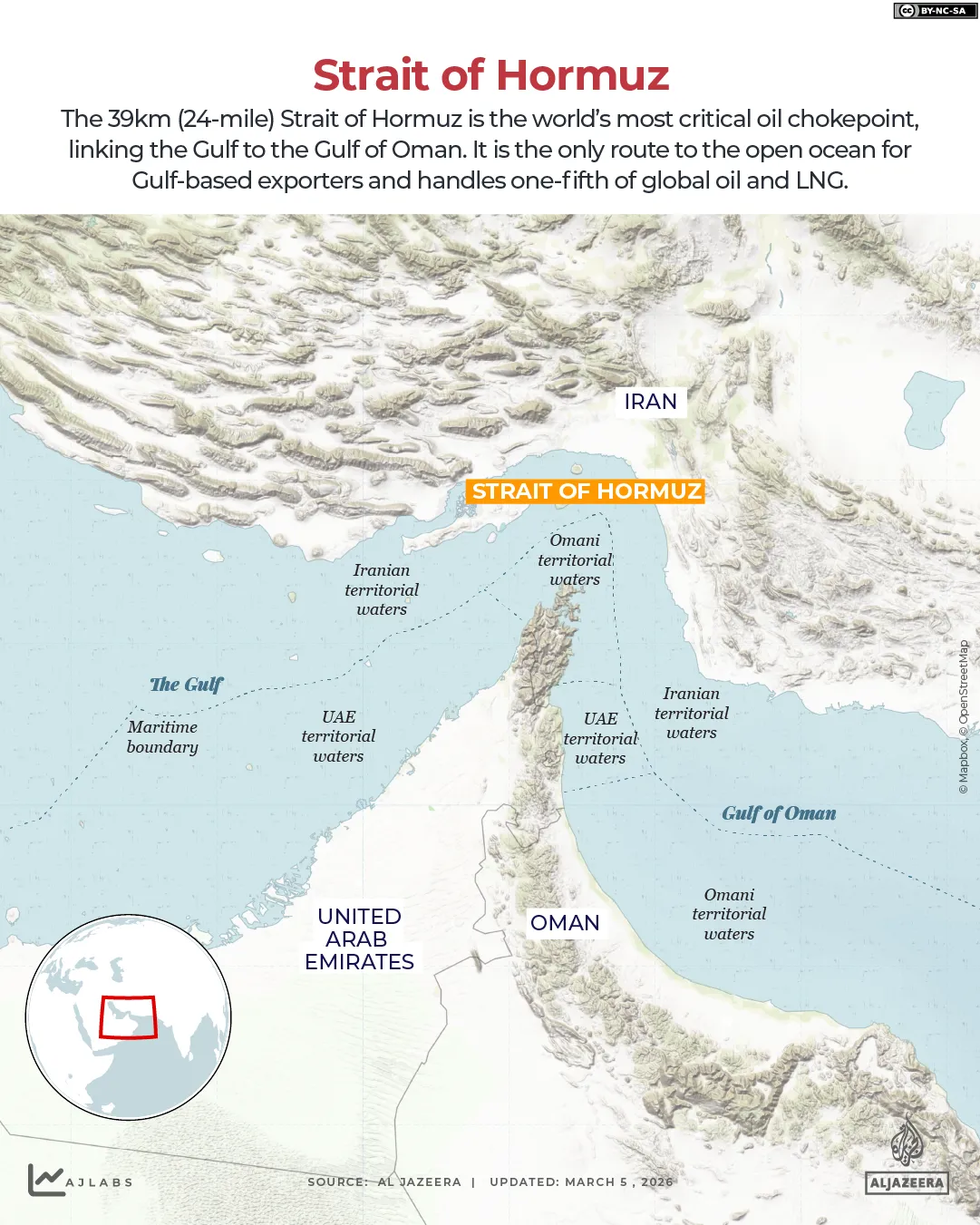
Iran threatened to block “enemy” ships passing through the Strait of Hormuz – a crucial chokepoint for a fifth of the world’s oil – in the wake of the United States-Israeli war launched on February 28. Soon, navigation through the strait was disrupted amid fears of attacks.

Following a temporary ceasefire on April 8, the United States imposed a full naval blockade on Iranian ports on April 13. Theoretically, traffic through the strait should have come to a complete halt.

However, tracking data reveals a remarkably different reality.

INTERACTIVE - Strait of Hormuz - March 2, 2026-1772714221
(Al Jazeera)

An exclusive Al Jazeera open-source investigation tracked 202 voyages made by 185 vessels through the strait between March 1 and April 15, navigating both under fire and across blockade lines.

The numbers behind the shadows

To understand how the strait operated under extreme pressure, Al Jazeera’s Digital Investigative Unit monitored the waterway daily, cross-referencing vessel International Maritime Organization (IMO) numbers with international sanction lists from the US Office of Foreign Assets Control (OFAC), the European Union, the United Kingdom and the United Nations. An IMO number is a unique seven-digit figure assigned to commercial ships.

Of the tracked voyages, 77 (38.5 percent) were directly or indirectly linked to Iran. Notably, 61 of the ships transiting the strait were explicitly listed on international sanctions lists.

INTERACTIVE-Vessel Traffic Through the Strait of Hormuz between March 1 and April 15-1777534474
(Al Jazeera)

The investigation divided the conflict into three distinct phases to map the fleet’s behaviour:

  • Phase 1: Open War (March 1 – April 6): 126 ships crossed the strait, peaking at 30 vessels on March 1. Among these, 46 were linked to Iran.
  • Phase 2: The Truce (April 7 – 13): 49 ships crossed during this fragile pause. More than 40 percent of these vessels were tied to Iran, including the US-sanctioned, Iranian-flagged Roshak, which successfully exited the Gulf.
  • Phase 3: The US Blockade (April 13 – 15): Despite the explicit naval blockade, 25 ships crossed the strait.

Breaking the blockade

When the US blockade took effect, the shadow fleet adapted immediately.

The Iranian cargo ship “13448” successfully broke the blockade. Because it is a smaller vessel operating in coastal waters, it lacks an official IMO number, allowing it to evade traditional sanction-monitoring tools. The vessel departed Iran’s Al Hamriya port and reached Karachi, Pakistan.

Similarly, the Panama-flagged Manali broke the blockade, crossing on April 14 and penetrating the cordon again on April 17 en route to Mumbai, India.

The investigation uncovered widespread manipulation of Automatic Identification System (AIS) trackers. Vessels such as the US-sanctioned Flora, Genoa and Skywave deliberately disabled or jammed their signals to hide their identities and destinations.

Fake flags and shell companies

To obscure ultimate ownership, the shadow fleet heavily relies on a complex web of “false flags” and shell companies. The investigation identified 16 ships operating under fake flags, including registries from landlocked nations like Botswana and San Marino, as well as others from Madagascar, Guinea, Haiti and Comoros.

INTERACTIVE- Strait of Hormuz AJA Vessel registry breakdown by flag state-1777534470
(Al Jazeera)
INTERACTIVE-Commercial managers behind vessels-1777534468
(Al Jazeera)

The operational network managing these ships spans the globe. Operating firms were primarily based in Iran (15.7 percent), China (13 percent), Greece (more than 11 percent) and the United Arab Emirates (9.7 percent). Notably, the operators of nearly 19 percent of the observed vessels remain unknown.

The toll of a parallel system

Despite the intense military pressure, energy carriers dominated the traffic, with 68 ships (36.2 percent) transporting crude oil, petroleum products and gas. Ten of these tankers were directly linked to Iran. Non-oil trade also persisted, with 57 bulk and general cargo ships crossing during the open war phase, 41 of which were tied to Tehran.

INTERACTIVE-Strait of Hormuz traffic by vessel type-1777534472
(Al Jazeera)

Before the war, at least 100 ships crossed the Strait of Hormuz daily. Today, a staggering 20,000 sailors are trapped on 2,000 ships across the Gulf – a crisis the International Maritime Organization described as unprecedented since World War II.

A shadow Iranian fleet, meanwhile, has been navigating seamlessly as part of a parallel maritime system born from 47 years of US sanctions on Tehran. Washington slapped sanctions on Tehran following the 1979 Islamic revolution that toppled the pro-Washington ruler Shah Mohammad Reza Pahlavi. The two countries have had no diplomatic ties since 1980.

Source link

Jet2, easyJet, Ryanair and TUI list of check-in desk opening times

A travel specialist has said some people are giving themselves ‘too much time’

Travellers can avoid ‘pointless’ time-wasting this spring and summer by knowing exactly when to turn up at European airports with enough time to get through the new EES checks. Getting the timing spot on could help passengers feel less worried about missing their flights if they find themselves stuck in lengthy passport control queues.

Travel specialist Kate Donnelly (@Thedonnellyedit) said: “There is a lot of mixed information out there, and some people are saying that you need to get to the airport four to five hours before your departure. This is absolute nonsense. You need to be at the airport a minimum of three hours before your flight.

“Firstly, the bag drop in most European airports only opens two hours before departure, in some cases it may be three hours. [So] getting there four to five hours before your flight just means you’re going to be sitting waiting for the check-in desks to open.”

Kate went on to explain that, once you’ve cleared security and duty-free, most airports should have multiple border control points, reports the Express. She said: “You need to wait for your gate to be announced in order to know which one you have to pass through.

“[Even] if you haven’t had to wait to check a bag (you’re travelling with just hand luggage) and you’ve gone straight through, you are still going to be sitting in the main airport waiting for your gate to be called. This is why getting there hours ahead of time is pointless.”

Content cannot be displayed without consent

How much time should I allow myself?

Depending on which airline you fly with, some carriers open their check-in desks several hours ahead of departure. Getting your timing spot on will give you the best chance of sailing through the airport, even if there are potential EES-related delays.

Most airlines work to similar timeframes, though this can vary by route. For instance, airlines tend to open check-in desks for long-haul flights considerably earlier than for shorter trips, as they require additional time for security and document checks, including visa verification.

It’s worth double-checking directly with the airline operating your service, or you may receive guidance a few days before you’re due to depart. Below is some general advice on when some of the more popular airlines will begin checking passengers in:

  • British Airways: Two to three hours before the flight
  • easyJet: Two hours before the flight
  • Jet2: Three hours before the flight
  • Ryanair: Two to three hours before the flight (airport dependent)
  • TUI: 2.5 hours before (short-haul) / 3.5 hours before (long-haul)
  • Virgin Atlantic: Four hours before the flight

Some airlines – like Jet2, easyJet, TUI, British Airways, and Ryanair – offer a twilight check-in service for people catching early departures. Passengers who are staying close enough to the airport to arrive the night before can drop off bags at select airports the night before their flight, so they can head straight to security on the day of their flight.

What is the new EES system?

The European Union’s (EU) Entry/Exit System (EES) launched on October 12, 2025. This new digital border system has altered the requirements for British citizens travelling to the Schengen area, which includes the following countries:

  • Austria
  • Belgium
  • Bulgaria
  • Croatia
  • Czechia
  • Denmark
  • Estonia
  • Finland
  • France
  • Germany
  • Greece
  • Hungary
  • Iceland
  • Italy
  • Latvia
  • Liechtenstein
  • Lithuania
  • Luxembourg
  • Malta
  • Netherlands
  • Norway
  • Poland
  • Portugal
  • Romania
  • Slovakia
  • Slovenia
  • Spain
  • Sweden
  • Switzerland

The UK, the Republic of Ireland, and Cyprus are not part of the Schengen area. EES does not apply when travelling to any of these countries.

If you are travelling to a Schengen area country for a short stay on a UK passport, you may be required to register your biometric details, such as fingerprints and a photograph, upon arrival. No action is needed before you reach the border, and EES registration is completely free of charge.

EES registration will replace the existing manual passport stamping system for entering the EU. EES may require additional time per traveller, so travellers should be prepared for longer waits than usual at border control.

Source link

First USMC MQ-58 Valkyrie CCA Drones To Arrive In 2029

The U.S. Marine Corps wants to field its first conventional takeoff and landing Collaborative Combat Aircraft (CCA) drones in 2029, and is also looking at the possibility of fielding similar drones with short takeoff and landing capabilities. The news comes soon after the service outlined its plans for Kratos’ XQ-58 Valkyrie, and potentially other CCAs, to be paired with its F-35s as a “bridge” to an entire family of next-generation air combat capabilities, which could include a sixth-generation crewed fighter. You can read more about the implications of that in our previous coverage.

Updates on the latest developments within the Marine Corps’ CCA program were provided by Col. Scott Shadforth, a program manager for the Expeditionary and Maritime Aviation Advanced Development Team (XMA-ADT), at the annual Modern Day Marine conference in Washington, D.C., at which TWZ is in attendance.

An XQ-58A seen during the type’s first flight in Marine Corps service in October 2023. U.S. Air Force

The Corps’ CCA efforts currently fall under a program called Marine Air-Ground Task Force (MAGTF) Uncrewed Expeditionary Tactical Aircraft (MUX TACAIR). The MAGTF is the primary organizing concept around which the service deploys air and ground forces.

Shadforth defines the CCA program as “how the Marine Corps is going after increasing the lethality of existing and future tactical aircraft in a high-threat environment.”

The MUX TACAIR effort emerged out of a previous effort that the Marine Corps War Fighting Lab sponsored as part of a Rapid Defense Experimentation Reserve (RDER) with the Office of the Secretary of Defense (OSD). This earlier program was known as the Penetrating Affordable Autonomous Collaborative Killer — Portfolio (PAACK-P).

The Marine Corps is kicking off its CCA efforts with a landing gear-equipped version of the XQ-58. In contrast, the previous PAACK-P program involved the rocket-assisted takeoff (RATO) variant of the XQ-58. Meanwhile, the MQ-58 designation refers to Marine-specific variants of Kratos’ Valkyrie now in development, although it remains unclear how official this is. 

An XQ-58 is seen being launched using the rocket-assisted method. U.S. Air Force/2nd Lt. Rebecca Abordo

As Shadforth explained, under MUX TACAIR, the Marine Corps is attempting to answer the question: “How do we take that essential [XQ-58] airframe itself and turn it into a conventional takeoff and landing [CTOL] platform so that it’s reusable at a higher rate?”

The OSD effort involved four flights of the XQ-58, culminating in the fall of 2024. At the beginning of this month, the Marine Corps completed a risk-reduction flight involving XQ-58 payloads and integration at China Lake.

Up to this point, the tests have all involved RATO variants of the XQ-58, but the Marines are targeting a first flight using conventional takeoff and landing sometime in the mid- to late summer of this year.

A rendering of a landing gear-equipped version of Kratos’ XQ-58 Valkyrie, which is set to be the Marine Corps’ first operational CCA-type drone. Kratos

Shadforth confirmed that the “ultimate goal” for the MQ-58 effort is to get its hands on “deliverable prototypes” in the summer of 2029. In an ideal case, he added, these would be delivered to VMX-1 in Yuma, “so the Marine Corps can actually get their hands on the aircraft and fly the aircraft in a tactical environment and develop the CONOPS for how they’re actually going to employ those.”

VMX-1, or Marine Operational Test and Evaluation Squadron One, has multiple aircraft types in its inventory and is responsible for tests and evaluations of all types of Marine aircraft and associated systems, while assisting in the creation of tactics, techniques, and procedures (TTPs). You can read more about its work here.

MUX TACAIR doesn’t start and end with the MQ-58, however.

Shadforth said that the Marine Corps is currently exploring further MUX TACAIR options with “several vendors,” including General Atomics and Anduril. Meanwhile, the branch is also working with Northrop Grumman as part of the MQ-58 effort.

As to how the CTOL MQ-58 will be best integrated with the fleet of Marine Corps F-35Bs, which feature short takeoff and landing (STOVL) at the heart of their capabilities, this is something the service is still weighing up.

According to Shadforth, the Marine Corps “is always going to be interested” in finding ways for fixed-wing aircraft to operate from shorter runways, suggesting that a STOVL-type CCA could well be part of its future plans. Of course, a return to the RATO-capable MQ-58 could be one way of achieving this.

The Marine Corps included this graphic in its 2026 Aviation Plan, showing general timelines for various planned capabilities, including multiple tranches of MUX TACAIR drones. U.S. Marine Corps

For now, the Marine CCA effort is squarely focused on the CTOL variant of the Valkyrie, but Shadforth said that it’s also looking toward the future, including “other vendor offerings, whether they exist in reality or not, that remove the need for landing gear.” CCAs that offer either runway independence or that are able to operate from shorter or improvised airstrips represent a capability “the Marine Corps will be interested in exploring,” Shadforth added. One obvious candidate here would be the X-BAT, the jet-powered autonomous stealth ‘fighter’ drone designed to take off vertically and land the same way, tail first, after completing its mission. 

A scale model of the X-BAT on display at the Sea-Air-Space 2026 exposition near Washington, D.C, earlier this month. Jamie Hunter

At this point, it should be recalled that Kratos said earlier this year that the CTOL version of the Valkyrie being developed for the Marines will still be able to make rocket-assisted takeoffs from static launchers. This means the drone will retain a valuable degree of runway independence, though it will have to touch down on a runway at the end of its sortie.

Before that, Kratos also unveiled a special launch trolley that allows variants of the XQ-58 without landing gear to take off from traditional runways, though not land back on them, as seen in the video below.

Kratos Valkyrie Trolley Launch System thumbnail

Kratos Valkyrie Trolley Launch System


An aircraft with some kind of STOVL capabilities “just kind of opens up the world to us, where we don’t need 7,000-, 8,000-, 9,000-, or 10,000-foot paved runways. Those are always capabilities that we’re interested in,” Shadforth said.

Overall, this is a somewhat surprising route, considering that the XQ-58 in its basic form is already runway independent. This would suggest the Marines, in the future, are looking specifically for something that combines STOVL performance with faster sortie rates. After all, the XQ-58 also requires some infrastructure for that and requires a reset time. A STOVL or VTOL type of CCA would also be able to deploy and operate alongside the F-35B more seamlessly.

“As far as how CCA is envisioned integrating with existing STOVL-type platforms, the Marine Corps is kind of on the front end right now of getting CCA out to the operational forces. A lot of that’s going to come through experimentation and evaluation. As we target the 2029 timeframe to get prototypes out to VMX-1, part of their mission set is going to be: now we’ve physically got these things, how are we actually going to employ them with the various tactical aircraft we have available?” he continued.

As well as the STOVL F-35Bs, these tactical aircraft include CTOL/carrier-capable F-35Cs and potentially legacy F/A-18 Hornets, as well as other Joint Force capabilities.

PHILIPPINE SEA (June 4, 2022) An F-35C Lightning II, assigned to the "Black Knights" of Marine Fighter Attack Squadron (VMFA) 314, launches from the flight deck of the Nimitz-class aircraft carrier USS Abraham Lincoln (CVN 72). Abraham Lincoln Strike Group is on a scheduled deployment in the U.S. 7th Fleet area of operations to enhance interoperability through alliances and partnerships while serving as a ready-response force in support of a free and open Indo-Pacific region. (U.S. Navy photo by Mass Communication Specialist 3rd Class Madison Cassidy)
A U.S. Marine Corps F-35C launches from the flight deck of the aircraft carrier USS Abraham Lincoln (CVN 72) in the Indo-Pacific region. U.S. Navy photo by Mass Communication Specialist 3rd Class Madison Cassidy

Shadforth continued: “Those are issues that are going to have to be explored and experimented with for how we’re going to see how those CCAs are going to operate. The point being there’s no set solution at the moment.”

In terms of missions, the Marine Corps is initially focusing MUX TACAIR on an “electronic warfare type platform,” Shadforth said. “Those are the payloads we’re interested in looking at at the moment.”

XQ-58A Valkyrie Demonstrator Inaugural Flight thumbnail

XQ-58A Valkyrie Demonstrator Inaugural Flight


But Shadforth confirmed that other efforts with different vendors are exploring how to use the space within the Valkyrie air vehicle to see what other payloads and capabilities are available to the Marine Corps. Not only usefulness but timeliness are important factors here, Shadforth added.

Kratos is known to be working on a miniature cruise missile called Ragnarok, which the XQ-58 can carry in its internal bay and externally under its wings, and you can read more about it here. Renderings have also shown Valkyries with AIM-120 Advanced Medium Range Air-to-Air Missiles (AMRAAM) under their wings. The drone can carry Small Diameter Bombs (SDB) internally, and has demonstrated drone launch — launched effects are therefore almost certain to be included for the electronic warfare mission.

Ragnarok missiles, or mockups thereof, seen loaded in the internal bay of an XQ-58, as well as under its wing. Kratos

Within all this, it is important to remember that, at this point, the Marine CCA effort is still very much in the prototyping phase, led by the MQ-58. As Shadforth noted, the service has “not entered into a specific acquisition-type construct yet,” beyond developing these prototypes. Nevertheless, with a timeline now in place to get the first MQ-58s to Yuma, and with conventional takeoff and landing trials expected in the next few months, MUX TACAIR reflects the overall acceleration of the Corps’ CCA program.

Contact the author: thomas@thewarzone.com

Thomas is a defense writer and editor with over 20 years of experience covering military aerospace topics and conflicts. He’s written a number of books, edited many more, and has contributed to many of the world’s leading aviation publications. Before joining The War Zone in 2020, he was the editor of AirForces Monthly.


Source link

The shock truth about Justin Timberlake’s marriage as insiders reveal why long suffering wife Jessica Biel is ‘done’

WHEN pop superstar Justin Timberlake started dating actress Jessica Biel, they quickly became Hollywood’s hottest couple. 

But now, after 14 years of marriage, their relationship is going through a positively chilly phase. For long-suffering Jessica, 44, has drawn a line in the sand following a relentless string of public embarrassments, serving her husband with a brutal ultimatum to clean up his act, or she is out.

Jessica Biel and Justin Timberlake have been married for 14 years after tying the knot in Italy in 2012 Credit: Getty
Justin’s mugshot following his 2024 drink-driving arrest Credit: Rex

From the humiliating release of bodycam footage showing Justin’s June 2024 drink-driving arrest to fresh whispers of intoxicated antics at a Las Vegas golf tournament just weeks ago, the Cry Me A River singer’s fall from grace has pushed his wife to the edge, according to reports.

But the drama doesn’t stop there. Insiders tell The Sun that Justin pulled the plug on a $100 million NSYNC reunion, in a last stand bid to save his marriage. 

Behind closed doors, those who work closely with the couple say Jessica has been the “glue” holding the family together. 

A well-placed Los Angeles producer, who has worked closely with Jessica, tells The Sun that the actress’s marriage can sometimes be a far cry from the fairytale Justin sold the world in the 2010s.

Justin was pictured in 2019 getting close with co-star Alisha Wainwright, later apologising publicly Credit: BD1
Jessica continued to work on her drama The Better Sister despite Justin Timberlake’s arrest Credit: Splash

The insider says: “Jessica is a superwoman. For the last decade, she has run the home, carried and raised two boys, continued acting and enjoyed success with a production company in Hollywood. Where she has found the time and energy to balance is staggering. She has been the glue.”

The couple’s permanent relocation to the luxury Yellowstone Club in Montana was Jessica’s way to shield their sons, Silas, 11, and Phineas, 5, from the downsides of fame.

“She took huge pride in being a hands-on mother, ensuring that her kids would be raised in the most normal way and not be impacted by LA life or Hollywood temptations and dramas,” the insider explains. 

“Her boys are the most important thing in her life, and she will do her utmost to protect them. That would have absolutely been made clear to Justin.”

The couple share two sons, Silas, 11, and Phineas, 5 Credit: Getty
Industry figures were shocked when Justin didn’t walk the red carpet to support Jessica during the awards season Credit: Instagram/ Jessica Biel

But while Jessica thrives in the tranquillity of the mountains, Justin remains obsessed with the spotlight. 

His gruelling Forget Tomorrow world tour, which finally wrapped last summer after more than 100 gigs, kept him away from home for massive chunks of time and put a strain on their marriage.

Our source adds: “When the lights go out, Jessica is still a devoted, hard-working mum wanting to do the best for her kids.

“Justin is committed, but is also balancing this battle to remain a pop star and entertainer. In today’s world, if you disappear for too long, you become forgotten or irrelevant. That is something Justin would never let happen.”

This desperate need for validation, however, has come at a steep personal cost.

Jessica’s own career has been flying high. She poured her heart into her production company, Iron Ocean Productions, and her acclaimed 2025 series The Better Sister earned her a prestigious 2026 Critics’ Choice Award nomination for Best Actress. 

Yet, when her big moment arrived in January, her husband was absent from the red carpet.

“Many industry figures were shocked that Justin didn’t walk the carpet to support her,” the producer notes. 

“She had been there for him over the previous seven months. Regardless of his recent scandals, it would have been a great public display of unity.”

Justin’s erratic decision making hasn’t just alienated his wife; he has also managed to infuriate his oldest friends.

The Sun can reveal that the singer recently blew a chance to catapult himself back centre stage by walking away from an epic NSYNC 30th anniversary reunion.

The highly lucrative comeback – which included proposals for a live comeback show, a lucrative Las Vegas residency, and a documentary – could have netted the five bandmates a staggering $100 million.

A top music executive, who was intimately involved in the proposals, claimed Justin’s refusal to commit has caused bitter “disdain and disappointment” among his former bandmates.

They said: “Justin let the boys down, and really killed the chance for a special 30th anniversary adventure. The other boys were the driving forces with everyone on board initially… well, that is what they believed.”

“Pinning down Justin just could not be done. It wasn’t so much that he was saying outright no, but more just not committing. There was a real hope for something momentous and exciting to play out, which could have really put them back to the top of the music world again.”

The insider notes that the bond between the five men, who were once like brothers, has been severely damaged.

“Those five men have been friends through many highs and lows. But this took something away from that bond. Publicly, of course, they will always support Justin, but this was really seen as a wasted chance to make magic happen.”

But those close to Justin say that walking away from the NSYNC reunion was an attempt to rebalance his work with his family life and repair his relationship with his wife.

Justin’s reluctance to embark on a massive boyband tour was also undoubtedly influenced by his latest health battle. 

Last summer, the singer revealed he had been diagnosed with Lyme disease, a debilitating bacterial infection that wreaked havoc on him both mentally and physically. 

Jessica, ever the dutiful wife, stepped up to the plate.

Our source says: “Last summer Jessica really urged her husband to slow down, recover fully and seek the best medical advice. There was a huge sense that Justin really had a tough time on the road doing the dance moves and powering through so many shows with his medical issues.”

“Jessica was really kind, caring, and sympathetic. Justin’s mood and outlook was hit quite hard at the diagnosis. The reality is that his entire future as a performer is potentially on the line given how debilitating Lyme disease can be.”

Even the music executive admitted that the health crisis “must have played a key factor in him stepping back” from the NSYNC tour, though they noted that “there were projects like a doc film which would not have needed him to dance or perform”.

Despite her immense sympathy for his health struggles, Jessica’s patience with Justin’s headline-grabbing antics is running dry.

It’s not the first time he has embarrassed his wife. In 2019, The Sun revealed pictures of him drinking and holding hands with his Palmer co-star Alisha Wainwright.

Justin was forced to admit he had been drinking alcohol during the encounter, describing it as a “strong lapse of judgement” but insisted “nothing happened”.

He also added a grovelling apology to his family, writing: “I drank way too much that night and regret my behaviour. I should have known better. This is not the example I want to set for my son.”

“I apologise to my amazing wife and family for putting them through such an embarrassing situation, and I am focused on being the best husband and father I can be.”

Then in 2024, Justin was arrested for drink-driving. The police bodycam footage was released earlier this year, and shows the slurring singer complaining to cops that they were ruining his “world tour”.

Jessica distracted from the embarrassing footage and posted a loved-up snap with her husband on February 1st, captioning it: “Happy 45th to a true original. I love you baby.”

But then last week on April 18 eyewitness reports say that Justin once-again appeared intoxicated at a golf tournament in Las Vegas.

Since then, Page Six reported Jessica was ready to “pull the trigger” on the marriages, with an insider adding: “There’s not much more she can take.”

Now with an ultimatum on the table it appears Jessica is officially done playing the doting wife.

Our source said: “Knowing what a straight shooter she is, there is no way she would hold back on telling her husband exactly how she feels.”

If Justin doesn’t clean up his act, it could be Jessica saying “Bye Bye Bye” to their marriage once and for all.

Jessica and Justin’s representatives were contacted for comment. 

Source link

Obamacare’s neglected legacy: Advancing civil rights

Dr. Susan Ward-Jones observed something remarkable not long after the East Arkansas Family Health Center opened a new clinic in this small city by the Mississippi River.

“People used to come in unkempt, sloppily dressed. They look better now,” said Ward-Jones, the clinic’s director. “I think people have a new pride in themselves. Maybe they see we’re doing better and they say, ‘I’ll try to do better, too.’”

With a two-story glass atrium and soaring brushed metal portico, the clinic — whose patients are mostly poor and African American — has nearly twice as many exam rooms as the health center’s old location in a cramped storefront down the road. Nine dental suites, a pharmacy and a state-of-the-art demonstration kitchen branch off the sun-dappled atrium. A shaded exercise track winds through a stand of tall oaks out back.

As nationwide protests highlight the continued impact of racism in criminal justice, the struggle to create and maintain health centers like this one — and over the law commonly known as Obamacare — offers a window into the tangled history of race and healthcare in the U.S., as well. The clinic opened in 2014, thanks to the Affordable Care Act, which also helped thousands of its patients get health insurance.

 The entrance of the East Arkansas Family Health Center.

The entrance of the East Arkansas Family Health Center.

(William DeShazer / For The Times)

“The Affordable Care Act empowered people who didn’t have power. It’s given people a measure of self-respect. That’s been very profound,” said Dr. David Satcher, the former U.S. surgeon general who grew up in the South when many hospitals didn’t allow black physicians like him to admit patients.

More darkly, the reaction to the law — whose passage in March 2010 was shadowed by racist outbursts from some opponents — also has revealed troubling fault lines that remain.

The 14 states that continue to oppose expansion of Medicaid insurance made possible by the law are concentrated in the South, effectively maintaining large racial disparities in access to care. Most of those same states are suing in federal court to have the law invalidated.

“It may be too simplistic to say that opposition to the Affordable Care Act in the South is just about race,” said Thomas J. Ward Jr., a historian who has written about healthcare and civil rights. “But you can’t look at opposition to expanding health services, and not see that some of that opposition is rooted in race in a significant way — not necessarily straight racial animosity, but fear of racial empowerment.”

Anita Earvin gets her teeth cleaned at East Arkansas Family Health Center.

Anita Earvin gets her teeth cleaned at East Arkansas Family Health Center.

(William DeShazer / For The Times)

Today, a new chapter in this complicated story is being written as the coronavirus outbreak disproportionately affects African American communities across the country, once again spotlighting the racial disparities that shadow American healthcare.

The connection between healthcare and race has been particularly resonant along the Mississippi River, where access to medical care was long a dividing line as rigid as separate schools and drinking fountains, and where federal healthcare initiatives half a century ago helped end segregation.

Clifton Collier, who ran a health center in Marianna, Ark., 50 miles south of West Memphis, lived a good part of this history.

Column One

A showcase for compelling storytelling from the Los Angeles Times.

Collier, 66, grew up in the heart of the Arkansas Delta, an expanse of dark, fertile earth stretching over bayous and through thick stands of cedar and live oak along the west bank of the Mississippi.

This was one of the last bastions of the Jim Crow South, a ferociously segregated place where former plantation homes still dot the landscape and a commanding statue of Robert E. Lee on the town square bears testimony to the persistence of the old system.

Collier’s was better off than most black families. His father ran a juke joint that did a brisk business, particularly on Sundays. And just outside town, in a place called Black Swamp, the family owned land it had bought after the Civil War. Some in the family say part of the money came from a white man who fathered one of Collier’s ancestors.

As children in the 1960s, Collier and his siblings worked the cotton fields around Black Swamp, lugging burlap sacks up and down long rows and pulling white bolls from between the plants’ needle-like stems.

If anyone got sick, they’d see a local black woman who practiced folk medicine. “We didn’t have money for a doctor,” Collier recalled. “Nobody did.”

None of the town’s four white doctors would see a black patient who didn’t have cash. “We just had to take care of ourselves,” Collier said.

Dr. Judy Ali, a pharmacist at East Arkansas Family Health Center, answers patient calls.

Dr. Judy Ali, a pharmacist at East Arkansas Family Health Center, answers patient calls.

(William DeShazer / For The Times)

That didn’t seem to trouble the physicians, who told a CBS News crew that visited Marianna in 1969 that black patients got what they needed. “They get adequate medical care if they come seeking it,” one doctor said. “So many times, they’re sick, and they don’t seek it because of ignorance or laziness.”

Cracks in this system began to emerge following passage of the 1965 law that created Medicare, the government insurance plan for the elderly and disabled. The law barred federal money for segregated institutions, forcing hundreds of hospitals across the South to desegregate waiting rooms, patient floors and nurseries almost overnight.

A second federal initiative helped bring community health centers such as Collier’s clinic to many of the poorest quarters of America, offering reliable medical care to black patients in places like the Arkansas Delta for the first time.

These clinics weren’t universally welcomed. When volunteers tried to open the Lee County Cooperative Clinic in Marianna in 1968, white landlords refused to rent space.

The local medical society blocked the clinic’s first doctor, a young physician from St. Louis, from admitting patients to the hospital in Marianna, forcing them to travel to Memphis or Little Rock, more than an hour away. Several workers at the clinic were beaten up outside a local restaurant.

But the clinic endured. Such health centers were designed to empower the low-income patients they served, with federal money funneled directly to the clinics, bypassing white-controlled state governments. In Lee County, clinic volunteers helped develop a slate of black candidates for local office.

“The clinic turned out to be the opening chapter of the civil rights movement in Lee County,” recalled Dr. Dan Blumenthal, the clinic’s first doctor, who taught at Atlanta’s Morehouse School of Medicine until he died last year.

Pharmacy technician Precious Parker fills patient prescriptions.

Pharmacy technician Precious Parker fills patient prescriptions.

(William DeShazer / For The Times)

The health centers — and federal programs such as Medicare and Medicaid — had a profound impact on the lives of black Americans.

Across the Mississippi River from Marianna, a federally funded health center in Mound Bayou, Miss., helped cut the infant mortality rate among African Americans in the surrounding county by more than a third in just four years, researchers found.

Nationwide, access to care also improved dramatically. In 1964, white Americans were nearly 50% more likely than their black counterparts to have seen a doctor in the previous two years. Three decades later, that reversed, with African Americans more likely than whites to have been to a doctor recently.

Nevertheless, by the time President Obama and congressional Democrats began pushing for the Affordable Care Act, substantial racial inequalities in healthcare remained.

Black Americans were more likely to be uninsured, more likely to report financial barriers to getting care and more likely to die from treatable diseases.

Obama didn’t cite these disparities, focusing instead on the promise of guaranteed health coverage for all Americans.

“Race wasn’t the focus,” a former senior Obama aide recalled. “We didn’t go there.”

But race was never far in the background of the debate.

Rush Limbaugh, Glenn Beck and other conservative commentators who vigorously opposed the health law repeatedly claimed it was part of Obama’s strategy to make the federal government compensate African Americans for slavery.

“This is a civil rights bill, this is reparations, whatever you want to call it,” Limbaugh told his listeners in 2009.

Democratic lawmakers, meanwhile, deliberately linked their healthcare fight to past struggles for racial equity.

Before the critical March 2010 vote on the law, Georgia Rep. John Lewis, a civil rights icon who had participated in the famous 1965 march across the Edmund Pettus Bridge in Selma, Ala., when marchers were beaten by police, walked arm-in-arm with other lawmakers to the Capitol to pass the bill.

Adding to the historical echoes that day, several black lawmakers reported hearing racial epithets as they walked through the crowd of protesters outside the Capitol, many from the then nascent tea party movement. One lawmaker was spit on.

“It was like going into a time machine with John Lewis,” Rep. Andre Carson, a black Democrat from Indiana, observed at the time.

A decade later, some of that vitriol has faded. And the health gains made possible by the law have been striking.

“I think people have a new pride in themselves," says Dr. Susan Ward-Jones, director of the East Arkansas Family Health Center.

“I think people have a new pride in themselves,” says Dr. Susan Ward-Jones, director of the East Arkansas Family Health Center.

(William DeShazer / For The Times)

Between 2013 and 2015, the share of African Americans without health insurance dropped by nearly half, falling from almost 25% to less than 14%, according to data assembled by the nonprofit Commonwealth Fund.

At the same time, African Americans reported skipping care less frequently because of concerns about cost, almost cutting the gap between blacks and whites in half.

And new research shows that inequalities in how quickly white and black patients start treatment for advanced cancers almost disappeared in states that fully expanded coverage through the health law.

“The law dramatically lessened disparities by race,” said Dr. Otis Brawley, an oncologist at Johns Hopkins University and former chief medical officer at the American Cancer Society.

In Arkansas, which was the first Southern state to expand Medicaid coverage through the law — Louisiana and Virginia have since followed — the impact has been particularly large.

The share of poor residents without health insurance tumbled from nearly 42% to just 19% between 2013 and 2014, researchers found.

The coverage gains allowed clinics like the ones in West Memphis and Marianna to expand services such as dentistry and behavioral health. They added more nurses, more case managers, more health educators and others to help the neediest patients.

Patients, in turn, are more frequently getting checkups and filling their prescriptions more regularly.

Mary Clarksenior gets an eye exam from Dr. Norman Denton.

Mary Clarksenior gets an eye exam from Dr. Norman Denton.

(William DeShazer / For The Times)

“What we’ve experienced in the last few years has been nothing short of amazing,” said Terrence Aikens, who led efforts at the West Memphis clinic to enroll patients in health insurance through the 2010 health law.

And yet, even now, as the Affordable Care Act enters its second decade, the gains feel tenuous to many here. The law’s opponents — including Arkansas’ governor and the Trump administration — are working to get the Supreme Court to overturn it.

“It is such a difficult history, and we have come so far,” said Ward-Jones, the director of the West Memphis clinic. “Sometimes, though, it feels like we take two steps forward and one step back.”

Source link

Lakers get Austin Reaves back, but still lose Game 5 to Rockets

Lakers lose to Rockets

From Broderick Turner: An hour before tip-off of Game 5 of the first-round playoff series against the Houston Rockets, the word came down that Austin Reaves was available to play for the Lakers, his wait over, his time away with a Grade 2 left oblique strain no longer an issue for him.

Reaves missed the first four games of the series against Houston and the last five regular-season games after sustaining the injury in Oklahoma
City on April 2. He checked into the game off the bench with 5 minutes and 39 seconds left in the first quarter to a standing ovation.

Reaves proceeded to give the Lakers a lift, but the Rockets received even more elevated play , their five starters scoring in double figures and their defense on point during Houston’s 99-93 win over Los Angeles on Wednesday night at Crypto.com Arena.

Even with Reaves scoring 22 points and handing out six assists and LeBron James producing 25 points and seven assists, the Lakers couldn’t close out this best-of-seven series they once had total command of just a few days ago.

The Lakers have lost the last two games and their once 3-0 lead heading to Houston with their lead down to 3-2.

“I mean, we don’t have a lot of time to dwell on it,” James said. “I mean, you can give yourself tonight, a little bit tomorrow. But … once we get on that plane and head down to Houston we got to forget about it and understand what we are going for and it’s going to be even harder.

Continue reading here

Lakers box score

NBA playoffs schedule

Go beyond the scoreboard

Get the latest on L.A.’s teams in the daily Sports Report newsletter.

Lakers playoff schedule

First round
All times Pacific

at Lakers 107, Houston 98 (box score)
at Lakers 101, Houston 94 (box score)
Lakers 112, at Houston 108 (box score)
at Houston 115, Lakers 96 (box score)
Houston 99, at Lakers 93 (box score)
Friday: Lakers at Houston, 6:30 p.m., Prime Video
*Sunday: Houston at Lakers, TBD

*-if necessary

Dodgers lose to Marlins again

From Kevin Baxter: Wednesday was getaway day for Dodgers, the final game of a six-game homestand ahead of a weeklong trip to St. Louis and Houston. And that’s a good thing, first baseman Freddie Freeman said, because there are a number of players on the team that really could use a getaway, Freeman chief among them.

With Wednesday’s 3-2 matinee loss to the Miami Marlins, the Dodgers (20-11) have lost two in a row at home for the first time this season. In those two games the Dodgers scored just three runs, went four for 18 with men in scoring position and left 16 runners on base.

And the final outs Wednesday came when Freeman, batting with the bases loaded and one out, grounded into a bizarre, unassisted double play with Marlins second baseman Xavier Edwards fielding the ball, tagging Shohei Ohtani as he ran him back to first, then dragging his foot across the bag to retire Freeman.

“I hit it right at the second baseman. He tagged Ohtani and tagged first,” Freeman offered in an accurate, if hardly revelatory explanation.

Continue reading here

Dodgers box score

MLB standings

Angels lose to White Sox again

Rookie Sam Antonacci hit a tying triple with two outs in the ninth inning and Colson Montgomery had a winning single in the 10th, lifting the Chicago White Sox to a 3-2 victory Wednesday for a three-game sweep that extended the Angels’ losing streak to six.

Mike Trout hit his 10th home run of the season for the Angels, who have lost 10 of 11 and dropped to 12-20. Additionally, Angels starter Yusei Kikuchi left after two innings with left shoulder tightness.

Kikuchi gave up no runs on two hits and a walk with one strikeout before exiting. His average fastball velocity dropped from 94.9 mph in the first inning to 92.8 mph in the second.

Continue reading here

Angels box score

MLB standings

Who is the Kentucky Derby favorite?

From Jay Posner: This year’s Kentucky Derby field does not appear to have a true standout. But it could have a star.

If that sounds illogical, trainer Chad Brown, who will start Emerging Market in a bid to win his first Derby, can explain.

“There’s clearly a couple horses that are deserving favorites in the race, but there’s by no means an American Pharoah in here, at least up to this point going into the race,” Brown said, referencing the 2015 Triple Crown champion. “Now, you know, whoever wins the race and goes on, maybe one emerges and turns into one of the best 3-year-olds in the last few years.”

That’s what happened last year, when Sovereignty, the third betting choice in the race, progressed from a Derby win to victories in the Belmont and Travers and was voted Eclipse Award for Horse of the Year.

This year’s field is so deep, Brown said, that an argument could be made “for maybe half the horses in the field, if they ran their very, very best race and had a good trip, could win this race.”

Continue reading here

Sparks to retire a number

From Marisa Ingemi: The Sparks will retire former player DeLisha Milton-Jones’ No. 8 jersey on July 28 when the team hosts the New York Liberty as a part of the WNBA’s 30th anniversary celebration.

A three-time All-Star, Milton-Jones played 11 years for the Sparks, helping lead them to back-to-back titles in 2001 and 2002.

“It’s like one of those moments where it’s Christmas, and you’re anticipating getting a gift and when the day finally is here, that feeling you can’t even describe is rather euphoric and nostalgic all at the same time, and it brings a peace about you in a way that you can’t explain,” Milton-Jones said. “Because you put so much time, energy and effort into everything that you did in that moment in your life, and now to be rewarded in this manner is just pretty big.”

Milton-Jones will be the fourth Sparks player to have her number retired after Lisa Leslie (No. 9), Penny Toler (No. 11) and Candace Parker (No. 3).

Continue reading here

NCAA men’s tournament could expand

From Steve Henson: Ever-growing power conferences are the driving force behind an impending expansion of the NCAA men’s and women’s basketball tournaments, which ESPN reported could be formalized within weeks and begin next season.

The field would grow from 68 teams to 76 that would include eight additional at-large teams in each tournament. The current First Four — eight teams playing four games — would expand to 12 games played by 24 teams at two sites on the first Tuesday and Wednesday of the tournament. The traditional 64-team bracket would begin Thursday as usual.

Mid-majors likely are tempering any celebration. The change might not mean more invitations to the Big Dance for underdogs because the NCAA and its media partners favor large, established schools with large, established fan bases for viewership and revenue.

Continue reading here

Ducks playoffs schedule

All times Pacific

at Edmonton 4, Ducks 3 (summary)
Ducks 6, at Edmonton 4 (summary)
at Ducks 7, Edmonton 4 (summary)
at Ducks 4, Edmonton 3 (OT) (summary)
at Edmonton 4, Ducks 1 (summary)
Thursday: Edmonton at Ducks, 7 p.m., TNT, truTV, HBO Max, KCOP-13
*Saturday: Ducks at Edmonton, TBD

*-if necessary

This day in sports history

1961 — LPGA Titleholders Championship Women’s Golf, Augusta CC: Mickey Wright wins her 5th major title by 1 stroke from Patty Berg & Louise Suggs.

1962 — LPGA Titleholders Championship Women’s Golf, Augusta CC: Mickey Wright wins her 8th major title in a playoff with Ruth Jessen.

1971 — The Milwaukee Bucks become the second team to register a four-game sweep in the NBA championship, beating the Baltimore Bullets 118-106.

1975 — Larry O’Brien is named the NBA’s third commissioner, following J. Walter Kennedy (1963-75) and Maurice Podoloff (1946-63). O’Brien holds the position until 1984.

1976 — Muhammad Ali wins a unanimous 15-round decision over Jimmy Young in Landover, Md., to retain his world heavyweight title.

1985 — NFL Draft: Virginia Tech defensive end Bruce Smith first pick by Buffalo Bills.

1987 — NY Islander Mike Bossy plays his final game.

1992 — The Red Wings and Canucks become the ninth and 10th teams in NHL history to rebound from 3-1 deficits to win playoff series. Detroit beats the Minnesota North Stars 5-2 in the Norris Division, while Vancouver defeats the Winnipeg Jets 5-0 in the Smythe Division.

1993 — Top-ranked Monica Seles is stabbed during a changeover in Hamburg, Germany. Guenter Parche, 38, reaches over a courtside railing and knifes Seles in the back. She has an inch-deep slit between her shoulder blades and missed the remainder of the 1993 season.

2005 — James Toney outpoints John Ruiz to win the WBA heavyweight title in New York. Toney, a former champion at three other weights, wins his third heavyweight bout, becoming the third one-time middleweight champion to take boxing’s top crown.

2010 — Tiger Woods matches the worst nine-hole score of his PGA Tour career and winds up with a 7-over 79 to miss the cut at the Quail Hollow Championship. Woods finishes at 9-over 153, the highest 36-hole total of his career. It’s the sixth time in his 14-year career he misses a cut.

2012 — Manchester City defeat Manchester United 1-0 in what is claimed to be the biggest match in the English Premier League’s history.

2014 — Anze Kopitar scores the tiebreaking goal late in the second period and Jonathan Quick makes 39 saves to cap the Kings’ comeback from three games down with a 5-1 victory over the San Jose Sharks in Game 7 of the first round. This is the fourth time an NHL team won a best-of-seven series after losing the first three games.

2015 — For the first time in 51 years, the NFL draft returns to Chicago. Florida State’s Jameis Winston is selected by Tampa Bay as the first selection.

2023 — Seattle Kraken become first NHL franchise to earn its first-ever playoff series win against reigning Stanley Cup champion, eliminating the Colorado Avalanche in seven games.

Compiled by the Associated Press

This day in baseball history

1903 — The New York Highlanders won their home opener at Hilltop Park, 6-2 over Washington.

1919 — Philadelphia’s Joe Oeschger and Brooklyn’s Burleigh Grimes pitched complete games in a 9-9, 20-inning tie. Both teams scored three runs in the 19th inning. Oeschger gave up 22 hits and walked five, while Grimes allowed 15 hits and walked five.

1922 — Charlie Robertson of the Chicago White Sox pitched a 2-0 perfect game against the Detroit Tigers. Johnny Mostil, playing left field for the only time, made two outstanding catches.

1923 — The New York Yankees sign 20-year-old prospect Lou Gehrig to a contract paying him a salary of $2,000 and a bonus of $1,500.

1940 — James “Tex” Carleton of the Brooklyn Dodgers threw a 3-0 no-hitter at Cincinnati.

1944 — In the first game of a doubleheader split, New York first baseman Phil Weintraub drove in 11 runs and player-manager Mel Ott scored six runs as the Giants beat the Brooklyn Dodgers 26-8. Brooklyn won the nightcap 5-4.

1946 — Bob Feller struck out 11 New York Yankees en route to his second of three career no-hitters, a 1-0 victory at Yankee Stadium.

1952 — Ted Williams plays his final game before leaving for military duty in Korea.

1958 —Ted Williams of the Boston Red Sox became the 10th major leaguer to reach 1,000 extra-base hits in a 10-4 loss to the Kansas City Athletics at Fenway Park.

1961 — Willie Mays of the San Francisco Giants hit four home runs and drove in eight runs in a 14-4 victory over the Braves in Milwaukee. Hank Aaron hit two homers for the Braves.

1967 — Steve Barber and Stu Miller of the Baltimore Orioles combined on a no-hitter in a 2-1 loss to the Detroit Tigers in the first game of a doubleheader.

1969 — Jim Maloney of the Cincinnati Reds struck out 13 en route to a 10-0 no-hitter over the Houston Astros, the third of his career.

1986 — The Seattle Mariners strike out 16 more times in a 9-4 loss to the Boston Red Sox, to set a major league record of 36 strikeouts in two consecutive games.

1988 — New York and Cincinnati hooked up in a wild game at Riverfront Stadium, with the Mets winning 6-5 on a delayed call by first base umpire Dave Pallone. The call resulted in a $10,000 fine and 30-day suspension of Reds manager Pete Rose when Pallone accidentally poked Rose in the cheek and Rose shoved Pallone twice.

1994 — Toronto’s Joe Carter finished April with 31 RBIs to set a major league record for the month. Colorado’s Andres Galarraga finished with 30 to set a National League record.

1996 — Jeff King of the Pittsburgh Pirates becomes the third major leaguer to hit two home runs in one inning twice in his career.

2000 — Randy Johnson of the Arizona Diamondbacks defeats the Chicago Cubs, 6-0, as he becomes only the third pitcher in major league history to win six games in April.

2002 — Al Leiter cruised through seven three-hit innings in the New York Mets’ 10-1 rout of Arizona to become the first pitcher to beat all 30 teams in the majors.

2005 — Major league players are asked by Commissioner Bud Selig to agree to a 50-game suspension for the first offense, a 100-game suspension for the second offense and a lifelong ban after the third offense for the use of steroids.

2008 — Julio Franco announces his retirement as a player at age 49.

2012 — Ryan Braun hit three homers and a two-run triple in Milwaukee’s 8-3 win over San Diego. No player had hit three homers and a triple in a game since Fred Lynn in 1975.

2017 — Anthony Rendon had 10 RBIs, three home runs and six hits, powering the Washington Nationals past the New York Mets 23-5. Rendon went a career-best 6 for 6 and scored five times.

2019 — CC Sabathia becomes the 17th pitcher to reach 3,000 strikeouts.

2020 — The latest event to be cancelled due to the ongoing global coronavirus pandemic is the annual Little League World Series.

2022 — Clayton Kershaw becomes the Dodgers’ all-time franchise leader for strikeouts when he fans Spencer Torkelson of the Tigers in the 4th inning. With 2,697 strikeouts, he moves past Hall of Famer Don Sutton.

Compiled by the Associated Press

Until next time…

That concludes today’s newsletter. If you have any feedback, ideas for improvement or things you’d like to see, email me at houston.mitchell@latimes.com. To get this newsletter in your inbox, click here.

Source link

‘One-of-a-kind’ British lido with 3 heated pools and dragon inflatables is offering free swimming for kids this weekend

A POPULAR lido is set to offer all day sessions this weekend – where kids will be able to swim for free.

The Grade II listed venue also offers a number of adult-friendly swim sessions and an adventure course.

Café building at the outdoor swimming lido in Pontypridd park.
The pool re-opened in 2015 following a multi-million pound renovation Credit: Ceri Breeze
Aerial view of the Lido swimming pool and adjacent playground in Ynysangharad Park, Pontypridd.
The lido offers three pools, an outdoor play areas and an inflatable course on weekends Credit: Ceri Breeze

The National Lido of Wales, in Pontypridd, is hosting all-day sessions from May 2 to 4, ahead of the pool’s official summer season on June 1.

Kids under 16 will be able to enjoy the lido for free all weekend, while adult entry is priced at just £4.

The pool currently offers weekday and weekend sessions from 6.30am until 8.45am for early-morning swimmers.

Family fun sessions are also hosted only on weekends and bank holidays until the start of June.

DIVE IN

‘Ultimate’ UK aquapark with beach bus and climbing towers is reopening this weekend


SPLASH OUT

UK’s biggest freshwater lido to reopen this week as temperatures to hit 26C

For an additional £3, visitors can purchase tickets for the inflatable obstacle course, Aqua Peddlerz and Water Walker, which includes floating zorbs – inflatable plastic balls that allow people to run on the water.

The area also contains an outdoor play section – a dedicated playpark with slides, seesaws, climbing and balancing equipment.

The historic venue, also known as Lido Ponty, has been nestled within Ynysangharad War Memorial Park since 1927.

Following its closure in 1991, the pool spent the intervening 24 years in a state of disrepair until its official re-opening in 2015.

Now it features a renovated main pool, an activity pool and a splash pool, which are all heated to 28 degrees.

The site is also considered the “earliest and best preserved lido” in South Wales.

Source link

New World Cup attractions coming to the UK capital with huge indoor screens and laser raves

WE ARE just six weeks away from the start of the World Cup and the UK’s capital is getting THREE fan attractions for watching the matches.

Launching across three London venues, Kick Off Club will open three new World Cup fanzones.

People socializing on a two-story outdoor patio at "Colour Factory," with "Food Traders" and "Pitta Goras" signs visible.
Kick Off Club will have three fanzones across London Credit: Kick off club

Follow The Sun’s award-winning travel team on Instagram and Tiktok for top holiday tips and inspiration @thesuntravel.

One will be at the Outernet on Tottenham Court Road, another will be at Electric Brixton in South London and the third will be at Colour Factory in Hackney Wick.

Each fanzone won’t have food for sale, but you will be able to get drinks, including drinks packages.

Outernet fanzone

At the Outernet fanzone, fans will find London’s largest indoor screen.

Read more on travel inspo

HOLLA

Never pay full price for hols again… 25 apps, sites & clubs for huge discounts


SUN SPOT

Travel experts’ guide to lesser-known holiday spots that are quieter AND cheaper

But the experience won’t just be your standard football screening, as there will be a surround sound system fully immersing visitors in each match.

Matches being shown at the Outernet include:

  • June 16: France v Senegal – 8pm Kick off (access from 6.30pm)
  • June 17: England v Croatia – 9pm Kick off (access from 7pm)
  • June 19: USA v Australia – 8pm Kick off (access from 6.30pm)
  • June 23: England v Ghana – 9pm Kick off (access from 7pm)
  • June 24: Scotland v Brazil – 11pm Kick off (access from 9pm)
  • June 27: England v Panama – 10pm (access from 8.30pm)

Electric Brixton

At the Electric Brixton fanzone, guests can expect Britpop-inspired football screenings with Indie music and a 90s theme.

Expect music by Oasis, Blur and Pulp booming through the speakers.

Matches being shown at Electric Brixton include:

  • June 17: England v Croatia – 9pm Kick off (access from 7pm)
  • June 19: USA v Australia – 8pm Kick off (access from 6.30pm)
  • June 19: Scotland v Morocco – 11pm Kick off (access from 9pm)
  • June 23: England v Ghana – 9pm Kick off (access from 7pm)
  • June 24: Scotland v Brazil – 11pm Kick off (access from 9pm)
  • June 27: England v Panama – 10pm (access from 8.30pm)
A large crowd of people facing a stage with three large screens showing concentric circles and cross patterns.
Each fanzone will have its own theme including one with a 90s vibe Credit: Kick off club

Colour Factory

As for Colour Factory, there will be a ‘Rave Energy‘ theme with lasers, smoke and a underground vibe.

There will be club lighting and DJ sets too, making it feel like the ultimate 90s laser rave.

Matches being shown at Colour Factory include:

  • June 17: England v Croatia – 9pm Kick off (access from 7pm)
  • June 23: England v Ghana – 9pm Kick off (access from 7pm)
  • June 24: Scotland v Brazil – 11pm Kick off (access from 9pm)
  • June 27: England v Panama – 10pm (access from 8.30pm)

All fanzones will then show the following:

  • July 1: England (potential knock-out date) – 5pm Kick off (access from 4pm)
  • July 5: England (potential knock-out date) – 9pm Kick off (access from 7pm)
  • July 11: England (potential quarter-final date) – 9pm Kick off (access from 8pm)
  • July 15: England (potential semi-final date) – 8pm Kick off (access from 6pm)
  • July 9: (quarter final date, team tbc) – 9pm Kick off (access from 7pm)
  • July 10: (quarter final date, team tbc) – 8pm Kick off (access from 6pm)
  • July 14: (semi final date, team tbc) – 8pm Kick off (access from 6pm)
  • July 19: (final date, team tbc) – 8pm Kick off (access from 6pm)

Tickets will be between £5 and £20 for groups.

Fans can pre-register for tickets, which then go on sale on May 5.


Source link

The ultimate seaside spot with the UK’s biggest outdoor waterpark

ONE of my favourite summer days out is on the south coast of Devon, where you’ll find the UK’s biggest waterpark.

Splashdown Quaywest Waterpark on Goodrington Sands beach in Paignton, Devon boasts several slides and pools and will reopen on May 2.

Splashdown Quaywest Waterpark on Goodrington Sands beach in Paignton, Devon will reopen on May 2 Credit: Google maps
In total, the waterpark has 11 slides Credit: Google maps

Follow The Sun’s award-winning travel team on Instagram and Tiktok for top holiday tips and inspiration @thesuntravel.

In total, the park has 11 main waterslides and one of the latest additions to the park is a pirate-themed water playground, ideal for kids under 12-years-old.

Dubbed Shipwreck Island, visitors will find seven smaller slides, tipping buckets and interactive water features such as spray arms.

As a born-and-bred Devonian, Splashdown Quaywest was on my doorstep growing up and it still hold a huge draw nowadays, when the sun is shining.

Read more on travel inspo

CHEAP BREAKS

UK’s best 100 cheap stays – our pick of the top hotels, holiday parks and pubs


HOLLA

Never pay full price for hols again… 25 apps, sites & clubs for huge discounts

The park’s provision for younger kids has grown significantly in recent years, but they’ve always been known for their bigger rides – making it a fail safe day out for families.

When it comes to those bigger rides, visitors can head on Devil’s Drop – a black hole ride, with a 19.8metre vertical drop, making it the highest and fastest flume in the UK.

Alternatively, you can head on The Screamer – a high-speed steep waterslide.

And there’s Corkscrew – a waterslide where across 98 metres you’ll spin 360 degrees several times over.

And there’s a normal swimming pool area, if you just fancy a swim.

Tickets cost from £20 per person aged over nine years old or from £16 for those aged under nine years old.

Alternatively you can get a combined adult and child under five years old ticket, which costs from £24.

But what makes the waterpark an even better place to visit than most, is that it sits right next to Goodrington Beach, which is a long beach split into North Sands and South Sands.

The latest addition to the park is a pirate-themed area for younger kids Credit: Google maps
Tickets cost from £20 per person Credit: Google maps

Along the South Sands you’ll find lots of different spots to eat from kiosks to restaurants including Brewers Fayre Inn On The Quay – which has a large garden and great views of the sea.

In between the two beaches is a Premier Inn which also has incredible views of the coastline and is a great option if you want to extend your stay in the area.

Behind the Premier Inn you’ll also find Reach Outdoors, so if waterslides weren’t enough for you, you can head on a kayaking adventure or try out paddleboarding.

On North Sands, the beach is backed by Young’s Park with a boating lake where I have spent many days during summer holidays on giant swan pedalos.

And if that wasn’t enough, in the park there is also crazy golf and go karting.

On this side of the beach you can drop by Cantina for some food, which also has a huge garden to soak up the sunshine, while you dine on £5 cheesy chips (or even crabby or steaky chips).

The waterpark sits right next to a huge beach as well Credit: Alamy
You’ll also find go karting and crazy golf there Credit: Alamy

Rather conveniently, it is also next to a play park if kids want to let off some steam.

After eating there, I would always venture back to the beach via Devon‘s Ice Cream Shop for a cone of locally made ice cream costing a few quid – the cappuccino crunch and clotted cream vanilla flavours are a must.

And if parents need a caffeine fix, coffee will set you back between just £2 and £3.

This end of the beach also has a number of B&Bs costing from around £79 a night – and you couldn’t be closer to the beach.

If you fancy a walk, Goodrington also sits on the South West Coast Path, which you can walk along to reach Paignton in as little as 20 minutes.

Paignton town centre has even more things to see and do for families as well, such as a huge play park, pier, arcades, cinema and often a sprawling funfair.


Source link

Somalia shapes its own destiny in global security forums | Opinions

In international politics, the platforms a country sits on often matter as much as what it says. For decades, Somalia was largely the subject of global security discussions, rarely a decisive participant in them. Today, that reality is changing in ways that carry symbolic weight and practical consequences.

Somalia’s recent election to the African Union Peace and Security Council (AU PSC), alongside its membership in the United Nations Security Council (UNSC), marks a turning point in its diplomatic trajectory. For quite some time, Somalia was merely being discussed in the world’s most influential security forums. It is now shaping the agenda on the table.

This shift reflects more than a procedural achievement. It signals the maturity of Somalia’s diplomatic and security institutions, and the steady rebuilding of its international credibility after decades of conflict and state fragility.

For much of the past three decades, decisions affecting Somalia’s security were often made in rooms where Somali voices were either absent or marginal. External actors debated intervention strategies, sanctions regimes, peacekeeping mandates, and humanitarian responses, while Somalia struggled with internal instability.

This membership in the UNSC and AU PSC changes that dynamic fundamentally. These bodies are not symbolic; they make binding decisions, adopt resolutions, authorise peacekeeping operations, and shape international legal frameworks. For Somalia, this may seem something simple, but its impact is profound. Somalia is now part of the process that determines policies affecting its own security and development.

That participation strengthens state-building in several ways. It reinforces institutional capacity within Somalia’s foreign policy apparatus, promotes transparency and accountability through engagement with multilateral norms, and aligns Somalia more closely with international legal and diplomatic standards.

Somalia is transitioning from being a recipient of international decisions to becoming a contributor to them. Somalia’s role on these councils also carries representational significance beyond its own borders.

As a member of the UNSC and AU PSC, Somalia now occupies a rare diplomatic position. It simultaneously represents the interests of the African continent, the Arab and Muslim world, and the least developed countries (LDCs). The concerns of these categories of states have often been overshadowed by the priorities of more powerful nations. Somalia now stands for them.

Somalia’s own first experience in rebuilding institutions after conflict, managing complex security transitions, and balancing sovereignty with international cooperation enables it to advocate not only for itself, but also for broader principles: Inclusive peace processes, sustainable development approaches to security, and equitable participation in global decision-making.

Peace in the world, peace at home

President Hassan Sheikh Mohamud’s 2022 political manifesto, “Somalia at peace with itself, and at peace with the world”, is increasingly reflected in these recent memberships. This vision is proving effective, as Somalia’s participation in global peace decision-making demonstrates a growing alignment between its external engagements and internal stabilisation efforts.

The seats at the UNSC and AU PSC will directly reinforce Somalia’s state-building process. Active involvement in shaping international peace also reflects and supports the way peace and security agendas are being handled domestically.

A defining moment in 2026

The year 2026 represents a rare convergence of opportunity. Somalia’s simultaneous presence at the AU PSC and UNSC provides a diplomatic platform unmatched in its recent history. This dual role should enable it to act as a bridge between regional and global security frameworks. It can ensure that Somalia’s security priorities are reflected in the AU decision, and forwardly, that African priorities are reflected in global resolutions. It can also translate international commitments into regional actions that qualify for alignment with local contexts.

This not only affects diplomacy and policy discussions but offers an opportunity to advocate for real change that directly affects the daily lives of Somalis. Such issues may include counterterrorism, stabilisation support, humanitarian access, development financing, climate security, and mechanisms for inclusive politics. By shaping the content and direction of relevant resolutions, Somalia can help align international commitments more closely with national priorities.

A future shaped by participation

With greater influence comes greater responsibility. Membership in these councils demands consistency and adherence to international norms. Somalia is now ready to navigate these complex diplomatic landscapes, balancing national interests with collective global security obligations. And it is now capable of maintaining credibility through constructive engagement, principled positions, and reliable partnerships.

With Somalia now seemingly committed to momentum on these fronts, its growing international stance will become self-reinforcing. Each diplomatic success will strengthen national institutions, which in turn will enhance future influence.

Somalia’s presence at the highest levels of global and regional security governance marks a significant milestone in its long journey towards recovery and stability. It reflects years of diplomatic effort, institutional rebuilding, and gradual restoration of international trust. It also signals a future in which Somalia is increasingly defined not by crisis, but by stability.

For a country that once stood on the margins of global decision-making, this transformation is both historic and hopeful. It signals a shift from isolation to engagement, from being acted upon to helping shape outcomes.

For young Somali generations who grew up hearing that Somalia could not advance, these diplomatic achievements offer a different narrative. They inspire pride, restore confidence, and help rebuild trust in the nation’s future.

That challenge lies ahead. But after a period of turmoil, Somalia is well positioned to meet it, not as a passive observer, but as an active shaper of its own destiny. This is also part of the broader Somalia policy on defence diplomacy, founded on global collaboration and mutual interdependency.

The views expressed in this article are the author’s own and do not necessarily reflect Al Jazeera’s editorial stance.

Source link

BBC Race Across the World star lets slip hidden struggle fans didn’t see

Race Across the World stars Jo and Kush appeared on BBC’s Morning Live on Thursday

One Race Across the World star has made an unexpected admission.

The hit travel competition sees five intrepid teams embarking on the journey of a lifetime, spanning more than 12,000km across southern Europe and Central Asia. They will navigate seven checkpoints on their way to Hatgal in remote northern Mongolia.

Cousins Puja and Roshni were the first pair to be eliminated earlier this month, with more dramatic twists in store.

Sibling duo Katie and Harrison lost their lengthy lead last week, dropping all the way down to last place. In-laws Mark and Margo have charged into the lead for the first time, followed by childhood best friends Jo and Kush, and father-and-daughter pair Molly and Andrew.

Ahead of a new instalment airing on Thursday (April 30), Jo and Kush appeared on BBC’s Morning Live, where they spoke to hosts Holly Hamilton and Rav Wilding about their experience on the show.

During the interview, Kush revealed a hidden struggle he faced during the race, which viewers wouldn’t have known about.

“I think the hardest part is the fact that you sacrifice everything. You’ve got no home life, no reminders of home, no [home] comforts. Everything is to do with the race, and I think that started to get a bit consuming at times,” he said.

“You’re going to sleep and thinking about the race. Every day, every action and decision you make is to advance your race, and I really struggled with that at times. I couldn’t sleep, couldn’t function.”

Holly then discussed a show “controversy” after Jo and Kush notably decided against giving money to their competitors Molly and Andrew.

The presenter said: “There was one point, as well, where you had to make a decision about whether or not to give money to one of the other teams. There was a bit of controversy around that.”

Kush replied: “People come up to us and they’re so 50/50. I had one person come up to me a few days ago at work, saying, ‘Oh, you should have given them [the money]. Why didn’t you give them the euros?'”

Jo added: “At the end of the day, it is a competition. The game’s a game. Obviously, we love Andrew and Molly. We actually gave them the €10 back the other day, and they gave us £10 back, so we made a little transaction there!”

Tonight’s episode will see the teams face the longest leg of the race so far. They will travel through the world’s largest landlocked country, Kazakhstan, and into Uzbekistan, navigating the vast Kazakh steppe with its endless horizons and limited English speakers.

One racer soon becomes overwhelmed after a string of missed connections and fraught taxi negotiations, while another pair take part in an authentic Kazakh coming-of-age celebration.

Race Across the World is available to stream on BBC iPlayer

Source link

EasyJet says passengers should always keep one item in their hand luggage

The airline advises passengers to avoid putting it in their hold luggage if possible

EasyJet says passengers should keep one type of item with them, ideally in their hand luggage rather than their check-in bags. All passengers can bring one small under-seat cabin bag per person on board for free. It can be a maximum size of 45 x 36 x 20 cm (including any handles and wheels) and must be kept under the seat in front of you.

Regarding what travellers should keep in their hand luggage or handbags, the airline stresses the importance of carrying any medication so it’s always within reach. A statement on EasyJet‘s website reads: “We do advise you to pack your medication in your hand luggage where possible, especially if it is medication that you may need to take during the flight.”

In an additional note, the airline says: “If you pack medicines in your hold luggage, we do not require a letter from your healthcare practitioner.” It adds: “We’re unable to refrigerate medication on board.”

There are certain types of medication and equipment passengers can bring on board. EasyJet says: “If you need to bring medication with you, please pack it in your cabin bag wherever possible.” A letter from your healthcare practitioner is only required if you are bringing any of the following items on board:

  • Liquids that exceed 100ml.
  • Sharp objects such as needles.
  • Oxygen cylinders and concentrators.
  • Any medical equipment that may be considered as dangerous goods in the aircraft cabin, a list of which can be found here.

EasyJet explains: “The letter should confirm that this medication is prescribed to you and it’s necessary for you to bring the items on board. We do not require a letter from your healthcare practitioner for all other medications and equipment.”

These include gel packs and cooler bags to maintain the temperature of your medication. As well as food and specialist devices such as dialysis machines (subject to size regulations), CPAP machines and nebulisers.

If travelling with medication containing a controlled drug, EasyJet advises passengers to check with their doctor or pharmacist if their prescription contains a controlled drug, as some countries have strict laws regarding these medications. Controlled drugs are medications that are subject to high levels of regulation as a result of government decisions, such as Diazepam, Lorazepam, Codeine or Tramadol.

EasyJet said: “If you need to travel with medicine that contains a controlled drug, please check the embassy rules for the country you’re travelling to, as well as the entry requirements before you fly. You will need to prove your medication is yours, either with a prescription or a letter from your doctor.”

Crutches and walking frames can be brought on board. EasyJet’s cabin crew can store them and return them after landing. Walking frames can be stored on board if space is available, or they will be put into the aircraft hold and returned after landing.

Portable medical equipment can be brought on board in addition to your cabin bag allowance. Portable medical devices must be no larger than 56 x 45 x 25 cm, otherwise they will have to travel in the hold. If you need to carry a small portable medical device, such as:

  • CPAP machines
  • TENS machines
  • Nebulisers
  • Portable dialysis machines

EasyJet said: “Then this may be carried in addition to your cabin bag allowance, provided that it’s no larger than 56 x 45 x 25 cm and that you have informed our Special Assistance Team, at least 48 hours before your flight that you require an additional medical bag for your journey. Non-essential medical equipment which exceeds your cabin-bag allowance will be charged in line with our baggage policy and may need to be placed in the hold.

“If you need to bring several medical devices or a large piece of medical equipment, please contact our Special Assistance team at least 48 hours before your flight so that they can advise you.”

Source link

Finishing START – Los Angeles Times

Re “Obama prevails on arms treaty,” Dec. 22, and “Treaty vote is key for Obama,” Dec. 21

The Times’ Dec. 21 article quoted three people: an unnamed Senate Republican aide, the Nixon Center’s executive director and the chief obstructionist, Senate Minority Leader Mitch McConnell. None of them had anything positive to say. Might some Democrats have had something newsworthy to contribute?

Fortunately, reason prevailed and the treaty pulled enough votes later in the day to guarantee its passage. This was arguably the most important Senate vote, so far, in the 21st century.

The entire community of nations was watching to see if the U.S. would take this critical step toward world peace. And McConnell vowed to vote against it, and against the Joint Chiefs of Staff, citing the possibility of President Obama holding a news conference?

God help us.

John Stickler

Murrieta

The Times treats the vote on the New START treaty as one that is important primarily for the political agendas of President Obama and the Senate Republican leadership.

Is it not possible that this vote is more important for the American people? Must The Times add to the corrosive partisanship in Washington by treating such a serious subject as a political test? Is that really all that is at stake here?

Michael Byrne

Oxnard

::

After reading that 11 GOP senators joined Democrats in cutting off debate on the START treaty with Russia, my Republican despise-o-meter went down considerably.

It’s great to know that some of them are putting their country first. Maybe we can all dare to hope.

Ramona Salinas Saenz

Alhambra

Pro and con on the Expo Line

Re “The Expo Line’s noisemakers,” Opinion, Dec. 21

Do Karen Leonard and Sarah Hays really think homeowners, with orange and black signs on their property protesting the Expo Line light rail project, are in the minority? If these Light Rail for Cheviot co-chairs truly listen to their neighbors, they might learn why so many protest signs adorn our front lawns.

Unlike the Gold Line, which they point out is within a mile of 38 schools, the Expo Line would be only 50 feet from the Overland Avenue Elementary School. Our residents believe mass transit should be built where density is highest; the Expo right of way doesn’t conform to that standard. The light rail’s street crossings should be underground.

If Los Angeles wants to build light rail, it must do so correctly. Leonard and Hays can walk the neighborhood exhaustively, but it doesn’t change the facts about the Expo Line’s negative effects.

Lucie Bava

Cheviot Hills

The writer is secretary of the Cheviot Hills Traffic Safety Assn.

::

As a neighbor of the future Expo Line, I totally agree with the need for the line and applaud the authors’ efforts to really talk to the community.

The implication that L.A. can’t adjust to alternatives to the car, or that residents can’t do what millions around the country can, is a slight to our population. Light rail alone certainly won’t solve traffic problems, but it will give us an alternative and move us along the path to cleaner air and safer travel.

The signs made by the group Neighbors for Smart Rail that say “Think traffic can’t get any worse?” amuse me. Unfortunately, it will if we don’t build this line.

Annette Mercer

Los Angeles

::

The “quiet majority” noted in this piece is a chilling characterization.

In 1969, as “vocal zealots” protested the Vietnam war, Richard Nixon went on TV to appeal for the support of the “silent majority.” This is deja vu on a local level.

I guess all those protesters back then should have just shut up.

Darryl Rehr

Los Angeles

Mortgage tax deduction

Re “Mortgage deduction on the line,” Dec. 20

How appropriate that in this season of watching “It’s a Wonderful Life,” the idea of eliminating the mortgage interest deduction should come up. As a boon to the middle class and home ownership, this “third rail” can finally come up for consideration.

We have had a long period of easing the burdens on our overtaxed corporate “citizens,” the wealthy, the unfortunate inheritors of large estates and hedge fund managers. This policy move would continue this new American tradition of squeezing the middle class.

We are now ready for the sequel to the Jimmy Stewart movie: “It Is a Wonderful Life, Mr. Potter.”

Leif Regvall

Los Angeles

::

Please don’t scare your readers with reports that the sacred mortgage deduction might be taken away.

As long as the politically conservative National Assn. of Realtors and the National Assn. of Home Builders maintain their powerful lobbyists in Washington, the mortgage deduction will never go away, national deficit or no deficit, Republican majority or no Republican majority.

Martin A. Brower

Corona del Mar

::

For the last five years I have used my mortgage tax deduction to take vacations I would have been unable to afford otherwise. I also spend some of the money on other activities, food, drink and gas; this puts all of the money back into the economy.

I believe that most people, like myself, spend this money as soon as they get it.

Apparently, politicians want the people to pad their wallets further so they can continue their reckless spending.

Robert LePage

Long Beach

Deporting a young scholar

Re “Scrambling to avert his deportation,” Dec. 19

Nice work, Immigration and Customs Enforcement. You nabbed your man. Mark Farrales is finally off the streets. The last thing this country needs is another illegal immigrant brought here as a 10-year-old by parents escaping tyranny.

Clearly, Farrales is one dangerous guy. Who else would have the nerve to become valedictorian of his high school, graduate magna cum laude from Harvard and continue on to get his master’s degree at UC San Diego?

I guess we should consider ourselves fortunate that Farrales was locked up before he could finish his doctorate.

Marley Sims

Valley Village

::

How sad that young people who were brought to this country by parents who came here illegally now face deportation to countries they barely know.

As for the senators who voted to end their dream, I am appalled by their complaint that being forced to stay in Washington to do the nation’s business might keep them from celebrating Christmas with their families, while at the same time punishing children for the sins of their fathers.

How Christian is that?

Joan Walston

Santa Monica

Policing Bell

Re “Deep cuts and unrest in store for Bell,” Dec. 20

The city of Bell may need to disband its Police Department and contract with the Los Angeles County Sheriff’s Department. But the head of the city’s police union says that a better move would be to put more police officers on the streets to fight crime.

The city is being investigated by the U.S. Justice Department for aggressively towing vehicles and charging residents exorbitant fees to get them back. If in fact the Bell police are implicated in this illegal practice, it follows that some reduction of crime would be accomplished if this police force were replaced.

Gary R. Levine

West Hills

Source link

L.A. native Brian Kahn thrilled he bred a Kentucky Derby horse

Brian Kahn was a teenager living in the San Fernando Valley in the 1970s, which meant at 5:30 p.m. every weekday he did what any true sports fan did at that time.

He listened to the radio.

“Is it true? … I am the king … Aw, blow it out! … The dreaded 6 o’clock tone …”

“I had a buddy and his dad used to listen to Jim Healy a lot,” Kahn recalled, “and I caught onto it and loved it and just religiously listened to it every day. He’d talk about horse racing all the time and I knew nothing about it.

“It caught my interest somehow.”

Little did 15-year-old Brian Kahn know that enjoying odd sound effects and rants from Tommy Lasorda and Lee Elia would someday lead him to breeding one of the 20 horses that will start in Saturday’s Kentucky Derby at Churchill Downs (3:57 p.m. PDT, NBC). The Puma, who is 10-1 on the morning line, is a son of Eve of War, a mare Kahn owns with Hidden Brook Farm in Paris, Ky.

After hearing Healy talk about the horses, Kahn began watching the race replays each night on TV. His cousin started taking him to Santa Anita, where he saw Spectacular Bid win the 1980 Strub Stakes in world record time for 1¼ miles and later followed such stars as John Henry.

“It was just so dynamic back then, being at Santa Anita for the big days and there would be 60,000 or 70,000 people there,” he said. “It was amazing.”

Brian Kahn stands alongside a 2026 foal, the daugher of Maximus Mischief, at Hidden Brook Farm in Paris, Ky.

Brian Kahn stands alongside a 2026 foal, the daugher of Maximus Mischief, at Hidden Brook Farm in Paris, Ky.

(Courtesy of Brian Kahn)

Kahn, 61, went to Birmingham High School and USC, and decided he wanted to have a career in horse racing. He worked as a hot walker for some trainers, including Gary Jones, read everything about the sport and business he could and learned that unless he wanted to get up at 4 a.m. and be a trainer, he needed to move to Kentucky.

Duncan Taylor from Taylor Made Farm offered him a job, and Kahn got in his car and drove more than 2,100 miles to Nicholasville, Ky., just outside Lexington.

He started working with horses but eventually Taylor thought Kahn was more suited to client relations, or “hustling business” for the farm by convincing owners to board their mares at Taylor Made or sell them.

It was a good beginning, but after three years, Kahn missed California.

“I really should have stayed in Lexington and made a life there for myself, but I ended up coming back,” he said. “But I was able to do business for them from out here.”

Kahn, who lives by the beach in Venice, enjoyed his first major success with Miatuschka, a mare he bought with Taylor Made in the mid-1990s and later sold for $380,000, making “a nice profit.”

“I’ve been doing that ever since,” Kahn said.

Brian Kahn, left; Bryan Cross, center; and Dan Hall are his partners owning Eve at War, the mother of The Puma.

Brian Kahn, left; Bryan Cross, center; and Dan Hall are his partners owning Eve at War, the mother of The Puma. They gathered at Hidden Brook Farm in Paris, Ky.

Not every sale works out like that, but Kahn has done well enough to make this his career. He looks to buy fillies and mares that are good broodmare prospects, then either resells them or breeds them and sells the foal.

For the colt that turned out to be The Puma, Kahn thought Eve of War — a daughter of Declaration of War, who was a multiple Grade 1-winner in Europe — had great promise after winning a maiden race. Her career never really took off like he thought, but Kahn believed she would be a good broodmare. When she was consigned to a sale in the summer of 2021, he bought her with Hidden Brook for $135,000.

Kahn’s idea was to breed her to Charlatan, who won the Arkansas Derby and Malibu Stakes for Bob Baffert in 2020. But Sergio de Sousa, managing partner at Hidden Brook, suggested Essential Quality, a champion colt at 2 and 3 at the start of this decade.

As a yearling, the colt didn’t meet his reserve price of $95,000, so Kahn and Hidden Brook pointed him to a 2-year-old in training sale last year at Ocala. He brought a price of $150,000, still less than Kahn hoped. But they still own Eve of War, whose value has increased with the progress of The Puma, and she has a yearling colt by Nyquist, a weanling colt by Practical Joke and this year was bred to Sierra Leone.

Under the care of trainer Gustavo Delgado, who won the Derby two years ago with Mage, The Puma has won only once in four starts, but that victory came in the Tampa Bay Derby. He also was second in the Florida Derby, losing to Commandment by a nose.

And now he’s in the Kentucky Derby. Kahn, who spends three to four months a year in Lexington, was there last week but will be home Saturday, watching by himself.

“To have a Derby horse … it’s very significant for me and very exciting,” he said. “Off the charts exciting.”

Silent Tactic scratched

Silent Tactic, second in the Rebel and Arkansas Derby, has been scratched from the Derby with a bruised foot. That moves Great White from the also-eligible list into the field of 20, breaking from the outside post position. Horses who were drawn from 14-20 will move inside by one spot.

Great White, a son of Violence, won the John Battaglia Memorial Stakes in February over the synthetic surface at Turfway Park, but in his first (and only) career start on dirt, he was a distant fifth in the Blue Grass at Keeneland.

Source link

World’s largest wildlife bridge that’s cost £84.5 million finally has opening date

The project has been delayed by a year.

After multiple setbacks and delays, the opening of the world’s largest wildlife bridge has finally been revealed. Spiralling costs and building delays pushed the project back by at least a year.

Work has been underway on the bridge for four and a half years. Now, it has been confirmed that the Wallis Annenberg Wildlife Crossing over the 101 Freeway in Agoura Hills, north of Los Angeles, will open on December 2.

The project leaders made the announcement on Earth Day. Managers said: “What a journey this has been! And we cannot wait to celebrate with you all.”

The main section of the bridge, which spans 10 lanes of the freeway, has largely been completed and landscaped. Work still left to do includes building over Agoura Road and connecting both ends of the bridge to the open space on either side.

It will eventually allow wildlife to safely pass through. California’s regional director for the National Wildlife Federation, Beth Pratt, has already seen some wildlife enjoying the bridge.

She told KNX News Radio: “I’ve recorded multiple species of butterflies up here. We’ve had, I think, eight species of birds.

“We’ve had red-tailed hawks and American kestrels fly by, so wildlife are already responding to it, even though it’s not connected to the landscape.”

The goal of the project is to reinvigorate the mountain lion population in the area. Animals that are frequently hit by cars on the freeway are also set to benefit, which include bears, bobcats, foxes, coyotes and deer.

The bridge has faced multiple delays and criticism. In 2022, the project broke ground with a $90million price tag (£66.5million) and was set to be completed by 2025.

However, reports today say the total has climbed to $114million (£84.5million), which has been paid for through private donations and public funds.

Project leaders have said near-record rainfall, which saturated the site in 2023 and 2024, delayed work. Project costs were also pushed higher due to inflation, labour shortages and the complexity of the project.

In a blog post, project leaders said: “The criticism often flattens a far more complicated reality. This is not a standard overpass. Engineers are effectively building a living ecosystem over 10 lanes of one of the busiest freeways in the country.”

It added: “Projects of this scale should be questioned, audited and debated—especially when it’s the public’s money being used.

“But they should also be judged on their purpose. In a region where wildlife populations face genetic isolation and frequent freeway deaths, doing nothing carries its own cost.

“The real question is not whether the crossing is ambitious—it clearly is. It’s whether Southern California is willing to invest in repairing the environmental missteps that made the project necessary in the first place.”

Source link

Martin Lewis warning for holidaymakers including Jet2, easyJet, TUI

Money expert on his ITV show said ‘there is a big risk in those circumstances’

Martin Lewis has warned anyone booking their summer holiday that they won’t get their money back if their flight is cancelled and they’re unable to reach their hotel – provided they’ve booked in a particular way. During his Money Show Live on ITV last night, the financial expert was questioned by an audience member: ‘If my flight’s cancelled due to no jet fuel will you definitely receive all your money back even for your hotel booking as well.’

Mr Lewis clarified that travellers would forfeit their hotel booking fees if they’ve arranged it separately from their flights booked with operators like Jet2, TUI, Wizz, Ryanair, easyJet – as they won’t be protected by consumer regulations. He said: “No. And I think this is what people need to be very aware of. If you booked a package holiday where you booked everything in one, then under the package holiday regulations and rules and protections generally if your flight went you would get everything back.

“And so actually at the moment package holidays give you a certain level of extra security that you wouldn’t get if you did a DIY booking where you bought your hotel and flight separately.”

This is because there’s nothing amiss with the hotel reservation itself, he explained: “Because the point is if you lose your flight and you’ve DIY booked, there’s nothing wrong with your hotel. The issue is you can’t get there. Your hotel is still there. It’s not faulty. It’s not cancelling. So, you don’t have those consumer rights.”

Content cannot be displayed without consent

If the hotel hasn’t done anything wrong, then travellers might look at how they’ve arranged their booking – but there’s little relief to be found there. He said: “So, you would then say, ‘What about using a credit card or debit card protection?’ It won’t work because there’s nothing faulty. And that’s just giving you the same replica rights that you would have with the retailer.”


Finally, people may turn to their travel insurance. Mr Lewis explained: “So, you then say, ‘What about travel insurance?’ This is the bad bit. We were checking 40 travel insurance policies. Of those, only a few would have covered you for the knock-on eventuality of your flight being cancelled due to jet fuel and then your hotel costs.”

READ MORE: Major airline cancels all flights to three UK holiday hotspots for JuneREAD MORE: TUI, easyJet and Jet2 Monday update as 3 statements for passengers issued

“Only about three or four and most of those were package bank accounts where it’s linked to your bank account. Only one standalone provider. So we need to be blunt at the moment. There is a big risk in those circumstances. If you’re booking, you want something with free or limited cancellation quite short before. So you could just cancel it. You should always talk to the provider.

“The reason this is important to know is if you are in that position once you understand you have no rights and they say, ‘Well, we’ll give you a voucher and you can come back in 6 months.’ You suddenly realise you’re doing well, not badly, right? If you didn’t have free cancellation and that this is going to be a problem if we get to that jet fuel shortage.

“Government are saying there isn’t one at the moment and they’re working on consolidating flights and doing things so there won’t be one, but people’s hotel costs if they book separately and other knock-on costs are potentially at risk.”

Source link