Month: April 2026

Civilians or Hezbollah: Who did Israel hit on Lebanon’s ‘Black Wednesday’? | Israel attacks Lebanon News

Beirut, Lebanon – On April 8, Ahmad Hamdi, 22, was sitting on his couch at home in Beirut’s Tallet el Khayat neighbourhood, hours after Israel had launched more than 100 attacks in under 10 minutes across Lebanon.

Then he heard the “indescribable sound” of a rocket. Ahmad jumped off the couch as the glass in his building shattered around him before more rockets hit.

Recommended Stories

list of 3 itemsend of list

Clouds of dust obscured the view from his apartment on the fourth floor. When they dispersed, he saw the building directly facing his had been reduced to a pile of rubble.

He looked back at the couch he had been sitting on. At some point between the second and fourth explosion, shards of shrapnel had hit the couch exactly where his chest had been when the first rocket struck.

“When you think of Tallet el Khayat, you feel it is safe and secure,” Ahmad told Al Jazeera. “No one would expect something like that would happen.”

Indiscriminate attacks

April 8 has become known in Lebanon as Black Wednesday. Israel’s attacks on that day killed at least 357 people across the country. Israel claimed it killed 250 Hezbollah operatives. The exact breakdown of civilians and combatants is still not known, but numerous sources looking into the day’s casualties told Al Jazeera that the attacks appeared to be indiscriminate at best and in some cases may have amounted to the direct targeting of civilians. United Nations experts have described Israel’s attacks on April 8 as “indiscriminate”.

“The method in which the attacks happened in the middle of the day with dozens of strikes all at one time without warning and when civilians were present shows recklessness in Israeli military conduct,” Ramzi Kaiss, Lebanon researcher at Human Rights Watch, told Al Jazeera.

On March 2, Israel intensified its war on Lebanon for the second time in under two years. Earlier that day, Hezbollah had responded to near-daily Israeli attacks on Lebanon for the first time since December 2024 in response to the United States and Israel’s assassination of Iran’s Ayatollah Ali Khamenei.

Israel also invaded southern Lebanon, where it has gone about systematically destroying towns and villages in what experts – and Israeli officials – said is an effort to create an uninhabitable “buffer zone” along its border.

“Part of [Israel’s] military strategy is to create a buffer zone and no man’s land,” Bassel Doueik, the Lebanon researcher for the Armed Conflict Location & Event Data (ACLED) conflict monitor, told Al Jazeera. “What Israel is doing in southern Lebanon is creating a multilayered buffer zone inside Lebanese territory and that is why they are demolishing houses in towns along the border.”

Israel has not stopped attacking Lebanon since October 2023 and has violated a November 2024 ceasefire more than 10,000 times, according to the UN. Most of its attacks have been in southern Lebanon and the Bekaa Valley in the east.

Doubts about Israel’s claims

Israel conducted 100 air strikes and dropped more than 160 bombs across Lebanon on April 8, according to ACLED.

Israel claimed the attacks targeted Hezbollah headquarters, command-and-control sites, military formations and assets of its air force unit and elite Radwan Force.

Hezbollah discontinued the practice of providing the circumstances of its fighters’ deaths in September 2024. The Lebanese group does conduct some public funerals for fighters killed during the battles in southern Lebanon, but it is difficult to ascertain the exact number of those killed, making it hard to prove or disprove Israel’s claims.

But groups investigating the April 8 attacks said the available information casts doubt on the Israeli narrative. Analysts with ACLED said they are still confirming casualties but early indications showed that only a few victims were known Hezbollah members.

“One hundred one women and children were killed on April 8,” Ghida Frangieh, a Lebanese lawyer and researcher with Legal Agenda, a Beirut-based nonprofit research and advocacy organisation, told Al Jazeera. “For this number of 250 to be correct, it means every man killed must have been a Hezbollah combatant. This is not true as we were able to document several civilian men killed during these attacks.”

Lebanese media reported on a number of those killed by Israel on April 8, including employees of local restaurants, teachers, a poet, journalists, Lebanese soldiers and a member of a Druze-majority political party.

In some cases, Israeli attacks wiped out several members of the same family. Seven members of the Nasreddine family were reportedly killed on April 8 in Hermel in northeastern Lebanon. And three generations of the displaced Hawi family, including three children, were killed in the Jnah neighbourhood bordering Beirut.

Israel ’emboldened to continue’ violations of international law

Even if Hezbollah targets were present at all of the sites struck during the April 8 attacks, researchers said the attacks should still be considered indiscriminate. And while there still may be a discrepancy over the exact numbers of Hezbollah members vs civilians killed, international humanitarian law places the burden of proof on the attacking army.

“International humanitarian law is clear: Armed forces must distinguish at all times between civilians and military objectives,” Reina Wehbi, Amnesty International’s Lebanon campaigner, told Al Jazeera. “Even when there is a legitimate military target and in order to avoid indiscriminate, disproportionate or other unlawful attacks, parties must respect the principle of precaution and do everything feasible to verify that targets are military objectives, to assess the proportionality of attacks and to halt attacks if it becomes apparent they are wrongly directed or disproportionate.”

Over the past two and a half years, Israel has regularly violated the laws of war in Lebanon and in Gaza by indiscriminately attacking civilians, targeting paramedics and journalists, and using white phosphorus. Still, experts said there is little chance Israel will be held accountable.

“For the Israeli military, there is no deterrence to committing violations in Lebanon,” Kaiss of Human Rights Watch said. “After the crimes of humanity against Gaza, countries could have immediately suspended arms sales, the transit of arms through airports, placed targeted sanctions on officials, and the US and others could have suspended arms sales, but none of that happened.”

Kaiss said Lebanon could also give jurisdiction to the International Criminal Court (ICC), of which it is not currently a member, to investigate and prosecute Israel’s crimes in Lebanon. The ICC has already issued arrest warrants for Israeli Prime Minister Benjamin Netanyahu and former Defence Minister Yoav Gallant on charges of war crimes and crimes against humanity in Gaza.

Attacks on Beirut have temporarily halted since US President Donald Trump announced a ceasefire in Lebanon on April 16. But the war rages on in southern Lebanon with Israel continuing to kill civilians, including rescue workers. Israel and Lebanon have started to engage in direct negotiations despite Hezbollah’s objections in what the Lebanese state hopes will bring an end to Israel’s attacks and occupation of southern Lebanon.

But on the ground, there has been little deterrence or accountability for Israel’s crimes against civilians.

“This hasn’t happened in the last two years, so the Israeli military on the ground feels emboldened to continue,” Kaiss said.

Source link

I am saving £3,000 on each family holiday by taking the kids away during term-time

Laura Melling, a mum-of-two, is willing to take the fine and the potential hit to her children’s schooling. She claims she’s saving herself a fortune by going against the rules and taking her kids away as and when she pleases

A mum saves £3,000 on each family holiday by taking her kids away during term-time.

It’s no secret that holiday prices soar during the school holidays. According to Go Compare, the high demand for a break away with the kids during the Easter holidays saw trips rise by 9% compared to non-peak periods.

And with the ongoing war between Iran and the US causing fuel shortage scares, some airlines are raising fares to combat jet fuel price increases. It’s a never-ending battle, particularly for state school families who don’t have the luxury of the long holidays as those in the private sector.

In a bid to tackle absenteeism among kids whose parents want to jet away during term time, many schools now fine £80 per parent, per child for any unauthorized absences up to five days outside of official holidays.

Laura Melling, a mum-of-two, is willing to take the fine and the potential hit to her children’s schooling. She claims she’s saving herself a fortune by going against the rules and taking her kids away as and when she pleases.

READ MORE: I visited the North Korean border – it’s even weirder than I expectedREAD MORE: How I’ve bagged extra days off to travel the world – and get paid for it

“It’s ridiculous, they’re my children – not the school’s,” the nurse, from Leyland, told creatorzine.com. “It works out cheaper to pay the fine than school holiday prices. I don’t feel guilty in the slightest. My kids are having the best experiences rather than sitting in a boring classroom.

“And we’re saving a fortune. It’s a no-brainer.”

Laura, 36, and her husband, Paul, 37, have shelled out over £500 in fines to date. But by jetting off during term-time, they’re saving themselves an estimated £3,000 per trip. And the mum to Lucy, eight, and Emily, seven, admits that teachers aren’t usually too displeased with their decision.

She said: “The teachers are usually supportive and say they wish they could do it. All the parents agree with me too. A few of them have followed suit after seeing us do it.”

So far, they’ve been to Egypt, Tunisia and France. And they’ve never paid more than £1,000 to get away for a week.

Earlier this year the family flew to Lapland. Instead of forking out £700-per-person for the flights in December, they went at the start of term in January, costing just £40-per-head. Their car hire was £189, rather than £545 during the school holidays and their accommodation came to just £500 instead of £1,900. In total, it saved them £2,946.

Laura added: “My kids are learning life skills. They learn in different ways when away, so we’re not neglecting their education. They have learning apps on their iPads and workbooks to complete.

“I would love to [take them out of school full-time], however, I don’t think our balance would cope; we need to work. My children are realising the world is a big place and they are now seeing different cultures.

“Everyone needs a break from the mundane, so being away gives us all time to relax and enjoy each other’s company without being stuck in a routine.”

Currently, parents whose children miss school without a good reason are initially given a fixed penalty notice of £80, which rises to £160 if not paid within 21 days. If the increased fine is then not paid within 28 days, or a child is off school three or more times within three years, the matter can be taken to magistrates’ court.

The court can fine parents up to £2,500, issue a community order, a parenting order or, in the most extreme cases, hand out a prison sentence of up to three months.

The Department for Education is attempting to tackle the scourge of absenteeism, which can impact a child’s prospects and disrupt the classroom.

Its spokesperson told the BBC: “Through our Plan for Change, we’re determined to give children growing up in our country the best start in life. But that can only happen if a strong foundation for learning is built through children regularly attending school.

“We have already made significant progress with five million more days in school in last academic year and 140,000 fewer pupils persistently absent. Poor attendance damages children’s prospects and term time holidays place the burden on teachers to support missed learning – affecting the entire class. That’s why fines have a vital place in our system, so everyone is held accountable for ensuring our children are in school.”


Source link

Press freedom worldwide falls to its lowest level in 25 years | Freedom of the Press News

Freedom of the press around the world has fallen to its lowest level in a quarter of a century, according to the leading Paris-based press freedom NGO, Reporters Sans Frontieres (RSF), or Reporters Without Borders.

Every year, RSF publishes a World Press Freedom Index used to compare the level of freedom enjoyed by journalists and media outlets in 180 countries. Its ranking uses a five-point scale to assess a country’s level of press freedom, ranging from “very serious” to “good”.

Recommended Stories

list of 3 itemsend of list

For the first time since RSF started producing the index in 2002, more than half of the world’s countries fall into the “difficult” or “very serious” categories for press freedom – “a clear sign that journalism is increasingly criminalised worldwide”.

Only seven mostly Nordic countries are ranked with “good” press freedom, with Norway, the Netherlands and Estonia in the top three. France ranks 25th with a “satisfactory” score, while the United States ranks 64th with a “problematic” score, falling seven places since President Donald Trump took office.

RSF reports that Trump “has turned his repeated attacks on the press and journalists into a systematic policy”, citing the detention of Salvadoran journalist Mario Guevara, who was later deported, while he was documenting a protest against immigration raids, as well as the suspension of several notable public media institutions.

In Latin America, RSF highlighted the dramatic fall of Javier Milei’s Argentina (98th, -11) and of El Salvador (143rd), which has dropped 105 places since 2014 following the launch of a war against the Maras criminal gangs.

The press freedom NGO said that “Eastern Europe and the Middle East are the two most dangerous regions for journalists in the world, as they have been for 25 years”, notably putting Russia (172nd) and Iran (177th) in the bottom 10.

It added that wars and restrictions on access to information are some of the driving factors for the decline in press freedom. It cited Israel’s attacks on journalists in Gaza, the occupied West Bank and Lebanon as an example of this, ranking Israel 116th.

“Since October 2023, more than 220 journalists have been killed in Gaza by the Israeli army, including at least 70 who were slain while carrying out their work,” it said.

Broadly speaking, RSF reported that “the criminalisation of journalism, which is rooted in circumventing press law and misusing emergency legislation and common law, is proving to be a global phenomenon”.

It reported that more than 60 percent of countries – 110 out of 180 – have criminalised media workers in various ways, notably citing India (157th), Egypt (169th), Georgia (135th), Turkiye (163rd) and Hong Kong (140th) as prime examples of state-imposed crackdowns.

“Although attacks on the right to information are more diverse and sophisticated, their perpetrators are now operating in plain sight,” Anne Bocande, RSF’s Editorial Director said.

She cited “authoritarian states, complicit or incompetent political powers, predatory economic actors and under-regulated online platforms” as the main causes “for the global decline in press freedom”.

Bocande called on democratic governments and citizens to do more to end this global criminalisation of journalists, particularly through “firm guarantees and meaningful sanctions”.

“Current protection mechanisms are not strong enough; international law is being undermined and impunity is rife,” she said. “Inaction is a form of endorsement,” while concluding that “the spread of authoritarianism isn’t inevitable”.

Source link

Ant and Dec weigh in on Jimmy Bullard pay row as they blast him for using Adam

Ant McPartlin and Dec Donnelly have had their say on the I’m A Celebrity live final, which descended into chaos when Adam Thomas was crowned champion

Ant McPartlin and Dec Donnelly have waded in on the I’m A Celebrity pay row after Jimmy Bullard raged about losing his fee for wanting to quit the show.

Ex footballer Jimmy had said he wanted full pay and that was why he decided to call out ‘I’m a celebrity get me out of here’ during a trial rather than in camp sparking a huge row with Adam Thomas. Jimmy said for his own reasons – thought to be his father’s health – he wanted to go home, but because of his contract, he would have to lose a trial rather than ask to leave early.

During an extraordinary moment in the final, Jimmy said: “Listen, Adam and all of you can be upset with me and I absolutely threw him under the bus, I get it and I’ll wear that.

“But what I don’t stand on, is someone being abusive, aggressive and intimidating, I don’t stand on that.” He then called on Ant and Dec to have their say on what happened.

Speaking for the first time in their podcast about the live fallout, Ant and Dec appeared to side with Adam as they suggested he was used as ‘collateral damage’ in Jimmy’s plan.

“Jimmy used Adam as collateral damage,” said Ant. “We tried to be professional and keep it on track. It was a real shame – we were supposed to hear from every person.

“The whole thing was weird to me,” he added. “Which is why I said quite firmly on the night said I disagree.”

Asked on the night why he quit, Jimmy said: “There were a lot of heavy reasons, which I don’t want to go into now. Also, [I told Ollie], can you talk me through my contract? Because my contract’s pro-rata. Let me give you an example, if I go home and call Adam back with me, I get full pay. That money’s big for me and my family.

“If I go home, stay in, and go back and pull the plug, I get a small percentage of that. I made my mind up in that lightbulb moment – I have to go home. Then all hell breaks loose. You can all be upset. I threw him under the bus. I absolutely get it. I’ll wear that. But what I don’t stand on is someone being abusive, aggressive or intimidating. I don’t stand on it. You didn’t show none of that. None of the C-words. You didn’t.”

The pair also clarified what happened between them and David and Jimmy in the car park, which was snapped by paparazzi.

Speaking on their podcast ‘Hanging Out with Ant & Dec’, Dec explained: “I went up to David Haye and he went ‘How brilliant was that? Wasn’t that great?’ I went well…

“It was certainly talk about TV, I wouldn’t call it great but anyway we had a laugh and we were cool and then I’ve walked off and seen Jimmy Bullard and I just shook his hand and I was like ‘look after yourself’ and he was like ‘yeah, yeah cheers, cheers, cheers’. So there was no confrontation. I wasn’t flanked by two security guards as it said in the paper.”

Setting the record straight Ant insisted there was no argument in the car park, with Dec adding: “I saw David Haye and he said ‘what about that then, hope you get some good ratings for that one.'”

Ant also added: “I just felt it was a shame the crowning moment of I’m A Celebrity South Africa couldn’t have been more celebratory. If anything, remember it for Craig Charles having a bath in the washing up bowl – that’s how I would remember it.”

Like this s tory? F or more of the latest showbiz news and gossip, follow Mirror Celebs on TikTok , Snapchat , Instagram , Twitter , Facebook , YouTube and Threads .


Source link

Nevada Sen. John Ensign hangs on to his seat despite affair

After delivering a floor speech against the financial overhaul bill last week, Sen. John Ensign (R-Nev.) walked out of the Capitol into the spring sunshine and spoke optimistically of getting back to raising money for his reelection campaign — never mind the looming ethics cloud stemming from his admitted affair with an aide.

Days earlier, the scene couldn’t have been more different when another member of Congress, Rep. Mark Souder (R-Ind.), stood grim-faced behind a lectern and resigned his seat after admitting to an affair with a part-time staff member.

Souder’s final day in Congress was Friday. But Ensign — who like Souder is a conservative Christian who stresses family values — soldiers on, determined to keep his seat in Congress.

The Nevadan has started organizing fundraisers and making calls to donors for help in winning a third term in 2012. Ensign, once a rising star in the Republican leadership, collected a mere $50 during the first quarter of this year, but he’s confident that is about to change.

“We just took some time off,” Ensign said as he walked back to his Senate office. “We’re getting it geared back up.”

The reasons why one member of Congress stays and one goes are as varied as the egos involved, the politics of the moment and the proximity of the next election.

House Minority Leader John A. Boehner of Ohio made it clear in a talk with Souder, who was seeking a ninth term this fall, that the best choice would be to resign. House Democrats similarly eased out one of their own, Rep. Eric Massa of New York, this year after he was accused of sexually harassing his staff.

In the Senate, Republicans may grumble over Ensign’s continued presence, and they do. But the Nevadan carries on, raising the question of just how effective can he be on behalf of his constituents?

One perk for those who give robustly to the Senate Republicans’ campaign arm is that they are routinely invited to chats with senators. Ensign headlined one such coffee talk this month.

Given the chance to hear Ensign speak, one GOP donor declined. “They offer Ensign and you think, ‘Who in the hell is going to want to sit through that?’ ” said the donor, who requested anonymity because of his continuing involvement in Republican politics.

“Senators want to keep their distance from the guy,” the donor said. “I don’t think you’re going to see Sen. Ensign championing any GOP initiatives.”

But others predict Ensign’s fundraising efforts will challenge such criticism. After all, he remains a sitting U.S. senator as well as a reliable 41st vote that his party needs in order to maintain its ability to filibuster the proposals of President Obama and Senate Democrats.

If Ensign can persuade his big-name donors to stay with him — namely, the Nevada gaming interests — others will follow, said a Republican strategist in the state, who also declined to speak on the record because of the sensitive political situation.

Ensign’s problems began almost a year ago, when he abruptly arrived in Las Vegas to disclose an eight-month affair with a staffer, Cynthia Hampton, the wife of one of his former top aides at the time, Doug Hampton.

As details of the affair unfolded, so did the story of Ensign’s wealthy parents making a $96,000 payment to the Hamptons as the couple left the senator’s employment. Efforts by the senator to find the husband a new job also surfaced.

Ethics watchdogs seized on Doug Hampton’s claim last year to the New York Times that he went on to lobby Ensign’s office, with the senator’s support, in violation of the ethics laws that require a one-year cooling-off period.

Ensign has said he has done nothing wrong and will comply with all official investigations.

The Justice Department began making preliminary inquires in January. One Las Vegas tech firm, Selling Source, confirmed being subpoenaed by the Justice Department this year for documents regarding a fundraising pitch Ensign made to its chief executive.

“The Senate Ethics Committee seems to be going full steam ahead and there’s no way that can come out well for Ensign,” said Melanie Sloan, executive director of the watchdog group Citizens for Responsibility and Ethics in Washington, noting then-Sen. Robert Packwood (R-Ore.) resigned in 1995 after a Senate investigation.

Many see Ensign as pursuing a strategy similar to that of Sen. David Vitter (R-La.), who kept a low profile after being connected to a prostitute but is now seeking a second term this fall.

The Nevadan benefits from his own healthy ego, as well as a Senate culture that has not expelled a member since the Civil War. He also perseveres thanks to a weak Republican Party in Nevada that is not calling for his head.

“He’s been an AWOL senator for a long time,” said Chuck Muth, a conservative activist in Nevada who is among a handful of political commentators in the state who have called for Ensign to resign.

“Who among his colleagues would want to co-sponsor a bill not knowing when he would implode? His effectiveness has clearly been diminished.”

Yet colleagues have come forward to work with Ensign on several initiatives. Sen. Thomas R. Carper (D-Del.) partnered with Ensign on an amendment during the healthcare debate and recently engaged in a colloquy on the Senate floor with Ensign and Sen. Scott Brown (R-Mass.) after they returned from a tour of Afghanistan and Pakistan.

Sen. Daniel K. Akaka (D-Hawaii) teamed up with Ensign last month on legislation to establish a veterinary official in the Department of Homeland Security to protect against animal disease outbreaks or other similar disasters.

“It is unfortunate what has happened,” Akaka said about Ensign, a veterinarian, “but I continue to work with him as a good friend and a colleague.”

In a brief interview last week, Ensign displayed the confidence that has kept him in office. “I think we’ve been doing a lot of good things,” he said.

lisa.mascaro@latimes.com

Source link

Burnley: Scott Parker leaves as head coach after relegation from Premier League

Parker took charge of Burnley in July 2024 – signing a three-year contract – and led them back to the Premier League at the first time of asking with a second-place finish in the Championship.

“It has been an immense privilege to lead this great club over the past two years,” said Parker.

“I have enjoyed every moment of our journey together, but feel that now is the right time for both parties to move in a different direction.

“I reflect back with great pride on what we achieved during my time at the club, especially our unforgettable promotion season in 2024-25, and it was a true honour to lead this team into the Premier League.”

Source link

Travel expert warns against the worst aeroplane seats to avoid booking

A travel expert has shared the specific seats that passengers repeatedly regret choosing

Booking a flight is often a crucial element of holiday planning, yet there’s one detail that frequently gets overlooked. Where you sit on the aircraft might not seem particularly significant at first glance, but if you’re embarking on a long-haul journey, you could well end up regretting your seat selection.

Seasoned travellers will attest that choosing the wrong seat can quietly derail your entire flight. Whether it’s being left without meal options, battling to get comfortable, or enduring non-stop disturbances, your seat can fundamentally shape your experience at 30,000 feet.

With this in mind, Andrea Platania, travel expert at airport transfer platform Transfeero, has disclosed that there are several seats passengers consistently regret selecting – and they’re not always the obvious culprits.

11A and 11F

The first pair of seats Andrea cautions against are 11A and 11F. He explains: “Seats like 11A and 11F are often overlooked when people are booking, but they’re right in that middle section of the aircraft where you lose a lot of the small conveniences.

“They don’t seem bad on paper, but in practice, they’re some of the least rewarding seats to be in.”

Given that cabin crew generally begin service from either end of the aircraft, passengers in these seats may discover that popular snacks, meals or even beverages have already sold out by the time the trolley arrives at their row.

On top of this, you’re positioned quite a distance from the lavatory, and manoeuvring in and out of these seats can prove awkward.

30E and 30F

“Seats like 30E and 30F are usually located very close to the toilets, and that brings a lot of disruption,” says Andrea. “It’s not just about proximity, it’s about the constant movement around you.”

He added: “You’ll often have passengers queuing in the aisle, standing near your seat, and moving back and forth. It can feel like you’re sitting in a corridor rather than in your own space.”

30A and 30F

The primary concern with these seats is comfort, especially when it comes to stretching out and reclining. “On many aircraft, seats towards the back, such as 30A and 30F, can have limited or no recline,” Andrea explains.

“That’s something people often only realise once they try to lean back and it doesn’t move. If you’re on a flight where you’re hoping to rest or even just sit comfortably, not being able to recline makes a big difference. You end up feeling much more tired by the time you land.”

Those seated in these positions are also likely to be amongst the very last passengers to disembark the plane, which could spell trouble if you’re in a hurry to catch a connecting flight.

Source link

Packing is ‘so much easier’ with ‘simple’ suitcase hack for ‘no creases’

Travel fans swear by the ‘game-changing’ packing method that prevents creases and saves space in your suitcase

A traveller has shared a “game-changing” packing hack that prevents clothes from getting creased in your suitcase. The popular method was demonstrated in a TikTok video posted by womenswear brand Sophie Cameron Davies.

Taking to social media, @Sophiecamerondavies explained why dedicating a little extra time to packing your suitcase can save considerable hassle during your trip. The caption said: “If your suitcase is full of floaty dresses, silk pieces or anything remotely crease-prone, try this. No more steaming out wrinkles for half your holiday.

“It’s simple, space-saving, and actually works. Save this one – your future self will thank you.” As shown in the clip, the method sees holidaymakers fold their garments as few times as possible, ensuring they stay flat within the suitcase.

Sophie said: “Lay your clothes completely flat, don’t roll or overfold. Fill the full width of your suitcase right into the corners, and fold only once or twice max to avoid deep creases.

“Then just lay each piece on top of the other like a stack. It keeps everything smooth and compact, so simple but game-changing.” The video racked up thousands of likes.

Content cannot be displayed without consent

It also prompted commenters to share their preferred methods, and it seems many are devoted to Sophie’s approach. One fan of the idea wrote: “I have packed like this for years and it’s honestly a game changer! Less folds = more space.”

A second fan replied: “I’ve been doing this more recently!” A third viewer wrote: “I always pack like this – never have to iron.” Adding to the praise, someone mentioned: “I’ve always done this and left them on hangers too. So once I arrive, hang straight up.”

There was more feedback. A social media user wrote: “I do this too ….makes unpacking at hotel sooooo much easier.” Others shared their own methods, with a viewer writing: “I use the other side for clothes as it’s flat and the side you have put the clothes in I use for toiletries and shoes, swimwear etc .. it works no creases.”

Another response added: “I do this but I lay each piece flat hanging from the sides. Lay items on top then flip the sides inwards and secure it.”

Not everyone was so convinced, though. A commenter wrote: “Then when you stand the case up everything will fall down,” someone defended the method but highlighted a different criticism, saying: “No, it doesn’t. I’ve packed like this – just a pain looking for things when arriving at destination.”

Source link

Pakistan opens up road trade routes into Iran amid Hormuz blockade | US-Israel war on Iran News

Islamabad, Pakistan – Pakistan has opened six overland transit routes for goods destined for Iran, formalising a road corridor through its territory as thousands of containers remain stranded at Karachi port because of the United States blockade of Iranian ports and ships trying to pass through the Strait of Hormuz.

The Ministry of Commerce issued the Transit of Goods through Territory of Pakistan Order 2026 on April 25, bringing it into immediate effect. The order allows goods originating from third countries to be transported through Pakistan and delivered to Iran by road.

Recommended Stories

list of 4 itemsend of list

The announcement coincided with Iranian Foreign Minister Abbas Araghchi’s visit to Islamabad for talks with Prime Minister Shehbaz Sharif and army chief Asim Munir, the latest in a series of diplomatic engagements as Pakistan seeks to mediate an end to the two-month war between Washington and Tehran.

Federal Minister for Commerce Jam Kamal Khan described the initiative as “a significant step toward promoting regional trade and enhancing Pakistan’s role as a key trade corridor”.

Iran has not publicly commented on the move, and Al Jazeera’s query to the Iranian embassy in Islamabad went unanswered.

The notification does not extend to Indian-origin goods. A separate Commerce Ministry order issued in May 2025, following the India-Pakistan aerial war that month, bans the transit of goods from India through Pakistan by any mode and remains in force.

Routes and regulations

The six designated routes link Pakistan’s main ports, Karachi, Port Qasim and Gwadar, with two Iranian border crossings, Gabd and Taftan, passing through Balochistan via Turbat, Panjgur, Khuzdar, Quetta and Dalbandin.

The shortest route, the Gwadar-Gabd corridor, reduces travel time to the Iranian border to between two and three hours, compared with the 16 to 18 hours it takes from Karachi – Pakistan’s biggest port – to the Iranian border. The Gwadar-Gabd route could cut transport costs by 45 to 55 percent compared with costs from Karachi port, according to officials.

But for Iran, firms sending their goods to the country, and transporters, all routes into Iranian territory today are viable options, with the principal maritime passage they have traditionally used – the Strait of Hormuz – blockaded by the US Navy.

Corridor shaped by conflict

The current US-Iran war began on February 28, when US and Israeli forces launched attacks on Iran.

In the weeks that followed, Iran restricted commercial navigation through the Strait of Hormuz, the narrow waterway through which roughly a fifth of the world’s oil and gas passes during peacetime, disrupting one of the most critical arteries of global trade.

Pakistan brokered a ceasefire on April 8 and hosted the first round of direct US-Iran talks on April 11, in Islamabad. The negotiations lasted nearly a day but ended without a deal. Two days later, Washington imposed a naval blockade on Iranian ports, throttling Tehran’s maritime access.

A second round of talks has since stalled. US President Donald Trump cancelled a planned visit to Islamabad by special envoys Steve Witkoff and Jared Kushner last weekend.

Iran has ruled out direct negotiations with Washington while the blockade remains in place, though Araghchi told Pakistani officials that Tehran would continue engaging with Islamabad’s mediation efforts “until a result is achieved”.

The transit order appears to be a direct economic response to that impasse.

More than 3,000 containers destined for Iran have been stuck at Karachi port for several days, with vessels unable to collect the cargo. War-risk insurance premiums have surged from about 0.12 percent of a vessel’s value before the conflict to roughly 5 percent, making shipping to the region too expensive for many operators.

Shifting regional dynamics

The corridor also signals a shift away from Afghanistan, whose relations with Pakistan have deteriorated sharply.

The two sides engaged in clashes in October 2025 and again in February and March this year, with skirmishes continuing along the northwestern and southwestern borders.

The Torkham and Chaman crossings have ceased to function as reliable commercial routes since tensions escalated, limiting Pakistan’s overland access to Central Asian markets.

“This is a paradigmatic shift. Pakistan’s relations with the Afghan Taliban, the de facto rulers in Kabul, have no reset switch,” Iftikhar Firdous, cofounder of The Khorasan Diary, told Al Jazeera.

“Kabul has been diversifying away from Pakistan towards Iran and Central Asia, but this move flips the equation. Pakistan can now bypass Afghanistan entirely for westbound trade. The impact on Kabul’s transit relevance and revenue is strategic, not immediate – but it is real.”

Firdous said the implications extend beyond bilateral ties.

“This corridor also reduces Pakistan’s reliance on longer maritime routes through the Gulf. Geopolitics, security, and infrastructure will ultimately determine which corridors dominate, but it places Pakistan as the main overland gateway for China-backed trade routes into West Asia and beyond,” he said.

Minhas Majeed Marwat, a Peshawar-based academic and geopolitical analyst, urged caution. “A cornered Afghanistan is a destabilised Afghanistan, and Pakistan knows better than most what that costs,” she wrote on X on April 27.

“The opportunity here is real. So is the risk. Security on the northwestern and southwestern borders remains the variable that could unravel everything. Pakistan is positioned well. It is not yet positioned safely. Those are different things.”

Source link

Ryanair passengers warned over type of bag you can never check in

Everyone knows Ryanair’s strict rules around the size and weight of your luggage, but there’s one bag type it won’t accept in the hold even if meets the other requirements for travel

Packing for a flight on a budget airline can be anxiety-inducing, as the baggage requirements seem to change all the time. It’s important to check for the latest luggage rules before you fly, so you can ensure you aren’t forced to pay additional fees at the gate.

However, some holidaymakers might not realise that there is more to luggage regulations than just the size and weight of your case. One particular type of bag, beloved by those who like to take lots of gadgets overseas, can not be checked into the hold on most airlines including Ryanair.

Smart bags, which are bags that have a built-in battery and USB charging port, cannot be checked into the hold on Ryanair flights if the battery is left inside them. There’s also a 100Wh maximum for batteries being carried in the cabin, so passengers should check the capacity before they fly.

Ryanair passengers warned over type of bag you can never check in

READ MORE: Ryanair passengers can ‘boost price of flights’ by making 1 booking mistakeREAD MORE: Major airline cancels all flights to three UK holiday hotspots for June

If you have a smart bag that you’d rather put in the hold rather than the cabin, Ryanair’s website states they “may be checked in as hold luggage only if the lithium battery is removed before the bag is checked in at the bag-drop desk or at the gate.”

It clarifies: “The battery must not be placed in the hold under any circumstances. The removed battery must be carried with you in the cabin and placed in small baggage that is placed underneath the seat in front of you or on your person. Removed batteries must not be placed in the overhead lockers.”

Some bags do not give the option to remove the battery, and Ryanair explicitly notes: “If the battery is non-removable the bag is not permitted as checked baggage.”

Ryanair recently updated its luggage policy for passengers bringing a free under-seat bag onboard. These bags can now be 20% larger, and can measure up to 40x30x20cm, whereas the old allowance was previously 40x25x20cm. Technically, these small bags have no weight restrictions, although they must be light enough for a passenger to handle and carry onboard.

READ MORE: Beautiful overlooked European gem outside Schengen zone has £17 flights and £2 pintsREAD MORE: Europe’s largest all-inclusive hotel has six pools, a waterpark, and its own chocolatier

The budget airline also announced another upcoming change to its baggage policy. Ryanair CMO, Dara Brady, said: “From Tuesday 10 Nov next, Ryanair customers will see airport check-in and bag drops close 60 minutes before scheduled departure, instead of today’s 40 minutes.

“This will allow these 20 percent of our customers [checking baggage] more time to clear through airport security and passport queues, and get to their departure gate on time, especially during busy travel periods when some of these airport queues can be longer.”

It also floated a more tongue-in-cheek idea on its Facebook page, joking: “we’ll be charging yappers on our 6AM flights very soon” and proposing that people who get chatty on its early morning flights should be charged a fee for annoying other passengers.

Have a story you want to share? Email us at webtravel@reachplc.com

Source link

Louise Thompson in feud with Alex Cooper after claiming Call Her Daddy star ‘stole’ her podcast name

LOUISE Thompson is locked in a new feud with Alex Cooper after claiming the Call Her Daddy star stole her podcast name.

The former Made in Chelsea star, 36, posted a TikTok video as she began: “I don’t know how well this is going to land but I’m going to say it anyway because I’m feeling like a big, brave dog.

Louise Thompson has claimed Alex Cooper “nicked” her podcast name Credit: Instagram
She took to TikTok to make the bold claims Credit: Instagram

“I was just on Instagram, I shouldn’t be doom scrolling on my way home, and I saw a Bloomberg business post that is essentially a takedown of Unwell, which is the podcast production company set up by Call Her Daddy host Alex Cooper and her husband.

“So there have been claims they’ve been treating staff badly, they have been shouting, they’ve been disrespecting people and obviously there’s been this very public feud that Alex Cooper has had with Alix Earle.

“I’m just gonna say something, karma is a b***h. Here’s a little story that none of you guys know, so I had a meeting when I was peak unwellness shall I say, a couple of years ago with an exec that come from the US who worked with a big talent agency about doing a podcast with us.”

Louise admitted that she wasn’t mentally in the right frame of mind during the meeting but she did suggest the name ‘Unwell’.

READ MORE ON LOUISE THOMPSON

AISLE SAY!

Louise Thompson shares real reason she’s not married Ryan after 8 years engaged


LOVED BY LOUISE

Fashion fans race to buy Louise Thompson’s floral midi dress for spring

Alex founded her Unwell network in 2023 Credit: Getty
Louise has faced a number of health issues over the years Credit: Instagram

“I thought it would be a really clever play on what I’ve been through to call this new business and this new project or podcast venture, Unwell or Unwellness. I have it written in my list of notes that I wrote years ago when I was recovering early doors.

“Then I noticed four or five months later, she announces that her entire podcast thing is going to be called Unwellness and I think it’s just a little bit too suspicious that we both had exactly the same name idea, especially given that I had the conversation with people who a part of her overall management team.

“What are they saying? Copying is the highest form of flattery,” Louise concluded.

She wrote over the video: “Alex cooper nicked my brand name… and karma exists.”

The mum-of-one captioned it: “Never thought I’d share this, but in the interest of being honest… this happened and in the words of carrie Bradshaw…. I can’t help but wonder.

“Sometimes I hate how dog eat dog this industry is… but stealing names isn’t cool.”

Alex, 31, founded her Unwell network in 2023, which has extended into wellness with Unwell Hydration and the Unwell Creative Agency last year.

Louise has faced a number of health issues since the traumatic birth of her son Leo in 2021, which has culminated in her living with a stoma bag due to chronic ulcerative colitis.

She launched her own podcast, He Said, She Said, with her partner Ryan Libbey in late 2024, before joining Staying Relevant Productions this year, which is owned by her brother Sam Thompson and Pete Wicks.

The Sun have contacted Alex’s representatives for a comment.

Source link

Oil temporarily surges above $126 per barrel as Iran war seemingly intensifies

Published on Updated

Brent crude, the international standard for oil prices, jumped by over 7% during early trading on Thursday, touching $126 per barrel, the highest intraday level since 2022 when Russia initiated the full-scale invasion of Ukraine.


ADVERTISEMENT


ADVERTISEMENT

The US benchmark crude, WTI, also rose more than 3% and hit over $110 per barrel.

At the time of writing, prices have corrected slightly with the front month contract for Brent trading at around $122 per barrel and WTI at roughly $108.5.

Prices are now the highest they have been since the start of the Iran war.

The surge in oil prices is a direct consequence of stalled negotiations over the reopening of the Strait of Hormuz, the absence of a clear path toward ending the war and a seemingly increased chance of US-Israeli military action returning.

US President Donald Trump is set to meet with the head of the US Central Command, Admiral Brad Cooper, on Thursday and receive a briefing on new military options for action in Iran, according to Axios which cites two unnamed people.

The meeting signals the potential for fresh escalation in the Middle East as the resumption of combat operations is reportedly “seriously under consideration” and oil markets have reacted swiftly to the news.

A ceasefire has held since early April but recent negotiating efforts have fallen flat with the two sides refusing to meet. Meanwhile, the US and Iran both maintain their blockade of the vital Strait of Hormuz.

US Central Command has also reportedly asked for hypersonic missiles to be sent to the Middle East, which would mark the first time the US army has deployed that type of weapon.

The persistent blockade of ports and the threat of expanded combat have fundamentally reshaped market expectations.

A shifting landscape for OPEC and global supply

The spike in prices is occurring against a backdrop of significant structural change within the global oil hierarchy.

Earlier this week, the United Arab Emirates officially withdrew from the Organisation of the Petroleum Exporting Countries (OPEC) and its wider alliance (OPEC+), a move the nation claimed was necessary to prioritise its own national interests.

Under normal market conditions, the exit of a major producer from the cartel might be expected to signal a potential increase in supply or a decrease in price stability.

However, the sheer scale of the Iran war has rendered the UAE’s departure secondary in the minds of traders.

Despite the UAE’s exit, which was expected to potentially weaken OPEC’s grip on production quotas, prices have continued their upward trajectory.

This suggests that the “war premium” currently dominates all other market fundamentals.

Investors are currently less concerned with the internal politics of oil-producing nations and more focused on the immediate physical absence of Iranian crude, suspended shipping routes through the Strait of Hormuz and the threat to regional infrastructure.

However, the transition of the UAE to an independent actor still highlights a growing fragmentation in global energy governance at a time when the world’s energy security is at its most vulnerable.

Source link

Essential Politics: About that phone call from President Trump to Vladimir Putin

Most presidents battling the perception of being too chummy with Russia might think twice about picking up the phone offering congratulations to the Russian leader on his election.

Most presidents, that is, except for President Trump.

TRUMP’S CALL TO PUTIN

On Tuesday, Trump recounted for reporters his “very good call” to congratulate newly reelected President Vladimir Putin, after Russian officials had already confirmed the two leaders had chatted.

“We had a very good call,” Trump said, “and I suspect that we’ll be meeting in the not-too-distant future to discuss the arms race, which is getting out of control.”

Not a fan of the call: Arizona Sen. John McCain. “An American president does not lead the Free World by congratulating dictators on winning sham elections,” McCain said in a statement and online.

COAST-TO-COAST LAWSUITS AGAINST TRUMP

There’s new legal and political jeopardy for Trump in both California and New York. A former Playboy Playmate is suing to break a confidentiality agreement that keeps her from discussing the president, at the same time that a judge in the Empire State has rejected his request to quash a lawsuit stemming from a charge of sexual assault.

Those legal challenges are on top of the ongoing battle over an adult film actress’ insistence that her own confidentiality agreement is invalid.

Sign up for the Essential Politics newsletter »

NATIONAL POLITICS LIGHTNING ROUND

— A California law that requires pregnancy centers — even those that are faith-based — to inform clients about abortion faced sharp, skeptical questions in the U.S. Supreme Court on Tuesday.

— The nation’s election systems, targeted by Russian hacking in the 2016 presidential race, need stiffer defenses to block future cyber-assaults, a bipartisan group of senators said Tuesday.

— Trying to persuade Trump to back down from his increasingly public battle with special counsel Robert S. Mueller III, Republican leaders turned Tuesday to the approach that has worked for Fox network personalities: They talked to him through the television screen.

— Retired Lt. Col. Ralph Peters, a longtime analyst for Fox News, told colleagues he is done with the network he says has become “a propaganda machine” for President Trump.

— Democrats see the tumultuous Trump presidency as the means to finally oust a five-term Republican congressman in Colorado, one of the most vulnerable GOP incumbents in the November midterm election.

— Congressional negotiators laboring to write a trillion-dollar plan to fund the federal government are caught up in last-minute partisan disputes over abortion rights, healthcare costs and the fate of a Northeastern railway tunnel that Trump has sought to derail.

Education Secretary Betsy DeVos faced blistering questioning from House Democrats on Tuesday as they confronted her on gun control, racism and LGBTQ rights.

— As the Trump administration barrels ahead with its plan to apply stiff tariffs on imported metals starting Friday, governments and businesses across the globe are in a fog as to what is happening and are bracing for at least a short-term hit.

— A study says the coalitions behind the nation’s two major political parties have grown steadily apart over the past decade. Democrats are increasingly racially diverse, younger and college educated. Republicans have remained overwhelmingly white and non-college-educated.

— A wall on which border? “We might need to build a wall between California and Arizona as well,” said Rep. Martha McSally (R-Ariz.) on Tuesday.

NO SANCTUARY HERE, SAYS ONE ORANGE COUNTY CITY

The small city of Los Alamitos is making big news for its rejection of California’s new “sanctuary state” law that limits the immigration assistance provided by local law enforcement officers.

Los Alamitos leaders on Monday approved an ordinance that exempts their city from Senate Bill 54, a state law that took effect Jan. 1. It marks a rare effort by a city to challenge the sanctuary movement, which has wide support among elected officials.

NO CASH FROM APPOINTEES TO STATE POSTS?

Californians appointed to state posts could soon be barred from writing checks to lawmakers who must vote on their nomination.

A Central Valley assemblyman has introduced legislation to outlaw contributions to state senators by political appointees for up to a year between the time they are chosen by the governor until their required confirmation.

“The state Legislature should safeguard the public’s confidence in our government institutions,” said Assemblyman Adam Gray (D-Merced).

TODAY’S ESSENTIALS

— Here’s how California Republicans are responding to Trump’s attacks on Mueller and to former FBI Deputy Director Andrew McCabe‘s firing.

— The Los Angeles Police Department’s practice of keeping video from body cameras and patrol cars under wraps will end after the agency’s civilian bosses approved a policy Tuesday that requires the release of recordings in the future.

— New state legislation would end a city of Los Angeles policy giving council members veto power over proposed homeless housing projects in their districts.

— Saudi Crown Prince Mohammed bin Salman is on a two-week visit to the U.S. that will include a visit to Los Angeles to meet with entertainment and defense executives, and Silicon Valley to meet with tech leaders.

— Despite pleas from relatives of those killed in the 2015 mass shooting in San Bernardino, leaders of the state’s largest public sector pension fund have rejected a proposal to consider divesting from retailers who sell assault-style rifles.

— California privacy advocates are asking Facebook to stop opposing their proposed November ballot measure after the Cambridge Analytica debacle.

Gov. Jerry Brown took aim at opponents of his signature high-speed rail project, cursing at those who argue that rising cost estimates threaten the effort’s viability.

LOGISTICS

Essential Politics is published Monday, Wednesday and Friday.

You can keep up with breaking news on our politics page throughout the day. And are you following us on Twitter at @latimespolitics?

Miss Monday’s newsletter? Here you go.

Please send thoughts, concerns and news tips to politics@latimes.com.

Did someone forward you this? Sign up here to get Essential Politics in your inbox.


Source link

Palisades boys win 17th consecutive City team tennis title

Make it 17 and counting.

That is how many boys’ tennis titles Palisades has won in a row after its 18.5 to 11 victory over Taft in the City Section Open Division championship match Wednesday afternoon at Balboa Sports Center in Encino.

Freshman Kensho Ford, who reached the CIF singles semifinals at the Ojai tournament four days earlier, swept his four sets at No. 1 as expected — dropping a total of three games in the process — but what co-coaches Robert Silvers and Bud Kling did not anticipate was Zach Cohen sweeping at No. 4 to give the top-seeded Dolphins a split of the 16 possible singles points.

Cohen played No. 1 doubles with Zach Stuffman all season but was itching to play singles for the playoffs and wound up winning all six of his sets including two before being subbed out for the last two rotations in Monday’s semifinal rout of fourth-seeded Marshall.

“I’ve been asking for two years now and when Coach Rob told me Saturday I’d be in singles I was so excited,” said Cohen, who was also the Division I individual champion while pacing the Dolphins to their fifth straight cross-country team title in November at Elysian Park.

Five is nice, but 17 straight is a dynasty unparalleled in City Section history. No team in any sport from a City school has ever produced a longer streak and no coach has more City crowns than Kling’s 55 (33 boys, 22 girls). Palisades has also appeared in 21 straight finals. The last time two other schools met for the City’s upper division title was 2004 when El Camino Real defeated West Valley League rival Granada Hills.

Palisades got another surprise when the sophomore tandem of Josh Glaser and Bennett Murphy, who were bumped up to varsity a month earlier, won all three of ithebsets at No. 3 doubles, beating the Toreadors’ top two duos in tiebreakers.

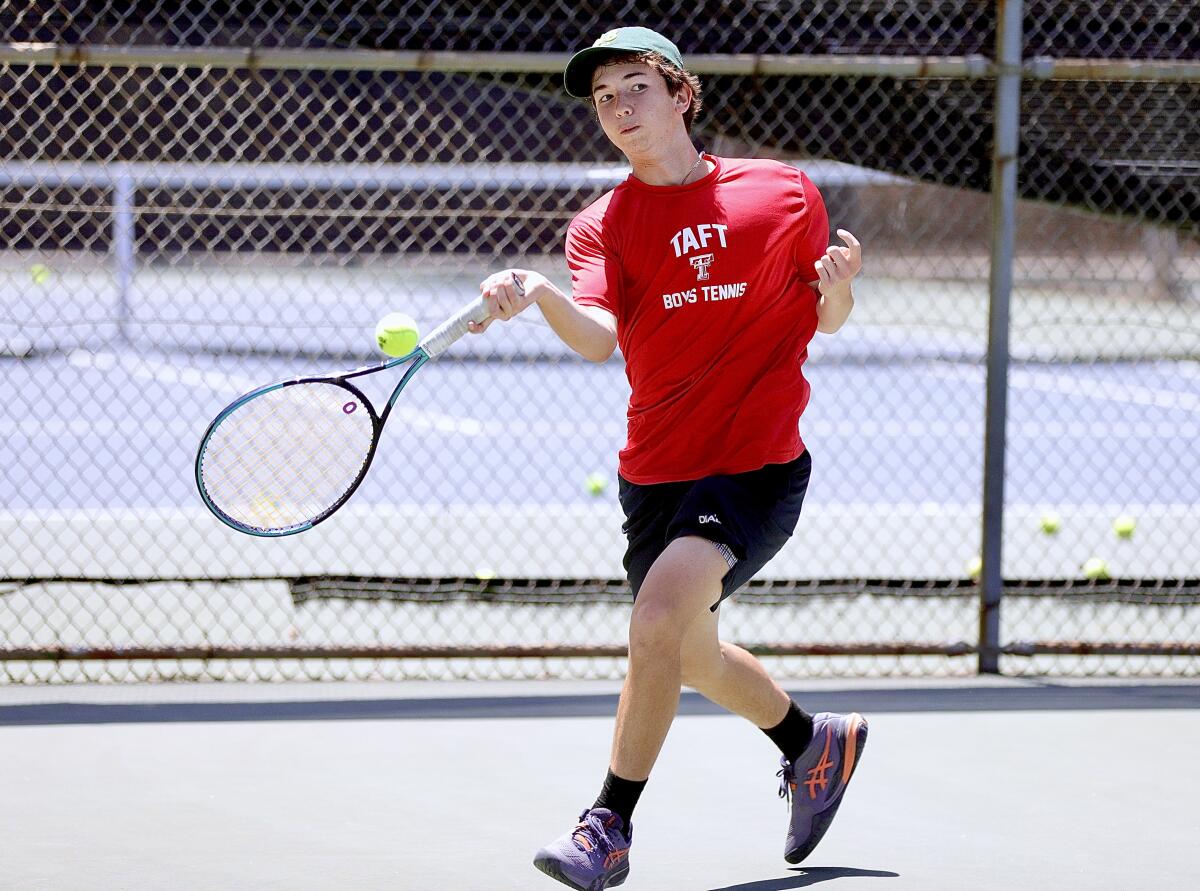
Taft's Dannes Djalilov won two sets at No. 1 singles during Wednesday’s City Section Open Division tennis final.

Taft’s Dannes Djalilov won two sets at No. 1 singles during Wednesday’s City Section Open Division tennis final.

(Steve Galluzzo / For The Times)

Danees Djalilov took two of his four sets at No. 1 singles and Brandon Celestine did the same at No. 4 for the second-seeded Toreadors, who were the last team to defeat Palisades in the finals — doing so in 2007 and 2008 led by two-time City individual singles winner Josh Tchan.

Moments after Ford finished off his 6-0 victory over Alec Volodarskiy to move his team within half a point of the championship, Stuffman and new partner Jack Plotkowski put the Dolphins over the 15-point threshold by completing a sweep at No. 1 doubles with a 6-2 ousting of Taft’s No. 2 team.

Taft was seeking its eighth City title and first since winning Division II in 2019.

Source link

Britain expels Russian diplomat after Moscow ousts British official

Britain on Wednesday summoned the Russian ambassador and revoked the accreditation of a Russian diploma. Seen here is the Consular Section of the Russian Embassy in Central London, Britain, in January 2017. File Photo by Will Oliver/EPA

April 30 (UPI) — Britain has expelled a Russian diplomat in retaliation for Moscow doing the same last month to a British official it accused of spying.

The tit-for-tat expulsions come as tensions rise between the two countries, with Britain accusing Russian submarines and undersea naval units in recent weeks of operating in and around British waters.

Britain’s Foreign, Commonwealth and Development Office announced the unidentified Russian diplomat’s expulsion Wednesday in a statement, saying it had summoned Russian Ambassador to Britain Andrei Kelin to inform him of the “reciprocal action.”

“Russia’s repeated unprovoked and unjustified actions are designed to disrupt our diplomatic work and form part of a wider campaign of aggressive behavior toward the U.K.,” the office said.

“Any further action by Russia will be treated as an escalation and met with a firm and proportionate response.”

UPI has contacted the Russian Embassy in London for comment.

The expulsion is in response to Russia expelling a British diplomat late last month who the Federal Security Service accused of being a British intelligence agent involved in “intelligence and subversive activities on Russian territory.”

The FSB identified the diplomat as Albertus Gerardus Janse van Rensburg, second secretary of the British Embassy in Moscow, stating he attempted to “obtain sensitive information during informal meetings with Russian economic experts.”

Britain’s foreign office on Wednesday condemned Russia’s “unjustified decision” to expel Janse van Rensburg and “the malicious public smear campaign that followed.”

“This behavior is wholly unacceptable, and we will not tolerate harassment or intimidation of our diplomatic staff,” it said.

The expulsion comes two weeks after Britain announced on April 9 that it had detected a Russian attack submarine entering international waters in the High North to distract from undersea naval units conducting “nefarious activity over critical undersea infrastructure elsewhere.”

The operation occurred several weeks before the announcement. Britain said the activity targeted subsea fiber-optic cables, which carry more than 99% of international data traffic, including voice calls and Internet data.

British and allied military assets were deployed, forcing the Russian GUGI units and Akula-class submarine to retreat, the Ministry of Defense said.

Source link

UN experts warn Gaza reconstruction cannot succeed without ending occupation – Middle East Monitor

UN experts said Wednesday that reconstruction in the Gaza Strip cannot succeed without ending Israel’s occupation and ensuring rebuilding efforts are rooted in human rights and Palestinian self-determination, Anadolu reports.

“The occupation must end, and the dispossession and discrimination against Palestinians must stop if rebuilding is to have any real chance of success,” the experts said in a statement.

Citing the Gaza Rapid Damage and Needs Assessment, they said more than 371,000 housing units have been destroyed or damaged, 1.9 million people displaced, and over 60% of the population remains homeless, with reconstruction needs estimated at more than $71 billion.

“The data confirms a pattern of structural discrimination that reconstruction efforts must urgently correct rather than reproduce,” they said, warning that women, persons with disabilities and older people face disproportionate hardship.

The experts said reconstruction must be inclusive, participatory, transparent and accountable, with Palestinians shaping decisions in line with their right to self-determination under international law.

READ: Former US official accuses Israel of genocide in Gaza, says Washington is complicit

They raised questions about governance of the process, saying the assessment does not address who would oversee reconstruction or whether the proposed “Board of Peace” by US President Donald Trump is consistent with international law.

The experts are also concerned that the assessment does not sufficiently embed human rights principles, warning that an emphasis on financial needs and infrastructure could reduce housing to mere shelter provision rather than ensuring dignity, security and long-term sustainability.

They said reconstruction could become “a race for profits” without safeguards protecting vulnerable groups.

“Reconstruction is not only about rebuilding structures – it is about restoring rights, dignity and equality,” they said.

They urged states and donors to place human rights at the center of Gaza’s reconstruction, warning failure to do so “risks entrenching injustice and prolonging the suffering of Palestinians for generations.”

READ: Israeli court extends detention of Gaza hospital director Abu Safiya ‘without charges’

Source link

Days Of Our Lives & Melrose Place star Patrick Muldoon’s tragic cause of death confirmed after his sudden collapse at 57

PATRICK Muldoon’s tragic cause of death has been confirmed after the soap star’s sudden collapse at the age of 57.

The Days Of Our Lives and Melrose Place actor died from a heart attack, according to official records, with several underlying health conditions also revealed.

Patrick Muldoon, aged 57, died from a heart attack on April 19, as confirmed by his death certificate Credit: Splash
Contributing factors to his death included a hereditary coagulopathy disorder and a pulmonary embolism Credit: Getty

New details show Muldoon suffered a myocardial infarction – more commonly known as a heart attack – on April 19, as confirmed by his death certificate.

The document, released by the County of Los Angeles’ Department of Public Health, also listed contributing factors to his death.

These included a hereditary coagulopathy disorder, which affects blood clotting, and a pulmonary embolism – a dangerous blood clot that travels to the lungs and blocks blood flow.

The actor was cremated on Tuesday, with his occupation listed as both actor and producer.

Read more on Celebrity Deaths

SOAP STAR TRAGEDY

Days Of Our Lives & Melrose Place actor dies ‘suddenly’ at 57


RIDE OVER

Country singer David Allen Coe who penned Take This Job and Shove It dies at 86

His sister, Shana Muldoon-Zappa, had earlier shared that he died of a heart attack, posting a touching tribute alongside a final video sent to family just hours before his death.

In the clip, Muldoon is seen joking while showing a painting at the Los Angeles County Museum of Art.

“As always, he jokes… and yet profoundly brings all things into one moment,” she wrote.

“The joke-ster, the artist, the football player, and the intensely spiritually connected, Jesuit educated, incredible being that is Patrick Muldoon. My best friend. The best brother/son/uncle/anyone could ever possibly ask for.”

Most read in Entertainment

“I will have so much more to share as I know he loves this earthly realm and all he created within it,” she continued, “including all of the love and light his spirit is now receiving through all of you…. Surrounding you in light.”

Tributes also poured in from friends and co-stars, including actress Barbara Eden.

Patrick Muldoon as Austin, pictured with Days Of Our Lives co-star Christie Clark as Carrie Credit: Getty
Patrick Muldoon – pictured in A Boyfriend For Christmas, 2005 – is set to have his final film released later this year Credit: Shutterstock Editorial

“Patrick was a sweet man who was very personable,” she said.

“I enjoyed the time we spent between takes and just enjoying each other’s company in general during the production of the film. He made the experience even more fun.”

“While the passing of a loved one is never easy,” she added, “it is especially difficult when it’s unexpected and sudden as I understand Patrick’s was. My thoughts and condolences are with his family and friends.”

Born in San Pedro, California, Patrick Muldoon shot to fame in the 1990s after launching his career while studying in the University of Southern California, where he also played football.

He first appeared on Who’s the Boss? before landing a role on Saved By the Bell after graduating in 1991.

His big break came as Austin Reed on Days of Our Lives, a role he originated between 1992 and 1995 before returning years later.

Muldoon later played villain Richard Hart on Melrose Place and starred in a string of TV movies.

On the big screen, he was known for playing Zander Barcalow in the 1997 sci-fi hit Starship Troopers.

His final film, Dirty Hands, is due for release later this year.

Away from the spotlight, Muldoon worked behind the scenes as an executive producer on a number of films and was also passionate about music, performing as lead singer of The Sleeping Masses.

Known as “Bobo” to loved ones, Muldoon is survived by his partner Miriam Rothbart, his parents, his sister and extended family.

Muldoon was also passionate about music and performed as lead singer for The Sleeping Masses, often seen playing guitar and entertaining friends Credit: EPA

Source link

‘Earthquake’: Supreme Court limits Voting Rights Act in setback for Black Democrats, boost for GOP

The Supreme Court’s conservative majority on Wednesday sharply limited a part of the Voting Rights Act that has forced states to draw voting districts to help elect Black or Latino representatives to Congress as well as state and local boards.

In a 6-3 decision in Louisiana vs. Callais, the court ruled that creating these majority-minority districts may amount to racial discrimination that violates the 14th Amendment.

When weighing what the Voting Rights Act requires, “we start with the general rule that the Constitution almost never permits the federal government or a state to discriminate on the basis of race,” Justice Samuel A. Alito Jr. wrote for the court.

Alito said states may draw election districts for partisan advantage but may not use race as a basis for redistricting.

The ruling in a Louisiana case appears to clear the way for Republican-led states across the South to redraw their election maps and eliminate voting districts that favor Black or Latino candidates for Congress, state legislatures and county boards.

UCLA law professor Rick Hasen said, “It is hard to overstate what an earthquake this will be for American politics,” adding that the decision makes the Voting Rights Act a “much weaker, and potentially toothless law.”

Hasen said it’s unclear how the decision will affect the November election because in many states early voting has already started and primaries have already taken place.

But the ruling’s long-term consequences for minority representation in Congress, state legislatures and local government are almost “certainly” going to be felt in 2028, Hasen said.

Republican leaders in states across the South have already signaled they intend to move quickly to redraw congressional maps in the wake of the ruling.

Alabama Atty. Gen. Steve Marshall said the state will “act as quickly as possible” to ensure its congressional maps “reflect the will of the people, not a racial quota system the Constitution forbids.” Marshall called the decision a recognition of how much the South has changed since the civil rights era.

“The court rightly acknowledged that the South has made extraordinary progress, and that laws designed for a different era do not reflect the present reality,” he said in a statement.

Florida was already in motion before the ruling came down. But Gov. Ron DeSantis celebrated the decision and said it was all the more reason for state lawmakers to redraw its congressional maps, in a manner that could give Republicans up to four more seats in Congress.

The proposed congressional maps, drawn by DeSantis’ office, were first unveiled to Fox News on Monday. On Wednesday, both chambers approved the maps, and readied them for DeSantis’ final approval.

In Mississippi, Gov. Tate Reeves had already called lawmakers into a special session at the end of May in anticipation of a court ruling on the Voting Rights Act. In a post on X, Reeves underscored the ideological underpinnings to the ruling’s potential implications.

“First Dobbs. Now Callais. Just Mississippi and Louisiana down here saving our country!” Reeves wrote.

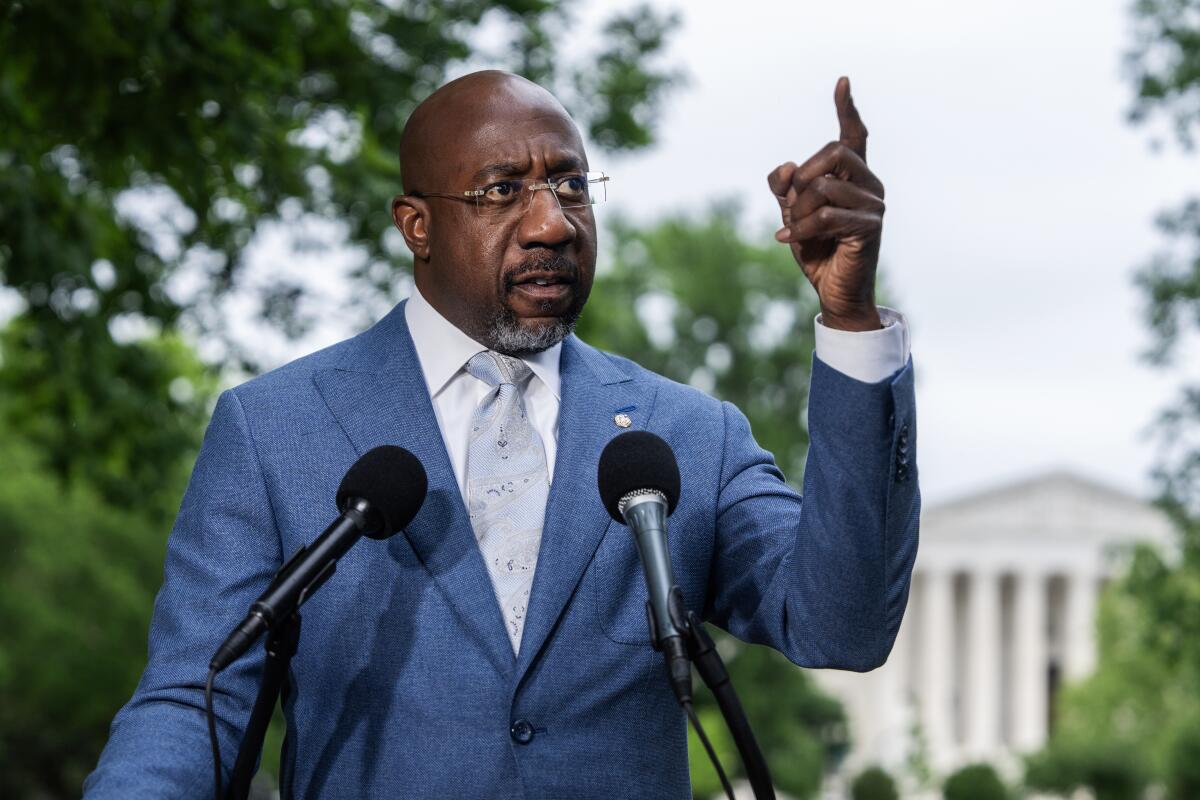
Sen. Raphael Warnock of Georgia speaks outside the Capitol.

Sen. Raphael Warnock (D-Ga.) speaks at a news conference outside the U.S. Capitol after the Supreme Court ruling.

(Tom Williams / CQ-Roll Call / Getty Images)

At issue was how to ensure equal representation for Black and Latino citizens.

About one-third of Louisiana’s voters are Black, but the state seeks an election map that will elect white Republicans to five of its six seats in the House of Representatives.

Lower courts said that map violated the Voting Rights Act because it denied fair representation to Black residents.

The state had one Black-majority district, in New Orleans.

Two years ago, judges upheld the creation of a second Black-majority district that stretched from Shreveport to Baton Rouge on the grounds that it was required under the law.

The state’s Republican leaders appealed and argued that race was the motivating factor in drawing the second district.

Alito and the conservatives agreed and called that district an “unconstitutional racial gerrymander.”

The three liberals dissented. The consequences of the ruling “are likely to be far-reaching and grave,” said Justice Elena Kagan, adding that it will allow “racial vote dilution in its most classic form.”

She said the decision means “a state can, without legal consequence, systematically dilute minority citizens’ voting power. Of course, the majority does not announce today’s holding that way. Its opinion is understated, even antiseptic.”

But she said states across the South may draw electoral districts that deprive Black voters of equal representation. Justices Sonia Sotomayor and Ketanji Brown Jackson agreed.

The decision was the latest example of a partisan political dispute in which the court’s six Republican appointees vote in favor of the Republican state plan, while the three Democratic appointees dissent.

The ruling is likely to have its greatest impact in the Southern states, where white Republicans are in control and Black Democrats are in the minority.

The court’s divide over redistricting is similar to the long dispute over affirmative action.

For decades, university officials said they needed to consider the race of applicants to achieve diversity and equal representation.

But in 2023, the court by a 6-3 vote struck down college affirmative action policies at Harvard and the University of North Carolina and ruled race may not be used to judge applicants.

The historic Voting Rights Act of 1965 succeeded in clearing the way for Black citizens to register and vote across the South, but it took longer for Black candidates to win elections.

The dispute was highlighted in a 1980 case from Mobile, Ala. Its three commissioners were elected to six-year terms, and each of them ran countywide.

Even though one-third of the county’s voters were Black, white candidates always won.

The Supreme Court upheld this arrangement as legal and constitutional. In dissent, Justice Thurgood Marshall said Black residents were left with the right to cast meaningless ballots.

In response, Congress amended the Voting Rights Act in 1982 to say states must give minorities an opportunity to elect representatives of their choice.

Four years later, the Supreme Court interpreted that to mean that states had a duty to draw voting districts that would elect a Black or Latino candidate if these minorities had a sufficiently large number of voters in a particular area.

In recent years, the court’s conservatives, led by Justice Clarence Thomas, have chafed at the rule on the grounds it sometimes required states to use race as a factor for drawing election districts.

Alito’s opinion adopted that view and said states are not required or permitted to use race as a basis for drawing districts.

Hours after the ruling came out, President Trump met with reporters in the Oval Office and said he had not yet seen the decision. He was visibly excited, however, when a reporter explained the decision favored Republicans.

“I love it!” he said. “This is very good.”

Former President Obama said in a statement that the court’s decision “effectively guts a key pillar of the Voting Rights Act, freeing state legislatures to gerrymander legislative districts to systematically dilute and weaken the voting power of racial minorities — so long as they do it under the guise of ‘partisanship’ rather than explicit racial bias.”

The Mexican American Legal Defense and Educational Fund, in Los Angeles, also denounced the decision.

“The Supreme Court’s decision blesses racially discriminatory gerrymandering, and dismantles the legal protections for minority voters,” said Nina Perales, the group’s vice president for litigation. It “openly invites states to dilute minority voting strength, and undermines our democracy.”

Source link

High school boys’ volleyball: Wednesday’s playoff scores and Thursday’s schedule

SOUTHERN SECTION BOYS VOLLEYBALL PLAYOFFS

WEDNESDAY’S RESULTS

FIRST ROUND
DIVISION 1
Mira Costa, bye
Tesoro d. Los Alamitos, 25-19, 25-23, 25-17
Corona del Mar d. Mater Dei, 3-0
Huntington Beach, bye
Loyola, bye
Newport Harbor d. Millikan, 25-8, 25-13, 25-19
Santa Margarita d. San Marcos, 3-0
Redondo Union, bye

DIVISION 2
Camarillo d. Anaheim Canyon, 25-21, 25-17, 25-18

DIVISION 3
Palos Verdes d. Corona Centennial, 3-1
Sage Hill d. Malibu, 3-1
Valencia d. La Palma Kennedy, 25-12, 25-20, 25-20
Claremont d. Murrieta Valley, 3-1
Corona Santiago d. Mark Keppel, 3-2
Eastvale Roosevelt d. Downey, 3-1
Bishop Montgomery d. South Torrance, 3-2
St. John Bosco d. Woodbridge, 3-1
Mission Viejo d. Paloma Valley, 25-20, 25-15, 25-18
Santa Ana Foothill d. Canyon Country Canyon, 25-20, 25-19, 25-16
Servite d. Wiseburn Da Vinci, 3-0
Santa Barbara d. Diamond Ranch, 3-1
Trabuco Hills d. Westlake, 3-0
Crescenta Valley d. North Torrance, 25-18, 25-15, 25-21
Saugus d. Newbury Park, 25-23, 25-23, 23-25, 30-28
Windward d. South Pasadena, 3-0

DIVISION 5
Dos Pueblos d. Aquinas, 21-25, 20-25, 25-15, 25-11, 15-13
Hemet d. Summit, 3-2
Oak Park d. Damien, 25-22, 26-24, 25-16
El Dorado d. San Dimas, 3-1
Westminster La Quinta d. Garden Grove Pacifica, 3-2
Bishop Diego d. Rio Hondo Prep, 25-22, 25-22, 31-29
Brea Olinda d. Aliso Niguel, 26-24, 16-25, 25-21, 29-27
Norco d. Cajon, 23-25, 25-22, 25-17, 12-25, 15-13
Bellflower d. Crespi, 25-16, 25-22, 25-15
El Rancho d. San Gabriel Academy, 3-1
Ventura d. Vista del Lago, 25-14, 25-18, 25-21
Flintridge Prep d. Castaic, 3-0
St. Anthony d. Oxford Academy, 3-0
Orange County Pacifica Christian d. Etiwanda, 25-16, 25-16, 25-19
Ontario Christian d. Monrovia, 25-23, 25-21, 23-25, 25-18
Western Christian d. Westminster, 3-2

DIVISION 7
Pasadena Marshall d. La Mirada, 3-2
Rialto d. Rosemead, 3-1
La Sierra Academy d. Sierra Vista, 3-0
Trinity Classical Academy d. Canyon Springs, 25-19, 25-19, 25-19
Hacienda Heights Wilson d. Maranatha, 3-1
Cerritos Valley Christian d. Norwalk, 25-21, 25-15, 25-23
Foothill Tech d. Anaheim, 3-0
Bell Gardens d. Ganesha, 25-17, 25-21, 25-17
Long Beach Jordan d. Jurupa Valley, 3-0
Oakwood d. Savanna, 3-1
Knight d. Santa Ana, 3-2
Godinez d. Santa Barbara Providence, 3-2
Los Amigos d. San Jacinto Valley, 3-2
Indio d. Katella, 3-1
Tustin d. Highland, 3-0
Loara d. Gabrielino, 3-2

DIVISION 9
Palm Valley d. Bassett, 25-15, 28-26, 25-17
Webb d. Inglewood, 3-2
Le Lycée d. Acaciawood Academy, 25-16, 25-20, 25-21
Edgewood 3, Rim of the World 2
Indian Springs d. Compton Early College, 25-21, 25-20, 19-25, 25-13
YULA d. Coachella Valley, 3-0
Duarte d. Southwestern Academy, 3-0
Vasquez d. Legacy College Prep, 20-25, 25-20, 25-18, 25-19
Wildwood d. Garden Grove Santiago, 3-2
Cantwell Sacred Heart d. Pilgrim, 3-1
Bethel Baptist d. Pacific Lutheran, 3-2
Avalon d. South El Monte, 3-1
Downey Calvary Chapel d. Xavier Prep, 3-1
Southlands Christian d. New Covenant, 3-0

THURSDAY’S SCHEDULE
(Matches at 6 p.m. unless noted)

SECOND ROUND

DIVISION 4
Village Christian at Bolsa Grande, Friday
Chino Hills vs.Long Beach Poly at Lakewood
Warren at Temple City
Liberty at Royal
Sunny Hills at St. Monica Prep
Northwood at Elsinore
Crossroads at Los Altos
Harvard-Westlake at San Marino

DIVISION 6
Temecula Valley at St. Francis
San Gabriel at Beverly Hills
Culver City at El Modena
Samueli Academy at Firebaugh
Ayala at Garden Grove
Moorpark at Capistrano Valley Christian
Pasadena Poly at Yucaipa
Santa Ana Calvary Chapel at Cerritos

DIVISION 8
Temescal Canyon at West Covina
Paramount at Santa Rosa Academy, 5 p.m.
Miller vs. CAMS at Long Beach Cabrillo
Cathedral City at Eastside
Burbank Providence at Temecula Prep
West Valley at Laguna Blanca
Palmdale Aerospace Academy at Garey
Desert Hot Springs at Glendale Adventist, 5 p.m.

Note: Second Round Divisions 3, 5, 7, 9 May 1; Quarterfinals Divisions 1 & 2 May 5; Quarterfinals Divisions 3-9 May 6; Semifinals All Divisions May 9; Finals All Divisions May 15-16.

Source link

On This Day, April 30: Vietnam War comes to end

April 30 (UPI) — On this date in history:

In 1789, George Washington was inaugurated as the first president of the United States.

In 1803, the United States more than doubled its land area with the Louisiana Purchase. It obtained all French territory west of the Mississippi River for $15 million.

In 1812, Louisiana entered the union as the 18th U.S. state.

In 1927, Douglas Fairbanks and Mary Pickford became the first movie personalities to leave their footprints in concrete at Grauman’s Chinese Theater in Hollywood.

File Photo by Jim Ruymen/UPI

In 1939, Franklin D. Roosevelt became the first U.S. president to appear on television when he was shown on opening day at the New York World’s Fair.

In 1945, the burned body of Nazi dictator Adolf Hitler was found in a bunker in the ruins of Berlin.

In 1948, 21 countries of the Western Hemisphere formed the Organization of American States.

In 1967, Muhammad Ali was stripped of his world heavyweight boxing championship title after he refused to be drafted into the U.S. military.

In 1975, South Vietnam unconditionally surrendered to North Vietnam. The communists occupied Saigon and renamed it Ho Chi Minh City.

In 1997, Ellen DeGeneres’ character came out as gay on the popular sitcom Ellen, making it the first sitcom to feature a gay leading character. The local ABC affiliate in Birmingham, Ala., refused to air the episode so gay rights advocates arranged for a satellite downlink to beam the show.

In 1993, tennis star Monica Seles was stabbed and injured by a self-described fan of Steffi Graf during a break between games in a match against another player in Hamburg, Germany. Seles, who won nine grand-slam singles titles in her career, was out of competitive tennis for more than two years after the attack.

In 2006, rebel factions in Sudan rejected a peace agreement in the Darfur conflict. Officials estimated the fighting had killed at least 180,000 people and driven more than 2 million from their homes.

File Photo by Debbie Hill/UPI

In 2009, Chrysler filed for bankruptcy protection in a key move of a restructuring plan backed by the Obama administration.

In 2012, Israel began construction of a wall that would be 23 feet high and less than a mile long on its border with Lebanon. Security officials said the concrete wall would protect residents in the Matulla area from sniper fire from nearby Lebanese villages.

In 2013, Queen Beatrix, the 75-year-old monarch of the Netherlands, signed a formal declaration abdicating in favor of her eldest son, Willem-Alexander, 46, who became the country’s first king in 123 years.

In 2019, Japanese Emperor Akihito, 85, formally abdicated his throne, becoming the nation’s first monarch to step down in 200 years. His son, Crown Prince Naruhito, ascended to the throne, starting the Reiwa era.

In 2022, country legend Naomi Judd, one half of duo the Judds, died at the age of 76.

File Photo by Frederick Breedon/UPI

Source link