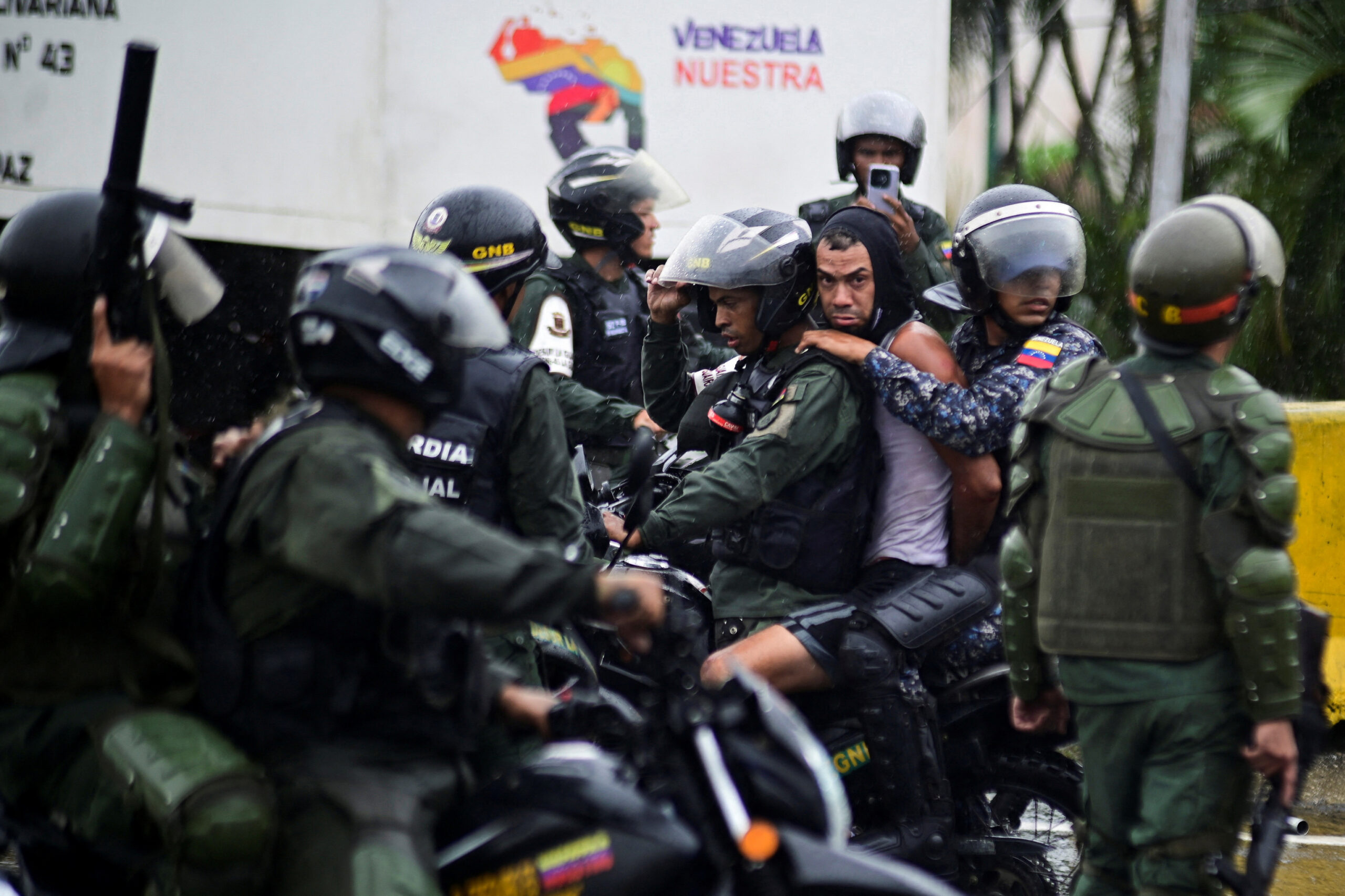
Photograph by Maxwell Briceño for Reuters, 2024.
Human beings invented States to protect themselves from catastrophe. You understand this in Lewis Mumford’s books on the first cities or in Jared Diamond’s on civilizational collapse: we went from nomadic tribal groups to organized societies of thousands of people because we learned to organize governments that, besides making some richer and more powerful than others, reduced the chances of dying from hunger, cold, disease, or enemy attack.
Until the mid-20th century, Venezuela did not have a State that significantly reduced the primitive precarity of its population, that defended it from catastrophe. As in so many other places on Earth, it was then that Venezuelans began to benefit from technology and institutions that saved them from dying of starvation or influenza. There had been previous efforts, from Páez’s first economic reconstruction programs and Guzmán Blanco’s compulsory education to Gómez’s road construction.
But it was with the López Contreras administration in 1936 that we began to see institutions functioning on a truly national scale, vaccination and literacy campaigns, a systematic effort to transform a dispersed, sparsely populated society with a very low life expectancy, where the vast majority of people were sick and malnourished, into a functional and productive one. During those decades, the governments of López Contreras, Medina Angarita, the 1945-1948 junta, Gallegos, and Pérez Jiménez took advantage of oil revenues to implement measures that benefited the people. With democracy, in 1958, came more public works and institutional innovations, such as the expansion of political rights.
With Chávez, the decadent welfare state we had not only ceased to protect society from catastrophe, but became the cause of the catastrophe. It was like teaching a loyal guard dog to kill the children in the house.
Until that promise of development for all was broken, inequality began to grow, vulnerability began to regain ground, and a frustrated and confused society chose Hugo Chávez as its answer, precisely in the year, 1998, that marked five centuries since the first contact with Spain. It had taken us half a millennium to have a State that provided health, education, justice, and order. That year, that history of progress halted, and the long road traveled began to unravel.
Reversal and investment
As Paula Vásquez Lezama described it, since the Vargas tragedy in 1999, when chavismo appropriated the bodies of the survivors, everything the State gave demanded in return helping that State grow and maintain itself. As Mirtha Rivero recounts in La oscuridad no llegó sola, chavismo used every crisis to seize control of the entire State. Once it had it in its hands, it turned it upside down. The State that should have served society now only had to serve power, against society.
With Chávez, the decadent welfare state we had not only ceased to protect society from catastrophe, but became the cause of the catastrophe. It was like teaching a loyal guard dog to kill the children in the house.
Chavismo deepened all the vices of those previous governments to reverse the complicated history of our development and invert the role of the State. The long-standing culture of police and military violence expanded to turn the entire country into a checkpoint, where the armed forces behave like an army of occupation that treats all natives as enemies, on a scale that covers the entire territory, not just the slums riddled with bullets during the Caracazo. The perennial culture of corruption among civil servants was perfected to privatize the public administration, which does nothing unless its staff is paid personally, and to transform the bureaucracy into an industry for extracting wealth from citizens and the land, far more voracious than under any dictatorial or democratic government prior to 1999.
As long as this perpetrator State exists, we will not have any transition to democracy in Venezuela.
The elephantine State erected by Chávez had lost much of its muscle mass by 2020, but it remained, and remains, capable of subjugating a nation diminished by the miniaturization of its economy and mass migration. Maduro redesigned repression to maximize the yield of his limited resources. And so he reached the point where he discovered, especially after the 2024 electoral fraud, the efficiency of kidnapping a minor, because that means imprisoning an entire family and the community network to which the family turns to.
The method of subjugating society by harming entire families is evident in the Víctor Quero case. It wasn’t administrative chaos that prevented his family from knowing whether he was alive or dead, nor was it that the clerks couldn’t find the file with his name on it. It was terror, a set of practices that a regime, illegitimate and rejected by the majority of the population, implemented to minimize the chances of losing power. That State, which for decades attempted to be a welfare state, providing public goods to millions of citizens, now focuses on managing harm to those millions in order to provide private goods to the few thousand who control it.
Beyond the anger we feel over the story of Carmen Navas asking about her son from the cruel giant who killed him, the Víctor Quero case is causing such a stir because of how it exposes the way the Venezuelan State has become the very opposite of what it should be. Instead of saving people from misfortune, it inflicts misfortune to govern through fear. Instead of being accountable, it lies and sows confusion for months as a form of torture. Instead of being the state of law and justice promised by the Constitution that frames it, it is a criminal State where justice does not exist.
The great work of chavismo
This is the State that killed Víctor Quero and that forced an elderly woman, for more than nine months, to undertake the economic and logistical challenge of visiting courts and prisons, even outside Caracas, driven by the hope of seeing her son again before he died.
And this State is the main achievement of chavismo.
Previous governments, whose main task was to govern for better or for worse, left behind a legacy of buildings and institutions, from banks and State-owned enterprises to schools, museums, and universities, which were a mix of successes and failures. Chavismo will leave some buildings and infrastructure projects, far too few considering the revenue it received during almost three decades in power. But the main creation of chavismo is this gigantic state that serves only to subjugate society.
And as long as this perpetrator State exists, we will not have any transition to democracy in Venezuela. We will not be able to return to the path of democracy and development from which chavismo diverted us.