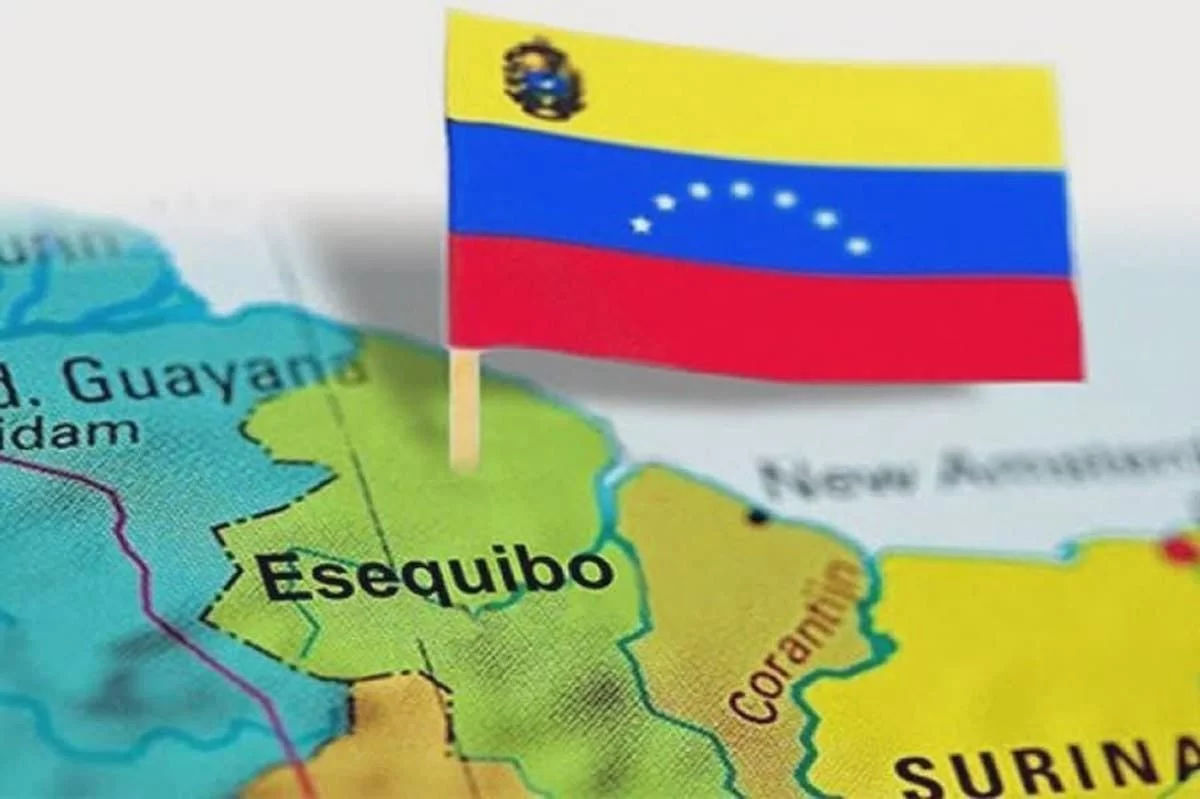
The territorial dispute flared up over the discovery of massive offshore oil deposits. (Archive)
Mérida, February 18, 2026 (venezuelanalysis.com) – The Venezuelan government commemorated the 60th anniversary of the Geneva Agreement and urged Guyana to engage in “good faith negotiations” to settle the longstanding dispute over the Essequibo Strip.
In a statement published on Tuesday, Caracas celebrated six decades of the agreement and reiterated that the treaty is “the only valid legal instrument for reaching a mutually acceptable solution to the dispute” over the 160,000 square-kilometer territory.
The 1966 accord, signed by Venezuela, the United Kingdom, and British Guiana, a British colony at the time, saw the different parties pledge to find an agreeable solution to the border issue.
The Venezuelan government’s communique noted that the treaty was submitted to the United Nations, arguing that it overruled the controversial 1899 arbitration ruling which awarded the territory to the United Kingdom.
The text also reaffirmed Venezuela’s sovereignty claim over the resource-rich territory and referenced the popular mandate from the December 3, 2023, referendum that saw over 90 percent of respondents back the country’s rights over the Essequibo Strip.
“The only possible solution to the territorial controversy is to engage in good faith negotiations, to achieve a satisfactory arrangement for the two parties that signed the Geneva Agreement,” the declaration concluded.
The Guyanese government responded on Wednesday with its own statement, arguing that the Geneva Agreement did not annul the 1899 Arbitral Award but rather established a framework for resolving the dispute that arose when Venezuela questioned the border’s validity in 1962.
Georgetown likewise noted that, in January 2018, the Secretary-General of the United Nations determined that the “good offices” mechanism had been unsuccessful in resolving the dispute.
“In accordance with Article IV (2) of the Geneva Agreement, the Secretary-General decided to submit the case to the International Court of Justice (ICJ) as the final means of resolution. Both Guyana and Venezuela were bound by that decision.”
Hours later, the Venezuelan government issued a second statement accusing Guyana of attempting to distort the spirit of the Geneva Agreement and reiterating Caracas’ position rejecting the ICJ’s jurisdiction over the border controversy.
“Venezuela will not recognize any decision emanating from the International Court of Justice on the territorial dispute surrounding Guayana Esequiba,” the document read.
Despite rejecting the Hague-based court’s authority on the matter, the Venezuelan government participated in a documentation-gathering process before the ICJ during 2023 and 2024. Acting President Delcy Rodríguez, then vice president, led the country’s legal efforts.
In August 2025, Caracas submitted further evidence backing its Essequibo sovereignty claim and challenging Georgetown’s historical and legal arguments. The case will advance to the oral hearings phase in May 2026.
In January, the Guyanese Minister of Foreign Affairs and International Cooperation, Hugh Todd, claimed that the ICJ’s ruling would be binding for both nations and that the case was now in the hands of “the highest and most respected judicial authority in the world.”
The longstanding territorial controversy flared up in 2015 after ExxonMobil discovered and began exploiting massive offshore oil reserves. Venezuelan authorities have raised their sovereignty claims and criticized Guyanese counterparts for giving drilling permits to multinational corporations in undelimited waters.
Caracas has also criticized the US’ interference in the issue, with successive administrations offering their full backing to Georgetown. Venezuelan authorities have accused Washington of stoking regional tensions amid plans to establish military bases in Guyana.
Edited by Ricardo Vaz in Caracas.