Since the start of the war, there have been several negotiation initiatives between the United States and Iran. Only one – the memorandum of understanding signed in Islamabad on June 18 – was concluded, but it collapsed within days.
While prevailing analyses tend to explain this failure through the details of the provisions, this article proceeds from a different premise: that the diplomatic stalemate between the two sides is shaped by a syndrome that has governed US-Iranian relations for years.
In international relations, psychological syndromes can arise as a result of deep crises that leave their mark on political consciousness and memory, potentially obstructing efforts at rapprochement and negotiation between countries.
In the case of Iran and the US, the syndrome is comprised of two complexes: the complex Washington developed as a result of the 1979 siege of the US embassy in Tehran and the complex Tehran developed as a result of historical US hostility and its withdrawal from the Iran nuclear deal in 2018.
The roots of the rupture between the two countries go as far back as August 1953 when US and British intelligence agencies helped overthrow the nationalist government of Mohammad Mosaddegh after it nationalised the oil industry in 1951. Since then, a perception has become entrenched in Iranian consciousness: that Washington does not accept an independent government in Tehran and it is prepared to sabotage it if it goes against its interests.
From this perspective, Washington’s decision to host Shah Reza Pahlavi, who had just been overthrown by his people, for medical treatment in October 1979 was read in revolutionary Tehran as a prelude to a second coup.
Iranian students stormed the US embassy on November 4 that year and held 52 Americans for 444 days. Diplomatic relations between the two countries were severed and have not been restored to this day.
While the incident is portrayed in the Iranian narrative as a defence of the revolution, in American consciousness, it established the image of Iran as a state that does not respect international norms, whose word cannot be relied upon and whose behaviour should not be rewarded.
That is the embassy siege complex. It is not about the incident itself so much as the informal rule it produced in US decision-making: that Iran must concede first and its concession must be verified before it receives anything in return.
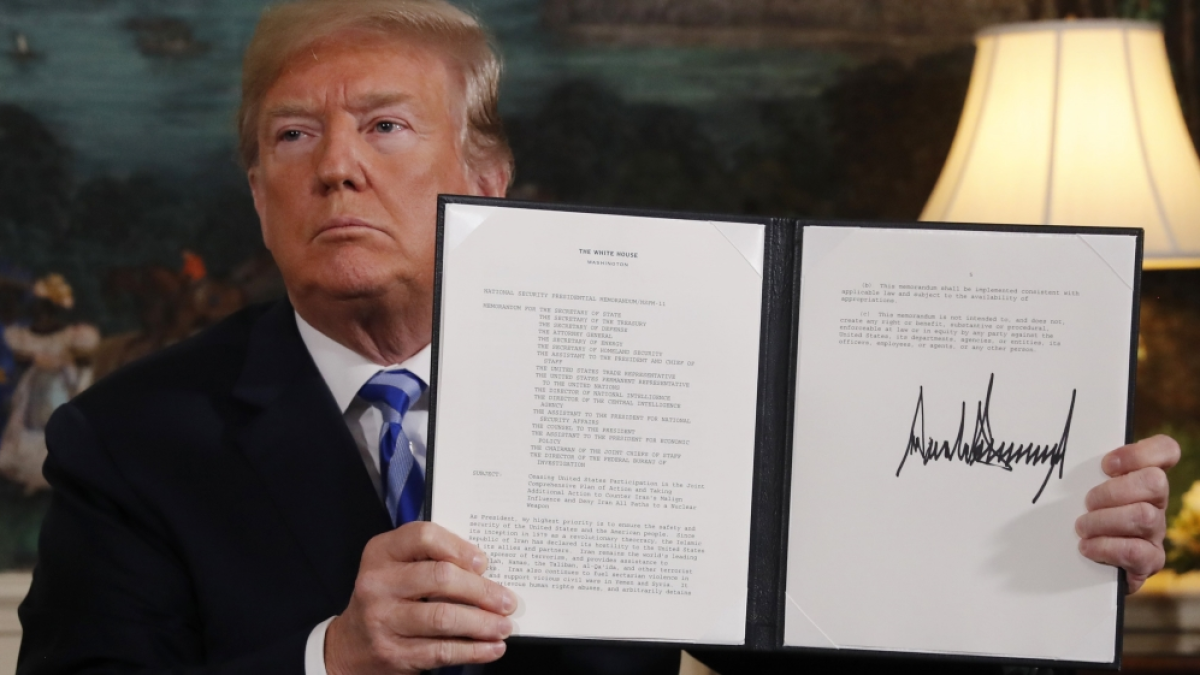
The Iranian complex was shaped by this history as well, but it reached its peak in May 2018 when US President Donald Trump withdrew from the Joint Comprehensive Plan of Action (JCPOA) despite the International Atomic Energy Agency’s (IAEA’s) confirmation that Tehran was complying with it.
Just two weeks later, US Secretary of State Mike Pompeo announced 12 demands for a new deal, only four of which were related to the nuclear file. Seven of them were related to Iran’s regional behaviour in Lebanon, Palestine, Iraq, Yemen, Syria, Afghanistan and the Gulf. In other words, Washington did not merely revoke an existing agreement; it also raised the ceiling of its conditions for any future agreement.
The knot then deepened in June 2025 when the US took part in the Twelve-Day War and struck the nuclear facilities at Fordow, Natanz and Isfahan at a time when a new round of indirect negotiations was scheduled in Muscat. It then reached its furthest point with Washington’s participation alongside Israel in the current war.
Accordingly, a conviction became entrenched in the Iranian consciousness that an American signature guarantees nothing, that any agreement can be overturned with a change of administration and indeed that negotiation itself may be a cover for war rather than an alternative to it.
The informal rule this has produced in Iranian decision-making is that there will be no step taken before binding guarantees and no concession before pressure is lifted.
Thus, the two complexes stand at opposite ends: The first requires Iranian action before an American quid pro quo while the second requires an American guarantee before Iranian action.
A reading of the recent negotiation initiatives shows that every US initiative bears the imprint of the embassy siege complex. The 15-point plan put forward in March demanded the dismantling of the Natanz, Isfahan and Fordow facilities; an end to uranium enrichment; the suspension of Iran’s missile programme; and the abandonment of its allies in exchange for promises to lift sanctions later.
The May draft by White House envoys Steve Witkoff and Jared Kushner linked the release of Iran’s frozen funds to the suspension of enrichment first. The American response in September also stipulated the freezing of enrichment and the entry of inspectors throughout the negotiation period.
What remains constant in the American initiatives is that Iranian action precedes the quid pro quo and verification precedes trust.
The imprint of the JCPOA withdrawal complex in the Iranian initiatives is also a constant. The five-point response in late March demanded guarantees that war would not be repeated. The 10 points put forward in April demanded a binding UN Security Council resolution shielding any agreement from being overturned. And the 14 points in May demanded a nonaggression pledge that includes Israel.
Meanwhile, the seven-day plan proposed by Tehran last month stipulated the lifting of sanctions and the US naval blockade on Iran before the opening of the Strait of Hormuz on the sixth day and the start of nuclear negotiations on the seventh. What remains constant in the Iranian initiatives is that guarantees precede action and the lifting of pressure precedes Iranian concessions.
All these initiatives were dialogue between two complexes with each side drafting its text to protect itself from a repetition of its historical experience with the other, rather than to meet the other halfway. This may explain why the gap in substance has narrowed, but the gap in trust has not.
The Islamabad memorandum represents the exception that proves the rule as it was the closest moment to a settlement because it was formulated to reassure both sides over their core concerns. To reassure Washington, it stipulated the dilution of Iran’s stockpile of enriched uranium and made the lifting of sanctions and unfreezing of funds conditional on Iranian implementation.
To reassure Tehran, it provided for an end to hostilities, respect for mutual sovereignty, a mechanism to monitor implementation and UN Security Council approval of the final agreement. Ballistic missiles were also entirely absent from the text.
But this agreement did not hold. Tehran suspended its participation in the Geneva round of talks because of the absence of a ceasefire in Lebanon, which had been a consistent demand in every Iranian initiative since March. In the Iranian reading, Washington’s inability to rein in Israel confirmed that an American signature was not enough. The JCPOA withdrawal complex immediately kicked in, and the two sides returned to square one.
By late September, the dispute appeared to have shifted definitively from substance to sequencing. Informed sources indicated that it now revolves around the order of steps rather than their content and the stated goal has become a return to an enhanced version of the June memorandum.
Here the two complexes appear in their clearest form: Washington wants the Strait of Hormuz opened and enrichment frozen first because it does not trust Iran while Tehran wants the naval blockade lifted first because it does not trust the US.
A comparison between Pompeo’s 2018 conditions and the June 2026 memorandum shows that US demands have retreated from redefining Iran’s regional role to focusing on the nuclear file and the Strait of Hormuz while Iranian demands have shifted from compensation to be paid by Washington to a conditional investment fund financed by other parties.
In other words, the substantive gap between the two sides has narrowed considerably – something that would have been unimaginable eight years ago.
However, the two complexes have not diminished; indeed, they may have deepened because of the war. Each complex feeds the other until together they have become a single syndrome, and diplomatic deadlock has turned from a passing condition into a stable structure.
Accordingly, any new formula for sequencing the steps, however precise, will remain unable to break this deadlock unless it addresses both complexes at once – something that requires a third party capable of guaranteeing both the action and the reciprocal action simultaneously.
The views expressed in this article are the author’s own and do not necessarily reflect Al Jazeera’s editorial stance.