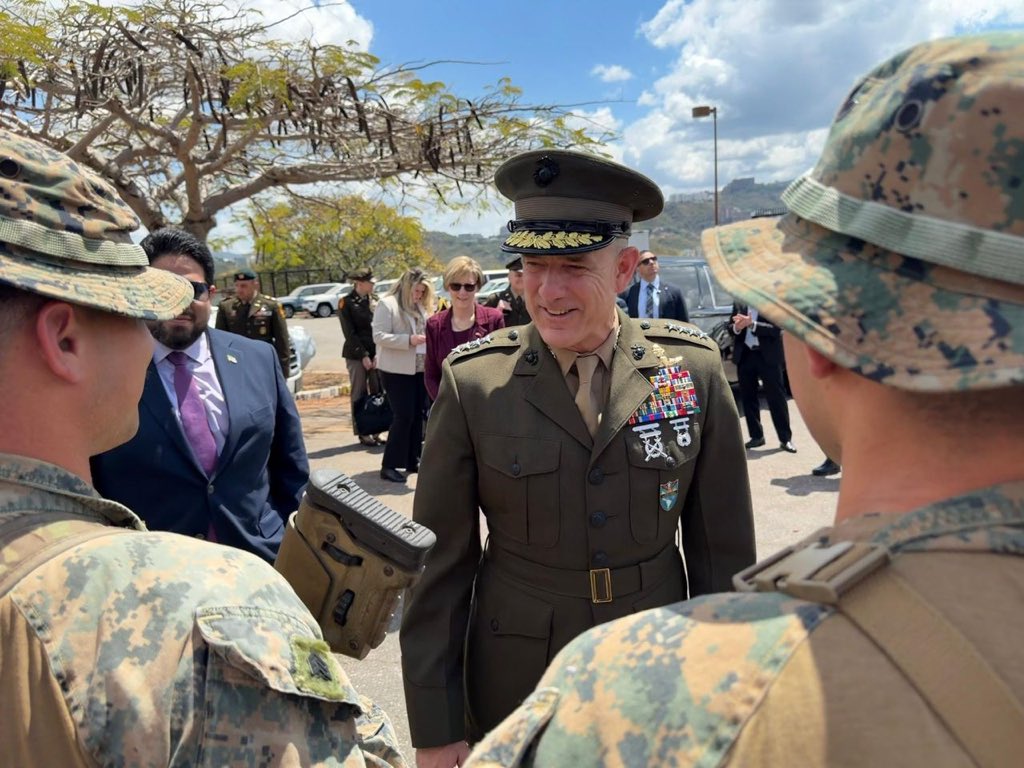
SOUTHCOM has spearheaded the lethal strikes against small vessels in the Caribbean and Eastern Pacific. (SOUTHCOM)
Caracas, February 19, 2026 (venezuelanalysis.com) – Venezuelan Acting President Delcy Rodríguez met with US Southern Command (SOUTHCOM) chief General Francis Donovan in Miraflores Palace on Wednesday.
According to the presidential press, the previously unannounced high-level talks also included Venezuela’s interior and defense ministers, Diosdado Cabello and Vladimir Padrino López, respectively.
“During the meeting, both countries agreed to work on a bilateral cooperation agenda to fight against drug trafficking in our region, as well as on terrorism and migration,” a statement released on social media read.
The Venezuelan government argued that the meeting showed that “diplomacy” is the mechanism to address “differences and issues of regional interest.”
Donovan is the latest US high-ranking official to visit Caracas and meet with Rodríguez since the January 3 US military attacks that killed over 100 people and saw special operations forces kidnap Venezuelan President Nicolás Maduro and First Lady Cilia Flores.
The acting president held talks with CIA Director John Ratcliffe on January 15 and hosted Energy Secretary Chris Wright last week at the presidential palace. US Chargé d’Affaires Laura Dogu has been in the country since late January, and Rodríguez has recently reported regular “respectful and courteous” communication with Trump and Secretary of State Marco Rubio.
SOUTHCOM confirmed the visit in a press release, disclosing that Donovan was accompanied by Acting Assistant Secretary of War Joseph Humire and stating that the officials expressed the US’ “commitment to a free, safe and prosperous Venezuela.”
The US military command added that discussions focused on “shared security across the Western Hemisphere,” and the Trump administration’s stated “three-phase plan” for the Caribbean nation: “stabilization, economic recovery and reconciliation, and transition.” For her part, Dogu reported Donovan’s visit on social media, calling it a “historic day” to “advance in the objective of having Venezuela aligned with the United States.”
Donovan took over the SOUTHCOM leadership in February after the resignation of Admiral Alvin Holsey over reported disagreements with US Secretary of War Pete Hegseth on the legality of US lethal strikes against boats suspected of carrying drugs.
Since September, through “Operation Southern Spear,” SOUTHCOM has coordinated over 40 bombings of small vessels that have killed more than 130 civilians. The latest strikes, on February 16, targeted two boats in the Eastern Pacific and one in the Caribbean, killing 11 people in total. Neither Donovan nor Rodríguez mentioned the ongoing attacks in their public readouts following the meeting.
SOUTHCOM has also participated in the seizure of oil tankers accused of violating US sanctions by transporting Venezuelan crude. After seizing seven ships in the Caribbean between December and January, US forces have boarded two tankers in the Indian Ocean this month.
In the months leading up to the January 3 operation, Maduro and other Venezuelan officials consistently denounced the US’ military buildup in the Caribbean Sea and the subsequent naval blockade against oil exports.
Venezuelan authorities likewise blasted Washington’s “narcoterrorism” accusations against Caracas, pointing to specialized reports, including from the DEA, that placed Venezuela as a marginal country for global narcotics flows. Venezuelan officials also recalled the history of US agencies’ involvement in drug trafficking.
However, in the weeks after the January 3 strikes, Washington and Caracas have fast-tracked a diplomatic rapprochement with a view toward reopening embassies. President Donald Trump has publicly recognized the acting government but the official change in policy has yet to be confirmed.
The acting Rodríguez administration also prioritized economic reforms to attract foreign investment, including a pro-business overhaul of the country’s Hydrocarbon Law. National Assembly President Jorge Rodríguez said that the government is “adapting” legislation to attract US corporations and aiming for a “free market economy.”